

CLASSIFICATION OF
MOVEMENTS
Dr. Ramandeep Kaur Saini, PT
Assistant Professor- Community PT
DPO’s Nett College Of Physiotherapy
Objectives:
 At the end of the session you should know:
 Definition of movement
 Classification of Passive and active movements
 Principles of passive and active movements
 Effect, uses and techniques of different movement type
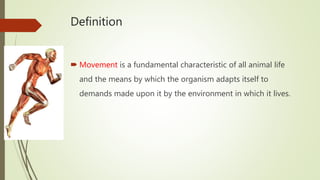
Definition
 Movement is a fundamental characteristic of all animal life
and the means by which the organism adapts itself to
demands made upon it by the environment in which it lives.
Classification of movements
 Passive movement-
o Movement which are produced by an external force during muscular inactivity.
 Active movement-
o Movement performed or controlled by active contraction of muscle
o Can be voluntary or Involuntary
o Voluntary movement is directly under the control of the will.
o Involuntary is never under the control of will.
 Active voluntary movements
- Free
- Assisted
- Resisted
 Active involuntary movements:
- Reflex
- Associated
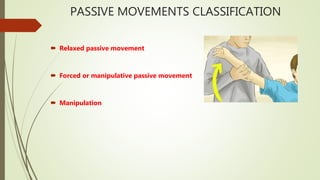
PASSIVE MOVEMENTS CLASSIFICATION
 Relaxed passive movement
 Forced or manipulative passive movement
 Manipulation
I) RELAXED PASSIVE MOVEMENT
 A state of relaxation is presupposed, and the joint is movement through
the existing free range and within the limits of pain.
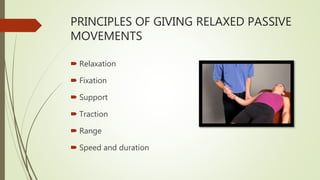
PRINCIPLES OF GIVING RELAXED PASSIVE
MOVEMENTS
 Relaxation
 Fixation
 Support
 Traction
 Range
 Speed and duration
EFFECTS AND USE OF RELAXED PASSIVE
MOVEMENTS
 Prevent adhesion formation
 Maintain free range of movement
 When active movement not possible
 Extensibility of muscle maintained
 Assist circulation and vascular dynamics
 Induce relaxation
 Movement in a joint is limited; these movements are carried beyond the existing
free range, in an attempt to restore the normal range
 By sudden but controlled application of force at the limit OR
 A steady sustained passive stretch
 Aims at increasing the existing ROM in a stiff joint by tearing or stretching the
limiting structure
II) FORCED OR MANIPULATIVE PASSIVE
MOVEMENT
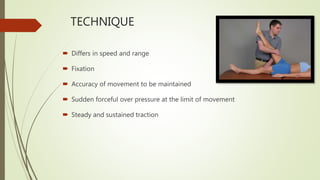
 Differs in speed and range
 Fixation
 Accuracy of movement to be maintained
 Sudden forceful over pressure at the limit of movement
 Steady and sustained traction
TECHNIQUE
EFFECT AND USE OF FORCED PASSIVE
MOVEMENTS
 Breakdown of recently formed adhesion
 Accessory movements which cannot be localised actively
 Sudden forceful movement may relace or alter position of interarticular structure
 Stretch can overcome resistance of shortened structures
III) Manipulations
 Performed by surgeons under general anaesthesia
 Eliminates pain or spasm
 Use of greater force
 Maximum effort after manipulation to maintain the ROM gained
Active
movements
Active movements
 Active voluntary movements
- Free
- Assisted
- Resisted
 Active involuntary movements:
- Reflex
- Associated
Definition: Active voluntary movement
 Movements performed or controlled by the voluntary action of muscle
 Working in opposition to an external force
 Active voluntary movements
- Free exercise : subject only to the forces of gravity
- Assisted exercise : inadequate co-ordination or strength of muscle performed by an
external force
- Resisted exercise : forces of resistance offered
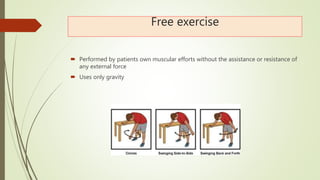
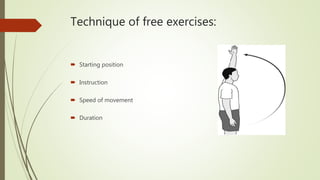
Free exercise
 Performed by patients own muscular efforts without the assistance or resistance of
any external force
 Uses only gravity
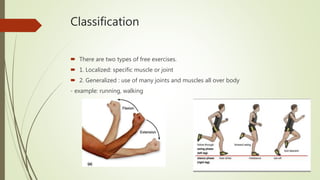
Classification
 There are two types of free exercises.
 1. Localized: specific muscle or joint
 2. Generalized : use of many joints and muscles all over body
- example: running, walking
Characteristic of free exercises
 Subjective:
-usually formal and consist of more or less anatomical movements performed in full
range
- Focus on form and pattern
 Objective:
-patients attention is concentrated on particular aim
-accuracy of movement
-Example: Bending and touching the great toe with the middle finger. Here the goal is
set to touch the toe.
Technique of free exercises:
 Starting position
 Instruction
 Speed of movement
 Duration
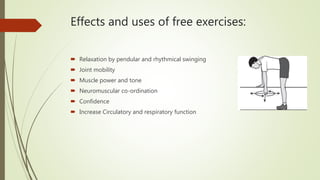
Effects and uses of free exercises:
 Relaxation by pendular and rhythmical swinging
 Joint mobility
 Muscle power and tone
 Neuromuscular co-ordination
 Confidence
 Increase Circulatory and respiratory function
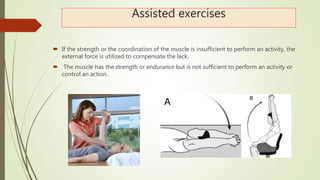
Assisted exercises
 If the strength or the coordination of the muscle is insufficient to perform an activity, the
external force is utilized to compensate the lack.
 The muscle has the strength or endurance but is not sufficient to perform an activity or
control an action.
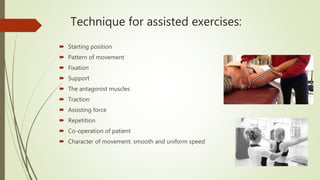
Technique for assisted exercises:
 Starting position
 Pattern of movement
 Fixation
 Support
 The antagonist muscles
 Traction
 Assisting force
 Repetition
 Co-operation of patient
 Character of movement: smooth and uniform speed
Effect and use of assisted exercise
 Co-operation of working muscle in which they are capable
 Strength and hypertrophy
 Neuromuscular re-education
 Co-ordination training
 Confidence and encouragement for patient to make maximum effort
 Increasing range of motion
Resisted exercises
 The principles of resistance:
 An external force is applied to the body levers to oppose the force of muscular
contraction.
 Tension increased by opposing force to increase power.
 5 factors that contribute the development of muscular efficiency
- Power: progressive resistance-low rep.
- Endurance : low resistance-high rep.
- Volume
- Speed
- Co-ordination
Technique of resisted exercises
 Starting position
 Pattern of movement
 Stabilization
 Traction
 Resisting force
 Repetition
 Co-operation of patient
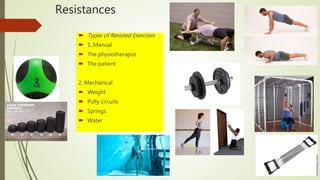
Resistances
 Types of Resisted Exercises
 1. Manual
 The physiotherapist
 The patient
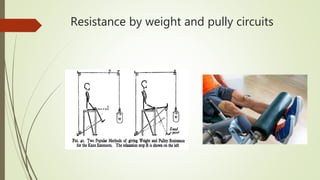
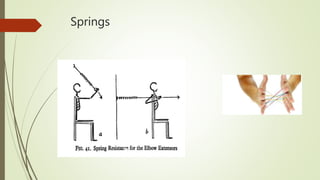
2. Mechanical
 Weight
 Pully circuits
 Springs
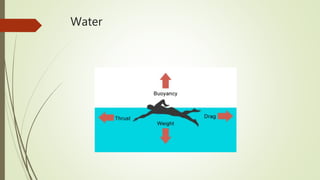
 Water
Progressive resistance
exercises
PRE
 Restoration of muscle power and volume
 Dr Lorme
 Promote muscular development
Repetition Maximum
 Repetition Maximum :
 The maximum amount of the weight a person can lift throughout the range of
motion only once is 1RM
 The maximum amount of the weight a person can lift throughout the range of
motion exactly 10 times(10RM).
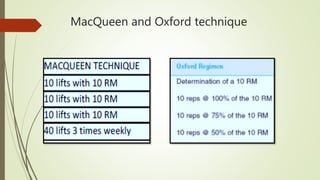
 3 types of progressive resisted exercise regimens are available.
 1. DeLorme and Watkins
 2. MacQueen
 3. Zinovieff (Oxford technique)
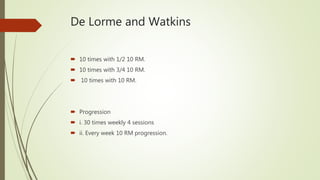
De Lorme and Watkins
 10 times with 1/2 10 RM.
 10 times with 3/4 10 RM.
 10 times with 10 RM.
 Progression
 i. 30 times weekly 4 sessions
 ii. Every week 10 RM progression.
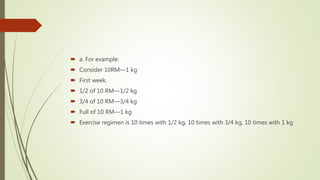
 a. For example:
 Consider 10RM—1 kg
 First week.
 1/2 of 10 RM—1/2 kg.
 3/4 of 10 RM—3/4 kg
 Full of 10 RM—1 kg
 Exercise regimen is 10 times with 1/2 kg, 10 times with 3/4 kg, 10 times with 1 kg
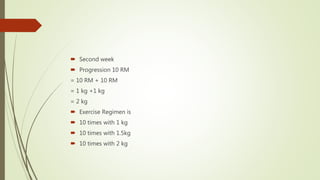
 Second week
 Progression 10 RM
= 10 RM + 10 RM
= 1 kg +1 kg
= 2 kg
 Exercise Regimen is
 10 times with 1 kg
 10 times with 1.5kg
 10 times with 2 kg
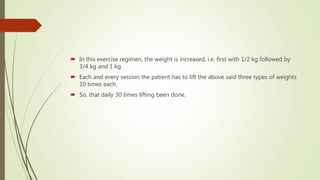
 In this exercise regimen, the weight is increased, i.e. first with 1/2 kg followed by
3/4 kg and 1 kg.
 Each and every session the patient has to lift the above said three types of weights
10 times each.
 So, that daily 30 times lifting been done.
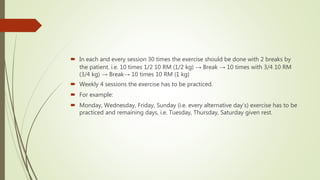
 In each and every session 30 times the exercise should be done with 2 breaks by
the patient. i.e. 10 times 1/2 10 RM (1/2 kg) → Break → 10 times with 3/4 10 RM
(3/4 kg) → Break→ 10 times 10 RM (1 kg)
 Weekly 4 sessions the exercise has to be practiced.
 For example:
 Monday, Wednesday, Friday, Sunday (i.e. every alternative day’s) exercise has to be
practiced and remaining days, i.e. Tuesday, Thursday, Saturday given rest.
MacQueen and Oxford technique
Resistance by weight and pully circuits
Springs
Malleable substances
Water
Progression
 Increase pondage or wgt. of resisting force
 Increase leverage of resisting force
 Alteration in speed of movement
 Increase duration of the exercise
Effects and uses of resisted exercises
 Muscle power
 Endurance
 Stability and co-ordination
 Blood flow increased
 Vaso-dilation
Involuntary movement
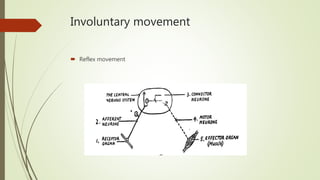
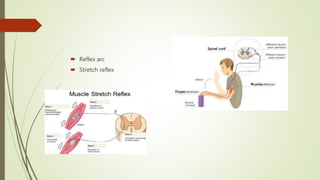
 Reflex movement
 Reflex arc
 Stretch reflex
Effects and uses of reflex movement
 Promote activity
 Normal joint movement
 Circulation improved
 Temporary relaxation of spastic muscles
Associated movements
 Occurs involuntarily and accompanies another movement which is usually
voluntary
 May arise as a result of spreading of impluses discharged to promote the initial
movement
 Example:
 Stimulation of involuntary musculature of alimentary tract asso. With voluntary
muscle of abdominal wall
 Corresponding muscles on the opp. Side of the body tend to contract in unison or
reciprocally when those of one side are stimulated
 Tremors frequently accompany specific voluntary movements
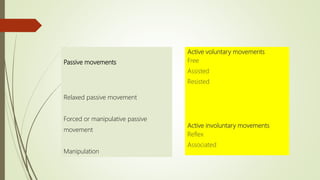
Active voluntary movements
Free
Assisted
Resisted
Active involuntary movements
Reflex
Associated
Passive movements
Relaxed passive movement
Forced or manipulative passive
movement
Manipulation
Thank
you!

Classification of movements

  • 1.
    CLASSIFICATION OF MOVEMENTS Dr. RamandeepKaur Saini, PT Assistant Professor- Community PT DPO’s Nett College Of Physiotherapy
  • 2.
    Objectives:  At theend of the session you should know:  Definition of movement  Classification of Passive and active movements  Principles of passive and active movements  Effect, uses and techniques of different movement type
  • 3.
    Definition  Movement isa fundamental characteristic of all animal life and the means by which the organism adapts itself to demands made upon it by the environment in which it lives.
  • 4.
    Classification of movements Passive movement- o Movement which are produced by an external force during muscular inactivity.  Active movement- o Movement performed or controlled by active contraction of muscle o Can be voluntary or Involuntary o Voluntary movement is directly under the control of the will. o Involuntary is never under the control of will.
  • 5.
     Active voluntarymovements - Free - Assisted - Resisted  Active involuntary movements: - Reflex - Associated
  • 6.
    PASSIVE MOVEMENTS CLASSIFICATION Relaxed passive movement  Forced or manipulative passive movement  Manipulation
  • 7.
    I) RELAXED PASSIVEMOVEMENT  A state of relaxation is presupposed, and the joint is movement through the existing free range and within the limits of pain.
  • 8.
    PRINCIPLES OF GIVINGRELAXED PASSIVE MOVEMENTS  Relaxation  Fixation  Support  Traction  Range  Speed and duration
  • 9.
    EFFECTS AND USEOF RELAXED PASSIVE MOVEMENTS  Prevent adhesion formation  Maintain free range of movement  When active movement not possible  Extensibility of muscle maintained  Assist circulation and vascular dynamics  Induce relaxation
  • 10.
     Movement ina joint is limited; these movements are carried beyond the existing free range, in an attempt to restore the normal range  By sudden but controlled application of force at the limit OR  A steady sustained passive stretch  Aims at increasing the existing ROM in a stiff joint by tearing or stretching the limiting structure II) FORCED OR MANIPULATIVE PASSIVE MOVEMENT
  • 11.
     Differs inspeed and range  Fixation  Accuracy of movement to be maintained  Sudden forceful over pressure at the limit of movement  Steady and sustained traction TECHNIQUE
  • 12.
    EFFECT AND USEOF FORCED PASSIVE MOVEMENTS  Breakdown of recently formed adhesion  Accessory movements which cannot be localised actively  Sudden forceful movement may relace or alter position of interarticular structure  Stretch can overcome resistance of shortened structures
  • 13.
    III) Manipulations  Performedby surgeons under general anaesthesia  Eliminates pain or spasm  Use of greater force  Maximum effort after manipulation to maintain the ROM gained
  • 14.
  • 15.
    Active movements  Activevoluntary movements - Free - Assisted - Resisted  Active involuntary movements: - Reflex - Associated
  • 16.
    Definition: Active voluntarymovement  Movements performed or controlled by the voluntary action of muscle  Working in opposition to an external force  Active voluntary movements - Free exercise : subject only to the forces of gravity - Assisted exercise : inadequate co-ordination or strength of muscle performed by an external force - Resisted exercise : forces of resistance offered
  • 17.
    Free exercise  Performedby patients own muscular efforts without the assistance or resistance of any external force  Uses only gravity
  • 18.
    Classification  There aretwo types of free exercises.  1. Localized: specific muscle or joint  2. Generalized : use of many joints and muscles all over body - example: running, walking
  • 19.
    Characteristic of freeexercises  Subjective: -usually formal and consist of more or less anatomical movements performed in full range - Focus on form and pattern  Objective: -patients attention is concentrated on particular aim -accuracy of movement -Example: Bending and touching the great toe with the middle finger. Here the goal is set to touch the toe.
  • 20.
    Technique of freeexercises:  Starting position  Instruction  Speed of movement  Duration
  • 21.
    Effects and usesof free exercises:  Relaxation by pendular and rhythmical swinging  Joint mobility  Muscle power and tone  Neuromuscular co-ordination  Confidence  Increase Circulatory and respiratory function
  • 22.
    Assisted exercises  Ifthe strength or the coordination of the muscle is insufficient to perform an activity, the external force is utilized to compensate the lack.  The muscle has the strength or endurance but is not sufficient to perform an activity or control an action.
  • 23.
    Technique for assistedexercises:  Starting position  Pattern of movement  Fixation  Support  The antagonist muscles  Traction  Assisting force  Repetition  Co-operation of patient  Character of movement: smooth and uniform speed
  • 24.
    Effect and useof assisted exercise  Co-operation of working muscle in which they are capable  Strength and hypertrophy  Neuromuscular re-education  Co-ordination training  Confidence and encouragement for patient to make maximum effort  Increasing range of motion
  • 25.
    Resisted exercises  Theprinciples of resistance:  An external force is applied to the body levers to oppose the force of muscular contraction.  Tension increased by opposing force to increase power.  5 factors that contribute the development of muscular efficiency - Power: progressive resistance-low rep. - Endurance : low resistance-high rep. - Volume - Speed - Co-ordination
  • 26.
    Technique of resistedexercises  Starting position  Pattern of movement  Stabilization  Traction  Resisting force  Repetition  Co-operation of patient
  • 27.
    Resistances  Types ofResisted Exercises  1. Manual  The physiotherapist  The patient 2. Mechanical  Weight  Pully circuits  Springs  Water
  • 28.
  • 29.
    PRE  Restoration ofmuscle power and volume  Dr Lorme  Promote muscular development
  • 30.
    Repetition Maximum  RepetitionMaximum :  The maximum amount of the weight a person can lift throughout the range of motion only once is 1RM  The maximum amount of the weight a person can lift throughout the range of motion exactly 10 times(10RM).
  • 31.
     3 typesof progressive resisted exercise regimens are available.  1. DeLorme and Watkins  2. MacQueen  3. Zinovieff (Oxford technique)
  • 32.
    De Lorme andWatkins  10 times with 1/2 10 RM.  10 times with 3/4 10 RM.  10 times with 10 RM.  Progression  i. 30 times weekly 4 sessions  ii. Every week 10 RM progression.
  • 33.
     a. Forexample:  Consider 10RM—1 kg  First week.  1/2 of 10 RM—1/2 kg.  3/4 of 10 RM—3/4 kg  Full of 10 RM—1 kg  Exercise regimen is 10 times with 1/2 kg, 10 times with 3/4 kg, 10 times with 1 kg
  • 34.
     Second week Progression 10 RM = 10 RM + 10 RM = 1 kg +1 kg = 2 kg  Exercise Regimen is  10 times with 1 kg  10 times with 1.5kg  10 times with 2 kg
  • 35.
     In thisexercise regimen, the weight is increased, i.e. first with 1/2 kg followed by 3/4 kg and 1 kg.  Each and every session the patient has to lift the above said three types of weights 10 times each.  So, that daily 30 times lifting been done.
  • 36.
     In eachand every session 30 times the exercise should be done with 2 breaks by the patient. i.e. 10 times 1/2 10 RM (1/2 kg) → Break → 10 times with 3/4 10 RM (3/4 kg) → Break→ 10 times 10 RM (1 kg)  Weekly 4 sessions the exercise has to be practiced.  For example:  Monday, Wednesday, Friday, Sunday (i.e. every alternative day’s) exercise has to be practiced and remaining days, i.e. Tuesday, Thursday, Saturday given rest.
  • 37.
  • 38.
    Resistance by weightand pully circuits
  • 39.
  • 40.
  • 41.
  • 42.
    Progression  Increase pondageor wgt. of resisting force  Increase leverage of resisting force  Alteration in speed of movement  Increase duration of the exercise
  • 43.
    Effects and usesof resisted exercises  Muscle power  Endurance  Stability and co-ordination  Blood flow increased  Vaso-dilation
  • 44.
  • 45.
     Reflex arc Stretch reflex
  • 46.
    Effects and usesof reflex movement  Promote activity  Normal joint movement  Circulation improved  Temporary relaxation of spastic muscles
  • 47.
    Associated movements  Occursinvoluntarily and accompanies another movement which is usually voluntary  May arise as a result of spreading of impluses discharged to promote the initial movement  Example:  Stimulation of involuntary musculature of alimentary tract asso. With voluntary muscle of abdominal wall  Corresponding muscles on the opp. Side of the body tend to contract in unison or reciprocally when those of one side are stimulated  Tremors frequently accompany specific voluntary movements
  • 48.
    Active voluntary movements Free Assisted Resisted Activeinvoluntary movements Reflex Associated Passive movements Relaxed passive movement Forced or manipulative passive movement Manipulation
  • 49.