The document discusses muscle contractions and exercise classification, detailing the differences between isotonic and isometric contractions. Isotonic contractions change muscle length with constant tension, while isometric contractions maintain muscle length with no work done. It also categorizes exercises based on muscle contraction types and metabolic demands, highlighting the importance of selecting the right type of exercise for specific goals.
TYPES OF MUSCLECONTRACTION & CLASSIFICATION OF EXERCISE USNISH ADHIKARI 5 TH SEMESTER
2.
Skeletal muscles are the principal executor of exercise. Human skeletal muscle can exert maximal contractile force of around 3-4 kg per square cm of cross sectional area. The total tension that could be developed if all the muscles in an adult man pulled together is approximately 25 tons . Contraction of a skeletal muscle is explained by the sliding filament mechanism.
3.
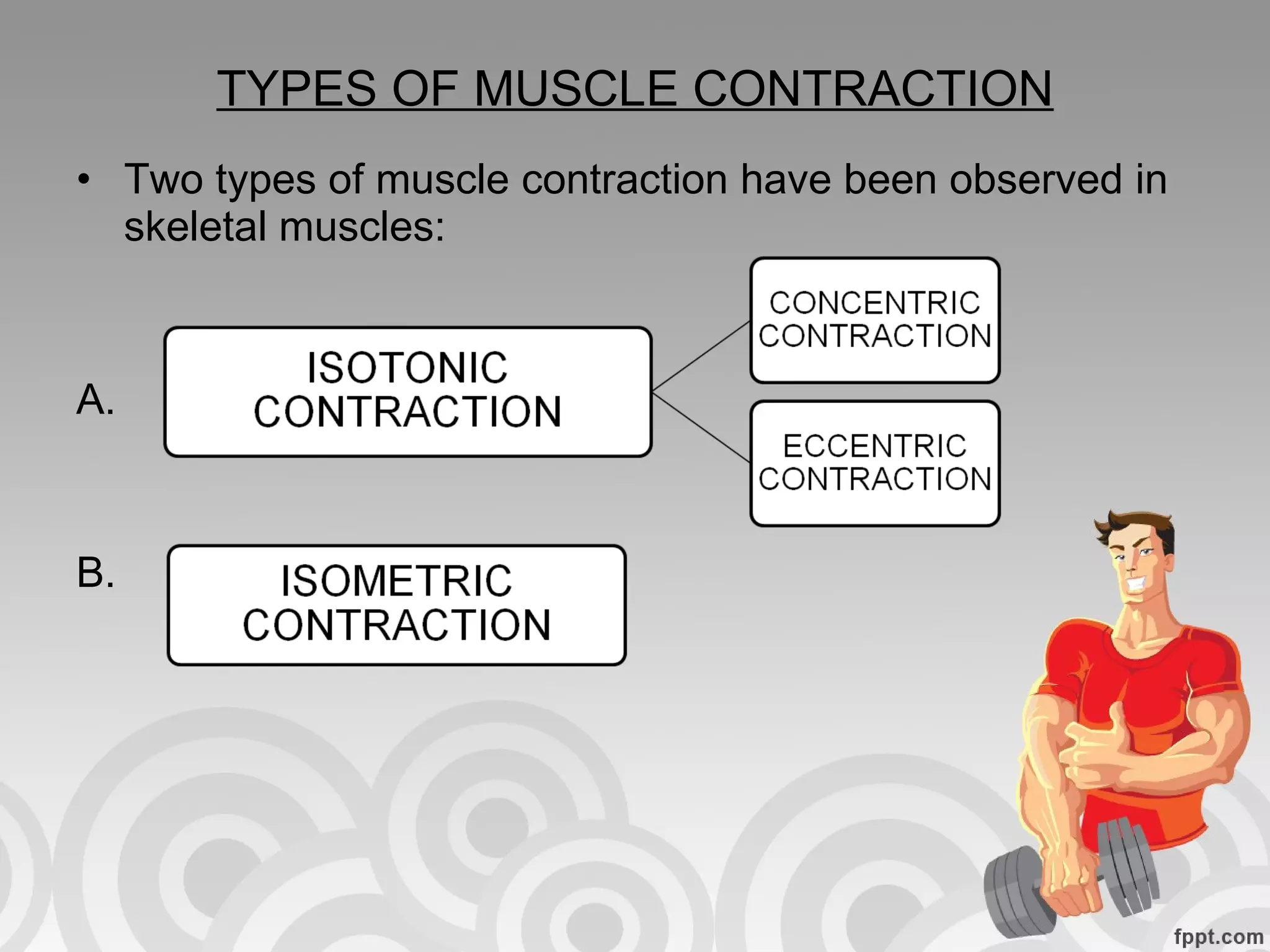
TYPES OF MUSCLECONTRACTION Two types of muscle contraction have been observed in skeletal muscles: A. B.
4.
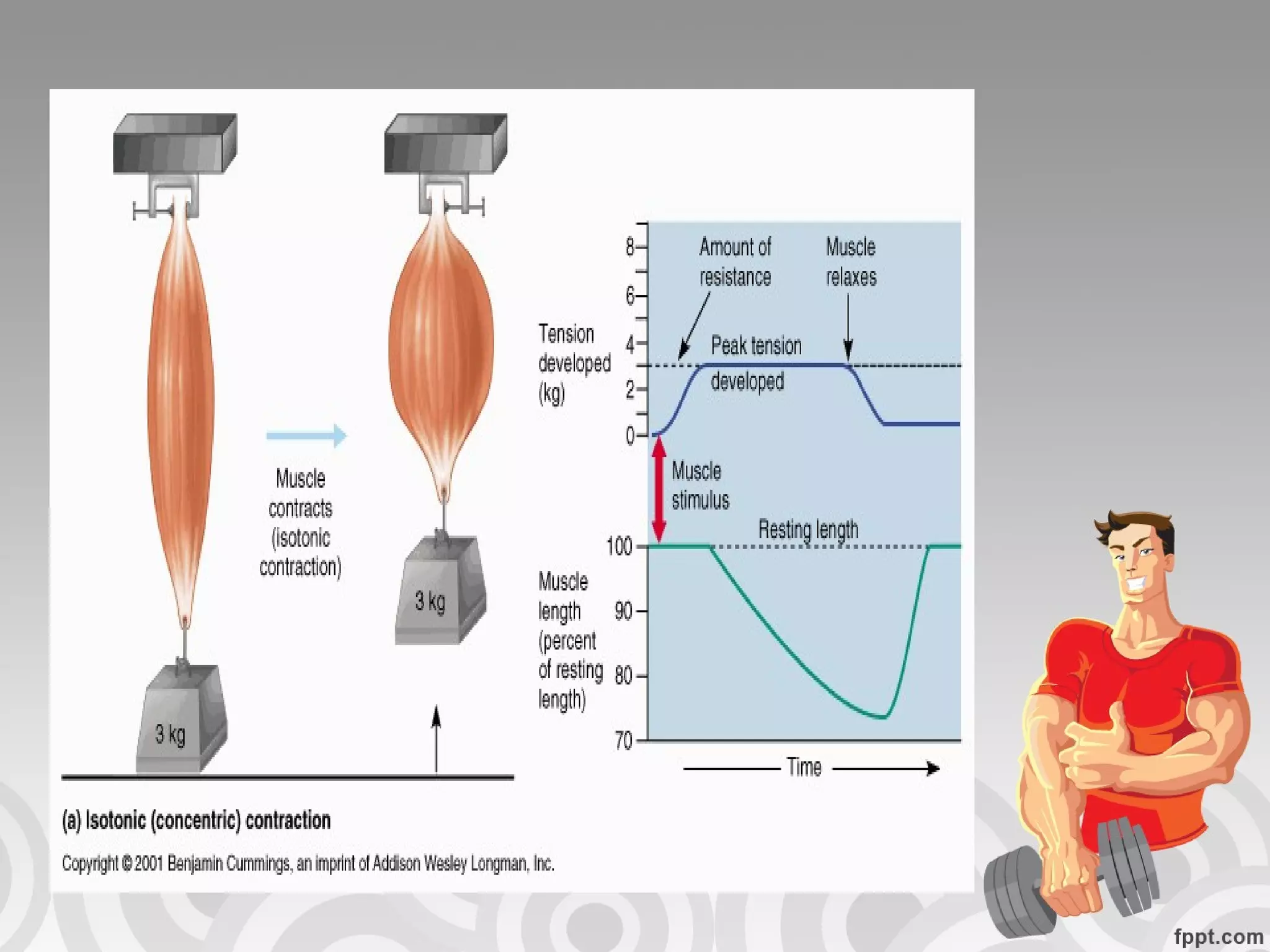
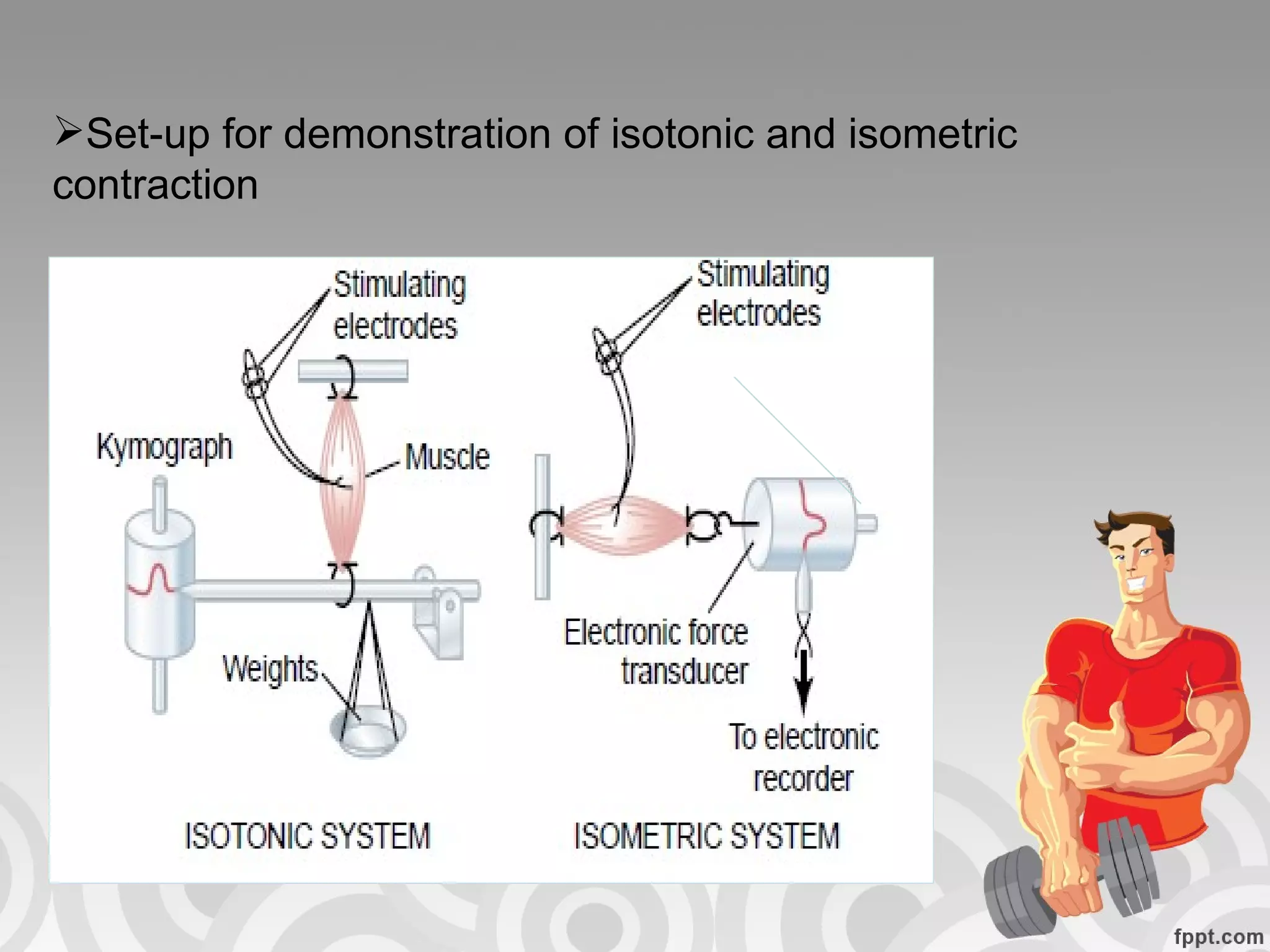
A. ISOTONICCONTRACTION Muscle contraction is said to be isotonic when the tension on the muscle remains constant throughout, though the length changes. ‘ Iso’= same, ‘Tonic’= strength or tension Since Work done = Force X Distance moved work is done in case of isotonic contraction. The characteristics of isotonic contraction depends on the load against which the muscle contracts as well as the inertia of the load.
5.
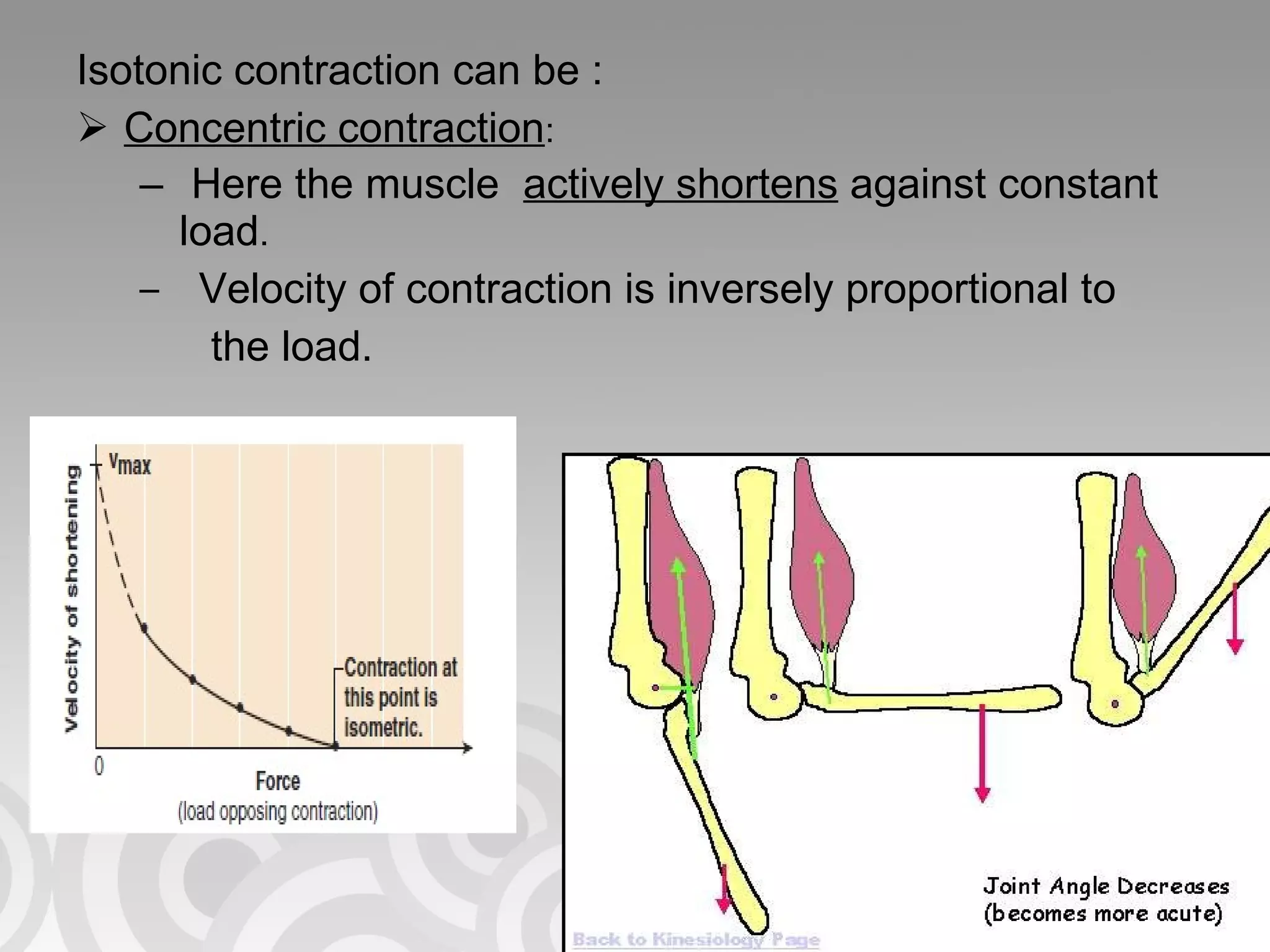
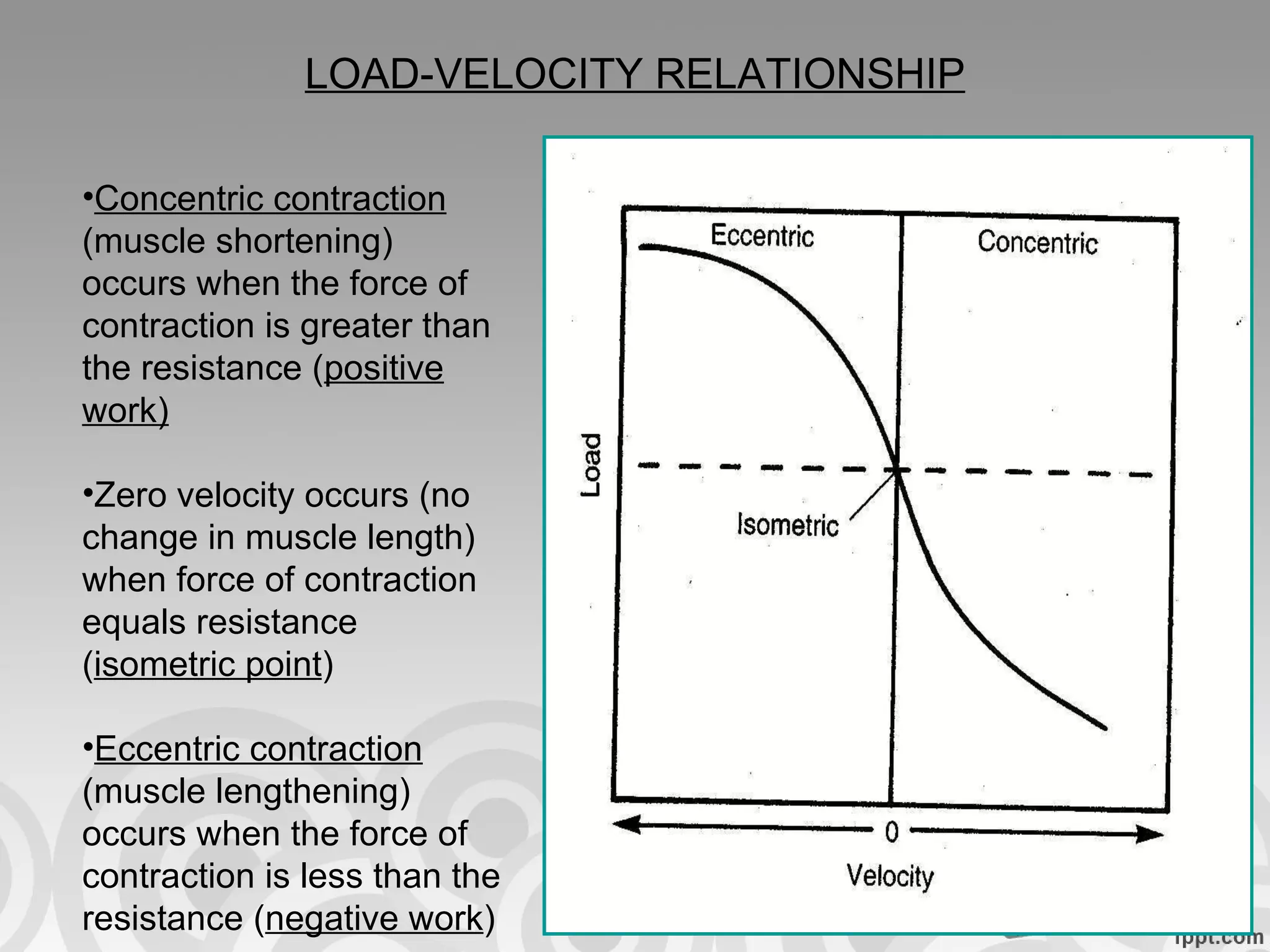
Isotonic contraction canbe : Concentric contraction : Here the muscle actively shortens against constant load . Velocity of contraction is inversely proportional to the load.
6.
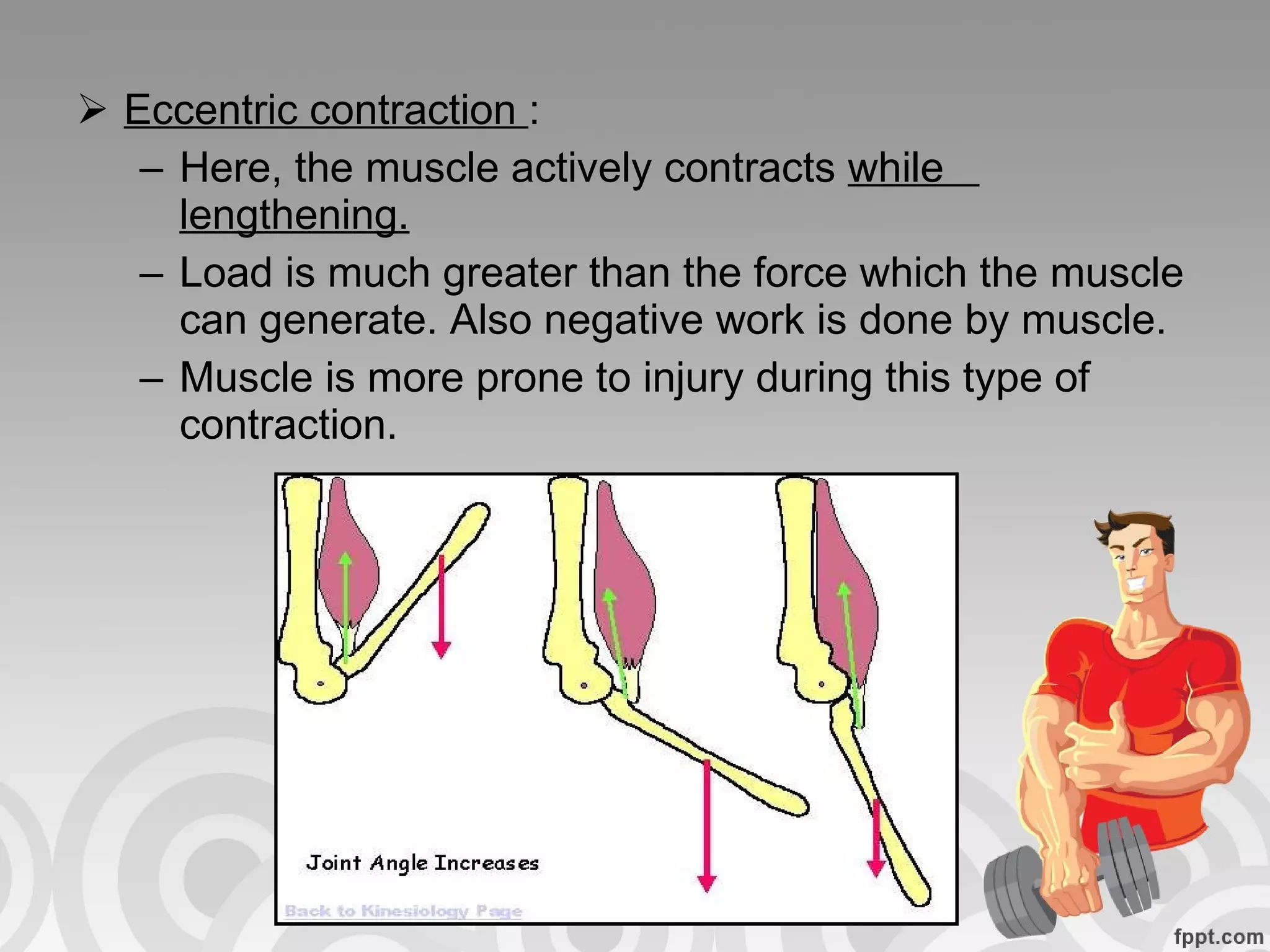
Eccentric contraction : Here, the muscle actively contracts while lengthening. Load is much greater than the force which the muscle can generate. Also negative work is done by muscle. Muscle is more prone to injury during this type of contraction.
7.
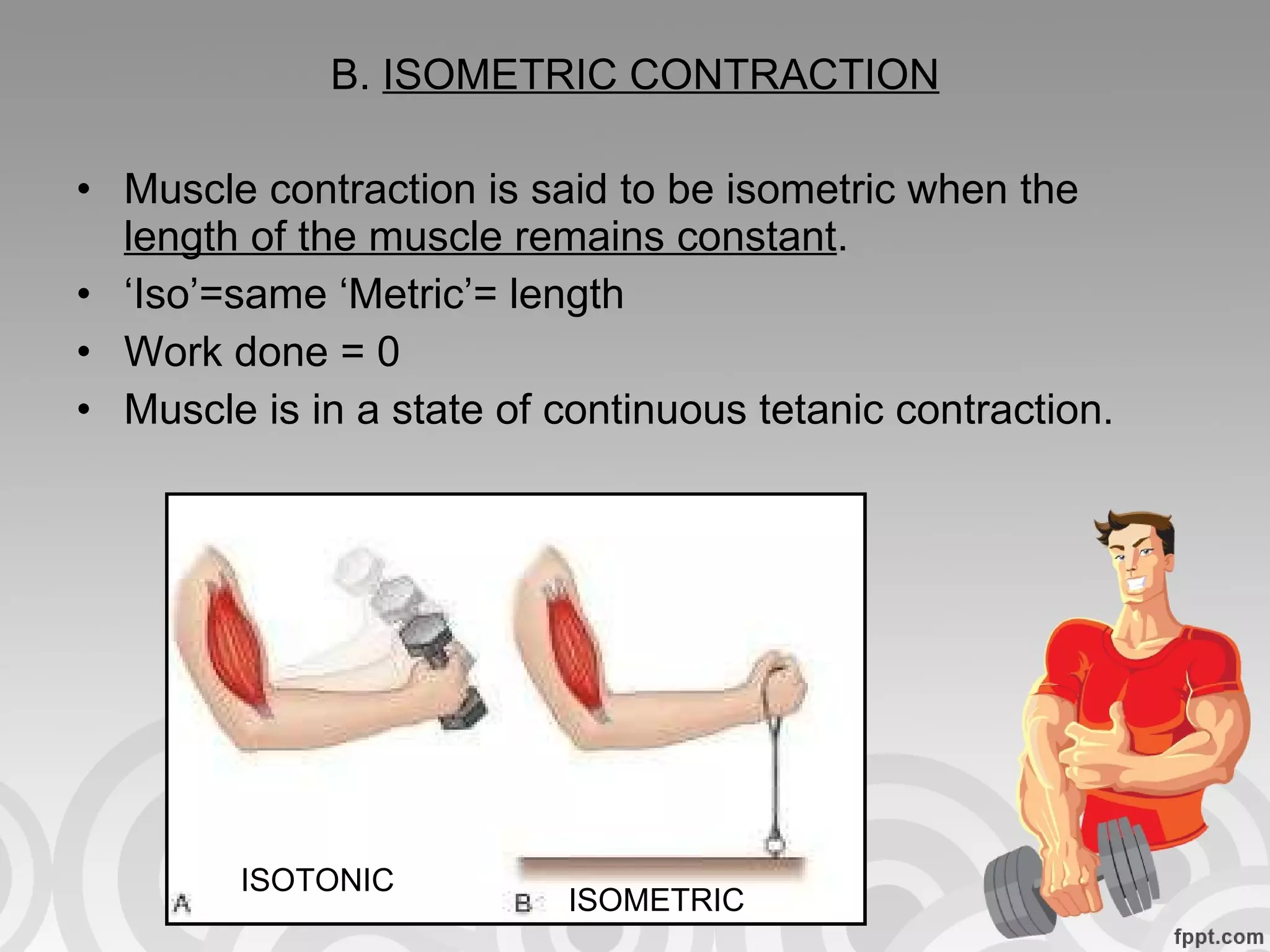
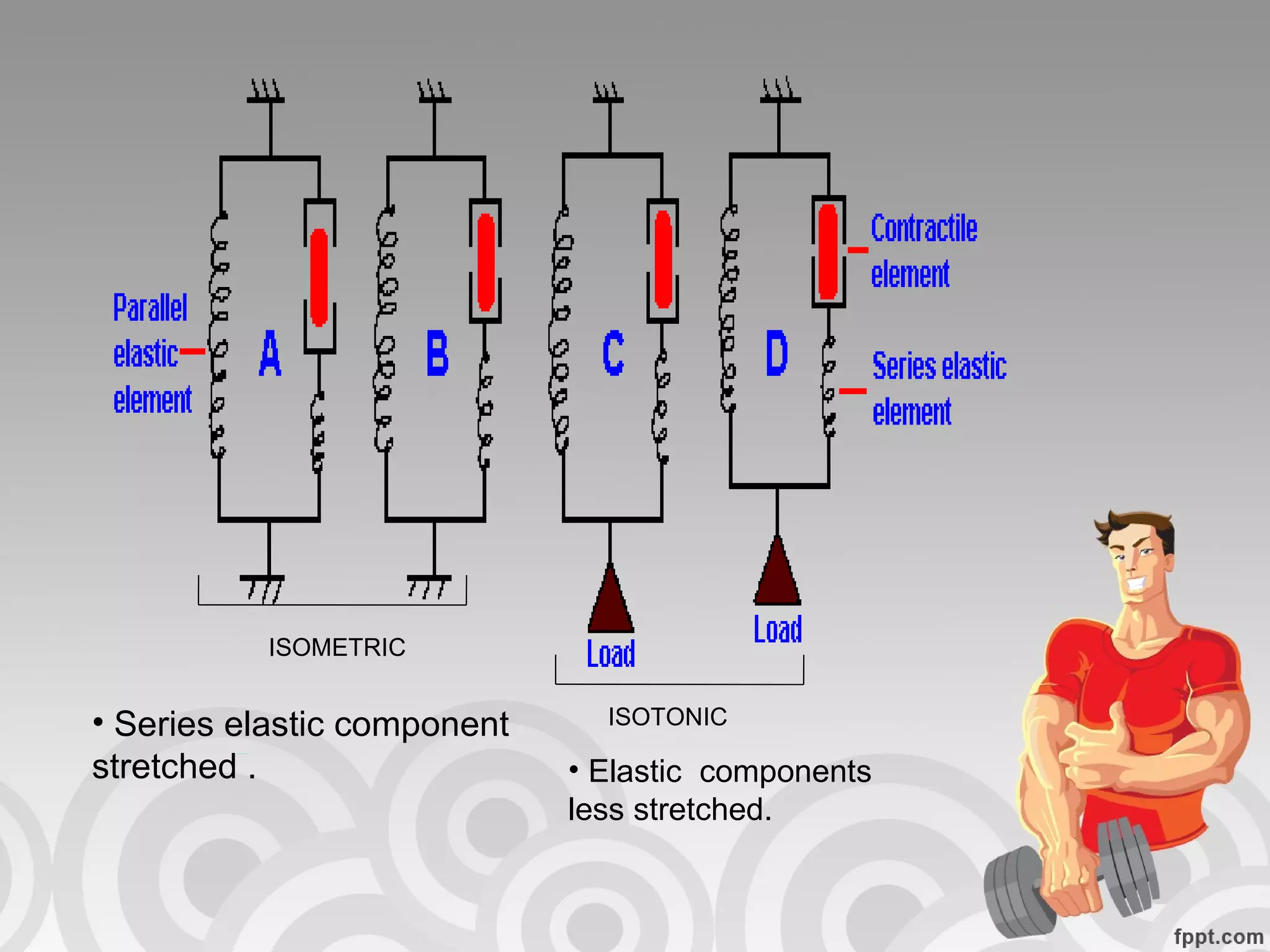
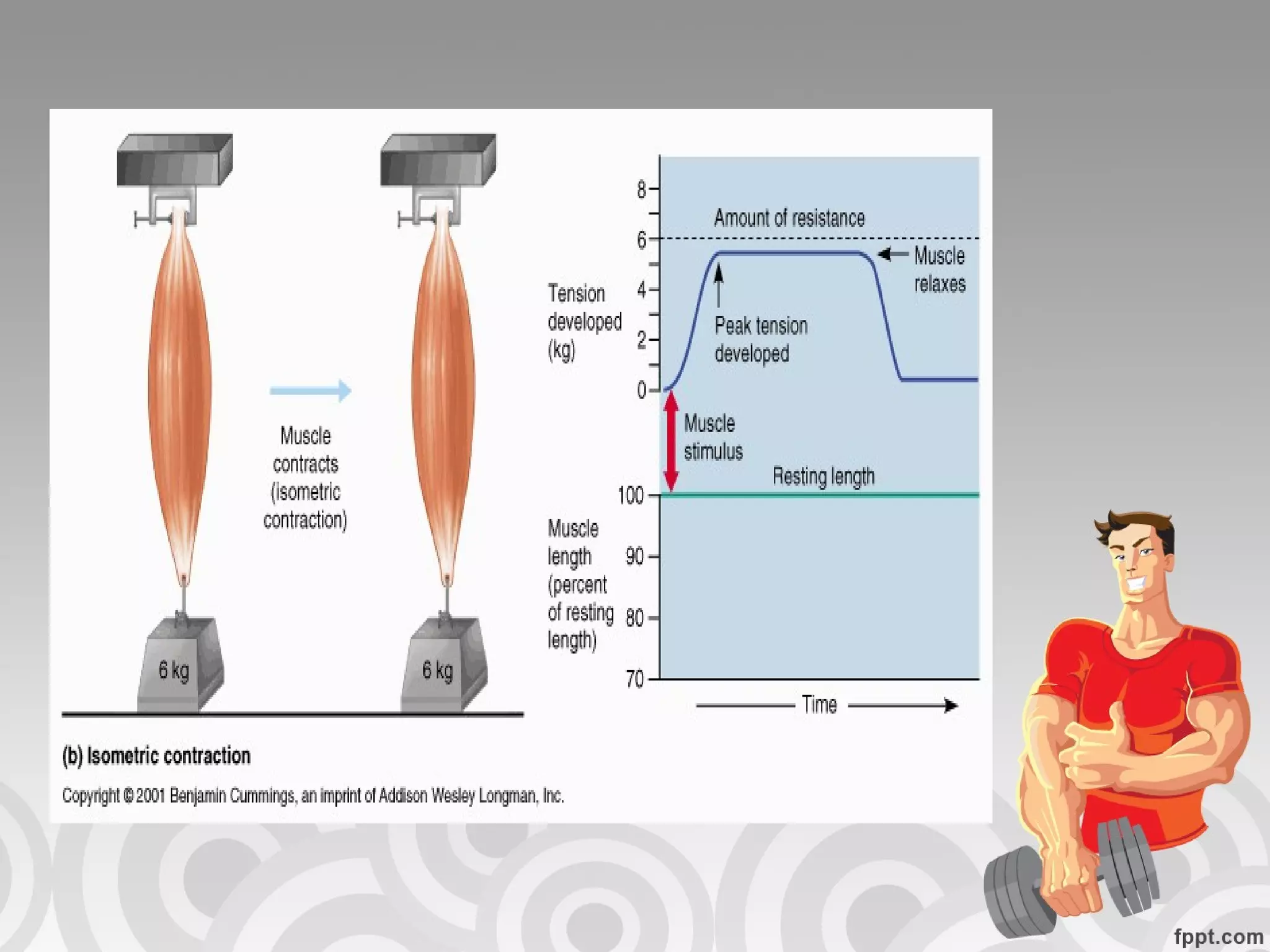
B. ISOMETRICCONTRACTION Muscle contraction is said to be isometric when the length of the muscle remains constant . ‘ Iso’=same ‘Metric’= length Work done = 0 Muscle is in a state of continuous tetanic contraction. ISOTONIC ISOMETRIC
LOAD-VELOCITY RELATIONSHIP Concentriccontraction (muscle shortening) occurs when the force of contraction is greater than the resistance ( positive work) Zero velocity occurs (no change in muscle length) when force of contraction equals resistance ( isometric point ) Eccentric contraction (muscle lengthening) occurs when the force of contraction is less than the resistance ( negative work )
EXERCISE What isexercise ? Any state other than rest can be designated as an exercise. Therapeutically, exercise is performance of physical exertion for improvement of health or correction of physical deformity. The type of exercise should be selected according to the objective.
14.
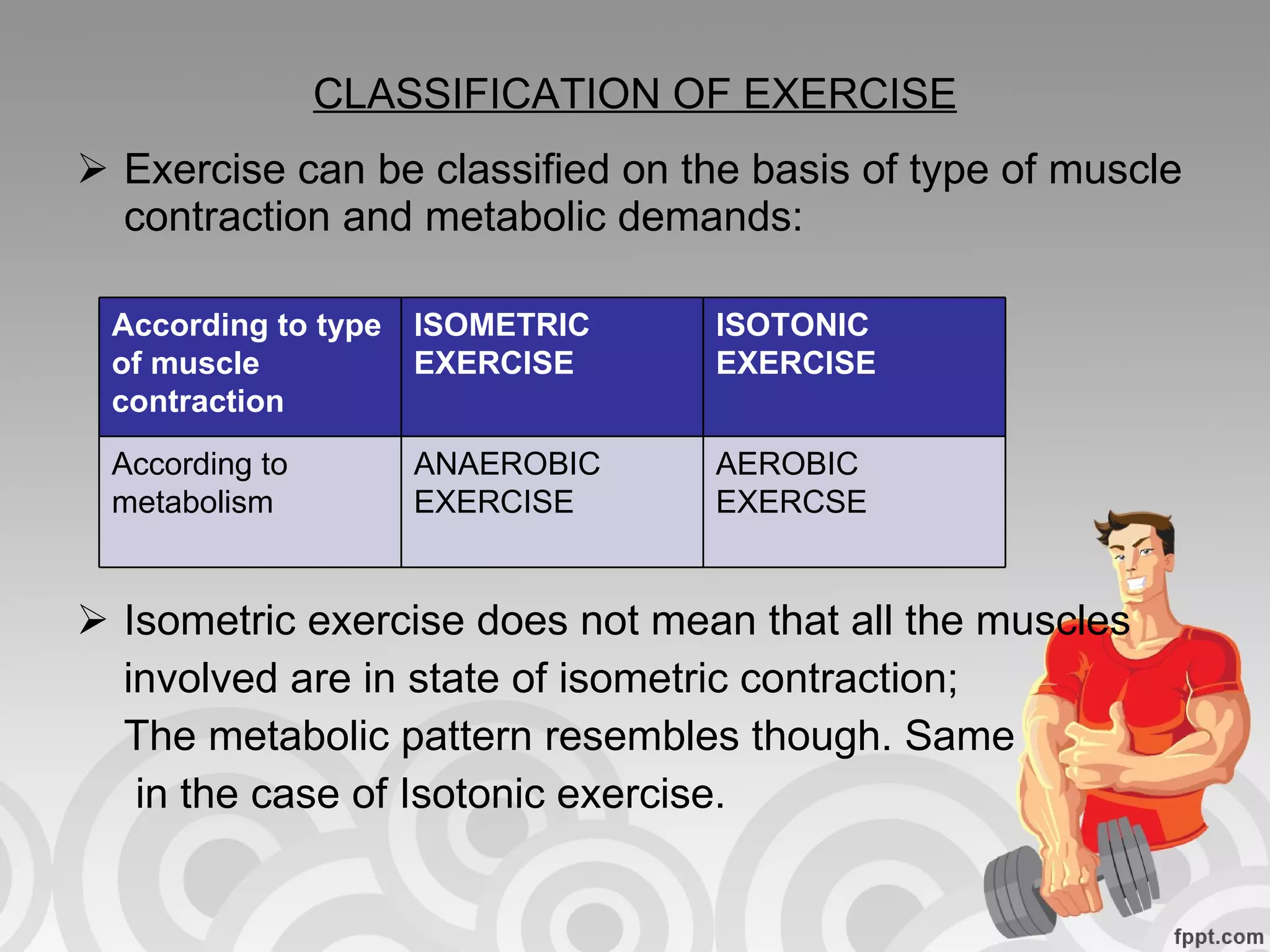
CLASSIFICATION OF EXERCISEExercise can be classified on the basis of type of muscle contraction and metabolic demands: Isometric exercise does not mean that all the muscles involved are in state of isometric contraction; The metabolic pattern resembles though. Same in the case of Isotonic exercise. According to type of muscle contraction ISOMETRIC EXERCISE ISOTONIC EXERCISE According to metabolism ANAEROBIC EXERCISE AEROBIC EXERCSE
15.
A. ISOMETRICEXERCISE In this kind of exercise, majority of the muscles are in a metabolic state similar to isometric contraction. High degree of tissue tension develops in the muscles, due to which the blood vessels supplying the muscles get occluded. Hence the muscle resorts to ANAEROBIC metabolism. These exercises cannot be performed for long time as lactic acid production leads to ischemic pain ( Muscle fatigue).
16.
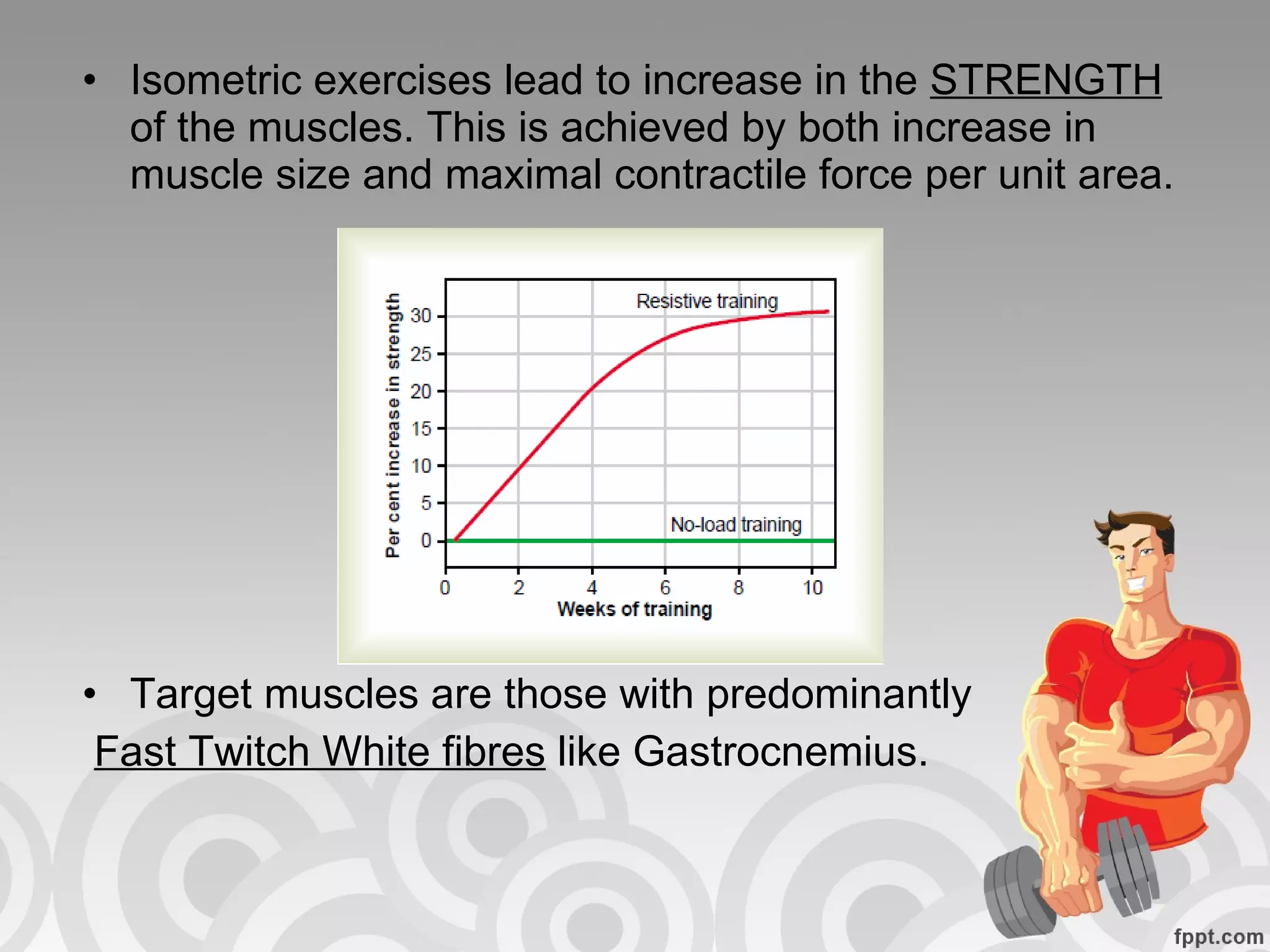
Isometric exercises leadto increase in the STRENGTH of the muscles. This is achieved by both increase in muscle size and maximal contractile force per unit area. Target muscles are those with predominantly Fast Twitch White fibres like Gastrocnemius.
17.
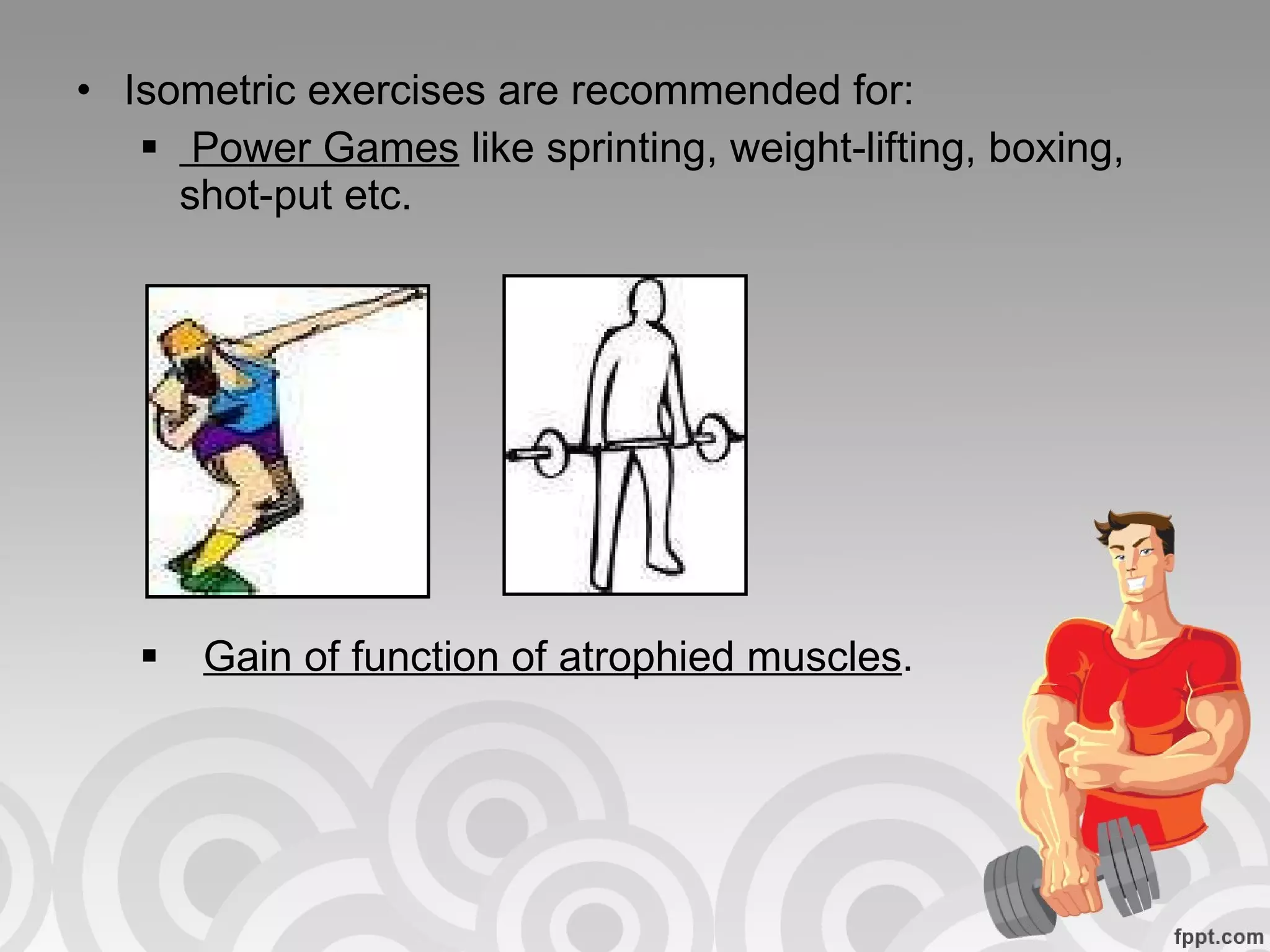
Isometric exercises arerecommended for: Power Games like sprinting, weight-lifting, boxing, shot-put etc. Gain of function of atrophied muscles .
18.
B. ISOTONICEXERCISE In this kind of exercise, majority of the muscles are in a metabolic state similar to isotonic contraction. Energy is derived by the muscles through AEROBIC METABOLISM. These exercises can be performed for long time at a stretch. Isotonic exercises lead to increase in the ENDURANCE of muscles ( measured by time till they can sustain exertion until complete exhaustion)
19.
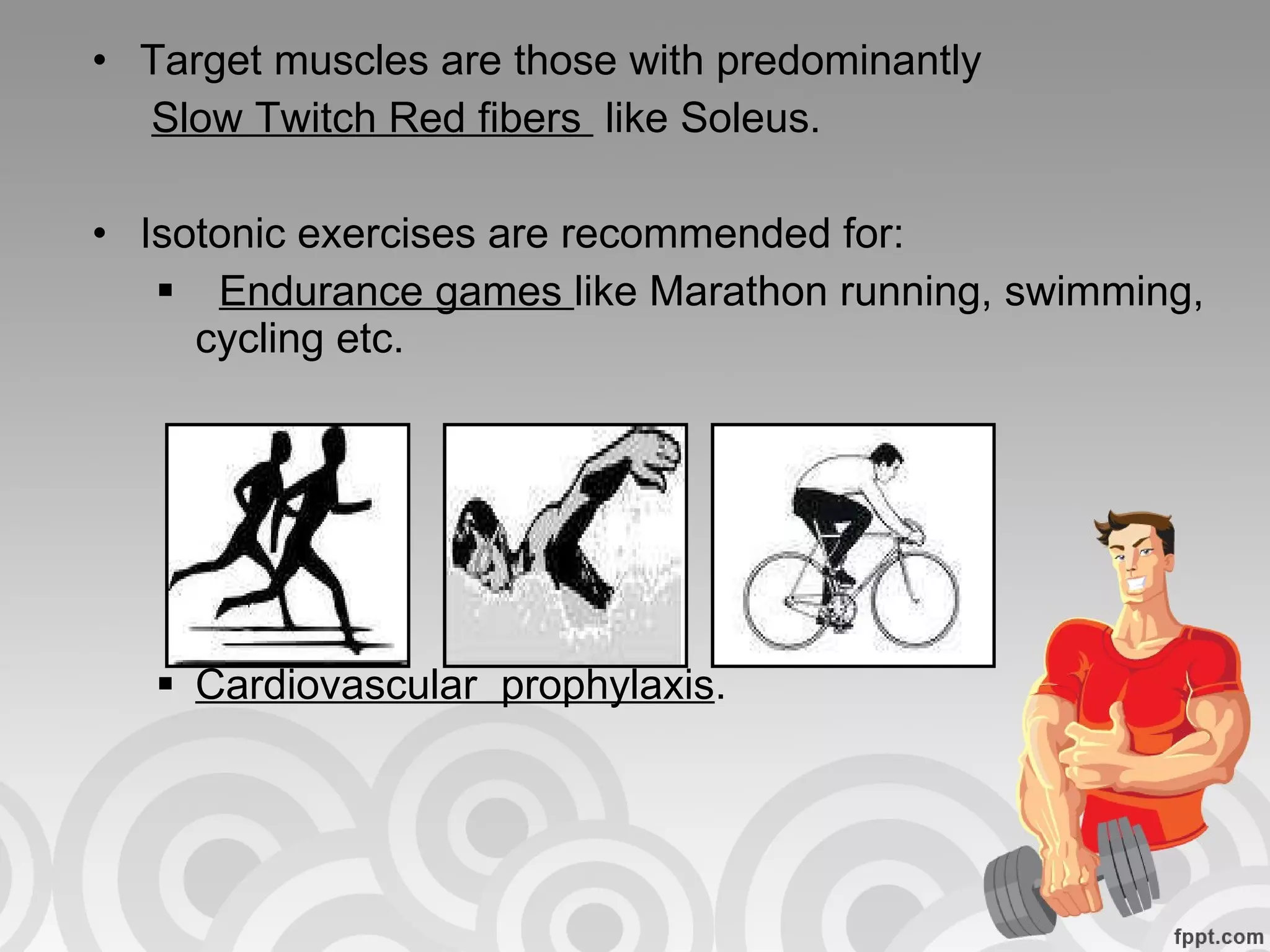
Target muscles arethose with predominantly Slow Twitch Red fibers like Soleus. Isotonic exercises are recommended for: Endurance games like Marathon running, swimming, cycling etc. Cardiovascular prophylaxis .
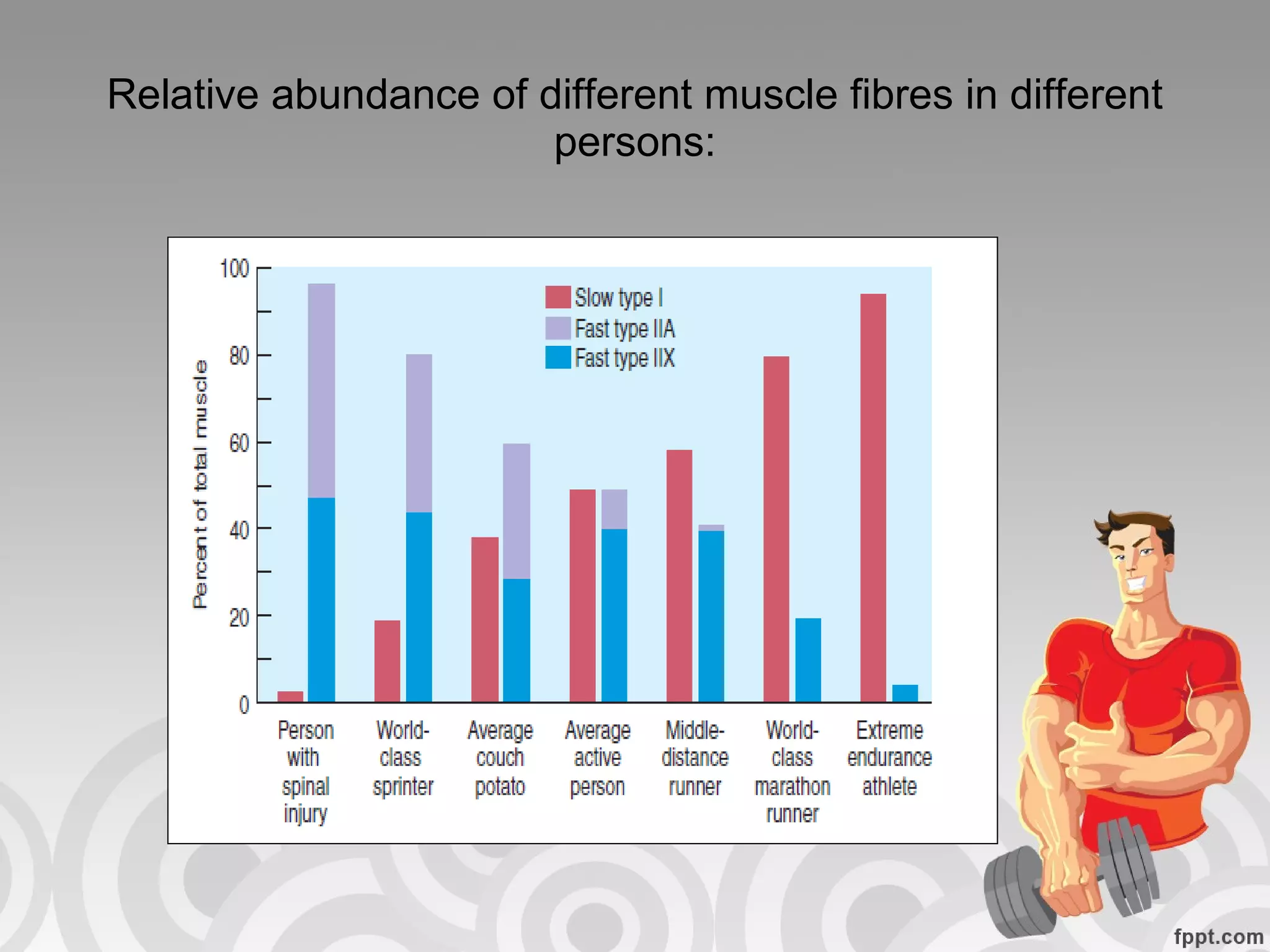
Hereditary differences have been observed among athletes regarding the relative proportions of Fast and Slow Twitch fibers. Athletic training and exercise has not been shown to change the percentage of slow and fast twitch fibers in humans. So some people are born to be sprinters, while others are born to be marathoners. However, experiments on mice have shown varying results in this respect.
22.
The selection ofproper exercise should be based on long term objectives to gain the maximum benefit.