MECHANICAL PROPERTIES OF
SKELETAL MUSCLE
Motor Unit
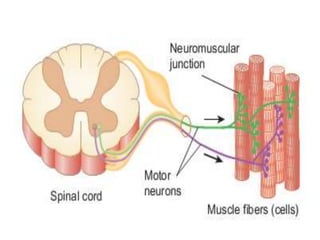
• A motor unit consists of a somatic motor
neuron plus all the skeletal muscle fibers it
stimulates
• A single somatic motor neuron makes contact
with an average of 150 skeletal muscle fibers,
and all of the muscle fibers in one motor unit
contract in unison
Motor Unit
A twitch contraction is the brief
contraction of all the muscle fibers in a
motor unit in response to a single action
potential in its motor neuron
Q. In muscle physiology, the latent period refers to
a. the period of lost excitability that occurs when
two stimuli are applied immediately one after the
other.
b. the brief contraction of a motor unit.
c. the period of elevated oxygen use after exercise.
d. an inability of a muscle to contract forcefully
after prolonged activity.
e. a brief delay that occurs between application of a
stimulus and the beginning of contraction
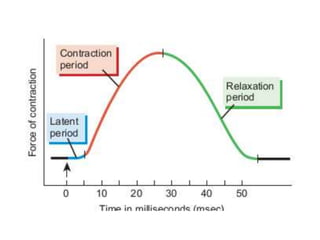
• Note that a brief delay occurs between application of the
stimulus (time zero on the graph) and the beginning of
contraction. The delay, which lasts about two milliseconds,
is termed the latent period.
• During the latent period, the muscle action potential
sweeps over the sarcolemma and calcium ions are released
from the sarcoplasmic reticulum.
• The second phase, the contraction period, lasts 10–100
msec. During this time, Ca2 binds to troponin, myosin-
binding sites on actin are exposed, and crossbridges form.
Peak tension develops in the muscle fiber.
• During the third phase, the relaxation period,also lasting
10–100 msec, Ca2is actively transported back into the
sarcoplasmic reticulum, myosin-binding sites are covered
by tropomyosin, myosin heads detach from actin, and
tension in the muscle fiber decreases
PROPERTIES OF SKELETAL MUSCLE
• Extensibility & elasticity
• Excitability
• Conductivity
• Contractility
• Tonicity
• Refractory period
• Fatigue
• Extensibility:Ability of the muscle to
elongate when stretched.
• Elasticity: Ability of the muscle to return
to its original length when stretch is
removed.
• Excitability: Ability of the muscle to
respond to a stimulus.(electrical ,thermal
,chemical,mechanical).
• Contractility: Ability of the muscle to
shorten or contract in response to a
stimulus.
• Conductivity: Ability of the muscle to transmit
an impulse (AP) from one part of the fibre to
another part.
• The condution velocity of an impulse in
skeletal muscle fiber is slow. it is about 5
meters/sec
• Tone:The state of partial sustained contraction
seen in all muscles.
REFRACTORY PERIOD: It is about 30-
50millisec . It is a period of action potential in
which another stimulus applied will not produce
a response in a muscle.
Types: Absolute
Relative
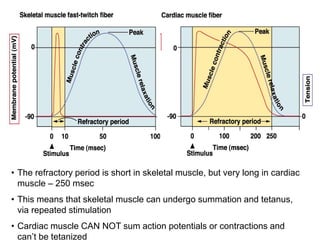
• The refractory period is short in skeletal muscle, but very long in cardiac
muscle – 250 msec
• This means that skeletal muscle can undergo summation and tetanus,
via repeated stimulation
• Cardiac muscle CAN NOT sum action potentials or contractions and
can’t be tetanized
• CONTRACTILITY: Ability to contract in
response to a stimulus.
• Types :-
•Isotonic contraction
•Isometric contraction
Isotonic and Isometric Contractions
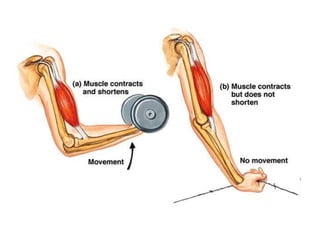
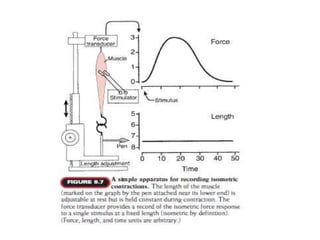
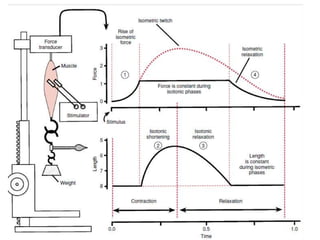
• Isotonic contraction:The contraction that
occurs when the muscle is allowed to freely
shorten,so that tension in the muscle is kept
constant.
• Isometric contraction: the contraction that
occurs without any shortening of the muscle,
so that the tension increases, but the length
of the muscle remains constant.
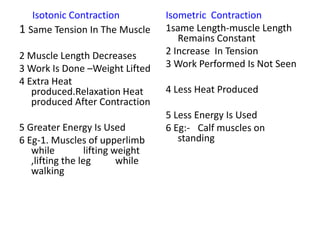
Isotonic Contraction
1 Same Tension In The Muscle
2 Muscle Length Decreases
3 Work Is Done –Weight Lifted
4 Extra Heat
produced.Relaxation Heat
produced After Contraction
5 Greater Energy Is Used
6 Eg-1. Muscles of upperlimb
while lifting weight
,lifting the leg while
walking
Isometric Contraction
1same Length-muscle Length
Remains Constant
2 Increase In Tension
3 Work Performed Is Not Seen
4 Less Heat Produced
5 Less Energy Is Used
6 Eg:- Calf muscles on
standing
How do we control the strength of
contraction?
1. Large Motor unit involved
2. More motor units recruited
3. More fast type II b types of fiber
4. Increasing the rate of stimulation
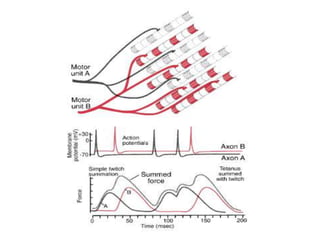
SUMMATION
• When the strength of the stimulus is increased
the contractile response also increases.The
increase in response is due to recruitment of
motor units. This is called quantal summation
or multimotor unit summation
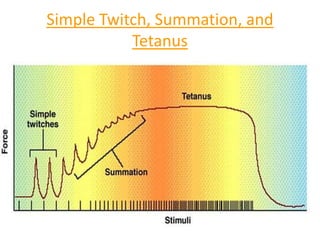
Twitch, Summation, and Tetanus
• Twitch:
–Muscle is stimulated with a single electrical
shock (above threshold).
• Quickly contracts and then relaxes.
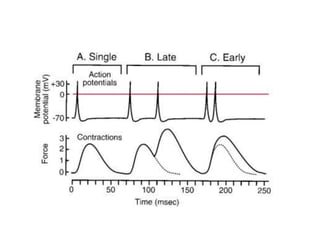
• Summation:
–If second electrical shock is administered
before complete relaxation of muscle.
Twitch, Summation, and Tetanus (continued)
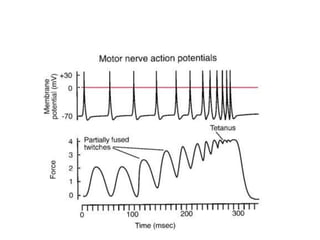
• Incomplete tetanus:
–Stimulator delivers an increasing frequency of
electrical shocks.
• Relaxation period shortens between twitches.
• Strength of contraction increases.
• Complete tetanus:
– Fusion frequency of stimulation.
– No visible relaxation between twitches.
– Smooth sustained contraction.
Simple Twitch, Summation, and
Tetanus
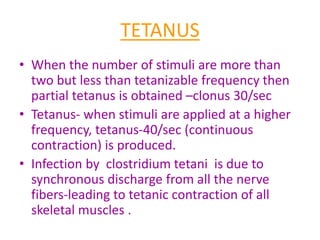
TETANUS
• When the number of stimuli are more than
two but less than tetanizable frequency then
partial tetanus is obtained –clonus 30/sec
• Tetanus- when stimuli are applied at a higher
frequency, tetanus-40/sec (continuous
contraction) is produced.
• Infection by clostridium tetani is due to
synchronous discharge from all the nerve
fibers-leading to tetanic contraction of all
skeletal muscles .
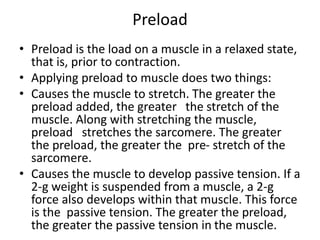
Preload
• Preload is the load on a muscle in a relaxed state,
that is, prior to contraction.
• Applying preload to muscle does two things:
• Causes the muscle to stretch. The greater the
preload added, the greater the stretch of the
muscle. Along with stretching the muscle,
preload stretches the sarcomere. The greater
the preload, the greater the pre- stretch of the
sarcomere.
• Causes the muscle to develop passive tension. If a
2-g weight is suspended from a muscle, a 2-g
force also develops within that muscle. This force
is the passive tension. The greater the preload,
the greater the passive tension in the muscle.
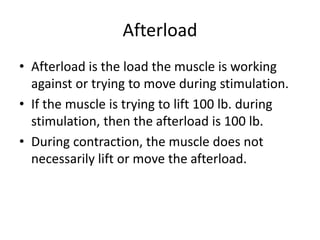
Afterload
• Afterload is the load the muscle is working
against or trying to move during stimulation.
• If the muscle is trying to lift 100 lb. during
stimulation, then the afterload is 100 lb.
• During contraction, the muscle does not
necessarily lift or move the afterload.
LENGTH-TENSION CURVES
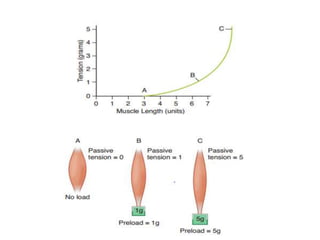
Preload-length Tension Curve
– resting skeletal muscle acts as a simple spring. As
preload is added, the muscle stretches and
develops a passive tension. The passive tension
can be considered an internal force that opposes
and equals the preload force.
ISOMETRIC CONTRACTION OF THE ISOLATED
SKELETAL MUSCLE
• During an isometric (same length) contraction,
the overall muscle length will not change.
• the cross-bridge cycling will produce active
tension
Active Tension Development
• The active tension developed during an isometric
contraction is proportional to the number of
these cross-bridges that cycle. The more cross-
bridges that cycle, the greater the developed
active tension.
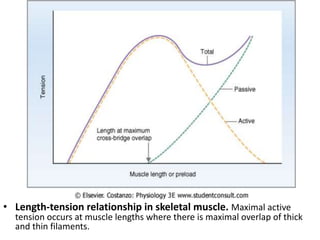
• the active tension is maximal when there is
maximal overlap of thick and thin filaments and
maximal possible cross-bridges which is at
resting state.
• When the muscle is stretched to longer lengths,
the number of possible cross-bridges is reduced,
and active tension is reduced.
• When muscle length is decreased, the thin
filaments don’t have enough space to slide on
thick filaments so more active tension can’t be
generated.
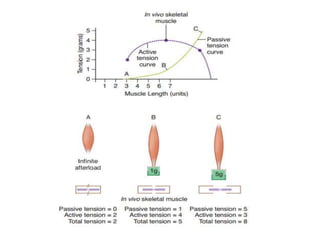
Total Tension
• The preload creates a passive tension prior to
contraction, and cross-bridge cycling during
contraction adds an active tension
component.
• The total tension in the active muscle is the
passive or preload tension plus the active
tension.
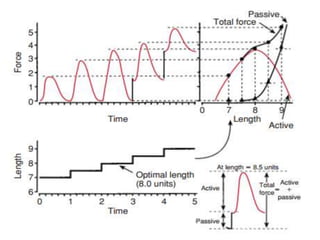
• Length-tension relationship in skeletal muscle. Maximal active
tension occurs at muscle lengths where there is maximal overlap of thick
and thin filaments.
Q. All of the following will occur when an
unstimulated muscle is stretched except:
A. increased preload
B. increased afterload
C. increased muscle length
D. increased passive tension
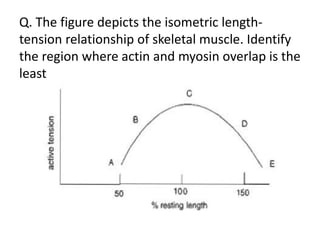
Q. The figure depicts the isometric length-
tension relationship of skeletal muscle. Identify
the region where actin and myosin overlap is the
least
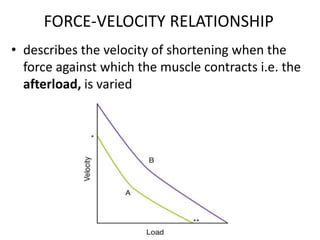
FORCE-VELOCITY RELATIONSHIP
• describes the velocity of shortening when the
force against which the muscle contracts i.e. the
afterload, is varied
• Isotonic (same tone) contraction - The force,
rather than the length, is fixed i.e. the muscle
contracts with the same force
• The velocity of shortening reflects the speed of
cross-bridge cycling.
• the velocity of shortening will be maximal (Vmax)
when the afterload on the muscle is zero.
• As the afterload on the muscle increases, the
velocity will be decreased because cross-bridges
can cycle less rapidly against the higher
resistance.
• As the afterload increases to even higher levels,
the velocity of shortening is reduced to zero.
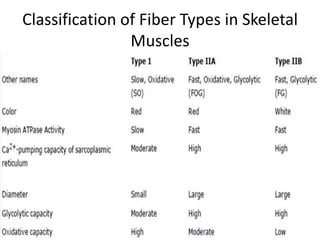
Classification of Fiber Types in Skeletal
Muscles
Examples:
• Type I Red fibers: in postural muscles
– Large myoglobin content and many mitochondria
• Type IIa Red fibers: in muscles needed for
activities like middle distance running,
swimming, etc.
– Large myoglobin content and many mitochondria
• Type IIb White fibers: needed for activities like
sprinting
• Low myoglobin content and few mitochondria

4594680.ppt

  • 1.
  • 2.
    Motor Unit • Amotor unit consists of a somatic motor neuron plus all the skeletal muscle fibers it stimulates • A single somatic motor neuron makes contact with an average of 150 skeletal muscle fibers, and all of the muscle fibers in one motor unit contract in unison
  • 4.
    Motor Unit A twitchcontraction is the brief contraction of all the muscle fibers in a motor unit in response to a single action potential in its motor neuron
  • 6.
    Q. In musclephysiology, the latent period refers to a. the period of lost excitability that occurs when two stimuli are applied immediately one after the other. b. the brief contraction of a motor unit. c. the period of elevated oxygen use after exercise. d. an inability of a muscle to contract forcefully after prolonged activity. e. a brief delay that occurs between application of a stimulus and the beginning of contraction
  • 7.
    • Note thata brief delay occurs between application of the stimulus (time zero on the graph) and the beginning of contraction. The delay, which lasts about two milliseconds, is termed the latent period. • During the latent period, the muscle action potential sweeps over the sarcolemma and calcium ions are released from the sarcoplasmic reticulum. • The second phase, the contraction period, lasts 10–100 msec. During this time, Ca2 binds to troponin, myosin- binding sites on actin are exposed, and crossbridges form. Peak tension develops in the muscle fiber. • During the third phase, the relaxation period,also lasting 10–100 msec, Ca2is actively transported back into the sarcoplasmic reticulum, myosin-binding sites are covered by tropomyosin, myosin heads detach from actin, and tension in the muscle fiber decreases
  • 8.
    PROPERTIES OF SKELETALMUSCLE • Extensibility & elasticity • Excitability • Conductivity • Contractility • Tonicity • Refractory period • Fatigue
  • 9.
    • Extensibility:Ability ofthe muscle to elongate when stretched. • Elasticity: Ability of the muscle to return to its original length when stretch is removed. • Excitability: Ability of the muscle to respond to a stimulus.(electrical ,thermal ,chemical,mechanical). • Contractility: Ability of the muscle to shorten or contract in response to a stimulus.
  • 10.
    • Conductivity: Abilityof the muscle to transmit an impulse (AP) from one part of the fibre to another part. • The condution velocity of an impulse in skeletal muscle fiber is slow. it is about 5 meters/sec • Tone:The state of partial sustained contraction seen in all muscles.
  • 11.
    REFRACTORY PERIOD: Itis about 30- 50millisec . It is a period of action potential in which another stimulus applied will not produce a response in a muscle. Types: Absolute Relative
  • 12.
    • The refractoryperiod is short in skeletal muscle, but very long in cardiac muscle – 250 msec • This means that skeletal muscle can undergo summation and tetanus, via repeated stimulation • Cardiac muscle CAN NOT sum action potentials or contractions and can’t be tetanized
  • 13.
    • CONTRACTILITY: Abilityto contract in response to a stimulus. • Types :- •Isotonic contraction •Isometric contraction
  • 14.
    Isotonic and IsometricContractions • Isotonic contraction:The contraction that occurs when the muscle is allowed to freely shorten,so that tension in the muscle is kept constant. • Isometric contraction: the contraction that occurs without any shortening of the muscle, so that the tension increases, but the length of the muscle remains constant.
  • 18.
    Isotonic Contraction 1 SameTension In The Muscle 2 Muscle Length Decreases 3 Work Is Done –Weight Lifted 4 Extra Heat produced.Relaxation Heat produced After Contraction 5 Greater Energy Is Used 6 Eg-1. Muscles of upperlimb while lifting weight ,lifting the leg while walking Isometric Contraction 1same Length-muscle Length Remains Constant 2 Increase In Tension 3 Work Performed Is Not Seen 4 Less Heat Produced 5 Less Energy Is Used 6 Eg:- Calf muscles on standing
  • 19.
    How do wecontrol the strength of contraction? 1. Large Motor unit involved 2. More motor units recruited 3. More fast type II b types of fiber 4. Increasing the rate of stimulation
  • 20.
    SUMMATION • When thestrength of the stimulus is increased the contractile response also increases.The increase in response is due to recruitment of motor units. This is called quantal summation or multimotor unit summation
  • 22.
    Twitch, Summation, andTetanus • Twitch: –Muscle is stimulated with a single electrical shock (above threshold). • Quickly contracts and then relaxes. • Summation: –If second electrical shock is administered before complete relaxation of muscle.
  • 24.
    Twitch, Summation, andTetanus (continued) • Incomplete tetanus: –Stimulator delivers an increasing frequency of electrical shocks. • Relaxation period shortens between twitches. • Strength of contraction increases. • Complete tetanus: – Fusion frequency of stimulation. – No visible relaxation between twitches. – Smooth sustained contraction.
  • 26.
  • 27.
    TETANUS • When thenumber of stimuli are more than two but less than tetanizable frequency then partial tetanus is obtained –clonus 30/sec • Tetanus- when stimuli are applied at a higher frequency, tetanus-40/sec (continuous contraction) is produced. • Infection by clostridium tetani is due to synchronous discharge from all the nerve fibers-leading to tetanic contraction of all skeletal muscles .
  • 28.
    Preload • Preload isthe load on a muscle in a relaxed state, that is, prior to contraction. • Applying preload to muscle does two things: • Causes the muscle to stretch. The greater the preload added, the greater the stretch of the muscle. Along with stretching the muscle, preload stretches the sarcomere. The greater the preload, the greater the pre- stretch of the sarcomere. • Causes the muscle to develop passive tension. If a 2-g weight is suspended from a muscle, a 2-g force also develops within that muscle. This force is the passive tension. The greater the preload, the greater the passive tension in the muscle.
  • 29.
    Afterload • Afterload isthe load the muscle is working against or trying to move during stimulation. • If the muscle is trying to lift 100 lb. during stimulation, then the afterload is 100 lb. • During contraction, the muscle does not necessarily lift or move the afterload.
  • 30.
    LENGTH-TENSION CURVES Preload-length TensionCurve – resting skeletal muscle acts as a simple spring. As preload is added, the muscle stretches and develops a passive tension. The passive tension can be considered an internal force that opposes and equals the preload force.
  • 32.
    ISOMETRIC CONTRACTION OFTHE ISOLATED SKELETAL MUSCLE • During an isometric (same length) contraction, the overall muscle length will not change. • the cross-bridge cycling will produce active tension Active Tension Development • The active tension developed during an isometric contraction is proportional to the number of these cross-bridges that cycle. The more cross- bridges that cycle, the greater the developed active tension.
  • 33.
    • the activetension is maximal when there is maximal overlap of thick and thin filaments and maximal possible cross-bridges which is at resting state. • When the muscle is stretched to longer lengths, the number of possible cross-bridges is reduced, and active tension is reduced. • When muscle length is decreased, the thin filaments don’t have enough space to slide on thick filaments so more active tension can’t be generated.
  • 35.
    Total Tension • Thepreload creates a passive tension prior to contraction, and cross-bridge cycling during contraction adds an active tension component. • The total tension in the active muscle is the passive or preload tension plus the active tension.
  • 37.
    • Length-tension relationshipin skeletal muscle. Maximal active tension occurs at muscle lengths where there is maximal overlap of thick and thin filaments.
  • 38.
    Q. All ofthe following will occur when an unstimulated muscle is stretched except: A. increased preload B. increased afterload C. increased muscle length D. increased passive tension
  • 39.
    Q. The figuredepicts the isometric length- tension relationship of skeletal muscle. Identify the region where actin and myosin overlap is the least
  • 40.
    FORCE-VELOCITY RELATIONSHIP • describesthe velocity of shortening when the force against which the muscle contracts i.e. the afterload, is varied
  • 41.
    • Isotonic (sametone) contraction - The force, rather than the length, is fixed i.e. the muscle contracts with the same force • The velocity of shortening reflects the speed of cross-bridge cycling. • the velocity of shortening will be maximal (Vmax) when the afterload on the muscle is zero. • As the afterload on the muscle increases, the velocity will be decreased because cross-bridges can cycle less rapidly against the higher resistance. • As the afterload increases to even higher levels, the velocity of shortening is reduced to zero.
  • 42.
    Classification of FiberTypes in Skeletal Muscles
  • 43.
    Examples: • Type IRed fibers: in postural muscles – Large myoglobin content and many mitochondria • Type IIa Red fibers: in muscles needed for activities like middle distance running, swimming, etc. – Large myoglobin content and many mitochondria • Type IIb White fibers: needed for activities like sprinting • Low myoglobin content and few mitochondria

Editor's Notes

  • #6 Note that a brief delay occurs between application of the stimulus (time zero on the graph) and the beginning of contraction. The delay, which lasts about two milliseconds, is termed the latent period. During the latent period, the muscle action potential sweeps over the sarcolemma and calcium ions are released from the sarcoplasmic reticulum. The second phase, the contraction period, lasts 10–100 msec. During this time, Ca2 binds to troponin, myosin-binding sites on actin are exposed, and crossbridges form. Peak tension develops in the muscle fiber. During the third phase, the relaxation period, also lasting 10–100 msec, Ca2is actively transported back into the sarcoplasmic reticulum, myosin-binding sites are covered by tropomyosin, myosin heads detach from actin, and tension in the muscle fiber decreases
  • #9 Muscle is a excitable tissue like nerve fibre/cell When therashold stimulus applied it produce contraction/response.
  • #13 The refractory period of a cardiac muscle fiber lasts longer than the contraction itself . As a result, another contraction cannot begin until relaxation is well underway. For this reason, tetanus (maintained contraction) cannot occur in cardiac muscle as it can in skeletal muscle.
  • #17 In a twitch, isometric force develops relatively rapidly, and subsequent isometric relaxation is somewhat slower. The durations of both contraction time and relaxation time are related to the rate at which calcium ions can be delivered to and removed from the region of the crossbridges, the actual sites of force development. During an isometric contraction, no actual physical work is done on the external environment because no movement takes place while the force is developed. The muscle, however, still consumes energy to fuel the processes that generate and maintain force.
  • #18 When the muscle is stimulated, it will begin to develop force without shortening, since it takes some time to build up enough force to begin to lift the weight. This means that early on, the contraction is isometric (phase 1; Fig. 9.8). After sufficient force has been generated, the muscle will begin to shorten and lift the load (phase 2). The contraction then becomes isotonic because the force exerted by the muscle exactly matches that of the weight, and the mass of the weight does not vary. Therefore, the upper tracing in Figure 9.8 shows a flat line representing constant force, while the muscle length (lower tracing) is free to change. As relaxation begins (phase 3), the muscle lengthens at constant force because it is still supporting the load; this phase of relaxation is isotonic, and the muscle is re extended by the weight. When the muscle has been extended sufficiently to return to its original length, conditions again become isometric (phase 4), and the remaining force in the muscle declines as it would in a purely isometric twitch. In almost all situations encountered in daily life, isotonic contraction is preceded by isometric force development; such contractions are called mixed contractions (isometric-isotonic-isometric
  • #20 All of these will increase the force of contraction
  • #22 In muscles adapted for fine and precise control, only a few muscle fibers are associated with a given motor axon; in muscles in which high force is more important, a single motor axon controls many more muscle fibers. The total force produced by a muscle is determined by the number of motor units active at any one time; as more motor units are brought into play, the force increases. This phenomenon, called motor unit summation, is illustrated in Figure 9.6. The force of contraction of the whole muscle is further modified by the degree
  • #24 Temporal summation of muscle twitches. A,The first contraction is in response to a single action potential. B,The next contraction shows the summed re-sponse to a second stimulus given during relaxation; the two indi-vidual responses are evident. C,The last contraction is the resultof two stimuli in quick succession. Though measured force was still rising when the second stimulus was given, the fact that there could be an added response shows that internal activation had be-gun to decline. In all cases, the solid line in the lower graph rep-resents the actual summed tension.
  • #25 Treppe: Staircase effect. Electrical shocks are delivered at maximum voltage. Each shock produces a separate, stronger twitch (up to maximum). Due to increase in intracellular Ca2+. Represents “warm-up.”
  • #29 Normally a muscle is protected against overextension by attachments to the skeleton or by other anatomic structures. If the muscle has not been stimulated, this resisting force is called passive Force or resting force
  • #34 The amount of active force or active tension a muscle can produce during an isometric contraction depends on the length at which the muscle is held. At a length roughly corresponding to the natural length in the body, the resting length,the maximum force is produced. If the muscle is set to a shorter length and then stimulated, it produces less force. At an extremely short length, it produces no force at all. If the muscle is made longer than its optimal length, it produces less force when stimulated. This behavior is summarized in the length-ten-sion curve
  • #35 A length-tension curve for skeletal muscle. Contractions are made at several resting lengths, and the resting (passive) and peak (total)forces for each twitch are transferred to the graph at the right. Subtraction of the passive curve from the total curve yields the active force curve. The muscle length is changed only when the muscle is not stimulated, and it is held constant (isometric) during contraction.
  • #38 In muscle mechanics, there are two types of tension: l Passive tension: produced by preload prior to contraction l Active tension: produced by cross-bridge cycling during the process of con-traction
  • #42 Muscle A: a smaller, slower muscle (red muscle) Muscle B: a larger, faster muscle (white muscle) *Maximum velocity (Vmax) is determined by the muscle’s ATPase activity. It is the ATPase activity that determines a fast versus a slow muscle. **Maximum force generated by a muscle (or maximum load lifted by a muscle) is determined by muscle mass or, putting it another way, the num-ber of motor units activated during contraction. The greater the muscle mass, the greater the maximum force generated.