coordination geometry class 12 very brilliant presentation
1.
Theories Related toCoordination Compounds
There are five theories
that describe the
bonding features in
coordination compounds.
2.
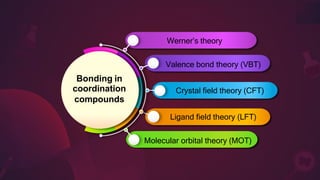
Crystal field theory(CFT)
coordination
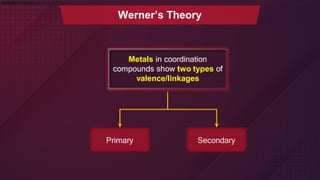
Werner’s theory
Valence bond theory (VBT)
Bonding in
compounds
Ligand field theory (LFT)
Molecular orbital theory (MOT)
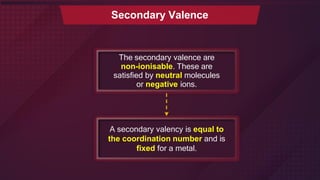
The secondary valenceare
non-ionisable. These are
satisfied by neutral molecules
or negative ions.
Secondary Valence
A secondary valency is equal to
the coordination number and is
fixed for a metal.
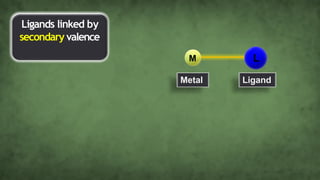
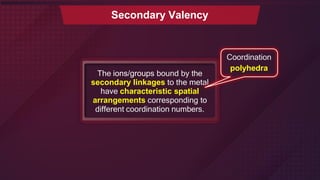
The ions/groups boundby the
secondary linkages to the metal
have characteristic spatial
arrangements corresponding to
different coordination numbers.
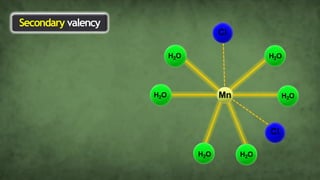
Secondary Valency
Coordination
polyhedra
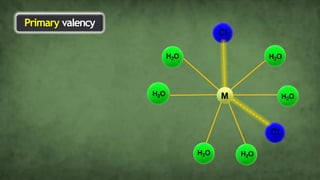
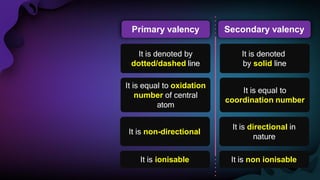
Primary valency Secondaryvalency
It is ionisable It is non ionisable
It is non-directional
It is directional in
nature
It is equal to oxidation
number of central
atom
It is equal to
coordination number
It is denoted by
dotted/dashed line
It is denoted
by solid line
26.
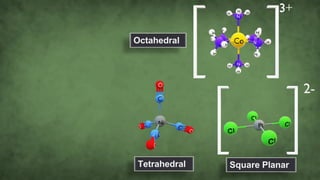
Most common
geometrical shapesin
coordination compounds
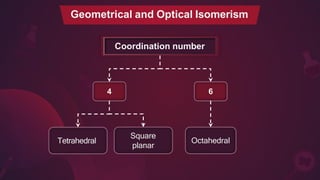
Octahedral Tetrahedral Square planar
Werfier’s Theory
3+
[Co(NH3)6] [Ni(CO)4]
2_
[Pt(Cl)4]
What you willlearn
• Hydrate Isomerism
• Polymerisation Isomerism
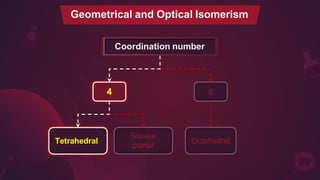
• Stereoisomerism in Tetrahedral Complexes
• Geometrical and Optical Isomerism in Tetrahedral
Complexes and in Square Planar Complexes
• Geometrical Isomerism in Octahedral Complexes
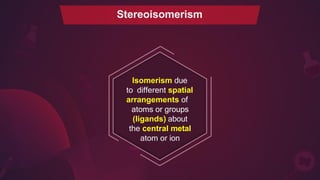
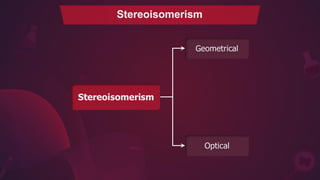
Stereoisomerism in Complexes
29.
It arises when
counterion in a
complex salt itself
is a potential
ligand.
So, it can displace
an actual ligand,
which can then
become a counter
ion.
Ionisation Isomerism
How are thebelow
compounds related?
Pt(NH3)2Cl2
and
[Pt(NH3)4] [PtCl4]
39.
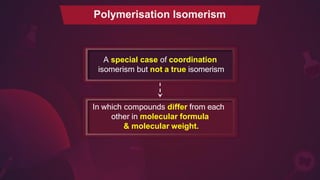
Polymerisation Isomerism
A specialcase of coordination
isomerism but not a true isomerism
In which compounds differ from each
other in molecular formula
& molecular weight.
The ionisation isomerof [Cr(H2O)4Cl(NO2)]Cl is:
a
b
c
d
[Cr(H2O)4Cl2](NO2)
[Cr(H2O)4(O2N)]Cl2
[Cr(H2O)4Cl(ONO)]Cl
[Cr(H2O)4Cl2(NO2)].H2O
Ionisation isomers are the
complexes that produce different
ions in solution, i.e., they have ions
interchanged inside and outside
the coordination sphere.
[Cr(H2O)4(O2N)]Cl2
and [Cr(H2O)4Cl2](NO2)
have different ions outside the
coordination sphere and they are
isomers. Therefore, they are
ionisation isomers.
Hence, option b is
the correct answer.
42.
Which of thefollowing pairs represent linkage isomers?
a
b
c
d
[Cu(NH3)4][PtCl4] and
[Pt(NH3)4][CuCl4]
[Pd(PPh3)2(NCS)2] and
[Pd(PPh3)2(SCN)2]
[Co(NH3)5(NO3)] SO4 and
[Co(NH3)5(SO4)] NO3
[PtCl2(NH3)4]Br2 and
[PtBr2(NH3)4]Cl2
Linkage isomerism is shown by
ambidentate ligands like NCS and
SCN. It can be linked through N or S.
[Pd(PPh3)2(NCS)2] and
[Pd(PPh3)2(SCN)2]
Hence, option b is
the correct answer.
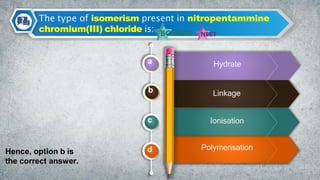
43.
The type ofisomerism present in nitropentammine
chromium(III) chloride is:
a
b
c
d
Linkage
Hydrate
Ionisation
Polymerisation
Hence, option b is
the correct answer.
Optical Isomerism inTetrahedral Complexes
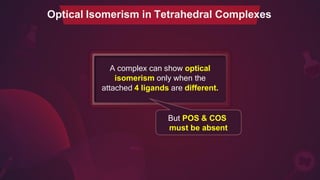
A complex can show optical
isomerism only when the
attached 4 ligands are different.
But POS & COS
must be absent
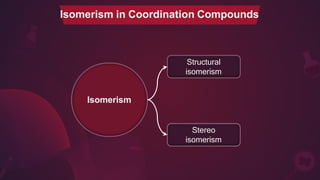
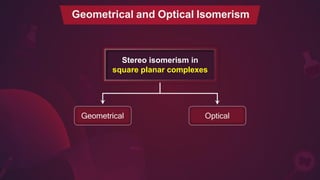
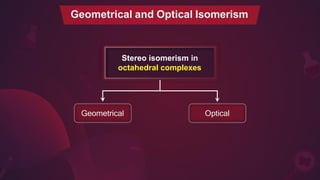
Geometrical and OpticalIsomerism
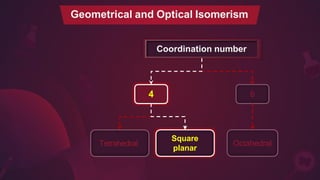
Stereo isomerism in
square planar complexes
Geometrical Optical
76.
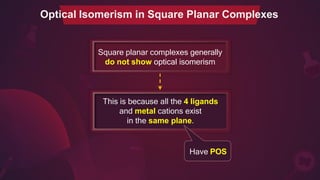
Optical Isomerism inSquare Planar Complexes
Square planar complexes generally
do not show optical isomerism
This is because all the 4 ligands
and metal cations exist
in the same plane.
Have POS
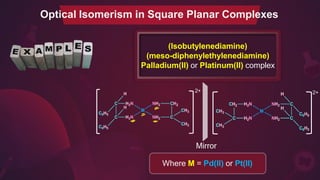
Optical Isomerism inSquare Planar Complexes
(Isobutylenediamine)
(meso-diphenylethylenediamine)
Palladium(II) or Platinum(II) complex
2+ 2+
Mirror
Where M = Pd(II) or Pt(II)
79.
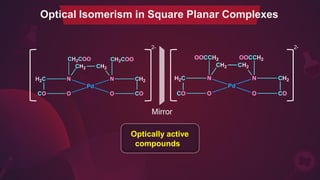
Optical Isomerism inSquare Planar Complexes
[Pd(EDTA)]2─
Acts as a
tetradentate ligand
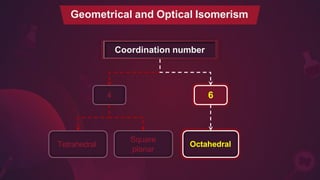
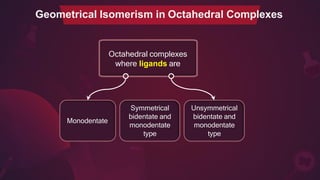
Octahedral complexes
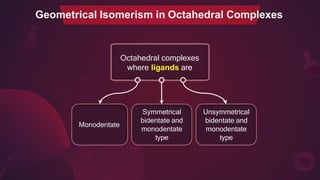
where ligandsare
Geometrical Isomerism in Octahedral Complexes
Monodentate
Unsymmetrical
bidentate and
monodentate
type
Symmetrical
bidentate and
monodentate
type
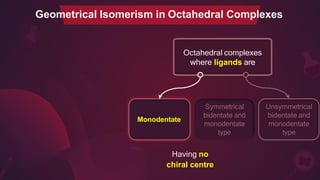
84.
Octahedral complexes
where ligandsare
Geometrical Isomerism in Octahedral Complexes
Monodentate
Unsymmetrical
bidentate and
monodentate
type
Symmetrical
bidentate and
monodentate
type
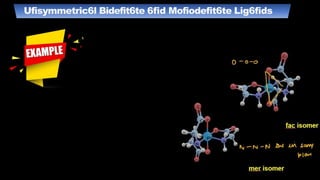
Having no
chiral centre
n±
[Ma3b3]
a a
b
Facial (Fac)
b
Meridional(Mer)
Possible number of
geometrical isomers
2
=
Octahedral Complexes Having Monodentate Ligands
Have three
identical ligands
on one
triangular face
Have three
identical
ligands in a
plane
bisecting the
molecule
Case 1(e)
92.
n±
[Ma3b3]
a a
b
Facial (Fac)
b
Meridional(Mer)
Possible number of
geometrical isomers
= 2
Octahedral Complexes Having Monodentate Ligands
Have three
identical ligands
on one
triangular face
Have three
identical
ligands in a
plane
bisecting the
molecule
Case 1(e)
93.
What you willlearn
• Geometrical Isomerism is Octahedral Complexes
Continued
• Optical Isomerism in Octahedral Complexes
• Problems Based on Stereoismerism
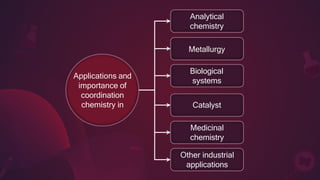
• Applications and Importance of Coordination
Chemistry
Stereoisomerism in Octahedral
Complexes
94.
Octahedral complexes
where ligandsare
Geometrical Isomerism in Octahedral Complexes
Monodentate
Unsymmetrical
bidentate and
monodentate
type
Symmetrical
bidentate and
monodentate
type
Case 1(e)
3 3
[Mab ]n±
a a
b
Facial (Fac)
b
Meridional (Mer)
Possible number of
geometrical isomers
= 2
Octahedral Complexes Having Monodentate Ligands
Have three
identical
ligands on one
triangular
face
Have three
identical
ligands in a
plane
bisecting the
molecule
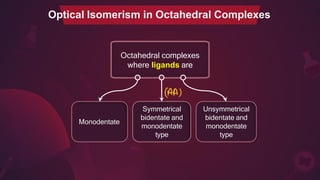
Octahedral complexes
where ligandsare
Optical Isomerism in Octahedral Complexes
Monodentate
Unsymmetrical
bidentate and
monodentate
type
Symmetrical
bidentate and
monodentate
type
123.
Case 1(a)
Possible numberof
enantiomers
0
=
Octahedral Complexes Having Monodentate Ligands
n±
[M(a4b2)]
Does not
show OI
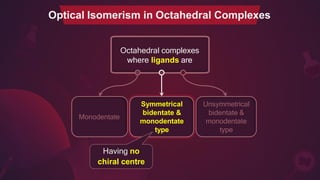
Octahedral complexes
where ligandsare
Optical Isomerism in Octahedral Complexes
Monodentate
Unsymmetrical
bidentate &
monodentate
type
Symmetrical
bidentate &
monodentate
type
Having no
chiral centre
127.
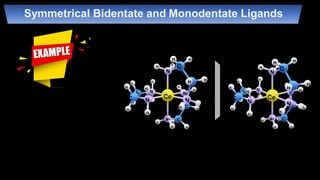
Case 2(a)
A A
Possiblenumber of
Enantiomeric pairs
= 1
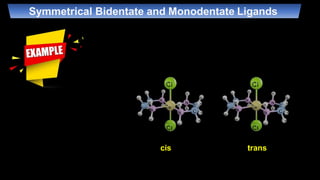
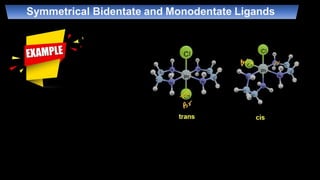
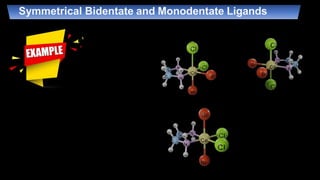
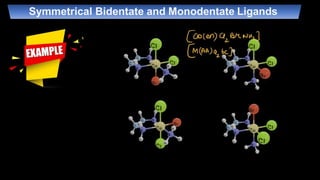
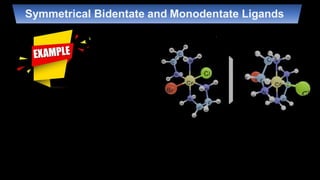
Symmetrical Bidentate and Monodentate Ligands
Optical
[M(AA) ]n±
isomers
3
A A
Total possible
stereoisomers
2
=
Case 2(b) [M(AA)2ab]n±
Possiblenumber of
Enantiomeric pairs
1
=
A
A
A
A
Symmetrical Bidentate and Monodentate Ligands
Optical
isomers
Total possible
stereoisomers
3
=
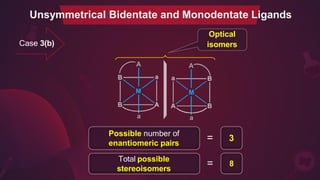
Case 3(b)
2 2
[M(AB)a ]n±
Unsymmetrical Bidentate and Monodentate Ligands
A A
A
A
B
A
A
B
Optical
isomers
136.
Case 3(b)
Possible numberof
enantiomeric pairs
3
=
Unsymmetrical Bidentate and Monodentate Ligands
A
a
A
a
Optical
isomers
Total possible
stereoisomers
8
=
137.
Ionisation isomers
a
Coordination isomers
b
Geometricalisomers
c
Linkage isomers
d
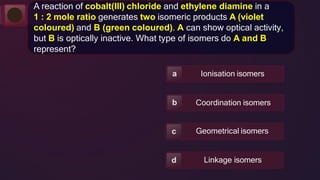
A reaction of cobalt(III) chloride and ethylene diamine in a
1 : 2 mole ratio generates two isomeric products A (violet
coloured) and B (green coloured). A can show optical activity,
but B is optically inactive. What type of isomers do A and B
represent?
138.
We know thatethylenediamine is a bidentate ligand and Co3+ forms an
octahedral complex having a co-ordination number 6.
Here, 2 moles of ethylenediamine can satisfy four co-ordination numbers.
The remaining two would be satisfied by existing chloride ions.
The reaction is,
CoCl3 +2C2H8N2 → [CoCl2(en)2]Cl
According to a given ratio, the above product can only be formed. As it
says there are two products, another product should be an isomer. The
possibility is that two Cl ions can be either in cis form or in trans-form. On
observing the cis form, there is no plane of symmetry and hence, it is chiral
and optically active, and the trans will be optically inactive.
Hence, they are Geometrical isomers of each other.
Hence, option c is the correct answer.
139.
Both (A) and(B) can be
optically active.
a
Both (A) and (B) can not be
optically active.
b
(A) can not be optically active, but
(B) can be optically active.
c
(A) can be optically active, but
(B) can not be optically active.
d
Consider the complex ions, trans-[Co(en)2Cl2]+ (A) and
cis-[Co(en)2Cl2]+ (B) The correct statement regarding them is:
(A) is trans-form and shows plane of
symmetry, which is optically
inactive.
(B) is cis-form and does not show
plane of symmetry. Hence, it is
optically active.
Hence, option c is the
correct answer.
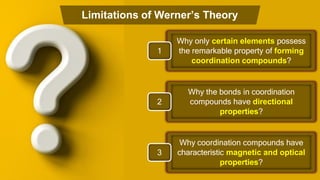
Why the bondsin coordination
compounds have directional
properties?
2
Why coordination compounds have
characteristic magnetic and optical
properties?
3
Why only certain elements possess
the remarkable property of forming
coordination compounds?
1
Limitations of Werner’s Theory
146.
Valence Bond Theory
Thevalence bond theory,
VBT, was extended to
coordination compounds by
Linus Pauling.
In 1931
147.
Valence Bond Theory
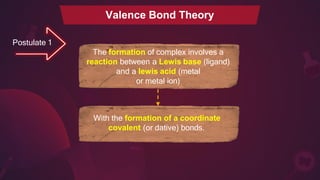
Postulate1
The formation of complex involves a
reaction between a Lewis base (ligand)
and a lewis acid (metal
or metal ion)
With the formation of a coordinate
covalent (or dative) bonds.
148.
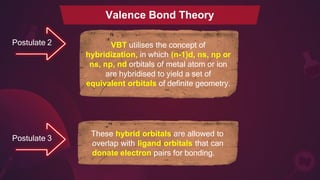
Postulate 2 VBTutilises the concept of
hybridization, in which (n-1)d, ns, np or
ns, np, nd orbitals of metal atom or ion
are hybridised to yield a set of
equivalent orbitals of definite geometry.
Postulate 3
These hybrid orbitals are allowed to
overlap with ligand orbitals that can
donate electron pairs for bonding.
Valence Bond Theory
149.
Valence Bond Theory
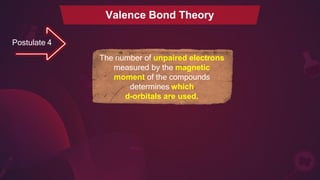
Postulate4
The number of unpaired electrons
measured by the magnetic
moment of the compounds
determines which
d-orbitals are used.
150.
Valence Bond Theory
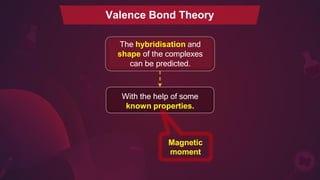
Thehybridisation and
shape of the complexes
can be predicted.
With the help of some
known properties.
Magnetic
moment
151.
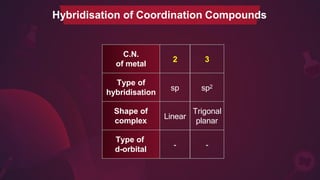
Hybridisation of CoordinationCompounds
C.N.
of metal
2 3
Type of
hybridisation
sp sp2
Shape of
complex
Linear
Trigonal
planar
Type of
d-orbital
- -
152.
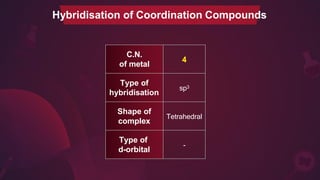
Hybridisation of CoordinationCompounds
C.N.
of metal
4
Type of
hybridisation
sp3
Shape of
complex
Tetrahedral
Type of
d-orbital
-
153.
Do you knowany other
types of hybridisation
with CN=4?
154.
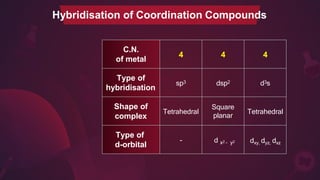
Hybridisation of CoordinationCompounds
C.N.
of metal
4 4 4
Type of
hybridisation
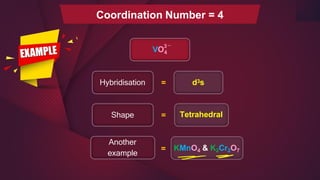
sp3 dsp2 d3s
Shape of
complex
Tetrahedral
Square
planar
Tetrahedral
Type of
d-orbital
- d x2 – y2 dxy, dyz, dxz
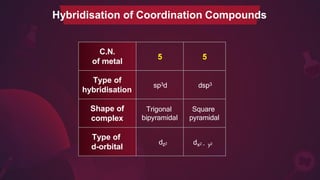
155.
Hybridisation of CoordinationCompounds
C.N.
of metal
5 5
Type of
hybridisation
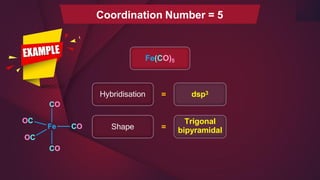
sp3d dsp3
Shape of
complex
Trigonal
bipyramidal
Square
pyramidal
Type of
d-orbital
dz2 dx2 – y2
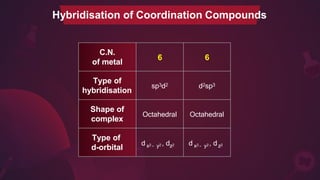
156.
C.N.
of metal
6 6
Typeof
hybridisation
sp3d2 d2sp3
Shape of
complex
Octahedral Octahedral
Type of
d-orbital
d x2 – y2 , dz2 d x2 – y2 , dz2
Hybridisation of Coordination Compounds

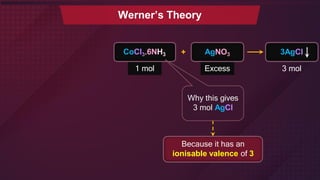
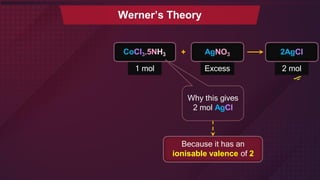
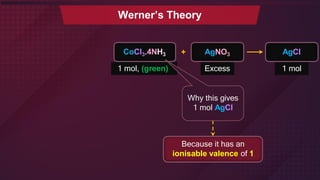
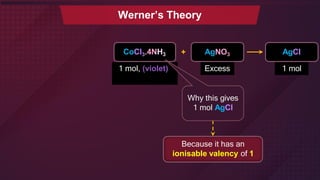
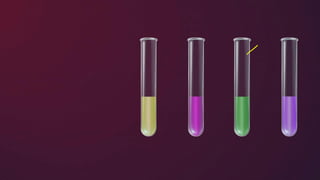
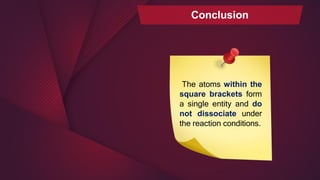
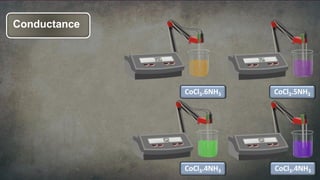
![Conclusion of Werner’s Experiment
Atoms in square brackets do not dissociate.
Colour Formula
Solution
conductivity
corresponds to
Yellow
3+ _
[Co(NH3)6] 3Cl 1:3 electrolyte
Purple
2+ _
[CoCl(NH3)5] 2Cl 1:2 electrolyte
Green
+ _
[CoCl2(NH3)4] Cl 1:1 electrolyte
Violet
+ _
[CoCl2(NH3)4] Cl 1:1 electrolyte](https://image.slidesharecdn.com/l3-250408090410-761c20a0/85/coordination-geometry-class-12-very-brilliant-presentation-11-320.jpg)
![Primary Valency
The primary valence are
normally ionisable and are
satisfied by negative ions.
[ Mn (H2O)6 ] Cl2
Primary valency](https://image.slidesharecdn.com/l3-250408090410-761c20a0/85/coordination-geometry-class-12-very-brilliant-presentation-14-320.jpg)
![[ Mn(H2O)6
] Cl2
Secondary valency
Secondary Valency](https://image.slidesharecdn.com/l3-250408090410-761c20a0/85/coordination-geometry-class-12-very-brilliant-presentation-18-320.jpg)
![Structure of [Co(NH3)6]Cl3
[Co(NH3)6]Cl3](https://image.slidesharecdn.com/l3-250408090410-761c20a0/85/coordination-geometry-class-12-very-brilliant-presentation-21-320.jpg)
![Structure of [Co(NH3)5Cl]Cl2
[Co(NH3)5Cl]Cl2](https://image.slidesharecdn.com/l3-250408090410-761c20a0/85/coordination-geometry-class-12-very-brilliant-presentation-22-320.jpg)
![Structure of [Co(NH3)5Cl2]Cl
[Co(NH3)4Cl2]Cl](https://image.slidesharecdn.com/l3-250408090410-761c20a0/85/coordination-geometry-class-12-very-brilliant-presentation-23-320.jpg)
![Structure of [Co(NH3)5Cl2]Cl
[Co(NH3)4Cl2]Cl](https://image.slidesharecdn.com/l3-250408090410-761c20a0/85/coordination-geometry-class-12-very-brilliant-presentation-24-320.jpg)
![Most common
geometrical shapes in
coordination compounds
Octahedral Tetrahedral Square planar
Werfier’s Theory
3+
[Co(NH3)6] [Ni(CO)4]
2_
[Pt(Cl)4]](https://image.slidesharecdn.com/l3-250408090410-761c20a0/85/coordination-geometry-class-12-very-brilliant-presentation-26-320.jpg)
![[Pt(NH3)3Br] NO2 [Pt(NH3)3NO2] Br
Counter ion
Ionisation Isomerism](https://image.slidesharecdn.com/l3-250408090410-761c20a0/85/coordination-geometry-class-12-very-brilliant-presentation-30-320.jpg)
![[Co(NH3)5(SO4)] Br [Co(NH3)5Br] SO4
Counter ion
Ionisation Isomerism](https://image.slidesharecdn.com/l3-250408090410-761c20a0/85/coordination-geometry-class-12-very-brilliant-presentation-31-320.jpg)
![Ionisation isomers
produce different ions in
aqueous solutions.
[Co(NH3)5(SO4)]Br [Co(NH3)5(SO4)]+ + Br
Red
[Co(NH3)5Br]SO4 [Co(NH3)5Br]2+ + SO4
Violet
Note!
2─
—
H2O
H2O](https://image.slidesharecdn.com/l3-250408090410-761c20a0/85/coordination-geometry-class-12-very-brilliant-presentation-32-320.jpg)
![Hydrate Isomerism
CrCl3.6H2O [Cr(H2O)6]Cl3
Bright blue green
[Cr(H2O)4Cl2]Cl.2H2O
Dark green
Produces
3Cl─
Produces
2Cl─
[Cr(H2O)5Cl]Cl2.H2O
Produces
1Cl─
Violet](https://image.slidesharecdn.com/l3-250408090410-761c20a0/85/coordination-geometry-class-12-very-brilliant-presentation-36-320.jpg)
![How are the below
compounds related?
Pt(NH3)2Cl2
and
[Pt(NH3)4] [PtCl4]](https://image.slidesharecdn.com/l3-250408090410-761c20a0/85/coordination-geometry-class-12-very-brilliant-presentation-38-320.jpg)
![Polymerisation Isomerism
[Pt(NH3)2Cl2] and [Pt(NH3)4] [PtCl4]
1
[Pt(NH3)Cl3] and [Pt(NH3)3Cl2] [PtCl4]
2](https://image.slidesharecdn.com/l3-250408090410-761c20a0/85/coordination-geometry-class-12-very-brilliant-presentation-40-320.jpg)
![The ionisation isomer of [Cr(H2O)4Cl(NO2)]Cl is:
a
b
c
d
[Cr(H2O)4Cl2](NO2)
[Cr(H2O)4(O2N)]Cl2
[Cr(H2O)4Cl(ONO)]Cl
[Cr(H2O)4Cl2(NO2)].H2O
Ionisation isomers are the
complexes that produce different
ions in solution, i.e., they have ions
interchanged inside and outside
the coordination sphere.
[Cr(H2O)4(O2N)]Cl2
and [Cr(H2O)4Cl2](NO2)
have different ions outside the
coordination sphere and they are
isomers. Therefore, they are
ionisation isomers.
Hence, option b is
the correct answer.](https://image.slidesharecdn.com/l3-250408090410-761c20a0/85/coordination-geometry-class-12-very-brilliant-presentation-41-320.jpg)
![Which of the following pairs represent linkage isomers?
a
b
c
d
[Cu(NH3)4][PtCl4] and
[Pt(NH3)4][CuCl4]
[Pd(PPh3)2(NCS)2] and
[Pd(PPh3)2(SCN)2]
[Co(NH3)5(NO3)] SO4 and
[Co(NH3)5(SO4)] NO3
[PtCl2(NH3)4]Br2 and
[PtBr2(NH3)4]Cl2
Linkage isomerism is shown by
ambidentate ligands like NCS and
SCN. It can be linked through N or S.
[Pd(PPh3)2(NCS)2] and
[Pd(PPh3)2(SCN)2]
Hence, option b is
the correct answer.](https://image.slidesharecdn.com/l3-250408090410-761c20a0/85/coordination-geometry-class-12-very-brilliant-presentation-42-320.jpg)
![Generally, GI is not possible in
tetrahedral complexes.
[Ma4] , [Ma2b2], or [Mabcd]
Geometrical Isomerism in Tetrahedral Complexes](https://image.slidesharecdn.com/l3-250408090410-761c20a0/85/coordination-geometry-class-12-very-brilliant-presentation-49-320.jpg)
![Optical Isomerism in Tetrahedral Complexes
Optically
inactive
[Be(acac)2]
acetylacetonato
─ ─](https://image.slidesharecdn.com/l3-250408090410-761c20a0/85/coordination-geometry-class-12-very-brilliant-presentation-53-320.jpg)
![Optical Isomerism in Tetrahedral Complexes
─ ─
[Be(acac)2]
benzoylacetonato
Optically
active](https://image.slidesharecdn.com/l3-250408090410-761c20a0/85/coordination-geometry-class-12-very-brilliant-presentation-54-320.jpg)
![[M(AA)2]n±
[M(AA)a2]n±
[Ma4]n±
[Ma3b]n±
GI in Square Planar Complexes
[Ma2bc]n±
[Mabcd]n±
n±
[M(AB)a2]
[Ma2b2]n±](https://image.slidesharecdn.com/l3-250408090410-761c20a0/85/coordination-geometry-class-12-very-brilliant-presentation-57-320.jpg)
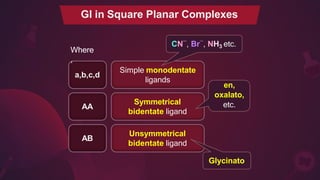
![GI in Square Planar Complexes
[M(AA)2]n±
[M(AA)a2]n±
[Ma4]n±
[Ma3b]n±
[Ma2bc]n±
[Mabcd]n±
n±
[M(AB)a2]
[Ma2b2]n±](https://image.slidesharecdn.com/l3-250408090410-761c20a0/85/coordination-geometry-class-12-very-brilliant-presentation-59-320.jpg)
![[Ma2b2]n±
[Ma2bc]n±
[Mabcd]n±
[Ma3b]n±
[M(AA)2]n±
[M(AA)a2]n±
4
[Ma ]n±
2
[M(AB)a ]n±
GI in Square Planar Complexes
Do not show
geometrical
isomerism.](https://image.slidesharecdn.com/l3-250408090410-761c20a0/85/coordination-geometry-class-12-very-brilliant-presentation-60-320.jpg)
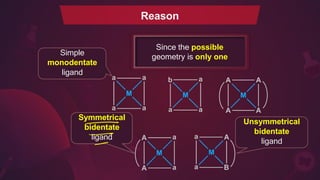
![[Ma3b]n±
[M(AB)a2]n±
[M(AA)2]n±
[M(AA)a2]n±
[Ma4]n±
GI in Square Planar Complexes
[Ma2b2]n±
[Ma2bc]n±
[Mabcd]n±
Shows
geometrical
isomerism](https://image.slidesharecdn.com/l3-250408090410-761c20a0/85/coordination-geometry-class-12-very-brilliant-presentation-62-320.jpg)
![[Ma2b2]n±
Same group
opposite side
(Trans)
Same group
same side
(cis)
GI in Square Planar Complexes](https://image.slidesharecdn.com/l3-250408090410-761c20a0/85/coordination-geometry-class-12-very-brilliant-presentation-63-320.jpg)
![GI in Square Planar Complexes
[Ma2b2]n±
Same group
opposite side
(Trans)
Same group
same side
(cis)](https://image.slidesharecdn.com/l3-250408090410-761c20a0/85/coordination-geometry-class-12-very-brilliant-presentation-64-320.jpg)
![GI in Square Planar Complexes
[Ma2bc]n±
Same group
opposite side
(Trans)
Same group
same side
(cis)](https://image.slidesharecdn.com/l3-250408090410-761c20a0/85/coordination-geometry-class-12-very-brilliant-presentation-65-320.jpg)
![GI in Square Planar Complexes
[Ma2bc]n±
Same group
opposite side
(Trans)
Same group
same side
(cis)](https://image.slidesharecdn.com/l3-250408090410-761c20a0/85/coordination-geometry-class-12-very-brilliant-presentation-66-320.jpg)
![Total possible
isomers: 3
[Mabcd]n±
GI in Square Planar Complexes](https://image.slidesharecdn.com/l3-250408090410-761c20a0/85/coordination-geometry-class-12-very-brilliant-presentation-67-320.jpg)
![Total possible
isomers: 3
[Mabcd]n±
GI in Square Planar Complexes](https://image.slidesharecdn.com/l3-250408090410-761c20a0/85/coordination-geometry-class-12-very-brilliant-presentation-68-320.jpg)
![n±
[M(AB)2]
GI in Square Planar Complexes](https://image.slidesharecdn.com/l3-250408090410-761c20a0/85/coordination-geometry-class-12-very-brilliant-presentation-70-320.jpg)
![n±
[M(AB)2]
GI in Square Planar Complexes](https://image.slidesharecdn.com/l3-250408090410-761c20a0/85/coordination-geometry-class-12-very-brilliant-presentation-71-320.jpg)
![GI in Square Planar Complexes
Cis Trans
[Pt(NH3)2(Cl)2]](https://image.slidesharecdn.com/l3-250408090410-761c20a0/85/coordination-geometry-class-12-very-brilliant-presentation-72-320.jpg)
![GI in Square Planar Complexes
[Pt(NH3)BrCl(py)]](https://image.slidesharecdn.com/l3-250408090410-761c20a0/85/coordination-geometry-class-12-very-brilliant-presentation-73-320.jpg)
![GI in Square Planar Complexes
[Pt(gly)2]
Cis Trans](https://image.slidesharecdn.com/l3-250408090410-761c20a0/85/coordination-geometry-class-12-very-brilliant-presentation-74-320.jpg)

![Optical Isomerism in Square Planar Complexes
[Pd(EDTA)]2─
Acts as a
tetradentate ligand](https://image.slidesharecdn.com/l3-250408090410-761c20a0/85/coordination-geometry-class-12-very-brilliant-presentation-79-320.jpg)
![Case 1(a)
6
[M(a) ]n±
Does not show GI
a
a
Octahedral Complexes Having Monodentate Ligands](https://image.slidesharecdn.com/l3-250408090410-761c20a0/85/coordination-geometry-class-12-very-brilliant-presentation-85-320.jpg)
![b
5
[Ma b]n±
Does not show GI
a
Octahedral Complexes Having Monodentate Ligands
Case 1(b)](https://image.slidesharecdn.com/l3-250408090410-761c20a0/85/coordination-geometry-class-12-very-brilliant-presentation-86-320.jpg)
![[Ma4b2]n±
b
a
Cis
b
b
Trans
Possible number of
geometrical isomers
2
=
Octahedral Complexes Having Monodentate Ligands
Case 1(c)](https://image.slidesharecdn.com/l3-250408090410-761c20a0/85/coordination-geometry-class-12-very-brilliant-presentation-87-320.jpg)
![b
a
Octahedral Complexes Having Monodentate Ligands
n±
[Ma2b2c2]
1
Case 1(d)](https://image.slidesharecdn.com/l3-250408090410-761c20a0/85/coordination-geometry-class-12-very-brilliant-presentation-88-320.jpg)
![a
a
a
a
Octahedral Complexes Having Monodentate Ligands
n±
[Ma2b2c2]
2 3
Case 1(d)](https://image.slidesharecdn.com/l3-250408090410-761c20a0/85/coordination-geometry-class-12-very-brilliant-presentation-89-320.jpg)
![b
b
c
c
n±
[Ma2b2c2]
Possible number of
geometrical isomers
= 5
Oct6hedr6l Complexes H6vifig Mofiodefit6te Lig6fids
4 5
Case 1(d)](https://image.slidesharecdn.com/l3-250408090410-761c20a0/85/coordination-geometry-class-12-very-brilliant-presentation-90-320.jpg)
![n±
[Ma3b3]
a a
b
Facial (Fac)
b
Meridional (Mer)
Possible number of
geometrical isomers
2
=
Octahedral Complexes Having Monodentate Ligands
Have three
identical ligands
on one
triangular face
Have three
identical
ligands in a
plane
bisecting the
molecule
Case 1(e)](https://image.slidesharecdn.com/l3-250408090410-761c20a0/85/coordination-geometry-class-12-very-brilliant-presentation-91-320.jpg)
![n±
[Ma3b3]
a a
b
Facial (Fac)
b
Meridional (Mer)
Possible number of
geometrical isomers
= 2
Octahedral Complexes Having Monodentate Ligands
Have three
identical ligands
on one
triangular face
Have three
identical
ligands in a
plane
bisecting the
molecule
Case 1(e)](https://image.slidesharecdn.com/l3-250408090410-761c20a0/85/coordination-geometry-class-12-very-brilliant-presentation-92-320.jpg)
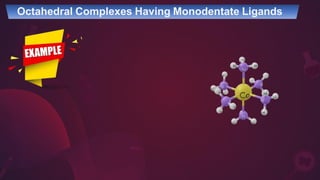
![Case 1(a)
n±
[M(a)6]
Does not show GI
a
a
Octahedral Complexes Having Monodentate Ligands](https://image.slidesharecdn.com/l3-250408090410-761c20a0/85/coordination-geometry-class-12-very-brilliant-presentation-95-320.jpg)
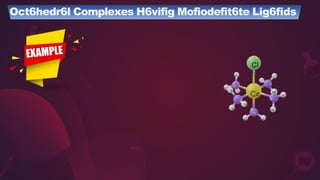
![b
n±
[Ma5b]
Does not show GI
a
Case 1(b)
Octahedral Complexes Having Monodentate Ligands](https://image.slidesharecdn.com/l3-250408090410-761c20a0/85/coordination-geometry-class-12-very-brilliant-presentation-97-320.jpg)
![[Ma4b2]n±
b
a
Cis
b
b
Trans
Possible number of
geometrical isomers
2
=
Case 1(c)
Octahedral Complexes Having Monodentate Ligands](https://image.slidesharecdn.com/l3-250408090410-761c20a0/85/coordination-geometry-class-12-very-brilliant-presentation-99-320.jpg)
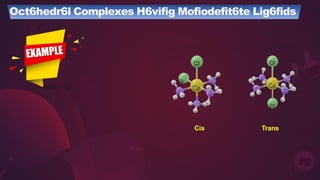
![b
a
Case 1(d)
Octahedral Complexes Having Monodentate Ligands
n±
[Ma2b2c2]
1](https://image.slidesharecdn.com/l3-250408090410-761c20a0/85/coordination-geometry-class-12-very-brilliant-presentation-101-320.jpg)
![a
a
a
a
Case 1(d)
Octahedral Complexes Having Monodentate Ligands
n±
[Ma2b2c2]
2 3](https://image.slidesharecdn.com/l3-250408090410-761c20a0/85/coordination-geometry-class-12-very-brilliant-presentation-102-320.jpg)
![b
b
c
c
n±
[Ma2b2c2]
Possible number of
geometrical isomers
= 5
Case 1(d)
Octahedral Complexes Having Monodentate Ligands
4 5](https://image.slidesharecdn.com/l3-250408090410-761c20a0/85/coordination-geometry-class-12-very-brilliant-presentation-103-320.jpg)
![Case 1(e)
3 3
[Ma b ]n±
a a
b
Facial (Fac)
b
Meridional (Mer)
Possible number of
geometrical isomers
= 2
Octahedral Complexes Having Monodentate Ligands
Have three
identical
ligands on one
triangular
face
Have three
identical
ligands in a
plane
bisecting the
molecule](https://image.slidesharecdn.com/l3-250408090410-761c20a0/85/coordination-geometry-class-12-very-brilliant-presentation-104-320.jpg)
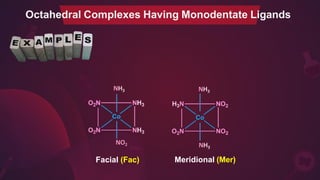
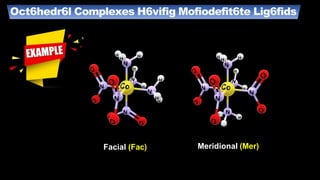
![Case 1(f)
[M(abcdef)]n±
Possible number of
geometrical isomers
15
=
Octahedral Complexes Having Monodentate Ligands](https://image.slidesharecdn.com/l3-250408090410-761c20a0/85/coordination-geometry-class-12-very-brilliant-presentation-107-320.jpg)
![Case 2(a)
n±
[M(AA)3]
Does not
show GI
A
A
Symmetrical Bidentate and Monodentate Ligands](https://image.slidesharecdn.com/l3-250408090410-761c20a0/85/coordination-geometry-class-12-very-brilliant-presentation-108-320.jpg)
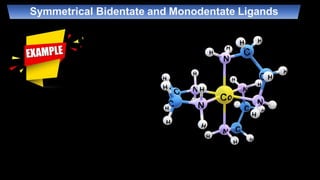
![Case 2(b) [M(AA)2a2]n±
Possible number of
geometrical isomers
= 2
a
a
A
cis
a
trans
Symmetrical Bidentate and Monodentate Ligands](https://image.slidesharecdn.com/l3-250408090410-761c20a0/85/coordination-geometry-class-12-very-brilliant-presentation-110-320.jpg)
![Symmetrical Bidentate and Monodentate Ligands
2+
2+
[Pt(en)2Cl2]2+
cis trans](https://image.slidesharecdn.com/l3-250408090410-761c20a0/85/coordination-geometry-class-12-very-brilliant-presentation-112-320.jpg)
![a
a
a
b
Case 2(c)
2 2
[M(AA)a b ]n±
Possible number of
geometrical isomers
3
=
b
b
Symmetrical Bidentate and Monodentate Ligands](https://image.slidesharecdn.com/l3-250408090410-761c20a0/85/coordination-geometry-class-12-very-brilliant-presentation-114-320.jpg)
![c
b
a
b
Case 2(d)
n±
[M(AA)a2bc]
Possible number of
geometrical isomers
= 4
a
a a
c
Symmetrical Bidentate and Monodentate Ligands](https://image.slidesharecdn.com/l3-250408090410-761c20a0/85/coordination-geometry-class-12-very-brilliant-presentation-116-320.jpg)
![Case 3(a)
3
[M(AB) ]n±
Possible number of
geometrical isomers
2
=
Unsymmetrical Bidentate and Monodentate Ligands
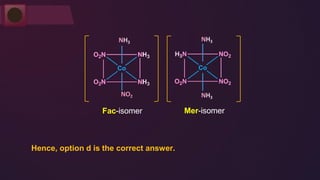
mer-isomer Fac-isomer](https://image.slidesharecdn.com/l3-250408090410-761c20a0/85/coordination-geometry-class-12-very-brilliant-presentation-118-320.jpg)
![[Co(gly)3]
Possible number of
geometrical isomers
= 2
Unsymmetrical Bidentate and Monodentate Ligands](https://image.slidesharecdn.com/l3-250408090410-761c20a0/85/coordination-geometry-class-12-very-brilliant-presentation-119-320.jpg)
![Case 3(b)
n±
[M(AB)2a2b2]
Possible number of
geometrical isomers
= 4
Unsymmetrical Bidentate and Monodentate Ligands](https://image.slidesharecdn.com/l3-250408090410-761c20a0/85/coordination-geometry-class-12-very-brilliant-presentation-121-320.jpg)
![Case 1(a)
Possible number of
enantiomers
0
=
Octahedral Complexes Having Monodentate Ligands
n±
[M(a4b2)]
Does not
show OI](https://image.slidesharecdn.com/l3-250408090410-761c20a0/85/coordination-geometry-class-12-very-brilliant-presentation-123-320.jpg)
![Case 1(b)
a
b
a
a
a
a b
c
Optically
active
Optically
inactive
Optically
inactive
Optically
inactive
Optically
inactive
n±
[M(a2b2c2)]
All possible
GIs
b c
Octahedral Complexes Having Monodentate Ligands](https://image.slidesharecdn.com/l3-250408090410-761c20a0/85/coordination-geometry-class-12-very-brilliant-presentation-124-320.jpg)
![Case 1(b)
a
b
a
b
n±
[Ma2b2c2]
Possible number of
enantiomeric pairs
1
=
Octahedral Complexes Having Monodentate Ligands
Total possible
stereoisomers
6
=
Optical
isomers](https://image.slidesharecdn.com/l3-250408090410-761c20a0/85/coordination-geometry-class-12-very-brilliant-presentation-125-320.jpg)
![Case 2(a)
A A
Possible number of
Enantiomeric pairs
= 1
Symmetrical Bidentate and Monodentate Ligands
Optical
[M(AA) ]n±
isomers
3
A A
Total possible
stereoisomers
2
=](https://image.slidesharecdn.com/l3-250408090410-761c20a0/85/coordination-geometry-class-12-very-brilliant-presentation-127-320.jpg)
![Case 2(b)
Possible
GI’s
n±
[M(AA)2ab]
a
A
A
Optically
active
b
Optically
inactive
Symmetrical Bidentate and Monodentate Ligands](https://image.slidesharecdn.com/l3-250408090410-761c20a0/85/coordination-geometry-class-12-very-brilliant-presentation-129-320.jpg)
![Case 2(b) [M(AA)2ab]n±
Possible number of
Enantiomeric pairs
1
=
A
A
A
A
Symmetrical Bidentate and Monodentate Ligands
Optical
isomers
Total possible
stereoisomers
3
=](https://image.slidesharecdn.com/l3-250408090410-761c20a0/85/coordination-geometry-class-12-very-brilliant-presentation-130-320.jpg)
![Case 3(a)
n±
[M(AB)3]
Optically
active
Optically
active
Unsymmetrical Bidentate and Monodentate Ligands
Possible
GI’s](https://image.slidesharecdn.com/l3-250408090410-761c20a0/85/coordination-geometry-class-12-very-brilliant-presentation-132-320.jpg)
![Possible number of
Enantiomeric pairs
2
=
[Co(gly)3]
Unsymmetrical Bidentate and Monodentate Ligands
Optical
isomers
Total possible
stereoisomers
4
=](https://image.slidesharecdn.com/l3-250408090410-761c20a0/85/coordination-geometry-class-12-very-brilliant-presentation-133-320.jpg)
![Case 3(b)
2 2
[M(AB) a ]n±
Unsymmetrical Bidentate and Monodentate Ligands
A A
A
A
B
A
A
B
Optical
isomers](https://image.slidesharecdn.com/l3-250408090410-761c20a0/85/coordination-geometry-class-12-very-brilliant-presentation-135-320.jpg)
![We know that ethylenediamine is a bidentate ligand and Co3+ forms an
octahedral complex having a co-ordination number 6.
Here, 2 moles of ethylenediamine can satisfy four co-ordination numbers.
The remaining two would be satisfied by existing chloride ions.
The reaction is,
CoCl3 +2C2H8N2 → [CoCl2(en)2]Cl
According to a given ratio, the above product can only be formed. As it
says there are two products, another product should be an isomer. The
possibility is that two Cl ions can be either in cis form or in trans-form. On
observing the cis form, there is no plane of symmetry and hence, it is chiral
and optically active, and the trans will be optically inactive.
Hence, they are Geometrical isomers of each other.
Hence, option c is the correct answer.](https://image.slidesharecdn.com/l3-250408090410-761c20a0/85/coordination-geometry-class-12-very-brilliant-presentation-138-320.jpg)
![Both (A) and (B) can be
optically active.
a
Both (A) and (B) can not be
optically active.
b
(A) can not be optically active, but
(B) can be optically active.
c
(A) can be optically active, but
(B) can not be optically active.
d
Consider the complex ions, trans-[Co(en)2Cl2]+ (A) and
cis-[Co(en)2Cl2]+ (B) The correct statement regarding them is:
(A) is trans-form and shows plane of
symmetry, which is optically
inactive.
(B) is cis-form and does not show
plane of symmetry. Hence, it is
optically active.
Hence, option c is the
correct answer.](https://image.slidesharecdn.com/l3-250408090410-761c20a0/85/coordination-geometry-class-12-very-brilliant-presentation-139-320.jpg)
![—
[Pt(NH3)Cl3]
a
b [PtCl2(NH3)2]
[Ni(CO)4]
c
[Co(NO2)3(NH3)3]
d
Which of the following complexes exhibit facial-meridional
geometrical isomerism?](https://image.slidesharecdn.com/l3-250408090410-761c20a0/85/coordination-geometry-class-12-very-brilliant-presentation-140-320.jpg)
![List I List II
(a) [Co(NH3)6][Cr(CN)6] (i)
Linkage
isomerism
[Co(NH3)3(NO2)3]
[Cr(H2O)6]Cl3
[CrCl2(ox)2]3−
Match List-I with List-II:](https://image.slidesharecdn.com/l3-250408090410-761c20a0/85/coordination-geometry-class-12-very-brilliant-presentation-142-320.jpg)
![a (a)-(iii), (b)-(i), (c)-(ii), (d)-(iv)
b (a)-(iv), (b)-(ii), (c)-(iii), (d)-(i)
c (a)-(ii), (b)-(i), (c)-(iii), (d)-(iv)
d (a)-(i), (b)-(ii), (c)-(iii), (d)-(iv)
Match List-I with List-II:
(a)-(iii), (b)-(i), (c)-(ii), (d)-(iv)
[Co(NH3)6][Cr(CN)6]
– Coordination isomerism
[Co(NH3)3(NO2)3] – Linkage isomerism
[Cr(H2O)6]Cl3– Solvate isomerism
[CrCl2(ox)2]3−– Optical isomerism
Hence, option a is the
correct answer.](https://image.slidesharecdn.com/l3-250408090410-761c20a0/85/coordination-geometry-class-12-very-brilliant-presentation-143-320.jpg)
![μex = 0
No unpaired
electrons
Diamagnetic
[Ag(NH3)2]
+
Coordination Number = 2](https://image.slidesharecdn.com/l3-250408090410-761c20a0/85/coordination-geometry-class-12-very-brilliant-presentation-159-320.jpg)
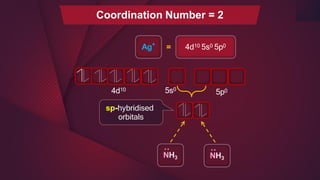
![Hybridisation sp
=
Shape Linear
=
+
[Ag(NH3)2]
Coordination Number = 2](https://image.slidesharecdn.com/l3-250408090410-761c20a0/85/coordination-geometry-class-12-very-brilliant-presentation-161-320.jpg)
![μex = 0
No unpaired
electron
Diamagnetic
Coordination Number = 3
_
[Hg(CN)3]](https://image.slidesharecdn.com/l3-250408090410-761c20a0/85/coordination-geometry-class-12-very-brilliant-presentation-162-320.jpg)
![Hybridisation sp2
=
Shape Trigonal planar
=
_
[Hg(CN)3]
Coordination Number = 3](https://image.slidesharecdn.com/l3-250408090410-761c20a0/85/coordination-geometry-class-12-very-brilliant-presentation-163-320.jpg)
![μex = 2.5 BM
2 unpaired
electrons
Paramagnetic
_
[Ni(Cl)4]2
Coordination Number = 4](https://image.slidesharecdn.com/l3-250408090410-761c20a0/85/coordination-geometry-class-12-very-brilliant-presentation-164-320.jpg)
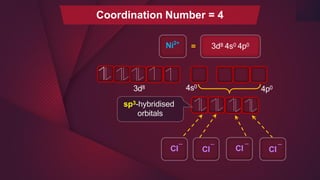
![Hybridisation sp3
=
Shape = Tetrahedral
2
_
[Ni(Cl)4]
Coordination Number = 4](https://image.slidesharecdn.com/l3-250408090410-761c20a0/85/coordination-geometry-class-12-very-brilliant-presentation-166-320.jpg)
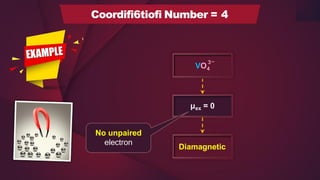
![μex = 0
Diamagnetic
No unpaired
electron
2_
[Ni(CN)4]
Coordination Number = 4](https://image.slidesharecdn.com/l3-250408090410-761c20a0/85/coordination-geometry-class-12-very-brilliant-presentation-167-320.jpg)
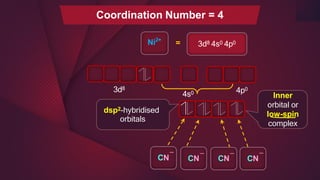
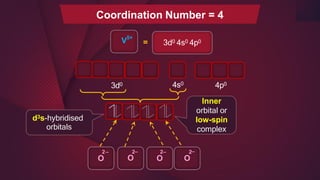
![dsp2
Hybridisation =
Shape
Square
planar
=
2
_
[Ni(CN)4]
Coordination Number = 4](https://image.slidesharecdn.com/l3-250408090410-761c20a0/85/coordination-geometry-class-12-very-brilliant-presentation-169-320.jpg)