Dr V.M. Bhuse, Department of Chemistry, Rajaram College, Kolhapur.
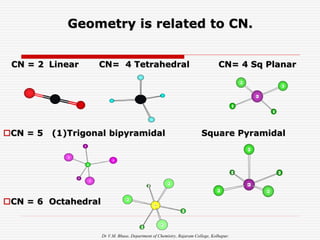
CN = 2 Linear CN= 4 Tetrahedral CN= 4 Sq Planar
CN = 5 (1)Trigonal bipyramidal Square Pyramidal
CN = 6 Octahedral
F
F
F
S
F
F
F
F
F
Br
F
F
I
I
I
P
I
I
I
F F
Br
F
F
F
Geometry is related to CN.
Dr V.M. Bhuse, Department of Chemistry, Rajaram College, Kolhapur.
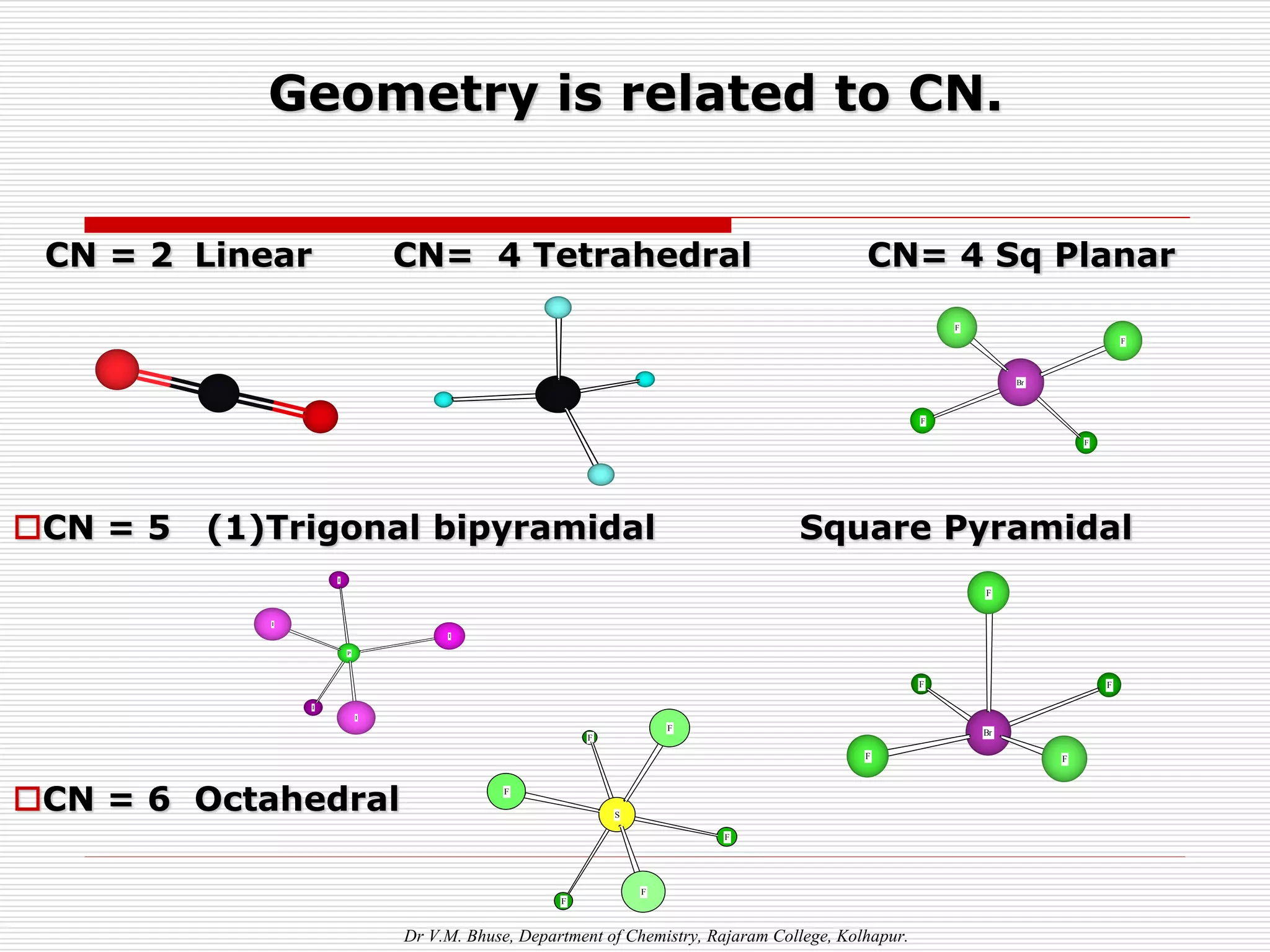
Geometry & C.N
Ag(NH3)2 Pt(NH3)4
Zn(NH3)4
Co(NH3)6
Dr V.M. Bhuse, Department of Chemistry, Rajaram College, Kolhapur.
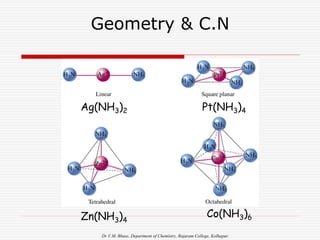
Relation between CN Hybridization &
Geometries
C N Hybridization Electron-group geometry Examples
2 sp Linear BeCl2
3 sp2 Trigonal planar BCl3
4 sp3 Tetrahedral SiCl3
5 dsp2 Square planar CuCl4
6 dsp3 Trigonal bipyramidal PCl5
7 d2sp3 Octahedral Ni(NH3)6
8 d3sp3 Pentagonal
bypyramidal
IF7
Dr V.M. Bhuse, Department of Chemistry, Rajaram College, Kolhapur.
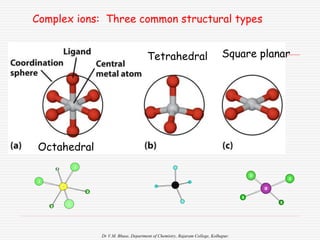
Complex ions: Three common structural types
Octahedral
Tetrahedral Square planar
F
F
F
S
F
F
F
F
F
Br
F
F
Dr V.M. Bhuse, Department of Chemistry, Rajaram College, Kolhapur.
GEOMETRY & CN More examples
CN Shape Example
 2 Linear [CuCl2]-, [Ag(NH3)2]+, [AuCl2]-
 4 Square Planar [Ni(CN)4] 2-, [PdCl4]2-
 [Pt(NH3)4] 2+, [Cu(NH3)4] 2+
 4 Tetrahedral [Cu(CN)4] 3-, [Zn(NH3)4]2+
 [CdCl4] 2-, [MnCl4] 2-
 6 Octahedral [Cu(H2O)6] 3+, [V(CN)6] 4-,
 [Cu(NH3)4Cl2] +, [Co(en)3] 3+
F
F
Br
F
F
F
F
F
S
F
F
F
Chapter Ten
Prentice Hall © 2005 General Chemistry 4th edition, Hill, Petrucci, McCreary, Perry
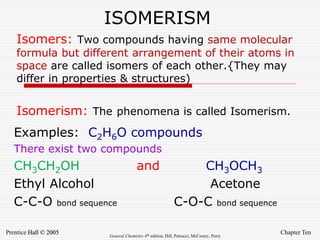
ISOMERISM
Examples: C2H6O compounds
There exist two compounds
CH3CH2OH and CH3OCH3
Ethyl Alcohol Acetone
C-C-O bond sequence C-O-C bond sequence
Isomers: Two compounds having same molecular
formula but different arrangement of their atoms in
space are called isomers of each other.{They may
differ in properties & structures)
Isomerism: The phenomena is called Isomerism.
Chapter Ten
Prentice Hall © 2005 General Chemistry 4th edition, Hill, Petrucci, McCreary, Perry
Isomers: The compounds having same molecular formula but
different arrangement of their atoms in space are called
isomers of each other.
CH3CH2OH and CH3OCH3
Ethyl Alcohol Acetone
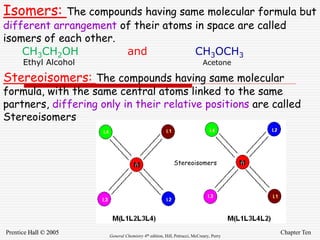
Stereoisomers: The compounds having same molecular
formula, with the same central atoms linked to the same
partners, differing only in their relative positions are called
Stereoisomers
Stereoisomers
Dr V.M. Bhuse, Department of Chemistry, Rajaram College, Kolhapur.
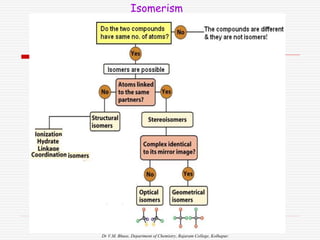
Isomerism
Chapter Ten
Prentice Hall © 2005 General Chemistry 4th edition, Hill, Petrucci, McCreary, Perry
Types of Stereoisomers
Two types;
a)Geometrical: Cis (Z)and Trans(E)
b)Optical: d (+) or l (-)
Chapter Ten
Prentice Hall © 2005 General Chemistry 4th edition, Hill, Petrucci, McCreary, Perry
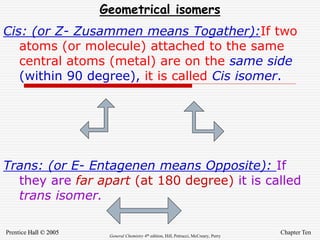
Geometrical isomers
Cis: (or Z- Zusammen means Togather):If two
atoms (or molecule) attached to the same
central atoms (metal) are on the same side
(within 90 degree), it is called Cis isomer.
Trans: (or E- Entagenen means Opposite): If
they are far apart (at 180 degree) it is called
trans isomer.
Chapter Ten
Prentice Hall © 2005 General Chemistry 4th edition, Hill, Petrucci, McCreary, Perry
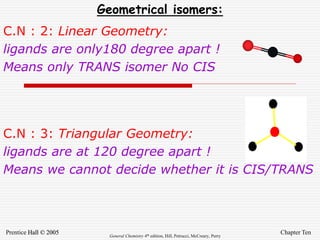
Geometrical isomers:
C.N : 2: Linear Geometry:
ligands are only180 degree apart !
Means only TRANS isomer No CIS
C.N : 3: Triangular Geometry:
ligands are at 120 degree apart !
Means we cannot decide whether it is CIS/TRANS
Chapter Ten
Prentice Hall © 2005 General Chemistry 4th edition, Hill, Petrucci, McCreary, Perry
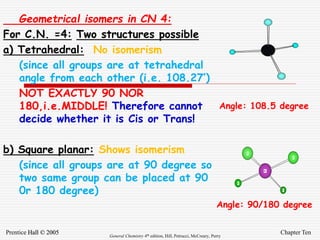
Geometrical isomers in CN 4:
For C.N. =4: Two structures possible
a) Tetrahedral: No isomerism
(since all groups are at tetrahedral
angle from each other (i.e. 108.27’)
NOT EXACTLY 90 NOR
180,i.e.MIDDLE! Therefore cannot
decide whether it is Cis or Trans!
b) Square planar: Shows isomerism
(since all groups are at 90 degree so
two same group can be placed at 90
0r 180 degree)
Angle: 108.5 degree
F
F
Br
F
F
Angle: 90/180 degree
Chapter Ten
Prentice Hall © 2005 General Chemistry 4th edition, Hill, Petrucci, McCreary, Perry
Geometrical isomers in Square Planar: (CN = 4)
Examples:
1. Ma2bc
or Mab2c
or Mabc2 [where, M=Pt, a= NH3, b= Py, c=H2O
]
L3 within 90:CIS L3 within 180:TRANS
Chapter Ten
Prentice Hall © 2005 General Chemistry 4th edition, Hill, Petrucci, McCreary, Perry
Geometrical isomers in Square Planar: (CN = 4)
Examples
2. Ma2b2
a a
M
b b
a b
M
b a
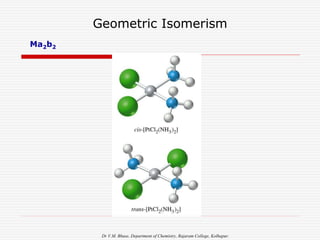
Trans:Ma2b2
Cis: Ma2b2
[e.g.M= Pt, Pd,A=Cl,Br,I , B=NH3, Py]
Dr V.M. Bhuse, Department of Chemistry, Rajaram College, Kolhapur.
Geometric Isomerism
Ma2b2
Chapter Ten
Prentice Hall © 2005 General Chemistry 4th edition, Hill, Petrucci, McCreary, Perry
Geometrical isomers in Square Planar: (CN = 4)
Examples
3.Mabcd
a c
M
d b
Cis: Trans:
a b
M
d c
[e.g. M =Pt,a= Py, b= NH3,c=Cl, d=Br ]
In such example, we have to consider any 2 ligand
same (e.g. a & c same)
Chapter Ten
Prentice Hall © 2005 General Chemistry 4th edition, Hill, Petrucci, McCreary, Perry
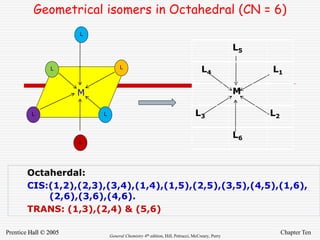
Geometrical isomers in Octahedral (CN = 6)
Octaherdal:
CIS:(1,2),(2,3),(3,4),(1,4),(1,5),(2,5),(3,5),(4,5),(1,6),
(2,6),(3,6),(4,6).
TRANS: (1,3),(2,4) & (5,6)
L5
L4 L1
M
L3 L2
L6
M
L
L
L
L
L
L
Chapter Ten
Prentice Hall © 2005 General Chemistry 4th edition, Hill, Petrucci, McCreary, Perry
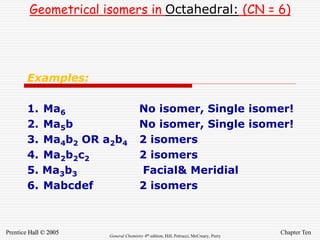
Geometrical isomers in Octahedral: (CN = 6)
Examples:
1. Ma6 No isomer, Single isomer!
2. Ma5b No isomer, Single isomer!
3. Ma4b2 OR a2b4 2 isomers
4. Ma2b2c2 2 isomers
5. Ma3b3 Facial& Meridial
6. Mabcdef 2 isomers
Dr V.M. Bhuse, Department of Chemistry, Rajaram College, Kolhapur.
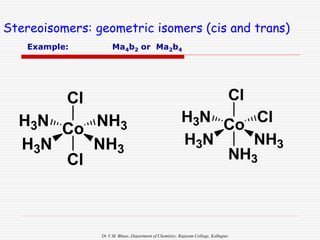
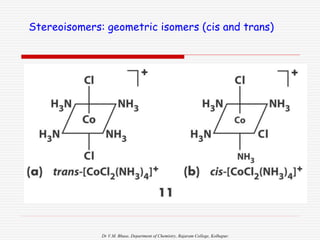
Stereoisomers: geometric isomers (cis and trans)
Cl
Co Cl
NH3
H3N
H3N
NH3
Cl
Co NH3
NH3
H3N
H3N
Cl
Example: Ma4b2 or Ma2b4
Dr V.M. Bhuse, Department of Chemistry, Rajaram College, Kolhapur.
Stereoisomers: geometric isomers (cis and trans)
Dr V.M. Bhuse, Department of Chemistry, Rajaram College, Kolhapur.
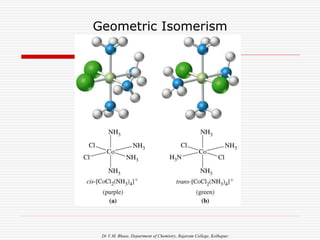
Geometric Isomerism
Dr V.M. Bhuse, Department of Chemistry, Rajaram College, Kolhapur.
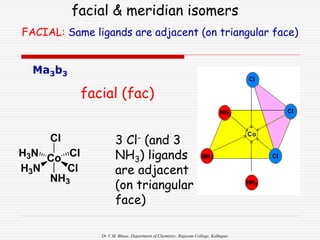
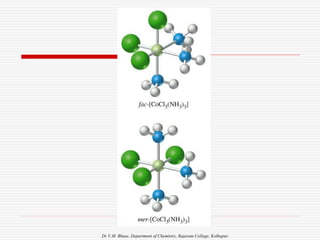
Ma3b3
facial & meridian isomers
facial (fac)
3 Cl- (and 3
NH3) ligands
are adjacent
(on triangular
face)
Cl
Co Cl
Cl
H3N
H3N
NH3
FACIAL: Same ligands are adjacent (on triangular face)
Dr V.M. Bhuse, Department of Chemistry, Rajaram College, Kolhapur.
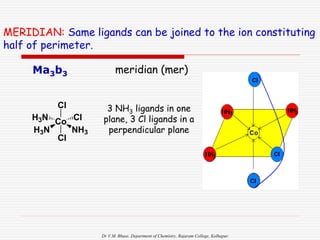
Ma3b3 meridian (mer)
3 NH3 ligands in one
plane, 3 Cl ligands in a
perpendicular plane
Cl
Co Cl
NH3
H3N
H3N
Cl
MERIDIAN: Same ligands can be joined to the ion constituting
half of perimeter.
Dr V.M. Bhuse, Department of Chemistry, Rajaram College, Kolhapur.
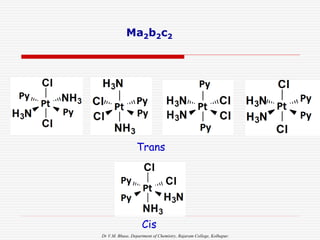
Ma2b2c2
Trans
Cis
Dr V.M. Bhuse, Department of Chemistry, Rajaram College, Kolhapur.
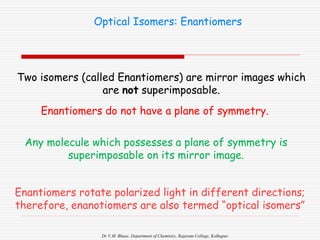
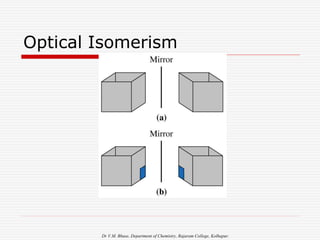
Optical Isomers: Enantiomers
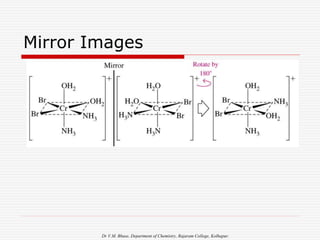
Two isomers (called Enantiomers) are mirror images which
are not superimposable.
Enantiomers do not have a plane of symmetry.
Any molecule which possesses a plane of symmetry is
superimposable on its mirror image.
Enantiomers rotate polarized light in different directions;
therefore, enanotiomers are also termed “optical isomers”
Dr V.M. Bhuse, Department of Chemistry, Rajaram College, Kolhapur.
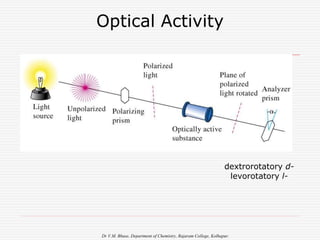
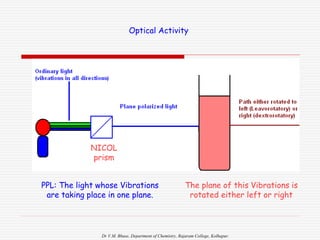
Optical Activity
dextrorotatory d-
levorotatory l-
Dr V.M. Bhuse, Department of Chemistry, Rajaram College, Kolhapur.
Optical Activity
The plane of this Vibrations is
rotated either left or right
PPL: The light whose Vibrations
are taking place in one plane.
NICOL
prism
Dr V.M. Bhuse, Department of Chemistry, Rajaram College, Kolhapur.
Optical Isomerism
Dr V.M. Bhuse, Department of Chemistry, Rajaram College, Kolhapur.
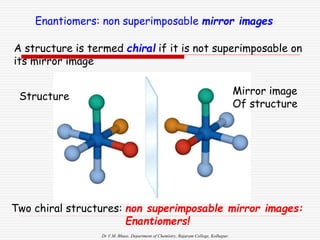
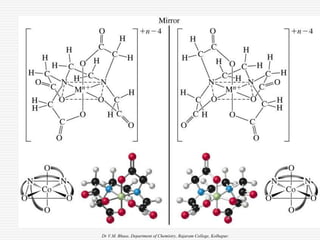
Enantiomers: non superimposable mirror images
A structure is termed chiral if it is not superimposable on
its mirror image
Two chiral structures: non superimposable mirror images:
Enantiomers!
Structure
Mirror image
Of structure
Dr V.M. Bhuse, Department of Chemistry, Rajaram College, Kolhapur.
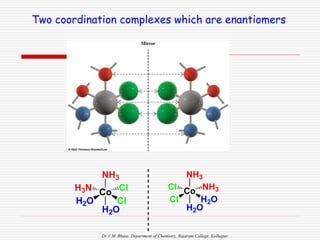
Two coordination complexes which are enantiomers
NH3
Co Cl
Cl
H2O
H3N
H2O
NH3
Co NH3
H2O
Cl
Cl
H2O
Dr V.M. Bhuse, Department of Chemistry, Rajaram College, Kolhapur.
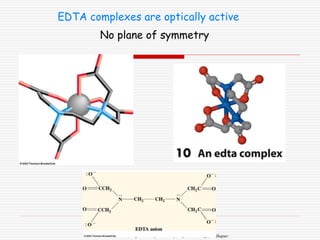
EDTA complexes are optically active
No plane of symmetry
Dr V.M. Bhuse, Department of Chemistry, Rajaram College, Kolhapur.
Plane of symmetry
Achiral (one structure)
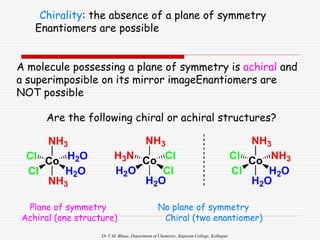
Chirality: the absence of a plane of symmetry
Enantiomers are possible
A molecule possessing a plane of symmetry is achiral and
a superimposible on its mirror imageEnantiomers are
NOT possible
No plane of symmetry
Chiral (two enantiomer)
NH3
Co H2O
H2O
Cl
Cl
NH3
NH3
Co Cl
Cl
H2O
H3N
H2O
NH3
Co NH3
H2O
Cl
Cl
H2O
Are the following chiral or achiral structures?
Dr V.M. Bhuse, Department of Chemistry, Rajaram College, Kolhapur.
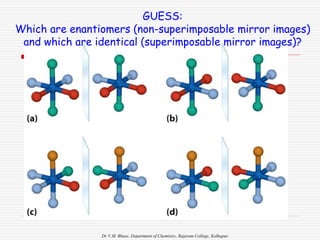
GUESS:
Which are enantiomers (non-superimposable mirror images)
and which are identical (superimposable mirror images)?
Dr V.M. Bhuse, Department of Chemistry, Rajaram College, Kolhapur.
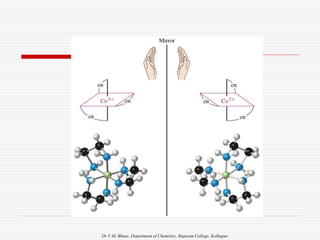
Mirror Images
Dr V.M. Bhuse, Department of Chemistry, Rajaram College, Kolhapur.

COORDN ISOMERS B.Sc II.ppt

  • 1.
    Dr V.M. Bhuse,Department of Chemistry, Rajaram College, Kolhapur. CN = 2 Linear CN= 4 Tetrahedral CN= 4 Sq Planar CN = 5 (1)Trigonal bipyramidal Square Pyramidal CN = 6 Octahedral F F F S F F F F F Br F F I I I P I I I F F Br F F F Geometry is related to CN.
  • 2.
    Dr V.M. Bhuse,Department of Chemistry, Rajaram College, Kolhapur. Geometry & C.N Ag(NH3)2 Pt(NH3)4 Zn(NH3)4 Co(NH3)6
  • 3.
    Dr V.M. Bhuse,Department of Chemistry, Rajaram College, Kolhapur. Relation between CN Hybridization & Geometries C N Hybridization Electron-group geometry Examples 2 sp Linear BeCl2 3 sp2 Trigonal planar BCl3 4 sp3 Tetrahedral SiCl3 5 dsp2 Square planar CuCl4 6 dsp3 Trigonal bipyramidal PCl5 7 d2sp3 Octahedral Ni(NH3)6 8 d3sp3 Pentagonal bypyramidal IF7
  • 4.
    Dr V.M. Bhuse,Department of Chemistry, Rajaram College, Kolhapur. Complex ions: Three common structural types Octahedral Tetrahedral Square planar F F F S F F F F F Br F F
  • 5.
    Dr V.M. Bhuse,Department of Chemistry, Rajaram College, Kolhapur. GEOMETRY & CN More examples CN Shape Example  2 Linear [CuCl2]-, [Ag(NH3)2]+, [AuCl2]-  4 Square Planar [Ni(CN)4] 2-, [PdCl4]2-  [Pt(NH3)4] 2+, [Cu(NH3)4] 2+  4 Tetrahedral [Cu(CN)4] 3-, [Zn(NH3)4]2+  [CdCl4] 2-, [MnCl4] 2-  6 Octahedral [Cu(H2O)6] 3+, [V(CN)6] 4-,  [Cu(NH3)4Cl2] +, [Co(en)3] 3+ F F Br F F F F F S F F F
  • 6.
    Chapter Ten Prentice Hall© 2005 General Chemistry 4th edition, Hill, Petrucci, McCreary, Perry ISOMERISM Examples: C2H6O compounds There exist two compounds CH3CH2OH and CH3OCH3 Ethyl Alcohol Acetone C-C-O bond sequence C-O-C bond sequence Isomers: Two compounds having same molecular formula but different arrangement of their atoms in space are called isomers of each other.{They may differ in properties & structures) Isomerism: The phenomena is called Isomerism.
  • 7.
    Chapter Ten Prentice Hall© 2005 General Chemistry 4th edition, Hill, Petrucci, McCreary, Perry Isomers: The compounds having same molecular formula but different arrangement of their atoms in space are called isomers of each other. CH3CH2OH and CH3OCH3 Ethyl Alcohol Acetone Stereoisomers: The compounds having same molecular formula, with the same central atoms linked to the same partners, differing only in their relative positions are called Stereoisomers Stereoisomers
  • 8.
    Dr V.M. Bhuse,Department of Chemistry, Rajaram College, Kolhapur. Isomerism
  • 9.
    Chapter Ten Prentice Hall© 2005 General Chemistry 4th edition, Hill, Petrucci, McCreary, Perry Types of Stereoisomers Two types; a)Geometrical: Cis (Z)and Trans(E) b)Optical: d (+) or l (-)
  • 10.
    Chapter Ten Prentice Hall© 2005 General Chemistry 4th edition, Hill, Petrucci, McCreary, Perry Geometrical isomers Cis: (or Z- Zusammen means Togather):If two atoms (or molecule) attached to the same central atoms (metal) are on the same side (within 90 degree), it is called Cis isomer. Trans: (or E- Entagenen means Opposite): If they are far apart (at 180 degree) it is called trans isomer.
  • 11.
    Chapter Ten Prentice Hall© 2005 General Chemistry 4th edition, Hill, Petrucci, McCreary, Perry Geometrical isomers: C.N : 2: Linear Geometry: ligands are only180 degree apart ! Means only TRANS isomer No CIS C.N : 3: Triangular Geometry: ligands are at 120 degree apart ! Means we cannot decide whether it is CIS/TRANS
  • 12.
    Chapter Ten Prentice Hall© 2005 General Chemistry 4th edition, Hill, Petrucci, McCreary, Perry Geometrical isomers in CN 4: For C.N. =4: Two structures possible a) Tetrahedral: No isomerism (since all groups are at tetrahedral angle from each other (i.e. 108.27’) NOT EXACTLY 90 NOR 180,i.e.MIDDLE! Therefore cannot decide whether it is Cis or Trans! b) Square planar: Shows isomerism (since all groups are at 90 degree so two same group can be placed at 90 0r 180 degree) Angle: 108.5 degree F F Br F F Angle: 90/180 degree
  • 13.
    Chapter Ten Prentice Hall© 2005 General Chemistry 4th edition, Hill, Petrucci, McCreary, Perry Geometrical isomers in Square Planar: (CN = 4) Examples: 1. Ma2bc or Mab2c or Mabc2 [where, M=Pt, a= NH3, b= Py, c=H2O ] L3 within 90:CIS L3 within 180:TRANS
  • 14.
    Chapter Ten Prentice Hall© 2005 General Chemistry 4th edition, Hill, Petrucci, McCreary, Perry Geometrical isomers in Square Planar: (CN = 4) Examples 2. Ma2b2 a a M b b a b M b a Trans:Ma2b2 Cis: Ma2b2 [e.g.M= Pt, Pd,A=Cl,Br,I , B=NH3, Py]
  • 15.
    Dr V.M. Bhuse,Department of Chemistry, Rajaram College, Kolhapur. Geometric Isomerism Ma2b2
  • 16.
    Chapter Ten Prentice Hall© 2005 General Chemistry 4th edition, Hill, Petrucci, McCreary, Perry Geometrical isomers in Square Planar: (CN = 4) Examples 3.Mabcd a c M d b Cis: Trans: a b M d c [e.g. M =Pt,a= Py, b= NH3,c=Cl, d=Br ] In such example, we have to consider any 2 ligand same (e.g. a & c same)
  • 17.
    Chapter Ten Prentice Hall© 2005 General Chemistry 4th edition, Hill, Petrucci, McCreary, Perry Geometrical isomers in Octahedral (CN = 6) Octaherdal: CIS:(1,2),(2,3),(3,4),(1,4),(1,5),(2,5),(3,5),(4,5),(1,6), (2,6),(3,6),(4,6). TRANS: (1,3),(2,4) & (5,6) L5 L4 L1 M L3 L2 L6 M L L L L L L
  • 18.
    Chapter Ten Prentice Hall© 2005 General Chemistry 4th edition, Hill, Petrucci, McCreary, Perry Geometrical isomers in Octahedral: (CN = 6) Examples: 1. Ma6 No isomer, Single isomer! 2. Ma5b No isomer, Single isomer! 3. Ma4b2 OR a2b4 2 isomers 4. Ma2b2c2 2 isomers 5. Ma3b3 Facial& Meridial 6. Mabcdef 2 isomers
  • 19.
    Dr V.M. Bhuse,Department of Chemistry, Rajaram College, Kolhapur. Stereoisomers: geometric isomers (cis and trans) Cl Co Cl NH3 H3N H3N NH3 Cl Co NH3 NH3 H3N H3N Cl Example: Ma4b2 or Ma2b4
  • 20.
    Dr V.M. Bhuse,Department of Chemistry, Rajaram College, Kolhapur. Stereoisomers: geometric isomers (cis and trans)
  • 21.
    Dr V.M. Bhuse,Department of Chemistry, Rajaram College, Kolhapur. Geometric Isomerism
  • 22.
    Dr V.M. Bhuse,Department of Chemistry, Rajaram College, Kolhapur. Ma3b3 facial & meridian isomers facial (fac) 3 Cl- (and 3 NH3) ligands are adjacent (on triangular face) Cl Co Cl Cl H3N H3N NH3 FACIAL: Same ligands are adjacent (on triangular face)
  • 23.
    Dr V.M. Bhuse,Department of Chemistry, Rajaram College, Kolhapur. Ma3b3 meridian (mer) 3 NH3 ligands in one plane, 3 Cl ligands in a perpendicular plane Cl Co Cl NH3 H3N H3N Cl MERIDIAN: Same ligands can be joined to the ion constituting half of perimeter.
  • 24.
    Dr V.M. Bhuse,Department of Chemistry, Rajaram College, Kolhapur.
  • 25.
    Dr V.M. Bhuse,Department of Chemistry, Rajaram College, Kolhapur. Ma2b2c2 Trans Cis
  • 26.
    Dr V.M. Bhuse,Department of Chemistry, Rajaram College, Kolhapur. Optical Isomers: Enantiomers Two isomers (called Enantiomers) are mirror images which are not superimposable. Enantiomers do not have a plane of symmetry. Any molecule which possesses a plane of symmetry is superimposable on its mirror image. Enantiomers rotate polarized light in different directions; therefore, enanotiomers are also termed “optical isomers”
  • 27.
    Dr V.M. Bhuse,Department of Chemistry, Rajaram College, Kolhapur. Optical Activity dextrorotatory d- levorotatory l-
  • 28.
    Dr V.M. Bhuse,Department of Chemistry, Rajaram College, Kolhapur. Optical Activity The plane of this Vibrations is rotated either left or right PPL: The light whose Vibrations are taking place in one plane. NICOL prism
  • 29.
    Dr V.M. Bhuse,Department of Chemistry, Rajaram College, Kolhapur. Optical Isomerism
  • 30.
    Dr V.M. Bhuse,Department of Chemistry, Rajaram College, Kolhapur. Enantiomers: non superimposable mirror images A structure is termed chiral if it is not superimposable on its mirror image Two chiral structures: non superimposable mirror images: Enantiomers! Structure Mirror image Of structure
  • 31.
    Dr V.M. Bhuse,Department of Chemistry, Rajaram College, Kolhapur. Two coordination complexes which are enantiomers NH3 Co Cl Cl H2O H3N H2O NH3 Co NH3 H2O Cl Cl H2O
  • 32.
    Dr V.M. Bhuse,Department of Chemistry, Rajaram College, Kolhapur. EDTA complexes are optically active No plane of symmetry
  • 33.
    Dr V.M. Bhuse,Department of Chemistry, Rajaram College, Kolhapur. Plane of symmetry Achiral (one structure) Chirality: the absence of a plane of symmetry Enantiomers are possible A molecule possessing a plane of symmetry is achiral and a superimposible on its mirror imageEnantiomers are NOT possible No plane of symmetry Chiral (two enantiomer) NH3 Co H2O H2O Cl Cl NH3 NH3 Co Cl Cl H2O H3N H2O NH3 Co NH3 H2O Cl Cl H2O Are the following chiral or achiral structures?
  • 34.
    Dr V.M. Bhuse,Department of Chemistry, Rajaram College, Kolhapur. GUESS: Which are enantiomers (non-superimposable mirror images) and which are identical (superimposable mirror images)?
  • 35.
    Dr V.M. Bhuse,Department of Chemistry, Rajaram College, Kolhapur.
  • 36.
    Dr V.M. Bhuse,Department of Chemistry, Rajaram College, Kolhapur. Mirror Images
  • 37.
    Dr V.M. Bhuse,Department of Chemistry, Rajaram College, Kolhapur.