Isomerism
1.Structural Isomerism
Inthis isomerism. isomers have different bonding pattern.
Different types of structural isomers are
(i) Linkage isomerism This type of isomerism is shown by
the coordination compounds having ambidentate ligands.
e.g.,[Co(NH3)5(NO2)]Cl and [Co(NH3)5(ONO)]Cl or
pentaammine nitrito- N Cobalt (III) chloride and
pentaammine nitrito-O-Cobalt (III) chloride.
(ii) Coordination isomerism This type of isomerism arises
from the interchange of ligands between cationic and
anionic complexes of different metal ions present in a
complex,
e.g.,[Cr(NH3)6] [Co(CN)6]and [Co(NH3)6] [Cr(CN)6]
3.
Isomerism
(iii) Ionisationisomerism This isomerism arise
due to exchange of ionisable anion with an anionic
ligand. e.g. [Co(NH3)5SO4]Br and [Co(NH3)5Br]SO4.
(iv) Solvate isomerism This is also known as
hydrate isomerism. In this isomerism, water is
taken as solvent. It has different number of water
molecules in the coordination sphere and outside
it.
e.g..[Co(H2O)6]Cl3, [Co(H2O)4Cl2]Cl·2H2O,
[Co(H2O)3Cl3]. 3H2O
4.
2. Stereoisomerism
Stereoisomershave the same chemical formula and chemical
bonds but they have different spatial arrangement. These are
of two types :
i) Geometrical isomerism
Geometrical isomers are of two types i.e., cis and trans
isomers.
This isomensm is common in complexes with coordination
number 4 and 6.
Geometrical isomerism in complexes with coordination
number 4
(i) Tetrahedral complexes do not show geometrical
isomerism.
(ii) Square planar complexes of formula [MX2L2] (X and L
are unidentate) show geometrical isomerism. The two X
ligands may be arranged adjacent to each other in a cis
isomer, or opposite to each other in a trans isomer, e.g.,
Square planar complexesof
formula [MABXL]
(iii) Square planar complex of the type [MABXL] (where A, B, X, L, are unidentate ligands)shows three isomers, two
cis and one trans.
e.g., [Pt(NH3) (Br)(Cl)(Py)].
7.
Geometrical isomerismin complexes with
coordination number 6
Octahedral complexes of formula [MX2L4], in
which the two X ligands may be oriented cis
ortrans to each other, e.g., [Co(NH3)4Cl2]+
8.
Geometrical isomerismin complexes with
coordination number 6
Octahedral complexes of formula [MX2A2], where X
are unidentate ligands and A are bidentate ligand.
form cis and trans isomers, e.g., [CoCl2(en)2]+
+ +
trans
cis
9.
Geometrical isomerismin complexes with
coordination number 6
In octahedral complexes of formula [MA3X3], if three
donor atoms of the same ligands occupy adjacent
positions at the corners of an octahedral face. it is
known as facial (fac) isomer, when the positions are
around the meridian of the octahedron, it is known as
meridional (mer)isomer. e.g.,

![Isomerism
1.Structural Isomerism
In this isomerism. isomers have different bonding pattern.
Different types of structural isomers are
(i) Linkage isomerism This type of isomerism is shown by
the coordination compounds having ambidentate ligands.
e.g.,[Co(NH3)5(NO2)]Cl and [Co(NH3)5(ONO)]Cl or
pentaammine nitrito- N Cobalt (III) chloride and
pentaammine nitrito-O-Cobalt (III) chloride.
(ii) Coordination isomerism This type of isomerism arises
from the interchange of ligands between cationic and
anionic complexes of different metal ions present in a
complex,
e.g.,[Cr(NH3)6] [Co(CN)6]and [Co(NH3)6] [Cr(CN)6]](https://image.slidesharecdn.com/isomers12th-250324130437-3593768a/85/Based-on-coordination-chemistry-Isomers-12th-based-2-320.jpg)
![Isomerism
(iii) Ionisation isomerism This isomerism arise
due to exchange of ionisable anion with an anionic
ligand. e.g. [Co(NH3)5SO4]Br and [Co(NH3)5Br]SO4.
(iv) Solvate isomerism This is also known as
hydrate isomerism. In this isomerism, water is
taken as solvent. It has different number of water
molecules in the coordination sphere and outside
it.
e.g..[Co(H2O)6]Cl3, [Co(H2O)4Cl2]Cl·2H2O,
[Co(H2O)3Cl3]. 3H2O](https://image.slidesharecdn.com/isomers12th-250324130437-3593768a/85/Based-on-coordination-chemistry-Isomers-12th-based-3-320.jpg)
![2. Stereoisomerism
Stereoisomers have the same chemical formula and chemical
bonds but they have different spatial arrangement. These are
of two types :
i) Geometrical isomerism
Geometrical isomers are of two types i.e., cis and trans
isomers.
This isomensm is common in complexes with coordination
number 4 and 6.
Geometrical isomerism in complexes with coordination
number 4
(i) Tetrahedral complexes do not show geometrical
isomerism.
(ii) Square planar complexes of formula [MX2L2] (X and L
are unidentate) show geometrical isomerism. The two X
ligands may be arranged adjacent to each other in a cis
isomer, or opposite to each other in a trans isomer, e.g.,](https://image.slidesharecdn.com/isomers12th-250324130437-3593768a/85/Based-on-coordination-chemistry-Isomers-12th-based-4-320.jpg)
![Square planar complexes of
formula [MX2L2]](https://image.slidesharecdn.com/isomers12th-250324130437-3593768a/85/Based-on-coordination-chemistry-Isomers-12th-based-5-320.jpg)
![Square planar complexes of
formula [MABXL]
(iii) Square planar complex of the type [MABXL] (where A, B, X, L, are unidentate ligands)shows three isomers, two
cis and one trans.
e.g., [Pt(NH3) (Br)(Cl)(Py)].](https://image.slidesharecdn.com/isomers12th-250324130437-3593768a/85/Based-on-coordination-chemistry-Isomers-12th-based-6-320.jpg)
![ Geometrical isomerism in complexes with
coordination number 6
Octahedral complexes of formula [MX2L4], in
which the two X ligands may be oriented cis
ortrans to each other, e.g., [Co(NH3)4Cl2]+](https://image.slidesharecdn.com/isomers12th-250324130437-3593768a/85/Based-on-coordination-chemistry-Isomers-12th-based-7-320.jpg)
![ Geometrical isomerism in complexes with
coordination number 6
Octahedral complexes of formula [MX2A2], where X
are unidentate ligands and A are bidentate ligand.
form cis and trans isomers, e.g., [CoCl2(en)2]+
+ +
trans
cis](https://image.slidesharecdn.com/isomers12th-250324130437-3593768a/85/Based-on-coordination-chemistry-Isomers-12th-based-8-320.jpg)
![ Geometrical isomerism in complexes with
coordination number 6
In octahedral complexes of formula [MA3X3], if three
donor atoms of the same ligands occupy adjacent
positions at the corners of an octahedral face. it is
known as facial (fac) isomer, when the positions are
around the meridian of the octahedron, it is known as
meridional (mer)isomer. e.g.,](https://image.slidesharecdn.com/isomers12th-250324130437-3593768a/85/Based-on-coordination-chemistry-Isomers-12th-based-9-320.jpg)
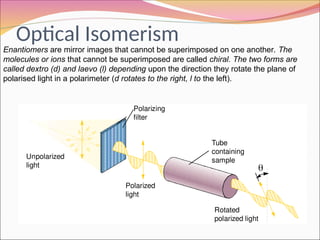
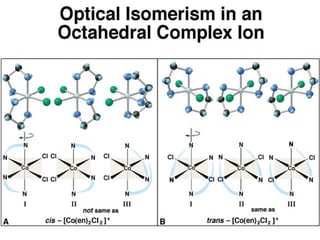
![Stereo Isomerism in
[[Fe(NH3)4Cl2]](https://image.slidesharecdn.com/isomers12th-250324130437-3593768a/85/Based-on-coordination-chemistry-Isomers-12th-based-12-320.jpg)