How To Boost Hospital Performance By
Optimizing Your Pharmacy
July 15, 2015
&
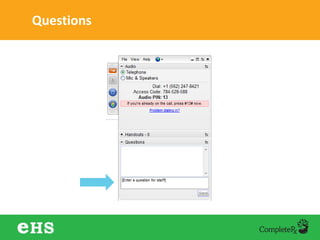
Questions
Speakers
Michael Talerico, Envigorate
Managing Partner
www.envigoratehealthcare.com
Joe Vargas, CompleteRx
Regional Director
www.completerx.com
Today's Objectives
1. Historical and current practices
2. Pros and cons of current options
3. Common metrics and how to choose
4. Managing a productivity target
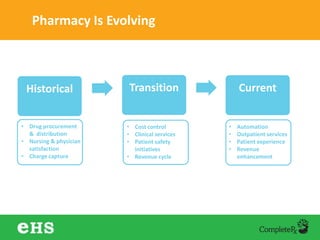
Pharmacy Is Evolving
Historical Transition Current
• Drug procurement
& distribution
• Nursing & physician
satisfaction
• Charge capture
• Cost control
• Clinical services
• Patient safety
initiatives
• Revenue cycle
• Automation
• Outpatient services
• Patient experience
• Revenue
enhancement
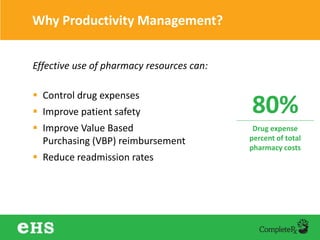
Why Productivity Management?
Effective use of pharmacy resources can:
 Control drug expenses
 Improve patient safety
 Improve Value Based
Purchasing (VBP) reimbursement
 Reduce readmission rates
80%
Drug expense
percent of total
pharmacy costs
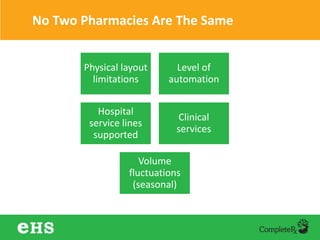
No Two Pharmacies Are The Same
Physical layout
limitations
Level of
automation
Hospital
service lines
supported
Clinical
services
Volume
fluctuations
(seasonal)
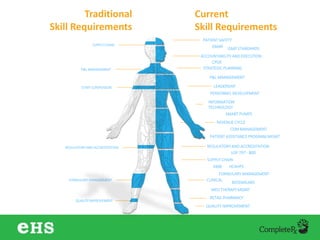
Current
Skill Requirements
Traditional
Skill Requirements
SUPPLY CHAIN
P&L MANAGEMENT
STAFF SUPERVISION
FORMULARY MANAGEMENT
QUALITY IMPROVEMENT
REGULATORY AND ACCREDITATION
HCAHPS
EMAR
CPOE
SMART PUMPS
340B
USP 797 - 800
BIOSIMILARS
MED THERAPY MGMT
ISMP STANDARDS
STRATEGIC PLANNING
P&L MANAGEMENT
PATIENT ASSISTANCE PROGRAM MGMT
RETAIL PHARMACY
FORMULARY MANAGEMENT
PERSONNEL DEVELOPMENT
CDM MANAGEMENT
PATIENT SAFETY
INFORMATION
TECHNOLOGY
LEADERSHIP
REVENUE CYCLE
REGULATORY AND ACCREDITATION
SUPPLY CHAIN
CLINICAL
ACCOUNTABILITY AND EXECUTION
QUALITY IMPROVEMENT
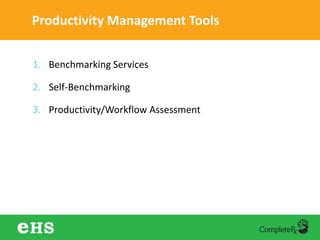
Productivity Management Tools
1. Benchmarking Services
2. Self-Benchmarking
3. Productivity/Workflow Assessment
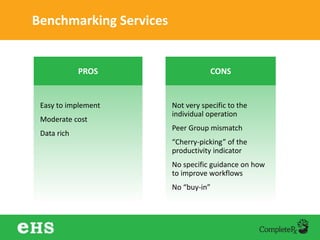
Benchmarking Services
PROS
Easy to implement
Moderate cost
Data rich
CONS
Not very specific to the
individual operation
Peer Group mismatch
“Cherry-picking” of the
productivity indicator
No specific guidance on how
to improve workflows
No “buy-in”
Self Benchmarking
Pros
 “Best Period
Average”
 No cost
 Facility specific
Cons
 Current status quo
 No specific guidance
Productivity/Workflow Assessment
Gap Analysis
Workflow Analysis
Customize to Facility
Staff Engagement
What is a Volume Indicator?
Indicator for determining
pharmacy’s target staffing
Used as a “surrogate” for all
of the activities
The denominator in the
productivity target
There is no “perfect”
volume indicator!
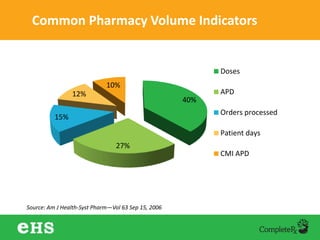
Common Pharmacy Volume Indicators
40%
27%
15%
12%
10%
Doses
APD
Orders processed
Patient days
CMI APD
Source: Am J Health-Syst Pharm—Vol 63 Sep 15, 2006
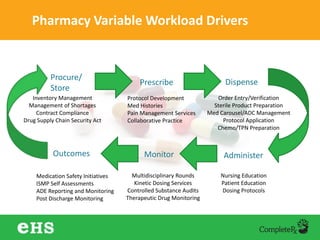
Pharmacy Variable Workload Drivers
Prescribe Dispense
AdministerMonitorOutcomes
Procure/
Store
Protocol Development
Med Histories
Pain Management Services
Collaborative Practice
Nursing Education
Patient Education
Dosing Protocols
Multidisciplinary Rounds
Kinetic Dosing Services
Controlled Substance Audits
Therapeutic Drug Monitoring
Medication Safety Initiatives
ISMP Self Assessments
ADE Reporting and Monitoring
Post Discharge Monitoring
Inventory Management
Management of Shortages
Contract Compliance
Drug Supply Chain Security Act
Order Entry/Verification
Sterile Product Preparation
Med Carousel/ADC Management
Protocol Application
Chemo/TPN Preparation
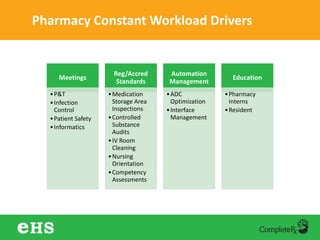
Pharmacy Constant Workload Drivers
Meetings
•P&T
•Infection
Control
•Patient Safety
•Informatics
Reg/Accred
Standards
•Medication
Storage Area
Inspections
•Controlled
Substance
Audits
•IV Room
Cleaning
•Nursing
Orientation
•Competency
Assessments
Automation
Management
•ADC
Optimization
•Interface
Management
Education
•Pharmacy
Interns
•Resident
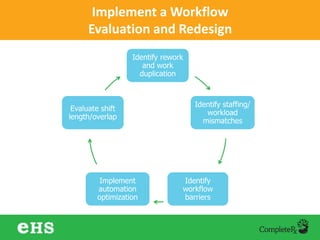
Implement a Workflow
Evaluation and Redesign
Identify rework
and work
duplication
Identify staffing/
workload
mismatches
Identify
workflow
barriers
Implement
automation
optimization
Evaluate shift
length/overlap
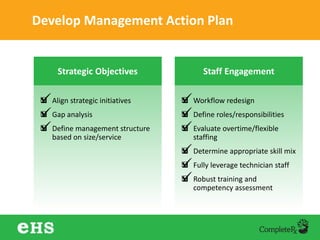
Develop Management Action Plan
Strategic Objectives
 Align strategic initiatives
 Gap analysis
 Define management structure
based on size/service
Staff Engagement
 Workflow redesign
 Define roles/responsibilities
 Evaluate overtime/flexible
staffing
 Determine appropriate skill mix
 Fully leverage technician staff
 Robust training and
competency assessment
Key Drivers for Success
Decide on a process
Pick a volume indicator
Measure productivity
Manage staffing resources
Implement an ongoing
review process
“You can only manage what you measure.”
Hospital Pharmacy Productivity
FROM TO
3436 3787 3.50 4.00 1.75 2.90 1.50 1.60 6.50 3.50 2.80 28.05
3788 4140 3.50 4.00 1.75 2.90 1.50 1.60 7.00 4.00 2.80 29.05
4141 4492 3.50 4.50 1.75 2.90 1.50 1.60 7.50 4.50 2.80 30.55
4493 4844 3.50 5.00 1.75 2.90 1.50 1.60 8.00 4.50 2.80 31.55 0.5383
4845 5196 3.50 5.00 1.75 2.90 1.50 1.60 8.50 5.00 2.80 32.55
5197 5548 3.50 5.50 1.75 2.90 1.50 1.60 9.00 5.00 2.80 33.55
5549 5900 3.50 5.50 1.75 2.90 1.50 2.00 9.50 5.50 2.80 34.95
Leadership Breakdown (Fixed) FTEs
Director 1.0
IT Coordinator 0.9
Inventory Clerk 0.9
Courier for Hospice Patients 0.7
EPRS Example
Patient and
Provider
Satisfaction
Patient Safety
Medication Cost
Management
Hospital Pharmacy Productivity
Rx
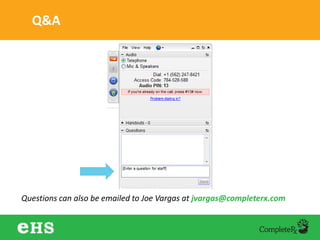
Q&A
Questions can also be emailed to Joe Vargas at jvargas@completerx.com

How To Boost Hospital Performance By Optimizing Your Pharmacy

  • 1.
    How To BoostHospital Performance By Optimizing Your Pharmacy July 15, 2015 &
  • 2.
  • 3.
    Speakers Michael Talerico, Envigorate ManagingPartner www.envigoratehealthcare.com Joe Vargas, CompleteRx Regional Director www.completerx.com
  • 4.
    Today's Objectives 1. Historicaland current practices 2. Pros and cons of current options 3. Common metrics and how to choose 4. Managing a productivity target
  • 5.
    Pharmacy Is Evolving HistoricalTransition Current • Drug procurement & distribution • Nursing & physician satisfaction • Charge capture • Cost control • Clinical services • Patient safety initiatives • Revenue cycle • Automation • Outpatient services • Patient experience • Revenue enhancement
  • 6.
    Why Productivity Management? Effectiveuse of pharmacy resources can:  Control drug expenses  Improve patient safety  Improve Value Based Purchasing (VBP) reimbursement  Reduce readmission rates 80% Drug expense percent of total pharmacy costs
  • 7.
    No Two PharmaciesAre The Same Physical layout limitations Level of automation Hospital service lines supported Clinical services Volume fluctuations (seasonal)
  • 8.
    Current Skill Requirements Traditional Skill Requirements SUPPLYCHAIN P&L MANAGEMENT STAFF SUPERVISION FORMULARY MANAGEMENT QUALITY IMPROVEMENT REGULATORY AND ACCREDITATION HCAHPS EMAR CPOE SMART PUMPS 340B USP 797 - 800 BIOSIMILARS MED THERAPY MGMT ISMP STANDARDS STRATEGIC PLANNING P&L MANAGEMENT PATIENT ASSISTANCE PROGRAM MGMT RETAIL PHARMACY FORMULARY MANAGEMENT PERSONNEL DEVELOPMENT CDM MANAGEMENT PATIENT SAFETY INFORMATION TECHNOLOGY LEADERSHIP REVENUE CYCLE REGULATORY AND ACCREDITATION SUPPLY CHAIN CLINICAL ACCOUNTABILITY AND EXECUTION QUALITY IMPROVEMENT
  • 9.
    Productivity Management Tools 1.Benchmarking Services 2. Self-Benchmarking 3. Productivity/Workflow Assessment
  • 10.
    Benchmarking Services PROS Easy toimplement Moderate cost Data rich CONS Not very specific to the individual operation Peer Group mismatch “Cherry-picking” of the productivity indicator No specific guidance on how to improve workflows No “buy-in”
  • 11.
    Self Benchmarking Pros  “BestPeriod Average”  No cost  Facility specific Cons  Current status quo  No specific guidance
  • 12.
    Productivity/Workflow Assessment Gap Analysis WorkflowAnalysis Customize to Facility Staff Engagement
  • 13.
    What is aVolume Indicator? Indicator for determining pharmacy’s target staffing Used as a “surrogate” for all of the activities The denominator in the productivity target There is no “perfect” volume indicator!
  • 14.
    Common Pharmacy VolumeIndicators 40% 27% 15% 12% 10% Doses APD Orders processed Patient days CMI APD Source: Am J Health-Syst Pharm—Vol 63 Sep 15, 2006
  • 15.
    Pharmacy Variable WorkloadDrivers Prescribe Dispense AdministerMonitorOutcomes Procure/ Store Protocol Development Med Histories Pain Management Services Collaborative Practice Nursing Education Patient Education Dosing Protocols Multidisciplinary Rounds Kinetic Dosing Services Controlled Substance Audits Therapeutic Drug Monitoring Medication Safety Initiatives ISMP Self Assessments ADE Reporting and Monitoring Post Discharge Monitoring Inventory Management Management of Shortages Contract Compliance Drug Supply Chain Security Act Order Entry/Verification Sterile Product Preparation Med Carousel/ADC Management Protocol Application Chemo/TPN Preparation
  • 16.
    Pharmacy Constant WorkloadDrivers Meetings •P&T •Infection Control •Patient Safety •Informatics Reg/Accred Standards •Medication Storage Area Inspections •Controlled Substance Audits •IV Room Cleaning •Nursing Orientation •Competency Assessments Automation Management •ADC Optimization •Interface Management Education •Pharmacy Interns •Resident
  • 17.
    Implement a Workflow Evaluationand Redesign Identify rework and work duplication Identify staffing/ workload mismatches Identify workflow barriers Implement automation optimization Evaluate shift length/overlap
  • 18.
    Develop Management ActionPlan Strategic Objectives  Align strategic initiatives  Gap analysis  Define management structure based on size/service Staff Engagement  Workflow redesign  Define roles/responsibilities  Evaluate overtime/flexible staffing  Determine appropriate skill mix  Fully leverage technician staff  Robust training and competency assessment
  • 19.
    Key Drivers forSuccess Decide on a process Pick a volume indicator Measure productivity Manage staffing resources Implement an ongoing review process “You can only manage what you measure.”
  • 20.
    Hospital Pharmacy Productivity FROMTO 3436 3787 3.50 4.00 1.75 2.90 1.50 1.60 6.50 3.50 2.80 28.05 3788 4140 3.50 4.00 1.75 2.90 1.50 1.60 7.00 4.00 2.80 29.05 4141 4492 3.50 4.50 1.75 2.90 1.50 1.60 7.50 4.50 2.80 30.55 4493 4844 3.50 5.00 1.75 2.90 1.50 1.60 8.00 4.50 2.80 31.55 0.5383 4845 5196 3.50 5.00 1.75 2.90 1.50 1.60 8.50 5.00 2.80 32.55 5197 5548 3.50 5.50 1.75 2.90 1.50 1.60 9.00 5.00 2.80 33.55 5549 5900 3.50 5.50 1.75 2.90 1.50 2.00 9.50 5.50 2.80 34.95 Leadership Breakdown (Fixed) FTEs Director 1.0 IT Coordinator 0.9 Inventory Clerk 0.9 Courier for Hospice Patients 0.7
  • 21.
  • 22.
    Patient and Provider Satisfaction Patient Safety MedicationCost Management Hospital Pharmacy Productivity Rx
  • 23.
    Q&A Questions can alsobe emailed to Joe Vargas at jvargas@completerx.com

Editor's Notes

  • #5 The hospital pharmacy can be one of the most challenging areas to establish a productivity metric by which to manage the staffing requirement. In the presentation today we want accomplish a few goals; • Define the historical and current practice environment in pharmacy • Understand the pros and cons of current options for determining productivity targets • Understand the most common productivity volume metrics and how to choose one • Present best practice options for managing to a productivity target
  • #6 Historical Years ago the hospital pharmacy environment was much different than today Primary function was drug procurement and distribution Maintain high nursing and physician satisfaction Ensure charge capture (paid % of charges) Transitions During the last 20 years there have been a significant changes in the pharmacy environment Prospective reimbursement (DRG, OPPS) – cost control Advent of functional information systems Expansion of clinical pharmacy services (Nutritional support, dosing of high risk drugs) Patient safety initiatives (ISMP, NCC-MERP), and More pharmacy involvement in revenue cycle Current Practice has evolved into Robust automation management responsibilities (Medication carousels, ADM, robotics, CPOE, BMV, Smart pumps, Meaningful use) Further expansion of clinical services (Dosing, protocol development, clinical decision support, utilization management) Patient safety initiatives Medication use management Decentralization of pharmacy services Medication reconciliation Discharge patient medication education Supply chain (Procurement, contract compliance, inventory management, Shortages, DSCSA-pedigree documentation requirements, 340B) Revenue cycle (Charge capture, drug dictionary management, CDM management, reconciliation, 340B) Medication distribution
  • #7 So why productivity management?... The underlying goal to any productivity management system is to be good stewards of scarce resources and ensure the right amount of staffing resource is used efficiently and effectively to maintain safety, quality and service. Drug expenses make up about 80% of pharmacy costs. Effective drug utilization management by the clinical pharmacy staff can have a significant impact on those expenses. Improve patient safety through management of drug protocols and clinical decision support Improve Value Based Purchasing (VBP) reimbursement and reduce readmission rates with pharmacist provided patient medication education
  • #8 I don’t think anyone will disagree that no two pharmacies are the same. Some of the differences can include: Physical layout limitations. That can include limitations within the pharmacy and/or the layout of the hospital campus. Level of automation in place (ADM, Carousel, CPOE, standard order sets, protocols) Hospital service lines supported. A hospital with a heavy medical oncology practice will have a higher pharmacy staffing requirement than a similar pharmacy that does not. (Chemo, Ortho, Neuro, Peds, NICU, Transplant) Clinical services provided and the level of decentralization will have an impact on staffing as well…. (Dosing protocols, therapeutic interchange, IV to PO conversion, medication histories, Medication reconciliation, decentralized services, patient rounding, discharge patient education) And seasonal volume fluctuations if you are located in such an area.
  • #9 Pharmacy is a complex department. It touches almost every other department at multiple levels including supply chain, clinical, safety, regulatory and revenue cycle. And the role and complexity of pharmacy management has evolved over the last several years leading to a reassessment of department staffing requirements. Pharmacy has really become a business within a business with responsibilities for… Information Technology – Information not data; HIS systems, medication cabinets, Strategic planning as the industry transitions from sickness to wellness. The focus on outpatient clinics and retail pharmacies adds to the complexity of regulatory compliance and hospital liability Meaningful use and cost of not being compliant HCAHPS scores and Readmission rates and their impact on reimbursement And Personnel development and competency assessment to name a few MIKE… had a comment about strategic planning
  • #10 So the Productivity Management Tools currently available to us fall into three general categories: Benchmarking services (External benchmarking) Self benchmarking (Internal benchmarking) Productivity/Workflow Assessment (Consult service) We’re going to go over each of these in the next few slides…
  • #11 1st Type of Productivity Management Tool are external Benchmarking services Several available such as Quantify (AMS), Insights (Healthcare Insights), Operations Advisor (Premier), Main advantages to using an external benchmarking service is that it is… Fairly easy to implement Moderate to no cost There is a lot of data available The challenges are that it is … Not very specific to the individual operation, we mentioned earlier that no two pharmacies are the same… I would say that one of the biggest disadvantages is Peer Group mismatch. Hospitals tend to pick peer groups based on hosp type (for profit/NFP; community host/medical center), also their bed size, payor mix, CMI. In the case of the pharmacy elements like service lines supported, clinical services provided, pharmacy intensity score, and level of automation may be most important) “Cherry-picking” of the productivity indicator. There are several pharmacy productivity indicators each of which can have a significantly different impact on target staffing levels. The benchmarking service only provides a target, but no specific guidance on how to improve workflows to achieve that target No “buy-in” from the staff because there is no staff engagement in the process
  • #12 The 2nd type of Productivity Management Tool is Self benchmarking (Internal benchmarking) Advantages here are that… This type of benchmarking is easy to implement using a “best period average” as a starting point for a target Pause – Mike had a comment about budget… Little to no cost And it is specific to the existing operation Disadvantages “Best period average” is still based on current “status quo” No specific guidance on how to improve workflows and possibly improve productivity
  • #13 The 3rd type of productivity management tool is a Productivity and Workflow Assessment. This is typically a Consult service. Advantages include… Evaluation against “best practice” through a gap analysis tool. There are several excellent tools available through our professional organizations. The resulting target is customized to the department’s and hospital’s specific environment. There is staff involvement and engagement in the process. It provides specific workload requirements by skill mix and by time of day. Pause…Mike, made a comment about educational opportunities, strengths and weakness, learning the process for future review and evaluation of the target… It identifies any mismatch of workload to staffing resource. It provides for assistance with workflow redesign (consulting engagement) Provides a functional productivity management tool that is easy to review and revise as needed Few disadvantages… It requires departmental resources to complete for data collection and evaluation of workload redesign. That’s not necessarily a bad thing since this also provides for staff engagement which is important to a successful implementation.
  • #14 One of the decisions to be made when implementing a productivity target is the selection of a volume indicator So what is a volume indicator? The indicator that the pharmacy’s target will be based on Used as a “surrogate” for all of the activities required to provide pharmacy services based on volume And it’s the denominator in the productivity target for example if APD are being used and the volume indicator, a productivity target may be 0.54 hours worked/APD. APD is the volume indicator. Pause for Mike…Use of a single metric to indicate… I think everyone will agree there is no “perfect” volume indicator, but we have to pick one and it has to be meaningful, accurate and practical.
  • #15 Some of the common volume indicators for pharmacy are listed here: *The total percentage exceeds 100 because respondents in the survey referenced were instructed to select all applicable indicators and some picked more than one Doses (Doses billed/ doses dispensed, doses administered) Adjusted patient days (hospital or pharmacy) Orders processed Patient Days CMI Adjusted Patient Days Comment? Even though this reference is a little dated this breakdown is still what we are seeing for the most part.
  • #16 We won’t go through this entire slide and it certainly is not all inclusive but any productivity target must include all workload drivers. There are many activities involved in the Medication Use cycle, that includes distributive, operational, patient safety and clinical functions. Activities are considered variable activities when they are driven by the inpatient and outpatient volumes. (Hit on some of the high point drivers?) Mike… (The info below is just for reference) What are the activities that drive pharmacy workload? Orders processed (Entered/Verified) Doses processed (ADM fill/check, first dose) IVs processed (Stat, first dose, batched) Chemo doses prepared Phone calls Clinical services provided Dosing protocols Therapeutic interchange IV to PO conversion Pain management Medication histories Medication reconciliation Decentralized services Multidisciplinary patient rounding Discharge patient education
  • #17 There is also a list of workload drivers that are considered constants, in other words independent of patient volumes. Again, this is not an all inclusive list but rather an example of some of those constant activities that have to be considered when determining staffing requirements.
  • #18 Mike will take the lead from this slide forward… One of the most important elements of effective productivity improvement is workflow evaluation and redesign. Whether you plan on implementing a workflow evaluation and redesign through an internal lean process or with the assistance of a consultant engagement, some of the steps involved include… Identify rework and work duplication within existing processes Identify staffing/workload mismatches through focused TOD analysis Identify workflow barriers. Ask your staff, they can usually get you started. Implement automation optimization, especially of your automated dispensing cabinets. It is not unusual to find that little optimization has occurred since the automation was originally implemented. Evaluate shift length and shift overlap. In the past some pharmacy departments switched to 10 hour shifts for some or all of their staff as a recruitment strategy. While this may be a staff satisfier, it may also cause extended shift overlap periods that are not fully productive. It also limits the number of days covered per week. So these are just a few areas that can be targeted for productivity improvements.
  • #19 Mike is on lead… We’ve talked about the workload drivers that need to be included in determining a productivity standard. Now let’s look at some of the higher level processes and evaluations that should happen as part of an evaluation of staffing requirements starting with... Strategic Objectives It’s important to align the pharmacy’s strategic plan with the hospital’s strategic initiatives. Perform a gap analysis to ensure the pharmacy is functioning in compliance with all regulatory and accreditation standards and at a “best practice” level. There are several tools available for this through the professional organizations. Make sure your management structure is appropriate for the size and complexity of your pharmacy and hospital Based on the results of the assessment and redesign develop a Management Action Plan. Staff engagement is important for any productivity management system to be successful. Elements of this plan usually include… What are we going to change to improve staff utilization How long will it take to achieve the objective Routine discussion and adjustment to plan to continue momentum (Engage Sr Leadership and Physicians) Evaluate overtime/flexible staffing Determine appropriate skill mix Fully leverage technician staff
  • #20 Mike is on lead… As we near the end of our presentation we would like to review the key elements of a successful productivity plan. Be decisive and select a process that will enable a hospital specific target, one that you can believe in. Determine the best single volume indicator and validate for consistent accuracy. Measure, talk and make productivity part of your department culture. Share challenges and success and empower creativity and change. That will lead to more effective use of department resources. And remember, this process never ends. One thing is certain, we will need to improve efficiency well into the future. Continual review and improvement is paramount to success. Joe’s comment… The ongoing review process with staff involvement is an important element that often gets overlooked. We’ve mentioned how much change has occurred in pharmacy over time and there is no indication that trend won’t continue. Without an ongoing review process this tool can lose it’s relevance over time.
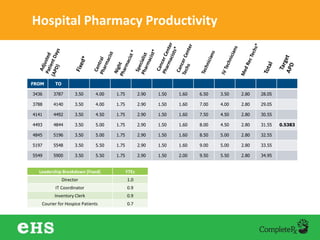
  • #21 This is a sample staffing matrix for a pharmacy department. Please note, the department is counting Adjusted Patient Days as its MVI. All staff and skills are listed and the appropriate target determined for the average biweekly volume. This provides guidance and should be used as part of the decision process when setting schedules, staffing, and employee requisition. This type of tool enables a deeper understanding of a productivity target by all levels of leadership. If the department is understaffed, we will know where. This will facilitate the development of the management action plan we discussed earlier.
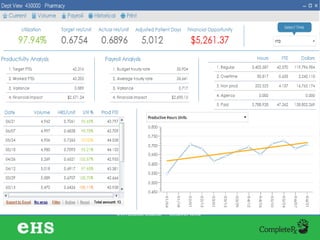
  • #22 Now that we have a hospital specific target, a management action plan for change, and engaged employees we need to monitor our performance. This is a biweekly dashboard for a pharmacy department. This demonstrates YTD utilization and performance relative to target. Discuss Target, MVI, Target FTEs, Financial Impact, Payroll analysis, financial impact, historical trends. Use this tool for budgeting, employee requisition and all strategic initiatives.
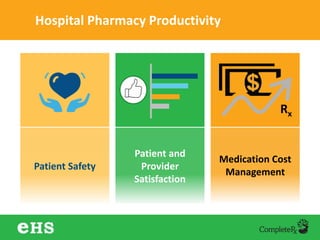
  • #23 Determining the correct staffing target allows us to properly staff, deploy and manage our pharmacy clinicians and support staff; and can have a powerful impact on patient safety, patient and provider satisfaction. and medication cost management.
  • #24 Questions: What’s the most common approach to measure productivity? How long does it take to implement a strategic plan (once an evaluation is complete)? How often does productivity management result in reduction of staff vs redeployment?