ISO 9000 – Quality
Management Systems
Elements, Requirements and Interpretation of
ISO 9000:2000
Presented By,
Hinglajia Hetal Ratilal, Roll no. 01,
M.pharm, Pharmaceutics , Sem-II
Guided by,
Dr. B. G. Prajapati
ISO 9000 - An Introduction
• ISO stands for International Organization
for Standardization.
• ISO 9001:2000 is an international
standard for the implementation and
management of a quality assurance
system.
• ISO 9000, can be adopted by all types of
organizations producing and supplying all
kinds of goods, services and software etc.
ISO 9000 - General Overview
• ISO 9000 series constitute ISO 9000, 9001,
9002,9003 and 9004.
• ISO 9001, 9002, 9003 are three quality system
models for external quality assurance.
• ISO 9001 is for design , manufacturing, installation
and servicing system,
• ISO 9002 covers manufacturing and installation
• ISO 9003 covers only final product inspection and
ISO 9000 - General Overview
• An example of the impact created by the
initiation of ISO 9000 is that most government,
military, European, and multi-national company
contracts make it mandatory to possess
registration to one (or more) of the standards.
• ISO 9004 provides guidelines for internal use by
a manufacturer developing its own quality
system to meet the business needs.
ISO 9000 - General Overview
• To attain ISO 9000 registration , a manufacturer
must provide evidence that its management is
actively involved in its quality process, that its
supplier and customer assured that there is
consistency in supply .
• It also require the control on documentation of
design , production ,inspection, handling
,storage and delivery of all materials and product
ISO 9000 - General Overview
• In the years since the introduction of ISO 9000,
several issues have arisen, including the
application of the standards to cover services,
software development, pharmaceutical,
processing industries, the concept of an
expanded stakeholder accountability beyond
customers, the needs of the smaller
organizations, and the needs of other
specialized industry sectors, such as medical
devices (ISO 13485/13488).
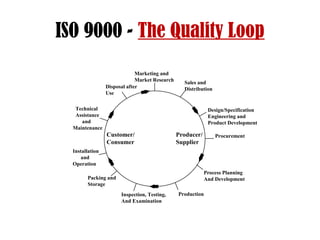
ISO 9000 - The Quality Loop
Customer/
Consumer
Producer/
Supplier
Marketing and
Market Research
Disposal after
Use
Sales and
Distribution
Design/Specification
Engineering and
Product Development
Procurement
Process Planning
And Development
ProductionInspection, Testing,
And Examination
Packing and
Storage
Installation
and
Operation
Technical
Assistance
and
Maintenance
ISO 9000 - Objectives
• The objectives of any good quality
management system are the following:
– Assure that the customer receives the service or product that is
expected and remains satisfied
– Prevent errors in all operations
– Prevent delivery delays
– Reduce costs of operation
– Increase productivity
– Increase the reliability of service or product
– Meet all the quality requirements specified by the customer
ISO 9000 - Prerequisites of a Quality
System
• Whatever the definition of quality, one must first
focus on three fundamental elements: Quality
Policy, QualityManagement, andQualitySystem.
• ISO 9000 family distinguishes between
requirements for quality management systems
and requirement for products.
ISO 9000 - Prerequisites of a Quality
System
• QualityPolicy: Overall quality objectives and
direction of an organization pertaining to key
elements of quality such as fitness for use,
performance, safety and reliability, as formally
expressed by top management.
• QualitySystem: The organizational structure,
responsibilities, procedures, processes, and
resources used for implementing quality
ISO 9000 - Prerequisites of a Quality
System
• QualityManagement: That aspect of the overall
management function that establishes and
implements the quality policy.
• Determining the needs and expectation of
customers and other interested parties.
• This can lead to increased satisfaction of
customers than other interested parties an to the
ISO 9000 - The Philosophy
• Basically, there are two mindset approaches to ISO 9000 registration.
• First, to view the ISO 9000 series as a set of standards which needs to
be addressed sooner or later.
– This first approach is invariably and primarily motivated by a
commercial/marketing/business set of convictions.]
• The other approach sees the ISO 9000 standards as something more
than just a model for quality assurance.
– This philosophy will more often than not see in ISO 9000 an
opportunity to improve managerial style.
– Most experts speak of ways in which the various ISO 9000 models
can help a company reduce internal cost and/or increase efficiency.
ISO 9000 - Documentation
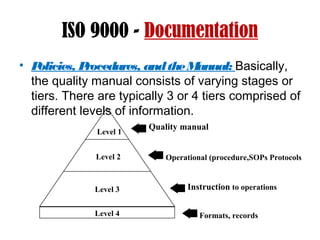
• Policies, Procedures, andtheManual: Basically,
the quality manual consists of varying stages or
tiers. There are typically 3 or 4 tiers comprised of
different levels of information.
Level 1
Level 2
Level 3
Level 4
Quality manual
Operational (procedure,SOPs Protocols
Instruction to operations
Formats, records
ISO 9000 - Documentation
• Tier1 consists of the Quality Policy, business unit
policies and objectives.
• Tier2 consists of the departmental procedures and
responsibilities for each of the pertinent ISO elements.
• Tier3 consists of the procedures reflecting the
individuals’ day-to-day business activities (Work
Instructions, Plant Equipment Instructions, etc.).
• Tier4 (sometimes not applicable) consists of any
business supporting documentation (Accounting data,
ISO 9000 - Execution
• When people realize that a significant portion of the
executing efforts required to achieve registration consist
of documenting what yo u say yo u do , some individuals
develop an allergic reaction to ISO.
• To them, the real issue is total quality management. To
achieve that objective, everyone must be involved to
solve a multitude of problems which may have
accumulated over several years.
• Such criticisms are not well founded for several reasons.
First of all, the ISO series of standards is a m o de lfor the
management of a quality assurance system designed to
insure that at a minimum, a series of steps are taken to
ensure that you do indeed satisfy your customer
requirements.
ISO 9000 –Management commitment
• Roleof Employees: In its simplest form, by saying
what the y do and do ing what the y say, the
employees effectively ensure the continued
success of any quality system. This holds true
for ISO 9000 as well. In fact, it is the foundation
upon which registration lies.
• Roleof Employers: here proprietor , owner should
responsible for business growth, provide
commitment, with conviction to develop QMS
system .
ISO 9000 –Management commitment
• Role of the Internal Quality Assurance
Individual(s):
The conduct of internal audits is clearly specified by
ISO. To ensure compliance, most companies enroll
their designated quality assurance individual(s) into
one of the many Quality Auditor courses currently
offered by the few “officially approved” agencies or
registrars. The individual(s) shall also be responsible
for the upkeep and maintenance of all the
ISO 9000 –Management commitment
• Roleof theRegistrar: Once the quality
assurance system has been documented and
implemented, an accredited registrar must be
consulted to conduct a review of the quality
manual and to perform a third party audit.
Accreditation in Canada is granted by the SCC
(Standards Council of Canada). At present there
ISO 9000 –Management commitment
• As most businesses begin to implement a
quality assurance system, they quickly notice
that a vast network of internal customer/supplier
relationships begin to develop. When done
properly and in a spirit of cooperation, the
setting-up of an ISO 9000 quality assurance
system can lead to a sharing and exchange of
information across previously impermeable
ISO 9001:2000 - The Standard
• The ISO 9001:2000 standard consists of 5 main sections
addressing some 23 different elements of compliance.
• Section 1 identifies the ‘Scope’ of the standard,
• Section 2 deals with the ‘Normative Reference’ of the
standard,
• Section 3 addresses the ‘Terms and Definitions’ of the
standard.
The Main Sections:
• Section 4 - Quality Management System
• Section 5 - Management Responsibility
• Section 6 - Resource Management
• Section 7 - Product Realization
ISO 9001:2000 - The Standard
Section 4 - Quality Management System:
• This Section deals with the establishment, implementation, and
maintenance of the QMS with regards to the control of
documentation and records
Section 5 - Management Responsibility:
• This Section serves to provide evidence of management’s
commitment to the development and implementation of the
QMS and to continually improve its effectiveness
Section 6 – Resource Management:
• This Section covers the organization’s provision of
requirements such as Human Resources, Infrastructure, and
WorkEnvironment
ISO 9001:2000 - The Standard
Section 7 - Product Realization:
• This Section serves to confirmhow the organization
plans and develops the processes needed forproduct
realization
Section 8 - Measurement, Analysis and Improvement:
• This Section deals with the planning and
implementation of the monitoring, measurement,
analysis and improvement processes needed to
– (a) demonstrate conformity of the product,
– (b) ensure conformity of the QMS, and
– (c) continually improve the effectiveness of the QMS
ISO 9000 - The Strategy
• Basically there are 6 working phases to
successfully map out any worthwhile
quality management system:
–System Investigation
–System Analysis
–System Design
–System Development
–System Implementation
–System Maintenance
ISO 9000 - Summary
• Study current
documentation
• Conduct interviews
and/orperform surveys
• Observe individuals
actually performing the
activities
• Create new
documentation
• Meet with executive
management of
responsibility to critique
& approve the new
documentation
• Finalize and control new
documentation
• Performinternal audits
of the ISO9001:2000
Standards’ elements
• Identify all majorand/or
minornon-conformances
• Recommend corrective
actions
• Perform‘follow-up’
internal audits to confirm
the effectiveness of the
corrective actions
• Have the Quality Manual
reviewed and approved
by an accredited ISO
Registrar
• Have the QMS audited by
Iso9000  pvcgmp roll no. 01

Iso9000 pvcgmp roll no. 01

  • 1.
    ISO 9000 –Quality Management Systems Elements, Requirements and Interpretation of ISO 9000:2000 Presented By, Hinglajia Hetal Ratilal, Roll no. 01, M.pharm, Pharmaceutics , Sem-II Guided by, Dr. B. G. Prajapati
  • 2.
    ISO 9000 -An Introduction • ISO stands for International Organization for Standardization. • ISO 9001:2000 is an international standard for the implementation and management of a quality assurance system. • ISO 9000, can be adopted by all types of organizations producing and supplying all kinds of goods, services and software etc.
  • 3.
    ISO 9000 -General Overview • ISO 9000 series constitute ISO 9000, 9001, 9002,9003 and 9004. • ISO 9001, 9002, 9003 are three quality system models for external quality assurance. • ISO 9001 is for design , manufacturing, installation and servicing system, • ISO 9002 covers manufacturing and installation • ISO 9003 covers only final product inspection and
  • 4.
    ISO 9000 -General Overview • An example of the impact created by the initiation of ISO 9000 is that most government, military, European, and multi-national company contracts make it mandatory to possess registration to one (or more) of the standards. • ISO 9004 provides guidelines for internal use by a manufacturer developing its own quality system to meet the business needs.
  • 5.
    ISO 9000 -General Overview • To attain ISO 9000 registration , a manufacturer must provide evidence that its management is actively involved in its quality process, that its supplier and customer assured that there is consistency in supply . • It also require the control on documentation of design , production ,inspection, handling ,storage and delivery of all materials and product
  • 6.
    ISO 9000 -General Overview • In the years since the introduction of ISO 9000, several issues have arisen, including the application of the standards to cover services, software development, pharmaceutical, processing industries, the concept of an expanded stakeholder accountability beyond customers, the needs of the smaller organizations, and the needs of other specialized industry sectors, such as medical devices (ISO 13485/13488).
  • 7.
    ISO 9000 -The Quality Loop Customer/ Consumer Producer/ Supplier Marketing and Market Research Disposal after Use Sales and Distribution Design/Specification Engineering and Product Development Procurement Process Planning And Development ProductionInspection, Testing, And Examination Packing and Storage Installation and Operation Technical Assistance and Maintenance
  • 8.
    ISO 9000 -Objectives • The objectives of any good quality management system are the following: – Assure that the customer receives the service or product that is expected and remains satisfied – Prevent errors in all operations – Prevent delivery delays – Reduce costs of operation – Increase productivity – Increase the reliability of service or product – Meet all the quality requirements specified by the customer
  • 9.
    ISO 9000 -Prerequisites of a Quality System • Whatever the definition of quality, one must first focus on three fundamental elements: Quality Policy, QualityManagement, andQualitySystem. • ISO 9000 family distinguishes between requirements for quality management systems and requirement for products.
  • 10.
    ISO 9000 -Prerequisites of a Quality System • QualityPolicy: Overall quality objectives and direction of an organization pertaining to key elements of quality such as fitness for use, performance, safety and reliability, as formally expressed by top management. • QualitySystem: The organizational structure, responsibilities, procedures, processes, and resources used for implementing quality
  • 11.
    ISO 9000 -Prerequisites of a Quality System • QualityManagement: That aspect of the overall management function that establishes and implements the quality policy. • Determining the needs and expectation of customers and other interested parties. • This can lead to increased satisfaction of customers than other interested parties an to the
  • 12.
    ISO 9000 -The Philosophy • Basically, there are two mindset approaches to ISO 9000 registration. • First, to view the ISO 9000 series as a set of standards which needs to be addressed sooner or later. – This first approach is invariably and primarily motivated by a commercial/marketing/business set of convictions.] • The other approach sees the ISO 9000 standards as something more than just a model for quality assurance. – This philosophy will more often than not see in ISO 9000 an opportunity to improve managerial style. – Most experts speak of ways in which the various ISO 9000 models can help a company reduce internal cost and/or increase efficiency.
  • 13.
    ISO 9000 -Documentation • Policies, Procedures, andtheManual: Basically, the quality manual consists of varying stages or tiers. There are typically 3 or 4 tiers comprised of different levels of information. Level 1 Level 2 Level 3 Level 4 Quality manual Operational (procedure,SOPs Protocols Instruction to operations Formats, records
  • 14.
    ISO 9000 -Documentation • Tier1 consists of the Quality Policy, business unit policies and objectives. • Tier2 consists of the departmental procedures and responsibilities for each of the pertinent ISO elements. • Tier3 consists of the procedures reflecting the individuals’ day-to-day business activities (Work Instructions, Plant Equipment Instructions, etc.). • Tier4 (sometimes not applicable) consists of any business supporting documentation (Accounting data,
  • 15.
    ISO 9000 -Execution • When people realize that a significant portion of the executing efforts required to achieve registration consist of documenting what yo u say yo u do , some individuals develop an allergic reaction to ISO. • To them, the real issue is total quality management. To achieve that objective, everyone must be involved to solve a multitude of problems which may have accumulated over several years. • Such criticisms are not well founded for several reasons. First of all, the ISO series of standards is a m o de lfor the management of a quality assurance system designed to insure that at a minimum, a series of steps are taken to ensure that you do indeed satisfy your customer requirements.
  • 16.
    ISO 9000 –Managementcommitment • Roleof Employees: In its simplest form, by saying what the y do and do ing what the y say, the employees effectively ensure the continued success of any quality system. This holds true for ISO 9000 as well. In fact, it is the foundation upon which registration lies. • Roleof Employers: here proprietor , owner should responsible for business growth, provide commitment, with conviction to develop QMS system .
  • 17.
    ISO 9000 –Managementcommitment • Role of the Internal Quality Assurance Individual(s): The conduct of internal audits is clearly specified by ISO. To ensure compliance, most companies enroll their designated quality assurance individual(s) into one of the many Quality Auditor courses currently offered by the few “officially approved” agencies or registrars. The individual(s) shall also be responsible for the upkeep and maintenance of all the
  • 18.
    ISO 9000 –Managementcommitment • Roleof theRegistrar: Once the quality assurance system has been documented and implemented, an accredited registrar must be consulted to conduct a review of the quality manual and to perform a third party audit. Accreditation in Canada is granted by the SCC (Standards Council of Canada). At present there
  • 19.
    ISO 9000 –Managementcommitment • As most businesses begin to implement a quality assurance system, they quickly notice that a vast network of internal customer/supplier relationships begin to develop. When done properly and in a spirit of cooperation, the setting-up of an ISO 9000 quality assurance system can lead to a sharing and exchange of information across previously impermeable
  • 20.
    ISO 9001:2000 -The Standard • The ISO 9001:2000 standard consists of 5 main sections addressing some 23 different elements of compliance. • Section 1 identifies the ‘Scope’ of the standard, • Section 2 deals with the ‘Normative Reference’ of the standard, • Section 3 addresses the ‘Terms and Definitions’ of the standard. The Main Sections: • Section 4 - Quality Management System • Section 5 - Management Responsibility • Section 6 - Resource Management • Section 7 - Product Realization
  • 21.
    ISO 9001:2000 -The Standard Section 4 - Quality Management System: • This Section deals with the establishment, implementation, and maintenance of the QMS with regards to the control of documentation and records Section 5 - Management Responsibility: • This Section serves to provide evidence of management’s commitment to the development and implementation of the QMS and to continually improve its effectiveness Section 6 – Resource Management: • This Section covers the organization’s provision of requirements such as Human Resources, Infrastructure, and WorkEnvironment
  • 22.
    ISO 9001:2000 -The Standard Section 7 - Product Realization: • This Section serves to confirmhow the organization plans and develops the processes needed forproduct realization Section 8 - Measurement, Analysis and Improvement: • This Section deals with the planning and implementation of the monitoring, measurement, analysis and improvement processes needed to – (a) demonstrate conformity of the product, – (b) ensure conformity of the QMS, and – (c) continually improve the effectiveness of the QMS
  • 23.
    ISO 9000 -The Strategy • Basically there are 6 working phases to successfully map out any worthwhile quality management system: –System Investigation –System Analysis –System Design –System Development –System Implementation –System Maintenance
  • 24.
    ISO 9000 -Summary • Study current documentation • Conduct interviews and/orperform surveys • Observe individuals actually performing the activities • Create new documentation • Meet with executive management of responsibility to critique & approve the new documentation • Finalize and control new documentation • Performinternal audits of the ISO9001:2000 Standards’ elements • Identify all majorand/or minornon-conformances • Recommend corrective actions • Perform‘follow-up’ internal audits to confirm the effectiveness of the corrective actions • Have the Quality Manual reviewed and approved by an accredited ISO Registrar • Have the QMS audited by