Quality Management
System
QMS
Topic Covered
 QMS Goal, Purpose
 Documentation of QMS
What is QMS ?
 Structured collection of policies, procedures, processes and their associated
responsibilities
Policies
Process
Procedures
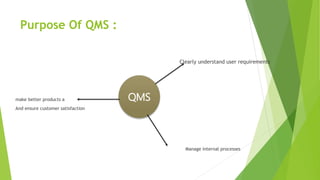
Purpose Of QMS :
Clearly understand user requirements
make better products a
And ensure customer satisfaction
Manage internal processes
QMS
Goals And Objectives of QMS:
Goals of QMS:
 Improving Quality
 Institutionalize quality-related activities into every aspect of the organization and its key
business practices. This starts at the highest levels of management where quality goals or
targets are established and integrated into the strategic plans of the organization.
Continued….
Objectives of QMS:
► quality objectives are set to specify what specific actions will be taken, within a given
time period, to achieve a measurable quality
outcome” (Westcott 2006).
QMS Documentation:
“ defines the organization’s strategy and tactics
for achieving its quality objectives. ”
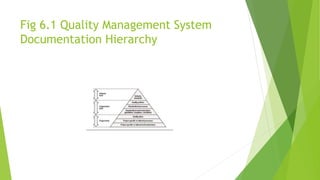
Fig 6.1 Quality Management System
Documentation Hierarchy
Industry Level :
Industry Standards:
 based on a framework of one or more industry standards or models.
 for example, ISO 9001,ISO 15504, the IEEE standards, or the SEI’s CMMI for
Development.
 provide guidance that helps the organization share the good practices
discovered through trial and error by other organizations and defined by the
industry experts.
Organization Level:
 Quality policies:
 formally established to define the overall direction and principles to be
followed when making decisions and performing activities that impact
quality.
 Upper-level management usually establishes quality policies to communicate
the intent of the QMS and its objectives.
 A document, such as a quality manual, is typically used to document the
quality policies.
Organization Level:
 Standardized processes:
 define the mechanics of what is required to implement the QMS activities at
the organizational level.
 By documenting software processes, an organization can describe and
communicate what usually works best.
Continued….
► This can help the organization:
 Ensure that important steps in the processes aren’t forgotten.
 Facilitate the propagation of lessons learned from one project to
the next so the organization can repeat its successes and stop
repeating actions that lead to problems .
 Eliminate the need to “reinvent the wheel” with each new project
while providing a foundation for tailoring the processes to the specific
needs of that project .
ETVX (Entry criteria, Tasks, Verification
steps, exit criteria) method:
► simple way of documenting processes is to use the ETVX method
► entry criteria are specific, measurable conditions that must be met before the process can
be started.
► tasks are the individual steps or activities that must be performed to implement the process
and create the resulting product. The task definitions should also include responsibility
assignments for each step.
Continued….
► Verification steps describe the mechanisms used to ensure that the tasks are
performed as required and that the deliverables meet required quality levels.
Typical verification steps include reviews, tests, or signoffs.
► The exit criteria are specific, measurable conditions that must be met before
the process can be completed.
Chapter 7: B. Methodologies (for Quality Management)
THANK
YOU

Quality Management System

  • 1.
    Quality Management System QMS Topic Covered QMS Goal, Purpose  Documentation of QMS
  • 2.
    What is QMS?  Structured collection of policies, procedures, processes and their associated responsibilities Policies Process Procedures
  • 3.
    Purpose Of QMS: Clearly understand user requirements make better products a And ensure customer satisfaction Manage internal processes QMS
  • 4.
    Goals And Objectivesof QMS: Goals of QMS:  Improving Quality  Institutionalize quality-related activities into every aspect of the organization and its key business practices. This starts at the highest levels of management where quality goals or targets are established and integrated into the strategic plans of the organization.
  • 5.
    Continued…. Objectives of QMS: ►quality objectives are set to specify what specific actions will be taken, within a given time period, to achieve a measurable quality outcome” (Westcott 2006).
  • 6.
    QMS Documentation: “ definesthe organization’s strategy and tactics for achieving its quality objectives. ”
  • 7.
    Fig 6.1 QualityManagement System Documentation Hierarchy
  • 8.
    Industry Level : IndustryStandards:  based on a framework of one or more industry standards or models.  for example, ISO 9001,ISO 15504, the IEEE standards, or the SEI’s CMMI for Development.  provide guidance that helps the organization share the good practices discovered through trial and error by other organizations and defined by the industry experts.
  • 9.
    Organization Level:  Qualitypolicies:  formally established to define the overall direction and principles to be followed when making decisions and performing activities that impact quality.  Upper-level management usually establishes quality policies to communicate the intent of the QMS and its objectives.  A document, such as a quality manual, is typically used to document the quality policies.
  • 10.
    Organization Level:  Standardizedprocesses:  define the mechanics of what is required to implement the QMS activities at the organizational level.  By documenting software processes, an organization can describe and communicate what usually works best.
  • 11.
    Continued…. ► This canhelp the organization:  Ensure that important steps in the processes aren’t forgotten.  Facilitate the propagation of lessons learned from one project to the next so the organization can repeat its successes and stop repeating actions that lead to problems .  Eliminate the need to “reinvent the wheel” with each new project while providing a foundation for tailoring the processes to the specific needs of that project .
  • 12.
    ETVX (Entry criteria,Tasks, Verification steps, exit criteria) method: ► simple way of documenting processes is to use the ETVX method ► entry criteria are specific, measurable conditions that must be met before the process can be started. ► tasks are the individual steps or activities that must be performed to implement the process and create the resulting product. The task definitions should also include responsibility assignments for each step.
  • 13.
    Continued…. ► Verification stepsdescribe the mechanisms used to ensure that the tasks are performed as required and that the deliverables meet required quality levels. Typical verification steps include reviews, tests, or signoffs. ► The exit criteria are specific, measurable conditions that must be met before the process can be completed.
  • 14.
    Chapter 7: B.Methodologies (for Quality Management) THANK YOU