Quality Standards
Quality Standards
ISO 9000
ISO 9000
• What it is?
• ISO 9000 = The International Organization for
Standardization.
• ISO is a federation of the national standards bodies of
nations from around the world.
• ISO 9000 is an international quality standard for goods
and services.
• Aim of ISO;
– Historically: To ensure that the product or services provided by
registered organizations are consistently fit for their intended
purposes.
– New aim: To enable organizations to better serve their
customers and be more competitive
• Some of the requirements in ISO 9001 (one of
the standard is ISO 9000) are;
o A set of procedures that cover all key processes in
the business;
o Monitoring processes to ensure they are effective;
o Keeping adequate records;
o Checking output for defects, with appropriate and
corrective action where necessary;
o Regularly reviewing individual processes and the
quality system itself for effectiveness; and
o Facilitating continual improvement
ISO 9000
ISO 9000
ISO 9000
ISO 9000
• ISO 9000 does not set any specifications for
quality.
• Rather, it sets broad requirements for the
insurance of quality and for management’s
involvement.
• More on prevention rather than inspection and
rework.
• ISO 9000 is about standardizing the approach
organizations everywhere take to managing and
improving the processes that ultimately result in
their product and services.
Benefits That Registered Organizations Can
Enjoy from ISO 9000
Enjoy from ISO 9000
• Wider Customer Acceptance of products
and services.
• Improved effectiveness and reliability of its
process.
• Improved Quality of products and services.
• Improved Organizational performance and
competitiveness.
ISO 9000
ISO 9000
• ISO 9000 is composed of three standards;
1. ISO 9000:2000 Quality Management Systems –
Fundamentals and Vocabulary
2. ISO 9001:2000 Quality management Systems –
Requirements
3. ISO 9004:2000 Quality Management Systems –
Guidelines for Performance Improvements
ISO 9000:2000, Quality management
systems
systems
Fundamentals and vocabulary.
• Covers the basics of what quality management
systems are
• Contains the core language of the ISO 9000
series of standards.
• A guidance document, not used for certification
purposes, but important reference document to
understand terms and vocabulary related to
quality management systems.
• In the year 2005, revised ISO 9000:2005
standard has been published, so it is now
advised to refer to ISO 9000:2005.
ISO 9001:2000 Quality management systems –
Requirements
Requirements
• For use in any organization which designs,
develops, manufactures, installs and/or services
any product or provides any form of service.
• It provides requirements to achieve customer
satisfaction through consistent products and
services which meet customer expectations.
• It includes a requirement for the continual
improvement of the Quality Management
System
ISO 9004:2000 Quality management systems
Guidelines for performance improvements.
• Covers continual improvement.
• Advice on what do to enhance a mature
system.
Comparative Scope of ISO 9000 and Total
Quality Management
Quality Management
• Total Quality Management is the organization wide
management of quality. Management consists of
planning, organizing, directing, control, and assurance.
• TWO principal quality initiatives are;
– ISO9000
– Total Quality Management
• There are some relationship between these two.
– ISO 9000 and TQM are not interchangeable (not same).
– ISO 9000 is compatible and is a subset of TQM
– ISO 9000 is frequently implemented in a non-TQM environment
– ISO 9000 may be redundant in a mature TQM environment.
– ISO 9000 and TQM are not in competition.
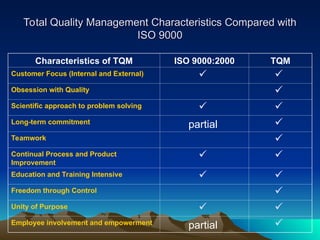
Total Quality Management Characteristics Compared with
ISO 9000
ISO 9000
Characteristics of TQM ISO 9000:2000 TQM
Customer Focus (Internal and External)  
Obsession with Quality 
Scientific approach to problem solving  
Long-term commitment
partial 
Teamwork 
Continual Process and Product
Improvement
 
Education and Training Intensive  
Freedom through Control 
Unity of Purpose  
Employee involvement and empowerment
partial 
• The primary difference between ISO9000:
2000 and TQM is in the degree to which
the total organization is involved.
– TQM requires the involvement of all functions
and levels of the organization.
Compatibility of ISO 9000 and Total
Quality
Quality
• ISO 9000 is compatible with and can be viewed
as a subset of TQM.
• Organizations that already apply TQM in a
mature level can find it easy to implement ISO
9000.
• Because TQM has its top-management
commitment, documented processes and
procedures, continuous improvement, obsession
with quality etc.
• This means, TQM requires everything required
by ISO 9000.
• No international certification for TQM.
• So, even a mature TQM organization may
find it necessary to seek ISO 9000 to
satisfy demands of its customers.
• On the other hand, traditional organization
that is registered under ISO 9000 may find
it needs the larger TQM to stay
competitive.
Movement from ISO 9000 to TQM
and vice versa
and vice versa
• An organization that has its process
documented and under control, such as a
company involved in TQM, should find it
relatively easy to prepare for ISO 9000
• Company that already have ISO 9000 can
have an advance start towards TQM.

293297953-QUALITY-STANDARDS-PPT.phdjdjdhdpt

  • 1.
  • 2.
    ISO 9000 ISO 9000 •What it is? • ISO 9000 = The International Organization for Standardization. • ISO is a federation of the national standards bodies of nations from around the world. • ISO 9000 is an international quality standard for goods and services. • Aim of ISO; – Historically: To ensure that the product or services provided by registered organizations are consistently fit for their intended purposes. – New aim: To enable organizations to better serve their customers and be more competitive
  • 3.
    • Some ofthe requirements in ISO 9001 (one of the standard is ISO 9000) are; o A set of procedures that cover all key processes in the business; o Monitoring processes to ensure they are effective; o Keeping adequate records; o Checking output for defects, with appropriate and corrective action where necessary; o Regularly reviewing individual processes and the quality system itself for effectiveness; and o Facilitating continual improvement ISO 9000 ISO 9000
  • 4.
    ISO 9000 ISO 9000 •ISO 9000 does not set any specifications for quality. • Rather, it sets broad requirements for the insurance of quality and for management’s involvement. • More on prevention rather than inspection and rework. • ISO 9000 is about standardizing the approach organizations everywhere take to managing and improving the processes that ultimately result in their product and services.
  • 5.
    Benefits That RegisteredOrganizations Can Benefits That Registered Organizations Can Enjoy from ISO 9000 Enjoy from ISO 9000 • Wider Customer Acceptance of products and services. • Improved effectiveness and reliability of its process. • Improved Quality of products and services. • Improved Organizational performance and competitiveness.
  • 6.
    ISO 9000 ISO 9000 •ISO 9000 is composed of three standards; 1. ISO 9000:2000 Quality Management Systems – Fundamentals and Vocabulary 2. ISO 9001:2000 Quality management Systems – Requirements 3. ISO 9004:2000 Quality Management Systems – Guidelines for Performance Improvements
  • 7.
    ISO 9000:2000, Qualitymanagement ISO 9000:2000, Quality management systems systems Fundamentals and vocabulary. Fundamentals and vocabulary. • Covers the basics of what quality management systems are • Contains the core language of the ISO 9000 series of standards. • A guidance document, not used for certification purposes, but important reference document to understand terms and vocabulary related to quality management systems. • In the year 2005, revised ISO 9000:2005 standard has been published, so it is now advised to refer to ISO 9000:2005.
  • 8.
    ISO 9001:2000 Qualitymanagement systems – ISO 9001:2000 Quality management systems – Requirements Requirements • For use in any organization which designs, develops, manufactures, installs and/or services any product or provides any form of service. • It provides requirements to achieve customer satisfaction through consistent products and services which meet customer expectations. • It includes a requirement for the continual improvement of the Quality Management System
  • 9.
    ISO 9004:2000 Qualitymanagement systems ISO 9004:2000 Quality management systems Guidelines for performance improvements. Guidelines for performance improvements. • Covers continual improvement. • Advice on what do to enhance a mature system.
  • 10.
    Comparative Scope ofISO 9000 and Total Comparative Scope of ISO 9000 and Total Quality Management Quality Management • Total Quality Management is the organization wide management of quality. Management consists of planning, organizing, directing, control, and assurance. • TWO principal quality initiatives are; – ISO9000 – Total Quality Management • There are some relationship between these two. – ISO 9000 and TQM are not interchangeable (not same). – ISO 9000 is compatible and is a subset of TQM – ISO 9000 is frequently implemented in a non-TQM environment – ISO 9000 may be redundant in a mature TQM environment. – ISO 9000 and TQM are not in competition.
  • 11.
    Total Quality ManagementCharacteristics Compared with Total Quality Management Characteristics Compared with ISO 9000 ISO 9000 Characteristics of TQM ISO 9000:2000 TQM Customer Focus (Internal and External)   Obsession with Quality  Scientific approach to problem solving   Long-term commitment partial  Teamwork  Continual Process and Product Improvement   Education and Training Intensive   Freedom through Control  Unity of Purpose   Employee involvement and empowerment partial 
  • 12.
    • The primarydifference between ISO9000: 2000 and TQM is in the degree to which the total organization is involved. – TQM requires the involvement of all functions and levels of the organization.
  • 13.
    Compatibility of ISO9000 and Total Compatibility of ISO 9000 and Total Quality Quality • ISO 9000 is compatible with and can be viewed as a subset of TQM. • Organizations that already apply TQM in a mature level can find it easy to implement ISO 9000. • Because TQM has its top-management commitment, documented processes and procedures, continuous improvement, obsession with quality etc. • This means, TQM requires everything required by ISO 9000.
  • 14.
    • No internationalcertification for TQM. • So, even a mature TQM organization may find it necessary to seek ISO 9000 to satisfy demands of its customers. • On the other hand, traditional organization that is registered under ISO 9000 may find it needs the larger TQM to stay competitive.
  • 15.
    Movement from ISO9000 to TQM Movement from ISO 9000 to TQM and vice versa and vice versa • An organization that has its process documented and under control, such as a company involved in TQM, should find it relatively easy to prepare for ISO 9000 • Company that already have ISO 9000 can have an advance start towards TQM.