ISO 9000 – Quality
Management Systems
Elements,Requirements and Interpretation of
ISO 9000:2000
What is ISO
 System of standardization
 Certification
 Quality standards
 Commercial standards
 Internationally regulated
 Facilitate trade between countries
 Documentation
 Specifications
 Level of Quality
 Trust factor improves
 Conforming to standard processes.
 Promotion of product
 Image of the co.
 Advertisement
 Brand Value increase
What is Process based organization
 All activities are based on a process
 SOP is there for controlling all the activities.
 Different Functions are linked for a specific
activity.
 Feedback and improve the process.
 Continous monitoring
 It is a collective effort
 Small organizations-Function based is good
 Big Organizations-Process based is good
 Implementing ISO requires processes to be
implemented.
ISO9000 - An Introduction
• ISO standsforInternationalOrganization
for Standardization.
• ISO 9001:2000isaninternational
standardfortheimplementationand
managementof aqualityassurance
system.
• ISO 9000, can be adopted by all types of
organizations producing and supplying all
kindsof goods,servicesand softwareetc.
ISO9000 - General Overview
• ISO 9000seriesconstituteISO 9000, 9001,
9002,9003 and 9004.
ISO 9001,9002,9003arethreequalitysystem
modelsforexternalqualityassurance.
ISO 9001 isfordesign, manufacturing,installation
andservicing system,
ISO 9002 coversmanufacturingand installation
ISO 9003coversonlyfinalproductinspectionand
test.
•
•
•
•
ISO9000 - General Overview
• Anexampleof theimpactcreatedbythe
initiationof ISO 9000isthatmostgovernment,
military
,European,andmulti-nationalcompany
contractsmakeitmandatorytopossess
registrationtoone(ormore)of thestandards.
• ISO 9004providesguidelinesforinternaluseby
amanufacturerdevelopingitsownquality
systemtomeetthebusinessneeds.
ISO9000 - General Overview
• T
oattainISO 9000registration, amanufacturer
must provide evidencethatitsmanagementis
activelyinvolvedinitsqualityprocess,thatits supplier
andcustomerassuredthatthereis consistencyin
supply .
• Italsorequirethecontrolondocumentationof
design, production,inspection, handling
,storageanddeliveryofallmaterialsand product
ISO9000 - General Overview
• IntheyearssincetheintroductionofISO 9000,
severalissueshavearisen, includingthe application
ofthestandardstocoverservices, software
development,pharmaceutical, processingindustries,
theconceptofan expandedstakeholder
accountabilitybeyond customers,theneedsofthe
smaller organizations,andtheneedsofother
specializedindustrysectors,suchasmedical devices
(ISO 13485/13488).
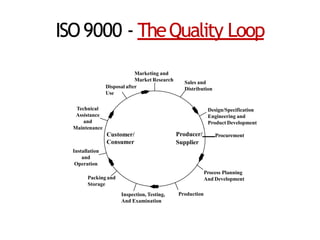
ISO9000 - TheQuality Loop
Customer/
Consumer
Marketing and
Market Research
Disposal after
Use
Sales and
Distribution
Producer/ Procurement
Supplier
Design/Specification
Engineering and
Product Development
Process Planning
And Development
Production
Inspection, Testing,
And Examination
Packing and
Storage
Installation
and
Operation
Technical
Assistance
and
Maintenance
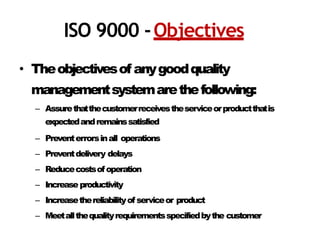
ISO 9000 -Objectives
• Theobjectivesof anygoodquality
managementsystemarethefollowing:
– Assurethatthecustomerreceivestheserviceorproductthatis
expectedandremainssatisfied
– Preventerrorsinall operations
– Preventdelivery delays
– Reducecostsofoperation
– Increaseproductivity
– Increasethereliabilityof serviceor product
– Meetallthequalityrequirementsspecifiedbythe customer
ISO9000 - Prerequisites ofa Quality
System
• Whateverthedefinitionof quality,onemustfirst
focusonthreefundamentalelements:Quality
Policy, QualityManagement, andQualitySystem.
• ISO 9000familydistinguishesbetween
requirementsforqualitymanagementsystems
andrequirementfor products.
ISO9000 - Prerequisites ofa Quality
System
• QualityPolicy: Overallqualityobjectivesand
directionof anorganizationpertainingtokey
elementsof qualitysuchasfitnessforuse,
performance,safetyandreliability,asformally
expressedbytop management.
• QualitySystem: Theorganizationalstructure,
responsibilities, procedures, processes, and
resourcesusedforimplementingquality
ISO9000 - Prerequisites ofa Quality
System
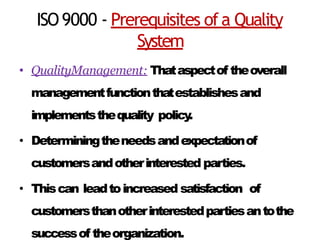
• QualityManagement: Thataspectof theoverall
managementfunctionthatestablishesand
implementsthequality policy
.
• Determiningtheneedsandexpectationof
customersandotherinterested parties.
• Thiscan leadtoincreased satisfaction of
customersthanotherinterestedpartiesantothe
successof theorganization.
ISO9000 - The Philosophy
•
•
Basically,therearetwomindsetapproachestoISO 9000 registration.
First,toviewtheISO 9000seriesasasetof standardswhichneeds to
beaddressedsooneror later.
– Thisfirstapproachisinvariablyandprimarilymotivatedbya
commercial/marketing/businesssetofconvictions.]
TheotherapproachseestheISO 9000standardsassomethingmore
than justa model for quality assurance.
– ThisphilosophywillmoreoftenthannotseeinISO 9000an
opportunitytoimprovemanagerial style.
– Mostexpertsspeakof waysinwhichthevariousISO 9000models
canhelpacompanyreduceinternalcostand/orincreaseefficiency
.
•
ISO9000 - Documentation
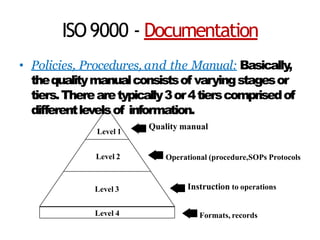
• Policies, Procedures, and the Manual: Basically,
thequalitymanualconsistsof varyingstagesor
tiers.Therearetypically3or4tierscomprisedof
differentlevelsof information.
Level 1
Level 2
Level 3
Level 4
Quality manual
Operational (procedure,SOPs Protocols
Instruction to operations
Formats, records
ISO9000 - Documentation
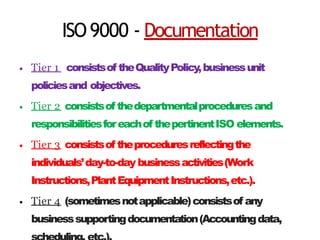
• Tier 1 consistsof theQualityPolicy,businessunit
policiesand objectives.
Tier 2 consistsof thedepartmentalproceduresand
responsibilitiesforeachof thepertinentISO elements.
Tier 3 consistsof theproceduresreflectingthe
individuals’day-to-day businessactivities(Work
Instructions,PlantEquipmentInstructions,etc.).
Tier 4 (sometimesnotapplicable)consistsof any
businesssupportingdocumentation(Accountingdata,
•
•
•
ISO9000- Execution
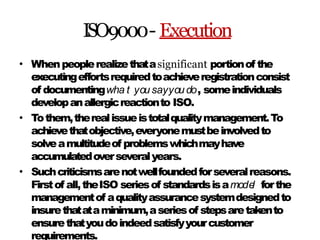
• Whenpeoplerealizethatasignificant portionof the
executingeffortsrequiredtoachieveregistrationconsist
of documentingwha t you sayyou do, someindividuals
developanallergicreactionto ISO.
Tothem,therealissueistotalqualitymanagement.To
achievethatobjective,everyonemustbeinvolvedto
solveamultitudeof problemswhichmayhave
accumulatedoverseveralyears.
Suchcriticismsarenotwellfoundedforseveralreasons.
Firstof all,theISO seriesof standardsisamode
l forthe
managementof aqualityassurancesystemdesignedto
insurethatataminimum,aseriesof stepsaretakento
ensurethatyoudoindeedsatisfyyourcustomer
requirements.
•
•
ISO9000–Managementcommitment
• Role of Employees: Initssimplestform,bysaying
wha t they do and doing wha t theysay, the
employeeseffectivelyensurethecontinued
successof anyqualitysystem.Thisholdstrue
forISO 9000aswell.Infact,itisthefoundation
uponwhichregistrationlies.
• Role of Employers: hereproprietor,ownershould
responsibleforbusinessgrowth,provide
commitment,withconvictiontodevelopQMS
system .
ISO9000–Managementcommitment
• Roleof theInternalQualityAssurance
Individual(s):
Theconductof internalauditsisclearlyspecifiedby
ISO. Toensurecompliance,mostcompaniesenroll
theirdesignatedqualityassuranceindividual(s)into
oneof themanyQualityAuditorcoursescurrently
offeredbythefew“officiallyapproved”agenciesor
registrars.Theindividual(s)shallalsoberesponsible
fortheupkeepandmaintenanceof allthe
ISO9000–Managementcommitment
• Role of the Registrar: Oncethequality
assurancesystemhasbeendocumentedand
implemented,anaccreditedregistrarmustbe
consultedtoconductareviewof thequality
manualandtoperformathirdpartyaudit.
AccreditationinCanadaisgrantedbytheSCC
(StandardsCouncilof Canada). Atpresentthere
arearound16accreditedregistrarsin Canada
ISO9000–Managementcommitment
• Asmostbusinessesbegintoimplementa
qualityassurancesystem,theyquicklynotice
thatavastnetworkof internalcustomer/supplier
relationshipsbegintodevelop.Whendone
properlyandinaspiritof cooperation,the
setting-upof anISO 9000qualityassurance
systemcanleadtoasharingandexchangeof
informationacrosspreviously impermeable
ISO9001:2000-TheStandard
•
•
•
TheISO 9001:2000standardconsistsof5mainsections
addressing some 23 different elementsof compliance.
Section 1 identifies the ‘Scope’ of the standard,
Section 2 deals with the ‘Normative Reference’ of the
standard,
• Section 3 ad resses the ‘Terms and Definitions’ of the
standard.
The Main Sections:
•
•
•
•
Section 4 - Quality Management System
Section 5 - Management Responsibility
Section 6 - Resource Management
Section 7 - Product Realization
ISO9001:2000-TheStandard
Section 4 - Quality Management System:
• This Sectiondeals with the establishment, implementation, and
maintenance of the QMS with regards to the control of
documentation andrecords
Section 5 - Management Responsibility:
• This Section serves to provide evidence of management’s
commitment to the development and implementation of the
QMS and to continua ly improve its effectiveness
Section 6–Resource Management:
• This Section covers the organization’s provision of
requirements such asHuman Resources, Infrastructure, and
Work Environment
ISO9001:2000-TheStandard
Section 7 - Product Realization:
• This Section serves to confirm how the organization
plans and develops the processes needed for product
realization
Section 8- Measurement, Analysis and Improvement:
• This Section deals with the planning and
implementation of the monitoring,measurement,
analysis and improvement processes needed to
– (a) demonstrate conformity of the product,
– (b) ensure conformity of the QMS, and
– (c) continual y improve the effectiveness of the QMS
ISO9000-TheStrategy
• Basicallythereare6workingphasesto
successfullymapoutanyworthwhile
qualitymanagement system:
–SystemInvestigation
–SystemAnalysis
–SystemDesign
–SystemDevelopment
–SystemImplementation
–SystemMaintenance
ISO9000- Summary
• Study cur ent
documentation
Conduct interviews
and/or performsurveys
Observe individuals
actual y performing the
activities
Create new
documentation
Meet with executive
management of
responsibility to critique
& approve the new
documentation
Finalize and control new
documentation
•
•
•
•
•
•
•
•
•
•
• Performinternal audits
of the ISO 9001:2000
Standards’ elements
Identify al major and/or
minornon-conformances
Recommend cor ective
actions
Perform ‘fol ow-up’
internal audits to confirm
the effectiveness of the
cor ective actions
Have the Quality Manual
reviewed and approved
by an accredited ISO
Registrar
Have the QMS audited by
ISO Intro1.pptx

ISO Intro1.pptx

  • 1.
    ISO 9000 –Quality Management Systems Elements,Requirements and Interpretation of ISO 9000:2000
  • 2.
    What is ISO System of standardization  Certification  Quality standards  Commercial standards  Internationally regulated  Facilitate trade between countries  Documentation  Specifications  Level of Quality  Trust factor improves  Conforming to standard processes.  Promotion of product  Image of the co.  Advertisement  Brand Value increase
  • 3.
    What is Processbased organization  All activities are based on a process  SOP is there for controlling all the activities.  Different Functions are linked for a specific activity.  Feedback and improve the process.  Continous monitoring  It is a collective effort  Small organizations-Function based is good  Big Organizations-Process based is good  Implementing ISO requires processes to be implemented.
  • 4.
    ISO9000 - AnIntroduction • ISO standsforInternationalOrganization for Standardization. • ISO 9001:2000isaninternational standardfortheimplementationand managementof aqualityassurance system. • ISO 9000, can be adopted by all types of organizations producing and supplying all kindsof goods,servicesand softwareetc.
  • 5.
    ISO9000 - GeneralOverview • ISO 9000seriesconstituteISO 9000, 9001, 9002,9003 and 9004. ISO 9001,9002,9003arethreequalitysystem modelsforexternalqualityassurance. ISO 9001 isfordesign, manufacturing,installation andservicing system, ISO 9002 coversmanufacturingand installation ISO 9003coversonlyfinalproductinspectionand test. • • • •
  • 6.
    ISO9000 - GeneralOverview • Anexampleof theimpactcreatedbythe initiationof ISO 9000isthatmostgovernment, military ,European,andmulti-nationalcompany contractsmakeitmandatorytopossess registrationtoone(ormore)of thestandards. • ISO 9004providesguidelinesforinternaluseby amanufacturerdevelopingitsownquality systemtomeetthebusinessneeds.
  • 7.
    ISO9000 - GeneralOverview • T oattainISO 9000registration, amanufacturer must provide evidencethatitsmanagementis activelyinvolvedinitsqualityprocess,thatits supplier andcustomerassuredthatthereis consistencyin supply . • Italsorequirethecontrolondocumentationof design, production,inspection, handling ,storageanddeliveryofallmaterialsand product
  • 8.
    ISO9000 - GeneralOverview • IntheyearssincetheintroductionofISO 9000, severalissueshavearisen, includingthe application ofthestandardstocoverservices, software development,pharmaceutical, processingindustries, theconceptofan expandedstakeholder accountabilitybeyond customers,theneedsofthe smaller organizations,andtheneedsofother specializedindustrysectors,suchasmedical devices (ISO 13485/13488).
  • 9.
    ISO9000 - TheQualityLoop Customer/ Consumer Marketing and Market Research Disposal after Use Sales and Distribution Producer/ Procurement Supplier Design/Specification Engineering and Product Development Process Planning And Development Production Inspection, Testing, And Examination Packing and Storage Installation and Operation Technical Assistance and Maintenance
  • 10.
    ISO 9000 -Objectives •Theobjectivesof anygoodquality managementsystemarethefollowing: – Assurethatthecustomerreceivestheserviceorproductthatis expectedandremainssatisfied – Preventerrorsinall operations – Preventdelivery delays – Reducecostsofoperation – Increaseproductivity – Increasethereliabilityof serviceor product – Meetallthequalityrequirementsspecifiedbythe customer
  • 11.
    ISO9000 - Prerequisitesofa Quality System • Whateverthedefinitionof quality,onemustfirst focusonthreefundamentalelements:Quality Policy, QualityManagement, andQualitySystem. • ISO 9000familydistinguishesbetween requirementsforqualitymanagementsystems andrequirementfor products.
  • 12.
    ISO9000 - Prerequisitesofa Quality System • QualityPolicy: Overallqualityobjectivesand directionof anorganizationpertainingtokey elementsof qualitysuchasfitnessforuse, performance,safetyandreliability,asformally expressedbytop management. • QualitySystem: Theorganizationalstructure, responsibilities, procedures, processes, and resourcesusedforimplementingquality
  • 13.
    ISO9000 - Prerequisitesofa Quality System • QualityManagement: Thataspectof theoverall managementfunctionthatestablishesand implementsthequality policy . • Determiningtheneedsandexpectationof customersandotherinterested parties. • Thiscan leadtoincreased satisfaction of customersthanotherinterestedpartiesantothe successof theorganization.
  • 14.
    ISO9000 - ThePhilosophy • • Basically,therearetwomindsetapproachestoISO 9000 registration. First,toviewtheISO 9000seriesasasetof standardswhichneeds to beaddressedsooneror later. – Thisfirstapproachisinvariablyandprimarilymotivatedbya commercial/marketing/businesssetofconvictions.] TheotherapproachseestheISO 9000standardsassomethingmore than justa model for quality assurance. – ThisphilosophywillmoreoftenthannotseeinISO 9000an opportunitytoimprovemanagerial style. – Mostexpertsspeakof waysinwhichthevariousISO 9000models canhelpacompanyreduceinternalcostand/orincreaseefficiency . •
  • 15.
    ISO9000 - Documentation •Policies, Procedures, and the Manual: Basically, thequalitymanualconsistsof varyingstagesor tiers.Therearetypically3or4tierscomprisedof differentlevelsof information. Level 1 Level 2 Level 3 Level 4 Quality manual Operational (procedure,SOPs Protocols Instruction to operations Formats, records
  • 16.
    ISO9000 - Documentation •Tier 1 consistsof theQualityPolicy,businessunit policiesand objectives. Tier 2 consistsof thedepartmentalproceduresand responsibilitiesforeachof thepertinentISO elements. Tier 3 consistsof theproceduresreflectingthe individuals’day-to-day businessactivities(Work Instructions,PlantEquipmentInstructions,etc.). Tier 4 (sometimesnotapplicable)consistsof any businesssupportingdocumentation(Accountingdata, • • •
  • 17.
    ISO9000- Execution • Whenpeoplerealizethatasignificantportionof the executingeffortsrequiredtoachieveregistrationconsist of documentingwha t you sayyou do, someindividuals developanallergicreactionto ISO. Tothem,therealissueistotalqualitymanagement.To achievethatobjective,everyonemustbeinvolvedto solveamultitudeof problemswhichmayhave accumulatedoverseveralyears. Suchcriticismsarenotwellfoundedforseveralreasons. Firstof all,theISO seriesof standardsisamode l forthe managementof aqualityassurancesystemdesignedto insurethatataminimum,aseriesof stepsaretakento ensurethatyoudoindeedsatisfyyourcustomer requirements. • •
  • 18.
    ISO9000–Managementcommitment • Role ofEmployees: Initssimplestform,bysaying wha t they do and doing wha t theysay, the employeeseffectivelyensurethecontinued successof anyqualitysystem.Thisholdstrue forISO 9000aswell.Infact,itisthefoundation uponwhichregistrationlies. • Role of Employers: hereproprietor,ownershould responsibleforbusinessgrowth,provide commitment,withconvictiontodevelopQMS system .
  • 19.
    ISO9000–Managementcommitment • Roleof theInternalQualityAssurance Individual(s): Theconductofinternalauditsisclearlyspecifiedby ISO. Toensurecompliance,mostcompaniesenroll theirdesignatedqualityassuranceindividual(s)into oneof themanyQualityAuditorcoursescurrently offeredbythefew“officiallyapproved”agenciesor registrars.Theindividual(s)shallalsoberesponsible fortheupkeepandmaintenanceof allthe
  • 20.
    ISO9000–Managementcommitment • Role ofthe Registrar: Oncethequality assurancesystemhasbeendocumentedand implemented,anaccreditedregistrarmustbe consultedtoconductareviewof thequality manualandtoperformathirdpartyaudit. AccreditationinCanadaisgrantedbytheSCC (StandardsCouncilof Canada). Atpresentthere arearound16accreditedregistrarsin Canada
  • 21.
  • 22.
    ISO9001:2000-TheStandard • • • TheISO 9001:2000standardconsistsof5mainsections addressing some23 different elementsof compliance. Section 1 identifies the ‘Scope’ of the standard, Section 2 deals with the ‘Normative Reference’ of the standard, • Section 3 ad resses the ‘Terms and Definitions’ of the standard. The Main Sections: • • • • Section 4 - Quality Management System Section 5 - Management Responsibility Section 6 - Resource Management Section 7 - Product Realization
  • 23.
    ISO9001:2000-TheStandard Section 4 -Quality Management System: • This Sectiondeals with the establishment, implementation, and maintenance of the QMS with regards to the control of documentation andrecords Section 5 - Management Responsibility: • This Section serves to provide evidence of management’s commitment to the development and implementation of the QMS and to continua ly improve its effectiveness Section 6–Resource Management: • This Section covers the organization’s provision of requirements such asHuman Resources, Infrastructure, and Work Environment
  • 24.
    ISO9001:2000-TheStandard Section 7 -Product Realization: • This Section serves to confirm how the organization plans and develops the processes needed for product realization Section 8- Measurement, Analysis and Improvement: • This Section deals with the planning and implementation of the monitoring,measurement, analysis and improvement processes needed to – (a) demonstrate conformity of the product, – (b) ensure conformity of the QMS, and – (c) continual y improve the effectiveness of the QMS
  • 25.
  • 26.
    ISO9000- Summary • Studycur ent documentation Conduct interviews and/or performsurveys Observe individuals actual y performing the activities Create new documentation Meet with executive management of responsibility to critique & approve the new documentation Finalize and control new documentation • • • • • • • • • • • Performinternal audits of the ISO 9001:2000 Standards’ elements Identify al major and/or minornon-conformances Recommend cor ective actions Perform ‘fol ow-up’ internal audits to confirm the effectiveness of the cor ective actions Have the Quality Manual reviewed and approved by an accredited ISO Registrar Have the QMS audited by