ISO 9001:2015 - QUALITY
MANAGEMENT DOCUMENTS
1
2
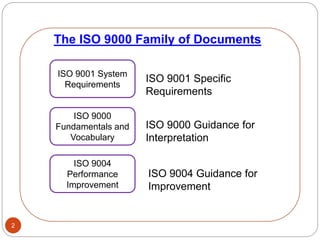
The ISO 9000 Family of Documents
ISO 9001 System
Requirements
ISO 9000
Fundamentals and
Vocabulary
ISO 9004
Performance
Improvement
ISO 9001 Specific
Requirements
ISO 9000 Guidance for
Interpretation
ISO 9004 Guidance for
Improvement
3
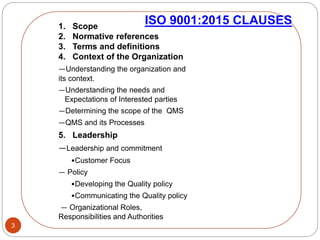
1. Scope
2. Normative references
3. Terms and definitions
4. Context of the Organization
—Understanding the organization and
its context.
—Understanding the needs and
Expectations of Interested parties
—Determining the scope of the QMS
—QMS and its Processes
5. Leadership
—Leadership and commitment
•Customer Focus
— Policy
•Developing the Quality policy
•Communicating the Quality policy
— Organizational Roles,
Responsibilities and Authorities
ISO 9001:2015 CLAUSES
4
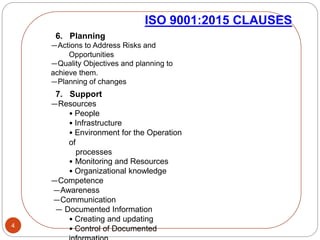
ISO 9001:2015 CLAUSES
6. Planning
—Actions to Address Risks and
Opportunities
—Quality Objectives and planning to
achieve them.
—Planning of changes
7. Support
—Resources
• People
• Infrastructure
• Environment for the Operation
of
processes
• Monitoring and Resources
• Organizational knowledge
—Competence
—Awareness
—Communication
— Documented Information
• Creating and updating
• Control of Documented
5
ISO 9001:2015 CLAUSES
8. Operation
—Operation planning and control
—Requirements for products and
services
• Customer satisfaction
• Determining the Requirements
Related to Products and services
• Review Of requirements related
to Products and Services
• Changes to Requirements for
Products and services
—Design and development of
products and services
• Design and development
planning
• Design and development inputs
• Design and development controls
• Design and development
outputs
•Design and development
changes
—Control of Externally provided
processes , product and services.
6
ISO 9001:2015 CLAUSES8. Operation ( cont’d)
—Production and service provision
• Control of production and service
provision
• Identification and traceability
• Property belonging to Customers
or
external Providers
• Preservation
• Post-delivery activities
• Control of changes
—Release of Products and services
—Control of products and services
9. Performance Evaluation
—Monitoring, Measurement, Analysis
and
Evaluation
• Customer satisfaction
• Analysis and evaluation
—Internal Audit
—Management Review
• Management review inputs
• Management review outputs
10. Improvement
—Non-conformity and corrective
High Level Structure (HLS) Core
Terminology –Changes and Additions
7
 Changed definitions
include:
—Organization
—Interested Party
—Management system
—Objective
—Competence
—Corrective Actions
—Continual Improvement
 New definitions added
include :
—Risk
—Documented Information
—Performance
—Context of the Organization
—Monitoring
—Improvement
—Knowledge
8
 ORGANISATION :
Person or group of people that has its own functions with
responsibilities, authorities and relationships to achieve its
objectives.
• INTERESTED PARTY:
Person or Organization that can affect, be affected by, or perceive
themselves to be affected by a decision or activity.
Examples : Customers, Owners, people in an organization,
Suppliers, bankers, unions, partners or society.
• MANAGEMENT SYSTEM:
Set of interrelated or interacting elements of an organization to
establish policies and objectives and processes to achieve those
objectives.
Definitions
9
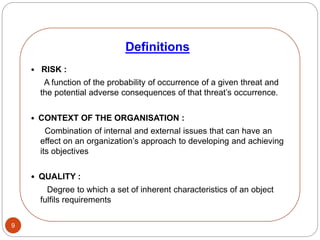
• RISK :
A function of the probability of occurrence of a given threat and
the potential adverse consequences of that threat’s occurrence.
• CONTEXT OF THE ORGANISATION :
Combination of internal and external issues that can have an
effect on an organization’s approach to developing and achieving
its objectives
• QUALITY :
Degree to which a set of inherent characteristics of an object
fulfils requirements
Definitions
QUALITY MANAGEMENT
PRINCIPLES
10
Quality Management Principles
11
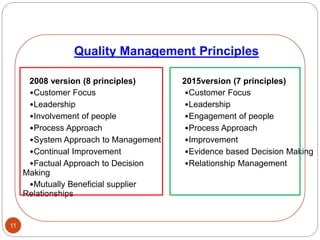
2008 version (8 principles)
•Customer Focus
•Leadership
•Involvement of people
•Process Approach
•System Approach to Management
•Continual Improvement
•Factual Approach to Decision
Making
•Mutually Beneficial supplier
Relationships
2015version (7 principles)
•Customer Focus
•Leadership
•Engagement of people
•Process Approach
•Improvement
•Evidence based Decision Making
•Relationship Management
THE PROCESS
APPROACH
12
13
• ISO 9001 promotes the adoption of a process approach when
developing, implementing and improving QMS effectiveness.
• Applies systematic definition, management of processes and their
interactions to achieve the intended results aligned with the Quality
Policy and strategic direction of the organization.
•Establish
•Document
•Implement
•Maintain and Monitor
The Process
Approach
14
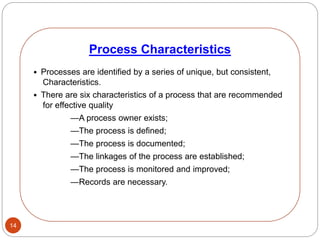
• Processes are identified by a series of unique, but consistent,
Characteristics.
• There are six characteristics of a process that are recommended
for effective quality
—A process owner exists;
—The process is defined;
—The process is documented;
—The linkages of the process are established;
—The process is monitored and improved;
—Records are necessary.
Process Characteristics
15
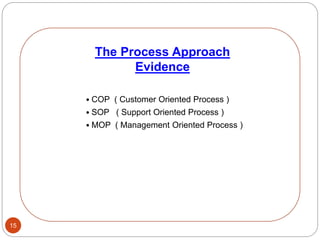
• COP ( Customer Oriented Process )
• SOP ( Support Oriented Process )
• MOP ( Management Oriented Process )
The Process Approach
Evidence
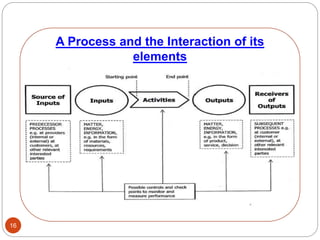
A Process and the Interaction of its
elements
16
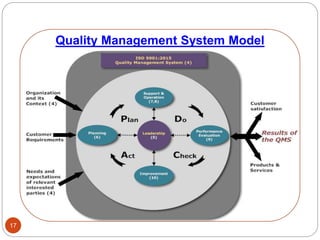
Quality Management System Model
17
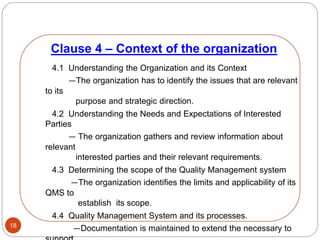
Clause 4 – Context of the organization
18
4.1 Understanding the Organization and its Context
—The organization has to identify the issues that are relevant
to its
purpose and strategic direction.
4.2 Understanding the Needs and Expectations of Interested
Parties
— The organization gathers and review information about
relevant
interested parties and their relevant requirements.
4.3 Determining the scope of the Quality Management system
—The organization identifies the limits and applicability of its
QMS to
establish its scope.
4.4 Quality Management System and its processes.
—Documentation is maintained to extend the necessary to
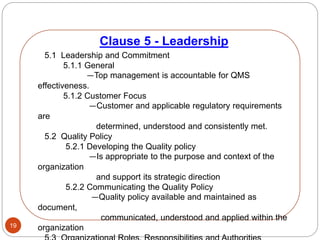
Clause 5 - Leadership
19
5.1 Leadership and Commitment
5.1.1 General
—Top management is accountable for QMS
effectiveness.
5.1.2 Customer Focus
—Customer and applicable regulatory requirements
are
determined, understood and consistently met.
5.2 Quality Policy
5.2.1 Developing the Quality policy
—Is appropriate to the purpose and context of the
organization
and support its strategic direction
5.2.2 Communicating the Quality Policy
—Quality policy available and maintained as
document,
communicated, understood and applied within the
organization
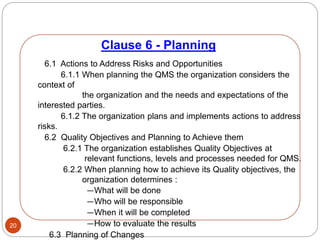
Clause 6 - Planning
20
6.1 Actions to Address Risks and Opportunities
6.1.1 When planning the QMS the organization considers the
context of
the organization and the needs and expectations of the
interested parties.
6.1.2 The organization plans and implements actions to address
risks.
6.2 Quality Objectives and Planning to Achieve them
6.2.1 The organization establishes Quality Objectives at
relevant functions, levels and processes needed for QMS.
6.2.2 When planning how to achieve its Quality objectives, the
organization determines :
—What will be done
—Who will be responsible
—When it will be completed
—How to evaluate the results
6.3 Planning of Changes
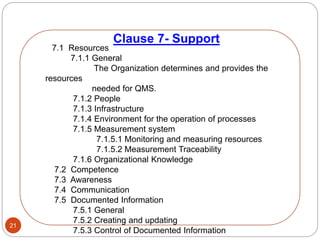
Clause 7- Support
21
7.1 Resources
7.1.1 General
The Organization determines and provides the
resources
needed for QMS.
7.1.2 People
7.1.3 Infrastructure
7.1.4 Environment for the operation of processes
7.1.5 Measurement system
7.1.5.1 Monitoring and measuring resources
7.1.5.2 Measurement Traceability
7.1.6 Organizational Knowledge
7.2 Competence
7.3 Awareness
7.4 Communication
7.5 Documented Information
7.5.1 General
7.5.2 Creating and updating
7.5.3 Control of Documented Information
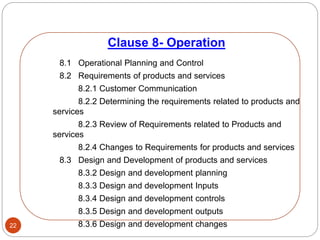
Clause 8- Operation
22
8.1 Operational Planning and Control
8.2 Requirements of products and services
8.2.1 Customer Communication
8.2.2 Determining the requirements related to products and
services
8.2.3 Review of Requirements related to Products and
services
8.2.4 Changes to Requirements for products and services
8.3 Design and Development of products and services
8.3.2 Design and development planning
8.3.3 Design and development Inputs
8.3.4 Design and development controls
8.3.5 Design and development outputs
8.3.6 Design and development changes
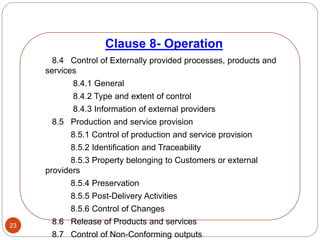
Clause 8- Operation
23
8.4 Control of Externally provided processes, products and
services
8.4.1 General
8.4.2 Type and extent of control
8.4.3 Information of external providers
8.5 Production and service provision
8.5.1 Control of production and service provision
8.5.2 Identification and Traceability
8.5.3 Property belonging to Customers or external
providers
8.5.4 Preservation
8.5.5 Post-Delivery Activities
8.5.6 Control of Changes
8.6 Release of Products and services
8.7 Control of Non-Conforming outputs
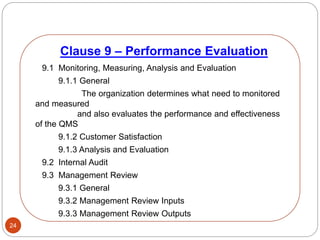
24
9.1 Monitoring, Measuring, Analysis and Evaluation
9.1.1 General
The organization determines what need to monitored
and measured
and also evaluates the performance and effectiveness
of the QMS
9.1.2 Customer Satisfaction
9.1.3 Analysis and Evaluation
9.2 Internal Audit
9.3 Management Review
9.3.1 General
9.3.2 Management Review Inputs
9.3.3 Management Review Outputs
Clause 9 – Performance Evaluation
25
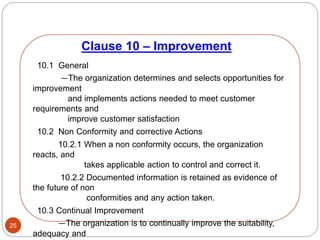
10.1 General
—The organization determines and selects opportunities for
improvement
and implements actions needed to meet customer
requirements and
improve customer satisfaction
10.2 Non Conformity and corrective Actions
10.2.1 When a non conformity occurs, the organization
reacts, and
takes applicable action to control and correct it.
10.2.2 Documented information is retained as evidence of
the future of non
conformities and any action taken.
10.3 Continual Improvement
—The organization is to continually improve the suitability,
adequacy and
Clause 10 – Improvement
26

ISO QMS 9001: 2015 clauses

  • 1.
    ISO 9001:2015 -QUALITY MANAGEMENT DOCUMENTS 1
  • 2.
    2 The ISO 9000Family of Documents ISO 9001 System Requirements ISO 9000 Fundamentals and Vocabulary ISO 9004 Performance Improvement ISO 9001 Specific Requirements ISO 9000 Guidance for Interpretation ISO 9004 Guidance for Improvement
  • 3.
    3 1. Scope 2. Normativereferences 3. Terms and definitions 4. Context of the Organization —Understanding the organization and its context. —Understanding the needs and Expectations of Interested parties —Determining the scope of the QMS —QMS and its Processes 5. Leadership —Leadership and commitment •Customer Focus — Policy •Developing the Quality policy •Communicating the Quality policy — Organizational Roles, Responsibilities and Authorities ISO 9001:2015 CLAUSES
  • 4.
    4 ISO 9001:2015 CLAUSES 6.Planning —Actions to Address Risks and Opportunities —Quality Objectives and planning to achieve them. —Planning of changes 7. Support —Resources • People • Infrastructure • Environment for the Operation of processes • Monitoring and Resources • Organizational knowledge —Competence —Awareness —Communication — Documented Information • Creating and updating • Control of Documented
  • 5.
    5 ISO 9001:2015 CLAUSES 8.Operation —Operation planning and control —Requirements for products and services • Customer satisfaction • Determining the Requirements Related to Products and services • Review Of requirements related to Products and Services • Changes to Requirements for Products and services —Design and development of products and services • Design and development planning • Design and development inputs • Design and development controls • Design and development outputs •Design and development changes —Control of Externally provided processes , product and services.
  • 6.
    6 ISO 9001:2015 CLAUSES8.Operation ( cont’d) —Production and service provision • Control of production and service provision • Identification and traceability • Property belonging to Customers or external Providers • Preservation • Post-delivery activities • Control of changes —Release of Products and services —Control of products and services 9. Performance Evaluation —Monitoring, Measurement, Analysis and Evaluation • Customer satisfaction • Analysis and evaluation —Internal Audit —Management Review • Management review inputs • Management review outputs 10. Improvement —Non-conformity and corrective
  • 7.
    High Level Structure(HLS) Core Terminology –Changes and Additions 7  Changed definitions include: —Organization —Interested Party —Management system —Objective —Competence —Corrective Actions —Continual Improvement  New definitions added include : —Risk —Documented Information —Performance —Context of the Organization —Monitoring —Improvement —Knowledge
  • 8.
    8  ORGANISATION : Personor group of people that has its own functions with responsibilities, authorities and relationships to achieve its objectives. • INTERESTED PARTY: Person or Organization that can affect, be affected by, or perceive themselves to be affected by a decision or activity. Examples : Customers, Owners, people in an organization, Suppliers, bankers, unions, partners or society. • MANAGEMENT SYSTEM: Set of interrelated or interacting elements of an organization to establish policies and objectives and processes to achieve those objectives. Definitions
  • 9.
    9 • RISK : Afunction of the probability of occurrence of a given threat and the potential adverse consequences of that threat’s occurrence. • CONTEXT OF THE ORGANISATION : Combination of internal and external issues that can have an effect on an organization’s approach to developing and achieving its objectives • QUALITY : Degree to which a set of inherent characteristics of an object fulfils requirements Definitions
  • 10.
  • 11.
    Quality Management Principles 11 2008version (8 principles) •Customer Focus •Leadership •Involvement of people •Process Approach •System Approach to Management •Continual Improvement •Factual Approach to Decision Making •Mutually Beneficial supplier Relationships 2015version (7 principles) •Customer Focus •Leadership •Engagement of people •Process Approach •Improvement •Evidence based Decision Making •Relationship Management
  • 12.
  • 13.
    13 • ISO 9001promotes the adoption of a process approach when developing, implementing and improving QMS effectiveness. • Applies systematic definition, management of processes and their interactions to achieve the intended results aligned with the Quality Policy and strategic direction of the organization. •Establish •Document •Implement •Maintain and Monitor The Process Approach
  • 14.
    14 • Processes areidentified by a series of unique, but consistent, Characteristics. • There are six characteristics of a process that are recommended for effective quality —A process owner exists; —The process is defined; —The process is documented; —The linkages of the process are established; —The process is monitored and improved; —Records are necessary. Process Characteristics
  • 15.
    15 • COP (Customer Oriented Process ) • SOP ( Support Oriented Process ) • MOP ( Management Oriented Process ) The Process Approach Evidence
  • 16.
    A Process andthe Interaction of its elements 16
  • 17.
  • 18.
    Clause 4 –Context of the organization 18 4.1 Understanding the Organization and its Context —The organization has to identify the issues that are relevant to its purpose and strategic direction. 4.2 Understanding the Needs and Expectations of Interested Parties — The organization gathers and review information about relevant interested parties and their relevant requirements. 4.3 Determining the scope of the Quality Management system —The organization identifies the limits and applicability of its QMS to establish its scope. 4.4 Quality Management System and its processes. —Documentation is maintained to extend the necessary to
  • 19.
    Clause 5 -Leadership 19 5.1 Leadership and Commitment 5.1.1 General —Top management is accountable for QMS effectiveness. 5.1.2 Customer Focus —Customer and applicable regulatory requirements are determined, understood and consistently met. 5.2 Quality Policy 5.2.1 Developing the Quality policy —Is appropriate to the purpose and context of the organization and support its strategic direction 5.2.2 Communicating the Quality Policy —Quality policy available and maintained as document, communicated, understood and applied within the organization
  • 20.
    Clause 6 -Planning 20 6.1 Actions to Address Risks and Opportunities 6.1.1 When planning the QMS the organization considers the context of the organization and the needs and expectations of the interested parties. 6.1.2 The organization plans and implements actions to address risks. 6.2 Quality Objectives and Planning to Achieve them 6.2.1 The organization establishes Quality Objectives at relevant functions, levels and processes needed for QMS. 6.2.2 When planning how to achieve its Quality objectives, the organization determines : —What will be done —Who will be responsible —When it will be completed —How to evaluate the results 6.3 Planning of Changes
  • 21.
    Clause 7- Support 21 7.1Resources 7.1.1 General The Organization determines and provides the resources needed for QMS. 7.1.2 People 7.1.3 Infrastructure 7.1.4 Environment for the operation of processes 7.1.5 Measurement system 7.1.5.1 Monitoring and measuring resources 7.1.5.2 Measurement Traceability 7.1.6 Organizational Knowledge 7.2 Competence 7.3 Awareness 7.4 Communication 7.5 Documented Information 7.5.1 General 7.5.2 Creating and updating 7.5.3 Control of Documented Information
  • 22.
    Clause 8- Operation 22 8.1Operational Planning and Control 8.2 Requirements of products and services 8.2.1 Customer Communication 8.2.2 Determining the requirements related to products and services 8.2.3 Review of Requirements related to Products and services 8.2.4 Changes to Requirements for products and services 8.3 Design and Development of products and services 8.3.2 Design and development planning 8.3.3 Design and development Inputs 8.3.4 Design and development controls 8.3.5 Design and development outputs 8.3.6 Design and development changes
  • 23.
    Clause 8- Operation 23 8.4Control of Externally provided processes, products and services 8.4.1 General 8.4.2 Type and extent of control 8.4.3 Information of external providers 8.5 Production and service provision 8.5.1 Control of production and service provision 8.5.2 Identification and Traceability 8.5.3 Property belonging to Customers or external providers 8.5.4 Preservation 8.5.5 Post-Delivery Activities 8.5.6 Control of Changes 8.6 Release of Products and services 8.7 Control of Non-Conforming outputs
  • 24.
    24 9.1 Monitoring, Measuring,Analysis and Evaluation 9.1.1 General The organization determines what need to monitored and measured and also evaluates the performance and effectiveness of the QMS 9.1.2 Customer Satisfaction 9.1.3 Analysis and Evaluation 9.2 Internal Audit 9.3 Management Review 9.3.1 General 9.3.2 Management Review Inputs 9.3.3 Management Review Outputs Clause 9 – Performance Evaluation
  • 25.
    25 10.1 General —The organizationdetermines and selects opportunities for improvement and implements actions needed to meet customer requirements and improve customer satisfaction 10.2 Non Conformity and corrective Actions 10.2.1 When a non conformity occurs, the organization reacts, and takes applicable action to control and correct it. 10.2.2 Documented information is retained as evidence of the future of non conformities and any action taken. 10.3 Continual Improvement —The organization is to continually improve the suitability, adequacy and Clause 10 – Improvement
  • 26.