Awarness
training on
IMS system
ISO 9001:2015, ISO 14001: 2015 &
ISO 45001:2018.
PREPARED: R.RANGANATHAN
Why this training is required ?
when already materials standards available?
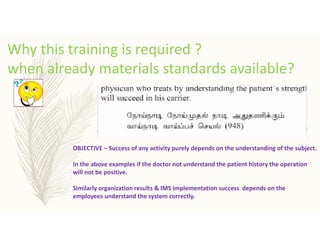
OBJECTIVE – Success of any activity purely depends on the understanding of the subject.
In the above examples if the doctor not understand the patient history the operation
will not be positive.
Similarly organization results & IMS implementation success depends on the
employees understand the system correctly.
What is Management??
MANAGEMENT:
The planning, organizing, leading, and
controlling of human and other resources
to achieve organizational goals effectively
and efficiently
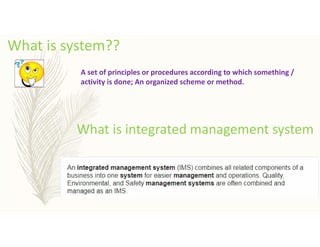
What is system??
A set of principles or procedures according to which something /
activity is done; An organized scheme or method.
What is integrated management system
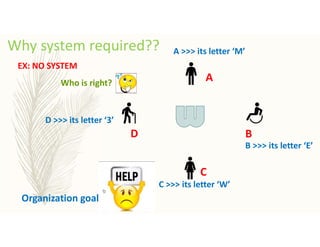
Why system required??
A
B
C
D
EX: NO SYSTEM
D >>> its letter ‘3’
Who is right?
A >>> its letter ‘M’
B >>> its letter ‘E’
C >>> its letter ‘W’
Organization goal
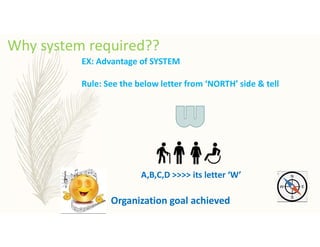
Why system required??
EX: Advantage of SYSTEM
Rule: See the below letter from ‘NORTH’ side & tell
A,B,C,D >>>> its letter ‘W’
Organization goal achieved
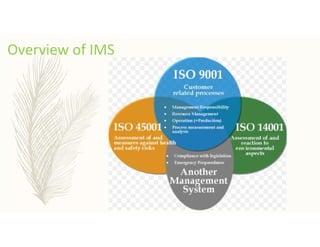
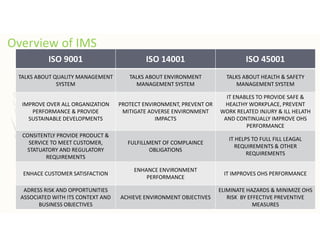
Overview of IMS
Overview of IMS
ISO 9001 ISO 14001 ISO 45001
TALKS ABOUT QUALITY MANAGEMENT
SYSTEM
TALKS ABOUT ENVIRONMENT
MANAGEMENT SYSTEM
TALKS ABOUT HEALTH & SAFETY
MANAGEMENT SYSTEM
IMPROVE OVER ALL ORGANIZATION
PERFORMANCE & PROVIDE
SUSTAINABLE DEVELOPMENTS
PROTECT ENVIRONMENT, PREVENT OR
MITIGATE ADVERSE ENVIRONMENT
IMPACTS
IT ENABLES TO PROVIDE SAFE &
HEALTHY WORKPLACE, PREVENT
WORK RELATED INJURY & ILL HELATH
AND CONTINUALLY IMPROVE OHS
PERFORMANCE
CONSITENTLY PROVIDE PRODUCT &
SERVICE TO MEET CUSTOMER,
STATUATORY AND REGULATORY
REQUIREMENTS
FULFILLMENT OF COMPLAINCE
OBLIGATIONS
IT HELPS TO FULL FILL LEAGAL
REQUIREMENTS & OTHER
REQUIREMENTS
ENHACE CUSTOMER SATISFACTION
ENHANCE ENVIRONMENT
PERFORMANCE
IT IMPROVES OHS PERFORMANCE
ADRESS RISK AND OPPORTUNITIES
ASSOCIATED WITH ITS CONTEXT AND
BUSINESS OBJECTIVES
ACHIEVE ENVIRONMENT OBJECTIVES
ELIMINATE HAZARDS & MINIMIZE OHS
RISK BY EFFECTIVE PREVENTIVE
MEASURES
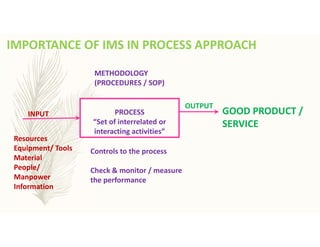
IMPORTANCE OF IMS IN PROCESS APPROACH
PROCESS
“Set of interrelated or
interacting activities”
INPUT
OUTPUT
METHODOLOGY
(PROCEDURES / SOP)
Controls to the process
Check & monitor / measure
the performance
Resources
Equipment/ Tools
Material
People/
Manpower
Information
GOOD PRODUCT /
SERVICE
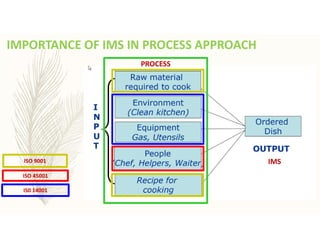
IMPORTANCE OF IMS IN PROCESS APPROACH
ISO 9001
ISO 45001
IS0 14001
PROCESS
IMS
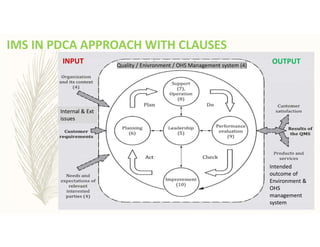
IMS IN PDCA APPROACH WITH CLAUSES
Quality / Enivronment / OHS Management system (4)
Intended
outcome of
Environment &
OHS
management
system
Internal & Ext
issues
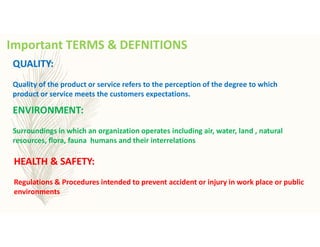
Important TERMS & DEFNITIONS
ENVIRONMENT:
Surroundings in which an organization operates including air, water, land , natural
resources, flora, fauna humans and their interrelations
QUALITY:
Quality of the product or service refers to the perception of the degree to which
product or service meets the customers expectations.
HEALTH & SAFETY:
Regulations & Procedures intended to prevent accident or injury in work place or public
environments
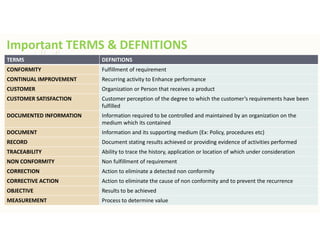
Important TERMS & DEFNITIONS
TERMS DEFNITIONS
CONFORMITY Fulfillment of requirement
CONTINUAL IMPROVEMENT Recurring activity to Enhance performance
CUSTOMER Organization or Person that receives a product
CUSTOMER SATISFACTION Customer perception of the degree to which the customer’s requirements have been
fulfilled
DOCUMENTED INFORMATION Information required to be controlled and maintained by an organization on the
medium which its contained
DOCUMENT Information and its supporting medium (Ex: Policy, procedures etc)
RECORD Document stating results achieved or providing evidence of activities performed
TRACEABILITY Ability to trace the history, application or location of which under consideration
NON CONFORMITY Non fulfillment of requirement
CORRECTION Action to eliminate a detected non conformity
CORRECTIVE ACTION Action to eliminate the cause of non conformity and to prevent the recurrence
OBJECTIVE Results to be achieved
MEASUREMENT Process to determine value
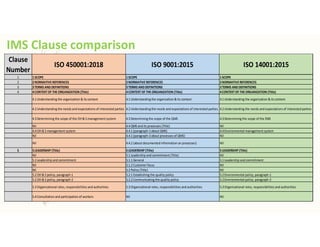
IMS Clause comparison
Clause
Number
ISO 450001:2018 ISO 9001:2015 ISO 14001:2015
1 1SCOPE 1SCOPE 1SCOPE
2 2NORMATIVE REFERENCES 2NORMATIVE REFERENCES 2NORMATIVE REFERENCES
3 3TERMS AND DEFINITIONS 3TERMS ANDDEFINITIONS 3TERMS AND DEFINITIONS
4 4CONTEXTOF THE ORGANIZATION (Title) 4CONTEXT OF THE ORGANIZATION (Title) 4CONTEXTOF THE ORGANIZATION (Title)
4.1 Understanding the organization & its context 4.1 Understanding the organization & its context 4.1Understanding the organization & its context
4.2 Understanding the needs and expectations of interested parties 4.2 Understanding the needs and expectations of interested parties 4.2Understanding the needs and expectations of interested parties
4.3 Determining the scope of the OH & S management system 4.3 Determining the scope of the QMS 4.3Determining the scope of the EMS
Nil 4.4 QMS and its processes (Title) Nil
4.4 OH & S management system 4.4.1(paragraph-1about QMS) 4.4Environmental management system
Nil 4.4.1(paragraph-2about processes of QMS) Nil
Nil 4.4.2 (about documented information on processes) Nil
5 5LEADERSHIP (Title) 5LEADERSHIP (Title) 5LEADERSHIP (Title)
Nil 5.1 Leadership and commitment (Title) Nil
5.1 Leadership and commitment 5.1.1General 5.1Leadership and commitment
Nil 5.1.2Customer focus Nil
Nil 5.2 Policy (Title) Nil
5.2 OH & S policy, paragraph-1 5.2.1Establishing the quality policy 5.2Environmental policy, paragraph-1
5.2 OH & S policy, paragraph-2 5.2.2Communicating the quality policy 5.2Environmental policy, paragraph-2
5.3 Organizational roles, responsibilities and authorities 5.3 Organizational roles, responsibilities and authorities 5.3Organizational roles, responsibilities and authorities
5.4 Consultation and participation of workers Nil Nil
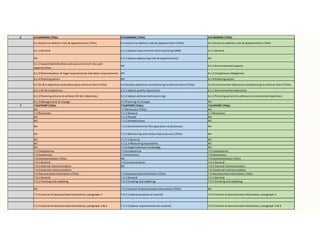
IMS Clause comparison contd
6 6 PLANNING (Title) 6 PLANNING (Title) 6 PLANNING (Title)
6.1 Actions to address risks & opportunities (Title) 6.1 Actions to address risks & opportunities (Title) 6.1 Actions to address risks & opportunities (Title)
6.1.1 General 6.1.1 (about requirements when planning QMS) 6.1.1 General
Nil 6.1.2 (about addressing risks & opportunities) Nil
6.1.2 Hazard Identification and assessment of risks and
opportunities
Nil 6.1.2 Environmental aspects
6.1.3 Determination of legal requirements and other requirements Nil 6.1.3 Compliance obligations
6.1.4 Planning action Nil 6.1.4 Planning action
6.2 OH & S objectives and planning to achieve them (Title) 6.2 Quality objectives and planning to achieve them (Title) 6.2 Environmental objectives and planning to achieve them (Title)
6.2.1 OH & S objectives 6.2.1 (about quality objectives) 6.2.1 Environmental objectives
6.2.2 Planning actions to achieve OH & S objectives 6.2.2 (about achievement planning) 6.2.2 Planning actions to achieve environmental objectives
8.1.3 Management of change 6.3 Planning of changes Nil
7 7 SUPPORT (Title) 7 SUPPORT (Title) 7 SUPPORT (Title)
Nil 7.1 Resources (Title) Nil
7.1 Resources 7.1.1 General 7.1 Resources
Nil 7.1.2 People Nil
Nil 7.1.3 Infrastructure Nil
Nil 7.1.4 Environment for the operation of processes Nil
Nil 7.1.5 Monitoring and measuring resources (Title) Nil
Nil 7.1.5.1 General Nil
Nil 7.1.5.2 Measuring traceability Nil
Nil 7.1.6 Organizational knowledge Nil
7.2 Competence 7.2 Competence 7.2 Competence
7.3 Awareness 7.3 Awareness 7.3 Awareness
7.4 Communication (Title) Nil 7.4 Communication (Title)
7.4.1 General 7.4 Communication 7.4.1 General
7.4.2 Internal Communication Nil 7.4.2 Internal Communication
7.4.3 External Communication 7.4.3 External Communication
7.5 Documented information (Title) 7.5 Documented information (Title) 7.5 Documented information (Title)
7.5.1 General 7.5.1 General 7.5.1 General
7.5.2 Creating and updating 7.5.2 Creating and updating 7.5.2 Creating and updating
Nil 7.5.3 Control of documented information (Title) Nil
7.5.3 Control of documented information, paragraph-1 7.5.3.1 (about purpose of control) 7.5.3 Control of documented information, paragraph-1
7.5.3 Control of documented information, paragraph-2 & 3 7.5.3.2 (about requirements for control) 7.5.3 Control of documented information, paragraph-2 & 3
IMS Clause comparison contd
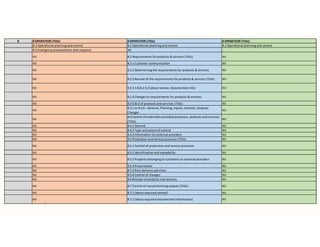
8 8 OPERATION (Title) 8 OPERATION (Title) 8 OPERATION (Title)
8.1 Operational planning and control 8.1 Operational planning and control 8.1 Operational planning and control
8.2 Emergency preparedness and response Nil ;
Nil 8.2 Requirements for products & services (Title) Nil
Nil 8.2.1 Customer communication Nil
Nil 8.2.2 Determining the requirements for products & services Nil
Nil 8.2.3 Review of the requirements for products & services (Title) Nil
Nil 8.2.3.1 & 8.2.3.2 (about review, documented info) Nil
Nil 8.2.4 Changes to requirements for products & services Nil
Nil 8.3 D & D of products and services (Title) Nil
Nil
8.3.1 to 8.3.6 – General, Planning, Inputs, Controls, Outputs,
Changes
Nil
Nil
8.4 Control of externally provided processes, products and services
(Title)
Nil
Nil 8.4.1 General Nil
Nil 8.4.2 Type and extent of control Nil
Nil 8.4.3 Information for external providers Nil
Nil 8.5 Production and service provision (Title) Nil
Nil 8.5.1 Control of production and service provision Nil
Nil 8.5.2 Identification and traceability Nil
Nil 8.5.3 Property belonging to customers or external providers Nil
Nil 8.5.4 Preservation Nil
Nil 8.5.5 Post-delivery activities Nil
Nil 8.5.6 Control of changes Nil
Nil 8.6 Release of products and services Nil
Nil 8.7 Control of nonconforming outputs (Title) Nil
Nil 8.7.1 (about required control) Nil
Nil 8.7.2 (about required documented information) Nil
IMS Clause comparison contd
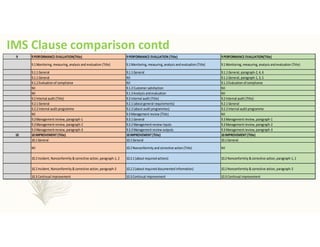
9 9PERFORMANCE EVALUATION(Title) 9PERFORMANCE EVALUATION (Title) 9PERFORMANCE EVALUATION(Title)
9.1Monitoring, measuring, analysis and evaluation (Title) 9.1Monitoring, measuring, analysis and evaluation (Title) 9.1Monitoring, measuring, analysis and evaluation (Title)
9.1.1General 9.1.1General 9.1.1General, paragraph-2, 4, 6
9.1.1General Nil 9.1.1General, paragraph-1, 3, 5
9.1.2Evaluation of compliance Nil 9.1.2Evaluation of compliance
Nil 9.1.2Customer satisfaction Nil
Nil 9.1.3Analysis and evaluation Nil
9.2Internal audit (Title) 9.2Internal audit (Title) 9.2Internal audit (Title)
9.2.1General 9.2.1(about general requirements) 9.2.1General
9.2.2Internal audit programme 9.2.2(about audit programmes) 9.2.2Internal audit programme
Nil 9.3Management review (Title) Nil
9.3Management review, paragraph-1 9.3.1General 9.3Management review, paragraph-1
9.3Management review, paragraph-2 9.3.2Management review inputs 9.3Management review, paragraph-2
9.3Management review, paragraph-3 9.3.3Management review outputs 9.3Management review, paragraph-3
10 10IMPROVEMENT(Title) 10IMPROVEMENT(Title) 10IMPROVEMENT(Title)
10.1General 10.1General 10.1General
Nil 10.2Nonconformity and corrective action (Title) Nil
10.2Incident, Nonconformity & corrective action, paragraph-1, 2 10.2.1(about required actions) 10.2Nonconformity & corrective action, paragraph-1, 2
10.2Incident, Nonconformity & corrective action, paragraph-3 10.2.2(about required documented information) 10.2Nonconformity & corrective action, paragraph-3
10.3Continual improvement 10.3Continual improvement 10.3Continual improvement
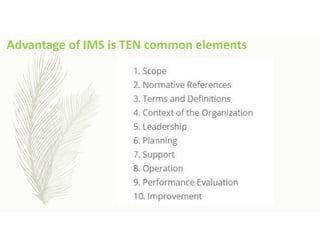
Advantage of IMS is TEN common elements
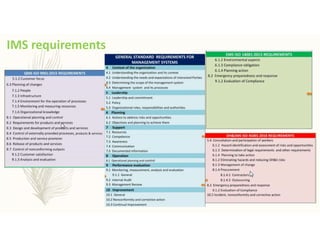
IMS requirements
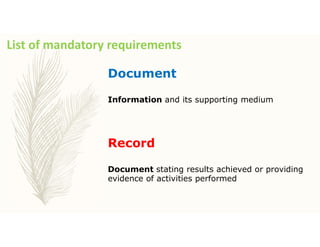
List of mandatory requirements
Document
Information and its supporting medium
Record
Document stating results achieved or providing
evidence of activities performed
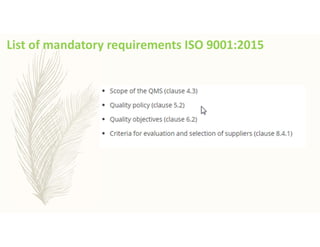
List of mandatory requirements ISO 9001:2015
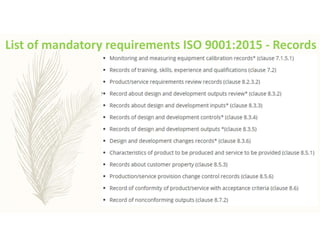
List of mandatory requirements ISO 9001:2015 - Records
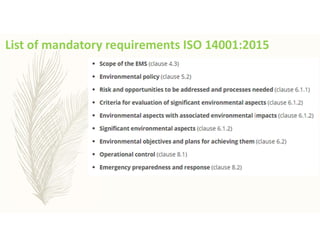
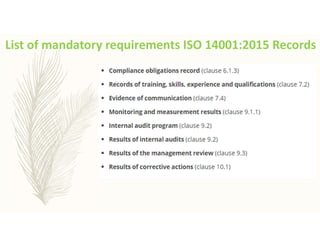
List of mandatory requirements ISO 14001:2015
List of mandatory requirements ISO 14001:2015 Records
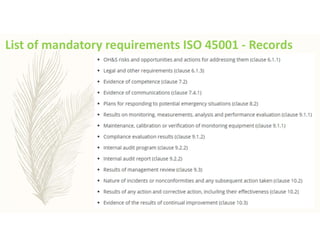
List of mandatory requirements ISO 45001
List of mandatory requirements ISO 45001 - Records
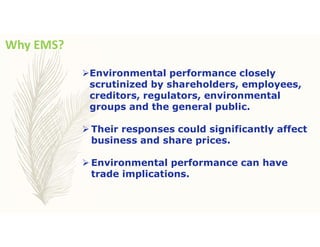
Why EMS?
Environmental performance closely
scrutinized by shareholders, employees,
creditors, regulators, environmental
groups and the general public.
 Their responses could significantly affect
business and share prices.
 Environmental performance can have
trade implications.
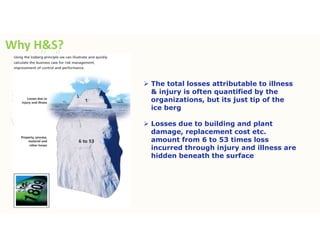
Why H&S?
 The total losses attributable to illness
& injury is often quantified by the
organizations, but its just tip of the
ice berg
 Losses due to building and plant
damage, replacement cost etc.
amount from 6 to 53 times loss
incurred through injury and illness are
hidden beneath the surface
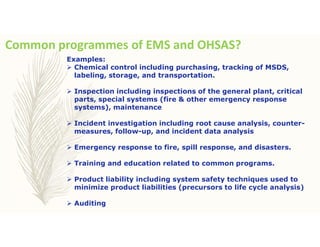
Common programmes of EMS and OHSAS?
Examples:
 Chemical control including purchasing, tracking of MSDS,
labeling, storage, and transportation.
 Inspection including inspections of the general plant, critical
parts, special systems (fire & other emergency response
systems), maintenance
 Incident investigation including root cause analysis, counter-
measures, follow-up, and incident data analysis
 Emergency response to fire, spill response, and disasters.
 Training and education related to common programs.
 Product liability including system safety techniques used to
minimize product liabilities (precursors to life cycle analysis)
 Auditing
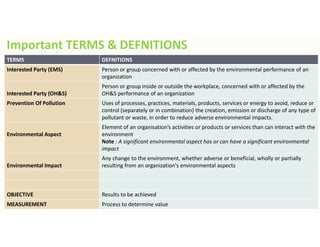
Important TERMS & DEFNITIONS
TERMS DEFNITIONS
Interested Party (EMS) Person or group concerned with or affected by the environmental performance of an
organization
Interested Party (OH&S)
Person or group inside or outside the workplace, concerned with or affected by the
OH&S performance of an organization
Prevention Of Pollution Uses of processes, practices, materials, products, services or energy to avoid, reduce or
control (separately or in combination) the creation, emission or discharge of any type of
pollutant or waste, in order to reduce adverse environmental impacts.
Environmental Aspect
Element of an organisation’s activities or products or services than can interact with the
environment
Note : A significant environmental aspect has or can have a significant environmental
impact
Environmental Impact
Any change to the environment, whether adverse or beneficial, wholly or partially
resulting from an organization's environmental aspects
OBJECTIVE Results to be achieved
MEASUREMENT Process to determine value
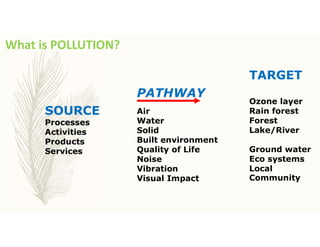
What is POLLUTION?
SOURCE
Processes
Activities
Products
Services
PATHWAY
Air
Water
Solid
Built environment
Quality of Life
Noise
Vibration
Visual Impact
TARGET
Ozone layer
Rain forest
Forest
Lake/River
Ground water
Eco systems
Local
Community
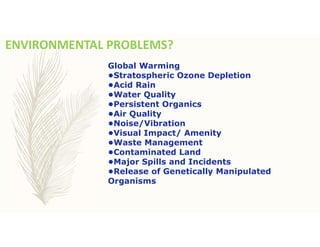
ENVIRONMENTAL PROBLEMS?
Global Warming
•Stratospheric Ozone Depletion
•Acid Rain
•Water Quality
•Persistent Organics
•Air Quality
•Noise/Vibration
•Visual Impact/ Amenity
•Waste Management
•Contaminated Land
•Major Spills and Incidents
•Release of Genetically Manipulated
Organisms
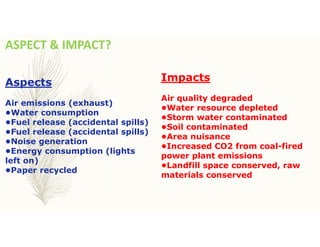
ASPECT & IMPACT?
Aspects
Air emissions (exhaust)
•Water consumption
•Fuel release (accidental spills)
•Noise generation
•Energy consumption (lights
left on)
•Paper recycled
Impacts
Air quality degraded
•Water resource depleted
•Storm water contaminated
•Soil contaminated
•Area nuisance
•Increased CO2 from coal-fired
power plant emissions
•Landfill space conserved, raw
materials conserved
LEGAL & OTHER REQUIREMENTS
Procedures to identify and access
applicable legal & other requirements
• Keep information up to date
• Communicate requirements to :-
– employees
- Person working under the control
of organisation
– interested parties
LEGAL & OTHER REQUIREMENTS
The statutes relating to OH&S are
broadly divided into three:-
• Statutes for safety at workplaces
• Statutes for safety of substances
• Statutes for safety of activities
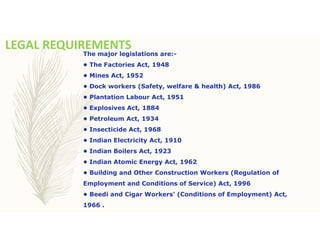
LEGAL REQUIREMENTS
The major legislations are:-
• The Factories Act, 1948
• Mines Act, 1952
• Dock workers (Safety, welfare & health) Act, 1986
• Plantation Labour Act, 1951
• Explosives Act, 1884
• Petroleum Act, 1934
• Insecticide Act, 1968
• Indian Electricity Act, 1910
• Indian Boilers Act, 1923
• Indian Atomic Energy Act, 1962
• Building and Other Construction Workers (Regulation of
Employment and Conditions of Service) Act, 1996
• Beedi and Cigar Workers' (Conditions of Employment) Act,
1966 .
THANK YOU
QUESTIONS AND FEEDBACK
Ranganathan Radhakrishnan
Mobile: + 91 8754449482

ISO 9001, 14001, 45001 (IMS) basics training material

  • 1.
    Awarness training on IMS system ISO9001:2015, ISO 14001: 2015 & ISO 45001:2018. PREPARED: R.RANGANATHAN
  • 2.
    Why this trainingis required ? when already materials standards available? OBJECTIVE – Success of any activity purely depends on the understanding of the subject. In the above examples if the doctor not understand the patient history the operation will not be positive. Similarly organization results & IMS implementation success depends on the employees understand the system correctly.
  • 3.
    What is Management?? MANAGEMENT: Theplanning, organizing, leading, and controlling of human and other resources to achieve organizational goals effectively and efficiently
  • 4.
    What is system?? Aset of principles or procedures according to which something / activity is done; An organized scheme or method. What is integrated management system
  • 5.
    Why system required?? A B C D EX:NO SYSTEM D >>> its letter ‘3’ Who is right? A >>> its letter ‘M’ B >>> its letter ‘E’ C >>> its letter ‘W’ Organization goal
  • 6.
    Why system required?? EX:Advantage of SYSTEM Rule: See the below letter from ‘NORTH’ side & tell A,B,C,D >>>> its letter ‘W’ Organization goal achieved
  • 7.
  • 8.
    Overview of IMS ISO9001 ISO 14001 ISO 45001 TALKS ABOUT QUALITY MANAGEMENT SYSTEM TALKS ABOUT ENVIRONMENT MANAGEMENT SYSTEM TALKS ABOUT HEALTH & SAFETY MANAGEMENT SYSTEM IMPROVE OVER ALL ORGANIZATION PERFORMANCE & PROVIDE SUSTAINABLE DEVELOPMENTS PROTECT ENVIRONMENT, PREVENT OR MITIGATE ADVERSE ENVIRONMENT IMPACTS IT ENABLES TO PROVIDE SAFE & HEALTHY WORKPLACE, PREVENT WORK RELATED INJURY & ILL HELATH AND CONTINUALLY IMPROVE OHS PERFORMANCE CONSITENTLY PROVIDE PRODUCT & SERVICE TO MEET CUSTOMER, STATUATORY AND REGULATORY REQUIREMENTS FULFILLMENT OF COMPLAINCE OBLIGATIONS IT HELPS TO FULL FILL LEAGAL REQUIREMENTS & OTHER REQUIREMENTS ENHACE CUSTOMER SATISFACTION ENHANCE ENVIRONMENT PERFORMANCE IT IMPROVES OHS PERFORMANCE ADRESS RISK AND OPPORTUNITIES ASSOCIATED WITH ITS CONTEXT AND BUSINESS OBJECTIVES ACHIEVE ENVIRONMENT OBJECTIVES ELIMINATE HAZARDS & MINIMIZE OHS RISK BY EFFECTIVE PREVENTIVE MEASURES
  • 9.
    IMPORTANCE OF IMSIN PROCESS APPROACH PROCESS “Set of interrelated or interacting activities” INPUT OUTPUT METHODOLOGY (PROCEDURES / SOP) Controls to the process Check & monitor / measure the performance Resources Equipment/ Tools Material People/ Manpower Information GOOD PRODUCT / SERVICE
  • 10.
    IMPORTANCE OF IMSIN PROCESS APPROACH ISO 9001 ISO 45001 IS0 14001 PROCESS IMS
  • 11.
    IMS IN PDCAAPPROACH WITH CLAUSES Quality / Enivronment / OHS Management system (4) Intended outcome of Environment & OHS management system Internal & Ext issues
  • 12.
    Important TERMS &DEFNITIONS ENVIRONMENT: Surroundings in which an organization operates including air, water, land , natural resources, flora, fauna humans and their interrelations QUALITY: Quality of the product or service refers to the perception of the degree to which product or service meets the customers expectations. HEALTH & SAFETY: Regulations & Procedures intended to prevent accident or injury in work place or public environments
  • 13.
    Important TERMS &DEFNITIONS TERMS DEFNITIONS CONFORMITY Fulfillment of requirement CONTINUAL IMPROVEMENT Recurring activity to Enhance performance CUSTOMER Organization or Person that receives a product CUSTOMER SATISFACTION Customer perception of the degree to which the customer’s requirements have been fulfilled DOCUMENTED INFORMATION Information required to be controlled and maintained by an organization on the medium which its contained DOCUMENT Information and its supporting medium (Ex: Policy, procedures etc) RECORD Document stating results achieved or providing evidence of activities performed TRACEABILITY Ability to trace the history, application or location of which under consideration NON CONFORMITY Non fulfillment of requirement CORRECTION Action to eliminate a detected non conformity CORRECTIVE ACTION Action to eliminate the cause of non conformity and to prevent the recurrence OBJECTIVE Results to be achieved MEASUREMENT Process to determine value
  • 14.
    IMS Clause comparison Clause Number ISO450001:2018 ISO 9001:2015 ISO 14001:2015 1 1SCOPE 1SCOPE 1SCOPE 2 2NORMATIVE REFERENCES 2NORMATIVE REFERENCES 2NORMATIVE REFERENCES 3 3TERMS AND DEFINITIONS 3TERMS ANDDEFINITIONS 3TERMS AND DEFINITIONS 4 4CONTEXTOF THE ORGANIZATION (Title) 4CONTEXT OF THE ORGANIZATION (Title) 4CONTEXTOF THE ORGANIZATION (Title) 4.1 Understanding the organization & its context 4.1 Understanding the organization & its context 4.1Understanding the organization & its context 4.2 Understanding the needs and expectations of interested parties 4.2 Understanding the needs and expectations of interested parties 4.2Understanding the needs and expectations of interested parties 4.3 Determining the scope of the OH & S management system 4.3 Determining the scope of the QMS 4.3Determining the scope of the EMS Nil 4.4 QMS and its processes (Title) Nil 4.4 OH & S management system 4.4.1(paragraph-1about QMS) 4.4Environmental management system Nil 4.4.1(paragraph-2about processes of QMS) Nil Nil 4.4.2 (about documented information on processes) Nil 5 5LEADERSHIP (Title) 5LEADERSHIP (Title) 5LEADERSHIP (Title) Nil 5.1 Leadership and commitment (Title) Nil 5.1 Leadership and commitment 5.1.1General 5.1Leadership and commitment Nil 5.1.2Customer focus Nil Nil 5.2 Policy (Title) Nil 5.2 OH & S policy, paragraph-1 5.2.1Establishing the quality policy 5.2Environmental policy, paragraph-1 5.2 OH & S policy, paragraph-2 5.2.2Communicating the quality policy 5.2Environmental policy, paragraph-2 5.3 Organizational roles, responsibilities and authorities 5.3 Organizational roles, responsibilities and authorities 5.3Organizational roles, responsibilities and authorities 5.4 Consultation and participation of workers Nil Nil
  • 15.
    IMS Clause comparisoncontd 6 6 PLANNING (Title) 6 PLANNING (Title) 6 PLANNING (Title) 6.1 Actions to address risks & opportunities (Title) 6.1 Actions to address risks & opportunities (Title) 6.1 Actions to address risks & opportunities (Title) 6.1.1 General 6.1.1 (about requirements when planning QMS) 6.1.1 General Nil 6.1.2 (about addressing risks & opportunities) Nil 6.1.2 Hazard Identification and assessment of risks and opportunities Nil 6.1.2 Environmental aspects 6.1.3 Determination of legal requirements and other requirements Nil 6.1.3 Compliance obligations 6.1.4 Planning action Nil 6.1.4 Planning action 6.2 OH & S objectives and planning to achieve them (Title) 6.2 Quality objectives and planning to achieve them (Title) 6.2 Environmental objectives and planning to achieve them (Title) 6.2.1 OH & S objectives 6.2.1 (about quality objectives) 6.2.1 Environmental objectives 6.2.2 Planning actions to achieve OH & S objectives 6.2.2 (about achievement planning) 6.2.2 Planning actions to achieve environmental objectives 8.1.3 Management of change 6.3 Planning of changes Nil 7 7 SUPPORT (Title) 7 SUPPORT (Title) 7 SUPPORT (Title) Nil 7.1 Resources (Title) Nil 7.1 Resources 7.1.1 General 7.1 Resources Nil 7.1.2 People Nil Nil 7.1.3 Infrastructure Nil Nil 7.1.4 Environment for the operation of processes Nil Nil 7.1.5 Monitoring and measuring resources (Title) Nil Nil 7.1.5.1 General Nil Nil 7.1.5.2 Measuring traceability Nil Nil 7.1.6 Organizational knowledge Nil 7.2 Competence 7.2 Competence 7.2 Competence 7.3 Awareness 7.3 Awareness 7.3 Awareness 7.4 Communication (Title) Nil 7.4 Communication (Title) 7.4.1 General 7.4 Communication 7.4.1 General 7.4.2 Internal Communication Nil 7.4.2 Internal Communication 7.4.3 External Communication 7.4.3 External Communication 7.5 Documented information (Title) 7.5 Documented information (Title) 7.5 Documented information (Title) 7.5.1 General 7.5.1 General 7.5.1 General 7.5.2 Creating and updating 7.5.2 Creating and updating 7.5.2 Creating and updating Nil 7.5.3 Control of documented information (Title) Nil 7.5.3 Control of documented information, paragraph-1 7.5.3.1 (about purpose of control) 7.5.3 Control of documented information, paragraph-1 7.5.3 Control of documented information, paragraph-2 & 3 7.5.3.2 (about requirements for control) 7.5.3 Control of documented information, paragraph-2 & 3
  • 16.
    IMS Clause comparisoncontd 8 8 OPERATION (Title) 8 OPERATION (Title) 8 OPERATION (Title) 8.1 Operational planning and control 8.1 Operational planning and control 8.1 Operational planning and control 8.2 Emergency preparedness and response Nil ; Nil 8.2 Requirements for products & services (Title) Nil Nil 8.2.1 Customer communication Nil Nil 8.2.2 Determining the requirements for products & services Nil Nil 8.2.3 Review of the requirements for products & services (Title) Nil Nil 8.2.3.1 & 8.2.3.2 (about review, documented info) Nil Nil 8.2.4 Changes to requirements for products & services Nil Nil 8.3 D & D of products and services (Title) Nil Nil 8.3.1 to 8.3.6 – General, Planning, Inputs, Controls, Outputs, Changes Nil Nil 8.4 Control of externally provided processes, products and services (Title) Nil Nil 8.4.1 General Nil Nil 8.4.2 Type and extent of control Nil Nil 8.4.3 Information for external providers Nil Nil 8.5 Production and service provision (Title) Nil Nil 8.5.1 Control of production and service provision Nil Nil 8.5.2 Identification and traceability Nil Nil 8.5.3 Property belonging to customers or external providers Nil Nil 8.5.4 Preservation Nil Nil 8.5.5 Post-delivery activities Nil Nil 8.5.6 Control of changes Nil Nil 8.6 Release of products and services Nil Nil 8.7 Control of nonconforming outputs (Title) Nil Nil 8.7.1 (about required control) Nil Nil 8.7.2 (about required documented information) Nil
  • 17.
    IMS Clause comparisoncontd 9 9PERFORMANCE EVALUATION(Title) 9PERFORMANCE EVALUATION (Title) 9PERFORMANCE EVALUATION(Title) 9.1Monitoring, measuring, analysis and evaluation (Title) 9.1Monitoring, measuring, analysis and evaluation (Title) 9.1Monitoring, measuring, analysis and evaluation (Title) 9.1.1General 9.1.1General 9.1.1General, paragraph-2, 4, 6 9.1.1General Nil 9.1.1General, paragraph-1, 3, 5 9.1.2Evaluation of compliance Nil 9.1.2Evaluation of compliance Nil 9.1.2Customer satisfaction Nil Nil 9.1.3Analysis and evaluation Nil 9.2Internal audit (Title) 9.2Internal audit (Title) 9.2Internal audit (Title) 9.2.1General 9.2.1(about general requirements) 9.2.1General 9.2.2Internal audit programme 9.2.2(about audit programmes) 9.2.2Internal audit programme Nil 9.3Management review (Title) Nil 9.3Management review, paragraph-1 9.3.1General 9.3Management review, paragraph-1 9.3Management review, paragraph-2 9.3.2Management review inputs 9.3Management review, paragraph-2 9.3Management review, paragraph-3 9.3.3Management review outputs 9.3Management review, paragraph-3 10 10IMPROVEMENT(Title) 10IMPROVEMENT(Title) 10IMPROVEMENT(Title) 10.1General 10.1General 10.1General Nil 10.2Nonconformity and corrective action (Title) Nil 10.2Incident, Nonconformity & corrective action, paragraph-1, 2 10.2.1(about required actions) 10.2Nonconformity & corrective action, paragraph-1, 2 10.2Incident, Nonconformity & corrective action, paragraph-3 10.2.2(about required documented information) 10.2Nonconformity & corrective action, paragraph-3 10.3Continual improvement 10.3Continual improvement 10.3Continual improvement
  • 18.
    Advantage of IMSis TEN common elements
  • 19.
  • 20.
    List of mandatoryrequirements Document Information and its supporting medium Record Document stating results achieved or providing evidence of activities performed
  • 21.
    List of mandatoryrequirements ISO 9001:2015
  • 22.
    List of mandatoryrequirements ISO 9001:2015 - Records
  • 23.
    List of mandatoryrequirements ISO 14001:2015
  • 24.
    List of mandatoryrequirements ISO 14001:2015 Records
  • 25.
    List of mandatoryrequirements ISO 45001
  • 26.
    List of mandatoryrequirements ISO 45001 - Records
  • 27.
    Why EMS? Environmental performanceclosely scrutinized by shareholders, employees, creditors, regulators, environmental groups and the general public.  Their responses could significantly affect business and share prices.  Environmental performance can have trade implications.

  • 28.
    Why H&S?  Thetotal losses attributable to illness & injury is often quantified by the organizations, but its just tip of the ice berg  Losses due to building and plant damage, replacement cost etc. amount from 6 to 53 times loss incurred through injury and illness are hidden beneath the surface
  • 29.
    Common programmes ofEMS and OHSAS? Examples:  Chemical control including purchasing, tracking of MSDS, labeling, storage, and transportation.  Inspection including inspections of the general plant, critical parts, special systems (fire & other emergency response systems), maintenance  Incident investigation including root cause analysis, counter- measures, follow-up, and incident data analysis  Emergency response to fire, spill response, and disasters.  Training and education related to common programs.  Product liability including system safety techniques used to minimize product liabilities (precursors to life cycle analysis)  Auditing
  • 30.
    Important TERMS &DEFNITIONS TERMS DEFNITIONS Interested Party (EMS) Person or group concerned with or affected by the environmental performance of an organization Interested Party (OH&S) Person or group inside or outside the workplace, concerned with or affected by the OH&S performance of an organization Prevention Of Pollution Uses of processes, practices, materials, products, services or energy to avoid, reduce or control (separately or in combination) the creation, emission or discharge of any type of pollutant or waste, in order to reduce adverse environmental impacts. Environmental Aspect Element of an organisation’s activities or products or services than can interact with the environment Note : A significant environmental aspect has or can have a significant environmental impact Environmental Impact Any change to the environment, whether adverse or beneficial, wholly or partially resulting from an organization's environmental aspects OBJECTIVE Results to be achieved MEASUREMENT Process to determine value
  • 31.
    What is POLLUTION? SOURCE Processes Activities Products Services PATHWAY Air Water Solid Builtenvironment Quality of Life Noise Vibration Visual Impact TARGET Ozone layer Rain forest Forest Lake/River Ground water Eco systems Local Community
  • 32.
    ENVIRONMENTAL PROBLEMS? Global Warming •StratosphericOzone Depletion •Acid Rain •Water Quality •Persistent Organics •Air Quality •Noise/Vibration •Visual Impact/ Amenity •Waste Management •Contaminated Land •Major Spills and Incidents •Release of Genetically Manipulated Organisms
  • 33.
    ASPECT & IMPACT? Aspects Airemissions (exhaust) •Water consumption •Fuel release (accidental spills) •Fuel release (accidental spills) •Noise generation •Energy consumption (lights left on) •Paper recycled Impacts Air quality degraded •Water resource depleted •Storm water contaminated •Soil contaminated •Area nuisance •Increased CO2 from coal-fired power plant emissions •Landfill space conserved, raw materials conserved
  • 34.
    LEGAL & OTHERREQUIREMENTS Procedures to identify and access applicable legal & other requirements • Keep information up to date • Communicate requirements to :- – employees - Person working under the control of organisation – interested parties
  • 35.
    LEGAL & OTHERREQUIREMENTS The statutes relating to OH&S are broadly divided into three:- • Statutes for safety at workplaces • Statutes for safety of substances • Statutes for safety of activities
  • 36.
    LEGAL REQUIREMENTS The majorlegislations are:- • The Factories Act, 1948 • Mines Act, 1952 • Dock workers (Safety, welfare & health) Act, 1986 • Plantation Labour Act, 1951 • Explosives Act, 1884 • Petroleum Act, 1934 • Insecticide Act, 1968 • Indian Electricity Act, 1910 • Indian Boilers Act, 1923 • Indian Atomic Energy Act, 1962 • Building and Other Construction Workers (Regulation of Employment and Conditions of Service) Act, 1996 • Beedi and Cigar Workers' (Conditions of Employment) Act, 1966 .
  • 37.
    THANK YOU QUESTIONS ANDFEEDBACK Ranganathan Radhakrishnan Mobile: + 91 8754449482