2
Upon completionof this Module, Learners will be
able to:
· Know and understand the requirements of ISO
9001:2015
LEARNING OBJECTIVES
3.
3
ISO 9001:2015,clauses 4, 5 & 6
ISO 9001:2015, clause 7
ISO 9001:2015, clauses 8, 9, 10
AGENDA
4.
4
ISO 9001:2015overview and clauses 4, 5 and 6
· Process approach
· Risk-based thinking
· Quality management principles
· Structure of ISO 9001:2015
· Scope
· ISO 9001:2015 requirements:
– Context of the organisation
– Leadership
– Planning
SESSION 1
5.
5
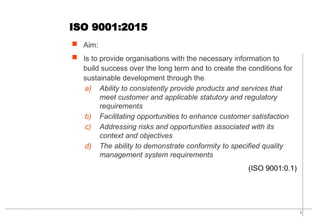
ISO 9001:2015
Aim:
Is to provide organisations with the necessary information to
build success over the long term and to create the conditions for
sustainable development through the
a) Ability to consistently provide products and services that
meet customer and applicable statutory and regulatory
requirements
b) Facilitating opportunities to enhance customer satisfaction
c) Addressing risks and opportunities associated with its
context and objectives
d) The ability to demonstrate conformity to specified quality
management system requirements
(ISO 9001:0.1)
7
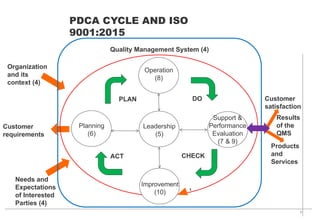
PDCA CYCLE ANDISO
9001:2015
ACT
Organization
and its
context (4)
Needs and
Expectations
of Interested
Parties (4)
Customer
requirements
Operation
(8)
Support &
Performance
Evaluation
(7 & 9)
Planning
(6)
Improvement
(10)
Leadership
(5)
PLAN DO
CHECK
Results
of the
QMS
Quality Management System (4)
Customer
satisfaction
Products
and
Services
-
8.
8
Risk isthe effect of uncertainty on an expected
result
ISO 9001:2015 incorporates risk into
requirements for the QMS
The extent of risk is determined by the
organisation
“Risk-based thinking” is considering risk
qualitatively (and quantitatively) depending on
the organisation’s context
“RISK BASED THINKING”
9.
9
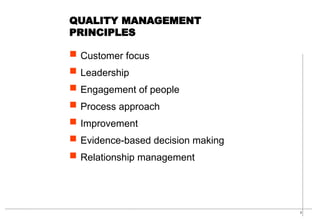
QUALITY MANAGEMENT
PRINCIPLES
Customerfocus
Leadership
Engagement of people
Process approach
Improvement
Evidence-based decision making
Relationship management
10.
10
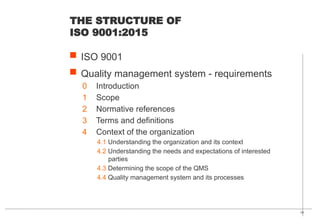
THE STRUCTURE OF
ISO9001:2015
ISO 9001
Quality management system - requirements
0 Introduction
1 Scope
2 Normative references
3 Terms and definitions
4 Context of the organization
4.1 Understanding the organization and its context
4.2 Understanding the needs and expectations of interested
parties
4.3 Determining the scope of the QMS
4.4 Quality management system and its processes
11.
11
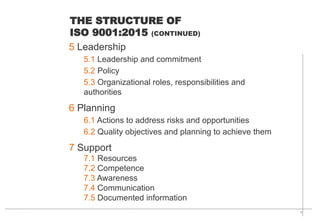
THE STRUCTURE OF
ISO9001:2015 (CONTINUED)
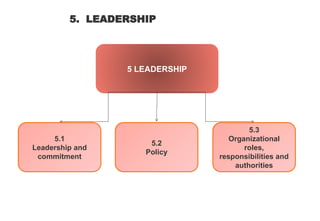
5 Leadership
5.1 Leadership and commitment
5.2 Policy
5.3 Organizational roles, responsibilities and
authorities
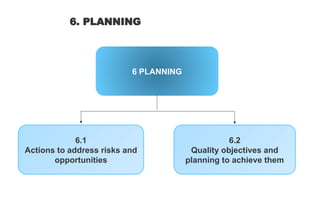
6 Planning
6.1 Actions to address risks and opportunities
6.2 Quality objectives and planning to achieve them
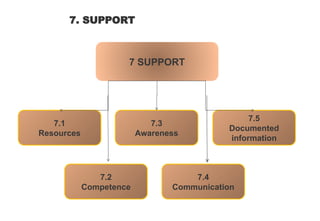
7 Support
7.1 Resources
7.2 Competence
7.3 Awareness
7.4 Communication
7.5 Documented information
12.
12
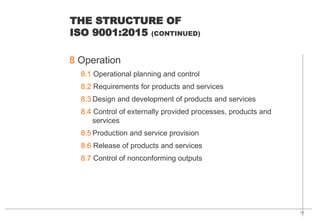
THE STRUCTURE OF
ISO9001:2015 (CONTINUED)
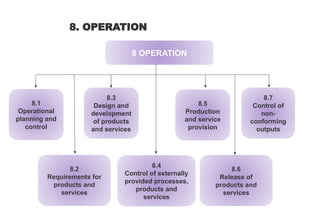
8 Operation
8.1 Operational planning and control
8.2 Requirements for products and services
8.3 Design and development of products and services
8.4 Control of externally provided processes, products and
services
8.5 Production and service provision
8.6 Release of products and services
8.7 Control of nonconforming outputs
13.
13
THE STRUCTURE OF
ISO9001:2015 (CONTINUED)
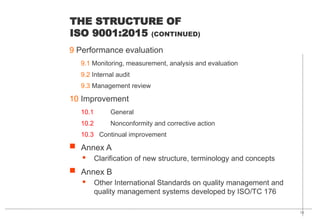
9 Performance evaluation
9.1 Monitoring, measurement, analysis and evaluation
9.2 Internal audit
9.3 Management review
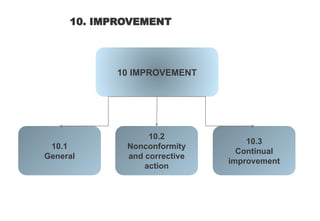
10 Improvement
10.1 General
10.2 Nonconformity and corrective action
10.3 Continual improvement
Annex A
· Clarification of new structure, terminology and concepts
Annex B
· Other International Standards on quality management and
quality management systems developed by ISO/TC 176
14.
14
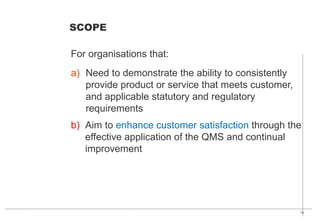
a) Need todemonstrate the ability to consistently
provide product or service that meets customer,
and applicable statutory and regulatory
requirements
b) Aim to enhance customer satisfaction through the
effective application of the QMS and continual
improvement
For organisations that:
SCOPE
15.
15
APPLICATION
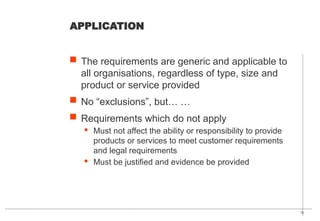
The requirementsare generic and applicable to
all organisations, regardless of type, size and
product or service provided
No “exclusions”, but… …
Requirements which do not apply
· Must not affect the ability or responsibility to provide
products or services to meet customer requirements
and legal requirements
· Must be justified and evidence be provided
16.
16
ISO 9001:2015 CLAUSES2
& 3
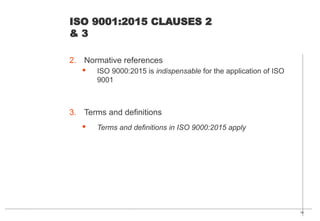
2. Normative references
· ISO 9000:2015 is indispensable for the application of ISO
9001
3. Terms and definitions
· Terms and definitions in ISO 9000:2015 apply
17.
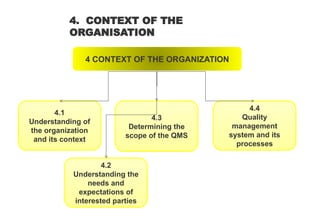
4 CONTEXT OFTHE ORGANIZATION
4.1
Understanding of
the organization
and its context
4.3
Determining the
scope of the QMS
4.4
Quality
management
system and its
processes
4.2
Understanding the
needs and
expectations of
interested parties
4. CONTEXT OF THE
ORGANISATION
19
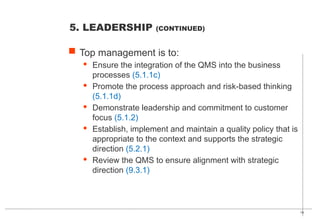
Top managementis to:
· Ensure the integration of the QMS into the business
processes (5.1.1c)
· Promote the process approach and risk-based thinking
(5.1.1d)
· Demonstrate leadership and commitment to customer
focus (5.1.2)
· Establish, implement and maintain a quality policy that is
appropriate to the context and supports the strategic
direction (5.2.1)
· Review the QMS to ensure alignment with strategic
direction (9.3.1)
5. LEADERSHIP (CONTINUED)
20.
6 PLANNING
6.1
Actions toaddress risks and
opportunities
6.2
Quality objectives and
planning to achieve them
6. PLANNING
21.
21
Any changesto the QMS must be carried out in a
planned and systematic manner (6.3)
6. PLANNING (CONTINUED)
22.
22
PURPOSE
• The InternationalStandard sets the requirements for a QMS that
brings together generally recognised key quality management
principles. These have been amended from previous versions of the
QMS Standards
• The purpose of this workshop is to enable you to consider these
principles, their impact, the use and benefits in formulating a QMS
METHOD
• You will be divided into teams and asked to consider each of the
quality management principles:
Customer focus
Leadership
Engagement of people
Process approach
Improvement
Evidence-based decision making
Relationship management
WORKSHOP 1: QM
PRINCIPLES
23.
23
METHOD, continued
• Whatdo these mean in reality?
• How can each of these be applied in organisations?
OUTPUT
• You will be asked to present your conclusions for discussion by the
whole class
TIME ALLOWED
• Reading and preparation of findings: 30 minutes
• Feedback: 30 minutes
WORKSHOP 1: QM
PRINCIPLES (CONTINUED)
24.
24
ISO 9001:2015Clause 7
· ISO 9001:2015 requirements:
· Support
– Resources
– Competence
– Awareness
– Communication
– Documented information
SESSION 2
27
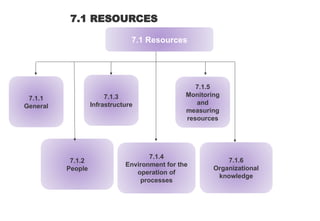
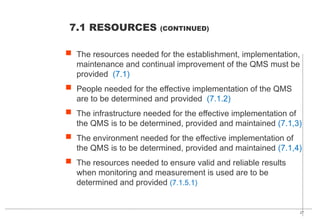
The resourcesneeded for the establishment, implementation,
maintenance and continual improvement of the QMS must be
provided (7.1)
People needed for the effective implementation of the QMS
are to be determined and provided (7.1.2)
The infrastructure needed for the effective implementation of
the QMS is to be determined, provided and maintained (7.1,3)
The environment needed for the effective implementation of
the QMS is to be determined, provided and maintained (7.1,4)
The resources needed to ensure valid and reliable results
when monitoring and measurement is used are to be
determined and provided (7.1.5.1)
7.1 RESOURCES (CONTINUED)
28.
28
7.1 RESOURCES (CONTINUED)
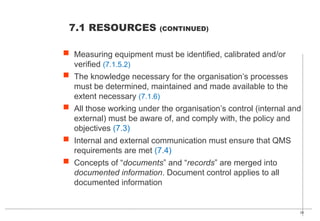
Measuring equipment must be identified, calibrated and/or
verified (7.1.5.2)
The knowledge necessary for the organisation’s processes
must be determined, maintained and made available to the
extent necessary (7.1.6)
All those working under the organisation’s control (internal and
external) must be aware of, and comply with, the policy and
objectives (7.3)
Internal and external communication must ensure that QMS
requirements are met (7.4)
Concepts of “documents” and “records” are merged into
documented information. Document control applies to all
documented information
29.
29
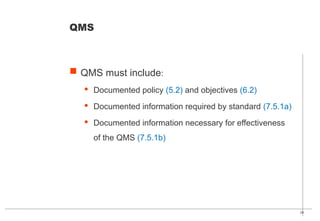
QMS mustinclude:
· Documented policy (5.2) and objectives (6.2)
· Documented information required by standard (7.5.1a)
· Documented information necessary for effectiveness
of the QMS (7.5.1b)
QMS
30.
30
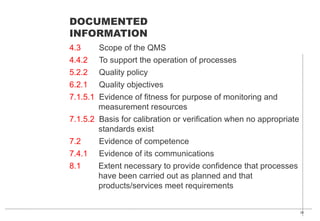
4.3 Scope ofthe QMS
4.4.2 To support the operation of processes
5.2.2 Quality policy
6.2.1 Quality objectives
7.1.5.1 Evidence of fitness for purpose of monitoring and
measurement resources
7.1.5.2 Basis for calibration or verification when no appropriate
standards exist
7.2 Evidence of competence
7.4.1 Evidence of its communications
8.1 Extent necessary to provide confidence that processes
have been carried out as planned and that
products/services meet requirements
DOCUMENTED
INFORMATION
31.
31
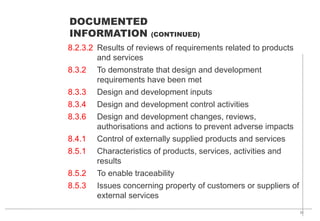
8.2.3.2 Results ofreviews of requirements related to products
and services
8.3.2 To demonstrate that design and development
requirements have been met
8.3.3 Design and development inputs
8.3.4 Design and development control activities
8.3.6 Design and development changes, reviews,
authorisations and actions to prevent adverse impacts
8.4.1 Control of externally supplied products and services
8.5.1 Characteristics of products, services, activities and
results
8.5.2 To enable traceability
8.5.3 Issues concerning property of customers or suppliers of
external services
DOCUMENTED
INFORMATION (CONTINUED)
32.
32
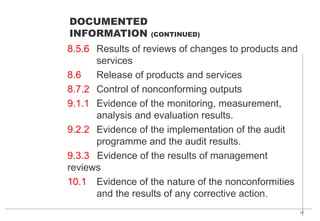
8.5.6 Results ofreviews of changes to products and
services
8.6 Release of products and services
8.7.2 Control of nonconforming outputs
9.1.1 Evidence of the monitoring, measurement,
analysis and evaluation results.
9.2.2 Evidence of the implementation of the audit
programme and the audit results.
9.3.3 Evidence of the results of management
reviews
10.1 Evidence of the nature of the nonconformities
and the results of any corrective action.
DOCUMENTED
INFORMATION (CONTINUED)
33.
33
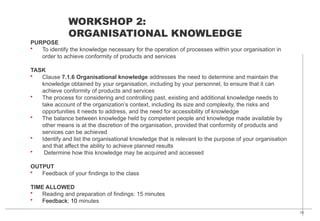
WORKSHOP 2:
ORGANISATIONAL KNOWLEDGE
PURPOSE
•To identify the knowledge necessary for the operation of processes within your organisation in
order to achieve conformity of products and services
TASK
• Clause 7.1.6 Organisational knowledge addresses the need to determine and maintain the
knowledge obtained by your organisation, including by your personnel, to ensure that it can
achieve conformity of products and services
• The process for considering and controlling past, existing and additional knowledge needs to
take account of the organization’s context, including its size and complexity, the risks and
opportunities it needs to address, and the need for accessibility of knowledge
• The balance between knowledge held by competent people and knowledge made available by
other means is at the discretion of the organisation, provided that conformity of products and
services can be achieved
• Identify and list the organisational knowledge that is relevant to the purpose of your organisation
and that affect the ability to achieve planned results
• Determine how this knowledge may be acquired and accessed
OUTPUT
• Feedback of your findings to the class
TIME ALLOWED
• Reading and preparation of findings: 15 minutes
• Feedback: 10 minutes
8 OPERATION
8.1
Operational
planning and
control
8.3
Designand
development
of products
and services
8.5
Production
and service
provision
8.2
Requirements for
products and
services
8.4
Control of externally
provided processes,
products and
services
8.6
Release of
products and
services
8.7
Control of
non-
conforming
outputs
8. OPERATION
36.
36
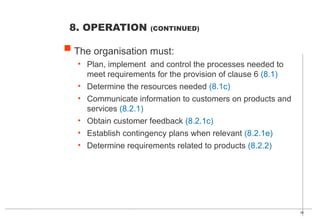
The organisation must:
•Plan, implement and control the processes needed to
meet requirements for the provision of clause 6 (8.1)
• Determine the resources needed (8.1c)
• Communicate information to customers on products and
services (8.2.1)
• Obtain customer feedback (8.2.1c)
• Establish contingency plans when relevant (8.2.1e)
• Determine requirements related to products (8.2.2)
8. OPERATION (CONTINUED)
37.
37
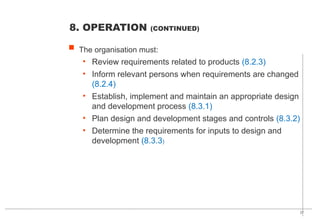
The organisationmust:
• Review requirements related to products (8.2.3)
• Inform relevant persons when requirements are changed
(8.2.4)
• Establish, implement and maintain an appropriate design
and development process (8.3.1)
• Plan design and development stages and controls (8.3.2)
• Determine the requirements for inputs to design and
development (8.3.3)
8. OPERATION (CONTINUED)
38.
38
The organisation must:
•control the design and development process (8.3.4)
• ensure design and development outputs meet
requirements (8.3.5)
• identify, review and control design and development
changes (8.3.6)
• ensure that externally provided process, products and
services conform to requirements (8.4.1)
• determine and apply criteria for the evaluation,
selection, monitoring, and re-valuation of external
providers (8.4.1)
8. OPERATION (CONTINUED)
39.
39
The organisationmust:
• Control production and service provision (8.5.1)
• Appoint competent persons with required qualifications
(8.5.1e)
• Implement actions to prevent human error (8.5.1g)
• Identify outputs to ensure conformity of products and
services (8.5.2)
• Identify the status of outputs with respect to monitoring
and measurement requirements (8.5.2)
8. OPERATION (CONTINUED)
40.
40
The organisationmust:
• Control the unique identification of outputs when traceability is a
requirement (8.5.3)
• Preserve the outputs during production and service provision to
ensure conformity to requirements (8.5.4)
• Meet requirements for post-delivery activities (8.5.5)
• Review and control changes for production and service provision
(8.5.6)
• Implement planned arrangements, at appropriate stages, to verify
that the product and service requirements have been met (8.6)
• Release products and services to customers only when planned
arrangements have been satisfactorily completed (unless approved)
(8.6)
• Identify and control outputs that do not conform to requirements are
prevented from unintended use (8.7.1)
8. OPERATION (CONTINUED)
42
Customer perceptionsof the degree to which requirements
have been met must be monitored (9.1.2)
Appropriate data and information from monitoring and
measurement activities must be analysed and evaluated
(9.1.3)
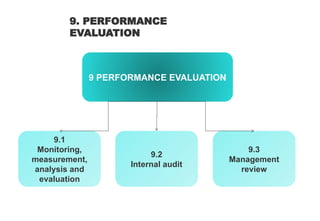
9. PERFORMANCE
EVALUATION (CONTINUED)
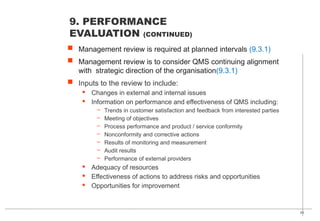
43.
43
Management reviewis required at planned intervals (9.3.1)
Management review is to consider QMS continuing alignment
with strategic direction of the organisation(9.3.1)
Inputs to the review to include:
· Changes in external and internal issues
· Information on performance and effectiveness of QMS including:
– Trends in customer satisfaction and feedback from interested parties
– Meeting of objectives
– Process performance and product / service conformity
– Nonconformity and corrective actions
– Results of monitoring and measurement
– Audit results
– Performance of external providers
· Adequacy of resources
· Effectiveness of actions to address risks and opportunities
· Opportunities for improvement
9. PERFORMANCE
EVALUATION (CONTINUED)
#8 “Risk-based thinking”
Risk is the effect of uncertainty on an expected result and the concept of risk-based thinking has always been implicit in ISO 9001. However, the 2015 version of this Standard makes risk-based thinking more explicit and incorporates it in requirements for the establishment, implementation, maintenance and continual improvement of the QMS.
It is up to the organisation to choose to develop a more extensive risk-based approach than is required by ISO 9001:2015 and ISO 31000 provides guidelines on formal risk management which can be appropriate in certain organisational contexts.
Not all the processes of the QMS contain the same level of risk in terms of the organisation’s ability to meet its objectives, and the consequences of process, product, service or system nonconformities are not the same for all organisations. For some organisations, the consequences of delivering nonconforming products and services can result in minor inconvenience to the customer but for others, the consequences can be far-reaching and even fatal. “Risk-based thinking” therefore means considering risk qualitatively (and quantitatively) depending on the organisation’s context, when defining the rigour and degree of formality needed to plan and control the QMS, as well as its component processes and activities.
#46 Summarise the session and the course. Ask the learners if they have any questions or want to share any learning points with the group.





![제 23회 보아즈(BOAZ) 빅데이터 컨퍼런스 - [MBOAX] : ABSA를 활용한 소비자 반응 분석 기반 운영 효율화 대시보드 설계](https://cdn.slidesharecdn.com/ss_thumbnails/3-1boaz23rdconferencemboax-260203102709-9d519923-thumbnail.jpg?width=640&height=640&fit=bounds)


