QMS
Quality
An organization focused on quality promotes a culture that results in the
behaviour, attitudes, activities and processes that deliver value through fulfilling
the needs and expectations of customers and other relevant interested parties.
The quality of an organization’s products and services is determined by the ability
to satisfy customers and the intended and unintended impact on relevant
interested parties.
The quality of products and services includes not only their intended function and
performance, but also their perceived value and benefit to the customer.
1.Introduction to QMS
Quality is defined as the degree to which a set of inherent
characteristics fulfills the requirements
Introduction to QMS
What is a Quality management system (QMS)?
•A QMS comprises activities by which the organization identifies its
objectives and determines the processes and resources required to achieve
desired results.
•The QMS manages the interacting processes and resources required to
provide value and realize results for relevant interested parties.
•The QMS enables top management to optimize the use of resources
considering the long and short term consequences of their decision.
•A QMS provides the means to identify actions to address intended and
unintended consequences in providing products and services.
Management is a set of co–ordinated activities to direct and
control an organization
Introduction to QMS
Importance and benefits of Quality management system in Organizations
Quality management provides a framework for constant quality
improvement to ensure companies build and launch the best possible
products and services. Quality management functions as both a
perspective and an approach to increasing customer satisfaction, cutting
costs, and eliminating errors.
Benefits of QMS
• System drives the organization rather than people
• Enhanced Customer satisfaction
• Increased Employee engagement
• Change control
• Enhanced efficiency
• Better Decision making
• Continual improvement
• Risk based thinking
• Retaining knowledge base
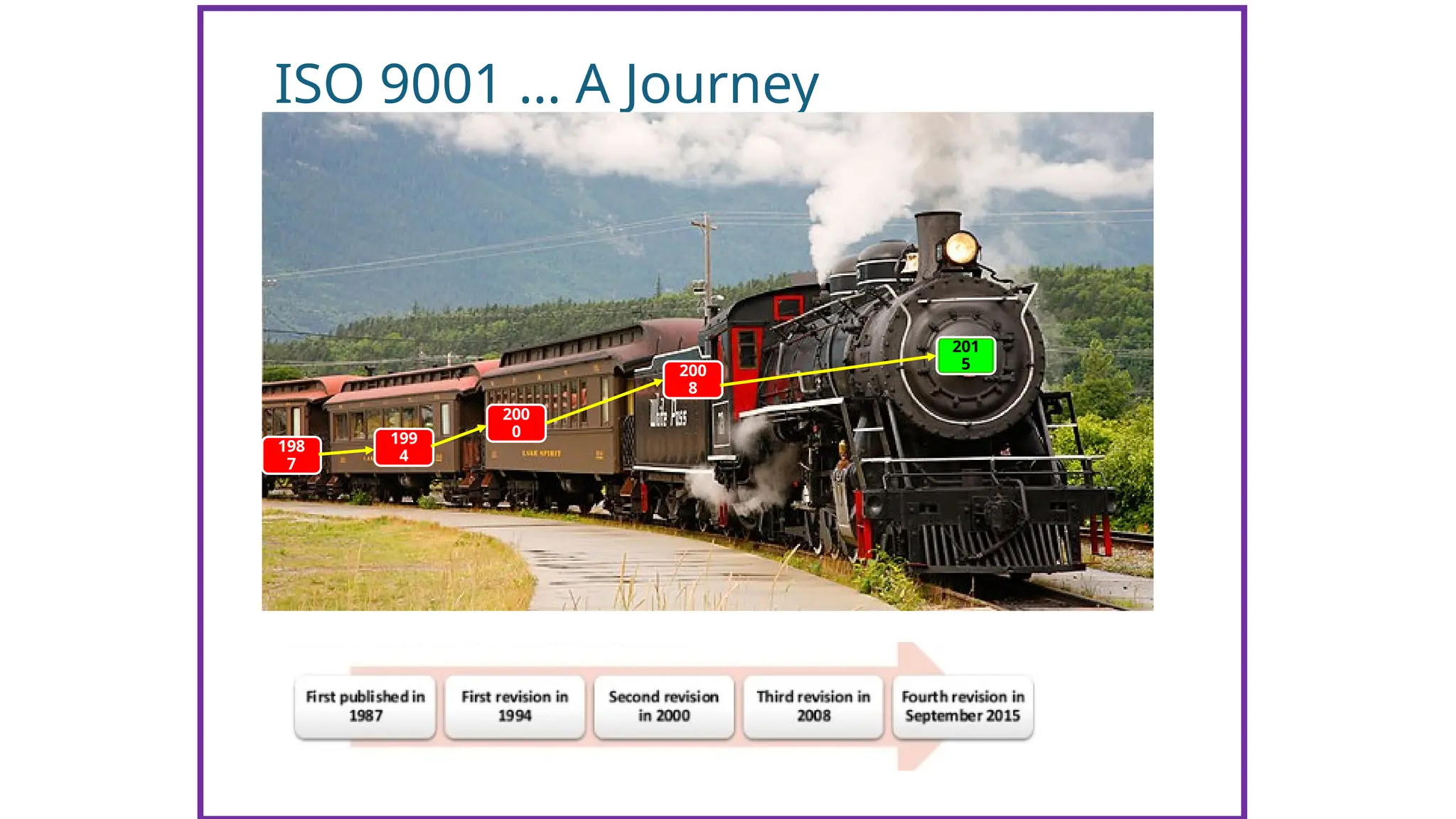
ISO 9001 … A Journey
198
7
199
4
200
0
200
8
201
5
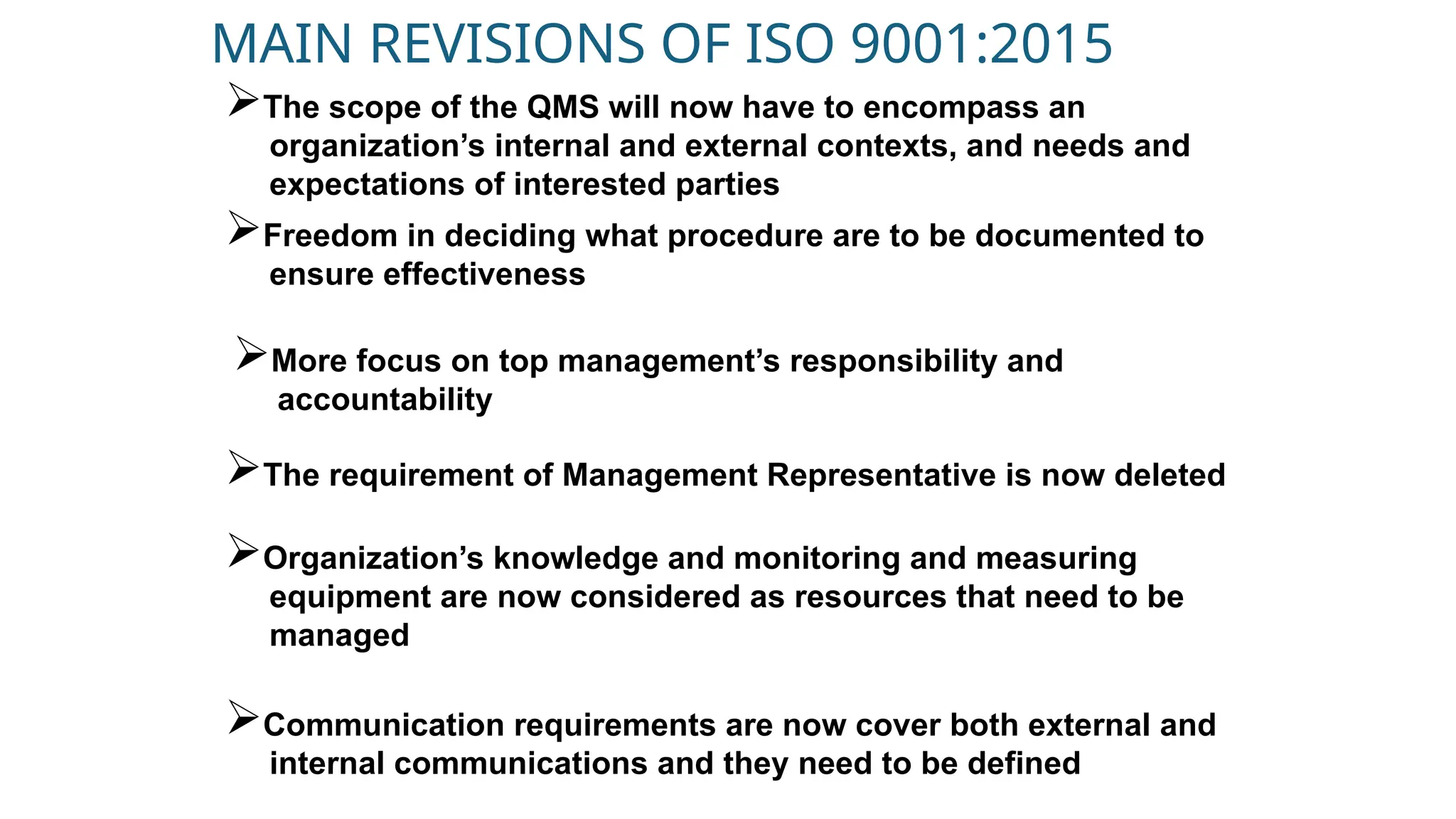
MAIN REVISIONS OF ISO 9001:2015
The scope of the QMS will now have to encompass an
organization’s internal and external contexts, and needs and
expectations of interested parties
Freedom in deciding what procedure are to be documented to
ensure effectiveness
More focus on top management’s responsibility and
accountability
The requirement of Management Representative is now deleted
Organization’s knowledge and monitoring and measuring
equipment are now considered as resources that need to be
managed
Communication requirements are now cover both external and
internal communications and they need to be defined
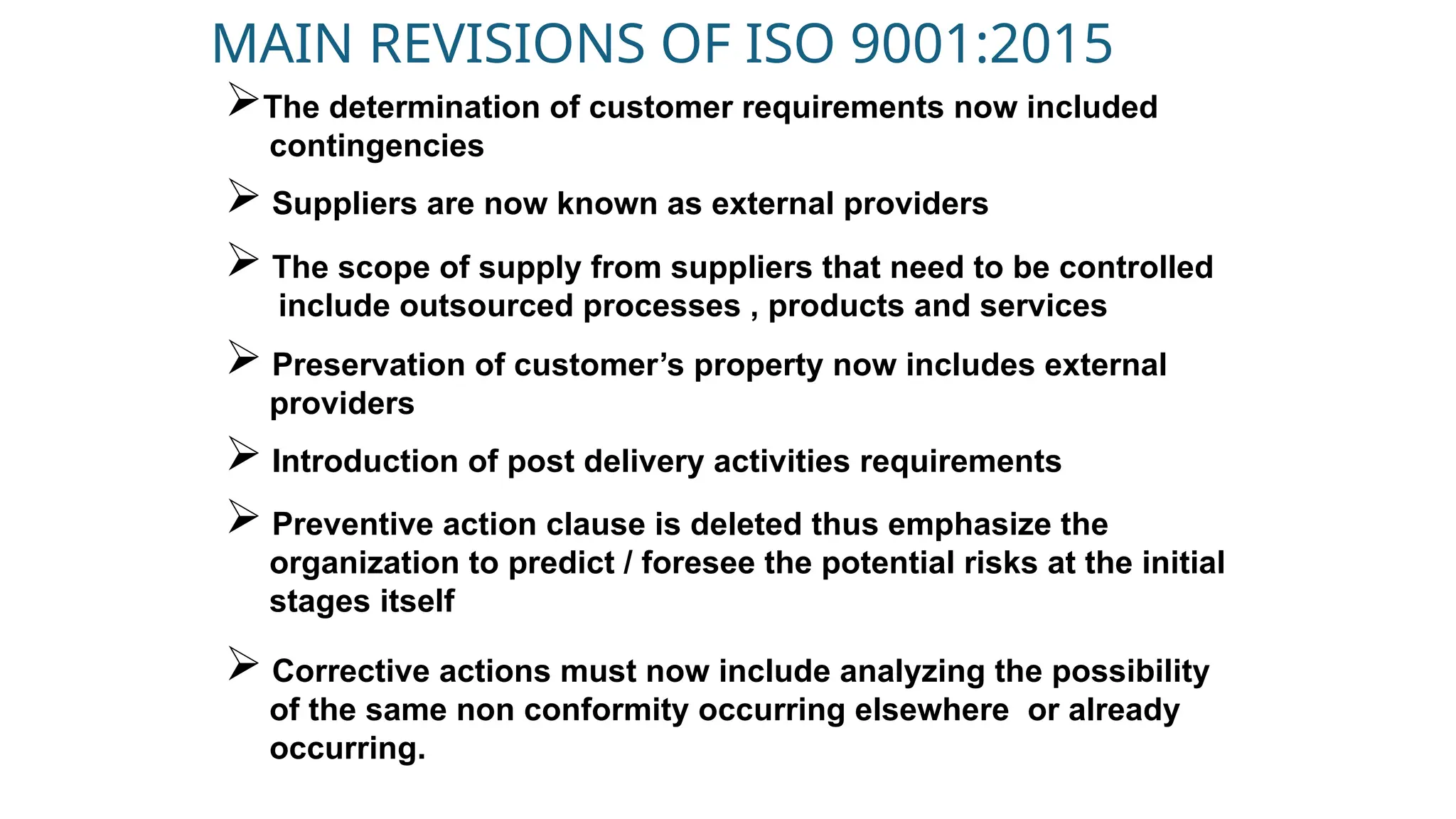
MAIN REVISIONS OF ISO 9001:2015
The determination of customer requirements now included
contingencies
 Suppliers are now known as external providers
 The scope of supply from suppliers that need to be controlled
include outsourced processes , products and services
 Preservation of customer’s property now includes external
providers
 Introduction of post delivery activities requirements
 Preventive action clause is deleted thus emphasize the
organization to predict / foresee the potential risks at the initial
stages itself
 Corrective actions must now include analyzing the possibility
of the same non conformity occurring elsewhere or already
occurring.
MAIN REVISIONS OF ISO 9001:2015
New clauses
- (4.1) Understanding the organization and its context
- (4.2) Understanding the needs and expectations of
interested parties
 No requirement of Quality Manual
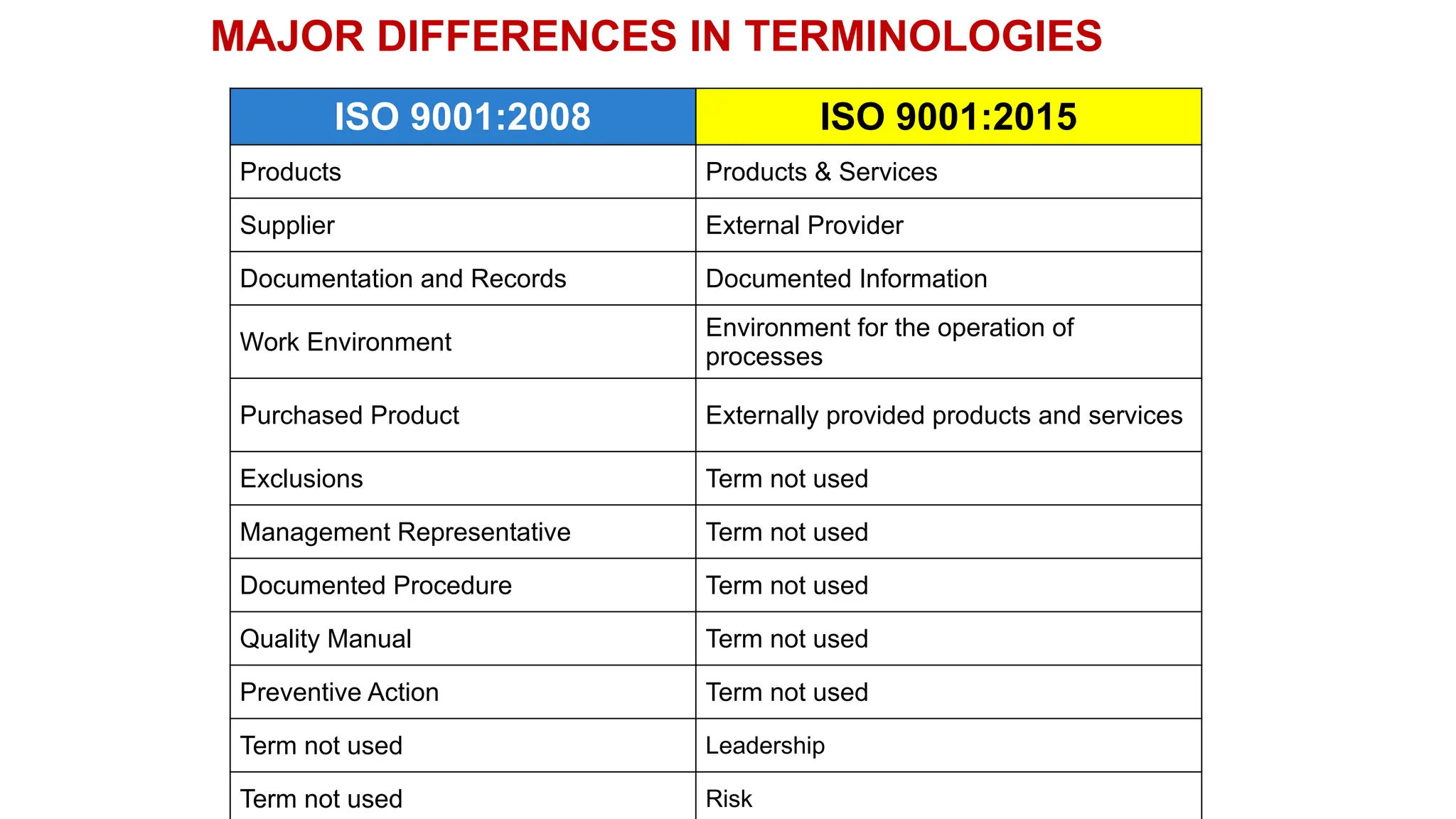
MAJOR DIFFERENCES IN TERMINOLOGIES
ISO 9001:2008 ISO 9001:2015
Products Products & Services
Supplier External Provider
Documentation and Records Documented Information
Work Environment
Environment for the operation of
processes
Purchased Product Externally provided products and services
Exclusions Term not used
Management Representative Term not used
Documented Procedure Term not used
Quality Manual Term not used
Preventive Action Term not used
Term not used Leadership
Term not used Risk
11
Model of a process-
based QMS
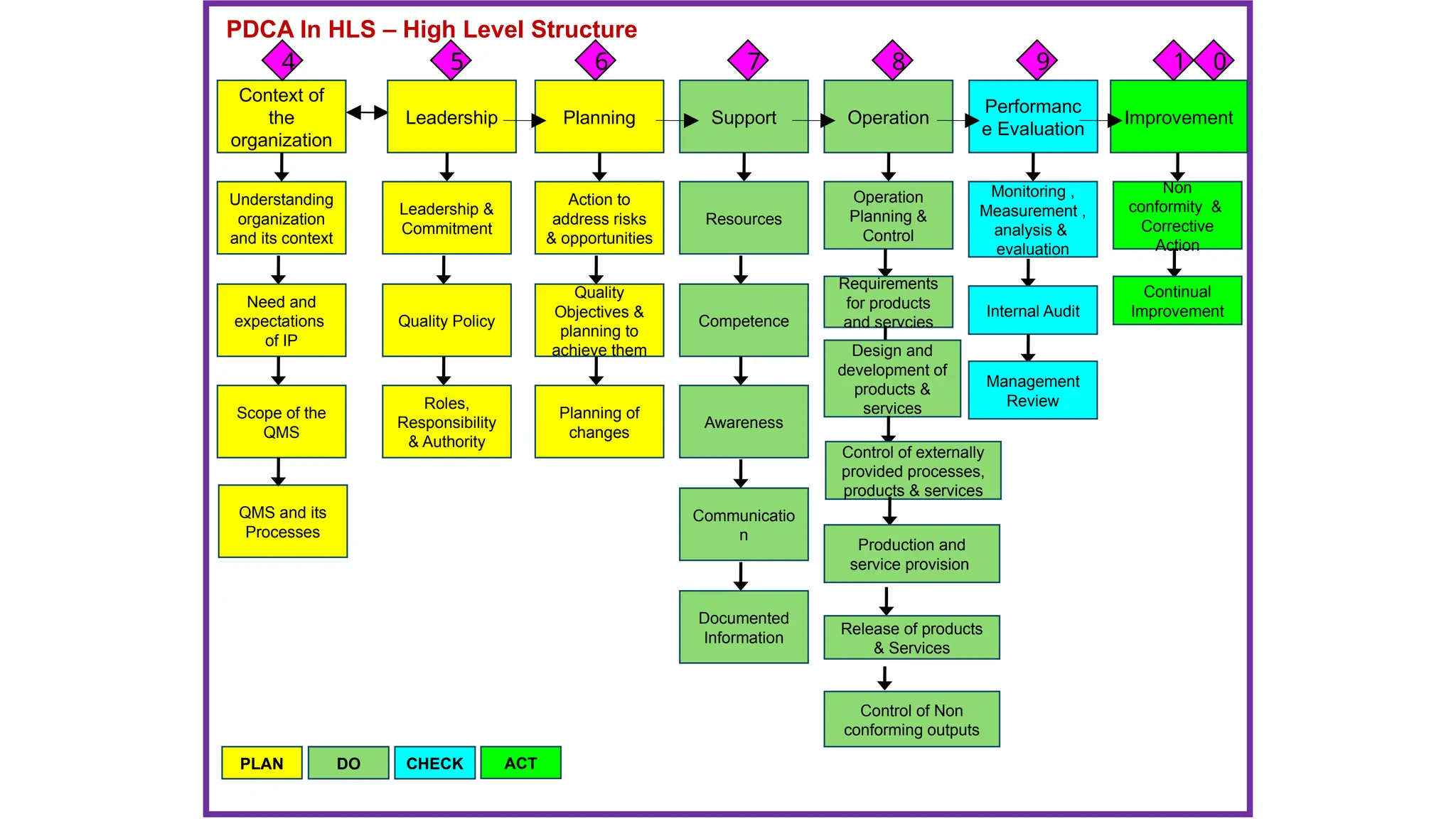
PDCA In HLS – High Level Structure
Context of
the
organization
Understanding
organization
and its context
Need and
expectations
of IP
Scope of the
QMS
QMS and its
Processes
Leadership Planning Support Operation
Performanc
e Evaluation
Improvement
Leadership &
Commitment
Quality Policy
Roles,
Responsibility
& Authority
Action to
address risks
& opportunities
Quality
Objectives &
planning to
achieve them
Planning of
changes
Resources
Competence
Awareness
Communicatio
n
Documented
Information
Operation
Planning &
Control
Requirements
for products
and servcies
Design and
development of
products &
services
Control of externally
provided processes,
products & services
Production and
service provision
Release of products
& Services
Control of Non
conforming outputs
Monitoring ,
Measurement ,
analysis &
evaluation
Internal Audit
Management
Review
Non
conformity &
Corrective
Action
Continual
Improvement
4 5 6 7 8 9 1 0
PLAN DO CHECK ACT
GET STARTED …… OF ISO 9001:2015
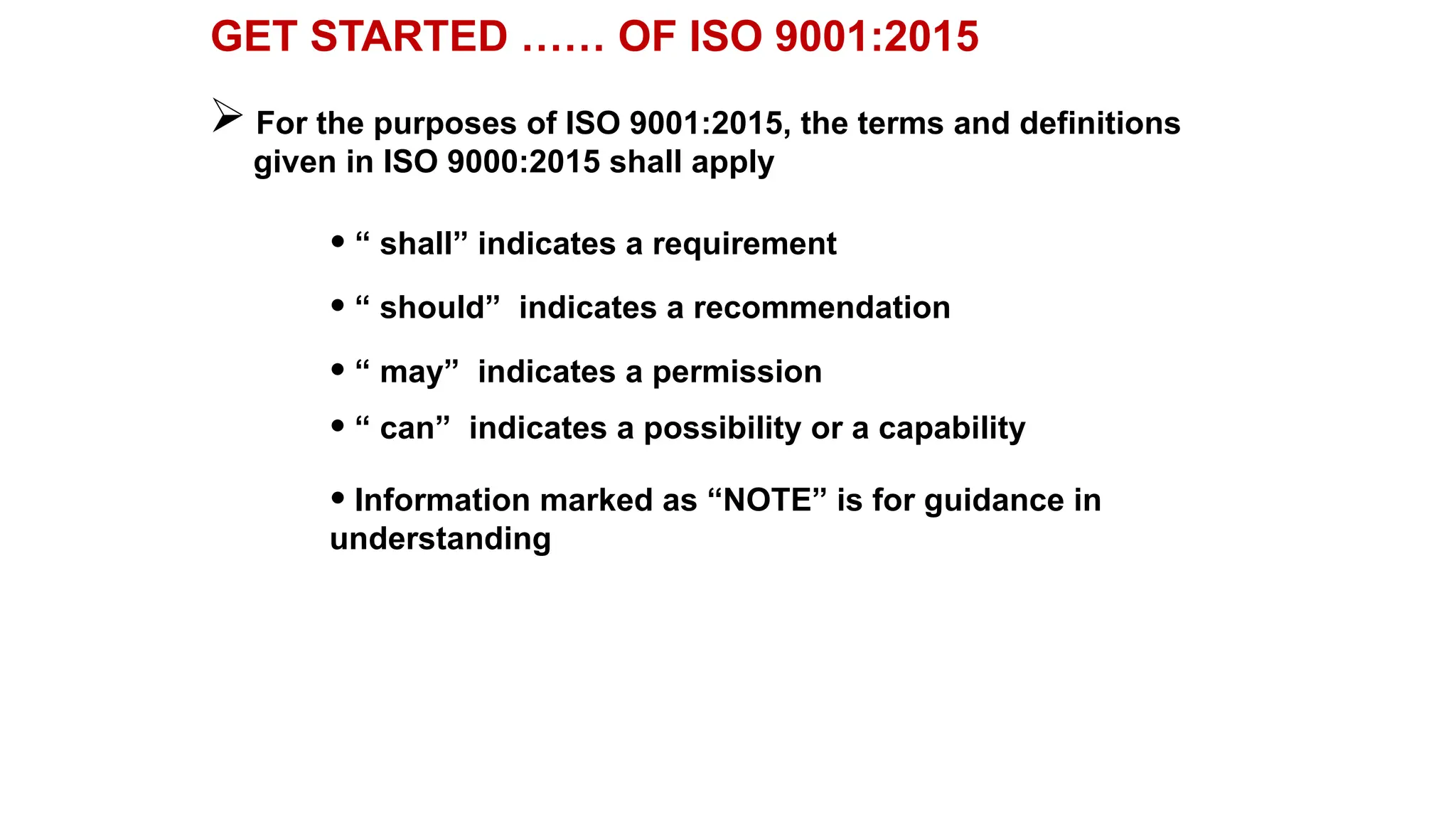
 For the purposes of ISO 9001:2015, the terms and definitions
given in ISO 9000:2015 shall apply
• “ shall” indicates a requirement
• “ should” indicates a recommendation
• “ may” indicates a permission
• “ can” indicates a possibility or a capability
• Information marked as “NOTE” is for guidance in
understanding
GET STARTED …… OF ISO 9001:2015
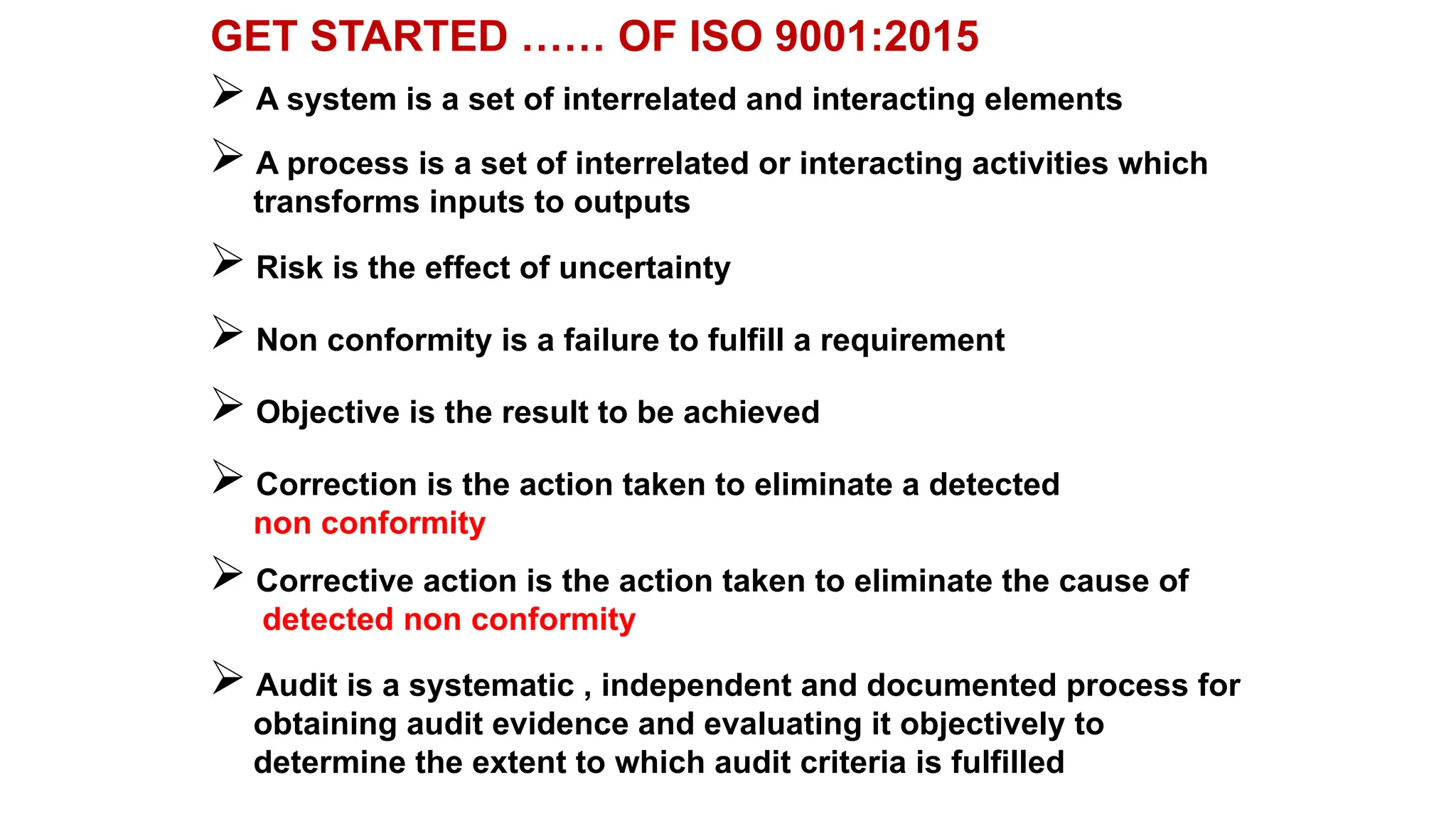
 A system is a set of interrelated and interacting elements
 A process is a set of interrelated or interacting activities which
transforms inputs to outputs
 Risk is the effect of uncertainty
 Non conformity is a failure to fulfill a requirement
 Objective is the result to be achieved
 Correction is the action taken to eliminate a detected
non conformity
 Corrective action is the action taken to eliminate the cause of
detected non conformity
 Audit is a systematic , independent and documented process for
obtaining audit evidence and evaluating it objectively to
determine the extent to which audit criteria is fulfilled
GET STARTED …… OF ISO 9001:2015
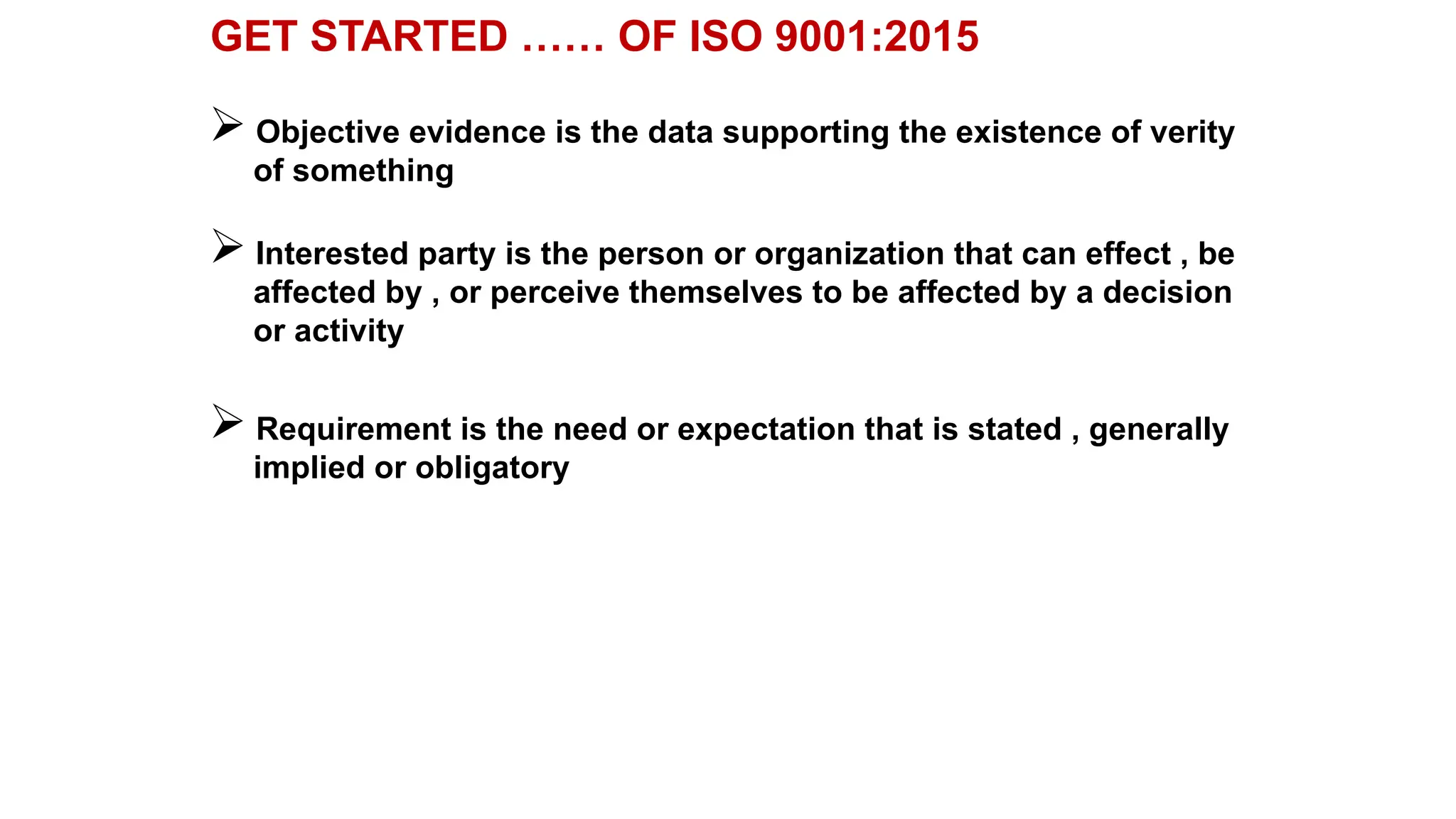
 Objective evidence is the data supporting the existence of verity
of something
 Interested party is the person or organization that can effect , be
affected by , or perceive themselves to be affected by a decision
or activity
 Requirement is the need or expectation that is stated , generally
implied or obligatory
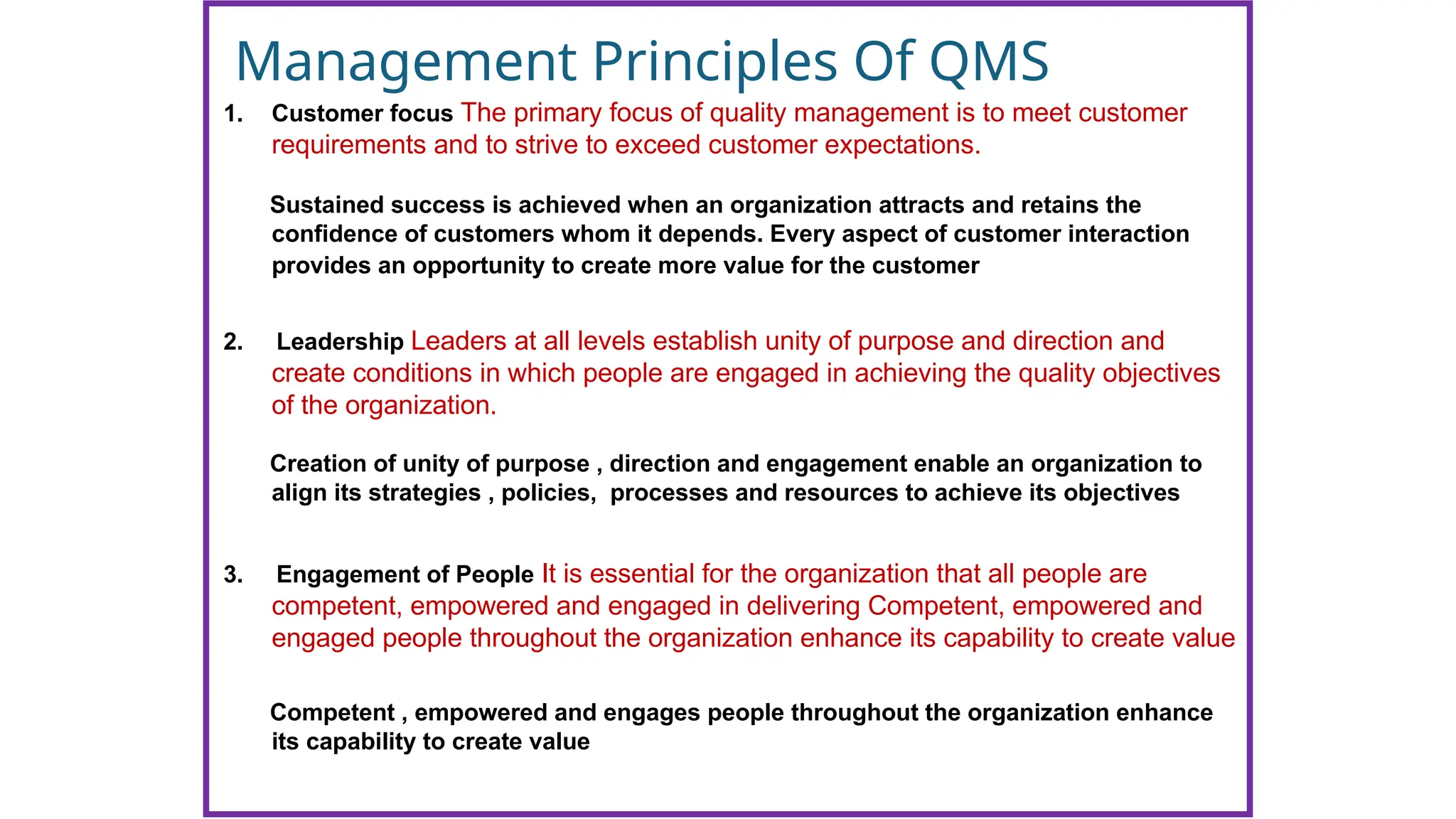
Management Principles Of QMS
1. Customer focus The primary focus of quality management is to meet customer
requirements and to strive to exceed customer expectations.
Sustained success is achieved when an organization attracts and retains the
confidence of customers whom it depends. Every aspect of customer interaction
provides an opportunity to create more value for the customer
2. Leadership Leaders at all levels establish unity of purpose and direction and
create conditions in which people are engaged in achieving the quality objectives
of the organization.
Creation of unity of purpose , direction and engagement enable an organization to
align its strategies , policies, processes and resources to achieve its objectives
3. Engagement of People It is essential for the organization that all people are
competent, empowered and engaged in delivering Competent, empowered and
engaged people throughout the organization enhance its capability to create value
Competent , empowered and engages people throughout the organization enhance
its capability to create value
17
Management Principles Of QMS
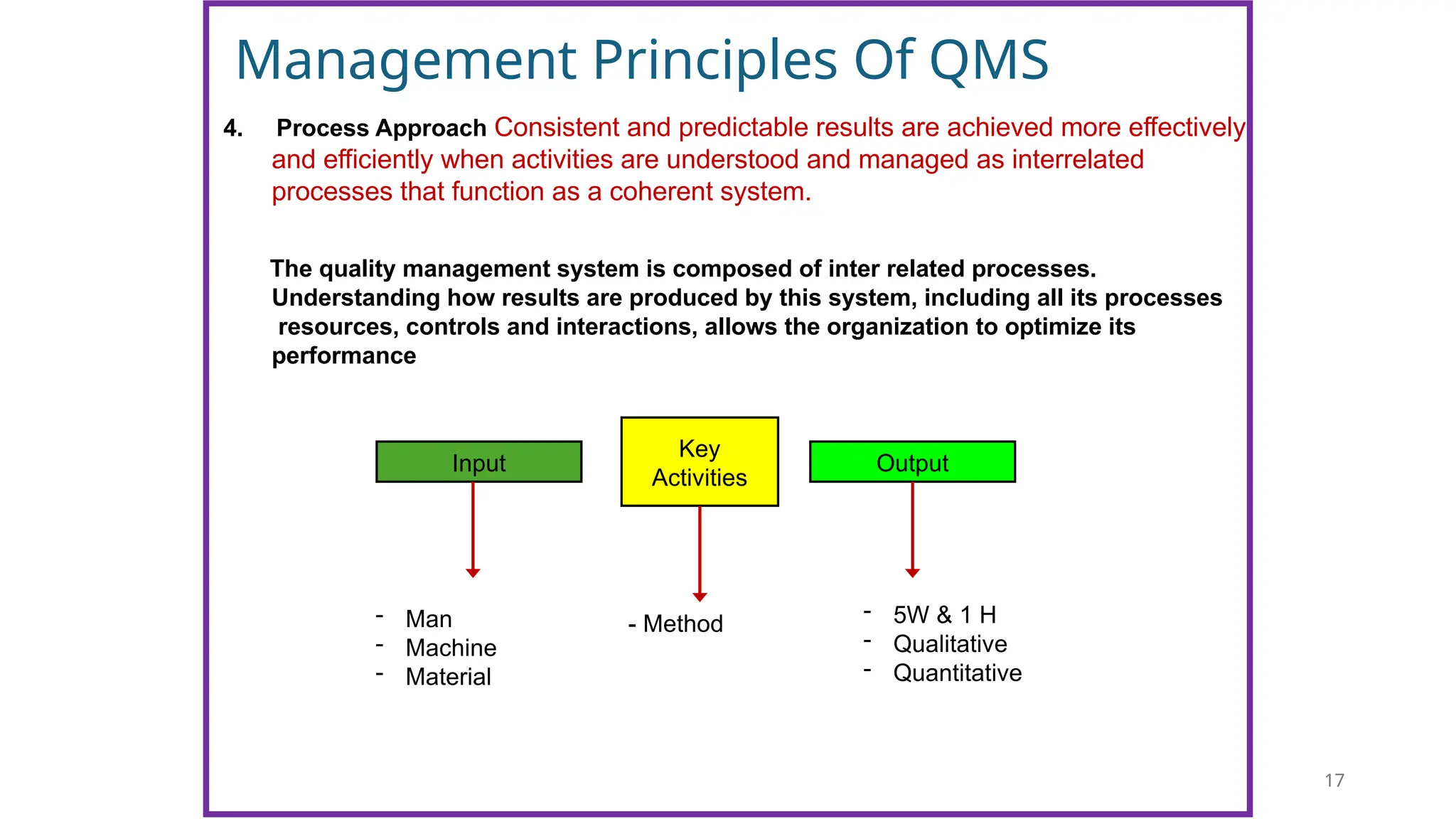
4. Process Approach Consistent and predictable results are achieved more effectively
and efficiently when activities are understood and managed as interrelated
processes that function as a coherent system.
The quality management system is composed of inter related processes.
Understanding how results are produced by this system, including all its processes
resources, controls and interactions, allows the organization to optimize its
performance
Key
Activities
Input Output
- Man
- Machine
- Material
- Method
- 5W & 1 H
- Qualitative
- Quantitative
Management Principles Of QMS
5. Improvement Successful organizations have an ongoing focus on improvement.
Improvement is essential for an organization to maintain current levels of
performance, to react to changes in its internal and external conditions and to
create new opportunities.
Improvement is essential for an organization to maintain current levels of
performance, to react to changes in its internal and external conditions and to
create new opportunities
6. Evidence-based Decision Making Decisions based on the analysis and evaluation
of data and information are more likely to produce desired results.
7. Relationship Management For sustained success, organizations manage their
relationships with interested parties, such as suppliers
Facts, evidence and data analysis lead to greater objectivity and confidence in
decisions made
Interested parties influence the performance of an organization. Sustained success
is more likely to be achieved when an organization manages relationships with its
interested parties to optimize their impact on its performance.
DEFINITIONS
Audit
Systematic, independent and documented process for obtaining
audit evidence and evaluating it objectively to determine the
extent to which the audit criteria are fulfilled
Audit criteria / Requirements
The reference against which the audit is performed
Set of policies, procedures or requirements
Objective evidence
Data supporting the existence or verity of something
May be obtained through observation, measurement, Test or other
means
Can be verified
NOTE Audit criteria are used as a reference against which audit
evidence is compared
DEFINITIONS
Audit evidence
Records, statements of fact or other information, which are
relevant to the audit criteria and verifiable
NOTE Audit evidence may be qualitative or quantitative.
Audit findings
Results of the evaluation of the collected audit evidence
against audit criteria
NOTE Audit findings can indicate either conformity or
nonconformity with audit criteria or opportunities for
improvement
DEFINITIONS
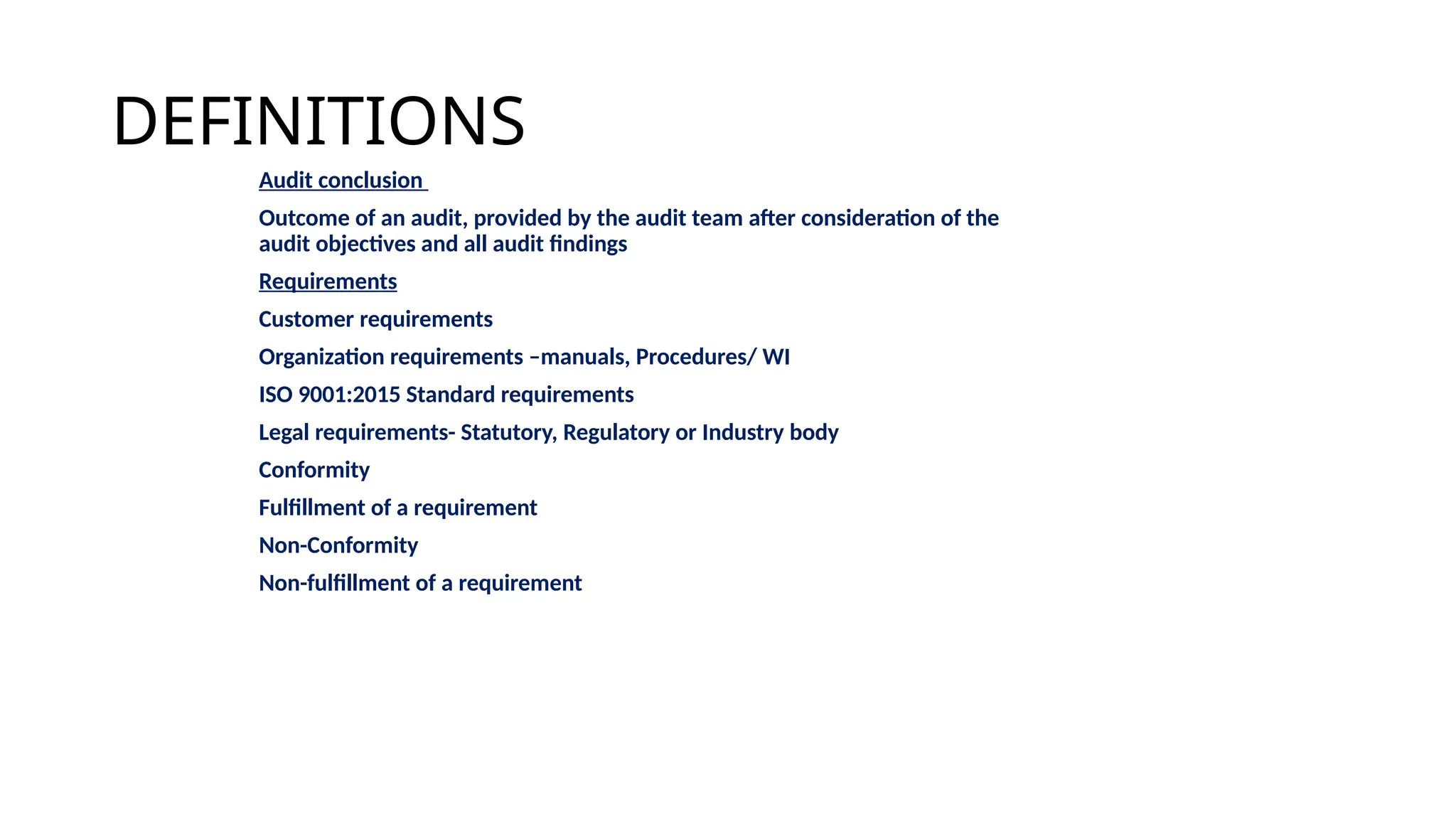
Audit conclusion
Outcome of an audit, provided by the audit team after consideration of the
audit objectives and all audit findings
Requirements
Customer requirements
Organization requirements –manuals, Procedures/ WI
ISO 9001:2015 Standard requirements
Legal requirements- Statutory, Regulatory or Industry body
Conformity
Fulfillment of a requirement
Non-Conformity
Non-fulfillment of a requirement
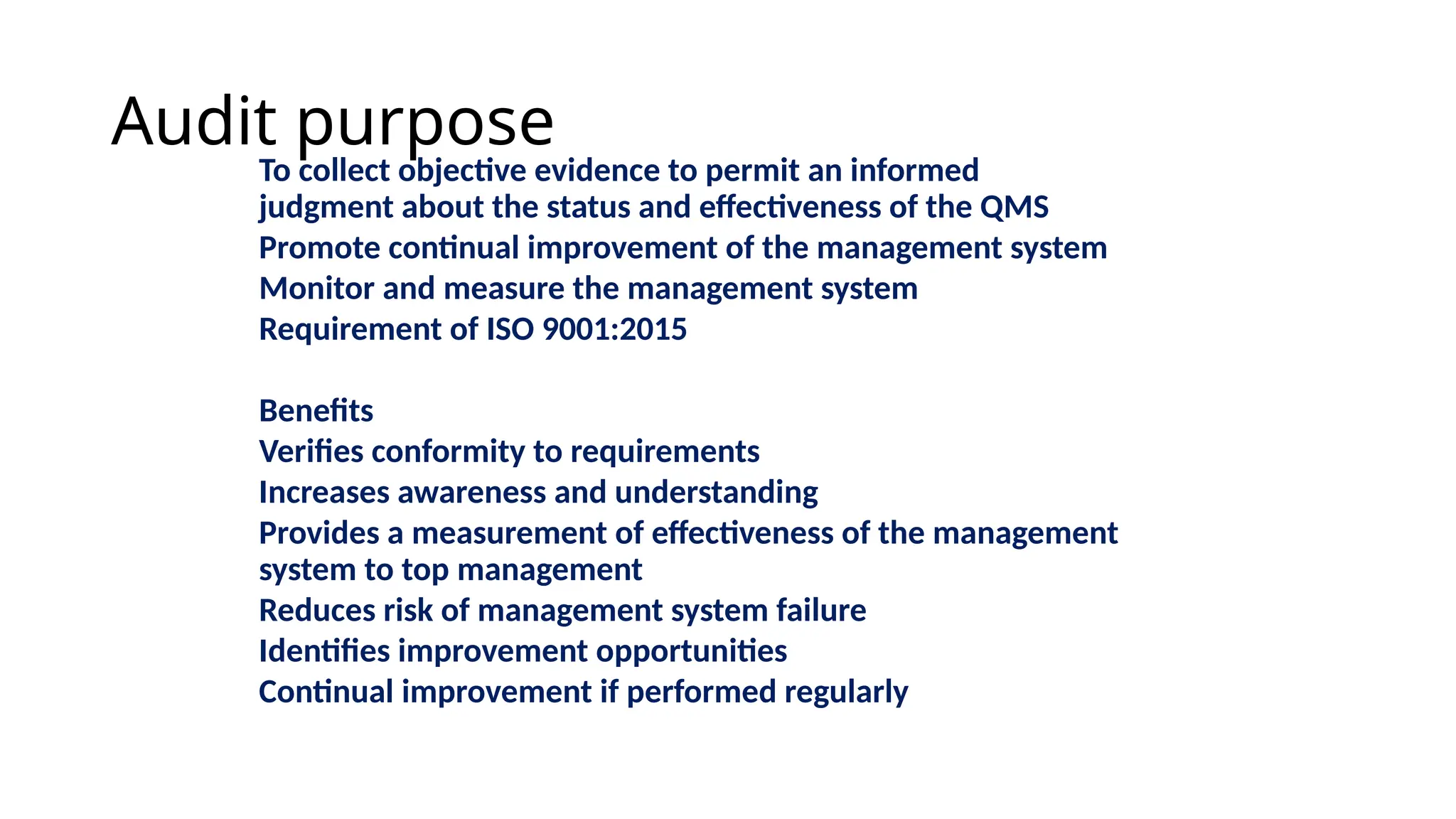
Audit purpose
To collect objective evidence to permit an informed
judgment about the status and effectiveness of the QMS
Promote continual improvement of the management system
Monitor and measure the management system
Requirement of ISO 9001:2015
Benefits
Verifies conformity to requirements
Increases awareness and understanding
Provides a measurement of effectiveness of the management
system to top management
Reduces risk of management system failure
Identifies improvement opportunities
Continual improvement if performed regularly
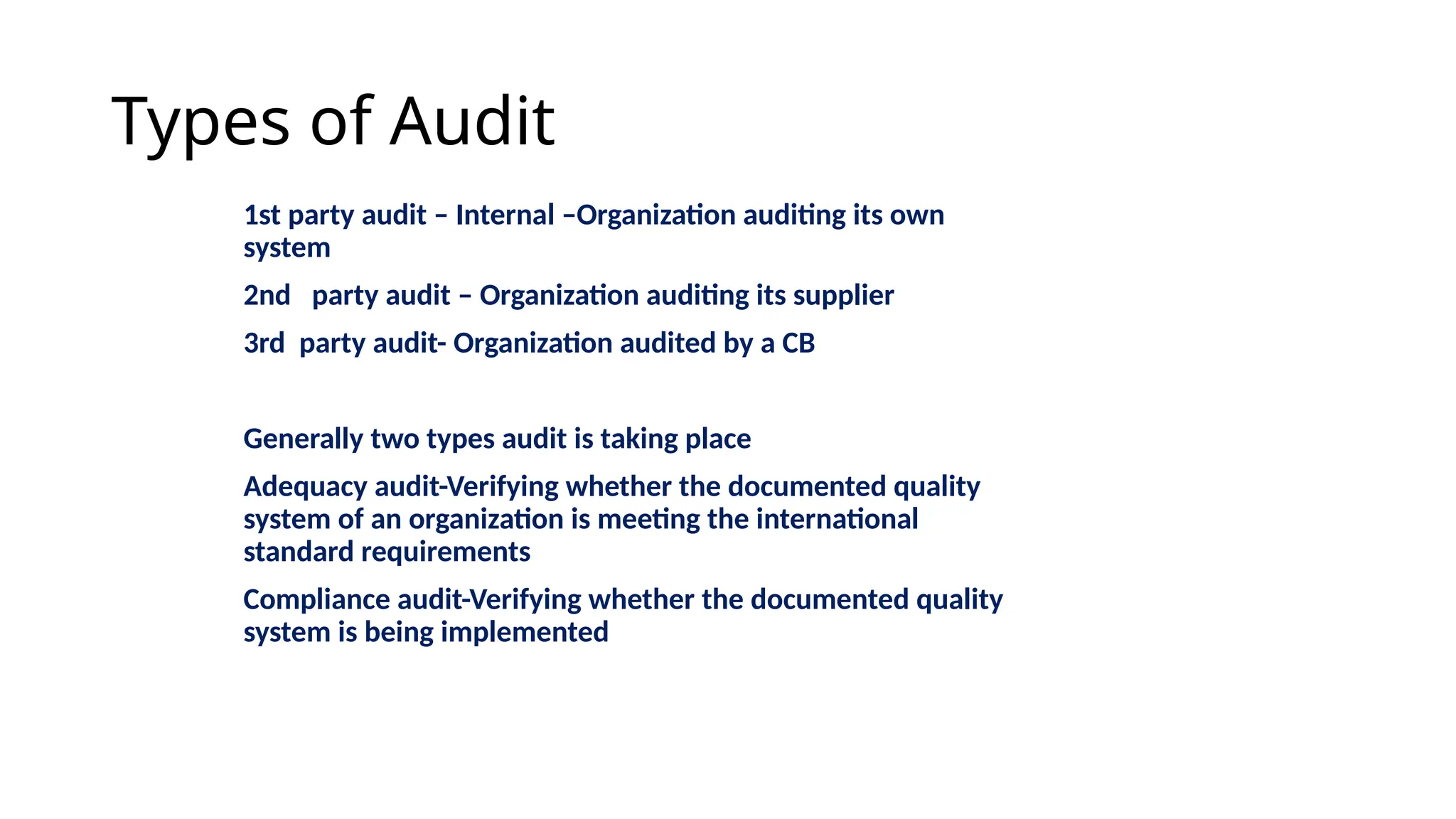
Types of Audit
1st party audit – Internal –Organization auditing its own
system
2nd party audit – Organization auditing its supplier
3rd party audit- Organization audited by a CB
Generally two types audit is taking place
Adequacy audit-Verifying whether the documented quality
system of an organization is meeting the international
standard requirements
Compliance audit-Verifying whether the documented quality
system is being implemented
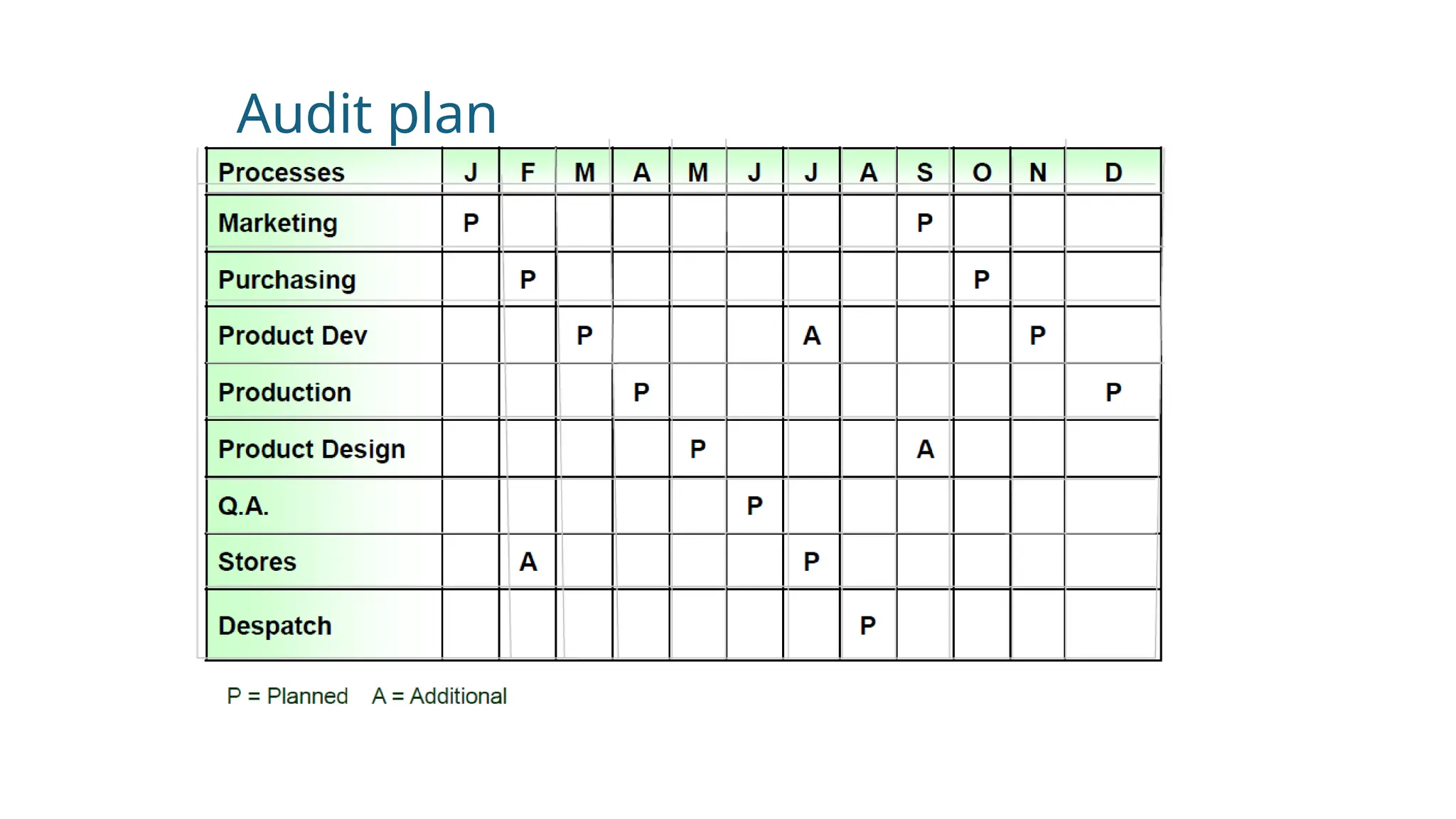
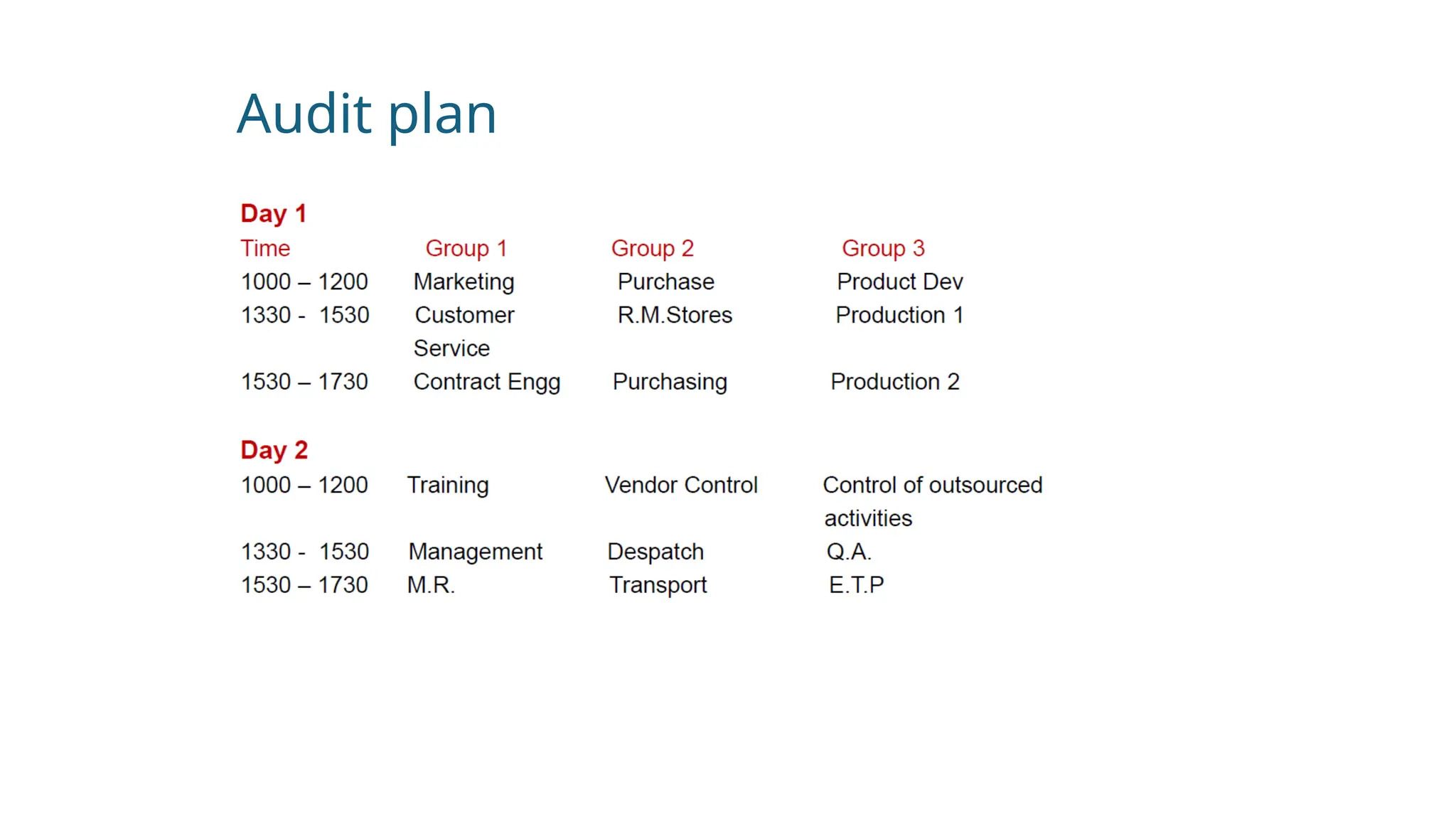
Audit plan
Audit plan
Examples
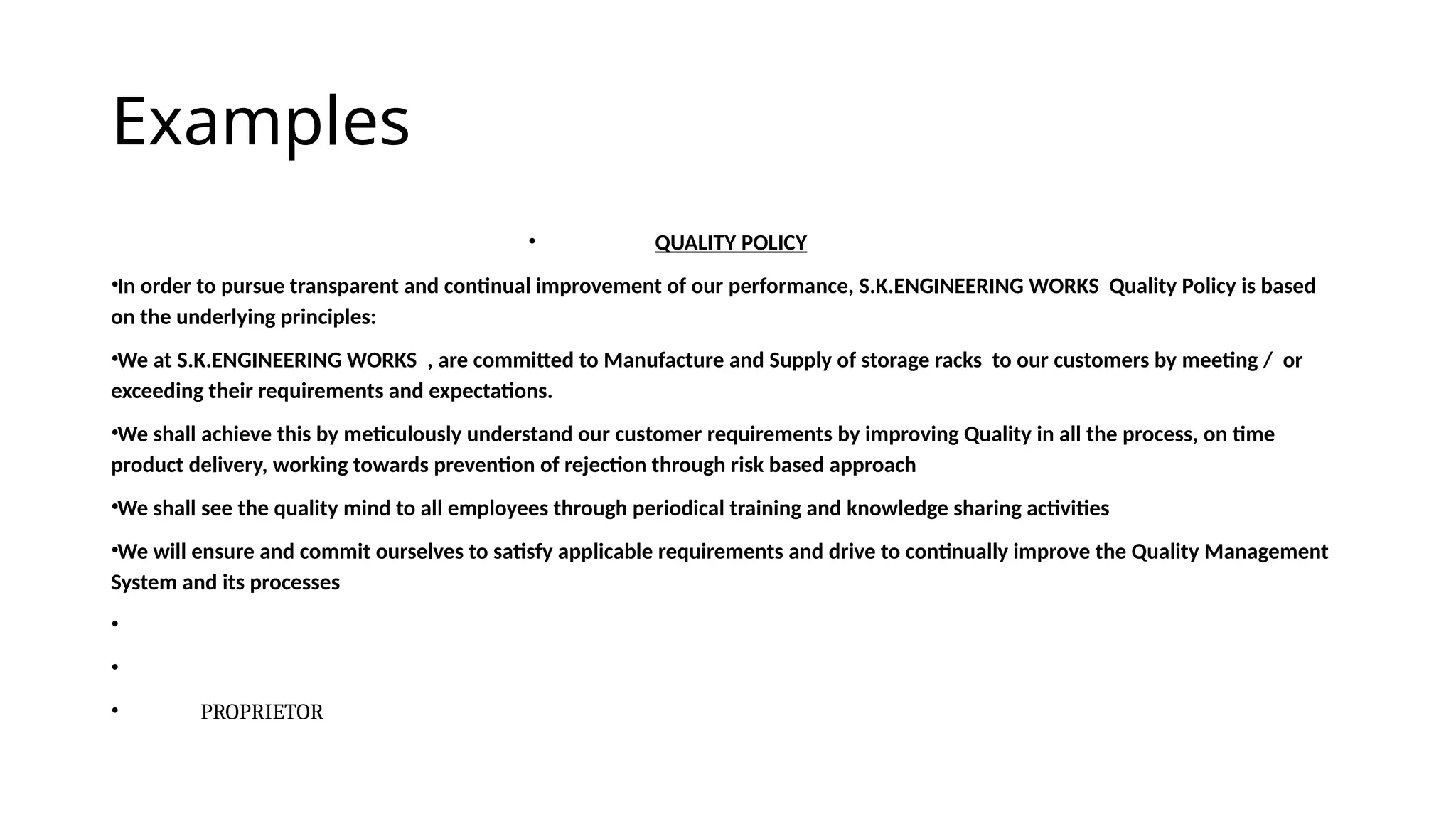
• QUALITY POLICY
•In order to pursue transparent and continual improvement of our performance, S.K.ENGINEERING WORKS Quality Policy is based
on the underlying principles:
•We at S.K.ENGINEERING WORKS , are committed to Manufacture and Supply of storage racks to our customers by meeting / or
exceeding their requirements and expectations.
•We shall achieve this by meticulously understand our customer requirements by improving Quality in all the process, on time
product delivery, working towards prevention of rejection through risk based approach
•We shall see the quality mind to all employees through periodical training and knowledge sharing activities
•We will ensure and commit ourselves to satisfy applicable requirements and drive to continually improve the Quality Management
System and its processes
•
•
• PROPRIETOR
30
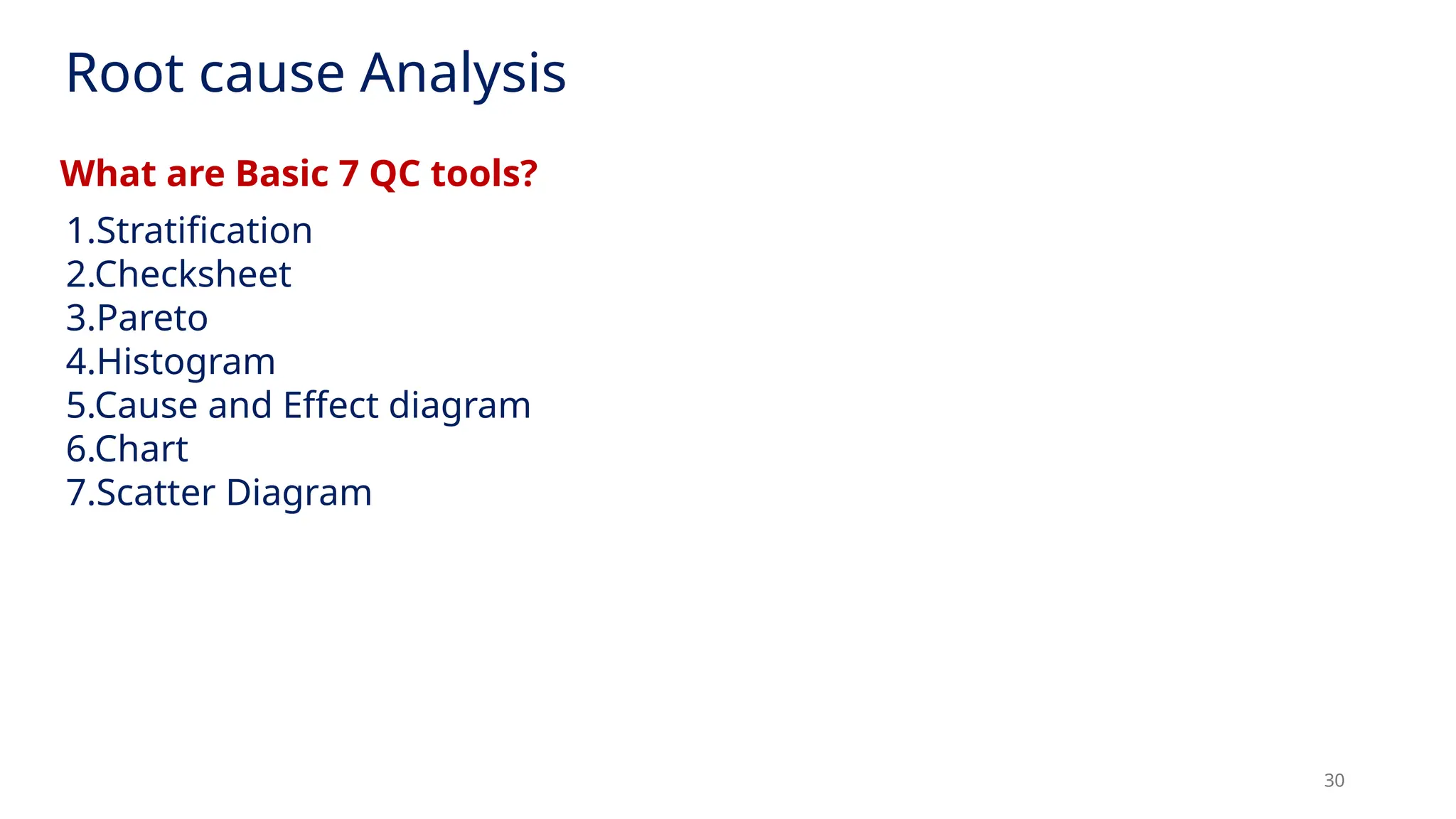
1.Stratification
2.Checksheet
3.Pareto
4.Histogram
5.Cause and Effect diagram
6.Chart
7.Scatter Diagram
What are Basic 7 QC tools?
Root cause Analysis
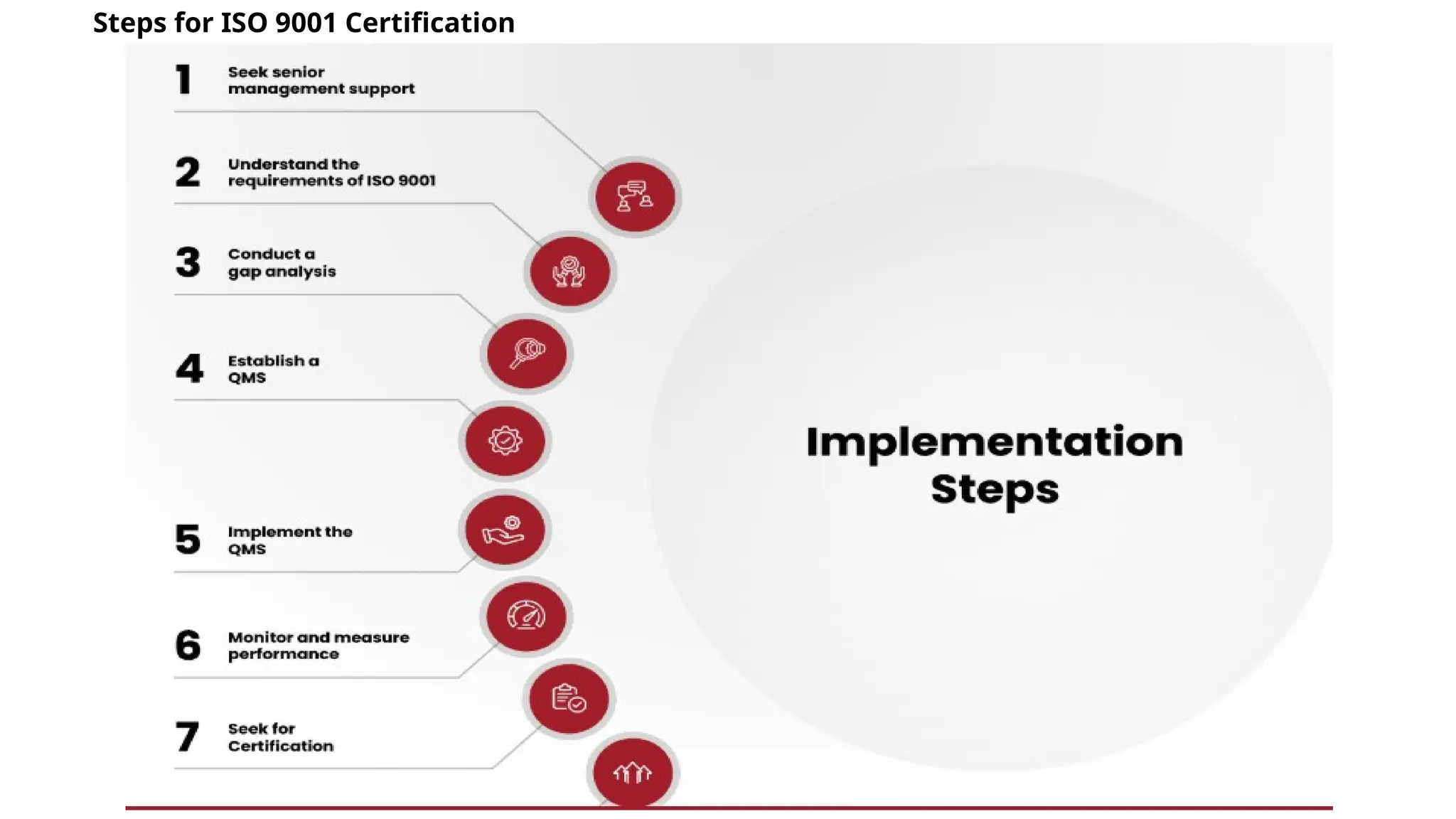
Steps for ISO 9001 Certification
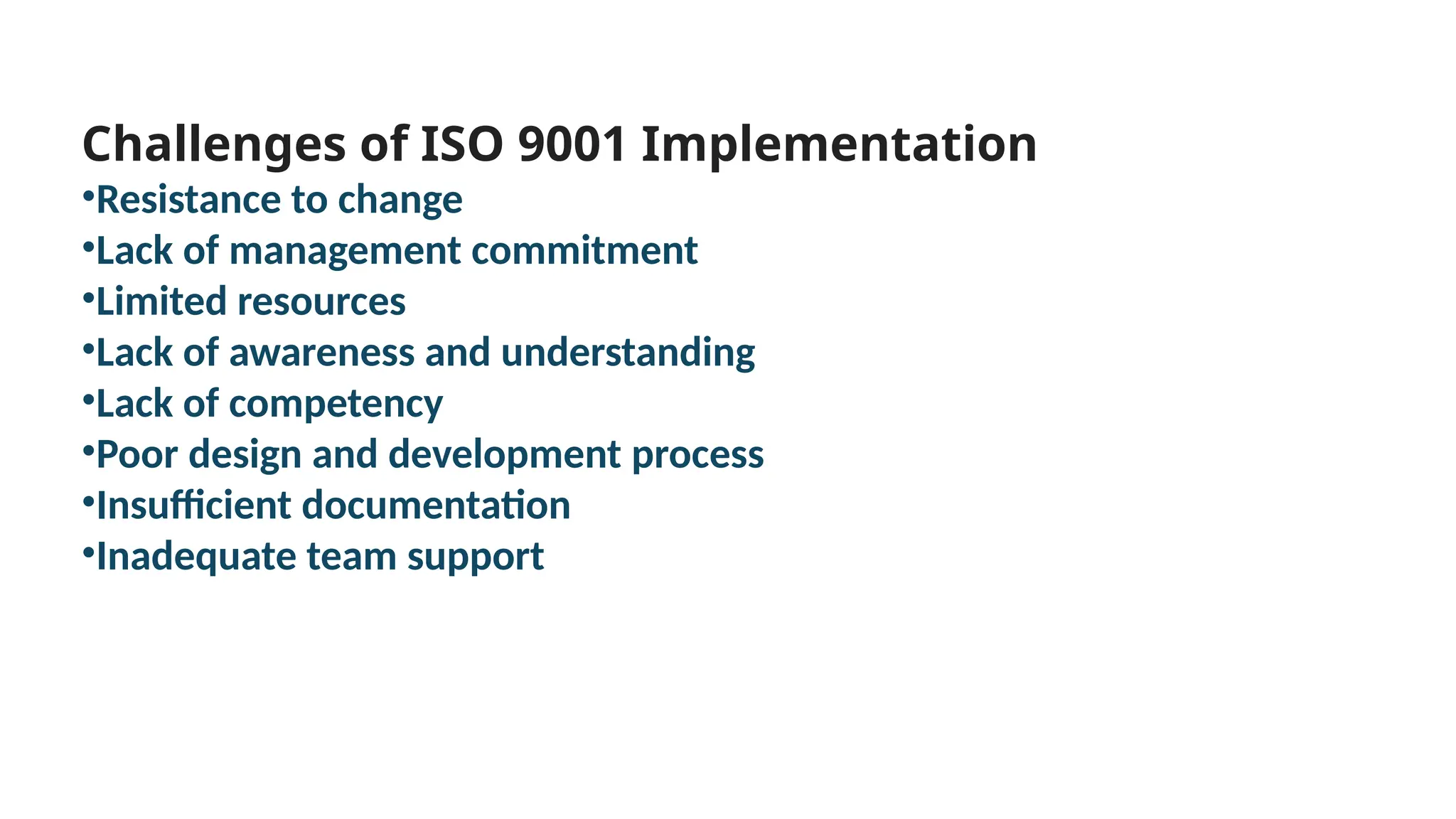
Challenges of ISO 9001 Implementation
•Resistance to change
•Lack of management commitment
•Limited resources
•Lack of awareness and understanding
•Lack of competency
•Poor design and development process
•Insufficient documentation
•Inadequate team support
Maintaining compliance
Complying defined system
Assigning responsibility and Authority
Change management
Periodical audit and implementing systemic corrective action
for gaps
Management review
Provide resources
Train the employees
5 simple steps to your ISO 9001 Certification
•Documentation review audit: CB evaluates your documentation
and company records-Stage 1 audit
•On-site audit: CB reviews the compliance of your actual activities
to ISO 9001 requirements and company records – Stage 2 audit
•Close the gap: Your organisation identifies and implements
measures to correct the root cause of any non-conformances
identified by the audit
•Certification issuance: CB issues the ISO 9001 certification and
certification mark
•Surveillance audits: Annual audit required to maintain
certification validity (Unannounced audits may occur in special
cases)

Training on Quality Management System for Implementation

  • 1.
  • 2.
    Quality An organization focusedon quality promotes a culture that results in the behaviour, attitudes, activities and processes that deliver value through fulfilling the needs and expectations of customers and other relevant interested parties. The quality of an organization’s products and services is determined by the ability to satisfy customers and the intended and unintended impact on relevant interested parties. The quality of products and services includes not only their intended function and performance, but also their perceived value and benefit to the customer. 1.Introduction to QMS Quality is defined as the degree to which a set of inherent characteristics fulfills the requirements
  • 3.
    Introduction to QMS Whatis a Quality management system (QMS)? •A QMS comprises activities by which the organization identifies its objectives and determines the processes and resources required to achieve desired results. •The QMS manages the interacting processes and resources required to provide value and realize results for relevant interested parties. •The QMS enables top management to optimize the use of resources considering the long and short term consequences of their decision. •A QMS provides the means to identify actions to address intended and unintended consequences in providing products and services. Management is a set of co–ordinated activities to direct and control an organization
  • 4.
    Introduction to QMS Importanceand benefits of Quality management system in Organizations Quality management provides a framework for constant quality improvement to ensure companies build and launch the best possible products and services. Quality management functions as both a perspective and an approach to increasing customer satisfaction, cutting costs, and eliminating errors.
  • 5.
    Benefits of QMS •System drives the organization rather than people • Enhanced Customer satisfaction • Increased Employee engagement • Change control • Enhanced efficiency • Better Decision making • Continual improvement • Risk based thinking • Retaining knowledge base
  • 6.
    ISO 9001 …A Journey 198 7 199 4 200 0 200 8 201 5
  • 7.
    MAIN REVISIONS OFISO 9001:2015 The scope of the QMS will now have to encompass an organization’s internal and external contexts, and needs and expectations of interested parties Freedom in deciding what procedure are to be documented to ensure effectiveness More focus on top management’s responsibility and accountability The requirement of Management Representative is now deleted Organization’s knowledge and monitoring and measuring equipment are now considered as resources that need to be managed Communication requirements are now cover both external and internal communications and they need to be defined
  • 8.
    MAIN REVISIONS OFISO 9001:2015 The determination of customer requirements now included contingencies  Suppliers are now known as external providers  The scope of supply from suppliers that need to be controlled include outsourced processes , products and services  Preservation of customer’s property now includes external providers  Introduction of post delivery activities requirements  Preventive action clause is deleted thus emphasize the organization to predict / foresee the potential risks at the initial stages itself  Corrective actions must now include analyzing the possibility of the same non conformity occurring elsewhere or already occurring.
  • 9.
    MAIN REVISIONS OFISO 9001:2015 New clauses - (4.1) Understanding the organization and its context - (4.2) Understanding the needs and expectations of interested parties  No requirement of Quality Manual
  • 10.
    MAJOR DIFFERENCES INTERMINOLOGIES ISO 9001:2008 ISO 9001:2015 Products Products & Services Supplier External Provider Documentation and Records Documented Information Work Environment Environment for the operation of processes Purchased Product Externally provided products and services Exclusions Term not used Management Representative Term not used Documented Procedure Term not used Quality Manual Term not used Preventive Action Term not used Term not used Leadership Term not used Risk
  • 11.
    11 Model of aprocess- based QMS
  • 12.
    PDCA In HLS– High Level Structure Context of the organization Understanding organization and its context Need and expectations of IP Scope of the QMS QMS and its Processes Leadership Planning Support Operation Performanc e Evaluation Improvement Leadership & Commitment Quality Policy Roles, Responsibility & Authority Action to address risks & opportunities Quality Objectives & planning to achieve them Planning of changes Resources Competence Awareness Communicatio n Documented Information Operation Planning & Control Requirements for products and servcies Design and development of products & services Control of externally provided processes, products & services Production and service provision Release of products & Services Control of Non conforming outputs Monitoring , Measurement , analysis & evaluation Internal Audit Management Review Non conformity & Corrective Action Continual Improvement 4 5 6 7 8 9 1 0 PLAN DO CHECK ACT
  • 13.
    GET STARTED ……OF ISO 9001:2015  For the purposes of ISO 9001:2015, the terms and definitions given in ISO 9000:2015 shall apply • “ shall” indicates a requirement • “ should” indicates a recommendation • “ may” indicates a permission • “ can” indicates a possibility or a capability • Information marked as “NOTE” is for guidance in understanding
  • 14.
    GET STARTED ……OF ISO 9001:2015  A system is a set of interrelated and interacting elements  A process is a set of interrelated or interacting activities which transforms inputs to outputs  Risk is the effect of uncertainty  Non conformity is a failure to fulfill a requirement  Objective is the result to be achieved  Correction is the action taken to eliminate a detected non conformity  Corrective action is the action taken to eliminate the cause of detected non conformity  Audit is a systematic , independent and documented process for obtaining audit evidence and evaluating it objectively to determine the extent to which audit criteria is fulfilled
  • 15.
    GET STARTED ……OF ISO 9001:2015  Objective evidence is the data supporting the existence of verity of something  Interested party is the person or organization that can effect , be affected by , or perceive themselves to be affected by a decision or activity  Requirement is the need or expectation that is stated , generally implied or obligatory
  • 16.
    Management Principles OfQMS 1. Customer focus The primary focus of quality management is to meet customer requirements and to strive to exceed customer expectations. Sustained success is achieved when an organization attracts and retains the confidence of customers whom it depends. Every aspect of customer interaction provides an opportunity to create more value for the customer 2. Leadership Leaders at all levels establish unity of purpose and direction and create conditions in which people are engaged in achieving the quality objectives of the organization. Creation of unity of purpose , direction and engagement enable an organization to align its strategies , policies, processes and resources to achieve its objectives 3. Engagement of People It is essential for the organization that all people are competent, empowered and engaged in delivering Competent, empowered and engaged people throughout the organization enhance its capability to create value Competent , empowered and engages people throughout the organization enhance its capability to create value
  • 17.
    17 Management Principles OfQMS 4. Process Approach Consistent and predictable results are achieved more effectively and efficiently when activities are understood and managed as interrelated processes that function as a coherent system. The quality management system is composed of inter related processes. Understanding how results are produced by this system, including all its processes resources, controls and interactions, allows the organization to optimize its performance Key Activities Input Output - Man - Machine - Material - Method - 5W & 1 H - Qualitative - Quantitative
  • 18.
    Management Principles OfQMS 5. Improvement Successful organizations have an ongoing focus on improvement. Improvement is essential for an organization to maintain current levels of performance, to react to changes in its internal and external conditions and to create new opportunities. Improvement is essential for an organization to maintain current levels of performance, to react to changes in its internal and external conditions and to create new opportunities 6. Evidence-based Decision Making Decisions based on the analysis and evaluation of data and information are more likely to produce desired results. 7. Relationship Management For sustained success, organizations manage their relationships with interested parties, such as suppliers Facts, evidence and data analysis lead to greater objectivity and confidence in decisions made Interested parties influence the performance of an organization. Sustained success is more likely to be achieved when an organization manages relationships with its interested parties to optimize their impact on its performance.
  • 19.
    DEFINITIONS Audit Systematic, independent anddocumented process for obtaining audit evidence and evaluating it objectively to determine the extent to which the audit criteria are fulfilled Audit criteria / Requirements The reference against which the audit is performed Set of policies, procedures or requirements Objective evidence Data supporting the existence or verity of something May be obtained through observation, measurement, Test or other means Can be verified NOTE Audit criteria are used as a reference against which audit evidence is compared
  • 20.
    DEFINITIONS Audit evidence Records, statementsof fact or other information, which are relevant to the audit criteria and verifiable NOTE Audit evidence may be qualitative or quantitative. Audit findings Results of the evaluation of the collected audit evidence against audit criteria NOTE Audit findings can indicate either conformity or nonconformity with audit criteria or opportunities for improvement
  • 21.
    DEFINITIONS Audit conclusion Outcome ofan audit, provided by the audit team after consideration of the audit objectives and all audit findings Requirements Customer requirements Organization requirements –manuals, Procedures/ WI ISO 9001:2015 Standard requirements Legal requirements- Statutory, Regulatory or Industry body Conformity Fulfillment of a requirement Non-Conformity Non-fulfillment of a requirement
  • 22.
    Audit purpose To collectobjective evidence to permit an informed judgment about the status and effectiveness of the QMS Promote continual improvement of the management system Monitor and measure the management system Requirement of ISO 9001:2015 Benefits Verifies conformity to requirements Increases awareness and understanding Provides a measurement of effectiveness of the management system to top management Reduces risk of management system failure Identifies improvement opportunities Continual improvement if performed regularly
  • 23.
    Types of Audit 1stparty audit – Internal –Organization auditing its own system 2nd party audit – Organization auditing its supplier 3rd party audit- Organization audited by a CB Generally two types audit is taking place Adequacy audit-Verifying whether the documented quality system of an organization is meeting the international standard requirements Compliance audit-Verifying whether the documented quality system is being implemented
  • 24.
  • 25.
  • 26.
    Examples • QUALITY POLICY •Inorder to pursue transparent and continual improvement of our performance, S.K.ENGINEERING WORKS Quality Policy is based on the underlying principles: •We at S.K.ENGINEERING WORKS , are committed to Manufacture and Supply of storage racks to our customers by meeting / or exceeding their requirements and expectations. •We shall achieve this by meticulously understand our customer requirements by improving Quality in all the process, on time product delivery, working towards prevention of rejection through risk based approach •We shall see the quality mind to all employees through periodical training and knowledge sharing activities •We will ensure and commit ourselves to satisfy applicable requirements and drive to continually improve the Quality Management System and its processes • • • PROPRIETOR
  • 30.
    30 1.Stratification 2.Checksheet 3.Pareto 4.Histogram 5.Cause and Effectdiagram 6.Chart 7.Scatter Diagram What are Basic 7 QC tools? Root cause Analysis
  • 31.
    Steps for ISO9001 Certification
  • 32.
    Challenges of ISO9001 Implementation •Resistance to change •Lack of management commitment •Limited resources •Lack of awareness and understanding •Lack of competency •Poor design and development process •Insufficient documentation •Inadequate team support
  • 33.
    Maintaining compliance Complying definedsystem Assigning responsibility and Authority Change management Periodical audit and implementing systemic corrective action for gaps Management review Provide resources Train the employees
  • 34.
    5 simple stepsto your ISO 9001 Certification •Documentation review audit: CB evaluates your documentation and company records-Stage 1 audit •On-site audit: CB reviews the compliance of your actual activities to ISO 9001 requirements and company records – Stage 2 audit •Close the gap: Your organisation identifies and implements measures to correct the root cause of any non-conformances identified by the audit •Certification issuance: CB issues the ISO 9001 certification and certification mark •Surveillance audits: Annual audit required to maintain certification validity (Unannounced audits may occur in special cases)