ISO 9001:2015 Changes, Requirements and Implementation September 2014 Govind Ramu, P. Eng., ASQ Fellow, ASQ CMQOE, CQE, CSSBB, CQA, CSQE, CRE US TAG Member for TC 176/SC2
Why this revision? 
Key reasons for the revision of this standard 
•increased prominence of services . Products – “products and services” (Also there is a general perception that the standard is leaned towards manufacturing) . Expand and clarify the output of a process to include services, software and other products. 
•Globalization (Integration of products and ideas from all parts of the world made possible by technology) 
•more complex supply chain (sub-suppliers, suppliers, organization, distributors, wholesalers, online sellers, customer, etc.) 
•increased interested parties’ expectations (expectations go beyond customers (i.e. owners, people in an organization, suppliers , bankers, unions, partners or society that may include competitors or opposing pressure groups). 
*Interested Parties: person or organization that can affect, be affected by, or perceive themselves to be affected by a decision or activity
What has changed? 
Emphasis on: 
Greater focus on the customer 
Risk-based thinking (10+ references) 
Aligning QMS policy and objectives with the strategy of an organization (Strategic planning and deployment) 
Greater flexibility with documentation
Main Changes 
the adoption of the High Level Structure (HLS) 
an explicit requirement for risk-based thinking to support and improve the understanding and application of the process approach 
fewer prescribed requirements 
less emphasis on documents 
improved applicability for services 
a requirement to define the boundaries of the QMS 
increased emphasis on organizational context 
increased leadership requirements 
greater emphasis on achieving desired outcomes to improve customer satisfaction
By the Numbers 
•132 Explicit* “shall” Vs 136 in the current version 
•Over 50 references** to “customer” Vs 32 references in the current version 
•20 references of Improvement Vs 17 in the current version 
•18 references to effectiveness Vs 21 in the current version. 
* not counting the shall applicability to sub clauses ** Headers and captions not included
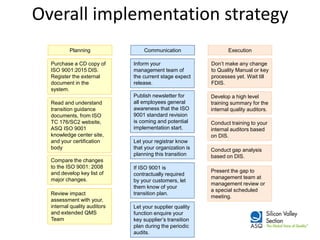
Purchase a CD copy of ISO 9001:2015 DIS. Register the external document in the system. 
Read and understand transition guidance documents, from ISO TC 176/SC2 website, ASQ ISO 9001 knowledge center site, and your certification body 
Compare the changes to the ISO 9001: 2008 and develop key list of major changes. 
Review impact assessment with your, internal quality auditors and extended QMS Team 
Inform your management team of the current stage expect release. 
Publish newsletter for all employees general awareness that the ISO 9001 standard revision is coming and potential implementation start. 
Let your registrar know that your organization is planning this transition 
If ISO 9001 is contractually required by your customers, let them know of your transition plan. 
Let your supplier quality function enquire your key supplier’s transition plan during the periodic audits. 
Don’t make any change to Quality Manual or key processes yet. Wait till FDIS. 
Develop a high level training summary for the internal quality auditors. 
Conduct training to your internal auditors based on DIS. 
Conduct gap analysis based on DIS. 
Present the gap to management team at management review or a special scheduled meeting. 
Planning 
Communication 
Execution 
Overall implementation strategy
Documented information (documents) 
The organization shall maintain documented information to the extent necessary to support the operation of processes (4.4) 
Scope 
Quality Policy 
information determined by the organization as being necessary for the effectiveness of the quality management system 
information of external origin determined by the organization 
Where requirements for products and services are changed, relevant documented information is amended 
Note: There is no requirement for the structure of an organization’s QMS documentation to mirror that of this international standard. A new look- QP Sep 2014
Documented information 
•No requirement for a quality manual (7.5). There is no longer a requirement for mandated procedures. 
•When creating and updating documented information the organization shall ensure appropriate: b) format (e.g. language, software version, graphics) and media (e.g. paper, electronic); (7.5.2) 
•it is adequately protected (e.g. from loss of confidentiality, improper use, or loss of integrity). (7.5.3) 
Summary: appropriate, protected. 
•Dominance of electronic information in the last several years.
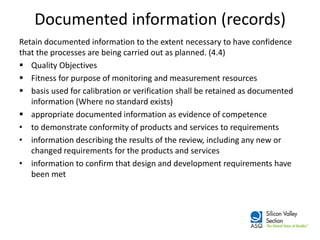
Documented information (records) 
Retain documented information to the extent necessary to have confidence that the processes are being carried out as planned. (4.4) 
Quality Objectives 
Fitness for purpose of monitoring and measurement resources 
basis used for calibration or verification shall be retained as documented information (Where no standard exists) 
appropriate documented information as evidence of competence 
•to demonstrate conformity of products and services to requirements 
•information describing the results of the review, including any new or changed requirements for the products and services 
•information to confirm that design and development requirements have been met
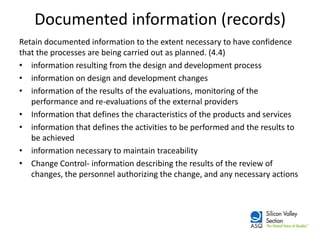
Documented information (records) 
Retain documented information to the extent necessary to have confidence that the processes are being carried out as planned. (4.4) 
•information resulting from the design and development process 
•information on design and development changes 
•information of the results of the evaluations, monitoring of the performance and re-evaluations of the external providers 
•Information that defines the characteristics of the products and services 
•information that defines the activities to be performed and the results to be achieved 
•information necessary to maintain traceability 
•Change Control- information describing the results of the review of changes, the personnel authorizing the change, and any necessary actions
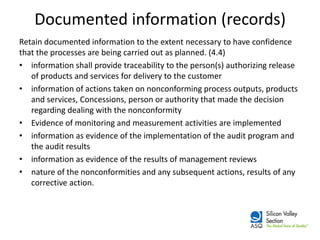
Documented information (records) 
Retain documented information to the extent necessary to have confidence that the processes are being carried out as planned. (4.4) 
•information shall provide traceability to the person(s) authorizing release of products and services for delivery to the customer 
•information of actions taken on nonconforming process outputs, products and services, Concessions, person or authority that made the decision regarding dealing with the nonconformity 
•Evidence of monitoring and measurement activities are implemented 
•information as evidence of the implementation of the audit program and the audit results 
•information as evidence of the results of management reviews 
•nature of the nonconformities and any subsequent actions, results of any corrective action.
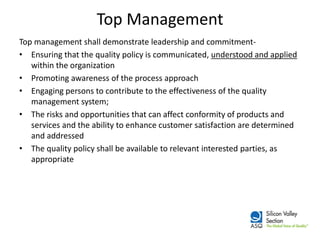
Top Management 
Top management shall demonstrate leadership and commitment- 
•Ensuring that the quality policy is communicated, understood and applied within the organization 
•Promoting awareness of the process approach 
•Engaging persons to contribute to the effectiveness of the quality management system; 
•The risks and opportunities that can affect conformity of products and services and the ability to enhance customer satisfaction are determined and addressed 
•The quality policy shall be available to relevant interested parties, as appropriate
Context of the Organization 
The organization shall determine external and internal issues that are relevant to its purpose and its strategic direction and that affect its ability to achieve the intended result(s) of its quality management system. 
Organization shall determine 
a) the interested parties that are relevant to the quality management system; 
b) the requirements of these interested parties that are relevant to the quality management system. 
The organization shall monitor and review the information about these interested parties and their relevant requirements. 
Summary: Environmental scanning, SWOT, Balanced Scorecard - Strategic Planning and deployment.
Organizational Knowledge 
The organization shall determine the knowledge necessary for the operation of its processes and to achieve conformity of products and services. 
•This knowledge shall be maintained, and made available to the extent necessary. 
•When addressing changing needs and trends, the organization shall consider its current knowledge and determine how to acquire or access the necessary additional knowledge. 
Summary: knowledge assessment, maintenance, dissemination, dynamic, acquisition, and accessibility- Knowledge management
Risk based thinking 
Organization and shall determine risks and opportunities 
•in accordance with the requirements 
•that can affect conformity of products and services and the ability to enhance customer satisfaction 
•give assurance that the quality management system can achieve its intended result 
•prevent, or reduce, undesired effects 
•achieve continual improvement 
•integrate and implement the actions into its quality management system processes 
•evaluate the effectiveness of these actions 
•post-delivery - associated with the products and services 
•Effectiveness of actions management review
What should organizations do 
Organizations using ISO 9001:2008 are recommended to take the following actions: 
•identify organizational gaps which need to be addressed to meet new requirements (using Draft and subsequently using Final Draft) 
•develop an implementation plan (High Level Plan now and a more detailed plan after final draft) 
•provide appropriate training and awareness for all parties that have an impact on the effectiveness of the organization (For internal quality auditors now all employees after final draft) 
•update existing quality management system (QMS) to meet the revised (after the release of final standard) 
•where applicable, liaise with your certification body for transition arrangements (after final draft)
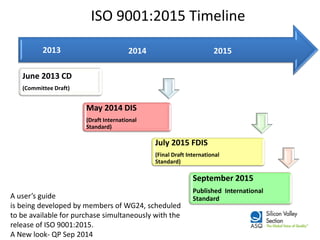
ISO 9001:2015 Timeline 
June 2013 CD 
(Committee Draft) 
May 2014 DIS 
(Draft International Standard) 
July 2015 FDIS 
(Final Draft International Standard) 
September 2015 
Published International Standard 
2015 
2014 
2013 
A user’s guide 
is being developed by members of WG24, scheduled 
to be available for purchase simultaneously with the 
release of ISO 9001:2015. 
A New look- QP Sep 2014
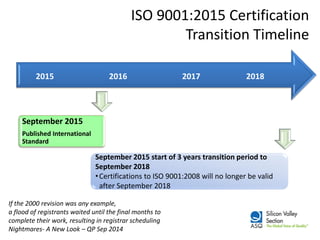
If the 2000 revision was any example, 
a flood of registrants waited until the final months to 
complete their work, resulting in registrar scheduling 
Nightmares- A New Look – QP Sep 2014 
ISO 9001:2015 Certification Transition Timeline 
September 2015 start of 3 years transition period to September 2018 
•Certifications to ISO 9001:2008 will no longer be valid after September 2018 
2018 
2017 
2016 
2015 
September 2015 
Published International Standard
References & Bibliography 
•ISO 9001:2015 DIS 
•ISO 9000 DIS 
•ISO TC 176/SC2 N1219_-_ISO_9001_Revision_DIS_presentation 
•ISO TC 176/SC2 N1220_-_ISO_9001_Revision_DIS_presentation 
•ISO TC 176/SC2 N1221_-_ISO_9001_Risk_based_thinking_presentation 
•N1223_-_Draft_ISO_9001_Transition_Plan 
•A new look by Paul Palmes- Quality Progress September 2014

ISO 9001:2015 DIS Changes, Requirements and Implementation

  • 1.
    ISO 9001:2015 Changes,Requirements and Implementation September 2014 Govind Ramu, P. Eng., ASQ Fellow, ASQ CMQOE, CQE, CSSBB, CQA, CSQE, CRE US TAG Member for TC 176/SC2
  • 2.
    Why this revision? Key reasons for the revision of this standard •increased prominence of services . Products – “products and services” (Also there is a general perception that the standard is leaned towards manufacturing) . Expand and clarify the output of a process to include services, software and other products. •Globalization (Integration of products and ideas from all parts of the world made possible by technology) •more complex supply chain (sub-suppliers, suppliers, organization, distributors, wholesalers, online sellers, customer, etc.) •increased interested parties’ expectations (expectations go beyond customers (i.e. owners, people in an organization, suppliers , bankers, unions, partners or society that may include competitors or opposing pressure groups). *Interested Parties: person or organization that can affect, be affected by, or perceive themselves to be affected by a decision or activity
  • 3.
    What has changed? Emphasis on: Greater focus on the customer Risk-based thinking (10+ references) Aligning QMS policy and objectives with the strategy of an organization (Strategic planning and deployment) Greater flexibility with documentation
  • 4.
    Main Changes theadoption of the High Level Structure (HLS) an explicit requirement for risk-based thinking to support and improve the understanding and application of the process approach fewer prescribed requirements less emphasis on documents improved applicability for services a requirement to define the boundaries of the QMS increased emphasis on organizational context increased leadership requirements greater emphasis on achieving desired outcomes to improve customer satisfaction
  • 5.
    By the Numbers •132 Explicit* “shall” Vs 136 in the current version •Over 50 references** to “customer” Vs 32 references in the current version •20 references of Improvement Vs 17 in the current version •18 references to effectiveness Vs 21 in the current version. * not counting the shall applicability to sub clauses ** Headers and captions not included
  • 6.
    Purchase a CDcopy of ISO 9001:2015 DIS. Register the external document in the system. Read and understand transition guidance documents, from ISO TC 176/SC2 website, ASQ ISO 9001 knowledge center site, and your certification body Compare the changes to the ISO 9001: 2008 and develop key list of major changes. Review impact assessment with your, internal quality auditors and extended QMS Team Inform your management team of the current stage expect release. Publish newsletter for all employees general awareness that the ISO 9001 standard revision is coming and potential implementation start. Let your registrar know that your organization is planning this transition If ISO 9001 is contractually required by your customers, let them know of your transition plan. Let your supplier quality function enquire your key supplier’s transition plan during the periodic audits. Don’t make any change to Quality Manual or key processes yet. Wait till FDIS. Develop a high level training summary for the internal quality auditors. Conduct training to your internal auditors based on DIS. Conduct gap analysis based on DIS. Present the gap to management team at management review or a special scheduled meeting. Planning Communication Execution Overall implementation strategy
  • 7.
    Documented information (documents) The organization shall maintain documented information to the extent necessary to support the operation of processes (4.4) Scope Quality Policy information determined by the organization as being necessary for the effectiveness of the quality management system information of external origin determined by the organization Where requirements for products and services are changed, relevant documented information is amended Note: There is no requirement for the structure of an organization’s QMS documentation to mirror that of this international standard. A new look- QP Sep 2014
  • 8.
    Documented information •Norequirement for a quality manual (7.5). There is no longer a requirement for mandated procedures. •When creating and updating documented information the organization shall ensure appropriate: b) format (e.g. language, software version, graphics) and media (e.g. paper, electronic); (7.5.2) •it is adequately protected (e.g. from loss of confidentiality, improper use, or loss of integrity). (7.5.3) Summary: appropriate, protected. •Dominance of electronic information in the last several years.
  • 9.
    Documented information (records) Retain documented information to the extent necessary to have confidence that the processes are being carried out as planned. (4.4) Quality Objectives Fitness for purpose of monitoring and measurement resources basis used for calibration or verification shall be retained as documented information (Where no standard exists) appropriate documented information as evidence of competence •to demonstrate conformity of products and services to requirements •information describing the results of the review, including any new or changed requirements for the products and services •information to confirm that design and development requirements have been met
  • 10.
    Documented information (records) Retain documented information to the extent necessary to have confidence that the processes are being carried out as planned. (4.4) •information resulting from the design and development process •information on design and development changes •information of the results of the evaluations, monitoring of the performance and re-evaluations of the external providers •Information that defines the characteristics of the products and services •information that defines the activities to be performed and the results to be achieved •information necessary to maintain traceability •Change Control- information describing the results of the review of changes, the personnel authorizing the change, and any necessary actions
  • 11.
    Documented information (records) Retain documented information to the extent necessary to have confidence that the processes are being carried out as planned. (4.4) •information shall provide traceability to the person(s) authorizing release of products and services for delivery to the customer •information of actions taken on nonconforming process outputs, products and services, Concessions, person or authority that made the decision regarding dealing with the nonconformity •Evidence of monitoring and measurement activities are implemented •information as evidence of the implementation of the audit program and the audit results •information as evidence of the results of management reviews •nature of the nonconformities and any subsequent actions, results of any corrective action.
  • 12.
    Top Management Topmanagement shall demonstrate leadership and commitment- •Ensuring that the quality policy is communicated, understood and applied within the organization •Promoting awareness of the process approach •Engaging persons to contribute to the effectiveness of the quality management system; •The risks and opportunities that can affect conformity of products and services and the ability to enhance customer satisfaction are determined and addressed •The quality policy shall be available to relevant interested parties, as appropriate
  • 13.
    Context of theOrganization The organization shall determine external and internal issues that are relevant to its purpose and its strategic direction and that affect its ability to achieve the intended result(s) of its quality management system. Organization shall determine a) the interested parties that are relevant to the quality management system; b) the requirements of these interested parties that are relevant to the quality management system. The organization shall monitor and review the information about these interested parties and their relevant requirements. Summary: Environmental scanning, SWOT, Balanced Scorecard - Strategic Planning and deployment.
  • 14.
    Organizational Knowledge Theorganization shall determine the knowledge necessary for the operation of its processes and to achieve conformity of products and services. •This knowledge shall be maintained, and made available to the extent necessary. •When addressing changing needs and trends, the organization shall consider its current knowledge and determine how to acquire or access the necessary additional knowledge. Summary: knowledge assessment, maintenance, dissemination, dynamic, acquisition, and accessibility- Knowledge management
  • 15.
    Risk based thinking Organization and shall determine risks and opportunities •in accordance with the requirements •that can affect conformity of products and services and the ability to enhance customer satisfaction •give assurance that the quality management system can achieve its intended result •prevent, or reduce, undesired effects •achieve continual improvement •integrate and implement the actions into its quality management system processes •evaluate the effectiveness of these actions •post-delivery - associated with the products and services •Effectiveness of actions management review
  • 16.
    What should organizationsdo Organizations using ISO 9001:2008 are recommended to take the following actions: •identify organizational gaps which need to be addressed to meet new requirements (using Draft and subsequently using Final Draft) •develop an implementation plan (High Level Plan now and a more detailed plan after final draft) •provide appropriate training and awareness for all parties that have an impact on the effectiveness of the organization (For internal quality auditors now all employees after final draft) •update existing quality management system (QMS) to meet the revised (after the release of final standard) •where applicable, liaise with your certification body for transition arrangements (after final draft)
  • 17.
    ISO 9001:2015 Timeline June 2013 CD (Committee Draft) May 2014 DIS (Draft International Standard) July 2015 FDIS (Final Draft International Standard) September 2015 Published International Standard 2015 2014 2013 A user’s guide is being developed by members of WG24, scheduled to be available for purchase simultaneously with the release of ISO 9001:2015. A New look- QP Sep 2014
  • 18.
    If the 2000revision was any example, a flood of registrants waited until the final months to complete their work, resulting in registrar scheduling Nightmares- A New Look – QP Sep 2014 ISO 9001:2015 Certification Transition Timeline September 2015 start of 3 years transition period to September 2018 •Certifications to ISO 9001:2008 will no longer be valid after September 2018 2018 2017 2016 2015 September 2015 Published International Standard
  • 19.
    References & Bibliography •ISO 9001:2015 DIS •ISO 9000 DIS •ISO TC 176/SC2 N1219_-_ISO_9001_Revision_DIS_presentation •ISO TC 176/SC2 N1220_-_ISO_9001_Revision_DIS_presentation •ISO TC 176/SC2 N1221_-_ISO_9001_Risk_based_thinking_presentation •N1223_-_Draft_ISO_9001_Transition_Plan •A new look by Paul Palmes- Quality Progress September 2014