ISO 9001 : 2015* New version
3 Main reason the changes of standard
 Process Review from technical committee TC 176
- Aims to ensure conformity of standard with changes and development of the
industry
- Held a minimum of 5 years
 Input from System Users
- survey result and questionnaire
- Include recommendations given by the user from result of interpretation process
 Trend
- To adjust with development in management system field
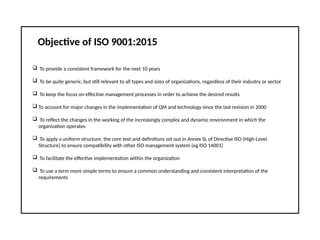
Objective of ISO 9001:2015
 To provide a consistent framework for the next 10 years
 To be quite generic, but still relevant to all types and sizes of organizations, regardless of their industry or sector
 To keep the focus on effective management processes in order to achieve the desired results
 To account for major changes in the implementation of QM and technology since the last revision in 2000
 To reflect the changes in the working of the increasingly complex and dynamic environment in which the
organization operates
 To apply a uniform structure, the core text and definitions set out in Annex SL of Directive ISO (High-Level
Structure) to ensure compatibility with other ISO management system (eg ISO 14001)
 To facilitate the effective implementation within the organization
 To use a term more simple terms to ensure a common understanding and consistent interpretation of the
requirements
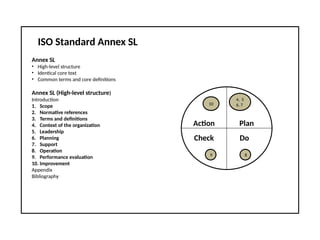
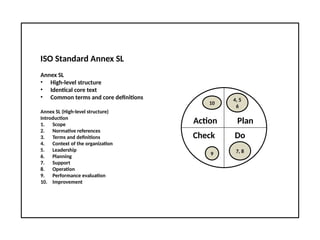
ISO Standard Annex SL
Annex SL
• High-level structure
• Identical core text
• Common terms and core definitions
Annex SL (High-level structure)
Introduction
1. Scope
2. Normative references
3. Terms and definitions
4. Context of the organization
5. Leadership
6. Planning
7. Support
8. Operation
9. Performance evaluation
10. Improvement
Appendix
Bibliography
10
Action
4, 5
6, 7
Plan
9 8
Check Do
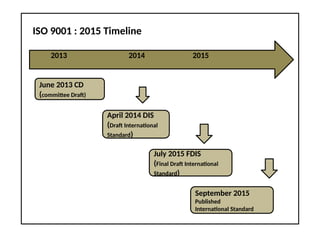
ISO 9001 : 2015 Timeline
2013 2014 2015
June 2013 CD
(committee Draft)
April 2014 DIS
(Draft International
Standard)
July 2015 FDIS
(Final Draft International
Standard)
September 2015
Published
International Standard
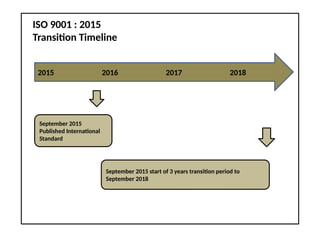
ISO 9001 : 2015
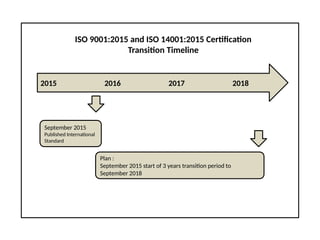
Transition Timeline
2015 2016 2017 2018
September 2015
Published International
Standard
September 2015 start of 3 years transition period to
September 2018
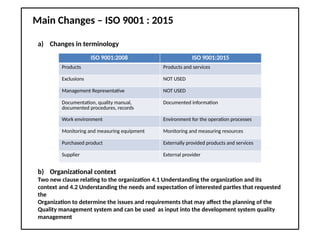
Main Changes – ISO 9001 : 2015
a) Changes in terminology
b) Organizational context
Two new clause relating to the organization 4.1 Understanding the organization and its
context and 4.2 Understanding the needs and expectation of interested parties that requested
the
Organization to determine the issues and requirements that may affect the planning of the
Quality management system and can be used as input into the development system quality
management
ISO 9001:2008 ISO 9001:2015
Products Products and services
Exclusions NOT USED
Management Representative NOT USED
Documentation, quality manual,
documented procedures, records
Documented information
Work environment Environment for the operation processes
Monitoring and measuring equipment Monitoring and measuring resources
Purchased product Externally provided products and services
Supplier External provider
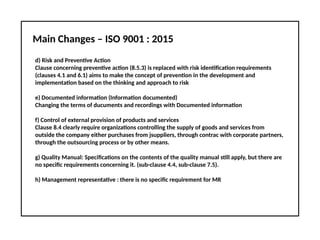
Main Changes – ISO 9001 : 2015
d) Risk and Preventive Action
Clause concerning preventive action (8.5.3) is replaced with risk identification requirements
(clauses 4.1 and 6.1) aims to make the concept of prevention in the development and
implementation based on the thinking and approach to risk
e) Documented information (Information documented)
Changing the terms of ducuments and recordings with Documented information
f) Control of external provision of products and services
Clause 8.4 clearly require organizations controlling the supply of goods and services from
outside the company either purchases from jsuppliers, through contrac with corporate partners,
through the outsourcing process or by other means.
g) Quality Manual: Specifications on the contents of the quality manual still apply, but there are
no specific requirements concerning it. (sub-clause 4.4, sub-clause 7.5).
h) Management representative : there is no specific requirement for MR
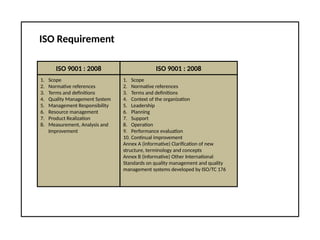
ISO Requirement
ISO 9001 : 2008 ISO 9001 : 2008
1. Scope
2. Normative references
3. Terms and definitions
4. Quality Management System
5. Management Responsibility
6. Resource management
7. Product Realization
8. Measurement, Analysis and
Improvement
1. Scope
2. Normative references
3. Terms and definitions
4. Context of the organization
5. Leadership
6. Planning
7. Support
8. Operation
9. Performance evaluation
10. Continual improvement
Annex A (informative) Clarification of new
structure, terminology and concepts
Annex B (informative) Other International
Standards on quality management and quality
management systems developed by ISO/TC 176
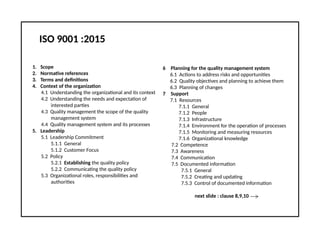
ISO 9001 :2015
1. Scope
2. Normative references
3. Terms and definitions
4. Context of the organization
4.1 Understanding the organizational and its context
4.2 Understanding the needs and expectation of
interested parties
4.3 Quality management the scope of the quality
management system
4.4 Quality management system and its processes
5. Leadership
5.1 Leadership Commitment
5.1.1 General
5.1.2 Customer Focus
5.2 Policy
5.2.1 Establishing the quality policy
5.2.2 Communicating the quality policy
5.3 Organizational roles, responsibilities and
authorities
6 Planning for the quality management system
6.1 Actions to address risks and opportunities
6.2 Quality objectives and planning to achieve them
6.3 Planning of changes
7 Support
7.1 Resources
7.1.1 General
7.1.2 People
7.1.3 Infrastructure
7.1.4 Environment for the operation of processes
7.1.5 Monitoring and measuring resources
7.1.6 Organizational knowledge
7.2 Competence
7.3 Awareness
7.4 Communication
7.5 Documented information
7.5.1 General
7.5.2 Creating and updating
7.5.3 Control of documented information
next slide : clause 8,9,10
ISO 9001 :2015
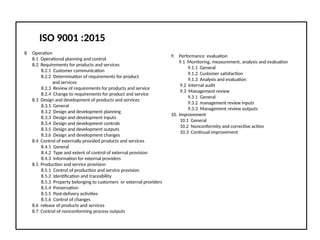
8 Operation
8.1 Operational planning and control
8.2 Requirements for products and services
8.2.1 Customer communication
8.2.2 Determination of requirements for product
and services
8.2.3 Review of requirements for products and service
8.2.4 Change to requirements for product and service
8.3 Design and development of products and services
8.3.1 General
8.3.2 Design and development planning
8.3.3 Design and development inputs
8.3.4 Design and development controls
8.3.5 Design and development outputs
8.3.6 Design and development changes
8.4 Control of externally provided products and services
8.4.1 General
8.4.2 Type and extent of control of external provision
8.4.3 Information for external providers
8.5 Production and service provision
8.5.1 Control of production and service provision
8.5.2 Identification and traceability
8.5.3 Property belonging to customers or external providers
8.5.4 Preservation
8.5.5 Post-delivery activities
8.5.6 Control of changes
8.6 release of products and services
8.7 Control of nonconforming process outputs
9. Performance evaluation
9.1 Monitoring, measurement, analysis and evaluation
9.1.1 General
9.1.2 Customer satisfaction
9.1.3 Analysis and evaluation
9.2 Internal audit
9.3 Management review
9.3.1 General
9.3.2 management review inputs
9.3.3 Management review outputs
10. Improvement
10.1 General
10.2 Nonconformity and corrective action
10.3 Continual improvement
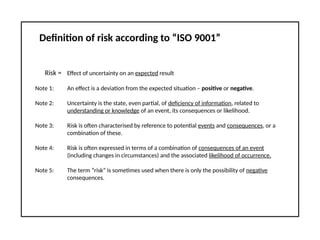
Definition of risk according to “ISO 9001”
Risk = Effect of uncertainty on an expected result
Note 1: An effect is a deviation from the expected situation – positive or negative.
Note 2: Uncertainty is the state, even partial, of deficiency of information, related to
understanding or knowledge of an event, its consequences or likelihood.
Note 3: Risk is often characterised by reference to potential events and consequences, or a
combination of these.
Note 4: Risk is often expressed in terms of a combination of consequences of an event
(including changes in circumstances) and the associated likelihood of occurrence.
Note 5: The term “risk” is sometimes used when there is only the possibility of negative
consequences.
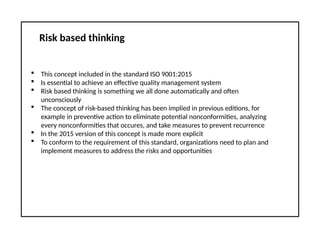
Risk based thinking
 This concept included in the standard ISO 9001:2015
 Is essential to achieve an effective quality management system
 Risk based thinking is something we all done automatically and often
unconsciously
 The concept of risk-based thinking has been implied in previous editions, for
example in preventive action to eliminate potential nonconformities, analyzing
every nonconformities that occures, and take measures to prevent recurrence
 In the 2015 version of this concept is made more explicit
 To conform to the requirement of this standard, organizations need to plan and
implement measures to address the risks and opportunities
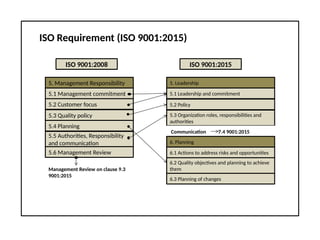
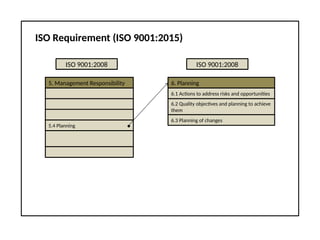
ISO Requirement (ISO 9001:2015)
ISO 9001:2008
5. Management Responsibility
5.1 Management commitment
5.2 Customer focus
5.3 Quality policy
5.4 Planning
5.5 Authorities, Responsibility
and communication
5.6 Management Review
ISO 9001:2015
5. Leadership
5.1 Leadership and commitment
5.2 Policy
5.3 Organization roles, responsibilities and
authorities
Communication 7.4 9001:2015
6. Planning
6.1 Actions to address risks and opportunities
6.2 Quality objectives and planning to achieve
them
6.3 Planning of changes
Management Review on clause 9.3
9001:2015
ISO Requirement (ISO 9001:2015)
ISO 9001:2008
5. Management Responsibility
5.4 Planning
ISO 9001:2008
6. Planning
6.1 Actions to address risks and opportunities
6.2 Quality objectives and planning to achieve
them
6.3 Planning of changes
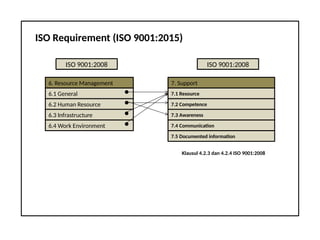
ISO Requirement (ISO 9001:2015)
ISO 9001:2008
6. Resource Management
6.1 General
6.2 Human Resource
6.3 Infrastructure
6.4 Work Environment
ISO 9001:2008
7. Support
7.1 Resource
7.2 Competence
7.3 Awareness
7.4 Communication
7.5 Documented information
Klausul 4.2.3 dan 4.2.4 ISO 9001:2008
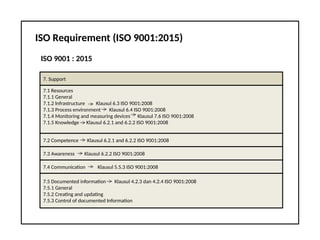
ISO Requirement (ISO 9001:2015)
ISO 9001 : 2015
7. Support
7.1 Resources
7.1.1 General
7.1.2 Infrastructure Klausul 6.3 ISO 9001:2008
7.1.3 Process environment Klausul 6.4 ISO 9001:2008
7.1.4 Monitoring and measuring devices Klausul 7.6 ISO 9001:2008
7.1.5 Knowledge Klausul 6.2.1 and 6.2.2 ISO 9001:2008
7.2 Competence Klausul 6.2.1 and 6.2.2 ISO 9001:2008
7.3 Awareness Klausul 6.2.2 ISO 9001:2008
7.4 Communication Klausul 5.5.3 ISO 9001:2008
7.5 Documented information Klausul 4.2.3 dan 4.2.4 ISO 9001:2008
7.5.1 General
7.5.2 Creating and updating
7.5.3 Control of documented Information
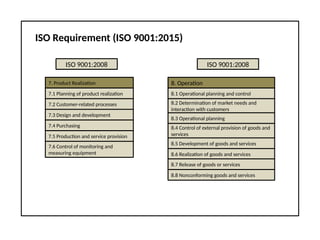
ISO Requirement (ISO 9001:2015)
ISO 9001:2008
7. Product Realization
7.1 Planning of product realization
7.2 Customer-related processes
7.3 Design and development
7.4 Purchasing
7.5 Production and service provision
7.6 Control of monitoring and
measuring equipment
ISO 9001:2008
8. Operation
8.1 Operational planning and control
8.2 Determination of market needs and
interaction with customers
8.3 Operational planning
8.4 Control of external provision of goods and
services
8.5 Development of goods and services
8.6 Realization of goods and services
8.7 Release of goods or services
8.8 Nonconforming goods and services
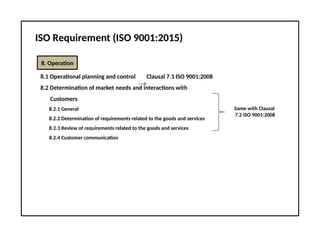
ISO Requirement (ISO 9001:2015)
8. Operation
8.1 Operational planning and control Clausal 7.1 ISO 9001:2008
8.2 Determination of market needs and interactions with
Customers
8.2.1 General
8.2.2 Determination of requirements related to the goods and services
8.2.3 Review of requirements related to the goods and services
8.2.4 Customer communication
Same with Clausal
7.2 ISO 9001:2008
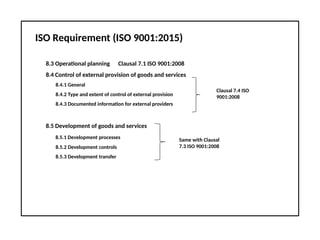
ISO Requirement (ISO 9001:2015)
8.3 Operational planning Clausal 7.1 ISO 9001:2008
8.4 Control of external provision of goods and services
8.4.1 General
8.4.2 Type and extent of control of external provision
8.4.3 Documented information for external providers
8.5 Development of goods and services
8.5.1 Development processes
8.5.2 Development controls
8.5.3 Development transfer
Clausal 7.4 ISO
9001:2008
Same with Clausal
7.3 ISO 9001:2008
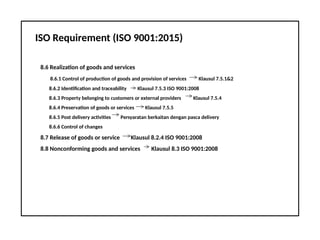
ISO Requirement (ISO 9001:2015)
8.6 Realization of goods and services
8.6.1 Control of production of goods and provision of services Klausul 7.5.1&2
8.6.2 Identification and traceability Klausul 7.5.3 ISO 9001:2008
8.6.3 Property belonging to customers or external providers Klausul 7.5.4
8.6.4 Preservation of goods or services Klausul 7.5.5
8.6.5 Post delivery activities Persyaratan berkaitan dengan pasca delivery
8.6.6 Control of changes
8.7 Release of goods or service Klausul 8.2.4 ISO 9001:2008
8.8 Nonconforming goods and services Klausul 8.3 ISO 9001:2008
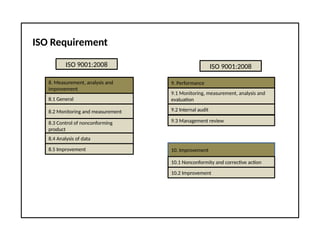
ISO Requirement
ISO 9001:2008
8. Measurement, analysis and
improvement
8.1 General
8.2 Monitoring and measurement
8.3 Control of nonconforming
product
8.4 Analysis of data
8.5 Improvement
ISO 9001:2008
9. Performance
9.1 Monitoring, measurement, analysis and
evaluation
9.2 Internal audit
9.3 Management review
10. Improvement
10.1 Nonconformity and corrective action
10.2 Improvement
ISO Requirement
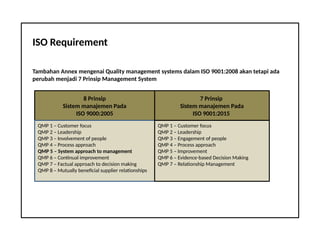
Tambahan Annex mengenai Quality management systems dalam ISO 9001:2008 akan tetapi ada
perubah menjadi 7 Prinsip Management System
8 Prinsip
Sistem manajemen Pada
ISO 9000:2005
7 Prinsip
Sistem manajemen Pada
ISO 9001:2015
QMP 1 – Customer focus
QMP 2 – Leadership
QMP 3 – Involvement of people
QMP 4 – Process approach
QMP 5 – System approach to management
QMP 6 – Continual improvement
QMP 7 – Factual approach to decision making
QMP 8 – Mutually beneficial supplier relationships
QMP 1 – Customer focus
QMP 2 – Leadership
QMP 3 – Engagement of people
QMP 4 – Process approach
QMP 5 – Improvement
QMP 6 – Evidence-based Decision Making
QMP 7 – Relationship Management
Thank You
Internal Audit Training ISO 19011 : 2011
Mobilitat
Und Verkehr
Anlagentechnik
Energie
Und umwelt
Produktiqualitat
Zertifizierung
Von Systemen
Consulting
Mensch
Und Arbeit
International
Welcome to
Management
System Audit
Training
Mobilitat
Und Verkehr
Anlagentechnik
Energie
Und umwelt
Produktiqualitat
Zertifizierung
Von Systemen
Consulting
Mensch
Und Arbeit
International
Requirement Review
ISO Standard Annex SL
Annex SL
• High-level structure
• Identical core text
• Common terms and core definitions
Annex SL (High-level structure)
Introduction
1. Scope
2. Normative references
3. Terms and definitions
4. Context of the organization
5. Leadership
6. Planning
7. Support
8. Operation
9. Performance evaluation
10. Improvement
10
Action
4, 5
6
Plan
9 7, 8
Do
Check
ISO 9001:2015 and ISO 14001:2015 Certification
Transition Timeline
2015 2016 2017 2018
September 2015
Published International
Standard
Plan :
September 2015 start of 3 years transition period to
September 2018
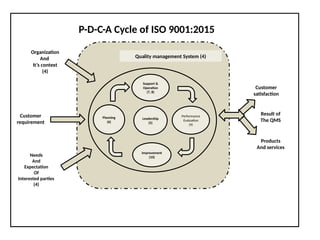
P-D-C-A Cycle of ISO 9001:2015
Support &
Operation
(7, 8)
Planning
(6)
Leadership
(5)
Performance
Evaluation
(9)
Improvement
(10)
Quality management System (4)
Customer
satisfaction
Result of
The QMS
Products
And services
Organization
And
It’s context
(4)
Customer
requirement
Needs
And
Expectation
Of
Interested parties
(4)
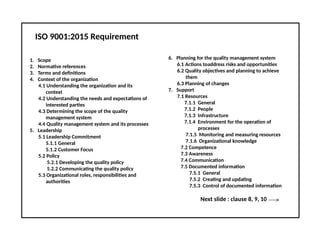
ISO 9001:2015 Requirement
1. Scope
2. Normative references
3. Terms and definitions
4. Context of the organization
4.1 Understanding the organization and its
context
4.2 Understanding the needs and expectations of
interested parties
4.3 Determining the scope of the quality
management system
4.4 Quality management system and its processes
5. Leadership
5.1 Leadership Commitment
5.1.1 General
5.1.2 Customer Focus
5.2 Policy
5.2.1 Developing the quality policy
5.2.2 Communicating the quality policy
5.3 Organizational roles, responsibilities and
authorities
6. Planning for the quality management system
6.1 Actions toaddress risks and opportunities
6.2 Quality objectives and planning to achieve
them
6.3 Planning of changes
7. Support
7.1 Resources
7.1.1 General
7.1.2 People
7.1.3 Infrastructure
7.1.4 Environment for the operation of
processes
7.1.5 Monitoring and measuring resources
7.1.6 Organizational knowledge
7.2 Competence
7.3 Awareness
7.4 Communication
7.5 Documented information
7.5.1 General
7.5.2 Creating and updating
7.5.3 Control of documented information
Next slide : clause 8, 9, 10
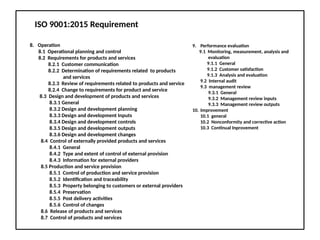
ISO 9001:2015 Requirement
8. Operation
8.1 Operational planning and control
8.2 Requirements for products and services
8.2.1 Customer communication
8.2.2 Determination of requirements related to products
and services
8.2.3 Review of requirements related to products and service
8.2.4 Change to requirements for product and service
8.3 Design and development of products and services
8.3.1 General
8.3.2 Design and development planning
8.3.3 Design and development Inputs
8.3.4 Design and development controls
8.3.5 Design and development outputs
8.3.6 Design and development changes
8.4 Control of externally provided products and services
8.4.1 General
8.4.2 Type and extent of control of external provision
8.4.3 Information for external providers
8.5 Production and service provision
8.5.1 Control of production and service provision
8.5.2 Identification and traceability
8.5.3 Property belonging to customers or external providers
8.5.4 Preservation
8.5.5 Post delivery activities
8.5.6 Control of changes
8.6 Release of products and services
8.7 Control of products and services
9. Performance evaluation
9.1 Monitoring, measurement, analysis and
evaluation
9.1.1 General
9.1.2 Customer satisfaction
9.1.3 Analysis and evaluation
9.2 Internal audit
9.3 management review
9.3.1 General
9.3.2 Management review inputs
9.3.3 Management review outputs
10. Improvement
10.1 general
10.2 Nonconformity and corrective action
10.3 Continual Inprovement
Mobilitat
Und Verkehr
Anlagentechnik
Energie
Und umwelt
Produktiqualitat
Zertifizierung
Von Systemen
Consulting
Mensch
Und Arbeit
International
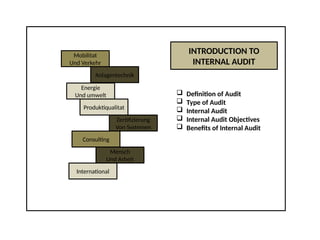
INTRODUCTION TO
INTERNAL AUDIT
 Definition of Audit
 Type of Audit
 Internal Audit
 Internal Audit Objectives
 Benefits of Internal Audit
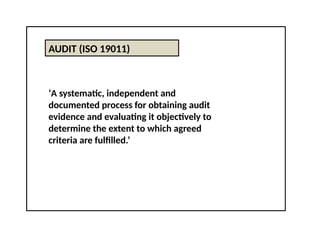
AUDIT (ISO 19011)
‘A systematic, independent and
documented process for obtaining audit
evidence and evaluating it objectively to
determine the extent to which agreed
criteria are fulfilled.’
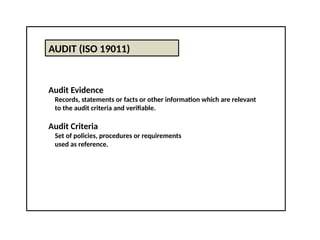
AUDIT (ISO 19011)
Audit Evidence
Records, statements or facts or other information which are relevant
to the audit criteria and verifiable.
Audit Criteria
Set of policies, procedures or requirements
used as reference.
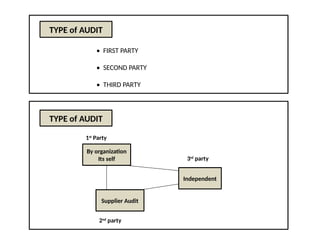
• FIRST PARTY
• SECOND PARTY
• THIRD PARTY
TYPE of AUDIT
TYPE of AUDIT
By organization
Its self
Independent
Supplier Audit
3rd
party
1st
Party
2nd
party
INTERNAL AUDIT
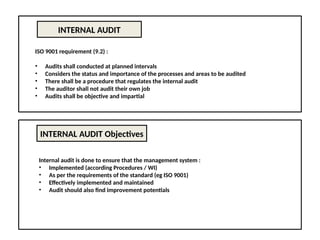
ISO 9001 requirement (9.2) :
• Audits shall conducted at planned intervals
• Considers the status and importance of the processes and areas to be audited
• There shall be a procedure that regulates the internal audit
• The auditor shall not audit their own job
• Audits shall be objective and impartial
INTERNAL AUDIT Objectives
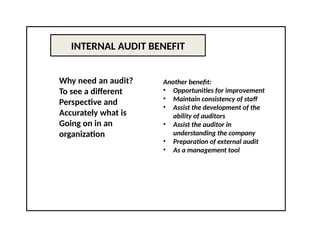
Internal audit is done to ensure that the management system :
• Implemented (according Procedures / WI)
• As per the requirements of the standard (eg ISO 9001)
• Effectively implemented and maintained
• Audit should also find improvement potentials
INTERNAL AUDIT BENEFIT
Why need an audit?
To see a different
Perspective and
Accurately what is
Going on in an
organization
Another benefit:
• Opportunities for improvement
• Maintain consistency of staff
• Assist the development of the
ability of auditors
• Assist the auditor in
understanding the company
• Preparation of external audit
• As a management tool
Mobilitat
Und Verkehr
Anlagentechnik
Energie
Und umwelt
Produktiqualitat
Zertifizierung
Von Systemen
Consulting
Mensch
Und Arbeit
International
AUDIT PRINCIPLES
AND AUDITOR
COMPETENCE
 Audit Standard
 Principle of Auditing
 Auditor competence
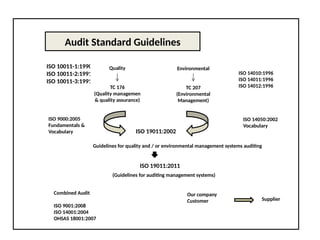
Audit Standard Guidelines
ISO 10011-1:1990
ISO 10011-2:1991
ISO 10011-3:1991
Quality
TC 176
(Quality managemen
& quality assurance)
Environmental
TC 207
(Environmental
Management)
ISO 14010:1996
ISO 14011:1996
ISO 14012:1996
ISO 9000:2005
Fundamentals &
Vocabulary ISO 19011:2002
Guidelines for quality and / or environmental management systems auditing
ISO 19011:2011
(Guidelines for auditing management systems)
Combined Audit
ISO 9001:2008
ISO 14001:2004
OHSAS 18001:2007
Our company
Customer Supplier
ISO 14050:2002
Vocabulary
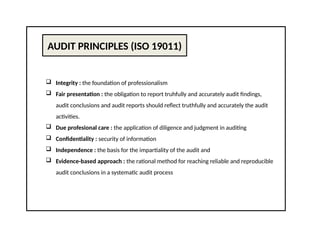
AUDIT PRINCIPLES (ISO 19011)
 Integrity : the foundation of professionalism
 Fair presentation : the obligation to report truhfully and accurately audit findings,
audit conclusions and audit reports should reflect truthfully and accurately the audit
activities.
 Due profesional care : the application of diligence and judgment in auditing
 Confidentiality : security of information
 Independence : the basis for the impartiality of the audit and
 Evidence-based approach : the rational method for reaching reliable and reproducible
audit conclusions in a systematic audit process
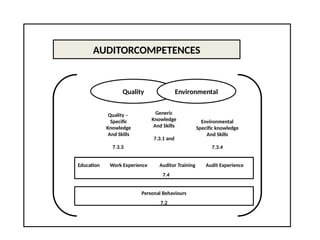
AUDITORCOMPETENCES
Quality Environmental
Quality –
Specific
Knowledge
And Skills
7.3.3
Generic
Knowledge
And Skills
7.3.1 and
Environmental
Specific knowledge
And Skills
7.3.4
Education Work Experience Auditor Training Audit Experience
7.4
Personal Behaviours
7.2
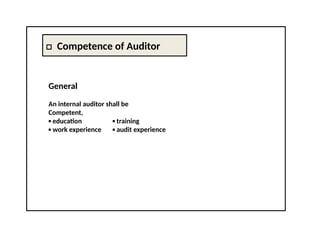
□ Competence of Auditor
General
An internal auditor shall be
Competent,
▪ education ▪ training
▪ work experience ▪ audit experience
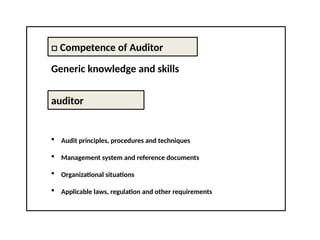
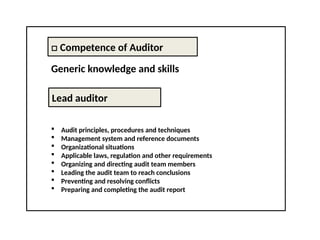
□ Competence of Auditor
Generic knowledge and skills
auditor
 Audit principles, procedures and techniques
 Management system and reference documents
 Organizational situations
 Applicable laws, regulation and other requirements
□ Competence of Auditor
Generic knowledge and skills
Lead auditor
 Audit principles, procedures and techniques
 Management system and reference documents
 Organizational situations
 Applicable laws, regulation and other requirements
 Organizing and directing audit team members
 Leading the audit team to reach conclusions
 Preventing and resolving conflicts
 Preparing and completing the audit report
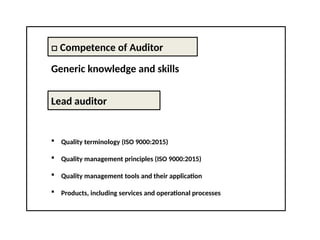
□ Competence of Auditor
Generic knowledge and skills
Lead auditor
 Quality terminology (ISO 9000:2015)
 Quality management principles (ISO 9000:2015)
 Quality management tools and their application
 Products, including services and operational processes
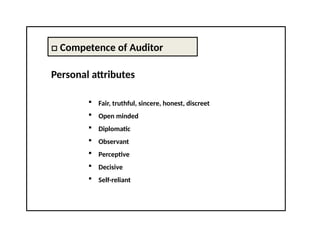
□ Competence of Auditor
Personal attributes
 Fair, truthful, sincere, honest, discreet
 Open minded
 Diplomatic
 Observant
 Perceptive
 Decisive
 Self-reliant
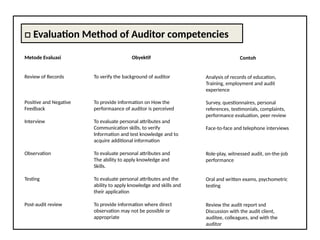
□ Evaluation Method of Auditor competencies
Metode Evaluasi
Review of Records
Positive and Negative
Feedback
Interview
Observation
Testing
Post-audit review
Obyektif
To verify the background of auditor
To provide information on How the
performaance of auditor is perceived
To evaluate personal attributes and
Communication skills, to verify
Information and test knowledge and to
acquire additional information
To evaluate personal attributes and
The ability to apply knowledge and
Skills.
To evaluate personal attributes and the
ability to apply knowledge and skills and
their application
To provide information where direct
observation may not be possible or
appropriate
Contoh
Analysis of records of education,
Training, employment and audit
experience
Survey, questionnaires, personal
references, testimonials, complaints,
performance evaluation, peer review
Face-to-face and telephone interviews
Role-play, witnessed audit, on-the-job
performance
Oral and written exams, psychometric
testing
Review the audit report snd
Discussion with the audit client,
auditee, colleagues, and with the
auditor
□ Competence of Auditor
Be an Ideal Auditor
• More friendly
• Good listener and communicates well
• Showed a strong interest
• More objective and logical
• Positive view of all things
• Always respond in kind
• Easy to get along with every levels of organization
• Always motivate and provide ideas
• Have a high curiosity
• Understanding technology and new things
□ Competence of Auditor
Type of Auditor
 Passive
 Aggressive
 Assertive
 Expression of needs, desires, views
and feelings
 Perfect attitude
 Straight to the issue
 Uphold the rights of others
 Work for the satisfaction of all
□ Competence of Auditor
Auditor should :
 Avoid looking mistake of auditee
 Note the good stuff too
 On time
 Check all processes
 Avoid arguments
 Only audit appropriate requirements agreed
 Respect the confidentiality of company / organization
 Avoid reading Procedure/documents by auditor, ask auditee to explain
 Audit the system rather than individuals
 Record objective evidence.
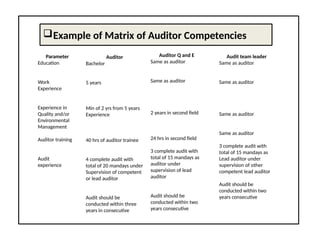
Example of Matrix of Auditor Competencies
Parameter
Education
Work
Experience
Experience in
Quality and/or
Environmental
Management
Auditor training
Audit
experience
Auditor
Bachelor
5 years
Min of 2 yrs from 5 years
Experience
40 hrs of auditor trainee
4 complete audit with
total of 20 mandays under
Supervision of competent
or lead auditor
Audit should be
conducted within three
years in consecutive
Auditor Q and E
Same as auditor
Same as auditor
2 years in second field
24 hrs in second field
3 complete audit with
total of 15 mandays as
auditor under
supervision of lead
auditor
Audit should be
conducted within two
years consecutive
Audit team leader
Same as auditor
Same as auditor
Same as auditor
Same as auditor
3 complete audit with
total of 15 mandays as
Lead auditor under
supervision of other
competent lead auditor
Audit should be
conducted within two
years consecutive
Mobilitat
Und Verkehr
Anlagentechnik
Energie
Und umwelt
Produktiqualitat
Zertifizierung
Von Systemen
Consulting
Mensch
Und Arbeit
International
Managing an audit
programme
 Managing an audit
programme
 Audit Implementation
 Audit Report
Managing the Audit Program
Top management should grant the authority for managing the audit
program :
□ establish, implement, monitor, review and improve the audit
programme,
□ identify the necessary resources and ensure they are
provided
An organization can establish more than one audit program. The audit
program can include audits with a variety of objectives.
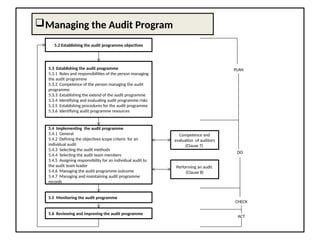
Managing the Audit Program
5.2 Establishing the audit programme objectives
5.3 Establishing the audit programme
5.3.1 Roles and responsibilities of the person managing
the audit programme
5.3.2 Competence of the person managing the audit
programme
5.3.3 Extablishing the extend of the audit programme
5.3.4 Identifying and evaluating audit programme risks
5.3.5 Establishing procedures for the audit programme
5.3.6 Identifying audit programme resources
5.4 Implementing the audit programme
5.4.1 General
5.4.2 Defining the objectives scope criteris for an
individual audit
5.4.3 Selecting the audit methods
5.4.4 Selecting the audit team members
5.4.5 Assigning responsibility for an individual audit to
the audit team leader
5.4.6 Managing the audit programme outcome
5.4.7 Managing and maintaining audit programme
records
5.5 Monitoring the audit programme
5.6 Reviewing and improving the audit programme
Competence and
evaluation of auditors
(Clause 7)
Performing an audit
(Clause 8)
PLAN
DO
CHECK
ACT
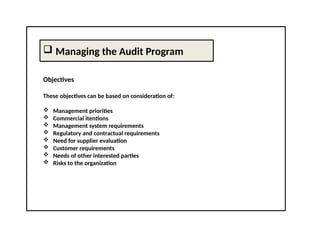
 Managing the Audit Program
Objectives
These objectives can be based on consideration of:
 Management priorities
 Commercial itentions
 Management system requirements
 Regulatory and contractual requirements
 Need for supplier evaluation
 Customer requirements
 Needs of other interested parties
 Risks to the organization
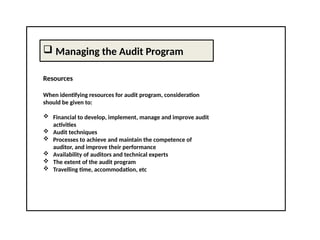
 Managing the Audit Program
Resources
When identifying resources for audit program, consideration
should be given to:
 Financial to develop, implement, manage and improve audit
activities
 Audit techniques
 Processes to achieve and maintain the competence of
auditor, and improve their performance
 Availability of auditors and technical experts
 The extent of the audit program
 Travelling time, accommodation, etc
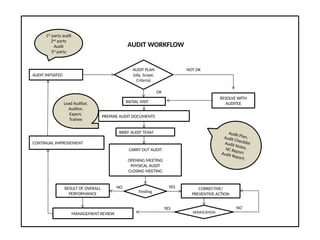
AUDIT INITIATED
AUDIT PLAN
(obj. Scope,
Criteria)
INITIAL VISIT
PREPARE AUDIT DOCUMENTS
BRIEF AUDIT TEAM
CARRY OUT AUDIT
OPENING MEETING
PHYSICAL AUDIT
CLOSING MEETING
RESULT OF OVERALL
PERFORMANCE
CONTINUAL IMPROVEMENT
Finding
CORRECTIVE/
PREVENTIVE ACTION
MANAGEMENT REVIEW VERIFICATION
RESOLVE WITH
AUDITEE
NOT OK
OK
NO YES
YES NO
1ST
party audit
2nd
party
Audit
3rd
party
Lead Auditor,
Auditor,
Expert,
Trainee
Audit Plan,
Audit Checklist
Audit Notes,
NC Report
Audit Report,
AUDIT WORKFLOW
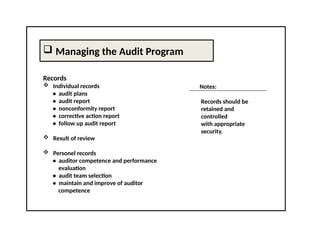
 Managing the Audit Program
Records
 Individual records
• audit plans
• audit report
• nonconformity report
• corrective action report
• follow up audit report
 Result of review
 Personel records
• auditor competence and performance
evaluation
• audit team selection
• maintain and improve of auditor
competence
Notes:
Records should be
retained and
controlled
with appropriate
security.
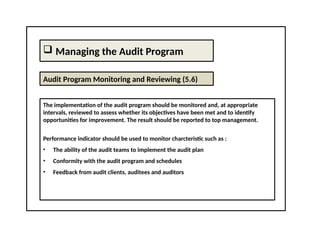
 Managing the Audit Program
Audit Program Monitoring and Reviewing (5.6)
The implementation of the audit program should be monitored and, at appropriate
intervals, reviewed to assess whether its objectives have been met and to identify
opportunities for improvement. The result should be reported to top management.
Performance indicator should be used to monitor charcteristic such as :
• The ability of the audit teams to implement the audit plan
• Conformity with the audit program and schedules
• Feedback from audit clients, auditees and auditors
 Managing the Audit Program
Audit Program Monitoring and Reviewing (5.6)
The audit review should consider, for example:
• Result and trends from monitoring
• Conformity with procedures
• Audit program records
• Alternative or new auditing practices
• Consistency in performance between audit teams in similar situation
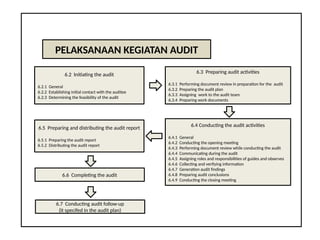
PELAKSANAAN KEGIATAN AUDIT
6.2 Initiating the audit
6.2.1 General
6.2.2 Establishing initial contact with the auditee
6.2.3 Determining the feasibility of the audit
6.5 Preparing and distributing the audit report
6.5.1 Preparing the audit report
6.5.2 Distributing the audit report
6.6 Completing the audit
6.7 Conducting audit follow-up
(it specifed in the audit plan)
6.3 Preparing audit activities
6.3.1 Performing document review in preparation for the audit
6.3.2 Preparing the audit plan
6.3.3 Assigning work to the audit team
6.3.4 Preparing work documents
6.4 Conducting the audit activities
6.4.1 General
6.4.2 Conducting the opening meeting
6.4.3 Performing document review while conducting the audit
6.4.4 Communicating during the audit
6.4.5 Assigning roles and responsibilities of guides and observes
6.4.6 Collecting and verifying information
6.4.7 Generation audit findings
6.4.8 Preparing audit conclusions
6.4.9 Conducting the closing meeting
 Conducting the Audit
Initiating the audit
□ appointing the audit team leader
□ defining audit objectives, scope and criteria
□ determining the feasibility of audit ( audit plan information,
cooperation from auditee, time and resources)
□ establishing the audit team
□ establishing initial contact with the auditee
 Conducting the Audit
Conducting document review
The documentation can include relevant management
System documents and records and previous audit reports.
Relevant documents:
 Env Manual
 Env Procedure
 Work Instruction
 External Documents
 Product Standard
 Conducting the Audit
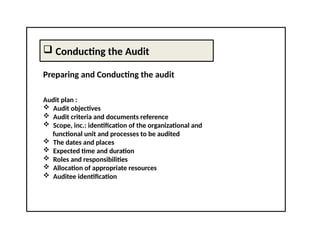
Preparing and Conducting the audit
Audit plan :
 Audit objectives
 Audit criteria and documents reference
 Scope, inc.: identification of the organizational and
functional unit and processes to be audited
 The dates and places
 Expected time and duration
 Roles and responsibilities
 Allocation of appropriate resources
 Auditee identification
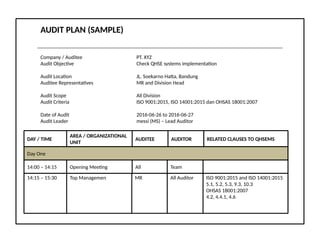
AUDIT PLAN (SAMPLE)
Company / Auditee PT. XYZ
Audit Objective Check QHSE systems implementation
Audit Location JL. Soekarno Hatta, Bandung
Auditee Representatives MR and Division Head
Audit Scope All Division
Audit Criteria ISO 9001:2015, ISO 14001:2015 dan OHSAS 18001:2007
Date of Audit 2016-06-26 to 2016-06-27
Audit Leader messi (MS) – Lead Auditor
DAY / TIME
AREA / ORGANIZATIONAL
UNIT
AUDITEE AUDITOR RELATED CLAUSES TO QHSEMS
Day One
14:00 – 14:15 Opening Meeting All Team
14:15 – 15:30 Top Managemen MR All Auditor ISO 9001:2015 and ISO 14001:2015
5.1, 5.2, 5.3, 9.3, 10.3
OHSAS 18001:2007
4.2, 4.4.1, 4.6
 Conducting the Audit
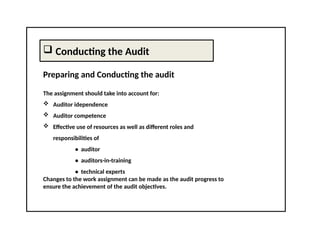
Preparing and Conducting the audit
The assignment should take into account for:
 Auditor idependence
 Auditor competence
 Effective use of resources as well as different roles and
responsibilities of
• auditor
• auditors-in-training
• technical experts
Changes to the work assignment can be made as the audit progress to
ensure the achievement of the audit objectives.
 Conducting the Audit
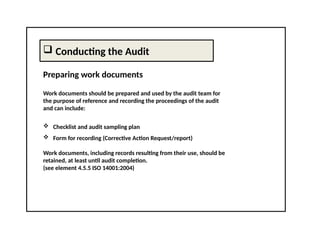
Preparing work documents
Work documents should be prepared and used by the audit team for
the purpose of reference and recording the proceedings of the audit
and can include:
 Checklist and audit sampling plan
 Form for recording (Corrective Action Request/report)
Work documents, including records resulting from their use, should be
retained, at least until audit completion.
(see element 4.5.5 ISO 14001:2004)
 Conducting the Audit
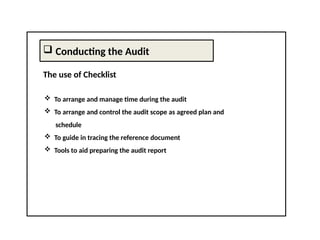
The use of Checklist
 To arrange and manage time during the audit
 To arrange and control the audit scope as agreed plan and
schedule
 To guide in tracing the reference document
 Tools to aid preparing the audit report
 Conducting the Audit
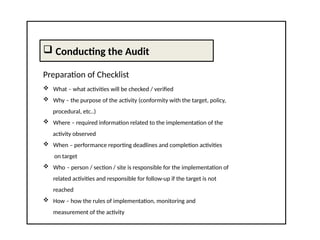
Preparation of Checklist
 What – what activities will be checked / verified
 Why – the purpose of the activity (conformity with the target, policy,
procedural, etc..)
 Where – required information related to the implementation of the
activity observed
 When – performance reporting deadlines and completion activities
on target
 Who – person / section / site is responsible for the implementation of
related activities and responsible for follow-up if the target is not
reached
 How – how the rules of implementation, monitoring and
measurement of the activity
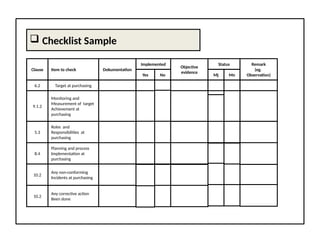
 Checklist Sample
Clause Item to check Dokumentation
Implemented
Yes No
Objective
evidence
Status
Mj Mn
Remark
(eg.
Observation)
6.2 Target at purchasing
9.1.2
Monitoring and
Measurement of target
Achievement at
purchasing
5.3
Roles and
Responsibilities at
purchasing
8.4
Planning and process
Implementation at
purchasing
10.2
10.2
Any non-conforming
Incidents at purchasing
Any corrective action
Been done
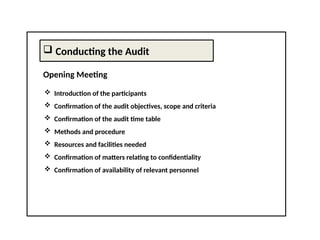
 Conducting the Audit
Opening Meeting
 Introduction of the participants
 Confirmation of the audit objectives, scope and criteria
 Confirmation of the audit time table
 Methods and procedure
 Resources and facilities needed
 Confirmation of matters relating to confidentiality
 Confirmation of availability of relevant personnel
 Conducting the Audit
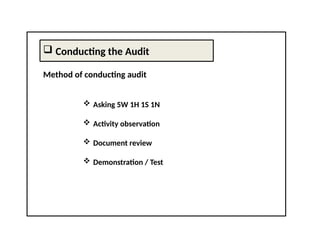
Method of conducting audit
 Asking 5W 1H 1S 1N
 Activity observation
 Document review
 Demonstration / Test
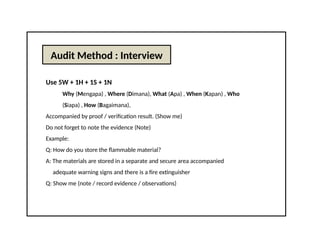
Audit Method : Interview
Use 5W + 1H + 1S + 1N
Why (Mengapa) , Where (Dimana), What (Apa) , When (Kapan) , Who
(Siapa) , How (Bagaimana),
Accompanied by proof / verification result. (Show me)
Do not forget to note the evidence (Note)
Example:
Q: How do you store the flammable material?
A: The materials are stored in a separate and secure area accompanied
adequate warning signs and there is a fire extinguisher
Q: Show me (note / record evidence / observations)
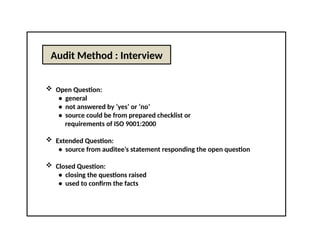
Audit Method : Interview
 Open Question:
• general
• not answered by ‘yes’ or ‘no’
• source could be from prepared checklist or
requirements of ISO 9001:2000
 Extended Question:
• source from auditee’s statement responding the open question
 Closed Question:
• closing the questions raised
• used to confirm the facts
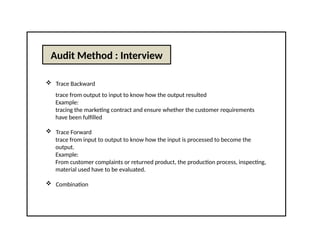
Audit Method : Interview
 Trace Backward
trace from output to input to know how the output resulted
Example:
tracing the marketing contract and ensure whether the customer requirements
have been fulfilled
 Trace Forward
trace from input to output to know how the input is processed to become the
output.
Example:
From customer complaints or returned product, the production process, inspecting,
material used have to be evaluated.
 Combination
Audit Method : Interview
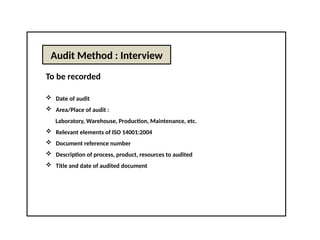
To be recorded
 Date of audit
 Area/Place of audit :
Laboratory, Warehouse, Production, Maintenance, etc.
 Relevant elements of ISO 14001:2004
 Document reference number
 Description of process, product, resources to audited
 Title and date of audited document
Audit Method : Interview
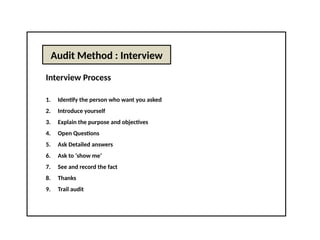
Interview Process
1. Identify the person who want you asked
2. Introduce yourself
3. Explain the purpose and objectives
4. Open Questions
5. Ask Detailed answers
6. Ask to ‘show me’
7. See and record the fact
8. Thanks
9. Trail audit
Audit Method : Interview
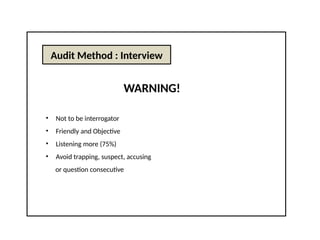
WARNING!
• Not to be interrogator
• Friendly and Objective
• Listening more (75%)
• Avoid trapping, suspect, accusing
or question consecutive
Audit Method : Interview
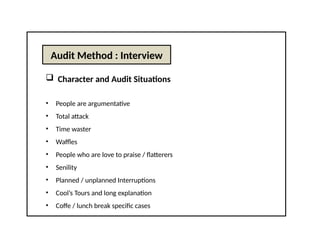
 Character and Audit Situations
• People are argumentative
• Total attack
• Time waster
• Waffles
• People who are love to praise / flatterers
• Senility
• Planned / unplanned Interruptions
• Cool’s Tours and long explanation
• Coffe / lunch break specific cases
Audit Method : Interview
Need to remember
• Speak to the person incharge
• Do not shusing
• Speak with the language of the interview
• Speak clearly
• Do not confuse the auditee, asking questions one by one
• Back to the question that can not be answered
immediately
Audit Method : physical observation
1. Observation of the infrastructure condition (eg. Building, AC, machines,
etc.)
2. Observation of the Environmental work (related to the quality,
environmetal or health and safety
3. Observations in the working process (appropriate requirements / no)
4. Human behavior (especially relating to unsafe action)
Don’t forget to record
Note: at the time of physical observation / field should be
accompanied by awitness (either from guide or auditee) to
strengthen the evidence report
 Conducting the Audit
Audit Findings
Audit findings should be evaluated against to the audit criteria to determine the
audit findings. Audit findings can indicate either conformity or nonconformity
with audit criteria and/or identify an opportunity for improvement.
Audit Findings:
 Observation
 Minor Non-conformity
 Major Non-conformity
 Conducting the Audit
Audit Findings
 not categorized as nonconformity
 Suggestion for improvement
 Based on internal auditor experience and knowledge
Observation
 Conducting the Audit
Audit Findings
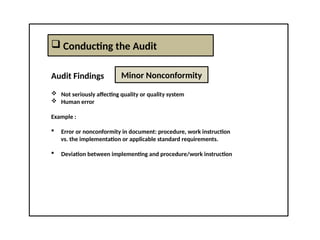
 Not seriously affecting quality or quality system
 Human error
Example :
 Error or nonconformity in document: procedure, work instruction
vs. the implementation or applicable standard requirements.
 Deviation between implementing and procedure/work instruction
Minor Nonconformity
 Conducting the Audit
Audit Findings
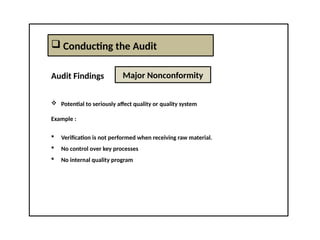
 Potential to seriously affect quality or quality system
Example :
 Verification is not performed when receiving raw material.
 No control over key processes
 No internal quality program
Major Nonconformity
 Reporting the Audit
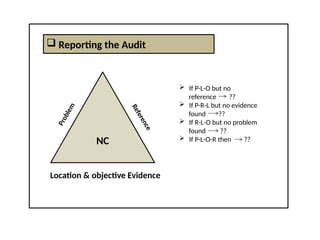
NC
P
r
o
b
l
e
m
R
e
f
e
r
e
n
c
e
Location & objective Evidence
 If P-L-O but no
reference ??
 If P-R-L but no evidence
found ??
 If R-L-O but no problem
found ??
 If P-L-O-R then ??
 Reporting the Audit
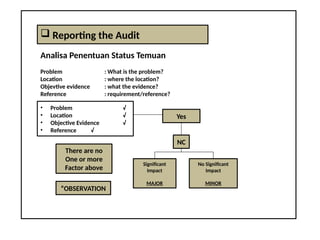
Analisa Penentuan Status Temuan
Problem : What is the problem?
Location : where the location?
Objevtive evidence : what the evidence?
Reference : requirement/reference?
• Problem √
• Location √
• Objective Evidence √
• Reference √
There are no
One or more
Factor above
“OBSERVATION
Yes
NC
Significant
Impact
MAJOR
No Significant
Impact
MINOR
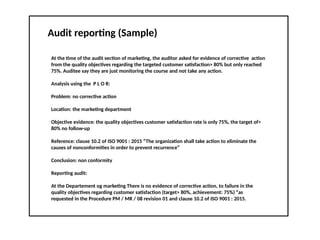
Audit reporting (Sample)
At the time of the audit section of marketing, the auditor asked for evidence of corrective action
from the quality objectives regarding the targeted customer satisfaction> 80% but only reached
75%. Auditee say they are just monitoring the course and not take any action.
Analysis using the P L O R:
Problem: no corrective action
Location: the marketing department
Objective evidence: the quality objectives customer satisfaction rate is only 75%, the target of>
80% no follow-up
Reference: clause 10.2 of ISO 9001 : 2015 “The organization shall take action to eliminate the
causes of nonconformities in order to prevent recurrence”
Conclusion: non conformity
Reporting audit:
At the Departement og marketing There is no evidence of corrective action, to failure in the
quality objectives regarding customer satisfaction (target> 80%, achievement: 75%) “as
requested in the Procedure PM / MR / 08 revision 01 and clause 10.2 of ISO 9001 : 2015.
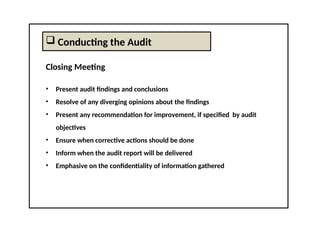
 Conducting the Audit
Closing Meeting
• Present audit findings and conclusions
• Resolve of any diverging opinions about the findings
• Present any recommendation for improvement, if specified by audit
objectives
• Ensure when corrective actions should be done
• Inform when the audit report will be delivered
• Emphasive on the confidentiality of information gathered
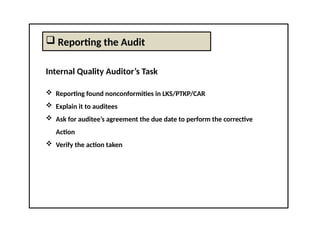
 Reporting the Audit
Internal Quality Auditor’s Task
 Reporting found nonconformities in LKS/PTKP/CAR
 Explain it to auditees
 Ask for auditee’s agreement the due date to perform the corrective
Action
 Verify the action taken
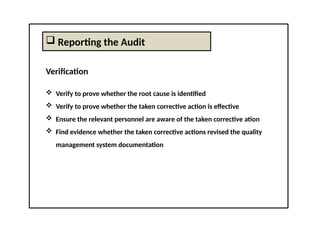
 Reporting the Audit
Verification
 Verify to prove whether the root cause is identified
 Verify to prove whether the taken corrective action is effective
 Ensure the relevant personnel are aware of the taken corrective ation
 Find evidence whether the taken corrective actions revised the quality
management system documentation
Questions & Answers
Thank You

ISO 9001 2015 version Quality Management System

  • 1.
    ISO 9001 :2015* New version 3 Main reason the changes of standard  Process Review from technical committee TC 176 - Aims to ensure conformity of standard with changes and development of the industry - Held a minimum of 5 years  Input from System Users - survey result and questionnaire - Include recommendations given by the user from result of interpretation process  Trend - To adjust with development in management system field
  • 2.
    Objective of ISO9001:2015  To provide a consistent framework for the next 10 years  To be quite generic, but still relevant to all types and sizes of organizations, regardless of their industry or sector  To keep the focus on effective management processes in order to achieve the desired results  To account for major changes in the implementation of QM and technology since the last revision in 2000  To reflect the changes in the working of the increasingly complex and dynamic environment in which the organization operates  To apply a uniform structure, the core text and definitions set out in Annex SL of Directive ISO (High-Level Structure) to ensure compatibility with other ISO management system (eg ISO 14001)  To facilitate the effective implementation within the organization  To use a term more simple terms to ensure a common understanding and consistent interpretation of the requirements
  • 3.
    ISO Standard AnnexSL Annex SL • High-level structure • Identical core text • Common terms and core definitions Annex SL (High-level structure) Introduction 1. Scope 2. Normative references 3. Terms and definitions 4. Context of the organization 5. Leadership 6. Planning 7. Support 8. Operation 9. Performance evaluation 10. Improvement Appendix Bibliography 10 Action 4, 5 6, 7 Plan 9 8 Check Do
  • 4.
    ISO 9001 :2015 Timeline 2013 2014 2015 June 2013 CD (committee Draft) April 2014 DIS (Draft International Standard) July 2015 FDIS (Final Draft International Standard) September 2015 Published International Standard
  • 5.
    ISO 9001 :2015 Transition Timeline 2015 2016 2017 2018 September 2015 Published International Standard September 2015 start of 3 years transition period to September 2018
  • 6.
    Main Changes –ISO 9001 : 2015 a) Changes in terminology b) Organizational context Two new clause relating to the organization 4.1 Understanding the organization and its context and 4.2 Understanding the needs and expectation of interested parties that requested the Organization to determine the issues and requirements that may affect the planning of the Quality management system and can be used as input into the development system quality management ISO 9001:2008 ISO 9001:2015 Products Products and services Exclusions NOT USED Management Representative NOT USED Documentation, quality manual, documented procedures, records Documented information Work environment Environment for the operation processes Monitoring and measuring equipment Monitoring and measuring resources Purchased product Externally provided products and services Supplier External provider
  • 7.
    Main Changes –ISO 9001 : 2015 d) Risk and Preventive Action Clause concerning preventive action (8.5.3) is replaced with risk identification requirements (clauses 4.1 and 6.1) aims to make the concept of prevention in the development and implementation based on the thinking and approach to risk e) Documented information (Information documented) Changing the terms of ducuments and recordings with Documented information f) Control of external provision of products and services Clause 8.4 clearly require organizations controlling the supply of goods and services from outside the company either purchases from jsuppliers, through contrac with corporate partners, through the outsourcing process or by other means. g) Quality Manual: Specifications on the contents of the quality manual still apply, but there are no specific requirements concerning it. (sub-clause 4.4, sub-clause 7.5). h) Management representative : there is no specific requirement for MR
  • 8.
    ISO Requirement ISO 9001: 2008 ISO 9001 : 2008 1. Scope 2. Normative references 3. Terms and definitions 4. Quality Management System 5. Management Responsibility 6. Resource management 7. Product Realization 8. Measurement, Analysis and Improvement 1. Scope 2. Normative references 3. Terms and definitions 4. Context of the organization 5. Leadership 6. Planning 7. Support 8. Operation 9. Performance evaluation 10. Continual improvement Annex A (informative) Clarification of new structure, terminology and concepts Annex B (informative) Other International Standards on quality management and quality management systems developed by ISO/TC 176
  • 9.
    ISO 9001 :2015 1.Scope 2. Normative references 3. Terms and definitions 4. Context of the organization 4.1 Understanding the organizational and its context 4.2 Understanding the needs and expectation of interested parties 4.3 Quality management the scope of the quality management system 4.4 Quality management system and its processes 5. Leadership 5.1 Leadership Commitment 5.1.1 General 5.1.2 Customer Focus 5.2 Policy 5.2.1 Establishing the quality policy 5.2.2 Communicating the quality policy 5.3 Organizational roles, responsibilities and authorities 6 Planning for the quality management system 6.1 Actions to address risks and opportunities 6.2 Quality objectives and planning to achieve them 6.3 Planning of changes 7 Support 7.1 Resources 7.1.1 General 7.1.2 People 7.1.3 Infrastructure 7.1.4 Environment for the operation of processes 7.1.5 Monitoring and measuring resources 7.1.6 Organizational knowledge 7.2 Competence 7.3 Awareness 7.4 Communication 7.5 Documented information 7.5.1 General 7.5.2 Creating and updating 7.5.3 Control of documented information next slide : clause 8,9,10
  • 10.
    ISO 9001 :2015 8Operation 8.1 Operational planning and control 8.2 Requirements for products and services 8.2.1 Customer communication 8.2.2 Determination of requirements for product and services 8.2.3 Review of requirements for products and service 8.2.4 Change to requirements for product and service 8.3 Design and development of products and services 8.3.1 General 8.3.2 Design and development planning 8.3.3 Design and development inputs 8.3.4 Design and development controls 8.3.5 Design and development outputs 8.3.6 Design and development changes 8.4 Control of externally provided products and services 8.4.1 General 8.4.2 Type and extent of control of external provision 8.4.3 Information for external providers 8.5 Production and service provision 8.5.1 Control of production and service provision 8.5.2 Identification and traceability 8.5.3 Property belonging to customers or external providers 8.5.4 Preservation 8.5.5 Post-delivery activities 8.5.6 Control of changes 8.6 release of products and services 8.7 Control of nonconforming process outputs 9. Performance evaluation 9.1 Monitoring, measurement, analysis and evaluation 9.1.1 General 9.1.2 Customer satisfaction 9.1.3 Analysis and evaluation 9.2 Internal audit 9.3 Management review 9.3.1 General 9.3.2 management review inputs 9.3.3 Management review outputs 10. Improvement 10.1 General 10.2 Nonconformity and corrective action 10.3 Continual improvement
  • 11.
    Definition of riskaccording to “ISO 9001” Risk = Effect of uncertainty on an expected result Note 1: An effect is a deviation from the expected situation – positive or negative. Note 2: Uncertainty is the state, even partial, of deficiency of information, related to understanding or knowledge of an event, its consequences or likelihood. Note 3: Risk is often characterised by reference to potential events and consequences, or a combination of these. Note 4: Risk is often expressed in terms of a combination of consequences of an event (including changes in circumstances) and the associated likelihood of occurrence. Note 5: The term “risk” is sometimes used when there is only the possibility of negative consequences.
  • 12.
    Risk based thinking This concept included in the standard ISO 9001:2015  Is essential to achieve an effective quality management system  Risk based thinking is something we all done automatically and often unconsciously  The concept of risk-based thinking has been implied in previous editions, for example in preventive action to eliminate potential nonconformities, analyzing every nonconformities that occures, and take measures to prevent recurrence  In the 2015 version of this concept is made more explicit  To conform to the requirement of this standard, organizations need to plan and implement measures to address the risks and opportunities
  • 13.
    ISO Requirement (ISO9001:2015) ISO 9001:2008 5. Management Responsibility 5.1 Management commitment 5.2 Customer focus 5.3 Quality policy 5.4 Planning 5.5 Authorities, Responsibility and communication 5.6 Management Review ISO 9001:2015 5. Leadership 5.1 Leadership and commitment 5.2 Policy 5.3 Organization roles, responsibilities and authorities Communication 7.4 9001:2015 6. Planning 6.1 Actions to address risks and opportunities 6.2 Quality objectives and planning to achieve them 6.3 Planning of changes Management Review on clause 9.3 9001:2015
  • 14.
    ISO Requirement (ISO9001:2015) ISO 9001:2008 5. Management Responsibility 5.4 Planning ISO 9001:2008 6. Planning 6.1 Actions to address risks and opportunities 6.2 Quality objectives and planning to achieve them 6.3 Planning of changes
  • 15.
    ISO Requirement (ISO9001:2015) ISO 9001:2008 6. Resource Management 6.1 General 6.2 Human Resource 6.3 Infrastructure 6.4 Work Environment ISO 9001:2008 7. Support 7.1 Resource 7.2 Competence 7.3 Awareness 7.4 Communication 7.5 Documented information Klausul 4.2.3 dan 4.2.4 ISO 9001:2008
  • 16.
    ISO Requirement (ISO9001:2015) ISO 9001 : 2015 7. Support 7.1 Resources 7.1.1 General 7.1.2 Infrastructure Klausul 6.3 ISO 9001:2008 7.1.3 Process environment Klausul 6.4 ISO 9001:2008 7.1.4 Monitoring and measuring devices Klausul 7.6 ISO 9001:2008 7.1.5 Knowledge Klausul 6.2.1 and 6.2.2 ISO 9001:2008 7.2 Competence Klausul 6.2.1 and 6.2.2 ISO 9001:2008 7.3 Awareness Klausul 6.2.2 ISO 9001:2008 7.4 Communication Klausul 5.5.3 ISO 9001:2008 7.5 Documented information Klausul 4.2.3 dan 4.2.4 ISO 9001:2008 7.5.1 General 7.5.2 Creating and updating 7.5.3 Control of documented Information
  • 17.
    ISO Requirement (ISO9001:2015) ISO 9001:2008 7. Product Realization 7.1 Planning of product realization 7.2 Customer-related processes 7.3 Design and development 7.4 Purchasing 7.5 Production and service provision 7.6 Control of monitoring and measuring equipment ISO 9001:2008 8. Operation 8.1 Operational planning and control 8.2 Determination of market needs and interaction with customers 8.3 Operational planning 8.4 Control of external provision of goods and services 8.5 Development of goods and services 8.6 Realization of goods and services 8.7 Release of goods or services 8.8 Nonconforming goods and services
  • 18.
    ISO Requirement (ISO9001:2015) 8. Operation 8.1 Operational planning and control Clausal 7.1 ISO 9001:2008 8.2 Determination of market needs and interactions with Customers 8.2.1 General 8.2.2 Determination of requirements related to the goods and services 8.2.3 Review of requirements related to the goods and services 8.2.4 Customer communication Same with Clausal 7.2 ISO 9001:2008
  • 19.
    ISO Requirement (ISO9001:2015) 8.3 Operational planning Clausal 7.1 ISO 9001:2008 8.4 Control of external provision of goods and services 8.4.1 General 8.4.2 Type and extent of control of external provision 8.4.3 Documented information for external providers 8.5 Development of goods and services 8.5.1 Development processes 8.5.2 Development controls 8.5.3 Development transfer Clausal 7.4 ISO 9001:2008 Same with Clausal 7.3 ISO 9001:2008
  • 20.
    ISO Requirement (ISO9001:2015) 8.6 Realization of goods and services 8.6.1 Control of production of goods and provision of services Klausul 7.5.1&2 8.6.2 Identification and traceability Klausul 7.5.3 ISO 9001:2008 8.6.3 Property belonging to customers or external providers Klausul 7.5.4 8.6.4 Preservation of goods or services Klausul 7.5.5 8.6.5 Post delivery activities Persyaratan berkaitan dengan pasca delivery 8.6.6 Control of changes 8.7 Release of goods or service Klausul 8.2.4 ISO 9001:2008 8.8 Nonconforming goods and services Klausul 8.3 ISO 9001:2008
  • 21.
    ISO Requirement ISO 9001:2008 8.Measurement, analysis and improvement 8.1 General 8.2 Monitoring and measurement 8.3 Control of nonconforming product 8.4 Analysis of data 8.5 Improvement ISO 9001:2008 9. Performance 9.1 Monitoring, measurement, analysis and evaluation 9.2 Internal audit 9.3 Management review 10. Improvement 10.1 Nonconformity and corrective action 10.2 Improvement
  • 22.
    ISO Requirement Tambahan Annexmengenai Quality management systems dalam ISO 9001:2008 akan tetapi ada perubah menjadi 7 Prinsip Management System 8 Prinsip Sistem manajemen Pada ISO 9000:2005 7 Prinsip Sistem manajemen Pada ISO 9001:2015 QMP 1 – Customer focus QMP 2 – Leadership QMP 3 – Involvement of people QMP 4 – Process approach QMP 5 – System approach to management QMP 6 – Continual improvement QMP 7 – Factual approach to decision making QMP 8 – Mutually beneficial supplier relationships QMP 1 – Customer focus QMP 2 – Leadership QMP 3 – Engagement of people QMP 4 – Process approach QMP 5 – Improvement QMP 6 – Evidence-based Decision Making QMP 7 – Relationship Management
  • 23.
  • 24.
    Internal Audit TrainingISO 19011 : 2011 Mobilitat Und Verkehr Anlagentechnik Energie Und umwelt Produktiqualitat Zertifizierung Von Systemen Consulting Mensch Und Arbeit International Welcome to Management System Audit Training
  • 25.
    Mobilitat Und Verkehr Anlagentechnik Energie Und umwelt Produktiqualitat Zertifizierung VonSystemen Consulting Mensch Und Arbeit International Requirement Review
  • 26.
    ISO Standard AnnexSL Annex SL • High-level structure • Identical core text • Common terms and core definitions Annex SL (High-level structure) Introduction 1. Scope 2. Normative references 3. Terms and definitions 4. Context of the organization 5. Leadership 6. Planning 7. Support 8. Operation 9. Performance evaluation 10. Improvement 10 Action 4, 5 6 Plan 9 7, 8 Do Check
  • 27.
    ISO 9001:2015 andISO 14001:2015 Certification Transition Timeline 2015 2016 2017 2018 September 2015 Published International Standard Plan : September 2015 start of 3 years transition period to September 2018
  • 28.
    P-D-C-A Cycle ofISO 9001:2015 Support & Operation (7, 8) Planning (6) Leadership (5) Performance Evaluation (9) Improvement (10) Quality management System (4) Customer satisfaction Result of The QMS Products And services Organization And It’s context (4) Customer requirement Needs And Expectation Of Interested parties (4)
  • 29.
    ISO 9001:2015 Requirement 1.Scope 2. Normative references 3. Terms and definitions 4. Context of the organization 4.1 Understanding the organization and its context 4.2 Understanding the needs and expectations of interested parties 4.3 Determining the scope of the quality management system 4.4 Quality management system and its processes 5. Leadership 5.1 Leadership Commitment 5.1.1 General 5.1.2 Customer Focus 5.2 Policy 5.2.1 Developing the quality policy 5.2.2 Communicating the quality policy 5.3 Organizational roles, responsibilities and authorities 6. Planning for the quality management system 6.1 Actions toaddress risks and opportunities 6.2 Quality objectives and planning to achieve them 6.3 Planning of changes 7. Support 7.1 Resources 7.1.1 General 7.1.2 People 7.1.3 Infrastructure 7.1.4 Environment for the operation of processes 7.1.5 Monitoring and measuring resources 7.1.6 Organizational knowledge 7.2 Competence 7.3 Awareness 7.4 Communication 7.5 Documented information 7.5.1 General 7.5.2 Creating and updating 7.5.3 Control of documented information Next slide : clause 8, 9, 10
  • 30.
    ISO 9001:2015 Requirement 8.Operation 8.1 Operational planning and control 8.2 Requirements for products and services 8.2.1 Customer communication 8.2.2 Determination of requirements related to products and services 8.2.3 Review of requirements related to products and service 8.2.4 Change to requirements for product and service 8.3 Design and development of products and services 8.3.1 General 8.3.2 Design and development planning 8.3.3 Design and development Inputs 8.3.4 Design and development controls 8.3.5 Design and development outputs 8.3.6 Design and development changes 8.4 Control of externally provided products and services 8.4.1 General 8.4.2 Type and extent of control of external provision 8.4.3 Information for external providers 8.5 Production and service provision 8.5.1 Control of production and service provision 8.5.2 Identification and traceability 8.5.3 Property belonging to customers or external providers 8.5.4 Preservation 8.5.5 Post delivery activities 8.5.6 Control of changes 8.6 Release of products and services 8.7 Control of products and services 9. Performance evaluation 9.1 Monitoring, measurement, analysis and evaluation 9.1.1 General 9.1.2 Customer satisfaction 9.1.3 Analysis and evaluation 9.2 Internal audit 9.3 management review 9.3.1 General 9.3.2 Management review inputs 9.3.3 Management review outputs 10. Improvement 10.1 general 10.2 Nonconformity and corrective action 10.3 Continual Inprovement
  • 31.
    Mobilitat Und Verkehr Anlagentechnik Energie Und umwelt Produktiqualitat Zertifizierung VonSystemen Consulting Mensch Und Arbeit International INTRODUCTION TO INTERNAL AUDIT  Definition of Audit  Type of Audit  Internal Audit  Internal Audit Objectives  Benefits of Internal Audit
  • 32.
    AUDIT (ISO 19011) ‘Asystematic, independent and documented process for obtaining audit evidence and evaluating it objectively to determine the extent to which agreed criteria are fulfilled.’
  • 33.
    AUDIT (ISO 19011) AuditEvidence Records, statements or facts or other information which are relevant to the audit criteria and verifiable. Audit Criteria Set of policies, procedures or requirements used as reference.
  • 34.
    • FIRST PARTY •SECOND PARTY • THIRD PARTY TYPE of AUDIT TYPE of AUDIT By organization Its self Independent Supplier Audit 3rd party 1st Party 2nd party
  • 35.
    INTERNAL AUDIT ISO 9001requirement (9.2) : • Audits shall conducted at planned intervals • Considers the status and importance of the processes and areas to be audited • There shall be a procedure that regulates the internal audit • The auditor shall not audit their own job • Audits shall be objective and impartial INTERNAL AUDIT Objectives Internal audit is done to ensure that the management system : • Implemented (according Procedures / WI) • As per the requirements of the standard (eg ISO 9001) • Effectively implemented and maintained • Audit should also find improvement potentials
  • 36.
    INTERNAL AUDIT BENEFIT Whyneed an audit? To see a different Perspective and Accurately what is Going on in an organization Another benefit: • Opportunities for improvement • Maintain consistency of staff • Assist the development of the ability of auditors • Assist the auditor in understanding the company • Preparation of external audit • As a management tool
  • 37.
    Mobilitat Und Verkehr Anlagentechnik Energie Und umwelt Produktiqualitat Zertifizierung VonSystemen Consulting Mensch Und Arbeit International AUDIT PRINCIPLES AND AUDITOR COMPETENCE  Audit Standard  Principle of Auditing  Auditor competence
  • 38.
    Audit Standard Guidelines ISO10011-1:1990 ISO 10011-2:1991 ISO 10011-3:1991 Quality TC 176 (Quality managemen & quality assurance) Environmental TC 207 (Environmental Management) ISO 14010:1996 ISO 14011:1996 ISO 14012:1996 ISO 9000:2005 Fundamentals & Vocabulary ISO 19011:2002 Guidelines for quality and / or environmental management systems auditing ISO 19011:2011 (Guidelines for auditing management systems) Combined Audit ISO 9001:2008 ISO 14001:2004 OHSAS 18001:2007 Our company Customer Supplier ISO 14050:2002 Vocabulary
  • 39.
    AUDIT PRINCIPLES (ISO19011)  Integrity : the foundation of professionalism  Fair presentation : the obligation to report truhfully and accurately audit findings, audit conclusions and audit reports should reflect truthfully and accurately the audit activities.  Due profesional care : the application of diligence and judgment in auditing  Confidentiality : security of information  Independence : the basis for the impartiality of the audit and  Evidence-based approach : the rational method for reaching reliable and reproducible audit conclusions in a systematic audit process
  • 40.
    AUDITORCOMPETENCES Quality Environmental Quality – Specific Knowledge AndSkills 7.3.3 Generic Knowledge And Skills 7.3.1 and Environmental Specific knowledge And Skills 7.3.4 Education Work Experience Auditor Training Audit Experience 7.4 Personal Behaviours 7.2
  • 41.
    □ Competence ofAuditor General An internal auditor shall be Competent, ▪ education ▪ training ▪ work experience ▪ audit experience
  • 42.
    □ Competence ofAuditor Generic knowledge and skills auditor  Audit principles, procedures and techniques  Management system and reference documents  Organizational situations  Applicable laws, regulation and other requirements
  • 43.
    □ Competence ofAuditor Generic knowledge and skills Lead auditor  Audit principles, procedures and techniques  Management system and reference documents  Organizational situations  Applicable laws, regulation and other requirements  Organizing and directing audit team members  Leading the audit team to reach conclusions  Preventing and resolving conflicts  Preparing and completing the audit report
  • 44.
    □ Competence ofAuditor Generic knowledge and skills Lead auditor  Quality terminology (ISO 9000:2015)  Quality management principles (ISO 9000:2015)  Quality management tools and their application  Products, including services and operational processes
  • 45.
    □ Competence ofAuditor Personal attributes  Fair, truthful, sincere, honest, discreet  Open minded  Diplomatic  Observant  Perceptive  Decisive  Self-reliant
  • 46.
    □ Evaluation Methodof Auditor competencies Metode Evaluasi Review of Records Positive and Negative Feedback Interview Observation Testing Post-audit review Obyektif To verify the background of auditor To provide information on How the performaance of auditor is perceived To evaluate personal attributes and Communication skills, to verify Information and test knowledge and to acquire additional information To evaluate personal attributes and The ability to apply knowledge and Skills. To evaluate personal attributes and the ability to apply knowledge and skills and their application To provide information where direct observation may not be possible or appropriate Contoh Analysis of records of education, Training, employment and audit experience Survey, questionnaires, personal references, testimonials, complaints, performance evaluation, peer review Face-to-face and telephone interviews Role-play, witnessed audit, on-the-job performance Oral and written exams, psychometric testing Review the audit report snd Discussion with the audit client, auditee, colleagues, and with the auditor
  • 47.
    □ Competence ofAuditor Be an Ideal Auditor • More friendly • Good listener and communicates well • Showed a strong interest • More objective and logical • Positive view of all things • Always respond in kind • Easy to get along with every levels of organization • Always motivate and provide ideas • Have a high curiosity • Understanding technology and new things
  • 48.
    □ Competence ofAuditor Type of Auditor  Passive  Aggressive  Assertive  Expression of needs, desires, views and feelings  Perfect attitude  Straight to the issue  Uphold the rights of others  Work for the satisfaction of all
  • 49.
    □ Competence ofAuditor Auditor should :  Avoid looking mistake of auditee  Note the good stuff too  On time  Check all processes  Avoid arguments  Only audit appropriate requirements agreed  Respect the confidentiality of company / organization  Avoid reading Procedure/documents by auditor, ask auditee to explain  Audit the system rather than individuals  Record objective evidence.
  • 50.
    Example of Matrixof Auditor Competencies Parameter Education Work Experience Experience in Quality and/or Environmental Management Auditor training Audit experience Auditor Bachelor 5 years Min of 2 yrs from 5 years Experience 40 hrs of auditor trainee 4 complete audit with total of 20 mandays under Supervision of competent or lead auditor Audit should be conducted within three years in consecutive Auditor Q and E Same as auditor Same as auditor 2 years in second field 24 hrs in second field 3 complete audit with total of 15 mandays as auditor under supervision of lead auditor Audit should be conducted within two years consecutive Audit team leader Same as auditor Same as auditor Same as auditor Same as auditor 3 complete audit with total of 15 mandays as Lead auditor under supervision of other competent lead auditor Audit should be conducted within two years consecutive
  • 51.
    Mobilitat Und Verkehr Anlagentechnik Energie Und umwelt Produktiqualitat Zertifizierung VonSystemen Consulting Mensch Und Arbeit International Managing an audit programme  Managing an audit programme  Audit Implementation  Audit Report
  • 52.
    Managing the AuditProgram Top management should grant the authority for managing the audit program : □ establish, implement, monitor, review and improve the audit programme, □ identify the necessary resources and ensure they are provided An organization can establish more than one audit program. The audit program can include audits with a variety of objectives.
  • 53.
    Managing the AuditProgram 5.2 Establishing the audit programme objectives 5.3 Establishing the audit programme 5.3.1 Roles and responsibilities of the person managing the audit programme 5.3.2 Competence of the person managing the audit programme 5.3.3 Extablishing the extend of the audit programme 5.3.4 Identifying and evaluating audit programme risks 5.3.5 Establishing procedures for the audit programme 5.3.6 Identifying audit programme resources 5.4 Implementing the audit programme 5.4.1 General 5.4.2 Defining the objectives scope criteris for an individual audit 5.4.3 Selecting the audit methods 5.4.4 Selecting the audit team members 5.4.5 Assigning responsibility for an individual audit to the audit team leader 5.4.6 Managing the audit programme outcome 5.4.7 Managing and maintaining audit programme records 5.5 Monitoring the audit programme 5.6 Reviewing and improving the audit programme Competence and evaluation of auditors (Clause 7) Performing an audit (Clause 8) PLAN DO CHECK ACT
  • 54.
     Managing theAudit Program Objectives These objectives can be based on consideration of:  Management priorities  Commercial itentions  Management system requirements  Regulatory and contractual requirements  Need for supplier evaluation  Customer requirements  Needs of other interested parties  Risks to the organization
  • 55.
     Managing theAudit Program Resources When identifying resources for audit program, consideration should be given to:  Financial to develop, implement, manage and improve audit activities  Audit techniques  Processes to achieve and maintain the competence of auditor, and improve their performance  Availability of auditors and technical experts  The extent of the audit program  Travelling time, accommodation, etc
  • 56.
    AUDIT INITIATED AUDIT PLAN (obj.Scope, Criteria) INITIAL VISIT PREPARE AUDIT DOCUMENTS BRIEF AUDIT TEAM CARRY OUT AUDIT OPENING MEETING PHYSICAL AUDIT CLOSING MEETING RESULT OF OVERALL PERFORMANCE CONTINUAL IMPROVEMENT Finding CORRECTIVE/ PREVENTIVE ACTION MANAGEMENT REVIEW VERIFICATION RESOLVE WITH AUDITEE NOT OK OK NO YES YES NO 1ST party audit 2nd party Audit 3rd party Lead Auditor, Auditor, Expert, Trainee Audit Plan, Audit Checklist Audit Notes, NC Report Audit Report, AUDIT WORKFLOW
  • 57.
     Managing theAudit Program Records  Individual records • audit plans • audit report • nonconformity report • corrective action report • follow up audit report  Result of review  Personel records • auditor competence and performance evaluation • audit team selection • maintain and improve of auditor competence Notes: Records should be retained and controlled with appropriate security.
  • 58.
     Managing theAudit Program Audit Program Monitoring and Reviewing (5.6) The implementation of the audit program should be monitored and, at appropriate intervals, reviewed to assess whether its objectives have been met and to identify opportunities for improvement. The result should be reported to top management. Performance indicator should be used to monitor charcteristic such as : • The ability of the audit teams to implement the audit plan • Conformity with the audit program and schedules • Feedback from audit clients, auditees and auditors
  • 59.
     Managing theAudit Program Audit Program Monitoring and Reviewing (5.6) The audit review should consider, for example: • Result and trends from monitoring • Conformity with procedures • Audit program records • Alternative or new auditing practices • Consistency in performance between audit teams in similar situation
  • 60.
    PELAKSANAAN KEGIATAN AUDIT 6.2Initiating the audit 6.2.1 General 6.2.2 Establishing initial contact with the auditee 6.2.3 Determining the feasibility of the audit 6.5 Preparing and distributing the audit report 6.5.1 Preparing the audit report 6.5.2 Distributing the audit report 6.6 Completing the audit 6.7 Conducting audit follow-up (it specifed in the audit plan) 6.3 Preparing audit activities 6.3.1 Performing document review in preparation for the audit 6.3.2 Preparing the audit plan 6.3.3 Assigning work to the audit team 6.3.4 Preparing work documents 6.4 Conducting the audit activities 6.4.1 General 6.4.2 Conducting the opening meeting 6.4.3 Performing document review while conducting the audit 6.4.4 Communicating during the audit 6.4.5 Assigning roles and responsibilities of guides and observes 6.4.6 Collecting and verifying information 6.4.7 Generation audit findings 6.4.8 Preparing audit conclusions 6.4.9 Conducting the closing meeting
  • 61.
     Conducting theAudit Initiating the audit □ appointing the audit team leader □ defining audit objectives, scope and criteria □ determining the feasibility of audit ( audit plan information, cooperation from auditee, time and resources) □ establishing the audit team □ establishing initial contact with the auditee
  • 62.
     Conducting theAudit Conducting document review The documentation can include relevant management System documents and records and previous audit reports. Relevant documents:  Env Manual  Env Procedure  Work Instruction  External Documents  Product Standard
  • 63.
     Conducting theAudit Preparing and Conducting the audit Audit plan :  Audit objectives  Audit criteria and documents reference  Scope, inc.: identification of the organizational and functional unit and processes to be audited  The dates and places  Expected time and duration  Roles and responsibilities  Allocation of appropriate resources  Auditee identification
  • 64.
    AUDIT PLAN (SAMPLE) Company/ Auditee PT. XYZ Audit Objective Check QHSE systems implementation Audit Location JL. Soekarno Hatta, Bandung Auditee Representatives MR and Division Head Audit Scope All Division Audit Criteria ISO 9001:2015, ISO 14001:2015 dan OHSAS 18001:2007 Date of Audit 2016-06-26 to 2016-06-27 Audit Leader messi (MS) – Lead Auditor DAY / TIME AREA / ORGANIZATIONAL UNIT AUDITEE AUDITOR RELATED CLAUSES TO QHSEMS Day One 14:00 – 14:15 Opening Meeting All Team 14:15 – 15:30 Top Managemen MR All Auditor ISO 9001:2015 and ISO 14001:2015 5.1, 5.2, 5.3, 9.3, 10.3 OHSAS 18001:2007 4.2, 4.4.1, 4.6
  • 65.
     Conducting theAudit Preparing and Conducting the audit The assignment should take into account for:  Auditor idependence  Auditor competence  Effective use of resources as well as different roles and responsibilities of • auditor • auditors-in-training • technical experts Changes to the work assignment can be made as the audit progress to ensure the achievement of the audit objectives.
  • 66.
     Conducting theAudit Preparing work documents Work documents should be prepared and used by the audit team for the purpose of reference and recording the proceedings of the audit and can include:  Checklist and audit sampling plan  Form for recording (Corrective Action Request/report) Work documents, including records resulting from their use, should be retained, at least until audit completion. (see element 4.5.5 ISO 14001:2004)
  • 67.
     Conducting theAudit The use of Checklist  To arrange and manage time during the audit  To arrange and control the audit scope as agreed plan and schedule  To guide in tracing the reference document  Tools to aid preparing the audit report
  • 68.
     Conducting theAudit Preparation of Checklist  What – what activities will be checked / verified  Why – the purpose of the activity (conformity with the target, policy, procedural, etc..)  Where – required information related to the implementation of the activity observed  When – performance reporting deadlines and completion activities on target  Who – person / section / site is responsible for the implementation of related activities and responsible for follow-up if the target is not reached  How – how the rules of implementation, monitoring and measurement of the activity
  • 69.
     Checklist Sample ClauseItem to check Dokumentation Implemented Yes No Objective evidence Status Mj Mn Remark (eg. Observation) 6.2 Target at purchasing 9.1.2 Monitoring and Measurement of target Achievement at purchasing 5.3 Roles and Responsibilities at purchasing 8.4 Planning and process Implementation at purchasing 10.2 10.2 Any non-conforming Incidents at purchasing Any corrective action Been done
  • 70.
     Conducting theAudit Opening Meeting  Introduction of the participants  Confirmation of the audit objectives, scope and criteria  Confirmation of the audit time table  Methods and procedure  Resources and facilities needed  Confirmation of matters relating to confidentiality  Confirmation of availability of relevant personnel
  • 71.
     Conducting theAudit Method of conducting audit  Asking 5W 1H 1S 1N  Activity observation  Document review  Demonstration / Test
  • 72.
    Audit Method :Interview Use 5W + 1H + 1S + 1N Why (Mengapa) , Where (Dimana), What (Apa) , When (Kapan) , Who (Siapa) , How (Bagaimana), Accompanied by proof / verification result. (Show me) Do not forget to note the evidence (Note) Example: Q: How do you store the flammable material? A: The materials are stored in a separate and secure area accompanied adequate warning signs and there is a fire extinguisher Q: Show me (note / record evidence / observations)
  • 73.
    Audit Method :Interview  Open Question: • general • not answered by ‘yes’ or ‘no’ • source could be from prepared checklist or requirements of ISO 9001:2000  Extended Question: • source from auditee’s statement responding the open question  Closed Question: • closing the questions raised • used to confirm the facts
  • 74.
    Audit Method :Interview  Trace Backward trace from output to input to know how the output resulted Example: tracing the marketing contract and ensure whether the customer requirements have been fulfilled  Trace Forward trace from input to output to know how the input is processed to become the output. Example: From customer complaints or returned product, the production process, inspecting, material used have to be evaluated.  Combination
  • 75.
    Audit Method :Interview To be recorded  Date of audit  Area/Place of audit : Laboratory, Warehouse, Production, Maintenance, etc.  Relevant elements of ISO 14001:2004  Document reference number  Description of process, product, resources to audited  Title and date of audited document
  • 76.
    Audit Method :Interview Interview Process 1. Identify the person who want you asked 2. Introduce yourself 3. Explain the purpose and objectives 4. Open Questions 5. Ask Detailed answers 6. Ask to ‘show me’ 7. See and record the fact 8. Thanks 9. Trail audit
  • 77.
    Audit Method :Interview WARNING! • Not to be interrogator • Friendly and Objective • Listening more (75%) • Avoid trapping, suspect, accusing or question consecutive
  • 78.
    Audit Method :Interview  Character and Audit Situations • People are argumentative • Total attack • Time waster • Waffles • People who are love to praise / flatterers • Senility • Planned / unplanned Interruptions • Cool’s Tours and long explanation • Coffe / lunch break specific cases
  • 79.
    Audit Method :Interview Need to remember • Speak to the person incharge • Do not shusing • Speak with the language of the interview • Speak clearly • Do not confuse the auditee, asking questions one by one • Back to the question that can not be answered immediately
  • 80.
    Audit Method :physical observation 1. Observation of the infrastructure condition (eg. Building, AC, machines, etc.) 2. Observation of the Environmental work (related to the quality, environmetal or health and safety 3. Observations in the working process (appropriate requirements / no) 4. Human behavior (especially relating to unsafe action) Don’t forget to record Note: at the time of physical observation / field should be accompanied by awitness (either from guide or auditee) to strengthen the evidence report
  • 81.
     Conducting theAudit Audit Findings Audit findings should be evaluated against to the audit criteria to determine the audit findings. Audit findings can indicate either conformity or nonconformity with audit criteria and/or identify an opportunity for improvement. Audit Findings:  Observation  Minor Non-conformity  Major Non-conformity
  • 82.
     Conducting theAudit Audit Findings  not categorized as nonconformity  Suggestion for improvement  Based on internal auditor experience and knowledge Observation
  • 83.
     Conducting theAudit Audit Findings  Not seriously affecting quality or quality system  Human error Example :  Error or nonconformity in document: procedure, work instruction vs. the implementation or applicable standard requirements.  Deviation between implementing and procedure/work instruction Minor Nonconformity
  • 84.
     Conducting theAudit Audit Findings  Potential to seriously affect quality or quality system Example :  Verification is not performed when receiving raw material.  No control over key processes  No internal quality program Major Nonconformity
  • 85.
     Reporting theAudit NC P r o b l e m R e f e r e n c e Location & objective Evidence  If P-L-O but no reference ??  If P-R-L but no evidence found ??  If R-L-O but no problem found ??  If P-L-O-R then ??
  • 86.
     Reporting theAudit Analisa Penentuan Status Temuan Problem : What is the problem? Location : where the location? Objevtive evidence : what the evidence? Reference : requirement/reference? • Problem √ • Location √ • Objective Evidence √ • Reference √ There are no One or more Factor above “OBSERVATION Yes NC Significant Impact MAJOR No Significant Impact MINOR
  • 87.
    Audit reporting (Sample) Atthe time of the audit section of marketing, the auditor asked for evidence of corrective action from the quality objectives regarding the targeted customer satisfaction> 80% but only reached 75%. Auditee say they are just monitoring the course and not take any action. Analysis using the P L O R: Problem: no corrective action Location: the marketing department Objective evidence: the quality objectives customer satisfaction rate is only 75%, the target of> 80% no follow-up Reference: clause 10.2 of ISO 9001 : 2015 “The organization shall take action to eliminate the causes of nonconformities in order to prevent recurrence” Conclusion: non conformity Reporting audit: At the Departement og marketing There is no evidence of corrective action, to failure in the quality objectives regarding customer satisfaction (target> 80%, achievement: 75%) “as requested in the Procedure PM / MR / 08 revision 01 and clause 10.2 of ISO 9001 : 2015.
  • 88.
     Conducting theAudit Closing Meeting • Present audit findings and conclusions • Resolve of any diverging opinions about the findings • Present any recommendation for improvement, if specified by audit objectives • Ensure when corrective actions should be done • Inform when the audit report will be delivered • Emphasive on the confidentiality of information gathered
  • 89.
     Reporting theAudit Internal Quality Auditor’s Task  Reporting found nonconformities in LKS/PTKP/CAR  Explain it to auditees  Ask for auditee’s agreement the due date to perform the corrective Action  Verify the action taken
  • 90.
     Reporting theAudit Verification  Verify to prove whether the root cause is identified  Verify to prove whether the taken corrective action is effective  Ensure the relevant personnel are aware of the taken corrective ation  Find evidence whether the taken corrective actions revised the quality management system documentation
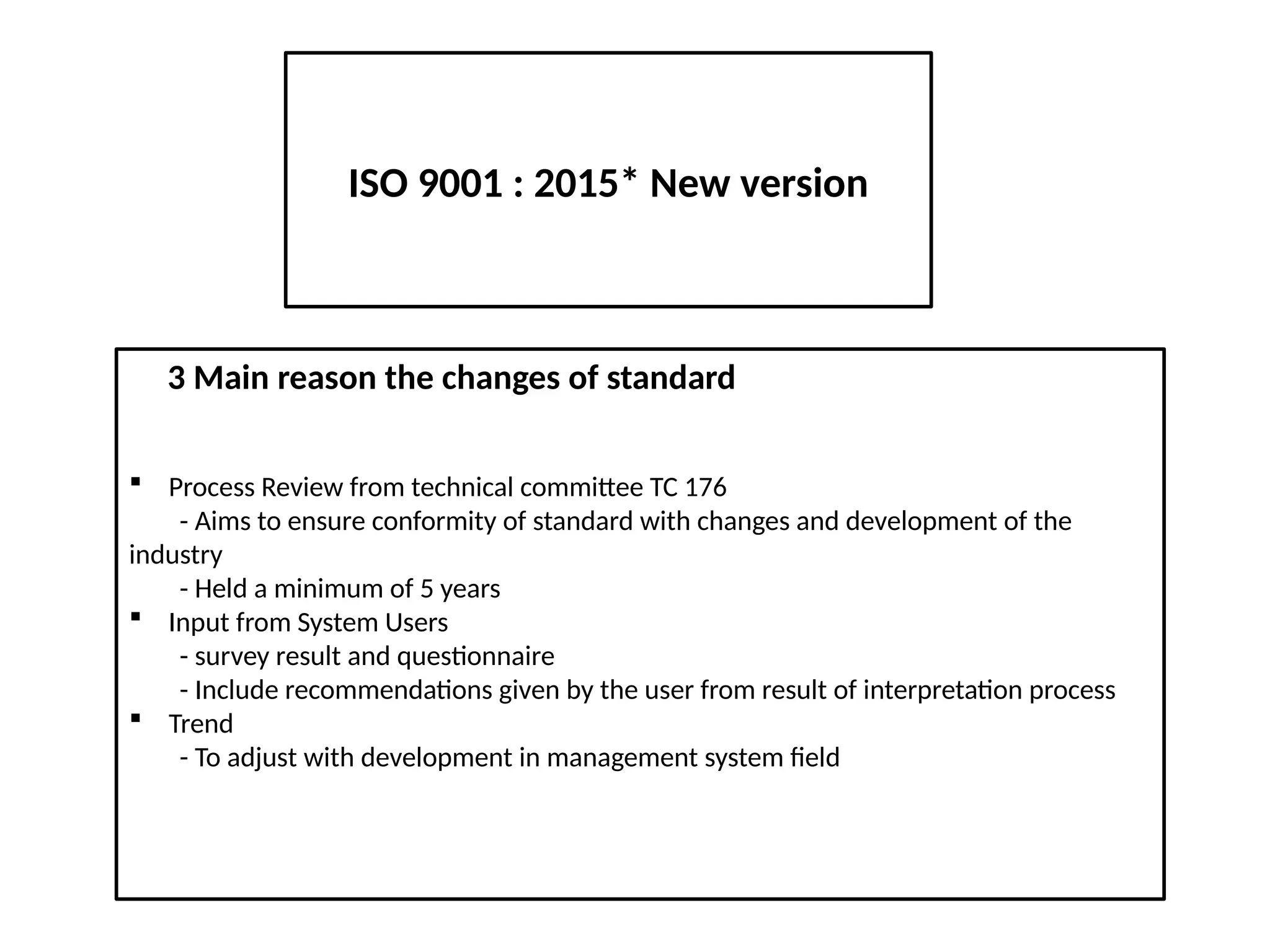
  • 91.