©2015
akshayanand
AND
MOBILEAPPS
FDA
MEDICAL
REGULATORY
APPROACH
AKSHAY ANAND M
I Year – Master of Pharmacy
Pharmaceutical Regulatory Affairs
JSS College Of Pharmacy
Mysuru 570015, Karnataka
MOBILE MEDICAL APP
• A mobile app is a computer program designed to run on smartphones, tablet
computers and other mobile devices.
• Apps are usually available through application distribution platform, which began
appearing in 2008 and are typically operated by the owner of the mobile operating
system, such as the Apple App Store, Google Play, Windows Phone Store, and
BlackBerry AppWorld.
• The terms medical software and medical device software are undefined terms that
can designate any software, software item or system used within a medical
context (e.g. medical devices that monitor or control patients are predominantly
controlled by software), depending on its intended use / indication for use.
• Mobile Medical Apps are the medical software applications developed as Apps on
multiple platforms as stated above.
1
ASPECTS
• Mobile App Statistics
• FDA Guidance on Mobile Medical Devices
• When is an App called a Device?
• FDA Criteria for Mobile Medical Apps
• FDA Categories of Mobile Medical Apps
• Medical Device Data System (MDDS)
• FDA Regulatory Process for Mobile Medical Apps
OF THIS PRESENTATION
2
App Stats
3 CLICK!
FDA Guidance
on Mobile Medical Devices
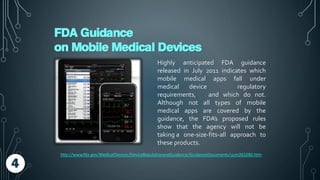
Highly anticipated FDA guidance
released in July 2011 indicates which
mobile medical apps fall under
medical device regulatory
requirements, and which do not.
Although not all types of mobile
medical apps are covered by the
guidance, the FDA’s proposed rules
show that the agency will not be
taking a one-size-fits-all approach to
these products.
http://www.fda.gov/MedicalDevices/DeviceRegulationandGuidance/GuidanceDocuments/ucm263280.htm
4
AnApp is Likely a Device if it,
But, manufacturers should take into
account several criteria, such as their
apps’ intended uses and how they
interact with other devices, when
determining whether their products
qualify as medical devices.
Amplifies
Analyzes
Attaches
Interprets
Assesses
Alarms
Calculates
Controls
Converts
Cures
Detects
Diagnoses
Manipulates
Measures
Monitors
Programs
Trends
Treats
5
FDA Criteria for Determining if an
App is a Medical Device
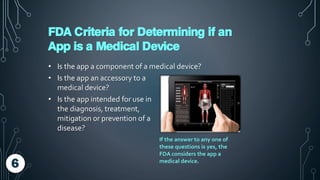
• Is the app a component of a medical device?
• Is the app an accessory to a
medical device?
• Is the app intended for use in
the diagnosis, treatment,
mitigation or prevention of a
disease?
6
If the answer to any one of
these questions is yes, the
FDA considers the app a
medical device.
FDA Criteria for Mobile
Medical Apps
Specific criteria for apps as medical devices:
1. Mobile medical apps that serve as extensions of regulated
medical devices and control those devices or display, store,
analyze or transmit patient-specific medical device data
2. Mobile medical apps that transform mobile platforms
into regulated medical devices by using attachments or
similar medical device functions
3. Mobile medical apps that allow users to input patient-
specific data and output patient-specific results or
diagnoses using formulae or processing algorithms
7
FDA Categories of Mobile
Medical Apps
The FDA’s guidance lists the following categories of
mobile medical apps that qualify as medical devices:
• Apps for displaying, storing or transmitting patient-
specific medical device data in its original format
• Apps that control intended use, functions or energy
sources of medical devices to which they connect
• Apps that transform mobile platforms into medical
devices
• Apps that analyze medical device data to create
alarms, recommendations or new information
8
Mobile Medical App Firms NOT
Regulated by the FDA
Firms that distribute mobile medical but do
not actually develop and/or manufacture
those products are not considered mobile
medical app manufacturers.
9
Medical Device Data Systems
The FDA’s Medical Device Data
Systems (MDDS) category of
devices covers products used to
transfer, store, convert or display
medical device data. Devices
falling under the MDDS are
designated as Class I, and are
exempt from FDA premarket
notification requirements in the
US. Some mobile medical apps
also fall under this category.
10
Does Your App Qualify
as MDDS?
Devices that provide one or more of the following functions
without controlling or altering how connected devices operate
qualify as MDDS products:
The scope of MDDS can include mobile medical apps as well as software,
hardware, modems, interfaces and communication protocols.
• Electronic transfer of medical device data
• Electronic storage of medical device data
• Electronic display of medical device data
11
The US FDA Regulatory
Process for Medical Devices
Mobile medical apps fall under the same regulatory requirements
as other medical devices. Whether an app is classified as Class I, II
or III depends on the level of risk it poses to users, as well as
whetherSubstantial Equivalence exists.
12
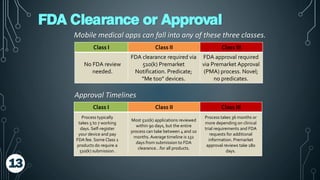
FDA Clearance or Approval
Mobile medical apps can fall into any of these three classes.
Class I Class II Class III
No FDA review
needed.
FDA clearance required via
510(k) Premarket
Notification. Predicate;
“Me too” devices.
FDA approval required
via Premarket Approval
(PMA) process. Novel;
no predicates.
Class I Class II Class III
Process typically
takes 5 to 7 working
days. Self-register
your device and pay
FDA fee. Some Class 1
products do require a
510(k) submission.
Most 510(k) applications reviewed
within 90 days, but the entire
process can take between 4 and 10
months.Average timeline is 132
days from submission to FDA
clearance…for all products.
Process takes 36 months or
more depending on clinical
trial requirements and FDA
requests for additional
information. Premarket
approval reviews take 180
days.
Approval Timelines
13
Below are broad steps manufacturers of Class I, II and III medical devices must typically
go through to obtain clearance or approval from the US FDA.
Steps in FDA Compliance
Process
Determine device classification.
Prepare and file 510(k) submission, if required.
Comply with FDA QSR – 21 CFR Part 820.
Appoint US Agent, if outside US.
Register with FDA.
Pay fee.
14
Quality System Requirements
Class I and allClass II and III medical devices, including mobile medical
apps, must implement quality management systems compliant with FDA
QualitySystem Regulations (QSR) found in 21 CFR Part 820
• The FDA does not recognize ISO 13485 or ISO 9001
certification—only QSR (aka current Good Manufacturing
Practice) compliance is accepted in the US.
• The FDA does not certify quality systems. Instead, the agency
conducts random inspections to determine QSR compliance.
• Even if a manufacturer outsources production of a device or app,
that firm must still comply with quality system requirements.
15
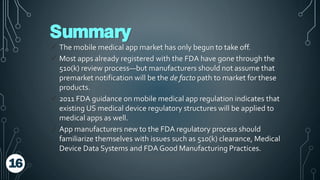
Summary
 The mobile medical app market has only begun to take off.
 Most apps already registered with the FDA have gone through the
510(k) review process—but manufacturers should not assume that
premarket notification will be the de facto path to market for these
products.
 2011 FDA guidance on mobile medical app regulation indicates that
existing US medical device regulatory structures will be applied to
medical apps as well.
 App manufacturers new to the FDA regulatory process should
familiarize themselves with issues such as 510(k) clearance, Medical
Device Data Systems and FDA Good Manufacturing Practices.
16
References
 FDA Guidance Document on Mobile MedicalApp Regulations
17
©2015
akshayanand
thankyou!axayanand@gmail.com

Mobile Medical Apps and FDA Regulatory Approach

  • 1.
    ©2015 akshayanand AND MOBILEAPPS FDA MEDICAL REGULATORY APPROACH AKSHAY ANAND M IYear – Master of Pharmacy Pharmaceutical Regulatory Affairs JSS College Of Pharmacy Mysuru 570015, Karnataka
  • 2.
    MOBILE MEDICAL APP •A mobile app is a computer program designed to run on smartphones, tablet computers and other mobile devices. • Apps are usually available through application distribution platform, which began appearing in 2008 and are typically operated by the owner of the mobile operating system, such as the Apple App Store, Google Play, Windows Phone Store, and BlackBerry AppWorld. • The terms medical software and medical device software are undefined terms that can designate any software, software item or system used within a medical context (e.g. medical devices that monitor or control patients are predominantly controlled by software), depending on its intended use / indication for use. • Mobile Medical Apps are the medical software applications developed as Apps on multiple platforms as stated above. 1
  • 3.
    ASPECTS • Mobile AppStatistics • FDA Guidance on Mobile Medical Devices • When is an App called a Device? • FDA Criteria for Mobile Medical Apps • FDA Categories of Mobile Medical Apps • Medical Device Data System (MDDS) • FDA Regulatory Process for Mobile Medical Apps OF THIS PRESENTATION 2
  • 4.
  • 5.
    FDA Guidance on MobileMedical Devices Highly anticipated FDA guidance released in July 2011 indicates which mobile medical apps fall under medical device regulatory requirements, and which do not. Although not all types of mobile medical apps are covered by the guidance, the FDA’s proposed rules show that the agency will not be taking a one-size-fits-all approach to these products. http://www.fda.gov/MedicalDevices/DeviceRegulationandGuidance/GuidanceDocuments/ucm263280.htm 4
  • 6.
    AnApp is Likelya Device if it, But, manufacturers should take into account several criteria, such as their apps’ intended uses and how they interact with other devices, when determining whether their products qualify as medical devices. Amplifies Analyzes Attaches Interprets Assesses Alarms Calculates Controls Converts Cures Detects Diagnoses Manipulates Measures Monitors Programs Trends Treats 5
  • 7.
    FDA Criteria forDetermining if an App is a Medical Device • Is the app a component of a medical device? • Is the app an accessory to a medical device? • Is the app intended for use in the diagnosis, treatment, mitigation or prevention of a disease? 6 If the answer to any one of these questions is yes, the FDA considers the app a medical device.
  • 8.
    FDA Criteria forMobile Medical Apps Specific criteria for apps as medical devices: 1. Mobile medical apps that serve as extensions of regulated medical devices and control those devices or display, store, analyze or transmit patient-specific medical device data 2. Mobile medical apps that transform mobile platforms into regulated medical devices by using attachments or similar medical device functions 3. Mobile medical apps that allow users to input patient- specific data and output patient-specific results or diagnoses using formulae or processing algorithms 7
  • 9.
    FDA Categories ofMobile Medical Apps The FDA’s guidance lists the following categories of mobile medical apps that qualify as medical devices: • Apps for displaying, storing or transmitting patient- specific medical device data in its original format • Apps that control intended use, functions or energy sources of medical devices to which they connect • Apps that transform mobile platforms into medical devices • Apps that analyze medical device data to create alarms, recommendations or new information 8
  • 10.
    Mobile Medical AppFirms NOT Regulated by the FDA Firms that distribute mobile medical but do not actually develop and/or manufacture those products are not considered mobile medical app manufacturers. 9
  • 11.
    Medical Device DataSystems The FDA’s Medical Device Data Systems (MDDS) category of devices covers products used to transfer, store, convert or display medical device data. Devices falling under the MDDS are designated as Class I, and are exempt from FDA premarket notification requirements in the US. Some mobile medical apps also fall under this category. 10
  • 12.
    Does Your AppQualify as MDDS? Devices that provide one or more of the following functions without controlling or altering how connected devices operate qualify as MDDS products: The scope of MDDS can include mobile medical apps as well as software, hardware, modems, interfaces and communication protocols. • Electronic transfer of medical device data • Electronic storage of medical device data • Electronic display of medical device data 11
  • 13.
    The US FDARegulatory Process for Medical Devices Mobile medical apps fall under the same regulatory requirements as other medical devices. Whether an app is classified as Class I, II or III depends on the level of risk it poses to users, as well as whetherSubstantial Equivalence exists. 12
  • 14.
    FDA Clearance orApproval Mobile medical apps can fall into any of these three classes. Class I Class II Class III No FDA review needed. FDA clearance required via 510(k) Premarket Notification. Predicate; “Me too” devices. FDA approval required via Premarket Approval (PMA) process. Novel; no predicates. Class I Class II Class III Process typically takes 5 to 7 working days. Self-register your device and pay FDA fee. Some Class 1 products do require a 510(k) submission. Most 510(k) applications reviewed within 90 days, but the entire process can take between 4 and 10 months.Average timeline is 132 days from submission to FDA clearance…for all products. Process takes 36 months or more depending on clinical trial requirements and FDA requests for additional information. Premarket approval reviews take 180 days. Approval Timelines 13
  • 15.
    Below are broadsteps manufacturers of Class I, II and III medical devices must typically go through to obtain clearance or approval from the US FDA. Steps in FDA Compliance Process Determine device classification. Prepare and file 510(k) submission, if required. Comply with FDA QSR – 21 CFR Part 820. Appoint US Agent, if outside US. Register with FDA. Pay fee. 14
  • 16.
    Quality System Requirements ClassI and allClass II and III medical devices, including mobile medical apps, must implement quality management systems compliant with FDA QualitySystem Regulations (QSR) found in 21 CFR Part 820 • The FDA does not recognize ISO 13485 or ISO 9001 certification—only QSR (aka current Good Manufacturing Practice) compliance is accepted in the US. • The FDA does not certify quality systems. Instead, the agency conducts random inspections to determine QSR compliance. • Even if a manufacturer outsources production of a device or app, that firm must still comply with quality system requirements. 15
  • 17.
    Summary  The mobilemedical app market has only begun to take off.  Most apps already registered with the FDA have gone through the 510(k) review process—but manufacturers should not assume that premarket notification will be the de facto path to market for these products.  2011 FDA guidance on mobile medical app regulation indicates that existing US medical device regulatory structures will be applied to medical apps as well.  App manufacturers new to the FDA regulatory process should familiarize themselves with issues such as 510(k) clearance, Medical Device Data Systems and FDA Good Manufacturing Practices. 16
  • 18.
    References  FDA GuidanceDocument on Mobile MedicalApp Regulations 17
  • 19.