ISO 18001
Dr Gajanan Pandit
Under Supervision of
Dr Shakti S Waghe, CLI, Mumbai.
International Organization for
Standardization
• The International
Organization for
Standardization known as
ISO, is an international
standard-setting body
composed of
representatives from
various national standards
organizations.
About ISO
• Founded on 23 February 1947
• The organization promotes worldwide
proprietary, industrial and commercial standards.
• It is headquartered in Geneva, Switzerland, and
as of 2013 works in 164 countries.
ISO 9001 and ISO 14001 are ISO's known
standards. ISO 9000 - implement quality
management. ISO 14000 - implement
environmental management
What is OHSAS 18001 ?
• Occupational Health and Safety Assessment
Series for Management Systems—
Requirements (officially BS OHSAS 18001) is
an internationally applied British Standard for
occupational health and Safety management
systems.
• It exists to help all kinds of organizations put
in place demonstrably sound occupational
health and safety performance
What is OHSAS 18001?
Internationally recognized model for Occupational
Health and Safety Assessment Series (OHSAS) for
management systems
Enable organizations to control their OH&S risks
and improve their performance
Specification is intended to address occupational
health and safety rather than product and
services safety
Why does OHSAS 18001 needed ?
• Organizations worldwide recognize the need to
control and improve health and safety
performance and do so with occupational health
and safety management systems (OHSMS).
Before 1999 lots of national standards and
proprietary certification schemes to choose from.
This caused confusion and fragmentation in the
market and undermined the credibility of
individual schemes.
Why Was OHSAS Developed ?
• In response to urgent customer demand for a
recognizable occupational health and safety
management system standard
• Need for health and safety management
system that could be audited and certified
• It is not a formal standard, an official British
Standard, nor is it an official International
Standard
Not mandatory - voluntary basis
How was OHSAS 18001 Developed?
• The Occupational Health and Safety Assessment Series (OHSAS)
Project Group comprised representatives from national standards
bodies, academic bodies, accreditation bodies, certification bodies
and occupational safety and health institutions, with the UK’s
national standards body, BSI Group, providing the secretariat.
• Drawing on existing standards and schemes, OHSAS Project Group
published the OHSAS 18000 Series in 1999.
– 18001 provided requirements for an OHS management system
&
– 18002 gave implementation guidelines.
As of 2005, around 16,000 organizations in more than 80 countries were using
the OHSAS 18001 specification. By 2009 more than 54,000 certificates had
been issued in 116 countries to OHSAS or equivalent OHSMS standards.
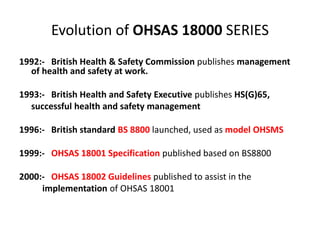
Evolution of OHSAS 18000 SERIES
1992:- British Health & Safety Commission publishes management
of health and safety at work.
1993:- British Health and Safety Executive publishes HS(G)65,
successful health and safety management
1996:- British standard BS 8800 launched, used as model OHSMS
1999:- OHSAS 18001 Specification published based on BS8800
2000:- OHSAS 18002 Guidelines published to assist in the
implementation of OHSAS 18001
Objectives of OHSMS
Occupational Health and Safety Management
System (OHSMS) provide a framework that
helps to:
• Identify and control health and safety risks
• Reduce the potential for accidents
• Aid legal compliance
• Improve overall performance
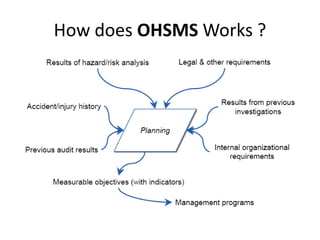
How does OHSMS Works ?
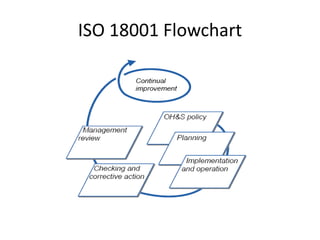
ISO 18001 Flowchart
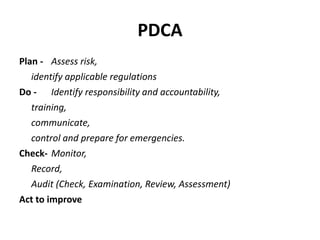
PDCA
Plan - Assess risk,
identify applicable regulations
Do - Identify responsibility and accountability,
training,
communicate,
control and prepare for emergencies.
Check- Monitor,
Record,
Audit (Check, Examination, Review, Assessment)
Act to improve
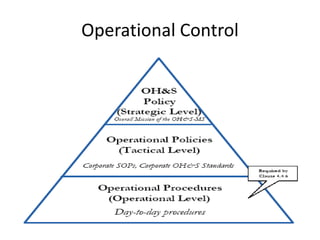
Operational Control
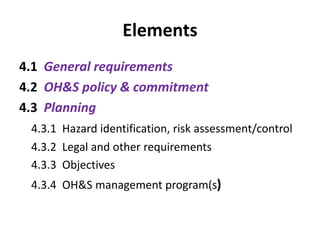
Elements
4.1 General requirements
4.2 OH&S policy & commitment
4.3 Planning
4.3.1 Hazard identification, risk assessment/control
4.3.2 Legal and other requirements
4.3.3 Objectives
4.3.4 OH&S management program(s)
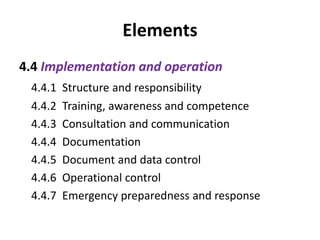
Elements
4.4 Implementation and operation
4.4.1 Structure and responsibility
4.4.2 Training, awareness and competence
4.4.3 Consultation and communication
4.4.4 Documentation
4.4.5 Document and data control
4.4.6 Operational control
4.4.7 Emergency preparedness and response
Elements
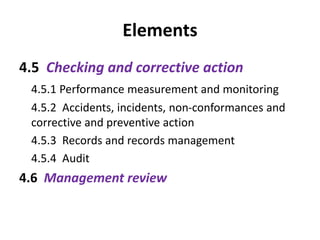
4.5 Checking and corrective action
4.5.1 Performance measurement and monitoring
4.5.2 Accidents, incidents, non-conformances and
corrective and preventive action
4.5.3 Records and records management
4.5.4 Audit
4.6 Management review
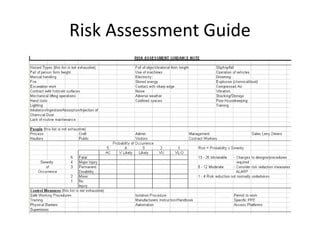
Risk Assessment Guide
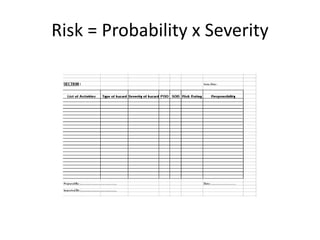
Risk = Probability x Severity
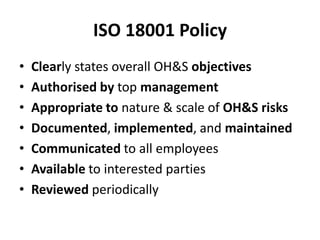
ISO 18001 Policy
• Clearly states overall OH&S objectives
• Authorised by top management
• Appropriate to nature & scale of OH&S risks
• Documented, implemented, and maintained
• Communicated to all employees
• Available to interested parties
• Reviewed periodically
Compatibility
OHSAS 18001 is compatible with:
ISO 9001:1994 (Quality) and ISO 14001:1996
(Environmental) management systems
standards
With ISO 9001:2000 based on the ISO
14001:1996 model - Integration of QEH&S MS
is easier
Applicability
Applies to general industry and fills gap of
health and safety issues not covered by:
• Responsible Care (RC),
• Chemical Plant -Process Safety
Management(PSM) industries or other health
and safety programs e.g. ISM Code (Marine
Safety)
About OSHAS
• It is an auditable protocol, against which a
company's health and safety management
system can be assessed.
• It does not state specific OH&S performance
criteria.
• Does not give detailed specifications for
design of a management system
• Comply with current applicable OH&S
legislation and other requirements
About OSHAS
Intended to address OH&S for employees,
temporary employees, contractors, visitors and
other personnel on-site
Not intended to cover product and service safety
No accreditation scheme based on OHSAS 18001
offered by any national accreditation body e.g.
RAB, UKAS, RvA, etc. Certification bodies can only
issue non-accredited certificates for OHSAS
18001 e.g. Certificate of Conformance
Requirements
A Health and Safety Management System must be
established and maintained
Instructions and procedures to ensure the health
and safety of all personnel in compliance with
relevant national and international regulations.
Defined levels of authority and lines of
communication between company personnel
The Health and Safety Management System must
be monitored by your own internal audit system
Requirements
Accidents & nonconformities are reported and
corrective actions taken
Part of planning must include hazard
identification, risk assessment and risk control
Management review
Management commitment
Continual improvement
Benefits
Environmental Health & Safety (EHS) managers
can’t be every place at the same time.
Provides tools to ensure health & safety is
everyone's responsibility
Integrate health and safety into all aspects of your
business
Effective safety and health programs earn positive
returns on their health and safety investment by:
Reducing work-related accidents and ill-health.
Benefits
Improving performance through heightened
employee morale and adherence to policies and
procedures
Reinforcing a responsible and well-managed
reputation with customers, stakeholders, and
communities
OHSAS 18001 provides a structure to incorporate
health and safety into the business
Includes health and safety impacts as part of the
business process and planning activities and
achieving the goal of an accident-free workplace
ISO 18001

ISO 18001

  • 1.
    ISO 18001 Dr GajananPandit Under Supervision of Dr Shakti S Waghe, CLI, Mumbai.
  • 2.
    International Organization for Standardization •The International Organization for Standardization known as ISO, is an international standard-setting body composed of representatives from various national standards organizations.
  • 3.
    About ISO • Foundedon 23 February 1947 • The organization promotes worldwide proprietary, industrial and commercial standards. • It is headquartered in Geneva, Switzerland, and as of 2013 works in 164 countries. ISO 9001 and ISO 14001 are ISO's known standards. ISO 9000 - implement quality management. ISO 14000 - implement environmental management
  • 4.
    What is OHSAS18001 ? • Occupational Health and Safety Assessment Series for Management Systems— Requirements (officially BS OHSAS 18001) is an internationally applied British Standard for occupational health and Safety management systems. • It exists to help all kinds of organizations put in place demonstrably sound occupational health and safety performance
  • 5.
    What is OHSAS18001? Internationally recognized model for Occupational Health and Safety Assessment Series (OHSAS) for management systems Enable organizations to control their OH&S risks and improve their performance Specification is intended to address occupational health and safety rather than product and services safety
  • 6.
    Why does OHSAS18001 needed ? • Organizations worldwide recognize the need to control and improve health and safety performance and do so with occupational health and safety management systems (OHSMS). Before 1999 lots of national standards and proprietary certification schemes to choose from. This caused confusion and fragmentation in the market and undermined the credibility of individual schemes.
  • 7.
    Why Was OHSASDeveloped ? • In response to urgent customer demand for a recognizable occupational health and safety management system standard • Need for health and safety management system that could be audited and certified • It is not a formal standard, an official British Standard, nor is it an official International Standard Not mandatory - voluntary basis
  • 8.
    How was OHSAS18001 Developed? • The Occupational Health and Safety Assessment Series (OHSAS) Project Group comprised representatives from national standards bodies, academic bodies, accreditation bodies, certification bodies and occupational safety and health institutions, with the UK’s national standards body, BSI Group, providing the secretariat. • Drawing on existing standards and schemes, OHSAS Project Group published the OHSAS 18000 Series in 1999. – 18001 provided requirements for an OHS management system & – 18002 gave implementation guidelines. As of 2005, around 16,000 organizations in more than 80 countries were using the OHSAS 18001 specification. By 2009 more than 54,000 certificates had been issued in 116 countries to OHSAS or equivalent OHSMS standards.
  • 9.
    Evolution of OHSAS18000 SERIES 1992:- British Health & Safety Commission publishes management of health and safety at work. 1993:- British Health and Safety Executive publishes HS(G)65, successful health and safety management 1996:- British standard BS 8800 launched, used as model OHSMS 1999:- OHSAS 18001 Specification published based on BS8800 2000:- OHSAS 18002 Guidelines published to assist in the implementation of OHSAS 18001
  • 10.
    Objectives of OHSMS OccupationalHealth and Safety Management System (OHSMS) provide a framework that helps to: • Identify and control health and safety risks • Reduce the potential for accidents • Aid legal compliance • Improve overall performance
  • 11.
  • 12.
  • 13.
    PDCA Plan - Assessrisk, identify applicable regulations Do - Identify responsibility and accountability, training, communicate, control and prepare for emergencies. Check- Monitor, Record, Audit (Check, Examination, Review, Assessment) Act to improve
  • 14.
  • 15.
    Elements 4.1 General requirements 4.2OH&S policy & commitment 4.3 Planning 4.3.1 Hazard identification, risk assessment/control 4.3.2 Legal and other requirements 4.3.3 Objectives 4.3.4 OH&S management program(s)
  • 16.
    Elements 4.4 Implementation andoperation 4.4.1 Structure and responsibility 4.4.2 Training, awareness and competence 4.4.3 Consultation and communication 4.4.4 Documentation 4.4.5 Document and data control 4.4.6 Operational control 4.4.7 Emergency preparedness and response
  • 17.
    Elements 4.5 Checking andcorrective action 4.5.1 Performance measurement and monitoring 4.5.2 Accidents, incidents, non-conformances and corrective and preventive action 4.5.3 Records and records management 4.5.4 Audit 4.6 Management review
  • 18.
  • 19.
  • 20.
    ISO 18001 Policy •Clearly states overall OH&S objectives • Authorised by top management • Appropriate to nature & scale of OH&S risks • Documented, implemented, and maintained • Communicated to all employees • Available to interested parties • Reviewed periodically
  • 21.
    Compatibility OHSAS 18001 iscompatible with: ISO 9001:1994 (Quality) and ISO 14001:1996 (Environmental) management systems standards With ISO 9001:2000 based on the ISO 14001:1996 model - Integration of QEH&S MS is easier
  • 22.
    Applicability Applies to generalindustry and fills gap of health and safety issues not covered by: • Responsible Care (RC), • Chemical Plant -Process Safety Management(PSM) industries or other health and safety programs e.g. ISM Code (Marine Safety)
  • 23.
    About OSHAS • Itis an auditable protocol, against which a company's health and safety management system can be assessed. • It does not state specific OH&S performance criteria. • Does not give detailed specifications for design of a management system • Comply with current applicable OH&S legislation and other requirements
  • 24.
    About OSHAS Intended toaddress OH&S for employees, temporary employees, contractors, visitors and other personnel on-site Not intended to cover product and service safety No accreditation scheme based on OHSAS 18001 offered by any national accreditation body e.g. RAB, UKAS, RvA, etc. Certification bodies can only issue non-accredited certificates for OHSAS 18001 e.g. Certificate of Conformance
  • 25.
    Requirements A Health andSafety Management System must be established and maintained Instructions and procedures to ensure the health and safety of all personnel in compliance with relevant national and international regulations. Defined levels of authority and lines of communication between company personnel The Health and Safety Management System must be monitored by your own internal audit system
  • 26.
    Requirements Accidents & nonconformitiesare reported and corrective actions taken Part of planning must include hazard identification, risk assessment and risk control Management review Management commitment Continual improvement
  • 27.
    Benefits Environmental Health &Safety (EHS) managers can’t be every place at the same time. Provides tools to ensure health & safety is everyone's responsibility Integrate health and safety into all aspects of your business Effective safety and health programs earn positive returns on their health and safety investment by: Reducing work-related accidents and ill-health.
  • 28.
    Benefits Improving performance throughheightened employee morale and adherence to policies and procedures Reinforcing a responsible and well-managed reputation with customers, stakeholders, and communities OHSAS 18001 provides a structure to incorporate health and safety into the business Includes health and safety impacts as part of the business process and planning activities and achieving the goal of an accident-free workplace

Editor's Notes

  • #5 Performance: measurable results of the OH&S management system, related to the organization’s control of health and safety risks, based on its OH&S policy and objectives. No. 41(8)/ISO/2005 Government of India Ministry of Small Scale Industries, Office of the Development Commissioner (Small Scale Industries) ISO Division 7th Floor, Nirman Bhavan New Delhi-110011 Dated: 23.11.2005 The Secretary(SSIs), All State Govts/Uts Commissioner/Director of Industries, All State Govts./Uts Director, All SISIs Subject:  Reimbursement of charges to SSI units for acquiring ISO 9000/14000 certification-Criteria for approving ISO 9000 and ISO 14000 Certification Bodies for reimbursement of certification expenses to SSI units. Sir, Further to this office circulars of even number dated 23.8.2005 on the above subject, the following certifying bodies have been accredited by NABCB/cleared by QCI for the purpose of re-imbursement of ISO 9000 certification (QMS) and ISO14001 (EMS) expenses to the SSI units by this office as on 8.11.2005: CAVEAT             Please note that in the case of applications for reimbursement received in the office of DC (SSI) on or after 01-01-2006, reimbursement will be made against certificates obtained from certification bodies directly accredited by NABCB (National Accreditation Board of Certification Bodies) and bearing the logo of NABCB only” In  other words,  the validity  of  the Certifying  Bodies in the category 2 & 3 below will  cease for applications received in the office of DC (SSI) after 31.12.2005.   List of Certifying Bodies, Meeting DC SSI Criteria for ISO 9000 QMS Certification as updated upto 8.11.2005: Certifying Bodies having direct accreditation from NABCB  S. No. Name of CB* Accredited By 1 Det Norske Veritas ,Certification Services, India NABCB 2 TUV India Pvt.Ltd. NABCB 3 BVQI (India) Pvt.Ltd. NABCB 4 Intel Quality Certification Pvt.Ltd. NABCB 5 American Global Standards India NABCB 6 Indian Register Quality Systems NABCB 7 ICS Certifications(Asia) Pvt.Ltd. NABCB 8 ICRS Management Systems Pvt.Ltd. NABCB 9 BSI India Pvt.Ltd. NABCB 10 TUV Rheninland India Pvt.Ltd. NABCB 11 TUV Suddeutschland (India)Pvt.Ltd. NABCB 12NVT Quality Certification Pvt. Ltd.NABCB13AQSR India Pvt.Ltd.NABCB Certifying Bodies having direct accreditation from Foreign ABs S. No. Name of CB* Accredited By 1 Bureau of Indian Standards RvA 2 Standardization Testing & Quality Certification (STQC) RvA 3 International Standards Certification (South Asia) Pvt.Ltd. RvA 4 Indian Register Quality Systems RvA 5 Quality-Cert.(India) Pvt.Ltd. RvA 6 KPMG Quality Registrar RvA 7 ICL Certification Ltd. RvA 8 Phoenix Progressive Certifications Enterprises Pvt.Ltd. RvA 9 Transpacific Certification Ltd. JAS-ANZ 10 NQAQSR Certification Pvt.Ltd. RVA,JAS-ANZ 11 International Certification Services(Asia) Pvt.Ltd. JAS-ANZ 12 Kvalitet Veritas Quality Assurance NORSK AKKREDITERING 13Surewin Quality Certification Pvt. Ltd.RENAR14PC Management System(P) Ltd.JAS-ANZ Certifying Bodies operating as branch office or franchisee of Foreign CBs.  S. No. Name of CB* Accredited By Indian Office 1 Det Norske Veritas ANSIRAB Det Norske Veritas, Certification Services, India 2 QSI America Inc ANSIRAB QSI(India) Certifications Pvt.Ltd. 3 International Standards Certification Pvt. ltd. JAS-ANZ International Standards Certification Pvt. Ltd. 4 NCS International Pvt.Ltd. JAS-ANZ NCS India 5 Allied Certification Services Ltd. JAS-ANZ Allied Certification Services Pvt.Ltd. 6 Benchmark Certification Intl, Australia Pvt. Ltd. JAS-ANZ Benchmark Certification Pvt. Ltd. 7 QMS Certification Services Pvt. Ltd. JAS-ANZ QMS Certification Services 8 International Certifications Ltd. New Zealand JAS-ANZ ICL Certifications Ltd. 9 DLIQ Pvt. Ltd.,Australia JAS-ANZ DLIQ Certifications India Pvt.Ltd. 10 System Management Registration Co.Ltd. JAS-ANZ System Management Registration(India) 11 United Registrar of Systems Ltd. UKAS URS Certification Ltd. 12 BVQI UKAS/ANSIRAB BVQI (India) Pvt.Ltd. 13 Chamber Certification & Assessments Ltd.(CCAS Ltd.) UKAS CCAS Quality Certification 14 BSI Management Systems UKAS BSI India Pvt.Ltd. 15 Underwrieter Laboratories Inc UKAS UL India Pvt.Ltd. 16 D.A.S. Certification Ltd. UKAS DAS Certifications (India) 17 Q.A. International Certification Certification Ltd. UKAS Q.A. International Certification(India), Mumbai 18 Moody International Certification Ltd. UKAS Moody International (India) Pvt.Ltd. 19 SGS UK Ltd., SGS Societe Generale de Surveillance UKAS, Swiss SGS India Pvt.Ltd. 20 AQA International ANSIRAB AQA (India) 21 AQSR International Inc. ANSIRAB AQSR India Pvt. Ltd. 22 National Quality Assurance Ltd.,U.K. ANSIRAB/UKAS/RvA National Quality Assurance India Operation 23 Registro Italiano Navale SINCERT Registro Italiano Navale India Pvt.Ltd. 24 TUV Management Service GmbH DAR, JAS-ANZ TUV Suddeutschland India Pvt.Ltd. 25 RWTUV DAR TUV India Pvt.Ltd. 26 TUV Rhineland,Berlin Brandenburg DAR TUV Rhineland India Pvt.Ltd. 27 Orion Registrar Inc ANSIRAB Orion Registrar India 28 HSB Registration Services RAB,RvA HSB International (India) Pvt.Ltd. 29SAI GLOBALJAS-ANZSAI GLOBAL30Perry Certifications Pvt.Ltd.ANABPJR Certifications Pvt.Ltd.(PJR India) * Certificates are issued by CBs duly signed by authorized signatures. List of Certifying Bodies, Meeting DC SSI Criteria for EMS Certification ISO 14001 as updated on 8.11.2005: Certifying Bodies having direct accreditation from NABCB S. No. Name of CB* Accredited By 1 Det Norske Veritas ,Certification Services, India NABCB 2 TUV India Pvt.Ltd. NABCB 3 BVQI (India) Pvt.Ltd. NABCB 4 ICS Certifications(Asia) Pvt.Ltd. NABCB Certifying Bodies having direct accreditation from Foreign ABs  S. No. Name of CB* Accredited By 1 Standardization Testing & Quality Certification (STQC) RvA 2 Indian Register Quality Systems RvA 3 KPMG Quality Register RvA 4 International Certification Services ( Asia) Pvt.Ltd. JAS-ANZ 5 NQAQSR Certification Pvt.Ltd. JAS-ANZ 6 ICL Certifications Ltd. JAS-ANZ 7 Kvalitet Veritas Quality Assurance NORSK AKKREDITERING Certifying Bodies operating as branch office or franchisee of Foreign CBs. S. No. Name of CB* Accredited By Indian Office 1 Det Norske Veritas RvA Det Norske Veritas, Certification Services, India 2 International Standards Certification Pvt.Ltd. JAS-ANZ International Standards Certification Pvt.Ltd. 3 BVQI UKAS BVQI (India) Pvt. Ltd. 4SGS UK Ltd.UKASSGS India Pvt. Ltd.5AQA International ANSIRAB AQA(India) 6 AQSR International Inc. ANSIRAB AQSR India Pvt. Ltd. 7 RWTUV DAR TUV India Pvt.Ltd. 8 International Certifications Ltd. New Zealand JAS-ANZ ICL Certifications Ltd. 9 DLIQ Pvt.Ltd.Australia JAS-ANZ DLIQ Certifications India Pvt.Ltd. 10Sai Global CertificationsJAS-ANZSai Global Certifications 11Registro Italino NavaleSINCERTRINA India Pvt. Ltd. 12United Registrar of Systems Ltd.UKASURS Certification Ltd. * Certificates are issued by CBs duly signed by authorized signatures. In view of above, reimbursement of expenditure incurred on obtaining ISO 9000/ISO 14001 is presently being considered in respect of such applications (from SSI units) who have obtained certificates from any of the above cited certifying Bodies. This circular supersedes all the previous circulars issued in this regard. This may please be brought to the notice of all concerned. Yours faithfully, (V.S. Karunakaran) Industrial Advisor
  • #23 Responsible Care is a global, voluntary initiative developed autonomously by the chemical industry for the chemical industry. It runs in 52 countries whose combined chemical industries account for nearly 90% of global chemical production. It stands for the chemical industry's desire to improve health, safety, and environmental performance. The signatory chemical companies agree to commit themselves to improve their performances in the fields of environmental protection, occupational safety and health protection, plant safety, product stewardship and logistics, as well as to continuously improve dialog with their neighbors and the public, independent from legal requirements. As part of Responsible Care initiative, the International Council of Chemical Associations introduced the The Global Product Strategy in 2006. Critical analyses of Responsible Care have been done by Andrew King and Michael Lenox, Michael Givel, and Moffet, Bregha and Middelkoop History Responsible Care was launched by the Chemistry Industry Association of Canada (formerly the Canadian Chemical Producers' Association - CCPA) in 1985. The scheme evolved, and, in 2006, The Responsible Care Global Charter was launched at the UN-led International Conference on Chemicals Management in Dubai. Controversy Poisoning of river Elbe by the company Draslovka Kolin a.s., a Responsible Care certified company or hiding of 20 mt leakage of naphthalene by the company Deza, also a Responsible Care company, questions whether the Responsible Care brings any real improvement or is just a marketing tool. Process safety management is a regulation, promulgated by the U.S. Occupational Safety and Health Administration (OSHA). A process is any activity or combination of activities including any use, storage, manufacturing, handling or the on-site movement of highly hazardous chemicals (HHCs) as defined by OSHA and the Environmental Protection Agency. Definition Process safety management is an analytical tool focused on preventing releases of any substance defined as a "highly hazardous chemicals" by the EPA or OSHA. Process Safety Management (PSM) refers to a set of inter-related approaches to manage hazards associated with the process industries and is intended to reduce the frequency and severity of incidents resulting from releases of chemicals and other energy sources (US OSHA 1993). These standards are composed of organizational and operational procedures, design guidance, audit programs, and a host of other methods. Elements of Process Safety Management (PSM) The process safety management program is divided into 14 elements. The U.S. Occupational Safety and Health Administration (OSHA) 1910.119 define all 14 elements of process safety management plan. 14 Elements of OSHA Process Safety Management Program (PSM) Process Safety Information Process Hazard Analysis Operating Procedures Training Contractors Mechanical Integrity Hot Work Management of Change Incident Investigation Compliance Audits Trade Secrets Employee Participation Pre-startup Safety Review Emergency Planning and Response All of those elements mentioned above are interlinked and interdependent. There is a tremendous interdependency of the various elements of PSM. All elements are related and are necessary to make up the entire PSM picture. Every element either contributes information to other elements for the completion or utilizes information from other elements in order to be completed. Process Safety Information (PSI) PSI or process safety information might be considered the keystone of a PSM Program in that it tells you what you are dealing with from both the equipment and the process standpoint. In order to be in compliance with the OSHA PSM regulations the process safety information should include information pertaining to the hazards of the highly hazardous chemicals used or produced by the process, information pertaining to the technology of the process and information pertaining to the equipment in the process. Information pertaining to the hazards of the highly hazardous chemicals in the process should consist of at least the following: Toxicity information Permissible exposure limit Physical data Reactivity data Corrosivity data Thermal and chemical stability data Hazardous effects of inadvertent mixing of different materials that could foreseeably occur. Information pertaining to the technology of the process should include at least the following: A block flow diagram or simplified process flow diagram Process chemistry and its properties Maximum intended inventory Safety upper and lower limits for such items as temperatures, pressures, flows or compositions An evaluation of the consequences of deviations, including those effecting the safety and health of the employees. Information pertaining to the equipment in the process should include following: Materials of construction Piping and instrument diagram (P&ID’s) Electrical classification Relief system design and design basis Ventilation system design Design codes and standards employed Material and energy balances for processes built after May 26, 1992 Safety system ( for example interlocks, detection or suppression systems) The employer should document that equipment complies with recognized and generally accepted good engineering practices (RAGAGEP) For existing equipment designed and constructed in accordance with codes, standards or practices that are no longer in general use, the employer should determine and document that the equipment is designed, maintained, inspected, tested and operating in a safe Compliance A process includes any group of vessels which are interconnected or separate and contain Highly Hazardous Chemicals (HHC's) which could be involved in a potential release. A process safety incident is the "Unexpected release of toxic, reactive, or flammable liquids and gases in processes involving highly hazardous chemicals. Incidents continue to occur in various industries that use highly hazardous chemicals which exhibit toxic, reactive, flammable, or even explosive properties, or may exhibit a combination of these properties. Regardless of the industry that uses these highly hazardous chemicals, there is a potential for an accidental release any time they are not properly controlled. This, in turn, creates the possibility of disaster. To help assure safe and healthy workplaces, OSHA has issued the Process Safety Management of Highly Hazardous Chemicals regulation (Title 29 of CFR Section 1910.119) which contains requirements for the management of hazards associated with processes using highly hazardous chemicals." Any facility that stores or uses a defined "highly hazardous chemical" must comply with OSHA's process safety management (PSM) regulations as well as the quite similar United States Environmental Protection Agency (EPA) Risk management program (RMP) regulations (Title 40 CFR Part 68). The EPA has published a model RMP plan for an ammonia refrigeration facility which provides excellent guidance on how to comply with either OSHA's PSM regulations or the EPA's RMP regulations. The Center for Chemical Process Safety (CCPS) of the American Institute of Chemical Engineers (AIChE) has published a widely used book that explains various methods for identifying hazards in industrial facilities and quantifying their potential severity. Appendix D of the OSHA's PSM regulations endorses the use of the methods explained in that book. AIChE publishes additional guidelines for process safety documentation, implementing process safety management systems, and the Center for Chemical Process Safety publishes an engineering design for process safety. In Australia, consideration of process safety management is a key consideration for the management of Major Hazard Facilities (MHFs).
  • #24 Performance: measurable results of the OH&S management system, related to the organization’s control of health and safety risks, based on its OH&S policy and objectives.
  • #25 Exemplar Global Incorporated, formerly known as RABQSA is an international not-for-profit organization with charitable status in Australia. Exemplar Global provide professional credentialing programs and training certification programs. They give professionals with credentials of their competence and capability through a personnel certification beyond the attainment of a certificate of training. Exemplar Global was created in 2004 from the acquisition of the personnel certification activities of United States of America-based Registrar Accreditation Board (RAB) by Australia-based Quality Society of Australasia (QSA). Exemplar Global has offices in Milwaukee, Sydney, Seoul plus international partnerships. Its business includes a number of distinct business divisions; Certification Services, College(Continual Professional Development activity for customers), Gratiis to support its charitable work, Laureate that supports the advancement of the communities it works in and iNARTE that supports the personnel certification of engineers and technicians. Exemplar Global is a wholly owned independent subsidiary of ASQ (formerly known American Society Quality). The United Kingdom Accreditation Service (UKAS) is the sole national accreditation body recognised by the British government to assess the competence of organisations that provide certification, testing, inspection and calibration services. It evaluates these conformity assessment bodies and then accredits them where they are found to meet the internationally specified standard. An organisation accredited by UKAS can demonstrate competence, impartiality and reliability in its ability to deliver results. Accreditation ensures that everyone from specifiers, purchasers, and suppliers to consumers can have confidence in the quality of goods and in the provision of services throughout the supply chain. Raad voor Accreditatie (Nederland) Each member state of the European Union has a national accreditation body. In the Netherlands it is the RvA. Our primary task consists of accrediting and renewing the accreditations of conformity-assessment bodies: laboratories, inspection bodies, certification bodies and verification bodies. This is to ensure that trust in the quality of products and services is genuinely justified. Background The RvA is a private organisation. In 2010 the Dutch government appointed the RvA as the national accreditation body based on European Regulation 765/2008. Since then the RvA has become an independent government agency that answers to the Minister for Economic Affairs. As an independent organisation and independent government agency the RvA is a non-profit organisation. The RvA was founded in 1995 following a multi-party merger involving: the Dutch Calibration Organisation (NKO); the Foundation for the Recognition of Laboratories and Inspection Bodies (STERLAB/STERIN); the Certification Council (RvC). Since 2008 CCKL has also been part of the RvA. CCKL accredits Dutch medical laboratories working in the human health sector based on the Dutch Code of Practice. Over the coming years the CCKL accreditations will undergo a phased transition to the European standard ISO 15189. This will also result in the medical laboratories receiving accreditation with an international scope. Our clients are conformity-assessment bodies: laboratories inspection bodies certification bodies verification bodies Conformity-assessment bodies assess whether products and services from suppliers meet the specified requirements. They do this for every imaginable field of work: health, environment, constructions, energy, food, transport and finance, to name but a few. In the event of a positive assessment the supplier is issued with a statement of conformity in the form of a certificate or report. It is important that conformity-assessment bodies are expert, impartial and independent because only then statements they issue are useful and reliable. The RvA therefore checks that these bodies meet the European (EN) and international (ISO or ISO/IEC) standards. If they do they receive an accreditation mark – an audit of the audit.