ISO 14001:2015 AWARENESS
TRAINING
BY
PARABAKARAN BALASUBRAMANIAM
Contents of Presentation
 Introduction
 What is EMS?
 Aim of EMS
 PDCA cycle
 Overview of various clauses
 Scope of ISO 14001:2015
 Few Important definitions from ISO 14001:2015
 All Clauses in Detail( Clause 4- Clause 10)
Introduction
 What is the need of this standard in today’s scenario of rapid development?
What is EMS?
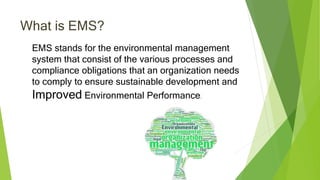
EMS stands for the environmental management
system that consist of the various processes and
compliance obligations that an organization needs
to comply to ensure sustainable development and
Improved Environmental Performance.
Aim of EMS
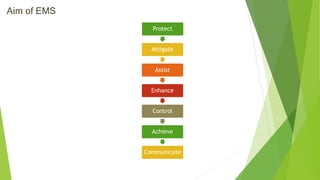
Protect
Mitigate
Assist
Enhance
Control
Achieve
Communicate
PDCA Cycle
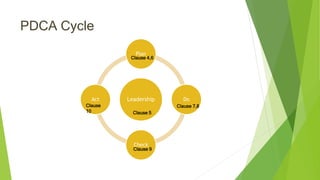
Leadership
Plan
Do
Check
Act
Clause 4,6
Clause 5
Clause 9
Clause
10
Clause 7,8
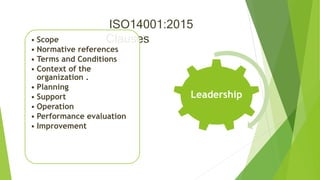
ISO14001:2015
Clauses
Leadership
• Scope
• Normative references
• Terms and Conditions
• Context of the
organization .
• Planning
• Support
• Operation
• Performance evaluation
• Improvement
Scope of ISO 14001:2015
 This standard helps organizations to
implement EMS to improve environmental
performance.
 Intended outcome of EMS:
 Improved environmental performance
 Fulfillment of compliance obligation
 Achieving environmental objectives
• This is applicable across all organization
regardless of size and complexity.
Few Important definitions from ISO
14001:2015
 What is compliance obligation?
Legal requirements that an organization needs to comply.
e.g. Organization needs to comply with Environment protection Act 1986.
 What is Policy?
Intention or direction of an organization, formally expressed by its top management.
e.g. Bench Policy, Travel Policy etc.
 What is risk?
Effect of uncertainty.
Effect- Deviation from expected that could be positive or negative.
Uncertainty- A state that lacks information, its likelihood and occurrence.
Clause 4:Context of the organization
 4.1- Understanding the organization and its
context
 4.2- Understanding the needs and
expectations of the interested parties
 4.3- Determine the scope of the EMS
Understanding the organization and its
context
 Organization shall determine the External and Internal factors that can effect
the implementation of EMS.
 Creating an EMS Manual covering the various aspects of organization core
business activities and day to day activities in context of environment
Understanding the needs and expectations of interested
parties
 Organization shall determine those parties that
are relevant to the EMS e.g. Vendors, Top
Management, Clients , Regulatory bodies, Corp.
Functions etc.
 Which of these requirements become compliance
obligation?
 Compliance obligation stands for the legal
requirements that organization has to comply and
other requirements that an organization has
chosen to comply.
 E.g. Environment Protection Act, 1986 is an Act of
parliament of India, that organization has to
comply with
Determining Scope of the EMS
When determining the scope of EMS the organization shall consider:
• Internal and External issues w.r.t. EMS( Authorized Vendor for the e-waste disposal
• Compliance Obligation(Legal Requirement)
• Organizational units e.g. Delivery Unit, Consulting Unit etc.
• Functions e.g. HR department, Admin Department
• Physical Boundaries
• Activities, Products and Services e.g. An Automobile Organization manufactures Car
and also provides after sales service to its customers. In this scenario
manufacturing is the activity, Car is a product and After Sales Service is the service
provided by the organization
• Authority and Ability to exercise control and influence.(Till what extent
organization can control its various products and services to improve
environmental performance)
Environmental Management System
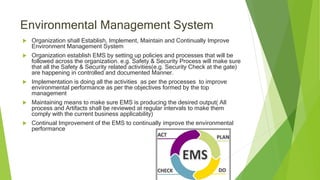
 Organization shall Establish, Implement, Maintain and Continually Improve
Environment Management System
 Organization establish EMS by setting up policies and processes that will be
followed across the organization. e.g. Safety & Security Process will make sure
that all the Safety & Security related activities(e.g. Security Check at the gate)
are happening in controlled and documented Manner.
 Implementation is doing all the activities as per the processes to improve
environmental performance as per the objectives formed by the top
management
 Maintaining means to make sure EMS is producing the desired output( All
process and Artifacts shall be reviewed at regular intervals to make them
comply with the current business applicability)
 Continual Improvement of the EMS to continually improve the environmental
performance
Clause5:Leadership
 Leadership and Commitment
 Environment Policy
 Organizational role, responsibility and
authority
Leadership and Commitment
Top management shall demonstrate Leadership and Commitment by:
 taking accountability for effectiveness of EMS i.e. taking accountability for all
aspects of EMS
 Ensuring Environmental policy and objectives are established and are inline
with the strategic direction and context of the organization
 Strategic direction of an Automobile Industry is to produce its end product by
using eco-friendly measures
 Integrate EMS into the business processes
 Change Management, Risk Management are few examples of business
processes.
 Ensuring required resources are available for the implementation of EMS
 People, Infrastructure and Software constitutes resources
Leadership and Commitment
 Communicating:
 Importance of effective environmental management( Can be part of EMS
Manual)
 Importance of conforming to EMS Requirements(Can be part of EMS Manual)
 Ensuring EMS is producing its intended outcome(Internal Auditing)
 Directing/Supporting persons to contribute to the effectiveness of EMS(Effective
Leadership)
 Promoting Continual Improvement
 Supporting Mangers/Leads/Heads or other management roles to demonstrate
Leadership w.r.t. EMS
Environmental Policy
Organization shall establish, implement and maintain an Environmental Policy keeping in
mind:
 It should be relevant to the context of the organization
 Provides a framework for setting up environmental objectives
 Includes a commitment for fulfillment of compliance obligation
 Includes a commitment for protecting the environment
 Includes a commitment for continual improvement of EMS
 Implementing above points will provide an appropriate structure to the Policy Statement
 Environmental Policy can be showcased at the suitable places in the organization to
increase environmental awareness
Organizational roles, responsibilities and
authorities
Organization shall identify roles and responsibilities for
the Implementation of the EMS to ensure:
• Fulfillment of the requirements of this particular
standard
• Reporting of performance of EMS to the top
management
• Reporting can include areas like Escalation
Management, Risk Management, Non Compliance
etc.
Clause 6:Planning
• Actions to reduce risks and opportunities
 General
 Environmental aspects
 Compliance obligations
 Planning action
• Environmental objectives and planning to achieve them
 Environmental objectives
 Planning actions to achieve environmental objectives
Clause 6.1.1 General
 Organization shall Establish, Implement and maintain the processes for EMS.
 e.g. Admin process for all Admin related activities like day to day cleaning activities,
Disposing organic waste Activity
 When planning for EMS the organization shall consider:
 Requirement from Clause 4.1 to Clause 4.3
 Determine Risk and Opportunities from Clause 4.1,Clause 4.2, Clause 6.1.2 and Clause
6.1.3
 This will ensure:
 EMS achieve its Intended Outcome
 To Mitigate the effect of external environmental conditions to affect the organization
 Continual Improvement
 Organization shall determine potential emergency situations to effect the organization
 E.g. Fire is a common potential emergency situation in Petroleum Industries
Environmental Aspects
 Organization shall capture Environmental Aspects related to its products and service
offerings.
 While determining environmental aspects the organization shall take into consideration:
 Change in existing services or any new service
 E.g. Organization has decided to add new service of providing cloud services across the

globe
 Change in existing products or any new product
 Abnormal Conditions
 E.g. An organization falls into the earthquake prone area
 Emergency Situation
 E.g. Fire Emergency Situation
Contd…
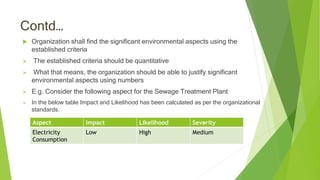
 Organization shall find the significant environmental aspects using the
established criteria
 The established criteria should be quantitative
 What that means, the organization should be able to justify significant
environmental aspects using numbers
 E.g. Consider the following aspect for the Sewage Treatment Plant
 In the below table Impact and Likelihood has been calculated as per the organizational
standards.
Aspect Impact Likelihood Severity
Electricity
Consumption
Low High Medium
Compliance obligations
• Organization shall determine its compliance obligations
• Compliance obligations consist of the legal requirements and other requirements that an
organization has decided to comply Internally e.g. An organization in India has to comply
with The Air Pollution Control Act of 1955(Legal Requirements), All Employees who come
with their own vehicle need to show PUC of their vehicle at the gate entrance(Other
Organization Requirements)
• Determine how compliance obligations will apply to the organization
 e.g. Currently Diesel Storage for the generator is 50 Liters and the Local Law says that the
Diesel Storage should not be more than 20 Liters. In this particular scenario organization
needs to reduce its diesel storage)
• Take compliance obligation into the account while Establishing, Implementing, Maintaining
and continually Improving EMS
• Compliance Obligation may lead to risks and opportunities
 e.g. An organization coming into Tsunami Prone area is an risk to the organization
Planning action
• Organization shall plan actions to address its:
 Significant Aspects
 e.g. lets say general cleanliness is poor in a manufacturing unit of the organization that is causing
various diseases in the campus which makes it a significant aspect( Note: Use Quantitative
Measures to find out significant environmental aspects)
 Now planning actions in this case means to figure out start date and end date of all actions items
that will generate from this significant environmental Aspects e.g. Giving cleanliness awareness
session to the employees
 Compliance Obligation
 Action plan to address compliance obligation will include action items like sending across
compliance awareness mailer to all the stakeholders, documentation of compliance obligation,
resolving conflicts with the local bodies w.r.t. environment as per legal requirements
 Risk & Opportunities
 Risk & Opportunities come from the compliance obligations or environmental aspects
 E.g. Organization disposing CFL Tubes in an uncontrolled manner is an risk
 Organization can turn this risk into opportunity by disposing CFL Tubes by the Authorized vendor
and have some financial benefits
Environmental Objectives
 Organization shall form its Environmental objectives taking
Compliance Obligation, Environmental Aspects, Risk and
Opportunities into account.
 Organization shall ensure its Environmental objectives are
measureable, monitored, communicated, Updated and inline with
the Environmental Objectives.
 E.g. An organization has an average total electricity bill of
$10000 and it forms an objective of reducing it to $8000 for
financial and environmental benefits. Environmental objectives
should be Quantitative in nature to make sure it is measurable
and be monitored.
Planning actions to achieve Environmental
Objectives
 When planning to achieve environmental objectives the organization shall
determine:
 What will be done?
 e.g. Organization decided to reduce its water consumption per employee by 10% by the
end of fiscal year.
 Now action items related to this can be:
 Awareness session among the employees to save the water
 Inhouse recycling of water using treatment plant
 What resources are required?
 E.g. Administration Team will be responsible for all the action items
 Who will be responsible?
 E.g. Administration Team’s Manager will be responsible for the completion of all the
actions items on time as per the applicability.
 When it will be completed?
 How the results will be evaluated?
 E.g. Reduction in water consumption of the organization can be measured as per water
bills charged by local municipal corporation
Clause 7: Support
 Resources
 Competence
 Awareness
 Communication
 General
 Internal Communication
 External Communication
 Documented Information
 General
 Creating and Updating
 Control of Documented Information
Resources
 The organization shall determine the resources required for the establishment,
implementation, maintenance and continual Improvement of the EMS.
 e.g. In IT organizations Quality Team, Admin Team, Procurement Team, Finance
Team and the HR Team are the main stakeholders for the implementation of the
EMS though many other stakeholders Interact with them.
Competence
 Competence should be based upon education, training and experience.
 E.g. For checking effectiveness of its EMS, An organization may hire
lead Auditor in ISO 14001:2015 to lead the team of EMS Auditors
 Determine training needs w.r.t. its Environmental Aspects and EMS
 e.g. Group Heads of all the corporate departments needs to do Lead
Auditor course in ISO 14001:2015
 Evaluate the effectiveness of actions taken and take appropriate actions
to have required competency for the Implementation of the EMS
Awareness
 Organization shall ensure that its employees are aware of:
 Organizational Policy
 Environmental Aspects and their Impacts
 Their contribution towards EMS
 This can be achieved through workshops or mandatory online trainings
on EMS
Communication: General
 Organization shall Establish, Implement and Maintain the communication
processes taking into the account its compliance obligation including:
 What to communicate
 When to communicate
 Whom to communicate
 How to communicate
 Communication is a medium through which organization provide or obtain
information
 This Information can be related to:
 Significant environmental Aspects
 Environmental Performance
 Compliance Obligation
 Recommendations for the continual improvement
Internal Communication
Organization shall communicate any
change in the EMS internally at all
levels and functions across the
organization.
1
The Internal communication process shall
enable people doing work under the
organization control to contribute to the
continual Improvement e.g. All employees of
the organization can raise Change Request
at any point of time to trigger process
changes in the EMS as per the applicability.
2
External Communication
 Organization shall externally communicate information related to the
EMS as per the established communication processes and as required
by its compliance obligation
 External communication includes external parties like customers,
potential customers, suppliers, investors and relevant shareholders
 E.g. External Communication may include New Environmental Policy or
Change in compliance obligation of the organization
Documentation: General
 Organization EMS shall include:
 Documented Information as required by this standard
 As per the standard following documented information is required:
1. Scope of EMS(Clause 4.3)
2. Environmental policy(Clause 5.2)
3. Environmental aspects(Clause 6.1.2)
4. Compliance obligations (Clause 6.1.3)
5. Environmental objectives (Clause 6.2.1)
6. Competence(Clause 7.2)
7. Communication Evidence(Clause 7.5.1)
Contd..
 Extent of the documentation required depends upon factors like:
 Products and Services of the organization
 e.g. Big IT Giants like IBM providing services in many domain require more
documentation to document the evidence of appropriate working of its
processes whereas A small product based company making an Anti-Virus
Software require less documentation to document the evidence of appropriate
working of its processes
 Size and Complexity of organization
 The need to demonstrate fulfillment of its compliance obligation
 Competence of people doing work under the organization
Creating and Updating
 While documenting organization shall ensure:
 Identification and Description(e.g. Title, Release Date, Author)
 This is to signify that for all processes and template that will be used for the implementation of
EMS, organization need to maintain the log of the revision history to track the changes made in
processes and templates
 Format and Media
 Many IT organizations have standard word or excel templates and in many cases all processes
and templates are placed on a common server so that it is available to use anytime for all the
stakeholders.
 Renewal and Approval for the suitability and adequacy
 This is to ensure that all changes in processes and templates occur in controlled manner
Control of documented information
 Organization shall Implement control of documented information:
 To ensure it is available and suitable to use whenever required
 E.g. If a template used for the implementation of the EMS has been updated, the concerned stakeholders should be
able to find the latest template
 To ensure it is adequately protected
 E.g. Cover page of the excel template should be password protected so that no one except the admin can change
the revision history of the template
 To ensure control of documented Information organization shall address following activities:
 Distribution of the document
 E.g. Copyright protection for the templates
 Access
 E.g. Management Audit Report can only be accessed by top management and the Auditors
 Retrieval(Backup)
 Use
 This signifies that organization should have controls in place to avoid wrong use of the template e.g. Cover page
should be password protected.
Clause 8: Operation
 Operational planning and control
 Emergency preparedness and response
Operational planning and control
 Organization shall Establish, Implement, Control and Maintain the processes required for the
EMS by:
 Establishing the operating criteria e.g. If an organization decided to procure IT assets, this can
be the operating criteria for the procurement process
 Implementing control of the processes, in accordance with the operating criteria
 E.g. Disposal of waste generated through Sewage Treatment Plant(STP). In this example STP
is an engineering control in waste disposal process.
 The organization shall control planned changes and review the consequences of unintended
changes
 E.g. Lets say organization establishes a waste disposal process, Now any change in this
process shall go through proper change request cycle
 The organization shall Control or Influence the outsourced process
 Example of outsourced process is purchase process which involves third party stakeholders or
vendors
Contd…
 While procuring products or services, the organization shall:
 establish controls as per the requirement of the EMS
 There are basically three types of controls:
 Visual Controls(Dashboard, Checklist, Scorecards etc.)
 Operating Controls( Involves various conditions e.g. If a vendor does not come after 3
months for e-waste disposal, write mail to the vendor for date settlement)
 Embedded Controls( Engineering Controls as explained earlier)
 Find out the environmental requirements for the purchase of products and services
 Environmental Requirements involves the following:
 Transportation
 End of life Treatment
 Final Disposal
Contd…
 Communicate these requirements to the external stakeholders or
vendors
 Communication can be done via email and shall be documented as per
the Clause 7.5.1
 Considering the need of giving awareness about the environmental
impacts of the Transportation or End of Delivery, End of Cycle
Treatment and Disposal of products and services provided by the
vendor
 This cam be done through free online training or Face to Face Meetings
Performance evaluation
 Monitoring, measurement, analysis and evaluation
 General
 Evaluation of compliance
 Internal audit
 General
 Internal audit program
 Management review
Monitoring, measurement, analysis and evaluation: General
 Organization shall determine what needs to be measured, monitored, analyze and evaluate the
environmental performance
 This starts with identifying the important KPIs related to the environmental performance
 The organization shall determine:
 What needs to be monitored and measured
 e.g. Admin and Procurement processes are most important processes to control the
environmental performance
 The methods for monitoring, measurement, analysis and evaluations
 e.g. Integrated sound level meter(ISLM) is used to measure noise level at the workplace
 ISLM becomes the method of measurement
 criteria against which the organization will evaluate its environmental performance and
appropriate indicators
 Criteria stands for the baseline and appropriate indicators stands for the KPIs
 E.g. Receiving at least 3 appreciation from Top management w.r.t environmental performance,
Over here 3 is the baseline and appreciation is the KPI
 When monitoring and measurement shall be performed
 When results from monitoring and monitoring shall be performed
 The frequency for above two points shall be determined by the organization as per the
complexity of processes
Contd….
 The organization shall use verified or calibrated instrument for measurement
and monitoring
 E.g. Bourdon pressure gauge is used to measure air pressure
 The organization shall communicate the relevant information related to
environmental performance internally and externally
 This can be done through mailers sent to the entire organization
9.1.2 Evaluation of Compliance
 Organization shall establish, implement, maintain their processes to evaluate
their compliance obligation
 Evaluation of obligation can be made evident through management review and
legal Audit
• Organization shall determine the frequency for the evaluation of compliance
• Evaluate compliance and take action if needed
• Maintain knowledge and understanding of its compliance obligation
• There are many services available like Legatrix to maintain the right
understanding of organization’s compliance obligation
9.2.1 Internal Audit: General
 The organization shall conduct Internal audits at planned intervals to ensure:
 Organization conforms to:
 Its own requirement for the EMS
 The requirement of this standard
 EMS is effectively implemented and maintain
 Frequency of Internal Audit shall be determined by the organization as per the
complexity of the processes and activities performed by the organization that
can effect environment
9.2.2 Internal Audit Programme
 Organization shall establish, implement and maintain the Internal Audit
programme
 Internal Audit programme ensure all the processes of the organization are
audited to ensure appropriate environment performance
 While establishing IAP the organization shall consider:
 processes affecting the environment
 e.g. Procurement process, Admin process
 changes affecting the environment
 e.g. addition of new products and services
 previous audit findings
Contd…
 The organization shall:
 define the audit criteria and scope
 this can be explained to the auditee of the process before the audit and written
down in the audit report for the evidence from the documentation point of view
 select auditors and conduct audits to ensure impartial audits
 Auditor should not be interacting with the process in day to day activities to
ensure impartiality e.g. As Admin and Procurements interacts with each other
processes in lot many way, Auditor for Admin and Procurement process should
be from a different department in the organization
 ensure that the result of the audits are reported to the relevant management
 This may include entire top management or senior members of the department
as per the applicability
Management Review
 While conducting the management review the organization shall consider:
 the previous audit findings
 Changes in:
 the internal and external issues affecting the environment
 needs and expectations of the interested parties, including compliance
obligation
 Significant environmental aspects
 Risk and Opportunities
Contd..
 The extent to which environmental objectives have been achieved
 Information on:
 Non conformities and corrective action
 All non conformities found in the audit should be treated by the
respective stakeholders by giving all findings appropriate corrective and
preventive action as per the applicability
 Monitoring and Measurement results
 Fulfillment of Compliance Obligation
 Audit Result
Contd…
 Adequacy of resources
 Communication with the external stakeholders including complaints
 Opportunities for continual improvement
Clause 10:Continual Improvement
 General
 Non conformity and corrective action
 Continual Improvement
Continual Improvement: General
 Organization shall determine the opportunities for improvement and Implement
necessary action to achieve the intended outcomes of the EMS
 Auditors highlight the opportunities for improvement as per the Audit
 It is process owner’s responsibility to close all the action items related to the
continuous improvement
Non Conformity and Corrective Action
 The organization shall react to the non conformity by:
 Take actions to control and correct it
 e.g. procurement process not updated as per the new guidelines of the
organization is an non conformity
 All action items related to the non conformity should have a start date and end
date for the effective monitoring
 deal with the consequences, including mitigating adverse environmental
impacts
 All non conformities may not have adverse environmental impact e.g. SOP for
use of generator not available in the generator room can be a non conformity
but may not have adverse environmental effect
Contd...
 evaluate the need to take actions to eliminate the causes of the nonconformity
by:
 Reviewing the non conformity
 In depth analysis of non conformity can be performed using root cause
analysis(Fish Bone)
 Determine the causes of non conformity
 There can be multiple causes of the non conformity
 Determine if similar non conformities exist, or could potentially occur
 It is always good to revisit the entire process once non conformity occur
because of interrelated sub processes and tasks
Contd...
 Implement any action required
 Check the effectiveness of the corrective actions taken
 If required, make changes to the EMS
Continuous Improvement
 Organization shall continuously improve the suitability, adequacy and
effectiveness of the EMS to enhance environmental performance

iso 14001-2015 implementation guide.pptx

  • 1.
  • 2.
    Contents of Presentation Introduction  What is EMS?  Aim of EMS  PDCA cycle  Overview of various clauses  Scope of ISO 14001:2015  Few Important definitions from ISO 14001:2015  All Clauses in Detail( Clause 4- Clause 10)
  • 3.
    Introduction  What isthe need of this standard in today’s scenario of rapid development?
  • 4.
    What is EMS? EMSstands for the environmental management system that consist of the various processes and compliance obligations that an organization needs to comply to ensure sustainable development and Improved Environmental Performance.
  • 5.
  • 6.
  • 7.
    ISO14001:2015 Clauses Leadership • Scope • Normativereferences • Terms and Conditions • Context of the organization . • Planning • Support • Operation • Performance evaluation • Improvement
  • 8.
    Scope of ISO14001:2015  This standard helps organizations to implement EMS to improve environmental performance.  Intended outcome of EMS:  Improved environmental performance  Fulfillment of compliance obligation  Achieving environmental objectives • This is applicable across all organization regardless of size and complexity.
  • 9.
    Few Important definitionsfrom ISO 14001:2015  What is compliance obligation? Legal requirements that an organization needs to comply. e.g. Organization needs to comply with Environment protection Act 1986.  What is Policy? Intention or direction of an organization, formally expressed by its top management. e.g. Bench Policy, Travel Policy etc.  What is risk? Effect of uncertainty. Effect- Deviation from expected that could be positive or negative. Uncertainty- A state that lacks information, its likelihood and occurrence.
  • 10.
    Clause 4:Context ofthe organization  4.1- Understanding the organization and its context  4.2- Understanding the needs and expectations of the interested parties  4.3- Determine the scope of the EMS
  • 11.
    Understanding the organizationand its context  Organization shall determine the External and Internal factors that can effect the implementation of EMS.  Creating an EMS Manual covering the various aspects of organization core business activities and day to day activities in context of environment
  • 12.
    Understanding the needsand expectations of interested parties  Organization shall determine those parties that are relevant to the EMS e.g. Vendors, Top Management, Clients , Regulatory bodies, Corp. Functions etc.  Which of these requirements become compliance obligation?  Compliance obligation stands for the legal requirements that organization has to comply and other requirements that an organization has chosen to comply.  E.g. Environment Protection Act, 1986 is an Act of parliament of India, that organization has to comply with
  • 13.
    Determining Scope ofthe EMS When determining the scope of EMS the organization shall consider: • Internal and External issues w.r.t. EMS( Authorized Vendor for the e-waste disposal • Compliance Obligation(Legal Requirement) • Organizational units e.g. Delivery Unit, Consulting Unit etc. • Functions e.g. HR department, Admin Department • Physical Boundaries • Activities, Products and Services e.g. An Automobile Organization manufactures Car and also provides after sales service to its customers. In this scenario manufacturing is the activity, Car is a product and After Sales Service is the service provided by the organization • Authority and Ability to exercise control and influence.(Till what extent organization can control its various products and services to improve environmental performance)
  • 14.
    Environmental Management System Organization shall Establish, Implement, Maintain and Continually Improve Environment Management System  Organization establish EMS by setting up policies and processes that will be followed across the organization. e.g. Safety & Security Process will make sure that all the Safety & Security related activities(e.g. Security Check at the gate) are happening in controlled and documented Manner.  Implementation is doing all the activities as per the processes to improve environmental performance as per the objectives formed by the top management  Maintaining means to make sure EMS is producing the desired output( All process and Artifacts shall be reviewed at regular intervals to make them comply with the current business applicability)  Continual Improvement of the EMS to continually improve the environmental performance
  • 15.
    Clause5:Leadership  Leadership andCommitment  Environment Policy  Organizational role, responsibility and authority
  • 16.
    Leadership and Commitment Topmanagement shall demonstrate Leadership and Commitment by:  taking accountability for effectiveness of EMS i.e. taking accountability for all aspects of EMS  Ensuring Environmental policy and objectives are established and are inline with the strategic direction and context of the organization  Strategic direction of an Automobile Industry is to produce its end product by using eco-friendly measures  Integrate EMS into the business processes  Change Management, Risk Management are few examples of business processes.  Ensuring required resources are available for the implementation of EMS  People, Infrastructure and Software constitutes resources
  • 17.
    Leadership and Commitment Communicating:  Importance of effective environmental management( Can be part of EMS Manual)  Importance of conforming to EMS Requirements(Can be part of EMS Manual)  Ensuring EMS is producing its intended outcome(Internal Auditing)  Directing/Supporting persons to contribute to the effectiveness of EMS(Effective Leadership)  Promoting Continual Improvement  Supporting Mangers/Leads/Heads or other management roles to demonstrate Leadership w.r.t. EMS
  • 18.
    Environmental Policy Organization shallestablish, implement and maintain an Environmental Policy keeping in mind:  It should be relevant to the context of the organization  Provides a framework for setting up environmental objectives  Includes a commitment for fulfillment of compliance obligation  Includes a commitment for protecting the environment  Includes a commitment for continual improvement of EMS  Implementing above points will provide an appropriate structure to the Policy Statement  Environmental Policy can be showcased at the suitable places in the organization to increase environmental awareness
  • 19.
    Organizational roles, responsibilitiesand authorities Organization shall identify roles and responsibilities for the Implementation of the EMS to ensure: • Fulfillment of the requirements of this particular standard • Reporting of performance of EMS to the top management • Reporting can include areas like Escalation Management, Risk Management, Non Compliance etc.
  • 20.
    Clause 6:Planning • Actionsto reduce risks and opportunities  General  Environmental aspects  Compliance obligations  Planning action • Environmental objectives and planning to achieve them  Environmental objectives  Planning actions to achieve environmental objectives
  • 21.
    Clause 6.1.1 General Organization shall Establish, Implement and maintain the processes for EMS.  e.g. Admin process for all Admin related activities like day to day cleaning activities, Disposing organic waste Activity  When planning for EMS the organization shall consider:  Requirement from Clause 4.1 to Clause 4.3  Determine Risk and Opportunities from Clause 4.1,Clause 4.2, Clause 6.1.2 and Clause 6.1.3  This will ensure:  EMS achieve its Intended Outcome  To Mitigate the effect of external environmental conditions to affect the organization  Continual Improvement  Organization shall determine potential emergency situations to effect the organization  E.g. Fire is a common potential emergency situation in Petroleum Industries
  • 22.
    Environmental Aspects  Organizationshall capture Environmental Aspects related to its products and service offerings.  While determining environmental aspects the organization shall take into consideration:  Change in existing services or any new service  E.g. Organization has decided to add new service of providing cloud services across the globe  Change in existing products or any new product  Abnormal Conditions  E.g. An organization falls into the earthquake prone area  Emergency Situation  E.g. Fire Emergency Situation
  • 23.
    Contd…  Organization shallfind the significant environmental aspects using the established criteria  The established criteria should be quantitative  What that means, the organization should be able to justify significant environmental aspects using numbers  E.g. Consider the following aspect for the Sewage Treatment Plant  In the below table Impact and Likelihood has been calculated as per the organizational standards. Aspect Impact Likelihood Severity Electricity Consumption Low High Medium
  • 24.
    Compliance obligations • Organizationshall determine its compliance obligations • Compliance obligations consist of the legal requirements and other requirements that an organization has decided to comply Internally e.g. An organization in India has to comply with The Air Pollution Control Act of 1955(Legal Requirements), All Employees who come with their own vehicle need to show PUC of their vehicle at the gate entrance(Other Organization Requirements) • Determine how compliance obligations will apply to the organization  e.g. Currently Diesel Storage for the generator is 50 Liters and the Local Law says that the Diesel Storage should not be more than 20 Liters. In this particular scenario organization needs to reduce its diesel storage) • Take compliance obligation into the account while Establishing, Implementing, Maintaining and continually Improving EMS • Compliance Obligation may lead to risks and opportunities  e.g. An organization coming into Tsunami Prone area is an risk to the organization
  • 25.
    Planning action • Organizationshall plan actions to address its:  Significant Aspects  e.g. lets say general cleanliness is poor in a manufacturing unit of the organization that is causing various diseases in the campus which makes it a significant aspect( Note: Use Quantitative Measures to find out significant environmental aspects)  Now planning actions in this case means to figure out start date and end date of all actions items that will generate from this significant environmental Aspects e.g. Giving cleanliness awareness session to the employees  Compliance Obligation  Action plan to address compliance obligation will include action items like sending across compliance awareness mailer to all the stakeholders, documentation of compliance obligation, resolving conflicts with the local bodies w.r.t. environment as per legal requirements  Risk & Opportunities  Risk & Opportunities come from the compliance obligations or environmental aspects  E.g. Organization disposing CFL Tubes in an uncontrolled manner is an risk  Organization can turn this risk into opportunity by disposing CFL Tubes by the Authorized vendor and have some financial benefits
  • 26.
    Environmental Objectives  Organizationshall form its Environmental objectives taking Compliance Obligation, Environmental Aspects, Risk and Opportunities into account.  Organization shall ensure its Environmental objectives are measureable, monitored, communicated, Updated and inline with the Environmental Objectives.  E.g. An organization has an average total electricity bill of $10000 and it forms an objective of reducing it to $8000 for financial and environmental benefits. Environmental objectives should be Quantitative in nature to make sure it is measurable and be monitored.
  • 27.
    Planning actions toachieve Environmental Objectives  When planning to achieve environmental objectives the organization shall determine:  What will be done?  e.g. Organization decided to reduce its water consumption per employee by 10% by the end of fiscal year.  Now action items related to this can be:  Awareness session among the employees to save the water  Inhouse recycling of water using treatment plant  What resources are required?  E.g. Administration Team will be responsible for all the action items  Who will be responsible?  E.g. Administration Team’s Manager will be responsible for the completion of all the actions items on time as per the applicability.  When it will be completed?  How the results will be evaluated?  E.g. Reduction in water consumption of the organization can be measured as per water bills charged by local municipal corporation
  • 28.
    Clause 7: Support Resources  Competence  Awareness  Communication  General  Internal Communication  External Communication  Documented Information  General  Creating and Updating  Control of Documented Information
  • 29.
    Resources  The organizationshall determine the resources required for the establishment, implementation, maintenance and continual Improvement of the EMS.  e.g. In IT organizations Quality Team, Admin Team, Procurement Team, Finance Team and the HR Team are the main stakeholders for the implementation of the EMS though many other stakeholders Interact with them.
  • 30.
    Competence  Competence shouldbe based upon education, training and experience.  E.g. For checking effectiveness of its EMS, An organization may hire lead Auditor in ISO 14001:2015 to lead the team of EMS Auditors  Determine training needs w.r.t. its Environmental Aspects and EMS  e.g. Group Heads of all the corporate departments needs to do Lead Auditor course in ISO 14001:2015  Evaluate the effectiveness of actions taken and take appropriate actions to have required competency for the Implementation of the EMS
  • 31.
    Awareness  Organization shallensure that its employees are aware of:  Organizational Policy  Environmental Aspects and their Impacts  Their contribution towards EMS  This can be achieved through workshops or mandatory online trainings on EMS
  • 32.
    Communication: General  Organizationshall Establish, Implement and Maintain the communication processes taking into the account its compliance obligation including:  What to communicate  When to communicate  Whom to communicate  How to communicate  Communication is a medium through which organization provide or obtain information  This Information can be related to:  Significant environmental Aspects  Environmental Performance  Compliance Obligation  Recommendations for the continual improvement
  • 33.
    Internal Communication Organization shallcommunicate any change in the EMS internally at all levels and functions across the organization. 1 The Internal communication process shall enable people doing work under the organization control to contribute to the continual Improvement e.g. All employees of the organization can raise Change Request at any point of time to trigger process changes in the EMS as per the applicability. 2
  • 34.
    External Communication  Organizationshall externally communicate information related to the EMS as per the established communication processes and as required by its compliance obligation  External communication includes external parties like customers, potential customers, suppliers, investors and relevant shareholders  E.g. External Communication may include New Environmental Policy or Change in compliance obligation of the organization
  • 35.
    Documentation: General  OrganizationEMS shall include:  Documented Information as required by this standard  As per the standard following documented information is required: 1. Scope of EMS(Clause 4.3) 2. Environmental policy(Clause 5.2) 3. Environmental aspects(Clause 6.1.2) 4. Compliance obligations (Clause 6.1.3) 5. Environmental objectives (Clause 6.2.1) 6. Competence(Clause 7.2) 7. Communication Evidence(Clause 7.5.1)
  • 36.
    Contd..  Extent ofthe documentation required depends upon factors like:  Products and Services of the organization  e.g. Big IT Giants like IBM providing services in many domain require more documentation to document the evidence of appropriate working of its processes whereas A small product based company making an Anti-Virus Software require less documentation to document the evidence of appropriate working of its processes  Size and Complexity of organization  The need to demonstrate fulfillment of its compliance obligation  Competence of people doing work under the organization
  • 37.
    Creating and Updating While documenting organization shall ensure:  Identification and Description(e.g. Title, Release Date, Author)  This is to signify that for all processes and template that will be used for the implementation of EMS, organization need to maintain the log of the revision history to track the changes made in processes and templates  Format and Media  Many IT organizations have standard word or excel templates and in many cases all processes and templates are placed on a common server so that it is available to use anytime for all the stakeholders.  Renewal and Approval for the suitability and adequacy  This is to ensure that all changes in processes and templates occur in controlled manner
  • 38.
    Control of documentedinformation  Organization shall Implement control of documented information:  To ensure it is available and suitable to use whenever required  E.g. If a template used for the implementation of the EMS has been updated, the concerned stakeholders should be able to find the latest template  To ensure it is adequately protected  E.g. Cover page of the excel template should be password protected so that no one except the admin can change the revision history of the template  To ensure control of documented Information organization shall address following activities:  Distribution of the document  E.g. Copyright protection for the templates  Access  E.g. Management Audit Report can only be accessed by top management and the Auditors  Retrieval(Backup)  Use  This signifies that organization should have controls in place to avoid wrong use of the template e.g. Cover page should be password protected.
  • 39.
    Clause 8: Operation Operational planning and control  Emergency preparedness and response
  • 40.
    Operational planning andcontrol  Organization shall Establish, Implement, Control and Maintain the processes required for the EMS by:  Establishing the operating criteria e.g. If an organization decided to procure IT assets, this can be the operating criteria for the procurement process  Implementing control of the processes, in accordance with the operating criteria  E.g. Disposal of waste generated through Sewage Treatment Plant(STP). In this example STP is an engineering control in waste disposal process.  The organization shall control planned changes and review the consequences of unintended changes  E.g. Lets say organization establishes a waste disposal process, Now any change in this process shall go through proper change request cycle  The organization shall Control or Influence the outsourced process  Example of outsourced process is purchase process which involves third party stakeholders or vendors
  • 41.
    Contd…  While procuringproducts or services, the organization shall:  establish controls as per the requirement of the EMS  There are basically three types of controls:  Visual Controls(Dashboard, Checklist, Scorecards etc.)  Operating Controls( Involves various conditions e.g. If a vendor does not come after 3 months for e-waste disposal, write mail to the vendor for date settlement)  Embedded Controls( Engineering Controls as explained earlier)  Find out the environmental requirements for the purchase of products and services  Environmental Requirements involves the following:  Transportation  End of life Treatment  Final Disposal
  • 42.
    Contd…  Communicate theserequirements to the external stakeholders or vendors  Communication can be done via email and shall be documented as per the Clause 7.5.1  Considering the need of giving awareness about the environmental impacts of the Transportation or End of Delivery, End of Cycle Treatment and Disposal of products and services provided by the vendor  This cam be done through free online training or Face to Face Meetings
  • 43.
    Performance evaluation  Monitoring,measurement, analysis and evaluation  General  Evaluation of compliance  Internal audit  General  Internal audit program  Management review
  • 44.
    Monitoring, measurement, analysisand evaluation: General  Organization shall determine what needs to be measured, monitored, analyze and evaluate the environmental performance  This starts with identifying the important KPIs related to the environmental performance  The organization shall determine:  What needs to be monitored and measured  e.g. Admin and Procurement processes are most important processes to control the environmental performance  The methods for monitoring, measurement, analysis and evaluations  e.g. Integrated sound level meter(ISLM) is used to measure noise level at the workplace  ISLM becomes the method of measurement  criteria against which the organization will evaluate its environmental performance and appropriate indicators  Criteria stands for the baseline and appropriate indicators stands for the KPIs  E.g. Receiving at least 3 appreciation from Top management w.r.t environmental performance, Over here 3 is the baseline and appreciation is the KPI  When monitoring and measurement shall be performed  When results from monitoring and monitoring shall be performed  The frequency for above two points shall be determined by the organization as per the complexity of processes
  • 45.
    Contd….  The organizationshall use verified or calibrated instrument for measurement and monitoring  E.g. Bourdon pressure gauge is used to measure air pressure  The organization shall communicate the relevant information related to environmental performance internally and externally  This can be done through mailers sent to the entire organization
  • 46.
    9.1.2 Evaluation ofCompliance  Organization shall establish, implement, maintain their processes to evaluate their compliance obligation  Evaluation of obligation can be made evident through management review and legal Audit • Organization shall determine the frequency for the evaluation of compliance • Evaluate compliance and take action if needed • Maintain knowledge and understanding of its compliance obligation • There are many services available like Legatrix to maintain the right understanding of organization’s compliance obligation
  • 47.
    9.2.1 Internal Audit:General  The organization shall conduct Internal audits at planned intervals to ensure:  Organization conforms to:  Its own requirement for the EMS  The requirement of this standard  EMS is effectively implemented and maintain  Frequency of Internal Audit shall be determined by the organization as per the complexity of the processes and activities performed by the organization that can effect environment
  • 48.
    9.2.2 Internal AuditProgramme  Organization shall establish, implement and maintain the Internal Audit programme  Internal Audit programme ensure all the processes of the organization are audited to ensure appropriate environment performance  While establishing IAP the organization shall consider:  processes affecting the environment  e.g. Procurement process, Admin process  changes affecting the environment  e.g. addition of new products and services  previous audit findings
  • 49.
    Contd…  The organizationshall:  define the audit criteria and scope  this can be explained to the auditee of the process before the audit and written down in the audit report for the evidence from the documentation point of view  select auditors and conduct audits to ensure impartial audits  Auditor should not be interacting with the process in day to day activities to ensure impartiality e.g. As Admin and Procurements interacts with each other processes in lot many way, Auditor for Admin and Procurement process should be from a different department in the organization  ensure that the result of the audits are reported to the relevant management  This may include entire top management or senior members of the department as per the applicability
  • 50.
    Management Review  Whileconducting the management review the organization shall consider:  the previous audit findings  Changes in:  the internal and external issues affecting the environment  needs and expectations of the interested parties, including compliance obligation  Significant environmental aspects  Risk and Opportunities
  • 51.
    Contd..  The extentto which environmental objectives have been achieved  Information on:  Non conformities and corrective action  All non conformities found in the audit should be treated by the respective stakeholders by giving all findings appropriate corrective and preventive action as per the applicability  Monitoring and Measurement results  Fulfillment of Compliance Obligation  Audit Result
  • 52.
    Contd…  Adequacy ofresources  Communication with the external stakeholders including complaints  Opportunities for continual improvement
  • 53.
    Clause 10:Continual Improvement General  Non conformity and corrective action  Continual Improvement
  • 54.
    Continual Improvement: General Organization shall determine the opportunities for improvement and Implement necessary action to achieve the intended outcomes of the EMS  Auditors highlight the opportunities for improvement as per the Audit  It is process owner’s responsibility to close all the action items related to the continuous improvement
  • 55.
    Non Conformity andCorrective Action  The organization shall react to the non conformity by:  Take actions to control and correct it  e.g. procurement process not updated as per the new guidelines of the organization is an non conformity  All action items related to the non conformity should have a start date and end date for the effective monitoring  deal with the consequences, including mitigating adverse environmental impacts  All non conformities may not have adverse environmental impact e.g. SOP for use of generator not available in the generator room can be a non conformity but may not have adverse environmental effect
  • 56.
    Contd...  evaluate theneed to take actions to eliminate the causes of the nonconformity by:  Reviewing the non conformity  In depth analysis of non conformity can be performed using root cause analysis(Fish Bone)  Determine the causes of non conformity  There can be multiple causes of the non conformity  Determine if similar non conformities exist, or could potentially occur  It is always good to revisit the entire process once non conformity occur because of interrelated sub processes and tasks
  • 57.
    Contd...  Implement anyaction required  Check the effectiveness of the corrective actions taken  If required, make changes to the EMS
  • 58.
    Continuous Improvement  Organizationshall continuously improve the suitability, adequacy and effectiveness of the EMS to enhance environmental performance