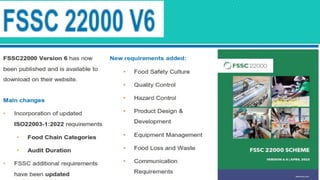
6 Key Changes in FSSC 22000 Version 6
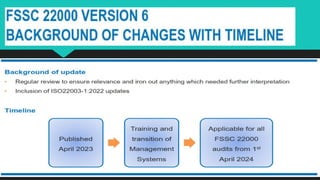
The mandatory upgrade in Apr 2023, and period to
upgrade is from 1 April 2024, to 31 March 2025
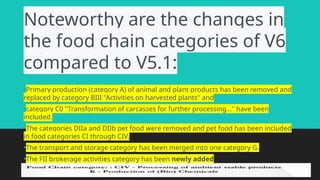
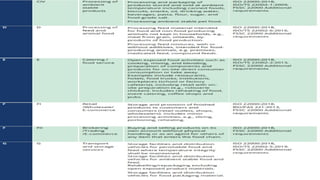
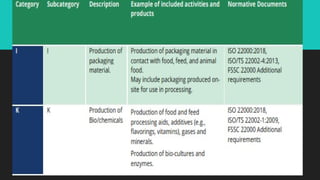
Noteworthy are the changes in
the food chain categories of V6
compared to V5.1:
•Primary production (category A) of animal and plant products has been removed and
replaced by category BIII "Activities on harvested plants" and
•category C0 "Transformation of carcasses for further processing..." have been
included.
•The categories DIIa and DIIb pet food were removed and pet food has been included
in food categories CI through CIV.
•The transport and storage category has been merged into one category G.
•The FII brokerage activities category has been newly added
1) Product Labelling and Printed Materials (2.5.2)
 Version 6 labelling requirements are more detailed and robust than in
Version 5.1 of the standard. These changes align with consumer needs and
regulatory expectations.
 Highlights include…
• Enhanced Specificity: Version 6 places a stronger emphasis on customer-
specific labelling requirements in addition to general statutory and
regulatory compliance.
• Traceability Enhancement: Detailed traceability information is now
required on labels to improve product-origin tracking.
• Label Claim Verification: The new version mandates validation and
verification of label claims to ensure authenticity and integrity.
• Artwork and Print Control: Version 6 introduces specific procedures for
managing artwork and print control for food chain category I to meet legal
and customer requirements.
2) Food Defense and Food Fraud Mitigation (2.5.3 & 2.5.4)
 The FSSC 22000 Version 6 clauses related to food fraud mitigation of
food defense shall be in more detailed than in Version 5.1.
 These changes are a testament to the evolving threats facing the
industry. These enhancements serve to shield the supply chain from
intentional adulteration and ensure the integrity of food products.
Food Defense (2.5.3)
• Documentation and Implementation: While Version 5.1 required a
documented procedure for threat assessment and mitigation, Version
6 specifies that the food defense plan must be reviewed at least
annually or more often when significant changes occur or new
threats are identified.
• Scope of the Defense Plan: Version 6 emphasizes ensuring that
suppliers for food chain category FI have a food defense plan in place,
extending the responsibility beyond the organization’s immediate
operations.
Food Fraud Mitigation (2.5.4)
• Vulnerability Assessment Specifics: Version 6 mandates that the
food fraud vulnerability assessment include both internal and
external elements. This comprehensive approach is designed to
address the entirety of the supply chain.
• Implementation of Mitigation Measures: The updated standard
requires not only the development but also the implementation of
mitigation measures.
• Plan Review and Adaptation: Organizations must now review their
food fraud mitigation plan following significant changes or when new
vulnerabilities are detected, ensuring that the plan remains current
and effective.
3) Management of Allergens (2.5.6)
 Updates to allergen management highlight the importance of
rigorous protocols to prevent allergen cross-contamination and to
safeguard sensitive consumers. These revisions are designed to help
reduce allergen-related incidents, which are one of the top reasons
for food recalls.
• Risk Assessment Scope: Version 6 expands the risk assessment to
ensure validation of control measures, whereas Version 5.1 focused
on assessing potential sources of allergen cross-contamination.
• Cross-Contamination Control Measures: Version 6 details specific
verification of control measures to mitigate cross-contamination.
• Labeling Requirements: Version 6 includes additional labeling
controls, especially regarding precautionary allergen labeling and its
verification.
• Employee Training: Explicit training requirements for all personnel in
allergen management are introduced in Version 6.
• Review and Update: The updated standard calls for an annual review
of the allergen management plan and updates as needed, particularly
after significant changes.
4) Environmental Monitoring (2.5.7)
 FSSC 22000 Version 6 introduces nuanced yet powerful changes to
environmental monitoring program (EMP), with a clear shift toward more
frequent, data-driven reviews and a defined set of triggers for revaluation.
Below are the key distinctions:
• Review Triggers: Version 6 explicitly defines specific events that necessitate a
review of the environmental monitoring program, such as significant
operational changes or the detection of pathogens.
• Review Frequency: The updated version requires at least an annual review of
the environmental monitoring program, promoting regular re-assessment to
ensure ongoing effectiveness.
• Data-Driven Review: There is a new emphasis on using data trends from
environmental monitoring as a basis for reviewing and adjusting the program,
enhancing the rigor of the program’s evaluation process.
5) Food Safety and Quality Culture (2.5.8)
 The requirements in clause 2.5.8 to develop a robust
Food Safety and Quality Culture (FSQC) within organizations may be the most
sweeping change to FSSC 22000 Version 6. It promises to have a profound effect
on food facilities.
 This clause underscores the importance of establishing a foundation of shared
values, beliefs, and norms that drive a proactive approach to food safety
behaviours and practices, going beyond compliance and procedures to the
underlying ethos of how your organization operates.
 Under the standard, an FSQC plan must include:
• Communication: Open, clear, and ongoing dialogue about food safety
practices and expectations at all levels of the organization.
• Training: Comprehensive and continuous food safety training and education
programs that empower all employees to uphold food safety standards.
• Employee Feedback: Mechanisms for staff to voice concerns, contribute
ideas, and be an active part of the food safety conversation.
• Performance Measurement: Objective metrics to assess and improve food
safety activities, ensuring they meet the established goals.
6) Quality Control (2.5.9)
 FSSC 22000 version 6 includes a stronger emphasis on Quality Control (QC) within food safety
systems. This clause mandates the establishment of rigorous QC measures akin to Critical
Control Points for quality, requiring organizations to actively manage and document quality at
every stage of the production process.
 Key Aspects of Clause 2.5.9 include:
• Alignment with ISO Standards: QC is to be integrated with quality policies and objectives as
outlined in ISO 22000:2018.
• Quality Parameters Definition: Establish, implement, and maintain clear quality parameters,
including upper and lower limits, for all products.
• Calibration and Verification: Implement quantity control procedures and regularly calibrate
and verify equipment used for quality and quantity control.
• Start-up and Change-over Controls: Ensure procedures are in place to manage start-up and
change-over processes, maintaining product integrity and compliance.
Additional Important Changes in FSSC 22000 Version 6
Management of Services and Purchased Materials (2.5.1)
• Recycled Packaging Criteria: Version 6 introduces specific criteria for
the use of recycled packaging as a raw material input, ensuring it
meets the same safety and quality requirements as other materials.
• Expansion of Requirements for Specific Food Chain
Categories: While both versions require documented procedures for
emergency procurement and policies for procurement of animals, fish,
and seafood, Version 6 extends these requirements to additional food
chain categories and includes the management of raw material and
finished product specifications.
Logo Use (2.5.5)
 Version 6 clarifies that certified organizations must not imply FSSC
22000 approval on their products, labels, or packaging with the logo,
which is consistent with version 5.1 but specifies additional contexts
like certificates of analysis or conformity and exclusions to the scope
of certification.
Transport, Storage, and Warehousing (2.5.10)
• Tanker Transport: Version 6 includes additional requirements for organizations
using tankers for transport, requiring a documented risk-based plan for
addressing tanker cleaning and cross-contamination measures.
• Enhanced Specificity in Storage and Warehousing: The updated version
specifies that the stock rotation system must include FEFO (First Expired, First
Out) principles in conjunction with FIFO (First In, First Out) requirements.
• Contamination Prevention in Transport: Version 6 provides specific
guidelines for food chain category FI to ensure that product transport and
delivery minimize the potential for contamination.
Hazard Control and Measures for Preventing Cross-Contamination (2.5.11)
• Packaging Requirements for Food Chain Category I: Version 6 maintains the
requirement from 5.1 for specific requirements in cases where packaging is
used to impart a functional effect on food, such as shelf-life extension.
• Inspection Process for Food Chain Category CI: Both versions require specific
inspection procedures to ensure animals are fit for human consumption;
however, Version 6 elaborates on managing the use of substances with
potential adverse animal health effects and includes a broader range of food
chain categories.
• Foreign Matter Management: Version 6 introduces comprehensive
requirements for managing foreign matter, mandating a documented risk
assessment, and specifying the type of detection equipment necessary.
Product Design and Development (2.5.13)
• Introduction of Shelf-life Verification Process: FSSC 22000 Version 6 contains
a requirement for an ongoing shelf-life verification process.
• Cooking Instructions Validation: Version 6 also requires that cooking
instructions provided on the label or packaging for ready-to-cook products be
validated to ensure food safety.
Communication Requirements
• Timely Reporting: Organizations must inform their certification body
within 3 working days of events that affect the
Food Safety Management System (FSMS) or the integrity of the
certification.
• Scope of Reportable Events: Reportable events include serious incidents
affecting food safety, legal compliance, or certification integrity due to
factors like natural disasters, malicious activities, or serious public food
safety events.
• Risk to Certification Integrity: Situations that could potentially damage
the reputation of the certification, such as public recalls, regulatory actions,
or legal issues, must be promptly communicated to the certification body.
THANKU

Key Changes in FSSC 22000 Version 6.pptx

  • 3.
    6 Key Changesin FSSC 22000 Version 6 The mandatory upgrade in Apr 2023, and period to upgrade is from 1 April 2024, to 31 March 2025
  • 5.
    Noteworthy are thechanges in the food chain categories of V6 compared to V5.1: •Primary production (category A) of animal and plant products has been removed and replaced by category BIII "Activities on harvested plants" and •category C0 "Transformation of carcasses for further processing..." have been included. •The categories DIIa and DIIb pet food were removed and pet food has been included in food categories CI through CIV. •The transport and storage category has been merged into one category G. •The FII brokerage activities category has been newly added
  • 9.
    1) Product Labellingand Printed Materials (2.5.2)  Version 6 labelling requirements are more detailed and robust than in Version 5.1 of the standard. These changes align with consumer needs and regulatory expectations.  Highlights include… • Enhanced Specificity: Version 6 places a stronger emphasis on customer- specific labelling requirements in addition to general statutory and regulatory compliance. • Traceability Enhancement: Detailed traceability information is now required on labels to improve product-origin tracking. • Label Claim Verification: The new version mandates validation and verification of label claims to ensure authenticity and integrity. • Artwork and Print Control: Version 6 introduces specific procedures for managing artwork and print control for food chain category I to meet legal and customer requirements.
  • 10.
    2) Food Defenseand Food Fraud Mitigation (2.5.3 & 2.5.4)  The FSSC 22000 Version 6 clauses related to food fraud mitigation of food defense shall be in more detailed than in Version 5.1.  These changes are a testament to the evolving threats facing the industry. These enhancements serve to shield the supply chain from intentional adulteration and ensure the integrity of food products.
  • 11.
    Food Defense (2.5.3) •Documentation and Implementation: While Version 5.1 required a documented procedure for threat assessment and mitigation, Version 6 specifies that the food defense plan must be reviewed at least annually or more often when significant changes occur or new threats are identified. • Scope of the Defense Plan: Version 6 emphasizes ensuring that suppliers for food chain category FI have a food defense plan in place, extending the responsibility beyond the organization’s immediate operations.
  • 12.
    Food Fraud Mitigation(2.5.4) • Vulnerability Assessment Specifics: Version 6 mandates that the food fraud vulnerability assessment include both internal and external elements. This comprehensive approach is designed to address the entirety of the supply chain. • Implementation of Mitigation Measures: The updated standard requires not only the development but also the implementation of mitigation measures. • Plan Review and Adaptation: Organizations must now review their food fraud mitigation plan following significant changes or when new vulnerabilities are detected, ensuring that the plan remains current and effective.
  • 13.
    3) Management ofAllergens (2.5.6)  Updates to allergen management highlight the importance of rigorous protocols to prevent allergen cross-contamination and to safeguard sensitive consumers. These revisions are designed to help reduce allergen-related incidents, which are one of the top reasons for food recalls.
  • 14.
    • Risk AssessmentScope: Version 6 expands the risk assessment to ensure validation of control measures, whereas Version 5.1 focused on assessing potential sources of allergen cross-contamination. • Cross-Contamination Control Measures: Version 6 details specific verification of control measures to mitigate cross-contamination. • Labeling Requirements: Version 6 includes additional labeling controls, especially regarding precautionary allergen labeling and its verification. • Employee Training: Explicit training requirements for all personnel in allergen management are introduced in Version 6. • Review and Update: The updated standard calls for an annual review of the allergen management plan and updates as needed, particularly after significant changes.
  • 15.
    4) Environmental Monitoring(2.5.7)  FSSC 22000 Version 6 introduces nuanced yet powerful changes to environmental monitoring program (EMP), with a clear shift toward more frequent, data-driven reviews and a defined set of triggers for revaluation. Below are the key distinctions: • Review Triggers: Version 6 explicitly defines specific events that necessitate a review of the environmental monitoring program, such as significant operational changes or the detection of pathogens. • Review Frequency: The updated version requires at least an annual review of the environmental monitoring program, promoting regular re-assessment to ensure ongoing effectiveness. • Data-Driven Review: There is a new emphasis on using data trends from environmental monitoring as a basis for reviewing and adjusting the program, enhancing the rigor of the program’s evaluation process.
  • 16.
    5) Food Safetyand Quality Culture (2.5.8)  The requirements in clause 2.5.8 to develop a robust Food Safety and Quality Culture (FSQC) within organizations may be the most sweeping change to FSSC 22000 Version 6. It promises to have a profound effect on food facilities.  This clause underscores the importance of establishing a foundation of shared values, beliefs, and norms that drive a proactive approach to food safety behaviours and practices, going beyond compliance and procedures to the underlying ethos of how your organization operates.  Under the standard, an FSQC plan must include:
  • 17.
    • Communication: Open,clear, and ongoing dialogue about food safety practices and expectations at all levels of the organization. • Training: Comprehensive and continuous food safety training and education programs that empower all employees to uphold food safety standards. • Employee Feedback: Mechanisms for staff to voice concerns, contribute ideas, and be an active part of the food safety conversation. • Performance Measurement: Objective metrics to assess and improve food safety activities, ensuring they meet the established goals.
  • 18.
    6) Quality Control(2.5.9)  FSSC 22000 version 6 includes a stronger emphasis on Quality Control (QC) within food safety systems. This clause mandates the establishment of rigorous QC measures akin to Critical Control Points for quality, requiring organizations to actively manage and document quality at every stage of the production process.  Key Aspects of Clause 2.5.9 include: • Alignment with ISO Standards: QC is to be integrated with quality policies and objectives as outlined in ISO 22000:2018. • Quality Parameters Definition: Establish, implement, and maintain clear quality parameters, including upper and lower limits, for all products. • Calibration and Verification: Implement quantity control procedures and regularly calibrate and verify equipment used for quality and quantity control. • Start-up and Change-over Controls: Ensure procedures are in place to manage start-up and change-over processes, maintaining product integrity and compliance.
  • 19.
    Additional Important Changesin FSSC 22000 Version 6 Management of Services and Purchased Materials (2.5.1) • Recycled Packaging Criteria: Version 6 introduces specific criteria for the use of recycled packaging as a raw material input, ensuring it meets the same safety and quality requirements as other materials. • Expansion of Requirements for Specific Food Chain Categories: While both versions require documented procedures for emergency procurement and policies for procurement of animals, fish, and seafood, Version 6 extends these requirements to additional food chain categories and includes the management of raw material and finished product specifications.
  • 20.
    Logo Use (2.5.5) Version 6 clarifies that certified organizations must not imply FSSC 22000 approval on their products, labels, or packaging with the logo, which is consistent with version 5.1 but specifies additional contexts like certificates of analysis or conformity and exclusions to the scope of certification.
  • 21.
    Transport, Storage, andWarehousing (2.5.10) • Tanker Transport: Version 6 includes additional requirements for organizations using tankers for transport, requiring a documented risk-based plan for addressing tanker cleaning and cross-contamination measures. • Enhanced Specificity in Storage and Warehousing: The updated version specifies that the stock rotation system must include FEFO (First Expired, First Out) principles in conjunction with FIFO (First In, First Out) requirements. • Contamination Prevention in Transport: Version 6 provides specific guidelines for food chain category FI to ensure that product transport and delivery minimize the potential for contamination.
  • 22.
    Hazard Control andMeasures for Preventing Cross-Contamination (2.5.11) • Packaging Requirements for Food Chain Category I: Version 6 maintains the requirement from 5.1 for specific requirements in cases where packaging is used to impart a functional effect on food, such as shelf-life extension. • Inspection Process for Food Chain Category CI: Both versions require specific inspection procedures to ensure animals are fit for human consumption; however, Version 6 elaborates on managing the use of substances with potential adverse animal health effects and includes a broader range of food chain categories. • Foreign Matter Management: Version 6 introduces comprehensive requirements for managing foreign matter, mandating a documented risk assessment, and specifying the type of detection equipment necessary.
  • 23.
    Product Design andDevelopment (2.5.13) • Introduction of Shelf-life Verification Process: FSSC 22000 Version 6 contains a requirement for an ongoing shelf-life verification process. • Cooking Instructions Validation: Version 6 also requires that cooking instructions provided on the label or packaging for ready-to-cook products be validated to ensure food safety.
  • 24.
    Communication Requirements • TimelyReporting: Organizations must inform their certification body within 3 working days of events that affect the Food Safety Management System (FSMS) or the integrity of the certification. • Scope of Reportable Events: Reportable events include serious incidents affecting food safety, legal compliance, or certification integrity due to factors like natural disasters, malicious activities, or serious public food safety events. • Risk to Certification Integrity: Situations that could potentially damage the reputation of the certification, such as public recalls, regulatory actions, or legal issues, must be promptly communicated to the certification body.
  • 25.