www.nqa.com


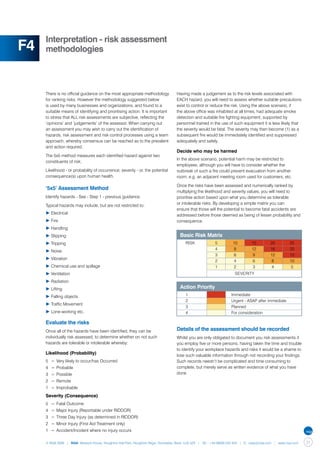
                   OHSAS 18001


                  Guide to implementing
                       a Health & Safety
                   Management System


              1
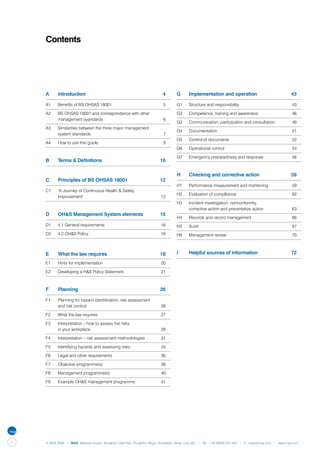
Contents


    A	     Introduction	                                                 4       G	     Implementation and operation	                               43

    A1	    Benefits of BS OHSAS 18001	                                   5       G1	    Structure and responsibility	                                43

    A2	    BS OHSAS 18001 and correspondence with other                          G2	    Competence, training and awareness	                          46
    	      management syandards	                                         6
                                                                                 G3	    Communication, participation and consultation	               49
    A3	    Similarities between the three major management 	
                                                                                 G4	    Documentation	                                               51
    	      system standards	                                             7
                                                                                 G5	    Control of documents	                                        52
    A4	    How to use this guide	                                        9
                                                                                 G6	    Operational control	                                         54

                                                                                 G7	    Emergency preparedness and response	                         56
    B	     Terms & Definitions	                                        10

                                                                                 H	     Checking and corrective action	                             59
    C	     Principles of BS OHSAS 18001	                               12
                                                                                 H1	    Performance measurement and monitoring	                      59
    C1	    “A Journey of Continuous Health & Safety
                                                                                 H2	    Evaluation of complliance	                                   62
    	      Improvement”	                                                12
                                                                                 H3	    Incident investigation, nonconformity,
                                                                                 	      corrective action and preventative action	                   63
    D	     OH&S Management System elements	                            15
                                                                                 H4	    Records and record management	                               66
    D1	    4.1 General requirements	                                    16       H5	    Audit	                                                       67
    D2	    4.2 OH&S Policy	                                             16       H6	    Management review	                                           70


    E	     What the law requires	                                      18        I	     Helpful sources of information	                             72

    E1	    Hints for implementation	                                    20

    E2	    Developing a H&S Policy Statement	                           21


    F	     Planning	                                                   26

    F1	    Planning for hazard identification, risk assessment
    	      and risk control	                                            26

    F2	    What the law requires	                                       27

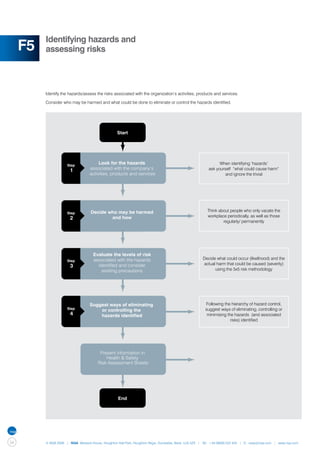
    F3	    Interpretation – how to assess the risks
    	      in your workplace	                                           29

    F4	    Interpretation – risk assessment methodologies	              31

    F5	    Identifying hazards and assessing risks	                     34

    F6	    Legal and other requirements	                                36

    F7	    Objective programme(s)	                                      38

    F8	    Management programme(s)	                                     40

    F9	    Example OH&S management programme	                           41


2   © NQA 2009 | NQA Warwick House, Houghton Hall Park, Houghton Regis, Dunstable, Beds. LU5 5ZX | Tel: +44 08000 522 424 | E: osas@nqa.com | www.nqa.com
A


    	 A	 Introduction
    	 A1	    Benefits of BS OHSAS 18001

    	 A2	    BS OHSAS 18001 and correspondence with other management standards

    	 A3	    Similarities between the three major management system standards

    	 A4	    How to use this guide


    © NQA 2009 | NQA Warwick House, Houghton Hall Park, Houghton Regis, Dunstable, Beds. LU5 5ZX | Tel: +44 08000 522 424 | E: osas@nqa.com | www.nqa.com   3
Introduction
    A

        In a climate of increasing health and safety legislation and                 Background to health and safety
        liabilities, organizations of all sizes and industry sectors are
                                                                                     The history of occupational health and safety in Great Britain is to
        now looking at management systems as a framework for
                                                                                     a great extent a story of legislative control over industry. In fact,
        improving their health and safety performance.
                                                                                     until the introduction of the Health and Safety at Work etc. Act
        The first guide published to assist directors, managers and                  1974, legislation consisted of a series of statutes passed on an
        health and safety professionals to meet their obligations was                ad hoc basis in an endeavour to control safety. The first statute to
        HS (G) 65 – Successful health and safety management. This guide              be passed was the Health and Morals of Apprentices Act 1802,
        was produced by the Health and Safety Executive in 1991 and                  which, sought to combat the dreadful conditions experienced by
        conveys the simple message that ‘organizations need to manage                child apprentices within the cotton industry. As well as limiting
        health and safety with the same degree of expertise and to the               the number of hours worked, it specified minimum standards for
        same standards as other core business activities’. It is based upon          lighting, heating and ventilation. Visitors appointed to factories by
        the quality management concepts of Plan, Do, Check and Act and               local magistrates regulated compliance.
        promotes Policy, Organising, Planning, Measuring Performance
                                                                                     Present day factory legislation is contained within the Factories Act
        and Auditing and Reviewing Performance as the key elements as
                                                                                     1961, which consolidated many of the earlier statutes. The Act, in
        being contributors to successful health and safety management.
                                                                                     conjunction with other legislation, is being replaced by The Health
        Following on from the success of HS (G) 65, BS 8800 – the                    and Safety at Work etc. Act 1974 and the supporting regulations
        Guide to Occupational Health and Safety Management Systems,                  passed under it.
        was introduced in 1996. This British Standard was intended to
                                                                                     The Health and Safety at Work etc Act 1974 enabled, for the first
        encourage organizations to adopt an occupational health and
                                                                                     time, broad general duties to be placed upon ALL workplaces and
        safety management system, based upon two approaches:
                                                                                     allowed for the introduction of more specific codes of practice.
        ▶	HS(G) 65
                                                                                     The Health and Safety at Work Act also:
        ▶	BS EN ISO 14001
                                                                                     ▶	Established the Health and Safety Commission (HSC) and gave 	
        BS 8800 merely translated the key concepts detailed within                   	 it the power to propose health and safety regulations and
        HS (G) 65 into specific measurable elements. It also sought to               	 Approved Codes of Practice (ACoPs)
        encourage organizations that had adopted sound environmental                 ▶	Set up the Health and Safety Executive (HSE) as the unified 	
        management systems compliant with the requirements of                        	 executive arm of the HSC with the responsibility for enforcing
        ISO 14001, to implement a formal documented OHS Management                   	 health and safety laws
        System.
                                                                                     ▶	Gave health and safety inspectors their enforcement powers
        However, BS8800 contained only guidance and recommendations,
                                                                                     ▶	For the first time in history, placed regulatory duties upon
        and as such could not be used for certification purposes.
                                                                                     	 the self employed
        Following the success of ISO 14001 (Environmental Management                 ▶	Made provisions for the appointment of safety representatives 	
        Systems) and ISO 9001 (Quality Management Systems), and                      	 and safety committees.
        in response to a demand for a recognisable OHS Management
        System ‘standard’ against which organizations could be assessed              However, the regulatory pressures placed upon industry are on
        and certificated, OHSAS (Occupational Health and Safety                      the increase, particularly with added demands being placed
        Assessment Series) 18001:1999 and the accompanying guide                     through EU directives. Such directives have been responsible for
        OHSAS 18002:2000 were published.                                             most of the recent UK health and safety regulations including the
                                                                                     Control of Substances Hazardous to Health Regulations (COSHH)
        Reviewed and revised in 2007, BS OHSAS 18001 is now fully                    and the Construction (Design and Management) Regulations to
        compatible with ISO 9001 and ISO 14001 in order to facilitate the            name but two.
        integration of quality, environmental and occupational health and
        safety management systems by organizations, should they wish to
        do so.


4       © NQA 2009 | NQA Warwick House, Houghton Hall Park, Houghton Regis, Dunstable, Beds. LU5 5ZX | Tel: +44 08000 522 424 | E: osas@nqa.com | www.nqa.com
Benefits of BS OHSAS 18001
A1

     There are many reasons for organizations to decide to implement
     an occupational health and safety management system, not least
     the reduced risk of failing to comply with legislation. A systematic
     approach to the effective management of health and safety can
     bring numerous benefits such as:

     Compliance with legislation
     BS OHSAS 18001 provides a framework by which an organization
     can identify the health and safety legislation applicable to its
     activities, products, services and identified hazards. Such a
     framework extends to provide the means to comply with the
     regulatory requirements identified.

     Ownership of health and safety issues
     BS OHSAS 18001 provides the means by which an organization
     can communicate and consult upon its health and safety issues.

     Nominal effort is required
     Companies with a formal documented management
     system compliant with ISO 9001 (Quality) and/or ISO 14001
     (Environmental) can easily extend existing system controls to
     encompass the management of health and safety.

     Training needs are identified and realised
     BS OHSAS 18001 enables health and safety training needs to be
     identified, and the adequacy of subsequent training assessed
     through measures of competency.

     Reduce costs
     The cost of an accident extends beyond the compensation paid
     to an employee. By implementing health and safety improvement
     strategies, through the effective implementation of a documented
     OH&S Management System, significant financial savings can be
     realised; not forgetting the effect that accident reduction can have
     upon the morale of employees.

     Opportunity for integration
     Compatibility with ISO 9001/14001 provides an opportunity
     to integrate your management systems, thereby reducing
     bureaucracy and maximising effectiveness.

     Liabilities minimised
     As hazards and their associated risks are eliminated or controlled
     liabilities are reduced, offering greater stability to your business.


     © NQA 2009 | NQA Warwick House, Houghton Hall Park, Houghton Regis, Dunstable, Beds. LU5 5ZX | Tel: +44 08000 522 424 | E: osas@nqa.com | www.nqa.com   5
BS OHSAS 18001 and
    A2   correspondence with other
         management standards


         Introduction                                                                 All the requirements of BS OHSAS 18001 are intended to be
                                                                                      incorporated into any OH&S Management System. The extent of
         This section includes an overview of BS OHSAS 18001
                                                                                      the application of the specification will depend on factors such as
         – Occupational Health and Safety Management Systems –
                                                                                      the policy statement, the nature of the activities of the organization
         Specification and OHSAS 18002 – Occupational Health and Safety
                                                                                      and the risks and complexity of its operations. It is intended to
         Management Systems – Guidelines for the implementation of
                                                                                      address occupational health and safety rather than product and
         BS OHSAS 18001 and how they correspond to other management
                                                                                      services safety.
         standards designed to manage quality and environmental issues.
                                                                                      OHSAS 18002 is the guidance, providing generic advice on
         BS OHSAS 18001 is a specification giving requirements for an
                                                                                      the application of BS OHSAS 18001. It explains the underlying
         Occupational Health and Safety OH&S Management System, to
                                                                                      principles of BS OHSAS 18001 and describes the intent, typical
         enable an organization to control its OH&S risks and improve its
                                                                                      inputs, processes and typical outputs, against each requirement of
         performance. It does not lay down specific performance criteria
                                                                                      the standard in order to aid the implementation process. It does not
         or give detailed specifications for the actual structure or form of
                                                                                      contain any additional requirements or prescribe any mandatory
         the management system. It is applicable to any organization that
                                                                                      approaches to the implementation of BS OHSAS 18001.
         wishes to:

         ▶	Establish an OH&S Management System to eliminate or 		                     Correspondence with other standards
         	 minimize risk to employees and other interested parties who 	
                                                                                      The table on the following page represents the correspondence
         	 may be exposed to OH&S risks associated with its activities
                                                                                      between BS OHSAS 18001, ISO 14001 and ISO 9001. As
         ▶	Implement, maintain and continually improve an OH&S 		                     previously discussed BS OHSAS 18001 closely follows the
         	 Management System                                                          principles of quality management (Plan, Do, Check and Act)
         ▶	Assure itself of its conformance with its stated OH&S policy               reflecting the key principles and structure of other management
                                                                                      systems. The link between health and safety management and
         ▶	Demonstrate such conformance to others
                                                                                      environmental management is strong and almost all of the
         ▶	Seek certification/ registration of its OH&S Management System 	           BS OHSAS 18001 clauses are similar to ISO 14001 the potential for
         	 by an external organization                                                integration of these two systems is therefore very clear.
         ▶	Make a self-determination and declaration of conformance with 	
         	 this OHSAS specification.


6        © NQA 2009 | NQA Warwick House, Houghton Hall Park, Houghton Regis, Dunstable, Beds. LU5 5ZX | Tel: +44 08000 522 424 | E: osas@nqa.com | www.nqa.com
Similarities between the
A3   three major management
     system standards


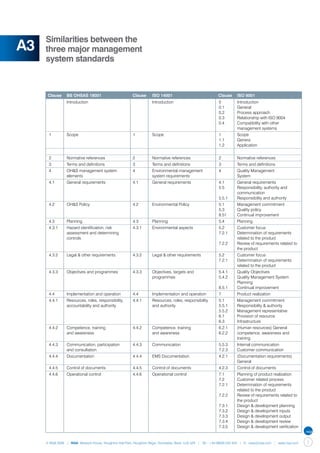
     	 Clause 	BS OHSAS 18001	                          Clause     ISO 14001	                             Clause	 ISO 9001
     		 Introduction		 Introduction	 0	                                                                              Introduction
     					                           0.1	                                                                            General
     					                           0.2	                                                                            Process approach
     					                           0.3	                                                                            Relationship with ISO 9004
     					                           0.4	                                                                            Compatibility with other 		
     						                                                                                                          management systems
     	 1	 Scope	 1	 Scope	                                                                                 1	        Scope
     					                                                                                                 1.1	      Genera
     					                                                                                                 1.2	      Application	


     	 2	        Normative references	                  2	         Normative references	                   2	        Normative references
     	 3	        Terms and definitions	                 3	         Terms and definitions	                  3	        Terms and definitions
     	 4	        OH&S management system 	 4	                       Environmental management 	 4	                     Quality Management			
     		          elements		                                        system requirements		                             System
     	 4.1	 General requirements	 4.1	 General requirements	 4.1	                                                    General requirements
     					                                                   5.5	                                                    Responsibility, authority and 		
     						                                                                                                          communication
     					                                                   5.5.1	                                                  Responsibility and authority	
     	 4.2	 OH&S Policy	 4.2	 Environmental Policy	                                                        5.1	      Management commitment
     					                                                                                                 5.3	      Quality policy
     					                                                                                                 8.51	     Continual improvement	
     	 4.3	      Planning 	                             4.3	       Planning	                               5.4	      Planning
     	 4.3.1	 Hazard identification, risk 	 4.3.1	 Environmental aspects	 5.2	                                       Customer focus
     		       assessment and determining 			                              7.2.1	                                     Determination of requirements 		
     		       controls				                                                                                           related to the product
     					                                                                7.2.2	                                     Review of requirements related to 	
     						                                                                                                          the product
     	 4.3.2	 Legal & other requirements	 4.3.2	 Legal & other requirements	 5.2	                                    Customer focus
     					                                                                   7.2.1	                                  Determination of requirements 		
     						                                                                                                          related to the product
     	 4.3.3	 Objectives and programmes	 4.3.3	 Objectives, targets and 	 5.4.1	                                     Quality Objectives
     				                                       programmes	               5.4.2	                                     Quality Management System 		
     						                                                                                                          Planning
     					                                                                8.5.1	                                     Continual improvement
     	 4.4	      Implementation and operation	          4.4	       Implementation and operation	           7	        Product realization
     	 4.4.1	 Resources, roles, responsibility, 	 4.4.1	 Resources, roles, responsibility 	                5.1	      Management commitment
     		       accountability and authority		             and authority	                                    5.5.1	    Responsibility & authority
     					                                                                                                 5.5.2	    Management representative
     					                                                                                                 6.1	      Provision of resource
     					                                                                                                 6.3	      Infrastructure	
     	 4.4.2	 Competence, training 	 4.4.2	 Competence, training	 6.2.1	                                             (Human resources) General
     		       and awareness		               and awareness	        6.2.2	                                             competence, awareness and 		
     						                                                                                                          training		
     	 4.4.3	    Communication, participation 	 4.4.3	 Communication	                                      5.5.3	    Internal communication
     		          and consultation			                                                                       7.2.3	    Customer communication	
     	 4.4.4	 Documentation	 4.4.4	 EMS Documentation	 4.2.1	                                                        (Documentation requirements) 		
     						                                                                                                          General
     	 4.4.5	    Control of documents	                  4.4.5	     Control of documents	                   4.2.3	    Control of documents
     	 4.4.6	 Operational control	 4.4.6	 Operational control	 7.1	                                                  Planning of product realization
     					                                                     7.2	                                                  Customer related process
     					                                                     7.2.1	                                                Determination of requirements 		
     						                                                                                                          related to the product
     					                                                     7.2.2	                                                Review of requirements related to 	
     						                                                                                                          the product
     					                                                     7.3.1	                                                Design & development planning
     					                                                     7.3.2	                                                Design & development inputs
     					                                                     7.3.3	                                                Design & development output
     					                                                     7.3.4	                                                Design & development review
     					                                                     7.3.5	                                                Design & development verification


     © NQA 2009 | NQA Warwick House, Houghton Hall Park, Houghton Regis, Dunstable, Beds. LU5 5ZX | Tel: +44 08000 522 424 | E: osas@nqa.com | www.nqa.com   7
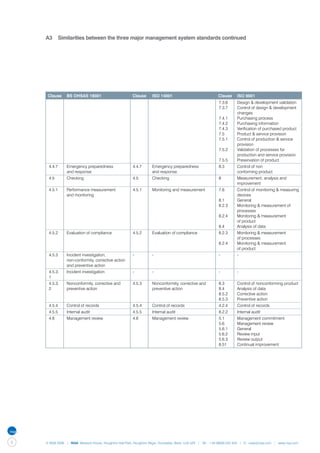
A3	 Similarities between the three major management system standards continued


    	 Clause 	BS OHSAS 18001	                          Clause     ISO 14001	                             Clause	 ISO 9001
    					 7.3.6	                                                                                                    Design & development validation
    					 7.3.7	                                                                                                    Control of design & development 	
    						                                                                                                          changes
    					 7.4.1	                                                                                                    Purchasing process
    					 7.4.2	                                                                                                    Purchasing information
    					 7.4.3	                                                                                                    Verification of purchased product
    					 7.5	                                                                                                      Product & service provision
    					 7.5.1	                                                                                                    Control of production & service 		
    						                                                                                                          provision
    					 7.5.2	                                                                                                    Validation of processes for 		
    						                                                                                                          production and service provision
    					 7.5.5	                                                                                                    Preservation of product
    	 4.4.7	    Emergency preparedness 	 4.4.7	                   Emergency preparedness 	 8.3	                     Control of non 			
    		          and response		                                    and response		                                    conforming product
    	 4.5	 Checking	 4.5	 Checking	 8	                                                                              Measurement, analysis and 		
    						                                                                                                          improvement
    	 4.5.1	 Performance measurement 	 4.5.1	 Monitoring and measurement	 7.6	                                      Control of monitoring & measuring 	
    		       and monitoring				                                                                                     devices
    					                                                                 8.1	                                      General
    					                                                                 8.2.3	                                    Monitoring & measurement of 		
    						                                                                                                          processes
    					                                                                 8.2.4	                                    Monitoring & measurement
    						                                                                                                          of product
    					                                                                 8.4	                                      Analysis of data
    	 4.5.2	 Evaluation of compliance	 4.5.2	 Evaluation of compliance	 8.2.3	                                      Monitoring & measurement
    						                                                                                                          of processes
    					                                                               8.2.4	                                      Monitoring & measurement
    						                                                                                                          of product
    	 4.5.3	    Incident investigation, 	              -	         -	                                      -	        -
    		          non-conformity, corrective action
    		          and preventive action	
    	 4.5.3.	   Incident investigation	                -	         -	                                      -	        -
    	 1
    	 4.5.3.	 Nonconformity, corrective and 	 4.5.3	 Nonconformity, corrective and 	                      8.3	      Control of nonconforming product
    	 2	      preventive action		                    preventive action	                                   8.4	      Analysis of data
    					                                                                                                 8.5.2	    Corrective action
    					                                                                                                 8.5.3	    Preventive action
    	 4.5.4	    Control of records	                    4.5.4	     Control of records	                     4.2.4	    Control of records
    	 4.5.5	    Internal audit	                        4.5.5	     Internal audit	                         8.2.2	    Internal audit
    	 4.6	 Management review	 4.6	 Management review	                                                     5.1	      Management commitment	
    					                                                                                                 5.6	      Management review
    					                                                                                                 5.6.1	    General
    					                                                                                                 5.6.2	    Review input
    					                                                                                                 5.6.3	    Review output	
    					                                                                                                 8.51	     Continual improvement


8   © NQA 2009 | NQA Warwick House, Houghton Hall Park, Houghton Regis, Dunstable, Beds. LU5 5ZX | Tel: +44 08000 522 424 | E: osas@nqa.com | www.nqa.com
How to use this guide
A4

     This guide is primarily focused on those people who are about                Each clause contains, where appropriate, one or more self-
     to implement an Occupational Health and Safety Management                    assessment questions (SAQ’s). These can be used to gauge the
     Systems in their organization.                                               current position of the organization with respect to meeting the
                                                                                  requirements of the specification or to gauge progress during
     This guidance will be helpful to organizations of all sizes and
                                                                                  implementation. If you can answer yes to all of the SAQ’s, you are
     structures. This book will also be helpful to other interested parties
                                                                                  probably ready for registration to BS OHSAS 18001. If not, work
     who seek a better understanding of Occupational Health and
                                                                                  through this book or contact NQA at the address below.
     Safety Management Systems in general and BS OHSAS 18001
     in particular.
                                                                                    NQA
     The main section of the guide addresses each clause of                         Warwick House
     BS OHSAS 18001. Broken down into headings, it aims to simplify                 Houghton Hall Park
     the intentions of each clause and gives practical guidance on how              Houghton Regis
     to implement the clause and meet the requirements of the OHSAS                 Dunstable
     specification.                                                                 LU5 5ZX

     The guide should be used in conjunction with BS OHSAS 18001                    Tel: +44 08000 522 424
     and OHSAS 18002; it provides an interpretation and guidance                    Fax: +44 (0)1582 539090
     to the intention of each clause. It should be noted that this is an            E-mail: ohsas@nqa.com
     interpretation only and the OHSAS specification itself should be               Website: www.nqa.com
     referred to.


     © NQA 2009 | NQA Warwick House, Houghton Hall Park, Houghton Regis, Dunstable, Beds. LU5 5ZX | Tel: +44 08000 522 424 | E: osas@nqa.com | www.nqa.com   9
Terms and definitions
     B

         Acceptable risk: risk that has been reduced to a level that can be               NOTE: a management system is a set of interrelated elements used to
         tolerated by the organization having regard to its legal obligations             establish policy and objectives and to achieve those objectives.
         and its own OH&S policy.                                                         NOTE: a management system includes organizational structure, planning
         Audit systematic: independent and documented process                             activities (including for example, risk assessment and the setting of
                                                                                          objectives), responsibilities, practices, procedures , processes and
         for obtaining “audit evidence” and evaluating it objectively to
                                                                                          resources.
         determine the extent to which “audit criteria” are fulfilled.
         NOTE: independent does not necessarily mean external to the organization.        OH&S objective: OH&S goal, in terms of OH&S performance, that
         In many cases, particularly in smaller organizations, independence can           an organization sets itself to achieve.
         be demonstrated by the freedom from responsibility for the activity being
                                                                                          NOTE: objectives should be quantified wherever practicable.
         audited.
                                                                                          NOTE: 4.3.3 requires that OH&S objectives are consistent with the
         NOTE: for further guidance on “audit evidence” and “audit criteria” see
                                                                                          OH&S policy
         ISO 19011.

         Continual improvement: recurring process of enhancing the                        OH&S performance: measurable results of an organization’s
         OH&S Management System in order to achieve improvements                          management of its OH&S risks.
         in overall OH&S performance consistent with the organization’s                   NOTE: OH&S performance measurement includes measuring the
         OH&S policy.                                                                     effectiveness of the organization’s controls

         NOTE: the process need not take place in all areas of activity simultaneously.   NOTE: in the context of OH&S Management Systems, results can also be
                                                                                          measured against the organization’s OH&S policy, OH&S objectives and
         NOTE: adapted from ISO 14001:2004.                                               other OH&S performance requirements.
         Corrective action: action to eliminate the cause of a detected                   OH&S Policy: overall intentions and direction of an organization
         nonconformity or other undesirable situation                                     related to its OH&S performance as formally expressed by top
         NOTE: there can be more than one cause for a nonconformity.                      management.
         NOTE: corrective action is taken to prevent recurrence whereas preventive        NOTE: the OH&S policy provides a framework for action and for the setting
         action is taken to prevent occurrence.                                           of OH&S objectives

         Document: information and its supporting medium.                                 Organization: company, corporation, firm, enterprise, authority or
         NOTE: the medium can be paper, magnetic, electronic or optical computer          institution, or part or combination thereof, whether incorporated or
         disc, photograph or master sample, or a combination thereof.                     not, public or private, that has its own functions and administration.
                                                                                          NOTE: for organizations with more than one operating unit, a single
         Hazard: source, situation, or act with a potential for harm in terms             operating unit may be defined as an organization.
         of human injury or ill health, or a combination of these.
                                                                                          Preventive action: action to eliminate the cause of a potential
         Hazard identification: process of recognizing that a hazard exists
                                                                                          nonconformity or other undesirable potential situation.
         and defining its characteristics.
                                                                                          NOTE: there can be more than one cause for a potential nonconformity.
         Ill health: identifiable, adverse physical or mental condition arising
         from and/or made worse by a work activity and/or work-related                    NOTE: preventive action is taken to prevent occurrence whereas corrective
         situation.                                                                       action is taken to prevent recurrence.

         Incident: work-related event(s) in which an injury or ill health                 Procedure: specified way to carry out an activity or a process.
         (regardless of severity) or fatality occurred, or could have occurred.           NOTE: procedures can be documented or not.
         NOTE: an accident is an incident which has given rise to injury, ill health      Record: document stating results achieved or providing evidence
         or fatality.
                                                                                          of activities performed.
         NOTE: an incident where no injury, ill health, or fatality occurs may also
                                                                                          Risk: combination of the likelihood of an occurrence of a
         be referred to as a “near-miss”, “near-hit”, “close call” or “dangerous
         occurrence”                                                                      hazardous event or exposure(s) and the severity of injury or ill
                                                                                          health that can be caused by the event or exposure(s).
         NOTE: an emergency situation is a particular type of incident.
                                                                                          Risk assessment: process of evaluating the risk(s) arising from
         Interested party: person or group, inside or outside the                         a hazard(s), taking into account the adequacy of any existing
         workplace, concerned with or affected by the OH&S performance                    controls, and deciding whether or not the risk(s) is acceptable.
         of an organization.
                                                                                          Workplace: any physical location in which work related activities
         Nonconformity: non-fulfilment of a requirement.                                  are performed under the control of the organization.
         Occupational Health and Safety (OH&S): conditions and factors                    NOTE: when giving consideration to what constitutes a workplace, the
         that affect, or could affect the health and safety of employees                  organization should take into account the OH&S effects on personnel who
         or other workers (including temporary workers and contractor                     are, for example, travelling or in transit (e.g. driving, flying, on boats or trains),
                                                                                          working at the premises of a client or customer, or working at home.
         personnel), visitors, or any other person in the workplace.
         NOTE: organizations can be subject to legal requirements for the health and      NOTE: some reference documents use the term “risk assessment” to
         safety of persons beyond the immediate workplace, or who are exposed to          encompass the entire process of hazard identification, determination of risk,
         the workplace activities                                                         and the selection of appropriate risk reduction or risk control measures.
                                                                                          OHSAS 18001 and OHSAS 18002 refer to the individual elements of this
         OH&S Management System: part of an organization’s                                process separately and use the term “risk assessment” to refer to the
         management system used to develop and implement its OH&S                         second of its steps, namely the determination of risk.
         policy and manage its OH&S risks.


10       © NQA 2009 | NQA Warwick House, Houghton Hall Park, Houghton Regis, Dunstable, Beds. LU5 5ZX | Tel: +44 08000 522 424 | E: osas@nqa.com | www.nqa.com
C


    	 C	 Principles of BS OHSAS 18001
    	 C1	    “A Journey of Continuous Health & Safety Improvement”


    © NQA 2009 | NQA Warwick House, Houghton Hall Park, Houghton Regis, Dunstable, Beds. LU5 5ZX | Tel: +44 08000 522 424 | E: osas@nqa.com | www.nqa.com   11
Principles of BS OHSAS 18001
     C


          “A Journey of Continuous
     C1   Health & Safety Improvement”


          Are you about to embark upon the journey of health and safety                Health Regulations - COSHH). You will need to identify the ‘one-
          improvement? It is now recognised by many companies that to                  way’ streets (legislative obligations) that you will have to travel
          embark upon such a journey will require a reliable and robust                down upon your journey and ensure that your road map (policy
          vehicle to transport them to their desired destination.                      statement) makes reference to them. To avoid driving down a ‘new’
                                                                                       one-way street the wrong way you will have to keep up to date with
          If BS OHSAS 18001 is to be your chosen vehicle, then the steps
                                                                                       changes to legislation.
          involved in implementing such a system can be likened to any
          journey that you would undertake in everyday life.
                                                                                       Objectives
          Health & Safety Policy                                                       The mandatory ‘points of call’
          Is the ‘road map’                                                            Detail where you need to be, and by when, to arrive at your ultimate
                                                                                       destination. Consideration will have to be taken as to the least
          Your health and safety policy should provide clear ‘direction’ as to
                                                                                       hazardous routes (risk assessment results), the one-way streets
          where you want to be and the strategies that are to be deployed
                                                                                       that you need to negotiate (legal compliance) and your overall
          to enable you to reach your chosen destination. It should clarify
                                                                                       journey map (policy statement) when identifying your mandatory
          the vehicle to be used, (in this case BS OHSAS 18001) and detail
                                                                                       points of call.
          who will be responsible for driving and steering it throughout the
          whole journey. As all employees will be required to travel along
          with you, your planned journey will have to be communicated to all
                                                                                       OH&S management programmes
          employees and a copy of the road map (OH&S policy statement)                 Your complete travel ‘timetable’
          explained to everyone, therefore avoiding the journey becoming a             Once you have identified your mandatory points of call (objectives),
          ‘mystery tour’.                                                              you can begin to map out the quickest and safest journey route
                                                                                       (management programme). With start and completion dates being
          Planning for hazard identification, risk assessment                          assigned between each point of call, the time taken to reach the
          and risk control                                                             ultimate destination can be calculated, the appropriate number of
          ‘Route planning’                                                             ‘driver’s assigned and consideration given to the amounts of fuel
                                                                                       required (£).
          Before you set off upon your journey, an assessment will have to be
          made to identify any actual or potential hazards that may prevent
                                                                                       Structure & responsibility
          you from reaching your ultimate destination (hazard identification
          and risk assessment) and your route adjusted to suit (risk control).         ‘Drivers’ of the health and safety vehicle
          Consideration will have to be taken when developing your company             As the road to continuous health and safety improvement is never
          specific road map (policy statement) to the avoidance and                    ending, responsibility for driving the vehicle (BS OHSAS 18001) will,
          elimination of such hazards.                                                 without doubt, have to be shared. To leave all of the driving to one
                                                                                       individual, can ultimately lead to ‘tiredness’ and a ‘system crash’. It
          Legal and other requirements                                                 is often best to appoint a ‘co-driver’ (Management Representative)
          The ‘one-way streets’                                                        who will ‘direct’ a number of select drivers through the one-way
                                                                                       streets (legislative obligations) and look out for any unpredicted
          All companies are affected by health and safety legislation,
                                                                                       hazards that may become apparent. Once a number of suitable
          albeit to varying degrees. Legislation can be likened to a ‘one-
                                                                                       drivers have been nominated, a decision can then be made as to
          way’ street, you have to drive up it the right way or you could
                                                                                       which particular parts of the journey that they themselves will drive.
          ultimately face a fine and/or prosecution. However, like a one-way
          street, legislation can be avoided (e.g. by eliminating the use of
          hazardous chemicals within your workplace you can negate the
          need to comply with the Control of Substances Hazardous to


12        © NQA 2009 | NQA Warwick House, Houghton Hall Park, Houghton Regis, Dunstable, Beds. LU5 5ZX | Tel: +44 08000 522 424 | E: osas@nqa.com | www.nqa.com
C1	 “A Journey of Continuous Health & Safety Improvement” continued


Training, awareness and competence                                           Accidents, incidents, non-conformance and
Driving lessons and test                                                     corrective and preventive action
Each selected driver will have to be made aware of the road map
                                                                             ‘Accident reporting’
(policy statement), road hazards (hazards and risk assessments),             Provides a systematic means of reporting accidents should they
one-way streets (legal obligations) and be taught the Highway                occur along the journey. It makes provisions for the amendment of
Code (safe systems of work/procedures). External ‘driving                    vehicle (system) faults, should that be found to be the cause of the
instructors’ [consultants] may be used for this purpose. An ‘on the          accident.
road’ test (measure of competence) will have to taken and passed
at the end of the driving lessons (training).                                Records and records management
                                                                             The ‘glove compartment’ of BS OHSAS 18001
Consultation and communication
                                                                             Where all obsolete road maps (policies), travel timetables
Making everyone aware of the complete journey
                                                                             (management programmes), etc. are kept for reference purposes.
Including the finalised road map (policy), the one-way streets
(legislation), the key points of call (objectives), travel timetable         Audit
(management programme) and Highway Code (operational
                                                                             ‘Vehicle servicing’
procedures).
                                                                             A periodic check as to the continued road worthiness of your
Documentation                                                                vehicle (system). The vehicle manufacturers (management team)
                                                                             usually specify the frequency of a ‘complete service’, e.g. every
Vehicle Operating Manual
                                                                             6000 miles (6 months).
The Vehicle-Operating Manual (OH&S policy manual) details how
                                                                             Failure to carry out regular servicing of the vehicle (system) can
the vehicle (BS OHSAS 18001) is built and structured. Usually
                                                                             result in an accident.
issued to all the ‘drivers’ at the onset of the journey, it provides a
complete overview of how to use the vehicle correctly to minimise
vehicle (system) breakdown.                                                  Third Party Certification
                                                                             ‘MOT’
Document and data control                                                    An independent check, by an accredited garage (certification
Ensuring that journey plans are kept up to date                              body) to determine the road worthiness of your vehicle (system).
                                                                             Following a set of pre-determined checks, a certificate or a test
If everyone is to arrive at the ultimate destination at the same time,
                                                                             sheet detailing the areas requiring repair is issued.
all information should be at the same issue status. ALL drivers will
need to be made aware any subsequent changes to prevent them
straying from the convoy.                                                    Management review
                                                                             ‘Motorway service stops’
Operational control                                                          Whereby all the drivers can get together to review the journey
The ‘Highway Code’                                                           to date and discuss the effectiveness of, and changes to, the
                                                                             road map (policy), key points of call (objectives), travel timetable
The Highway Code (operational procedures), which, if followed, will
                                                                             (management programme), one-way streets (legislation) and the
ensure that accidents do not occur, and that one-way streets (legal
                                                                             highway code (operational procedures). Such a get together is
obligations) are negotiated correctly.
                                                                             used to assess the adequacy of fuel levels (£) to complete the
                                                                             journey, and to discuss the results of police spot checks (Audits)
Emergency preparedness and response
                                                                             and MOT’s (Certification).
‘Breakdown and recovery membership’
Contingency plans, should an emergency occur.

Performance measurement and monitoring
‘Regular checks to see that the journey is to plan’
Continual monitoring and measurement of key points of
call (objectives) and the status of the one-way streets (legal
compliance).


© NQA 2009 | NQA Warwick House, Houghton Hall Park, Houghton Regis, Dunstable, Beds. LU5 5ZX | Tel: +44 08000 522 424 | E: osas@nqa.com | www.nqa.com   13
D


         	 D	 OH&S Management System elements
         	 D1	    4.1 General requirements

         	 D2	    4.2 OH&S Policy


14       © NQA 2009 | NQA Warwick House, Houghton Hall Park, Houghton Regis, Dunstable, Beds. LU5 5ZX | Tel: +44 08000 522 424 | E: osas@nqa.com | www.nqa.com
OH&S Management
D
A   System elements


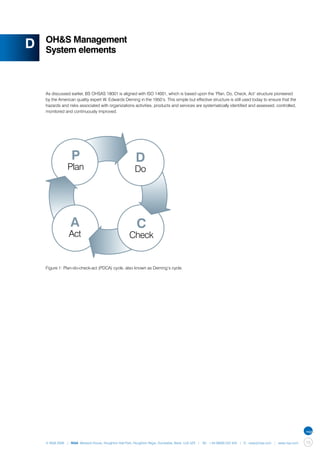
    As discussed earlier, BS OHSAS 18001 is aligned with ISO 14001, which is based upon the ‘Plan, Do, Check, Act’ structure pioneered
    by the American quality expert W. Edwards Deming in the 1950’s. This simple but effective structure is still used today to ensure that the
    hazards and risks associated with organizations activities, products and services are systematically identified and assessed, controlled,
    monitored and continuously improved.


                   P                                     D
                Plan                                    Do


                  A                                      C
                 Act                                 Check


    Figure 1: Plan-do-check-act (PDCA) cycle, also known as Deming’s cycle.


    © NQA 2009 | NQA Warwick House, Houghton Hall Park, Houghton Regis, Dunstable, Beds. LU5 5ZX | Tel: +44 08000 522 424 | E: osas@nqa.com | www.nqa.com   15
4.1 General requirements
     D1


          Specification intention
          Clause 4.1 – General requirements
          The organization shall establish and maintain an OH&S
          Management System, the requirements for which are set out in
          clause 4. (see above)


          4.2 OH&S Policy
     D2


          Introduction                                                                   BS OHSAS 18001 requirement
          Having decided to develop an OH&S Management System, the                       Top management shall define and authorize the organizations
          next most critical step is to set out what you wish it to deliver.             OH&S policy and ensure that within the defined scope of its
          The H&S policy statement can simply and effectively state these                management system it:
          aspirations and communicate such commitments to interested                     a)	 is appropriate to the nature and scale of the organization’s 		
          parties. This is especially important to smaller companies who are             	 OH&S risks
          under pressure from major clients to develop an OHSMS. Sending                 b)	 includes a commitment to prevention of injury and ill health 		
          such an OH&S policy to customers can form part of a marketing                  	 and continual improvement in OH&S management and 		
                                                                                         	 OH&S performance
          strategy and assure clients that you have embarked upon the road
                                                                                         c)	 include a commitment to at least comply with applicable 		
          to BS OHSAS 18001 certification.
                                                                                         	 legal requirements and with other requirements to which 		
          BS OHSAS 18001 policy requirements are based upon similar                      	 the organization subscribes that relate to its OH&S hazards;
          intentions as those enshrined within the Health & Safety at Work               d)	 provides the framework for setting and reviewing
          etc Act 1974 (HSAWA) as set out on the following page. However,                	 OH&S objectives
          they do not require that the ‘organizational structure’ and health             e)	 is documented, implemented and maintained
          and safety ‘arrangements’ form part of the actual policy document.             f)	 is communicated to all persons working under the control 		
          Instead, under BS OHSAS 18001 such aspirations are usually                     	 of the organization with the intent that they are made aware 		
                                                                                         	 of their individual OH&S obligations
          documented and communicated through the development,
          and subsequent issue, of a Health & Safety Policy Manual and                    g)	is available to interested parties and
          supporting operational procedures.                                              h)	is reviewed periodically to ensure that it remains relevant 		
                                                                                         	 and appropriate to the organization.


16        © NQA 2009 | NQA Warwick House, Houghton Hall Park, Houghton Regis, Dunstable, Beds. LU5 5ZX | Tel: +44 08000 522 424 | E: osas@nqa.com | www.nqa.com
E


    	 E	 What the law requires
    	 E1	    Hints for implementation

    	 E2	    Developing a H&S Policy Statement


    © NQA 2009 | NQA Warwick House, Houghton Hall Park, Houghton Regis, Dunstable, Beds. LU5 5ZX | Tel: +44 08000 522 424 | E: osas@nqa.com | www.nqa.com   17
What the law requires
     E


         s2 (3) of the Health & Safety at Work etc Act                                      Arrangements for headquarters’ staff should also be dealt with
         1974 states.                                                                       in detail, either in the ‘parent’ statement itself or in associated
                                                                                            documents.
         “Except in such cases as may be prescribed, it shall be the duty
         of every employer to prepare and as often as may be appropriate
                                                                                            Interpretation
         revise a written statement of his general policy with respect to the
         health and safety at work of his employees* and the organization                   BS OHSAS 18001 places a number of mandatory requirements
         and arrangements for the time being in force for carrying out that                 upon your organization with regards to the effective development,
         policy, and to bring the statement and any revision of it to the notice            issue, maintenance and communication of an OH&S policy. What
         of all his employees”                                                              does this mean?

         The only exception prescribed under s2 (3) is that contained                       Top management authorizing the policy
         within the Employers’ Health and Safety Policy Statements
                                                                                            Once developed, the OH&S policy needs to be authorized and
         (Exception) Regulations 1975 which exempt “any employer who
                                                                                            endorsed by top management to promote top-level commitment to
         carries on an undertaking in which for the time being he employs
                                                                                            the aspirations and general objectives contained within it. It is not
         less than five employees”.
                                                                                            uncommon for the whole management team to endorse the policy,
         Under s2 (3) the written statement must:                                           by signature (as a collective group) to demonstrate their support
                                                                                            to ensuring that the policy aspirations are effectively implemented
         ▶	State your general policy on health and safety
                                                                                            and delivered, rather than seaming to appear that only one
         ▶	Describe the organization and arrangements for carrying out 	                    senior person has made such a commitment. Such commitment
         	 your policy                                                                      demonstrates credence to the system within the organization.
         ▶	Be brought to the notice of all your employees                                   During the authorization and endorsement processes,
         ▶	Be revised whenever appropriate, and every revision must be 	                    consideration should be given to any corporate health and safety
         	 brought to your employees’ attention.                                            policies and aspirations that may exist. Compatibility with your
         NOTE: The law only requires safety policy statements to cover the health and       statement should be checked, and formal approval/endorsement
         safety of employees. However, you would do well to set down your strategy          of your policy sought from the corporate body.
         for protecting other people who could be put at risk by your activities such as
         contractors, customers, and the public. If other people’s activities (e.g. those   Dedication to the OHSMS should also be shown in other ways.
         of contractors on your site) could put your own employees at risk, you will in     As well as authorizing the policy, the management team should
         any case need to consider how these risks are to be avoided and to cover
                                                                                            support the system by allocating suitable and sufficient resources.
         this aspect in your policy statement.
                                                                                            Simple and regular communications (for example via bulletins)
         Under the HSAWA your general policy, organization and                              from management on the progress of the system will demonstrate
         arrangements must all be covered but it’s up to you how you set                    ongoing support.
         out the information. It is therefore acceptable to structure your
         health and safety management system as you wish as long as                         The inclusion of overall health and safety objectives 	
         you can demonstrate that you are complying with the law. The                       supported by a commitment to improving health and
         important thing is to think carefully about all the possible hazards               safety performance
         and the best ways of dealing with them, and to set out your policy                 Your policy should include your overall health and safety objectives,
         statement in the way you think will be clearest to your employees,                 i.e. what you are trying to achieve through the introduction of
         using everyday language. Remember that to be of any use the                        a formal documented management system, e.g. ‘to actively
         statement must be read, understood and acted upon by all                           identify health & safety hazards with a view to actively eliminating,
         concerned.                                                                         controlling or minimising them where practicable’.
         In the case of companies engaged in a number of different
                                                                                            Include a commitment to continual improvement
         activities or whose activities are geographically widespread, a
         single safety policy statement may not be the best solution. An                    Society’s expectations are increasing the pressure on organizations
         alternative would be to produce a general statement at the most                    to reduce the risk of illness, accidents and incidents in the
         senior level, setting out the main principles, which could then be                 workplace. In addition to meeting legal responsibilities, the
         used as a basis for more, detailed statements relating to each                     organization should aim to improve its OH&S performance, and
         operational unit.                                                                  its OH&S Management System, effectively and efficiently, to meet
                                                                                            changing business and regulatory needs. A commitment to such is
         Where the structure of an organization is such that a number of                    therefore imperative in the policy statement.
         subsidiaries are themselves employers, each subsidiary would
         need to issue the ‘parent’ statement under its own authority as part               This does not mean that have to improve in all areas at once, but
         of its statement.                                                                  the policy should drive you overall efforts to continually improve
                                                                                            your organization’s occupational health and safety performance.
         Although a ‘parent’ statement can be written in broad terms,
         because the detailed arrangements are described elsewhere, it
         should not be forgotten that the health and safety


18       © NQA 2009 | NQA Warwick House, Houghton Hall Park, Houghton Regis, Dunstable, Beds. LU5 5ZX | Tel: +44 08000 522 424 | E: osas@nqa.com | www.nqa.com
E	     What the law requires continued


Include a commitment to at least comply with applicable                        acquainted with the safety policy and the parts of any supporting
legislation and with other requirements to which the                           documents relevant to them.
organization subscribes that relate to its OH&S hazards
                                                                               Include a commitment to prevention of injury and
Organizations are required to be in compliance with ‘current’
                                                                               ill health
applicable OH&S legislation and other OH&S requirements. The
OH&S policy commitment is recognition by the organization of its               Any individual or group (either internal or external) concerned with
duty to comply with such legislation or other requirements, and                or affected by the OH&S performance of the organization would
states that it intends doing so.                                               be particularly interested in the OH&S policy statement. Therefore,
                                                                               a process should exist to communicate the OH&S policy to them.
NOTE: Other requirements may mean, for example, corporate or group
                                                                               The process should ensure that interested parties receive the
policies, the organizations own internal standards or specifications, or HSE
Approved Codes of Practice and guidance notes.                                 OH&S policy on request but does not necessarily provide for
                                                                               unsolicited copies.
Be documented, implemented and maintained
                                                                               You do not need to provide health and safety inspectors with
In order for the OH&S policy to be effective, it should be                     a copy of the statement unless asked to do so. However, if an
documented and be periodically reviewed for continuing adequacy,               inspector visits your premises, he or she may want to check the
and subsequently amended or revised as necessary. Reviewing the                statement to ensure that it complies with the law.
statement keeps it alive and relevant to the health and safety issues
it is trying to address. It may need to be revised in the light of             Communicating the policy commitments of
experience, or because of new hazards or organizational changes.               BS OHSAS 18001
The law requires you to revise the policy statement as often as may
be appropriate.                                                                	 Internally                         	 Externally

Planning and adequate preparation are the key to successful                     ▶	posting around the site             ▶	sales and marketing 	
                                                                                	 on notice boards and                	 literature
implementation. Often, OH&S policy statements and OH&S                          	 in reception
                                                                                                                      ▶	business cards
objectives are unrealistic because there are inadequate or                      ▶	letters, memos
inappropriate resources available to deliver them. Before making                                                      ▶	newspaper advertisements
                                                                                ▶	including it with pay 	
any public declarations the organization should ensure that any                                                       ▶	annual reports
                                                                                	 cheques
necessary finance, skills and resources are available, and that                                                       ▶	public library
                                                                                ▶	training sessions, 	
all OH&S objectives are realistically achievable within such a                  	 especially induction 	              ▶	local community meetings 	
framework.                                                                      	 training for new staff and 	        	 and open days
                                                                                	 contractors
                                                                                                                      ▶	visitor badges
Be communicated to all persons working under the                                ▶	staff meeting or briefing
                                                                                                                      ▶	internet/ e-mail
control of the organization with the intent that they are                       ▶	intranet/ e-mail
                                                                                                                      ▶	external site notice boards
made aware of their individual OH&S obligations                                 ▶	staff magazines/ bulletins
This requires the organization to clearly communicate its OH&S
policy (and as such general OH&S objectives) to any person
working under the control of the organization, which could (as well
                                                                               Be reviewed periodically to ensure that it remains
as employees) be contractors, agency/temporary workers etc., to
                                                                               relevant and appropriate to the organization
enable them to have a framework against which they can measure
their own individual OH&S performance. (See the table on the next              Legislation evolves, societal expectations increase, and change
page for ideas on communication).                                              is inevitable. Consequently, the organization’s OH&S Policy and
                                                                               Management System will need to be reviewed regularly to ensure
You may already have suitable means of communicating changes                   its continuing suitability and effectiveness. Such a review is usually
that affect your employees, e.g. team briefing sessions, etc., but             conducted as part of the health and safety management review
whatever communicative arrangements you decide on, similar                     process.
arrangements should apply for contractors and agency staff
whenever a revision is issued. Safety representatives are entitled to          The legal requirement aside, a safety policy statement can bring
inspect and take their own copies under Regulation 7 of the Safety             real benefits. If it is well thought out, has your backing, commands
Representatives and Safety Committees Regulations 1977.                        respect and it is thoroughly put into practice, it should lead to better
                                                                               standards of health and safety. Managers and employees will see
Publicising the statement will stimulate your employees’ interest,             the importance of the policy and will be encouraged to co-operate.
especially if the statement and its relevance to them is explained
and discussed. They are more likely to play their part if they are             The OH&S policy should be viewed, therefore, not as
convinced of the value you place on their health and safety.                   commandments set in stone, but as a living document, which
                                                                               drives the system but also grows with it as the system matures.
If part of your workforce does not read English as its native
language, you should already have some means of communication
established - through bilingual workers, safety signs written in other
languages, etc. You will need to ensure that these workers are


© NQA 2009 | NQA Warwick House, Houghton Hall Park, Houghton Regis, Dunstable, Beds. LU5 5ZX | Tel: +44 08000 522 424 | E: osas@nqa.com | www.nqa.com     19
Hints for implementation
     E1

          Consider your legal obligations under the Health and Safety at               Write your policy in easy to understand language, keep it
          Work etc Act 1974 (as well as BS OHSAS 18001 requirements)                   jargon free and to the point. The statement should set out clear
          when developing your health and safety policy statement, and                 commitments and act as a springboard when setting objectives.
          format and structure your policy accordingly.                                The policy will be brought to life in your plans and actions

          Consider your obligations under any ‘corporate’ health and                   Involve people who are exposed to hazards in the workplace in the
          safety policies or objectives and ensure that your OH&S policy is            development of your OH&S policy statement, e.g. shift managers,
          compatible with such aspirations.                                            operators, health and safety representatives etc. to gain ownership.

          Use brainstorming techniques to collate ideas and thoughts on                ‘Communicate’ you policy to all of your employees, don’t transmit
          the policy content, control and distribution. Try to involve as many         it. Communication is a two way process whereupon employees can
          people as possible; input from a wide range of people within your            have their say, many company’s merely issue the policy in wage
          organization will increase commitment and ownership. Try the                 packets or place it on notice boards and then fail to understand
          following questions to get ideas flowing:                                    why their employees do not comprehend its content or buy into the
                                                                                       process of continuous OH&S improvement.
          ▶	What are we trying to achieve through our occupational health 	
          	 and safety management system?

          ▶	What hazards and risks do we want to address?

          ▶	What positive OHS attributes can we promote in the policy?

          ▶	Will we do what we say we will?

          ▶	Shall we develop a stand-alone document or integrate into
          	 other policies?


20        © NQA 2009 | NQA Warwick House, Houghton Hall Park, Houghton Regis, Dunstable, Beds. LU5 5ZX | Tel: +44 08000 522 424 | E: osas@nqa.com | www.nqa.com
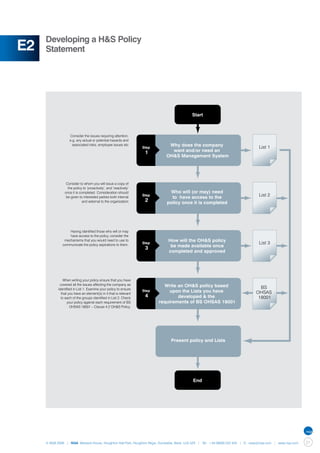
Developing a H&S Policy
E2   Statement


                                                                                           Start


                    Consider the issues requiring attention,
                    e.g. any actual or potential hazards and
                      associated risks, employee issues etc
                                                                   Step
                                                                             Why does the company                                 List 1
                                                                    1         want and/or need an
                                                                            OH&S Management System


                 Consider to whom you will issue a copy of
                  the policy to ‘proactively’, and ‘reactively’
                once it is completed. Consideration should                    Who will (or may) need
                 be given to interested parties both internal      Step
                                                                               to have access to the                              List 2
                             and external to the organization       2        policy once it is completed


                   Having identified those who will or may
                   have access to the policy, consider the
                mechanisms that you would need to use to                     How will the OH&S policy
               communicate the policy aspirations to them.         Step                                                           List 3
                                                                              be made available once
                                                                    3
                                                                             completed and approved


               When writing your policy ensure that you have
             covered all the issues affecting the company as                Write an OH&S policy based
            identified in List 1. Examine your policy to ensure                                                                    BS
              that you have an element(s) in it that is relevant
                                                                   Step       upon the Lists you have                            OHSAS
              to each of the groups identified in List 2. Check
                                                                    4             developed & the                                 18001
                  your policy against each requirement of BS              requirements of BS OHSAS 18001
                     OHSAS 18001 – Clause 4.2 OH&S Policy.


                                                                              Present policy and Lists


                                                                                           End


     © NQA 2009 | NQA Warwick House, Houghton Hall Park, Houghton Regis, Dunstable, Beds. LU5 5ZX | Tel: +44 08000 522 424 | E: osas@nqa.com | www.nqa.com   21
E2	 Developing a H&S Policy Statement continued


     List 1


     List 2


     List 3


22   © NQA 2009 | NQA Warwick House, Houghton Hall Park, Houghton Regis, Dunstable, Beds. LU5 5ZX | Tel: +44 08000 522 424 | E: osas@nqa.com | www.nqa.com
E2	 Developing a H&S Policy Statement continued


Intentionally left blank for writing the policy statement


© NQA 2009 | NQA Warwick House, Houghton Hall Park, Houghton Regis, Dunstable, Beds. LU5 5ZX | Tel: +44 08000 522 424 | E: osas@nqa.com | www.nqa.com   23
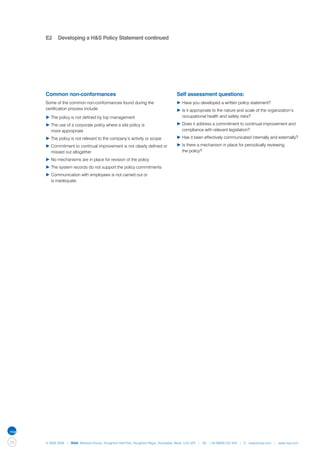
E2	 Developing a H&S Policy Statement continued


     Common non-conformances                                                      Self assessment questions:
     Some of the common non-conformances found during the                         ▶	Have you developed a written policy statement?
     certification process include:                                               ▶	Is it appropriate to the nature and scale of the organization’s 	
     ▶	The policy is not defined by top management                                	 occupational health and safety risks?

     ▶	The use of a corporate policy where a site policy is                       ▶	Does it address a commitment to continual improvement and 	
     	 more appropriate                                                           	 compliance with relevant legislation?

     ▶	The policy is not relevant to the company’s activity or scope              ▶	Has it been effectively communicated internally and externally?

     ▶	Commitment to continual improvement is not clearly defined or 	            ▶	Is there a mechanism in place for periodically reviewing
     	 missed out altogether                                                      	 the policy?

     ▶	No mechanisms are in place for revision of the policy
     ▶	The system records do not support the policy commitments
     ▶	Communication with employees is not carried out or
     	 is inadequate.


24   © NQA 2009 | NQA Warwick House, Houghton Hall Park, Houghton Regis, Dunstable, Beds. LU5 5ZX | Tel: +44 08000 522 424 | E: osas@nqa.com | www.nqa.com
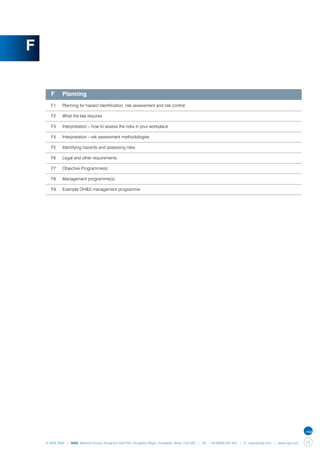
F


    	 F	     Planning
    	 F1	    Planning for hazard identification, risk assessment and risk control

    	 F2	    What the law requires

    	 F3	    Interpretation – how to assess the risks in your workplace

    	 F4	    Interpretation - risk assessment methodologies

    	 F5	    Identifying hazards and assessing risks

    	 F6	    Legal and other requirements

    	 F7	    Objective Programme(s)

    	 F8	    Management programme(s)

    	 F9	    Example OH&S management programme


    © NQA 2009 | NQA Warwick House, Houghton Hall Park, Houghton Regis, Dunstable, Beds. LU5 5ZX | Tel: +44 08000 522 424 | E: osas@nqa.com | www.nqa.com   25
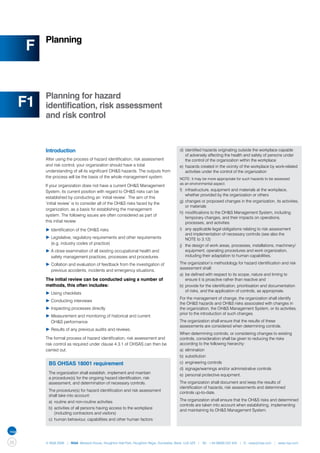
Planning
     F


          Planning for hazard
     F1   identification, risk assessment
          and risk control


          Introduction                                                                   d)	 identified hazards originating outside the workplace capable 	
                                                                                         	 of adversely affecting the health and safety of persons under 	
          After using the process of hazard identification, risk assessment              	 the control of the organization within the workplace
          and risk control, your organization should have a total                        e)	 hazards created in the vicinity of the workplace by work-related 	
          understanding of all its significant OH&S hazards. The outputs from            	 activities under the control of the organization
          the process will be the basis of the whole management system.                  NOTE: it may be more appropriate for such hazards to be assessed
                                                                                         as an environmental aspect.
          If your organization does not have a current OH&S Management
          System, its current position with regard to OH&S risks can be                  f)	 infrastructure, equipment and materials at the workplace, 		
                                                                                         	 whether provided by the organization or others
          established by conducting an ‘initial review’. The aim of this
                                                                                         g)	 changes or proposed changes in the organization, its activities,
          ‘initial review’ is to consider all of the OH&S risks faced by the
                                                                                         	 or materials
          organization, as a basis for establishing the management
                                                                                         h)	 modifications to the OH&S Management System, including 		
          system. The following issues are often considered as part of
                                                                                         	 temporary changes, and their impacts on operations,
          this initial review:                                                           	 processes, and activities
          ▶	Identification of the OH&S risks                                             i)	 any applicable legal obligations relating to risk assessment 		
                                                                                         	 and implementation of necessary controls (see also the
          ▶	Legislative, regulatory requirements and other requirements 	                	 NOTE to 3.12)
          	 (e.g. industry codes of practice)                                            j)	 the design of work areas, processes, installations, machinery/	
          ▶	A close examination of all existing occupational health and 		               	 equipment, operating procedures and work organization, 		
          	 safety management practices, processes and procedures                        	 including their adaptation to human capabilities.

          ▶ Collation and evaluation of feedback from the investigation of 	             The organization’s methodology for hazard identification and risk
                                                                                         assessment shall:
          	 previous accidents, incidents and emergency situations.
                                                                                         a)	 be defined with respect to its scope, nature and timing to 		
          The initial review can be conducted using a number of                          	 ensure it is proactive rather than reactive and
          methods, this often includes:                                                  b)	 provide for the identification, prioritisation and documentation 	
                                                                                         	 of risks, and the application of controls, as appropriate.
          ▶	Using checklists
                                                                                         For the management of change, the organization shall identify
          ▶	Conducting interviews
                                                                                         the OH&S hazards and OH&S risks associated with changes in
          ▶	Inspecting processes directly                                                the organization, the OH&S Management System, or its activities,
                                                                                         prior to the introduction of such changes.
          ▶	Measurement and monitoring of historical and current
          	 OH&S performance                                                             The organization shall ensure that the results of these
                                                                                         assessments are considered when determining controls.
          ▶	Results of any previous audits and reviews.
                                                                                         When determining controls, or considering changes to existing
          The formal process of hazard identification, risk assessment and               controls, consideration shall be given to reducing the risks
          risk control as required under clause 4.3.1 of OHSAS can then be               according to the following hierarchy:
          carried out.                                                                   a)	 elimination
                                                                                         b)	 substitution
           BS OHSAS 18001 requirement                                                    c)	 engineering controls
                                                                                         d)	 signage/warnings and/or administrative controls
           The organization shall establish, implement and maintain
                                                                                         e)	 personal protective equipment.
           a procedure(s) for the ongoing hazard identification, risk
           assessment, and determination of necessary controls.                          The organization shall document and keep the results of
                                                                                         identification of hazards, risk assessments and determined
           The procedure(s) for hazard identification and risk assessment
                                                                                         controls up-to-date.
           shall take into account:
           a)	 routine and non-routine activities                                        The organization shall ensure that the OH&S risks and determined
                                                                                         controls are taken into account when establishing, implementing
           b)	 activities of all persons having access to the workplace 		
                                                                                         and maintaining its OH&S Management System.
           	 (including contractors and visitors)
           c)	 human behaviour, capabilities and other human factors


26        © NQA 2009 | NQA Warwick House, Houghton Hall Park, Houghton Regis, Dunstable, Beds. LU5 5ZX | Tel: +44 08000 522 424 | E: osas@nqa.com | www.nqa.com
What the law requires
F2

     The concept of risk assessment became etched within the Health               The hazard identification, risk assessment and risk control
     & Safety Legislative framework when the Management of Health                 processes and their outputs should form the basis of the whole
     & Safety at Work Regulations 1992 (SI 2051) came into force in               OH&S system. It is important that the links between the hazard
     January 1993.                                                                identification, risk assessment and risk control and the other
                                                                                  elements of the OH&S Management System are clearly established
     The notion of risk assessment has of course always been ‘implied’,
                                                                                  and apparent.
     if not actually stated, within health and safety legislation.
     (e.g. s2 (2) (a) of the Health and Safety at Work Act 1974 requires          The hazard identification, risk assessment and risk control
     employers to provide and maintain plant and systems of work                  processes should take into account the cost and time of
     that are, so far a reasonably practicable, safe and without risks            performing these three processes, and the availability of reliable
     to health). Clear compliance with such a requirement would, by               data. Information already developed for regulatory or other
     implication, necessitate an assessment of risk.                              purposes may be used in these processes. You may also take
                                                                                  into account the degree of practical control you may have over
     Revised and re-issued in 1999 to include a requirement for
                                                                                  the OH&S risks being considered. You should determine what
     all companies to use the information obtained from their risk
                                                                                  the OH&S risks are, taking into account the inputs and outputs
     assessments to initiate control measures, the Management of
                                                                                  associated with your current and relevant past activities, processes,
     Health & Safety at Work Regulations, which are the principal
                                                                                  products and /or services.
     regulations with regards risk assessment, require that
                                                                                  The complexity of hazard identification, risk assessment and
     “(1) every employer shall make a suitable and sufficient
                                                                                  risk control processes will greatly depend on factors such as
     assessment of:
                                                                                  the size of the organization, the workplace situations within the
     (a) The risks to the health and safety of his employees to which             organization, and the nature, complexity and significance of the
     they are exposed whilst they are at work                                     hazards. It is not the purpose of BS OHSAS 18001:1999, to force
     (b) the risks to the health and safety of persons not in his                 small organizations with very limited hazards to undertake complex
     employment arising out of or in connection with the conduct by him           hazard identification, risk assessment and risk control exercises.
     of his undertakings.
                                                                                  In all cases, consideration should be given to:
     For the purpose of identifying the measures he needs to take to
     comply with the requirements and prohibitions imposed upon him               Routine and non-routine activities
     by or under the relevant statutory provisions.”                              Normal, abnormal and potential emergency conditions and
     The risk assessment process should therefore consider employees,             operations will need to be considered by the organization when
     visitors, contractors, members of the public, and be consistent with         identifying hazards and carrying out subsequent assessments of
     the health and safety regulations currently in effect.                       risk. It is important to remember, and assess, the activities that
                                                                                  occur on an infrequent basis such as window cleaning, machine
     Additional requirements for risk assessment are demanded in a                maintenance and repair etc. Organizations that operate a night
     number of supporting regulations, namely:                                    shift may have to consider other hazards/risks such as violence
     ▶	Manual Handling Operations Regulations 1992                                and aggression towards their staff from external sources, which
                                                                                  could occur whilst entering the premises in the dark, etc. Other
     ▶	Personal Protective Equipment at Work Regulations 1992
                                                                                  non-routine activities could include members of staff taking their
     ▶	Health and Safety (Display Screen Equipment) Regulations 1992              computers home to do work at the weekend, where upon a risk
     ▶	Noise at Work Regulations 2005                                             assessment may need to be undertaken to assess the risks
     ▶	Control of Substances Hazardous to Health Regulations 2002                 associated with the manual handling of the equipment and its
                                                                                  subsequent use.
     ▶	Control of Asbestos at Work Regulations 2007
     ▶	Control of Lead at Work Regulations 2002                                   Activities of all personnel having access to the workplace
                                                                                  (including contractors and visitors)
     ▶	Regulatory Reform (Fire Safety) Order 2005
                                                                                  The Management of Health & Safety at Work Regulations 1999
     ▶	Construction (Design and Management) Regulations 1997
                                                                                  requires that employers make suitable and sufficient assessment
     and as such, consideration should be given when developing                   the H&S risks to employees and the H&S risks to persons not in his
     hazard identification and risk assessment methodologies as                   employment arising out of or in connection with the conduct by him
     to what regulatory requirements are applicable, and methods                  of his undertakings.
     developed which assess the hazards and risks associated
     with them.                                                                   It is therefore imperative that you consider who could be harmed
                                                                                  whilst visiting or working at/on behalf of your organization. Such
     Interpretation                                                               consideration being given, but not limited, to young workers,
                                                                                  trainees, new and expectant mothers, etc. who may be at particular
     Hazard identification, risk assessment and risk control processes            risk; cleaners, visitors, contractors, maintenance workers, etc. who
     should be suitable and sufficient to allow your organization to              may not be in the workplace all the time; members of the public,
     identify, evaluate and control its OH&S risks on an ongoing basis.           or people you share your workplace with, if there is a chance they
                                                                                  could be hurt by your activities.

     © NQA 2009 | NQA Warwick House, Houghton Hall Park, Houghton Regis, Dunstable, Beds. LU5 5ZX | Tel: +44 08000 522 424 | E: osas@nqa.com | www.nqa.com   27
F2	 What the law requires continued


     Infrastructure, equipment and materials at the                               What is a risk assessment?
     workplace, whether provided by the organization                              A risk assessment is nothing more than a careful examination of
     or others.                                                                   what, in your workplace, could cause harm to people so that you
     Most workplaces must conform to the minimal facility standards               can weigh up whether you have taken enough precautions or
     as contained in the Workplace (Health, Safety and Welfare)                   should do more to prevent harm. The aim is to make sure that no
     Regulations 1992. These Regulations formerly consolidate and                 one gets hurt or becomes ill. Accidents and ill health can ruin lives,
     concentrate the requirements of the Factories Act 1961 and the               and affect your business if output is lost, machinery is damaged,
     Offices, Shops and Railway Premises Act 1963 into a single                   insurance costs increase, or you have to go to court.
     piece of legislation applicable to virtually all workplaces. The             You are legally required to assess the risks in your workplace.
     principle provisions of the Workplace (Health, Safety and Welfare)
     Regulations 1992, set parameters and requirements for:                       The important things you need to decide are whether a hazard
                                                                                  is significant, and whether you have it covered by satisfactory
     ▶	 Regular and systematic maintenance
                                                                                  precautions so that the risk is small. You need to check this when
     ▶	 Ventilation                                                               you assess the risks. For instance, electricity can kill but the risk of
     ▶	 Temperature                                                               it doing so in an office environment is remote, provided that ‘live’
     ▶	 Lighting                                                                  components are insulated and metal casings properly earthed.

     ▶	 Cleanliness
     ▶	 Absence of overcrowding
     ▶	 Sedentary comfort
     ▶	 Safety underfoot/floors
     ▶	 Freedom from falls and falling objects
     ▶	 Structural integrity and stability
     ▶	 Doors and gates
     ▶	 Windows and window cleaning
     ▶	 Escalators and travelators
     ▶	 Pedestrian traffic routes
     ▶	 Vehicular traffic routes
     ▶	 Sanitary conveniences/washing facilities
     ▶	 Drinking water
     ▶	 Clothing accommodation
     ▶	 Rest/meal facilities.

     It is therefore imperative that your risk assessment considers the
     factors above.

     Equipment will be governed by the Provision and Use of Work
     Equipment Regulations (PUWER).


28   © NQA 2009 | NQA Warwick House, Houghton Hall Park, Houghton Regis, Dunstable, Beds. LU5 5ZX | Tel: +44 08000 522 424 | E: osas@nqa.com | www.nqa.com
Interpretation – how to assess
F3   the risks in your workplace


     The complexity of hazard identification, risk assessment and risk            Step 3 - Evaluate the risks and decide whether
     control processes greatly depends on factors such as the size of             existing precautions are adequate or more should
     the organization, the workplace situations within the organization           be done
     and the nature, complexity and significance of the hazards. It is not
     the purpose of BS OHSAS 18001 to force small organizations with              Consider how likely it is that each hazard could cause harm. This
     very limited hazards to undertake complex hazard identification and          will determine whether or not you need to do more to reduce the
     risk assessment.                                                             risk. Even after all precautions have been taken, some risk usually
                                                                                  remains. What you have to decide for each significant hazard is
     HSE Guidance promotes a 5-step approach to hazard identification             whether this remaining is risk tolerable or intolerable.
     and risk assessment:
                                                                                  First, ask yourself whether you have done all the things that the law
     Step 1:	 Look for the hazards                                                says you have got to do. For example, there are legal requirements
     Step 2:	 Decide who might be harmed and how                                  on prevention of access to dangerous parts of machinery. Then
     Step 3:	 Evaluate the risks and decide whether the existing 		               ask yourself whether generally accepted industry standards are in
     			      precautions are adequate or whether more should                     place. But don’t stop there - think for yourself, because the law also
     			      be done                                                             says that you must do what is reasonably practicable to keep your
                                                                                  workplace safe. Your real aim is to make all risks small by adding to
     Step 4: 	 Record your findings
                                                                                  your precautions as necessary.
     Step 5: 		 Review your assessment and revise it if necessary.
                                                                                  If you find that something needs to be done, draw up an ‘action list’
     Don’t be over complicated. In most firms in the commercial,                  and give priority to any risks that are intolerable and/or those, which
     service and light industrial sectors, the hazards are few and simple.        could affect most people.
     Checking them is common sense, but necessary. You probably
                                                                                  In taking action ask yourself:
     already know whether, for example, you have machinery that could
     cause harm, or if there is an awkward entrance or stair where                ▶	Can I eliminate the hazard altogether?
     someone could be hurt. If so, check that you have taken what                 ▶	If not, how can I control the risks so that harm is unlikely?
     reasonable precautions you can to avoid injury.
                                                                                  In controlling risks apply the principles below, if possible in the
     If you are a small firm and you are confident you understand what’s          following order:
     involved, you can do the assessment yourself (you don’t have to be
                                                                                  ▶	Try a less risky option
     a health and safety expert!). If you are a larger firm, you could ask a
     responsible employee, safety representative or safety officer to help        ▶	Prevent access to the hazard (e.g. by guarding)
     you. If you are not confident, get help from a competent source, but         ▶	Organize work to reduce exposure to the hazard
     remember you are responsible for seeing it is adequately done.               ▶	Issue personal protective equipment
                                                                                  ▶	Provide welfare facilities (e.g. washing facilities for removal of 	
     Step 1 - Look for the hazards
                                                                                  	 contamination and first aid).
     If you are doing the assessment yourself, walk around your
                                                                                  Improving health and safety need not cost a lot. For instance,
     workplace and look afresh at what could reasonably be expected
                                                                                  placing a mirror on a dangerous blind corner to help prevent
     to cause harm. Ignore the trivial and concentrate on significant
                                                                                  vehicle accidents, or putting some non-slip material on slippery
     hazards that could result in serious harm or affect several people.
                                                                                  steps, are inexpensive precautions considering the risks? And
     Ask your employees or their representatives what they think.                 failure to take simple precautions can cost you a lot more if an
     They may have noticed things that are not immediately obvious.               accident does happen.
     Manufacturers’ instructions or data sheets can also help you spot
                                                                                  But what if the work you do tends to vary a lot or you or your
     hazards and put risks in their true perspective. So can accident and
                                                                                  employees move from one site to another? Identify the hazards
     ill-health records.
                                                                                  you can reasonably expect and assess the risks from them.
                                                                                  After that, if you spot any additional hazards when you get to a
     Step 2 - Decide who might be harmed, and how?
                                                                                  site, get information from others on site, and take what action
     ▶	Young workers, trainees, new and expectant mothers, etc. who 	             seems necessary.
     	 may be at particular risk
                                                                                  But what if you share a work place? Tell the other employers and
     ▶	Cleaners, visitors, contractors, maintenance workers, etc. who 	           self-employed people there about any risks your work could cause
     	 may not be in the workplace all the time                                   them, and what precautions you are taking. Also, think about the
     ▶	Members of the public, or people you share your workplace 	                risks to your own work force from those who share your workplace.
     	 with, if there is a chance they could be hurt by your activities.
                                                                                  But what if you have already assessed some of the risks? If, for
                                                                                  example, you use hazardous chemicals and you have already
                                                                                  assessed the risks to health and the precautions you need to take
                                                                                  under the Control of Substances Hazardous to Health Regulations
                                                                                  (COSHH), you can consider them ‘checked’ and move on.


     © NQA 2009 | NQA Warwick House, Houghton Hall Park, Houghton Regis, Dunstable, Beds. LU5 5ZX | Tel: +44 08000 522 424 | E: osas@nqa.com | www.nqa.com   29
F3	 Interpretation – how to assess the risks in your workplace continued


     Step 4 - Record your findings                                                Step 5 - Review your assessment and revise
     If you have fewer than five employees you do not need to write               it if necessary
     anything down, though it is useful to keep a written record of what          Sooner or later you will bring in new machines, substances and
     you have done. But if you employ five or more people you must                procedures which could lead to new hazards. If there is any
     record the significant findings of your assessment. This means               significant change, add to the assessment to take account of
     writing down the significant hazards and conclusions. Examples               the new hazard. Don’t amend your assessment for every trivial
     might be ‘Electrical installations: insulation and earthing checked          change, or still more, for each new job, but if a new job introduces
     and found sound’ or ‘Fume from welding: local exhaust ventilation            significant new hazards of its own, you will want to consider them in
     provided and regularly checked’. You must also tell your employees           their own right and do whatever you need to keep the risks down.
     about your findings.                                                         In any case, it is good practice to review your assessment from
                                                                                  time to time to make sure that the precautions are still working
     Suitable and sufficient - not perfect!                                       effectively.
     Risk assessments must be suitable and sufficient. You need to be
     able to show that:
     ▶	A proper check was made
     ▶	You asked who might be affected
     ▶	You dealt with all the obvious significant hazards, taking into 	
     	 account the number of people who could be involved
     ▶	Precautions are reasonable, and the remaining risk is low.

     Keep the written record for future reference or use; it can help you
     if an inspector asks what precautions you have taken, or if you
     become involved in any action for civil liability. It can also remind
     you to keep an eye on particular hazards and precautions. And it
     helps to show that you have done what the law requires.

     To make things simpler, you can refer to other documents, such
     as manuals, the arrangements in your health and safety policy
     statement, company rules, manufacturers’ instructions, your health
     and safety procedures and your arrangements for general fire
     safety. These may already list hazards and precautions. You don’t
     need to repeat all that, and it is up to you whether you combine all
     the documents, or keep them separately.


30   © NQA 2009 | NQA Warwick House, Houghton Hall Park, Houghton Regis, Dunstable, Beds. LU5 5ZX | Tel: +44 08000 522 424 | E: osas@nqa.com | www.nqa.com
Interpretation - risk assessment
F4   methodologies


     There is no official guidance on the most appropriate methodology            Having made a judgement as to the risk levels associated with
     for ranking risks. However the methodology suggested below                   EACH hazard, you will need to assess whether suitable precautions
     is used by many businesses and organizations, and found to a                 exist to control or reduce the risk. Using the above scenario, if
     suitable means of identifying and prioritising action. It is important       the above office was inhabited at all times, had adequate smoke
     to stress that ALL risk assessments are subjective, reflecting the           detection and suitable fire fighting equipment, supported by
     ‘opinions’ and ‘judgements’ of the assessor. When carrying out               personnel trained in the use of such equipment it is less likely that
     an assessment you may wish to carry out the identification of                the severity would be fatal. The severity may then become (1) as a
     hazards, risk assessment and risk control processes using a team             subsequent fire would be immediately identified and suppressed
     approach, whereby consensus can be reached as to the prevalent               adequately and safely.
     and action required.
                                                                                  Decide who may be harmed
     The 5x5 method measures each identified hazard against two
                                                                                  In the above scenario, potential harm may be restricted to
     constituents of risk;
                                                                                  employees, although you will have to consider whether the
     Likelihood - or probability of occurrence; severity - or, the potential      outbreak of such a fire could prevent evacuation from another
     consequence(s) upon human health.                                            room, e.g. an adjacent meeting room used for customers, etc.

                                                                                  Once the risks have been assessed and numerically ranked by
     ‘5x5’ Assessment Method
                                                                                  multiplying the likelihood and severity values, you will need to
     Identify hazards - See - Step 1 - previous guidance.                         prioritise action based upon what you determine as tolerable
                                                                                  or intolerable risks. By developing a simple matrix you can
     Typical hazards may include, but are not restricted to:
                                                                                  ensure that those will the potential to become fatal accidents are
     ▶	Electrical				                                                             addressed before those deemed as being of lesser probability and
     ▶	Fire                                                                       consequence.
     ▶	Handling
     ▶	Slipping                                                                     Basic Risk Matrix
     ▶	Tripping                                                                     	 RISK	             5	         10	        15	        20	         25
                                                                                    		                  4	         8	         12	        16	         20
     ▶	Noise
                                                                                    		                  3	         6	          9	        12	         15
     ▶	Vibration
                                                                                    		                  2	         4	          6	        8	          10
     ▶	Chemical use and spillage                                                    		                  1	         2	          3	        4	          5
     ▶	Ventilation                                                                  			                             S EVERITY
                                                                                                                    	
     ▶	Radiation
     ▶	Lifting                                                                      Action Priority
     ▶	Falling objects                                                              	   1	 Immediate
                                                                                    	   2		Urgent - ASAP after immediate
     ▶	Traffic Movement
                                                                                    	   3	 Planned
     ▶	Lone-working etc.                                                            	   4	 For consideration

     Evaluate the risks
     Once all of the hazards have been identified, they can be                    Details of the assessment should be recorded
     individually risk assessed, to determine whether on not such                 Whilst you are only obligated to document you risk assessments if
     hazards are tolerable or intolerable whereby:                                you employ five or more persons, having taken the time and trouble
                                                                                  to identify your workplace hazards and risks it would be a shame to
     Likelihood (Probability)                                                     lose such valuable information through not recording your findings.
     5	 =	 Very likely to occur/has Occurred                                      Such records needn’t be complicated and time consuming to
     4	 =	 Probable                                                               complete, but merely serve as written evidence of what you have
     3	 =	 Possible                                                               done.
     2	 =	 Remote
     1	 =	 Improbable
     Severity (Consequence)
     5	 =	 Fatal Outcome
     4	 =	 Major Injury (Reportable under RIDDOR)
     3	 =	 Three Day Injury (as determined in RIDDOR)
     2	 =	 Minor Injury (First Aid Treatment only)
     1	 =	 Accident/Incident where no injury occurs

     © NQA 2009 | NQA Warwick House, Houghton Hall Park, Houghton Regis, Dunstable, Beds. LU5 5ZX | Tel: +44 08000 522 424 | E: osas@nqa.com | www.nqa.com   31
F4	 Interpretation - risk assessment methodologies continued


     Eliminate, combat or minimise                                                Interpretation
     Wherever practicable, hazards should be eliminated, before control           The following criteria should apply to the hazard identification, risk
     or minimisation options are adopted. Signage, the issue of Personal          assessment and risk control processes:
     Protective Equipment (PPE) or the issue of formal instructions
                                                                                  ▶	Competency requirements and training needs for performing 	
     should only be adopted as a last resort. BS OHSAS 18001 was
                                                                                  	 hazard identification, risk assessment and risk control should 	
     modified in 2007 to ensure that it mirrored the hierarchy of control
                                                                                  	 be defined. For some organizations, depending on the type of 	
     as contained within Schedule 1 of the Management of Health and
                                                                                  	 process used, it may be necessary to use external
     Safety at Work Regulations i.e.:
                                                                                  	 advice/services
     ▶	Elimination                                                                ▶	The roles and authorities of personnel responsible for 		
     ▶	Substitution                                                               	 performing hazard identification, risk assessment and
     ▶	Engineering controls                                                       	 risk control should be defined

     ▶	Signage/warnings and/or administrative controls                            ▶	Information from employee OH&S consultation, review and 		
                                                                                  	 improvement activities should be considered (these activities 	
     ▶	Personal protective equipment.
                                                                                  	 may be either reactive or proactive in nature)
     All hazards identified as having an intolerable risk(s) associated           ▶	Feedback to management on the results of hazard identification, 	
     with them will require some form of action to eliminate, control or          	 risk assessment and risk control should be provided
     minimise the risk(s) identified.
                                                                                  ▶	As well as considering the hazards and risks posed by activities 	
     You should then consider setting an objective(s) to so. You may              	 carried out by its own personnel, the organization should 		
     however wish to develop a generic objective to ‘Eliminate, control           	 consider hazards and risks arising from the activities
     or minimise all intolerable health & safety risks as identified by the       	 of contractors and visitors, and from the use of products or 		
     hazard identification and risk assessment processes’, under which            	 services supplied to it by others
     will sit a number of supporting sub-objectives or tasks to address           ▶	The OH&S hazards posed by materials, plant and equipment 	
     each specific hazard graded as intolerable.                                  	 that degrade over time, particularly such materials/plant/		
     You should keep documentation, data and records concerning                   	 equipment that are being stored
     the identification of hazards, the risk assessment and subsequent            ▶	Hazard identification, risk assessment and risk control should 	
     control of risks up-to-date in respect of the current activities but also    	 take into account the measures implemented for the control 	
     extend them to cover any new or modified activities that may be              	 of risks that are effective at the time of the assessment; if 		
     take place within your organization before they are introduced.              	 consideration of the resulting risk leads to amendments to these 	
     The documentation should include the identification of hazards. It           	 measures, then further hazard identification and risk assessment 	
     should also include the evaluation of the risks with existing or any         	 should be conducted to reflect the amendments and to estimate 	
     proposed control measures in place but also take into account                	 the residual risk
     exposure to specific hazards, the likelihood of failure of the control       ▶	There should be clear evidence that actions identified from 		
     measures, and the potential severity of consequences of injury or            	 hazard identification, risk assessment and risk control processes 	
     damage. Other elements that should be included are the evaluation            	 are monitored for their timely completion
     of the tolerability of residual risk, the identification of any additional   ▶	Hazard identification, risk assessment and risk control should be 	
     risk control measures needed and the evaluation of whether the               	 carried out as a proactive measure, rather than a reactive one, 	
     risk control measures are sufficient to reduce the risk to a tolerable       	 i.e. they should precede the introduction of new or revised 		
     level.                                                                       	 activities or procedures, and risk reduction and control
     BS OHSAS 18001 clause 4.3.1 states that:                                     	 measures identified via the process should be in place before 	
                                                                                  	 the change takes place
     The organizations methodology for hazard identification
                                                                                  ▶	Where appropriate, hazard identification, risk assessment and 	
     and risk assessment shall:
                                                                                  	 risk control should identify competency/training requirements for 	
     ▶	Be defined with respect to its scope, nature and timing to ensure 	        	 affected personnel
     	 it is proactive rather than reactive and
                                                                                  ▶	Human error should be considered as an integral part of the 	
     ▶	Provide for the identification, prioritisation and documentation of 	      	 hazard identification, risk assessment and risk control process
     	 risks, and the application of controls, as appropriate.                    ▶	The organization should keep its documentation, data and 		
     For the management of change, the organization shall identify the            	 records concerning the identification of hazards and the 		
     OH&S hazards and OH&S risks associated with changes in the                   	 assessment and control of risks up-to-date in respect of ongoing 	
     organization, the OH&S Management System, or its activities, prior           	 activities, and extend them to cover new developments and new 	
     to the introduction of such changes.                                         	 or modified activities, before these are implemented. The results 	
                                                                                  	 should show the level of risk associated with a particular hazard 	
                                                                                  	 and may, therefore, affect the organization’s OH&S objectives. 	
                                                                                  	 If this occurs, the organization should review its OH&S
                                                                                  	 objectives accordingly.

32   © NQA 2009 | NQA Warwick House, Houghton Hall Park, Houghton Regis, Dunstable, Beds. LU5 5ZX | Tel: +44 08000 522 424 | E: osas@nqa.com | www.nqa.com
F4	 Interpretation - risk assessment methodologies continued


Hints for implementation:
▶	Consider ALL of your legal obligations when carrying out your 	
	 hazard identification and risk assessment processes
▶	Use the HSE’s five-step approach to risk assessment as a basis 	
	 for your methodologies
▶	Ensure that those responsible for carrying out your assessments 	
	 are trained and competent
▶	Review you assessments in light of significant changes to 		
	 workplace layout, equipment, processes etc. or any accidents 	
	 that may occur
▶	Assess any improvement actions, to make sure that your 		
	 suggested improvements do not create new hazards and risks
▶	Utilise your health and safety audits to continually review the 	
	 adequacy of your assessments.

▶	Keep     it simple!


© NQA 2009 | NQA Warwick House, Houghton Hall Park, Houghton Regis, Dunstable, Beds. LU5 5ZX | Tel: +44 08000 522 424 | E: osas@nqa.com | www.nqa.com   33
Identifying hazards and
     F5   assessing risks


          Identify the hazards/assess the risks associated with the organization’s activities, products and services.

          Consider who may be harmed and what could be done to eliminate or control the hazards identified.


                                                    Start


                      Step
                                        Look for the hazards                                                    When identifying ‘hazards’
                        1          associated with the company’s                                          ask yourself “what could cause harm”
                                   activities, products and services                                               and ignore the trivial


                                    Decide who may be harmed                                             Think about people who only vacate the
                      Step
                                                                                                         workplace periodically, as well as those
                        2                   and how
                                                                                                                 regularly/ permanently


                                      Evaluate the levels of risk
                                      associated with the hazards                                     Decide what could occur (likelihood) and the
                      Step
                                                                                                      actual harm that could be caused (severity)
                        3               identified and consider
                                          existing precautions                                              using the 5x5 risk methodology


                                   Suggest ways of eliminating                                          Following the hierarchy of hazard control,
                      Step                                                                              suggest ways of eliminating, controlling or
                                       or controlling the
                        4              hazards identified                                                minimising the hazards (and associated
                                                                                                                      risks) identified


                                         Present information in
                                            Health & Safety
                                        Risk Assessment Sheets


                                                    End


34        © NQA 2009 | NQA Warwick House, Houghton Hall Park, Houghton Regis, Dunstable, Beds. LU5 5ZX | Tel: +44 08000 522 424 | E: osas@nqa.com | www.nqa.com
F5	 Identifying hazards and assessing risks continued


Common non-conformances:
▶	Lack of comprehensive, documented procedures for
	 identifying hazards
▶	Incomplete coverage for past, current and planned activities
▶	Incomplete coverage of all activities, products or services
▶	Hazard identification under routine and non-routine not 		
	 adequately covered
▶	Risk assessment of activities of all personnel having access 	
	 to the workplace, including subcontractors and visitors
	 not considered
▶	Hazard identification and risk assessment does not include 		
	 facilities in the workplace provided by others
▶	Poor provision for keeping the information up to date

Self assessment questions:
▶	Have you established a procedure for identifying and assessing 	
	 the risk of hazards and the implementation of necessary
	 control measures?
▶	Have you considered the results of these assessments and the 	
	 effects of the control to feed into you objectives?
▶	Are you keeping this information up to date?


© NQA 2009 | NQA Warwick House, Houghton Hall Park, Houghton Regis, Dunstable, Beds. LU5 5ZX | Tel: +44 08000 522 424 | E: osas@nqa.com | www.nqa.com   35
Legal and other requirements
     F6


          Introduction                                                                 Typical inputs:
          Any organization needs to be aware of and understand how its                 ▶	Details of the organization’s production or service
          activities are, or will be, affected by applicable legislation and other     	 realization processes
          requirements such as Approved Codes of Practices (ACoPs).                    ▶	Hazard identification, risk assessment and risk control results
          This information needs to be communicated to all relevant
                                                                                       ▶	Best practices (e.g. codes, industry association guidelines)
          personnel and to other interested parties such as contractors.
          The organization also needs to keep abreast of the changes to                ▶	Legal requirements/governmental regulations
          legislation and to the introduction of new legislation. This will help       ▶	Listing of information sources
          to ensure compliance with the legislation and avoid enforcement              ▶	National, foreign, regional or international standards
          action by the regulatory bodies.
                                                                                       ▶	Internal organizational requirements
                                                                                       ▶	Requirements of interested parties.
           BS OHSAS 18001 requirements
                                                                                       Process:
           The organization shall establish, implement and maintain a
           procedure(s) for identifying and accessing the legal and other              ▶	Relevant legislation and other requirements should be identified	
           OH&S requirements that are applicable to it.                                	 (Other requirements may include, but are not necessarily 		
           The organization shall ensure that these applicable legal                   	 restricted to HSE Approved Codes of Practice and Guidelines)
           requirements and other requirements to which the organization
           subscribes are taken into account in establishing, implementing             ▶	Organizations should seek out the most appropriate means for 	
           and maintaining its OH&S Management System.                                 	 accessing the information. It is important to recognise that
                                                                                       	 access will be required to the actual regulations and to any 		
           The organization shall keep this information up-to-date.
                                                                                       	 changes made to them. Access to the actual regulations may 	
           The organization shall communicate relevant information on legal            	 be afforded through the Internet, public library access, etc.
           and other requirements to persons working under the control of
                                                                                       	 Whilst you may consider keeping up to date with legislative 		
           the organization, and other relevant interested parties.
                                                                                       	 changes and developments through health and safety journals, 	
                                                                                       	 legislative update services etc.
          Interpretation                                                               ▶	The organization should also evaluate which requirements
          This requirement of 4.3.2 from BS OHSAS 18001:2007 is                        	 apply, and where they apply, and who needs to receive which
          intended to promote an awareness and understanding of legal                  	 kind of information.
          responsibilities, not to require the organization to establish libraries
          of legal or other documents that will rarely be referenced or used.          Typical outputs:
                                                                                       ▶	Procedures for identifying and accessing legislative information
          One of the commitments of your OH&S policy is to comply with
          current applicable OH&S legislation and with other requirements to           ▶	Identification of which requirements apply and where [this 		
          which the organization subscribes. Your OHS Management System                	 may take the form of a register(s) of health and safety and
          will help you to:                                                            	 other requirements]
          ▶	Identify and evaluate applicable current and future legal and 	            ▶	Not only will this register provide evidence that you have 		
          	 other requirements such as ACoPs and Guidance Notes 		                     	 identified your legislative obligations but will also provide you 	
          	 published by the Health and Safety Executive (HSE)                         	 with an excellent tool for training staff in legislative awareness
          ▶	Ensure that any relevant requirements are integrated into the 	
                                                                                       ▶	Requirements (actual text, summary or analysis, where 		
          	 operational and management controls of your system.
                                                                                       	 appropriate), available in locations which are to be decided by
                                                                                       	 the organization

                                                                                       ▶	Procedures for monitoring the implementation of controls 		
                                                                                       	 consequent to new OH&S legislation

                                                                                       ▶	Objectives and targets to comply with your
                                                                                       	 legislative obligations.


36        © NQA 2009 | NQA Warwick House, Houghton Hall Park, Houghton Regis, Dunstable, Beds. LU5 5ZX | Tel: +44 08000 522 424 | E: osas@nqa.com | www.nqa.com
F6	 Legal and other requirements continued


Hints for implementation                                                     Common non-conformances
Considering the large volume of legislation now applicable to                On the whole, certification to BS OHSAS 18001 can be withheld
businesses, this element of BS OHSAS 18001 may seem like a                   if a legislative breach is identified. Only in circumstances where
particularly daunting task. Nevertheless there are several ways in           a documented agreement has been reached with regulator may
which your organization can obtain information about applicable              certification be recommended.
laws or regulations, without resorting to expensive legal advice.
                                                                             Other potential non-conformances include:
These include:
                                                                             ▶	Procedures not established or maintained
▶	Health and safety business journals/newsletters/magazines
                                                                             ▶	Identification of legal requirements not sufficiently
▶	Health and safety guidance notes and ACoPs
                                                                             	 comprehensive
▶	Advice from regulatory agencies (e.g. the Health and Safety
                                                                             ▶	Little or no reference to other requirements
	 Executive, or local authorities)
                                                                             ▶	Failure to recognise how laws, regulations or other requirements 	
▶	Trade associations
                                                                             	 are relevant to the organization
▶	Business clubs/networks
                                                                             ▶	Access to legal and other requirements cannot
▶	Public libraries                                                           	 be demonstrated

▶	The internet (e.g. OPSI web page)                                          ▶	Evidence of legal compliance cannot be demonstrated.

▶	Customers, suppliers and other companies.
                                                                             Self assessment questions:
In the same way as ISO14001, BS OHSAS 18001 does not require
                                                                             ▶	Have you identified applicable rules, requirements, legislation 	
the development of a register of legislation. It does however require
                                                                             	 and other requirements relevant to your organization?
your company to establish a procedure for identifying and having
access to legal and other requirements. The certification body               ▶	Have you established and documented a procedure for 		
will also want to see evidence that your company has evaluated               	 assessing legal and other requirements and keeping them
compliance and that the OH&S system is designed to deliver                   	 up-to-date?
compliance. Where non-compliance is identified appropriate
                                                                             ▶	Have legislative requirements been factored into the controls of 	
actions should be taken to rectify the situation. It would therefore,
                                                                             	 your management system?
be good practice to establish some sort of Manual/Register
showing that you have identified the relevant legislation and                ▶	Is there a procedure in place to deal with any areas of
documented current controls for compliance. This Manual/Register             	 non-compliance?
should be reviewed and updated as circumstances within the
company change and legislation evolves.

A pro-forma for this register could include the following
headings:

▶	Précis of legislation

▶	Purpose of legislation

▶	Coverage/scope of legislation

▶	Compliance requirements

▶	Current compliance status

▶	Responsibility for compliance

▶	Review frequency.

Not only will this register provide evidence that you have identified
and have access to legislation but it will also provide an excellent
tool for training staff in legislative awareness.


© NQA 2009 | NQA Warwick House, Houghton Hall Park, Houghton Regis, Dunstable, Beds. LU5 5ZX | Tel: +44 08000 522 424 | E: osas@nqa.com | www.nqa.com   37
Objective programme(s)
     F7

                                                                                       When setting objectives, consider your OH&S policy, including
           BS OHSAS 18001 requirements                                                 its three core commitments. You should also consider the views
                                                                                       of interested parties, your technological options, and financial,
           The organization shall establish, implement and maintain                    operational, and other business requirements.
           documented OH&S objectives, at relevant functions and levels
           within the organization.                                                    It is critical that your objectives and targets are appropriate to your
           The objectives shall be measurable, where practicable, and                  organization. They can be set for the entire company or applied
           consistent with the OH&S policy, including the commitments                  specifically to individual departments, activities, and services.
           to the prevention of injury and ill health, to compliance with
           applicable legal requirements and with other requirements to                Typical inputs:
           which the organization subscribes, and to continual improvement.
                                                                                       ▶	Policy and objectives relevant to the organization’s
           When establishing and reviewing its objectives, an organization             	 business as a whole
           shall take into account the legal requirements and other
           requirements to which the organization subscribes, and its OH&S             ▶	OH&S policy, including the commitment to
           risks. It shall also consider its technological options, its financial,     	 continual improvement
           operational and business requirements, and the views of relevant            ▶	Results of hazard identification, risk assessment and
           interested parties.
                                                                                       	 risk control
           The organization shall establish, implement and maintain a
                                                                                       ▶	Legal and other requirements
           programme(s) for achieving its objectives. Programme(s) shall
           include as a minimum:                                                       ▶	Technological options
           a)	designation of responsibility and authority for achieving                ▶	Financial, operational and business requirements
           	 objectives at relevant functions and levels of the organization
                                                                                       ▶	Views of employees and interested parties
           b)	the means and time-frame by which the objectives are to be
                                                                                       ▶	Information from employee OH&S consultation, reviews and 	
           	 achieved.
                                                                                       	 improvement activities in the workplace (these activities may be 	
           The programme(s) shall be reviewed at regular and planned                   	 either reactive or proactive in nature)
           intervals, and adjusted as necessary, to ensure that the objectives
           are achieved.                                                               ▶	Analysis of performance against previously established
                                                                                       	 OH&S objectives;
                                                                                       ▶	Past records of OH&S non-conformance, accidents, incidents, 	
          Introduction
                                                                                       	 and property damage
          Objectives                                                                   ▶	Results of the management review.
          It is necessary to ensure that, throughout the organization,
                                                                                       Process
          measurable OH&S objectives are established to enable the OH&S
          policy to be achieved.                                                       Using information or data from the ‘Typical inputs’ described
                                                                                       above, appropriate levels of management should identify, establish
          Following your OH&S hazard identification assessment, you
                                                                                       and prioritise OH&S objectives.
          will have created a list of several issues, some of which may be
          classed as significant. In addition, your review of relevant legislation     During the establishment of OH&S objectives, particular regard
          may have highlighted areas of compliance obligations requiring               should be given to information or data from those most likely to
          tighter control. These issues will need to be incorporated within            be affected by individual OH&S objectives, as this will assist in
          your OH&S system. To enable this, your company must take the                 ensuring that they are reasonable and more widely accepted. It will
          next step of setting objectives and targets.                                 also be useful to consider information or data from sources external
                                                                                       to the organization, e.g. from contractors or other interested
          Moreover, your OH&S policy contains a commitment to continual
                                                                                       parties.
          improvement so it is critical that your objectives reflect any
          aspirations outlined in the statement. The ongoing achievement of            Meetings by the appropriate levels of management for the
          objectives will also provide clear evidence to the certification body        establishment, and progression, of OH&S objectives should be
          that the OH&S system is effective in delivering continual health &           held regularly.
          safety improvement.
                                                                                       For some organizations, there may be a need to document the
                                                                                       process of establishing the OH&S objectives in the form of a
          Interpretation                                                               procedure; however this is not a specific requirement.
          Now that your company has identified its significant OH&S hazards
          and understood what its legal duties are, the standard now asks
          you to factor these into the OH&S system. This does not mean that
          you must set improvement objectives for every significant hazard
          identified. Financial resources may not allow this, but you should
          at least set objectives to ensure that the associated risks are
          effectively managed and controlled.


38        © NQA 2009 | NQA Warwick House, Houghton Hall Park, Houghton Regis, Dunstable, Beds. LU5 5ZX | Tel: +44 08000 522 424 | E: osas@nqa.com | www.nqa.com
F7	 Objective programme(s) continued


Interpretation
The OH&S objectives should address both broad corporate OH&S
issues and OH&S issues that are specific to individual functions
and levels within the organization.

Suitable indicators should be defined for each OH&S objective.
These indicators should allow for the monitoring of the
implementation of the OH&S objectives.

OH&S objectives should be reasonable and achievable, in that
the organization should have the ability to reach them and monitor
progress. A reasonable and achievable time scale should be
defined for the realization of each OH&S objective.

OH&S objectives may be broken down into separate goals,
depending on the size of the organization, the complexity of the
OH&S objective and its time-scale. There should be clear links
between the various levels of goals and OH&S objectives.

Examples of types of OH&S objectives include:
▶	Reduction of risk levels

▶	The introduction of additional features into the OH&S 		
	 management system

▶	The steps taken to improve existing features, or the consistency 	
	 of their application

▶	The elimination or the reduction in frequency of particular 		
	 undesired incident(s).

The OH&S objectives should be communicated (e.g. via training
or group briefing sessions) to relevant persons working under the
control of the organization, and be deployed through the OH&S
management programme(s).

Typical outputs
Documented, measurable, OH&S objectives for each function in
the organization.


© NQA 2009 | NQA Warwick House, Houghton Hall Park, Houghton Regis, Dunstable, Beds. LU5 5ZX | Tel: +44 08000 522 424 | E: osas@nqa.com | www.nqa.com   39
Management programme(s)
     F8


          Introduction                                                                 Typical outputs
                                                                                       Defined, documented OH&S management programme(s).
          OH&S Management programme(s)
          The organization should seek to achieve its OH&S policy and                  Objectives and targets should be S M A R T
          OH&S objectives by establishing an OH&S management                           Simple
          programme(s). This will require the development of strategies and
                                                                                       Measurable
          plans of action to be taken, which should be documented and
          communicated. Progress against meeting the OH&S objectives                   Achievable
          should be monitored, reviewed and recorded, and the strategies               Relevant
          and plans should be updated or amended accordingly.
                                                                                       Time-bound
          Interpretation                                                               You needn’t set up new management programmes to ensure that
                                                                                       OH&S objectives are achieved utilise what you already have in
          Typical inputs:
                                                                                       place. Some companies use their business plan, to good effect, to
          ▶	OH&S policy and OH&S objectives                                            document how such objectives will be achieved.
          ▶	Reviews of legal and other requirements                                    Consider other objectives that you have committed to,
          ▶	Results of hazard identification, risk assessment and risk control         i.e. productivity, quality, environmental, etc. when setting time-
                                                                                       scales for improvement. Otherwise you may end up continually
          ▶	Details of the organization’s production or service                        re-scheduling your management programme.
          	 realization processes

          ▶	Information from employee OH&S consultancy, review and 		
                                                                                       Examples of objectives and targets
          	 improvement activities in the workplace (these activities may be 	
          	 either reactive or proactive in nature)                                    	 Objectives                           	 Targets
          ▶	Reviews of opportunities available from new, or different, 		
                                                                                         On notice boards and                   Sales and marketing 	
          	 technological options                                                        Minimise exposure to                   Reduce recorded OEL levels
                                                                                         hazardous substances.                  of all solvents by 25% in 2009.
          ▶	Continual improvement activities
                                                                                         Improvement in the number of           Submit detailed reduction
          ▶	Availability of resources needed to achieve the organization’s 	             Lost Time Accidents caused             strategy by QTR3 2008 with
          	 OH&S objectives.                                                             by manual handling.                    a view to a 50% reduction
                                                                                                                                for 2010.
          Process
                                                                                         Improve employee awareness             Hold monthly awareness
          The OH&S management programme should identify the individuals                  of OH&S issues.                        training courses. Train all
          who are responsible for delivering the OH&S objectives (at each                                                       employees by end of 2009.
          relevant level). It should also identify the various tasks, which need
          to be implemented in order to meet each OH&S objective.

          It should provide for the allocation of appropriate responsibility and
          authority for each task and allocate time-scales to each individual
          task, in order to meet the overall time-scale of the related OH&S
          objective. It should also provide for the allocation of suitable
          resources (e.g. financial, human, equipment, logistics) to each
          task.

          The programme may also relate to specific training programmes.
          The training programmes will further provide for the distribution of
          information and co-ordinate supervision.

          Where significant alterations or modifications in working practices,
          processes, equipment or material are expected, the programme
          should provide for new hazard identification and risk assessment
          exercises. The OH&S management programme should provide for
          consultation of relevant personnel on expected changes.


40        © NQA 2009 | NQA Warwick House, Houghton Hall Park, Houghton Regis, Dunstable, Beds. LU5 5ZX | Tel: +44 08000 522 424 | E: osas@nqa.com | www.nqa.com
Example OH&S management
F9   programme


     	 OH&S Policy requirement
     	   Commitment to continual improvement

     	 Legal and other requirements
     	   Workplace (Health, Safety and Welfare) Regulations 1999

     	   Manual Handling (Operations) Regulations 1992

     	 Significant OH&S hazard
     	   6 Lost Time Accidents occurred in 2003 attributed to manual handling activity

     	 Impacts
     	   6 accidents cost the company approximately £xxx in terms of lost production and covering overtime

     	 Objective
     	   To reduce the number of Lost Time Accidents by 50% for 2004

     	 Targets
     	   Review relevant risk assessments and produce reduction strategy

     	   Reduce the amount of unnecessary manual handling operations

     	   Train all employees on manual handling techniques

     	 Task items	                                                                    Responsibility 	               Start	                Finish

     	   Produce reduction strategy	                                                       MJG	                   1 January	             1 February
     	   Produce new Safe Systems of Work to reduce amount of 	                            ABW	                    1 March	                31 July
     	   manual handling activity

     	   Develop training package on good manual handling	                                 ABW	                   1 August	            1 September
     	   techniques and present course to all relevant staff


     Common non-conformances:                                                     Self assessment questions:
     ▶	Objectives and targets do not reflect policy requirements                  ▶	Do you have documented objectives, targets and management 	
     ▶	Objectives and targets do not demonstrate                                  	 programmes at relevant functions and levels within
     	 continual improvement                                                      	 the organization?

     ▶	They are not linked to the significant hazards identified and 		           ▶	Have you ensured that your objectives, targets and 		
     	 legislative assessment                                                     	 management programmes are consistent with the OH&S 		
                                                                                  	 policy, including commitments to continual improvement, legal 	
     ▶	They are not documented and distributed to relevant sections 	
                                                                                  	 compliance and identified OH&S hazards?
     	 for action
                                                                                  ▶	Have you considered technological options, financial, 		
     ▶	Responsibilities are not adequately defined
                                                                                  	 operational, business requirements and the views of other 		
     ▶	No detailed means of achieving Objectives and Targets                      	 interested parties when setting your objectives and targets?
     	 are given
                                                                                  ▶	Have you established a process for tracking and reporting 		
     ▶	OH&S hazards of new projects, plant or methods of work are 	               	 progress and conformance with objectives and targets?
     	 not considered or identified
                                                                                  ▶	Have you established detailed action plans of how you will 		
     ▶	Time-scales are not met and / or unrealistic.                              	 achieve your objectives and targets?
                                                                                  ▶	Do they include responsibilities, means and time frames to 		
                                                                                  	 which they are to be achieved?
                                                                                  ▶	Have you communicated the plans to relevant functions and 	
                                                                                  	 levels of your organization?


     © NQA 2009 | NQA Warwick House, Houghton Hall Park, Houghton Regis, Dunstable, Beds. LU5 5ZX | Tel: +44 08000 522 424 | E: osas@nqa.com | www.nqa.com   41
G


         	 G	 Implementation and operation
         	 G1	    Structure and responsibility

         	 G2	    Competence, training and awareness

         	 G3	    Communication, participation and consultation

         	 G4	    Documentation

         	 G5	    Control of documents

         	 G6	    Operational control

         	 G7	    Emergency preparedness and response


42       © NQA 2009 | NQA Warwick House, Houghton Hall Park, Houghton Regis, Dunstable, Beds. LU5 5ZX | Tel: +44 08000 522 424 | E: osas@nqa.com | www.nqa.com
Implementation and operation
G


     Structure and responsibility
G1


      BS OHSAS 18001 requirements                                                 When establishing your OH&S Management System it is critical
                                                                                  to consider this human dimension. You should encourage
      Top management shall take ultimate responsibility for OH&S and              participation at all levels within the company including top
      the OH&S Management System.
                                                                                  management, middle management and operational staff. For
      Top management shall demonstrate its commitment by:                         your system to be effective you must also clearly define and
      a)	ensuring the availability of resources essential to establish, 		        communicate each person’s role within the system. Whether it is
      	 implement, maintain and improve the OH&S management 		                    the Managing Director or the staff trained to give First Aid.
      	 system
      	 NOTE: Resources include human resources and specialized skills,           Typical inputs:
      	 organizational infrastructure, technology and financial resources.        ▶	Organizational structure/organogram
      b)	defining roles, allocating responsibilities and accountabilities, 	      ▶	Hazard identification, risk assessment and risk control results
      	 and delegating authorities, to facilitate effective OH&S 		
      	 management; roles, responsibilities, accountabilities,                    ▶	OH&S objectives
      	 and authorities shall be documented and communicated.                     ▶	Legal and other requirements
      The organization shall appoint a member(s) of top 			                       ▶	Job descriptions
      management with specific responsibility for OH&S, irrespective 	
      of other responsibilities, and with defined roles and authority for:        ▶	Listings of qualified personnel
      a)	ensuring that the OH&S Management System is established, 	               Process:
      	 implemented and maintained in accordance with this
      	 OHSAS Standard                                                            1)	 Overview

      b)	ensuring that reports on the performance of the OH&S 		                  The responsibilities and authority of all persons who perform duties
      	 management system are presented to top management for                     that are part of the OH&S Management System should be defined,
      	 review and used as a basis for improvement of the OH&S 		                 including clear definitions of responsibilities at the interfaces
      	 Management System.
                                                                                  between different functions.
      	   NOTE: The top management appointee (e.g. in a large organization,
      	   a Board or executive committee member) may delegate some of their       Such definitions may, among others, be required for:
      	   duties to a subordinate management representative(s) while still
      	   retaining accountability.
                                                                                  ▶	Top management

      The identity of the top management appointee shall be made                  ▶	Line management at all levels in the organization
      available to all persons working under the control of the                   ▶	Process operators and the general workforce
      organization.
                                                                                  ▶	Those managing the OH&S of contractors
      All those with management responsibility shall demonstrate their
      commitment to the continual improvement of OH&S performance.                ▶	Those responsible for OH&S training

      The organization shall ensure that persons in the workplace take            ▶	Those responsible for equipment that is critical for OH&S;
      responsibility for aspects of OH&S over which they have control,            ▶	Employees with OH&S qualifications, or other OH&S specialists, 	
      including adherence to the organization’s applicable OH&S                   	 within the organization
      requirements.
                                                                                  ▶	Employee OH&S representatives on consultative forums.

                                                                                  However, the organization should communicate and promote the
     Introduction                                                                 idea that OH&S is the responsibility of everyone in the organization,
     Despite playing a fundamental role, organizational and human                 not just the responsibility of those with defined OH&S Management
     aspects of OH&S management are often overlooked in comparison                System duties.
     to the more technical aspects of regulatory compliance. As a result
     many systems are poorly understood and attract little or no support
     from staff.


     © NQA 2009 | NQA Warwick House, Houghton Hall Park, Houghton Regis, Dunstable, Beds. LU5 5ZX | Tel: +44 08000 522 424 | E: osas@nqa.com | www.nqa.com   43
G1	 Structure and responsibility continued


     2)	 Defining top management responsibilities                                 OH&S responsibilities and authorities need to be effectively
                                                                                  communicated to all those whom they affect at all levels within the
     The responsibility of top management should include defining
                                                                                  organization. This should ensure that individuals understand the
     the organization’s OH&S policy, and ensuring that the OH&S
                                                                                  scope and the interfaces between the various functions, and the
     Management System is implemented. As part of this commitment,
                                                                                  channels to be used to initiate action.
     top management should designate a specific management
     appointee with defined responsibilities and authority for                    7) Resources
     implementing the OH&S Management System. (In large or complex
                                                                                  Management should ensure that adequate resources are available
     organizations there may be more than one designated appointee.)
                                                                                  for the maintenance of a safe workplace, including equipment,
     3) Defining management appointee responsibilities                            human resources, expertise and training.

     The OH&S management appointee should be a member of top                      Resources can be considered adequate if they are sufficient to
     management. Other personnel who have delegated responsibilities              carry out OH&S programmes and activities, including performance
     for monitoring the overall operation of the OH&S function may                measurement and monitoring.
     support the OH&S management appointee. However, there
                                                                                  For organizations with established OH&S Management Systems,
     should be evidence that the management appointee is regularly
                                                                                  the adequacy of resources can be at least partially evaluated by
     informed of the performance of the system, and retains active
                                                                                  comparing the planned achievement of OH&S objectives with
     involvement in periodic reviews and the setting of OH&S objectives.
                                                                                  actual results.
     The organization should ensure that any other duties or functions
     assigned to these personnel do not conflict with fulfilment of their         8) Management commitment
     OH&S responsibilities.
                                                                                  Managers should provide visible demonstration of their
     4) Defining line management responsibilities                                 commitment to OH&S. Means of demonstration may include
                                                                                  visiting and inspecting sites, participating in accident investigation,
     Line management responsibility should include ensuring that
                                                                                  and providing resources in the context of corrective action,
     OH&S is managed within their area of operations. Where prime
                                                                                  attendance at OH&S meetings, and issuing messages of support.
     responsibility for OH&S matters rests with line management, the
     role and responsibilities of any specialist OH&S function within the         Typical outputs:
     organization should be appropriately defined to avoid ambiguity
                                                                                  ▶	Definitions of OH&S responsibilities and authorities for all 		
     with respect to responsibilities and authorities. This should include
                                                                                  	 relevant personnel
     arrangements to resolve any conflict between OH&S issues and
     productivity considerations by escalation to a higher level of               ▶	Documentation of roles/responsibilities in manuals/procedures/	
     management.                                                                  	 training packages
                                                                                  ▶	Process for communicating roles and responsibilities to all 		
     5) Documentation of roles and responsibilities
                                                                                  	 employees and other relevant parties
     OH&S responsibilities and authorities should be documented in a
                                                                                  ▶	Active management participation and support for OH&S,
     form appropriate to the organization. This may take one or more of
                                                                                  	 at all levels.
     the following forms, or an alternative of the organization’s choosing:

     ▶	OH&S Management System manuals
     ▶	Working procedures and task descriptions
     ▶	Job descriptions
     ▶	Induction training package.

     If the organization chooses to issue written job descriptions
     covering other aspects of employees’ roles and responsibilities,
     then OH&S responsibilities should be incorporated into those job
     descriptions.

     6) Communication of roles and responsibilities


44   © NQA 2009 | NQA Warwick House, Houghton Hall Park, Houghton Regis, Dunstable, Beds. LU5 5ZX | Tel: +44 08000 522 424 | E: osas@nqa.com | www.nqa.com
G1	 Structure and responsibility continued


Hints for implementation                                                     Common non-conformances
For smaller organizations defining additional resources and                  In most companies responsibilities are clearly defined on
responsibilities may not be an easy process. Where possible,                 organizational charts, but changes may need to be made to
try to make the best use of limited resources by using existing              incorporate OH&S responsibilities. Potential non-conformances
management frameworks and keeping the structure as simple as                 include:
possible. Considering the following issues may help you to set the
                                                                             ▶	Management representative responsibilities are not
right organizational structure for your OH&S system.
                                                                             	 clearly defined
Consider the results of previous quality or environmental audits.            ▶	Failure to identify OH&S responsibilities and authorities of
What does this information tell you about the effectiveness of               	 other personnel
existing structure and how they could be improved?
                                                                             ▶	Meaningful changes to job descriptions are often overlooked
Identified OH&S hazards                                                      ▶	Responsibilities often not communicated to relevant personnel.
Your OH&S system should be focused towards controlling and
managing your significant hazards so it is important to consider             Self assessment questions:
which operations these relate to. Then determine who already                 ▶	Have your senior management team provided adequate 		
manages these operations. Could they be used to manage the                   	 resources to implement and manage the OH&S
identified controls?                                                         	 management system?

Objectives and targets                                                       ▶	Have you defined documented roles and responsibilities for the 	
                                                                             	 OH&S Management System?
Consider whom you have assigned to implement the objectives
and targets and relevant management programmes.                              ▶	Have these roles been communicated to all relevant staff?
                                                                             ▶	Do you have an appointed OH&S management representative?
Existing roles and responsibilities
                                                                             ▶	Have you documented their specific roles in establishing, 		
Established roles and responsibilities for health and safety                 	 implementing, maintaining and reporting on the effectiveness of 	
management may be useful in the operation of the management                  	 the OH&S Management System?
system. However, it does not necessarily follow that their
specific health and safety knowledge will be an advantage in the
implementation of a management system. Help in an advisory
capacity may prove to be a much more effective use of their skills.


© NQA 2009 | NQA Warwick House, Houghton Hall Park, Houghton Regis, Dunstable, Beds. LU5 5ZX | Tel: +44 08000 522 424 | E: osas@nqa.com | www.nqa.com   45
Competence, training and
     G2   awareness


                                                                                       What the law requires
           BS OHSAS 18001 requirements                                                 Section 2 of the Health and Safety at Work etc Act 1974
           The organization shall ensure that any person(s) under its control          imposes a general duty on all employers to provide suitable and
           performing tasks that can impact on OH&S is (are) competent on              sufficient training to their employees, including the setting out of the
           the basis of appropriate education, training or experience, and             training provisions in their safety policy statement.
           shall retain associated records.
                                                                                       Complementary regulations to the 1974 Act provide more explicit
           The organization shall identify training needs associated with its
                                                                                       details of training requirements, e.g. The Management of Health
           OH&S risks and its OH&S Management System. It shall provide
           training or take other action to meet these needs, evaluate the             and Safety at Work Regulations; The Provision and Use of Work
           effectiveness of the training or action taken, and retain associated        Equipment Regulations, etc.
           records.
                                                                                       Commonly, health and safety legislation requires certain duties,
           The organization shall establish, implement and maintain a                  normally involving a high degree of expertise, to be carried out
           procedure(s) to make persons working under its control aware of:            by ‘competent’ persons. Examples of which extend, but are not
           a)	the OH&S consequences, actual or potential, of their work 		             limited, to;
           	 activities, their behaviour, and the OH&S benefits of improved 	
           	 personal performance                                                      Management of Health and Safety at Work regulations – all
                                                                                       employees to appoint a ‘competent’ person to assist with health
           b)	their roles and responsibilities and importance in achieving 		
           	 conformity to the OH&S policy and procedures and to the 		                and safety compliance.
           	 requirements of the OH&S Management System, including 		                  Ionising radiation regulations – appointment of radiation
           	 emergency preparedness and response requirements
                                                                                       protection supervisors.
           	 (see 4.4.7)
           c)	the potential consequences of departure from                             Abrasive wheels regulations – mounting of abrasive wheels.
           	 specified procedures.
           Training procedures shall take into account differing levels of:
           a)	responsibility, ability, language skills and literacy; and
           b) risk.


46        © NQA 2009 | NQA Warwick House, Houghton Hall Park, Houghton Regis, Dunstable, Beds. LU5 5ZX | Tel: +44 08000 522 424 | E: osas@nqa.com | www.nqa.com
G2	 Competence, training and awareness continued


Introduction                                                                 ▶	Training for all individuals who manage employees, contractors 	
                                                                             	 and others (e.g. temporary workers), in their OH&S 		
Organizations should have effective procedures for ensuring the
                                                                             	 responsibilities. This is to ensure that both they and those under 	
competence of personnel to carry out their designated functions.
                                                                             	 their control understand the hazards and risks of the operations 	
Typical inputs:                                                              	 for which they are responsible, wherever they may take
                                                                             	 place. Additionally, this is to ensure that personnel have the 		
▶	Definitions of roles and responsibilities
                                                                             	 competencies necessary to carry out the activities safely, by 	
▶	Job descriptions (including details of hazardous tasks to                  	 following OH&S procedures
	 be performed)
                                                                             ▶	The roles and responsibilities (including corporate and individual 	
▶	Employee performance appraisals                                            	 legal responsibilities) of top management for ensuring that the 	
▶	Hazard identification, risk assessment and risk control results            	 OH&S Management System functions to control risks and 		
                                                                             	 minimise illness, injury and other losses to the organization
▶	Procedures and operating instructions
                                                                             ▶	Training and awareness programmes for contractors, temporary 	
▶	OH&S policy and OH&S objectives
                                                                             	 workers and visitors, according to the level of risk to which they 	
▶	OH&S programmes                                                            	 are exposed.
▶	Skills matrix.
                                                                             Typical outputs:
Process                                                                      ▶	Competency requirements for individual roles
The following elements should be included in the process:                    ▶	Analysis of training needs
▶	A systematic identification of the OH&S awareness and 		                   ▶	Training programmes/plans for individual employees
	 competencies required at each level and function within
                                                                             ▶	Range of training courses/products available for use within
	 the organization
                                                                             	 the organization
▶	Arrangements to identify and remedy any shortfalls between the 	
                                                                             ▶	Training records, and records of evaluation of effectiveness
	 required OH&S awareness and competency, and the level
                                                                             	 of training.
	 currently possessed by the individual
▶	Provision of any training identified as being necessary, in a 		
	 timely and systematic manner
▶	Assessment of individuals to ensure that they have acquired, 	
	 and that they maintain the knowledge and competency required
▶	Maintenance of appropriate records of an individual’s training 	
	 and competency.
An OH&S awareness and training programme should be
established and maintained to address the following areas:

▶	An understanding of the organization’s OH&S arrangements 	
	 and individuals’ specific roles and responsibilities for them
▶	A systematic programme of induction and ongoing training for 	
	 employees and those who transfer between divisions
▶	Sites, departments, areas, jobs or tasks within the organization
▶	Training in local OH&S arrangements and hazards, risks, 		
	 precautions to be taken and procedures to be followed, this 	
	 training being provided before work commences
▶	Training for performing hazard identification, risk assessment 	
	 and risk control
▶	Specific in-house or external training which may be required 	
	 for employees with specific roles in the OH&S system, including 	
	 employee OH&S representatives


© NQA 2009 | NQA Warwick House, Houghton Hall Park, Houghton Regis, Dunstable, Beds. LU5 5ZX | Tel: +44 08000 522 424 | E: osas@nqa.com | www.nqa.com   47
G2	 Competence, training and awareness continued


     Defining training needs for H&S management                                   Common non-conformances
     Because of the time involved in conducting training needs analysis           This area of BS OHSAS 18001 is commonly cited as an area where
     and training programmes, this is one area of OH&S where it is best           most non-conformances can arise. Possible non-conformances
     not to start from scratch. For example, you probably already have            with an OH&S system include:
     a training programme for quality or environmental purposes. You
                                                                                  ▶	Training needs analysis not completed for all personnel at each 	
     may wish to consider using such opportunities to incorporate
                                                                                  	 function and level
     OH&S training.
                                                                                  ▶	Appropriate training not delivered especially where the training 	
     Also look at current staff experience and qualifications and build           	 need assessment has been identified potential hazards 		
     upon it. Your existing quality auditing team could be used for OH&S          	 associated with particular responsibilities
     audits if they are given appropriate instruction on the issues to look
                                                                                  ▶	Training found to be inadequate or incomplete, particularly for 	
     out for.
                                                                                  	 emergency preparedness and response (including contractors)
     If taking staff away from the organization is a problem consider
                                                                                  ▶	Failure to keep training records up to date or to undertake 		
     scheduling training opportunities to coincide with other meetings.
                                                                                  	 evaluation process to check competence.
     For instance, safety meetings, staff meetings, and quality circle
     briefings.
                                                                                  Self assessment questions:
     When developing your training plan, do not forget contractors,
                                                                                  ▶	Has an analysis of training needs been undertaken?
     suppliers and new employees. You may wish to develop an
     induction pack containing guidance notes, the OH&S policy and                ▶	Has a training plan been developed?
     relevant procedures. Also consider OH&S skills requirements into             ▶	Has appropriate training been delivered at all levels and within 	
     your recruitment and tendering processes. This will help to reduce           	 all functions?
     the costs of your training. It will also go some way to ensure that          ▶	Are records kept of training that has been provided?
     staff and contractors are competent to perform tasks.

     Another way to ensure competency is to question employees (in
     critical functions) on how they perform various aspects of their
     jobs and get them to demonstrate it. This could form part of your
     auditing process. Use responses to determine whether they have
     the requisite skills and understanding to do the job correctly. This
     will help you gauge whether additional training may be needed.

     For the sake of simplicity, you may wish to break training
     requirements down into different groupings, e.g., legislative
     requirement and management system requirement. This may help
     the team implementing your management system identify areas
     of weakness much more quickly and also generate a priority list of
     training requirements based on differing demands.

     Consideration should be given to providing an awareness course
     for all employees, where the policy, objectives and targets and a
     brief introduction to BS OHSAS 18001 and its requirements are
     communicated. This can also help with the future development of
     the system and its acceptance by the workforce.


48   © NQA 2009 | NQA Warwick House, Houghton Hall Park, Houghton Regis, Dunstable, Beds. LU5 5ZX | Tel: +44 08000 522 424 | E: osas@nqa.com | www.nqa.com
Communication, participation
G3   and consultation


                                                                                  Interpretation
      BS OHSAS 18001 requirements
                                                                                  Typical inputs:
      4.4.3.1 Communication                                                       ▶	OH&S policy and OH&S objectives
      With regard to its OH&S hazards and OH&S Management                         ▶	Relevant OH&S Management System documentation
      System, the organization shall establish, implement and maintain
      a procedure(s) for:                                                         ▶	Hazard identification, risk assessment and risk
                                                                                  	 control procedures
      a)	internal communication among the various levels and functions 	
      	 of the organization                                                       ▶	Definitions of OH&S roles and responsibilities
      b)	communication with contractors and other visitors to                     ▶	Results of formal employee OH&S consultations
      	 the workplace                                                             	 with management
      c)	receiving, documenting and responding to relevant 		                     ▶	Information from employee OH&S consultation, review and 		
      	 communications from external interested parties.                          	 improvement activities in the workplace (these activities may be 	
      4.4.3.2 Participation and consultation                                      	 either reactive or proactive in nature)
      The organization shall establish, implement and maintain a                  ▶	Training programme details.
      procedure(s) for:
      a)	the participation of workers by their:                                   Hints for implementation
      	 –	 appropriate involvement in hazard identification, risk 		
                                                                                  The first step in designing a communications procedure is to
      		 assessments and determination of controls
                                                                                  determine who your audience is. Make a list of internal and external
      	 –	 appropriate involvement in incident investigation
                                                                                  audiences. Next, decide how you can best reach them. Appropriate
      	 –	 involvement in the development and review of OH&S policies 	           communication methods might vary from audience to audience.
      		 and objectives
                                                                                  Start by looking at your existing methods for communicating, both
      	 –	 consultation where there are any changes that affect                   internally and externally. For instance, if you have a QMS consider
      		 their OH&S                                                               using the complaint procedure to deal with health and safety
      	 –	 representation on OH&S matters.                                        related complaints.
      Workers shall be informed about their participation arrangements,           Remember communication is an on-going process. Any
      including who is their representative(s) on OH&S matters.                   communication strategy that focuses on one–off or short-term
      b)	consultation with contractors where there are changes that 		            goals is unlikely to yield significant benefits and could be counter
      	 affect their OH&S.                                                        productive.
      The organization shall ensure that, when appropriate, relevant
                                                                                  Determine how proactive your external communications strategy
      external interested parties are consulted about pertinent
      OH&S matters.                                                               will be. Select an approach that fits your organization’s culture and
                                                                                  strategy. If you are part of a larger organization there may be a
                                                                                  corporate policy regarding release of health and safety information.
     What the law requires
                                                                                  Process
     Following the introduction of the Health and Safety (Consultation
     with Employees) Regulations in 1996 every employee is entitled to            The organization should document and promote the arrangements
     be provided with information and consulted upon matters affecting            by which it consults on and communicates pertinent OH&S
     them in terms of Health and Safety.                                          information to and from its employees and other interested parties
                                                                                  (e.g. contractors, visitors).
     Introduction                                                                 This should include arrangements to involve employees in:
     The organization should encourage participation in good OH&S                 ▶	Consultation over the development and review of policies, the 	
     practices, support for its OH&S policy and OH&S objectives, from             	 development and review of OH&S objectives, and decisions on 	
     all those affected by its operations, by a process of consultation,          	 the implementation of processes and procedures to manage 	
     participation and communication.                                             	 risks, including the carrying out of hazard identification, and in 	
                                                                                  	 reviewing risk assessments and risk controls relevant to their 	
                                                                                  	 own activities
                                                                                  ▶	Consultation over changes affecting workplace OH&S such 	
                                                                                  	 as the introduction of new, or modified, equipment, materials, 	
                                                                                  	 chemicals, technologies, processes, procedures or
                                                                                  	 work patterns.
                                                                                  Employees should be represented on OH&S matters, and should
                                                                                  be informed as to who are their employee representative, and the
                                                                                  specified management appointee.


     © NQA 2009 | NQA Warwick House, Houghton Hall Park, Houghton Regis, Dunstable, Beds. LU5 5ZX | Tel: +44 08000 522 424 | E: osas@nqa.com | www.nqa.com   49
G3	 Communication, participation and consultation continued


     Common non-conformances                                                      Self assessment questions:
     Potential non-conformances include:                                          ▶	Have you established a procedure for consultation, participation 	
                                                                                  	 and communication between various levels and functions within 	
     ▶	Communication procedures not established nor maintained
                                                                                  	 your organization?
     ▶	Complaints recorded but not properly communicated internally
                                                                                  ▶	Have you established a procedure for receiving, documenting 	
     ▶	Responses to communications not recorded in accordance                     	 and dealing with communications from interested parties?
     	 with procedures
                                                                                  ▶	Have you considered processes/decisions for external 		
     ▶	Poor communications with stakeholders and other interested 	               	 communication regarding policy, hazards and risks?
     	 parties such as contractors and suppliers
     ▶	Internal communication is often neglected
     ▶	Training programmes, team briefings and recommendations for 	
     	 improvement, etc not adequately communicated.


50   © NQA 2009 | NQA Warwick House, Houghton Hall Park, Houghton Regis, Dunstable, Beds. LU5 5ZX | Tel: +44 08000 522 424 | E: osas@nqa.com | www.nqa.com
Documentation
G4

                                                                                  One way to think about your OH&S documentation is to use the
      BS OHSAS 18001 requirements                                                 figure shown, which also applies to ISO 9001 and ISO14001
                                                                                  documents.
      The OH&S Management System documentation shall include:
                                                                                  The top manual acts as a series of explanations or statements of
      a)	the OH&S policy and objectives
                                                                                  how core elements of BS OHSAS 18001 apply to your organization.
      b)	a description of the scope of the OH&S Management System                 It should also be a permanent documented reference describing
      c)	description of the main elements of the OH&S management 		               the system and referencing other related procedures and records.
      	 system and their interaction, and reference to
      	 related documents                                                         Try to keep your OH&S documentation short and simple. Also use a
                                                                                  format that currently works well for your company and cross-refer to
      d)	documents, including records, required by this OHSAS 		
                                                                                  other systems, which may meet your OH&S standard requirements
      	 Standard and
                                                                                  (for instance, procedures for non-conformance and corrective
      e)	documents, including records, determined by the organization 	
                                                                                  actions under quality or environmental systems)
      	 to be necessary to ensure the effective planning, operation and 	
      	 control of processes that relate to the management of its                 The OH&S documentation does not need to describe every detail
      	 OH&S risks.                                                               of your system. Instead, provide cross-references to relevant
      NOTE: It is important that documentation is proportional to the level of    documents such as risk assessments.
      complexity, hazards and risks concerned and is kept to the minimum
      required for effectiveness and efficiency.                                  If you have universal access to computers around your
                                                                                  organization contemplate installing the documentation in an
                                                                                  electronic format. This has a number of advantages, such as easier
     Interpretation                                                               updating, access control, and ensuring that all readers use the
     To ensure that your OH&S is operating as originally intended                 most up-to-date version of a document.
     you should establish a series of documents to describe the core
     elements of the system and how each element relates to other                 Common non-conformances
     systems. OH&S documentation will help to ensure consistent                   Potential non-conformities in this area include:
     application of the system by providing clear information to people
     carrying out the tasks. In addition, external parties (such as               ▶	Documentation does not describe core elements of the system
     the certification body) will need to understand how your OH&S                ▶	Documentation does not direct the user to related 		
     operates before they can verify that it meets the requirements of the        	 documentation of the system
     standard.
                                                                                  ▶	Interfaces with the system are not clearly defined.
     In short the standard requires you to look at your system and define
     how you wish to run it. This should be a compilation of the best             Self assessment questions:
     practices and current methods.
                                                                                  ▶	Have you established a documented description of the
                                                                                  	 OH&S system including the policy, key system procedures
     Hints for implementation                                                     	 and relevant forms?
     BS OHSAS 18001 requires information, to be kept in paper or                  ▶	Does this documented system explain the linkages between 	
     electronic form, to describe the core elements of the OH&S system            	 system elements?
     and provide reference to other related documents. Most companies
     achieve this through the creation of a manual. Remember that there
     is no right or wrong way to structure an OH&S system.


                                     Policy
                                     OH&S

                                     Manual


                                   Procedures


                                      Work


                                   Instructions


                                    Records


     Figure 1: OHS System Hierarchy.


     © NQA 2009 | NQA Warwick House, Houghton Hall Park, Houghton Regis, Dunstable, Beds. LU5 5ZX | Tel: +44 08000 522 424 | E: osas@nqa.com | www.nqa.com   51
Control of documents
     G5


                                                                                       Interpretation
           BS OHSAS 18001 requirements
                                                                                       Typical outputs:
           Documents required by the OH&S Management System and by
                                                                                       ▶	Document control procedure, including assigned responsibilities 	
           this OHSAS Standard shall be controlled. Records are a special
           type of document and shall be controlled in accordance with the
                                                                                       	 and authorities
           requirements given in 4.5.4.                                                ▶	Document registers, master lists or indexes
           The organization shall establish, implement and maintain a                  ▶	List of controlled documentation and its location
           procedure(s) to:
                                                                                       ▶	Archive records (some of which may need to held in accordance 	
           a)	approve documents for adequacy prior to issue                            	 with legal or other time requirements)
           b)	review and update as necessary and re-approve documents
           c)	ensure that changes and the current revision status of 		                Hints for implementation
           	 documents are identified
                                                                                       The byword for document control is “keep it simple”. Do not make
           d)	ensure that relevant versions of applicable documents are 		             your procedure more complicated than it needs to be. Limiting
           	 available at points of use                                                distribution also makes the job easier. For a small organization it is
           e)	ensure that documents remain legible and readily identifiable            often better to issue one manual with all relevant documentation to
           f)	 ensure that documents of external origin determined by the 		           the areas needing information. This means that all documents will
           	 organization to be necessary for the planning and operation of 	          be in the same place and require the same action to keep them up
           	 the OH&S Management System are identified and their                       to date. All documents issued should be logged and controlled on
           	 distribution controlled and                                               a master list.
           g)	prevent the unintended use of obsolete documents and
                                                                                       The types of OH&S documentation that should be controlled
           	 apply suitable identification to them if they are retained for
           	 any purpose.                                                              include:

                                                                                       ▶	The OH&S policy statement

          Introduction                                                                 ▶	The OH&S Manual

          All documents and data containing information critical to the                ▶	All OH&S systems procedures
          operation of the OH&S Management System and the performance                  ▶	Any forms or drawings
          of the organization’s OH&S activities should be identified and               ▶	Any working instructions/operational procedures.
          controlled.
                                                                                       The following aspects of documentation control can often be found
          Interpretation                                                               on some of the most effective systems:

                                                                                       ▶	Issue and revision date
          Typical inputs:
                                                                                       ▶	Effective date
          ▶	Details of the documentation and data systems the organization 	
          	 develops to support its OH&S Management System and                         ▶	Approval signature
          	 OH&S activities, and to fulfil the requirements of                         ▶	Revision number
          	 BS OHSAS 18001:2007                                                        ▶	Documentation number (or other identifier)
          ▶	Details of responsibilities and authorities.                               ▶	Copy number

          Process                                                                      ▶	Cross-references.

          Written procedures should define the controls for the identification,        It is also a good idea to establish a procedure regarding
          approval, issue and removal of OH&S documentation, together                  photocopying controlled information. Generally it should be
          with the control of OH&S data. These procedures should clearly               discouraged; however in some circumstances it may be needed.
          define the categories of documentation and data to which they                One method of ensuring no photocopies are made is to use colour
          apply.                                                                       as identifying the authorized copies. Obsolete documentation
                                                                                       needs to be taken out of the system to ensure that it is not
          Documentation and data should be available and accessible                    inadvertently used.
          when required, under routine and non-routine conditions, including
          emergencies. For example, this should include ensuring that up-to-           If all staff that needs access to documents is connected to a
          date plant engineering drawings, hazardous material data sheets,             computer network, it may be worth consider an electronic system.
          procedures and instructions are available to process operators,              This can significantly reduce the administrative work involved in
          and all who may require them in an emergency.                                document control.

                                                                                       Prepare a document control index that shows all of your OH&S
                                                                                       documents and the history of their revision. Put this index in your
                                                                                       manual. Also, if multiple copies of documents are available at the
                                                                                       facility, prepare a distribution list, showing who has each copy and
                                                                                       where the copies are located.
52        © NQA 2009 | NQA Warwick House, Houghton Hall Park, Houghton Regis, Dunstable, Beds. LU5 5ZX | Tel: +44 08000 522 424 | E: osas@nqa.com | www.nqa.com
G5	 Control of documents continued


Common non-conformances                                                      Self assessment questions:
Some of the most common non-conformities found by certification              ▶	Have you prepared a procedure to control
bodies include:                                                              	 OH&S documentation?

▶	Procedure and responsibilities for creating, modifying and 		              ▶	Have you decided who needs access to documents and how 	
	 controlling documentation are not properly defined                         	 many they will need?

▶	A document review process is not established. This may lead to 	           ▶	Have you established responsibilities and authorities for 		
	 obsolete documents still being in circulation and current                  	 document preparation, revision, management and removal?
	 versions of documentation not being available

▶	Regular audits to establish effective documentation control are 	
	 not carried out.


© NQA 2009 | NQA Warwick House, Houghton Hall Park, Houghton Regis, Dunstable, Beds. LU5 5ZX | Tel: +44 08000 522 424 | E: osas@nqa.com | www.nqa.com   53
Operational control
     G6

                                                                                       1) Purchase or transfer of goods and services and use of external
           BS OHSAS 18001 requirements                                                 resources:

           The organization shall determine those operations and activities            ▶	Approval to purchase or transfer hazardous chemicals, materials 	
           that are associated with the identified hazard(s) where the                 	 and substances
           implementation of controls is necessary to manage the OH&S                  ▶	Availability of documentation for the safe handling of machinery, 	
           risk(s). This shall include the management of change (see 4.3.1).
                                                                                       	 equipment, materials, or chemicals at time of purchase, or the 	
           For those operations and activities, the organization shall                 	 need to obtain such documentation
           implement and maintain:
                                                                                       ▶	Evaluation, and periodic re-evaluation of the OH&S competence 	
           a)	operational controls, as applicable to the organization and 		           	 of contractors
           	 its activities; the organization shall integrate those operational 	
           	 controls into its overall OH&S Management System;                         ▶	Approval of the design of OH&S provisions for new plant
           b)	controls related to purchased goods, equipment and services;             	 or equipment.

           c)	controls related to contractors and other visitors to                    2) Hazardous tasks:
           	 the workplace;
                                                                                       ▶	Identification of hazardous tasks
           d)	documented procedures, to cover situations where their 		
           	 absence could lead to deviations from the OH&S policy                     ▶	Pre-determination and approval of working methods
           	 and the objectives;                                                       ▶	Pre-qualification of personnel for hazardous tasks
           e)	stipulated operating criteria where their absence could lead to 	        ▶	Permit-to-work systems and procedures controlling the entry 	
           	 deviations from the OH&S policy and objectives.                           	 and exit of personnel to hazardous work sites.

                                                                                       3) Hazardous materials:
          Introduction
                                                                                       ▶	Identification of inventories, and storage locations
          The organization should establish and maintain arrangements to
                                                                                       ▶	Safe storage provisions and control of access
          ensure the effective application of control and counter measures,
          wherever these are required to control operational risks, fulfil the         ▶	Provision and access to material safety data and other
          OH&S policy and OH&S objectives, and comply with legal and                   	 relevant information.
          other requirements.                                                          4) Maintenance of safe plant and equipment:

                                                                                       ▶	Provision, control and maintenance of the organization’s plant 	
          Interpretation
                                                                                       	 and equipment
          Typical inputs:                                                              ▶	Provision, control and maintenance of PPE
          ▶	OH&S policy and OH&S objectives                                            ▶	Segregation and control of access
          ▶	Hazard identification, risk assessment and risk control results            ▶	Inspection and testing of OH&S related equipment and high 	
          ▶	Identified legal and other requirements.                                   	 integrity systems such as:
                                                                                       	 –	 Operator protection systems
          Process
                                                                                       	 –	 Guarding and physical protection
          The organization should establish procedures to control its
          identified risks (including those that could be introduced by                	 –	 Shutdown systems
          contractors or visitors), documenting these in instances where               	 –	 Fire detection and suppression equipment
          a failure to do so could lead to incidents, accidents or other               	 –	 Handling equipment (cranes, forklifts, hoists and other
          deviations from the OH&S policy and OH&S objectives. The risk                		 lifting devices)
          control procedures should be reviewed on a regular basis for their
                                                                                       	 –	 Radiological sources and safeguards
          suitability and effectiveness, and changes that are identified as
          being necessary should be implemented.                                       	 –	 Essential monitoring devices

          Account may need to be taken in the procedures of situations                 	 –	 Local exhaust ventilation systems
          where the risks extend into client or other external party premises or       	 –	 Medical facilities and provisions.
          areas of control; for example, when employees of the organization
                                                                                       Typical outputs:
          are working at a client’s site. It can sometimes be necessary to
          enter into consultation with the external party on OH&S in such              ▶	Procedures
          circumstances.                                                               ▶	Work instructions.
          Some examples of areas in which risks typically arise, and some
          examples of control measures against them are given below:


54        © NQA 2009 | NQA Warwick House, Houghton Hall Park, Houghton Regis, Dunstable, Beds. LU5 5ZX | Tel: +44 08000 522 424 | E: osas@nqa.com | www.nqa.com
G6	 Operational control continued


Hints for implementation                                                     Common non-conformances
The most important step in developing operational controls is to             Potential non-conformances include:
understand the activity. Concentrate on the critical points of that
                                                                             ▶	Operational control procedures are not related to significant 	
activity that need to be managed to ensure consistent control or
                                                                             	 health and safety hazard
improvement of health and safety performance.
                                                                             ▶	Operational control procedures not prepared or implemented 	
Start the process by developing draft procedures with employees
                                                                             	 to avoid the possibility of contravening the policy, objectives
who at a later stage have to implement them. This will encourage
                                                                             	 and targets
their participation and the procedure is more likely to succeed.
Also consider existing procedures for quality and environment.               ▶	Operating criteria not stipulated
Some of these may be adequate to control significant health and              ▶	No mechanism in place to identify the significant health and 	
safety hazards.                                                              	 safety hazards of goods and services and weak operational 	
                                                                             	 control procedures applied to suppliers and contractors
You may find that some of your significant health and safety
hazards relate to goods purchased from suppliers. In addition,               ▶	Operating criteria not stipulated or implemented in the
the activities of your contractors may also affect your health and           	 following areas:
safety hazards. It is vital therefore, that controls covering issues are     	 –	 The identification and, where necessary, implementation of 	
effectively communicated to them.                                            		 control measures
Try whenever possible to keep procedures short and simple. Long-             	 –	 Functions to minimise the potential for adverse health and
winded procedures do not add any greater degree of control.                  		 safety hazards

As a general rule of thumb the more highly skilled and trained your          	 –	 Operational controls do not consider abnormal operating 		
employees are, the less critical procedures will be.                         		 conditions, e.g., maintenance.

                                                                             Self assessment questions:
                                                                             ▶	Have you identified those operations and activities associated 	
                                                                             	 with the significant health and safety hazards?
                                                                             ▶	Have you established operational controls, including
                                                                             	 operating criteria?
                                                                             ▶	Do these controls cover the significant health and safety
                                                                             	 hazards relating to goods and services?
                                                                             ▶	Do these controls consider abnormal as well as normal 		
                                                                             	 operating conditions?
                                                                             ▶	Have the relevant controls been communicated to suppliers
                                                                             	 and contractors?


© NQA 2009 | NQA Warwick House, Houghton Hall Park, Houghton Regis, Dunstable, Beds. LU5 5ZX | Tel: +44 08000 522 424 | E: osas@nqa.com | www.nqa.com   55
Emergency preparedness
     G7   and response


          	                                                                            The results of emergency and practice drills should be evaluated,
              BS OHSAS 18001 requirements                                              and changes that are identified as being necessary should be
                                                                                       implemented.
              The organization shall establish, implement and maintain a
              procedure(s):                                                            1) Emergency plan
              a)	to identify the potential for emergency situations;                   The emergency plan(s) should outline the actions to be taken when
              b)	to respond to such emergency situations.                              specified emergency situations arise, and should include:
              The organization shall respond to actual emergency situations            ▶	Identification of potential accidents and emergencies
              and prevent or mitigate associated adverse OH&S consequences.
                                                                                       ▶	Identification of the person who will take charge during
              In planning its emergency response the organization shall                	 the emergency
              take account of the needs of relevant interested parties, e.g.
              emergency services and neighbours.                                       ▶	Details of actions to be taken by personnel during an 		
                                                                                       	 emergency, including those actions to be taken by external 		
              The organization shall also periodically test its procedure(s) to
              respond to emergency situations, where practicable, involving            	 personnel who are on the site of the emergency, such
              relevant interested parties as appropriate.                              	 as contractors or visitors (who may be required, for example,
                                                                                       	 to move to specified assembly points)
              The organization shall periodically review and, where necessary,
              revise its emergency preparedness and response procedure(s),             ▶	Responsibility, authority and duties of personnel with specific 	
              in particular, after periodical testing and after the occurrence of      	 roles during the emergency (e.g. fire-wardens, first-aid staff, 	
              emergency situations (see 4.5.3).                                        	 nuclear leak/toxic spillage specialists, etc.)
                                                                                       ▶	Evacuation procedures
          Introduction                                                                 ▶	Identification and location of hazardous materials, and 		
          The organization should actively assess potential accident                   	 emergency action required
          and emergency response needs, plan to meet them, develop                     ▶	Interface with external emergency services
          procedures and processes to cope with them, test its planned
                                                                                       ▶	Communication with statutory bodies
          responses, and seeking to improve the effectiveness of its
          responses.                                                                   ▶	Communication with neighbours and the public
                                                                                       ▶	 Protection of vital records and equipment
          Interpretation                                                               ▶	Availability of necessary information during the emergency, e.g. 	
                                                                                       	 plant layout drawings, hazardous material data, procedures, 	
          Typical inputs:
                                                                                       	 work instructions and contact telephone numbers.
          ▶	Hazard identification, risk assessment and risk control results
                                                                                       The involvement of external agencies in emergency planning and
          ▶	Availability of local emergency services, and details of any 		
                                                                                       response should be clearly documented. These agencies should
          	 emergency response or consultation arrangements that have 	
                                                                                       be advised as to the possible circumstances of their involvement
          	 been agreed
                                                                                       and provided with such information as they require to facilitate their
          ▶	Legal or other requirements                                                involvement in response activities.
          ▶	Experiences of previous accidents, incidents and                           2) Emergency equipment
          	 emergency situations
                                                                                       Emergency equipment needs should be identified, and equipment
          ▶	Similar organizations’ experiences from previous accidents, 	
                                                                                       should be provided in adequate quantity. This should be tested at
          	 incidents and emergency situations (lessons learned,
                                                                                       specified intervals for continuing operability.
          	 best practices)
          ▶	Reviews of emergency and practice drills performed and the 	               Examples include:
          	 results of subsequent actions.                                             ▶	Alarm systems

          Process                                                                      ▶	Emergency lighting and power

          The organization should develop an emergency plan(s), identify               ▶	Means of escape
          and provide appropriate emergency equipment, and regularly test              ▶	Safe refuges
          its response capability through practice drills.                             ▶	Critical isolation valves, switches and cut-outs
          Emergency practice drills should aim to test the effectiveness of            ▶	Fire-fighting equipment
          the most critical parts of the emergency plan(s) and to test the             ▶	First aid equipment (including emergency showers, eye wash 	
          completeness of the emergency planning process. While desktop                	 stations, etc.)
          exercises may be useful during the planning process, practice drills
                                                                                       ▶	Communication facilities.
          should be as realistic as possible to be effective. This may require
          full-scale incident simulations to be conducted.


56        © NQA 2009 | NQA Warwick House, Houghton Hall Park, Houghton Regis, Dunstable, Beds. LU5 5ZX | Tel: +44 08000 522 424 | E: osas@nqa.com | www.nqa.com
G7	 Emergency preparedness and response continued


3) Practice drills                                                           Checklist for emergency preparedness and
Emergency practice drills should be carried out according to a               response plan
pre-determined schedule.
                                                                             Does your plan describe the following?
Where appropriate and practicable, the participation of external             ▶	Key organizational responsibilities
emergency services in practice drills should be encouraged.
                                                                             ▶	Potential emergency situations (such as accidents, spills, fires, 	
Typical outputs:                                                             	 explosions, and natural disasters)

▶	Documented emergency plans and procedures                                  ▶	Emergency response procedures, including emergency 		
                                                                             	 communication procedures
▶	Emergency equipment list
                                                                             ▶	Arrangements with local emergency services and regulators
▶	Test records for emergency equipment
                                                                             ▶	The location and volume of hazardous raw materials of wastes
▶	Records of
                                                                             ▶	The locations and types of emergency response equipment
▶	Practice drills
                                                                             ▶	Maintenance of emergency response equipment
▶	Reviews of practice drills
                                                                             ▶	Training / testing of personnel, including the on-site emergency 	
▶	Recommended actions arising from the reviews.
                                                                             	 response team

Hints for implementation                                                     ▶	Testing of alarm / public address systems
                                                                             ▶	Evacuation routes and exits (map), and assembly points.
This area of your OH&S systems will have direct links with
requirements under health and safety legislation and in particular
the Control of Major Accident Hazard Regulations. It is important,           Common non-conformances
therefore, that you closely examine existing controls.                       Common non-conformance identified by certification
One of the first steps in preparing such a plan is to define an              bodies include:
Emergency Response Team. This team should be made up of                      ▶	Emergency response plans not developed or tested
individuals who have sound understanding of the site process,
                                                                             ▶	Emergency plans not reviewed after the events and no records 	
local conditions and settings and the requirements of relevant
                                                                             	 to show this has occurred
environmental and health & safety legislation.
                                                                             ▶	Training programmes not extended to include
Using the principles of risk assessment the team should identify             	 emergency preparedness
the potential for accidents and emergencies of all process and
                                                                             ▶	Contractors not informed of procedures.
activities. In addition to normal operations, the team should also
consider abnormal operating conditions (such as start-up and
shutdown)
                                                                             Self assessment questions:
                                                                             ▶	Have you established procedures to identify potential 		
Once this is assessment is complete, the team should ask itself
                                                                             	 emergency situations?
who will need access the appropriate controls or plan. As a rule of
thumb copies should be given to each of the key managers and                 ▶	Do these procedures cover criteria for responding to and for 	
everybody should have access to it. In addition, other copies can            	 preventing and mitigating the health and safety hazards and 	
be placed at your reception desk and in each of the main buildings           	 risks that are foreseeable during emergency situations?
on site. Also consider contractors or visitors when distributing the
                                                                             ▶	Have you developed procedures to review and revise the 		
plan.
                                                                             	 procedures after and accident or emergency situation?
Also communicate with local emergency services and regulators
                                                                             ▶	Do you periodically test the procedures?
(Such as HSE, Fire Brigade and the Environment Agency) when
developing the plan. They will be able to advise you on its structure
and content. They may want to keep a copy of the plan for their
purposes.

Time is of the essence in emergency and accident situations,
so clearly outline key roles and responsibility and reporting
procedures.

Conduct regular mock drills to train staff and get feedback on the
effectiveness of your plans/procedures.


© NQA 2009 | NQA Warwick House, Houghton Hall Park, Houghton Regis, Dunstable, Beds. LU5 5ZX | Tel: +44 08000 522 424 | E: osas@nqa.com | www.nqa.com   57
H


         	 H	 Checking and corrective action
         	 H1	    Performance measurement and monitoring

         	 H2	    Evaluation of compliance

         	 H3	    Incident investigation, nonconformity, corrective action and preventive action

         	 H4	    Records and Record management

         	 H5	    Audit

         	 H6	    Management review


58       © NQA 2009 | NQA Warwick House, Houghton Hall Park, Houghton Regis, Dunstable, Beds. LU5 5ZX | Tel: +44 08000 522 424 | E: osas@nqa.com | www.nqa.com
Checking and corrective
H    action


     Performance measurement and
H1   monitoring


      BS OHSAS 18001 requirements                                                 ▶	Equipment test and calibration records (including those 		
                                                                                  	 belonging to contractors)
      The organization shall establish, implement and maintain a
      procedure(s) to monitor and measure OH&S performance on a                   ▶	Training records (including those belonging to contractors)
      regular basis. This procedure(s) shall provide for:                         ▶	Management reports.
      a)	 both qualitative and quantitative measures, appropriate to the
          needs of the organization                                               Process
      b)	 monitoring of the extent to which the organization’s OH&S               1) Proactive and reactive monitoring
          objectives are met
      c)	 monitoring the effectiveness of controls (for health as well as         An organization’s OH&S Management System should incorporate
          for safety)                                                             both proactive and reactive monitoring as follows:
      d)	 proactive measures of performance that monitor conformance
                                                                                  ▶	Proactive monitoring should be used to check compliance with
          with the OH&S programme(s), controls and operational criteria
                                                                                  	 the organization’s OH&S activities, for example by monitoring
      e)	 reactive measures of performance that monitor ill health,
                                                                                  	 the frequency and effectiveness of OH&S inspections
          incidents (including accidents, near-misses, etc.), and other
          historical evidence of deficient OH&S performance                       ▶	Reactive monitoring should be used to investigate, analyse and
      f)	 recording of data and results of monitoring and measurement             	 record OH&S Management System failures — including
           sufficient to facilitate subsequent corrective action and              	 accidents, incidents (including near misses), ill health and
           preventive action analysis.                                            	 property damage cases.
      If equipment is required to monitor or measure performance,                 2) Measurement techniques
      the organization shall establish and maintain procedures for the
      calibration and maintenance of such equipment, as appropriate.              The following are examples of methods that can be used to
      Records of calibration and maintenance activities and results shall         measure OH&S performance:
      be retained.
                                                                                  ▶	Results of hazard identification, risk assessment and risk
                                                                                  	 control processes
     Introduction                                                                 ▶	Systematic workplace inspections using checklists
     The organization should identify key performance parameters for its          ▶	OH&S inspections: for example, on a “walk through” basis
     OH&S performance across the whole organization. These should
                                                                                  ▶	Prior evaluations of new plant, equipment, materials, chemicals, 	
     include, but not be limited to, parameters that determine whether:
                                                                                  	 technologies, processes, procedures or work patterns
     ▶	OH&S policy and OH&S objectives are being achieved                         ▶	Inspections of specific machinery and plant to check that safety 	
     ▶	Risk controls have been implemented and are effective                      	 related parts are fitted and in good condition
     ▶	Lessons are being learnt from OH&S Management System 		                    ▶	Safety sampling: examining specific aspects of OH&S
     	 failures, including hazardous events (accidents, near misses 	             ▶	Environmental sampling: measuring exposure to chemical, 		
     	 and illness cases)                                                         	 biological or physical agents (e.g. noise, volatile organic 		
     ▶	Awareness, training, communication and consultation 		                     	 compounds, legionella) and comparing with
     	 programmes for employees and interested parties are effective              	 recognised standards
     ▶	Information that can be used to review and/or improve aspects 	            ▶	Availability and effectiveness of use of personnel with 		
     	 of the OH&S Management System is being produced and                        	 recognised OH&S experience or formal qualifications
     	 being used.                                                                ▶	Behaviour sampling: assessing workers’ behaviour to identify 	
                                                                                  	 unsafe work practices that might require correction
     Typical inputs:
                                                                                  ▶	Analysis of documentation and records
     ▶	Hazard identification, risk assessment and risk control results
                                                                                  ▶	Benchmarking against good OH&S practices in
     ▶	Legislation requirements, regulations, best practices (if any)
                                                                                  	 other organizations
     ▶	OH&S policy and OH&S objectives
                                                                                  ▶	Surveys to determine employee attitudes on the OH&S 		
     ▶	Procedure for dealing with non-conformance’s                               	 management system, OH&S practices, and employee
                                                                                  	 consultation processes.


     © NQA 2009 | NQA Warwick House, Houghton Hall Park, Houghton Regis, Dunstable, Beds. LU5 5ZX | Tel: +44 08000 522 424 | E: osas@nqa.com | www.nqa.com   59
H1	 Performance measurement and monitoring continued


     Organizations need to decide what to monitor and how often                   When required, a calibration scheme should be documented
     monitoring should take place based on the level of risk. The                 for the measuring equipment. This scheme should include:
     frequency of plant or machinery inspections may be defined by law
                                                                                  ▶	The frequency of calibration
     (e.g. for air receivers, steam plant, lifting equipment). An inspection
     schedule based on hazard identification and risk assessment                  ▶	Reference to test methods, where applicable
     results, legislation, and regulations should be prepared as part of          ▶	Identity of the equipment to be used for the calibration
     the OH&S Management System.                                                  ▶	Action to be taken when the specified measuring equipment is 	
     Routine OH&S monitoring of processes, workplaces and practices               	 found to be out of calibration.
     should be carried out according to a documented monitoring                   Calibration should be carried out under appropriate conditions.
     scheme by front-line or middle managers. All front-line supervisory          Procedures should be prepared for critical or difficult calibrations.
     personnel should undertake spot checks of critical tasks in order to
     assure compliance with OH&S procedures and codes of practice.                Equipment used for calibration should be in accordance with
                                                                                  national standards where such standards exist. If no such
     3) Inspections                                                               standards exist, the basis for the levels used should be
     Equipment: An inventory (using unique identification of all items)           documented.
     should be drawn up of all equipment subject to statutory or                  Records should be kept of all calibrations, maintenance activities
     technical examination by relevant personnel. Such equipment                  and results. Records should give details of the measurements
     should be inspected as required, and should be included in the               before and after adjustment.
     inspection schemes.
                                                                                  The calibration status of measuring equipment should be clearly
     Work conditions: Criteria that specify acceptable workplace                  identified to the users.
     conditions should be established and documented. At specified
     intervals, managers should perform inspections against these                 OH&S measuring equipment whose calibration status is unknown,
     criteria. A checklist giving details of the criteria and all items to be     or which is known to be out of calibration, should not be used.
     inspected may be used for this purpose.                                      Additionally, it should be removed from use, and be clearly labelled,
                                                                                  tagged, or otherwise marked, to prevent misuse. Such marking
     Verification inspections: Verification inspections should be carried         should be in accordance with written procedures. The procedures
     out, but these should not absolve front-line managers from carrying          should include the identification of the calibration status of the
     out regular inspections, or from identifying hazards.                        product. A non-conformance should be issued to document the
     Inspection records: A record should be kept of every OH&S                    actions taken. The procedures should include an action plan if out-
     inspection carried out. The records should indicate whether or not           of-calibration equipment is discovered.
     documented OH&S procedures were being complied with. Records                 5) Supplier (contractor) equipment
     of OH&S inspections, tours, surveys, and OH&S Management
     System audits should be sampled to identify underlying causes of             Measuring equipment used by contractors should be subject to
     non-compliance and repetitive hazards. Any necessary preventive              the same controls as in-house equipment. Contractors should
     action should be taken. Substandard conditions and unsafe                    be required to give assurances that their equipment conforms to
     situations and items identified during the inspections should be             these requirements. Prior to initiating the work, the supplier should
     documented as non-conformance’s, assessed as to risk and                     provide a copy of its equipment test records for any identified
     corrected in accordance with the non-conformance procedure.                  critical equipment that requires such records. If any tasks require
                                                                                  special training, the corresponding training records should be
     4) Measuring equipment                                                       provided to the customer for review.
     Measuring equipment that is used to assess OH&S conditions (e.g.             6) Statistical or other theoretical analytical techniques
     sound level meters, light meters, air samplers) should be listed,
     identified uniquely, and controlled. The accuracy of this equipment          Any statistical or other theoretical analytical technique used to
     should be known. Where necessary, written procedures should be               assess an OH&S situation, to investigate an OH&S incident or
     available describing how OH&S measurements are performed.                    failure, or to assist in decision making in relation to OH&S should
     Equipment used for OH&S measurement should be maintained                     be based on sound scientific principles. The management
     and stored in a proper manner, and should be capable of giving               appointee should ensure that the need for such techniques is
     measurements of the accuracy required.                                       identified. Where appropriate, guidelines for their use should be
                                                                                  documented, along with the circumstances in which they are
                                                                                  appropriate.


60   © NQA 2009 | NQA Warwick House, Houghton Hall Park, Houghton Regis, Dunstable, Beds. LU5 5ZX | Tel: +44 08000 522 424 | E: osas@nqa.com | www.nqa.com
H1	 Performance measurement and monitoring continued


Typical outputs:                                                             Common non-conformances:
▶	Procedure(s) for monitoring and measuring                                  ▶	Significant impacts are not monitored to track performance
▶	Inspection schedules and checklists
                                                                             ▶	Objectives and targets are not tracked
▶	“Critical” equipment lists
                                                                             ▶	Procedures are not established to track legislative compliance
▶	Equipment inspection checklists
                                                                             ▶	New legislation is not identified
▶	Workplace conditions standards and inspection checklists
▶	Measuring equipment lists                                                  ▶	Procedures dealing with calibration of equipment are
                                                                             	 not established.
▶	Measurement procedures
▶	Calibration scheme, and calibration records                                Self assessment questions:
▶	Maintenance activities and results                                         ▶	Have you established procedures to monitor and measure the 	
▶	Completed checklists, inspection reports (OH&S management 	                	 characteristics of operations and activities with significant health 	
	 system audit outputs)                                                      	 and safety hazards and risks?
▶	Non-conformance reports                                                    ▶	Do these procedures cover performance against objectives
▶	Evidence of the results of implementing such procedure(s).                 	 and targets?
                                                                             ▶	Have you established procedures to maintain and calibrate 		
Hints for implementation                                                     	 critical monitoring equipment?

Monitoring and measurement may at first seem like a time                     ▶	Do you have a documented procedure to regularly evaluate 	
consuming process, but you should make it relevant to your needs.            	 compliance with relevant laws and legislation?
Start with a relatively simple monitoring and measurement system
and build upon it as your system grows. Look to the factors of your
significant hazards and risks that will give you the most valuable
information on how that risk is controlled. Try to resist monitoring
just because you can measure it.

When monitoring a particular indicator try to relate it to a factor that
you have control over, for instance production or the volume of
materials used etc.

Examples of Health and Safety Performance Indicators:

▶	Lost time injuries per 10,000 hours worked
▶	Number of accidents, incidents or near misses per machine or 	
	 per process
▶	COSHH monitoring results for respirable dust or vapour
▶	Reduction of residual risk through the implementation of work 	
	 method statements.

Examples of Management Performance Indicators:

▶	Percentage of employees trained on health and safety matters
▶	Number of health and safety suggestions submitted
▶	Time taken to resolve non-conformances
▶	Time taken to deal with complaints.

To ensure that the information you are gathering is accurate you
should also establish procedures for equipment calibration. Once
again this requirement can be integrated within existing quality
assurance controls.


© NQA 2009 | NQA Warwick House, Houghton Hall Park, Houghton Regis, Dunstable, Beds. LU5 5ZX | Tel: +44 08000 522 424 | E: osas@nqa.com | www.nqa.com   61
Evaluation of compliance
     H2

                                                                                       A compliance evaluation programme can be integrated with other
           BS OHSAS 18001 requirements                                                 assessment activities. These can include management system
                                                                                       audits, environmental audits or quality assurance checks.
           4.5.2.1 Consistent with its commitment to compliance [see
           4.2c)], the organization shall establish, implement and maintain            The results of the periodic evaluations of legal or other
           a procedure(s) for periodically evaluating compliance with                  requirements should be recorded.
           applicable legal requirements (see 4.3.2).
           The organization shall keep records of the results of the periodic          Hints for implementation:
           evaluations.
                                                                                       ▶	Base your evaluation frequencies upon risk i.e. you will need 	
           NOTE: The frequency of periodic evaluation may vary for differing legal     	 to monitor compliance with the Work at Height Regulation more 	
           requirements.
                                                                                       	 frequently than say the Display Screen Equipment Regulations 	
           4.5.2.2 The organization shall evaluate compliance with other               	 as the consequences of failure are far greater. You may also 	
           requirements to which it subscribes (see 4.3.2). The organization
                                                                                       	 wish to initiate additional compliance audits in the event of 		
           may wish to combine this evaluation with the evaluation of legal
                                                                                       	 accidents and incidents
           compliance referred to in 4.5.2.1 or to establish a separate
           procedure(s).                                                               ▶	Utilise your management system audits to identify actual/		
           The organization shall keep records of the results of the periodic          	 potential breaches
           evaluations.
                                                                                       ▶	Use workplace inspections to support the auditing process.
           NOTE: The frequency of periodic evaluation may vary for differing other
           requirements to which the organization subscribes.                          Common non-conformances:
                                                                                       ▶	Evaluations are not carried out by ‘competent’ persons with 	
          Introduction                                                                 	 knowledge of the Regulatory requirements
          To enable BS OHSAS 18001 requirements to be met you will have                ▶	Compliance against new/amended Regulations have
          to establish, implement and maintain a procedure for periodically            	 been missed
          evaluating compliance with the legal or other requirements that              ▶	Procedures are not established to evaluate
          are applicable to your OH&S risks, as part of your commitment to             	 legislative compliance.
          compliance (as documented within your Health and Safety Policy).
          You should record the results of this evaluation.                            Self assessment questions:
          A variety of inputs can be used to assess                                    ▶	Have you identified the legal (and other) health and safety 		
          compliance, including:                                                       	 requirements that are applicable to your organization?
          ▶	audits                                                                     ▶	Can you demonstrate that you have evaluated compliance 		
          ▶	the results of regulatory inspections                                      	 against them?

          ▶	analysis of legal and other requirements                                   ▶	Do you have a documented procedure to regularly evaluate 	
                                                                                       	 compliance with relevant laws and legislation?
          ▶	reviews of documents and /or records of incidents and
          	 risk assessments
          ▶	facility inspections
          ▶	interviews
          ▶	project or work reviews
          ▶	analysis of test results from monitoring and testing
          ▶	facility tours and / or direct observations.
          You should establish a methodology for the evaluation of
          compliance that suits your size, type and complexity. A compliance
          evaluation can encompass multiple legal requirements or a single
          requirement. The frequency of evaluations can be affected by
          factors such as past compliance performance or specific legal
          requirements. While all legal requirements have to be evaluated,
          you may need to evaluate individual requirements at different times
          or at different frequencies, or as appropriate.


62        © NQA 2009 | NQA Warwick House, Houghton Hall Park, Houghton Regis, Dunstable, Beds. LU5 5ZX | Tel: +44 08000 522 424 | E: osas@nqa.com | www.nqa.com
Incident investigation,
H3   nonconformity, corrective action
     and preventive action


                                                                                  Process
      BS OHSAS 18001 requirements                                                 The organization is required to prepare documented procedures
                                                                                  to ensure that accidents, incidents and non-conformance’s are
      The organization shall establish, implement and maintain a
      procedure(s) to record, investigate and analyse incidents                   investigated, and corrective and/or preventive actions initiated.
      in order to:                                                                Progress in the completion of corrective and preventive actions
      a)	determine underlying OH&S deficiencies and other factors that 	
                                                                                  should be monitored, and the effectiveness of such actions
      	 might be causing or contributing to the occurrence of incidents           reviewed.

      b)	identify the need for corrective action                                  1) Procedure
      c)	identify opportunities for preventive action                             The procedures should include consideration of the following:
      d)	identify opportunities for continual improvement
                                                                                  General:
      e)	communicate the results of such investigations.
                                                                                  ▶	Define the responsibilities and authority of the persons involved 	
      The investigations shall be performed in a timely manner.
                                                                                  	 in implementing, reporting, investigating, follow-up and
      Any identified need for corrective action or opportunities for              	 monitoring of corrective and preventive actions
      preventive action shall be dealt with in accordance with the
      relevant parts of 4.5.3.2.                                                  ▶	Require that all non-conformance’s, accidents, incidents and 	
                                                                                  	 hazards be reported
      The results of incident investigations shall be documented and
      maintained.                                                                 ▶	Apply to all personnel (i.e. employees, temporary workers, 		
                                                                                  	 contractor personnel, visitors and any other person in
                                                                                  	 the workplace)
     What the law requires
                                                                                  ▶	Take into account property damage
     The Reporting of Injuries, Diseases and Dangerous Occurrences
                                                                                  ▶	Ensure that no employee suffers any hardship as a result of 	
     Regulations 1995 (RIDDOR) cover all places of work and place
                                                                                  	 reporting a non-conformance, accident or incident;
     duties on employers, the self employed and those in control
     of work premises to report injuries (following three days or                 ▶	Clearly define the course of action to be taken following non-	
     more absence from work), diseases and specified dangerous                    	 conformances identified in the OH&S Management System.
     occurrences (incidents).
                                                                                  Immediate action
     Under RIDDOR a ‘responsible person’ has the duty to report to the
                                                                                  Immediate action to be taken upon observation of non-
     relevant enforcing authority any of the above scenarios, including
                                                                                  conformance’s, accidents, incidents or hazards should be know to
     deaths.
                                                                                  all parties. The procedures should:
                                                                                  ▶	Define the process for notification
     Introduction
                                                                                  ▶	Where appropriate, include co-ordination with emergency plans 	
     Organizations should have effective procedures for reporting
                                                                                  	 and procedures
     and evaluating/investigating accidents, incidents and non-
     conformance’s. The prime purpose of the procedure(s) is to                   ▶	Define the scale of investigative effort in relation to the potential 	
     prevent further occurrence of the situation by identifying and               	 or actual harm (e.g. include management in the investigation for 	
     dealing with the root cause(s). Furthermore, the procedures should           	 serious accidents).
     allow detection, analysis and elimination of potential causes of
                                                                                  Recording
     non-conformities.
                                                                                  Appropriate means should be used to record the factual
     Interpretation                                                               information and the results of the immediate investigation and the
                                                                                  subsequent detailed investigation. The organization should ensure
     Typical inputs:                                                              that the procedures are followed for:
     ▶	Procedures (in general)                                                    ▶	Recording the details of the non-conformance, accident
     ▶	Emergency plan                                                             	 or hazard

     ▶	Hazard identification, risk assessment and risk control reports            ▶	Defining where the records are to be stored, and responsibility 	
                                                                                  	 for the storage.
     ▶	OH&S Management System audit reports, including non-		
     	 conformance reports                                                        Investigation
     ▶	Accident, incident and/or hazard reports                                   The procedures should define how the investigation process
     ▶	Maintenance and service reports.                                           should be handled. The procedures should identify:

                                                                                  ▶	The type of events to be investigated (e.g. incidents that could 	
                                                                                  	 have led to serious harm)


     © NQA 2009 | NQA Warwick House, Houghton Hall Park, Houghton Regis, Dunstable, Beds. LU5 5ZX | Tel: +44 08000 522 424 | E: osas@nqa.com | www.nqa.com    63
H3	 Incident investigation, nonconformity, corrective action and preventive action continued


     ▶	The purpose of investigations                                              2) Non-conformance, accident and incident analysis
     ▶	Who is to investigate, the authority of the investigators, required 	      Identified causes of non-conformance’s, accidents and incidents
     	 qualifications (including line management when appropriate)                should be classified, and analysed on a regular basis. Accident
     ▶	Identification of the root cause of non-conformance                        frequency and severity ratings should be calculated in accordance
                                                                                  with accepted industrial practice for comparison purposes.
     ▶	Arrangements for witness interviews
     ▶	Practical issues such as availability of cameras and storage               Classification and analysis should be carried out of:
     	 of evidence
                                                                                  ▶	Reportable or lost-time injury/illness frequency or severity rates
     ▶	Investigation reporting arrangements including statutory 		
                                                                                  ▶	Location, injury type, body part, activity involved, agency 		
     	 reporting requirements.
                                                                                  	 involved, day, time of day (whichever is appropriate)
     Investigatory personnel should begin their preliminary analysis
                                                                                  ▶	Type and amount of property damage
     of the facts while further information is collected. Data collection
     and analysis should continue until an adequate and sufficiently              ▶	Direct, and root causes.
     comprehensive explanation is obtained.
                                                                                  Due attention should be given to accidents involving property
     Corrective action                                                            damage. Records relating to repair of property could be an
                                                                                  indicator of damage caused by an unreported accident/incident.
     Corrective actions are actions taken to eliminate the root cause(s)
     of identified non-conformance’s, accidents or incidents, in order            Accident and illness data/information is vital, as it can be a direct
     to prevent recurrence. Examples of elements to be considered in              indicator of OH&S performance. However, caution in their use
     establishing and maintaining corrective action procedures include:           should be exercised, for example:

     ▶	Identification and implementation of corrective and preventive 	           ▶	Most organizations have too few injury accidents or cases of 	
     	 measures both for the short-term as well as long-term (this may 	          	 work related illness to distinguish real trends from
     	 also include the use of appropriate sources of information, such 	         	 random effects
     	 as advice from employees with OH&S expertise)
                                                                                  ▶	If more work is done by the same number of people in the same 	
     ▶	Evaluation of any impact on hazard identification and risk 		              	 time, increased workload alone may account for an increase in 	
     	 assessment results (and any need to update hazard                          	 accident rates
     	 identification, risk assessment and risk control report(s))
                                                                                  ▶	The length of absence from work attributed through injury or 	
     ▶	Recording any required changes in procedures resulting from 	              	 work-related illness may be influenced by factors other than 	
     	 the corrective action or hazard identification, risk assessment 	          	 the severity of injury or occupational illness, such as poor 		
     	 and risk control                                                           	 morale, monotonous work and poor management/employee 	
     ▶	Application of risk controls, or modification of existing risk 		          	 relations
     	 controls, to ensure that corrective actions are taken and that 	
                                                                                  ▶	Accidents are often under-reported (and occasionally over-		
     	 they are effective.
                                                                                  	 reported). Levels of reporting can change. They can improve as 	
     Preventive action                                                            	 a result of increased workforce awareness and better reporting 	
                                                                                  	 and recording systems
     Examples of elements to be considered in establishing and
     maintaining preventive action procedures include:                            ▶	A time delay will occur between OH&S Management System 	
                                                                                  	 failures and harmful effects. Moreover, many occupational 		
     ▶	Use of appropriate sources of information (trends in “no loss 	
                                                                                  	 diseases have long latent periods. It is not desirable to wait for 	
     	 incidents”, OH&S Management System audit reports, records, 	
                                                                                  	 harm to occur before judging whether OH&S management 		
     	 updating of risk analyses, new information on hazardous 		
                                                                                  	 systems are working.
     	 materials, safety “walk-throughs”, advice from employees with 	
     	 OH&S expertise, etc.)                                                      Valid conclusions should be drawn and corrective action taken.
     ▶	Identify any problems requiring preventive action                          At least annually, this analysis should be circulated to top
                                                                                  management and included in the management review.
     ▶	Initiate and implementing preventive action and application of 	
     	 controls to ensure that it is effective
     ▶	Record any changes in procedures resulting from the preventive 	
     	 action and submit for approval.

     Follow-up
     Corrective or preventive action taken should be as permanent
     and effective as practicable. Checks should be made on the
     effectiveness of corrective/preventive action taken. Outstanding/
     overdue actions should be reported to top management at the
     earliest opportunity.


64   © NQA 2009 | NQA Warwick House, Houghton Hall Park, Houghton Regis, Dunstable, Beds. LU5 5ZX | Tel: +44 08000 522 424 | E: osas@nqa.com | www.nqa.com
H3	 Incident investigation, nonconformity, corrective action and preventive action continued


3) Monitoring and communicating results                                      Hints for Implementation
The effectiveness of OH&S investigations and reporting should be             Again this is one section of BS OHSAS 18001, which has clear
assessed. The assessment should be objective, and should yield a             links to ISO 9001 and ISO 14001. If you have a quality and/or
quantitative result if possible.                                             environmental management system you should already have
                                                                             a corrective/preventive action process. You could use this as a
The organization, having learnt from the
                                                                             framework for health and safety non-conformances, or if possible
investigation, should:
                                                                             totally integrate the systems.
▶	Identify the root causes of deficiencies in the OH&S 		
                                                                             At first, your OH&S audit team will raise most of the non-
	 Management System and general management of the
                                                                             conformances. However, in the long run, it is worthwhile
	 organization, where applicable
                                                                             encouraging all staff to play an active role in reporting non-
▶	Communicate findings and recommendations to management 	                   conformance or observations. This is particular important for near
	 and relevant interested parties                                            miss incidents which often go unreported. Understanding such
▶	Include relevant findings and recommendations from 		                      events will allow you to put in place controls measure so that the
	 investigations in the continuing OH&S review process                       problem is avoided. Remember prevention is always better than a
▶	Monitor the timely implementation of remedial controls, and their 	        cure.
	 subsequent effectiveness over time
                                                                             Common non-conformances
▶	Apply the lessons learnt from the investigation of non-		
	 conformance’s across its whole organization, focussing on the 	            Common non-conformances brought up in the
	 broad principles involved, rather than being restricted to specific 	      pre-certification and certification audits include:
	 action designed to avoid repetition of a precisely similar event in 	
                                                                             ▶	Procedures and responsibilities inadequately defined to ensure 	
	 the same area of the organization.
                                                                             	 that non-conformities, corrective and preventative actions
4) Record keeping                                                            	 are taken

This can be accomplished rapidly and with a minimum of formal                ▶	No record of investigation of the cause of the non-conformance 	
planning or it can be a more complex and long-term activity. The             	 only of the action taken
associated documentation should be appropriate to the level of               ▶	Failure to take appropriate corrective action
corrective action.                                                           ▶	Preventative action not demonstrated to ensure that the same 	
Reports and suggestions should be sent to the management                     	 problem does not arise again.
appointee, and, where appropriate, the employee OH&S
representative, for analysis and filing.                                     Self assessment questions:
The organization should maintain a register of all accidents.                ▶	Have you developed procedures for investigating, correcting, 	
Incidents that had the potential for significant OH&S                        	 and preventing system deficiencies?
consequences, should also be included. Such a register is often              ▶	Have responsibilities been assigned for taking and tracking the 	
required by legislation.                                                     	 completion of corrective actions?

Typical output:                                                              ▶	Have you established a process to revise procedures or other 	
                                                                             	 OH&S documents based on corrective/preventive actions?
▶	Accident and non-conformance procedure
▶	Non-conformance reports
▶	Non-conformance register
▶	Investigation reports
▶	Updated hazard identification, risk assessment and risk
	 control reports
▶	Management review input
▶	Evidence of evaluations of the effectiveness of corrective and 	
	 preventive actions taken.


© NQA 2009 | NQA Warwick House, Houghton Hall Park, Houghton Regis, Dunstable, Beds. LU5 5ZX | Tel: +44 08000 522 424 | E: osas@nqa.com | www.nqa.com   65
Records and record
     H4   management


                                                                                       Typical outputs:
           BS OHSAS 18001 requirements                                                 ▶	Procedure (for the identification, maintenance and disposition
                                                                                       	 of OH&S records)
           The organization shall establish and maintain records as
           necessary to demonstrate conformity to the requirements of its              ▶	Adequately stored and readily retrievable OH&S records.
           OH&S Management System and of this OHSAS Standard, and the
           results achieved.
                                                                                       Hints for implementation
           The organization shall establish, implement and maintain a
           procedure(s) for the identification, storage, protection, retrieval,        Record management is in essence very simple, so try not to over
           retention and disposal of records.                                          complicate it with complex procedures. Firstly decide what records
                                                                                       you will keep, how you will keep them and for how long. You should
           Records shall be and remain legible, identifiable and traceable.
                                                                                       also consider how to dispose of records once you no longer need
                                                                                       them. If your organization has ISO 9001, you should already have
          Introduction                                                                 a system for managing quality records. You may wish to consider
                                                                                       integrating the requirements of both systems.
          Records should be kept to demonstrate that the OH&S
          Management System operates effectively, and processes have                   The evaluation of compliance against your legal obligations will
          been carried out under safe conditions. OH&S records that                    identify the records that you are legally bound to retain and will
          document the management system and conformance to the                        specify the mandatory retention periods e.g. health surveillance
          requirements should be prepared, maintained, legible, and                    records under Control of Substances Hazardous to Health
          adequately identified.                                                       Regulations (COSHH) need to be retained for 40 years.

          Typical inputs                                                               Common non-conformances
          Records (used to demonstrate conformance to the requirements)
                                                                                       Some of the most common non-conformities linked to
          that should be kept include:
                                                                                       records include:
          ▶	Training records
                                                                                       ▶	The records do not support conformance with the
          ▶	OH&S inspection reports                                                    	 policy commitments
          ▶	OH&S Management System audit reports                                       ▶	Breaches of legislative compliance are not recorded
          ▶	Consultations                                                              ▶	Procedures and responsibilities are inadequately defined to 	
          ▶	Accident/incident reports                                                  	 ensure that suitable records are made and retained to support 	
                                                                                       	 the system
          ▶	Accident/incident follow-up reports
                                                                                       ▶	Poor identification, traceability and retrievability of records
          ▶	OH&S meeting minutes
                                                                                       ▶	Insufficient detail to demonstrate conformance with the 		
          ▶	Medical tests
                                                                                       	 requirements of BS OHSAS 18001.
          ▶	Health surveillance
          ▶	PPE issues and PPE maintenance records                                     Self assessment questions:
          ▶	Emergency response drills                                                  ▶	Have you established a procedure for managing health and 	
          ▶	Management reviews                                                         	 safety records?
          ▶	Hazard identification, risk assessment and risk control records.           ▶	Does this procedure cover the identification, maintenance and 	
                                                                                       	 disposal of records?
          Process
                                                                                       ▶	Have you considered any statutory or good practise 		
          The requirement in BS OHSAS 18001 is largely self-explanatory.               	 requirements regarding retention times?
          However, notice should also be given to:
                                                                                       ▶	Do you have effective storage and retrieval systems to protect 	
          ▶	The authority for disposal of OH&S records                                 	 against loss and/or damage of records?
          ▶	The confidentiality of the OH&S records
          ▶	Legal and other requirements on the retention of OH&S records
          ▶	Issues surrounding the use of electronic records.

          OH&S records should be complete, legible, and adequately
          identified. Retention times for OH&S records should be defined.
          Records should be stored in a safe place, readily retrievable and
          protected from deterioration. Critical OH&S records should be
          protected from possible fire and other damage as appropriate, or
          as required by law.


66        © NQA 2009 | NQA Warwick House, Houghton Hall Park, Houghton Regis, Dunstable, Beds. LU5 5ZX | Tel: +44 08000 522 424 | E: osas@nqa.com | www.nqa.com
Audit
H5

                                                                                  Typical inputs:
      BS OHSAS 18001 requirements                                                 ▶	OH&S policy statement
      The organization shall ensure that internal audits of the OH&S              ▶	OH&S objectives
      Management System are conducted at planned intervals to:                    ▶	OH&S procedures and work instructions
      a)	determine whether the OH&S Management System:                            ▶	Hazard identification, risk assessment and risk control results
      	 1) conforms to planned arrangements for OH&S management 	
                                                                                  ▶	Legislation and best practices (if applicable)
      	 including the requirements of this OHSAS Standard and
                                                                                  ▶	Non-conformance reports
      	 2)has been properly implemented and is maintained and
                                                                                  ▶	OH&S Management System audit procedures
      	 3)is effective in meeting the organization’s policy
      	 and objectives                                                            ▶	Competent, independent, internal/external auditor(s)
      b)	provide information on the results of audits to management.              ▶	Non-conformance procedure
      Audit programme(s) shall be planned, established, implemented
      and maintained by the organization, based on the results of risk            Process
      assessments of the organization’s activities, and the results of            1) Audits
      previous audits.
                                                                                  OH&S Management System audits provide a comprehensive and
      Audit procedure(s) shall be established, implemented and
                                                                                  formal assessment of the organization’s compliance with OH&S
      maintained that address:
                                                                                  procedures and practices.
      a)	the responsibilities, competencies, and requirements for 		
      	 planning and conducting audits, reporting results and retaining 	         OH&S Management System audits should be conducted
      	 associated records and                                                    according to planned arrangements. Additional audits may need to
      b)	the determination of audit criteria, scope, frequency                    be performed as circumstances require.
      	 and methods.
                                                                                  Only competent, independent, personnel should carry out OH&S
      Selection of auditors and conduct of audits shall ensure objectivity        Management System audits.
      and the impartiality of the audit process.
                                                                                  The output of an OH&S Management System audit should include
                                                                                  detailed assessments of the effectiveness of OH&S procedures,
     Introduction                                                                 the level of compliance with procedures and practices, and
     OH&S Management System auditing is a process whereby                         should, where necessary, identify corrective actions. The results
     organizations can review and continuously evaluate the                       of the OH&S Management System audits should be recorded and
     effectiveness of their OH&S Management System. In general,                   reported to management, in a timely manner.
     OH&S Management System audits need to consider OH&S policy                   A review of the results should be carried out by management and
     and procedures, and the conditions and practices in the workplace.           effective corrective action taken (where necessary).
     An internal OH&S Management System audit programme                           NOTE: The general principles and methodology described in ISO 19011
     should be established to allow the organization to review its own            or BS 8800:1996, annex F, are appropriate for OH&S Management System
     compliance of its OH&S Management System to BS OHSAS                         auditing.
     18001. Planned OH&S Management System audits should be                       2) Scheduling
     carried out by personnel, from within the organization and/or by
     external personnel selected by the organization, to establish the            An annual plan should be prepared for carrying out internal OH&S
     degree of compliance with the documented OH&S procedures,                    Management System audits. The OH&S Management System
     and whether the system is effective in meeting the OH&S objectives           audits should cover the entire operation, which is subject to the
     of the organization. In either case, the personnel conducting the            OH&S Management System, and assess compliance with
     OH&S Management System audits should be in a position to do so               BS OHSAS 18001.
     impartially and objectively.                                                 The frequency and coverage of OH&S Management System audits
     NOTE: Internal OH&S Management System audits focus on the performance        should be related to the risks associated with the failure of the
     of the OH&S Management System. They should not be confused with OH&S         various elements of the OH&S Management System. Available data
     or other safety inspections.                                                 on the performance of the OH&S Management System, the output
                                                                                  from management reviews, and the extent to which the OH&S
                                                                                  Management System or the environment in which it operates
                                                                                  should be considered during the scheduling process.

                                                                                  Additional, unplanned, OH&S Management System audits may
                                                                                  need to be conducted, if situations occur which warrant them,
                                                                                  e.g. after an accident.


     © NQA 2009 | NQA Warwick House, Houghton Hall Park, Houghton Regis, Dunstable, Beds. LU5 5ZX | Tel: +44 08000 522 424 | E: osas@nqa.com | www.nqa.com   67
H5	 Audit continued


     3) Management support                                                        Wherever possible checks should be built into the OH&S
                                                                                  Management System audit procedures to help to avoid
     For OH&S Management System auditing to be of value, top
                                                                                  misinterpretation or misapplication of collected data, information or
     management should be fully committed to the concept of OH&S
                                                                                  other records.
     Management System auditing and its effective implementation
     within the organization. This includes a commitment to consider              6) Audit results
     OH&S Management System audit findings and recommendations
                                                                                  The content of the final OH&S Management System audit report
     and to take appropriate action as necessary, within an appropriate
                                                                                  should be clear, precise and complete. It should be dated and
     time. Once it has been agreed that an OH&S Management System
                                                                                  signed by the auditor. It should, depending on the case, contain the
     audit should be carried out it should be completed in an impartial
                                                                                  following elements:
     way. All relevant personnel should be informed of the purposes of
     OH&S Management System auditing and the benefits. Staff should               ▶	The OH&S Management System audit objectives and scope
     be encouraged to co-operate fully with the auditors and to respond           ▶	The particulars of the OH&S Management System audit plan, 	
     to their questions honestly.                                                 	 identification of the members of the auditing team and the 		
     4) Auditors                                                                  	 audited representatives, dates of audit and identification of the 	
                                                                                  	 areas subject to audit
     One or more persons may undertake OH&S Management System
                                                                                  ▶	The identification of reference documents used to conduct the 	
     audits. A team approach may widen involvement and improve
                                                                                  	 OH&S Management System audit (e.g. BS OHSAS 18001, 		
     co-operation. A team approach may also allow a wider range of
                                                                                  	 OH&S management handbook)
     specialist skills to be utilised.
                                                                                  ▶	Details of identified non-conformance’s
     Auditors should be independent of the part of the organization or
     the activity that is to be audited.                                          ▶	The auditor’s assessment of the degree of conformity with
                                                                                  	 BS OHSAS 18001
     Auditors need to understand their task and be competent to carry
                                                                                  ▶	The ability of the OH&S Management System to achieve the 	
     it out. They need to have the experience and knowledge of the
                                                                                  	 stated OH&S management objectives
     relevant standards and systems they are auditing to enable them
     to evaluate performance and identify deficiencies. Auditors should           ▶	The distribution of the final OH&S Management System
     be familiar with the requirements set out in any relevant legislation.       	 audit report.
     In addition, auditors should be aware of, and have access to,                The results of OH&S Management System audits should be fed
     standards and authoritative guidance relevant to the work they are           back to all relevant parties as soon as possible, to allow corrective
     engaged in.                                                                  actions to be taken. An action plan of agreed remedial measures
     5) Data collection and interpretation                                        should be drawn up together with identification of responsible
                                                                                  persons, completion dates and reporting requirements. Follow-
     The techniques and aids used in the collection of the information            up monitoring arrangements should be established to ensure
     will depend on the nature of the OH&S Management System audit                satisfactory implementation of the recommendations.
     being undertaken. The OH&S Management System audit should
     ensure that representative samples of essential activities are               Confidentiality should be considered when communicating the
     audited and that relevant personnel (including employee OH&S                 information contained within the OH&S Management System audit
     representatives, where appropriate) are interviewed. Relevant                reports.
     documentation should be examined. This may include:
                                                                                  Typical outputs:
     ▶	OH&S Management System documentation                                       ▶	OH&S Management System audit plan/program
     ▶	OH&S policy statement
                                                                                  ▶	OH&S Management System audit procedures
     ▶	OH&S objectives
                                                                                  ▶	OH&S Management System audit reports, including non-		
     ▶	OH&S and emergency procedures
                                                                                  	 conformance reports, recommendations and corrective
     ▶	Permit to work systems and procedures                                      	 action requests
     ▶	Minutes of OH&S meetings                                                   ▶	Signed-off/closed-out non-conformance reports
     ▶	Accident/incident reports and records
                                                                                  ▶	Evidence of the reporting of the results of OH&S Management 	
     ▶	Any reports or communication from the OH&S enforcement or 	                	 System audits to management.
     	 other regulatory bodies (verbal, letters, notices, etc.)
     ▶	Statutory registers and certificates
     ▶	Training records
     ▶	Previous OH&S Management System audit reports
     ▶	Corrective action requests
     ▶	Non-conformance reports.


68   © NQA 2009 | NQA Warwick House, Houghton Hall Park, Houghton Regis, Dunstable, Beds. LU5 5ZX | Tel: +44 08000 522 424 | E: osas@nqa.com | www.nqa.com
H5	 Audit continued


Hints for implementation                                                     Self assessment questions:
Your OH&S audits should focus on objective evidence of                       ▶	Have you an audit procedure and programme?
conformance. During the actual audit, try to resist evaluating why           ▶	Do you undertake periodic OH&S audits?
a procedure was not followed. This step will come later in the
                                                                             ▶	Does your audit programme determine audit frequency?
corrective and preventive actions.
                                                                             ▶	Have you selected and trained an OH&S audit team?
During the audit, discuss identified deficiencies with the people
who work in the area. This will help the auditors verify that their          ▶	Have you established a process to keep records of
understanding is correct. It can also serve as refresher training (on        	 audit reports?
OH&S requirements) for employees.

Before you start an audit, be sure to communicate the audit scope,
schedule, and other pertinent information with the people in the
affected area(s). This will help avoid confusion and will facilitate the
audit process.

Common non-conformances
Potential non-conformances include:
▶	Auditors are not sufficiently independent of the activity audited
▶	Responsibilities for performing audits are not clearly defined
▶	Audit programme is not sufficiently comprehensive to cover all 	
	 areas of the OH&S or activities which hazards can arise
▶	Audit frequencies are not based upon the levels of risk 		
	 associated with the activity
▶	Audit format or activity not consistent with previous audits
▶	Audit reports are not completed within the original scope of
	 the audit


© NQA 2009 | NQA Warwick House, Houghton Hall Park, Houghton Regis, Dunstable, Beds. LU5 5ZX | Tel: +44 08000 522 424 | E: osas@nqa.com | www.nqa.com   69
Management review
     H6

                                                                                       ▶	Report from the management appointee on the overall 		
           BS OHSAS 18001 requirements                                                 	 performance of the system
                                                                                       ▶	Reports from individual line managers on the effectiveness of 	
           Top management shall review the organization’s OH&S
           Management System, at planned intervals, to ensure its                      	 the system locally
           continuing suitability, adequacy and effectiveness. Reviews shall           ▶	Reports of hazard identification, risk assessment and risk
           include assessing opportunities for improvement and the need for            	 control processes.
           changes to the OH&S Management System, including the OH&S
           policy and OH&S objectives. Records of the management reviews               Process
           shall be retained.
                                                                                       Reviews should be carried out by top management on a regular
           Input to management reviews shall include:                                  basis (e.g. annually).
           a)	results of internal audits and evaluations of compliance with 		         NOTE: the frequency of such reviews should be commensurate with the age
           	 applicable legal requirements and with other requirements to 	            and development of the system, i.e. a relatively new and untested system
           	 which the organization subscribes                                         may be reviewed quarterly, whilst a tried and tested system which has
           b)	the results of participation and consultation (see 4.4.3)                demonstrated its effectiveness may only need to be reviewed annually.

           c)	relevant communication(s) from external interested parties, 		           The review should focus on the overall performance of the
           	 including complaints                                                      OH&S Management System and not on specific details, since
           d)	the OH&S performance of the organization                                 these should be handled by the normal means within the OH&S
           e)	the extent to which objectives have been met
                                                                                       Management System.

           f)	 status of incident investigations, corrective actions and 		
                                                                                       Interpretation
           	 preventive actions
           g)	follow-up actions from previous management reviews                       In planning for a management review, consideration should be
                                                                                       given to the following:
           h)	changing circumstances, including developments in legal and 	
           	 other requirements related to OH&S and                                    ▶	The topics to be addressed
           i)	 recommendations for improvement.                                        ▶	Who should attend (managers, OH&S specialist advisors,
                                                                                       	 other personnel)
           The outputs from management reviews shall be consistent
           with the organization’s commitment to continual improvement                 ▶	Responsibilities of individual participants in respect of
           and shall include any decisions and actions related to possible             	 the review
           changes to:
                                                                                       ▶	Information to be brought to the review
           a)	OH&S performance
                                                                                       The review should address:
           b)	OH&S policy and objectives
                                                                                       ▶	Suitability of current OH&S policy
           c)	resources and
                                                                                       ▶	Setting or updating of OH&S objectives for continual 		
           d)	other elements of the OH&S Management System.
                                                                                       	 improvement in the forthcoming period
           Relevant outputs from management review shall be made
                                                                                       ▶	Adequacy of current hazard identification, risk assessment and 	
           available for communication and consultation (see 4.4.3).
                                                                                       	 risk control processes
                                                                                       ▶	Current levels of risk and the effectiveness of existing
          Introduction
                                                                                       	 control measures
          Top management should review the operation of the OH&S
                                                                                       ▶	Adequacy of resources (financial, personnel, material)
          Management System to assess whether it is being fully
          implemented and remains suitable for achieving the company’s                 ▶	The effectiveness of the OH&S inspection process
          stated OH&S policy and OH&S objectives.                                      ▶	The effectiveness of the hazard reporting process

          The review should also consider whether the OH&S policy                      ▶	Data relating to accidents and incidents that have occurred
          continues to be appropriate. It should establish new or updated              ▶	Recorded instances of procedures not being effective
          OH&S objectives for continual improvement, appropriate to the                ▶	Results of internal and external OH&S Management System 	
          coming period, and consider whether changes are needed to any                	 audits carried out since the previous review and their
          elements of the OH&S Management System.                                      	 effectiveness
          Typical inputs:                                                              ▶	The state of preparedness for emergency
          ▶	Accident statistics                                                        ▶	Improvements to the OH&S Management System (e.g. new 	
                                                                                       	 initiatives to be introduced or expansion of existing initiatives)
          ▶	Results of internal and external OH&S management
          	 system audits                                                              ▶	Output of any investigations into accidents and incidents
          ▶	Corrective actions carried out to the system since the                     ▶	An assessment of the effects of foreseeable changes to 		
          	 previous review                                                            	 legislation or technology.
          ▶	Reports of emergencies (actual or exercises)

70        © NQA 2009 | NQA Warwick House, Houghton Hall Park, Houghton Regis, Dunstable, Beds. LU5 5ZX | Tel: +44 08000 522 424 | E: osas@nqa.com | www.nqa.com
H6	 Management review continued


The management appointee should report to the meeting on the                 Common non-conformances
overall performance of the OH&S Management System.
                                                                             Potential non-conformances include:
Partial reviews of the OH&S Management System performance                    ▶	The frequency of management reviews is not clearly stipulated 	
should be held at intervals that are more frequent, if required.             	 in the procedure
Typical outputs:                                                             ▶	The agenda of the management review does not include an 	
                                                                             	 examination of the effectiveness of the OH&S system in
▶	Minutes of the review
                                                                             	 delivering the policy
▶	Revisions to the OH&S policy and OH&S objectives
                                                                             ▶	Information gathered to review the OH&S system is insufficient
▶	Specific corrective actions for individual managers, with target 	
                                                                             ▶	Failure to document and follow up actions agreed action of the 	
	 dates for completion
                                                                             	 management review
▶	Specific improvement actions, with assigned responsibilities and 	
	 target dates for completion
                                                                             Self assessment questions:
▶	Date for review of corrective action
                                                                             ▶	Does your management team review the adequacy of your 		
▶	Areas of emphasis to be reflected in the planning of future 		             	 OH&S system at regular intervals?
	 internal OH&S Management System audits.
                                                                             ▶	Do your procedures ensure that adequate information is 		
                                                                             	 provided for management review purposes?
Hints for implementation
The term Management Review often gives people the impression                 ▶	Are the conclusions and actions required by the management 	
of a very senior and formalised board room or committee meeting.             	 review properly documented in the form of minutes?
However, it is none of these things; it is simply a mechanism to
ensure that the OH&S system is kept in good working order.

There are generally two types of people who should be involved in
the management review process. Firstly, people who have the right
information about the OH&S system (for example the Management
Representative) and secondly, people who can make decisions
(such as the Managing Director).

When deciding the frequency of management reviews, consider
what currently works for company. It is however worthy of note that
Health and Safety Legislation is released twice a year, in April and
October, as such you may wish to co-ordinate you management
review meetings to coincide with such changes.

Regardless of the approach you take, make sure that someone
takes notes on what issues were discussed, what decisions were
arrived at, and what action items were selected with time-scales.
Management reviews should be documented and the records
stored accordingly.

The management review should assess how changing
circumstances might influence the suitability, effectiveness or
adequacy of your OH&S system. Changing circumstances may
be internal to your organization (e.g., new materials or changes
in products or services) or may be external factors (such as new
regulations or new customers).

Once you have documented the action items arising from your
management review, be sure that someone follows-up. Progress
on these items should be tracked.


© NQA 2009 | NQA Warwick House, Houghton Hall Park, Houghton Regis, Dunstable, Beds. LU5 5ZX | Tel: +44 08000 522 424 | E: osas@nqa.com | www.nqa.com   71
Helpful sources of information
     I


         NQA
         Warwick House, Houghton Hall Park, Houghton Regis, Dunstable, Beds. LU5 5ZX
         Tel: +44 08000 522 424 | Fax: +44 (0)1582 539090
         E-mail: ohsas@nqa.com | Website: www.nqa.com


         Consultancy
         NQA is not allowed to provide a consultancy service but can
         provide information on a large number of local consultants who can
         provide specialist advice on health and safety management issues.
         Please contact NQA for details of consultants in your area.


         British Standards Institute                                                  Institution of Occupational Safety and Health
         Copies of international standards can be purchased from BSI at the           (IOSH)
         following address:                                                           IOSH is Europe’s leading body for health and safety professionals.
         Website:	 www.bsi.org.uk                                                     We have over 34,000 members worldwide, including 13,000
                                                                                      Chartered Safety and Health Practitioners. IOSH can be contacted
         Health and Safety Executive (HSE)                                            using the following details:

         As well as enforcing statutory legislation, the HSE also aims to             Tel: 0116 257 3100
         encourage improved health and safety performance by providing                Fax: 0116 257 3101
         guidance and assistance on legislation. Coupled with this, the HSE           www.iosh.co.uk
         produces a wide range of free leaflets which could be used as part of
         your health and safety training and communication programme. The             HSE Books
         HSE can be contacted at the following address:                               Free and priced guidance leaflets and books and can be contacted
         HSE Infoline, Caerphilly Business Park, Caerphilly CF83 3GG                  by using the following details:
         Tel:	     08701 545500                                                       Website:	 www.hsebooks.co.uk
         Fax:	     02920 859260
         E-mail:	 hseinformationservices@natbrit.com                                  RoSPA (The Royal Society for the Prevention of
         Website:	 www.hse.gov.uk                                                     Accidents)
                                                                                      The Royal Society for the Prevention of Accidents is a registered
         Health and Safety Executive for Northern Ireland                             charity which was established over 80 years ago. Providing
         Enforces health and safety law in Northern Ireland, which can be             information, advice, resources and training, RoSPA is actively
         contacted by using the following details:                                    involved in the promotion of safety in all areas of life - at work, in the
         Tel:	     +44 (0)28 9024 3249                                                home, and on the roads, in schools, at leisure and on or near water.
         Fax:	     +44 (0)28 9023 5383                                                RoSPA aims to campaign for change, influence opinion, contribute
         Website:	 www.hseni.gov.uk                                                   to debate, educate and inform - for the good of all. RoSPA can be
                                                                                      contacted at the following address:
         Incident Contact Centre                                                      Website:	 www.rospa.com
         National centre for employers in England, Scotland and Wales
         to report RIDDOR accidents, cases of ill health and dangerous
                                                                                      Trades Union Congress (TUC)
         occurrences. They can be contacted by using the following details:           Runs health and safety campaigns and provides information and
         Tel:	     0845 300 9923                                                      training to workplace safety representatives. The TUC can be
         Fax:	     0845 300 9924                                                      contacted at the following address:
         E-mail:	 riddor@natbrit.com                                                  Congress House, Great Russell Street, London WC1B 3LS
         Website:	 www.riddor.gov.uk                                                  Tel:	     +44 (0)20 7636 4030
                                                                                      Fax:	     +44 (0)20 7636 0632
                                                                                      Website:	 www.tuc.org.uk


72       © NQA 2009 | NQA Warwick House, Houghton Hall Park, Houghton Regis, Dunstable, Beds. LU5 5ZX | Tel: +44 08000 522 424 | E: osas@nqa.com | www.nqa.com

Guide to implementing ohsas 18001 (1)

  • 1.
    www.nqa.com OHSAS 18001 Guide to implementing a Health & Safety Management System 1
  • 2.
    Contents A Introduction 4 G Implementation and operation 43 A1 Benefits of BS OHSAS 18001 5 G1 Structure and responsibility 43 A2 BS OHSAS 18001 and correspondence with other G2 Competence, training and awareness 46 management syandards 6 G3 Communication, participation and consultation 49 A3 Similarities between the three major management G4 Documentation 51 system standards 7 G5 Control of documents 52 A4 How to use this guide 9 G6 Operational control 54 G7 Emergency preparedness and response 56 B Terms & Definitions 10 H Checking and corrective action 59 C Principles of BS OHSAS 18001 12 H1 Performance measurement and monitoring 59 C1 “A Journey of Continuous Health & Safety H2 Evaluation of complliance 62 Improvement” 12 H3 Incident investigation, nonconformity, corrective action and preventative action 63 D OH&S Management System elements 15 H4 Records and record management 66 D1 4.1 General requirements 16 H5 Audit 67 D2 4.2 OH&S Policy 16 H6 Management review 70 E What the law requires 18 I Helpful sources of information 72 E1 Hints for implementation 20 E2 Developing a H&S Policy Statement 21 F Planning 26 F1 Planning for hazard identification, risk assessment and risk control 26 F2 What the law requires 27 F3 Interpretation – how to assess the risks in your workplace 29 F4 Interpretation – risk assessment methodologies 31 F5 Identifying hazards and assessing risks 34 F6 Legal and other requirements 36 F7 Objective programme(s) 38 F8 Management programme(s) 40 F9 Example OH&S management programme 41 2 © NQA 2009 | NQA Warwick House, Houghton Hall Park, Houghton Regis, Dunstable, Beds. LU5 5ZX | Tel: +44 08000 522 424 | E: osas@nqa.com | www.nqa.com
  • 3.
    A A Introduction A1 Benefits of BS OHSAS 18001 A2 BS OHSAS 18001 and correspondence with other management standards A3 Similarities between the three major management system standards A4 How to use this guide © NQA 2009 | NQA Warwick House, Houghton Hall Park, Houghton Regis, Dunstable, Beds. LU5 5ZX | Tel: +44 08000 522 424 | E: osas@nqa.com | www.nqa.com 3
  • 4.
    Introduction A In a climate of increasing health and safety legislation and Background to health and safety liabilities, organizations of all sizes and industry sectors are The history of occupational health and safety in Great Britain is to now looking at management systems as a framework for a great extent a story of legislative control over industry. In fact, improving their health and safety performance. until the introduction of the Health and Safety at Work etc. Act The first guide published to assist directors, managers and 1974, legislation consisted of a series of statutes passed on an health and safety professionals to meet their obligations was ad hoc basis in an endeavour to control safety. The first statute to HS (G) 65 – Successful health and safety management. This guide be passed was the Health and Morals of Apprentices Act 1802, was produced by the Health and Safety Executive in 1991 and which, sought to combat the dreadful conditions experienced by conveys the simple message that ‘organizations need to manage child apprentices within the cotton industry. As well as limiting health and safety with the same degree of expertise and to the the number of hours worked, it specified minimum standards for same standards as other core business activities’. It is based upon lighting, heating and ventilation. Visitors appointed to factories by the quality management concepts of Plan, Do, Check and Act and local magistrates regulated compliance. promotes Policy, Organising, Planning, Measuring Performance Present day factory legislation is contained within the Factories Act and Auditing and Reviewing Performance as the key elements as 1961, which consolidated many of the earlier statutes. The Act, in being contributors to successful health and safety management. conjunction with other legislation, is being replaced by The Health Following on from the success of HS (G) 65, BS 8800 – the and Safety at Work etc. Act 1974 and the supporting regulations Guide to Occupational Health and Safety Management Systems, passed under it. was introduced in 1996. This British Standard was intended to The Health and Safety at Work etc Act 1974 enabled, for the first encourage organizations to adopt an occupational health and time, broad general duties to be placed upon ALL workplaces and safety management system, based upon two approaches: allowed for the introduction of more specific codes of practice. ▶ HS(G) 65 The Health and Safety at Work Act also: ▶ BS EN ISO 14001 ▶ Established the Health and Safety Commission (HSC) and gave BS 8800 merely translated the key concepts detailed within it the power to propose health and safety regulations and HS (G) 65 into specific measurable elements. It also sought to Approved Codes of Practice (ACoPs) encourage organizations that had adopted sound environmental ▶ Set up the Health and Safety Executive (HSE) as the unified management systems compliant with the requirements of executive arm of the HSC with the responsibility for enforcing ISO 14001, to implement a formal documented OHS Management health and safety laws System. ▶ Gave health and safety inspectors their enforcement powers However, BS8800 contained only guidance and recommendations, ▶ For the first time in history, placed regulatory duties upon and as such could not be used for certification purposes. the self employed Following the success of ISO 14001 (Environmental Management ▶ Made provisions for the appointment of safety representatives Systems) and ISO 9001 (Quality Management Systems), and and safety committees. in response to a demand for a recognisable OHS Management System ‘standard’ against which organizations could be assessed However, the regulatory pressures placed upon industry are on and certificated, OHSAS (Occupational Health and Safety the increase, particularly with added demands being placed Assessment Series) 18001:1999 and the accompanying guide through EU directives. Such directives have been responsible for OHSAS 18002:2000 were published. most of the recent UK health and safety regulations including the Control of Substances Hazardous to Health Regulations (COSHH) Reviewed and revised in 2007, BS OHSAS 18001 is now fully and the Construction (Design and Management) Regulations to compatible with ISO 9001 and ISO 14001 in order to facilitate the name but two. integration of quality, environmental and occupational health and safety management systems by organizations, should they wish to do so. 4 © NQA 2009 | NQA Warwick House, Houghton Hall Park, Houghton Regis, Dunstable, Beds. LU5 5ZX | Tel: +44 08000 522 424 | E: osas@nqa.com | www.nqa.com
  • 5.
    Benefits of BSOHSAS 18001 A1 There are many reasons for organizations to decide to implement an occupational health and safety management system, not least the reduced risk of failing to comply with legislation. A systematic approach to the effective management of health and safety can bring numerous benefits such as: Compliance with legislation BS OHSAS 18001 provides a framework by which an organization can identify the health and safety legislation applicable to its activities, products, services and identified hazards. Such a framework extends to provide the means to comply with the regulatory requirements identified. Ownership of health and safety issues BS OHSAS 18001 provides the means by which an organization can communicate and consult upon its health and safety issues. Nominal effort is required Companies with a formal documented management system compliant with ISO 9001 (Quality) and/or ISO 14001 (Environmental) can easily extend existing system controls to encompass the management of health and safety. Training needs are identified and realised BS OHSAS 18001 enables health and safety training needs to be identified, and the adequacy of subsequent training assessed through measures of competency. Reduce costs The cost of an accident extends beyond the compensation paid to an employee. By implementing health and safety improvement strategies, through the effective implementation of a documented OH&S Management System, significant financial savings can be realised; not forgetting the effect that accident reduction can have upon the morale of employees. Opportunity for integration Compatibility with ISO 9001/14001 provides an opportunity to integrate your management systems, thereby reducing bureaucracy and maximising effectiveness. Liabilities minimised As hazards and their associated risks are eliminated or controlled liabilities are reduced, offering greater stability to your business. © NQA 2009 | NQA Warwick House, Houghton Hall Park, Houghton Regis, Dunstable, Beds. LU5 5ZX | Tel: +44 08000 522 424 | E: osas@nqa.com | www.nqa.com 5
  • 6.
    BS OHSAS 18001and A2 correspondence with other management standards Introduction All the requirements of BS OHSAS 18001 are intended to be incorporated into any OH&S Management System. The extent of This section includes an overview of BS OHSAS 18001 the application of the specification will depend on factors such as – Occupational Health and Safety Management Systems – the policy statement, the nature of the activities of the organization Specification and OHSAS 18002 – Occupational Health and Safety and the risks and complexity of its operations. It is intended to Management Systems – Guidelines for the implementation of address occupational health and safety rather than product and BS OHSAS 18001 and how they correspond to other management services safety. standards designed to manage quality and environmental issues. OHSAS 18002 is the guidance, providing generic advice on BS OHSAS 18001 is a specification giving requirements for an the application of BS OHSAS 18001. It explains the underlying Occupational Health and Safety OH&S Management System, to principles of BS OHSAS 18001 and describes the intent, typical enable an organization to control its OH&S risks and improve its inputs, processes and typical outputs, against each requirement of performance. It does not lay down specific performance criteria the standard in order to aid the implementation process. It does not or give detailed specifications for the actual structure or form of contain any additional requirements or prescribe any mandatory the management system. It is applicable to any organization that approaches to the implementation of BS OHSAS 18001. wishes to: ▶ Establish an OH&S Management System to eliminate or Correspondence with other standards minimize risk to employees and other interested parties who The table on the following page represents the correspondence may be exposed to OH&S risks associated with its activities between BS OHSAS 18001, ISO 14001 and ISO 9001. As ▶ Implement, maintain and continually improve an OH&S previously discussed BS OHSAS 18001 closely follows the Management System principles of quality management (Plan, Do, Check and Act) ▶ Assure itself of its conformance with its stated OH&S policy reflecting the key principles and structure of other management systems. The link between health and safety management and ▶ Demonstrate such conformance to others environmental management is strong and almost all of the ▶ Seek certification/ registration of its OH&S Management System BS OHSAS 18001 clauses are similar to ISO 14001 the potential for by an external organization integration of these two systems is therefore very clear. ▶ Make a self-determination and declaration of conformance with this OHSAS specification. 6 © NQA 2009 | NQA Warwick House, Houghton Hall Park, Houghton Regis, Dunstable, Beds. LU5 5ZX | Tel: +44 08000 522 424 | E: osas@nqa.com | www.nqa.com
  • 7.
    Similarities between the A3 three major management system standards Clause BS OHSAS 18001 Clause ISO 14001 Clause ISO 9001 Introduction Introduction 0 Introduction 0.1 General 0.2 Process approach 0.3 Relationship with ISO 9004 0.4 Compatibility with other management systems 1 Scope 1 Scope 1 Scope 1.1 Genera 1.2 Application 2 Normative references 2 Normative references 2 Normative references 3 Terms and definitions 3 Terms and definitions 3 Terms and definitions 4 OH&S management system 4 Environmental management 4 Quality Management elements system requirements System 4.1 General requirements 4.1 General requirements 4.1 General requirements 5.5 Responsibility, authority and communication 5.5.1 Responsibility and authority 4.2 OH&S Policy 4.2 Environmental Policy 5.1 Management commitment 5.3 Quality policy 8.51 Continual improvement 4.3 Planning 4.3 Planning 5.4 Planning 4.3.1 Hazard identification, risk 4.3.1 Environmental aspects 5.2 Customer focus assessment and determining 7.2.1 Determination of requirements controls related to the product 7.2.2 Review of requirements related to the product 4.3.2 Legal & other requirements 4.3.2 Legal & other requirements 5.2 Customer focus 7.2.1 Determination of requirements related to the product 4.3.3 Objectives and programmes 4.3.3 Objectives, targets and 5.4.1 Quality Objectives programmes 5.4.2 Quality Management System Planning 8.5.1 Continual improvement 4.4 Implementation and operation 4.4 Implementation and operation 7 Product realization 4.4.1 Resources, roles, responsibility, 4.4.1 Resources, roles, responsibility 5.1 Management commitment accountability and authority and authority 5.5.1 Responsibility & authority 5.5.2 Management representative 6.1 Provision of resource 6.3 Infrastructure 4.4.2 Competence, training 4.4.2 Competence, training 6.2.1 (Human resources) General and awareness and awareness 6.2.2 competence, awareness and training 4.4.3 Communication, participation 4.4.3 Communication 5.5.3 Internal communication and consultation 7.2.3 Customer communication 4.4.4 Documentation 4.4.4 EMS Documentation 4.2.1 (Documentation requirements) General 4.4.5 Control of documents 4.4.5 Control of documents 4.2.3 Control of documents 4.4.6 Operational control 4.4.6 Operational control 7.1 Planning of product realization 7.2 Customer related process 7.2.1 Determination of requirements related to the product 7.2.2 Review of requirements related to the product 7.3.1 Design & development planning 7.3.2 Design & development inputs 7.3.3 Design & development output 7.3.4 Design & development review 7.3.5 Design & development verification © NQA 2009 | NQA Warwick House, Houghton Hall Park, Houghton Regis, Dunstable, Beds. LU5 5ZX | Tel: +44 08000 522 424 | E: osas@nqa.com | www.nqa.com 7
  • 8.
    A3 Similarities betweenthe three major management system standards continued Clause BS OHSAS 18001 Clause ISO 14001 Clause ISO 9001 7.3.6 Design & development validation 7.3.7 Control of design & development changes 7.4.1 Purchasing process 7.4.2 Purchasing information 7.4.3 Verification of purchased product 7.5 Product & service provision 7.5.1 Control of production & service provision 7.5.2 Validation of processes for production and service provision 7.5.5 Preservation of product 4.4.7 Emergency preparedness 4.4.7 Emergency preparedness 8.3 Control of non and response and response conforming product 4.5 Checking 4.5 Checking 8 Measurement, analysis and improvement 4.5.1 Performance measurement 4.5.1 Monitoring and measurement 7.6 Control of monitoring & measuring and monitoring devices 8.1 General 8.2.3 Monitoring & measurement of processes 8.2.4 Monitoring & measurement of product 8.4 Analysis of data 4.5.2 Evaluation of compliance 4.5.2 Evaluation of compliance 8.2.3 Monitoring & measurement of processes 8.2.4 Monitoring & measurement of product 4.5.3 Incident investigation, - - - - non-conformity, corrective action and preventive action 4.5.3. Incident investigation - - - - 1 4.5.3. Nonconformity, corrective and 4.5.3 Nonconformity, corrective and 8.3 Control of nonconforming product 2 preventive action preventive action 8.4 Analysis of data 8.5.2 Corrective action 8.5.3 Preventive action 4.5.4 Control of records 4.5.4 Control of records 4.2.4 Control of records 4.5.5 Internal audit 4.5.5 Internal audit 8.2.2 Internal audit 4.6 Management review 4.6 Management review 5.1 Management commitment 5.6 Management review 5.6.1 General 5.6.2 Review input 5.6.3 Review output 8.51 Continual improvement 8 © NQA 2009 | NQA Warwick House, Houghton Hall Park, Houghton Regis, Dunstable, Beds. LU5 5ZX | Tel: +44 08000 522 424 | E: osas@nqa.com | www.nqa.com
  • 9.
    How to usethis guide A4 This guide is primarily focused on those people who are about Each clause contains, where appropriate, one or more self- to implement an Occupational Health and Safety Management assessment questions (SAQ’s). These can be used to gauge the Systems in their organization. current position of the organization with respect to meeting the requirements of the specification or to gauge progress during This guidance will be helpful to organizations of all sizes and implementation. If you can answer yes to all of the SAQ’s, you are structures. This book will also be helpful to other interested parties probably ready for registration to BS OHSAS 18001. If not, work who seek a better understanding of Occupational Health and through this book or contact NQA at the address below. Safety Management Systems in general and BS OHSAS 18001 in particular. NQA The main section of the guide addresses each clause of Warwick House BS OHSAS 18001. Broken down into headings, it aims to simplify Houghton Hall Park the intentions of each clause and gives practical guidance on how Houghton Regis to implement the clause and meet the requirements of the OHSAS Dunstable specification. LU5 5ZX The guide should be used in conjunction with BS OHSAS 18001 Tel: +44 08000 522 424 and OHSAS 18002; it provides an interpretation and guidance Fax: +44 (0)1582 539090 to the intention of each clause. It should be noted that this is an E-mail: ohsas@nqa.com interpretation only and the OHSAS specification itself should be Website: www.nqa.com referred to. © NQA 2009 | NQA Warwick House, Houghton Hall Park, Houghton Regis, Dunstable, Beds. LU5 5ZX | Tel: +44 08000 522 424 | E: osas@nqa.com | www.nqa.com 9
  • 10.
    Terms and definitions B Acceptable risk: risk that has been reduced to a level that can be NOTE: a management system is a set of interrelated elements used to tolerated by the organization having regard to its legal obligations establish policy and objectives and to achieve those objectives. and its own OH&S policy. NOTE: a management system includes organizational structure, planning Audit systematic: independent and documented process activities (including for example, risk assessment and the setting of objectives), responsibilities, practices, procedures , processes and for obtaining “audit evidence” and evaluating it objectively to resources. determine the extent to which “audit criteria” are fulfilled. NOTE: independent does not necessarily mean external to the organization. OH&S objective: OH&S goal, in terms of OH&S performance, that In many cases, particularly in smaller organizations, independence can an organization sets itself to achieve. be demonstrated by the freedom from responsibility for the activity being NOTE: objectives should be quantified wherever practicable. audited. NOTE: 4.3.3 requires that OH&S objectives are consistent with the NOTE: for further guidance on “audit evidence” and “audit criteria” see OH&S policy ISO 19011. Continual improvement: recurring process of enhancing the OH&S performance: measurable results of an organization’s OH&S Management System in order to achieve improvements management of its OH&S risks. in overall OH&S performance consistent with the organization’s NOTE: OH&S performance measurement includes measuring the OH&S policy. effectiveness of the organization’s controls NOTE: the process need not take place in all areas of activity simultaneously. NOTE: in the context of OH&S Management Systems, results can also be measured against the organization’s OH&S policy, OH&S objectives and NOTE: adapted from ISO 14001:2004. other OH&S performance requirements. Corrective action: action to eliminate the cause of a detected OH&S Policy: overall intentions and direction of an organization nonconformity or other undesirable situation related to its OH&S performance as formally expressed by top NOTE: there can be more than one cause for a nonconformity. management. NOTE: corrective action is taken to prevent recurrence whereas preventive NOTE: the OH&S policy provides a framework for action and for the setting action is taken to prevent occurrence. of OH&S objectives Document: information and its supporting medium. Organization: company, corporation, firm, enterprise, authority or NOTE: the medium can be paper, magnetic, electronic or optical computer institution, or part or combination thereof, whether incorporated or disc, photograph or master sample, or a combination thereof. not, public or private, that has its own functions and administration. NOTE: for organizations with more than one operating unit, a single Hazard: source, situation, or act with a potential for harm in terms operating unit may be defined as an organization. of human injury or ill health, or a combination of these. Preventive action: action to eliminate the cause of a potential Hazard identification: process of recognizing that a hazard exists nonconformity or other undesirable potential situation. and defining its characteristics. NOTE: there can be more than one cause for a potential nonconformity. Ill health: identifiable, adverse physical or mental condition arising from and/or made worse by a work activity and/or work-related NOTE: preventive action is taken to prevent occurrence whereas corrective situation. action is taken to prevent recurrence. Incident: work-related event(s) in which an injury or ill health Procedure: specified way to carry out an activity or a process. (regardless of severity) or fatality occurred, or could have occurred. NOTE: procedures can be documented or not. NOTE: an accident is an incident which has given rise to injury, ill health Record: document stating results achieved or providing evidence or fatality. of activities performed. NOTE: an incident where no injury, ill health, or fatality occurs may also Risk: combination of the likelihood of an occurrence of a be referred to as a “near-miss”, “near-hit”, “close call” or “dangerous occurrence” hazardous event or exposure(s) and the severity of injury or ill health that can be caused by the event or exposure(s). NOTE: an emergency situation is a particular type of incident. Risk assessment: process of evaluating the risk(s) arising from Interested party: person or group, inside or outside the a hazard(s), taking into account the adequacy of any existing workplace, concerned with or affected by the OH&S performance controls, and deciding whether or not the risk(s) is acceptable. of an organization. Workplace: any physical location in which work related activities Nonconformity: non-fulfilment of a requirement. are performed under the control of the organization. Occupational Health and Safety (OH&S): conditions and factors NOTE: when giving consideration to what constitutes a workplace, the that affect, or could affect the health and safety of employees organization should take into account the OH&S effects on personnel who or other workers (including temporary workers and contractor are, for example, travelling or in transit (e.g. driving, flying, on boats or trains), working at the premises of a client or customer, or working at home. personnel), visitors, or any other person in the workplace. NOTE: organizations can be subject to legal requirements for the health and NOTE: some reference documents use the term “risk assessment” to safety of persons beyond the immediate workplace, or who are exposed to encompass the entire process of hazard identification, determination of risk, the workplace activities and the selection of appropriate risk reduction or risk control measures. OHSAS 18001 and OHSAS 18002 refer to the individual elements of this OH&S Management System: part of an organization’s process separately and use the term “risk assessment” to refer to the management system used to develop and implement its OH&S second of its steps, namely the determination of risk. policy and manage its OH&S risks. 10 © NQA 2009 | NQA Warwick House, Houghton Hall Park, Houghton Regis, Dunstable, Beds. LU5 5ZX | Tel: +44 08000 522 424 | E: osas@nqa.com | www.nqa.com
  • 11.
    C C Principles of BS OHSAS 18001 C1 “A Journey of Continuous Health & Safety Improvement” © NQA 2009 | NQA Warwick House, Houghton Hall Park, Houghton Regis, Dunstable, Beds. LU5 5ZX | Tel: +44 08000 522 424 | E: osas@nqa.com | www.nqa.com 11
  • 12.
    Principles of BSOHSAS 18001 C “A Journey of Continuous C1 Health & Safety Improvement” Are you about to embark upon the journey of health and safety Health Regulations - COSHH). You will need to identify the ‘one- improvement? It is now recognised by many companies that to way’ streets (legislative obligations) that you will have to travel embark upon such a journey will require a reliable and robust down upon your journey and ensure that your road map (policy vehicle to transport them to their desired destination. statement) makes reference to them. To avoid driving down a ‘new’ one-way street the wrong way you will have to keep up to date with If BS OHSAS 18001 is to be your chosen vehicle, then the steps changes to legislation. involved in implementing such a system can be likened to any journey that you would undertake in everyday life. Objectives Health & Safety Policy The mandatory ‘points of call’ Is the ‘road map’ Detail where you need to be, and by when, to arrive at your ultimate destination. Consideration will have to be taken as to the least Your health and safety policy should provide clear ‘direction’ as to hazardous routes (risk assessment results), the one-way streets where you want to be and the strategies that are to be deployed that you need to negotiate (legal compliance) and your overall to enable you to reach your chosen destination. It should clarify journey map (policy statement) when identifying your mandatory the vehicle to be used, (in this case BS OHSAS 18001) and detail points of call. who will be responsible for driving and steering it throughout the whole journey. As all employees will be required to travel along with you, your planned journey will have to be communicated to all OH&S management programmes employees and a copy of the road map (OH&S policy statement) Your complete travel ‘timetable’ explained to everyone, therefore avoiding the journey becoming a Once you have identified your mandatory points of call (objectives), ‘mystery tour’. you can begin to map out the quickest and safest journey route (management programme). With start and completion dates being Planning for hazard identification, risk assessment assigned between each point of call, the time taken to reach the and risk control ultimate destination can be calculated, the appropriate number of ‘Route planning’ ‘driver’s assigned and consideration given to the amounts of fuel required (£). Before you set off upon your journey, an assessment will have to be made to identify any actual or potential hazards that may prevent Structure & responsibility you from reaching your ultimate destination (hazard identification and risk assessment) and your route adjusted to suit (risk control). ‘Drivers’ of the health and safety vehicle Consideration will have to be taken when developing your company As the road to continuous health and safety improvement is never specific road map (policy statement) to the avoidance and ending, responsibility for driving the vehicle (BS OHSAS 18001) will, elimination of such hazards. without doubt, have to be shared. To leave all of the driving to one individual, can ultimately lead to ‘tiredness’ and a ‘system crash’. It Legal and other requirements is often best to appoint a ‘co-driver’ (Management Representative) The ‘one-way streets’ who will ‘direct’ a number of select drivers through the one-way streets (legislative obligations) and look out for any unpredicted All companies are affected by health and safety legislation, hazards that may become apparent. Once a number of suitable albeit to varying degrees. Legislation can be likened to a ‘one- drivers have been nominated, a decision can then be made as to way’ street, you have to drive up it the right way or you could which particular parts of the journey that they themselves will drive. ultimately face a fine and/or prosecution. However, like a one-way street, legislation can be avoided (e.g. by eliminating the use of hazardous chemicals within your workplace you can negate the need to comply with the Control of Substances Hazardous to 12 © NQA 2009 | NQA Warwick House, Houghton Hall Park, Houghton Regis, Dunstable, Beds. LU5 5ZX | Tel: +44 08000 522 424 | E: osas@nqa.com | www.nqa.com
  • 13.
    C1 “A Journeyof Continuous Health & Safety Improvement” continued Training, awareness and competence Accidents, incidents, non-conformance and Driving lessons and test corrective and preventive action Each selected driver will have to be made aware of the road map ‘Accident reporting’ (policy statement), road hazards (hazards and risk assessments), Provides a systematic means of reporting accidents should they one-way streets (legal obligations) and be taught the Highway occur along the journey. It makes provisions for the amendment of Code (safe systems of work/procedures). External ‘driving vehicle (system) faults, should that be found to be the cause of the instructors’ [consultants] may be used for this purpose. An ‘on the accident. road’ test (measure of competence) will have to taken and passed at the end of the driving lessons (training). Records and records management The ‘glove compartment’ of BS OHSAS 18001 Consultation and communication Where all obsolete road maps (policies), travel timetables Making everyone aware of the complete journey (management programmes), etc. are kept for reference purposes. Including the finalised road map (policy), the one-way streets (legislation), the key points of call (objectives), travel timetable Audit (management programme) and Highway Code (operational ‘Vehicle servicing’ procedures). A periodic check as to the continued road worthiness of your Documentation vehicle (system). The vehicle manufacturers (management team) usually specify the frequency of a ‘complete service’, e.g. every Vehicle Operating Manual 6000 miles (6 months). The Vehicle-Operating Manual (OH&S policy manual) details how Failure to carry out regular servicing of the vehicle (system) can the vehicle (BS OHSAS 18001) is built and structured. Usually result in an accident. issued to all the ‘drivers’ at the onset of the journey, it provides a complete overview of how to use the vehicle correctly to minimise vehicle (system) breakdown. Third Party Certification ‘MOT’ Document and data control An independent check, by an accredited garage (certification Ensuring that journey plans are kept up to date body) to determine the road worthiness of your vehicle (system). Following a set of pre-determined checks, a certificate or a test If everyone is to arrive at the ultimate destination at the same time, sheet detailing the areas requiring repair is issued. all information should be at the same issue status. ALL drivers will need to be made aware any subsequent changes to prevent them straying from the convoy. Management review ‘Motorway service stops’ Operational control Whereby all the drivers can get together to review the journey The ‘Highway Code’ to date and discuss the effectiveness of, and changes to, the road map (policy), key points of call (objectives), travel timetable The Highway Code (operational procedures), which, if followed, will (management programme), one-way streets (legislation) and the ensure that accidents do not occur, and that one-way streets (legal highway code (operational procedures). Such a get together is obligations) are negotiated correctly. used to assess the adequacy of fuel levels (£) to complete the journey, and to discuss the results of police spot checks (Audits) Emergency preparedness and response and MOT’s (Certification). ‘Breakdown and recovery membership’ Contingency plans, should an emergency occur. Performance measurement and monitoring ‘Regular checks to see that the journey is to plan’ Continual monitoring and measurement of key points of call (objectives) and the status of the one-way streets (legal compliance). © NQA 2009 | NQA Warwick House, Houghton Hall Park, Houghton Regis, Dunstable, Beds. LU5 5ZX | Tel: +44 08000 522 424 | E: osas@nqa.com | www.nqa.com 13
  • 14.
    D D OH&S Management System elements D1 4.1 General requirements D2 4.2 OH&S Policy 14 © NQA 2009 | NQA Warwick House, Houghton Hall Park, Houghton Regis, Dunstable, Beds. LU5 5ZX | Tel: +44 08000 522 424 | E: osas@nqa.com | www.nqa.com
  • 15.
    OH&S Management D A System elements As discussed earlier, BS OHSAS 18001 is aligned with ISO 14001, which is based upon the ‘Plan, Do, Check, Act’ structure pioneered by the American quality expert W. Edwards Deming in the 1950’s. This simple but effective structure is still used today to ensure that the hazards and risks associated with organizations activities, products and services are systematically identified and assessed, controlled, monitored and continuously improved. P D Plan Do A C Act Check Figure 1: Plan-do-check-act (PDCA) cycle, also known as Deming’s cycle. © NQA 2009 | NQA Warwick House, Houghton Hall Park, Houghton Regis, Dunstable, Beds. LU5 5ZX | Tel: +44 08000 522 424 | E: osas@nqa.com | www.nqa.com 15
  • 16.
    4.1 General requirements D1 Specification intention Clause 4.1 – General requirements The organization shall establish and maintain an OH&S Management System, the requirements for which are set out in clause 4. (see above) 4.2 OH&S Policy D2 Introduction BS OHSAS 18001 requirement Having decided to develop an OH&S Management System, the Top management shall define and authorize the organizations next most critical step is to set out what you wish it to deliver. OH&S policy and ensure that within the defined scope of its The H&S policy statement can simply and effectively state these management system it: aspirations and communicate such commitments to interested a) is appropriate to the nature and scale of the organization’s parties. This is especially important to smaller companies who are OH&S risks under pressure from major clients to develop an OHSMS. Sending b) includes a commitment to prevention of injury and ill health such an OH&S policy to customers can form part of a marketing and continual improvement in OH&S management and OH&S performance strategy and assure clients that you have embarked upon the road c) include a commitment to at least comply with applicable to BS OHSAS 18001 certification. legal requirements and with other requirements to which BS OHSAS 18001 policy requirements are based upon similar the organization subscribes that relate to its OH&S hazards; intentions as those enshrined within the Health & Safety at Work d) provides the framework for setting and reviewing etc Act 1974 (HSAWA) as set out on the following page. However, OH&S objectives they do not require that the ‘organizational structure’ and health e) is documented, implemented and maintained and safety ‘arrangements’ form part of the actual policy document. f) is communicated to all persons working under the control Instead, under BS OHSAS 18001 such aspirations are usually of the organization with the intent that they are made aware of their individual OH&S obligations documented and communicated through the development, and subsequent issue, of a Health & Safety Policy Manual and g) is available to interested parties and supporting operational procedures. h) is reviewed periodically to ensure that it remains relevant and appropriate to the organization. 16 © NQA 2009 | NQA Warwick House, Houghton Hall Park, Houghton Regis, Dunstable, Beds. LU5 5ZX | Tel: +44 08000 522 424 | E: osas@nqa.com | www.nqa.com
  • 17.
    E E What the law requires E1 Hints for implementation E2 Developing a H&S Policy Statement © NQA 2009 | NQA Warwick House, Houghton Hall Park, Houghton Regis, Dunstable, Beds. LU5 5ZX | Tel: +44 08000 522 424 | E: osas@nqa.com | www.nqa.com 17
  • 18.
    What the lawrequires E s2 (3) of the Health & Safety at Work etc Act Arrangements for headquarters’ staff should also be dealt with 1974 states. in detail, either in the ‘parent’ statement itself or in associated documents. “Except in such cases as may be prescribed, it shall be the duty of every employer to prepare and as often as may be appropriate Interpretation revise a written statement of his general policy with respect to the health and safety at work of his employees* and the organization BS OHSAS 18001 places a number of mandatory requirements and arrangements for the time being in force for carrying out that upon your organization with regards to the effective development, policy, and to bring the statement and any revision of it to the notice issue, maintenance and communication of an OH&S policy. What of all his employees” does this mean? The only exception prescribed under s2 (3) is that contained Top management authorizing the policy within the Employers’ Health and Safety Policy Statements Once developed, the OH&S policy needs to be authorized and (Exception) Regulations 1975 which exempt “any employer who endorsed by top management to promote top-level commitment to carries on an undertaking in which for the time being he employs the aspirations and general objectives contained within it. It is not less than five employees”. uncommon for the whole management team to endorse the policy, Under s2 (3) the written statement must: by signature (as a collective group) to demonstrate their support to ensuring that the policy aspirations are effectively implemented ▶ State your general policy on health and safety and delivered, rather than seaming to appear that only one ▶ Describe the organization and arrangements for carrying out senior person has made such a commitment. Such commitment your policy demonstrates credence to the system within the organization. ▶ Be brought to the notice of all your employees During the authorization and endorsement processes, ▶ Be revised whenever appropriate, and every revision must be consideration should be given to any corporate health and safety brought to your employees’ attention. policies and aspirations that may exist. Compatibility with your NOTE: The law only requires safety policy statements to cover the health and statement should be checked, and formal approval/endorsement safety of employees. However, you would do well to set down your strategy of your policy sought from the corporate body. for protecting other people who could be put at risk by your activities such as contractors, customers, and the public. If other people’s activities (e.g. those Dedication to the OHSMS should also be shown in other ways. of contractors on your site) could put your own employees at risk, you will in As well as authorizing the policy, the management team should any case need to consider how these risks are to be avoided and to cover support the system by allocating suitable and sufficient resources. this aspect in your policy statement. Simple and regular communications (for example via bulletins) Under the HSAWA your general policy, organization and from management on the progress of the system will demonstrate arrangements must all be covered but it’s up to you how you set ongoing support. out the information. It is therefore acceptable to structure your health and safety management system as you wish as long as The inclusion of overall health and safety objectives you can demonstrate that you are complying with the law. The supported by a commitment to improving health and important thing is to think carefully about all the possible hazards safety performance and the best ways of dealing with them, and to set out your policy Your policy should include your overall health and safety objectives, statement in the way you think will be clearest to your employees, i.e. what you are trying to achieve through the introduction of using everyday language. Remember that to be of any use the a formal documented management system, e.g. ‘to actively statement must be read, understood and acted upon by all identify health & safety hazards with a view to actively eliminating, concerned. controlling or minimising them where practicable’. In the case of companies engaged in a number of different Include a commitment to continual improvement activities or whose activities are geographically widespread, a single safety policy statement may not be the best solution. An Society’s expectations are increasing the pressure on organizations alternative would be to produce a general statement at the most to reduce the risk of illness, accidents and incidents in the senior level, setting out the main principles, which could then be workplace. In addition to meeting legal responsibilities, the used as a basis for more, detailed statements relating to each organization should aim to improve its OH&S performance, and operational unit. its OH&S Management System, effectively and efficiently, to meet changing business and regulatory needs. A commitment to such is Where the structure of an organization is such that a number of therefore imperative in the policy statement. subsidiaries are themselves employers, each subsidiary would need to issue the ‘parent’ statement under its own authority as part This does not mean that have to improve in all areas at once, but of its statement. the policy should drive you overall efforts to continually improve your organization’s occupational health and safety performance. Although a ‘parent’ statement can be written in broad terms, because the detailed arrangements are described elsewhere, it should not be forgotten that the health and safety 18 © NQA 2009 | NQA Warwick House, Houghton Hall Park, Houghton Regis, Dunstable, Beds. LU5 5ZX | Tel: +44 08000 522 424 | E: osas@nqa.com | www.nqa.com
  • 19.
    E What the law requires continued Include a commitment to at least comply with applicable acquainted with the safety policy and the parts of any supporting legislation and with other requirements to which the documents relevant to them. organization subscribes that relate to its OH&S hazards Include a commitment to prevention of injury and Organizations are required to be in compliance with ‘current’ ill health applicable OH&S legislation and other OH&S requirements. The OH&S policy commitment is recognition by the organization of its Any individual or group (either internal or external) concerned with duty to comply with such legislation or other requirements, and or affected by the OH&S performance of the organization would states that it intends doing so. be particularly interested in the OH&S policy statement. Therefore, a process should exist to communicate the OH&S policy to them. NOTE: Other requirements may mean, for example, corporate or group The process should ensure that interested parties receive the policies, the organizations own internal standards or specifications, or HSE Approved Codes of Practice and guidance notes. OH&S policy on request but does not necessarily provide for unsolicited copies. Be documented, implemented and maintained You do not need to provide health and safety inspectors with In order for the OH&S policy to be effective, it should be a copy of the statement unless asked to do so. However, if an documented and be periodically reviewed for continuing adequacy, inspector visits your premises, he or she may want to check the and subsequently amended or revised as necessary. Reviewing the statement to ensure that it complies with the law. statement keeps it alive and relevant to the health and safety issues it is trying to address. It may need to be revised in the light of Communicating the policy commitments of experience, or because of new hazards or organizational changes. BS OHSAS 18001 The law requires you to revise the policy statement as often as may be appropriate. Internally Externally Planning and adequate preparation are the key to successful ▶ posting around the site ▶ sales and marketing on notice boards and literature implementation. Often, OH&S policy statements and OH&S in reception ▶ business cards objectives are unrealistic because there are inadequate or ▶ letters, memos inappropriate resources available to deliver them. Before making ▶ newspaper advertisements ▶ including it with pay any public declarations the organization should ensure that any ▶ annual reports cheques necessary finance, skills and resources are available, and that ▶ public library ▶ training sessions, all OH&S objectives are realistically achievable within such a especially induction ▶ local community meetings framework. training for new staff and and open days contractors ▶ visitor badges Be communicated to all persons working under the ▶ staff meeting or briefing ▶ internet/ e-mail control of the organization with the intent that they are ▶ intranet/ e-mail ▶ external site notice boards made aware of their individual OH&S obligations ▶ staff magazines/ bulletins This requires the organization to clearly communicate its OH&S policy (and as such general OH&S objectives) to any person working under the control of the organization, which could (as well Be reviewed periodically to ensure that it remains as employees) be contractors, agency/temporary workers etc., to relevant and appropriate to the organization enable them to have a framework against which they can measure their own individual OH&S performance. (See the table on the next Legislation evolves, societal expectations increase, and change page for ideas on communication). is inevitable. Consequently, the organization’s OH&S Policy and Management System will need to be reviewed regularly to ensure You may already have suitable means of communicating changes its continuing suitability and effectiveness. Such a review is usually that affect your employees, e.g. team briefing sessions, etc., but conducted as part of the health and safety management review whatever communicative arrangements you decide on, similar process. arrangements should apply for contractors and agency staff whenever a revision is issued. Safety representatives are entitled to The legal requirement aside, a safety policy statement can bring inspect and take their own copies under Regulation 7 of the Safety real benefits. If it is well thought out, has your backing, commands Representatives and Safety Committees Regulations 1977. respect and it is thoroughly put into practice, it should lead to better standards of health and safety. Managers and employees will see Publicising the statement will stimulate your employees’ interest, the importance of the policy and will be encouraged to co-operate. especially if the statement and its relevance to them is explained and discussed. They are more likely to play their part if they are The OH&S policy should be viewed, therefore, not as convinced of the value you place on their health and safety. commandments set in stone, but as a living document, which drives the system but also grows with it as the system matures. If part of your workforce does not read English as its native language, you should already have some means of communication established - through bilingual workers, safety signs written in other languages, etc. You will need to ensure that these workers are © NQA 2009 | NQA Warwick House, Houghton Hall Park, Houghton Regis, Dunstable, Beds. LU5 5ZX | Tel: +44 08000 522 424 | E: osas@nqa.com | www.nqa.com 19
  • 20.
    Hints for implementation E1 Consider your legal obligations under the Health and Safety at Write your policy in easy to understand language, keep it Work etc Act 1974 (as well as BS OHSAS 18001 requirements) jargon free and to the point. The statement should set out clear when developing your health and safety policy statement, and commitments and act as a springboard when setting objectives. format and structure your policy accordingly. The policy will be brought to life in your plans and actions Consider your obligations under any ‘corporate’ health and Involve people who are exposed to hazards in the workplace in the safety policies or objectives and ensure that your OH&S policy is development of your OH&S policy statement, e.g. shift managers, compatible with such aspirations. operators, health and safety representatives etc. to gain ownership. Use brainstorming techniques to collate ideas and thoughts on ‘Communicate’ you policy to all of your employees, don’t transmit the policy content, control and distribution. Try to involve as many it. Communication is a two way process whereupon employees can people as possible; input from a wide range of people within your have their say, many company’s merely issue the policy in wage organization will increase commitment and ownership. Try the packets or place it on notice boards and then fail to understand following questions to get ideas flowing: why their employees do not comprehend its content or buy into the process of continuous OH&S improvement. ▶ What are we trying to achieve through our occupational health and safety management system? ▶ What hazards and risks do we want to address? ▶ What positive OHS attributes can we promote in the policy? ▶ Will we do what we say we will? ▶ Shall we develop a stand-alone document or integrate into other policies? 20 © NQA 2009 | NQA Warwick House, Houghton Hall Park, Houghton Regis, Dunstable, Beds. LU5 5ZX | Tel: +44 08000 522 424 | E: osas@nqa.com | www.nqa.com
  • 21.
    Developing a H&SPolicy E2 Statement Start Consider the issues requiring attention, e.g. any actual or potential hazards and associated risks, employee issues etc Step Why does the company List 1 1 want and/or need an OH&S Management System Consider to whom you will issue a copy of the policy to ‘proactively’, and ‘reactively’ once it is completed. Consideration should Who will (or may) need be given to interested parties both internal Step to have access to the List 2 and external to the organization 2 policy once it is completed Having identified those who will or may have access to the policy, consider the mechanisms that you would need to use to How will the OH&S policy communicate the policy aspirations to them. Step List 3 be made available once 3 completed and approved When writing your policy ensure that you have covered all the issues affecting the company as Write an OH&S policy based identified in List 1. Examine your policy to ensure BS that you have an element(s) in it that is relevant Step upon the Lists you have OHSAS to each of the groups identified in List 2. Check 4 developed & the 18001 your policy against each requirement of BS requirements of BS OHSAS 18001 OHSAS 18001 – Clause 4.2 OH&S Policy. Present policy and Lists End © NQA 2009 | NQA Warwick House, Houghton Hall Park, Houghton Regis, Dunstable, Beds. LU5 5ZX | Tel: +44 08000 522 424 | E: osas@nqa.com | www.nqa.com 21
  • 22.
    E2 Developing aH&S Policy Statement continued List 1 List 2 List 3 22 © NQA 2009 | NQA Warwick House, Houghton Hall Park, Houghton Regis, Dunstable, Beds. LU5 5ZX | Tel: +44 08000 522 424 | E: osas@nqa.com | www.nqa.com
  • 23.
    E2 Developing aH&S Policy Statement continued Intentionally left blank for writing the policy statement © NQA 2009 | NQA Warwick House, Houghton Hall Park, Houghton Regis, Dunstable, Beds. LU5 5ZX | Tel: +44 08000 522 424 | E: osas@nqa.com | www.nqa.com 23
  • 24.
    E2 Developing aH&S Policy Statement continued Common non-conformances Self assessment questions: Some of the common non-conformances found during the ▶ Have you developed a written policy statement? certification process include: ▶ Is it appropriate to the nature and scale of the organization’s ▶ The policy is not defined by top management occupational health and safety risks? ▶ The use of a corporate policy where a site policy is ▶ Does it address a commitment to continual improvement and more appropriate compliance with relevant legislation? ▶ The policy is not relevant to the company’s activity or scope ▶ Has it been effectively communicated internally and externally? ▶ Commitment to continual improvement is not clearly defined or ▶ Is there a mechanism in place for periodically reviewing missed out altogether the policy? ▶ No mechanisms are in place for revision of the policy ▶ The system records do not support the policy commitments ▶ Communication with employees is not carried out or is inadequate. 24 © NQA 2009 | NQA Warwick House, Houghton Hall Park, Houghton Regis, Dunstable, Beds. LU5 5ZX | Tel: +44 08000 522 424 | E: osas@nqa.com | www.nqa.com
  • 25.
    F F Planning F1 Planning for hazard identification, risk assessment and risk control F2 What the law requires F3 Interpretation – how to assess the risks in your workplace F4 Interpretation - risk assessment methodologies F5 Identifying hazards and assessing risks F6 Legal and other requirements F7 Objective Programme(s) F8 Management programme(s) F9 Example OH&S management programme © NQA 2009 | NQA Warwick House, Houghton Hall Park, Houghton Regis, Dunstable, Beds. LU5 5ZX | Tel: +44 08000 522 424 | E: osas@nqa.com | www.nqa.com 25
  • 26.
    Planning F Planning for hazard F1 identification, risk assessment and risk control Introduction d) identified hazards originating outside the workplace capable of adversely affecting the health and safety of persons under After using the process of hazard identification, risk assessment the control of the organization within the workplace and risk control, your organization should have a total e) hazards created in the vicinity of the workplace by work-related understanding of all its significant OH&S hazards. The outputs from activities under the control of the organization the process will be the basis of the whole management system. NOTE: it may be more appropriate for such hazards to be assessed as an environmental aspect. If your organization does not have a current OH&S Management System, its current position with regard to OH&S risks can be f) infrastructure, equipment and materials at the workplace, whether provided by the organization or others established by conducting an ‘initial review’. The aim of this g) changes or proposed changes in the organization, its activities, ‘initial review’ is to consider all of the OH&S risks faced by the or materials organization, as a basis for establishing the management h) modifications to the OH&S Management System, including system. The following issues are often considered as part of temporary changes, and their impacts on operations, this initial review: processes, and activities ▶ Identification of the OH&S risks i) any applicable legal obligations relating to risk assessment and implementation of necessary controls (see also the ▶ Legislative, regulatory requirements and other requirements NOTE to 3.12) (e.g. industry codes of practice) j) the design of work areas, processes, installations, machinery/ ▶ A close examination of all existing occupational health and equipment, operating procedures and work organization, safety management practices, processes and procedures including their adaptation to human capabilities. ▶ Collation and evaluation of feedback from the investigation of The organization’s methodology for hazard identification and risk assessment shall: previous accidents, incidents and emergency situations. a) be defined with respect to its scope, nature and timing to The initial review can be conducted using a number of ensure it is proactive rather than reactive and methods, this often includes: b) provide for the identification, prioritisation and documentation of risks, and the application of controls, as appropriate. ▶ Using checklists For the management of change, the organization shall identify ▶ Conducting interviews the OH&S hazards and OH&S risks associated with changes in ▶ Inspecting processes directly the organization, the OH&S Management System, or its activities, prior to the introduction of such changes. ▶ Measurement and monitoring of historical and current OH&S performance The organization shall ensure that the results of these assessments are considered when determining controls. ▶ Results of any previous audits and reviews. When determining controls, or considering changes to existing The formal process of hazard identification, risk assessment and controls, consideration shall be given to reducing the risks risk control as required under clause 4.3.1 of OHSAS can then be according to the following hierarchy: carried out. a) elimination b) substitution BS OHSAS 18001 requirement c) engineering controls d) signage/warnings and/or administrative controls The organization shall establish, implement and maintain e) personal protective equipment. a procedure(s) for the ongoing hazard identification, risk assessment, and determination of necessary controls. The organization shall document and keep the results of identification of hazards, risk assessments and determined The procedure(s) for hazard identification and risk assessment controls up-to-date. shall take into account: a) routine and non-routine activities The organization shall ensure that the OH&S risks and determined controls are taken into account when establishing, implementing b) activities of all persons having access to the workplace and maintaining its OH&S Management System. (including contractors and visitors) c) human behaviour, capabilities and other human factors 26 © NQA 2009 | NQA Warwick House, Houghton Hall Park, Houghton Regis, Dunstable, Beds. LU5 5ZX | Tel: +44 08000 522 424 | E: osas@nqa.com | www.nqa.com
  • 27.
    What the lawrequires F2 The concept of risk assessment became etched within the Health The hazard identification, risk assessment and risk control & Safety Legislative framework when the Management of Health processes and their outputs should form the basis of the whole & Safety at Work Regulations 1992 (SI 2051) came into force in OH&S system. It is important that the links between the hazard January 1993. identification, risk assessment and risk control and the other elements of the OH&S Management System are clearly established The notion of risk assessment has of course always been ‘implied’, and apparent. if not actually stated, within health and safety legislation. (e.g. s2 (2) (a) of the Health and Safety at Work Act 1974 requires The hazard identification, risk assessment and risk control employers to provide and maintain plant and systems of work processes should take into account the cost and time of that are, so far a reasonably practicable, safe and without risks performing these three processes, and the availability of reliable to health). Clear compliance with such a requirement would, by data. Information already developed for regulatory or other implication, necessitate an assessment of risk. purposes may be used in these processes. You may also take into account the degree of practical control you may have over Revised and re-issued in 1999 to include a requirement for the OH&S risks being considered. You should determine what all companies to use the information obtained from their risk the OH&S risks are, taking into account the inputs and outputs assessments to initiate control measures, the Management of associated with your current and relevant past activities, processes, Health & Safety at Work Regulations, which are the principal products and /or services. regulations with regards risk assessment, require that The complexity of hazard identification, risk assessment and “(1) every employer shall make a suitable and sufficient risk control processes will greatly depend on factors such as assessment of: the size of the organization, the workplace situations within the (a) The risks to the health and safety of his employees to which organization, and the nature, complexity and significance of the they are exposed whilst they are at work hazards. It is not the purpose of BS OHSAS 18001:1999, to force (b) the risks to the health and safety of persons not in his small organizations with very limited hazards to undertake complex employment arising out of or in connection with the conduct by him hazard identification, risk assessment and risk control exercises. of his undertakings. In all cases, consideration should be given to: For the purpose of identifying the measures he needs to take to comply with the requirements and prohibitions imposed upon him Routine and non-routine activities by or under the relevant statutory provisions.” Normal, abnormal and potential emergency conditions and The risk assessment process should therefore consider employees, operations will need to be considered by the organization when visitors, contractors, members of the public, and be consistent with identifying hazards and carrying out subsequent assessments of the health and safety regulations currently in effect. risk. It is important to remember, and assess, the activities that occur on an infrequent basis such as window cleaning, machine Additional requirements for risk assessment are demanded in a maintenance and repair etc. Organizations that operate a night number of supporting regulations, namely: shift may have to consider other hazards/risks such as violence ▶ Manual Handling Operations Regulations 1992 and aggression towards their staff from external sources, which could occur whilst entering the premises in the dark, etc. Other ▶ Personal Protective Equipment at Work Regulations 1992 non-routine activities could include members of staff taking their ▶ Health and Safety (Display Screen Equipment) Regulations 1992 computers home to do work at the weekend, where upon a risk ▶ Noise at Work Regulations 2005 assessment may need to be undertaken to assess the risks ▶ Control of Substances Hazardous to Health Regulations 2002 associated with the manual handling of the equipment and its subsequent use. ▶ Control of Asbestos at Work Regulations 2007 ▶ Control of Lead at Work Regulations 2002 Activities of all personnel having access to the workplace (including contractors and visitors) ▶ Regulatory Reform (Fire Safety) Order 2005 The Management of Health & Safety at Work Regulations 1999 ▶ Construction (Design and Management) Regulations 1997 requires that employers make suitable and sufficient assessment and as such, consideration should be given when developing the H&S risks to employees and the H&S risks to persons not in his hazard identification and risk assessment methodologies as employment arising out of or in connection with the conduct by him to what regulatory requirements are applicable, and methods of his undertakings. developed which assess the hazards and risks associated with them. It is therefore imperative that you consider who could be harmed whilst visiting or working at/on behalf of your organization. Such Interpretation consideration being given, but not limited, to young workers, trainees, new and expectant mothers, etc. who may be at particular Hazard identification, risk assessment and risk control processes risk; cleaners, visitors, contractors, maintenance workers, etc. who should be suitable and sufficient to allow your organization to may not be in the workplace all the time; members of the public, identify, evaluate and control its OH&S risks on an ongoing basis. or people you share your workplace with, if there is a chance they could be hurt by your activities. © NQA 2009 | NQA Warwick House, Houghton Hall Park, Houghton Regis, Dunstable, Beds. LU5 5ZX | Tel: +44 08000 522 424 | E: osas@nqa.com | www.nqa.com 27
  • 28.
    F2 What thelaw requires continued Infrastructure, equipment and materials at the What is a risk assessment? workplace, whether provided by the organization A risk assessment is nothing more than a careful examination of or others. what, in your workplace, could cause harm to people so that you Most workplaces must conform to the minimal facility standards can weigh up whether you have taken enough precautions or as contained in the Workplace (Health, Safety and Welfare) should do more to prevent harm. The aim is to make sure that no Regulations 1992. These Regulations formerly consolidate and one gets hurt or becomes ill. Accidents and ill health can ruin lives, concentrate the requirements of the Factories Act 1961 and the and affect your business if output is lost, machinery is damaged, Offices, Shops and Railway Premises Act 1963 into a single insurance costs increase, or you have to go to court. piece of legislation applicable to virtually all workplaces. The You are legally required to assess the risks in your workplace. principle provisions of the Workplace (Health, Safety and Welfare) Regulations 1992, set parameters and requirements for: The important things you need to decide are whether a hazard is significant, and whether you have it covered by satisfactory ▶ Regular and systematic maintenance precautions so that the risk is small. You need to check this when ▶ Ventilation you assess the risks. For instance, electricity can kill but the risk of ▶ Temperature it doing so in an office environment is remote, provided that ‘live’ ▶ Lighting components are insulated and metal casings properly earthed. ▶ Cleanliness ▶ Absence of overcrowding ▶ Sedentary comfort ▶ Safety underfoot/floors ▶ Freedom from falls and falling objects ▶ Structural integrity and stability ▶ Doors and gates ▶ Windows and window cleaning ▶ Escalators and travelators ▶ Pedestrian traffic routes ▶ Vehicular traffic routes ▶ Sanitary conveniences/washing facilities ▶ Drinking water ▶ Clothing accommodation ▶ Rest/meal facilities. It is therefore imperative that your risk assessment considers the factors above. Equipment will be governed by the Provision and Use of Work Equipment Regulations (PUWER). 28 © NQA 2009 | NQA Warwick House, Houghton Hall Park, Houghton Regis, Dunstable, Beds. LU5 5ZX | Tel: +44 08000 522 424 | E: osas@nqa.com | www.nqa.com
  • 29.
    Interpretation – howto assess F3 the risks in your workplace The complexity of hazard identification, risk assessment and risk Step 3 - Evaluate the risks and decide whether control processes greatly depends on factors such as the size of existing precautions are adequate or more should the organization, the workplace situations within the organization be done and the nature, complexity and significance of the hazards. It is not the purpose of BS OHSAS 18001 to force small organizations with Consider how likely it is that each hazard could cause harm. This very limited hazards to undertake complex hazard identification and will determine whether or not you need to do more to reduce the risk assessment. risk. Even after all precautions have been taken, some risk usually remains. What you have to decide for each significant hazard is HSE Guidance promotes a 5-step approach to hazard identification whether this remaining is risk tolerable or intolerable. and risk assessment: First, ask yourself whether you have done all the things that the law Step 1: Look for the hazards says you have got to do. For example, there are legal requirements Step 2: Decide who might be harmed and how on prevention of access to dangerous parts of machinery. Then Step 3: Evaluate the risks and decide whether the existing ask yourself whether generally accepted industry standards are in precautions are adequate or whether more should place. But don’t stop there - think for yourself, because the law also be done says that you must do what is reasonably practicable to keep your workplace safe. Your real aim is to make all risks small by adding to Step 4: Record your findings your precautions as necessary. Step 5: Review your assessment and revise it if necessary. If you find that something needs to be done, draw up an ‘action list’ Don’t be over complicated. In most firms in the commercial, and give priority to any risks that are intolerable and/or those, which service and light industrial sectors, the hazards are few and simple. could affect most people. Checking them is common sense, but necessary. You probably In taking action ask yourself: already know whether, for example, you have machinery that could cause harm, or if there is an awkward entrance or stair where ▶ Can I eliminate the hazard altogether? someone could be hurt. If so, check that you have taken what ▶ If not, how can I control the risks so that harm is unlikely? reasonable precautions you can to avoid injury. In controlling risks apply the principles below, if possible in the If you are a small firm and you are confident you understand what’s following order: involved, you can do the assessment yourself (you don’t have to be ▶ Try a less risky option a health and safety expert!). If you are a larger firm, you could ask a responsible employee, safety representative or safety officer to help ▶ Prevent access to the hazard (e.g. by guarding) you. If you are not confident, get help from a competent source, but ▶ Organize work to reduce exposure to the hazard remember you are responsible for seeing it is adequately done. ▶ Issue personal protective equipment ▶ Provide welfare facilities (e.g. washing facilities for removal of Step 1 - Look for the hazards contamination and first aid). If you are doing the assessment yourself, walk around your Improving health and safety need not cost a lot. For instance, workplace and look afresh at what could reasonably be expected placing a mirror on a dangerous blind corner to help prevent to cause harm. Ignore the trivial and concentrate on significant vehicle accidents, or putting some non-slip material on slippery hazards that could result in serious harm or affect several people. steps, are inexpensive precautions considering the risks? And Ask your employees or their representatives what they think. failure to take simple precautions can cost you a lot more if an They may have noticed things that are not immediately obvious. accident does happen. Manufacturers’ instructions or data sheets can also help you spot But what if the work you do tends to vary a lot or you or your hazards and put risks in their true perspective. So can accident and employees move from one site to another? Identify the hazards ill-health records. you can reasonably expect and assess the risks from them. After that, if you spot any additional hazards when you get to a Step 2 - Decide who might be harmed, and how? site, get information from others on site, and take what action ▶ Young workers, trainees, new and expectant mothers, etc. who seems necessary. may be at particular risk But what if you share a work place? Tell the other employers and ▶ Cleaners, visitors, contractors, maintenance workers, etc. who self-employed people there about any risks your work could cause may not be in the workplace all the time them, and what precautions you are taking. Also, think about the ▶ Members of the public, or people you share your workplace risks to your own work force from those who share your workplace. with, if there is a chance they could be hurt by your activities. But what if you have already assessed some of the risks? If, for example, you use hazardous chemicals and you have already assessed the risks to health and the precautions you need to take under the Control of Substances Hazardous to Health Regulations (COSHH), you can consider them ‘checked’ and move on. © NQA 2009 | NQA Warwick House, Houghton Hall Park, Houghton Regis, Dunstable, Beds. LU5 5ZX | Tel: +44 08000 522 424 | E: osas@nqa.com | www.nqa.com 29
  • 30.
    F3 Interpretation –how to assess the risks in your workplace continued Step 4 - Record your findings Step 5 - Review your assessment and revise If you have fewer than five employees you do not need to write it if necessary anything down, though it is useful to keep a written record of what Sooner or later you will bring in new machines, substances and you have done. But if you employ five or more people you must procedures which could lead to new hazards. If there is any record the significant findings of your assessment. This means significant change, add to the assessment to take account of writing down the significant hazards and conclusions. Examples the new hazard. Don’t amend your assessment for every trivial might be ‘Electrical installations: insulation and earthing checked change, or still more, for each new job, but if a new job introduces and found sound’ or ‘Fume from welding: local exhaust ventilation significant new hazards of its own, you will want to consider them in provided and regularly checked’. You must also tell your employees their own right and do whatever you need to keep the risks down. about your findings. In any case, it is good practice to review your assessment from time to time to make sure that the precautions are still working Suitable and sufficient - not perfect! effectively. Risk assessments must be suitable and sufficient. You need to be able to show that: ▶ A proper check was made ▶ You asked who might be affected ▶ You dealt with all the obvious significant hazards, taking into account the number of people who could be involved ▶ Precautions are reasonable, and the remaining risk is low. Keep the written record for future reference or use; it can help you if an inspector asks what precautions you have taken, or if you become involved in any action for civil liability. It can also remind you to keep an eye on particular hazards and precautions. And it helps to show that you have done what the law requires. To make things simpler, you can refer to other documents, such as manuals, the arrangements in your health and safety policy statement, company rules, manufacturers’ instructions, your health and safety procedures and your arrangements for general fire safety. These may already list hazards and precautions. You don’t need to repeat all that, and it is up to you whether you combine all the documents, or keep them separately. 30 © NQA 2009 | NQA Warwick House, Houghton Hall Park, Houghton Regis, Dunstable, Beds. LU5 5ZX | Tel: +44 08000 522 424 | E: osas@nqa.com | www.nqa.com
  • 31.
    Interpretation - riskassessment F4 methodologies There is no official guidance on the most appropriate methodology Having made a judgement as to the risk levels associated with for ranking risks. However the methodology suggested below EACH hazard, you will need to assess whether suitable precautions is used by many businesses and organizations, and found to a exist to control or reduce the risk. Using the above scenario, if suitable means of identifying and prioritising action. It is important the above office was inhabited at all times, had adequate smoke to stress that ALL risk assessments are subjective, reflecting the detection and suitable fire fighting equipment, supported by ‘opinions’ and ‘judgements’ of the assessor. When carrying out personnel trained in the use of such equipment it is less likely that an assessment you may wish to carry out the identification of the severity would be fatal. The severity may then become (1) as a hazards, risk assessment and risk control processes using a team subsequent fire would be immediately identified and suppressed approach, whereby consensus can be reached as to the prevalent adequately and safely. and action required. Decide who may be harmed The 5x5 method measures each identified hazard against two In the above scenario, potential harm may be restricted to constituents of risk; employees, although you will have to consider whether the Likelihood - or probability of occurrence; severity - or, the potential outbreak of such a fire could prevent evacuation from another consequence(s) upon human health. room, e.g. an adjacent meeting room used for customers, etc. Once the risks have been assessed and numerically ranked by ‘5x5’ Assessment Method multiplying the likelihood and severity values, you will need to Identify hazards - See - Step 1 - previous guidance. prioritise action based upon what you determine as tolerable or intolerable risks. By developing a simple matrix you can Typical hazards may include, but are not restricted to: ensure that those will the potential to become fatal accidents are ▶ Electrical addressed before those deemed as being of lesser probability and ▶ Fire consequence. ▶ Handling ▶ Slipping Basic Risk Matrix ▶ Tripping RISK 5 10 15 20 25 4 8 12 16 20 ▶ Noise 3 6 9 12 15 ▶ Vibration 2 4 6 8 10 ▶ Chemical use and spillage 1 2 3 4 5 ▶ Ventilation S EVERITY ▶ Radiation ▶ Lifting Action Priority ▶ Falling objects 1 Immediate 2 Urgent - ASAP after immediate ▶ Traffic Movement 3 Planned ▶ Lone-working etc. 4 For consideration Evaluate the risks Once all of the hazards have been identified, they can be Details of the assessment should be recorded individually risk assessed, to determine whether on not such Whilst you are only obligated to document you risk assessments if hazards are tolerable or intolerable whereby: you employ five or more persons, having taken the time and trouble to identify your workplace hazards and risks it would be a shame to Likelihood (Probability) lose such valuable information through not recording your findings. 5 = Very likely to occur/has Occurred Such records needn’t be complicated and time consuming to 4 = Probable complete, but merely serve as written evidence of what you have 3 = Possible done. 2 = Remote 1 = Improbable Severity (Consequence) 5 = Fatal Outcome 4 = Major Injury (Reportable under RIDDOR) 3 = Three Day Injury (as determined in RIDDOR) 2 = Minor Injury (First Aid Treatment only) 1 = Accident/Incident where no injury occurs © NQA 2009 | NQA Warwick House, Houghton Hall Park, Houghton Regis, Dunstable, Beds. LU5 5ZX | Tel: +44 08000 522 424 | E: osas@nqa.com | www.nqa.com 31
  • 32.
    F4 Interpretation -risk assessment methodologies continued Eliminate, combat or minimise Interpretation Wherever practicable, hazards should be eliminated, before control The following criteria should apply to the hazard identification, risk or minimisation options are adopted. Signage, the issue of Personal assessment and risk control processes: Protective Equipment (PPE) or the issue of formal instructions ▶ Competency requirements and training needs for performing should only be adopted as a last resort. BS OHSAS 18001 was hazard identification, risk assessment and risk control should modified in 2007 to ensure that it mirrored the hierarchy of control be defined. For some organizations, depending on the type of as contained within Schedule 1 of the Management of Health and process used, it may be necessary to use external Safety at Work Regulations i.e.: advice/services ▶ Elimination ▶ The roles and authorities of personnel responsible for ▶ Substitution performing hazard identification, risk assessment and ▶ Engineering controls risk control should be defined ▶ Signage/warnings and/or administrative controls ▶ Information from employee OH&S consultation, review and improvement activities should be considered (these activities ▶ Personal protective equipment. may be either reactive or proactive in nature) All hazards identified as having an intolerable risk(s) associated ▶ Feedback to management on the results of hazard identification, with them will require some form of action to eliminate, control or risk assessment and risk control should be provided minimise the risk(s) identified. ▶ As well as considering the hazards and risks posed by activities You should then consider setting an objective(s) to so. You may carried out by its own personnel, the organization should however wish to develop a generic objective to ‘Eliminate, control consider hazards and risks arising from the activities or minimise all intolerable health & safety risks as identified by the of contractors and visitors, and from the use of products or hazard identification and risk assessment processes’, under which services supplied to it by others will sit a number of supporting sub-objectives or tasks to address ▶ The OH&S hazards posed by materials, plant and equipment each specific hazard graded as intolerable. that degrade over time, particularly such materials/plant/ You should keep documentation, data and records concerning equipment that are being stored the identification of hazards, the risk assessment and subsequent ▶ Hazard identification, risk assessment and risk control should control of risks up-to-date in respect of the current activities but also take into account the measures implemented for the control extend them to cover any new or modified activities that may be of risks that are effective at the time of the assessment; if take place within your organization before they are introduced. consideration of the resulting risk leads to amendments to these The documentation should include the identification of hazards. It measures, then further hazard identification and risk assessment should also include the evaluation of the risks with existing or any should be conducted to reflect the amendments and to estimate proposed control measures in place but also take into account the residual risk exposure to specific hazards, the likelihood of failure of the control ▶ There should be clear evidence that actions identified from measures, and the potential severity of consequences of injury or hazard identification, risk assessment and risk control processes damage. Other elements that should be included are the evaluation are monitored for their timely completion of the tolerability of residual risk, the identification of any additional ▶ Hazard identification, risk assessment and risk control should be risk control measures needed and the evaluation of whether the carried out as a proactive measure, rather than a reactive one, risk control measures are sufficient to reduce the risk to a tolerable i.e. they should precede the introduction of new or revised level. activities or procedures, and risk reduction and control BS OHSAS 18001 clause 4.3.1 states that: measures identified via the process should be in place before the change takes place The organizations methodology for hazard identification ▶ Where appropriate, hazard identification, risk assessment and and risk assessment shall: risk control should identify competency/training requirements for ▶ Be defined with respect to its scope, nature and timing to ensure affected personnel it is proactive rather than reactive and ▶ Human error should be considered as an integral part of the ▶ Provide for the identification, prioritisation and documentation of hazard identification, risk assessment and risk control process risks, and the application of controls, as appropriate. ▶ The organization should keep its documentation, data and For the management of change, the organization shall identify the records concerning the identification of hazards and the OH&S hazards and OH&S risks associated with changes in the assessment and control of risks up-to-date in respect of ongoing organization, the OH&S Management System, or its activities, prior activities, and extend them to cover new developments and new to the introduction of such changes. or modified activities, before these are implemented. The results should show the level of risk associated with a particular hazard and may, therefore, affect the organization’s OH&S objectives. If this occurs, the organization should review its OH&S objectives accordingly. 32 © NQA 2009 | NQA Warwick House, Houghton Hall Park, Houghton Regis, Dunstable, Beds. LU5 5ZX | Tel: +44 08000 522 424 | E: osas@nqa.com | www.nqa.com
  • 33.
    F4 Interpretation -risk assessment methodologies continued Hints for implementation: ▶ Consider ALL of your legal obligations when carrying out your hazard identification and risk assessment processes ▶ Use the HSE’s five-step approach to risk assessment as a basis for your methodologies ▶ Ensure that those responsible for carrying out your assessments are trained and competent ▶ Review you assessments in light of significant changes to workplace layout, equipment, processes etc. or any accidents that may occur ▶ Assess any improvement actions, to make sure that your suggested improvements do not create new hazards and risks ▶ Utilise your health and safety audits to continually review the adequacy of your assessments. ▶ Keep it simple! © NQA 2009 | NQA Warwick House, Houghton Hall Park, Houghton Regis, Dunstable, Beds. LU5 5ZX | Tel: +44 08000 522 424 | E: osas@nqa.com | www.nqa.com 33
  • 34.
    Identifying hazards and F5 assessing risks Identify the hazards/assess the risks associated with the organization’s activities, products and services. Consider who may be harmed and what could be done to eliminate or control the hazards identified. Start Step Look for the hazards When identifying ‘hazards’ 1 associated with the company’s ask yourself “what could cause harm” activities, products and services and ignore the trivial Decide who may be harmed Think about people who only vacate the Step workplace periodically, as well as those 2 and how regularly/ permanently Evaluate the levels of risk associated with the hazards Decide what could occur (likelihood) and the Step actual harm that could be caused (severity) 3 identified and consider existing precautions using the 5x5 risk methodology Suggest ways of eliminating Following the hierarchy of hazard control, Step suggest ways of eliminating, controlling or or controlling the 4 hazards identified minimising the hazards (and associated risks) identified Present information in Health & Safety Risk Assessment Sheets End 34 © NQA 2009 | NQA Warwick House, Houghton Hall Park, Houghton Regis, Dunstable, Beds. LU5 5ZX | Tel: +44 08000 522 424 | E: osas@nqa.com | www.nqa.com
  • 35.
    F5 Identifying hazardsand assessing risks continued Common non-conformances: ▶ Lack of comprehensive, documented procedures for identifying hazards ▶ Incomplete coverage for past, current and planned activities ▶ Incomplete coverage of all activities, products or services ▶ Hazard identification under routine and non-routine not adequately covered ▶ Risk assessment of activities of all personnel having access to the workplace, including subcontractors and visitors not considered ▶ Hazard identification and risk assessment does not include facilities in the workplace provided by others ▶ Poor provision for keeping the information up to date Self assessment questions: ▶ Have you established a procedure for identifying and assessing the risk of hazards and the implementation of necessary control measures? ▶ Have you considered the results of these assessments and the effects of the control to feed into you objectives? ▶ Are you keeping this information up to date? © NQA 2009 | NQA Warwick House, Houghton Hall Park, Houghton Regis, Dunstable, Beds. LU5 5ZX | Tel: +44 08000 522 424 | E: osas@nqa.com | www.nqa.com 35
  • 36.
    Legal and otherrequirements F6 Introduction Typical inputs: Any organization needs to be aware of and understand how its ▶ Details of the organization’s production or service activities are, or will be, affected by applicable legislation and other realization processes requirements such as Approved Codes of Practices (ACoPs). ▶ Hazard identification, risk assessment and risk control results This information needs to be communicated to all relevant ▶ Best practices (e.g. codes, industry association guidelines) personnel and to other interested parties such as contractors. The organization also needs to keep abreast of the changes to ▶ Legal requirements/governmental regulations legislation and to the introduction of new legislation. This will help ▶ Listing of information sources to ensure compliance with the legislation and avoid enforcement ▶ National, foreign, regional or international standards action by the regulatory bodies. ▶ Internal organizational requirements ▶ Requirements of interested parties. BS OHSAS 18001 requirements Process: The organization shall establish, implement and maintain a procedure(s) for identifying and accessing the legal and other ▶ Relevant legislation and other requirements should be identified OH&S requirements that are applicable to it. (Other requirements may include, but are not necessarily The organization shall ensure that these applicable legal restricted to HSE Approved Codes of Practice and Guidelines) requirements and other requirements to which the organization subscribes are taken into account in establishing, implementing ▶ Organizations should seek out the most appropriate means for and maintaining its OH&S Management System. accessing the information. It is important to recognise that access will be required to the actual regulations and to any The organization shall keep this information up-to-date. changes made to them. Access to the actual regulations may The organization shall communicate relevant information on legal be afforded through the Internet, public library access, etc. and other requirements to persons working under the control of Whilst you may consider keeping up to date with legislative the organization, and other relevant interested parties. changes and developments through health and safety journals, legislative update services etc. Interpretation ▶ The organization should also evaluate which requirements This requirement of 4.3.2 from BS OHSAS 18001:2007 is apply, and where they apply, and who needs to receive which intended to promote an awareness and understanding of legal kind of information. responsibilities, not to require the organization to establish libraries of legal or other documents that will rarely be referenced or used. Typical outputs: ▶ Procedures for identifying and accessing legislative information One of the commitments of your OH&S policy is to comply with current applicable OH&S legislation and with other requirements to ▶ Identification of which requirements apply and where [this which the organization subscribes. Your OHS Management System may take the form of a register(s) of health and safety and will help you to: other requirements] ▶ Identify and evaluate applicable current and future legal and ▶ Not only will this register provide evidence that you have other requirements such as ACoPs and Guidance Notes identified your legislative obligations but will also provide you published by the Health and Safety Executive (HSE) with an excellent tool for training staff in legislative awareness ▶ Ensure that any relevant requirements are integrated into the ▶ Requirements (actual text, summary or analysis, where operational and management controls of your system. appropriate), available in locations which are to be decided by the organization ▶ Procedures for monitoring the implementation of controls consequent to new OH&S legislation ▶ Objectives and targets to comply with your legislative obligations. 36 © NQA 2009 | NQA Warwick House, Houghton Hall Park, Houghton Regis, Dunstable, Beds. LU5 5ZX | Tel: +44 08000 522 424 | E: osas@nqa.com | www.nqa.com
  • 37.
    F6 Legal andother requirements continued Hints for implementation Common non-conformances Considering the large volume of legislation now applicable to On the whole, certification to BS OHSAS 18001 can be withheld businesses, this element of BS OHSAS 18001 may seem like a if a legislative breach is identified. Only in circumstances where particularly daunting task. Nevertheless there are several ways in a documented agreement has been reached with regulator may which your organization can obtain information about applicable certification be recommended. laws or regulations, without resorting to expensive legal advice. Other potential non-conformances include: These include: ▶ Procedures not established or maintained ▶ Health and safety business journals/newsletters/magazines ▶ Identification of legal requirements not sufficiently ▶ Health and safety guidance notes and ACoPs comprehensive ▶ Advice from regulatory agencies (e.g. the Health and Safety ▶ Little or no reference to other requirements Executive, or local authorities) ▶ Failure to recognise how laws, regulations or other requirements ▶ Trade associations are relevant to the organization ▶ Business clubs/networks ▶ Access to legal and other requirements cannot ▶ Public libraries be demonstrated ▶ The internet (e.g. OPSI web page) ▶ Evidence of legal compliance cannot be demonstrated. ▶ Customers, suppliers and other companies. Self assessment questions: In the same way as ISO14001, BS OHSAS 18001 does not require ▶ Have you identified applicable rules, requirements, legislation the development of a register of legislation. It does however require and other requirements relevant to your organization? your company to establish a procedure for identifying and having access to legal and other requirements. The certification body ▶ Have you established and documented a procedure for will also want to see evidence that your company has evaluated assessing legal and other requirements and keeping them compliance and that the OH&S system is designed to deliver up-to-date? compliance. Where non-compliance is identified appropriate ▶ Have legislative requirements been factored into the controls of actions should be taken to rectify the situation. It would therefore, your management system? be good practice to establish some sort of Manual/Register showing that you have identified the relevant legislation and ▶ Is there a procedure in place to deal with any areas of documented current controls for compliance. This Manual/Register non-compliance? should be reviewed and updated as circumstances within the company change and legislation evolves. A pro-forma for this register could include the following headings: ▶ Précis of legislation ▶ Purpose of legislation ▶ Coverage/scope of legislation ▶ Compliance requirements ▶ Current compliance status ▶ Responsibility for compliance ▶ Review frequency. Not only will this register provide evidence that you have identified and have access to legislation but it will also provide an excellent tool for training staff in legislative awareness. © NQA 2009 | NQA Warwick House, Houghton Hall Park, Houghton Regis, Dunstable, Beds. LU5 5ZX | Tel: +44 08000 522 424 | E: osas@nqa.com | www.nqa.com 37
  • 38.
    Objective programme(s) F7 When setting objectives, consider your OH&S policy, including BS OHSAS 18001 requirements its three core commitments. You should also consider the views of interested parties, your technological options, and financial, The organization shall establish, implement and maintain operational, and other business requirements. documented OH&S objectives, at relevant functions and levels within the organization. It is critical that your objectives and targets are appropriate to your The objectives shall be measurable, where practicable, and organization. They can be set for the entire company or applied consistent with the OH&S policy, including the commitments specifically to individual departments, activities, and services. to the prevention of injury and ill health, to compliance with applicable legal requirements and with other requirements to Typical inputs: which the organization subscribes, and to continual improvement. ▶ Policy and objectives relevant to the organization’s When establishing and reviewing its objectives, an organization business as a whole shall take into account the legal requirements and other requirements to which the organization subscribes, and its OH&S ▶ OH&S policy, including the commitment to risks. It shall also consider its technological options, its financial, continual improvement operational and business requirements, and the views of relevant ▶ Results of hazard identification, risk assessment and interested parties. risk control The organization shall establish, implement and maintain a ▶ Legal and other requirements programme(s) for achieving its objectives. Programme(s) shall include as a minimum: ▶ Technological options a) designation of responsibility and authority for achieving ▶ Financial, operational and business requirements objectives at relevant functions and levels of the organization ▶ Views of employees and interested parties b) the means and time-frame by which the objectives are to be ▶ Information from employee OH&S consultation, reviews and achieved. improvement activities in the workplace (these activities may be The programme(s) shall be reviewed at regular and planned either reactive or proactive in nature) intervals, and adjusted as necessary, to ensure that the objectives are achieved. ▶ Analysis of performance against previously established OH&S objectives; ▶ Past records of OH&S non-conformance, accidents, incidents, Introduction and property damage Objectives ▶ Results of the management review. It is necessary to ensure that, throughout the organization, Process measurable OH&S objectives are established to enable the OH&S policy to be achieved. Using information or data from the ‘Typical inputs’ described above, appropriate levels of management should identify, establish Following your OH&S hazard identification assessment, you and prioritise OH&S objectives. will have created a list of several issues, some of which may be classed as significant. In addition, your review of relevant legislation During the establishment of OH&S objectives, particular regard may have highlighted areas of compliance obligations requiring should be given to information or data from those most likely to tighter control. These issues will need to be incorporated within be affected by individual OH&S objectives, as this will assist in your OH&S system. To enable this, your company must take the ensuring that they are reasonable and more widely accepted. It will next step of setting objectives and targets. also be useful to consider information or data from sources external to the organization, e.g. from contractors or other interested Moreover, your OH&S policy contains a commitment to continual parties. improvement so it is critical that your objectives reflect any aspirations outlined in the statement. The ongoing achievement of Meetings by the appropriate levels of management for the objectives will also provide clear evidence to the certification body establishment, and progression, of OH&S objectives should be that the OH&S system is effective in delivering continual health & held regularly. safety improvement. For some organizations, there may be a need to document the process of establishing the OH&S objectives in the form of a Interpretation procedure; however this is not a specific requirement. Now that your company has identified its significant OH&S hazards and understood what its legal duties are, the standard now asks you to factor these into the OH&S system. This does not mean that you must set improvement objectives for every significant hazard identified. Financial resources may not allow this, but you should at least set objectives to ensure that the associated risks are effectively managed and controlled. 38 © NQA 2009 | NQA Warwick House, Houghton Hall Park, Houghton Regis, Dunstable, Beds. LU5 5ZX | Tel: +44 08000 522 424 | E: osas@nqa.com | www.nqa.com
  • 39.
    F7 Objective programme(s)continued Interpretation The OH&S objectives should address both broad corporate OH&S issues and OH&S issues that are specific to individual functions and levels within the organization. Suitable indicators should be defined for each OH&S objective. These indicators should allow for the monitoring of the implementation of the OH&S objectives. OH&S objectives should be reasonable and achievable, in that the organization should have the ability to reach them and monitor progress. A reasonable and achievable time scale should be defined for the realization of each OH&S objective. OH&S objectives may be broken down into separate goals, depending on the size of the organization, the complexity of the OH&S objective and its time-scale. There should be clear links between the various levels of goals and OH&S objectives. Examples of types of OH&S objectives include: ▶ Reduction of risk levels ▶ The introduction of additional features into the OH&S management system ▶ The steps taken to improve existing features, or the consistency of their application ▶ The elimination or the reduction in frequency of particular undesired incident(s). The OH&S objectives should be communicated (e.g. via training or group briefing sessions) to relevant persons working under the control of the organization, and be deployed through the OH&S management programme(s). Typical outputs Documented, measurable, OH&S objectives for each function in the organization. © NQA 2009 | NQA Warwick House, Houghton Hall Park, Houghton Regis, Dunstable, Beds. LU5 5ZX | Tel: +44 08000 522 424 | E: osas@nqa.com | www.nqa.com 39
  • 40.
    Management programme(s) F8 Introduction Typical outputs Defined, documented OH&S management programme(s). OH&S Management programme(s) The organization should seek to achieve its OH&S policy and Objectives and targets should be S M A R T OH&S objectives by establishing an OH&S management Simple programme(s). This will require the development of strategies and Measurable plans of action to be taken, which should be documented and communicated. Progress against meeting the OH&S objectives Achievable should be monitored, reviewed and recorded, and the strategies Relevant and plans should be updated or amended accordingly. Time-bound Interpretation You needn’t set up new management programmes to ensure that OH&S objectives are achieved utilise what you already have in Typical inputs: place. Some companies use their business plan, to good effect, to ▶ OH&S policy and OH&S objectives document how such objectives will be achieved. ▶ Reviews of legal and other requirements Consider other objectives that you have committed to, ▶ Results of hazard identification, risk assessment and risk control i.e. productivity, quality, environmental, etc. when setting time- scales for improvement. Otherwise you may end up continually ▶ Details of the organization’s production or service re-scheduling your management programme. realization processes ▶ Information from employee OH&S consultancy, review and Examples of objectives and targets improvement activities in the workplace (these activities may be either reactive or proactive in nature) Objectives Targets ▶ Reviews of opportunities available from new, or different, On notice boards and Sales and marketing technological options Minimise exposure to Reduce recorded OEL levels hazardous substances. of all solvents by 25% in 2009. ▶ Continual improvement activities Improvement in the number of Submit detailed reduction ▶ Availability of resources needed to achieve the organization’s Lost Time Accidents caused strategy by QTR3 2008 with OH&S objectives. by manual handling. a view to a 50% reduction for 2010. Process Improve employee awareness Hold monthly awareness The OH&S management programme should identify the individuals of OH&S issues. training courses. Train all who are responsible for delivering the OH&S objectives (at each employees by end of 2009. relevant level). It should also identify the various tasks, which need to be implemented in order to meet each OH&S objective. It should provide for the allocation of appropriate responsibility and authority for each task and allocate time-scales to each individual task, in order to meet the overall time-scale of the related OH&S objective. It should also provide for the allocation of suitable resources (e.g. financial, human, equipment, logistics) to each task. The programme may also relate to specific training programmes. The training programmes will further provide for the distribution of information and co-ordinate supervision. Where significant alterations or modifications in working practices, processes, equipment or material are expected, the programme should provide for new hazard identification and risk assessment exercises. The OH&S management programme should provide for consultation of relevant personnel on expected changes. 40 © NQA 2009 | NQA Warwick House, Houghton Hall Park, Houghton Regis, Dunstable, Beds. LU5 5ZX | Tel: +44 08000 522 424 | E: osas@nqa.com | www.nqa.com
  • 41.
    Example OH&S management F9 programme OH&S Policy requirement Commitment to continual improvement Legal and other requirements Workplace (Health, Safety and Welfare) Regulations 1999 Manual Handling (Operations) Regulations 1992 Significant OH&S hazard 6 Lost Time Accidents occurred in 2003 attributed to manual handling activity Impacts 6 accidents cost the company approximately £xxx in terms of lost production and covering overtime Objective To reduce the number of Lost Time Accidents by 50% for 2004 Targets Review relevant risk assessments and produce reduction strategy Reduce the amount of unnecessary manual handling operations Train all employees on manual handling techniques Task items Responsibility Start Finish Produce reduction strategy MJG 1 January 1 February Produce new Safe Systems of Work to reduce amount of ABW 1 March 31 July manual handling activity Develop training package on good manual handling ABW 1 August 1 September techniques and present course to all relevant staff Common non-conformances: Self assessment questions: ▶ Objectives and targets do not reflect policy requirements ▶ Do you have documented objectives, targets and management ▶ Objectives and targets do not demonstrate programmes at relevant functions and levels within continual improvement the organization? ▶ They are not linked to the significant hazards identified and ▶ Have you ensured that your objectives, targets and legislative assessment management programmes are consistent with the OH&S policy, including commitments to continual improvement, legal ▶ They are not documented and distributed to relevant sections compliance and identified OH&S hazards? for action ▶ Have you considered technological options, financial, ▶ Responsibilities are not adequately defined operational, business requirements and the views of other ▶ No detailed means of achieving Objectives and Targets interested parties when setting your objectives and targets? are given ▶ Have you established a process for tracking and reporting ▶ OH&S hazards of new projects, plant or methods of work are progress and conformance with objectives and targets? not considered or identified ▶ Have you established detailed action plans of how you will ▶ Time-scales are not met and / or unrealistic. achieve your objectives and targets? ▶ Do they include responsibilities, means and time frames to which they are to be achieved? ▶ Have you communicated the plans to relevant functions and levels of your organization? © NQA 2009 | NQA Warwick House, Houghton Hall Park, Houghton Regis, Dunstable, Beds. LU5 5ZX | Tel: +44 08000 522 424 | E: osas@nqa.com | www.nqa.com 41
  • 42.
    G G Implementation and operation G1 Structure and responsibility G2 Competence, training and awareness G3 Communication, participation and consultation G4 Documentation G5 Control of documents G6 Operational control G7 Emergency preparedness and response 42 © NQA 2009 | NQA Warwick House, Houghton Hall Park, Houghton Regis, Dunstable, Beds. LU5 5ZX | Tel: +44 08000 522 424 | E: osas@nqa.com | www.nqa.com
  • 43.
    Implementation and operation G Structure and responsibility G1 BS OHSAS 18001 requirements When establishing your OH&S Management System it is critical to consider this human dimension. You should encourage Top management shall take ultimate responsibility for OH&S and participation at all levels within the company including top the OH&S Management System. management, middle management and operational staff. For Top management shall demonstrate its commitment by: your system to be effective you must also clearly define and a) ensuring the availability of resources essential to establish, communicate each person’s role within the system. Whether it is implement, maintain and improve the OH&S management the Managing Director or the staff trained to give First Aid. system NOTE: Resources include human resources and specialized skills, Typical inputs: organizational infrastructure, technology and financial resources. ▶ Organizational structure/organogram b) defining roles, allocating responsibilities and accountabilities, ▶ Hazard identification, risk assessment and risk control results and delegating authorities, to facilitate effective OH&S management; roles, responsibilities, accountabilities, ▶ OH&S objectives and authorities shall be documented and communicated. ▶ Legal and other requirements The organization shall appoint a member(s) of top ▶ Job descriptions management with specific responsibility for OH&S, irrespective of other responsibilities, and with defined roles and authority for: ▶ Listings of qualified personnel a) ensuring that the OH&S Management System is established, Process: implemented and maintained in accordance with this OHSAS Standard 1) Overview b) ensuring that reports on the performance of the OH&S The responsibilities and authority of all persons who perform duties management system are presented to top management for that are part of the OH&S Management System should be defined, review and used as a basis for improvement of the OH&S including clear definitions of responsibilities at the interfaces Management System. between different functions. NOTE: The top management appointee (e.g. in a large organization, a Board or executive committee member) may delegate some of their Such definitions may, among others, be required for: duties to a subordinate management representative(s) while still retaining accountability. ▶ Top management The identity of the top management appointee shall be made ▶ Line management at all levels in the organization available to all persons working under the control of the ▶ Process operators and the general workforce organization. ▶ Those managing the OH&S of contractors All those with management responsibility shall demonstrate their commitment to the continual improvement of OH&S performance. ▶ Those responsible for OH&S training The organization shall ensure that persons in the workplace take ▶ Those responsible for equipment that is critical for OH&S; responsibility for aspects of OH&S over which they have control, ▶ Employees with OH&S qualifications, or other OH&S specialists, including adherence to the organization’s applicable OH&S within the organization requirements. ▶ Employee OH&S representatives on consultative forums. However, the organization should communicate and promote the Introduction idea that OH&S is the responsibility of everyone in the organization, Despite playing a fundamental role, organizational and human not just the responsibility of those with defined OH&S Management aspects of OH&S management are often overlooked in comparison System duties. to the more technical aspects of regulatory compliance. As a result many systems are poorly understood and attract little or no support from staff. © NQA 2009 | NQA Warwick House, Houghton Hall Park, Houghton Regis, Dunstable, Beds. LU5 5ZX | Tel: +44 08000 522 424 | E: osas@nqa.com | www.nqa.com 43
  • 44.
    G1 Structure andresponsibility continued 2) Defining top management responsibilities OH&S responsibilities and authorities need to be effectively communicated to all those whom they affect at all levels within the The responsibility of top management should include defining organization. This should ensure that individuals understand the the organization’s OH&S policy, and ensuring that the OH&S scope and the interfaces between the various functions, and the Management System is implemented. As part of this commitment, channels to be used to initiate action. top management should designate a specific management appointee with defined responsibilities and authority for 7) Resources implementing the OH&S Management System. (In large or complex Management should ensure that adequate resources are available organizations there may be more than one designated appointee.) for the maintenance of a safe workplace, including equipment, 3) Defining management appointee responsibilities human resources, expertise and training. The OH&S management appointee should be a member of top Resources can be considered adequate if they are sufficient to management. Other personnel who have delegated responsibilities carry out OH&S programmes and activities, including performance for monitoring the overall operation of the OH&S function may measurement and monitoring. support the OH&S management appointee. However, there For organizations with established OH&S Management Systems, should be evidence that the management appointee is regularly the adequacy of resources can be at least partially evaluated by informed of the performance of the system, and retains active comparing the planned achievement of OH&S objectives with involvement in periodic reviews and the setting of OH&S objectives. actual results. The organization should ensure that any other duties or functions assigned to these personnel do not conflict with fulfilment of their 8) Management commitment OH&S responsibilities. Managers should provide visible demonstration of their 4) Defining line management responsibilities commitment to OH&S. Means of demonstration may include visiting and inspecting sites, participating in accident investigation, Line management responsibility should include ensuring that and providing resources in the context of corrective action, OH&S is managed within their area of operations. Where prime attendance at OH&S meetings, and issuing messages of support. responsibility for OH&S matters rests with line management, the role and responsibilities of any specialist OH&S function within the Typical outputs: organization should be appropriately defined to avoid ambiguity ▶ Definitions of OH&S responsibilities and authorities for all with respect to responsibilities and authorities. This should include relevant personnel arrangements to resolve any conflict between OH&S issues and productivity considerations by escalation to a higher level of ▶ Documentation of roles/responsibilities in manuals/procedures/ management. training packages ▶ Process for communicating roles and responsibilities to all 5) Documentation of roles and responsibilities employees and other relevant parties OH&S responsibilities and authorities should be documented in a ▶ Active management participation and support for OH&S, form appropriate to the organization. This may take one or more of at all levels. the following forms, or an alternative of the organization’s choosing: ▶ OH&S Management System manuals ▶ Working procedures and task descriptions ▶ Job descriptions ▶ Induction training package. If the organization chooses to issue written job descriptions covering other aspects of employees’ roles and responsibilities, then OH&S responsibilities should be incorporated into those job descriptions. 6) Communication of roles and responsibilities 44 © NQA 2009 | NQA Warwick House, Houghton Hall Park, Houghton Regis, Dunstable, Beds. LU5 5ZX | Tel: +44 08000 522 424 | E: osas@nqa.com | www.nqa.com
  • 45.
    G1 Structure andresponsibility continued Hints for implementation Common non-conformances For smaller organizations defining additional resources and In most companies responsibilities are clearly defined on responsibilities may not be an easy process. Where possible, organizational charts, but changes may need to be made to try to make the best use of limited resources by using existing incorporate OH&S responsibilities. Potential non-conformances management frameworks and keeping the structure as simple as include: possible. Considering the following issues may help you to set the ▶ Management representative responsibilities are not right organizational structure for your OH&S system. clearly defined Consider the results of previous quality or environmental audits. ▶ Failure to identify OH&S responsibilities and authorities of What does this information tell you about the effectiveness of other personnel existing structure and how they could be improved? ▶ Meaningful changes to job descriptions are often overlooked Identified OH&S hazards ▶ Responsibilities often not communicated to relevant personnel. Your OH&S system should be focused towards controlling and managing your significant hazards so it is important to consider Self assessment questions: which operations these relate to. Then determine who already ▶ Have your senior management team provided adequate manages these operations. Could they be used to manage the resources to implement and manage the OH&S identified controls? management system? Objectives and targets ▶ Have you defined documented roles and responsibilities for the OH&S Management System? Consider whom you have assigned to implement the objectives and targets and relevant management programmes. ▶ Have these roles been communicated to all relevant staff? ▶ Do you have an appointed OH&S management representative? Existing roles and responsibilities ▶ Have you documented their specific roles in establishing, Established roles and responsibilities for health and safety implementing, maintaining and reporting on the effectiveness of management may be useful in the operation of the management the OH&S Management System? system. However, it does not necessarily follow that their specific health and safety knowledge will be an advantage in the implementation of a management system. Help in an advisory capacity may prove to be a much more effective use of their skills. © NQA 2009 | NQA Warwick House, Houghton Hall Park, Houghton Regis, Dunstable, Beds. LU5 5ZX | Tel: +44 08000 522 424 | E: osas@nqa.com | www.nqa.com 45
  • 46.
    Competence, training and G2 awareness What the law requires BS OHSAS 18001 requirements Section 2 of the Health and Safety at Work etc Act 1974 The organization shall ensure that any person(s) under its control imposes a general duty on all employers to provide suitable and performing tasks that can impact on OH&S is (are) competent on sufficient training to their employees, including the setting out of the the basis of appropriate education, training or experience, and training provisions in their safety policy statement. shall retain associated records. Complementary regulations to the 1974 Act provide more explicit The organization shall identify training needs associated with its details of training requirements, e.g. The Management of Health OH&S risks and its OH&S Management System. It shall provide training or take other action to meet these needs, evaluate the and Safety at Work Regulations; The Provision and Use of Work effectiveness of the training or action taken, and retain associated Equipment Regulations, etc. records. Commonly, health and safety legislation requires certain duties, The organization shall establish, implement and maintain a normally involving a high degree of expertise, to be carried out procedure(s) to make persons working under its control aware of: by ‘competent’ persons. Examples of which extend, but are not a) the OH&S consequences, actual or potential, of their work limited, to; activities, their behaviour, and the OH&S benefits of improved personal performance Management of Health and Safety at Work regulations – all employees to appoint a ‘competent’ person to assist with health b) their roles and responsibilities and importance in achieving conformity to the OH&S policy and procedures and to the and safety compliance. requirements of the OH&S Management System, including Ionising radiation regulations – appointment of radiation emergency preparedness and response requirements protection supervisors. (see 4.4.7) c) the potential consequences of departure from Abrasive wheels regulations – mounting of abrasive wheels. specified procedures. Training procedures shall take into account differing levels of: a) responsibility, ability, language skills and literacy; and b) risk. 46 © NQA 2009 | NQA Warwick House, Houghton Hall Park, Houghton Regis, Dunstable, Beds. LU5 5ZX | Tel: +44 08000 522 424 | E: osas@nqa.com | www.nqa.com
  • 47.
    G2 Competence, trainingand awareness continued Introduction ▶ Training for all individuals who manage employees, contractors and others (e.g. temporary workers), in their OH&S Organizations should have effective procedures for ensuring the responsibilities. This is to ensure that both they and those under competence of personnel to carry out their designated functions. their control understand the hazards and risks of the operations Typical inputs: for which they are responsible, wherever they may take place. Additionally, this is to ensure that personnel have the ▶ Definitions of roles and responsibilities competencies necessary to carry out the activities safely, by ▶ Job descriptions (including details of hazardous tasks to following OH&S procedures be performed) ▶ The roles and responsibilities (including corporate and individual ▶ Employee performance appraisals legal responsibilities) of top management for ensuring that the ▶ Hazard identification, risk assessment and risk control results OH&S Management System functions to control risks and minimise illness, injury and other losses to the organization ▶ Procedures and operating instructions ▶ Training and awareness programmes for contractors, temporary ▶ OH&S policy and OH&S objectives workers and visitors, according to the level of risk to which they ▶ OH&S programmes are exposed. ▶ Skills matrix. Typical outputs: Process ▶ Competency requirements for individual roles The following elements should be included in the process: ▶ Analysis of training needs ▶ A systematic identification of the OH&S awareness and ▶ Training programmes/plans for individual employees competencies required at each level and function within ▶ Range of training courses/products available for use within the organization the organization ▶ Arrangements to identify and remedy any shortfalls between the ▶ Training records, and records of evaluation of effectiveness required OH&S awareness and competency, and the level of training. currently possessed by the individual ▶ Provision of any training identified as being necessary, in a timely and systematic manner ▶ Assessment of individuals to ensure that they have acquired, and that they maintain the knowledge and competency required ▶ Maintenance of appropriate records of an individual’s training and competency. An OH&S awareness and training programme should be established and maintained to address the following areas: ▶ An understanding of the organization’s OH&S arrangements and individuals’ specific roles and responsibilities for them ▶ A systematic programme of induction and ongoing training for employees and those who transfer between divisions ▶ Sites, departments, areas, jobs or tasks within the organization ▶ Training in local OH&S arrangements and hazards, risks, precautions to be taken and procedures to be followed, this training being provided before work commences ▶ Training for performing hazard identification, risk assessment and risk control ▶ Specific in-house or external training which may be required for employees with specific roles in the OH&S system, including employee OH&S representatives © NQA 2009 | NQA Warwick House, Houghton Hall Park, Houghton Regis, Dunstable, Beds. LU5 5ZX | Tel: +44 08000 522 424 | E: osas@nqa.com | www.nqa.com 47
  • 48.
    G2 Competence, trainingand awareness continued Defining training needs for H&S management Common non-conformances Because of the time involved in conducting training needs analysis This area of BS OHSAS 18001 is commonly cited as an area where and training programmes, this is one area of OH&S where it is best most non-conformances can arise. Possible non-conformances not to start from scratch. For example, you probably already have with an OH&S system include: a training programme for quality or environmental purposes. You ▶ Training needs analysis not completed for all personnel at each may wish to consider using such opportunities to incorporate function and level OH&S training. ▶ Appropriate training not delivered especially where the training Also look at current staff experience and qualifications and build need assessment has been identified potential hazards upon it. Your existing quality auditing team could be used for OH&S associated with particular responsibilities audits if they are given appropriate instruction on the issues to look ▶ Training found to be inadequate or incomplete, particularly for out for. emergency preparedness and response (including contractors) If taking staff away from the organization is a problem consider ▶ Failure to keep training records up to date or to undertake scheduling training opportunities to coincide with other meetings. evaluation process to check competence. For instance, safety meetings, staff meetings, and quality circle briefings. Self assessment questions: When developing your training plan, do not forget contractors, ▶ Has an analysis of training needs been undertaken? suppliers and new employees. You may wish to develop an induction pack containing guidance notes, the OH&S policy and ▶ Has a training plan been developed? relevant procedures. Also consider OH&S skills requirements into ▶ Has appropriate training been delivered at all levels and within your recruitment and tendering processes. This will help to reduce all functions? the costs of your training. It will also go some way to ensure that ▶ Are records kept of training that has been provided? staff and contractors are competent to perform tasks. Another way to ensure competency is to question employees (in critical functions) on how they perform various aspects of their jobs and get them to demonstrate it. This could form part of your auditing process. Use responses to determine whether they have the requisite skills and understanding to do the job correctly. This will help you gauge whether additional training may be needed. For the sake of simplicity, you may wish to break training requirements down into different groupings, e.g., legislative requirement and management system requirement. This may help the team implementing your management system identify areas of weakness much more quickly and also generate a priority list of training requirements based on differing demands. Consideration should be given to providing an awareness course for all employees, where the policy, objectives and targets and a brief introduction to BS OHSAS 18001 and its requirements are communicated. This can also help with the future development of the system and its acceptance by the workforce. 48 © NQA 2009 | NQA Warwick House, Houghton Hall Park, Houghton Regis, Dunstable, Beds. LU5 5ZX | Tel: +44 08000 522 424 | E: osas@nqa.com | www.nqa.com
  • 49.
    Communication, participation G3 and consultation Interpretation BS OHSAS 18001 requirements Typical inputs: 4.4.3.1 Communication ▶ OH&S policy and OH&S objectives With regard to its OH&S hazards and OH&S Management ▶ Relevant OH&S Management System documentation System, the organization shall establish, implement and maintain a procedure(s) for: ▶ Hazard identification, risk assessment and risk control procedures a) internal communication among the various levels and functions of the organization ▶ Definitions of OH&S roles and responsibilities b) communication with contractors and other visitors to ▶ Results of formal employee OH&S consultations the workplace with management c) receiving, documenting and responding to relevant ▶ Information from employee OH&S consultation, review and communications from external interested parties. improvement activities in the workplace (these activities may be 4.4.3.2 Participation and consultation either reactive or proactive in nature) The organization shall establish, implement and maintain a ▶ Training programme details. procedure(s) for: a) the participation of workers by their: Hints for implementation – appropriate involvement in hazard identification, risk The first step in designing a communications procedure is to assessments and determination of controls determine who your audience is. Make a list of internal and external – appropriate involvement in incident investigation audiences. Next, decide how you can best reach them. Appropriate – involvement in the development and review of OH&S policies communication methods might vary from audience to audience. and objectives Start by looking at your existing methods for communicating, both – consultation where there are any changes that affect internally and externally. For instance, if you have a QMS consider their OH&S using the complaint procedure to deal with health and safety – representation on OH&S matters. related complaints. Workers shall be informed about their participation arrangements, Remember communication is an on-going process. Any including who is their representative(s) on OH&S matters. communication strategy that focuses on one–off or short-term b) consultation with contractors where there are changes that goals is unlikely to yield significant benefits and could be counter affect their OH&S. productive. The organization shall ensure that, when appropriate, relevant Determine how proactive your external communications strategy external interested parties are consulted about pertinent OH&S matters. will be. Select an approach that fits your organization’s culture and strategy. If you are part of a larger organization there may be a corporate policy regarding release of health and safety information. What the law requires Process Following the introduction of the Health and Safety (Consultation with Employees) Regulations in 1996 every employee is entitled to The organization should document and promote the arrangements be provided with information and consulted upon matters affecting by which it consults on and communicates pertinent OH&S them in terms of Health and Safety. information to and from its employees and other interested parties (e.g. contractors, visitors). Introduction This should include arrangements to involve employees in: The organization should encourage participation in good OH&S ▶ Consultation over the development and review of policies, the practices, support for its OH&S policy and OH&S objectives, from development and review of OH&S objectives, and decisions on all those affected by its operations, by a process of consultation, the implementation of processes and procedures to manage participation and communication. risks, including the carrying out of hazard identification, and in reviewing risk assessments and risk controls relevant to their own activities ▶ Consultation over changes affecting workplace OH&S such as the introduction of new, or modified, equipment, materials, chemicals, technologies, processes, procedures or work patterns. Employees should be represented on OH&S matters, and should be informed as to who are their employee representative, and the specified management appointee. © NQA 2009 | NQA Warwick House, Houghton Hall Park, Houghton Regis, Dunstable, Beds. LU5 5ZX | Tel: +44 08000 522 424 | E: osas@nqa.com | www.nqa.com 49
  • 50.
    G3 Communication, participationand consultation continued Common non-conformances Self assessment questions: Potential non-conformances include: ▶ Have you established a procedure for consultation, participation and communication between various levels and functions within ▶ Communication procedures not established nor maintained your organization? ▶ Complaints recorded but not properly communicated internally ▶ Have you established a procedure for receiving, documenting ▶ Responses to communications not recorded in accordance and dealing with communications from interested parties? with procedures ▶ Have you considered processes/decisions for external ▶ Poor communications with stakeholders and other interested communication regarding policy, hazards and risks? parties such as contractors and suppliers ▶ Internal communication is often neglected ▶ Training programmes, team briefings and recommendations for improvement, etc not adequately communicated. 50 © NQA 2009 | NQA Warwick House, Houghton Hall Park, Houghton Regis, Dunstable, Beds. LU5 5ZX | Tel: +44 08000 522 424 | E: osas@nqa.com | www.nqa.com
  • 51.
    Documentation G4 One way to think about your OH&S documentation is to use the BS OHSAS 18001 requirements figure shown, which also applies to ISO 9001 and ISO14001 documents. The OH&S Management System documentation shall include: The top manual acts as a series of explanations or statements of a) the OH&S policy and objectives how core elements of BS OHSAS 18001 apply to your organization. b) a description of the scope of the OH&S Management System It should also be a permanent documented reference describing c) description of the main elements of the OH&S management the system and referencing other related procedures and records. system and their interaction, and reference to related documents Try to keep your OH&S documentation short and simple. Also use a format that currently works well for your company and cross-refer to d) documents, including records, required by this OHSAS other systems, which may meet your OH&S standard requirements Standard and (for instance, procedures for non-conformance and corrective e) documents, including records, determined by the organization actions under quality or environmental systems) to be necessary to ensure the effective planning, operation and control of processes that relate to the management of its The OH&S documentation does not need to describe every detail OH&S risks. of your system. Instead, provide cross-references to relevant NOTE: It is important that documentation is proportional to the level of documents such as risk assessments. complexity, hazards and risks concerned and is kept to the minimum required for effectiveness and efficiency. If you have universal access to computers around your organization contemplate installing the documentation in an electronic format. This has a number of advantages, such as easier Interpretation updating, access control, and ensuring that all readers use the To ensure that your OH&S is operating as originally intended most up-to-date version of a document. you should establish a series of documents to describe the core elements of the system and how each element relates to other Common non-conformances systems. OH&S documentation will help to ensure consistent Potential non-conformities in this area include: application of the system by providing clear information to people carrying out the tasks. In addition, external parties (such as ▶ Documentation does not describe core elements of the system the certification body) will need to understand how your OH&S ▶ Documentation does not direct the user to related operates before they can verify that it meets the requirements of the documentation of the system standard. ▶ Interfaces with the system are not clearly defined. In short the standard requires you to look at your system and define how you wish to run it. This should be a compilation of the best Self assessment questions: practices and current methods. ▶ Have you established a documented description of the OH&S system including the policy, key system procedures Hints for implementation and relevant forms? BS OHSAS 18001 requires information, to be kept in paper or ▶ Does this documented system explain the linkages between electronic form, to describe the core elements of the OH&S system system elements? and provide reference to other related documents. Most companies achieve this through the creation of a manual. Remember that there is no right or wrong way to structure an OH&S system. Policy OH&S Manual Procedures Work Instructions Records Figure 1: OHS System Hierarchy. © NQA 2009 | NQA Warwick House, Houghton Hall Park, Houghton Regis, Dunstable, Beds. LU5 5ZX | Tel: +44 08000 522 424 | E: osas@nqa.com | www.nqa.com 51
  • 52.
    Control of documents G5 Interpretation BS OHSAS 18001 requirements Typical outputs: Documents required by the OH&S Management System and by ▶ Document control procedure, including assigned responsibilities this OHSAS Standard shall be controlled. Records are a special type of document and shall be controlled in accordance with the and authorities requirements given in 4.5.4. ▶ Document registers, master lists or indexes The organization shall establish, implement and maintain a ▶ List of controlled documentation and its location procedure(s) to: ▶ Archive records (some of which may need to held in accordance a) approve documents for adequacy prior to issue with legal or other time requirements) b) review and update as necessary and re-approve documents c) ensure that changes and the current revision status of Hints for implementation documents are identified The byword for document control is “keep it simple”. Do not make d) ensure that relevant versions of applicable documents are your procedure more complicated than it needs to be. Limiting available at points of use distribution also makes the job easier. For a small organization it is e) ensure that documents remain legible and readily identifiable often better to issue one manual with all relevant documentation to f) ensure that documents of external origin determined by the the areas needing information. This means that all documents will organization to be necessary for the planning and operation of be in the same place and require the same action to keep them up the OH&S Management System are identified and their to date. All documents issued should be logged and controlled on distribution controlled and a master list. g) prevent the unintended use of obsolete documents and The types of OH&S documentation that should be controlled apply suitable identification to them if they are retained for any purpose. include: ▶ The OH&S policy statement Introduction ▶ The OH&S Manual All documents and data containing information critical to the ▶ All OH&S systems procedures operation of the OH&S Management System and the performance ▶ Any forms or drawings of the organization’s OH&S activities should be identified and ▶ Any working instructions/operational procedures. controlled. The following aspects of documentation control can often be found Interpretation on some of the most effective systems: ▶ Issue and revision date Typical inputs: ▶ Effective date ▶ Details of the documentation and data systems the organization develops to support its OH&S Management System and ▶ Approval signature OH&S activities, and to fulfil the requirements of ▶ Revision number BS OHSAS 18001:2007 ▶ Documentation number (or other identifier) ▶ Details of responsibilities and authorities. ▶ Copy number Process ▶ Cross-references. Written procedures should define the controls for the identification, It is also a good idea to establish a procedure regarding approval, issue and removal of OH&S documentation, together photocopying controlled information. Generally it should be with the control of OH&S data. These procedures should clearly discouraged; however in some circumstances it may be needed. define the categories of documentation and data to which they One method of ensuring no photocopies are made is to use colour apply. as identifying the authorized copies. Obsolete documentation needs to be taken out of the system to ensure that it is not Documentation and data should be available and accessible inadvertently used. when required, under routine and non-routine conditions, including emergencies. For example, this should include ensuring that up-to- If all staff that needs access to documents is connected to a date plant engineering drawings, hazardous material data sheets, computer network, it may be worth consider an electronic system. procedures and instructions are available to process operators, This can significantly reduce the administrative work involved in and all who may require them in an emergency. document control. Prepare a document control index that shows all of your OH&S documents and the history of their revision. Put this index in your manual. Also, if multiple copies of documents are available at the facility, prepare a distribution list, showing who has each copy and where the copies are located. 52 © NQA 2009 | NQA Warwick House, Houghton Hall Park, Houghton Regis, Dunstable, Beds. LU5 5ZX | Tel: +44 08000 522 424 | E: osas@nqa.com | www.nqa.com
  • 53.
    G5 Control ofdocuments continued Common non-conformances Self assessment questions: Some of the most common non-conformities found by certification ▶ Have you prepared a procedure to control bodies include: OH&S documentation? ▶ Procedure and responsibilities for creating, modifying and ▶ Have you decided who needs access to documents and how controlling documentation are not properly defined many they will need? ▶ A document review process is not established. This may lead to ▶ Have you established responsibilities and authorities for obsolete documents still being in circulation and current document preparation, revision, management and removal? versions of documentation not being available ▶ Regular audits to establish effective documentation control are not carried out. © NQA 2009 | NQA Warwick House, Houghton Hall Park, Houghton Regis, Dunstable, Beds. LU5 5ZX | Tel: +44 08000 522 424 | E: osas@nqa.com | www.nqa.com 53
  • 54.
    Operational control G6 1) Purchase or transfer of goods and services and use of external BS OHSAS 18001 requirements resources: The organization shall determine those operations and activities ▶ Approval to purchase or transfer hazardous chemicals, materials that are associated with the identified hazard(s) where the and substances implementation of controls is necessary to manage the OH&S ▶ Availability of documentation for the safe handling of machinery, risk(s). This shall include the management of change (see 4.3.1). equipment, materials, or chemicals at time of purchase, or the For those operations and activities, the organization shall need to obtain such documentation implement and maintain: ▶ Evaluation, and periodic re-evaluation of the OH&S competence a) operational controls, as applicable to the organization and of contractors its activities; the organization shall integrate those operational controls into its overall OH&S Management System; ▶ Approval of the design of OH&S provisions for new plant b) controls related to purchased goods, equipment and services; or equipment. c) controls related to contractors and other visitors to 2) Hazardous tasks: the workplace; ▶ Identification of hazardous tasks d) documented procedures, to cover situations where their absence could lead to deviations from the OH&S policy ▶ Pre-determination and approval of working methods and the objectives; ▶ Pre-qualification of personnel for hazardous tasks e) stipulated operating criteria where their absence could lead to ▶ Permit-to-work systems and procedures controlling the entry deviations from the OH&S policy and objectives. and exit of personnel to hazardous work sites. 3) Hazardous materials: Introduction ▶ Identification of inventories, and storage locations The organization should establish and maintain arrangements to ▶ Safe storage provisions and control of access ensure the effective application of control and counter measures, wherever these are required to control operational risks, fulfil the ▶ Provision and access to material safety data and other OH&S policy and OH&S objectives, and comply with legal and relevant information. other requirements. 4) Maintenance of safe plant and equipment: ▶ Provision, control and maintenance of the organization’s plant Interpretation and equipment Typical inputs: ▶ Provision, control and maintenance of PPE ▶ OH&S policy and OH&S objectives ▶ Segregation and control of access ▶ Hazard identification, risk assessment and risk control results ▶ Inspection and testing of OH&S related equipment and high ▶ Identified legal and other requirements. integrity systems such as: – Operator protection systems Process – Guarding and physical protection The organization should establish procedures to control its identified risks (including those that could be introduced by – Shutdown systems contractors or visitors), documenting these in instances where – Fire detection and suppression equipment a failure to do so could lead to incidents, accidents or other – Handling equipment (cranes, forklifts, hoists and other deviations from the OH&S policy and OH&S objectives. The risk lifting devices) control procedures should be reviewed on a regular basis for their – Radiological sources and safeguards suitability and effectiveness, and changes that are identified as being necessary should be implemented. – Essential monitoring devices Account may need to be taken in the procedures of situations – Local exhaust ventilation systems where the risks extend into client or other external party premises or – Medical facilities and provisions. areas of control; for example, when employees of the organization Typical outputs: are working at a client’s site. It can sometimes be necessary to enter into consultation with the external party on OH&S in such ▶ Procedures circumstances. ▶ Work instructions. Some examples of areas in which risks typically arise, and some examples of control measures against them are given below: 54 © NQA 2009 | NQA Warwick House, Houghton Hall Park, Houghton Regis, Dunstable, Beds. LU5 5ZX | Tel: +44 08000 522 424 | E: osas@nqa.com | www.nqa.com
  • 55.
    G6 Operational controlcontinued Hints for implementation Common non-conformances The most important step in developing operational controls is to Potential non-conformances include: understand the activity. Concentrate on the critical points of that ▶ Operational control procedures are not related to significant activity that need to be managed to ensure consistent control or health and safety hazard improvement of health and safety performance. ▶ Operational control procedures not prepared or implemented Start the process by developing draft procedures with employees to avoid the possibility of contravening the policy, objectives who at a later stage have to implement them. This will encourage and targets their participation and the procedure is more likely to succeed. Also consider existing procedures for quality and environment. ▶ Operating criteria not stipulated Some of these may be adequate to control significant health and ▶ No mechanism in place to identify the significant health and safety hazards. safety hazards of goods and services and weak operational control procedures applied to suppliers and contractors You may find that some of your significant health and safety hazards relate to goods purchased from suppliers. In addition, ▶ Operating criteria not stipulated or implemented in the the activities of your contractors may also affect your health and following areas: safety hazards. It is vital therefore, that controls covering issues are – The identification and, where necessary, implementation of effectively communicated to them. control measures Try whenever possible to keep procedures short and simple. Long- – Functions to minimise the potential for adverse health and winded procedures do not add any greater degree of control. safety hazards As a general rule of thumb the more highly skilled and trained your – Operational controls do not consider abnormal operating employees are, the less critical procedures will be. conditions, e.g., maintenance. Self assessment questions: ▶ Have you identified those operations and activities associated with the significant health and safety hazards? ▶ Have you established operational controls, including operating criteria? ▶ Do these controls cover the significant health and safety hazards relating to goods and services? ▶ Do these controls consider abnormal as well as normal operating conditions? ▶ Have the relevant controls been communicated to suppliers and contractors? © NQA 2009 | NQA Warwick House, Houghton Hall Park, Houghton Regis, Dunstable, Beds. LU5 5ZX | Tel: +44 08000 522 424 | E: osas@nqa.com | www.nqa.com 55
  • 56.
    Emergency preparedness G7 and response The results of emergency and practice drills should be evaluated, BS OHSAS 18001 requirements and changes that are identified as being necessary should be implemented. The organization shall establish, implement and maintain a procedure(s): 1) Emergency plan a) to identify the potential for emergency situations; The emergency plan(s) should outline the actions to be taken when b) to respond to such emergency situations. specified emergency situations arise, and should include: The organization shall respond to actual emergency situations ▶ Identification of potential accidents and emergencies and prevent or mitigate associated adverse OH&S consequences. ▶ Identification of the person who will take charge during In planning its emergency response the organization shall the emergency take account of the needs of relevant interested parties, e.g. emergency services and neighbours. ▶ Details of actions to be taken by personnel during an emergency, including those actions to be taken by external The organization shall also periodically test its procedure(s) to respond to emergency situations, where practicable, involving personnel who are on the site of the emergency, such relevant interested parties as appropriate. as contractors or visitors (who may be required, for example, to move to specified assembly points) The organization shall periodically review and, where necessary, revise its emergency preparedness and response procedure(s), ▶ Responsibility, authority and duties of personnel with specific in particular, after periodical testing and after the occurrence of roles during the emergency (e.g. fire-wardens, first-aid staff, emergency situations (see 4.5.3). nuclear leak/toxic spillage specialists, etc.) ▶ Evacuation procedures Introduction ▶ Identification and location of hazardous materials, and The organization should actively assess potential accident emergency action required and emergency response needs, plan to meet them, develop ▶ Interface with external emergency services procedures and processes to cope with them, test its planned ▶ Communication with statutory bodies responses, and seeking to improve the effectiveness of its responses. ▶ Communication with neighbours and the public ▶ Protection of vital records and equipment Interpretation ▶ Availability of necessary information during the emergency, e.g. plant layout drawings, hazardous material data, procedures, Typical inputs: work instructions and contact telephone numbers. ▶ Hazard identification, risk assessment and risk control results The involvement of external agencies in emergency planning and ▶ Availability of local emergency services, and details of any response should be clearly documented. These agencies should emergency response or consultation arrangements that have be advised as to the possible circumstances of their involvement been agreed and provided with such information as they require to facilitate their ▶ Legal or other requirements involvement in response activities. ▶ Experiences of previous accidents, incidents and 2) Emergency equipment emergency situations Emergency equipment needs should be identified, and equipment ▶ Similar organizations’ experiences from previous accidents, should be provided in adequate quantity. This should be tested at incidents and emergency situations (lessons learned, specified intervals for continuing operability. best practices) ▶ Reviews of emergency and practice drills performed and the Examples include: results of subsequent actions. ▶ Alarm systems Process ▶ Emergency lighting and power The organization should develop an emergency plan(s), identify ▶ Means of escape and provide appropriate emergency equipment, and regularly test ▶ Safe refuges its response capability through practice drills. ▶ Critical isolation valves, switches and cut-outs Emergency practice drills should aim to test the effectiveness of ▶ Fire-fighting equipment the most critical parts of the emergency plan(s) and to test the ▶ First aid equipment (including emergency showers, eye wash completeness of the emergency planning process. While desktop stations, etc.) exercises may be useful during the planning process, practice drills ▶ Communication facilities. should be as realistic as possible to be effective. This may require full-scale incident simulations to be conducted. 56 © NQA 2009 | NQA Warwick House, Houghton Hall Park, Houghton Regis, Dunstable, Beds. LU5 5ZX | Tel: +44 08000 522 424 | E: osas@nqa.com | www.nqa.com
  • 57.
    G7 Emergency preparednessand response continued 3) Practice drills Checklist for emergency preparedness and Emergency practice drills should be carried out according to a response plan pre-determined schedule. Does your plan describe the following? Where appropriate and practicable, the participation of external ▶ Key organizational responsibilities emergency services in practice drills should be encouraged. ▶ Potential emergency situations (such as accidents, spills, fires, Typical outputs: explosions, and natural disasters) ▶ Documented emergency plans and procedures ▶ Emergency response procedures, including emergency communication procedures ▶ Emergency equipment list ▶ Arrangements with local emergency services and regulators ▶ Test records for emergency equipment ▶ The location and volume of hazardous raw materials of wastes ▶ Records of ▶ The locations and types of emergency response equipment ▶ Practice drills ▶ Maintenance of emergency response equipment ▶ Reviews of practice drills ▶ Training / testing of personnel, including the on-site emergency ▶ Recommended actions arising from the reviews. response team Hints for implementation ▶ Testing of alarm / public address systems ▶ Evacuation routes and exits (map), and assembly points. This area of your OH&S systems will have direct links with requirements under health and safety legislation and in particular the Control of Major Accident Hazard Regulations. It is important, Common non-conformances therefore, that you closely examine existing controls. Common non-conformance identified by certification One of the first steps in preparing such a plan is to define an bodies include: Emergency Response Team. This team should be made up of ▶ Emergency response plans not developed or tested individuals who have sound understanding of the site process, ▶ Emergency plans not reviewed after the events and no records local conditions and settings and the requirements of relevant to show this has occurred environmental and health & safety legislation. ▶ Training programmes not extended to include Using the principles of risk assessment the team should identify emergency preparedness the potential for accidents and emergencies of all process and ▶ Contractors not informed of procedures. activities. In addition to normal operations, the team should also consider abnormal operating conditions (such as start-up and shutdown) Self assessment questions: ▶ Have you established procedures to identify potential Once this is assessment is complete, the team should ask itself emergency situations? who will need access the appropriate controls or plan. As a rule of thumb copies should be given to each of the key managers and ▶ Do these procedures cover criteria for responding to and for everybody should have access to it. In addition, other copies can preventing and mitigating the health and safety hazards and be placed at your reception desk and in each of the main buildings risks that are foreseeable during emergency situations? on site. Also consider contractors or visitors when distributing the ▶ Have you developed procedures to review and revise the plan. procedures after and accident or emergency situation? Also communicate with local emergency services and regulators ▶ Do you periodically test the procedures? (Such as HSE, Fire Brigade and the Environment Agency) when developing the plan. They will be able to advise you on its structure and content. They may want to keep a copy of the plan for their purposes. Time is of the essence in emergency and accident situations, so clearly outline key roles and responsibility and reporting procedures. Conduct regular mock drills to train staff and get feedback on the effectiveness of your plans/procedures. © NQA 2009 | NQA Warwick House, Houghton Hall Park, Houghton Regis, Dunstable, Beds. LU5 5ZX | Tel: +44 08000 522 424 | E: osas@nqa.com | www.nqa.com 57
  • 58.
    H H Checking and corrective action H1 Performance measurement and monitoring H2 Evaluation of compliance H3 Incident investigation, nonconformity, corrective action and preventive action H4 Records and Record management H5 Audit H6 Management review 58 © NQA 2009 | NQA Warwick House, Houghton Hall Park, Houghton Regis, Dunstable, Beds. LU5 5ZX | Tel: +44 08000 522 424 | E: osas@nqa.com | www.nqa.com
  • 59.
    Checking and corrective H action Performance measurement and H1 monitoring BS OHSAS 18001 requirements ▶ Equipment test and calibration records (including those belonging to contractors) The organization shall establish, implement and maintain a procedure(s) to monitor and measure OH&S performance on a ▶ Training records (including those belonging to contractors) regular basis. This procedure(s) shall provide for: ▶ Management reports. a) both qualitative and quantitative measures, appropriate to the needs of the organization Process b) monitoring of the extent to which the organization’s OH&S 1) Proactive and reactive monitoring objectives are met c) monitoring the effectiveness of controls (for health as well as An organization’s OH&S Management System should incorporate for safety) both proactive and reactive monitoring as follows: d) proactive measures of performance that monitor conformance ▶ Proactive monitoring should be used to check compliance with with the OH&S programme(s), controls and operational criteria the organization’s OH&S activities, for example by monitoring e) reactive measures of performance that monitor ill health, the frequency and effectiveness of OH&S inspections incidents (including accidents, near-misses, etc.), and other historical evidence of deficient OH&S performance ▶ Reactive monitoring should be used to investigate, analyse and f) recording of data and results of monitoring and measurement record OH&S Management System failures — including sufficient to facilitate subsequent corrective action and accidents, incidents (including near misses), ill health and preventive action analysis. property damage cases. If equipment is required to monitor or measure performance, 2) Measurement techniques the organization shall establish and maintain procedures for the calibration and maintenance of such equipment, as appropriate. The following are examples of methods that can be used to Records of calibration and maintenance activities and results shall measure OH&S performance: be retained. ▶ Results of hazard identification, risk assessment and risk control processes Introduction ▶ Systematic workplace inspections using checklists The organization should identify key performance parameters for its ▶ OH&S inspections: for example, on a “walk through” basis OH&S performance across the whole organization. These should ▶ Prior evaluations of new plant, equipment, materials, chemicals, include, but not be limited to, parameters that determine whether: technologies, processes, procedures or work patterns ▶ OH&S policy and OH&S objectives are being achieved ▶ Inspections of specific machinery and plant to check that safety ▶ Risk controls have been implemented and are effective related parts are fitted and in good condition ▶ Lessons are being learnt from OH&S Management System ▶ Safety sampling: examining specific aspects of OH&S failures, including hazardous events (accidents, near misses ▶ Environmental sampling: measuring exposure to chemical, and illness cases) biological or physical agents (e.g. noise, volatile organic ▶ Awareness, training, communication and consultation compounds, legionella) and comparing with programmes for employees and interested parties are effective recognised standards ▶ Information that can be used to review and/or improve aspects ▶ Availability and effectiveness of use of personnel with of the OH&S Management System is being produced and recognised OH&S experience or formal qualifications being used. ▶ Behaviour sampling: assessing workers’ behaviour to identify unsafe work practices that might require correction Typical inputs: ▶ Analysis of documentation and records ▶ Hazard identification, risk assessment and risk control results ▶ Benchmarking against good OH&S practices in ▶ Legislation requirements, regulations, best practices (if any) other organizations ▶ OH&S policy and OH&S objectives ▶ Surveys to determine employee attitudes on the OH&S ▶ Procedure for dealing with non-conformance’s management system, OH&S practices, and employee consultation processes. © NQA 2009 | NQA Warwick House, Houghton Hall Park, Houghton Regis, Dunstable, Beds. LU5 5ZX | Tel: +44 08000 522 424 | E: osas@nqa.com | www.nqa.com 59
  • 60.
    H1 Performance measurementand monitoring continued Organizations need to decide what to monitor and how often When required, a calibration scheme should be documented monitoring should take place based on the level of risk. The for the measuring equipment. This scheme should include: frequency of plant or machinery inspections may be defined by law ▶ The frequency of calibration (e.g. for air receivers, steam plant, lifting equipment). An inspection schedule based on hazard identification and risk assessment ▶ Reference to test methods, where applicable results, legislation, and regulations should be prepared as part of ▶ Identity of the equipment to be used for the calibration the OH&S Management System. ▶ Action to be taken when the specified measuring equipment is Routine OH&S monitoring of processes, workplaces and practices found to be out of calibration. should be carried out according to a documented monitoring Calibration should be carried out under appropriate conditions. scheme by front-line or middle managers. All front-line supervisory Procedures should be prepared for critical or difficult calibrations. personnel should undertake spot checks of critical tasks in order to assure compliance with OH&S procedures and codes of practice. Equipment used for calibration should be in accordance with national standards where such standards exist. If no such 3) Inspections standards exist, the basis for the levels used should be Equipment: An inventory (using unique identification of all items) documented. should be drawn up of all equipment subject to statutory or Records should be kept of all calibrations, maintenance activities technical examination by relevant personnel. Such equipment and results. Records should give details of the measurements should be inspected as required, and should be included in the before and after adjustment. inspection schemes. The calibration status of measuring equipment should be clearly Work conditions: Criteria that specify acceptable workplace identified to the users. conditions should be established and documented. At specified intervals, managers should perform inspections against these OH&S measuring equipment whose calibration status is unknown, criteria. A checklist giving details of the criteria and all items to be or which is known to be out of calibration, should not be used. inspected may be used for this purpose. Additionally, it should be removed from use, and be clearly labelled, tagged, or otherwise marked, to prevent misuse. Such marking Verification inspections: Verification inspections should be carried should be in accordance with written procedures. The procedures out, but these should not absolve front-line managers from carrying should include the identification of the calibration status of the out regular inspections, or from identifying hazards. product. A non-conformance should be issued to document the Inspection records: A record should be kept of every OH&S actions taken. The procedures should include an action plan if out- inspection carried out. The records should indicate whether or not of-calibration equipment is discovered. documented OH&S procedures were being complied with. Records 5) Supplier (contractor) equipment of OH&S inspections, tours, surveys, and OH&S Management System audits should be sampled to identify underlying causes of Measuring equipment used by contractors should be subject to non-compliance and repetitive hazards. Any necessary preventive the same controls as in-house equipment. Contractors should action should be taken. Substandard conditions and unsafe be required to give assurances that their equipment conforms to situations and items identified during the inspections should be these requirements. Prior to initiating the work, the supplier should documented as non-conformance’s, assessed as to risk and provide a copy of its equipment test records for any identified corrected in accordance with the non-conformance procedure. critical equipment that requires such records. If any tasks require special training, the corresponding training records should be 4) Measuring equipment provided to the customer for review. Measuring equipment that is used to assess OH&S conditions (e.g. 6) Statistical or other theoretical analytical techniques sound level meters, light meters, air samplers) should be listed, identified uniquely, and controlled. The accuracy of this equipment Any statistical or other theoretical analytical technique used to should be known. Where necessary, written procedures should be assess an OH&S situation, to investigate an OH&S incident or available describing how OH&S measurements are performed. failure, or to assist in decision making in relation to OH&S should Equipment used for OH&S measurement should be maintained be based on sound scientific principles. The management and stored in a proper manner, and should be capable of giving appointee should ensure that the need for such techniques is measurements of the accuracy required. identified. Where appropriate, guidelines for their use should be documented, along with the circumstances in which they are appropriate. 60 © NQA 2009 | NQA Warwick House, Houghton Hall Park, Houghton Regis, Dunstable, Beds. LU5 5ZX | Tel: +44 08000 522 424 | E: osas@nqa.com | www.nqa.com
  • 61.
    H1 Performance measurementand monitoring continued Typical outputs: Common non-conformances: ▶ Procedure(s) for monitoring and measuring ▶ Significant impacts are not monitored to track performance ▶ Inspection schedules and checklists ▶ Objectives and targets are not tracked ▶ “Critical” equipment lists ▶ Procedures are not established to track legislative compliance ▶ Equipment inspection checklists ▶ New legislation is not identified ▶ Workplace conditions standards and inspection checklists ▶ Measuring equipment lists ▶ Procedures dealing with calibration of equipment are not established. ▶ Measurement procedures ▶ Calibration scheme, and calibration records Self assessment questions: ▶ Maintenance activities and results ▶ Have you established procedures to monitor and measure the ▶ Completed checklists, inspection reports (OH&S management characteristics of operations and activities with significant health system audit outputs) and safety hazards and risks? ▶ Non-conformance reports ▶ Do these procedures cover performance against objectives ▶ Evidence of the results of implementing such procedure(s). and targets? ▶ Have you established procedures to maintain and calibrate Hints for implementation critical monitoring equipment? Monitoring and measurement may at first seem like a time ▶ Do you have a documented procedure to regularly evaluate consuming process, but you should make it relevant to your needs. compliance with relevant laws and legislation? Start with a relatively simple monitoring and measurement system and build upon it as your system grows. Look to the factors of your significant hazards and risks that will give you the most valuable information on how that risk is controlled. Try to resist monitoring just because you can measure it. When monitoring a particular indicator try to relate it to a factor that you have control over, for instance production or the volume of materials used etc. Examples of Health and Safety Performance Indicators: ▶ Lost time injuries per 10,000 hours worked ▶ Number of accidents, incidents or near misses per machine or per process ▶ COSHH monitoring results for respirable dust or vapour ▶ Reduction of residual risk through the implementation of work method statements. Examples of Management Performance Indicators: ▶ Percentage of employees trained on health and safety matters ▶ Number of health and safety suggestions submitted ▶ Time taken to resolve non-conformances ▶ Time taken to deal with complaints. To ensure that the information you are gathering is accurate you should also establish procedures for equipment calibration. Once again this requirement can be integrated within existing quality assurance controls. © NQA 2009 | NQA Warwick House, Houghton Hall Park, Houghton Regis, Dunstable, Beds. LU5 5ZX | Tel: +44 08000 522 424 | E: osas@nqa.com | www.nqa.com 61
  • 62.
    Evaluation of compliance H2 A compliance evaluation programme can be integrated with other BS OHSAS 18001 requirements assessment activities. These can include management system audits, environmental audits or quality assurance checks. 4.5.2.1 Consistent with its commitment to compliance [see 4.2c)], the organization shall establish, implement and maintain The results of the periodic evaluations of legal or other a procedure(s) for periodically evaluating compliance with requirements should be recorded. applicable legal requirements (see 4.3.2). The organization shall keep records of the results of the periodic Hints for implementation: evaluations. ▶ Base your evaluation frequencies upon risk i.e. you will need NOTE: The frequency of periodic evaluation may vary for differing legal to monitor compliance with the Work at Height Regulation more requirements. frequently than say the Display Screen Equipment Regulations 4.5.2.2 The organization shall evaluate compliance with other as the consequences of failure are far greater. You may also requirements to which it subscribes (see 4.3.2). The organization wish to initiate additional compliance audits in the event of may wish to combine this evaluation with the evaluation of legal accidents and incidents compliance referred to in 4.5.2.1 or to establish a separate procedure(s). ▶ Utilise your management system audits to identify actual/ The organization shall keep records of the results of the periodic potential breaches evaluations. ▶ Use workplace inspections to support the auditing process. NOTE: The frequency of periodic evaluation may vary for differing other requirements to which the organization subscribes. Common non-conformances: ▶ Evaluations are not carried out by ‘competent’ persons with Introduction knowledge of the Regulatory requirements To enable BS OHSAS 18001 requirements to be met you will have ▶ Compliance against new/amended Regulations have to establish, implement and maintain a procedure for periodically been missed evaluating compliance with the legal or other requirements that ▶ Procedures are not established to evaluate are applicable to your OH&S risks, as part of your commitment to legislative compliance. compliance (as documented within your Health and Safety Policy). You should record the results of this evaluation. Self assessment questions: A variety of inputs can be used to assess ▶ Have you identified the legal (and other) health and safety compliance, including: requirements that are applicable to your organization? ▶ audits ▶ Can you demonstrate that you have evaluated compliance ▶ the results of regulatory inspections against them? ▶ analysis of legal and other requirements ▶ Do you have a documented procedure to regularly evaluate compliance with relevant laws and legislation? ▶ reviews of documents and /or records of incidents and risk assessments ▶ facility inspections ▶ interviews ▶ project or work reviews ▶ analysis of test results from monitoring and testing ▶ facility tours and / or direct observations. You should establish a methodology for the evaluation of compliance that suits your size, type and complexity. A compliance evaluation can encompass multiple legal requirements or a single requirement. The frequency of evaluations can be affected by factors such as past compliance performance or specific legal requirements. While all legal requirements have to be evaluated, you may need to evaluate individual requirements at different times or at different frequencies, or as appropriate. 62 © NQA 2009 | NQA Warwick House, Houghton Hall Park, Houghton Regis, Dunstable, Beds. LU5 5ZX | Tel: +44 08000 522 424 | E: osas@nqa.com | www.nqa.com
  • 63.
    Incident investigation, H3 nonconformity, corrective action and preventive action Process BS OHSAS 18001 requirements The organization is required to prepare documented procedures to ensure that accidents, incidents and non-conformance’s are The organization shall establish, implement and maintain a procedure(s) to record, investigate and analyse incidents investigated, and corrective and/or preventive actions initiated. in order to: Progress in the completion of corrective and preventive actions a) determine underlying OH&S deficiencies and other factors that should be monitored, and the effectiveness of such actions might be causing or contributing to the occurrence of incidents reviewed. b) identify the need for corrective action 1) Procedure c) identify opportunities for preventive action The procedures should include consideration of the following: d) identify opportunities for continual improvement General: e) communicate the results of such investigations. ▶ Define the responsibilities and authority of the persons involved The investigations shall be performed in a timely manner. in implementing, reporting, investigating, follow-up and Any identified need for corrective action or opportunities for monitoring of corrective and preventive actions preventive action shall be dealt with in accordance with the relevant parts of 4.5.3.2. ▶ Require that all non-conformance’s, accidents, incidents and hazards be reported The results of incident investigations shall be documented and maintained. ▶ Apply to all personnel (i.e. employees, temporary workers, contractor personnel, visitors and any other person in the workplace) What the law requires ▶ Take into account property damage The Reporting of Injuries, Diseases and Dangerous Occurrences ▶ Ensure that no employee suffers any hardship as a result of Regulations 1995 (RIDDOR) cover all places of work and place reporting a non-conformance, accident or incident; duties on employers, the self employed and those in control of work premises to report injuries (following three days or ▶ Clearly define the course of action to be taken following non- more absence from work), diseases and specified dangerous conformances identified in the OH&S Management System. occurrences (incidents). Immediate action Under RIDDOR a ‘responsible person’ has the duty to report to the Immediate action to be taken upon observation of non- relevant enforcing authority any of the above scenarios, including conformance’s, accidents, incidents or hazards should be know to deaths. all parties. The procedures should: ▶ Define the process for notification Introduction ▶ Where appropriate, include co-ordination with emergency plans Organizations should have effective procedures for reporting and procedures and evaluating/investigating accidents, incidents and non- conformance’s. The prime purpose of the procedure(s) is to ▶ Define the scale of investigative effort in relation to the potential prevent further occurrence of the situation by identifying and or actual harm (e.g. include management in the investigation for dealing with the root cause(s). Furthermore, the procedures should serious accidents). allow detection, analysis and elimination of potential causes of Recording non-conformities. Appropriate means should be used to record the factual Interpretation information and the results of the immediate investigation and the subsequent detailed investigation. The organization should ensure Typical inputs: that the procedures are followed for: ▶ Procedures (in general) ▶ Recording the details of the non-conformance, accident ▶ Emergency plan or hazard ▶ Hazard identification, risk assessment and risk control reports ▶ Defining where the records are to be stored, and responsibility for the storage. ▶ OH&S Management System audit reports, including non- conformance reports Investigation ▶ Accident, incident and/or hazard reports The procedures should define how the investigation process ▶ Maintenance and service reports. should be handled. The procedures should identify: ▶ The type of events to be investigated (e.g. incidents that could have led to serious harm) © NQA 2009 | NQA Warwick House, Houghton Hall Park, Houghton Regis, Dunstable, Beds. LU5 5ZX | Tel: +44 08000 522 424 | E: osas@nqa.com | www.nqa.com 63
  • 64.
    H3 Incident investigation,nonconformity, corrective action and preventive action continued ▶ The purpose of investigations 2) Non-conformance, accident and incident analysis ▶ Who is to investigate, the authority of the investigators, required Identified causes of non-conformance’s, accidents and incidents qualifications (including line management when appropriate) should be classified, and analysed on a regular basis. Accident ▶ Identification of the root cause of non-conformance frequency and severity ratings should be calculated in accordance with accepted industrial practice for comparison purposes. ▶ Arrangements for witness interviews ▶ Practical issues such as availability of cameras and storage Classification and analysis should be carried out of: of evidence ▶ Reportable or lost-time injury/illness frequency or severity rates ▶ Investigation reporting arrangements including statutory ▶ Location, injury type, body part, activity involved, agency reporting requirements. involved, day, time of day (whichever is appropriate) Investigatory personnel should begin their preliminary analysis ▶ Type and amount of property damage of the facts while further information is collected. Data collection and analysis should continue until an adequate and sufficiently ▶ Direct, and root causes. comprehensive explanation is obtained. Due attention should be given to accidents involving property Corrective action damage. Records relating to repair of property could be an indicator of damage caused by an unreported accident/incident. Corrective actions are actions taken to eliminate the root cause(s) of identified non-conformance’s, accidents or incidents, in order Accident and illness data/information is vital, as it can be a direct to prevent recurrence. Examples of elements to be considered in indicator of OH&S performance. However, caution in their use establishing and maintaining corrective action procedures include: should be exercised, for example: ▶ Identification and implementation of corrective and preventive ▶ Most organizations have too few injury accidents or cases of measures both for the short-term as well as long-term (this may work related illness to distinguish real trends from also include the use of appropriate sources of information, such random effects as advice from employees with OH&S expertise) ▶ If more work is done by the same number of people in the same ▶ Evaluation of any impact on hazard identification and risk time, increased workload alone may account for an increase in assessment results (and any need to update hazard accident rates identification, risk assessment and risk control report(s)) ▶ The length of absence from work attributed through injury or ▶ Recording any required changes in procedures resulting from work-related illness may be influenced by factors other than the corrective action or hazard identification, risk assessment the severity of injury or occupational illness, such as poor and risk control morale, monotonous work and poor management/employee ▶ Application of risk controls, or modification of existing risk relations controls, to ensure that corrective actions are taken and that ▶ Accidents are often under-reported (and occasionally over- they are effective. reported). Levels of reporting can change. They can improve as Preventive action a result of increased workforce awareness and better reporting and recording systems Examples of elements to be considered in establishing and maintaining preventive action procedures include: ▶ A time delay will occur between OH&S Management System failures and harmful effects. Moreover, many occupational ▶ Use of appropriate sources of information (trends in “no loss diseases have long latent periods. It is not desirable to wait for incidents”, OH&S Management System audit reports, records, harm to occur before judging whether OH&S management updating of risk analyses, new information on hazardous systems are working. materials, safety “walk-throughs”, advice from employees with OH&S expertise, etc.) Valid conclusions should be drawn and corrective action taken. ▶ Identify any problems requiring preventive action At least annually, this analysis should be circulated to top management and included in the management review. ▶ Initiate and implementing preventive action and application of controls to ensure that it is effective ▶ Record any changes in procedures resulting from the preventive action and submit for approval. Follow-up Corrective or preventive action taken should be as permanent and effective as practicable. Checks should be made on the effectiveness of corrective/preventive action taken. Outstanding/ overdue actions should be reported to top management at the earliest opportunity. 64 © NQA 2009 | NQA Warwick House, Houghton Hall Park, Houghton Regis, Dunstable, Beds. LU5 5ZX | Tel: +44 08000 522 424 | E: osas@nqa.com | www.nqa.com
  • 65.
    H3 Incident investigation,nonconformity, corrective action and preventive action continued 3) Monitoring and communicating results Hints for Implementation The effectiveness of OH&S investigations and reporting should be Again this is one section of BS OHSAS 18001, which has clear assessed. The assessment should be objective, and should yield a links to ISO 9001 and ISO 14001. If you have a quality and/or quantitative result if possible. environmental management system you should already have a corrective/preventive action process. You could use this as a The organization, having learnt from the framework for health and safety non-conformances, or if possible investigation, should: totally integrate the systems. ▶ Identify the root causes of deficiencies in the OH&S At first, your OH&S audit team will raise most of the non- Management System and general management of the conformances. However, in the long run, it is worthwhile organization, where applicable encouraging all staff to play an active role in reporting non- ▶ Communicate findings and recommendations to management conformance or observations. This is particular important for near and relevant interested parties miss incidents which often go unreported. Understanding such ▶ Include relevant findings and recommendations from events will allow you to put in place controls measure so that the investigations in the continuing OH&S review process problem is avoided. Remember prevention is always better than a ▶ Monitor the timely implementation of remedial controls, and their cure. subsequent effectiveness over time Common non-conformances ▶ Apply the lessons learnt from the investigation of non- conformance’s across its whole organization, focussing on the Common non-conformances brought up in the broad principles involved, rather than being restricted to specific pre-certification and certification audits include: action designed to avoid repetition of a precisely similar event in ▶ Procedures and responsibilities inadequately defined to ensure the same area of the organization. that non-conformities, corrective and preventative actions 4) Record keeping are taken This can be accomplished rapidly and with a minimum of formal ▶ No record of investigation of the cause of the non-conformance planning or it can be a more complex and long-term activity. The only of the action taken associated documentation should be appropriate to the level of ▶ Failure to take appropriate corrective action corrective action. ▶ Preventative action not demonstrated to ensure that the same Reports and suggestions should be sent to the management problem does not arise again. appointee, and, where appropriate, the employee OH&S representative, for analysis and filing. Self assessment questions: The organization should maintain a register of all accidents. ▶ Have you developed procedures for investigating, correcting, Incidents that had the potential for significant OH&S and preventing system deficiencies? consequences, should also be included. Such a register is often ▶ Have responsibilities been assigned for taking and tracking the required by legislation. completion of corrective actions? Typical output: ▶ Have you established a process to revise procedures or other OH&S documents based on corrective/preventive actions? ▶ Accident and non-conformance procedure ▶ Non-conformance reports ▶ Non-conformance register ▶ Investigation reports ▶ Updated hazard identification, risk assessment and risk control reports ▶ Management review input ▶ Evidence of evaluations of the effectiveness of corrective and preventive actions taken. © NQA 2009 | NQA Warwick House, Houghton Hall Park, Houghton Regis, Dunstable, Beds. LU5 5ZX | Tel: +44 08000 522 424 | E: osas@nqa.com | www.nqa.com 65
  • 66.
    Records and record H4 management Typical outputs: BS OHSAS 18001 requirements ▶ Procedure (for the identification, maintenance and disposition of OH&S records) The organization shall establish and maintain records as necessary to demonstrate conformity to the requirements of its ▶ Adequately stored and readily retrievable OH&S records. OH&S Management System and of this OHSAS Standard, and the results achieved. Hints for implementation The organization shall establish, implement and maintain a procedure(s) for the identification, storage, protection, retrieval, Record management is in essence very simple, so try not to over retention and disposal of records. complicate it with complex procedures. Firstly decide what records you will keep, how you will keep them and for how long. You should Records shall be and remain legible, identifiable and traceable. also consider how to dispose of records once you no longer need them. If your organization has ISO 9001, you should already have Introduction a system for managing quality records. You may wish to consider integrating the requirements of both systems. Records should be kept to demonstrate that the OH&S Management System operates effectively, and processes have The evaluation of compliance against your legal obligations will been carried out under safe conditions. OH&S records that identify the records that you are legally bound to retain and will document the management system and conformance to the specify the mandatory retention periods e.g. health surveillance requirements should be prepared, maintained, legible, and records under Control of Substances Hazardous to Health adequately identified. Regulations (COSHH) need to be retained for 40 years. Typical inputs Common non-conformances Records (used to demonstrate conformance to the requirements) Some of the most common non-conformities linked to that should be kept include: records include: ▶ Training records ▶ The records do not support conformance with the ▶ OH&S inspection reports policy commitments ▶ OH&S Management System audit reports ▶ Breaches of legislative compliance are not recorded ▶ Consultations ▶ Procedures and responsibilities are inadequately defined to ▶ Accident/incident reports ensure that suitable records are made and retained to support the system ▶ Accident/incident follow-up reports ▶ Poor identification, traceability and retrievability of records ▶ OH&S meeting minutes ▶ Insufficient detail to demonstrate conformance with the ▶ Medical tests requirements of BS OHSAS 18001. ▶ Health surveillance ▶ PPE issues and PPE maintenance records Self assessment questions: ▶ Emergency response drills ▶ Have you established a procedure for managing health and ▶ Management reviews safety records? ▶ Hazard identification, risk assessment and risk control records. ▶ Does this procedure cover the identification, maintenance and disposal of records? Process ▶ Have you considered any statutory or good practise The requirement in BS OHSAS 18001 is largely self-explanatory. requirements regarding retention times? However, notice should also be given to: ▶ Do you have effective storage and retrieval systems to protect ▶ The authority for disposal of OH&S records against loss and/or damage of records? ▶ The confidentiality of the OH&S records ▶ Legal and other requirements on the retention of OH&S records ▶ Issues surrounding the use of electronic records. OH&S records should be complete, legible, and adequately identified. Retention times for OH&S records should be defined. Records should be stored in a safe place, readily retrievable and protected from deterioration. Critical OH&S records should be protected from possible fire and other damage as appropriate, or as required by law. 66 © NQA 2009 | NQA Warwick House, Houghton Hall Park, Houghton Regis, Dunstable, Beds. LU5 5ZX | Tel: +44 08000 522 424 | E: osas@nqa.com | www.nqa.com
  • 67.
    Audit H5 Typical inputs: BS OHSAS 18001 requirements ▶ OH&S policy statement The organization shall ensure that internal audits of the OH&S ▶ OH&S objectives Management System are conducted at planned intervals to: ▶ OH&S procedures and work instructions a) determine whether the OH&S Management System: ▶ Hazard identification, risk assessment and risk control results 1) conforms to planned arrangements for OH&S management ▶ Legislation and best practices (if applicable) including the requirements of this OHSAS Standard and ▶ Non-conformance reports 2)has been properly implemented and is maintained and ▶ OH&S Management System audit procedures 3)is effective in meeting the organization’s policy and objectives ▶ Competent, independent, internal/external auditor(s) b) provide information on the results of audits to management. ▶ Non-conformance procedure Audit programme(s) shall be planned, established, implemented and maintained by the organization, based on the results of risk Process assessments of the organization’s activities, and the results of 1) Audits previous audits. OH&S Management System audits provide a comprehensive and Audit procedure(s) shall be established, implemented and formal assessment of the organization’s compliance with OH&S maintained that address: procedures and practices. a) the responsibilities, competencies, and requirements for planning and conducting audits, reporting results and retaining OH&S Management System audits should be conducted associated records and according to planned arrangements. Additional audits may need to b) the determination of audit criteria, scope, frequency be performed as circumstances require. and methods. Only competent, independent, personnel should carry out OH&S Selection of auditors and conduct of audits shall ensure objectivity Management System audits. and the impartiality of the audit process. The output of an OH&S Management System audit should include detailed assessments of the effectiveness of OH&S procedures, Introduction the level of compliance with procedures and practices, and OH&S Management System auditing is a process whereby should, where necessary, identify corrective actions. The results organizations can review and continuously evaluate the of the OH&S Management System audits should be recorded and effectiveness of their OH&S Management System. In general, reported to management, in a timely manner. OH&S Management System audits need to consider OH&S policy A review of the results should be carried out by management and and procedures, and the conditions and practices in the workplace. effective corrective action taken (where necessary). An internal OH&S Management System audit programme NOTE: The general principles and methodology described in ISO 19011 should be established to allow the organization to review its own or BS 8800:1996, annex F, are appropriate for OH&S Management System compliance of its OH&S Management System to BS OHSAS auditing. 18001. Planned OH&S Management System audits should be 2) Scheduling carried out by personnel, from within the organization and/or by external personnel selected by the organization, to establish the An annual plan should be prepared for carrying out internal OH&S degree of compliance with the documented OH&S procedures, Management System audits. The OH&S Management System and whether the system is effective in meeting the OH&S objectives audits should cover the entire operation, which is subject to the of the organization. In either case, the personnel conducting the OH&S Management System, and assess compliance with OH&S Management System audits should be in a position to do so BS OHSAS 18001. impartially and objectively. The frequency and coverage of OH&S Management System audits NOTE: Internal OH&S Management System audits focus on the performance should be related to the risks associated with the failure of the of the OH&S Management System. They should not be confused with OH&S various elements of the OH&S Management System. Available data or other safety inspections. on the performance of the OH&S Management System, the output from management reviews, and the extent to which the OH&S Management System or the environment in which it operates should be considered during the scheduling process. Additional, unplanned, OH&S Management System audits may need to be conducted, if situations occur which warrant them, e.g. after an accident. © NQA 2009 | NQA Warwick House, Houghton Hall Park, Houghton Regis, Dunstable, Beds. LU5 5ZX | Tel: +44 08000 522 424 | E: osas@nqa.com | www.nqa.com 67
  • 68.
    H5 Audit continued 3) Management support Wherever possible checks should be built into the OH&S Management System audit procedures to help to avoid For OH&S Management System auditing to be of value, top misinterpretation or misapplication of collected data, information or management should be fully committed to the concept of OH&S other records. Management System auditing and its effective implementation within the organization. This includes a commitment to consider 6) Audit results OH&S Management System audit findings and recommendations The content of the final OH&S Management System audit report and to take appropriate action as necessary, within an appropriate should be clear, precise and complete. It should be dated and time. Once it has been agreed that an OH&S Management System signed by the auditor. It should, depending on the case, contain the audit should be carried out it should be completed in an impartial following elements: way. All relevant personnel should be informed of the purposes of OH&S Management System auditing and the benefits. Staff should ▶ The OH&S Management System audit objectives and scope be encouraged to co-operate fully with the auditors and to respond ▶ The particulars of the OH&S Management System audit plan, to their questions honestly. identification of the members of the auditing team and the 4) Auditors audited representatives, dates of audit and identification of the areas subject to audit One or more persons may undertake OH&S Management System ▶ The identification of reference documents used to conduct the audits. A team approach may widen involvement and improve OH&S Management System audit (e.g. BS OHSAS 18001, co-operation. A team approach may also allow a wider range of OH&S management handbook) specialist skills to be utilised. ▶ Details of identified non-conformance’s Auditors should be independent of the part of the organization or the activity that is to be audited. ▶ The auditor’s assessment of the degree of conformity with BS OHSAS 18001 Auditors need to understand their task and be competent to carry ▶ The ability of the OH&S Management System to achieve the it out. They need to have the experience and knowledge of the stated OH&S management objectives relevant standards and systems they are auditing to enable them to evaluate performance and identify deficiencies. Auditors should ▶ The distribution of the final OH&S Management System be familiar with the requirements set out in any relevant legislation. audit report. In addition, auditors should be aware of, and have access to, The results of OH&S Management System audits should be fed standards and authoritative guidance relevant to the work they are back to all relevant parties as soon as possible, to allow corrective engaged in. actions to be taken. An action plan of agreed remedial measures 5) Data collection and interpretation should be drawn up together with identification of responsible persons, completion dates and reporting requirements. Follow- The techniques and aids used in the collection of the information up monitoring arrangements should be established to ensure will depend on the nature of the OH&S Management System audit satisfactory implementation of the recommendations. being undertaken. The OH&S Management System audit should ensure that representative samples of essential activities are Confidentiality should be considered when communicating the audited and that relevant personnel (including employee OH&S information contained within the OH&S Management System audit representatives, where appropriate) are interviewed. Relevant reports. documentation should be examined. This may include: Typical outputs: ▶ OH&S Management System documentation ▶ OH&S Management System audit plan/program ▶ OH&S policy statement ▶ OH&S Management System audit procedures ▶ OH&S objectives ▶ OH&S Management System audit reports, including non- ▶ OH&S and emergency procedures conformance reports, recommendations and corrective ▶ Permit to work systems and procedures action requests ▶ Minutes of OH&S meetings ▶ Signed-off/closed-out non-conformance reports ▶ Accident/incident reports and records ▶ Evidence of the reporting of the results of OH&S Management ▶ Any reports or communication from the OH&S enforcement or System audits to management. other regulatory bodies (verbal, letters, notices, etc.) ▶ Statutory registers and certificates ▶ Training records ▶ Previous OH&S Management System audit reports ▶ Corrective action requests ▶ Non-conformance reports. 68 © NQA 2009 | NQA Warwick House, Houghton Hall Park, Houghton Regis, Dunstable, Beds. LU5 5ZX | Tel: +44 08000 522 424 | E: osas@nqa.com | www.nqa.com
  • 69.
    H5 Audit continued Hintsfor implementation Self assessment questions: Your OH&S audits should focus on objective evidence of ▶ Have you an audit procedure and programme? conformance. During the actual audit, try to resist evaluating why ▶ Do you undertake periodic OH&S audits? a procedure was not followed. This step will come later in the ▶ Does your audit programme determine audit frequency? corrective and preventive actions. ▶ Have you selected and trained an OH&S audit team? During the audit, discuss identified deficiencies with the people who work in the area. This will help the auditors verify that their ▶ Have you established a process to keep records of understanding is correct. It can also serve as refresher training (on audit reports? OH&S requirements) for employees. Before you start an audit, be sure to communicate the audit scope, schedule, and other pertinent information with the people in the affected area(s). This will help avoid confusion and will facilitate the audit process. Common non-conformances Potential non-conformances include: ▶ Auditors are not sufficiently independent of the activity audited ▶ Responsibilities for performing audits are not clearly defined ▶ Audit programme is not sufficiently comprehensive to cover all areas of the OH&S or activities which hazards can arise ▶ Audit frequencies are not based upon the levels of risk associated with the activity ▶ Audit format or activity not consistent with previous audits ▶ Audit reports are not completed within the original scope of the audit © NQA 2009 | NQA Warwick House, Houghton Hall Park, Houghton Regis, Dunstable, Beds. LU5 5ZX | Tel: +44 08000 522 424 | E: osas@nqa.com | www.nqa.com 69
  • 70.
    Management review H6 ▶ Report from the management appointee on the overall BS OHSAS 18001 requirements performance of the system ▶ Reports from individual line managers on the effectiveness of Top management shall review the organization’s OH&S Management System, at planned intervals, to ensure its the system locally continuing suitability, adequacy and effectiveness. Reviews shall ▶ Reports of hazard identification, risk assessment and risk include assessing opportunities for improvement and the need for control processes. changes to the OH&S Management System, including the OH&S policy and OH&S objectives. Records of the management reviews Process shall be retained. Reviews should be carried out by top management on a regular Input to management reviews shall include: basis (e.g. annually). a) results of internal audits and evaluations of compliance with NOTE: the frequency of such reviews should be commensurate with the age applicable legal requirements and with other requirements to and development of the system, i.e. a relatively new and untested system which the organization subscribes may be reviewed quarterly, whilst a tried and tested system which has b) the results of participation and consultation (see 4.4.3) demonstrated its effectiveness may only need to be reviewed annually. c) relevant communication(s) from external interested parties, The review should focus on the overall performance of the including complaints OH&S Management System and not on specific details, since d) the OH&S performance of the organization these should be handled by the normal means within the OH&S e) the extent to which objectives have been met Management System. f) status of incident investigations, corrective actions and Interpretation preventive actions g) follow-up actions from previous management reviews In planning for a management review, consideration should be given to the following: h) changing circumstances, including developments in legal and other requirements related to OH&S and ▶ The topics to be addressed i) recommendations for improvement. ▶ Who should attend (managers, OH&S specialist advisors, other personnel) The outputs from management reviews shall be consistent with the organization’s commitment to continual improvement ▶ Responsibilities of individual participants in respect of and shall include any decisions and actions related to possible the review changes to: ▶ Information to be brought to the review a) OH&S performance The review should address: b) OH&S policy and objectives ▶ Suitability of current OH&S policy c) resources and ▶ Setting or updating of OH&S objectives for continual d) other elements of the OH&S Management System. improvement in the forthcoming period Relevant outputs from management review shall be made ▶ Adequacy of current hazard identification, risk assessment and available for communication and consultation (see 4.4.3). risk control processes ▶ Current levels of risk and the effectiveness of existing Introduction control measures Top management should review the operation of the OH&S ▶ Adequacy of resources (financial, personnel, material) Management System to assess whether it is being fully implemented and remains suitable for achieving the company’s ▶ The effectiveness of the OH&S inspection process stated OH&S policy and OH&S objectives. ▶ The effectiveness of the hazard reporting process The review should also consider whether the OH&S policy ▶ Data relating to accidents and incidents that have occurred continues to be appropriate. It should establish new or updated ▶ Recorded instances of procedures not being effective OH&S objectives for continual improvement, appropriate to the ▶ Results of internal and external OH&S Management System coming period, and consider whether changes are needed to any audits carried out since the previous review and their elements of the OH&S Management System. effectiveness Typical inputs: ▶ The state of preparedness for emergency ▶ Accident statistics ▶ Improvements to the OH&S Management System (e.g. new initiatives to be introduced or expansion of existing initiatives) ▶ Results of internal and external OH&S management system audits ▶ Output of any investigations into accidents and incidents ▶ Corrective actions carried out to the system since the ▶ An assessment of the effects of foreseeable changes to previous review legislation or technology. ▶ Reports of emergencies (actual or exercises) 70 © NQA 2009 | NQA Warwick House, Houghton Hall Park, Houghton Regis, Dunstable, Beds. LU5 5ZX | Tel: +44 08000 522 424 | E: osas@nqa.com | www.nqa.com
  • 71.
    H6 Management reviewcontinued The management appointee should report to the meeting on the Common non-conformances overall performance of the OH&S Management System. Potential non-conformances include: Partial reviews of the OH&S Management System performance ▶ The frequency of management reviews is not clearly stipulated should be held at intervals that are more frequent, if required. in the procedure Typical outputs: ▶ The agenda of the management review does not include an examination of the effectiveness of the OH&S system in ▶ Minutes of the review delivering the policy ▶ Revisions to the OH&S policy and OH&S objectives ▶ Information gathered to review the OH&S system is insufficient ▶ Specific corrective actions for individual managers, with target ▶ Failure to document and follow up actions agreed action of the dates for completion management review ▶ Specific improvement actions, with assigned responsibilities and target dates for completion Self assessment questions: ▶ Date for review of corrective action ▶ Does your management team review the adequacy of your ▶ Areas of emphasis to be reflected in the planning of future OH&S system at regular intervals? internal OH&S Management System audits. ▶ Do your procedures ensure that adequate information is provided for management review purposes? Hints for implementation The term Management Review often gives people the impression ▶ Are the conclusions and actions required by the management of a very senior and formalised board room or committee meeting. review properly documented in the form of minutes? However, it is none of these things; it is simply a mechanism to ensure that the OH&S system is kept in good working order. There are generally two types of people who should be involved in the management review process. Firstly, people who have the right information about the OH&S system (for example the Management Representative) and secondly, people who can make decisions (such as the Managing Director). When deciding the frequency of management reviews, consider what currently works for company. It is however worthy of note that Health and Safety Legislation is released twice a year, in April and October, as such you may wish to co-ordinate you management review meetings to coincide with such changes. Regardless of the approach you take, make sure that someone takes notes on what issues were discussed, what decisions were arrived at, and what action items were selected with time-scales. Management reviews should be documented and the records stored accordingly. The management review should assess how changing circumstances might influence the suitability, effectiveness or adequacy of your OH&S system. Changing circumstances may be internal to your organization (e.g., new materials or changes in products or services) or may be external factors (such as new regulations or new customers). Once you have documented the action items arising from your management review, be sure that someone follows-up. Progress on these items should be tracked. © NQA 2009 | NQA Warwick House, Houghton Hall Park, Houghton Regis, Dunstable, Beds. LU5 5ZX | Tel: +44 08000 522 424 | E: osas@nqa.com | www.nqa.com 71
  • 72.
    Helpful sources ofinformation I NQA Warwick House, Houghton Hall Park, Houghton Regis, Dunstable, Beds. LU5 5ZX Tel: +44 08000 522 424 | Fax: +44 (0)1582 539090 E-mail: ohsas@nqa.com | Website: www.nqa.com Consultancy NQA is not allowed to provide a consultancy service but can provide information on a large number of local consultants who can provide specialist advice on health and safety management issues. Please contact NQA for details of consultants in your area. British Standards Institute Institution of Occupational Safety and Health Copies of international standards can be purchased from BSI at the (IOSH) following address: IOSH is Europe’s leading body for health and safety professionals. Website: www.bsi.org.uk We have over 34,000 members worldwide, including 13,000 Chartered Safety and Health Practitioners. IOSH can be contacted Health and Safety Executive (HSE) using the following details: As well as enforcing statutory legislation, the HSE also aims to Tel: 0116 257 3100 encourage improved health and safety performance by providing Fax: 0116 257 3101 guidance and assistance on legislation. Coupled with this, the HSE www.iosh.co.uk produces a wide range of free leaflets which could be used as part of your health and safety training and communication programme. The HSE Books HSE can be contacted at the following address: Free and priced guidance leaflets and books and can be contacted HSE Infoline, Caerphilly Business Park, Caerphilly CF83 3GG by using the following details: Tel: 08701 545500 Website: www.hsebooks.co.uk Fax: 02920 859260 E-mail: hseinformationservices@natbrit.com RoSPA (The Royal Society for the Prevention of Website: www.hse.gov.uk Accidents) The Royal Society for the Prevention of Accidents is a registered Health and Safety Executive for Northern Ireland charity which was established over 80 years ago. Providing Enforces health and safety law in Northern Ireland, which can be information, advice, resources and training, RoSPA is actively contacted by using the following details: involved in the promotion of safety in all areas of life - at work, in the Tel: +44 (0)28 9024 3249 home, and on the roads, in schools, at leisure and on or near water. Fax: +44 (0)28 9023 5383 RoSPA aims to campaign for change, influence opinion, contribute Website: www.hseni.gov.uk to debate, educate and inform - for the good of all. RoSPA can be contacted at the following address: Incident Contact Centre Website: www.rospa.com National centre for employers in England, Scotland and Wales to report RIDDOR accidents, cases of ill health and dangerous Trades Union Congress (TUC) occurrences. They can be contacted by using the following details: Runs health and safety campaigns and provides information and Tel: 0845 300 9923 training to workplace safety representatives. The TUC can be Fax: 0845 300 9924 contacted at the following address: E-mail: riddor@natbrit.com Congress House, Great Russell Street, London WC1B 3LS Website: www.riddor.gov.uk Tel: +44 (0)20 7636 4030 Fax: +44 (0)20 7636 0632 Website: www.tuc.org.uk 72 © NQA 2009 | NQA Warwick House, Houghton Hall Park, Houghton Regis, Dunstable, Beds. LU5 5ZX | Tel: +44 08000 522 424 | E: osas@nqa.com | www.nqa.com