Major Accident Hazards Control
Dr S K Haldar
Major Accident Hazards Control
• Factory act amended after Bhopal gas disaster
in 1987. Any company planning to get licence
for hazardous industry, they have to provide
Disaster Management Plan, which is prepared
by 1) Medical & 2) safety
• Medical:- Committee should have a medical
person as a member, who will make the plan,
called as Emergency Preparedness Plan.
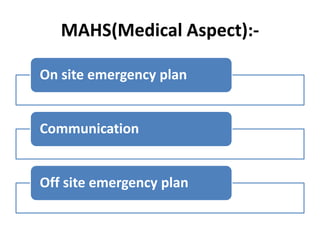
MAHS(Medical Aspect):-
On site emergency plan
Communication
Off site emergency plan
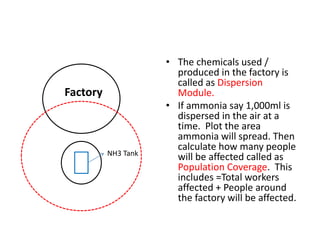
• The chemicals used /
produced in the factory is
called as Dispersion
Module.
• If ammonia say 1,000ml is
dispersed in the air at a
time. Plot the area
ammonia will spread. Then
calculate how many people
will be affected called as
Population Coverage. This
includes =Total workers
affected + People around
the factory will be affected.
Factory
NH3 Tank
• Reaction Time / Response Time / Delay time:- gap
between the injury occurred and the treatment started
• Mock Test:- Rehearsal assuming the disaster has
occurred. Purpose is to reduce the delay time.
• Peak Load Volume:- The dispensary of the factory will
be converted into emergency room. The team of
Medical & Paramedical people is called as Trauma
Team. It consists of Trained Doctor(s) & Paramedical
staff. Their duty is to evaluate & then refer the patients
to the hospital. Peak Load Volume means 1% of Total
Population Covered. There should be bed facility in the
referral hospital for this Peak Load Volume.
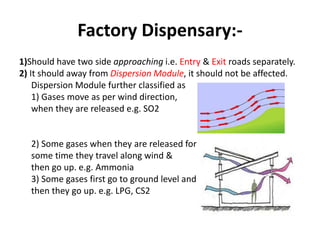
Factory Dispensary:-
1)Should have two side approaching i.e. Entry & Exit roads separately.
2) It should away from Dispersion Module, it should not be affected.
Dispersion Module further classified as
1) Gases move as per wind direction,
when they are released e.g. SO2
2) Some gases when they are released for
some time they travel along wind &
then go up. e.g. Ammonia
3) Some gases first go to ground level and
then they go up. e.g. LPG, CS2
Trauma Team:-
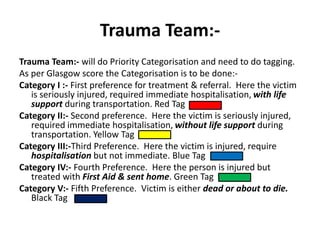
Trauma Team:- will do Priority Categorisation and need to do tagging.
As per Glasgow score the Categorisation is to be done:-
Category I :- First preference for treatment & referral. Here the victim
is seriously injured, required immediate hospitalisation, with life
support during transportation. Red Tag
Category II:- Second preference. Here the victim is seriously injured,
required immediate hospitalisation, without life support during
transportation. Yellow Tag
Category III:-Third Preference. Here the victim is injured, require
hospitalisation but not immediate. Blue Tag
Category IV:- Fourth Preference. Here the person is injured but
treated with First Aid & sent home. Green Tag
Category V:- Fifth Preference. Victim is either dead or about to die.
Black Tag
Paramedics & Ambulance
• By seeing the tag the paramedics & ambulance driver will
take the victims. Category I will go to Category I
Ambulance. Category II & III will go to Category II
Ambulance.
• The driver should have the knowledge of driving the
ambulance. The helper of the Ambulance should have the
First Aid knowledge & Training.
• Before sending the ambulance there will be
communication with the Referral Centre. Referral Centre
will have Crash Team consisting of Surgeons, Anaesthetics,
OT Nurse & Associated Paramedics. These offsite hospitals
will have all emergency plan, medicines, vaccines,
antitoxins etc.
• It is responsibility of the occupier to set up a
dispensary in the surrounding area, which can
be a mobile van. This will be active at the
time of disaster. They also need help from
local police, fire fighters, NGO etc.

Major Accident Hazard Control

  • 1.
    Major Accident HazardsControl Dr S K Haldar
  • 2.
    Major Accident HazardsControl • Factory act amended after Bhopal gas disaster in 1987. Any company planning to get licence for hazardous industry, they have to provide Disaster Management Plan, which is prepared by 1) Medical & 2) safety • Medical:- Committee should have a medical person as a member, who will make the plan, called as Emergency Preparedness Plan.
  • 3.
    MAHS(Medical Aspect):- On siteemergency plan Communication Off site emergency plan
  • 4.
    • The chemicalsused / produced in the factory is called as Dispersion Module. • If ammonia say 1,000ml is dispersed in the air at a time. Plot the area ammonia will spread. Then calculate how many people will be affected called as Population Coverage. This includes =Total workers affected + People around the factory will be affected. Factory NH3 Tank
  • 5.
    • Reaction Time/ Response Time / Delay time:- gap between the injury occurred and the treatment started • Mock Test:- Rehearsal assuming the disaster has occurred. Purpose is to reduce the delay time. • Peak Load Volume:- The dispensary of the factory will be converted into emergency room. The team of Medical & Paramedical people is called as Trauma Team. It consists of Trained Doctor(s) & Paramedical staff. Their duty is to evaluate & then refer the patients to the hospital. Peak Load Volume means 1% of Total Population Covered. There should be bed facility in the referral hospital for this Peak Load Volume.
  • 6.
    Factory Dispensary:- 1)Should havetwo side approaching i.e. Entry & Exit roads separately. 2) It should away from Dispersion Module, it should not be affected. Dispersion Module further classified as 1) Gases move as per wind direction, when they are released e.g. SO2 2) Some gases when they are released for some time they travel along wind & then go up. e.g. Ammonia 3) Some gases first go to ground level and then they go up. e.g. LPG, CS2
  • 7.
    Trauma Team:- Trauma Team:-will do Priority Categorisation and need to do tagging. As per Glasgow score the Categorisation is to be done:- Category I :- First preference for treatment & referral. Here the victim is seriously injured, required immediate hospitalisation, with life support during transportation. Red Tag Category II:- Second preference. Here the victim is seriously injured, required immediate hospitalisation, without life support during transportation. Yellow Tag Category III:-Third Preference. Here the victim is injured, require hospitalisation but not immediate. Blue Tag Category IV:- Fourth Preference. Here the person is injured but treated with First Aid & sent home. Green Tag Category V:- Fifth Preference. Victim is either dead or about to die. Black Tag
  • 8.
    Paramedics & Ambulance •By seeing the tag the paramedics & ambulance driver will take the victims. Category I will go to Category I Ambulance. Category II & III will go to Category II Ambulance. • The driver should have the knowledge of driving the ambulance. The helper of the Ambulance should have the First Aid knowledge & Training. • Before sending the ambulance there will be communication with the Referral Centre. Referral Centre will have Crash Team consisting of Surgeons, Anaesthetics, OT Nurse & Associated Paramedics. These offsite hospitals will have all emergency plan, medicines, vaccines, antitoxins etc.
  • 9.
    • It isresponsibility of the occupier to set up a dispensary in the surrounding area, which can be a mobile van. This will be active at the time of disaster. They also need help from local police, fire fighters, NGO etc.