Overview of
OHSAS 18001
Occupational Health and Safety
Management System
WHAT IS OHSAS????
Occupational Health and Safety Assessment
Series (OHSAS) Standard.
The 2007 version is the latest OHSAS 18001
standard that replaced the 1999 version.
It was developed to be compatible with the ISO
9001:2008/TS 16949 (Quality) and ISO 14001:2004
(Environmental) management systems standards.
OHSAS 18001 has been developed in response to
customer demand for a recognizable occupational
health and safety management system standard.
A NEW ISO STANDARD! OHSAS 18001 will be
changed to ISO 45001 on October, 2016
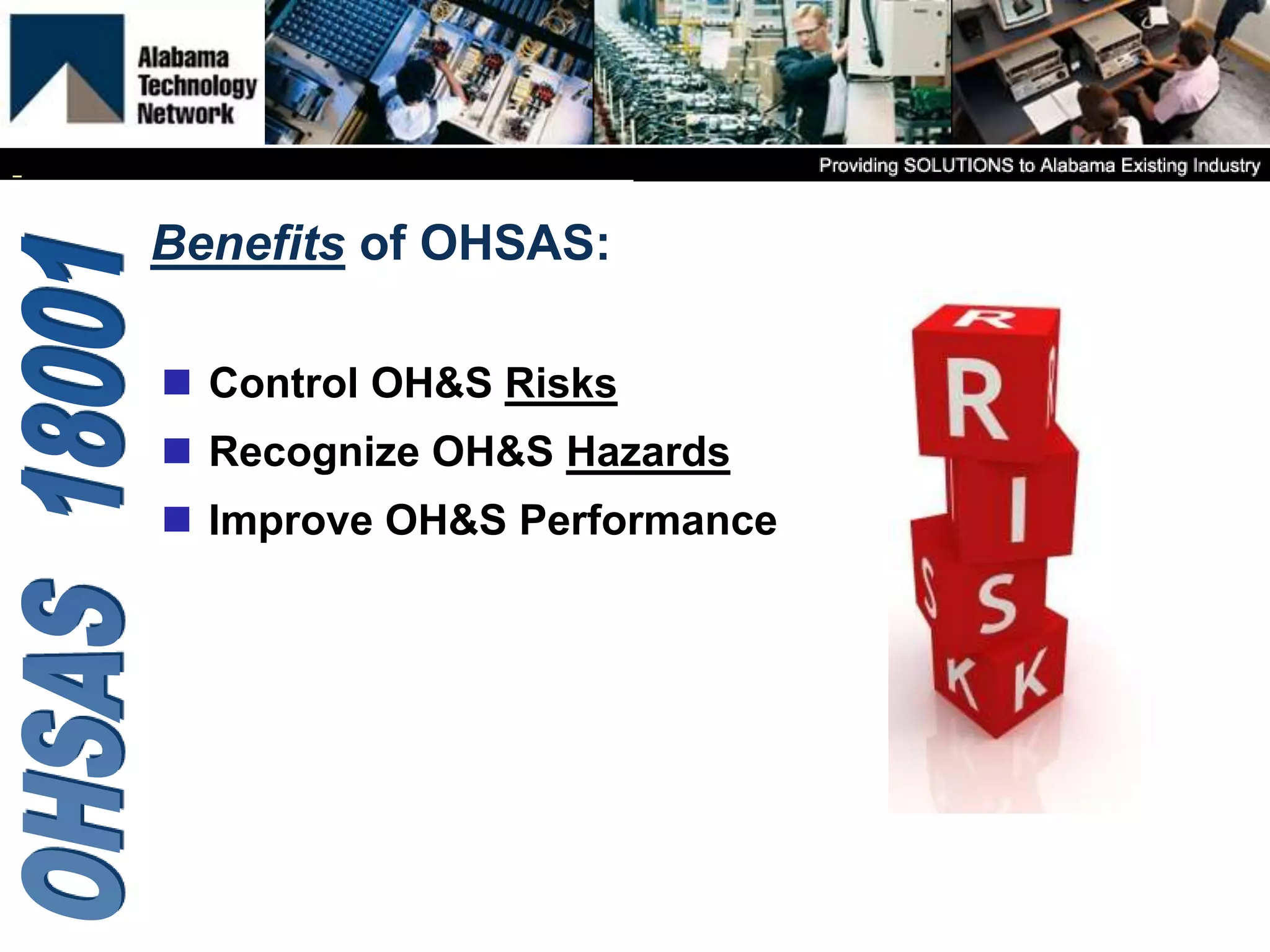
Benefits of OHSAS:
 Control OH&S Risks
 Recognize OH&S Hazards
 Improve OH&S Performance
Occupational Health and Safety (OH&S)
 conditions and factors that affect, or
could affect, the health and safety of:
employees or other workers
(including temporary workers and
contractor personnel),
 visitors,
or any other person in the workplace
OHSAS 18001 – Definitions:
Incident:
 Work-related event(s) in which:
An injury, or
ill health
(regardless of severity)
or fatality occurred,
OR could have occurred.
OHSAS 18001 – Definitions(continued):
ill Health:
 Identifiable, adverse physical or
mental condition:
arising from and/or
made worse
by a work activity and/or
work-related situation
OHSAS 18001 – Definitions (continued):
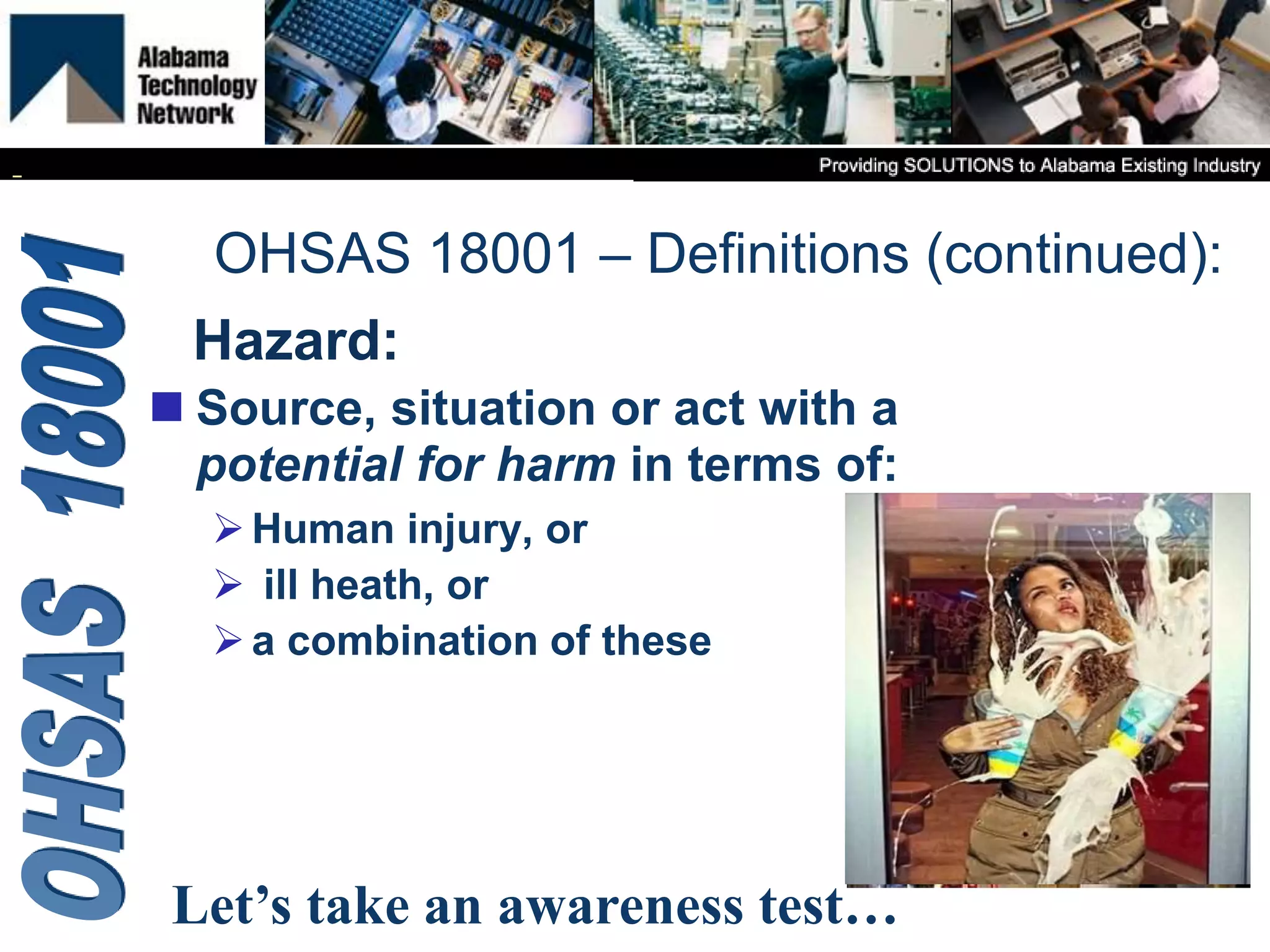
Hazard:
 Source, situation or act with a
potential for harm in terms of:
Human injury, or
 ill heath, or
a combination of these
OHSAS 18001 – Definitions (continued):
Let’s take an awareness test…
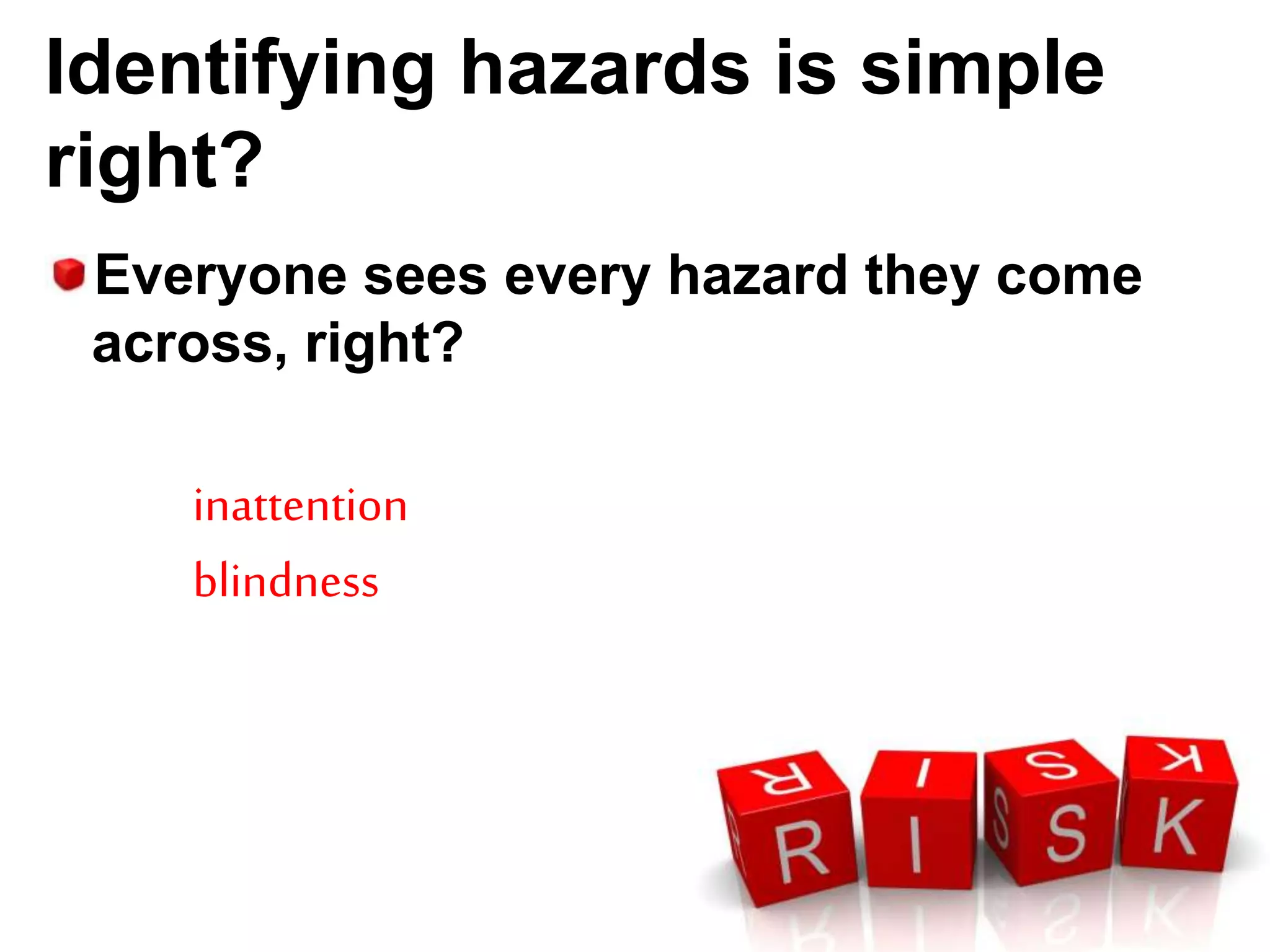
Identifying hazards is simple
right?
Everyone sees every hazard they come
across, right?
inattention
blindness
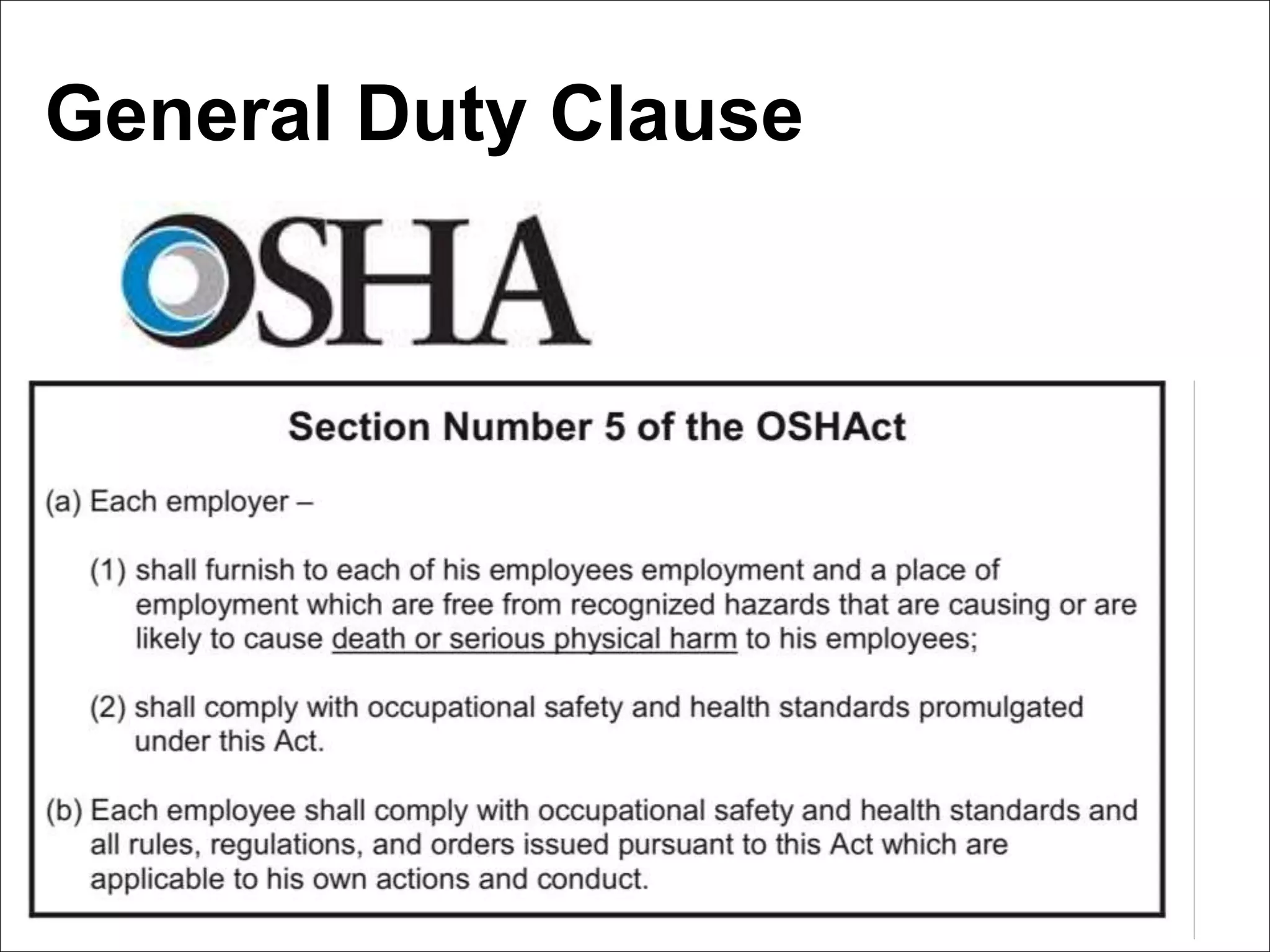
General Duty Clause
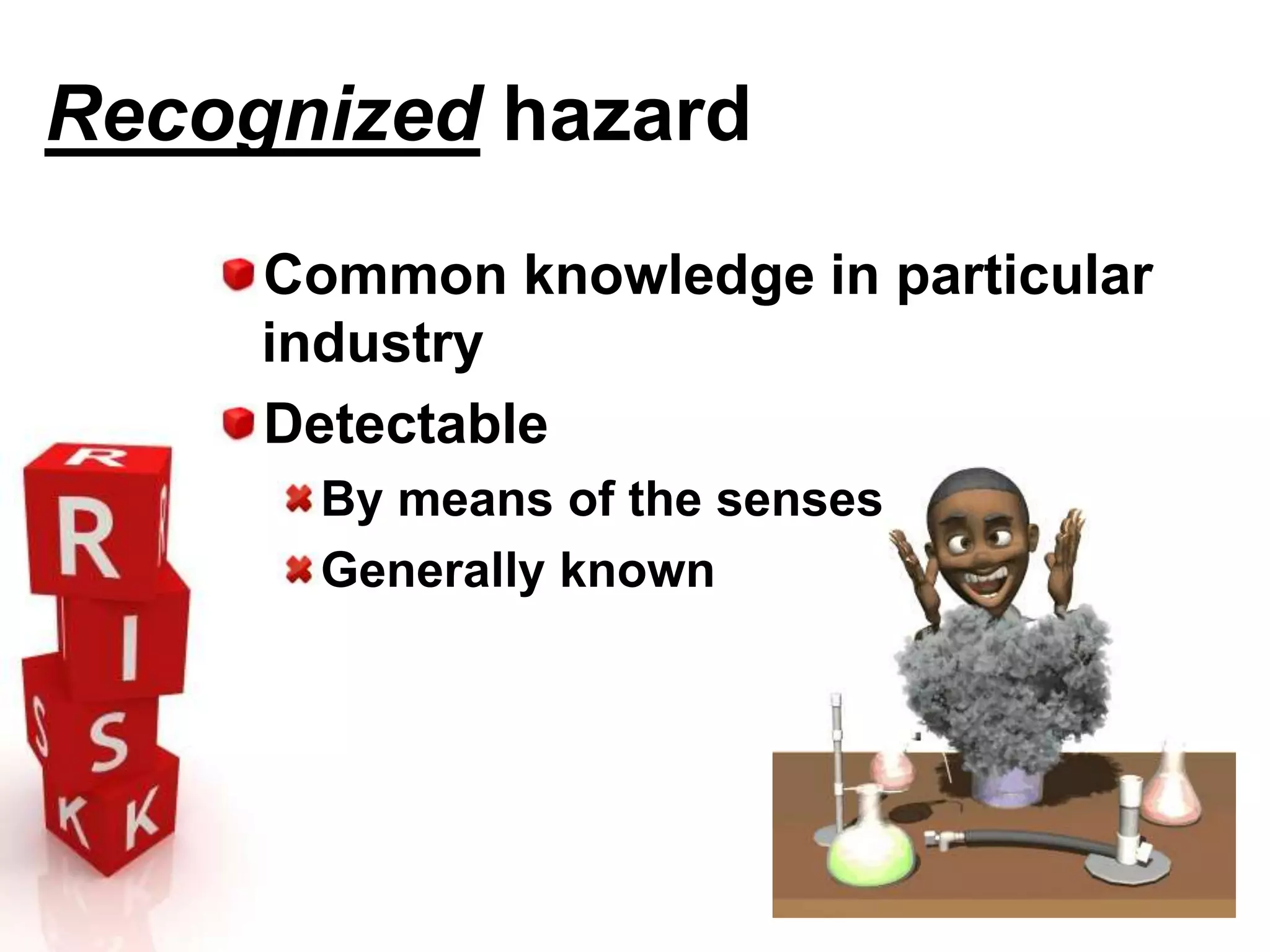
Recognized hazard
Common knowledge in particular
industry
Detectable
By means of the senses
Generally known
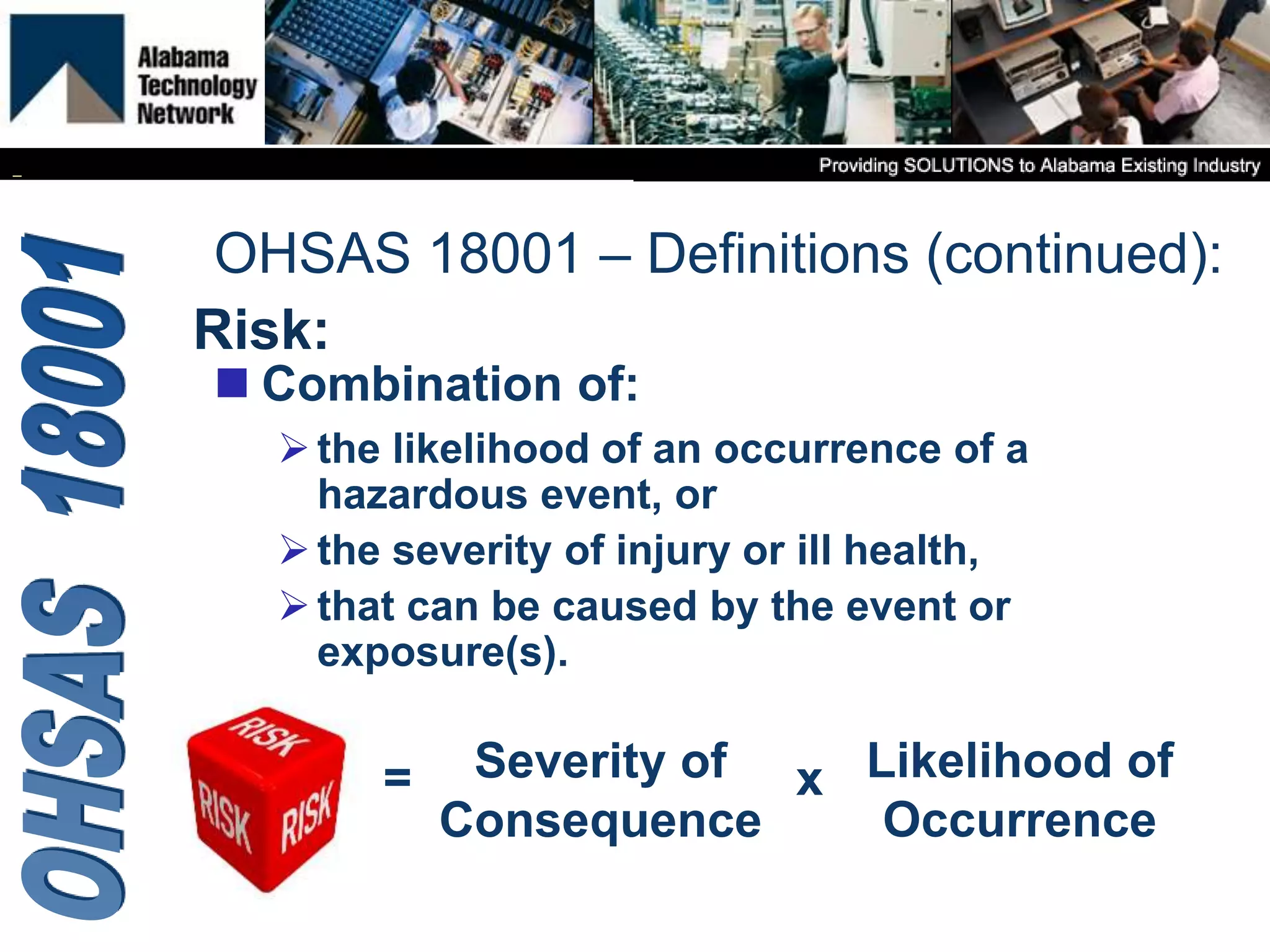
Risk:
 Combination of:
the likelihood of an occurrence of a
hazardous event, or
the severity of injury or ill health,
that can be caused by the event or
exposure(s).
OHSAS 18001 – Definitions (continued):
= Severity of
Consequence
Likelihood of
Occurrence
x
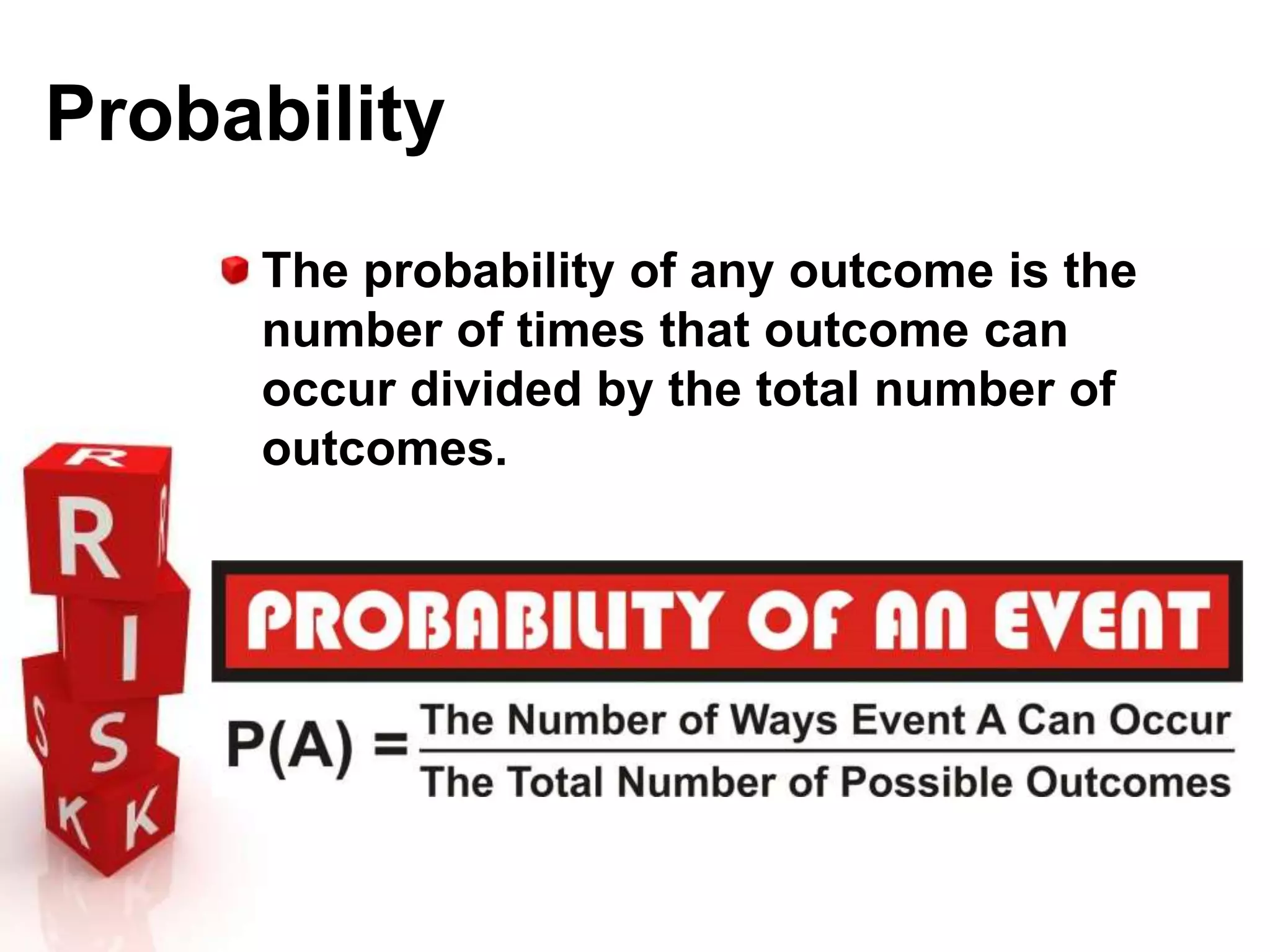
Probability
The probability of any outcome is the
number of times that outcome can
occur divided by the total number of
outcomes.
Risk Assessment:
 Process of evaluating the risk(s):
Arising from a hazard(s)
Taking into account the adequacy of any
existing controls,
and deciding whether or not the risk(s) is
acceptable
OHSAS 18001 – Definitions (continued):
Acceptable Risk:
 Risk that has been reduced to a level that
can be tolerated by the organization:
Having regard to its legal obligations and
its own OH&S policy.
OHSAS 18001 – Definitions (continued):
Management Systems
QMS…EMS…OHSAS
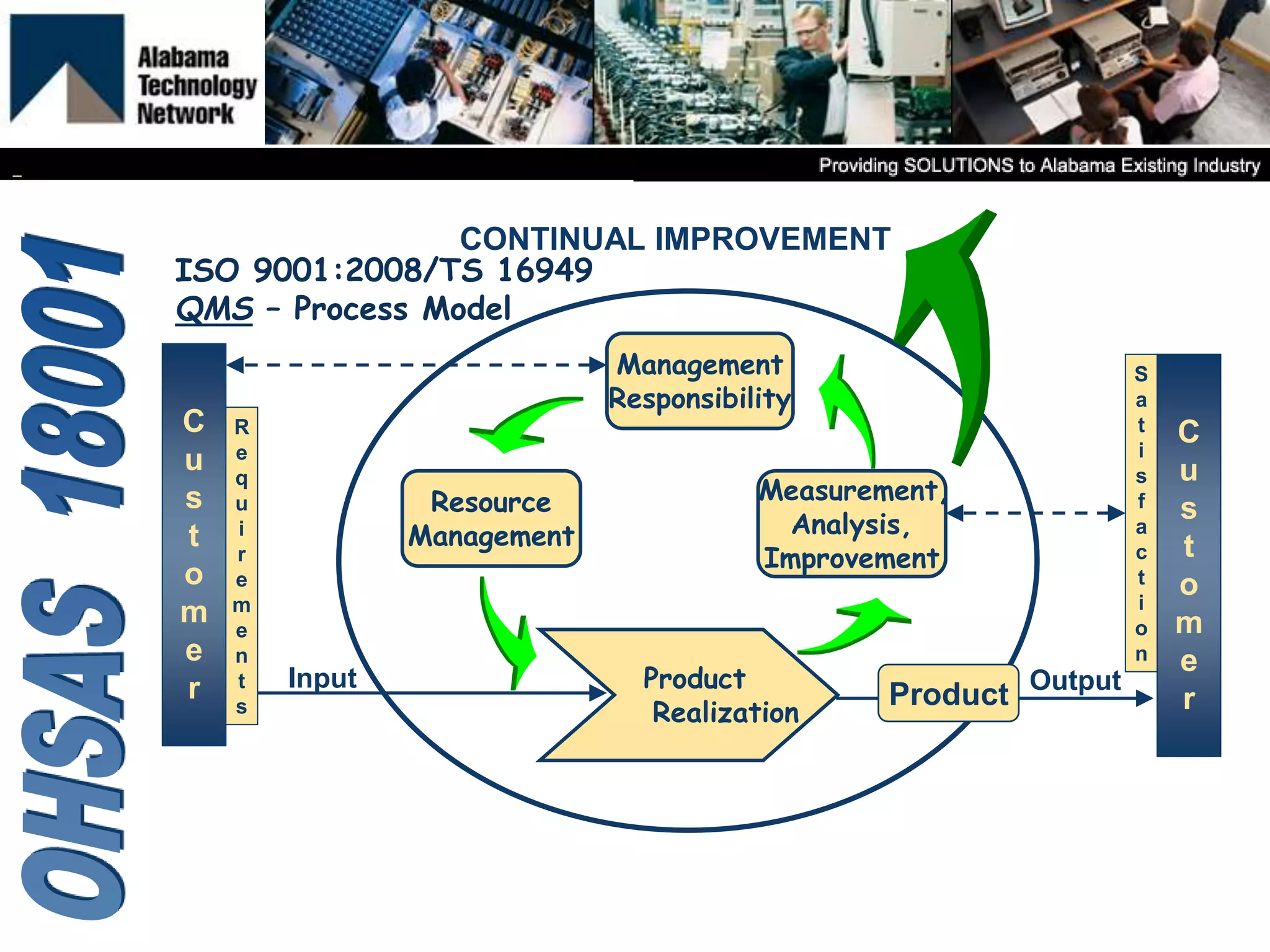
Resource
Management
Management
Responsibility
Measurement,
Analysis,
Improvement
Product
Realization
CONTINUAL IMPROVEMENT
C
u
s
t
o
m
e
r
C
u
s
t
o
m
e
r
R
e
q
u
i
r
e
m
e
n
t
s
S
a
t
i
s
f
a
c
t
i
o
n
Input Output
ISO 9001:2008/TS 16949
QMS – Process Model
Product
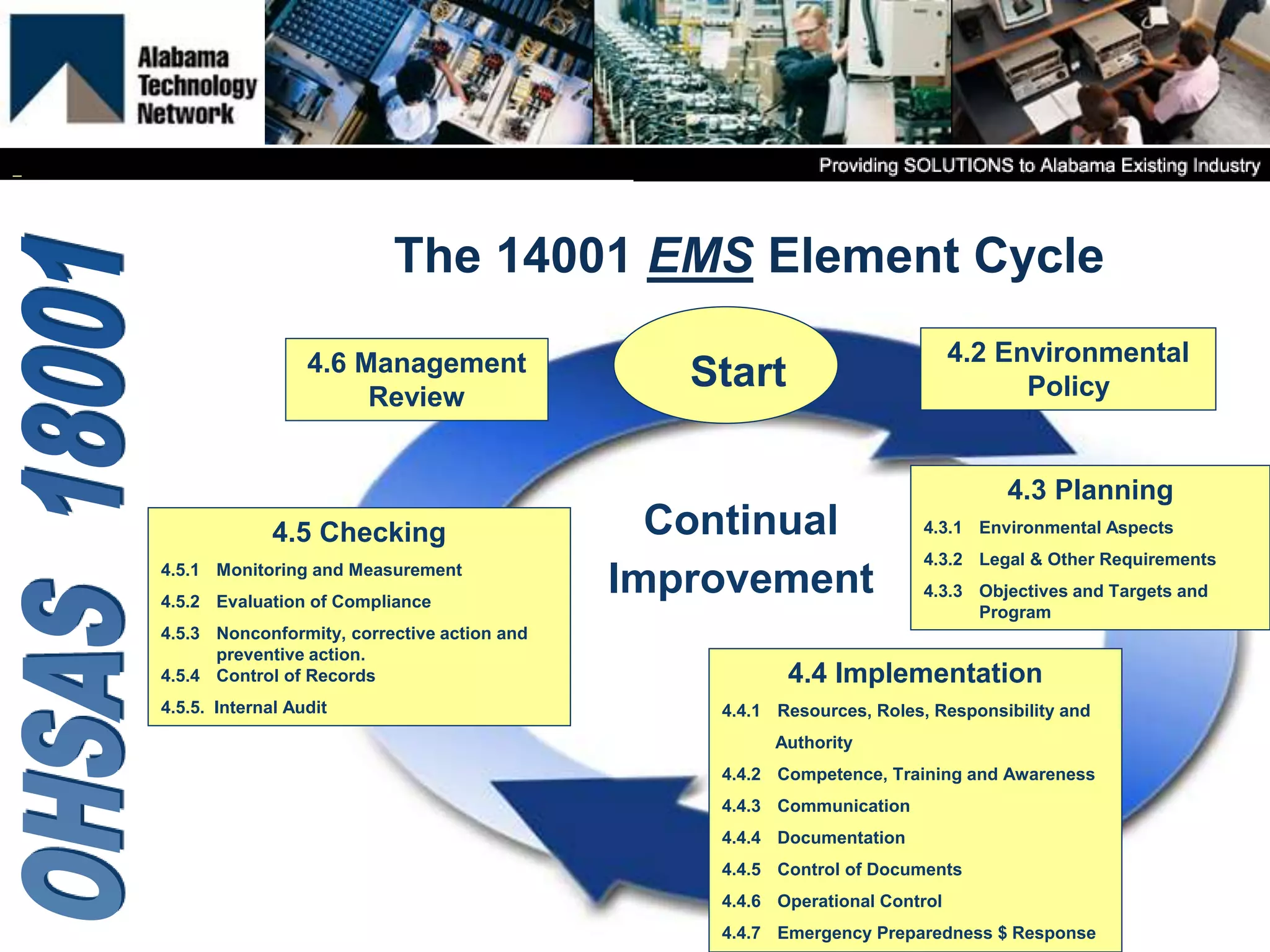
The 14001 EMS Element Cycle
Start
4.2 Environmental
Policy
4.6 Management
Review
4.5 Checking
4.5.1 Monitoring and Measurement
4.5.2 Evaluation of Compliance
4.5.3 Nonconformity, corrective action and
preventive action.
4.5.4 Control of Records
4.5.5. Internal Audit
4.3 Planning
4.3.1 Environmental Aspects
4.3.2 Legal & Other Requirements
4.3.3 Objectives and Targets and
Program
4.4 Implementation
4.4.1 Resources, Roles, Responsibility and
Authority
4.4.2 Competence, Training and Awareness
4.4.3 Communication
4.4.4 Documentation
4.4.5 Control of Documents
4.4.6 Operational Control
4.4.7 Emergency Preparedness $ Response
Continual
Improvement
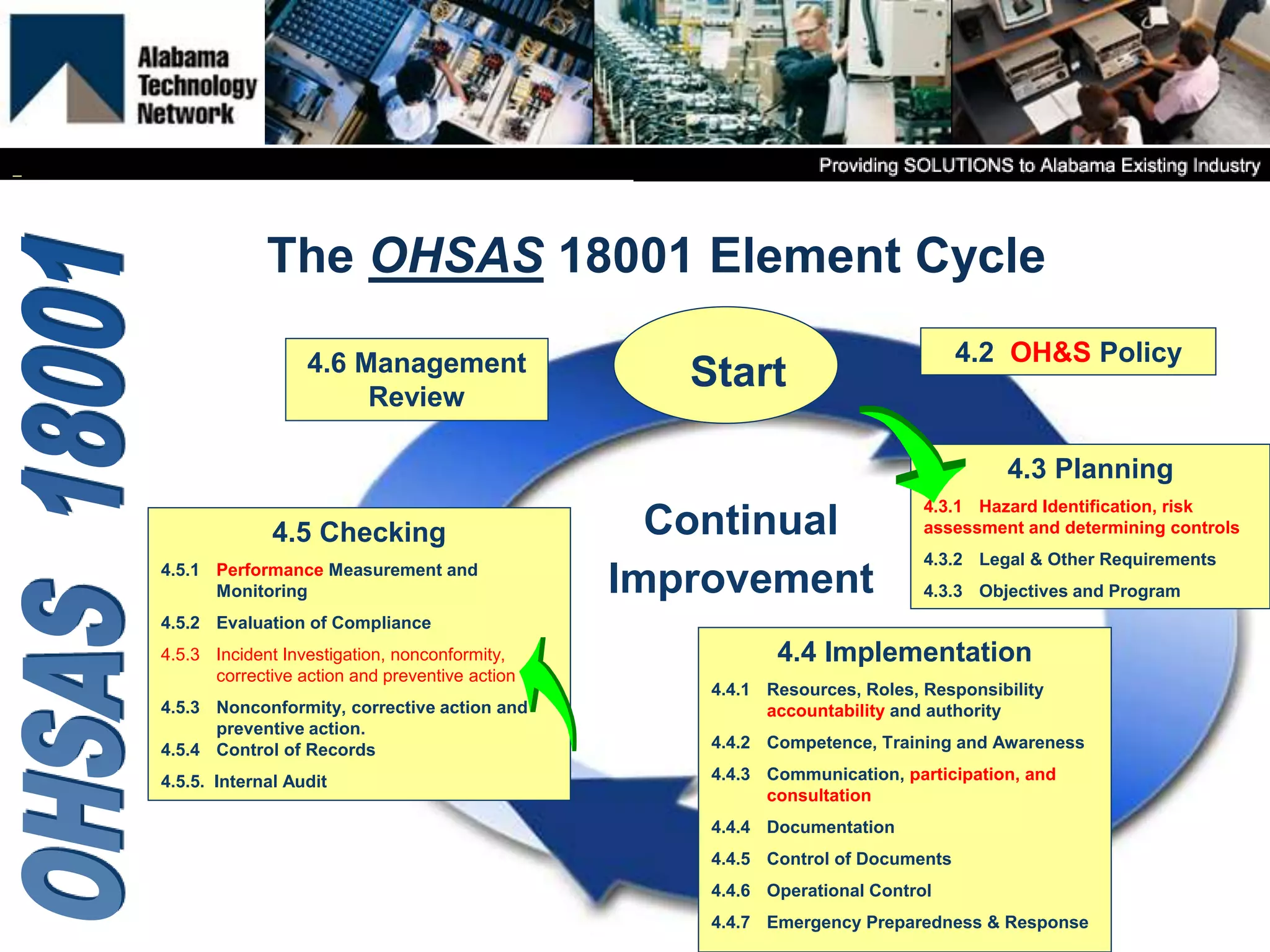
The OHSAS 18001 Element Cycle
Start
4.2 OH&S Policy4.6 Management
Review
4.5 Checking
4.5.1 Performance Measurement and
Monitoring
4.5.2 Evaluation of Compliance
4.5.3 Incident Investigation, nonconformity,
corrective action and preventive action
4.5.3 Nonconformity, corrective action and
preventive action.
4.5.4 Control of Records
4.5.5. Internal Audit
4.3 Planning
4.3.1 Hazard Identification, risk
assessment and determining controls
4.3.2 Legal & Other Requirements
4.3.3 Objectives and Program
4.4 Implementation
4.4.1 Resources, Roles, Responsibility
accountability and authority
4.4.2 Competence, Training and Awareness
4.4.3 Communication, participation, and
consultation
4.4.4 Documentation
4.4.5 Control of Documents
4.4.6 Operational Control
4.4.7 Emergency Preparedness & Response
Continual
Improvement
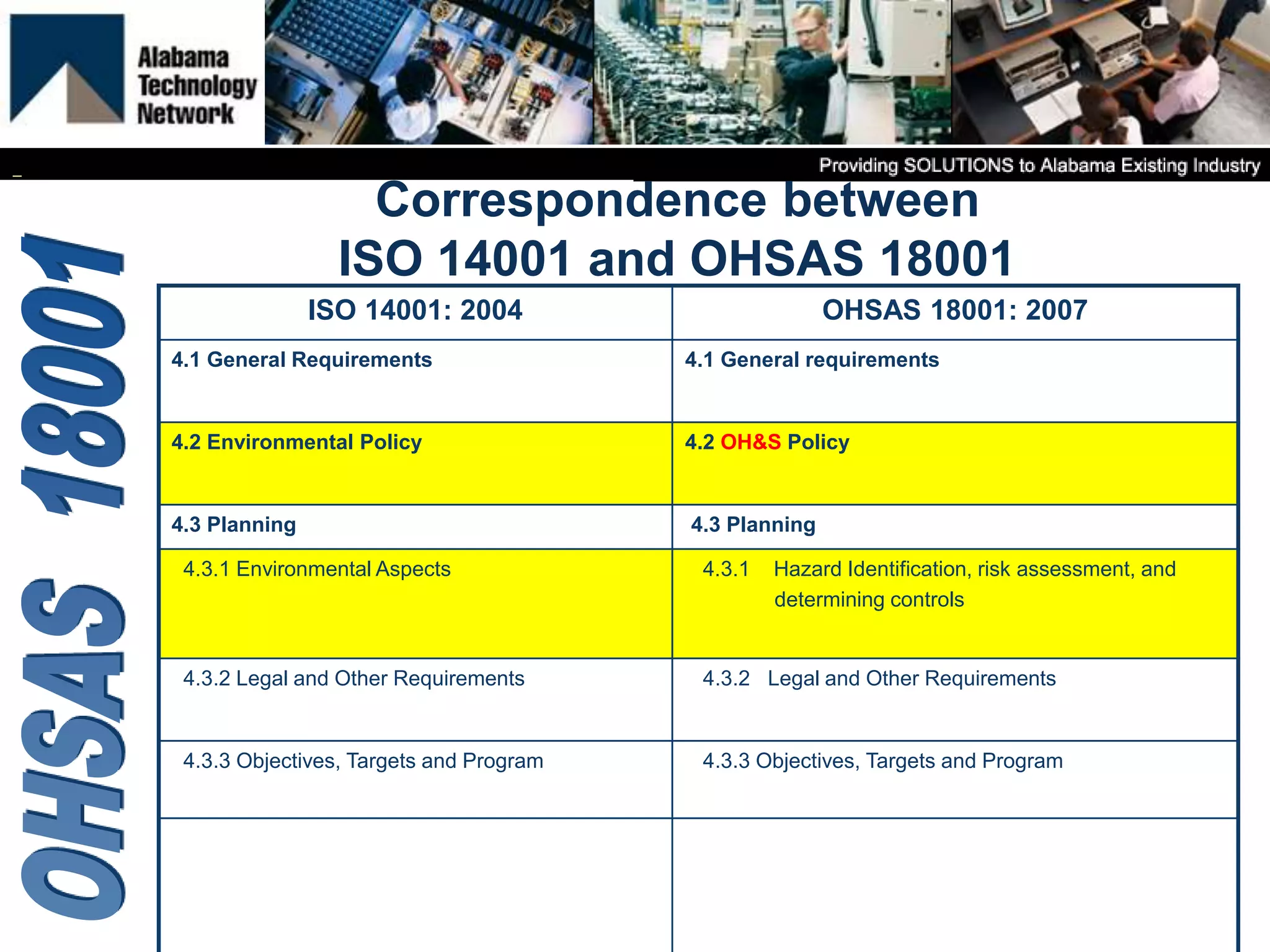
Correspondence between
ISO 14001 and OHSAS 18001
ISO 14001: 2004 OHSAS 18001: 2007
4.1 General Requirements 4.1 General requirements
4.2 Environmental Policy 4.2 OH&S Policy
4.3 Planning 4.3 Planning
4.3.1 Environmental Aspects 4.3.1 Hazard Identification, risk assessment, and
determining controls
4.3.2 Legal and Other Requirements 4.3.2 Legal and Other Requirements
4.3.3 Objectives, Targets and Program 4.3.3 Objectives, Targets and Program
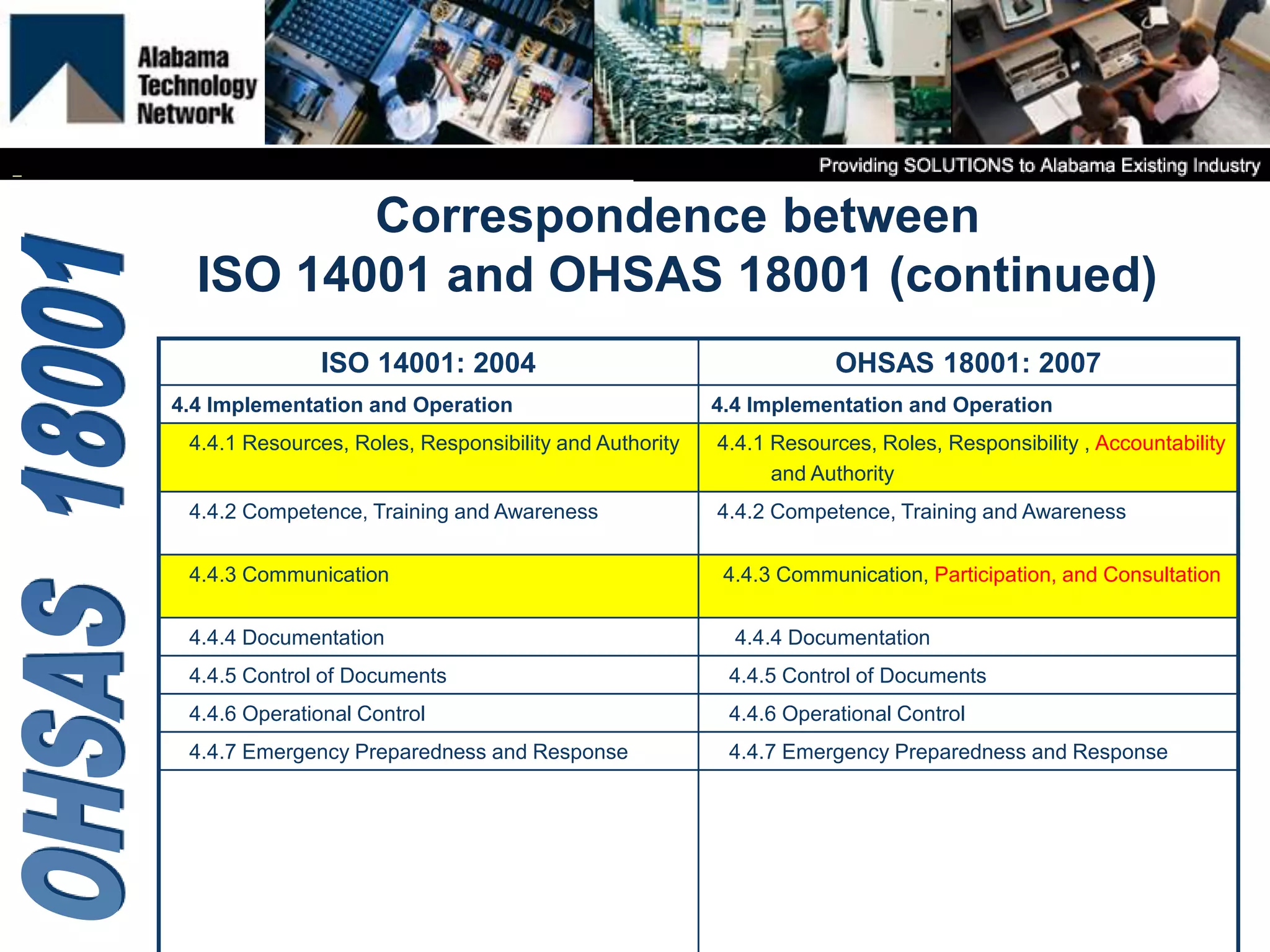
Correspondence between
ISO 14001 and OHSAS 18001 (continued)
ISO 14001: 2004 OHSAS 18001: 2007
4.4 Implementation and Operation 4.4 Implementation and Operation
4.4.1 Resources, Roles, Responsibility and Authority 4.4.1 Resources, Roles, Responsibility , Accountability
and Authority
4.4.2 Competence, Training and Awareness 4.4.2 Competence, Training and Awareness
4.4.3 Communication 4.4.3 Communication, Participation, and Consultation
4.4.4 Documentation 4.4.4 Documentation
4.4.5 Control of Documents 4.4.5 Control of Documents
4.4.6 Operational Control 4.4.6 Operational Control
4.4.7 Emergency Preparedness and Response 4.4.7 Emergency Preparedness and Response
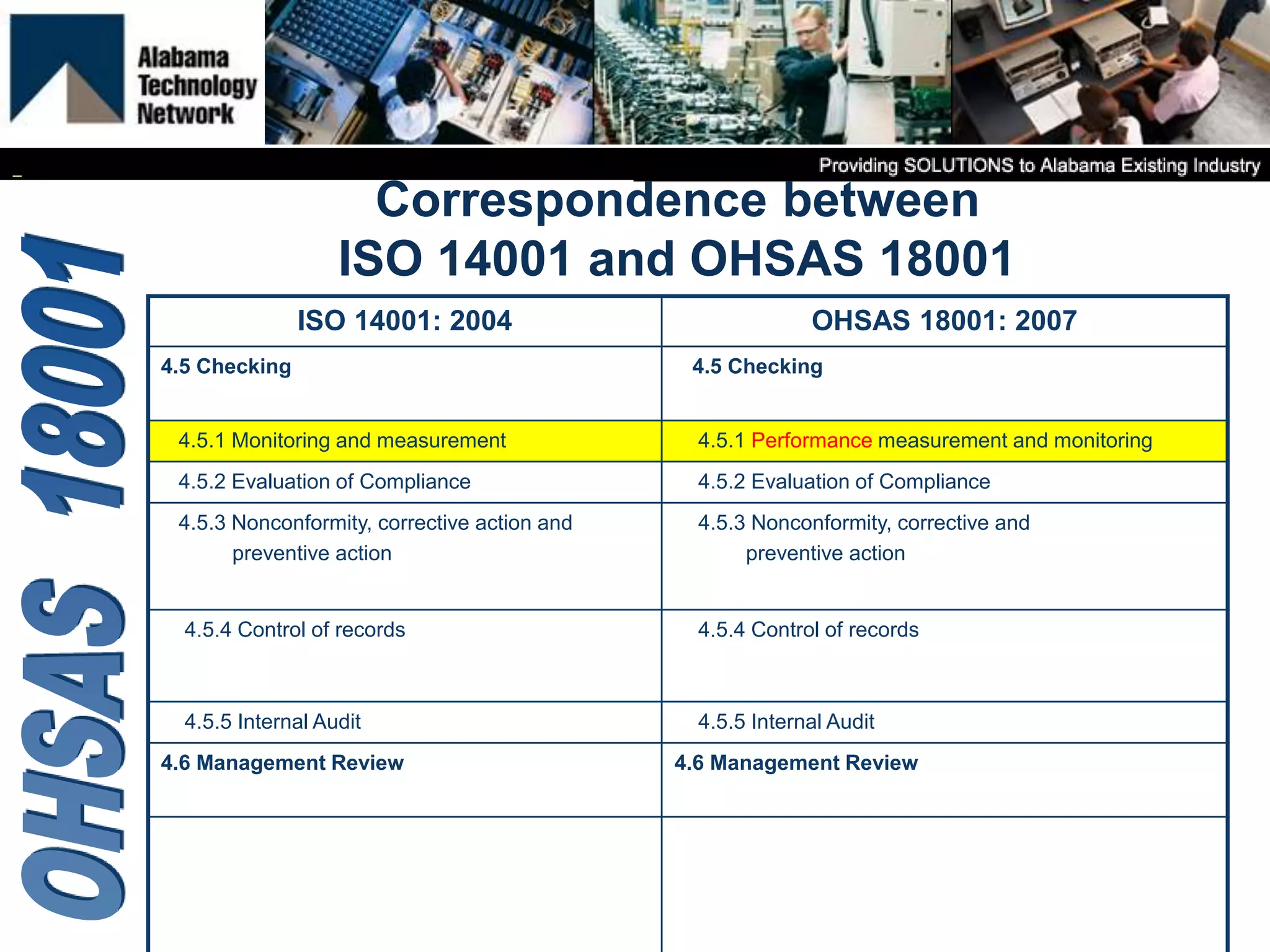
Correspondence between
ISO 14001 and OHSAS 18001
ISO 14001: 2004 OHSAS 18001: 2007
4.5 Checking 4.5 Checking
4.5.1 Monitoring and measurement 4.5.1 Performance measurement and monitoring
4.5.2 Evaluation of Compliance 4.5.2 Evaluation of Compliance
4.5.3 Nonconformity, corrective action and
preventive action
4.5.3 Nonconformity, corrective and
preventive action
4.5.4 Control of records 4.5.4 Control of records
4.5.5 Internal Audit 4.5.5 Internal Audit
4.6 Management Review 4.6 Management Review
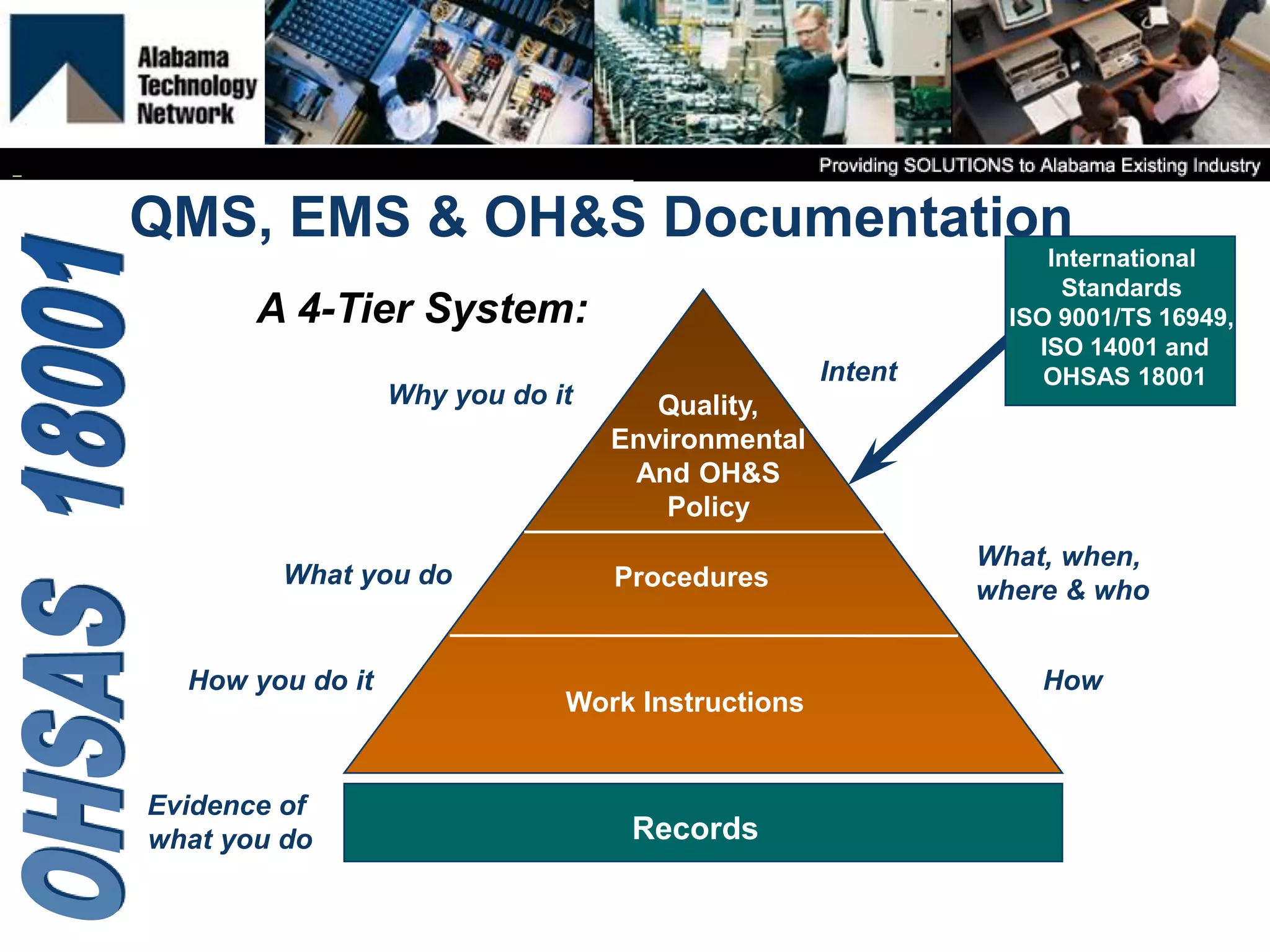
Quality,
Environmental
And OH&S
Policy
Procedures
Work Instructions
Records
Why you do it
What you do
How you do it
Evidence of
what you do
Intent
What, when,
where & who
How
QMS, EMS & OH&S Documentation
A 4-Tier System:
International
Standards
ISO 9001/TS 16949,
ISO 14001 and
OHSAS 18001
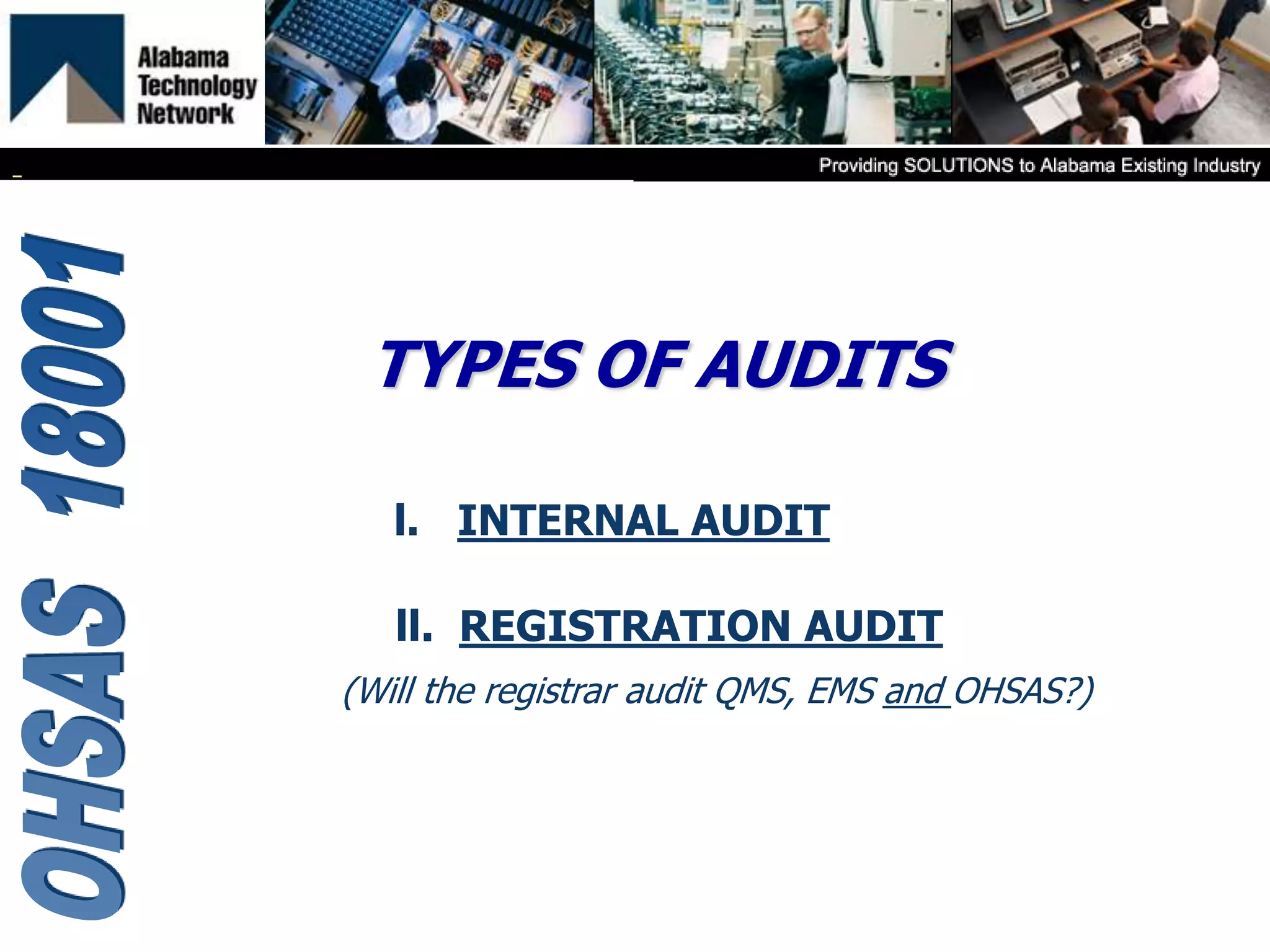
TYPES OF AUDITS
l. INTERNAL AUDIT
ll. REGISTRATION AUDIT
(Will the registrar audit QMS, EMS and OHSAS?)
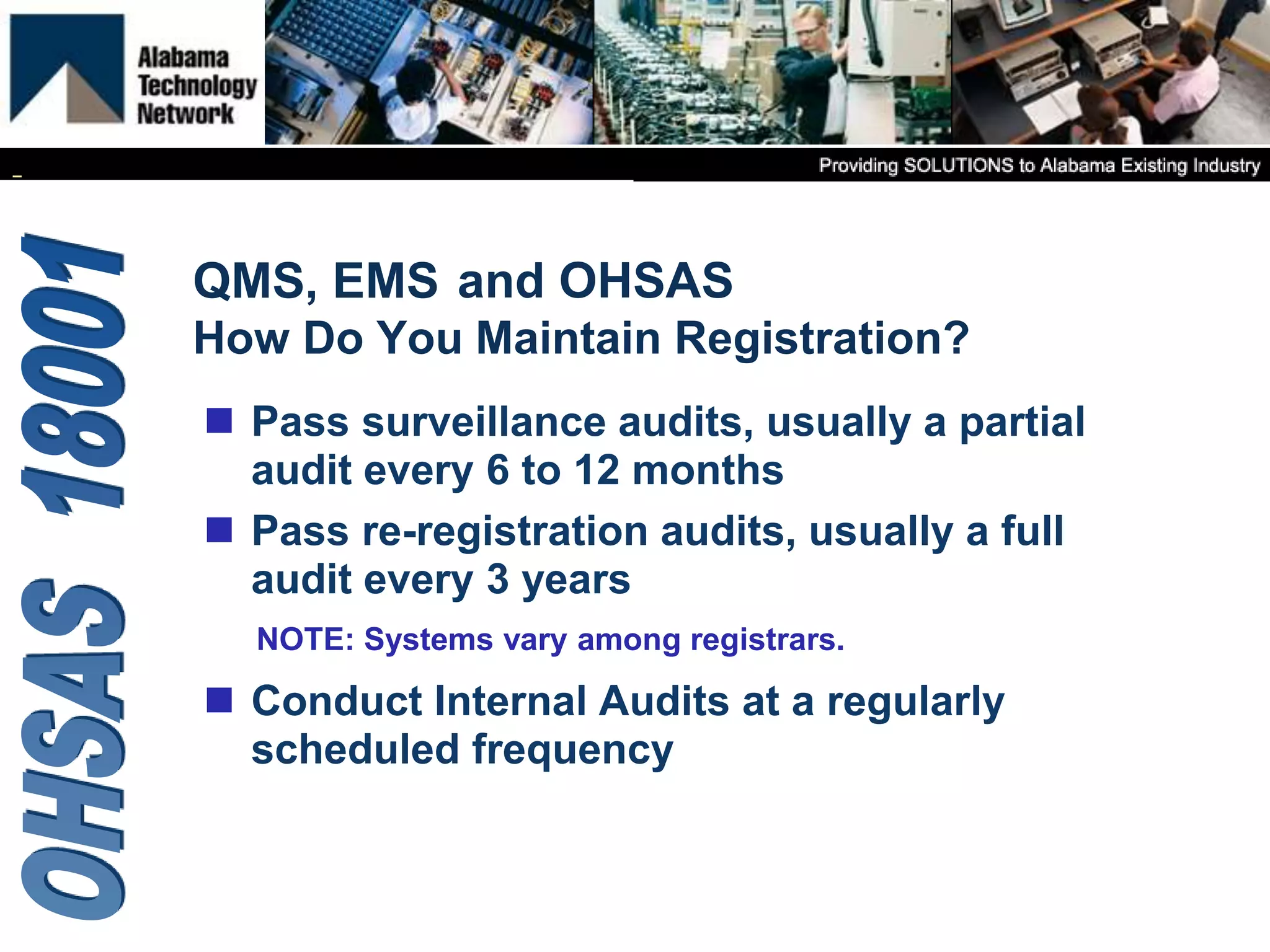
NOTE: Systems vary among registrars.
QMS, EMS
How Do You Maintain Registration?
 Pass surveillance audits, usually a partial
audit every 6 to 12 months
 Pass re-registration audits, usually a full
audit every 3 years
 Conduct Internal Audits at a regularly
scheduled frequency
and OHSAS
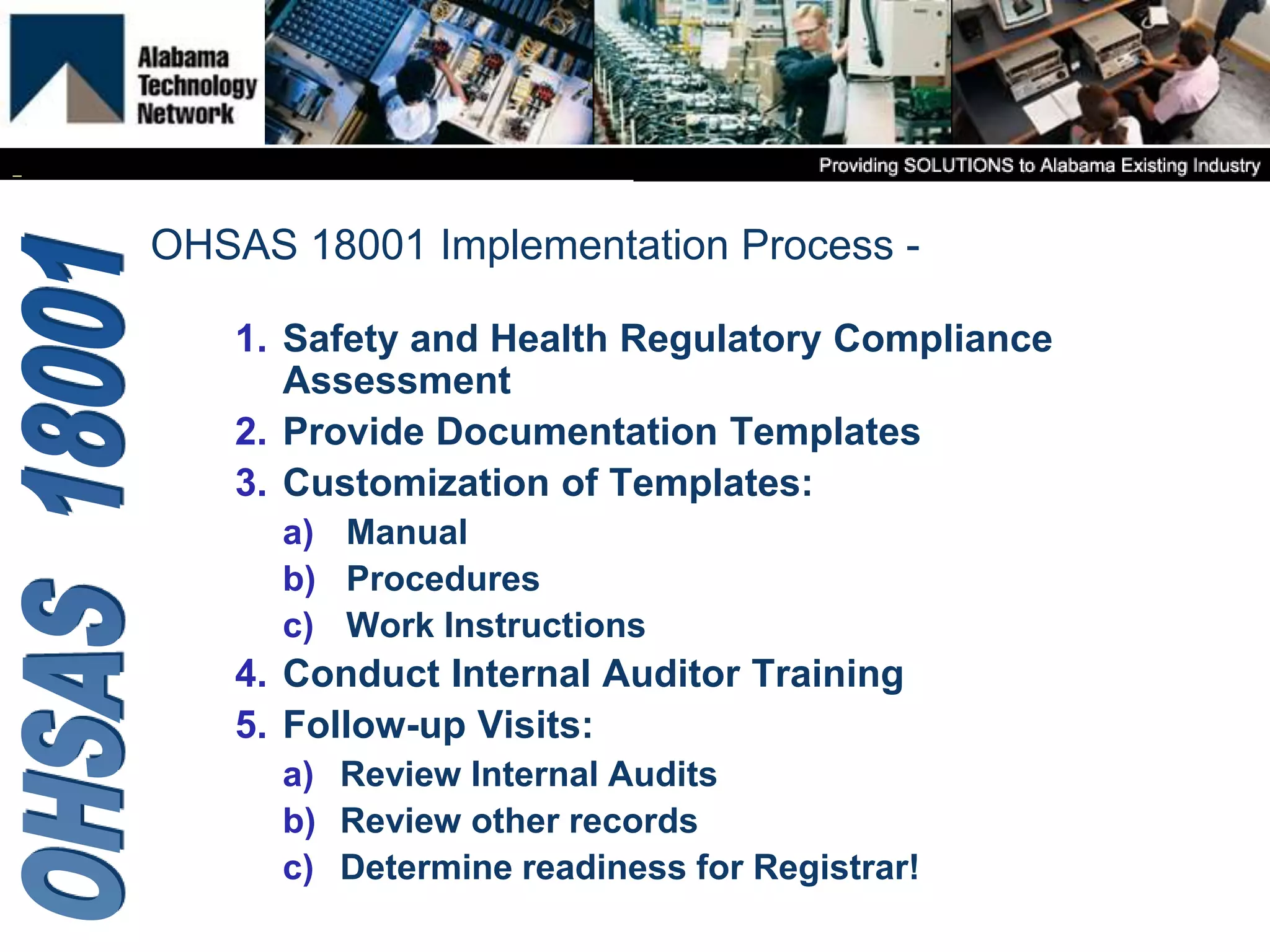
1. Safety and Health Regulatory Compliance
Assessment
2. Provide Documentation Templates
3. Customization of Templates:
a) Manual
b) Procedures
c) Work Instructions
4. Conduct Internal Auditor Training
5. Follow-up Visits:
a) Review Internal Audits
b) Review other records
c) Determine readiness for Registrar!
OHSAS 18001 Implementation Process -
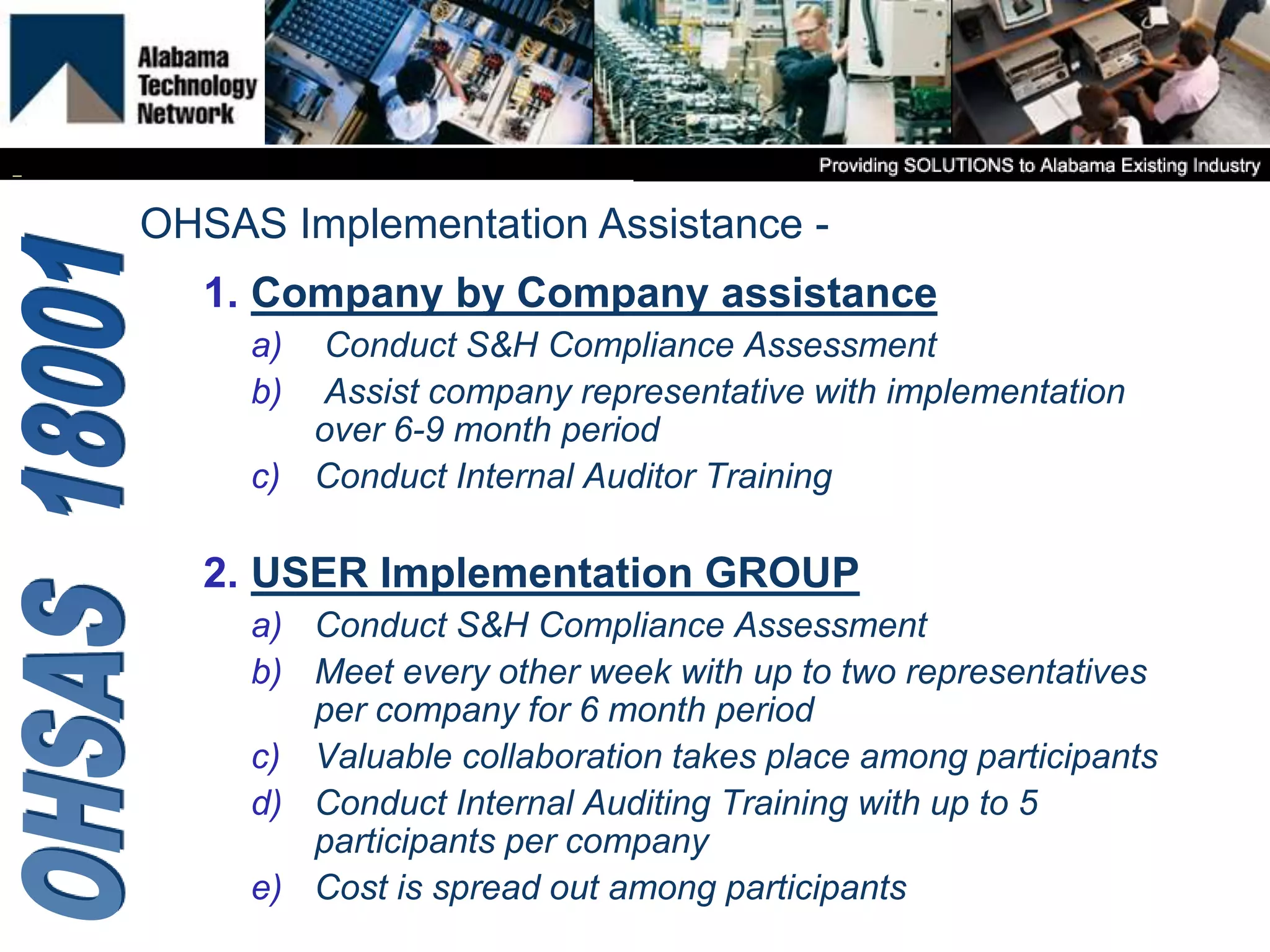
1. Company by Company assistance
a) Conduct S&H Compliance Assessment
b) Assist company representative with implementation
over 6-9 month period
c) Conduct Internal Auditor Training
2. USER Implementation GROUP
a) Conduct S&H Compliance Assessment
b) Meet every other week with up to two representatives
per company for 6 month period
c) Valuable collaboration takes place among participants
d) Conduct Internal Auditing Training with up to 5
participants per company
e) Cost is spread out among participants
OHSAS Implementation Assistance -
The USER GROUP Schedule 2013:
Date Location Topic Covered Homework
May 17
Trenholm State Community College
Building Q
 User Group Kick-Off
 Explanation of meeting
format
 Overview of Mgmt. System
 Workshop Exercises
 4.2 Policy
 Complete Policy
 Read sections 4.3, 4.3, 4.3.1
(OHSAS / EMS)
May 31
Trenholm State Community College
Building Q
 Workshop exercises on
 4.3 Planning – OHSAS 18001 /
ISO 14001
 4.3.1 Hazard Identification,
Risk Assessment and Controls
(OHSAS)
 ISO 14001 : 4.3.1
Environmental Aspects
Read sections 4.3.2, 4.3.3
June 14
Trenholm State Community College
Building Q
 Workshop exercises on
 4.3 Planning – OHSAS 18001
 4.3.2 Legal and Other
Requirements
 4.3.3 Objectives, Target and
Program
Read sections 4.4, 4.4.1, 4.4.2, 4.4.3
June 28
Trenholm State Community College
Building Q
 Workshop exercises on
 4.4 Implementation
 4.4.1 Resources, Roles,
Responsibility,
accountability, and Authority
 4.4.2 Competence, Training
and Awareness
 4.4.3 Communication,
Participation, and
Consultation
Read sections 4.4, 4.4.4, 4.4.5, 4.4.6
27
Date Location Topic Covered Homework
28
Date Location Topic Covered Homework
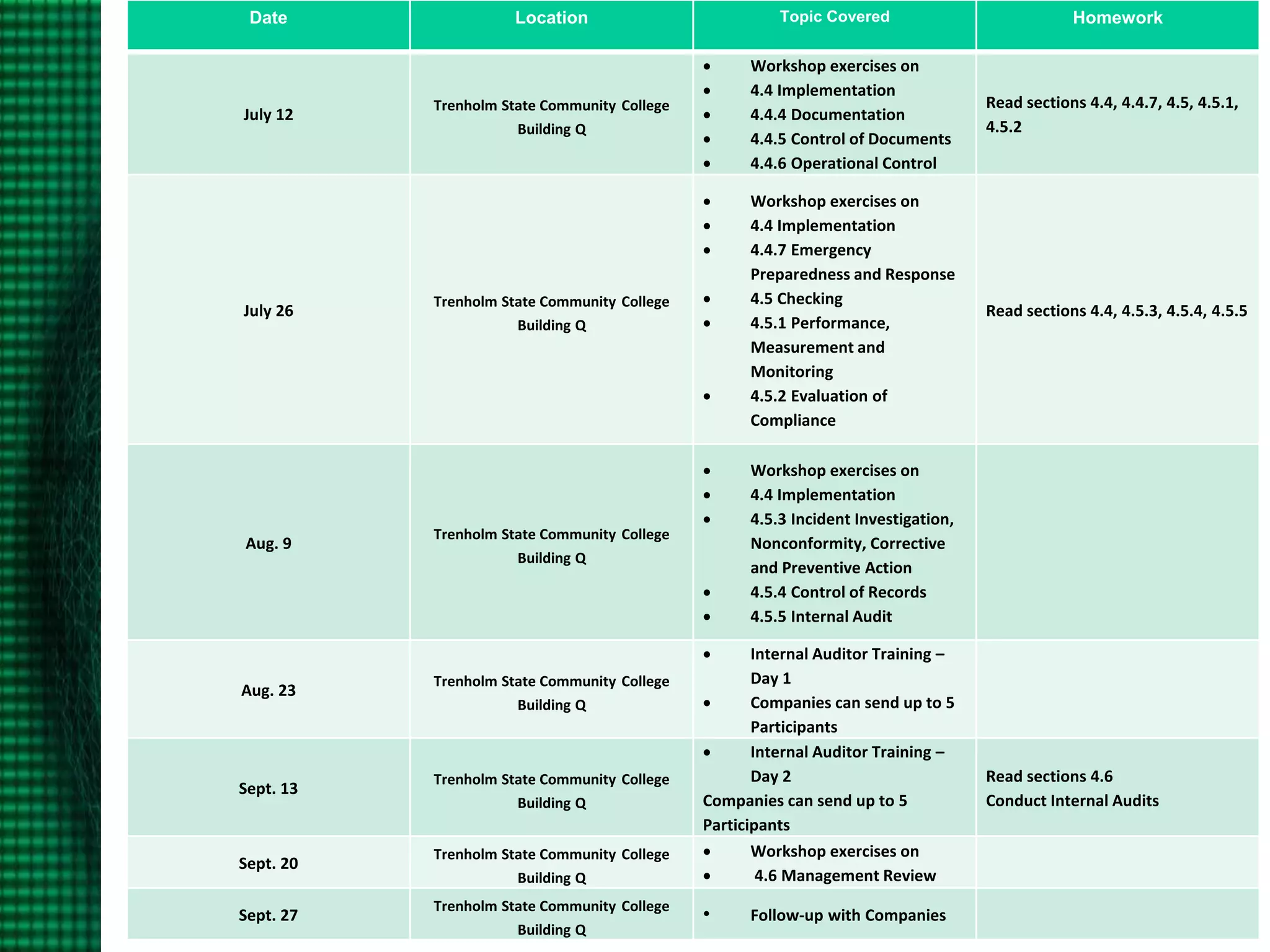
July 12
Trenholm State Community College
Building Q
 Workshop exercises on
 4.4 Implementation
 4.4.4 Documentation
 4.4.5 Control of Documents
 4.4.6 Operational Control
Read sections 4.4, 4.4.7, 4.5, 4.5.1,
4.5.2
July 26
Trenholm State Community College
Building Q
 Workshop exercises on
 4.4 Implementation
 4.4.7 Emergency
Preparedness and Response
 4.5 Checking
 4.5.1 Performance,
Measurement and
Monitoring
 4.5.2 Evaluation of
Compliance
Read sections 4.4, 4.5.3, 4.5.4, 4.5.5
Aug. 9
Trenholm State Community College
Building Q
 Workshop exercises on
 4.4 Implementation
 4.5.3 Incident Investigation,
Nonconformity, Corrective
and Preventive Action
 4.5.4 Control of Records
 4.5.5 Internal Audit
Aug. 23
Trenholm State Community College
Building Q
 Internal Auditor Training –
Day 1
 Companies can send up to 5
Participants
Sept. 13
Trenholm State Community College
Building Q
 Internal Auditor Training –
Day 2
Companies can send up to 5
Participants
Read sections 4.6
Conduct Internal Audits
Sept. 20
Trenholm State Community College
Building Q
 Workshop exercises on
 4.6 Management Review
Sept. 27
Trenholm State Community College
Building Q
• Follow-up with Companies
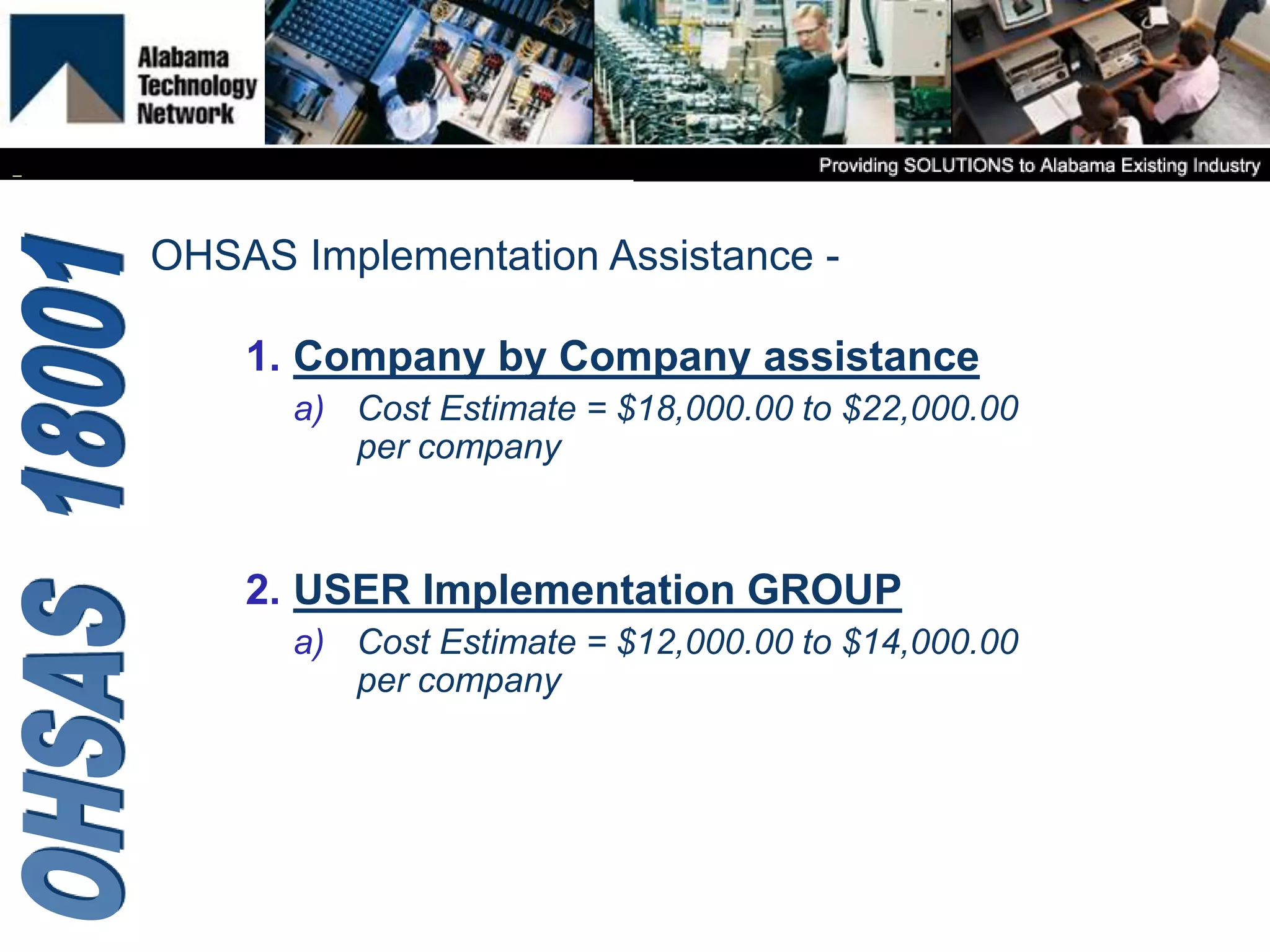
1. Company by Company assistance
a) Cost Estimate = $18,000.00 to $22,000.00
per company
2. USER Implementation GROUP
a) Cost Estimate = $12,000.00 to $14,000.00
per company
OHSAS Implementation Assistance -
1. If the company already has ISO 14001 EMS
(less time needed for implementation)
2. Grants may be available!
(first-come first-serve basis)
Contact Information:
ISO 9001:2008 certified
Chris Anderson
ATN – Rainsville
256-638-4418 ext. 2264
256-585-0429 (cell)
canderson@atn.org
Robert Tomlinson
ATN – Muscle Shoals
256-331-5381
256-810-5431 (cell)
rtomlinson@atn.org

OHSAS 18001 Management Overview 2014

  • 1.
    Overview of OHSAS 18001 OccupationalHealth and Safety Management System
  • 2.
    WHAT IS OHSAS???? OccupationalHealth and Safety Assessment Series (OHSAS) Standard. The 2007 version is the latest OHSAS 18001 standard that replaced the 1999 version. It was developed to be compatible with the ISO 9001:2008/TS 16949 (Quality) and ISO 14001:2004 (Environmental) management systems standards. OHSAS 18001 has been developed in response to customer demand for a recognizable occupational health and safety management system standard. A NEW ISO STANDARD! OHSAS 18001 will be changed to ISO 45001 on October, 2016
  • 3.
    Benefits of OHSAS: Control OH&S Risks  Recognize OH&S Hazards  Improve OH&S Performance
  • 4.
    Occupational Health andSafety (OH&S)  conditions and factors that affect, or could affect, the health and safety of: employees or other workers (including temporary workers and contractor personnel),  visitors, or any other person in the workplace OHSAS 18001 – Definitions:
  • 5.
    Incident:  Work-related event(s)in which: An injury, or ill health (regardless of severity) or fatality occurred, OR could have occurred. OHSAS 18001 – Definitions(continued):
  • 6.
    ill Health:  Identifiable,adverse physical or mental condition: arising from and/or made worse by a work activity and/or work-related situation OHSAS 18001 – Definitions (continued):
  • 7.
    Hazard:  Source, situationor act with a potential for harm in terms of: Human injury, or  ill heath, or a combination of these OHSAS 18001 – Definitions (continued): Let’s take an awareness test…
  • 8.
    Identifying hazards issimple right? Everyone sees every hazard they come across, right? inattention blindness
  • 9.
  • 10.
    Recognized hazard Common knowledgein particular industry Detectable By means of the senses Generally known
  • 11.
    Risk:  Combination of: thelikelihood of an occurrence of a hazardous event, or the severity of injury or ill health, that can be caused by the event or exposure(s). OHSAS 18001 – Definitions (continued): = Severity of Consequence Likelihood of Occurrence x
  • 12.
    Probability The probability ofany outcome is the number of times that outcome can occur divided by the total number of outcomes.
  • 13.
    Risk Assessment:  Processof evaluating the risk(s): Arising from a hazard(s) Taking into account the adequacy of any existing controls, and deciding whether or not the risk(s) is acceptable OHSAS 18001 – Definitions (continued):
  • 14.
    Acceptable Risk:  Riskthat has been reduced to a level that can be tolerated by the organization: Having regard to its legal obligations and its own OH&S policy. OHSAS 18001 – Definitions (continued):
  • 15.
  • 16.
  • 17.
    The 14001 EMSElement Cycle Start 4.2 Environmental Policy 4.6 Management Review 4.5 Checking 4.5.1 Monitoring and Measurement 4.5.2 Evaluation of Compliance 4.5.3 Nonconformity, corrective action and preventive action. 4.5.4 Control of Records 4.5.5. Internal Audit 4.3 Planning 4.3.1 Environmental Aspects 4.3.2 Legal & Other Requirements 4.3.3 Objectives and Targets and Program 4.4 Implementation 4.4.1 Resources, Roles, Responsibility and Authority 4.4.2 Competence, Training and Awareness 4.4.3 Communication 4.4.4 Documentation 4.4.5 Control of Documents 4.4.6 Operational Control 4.4.7 Emergency Preparedness $ Response Continual Improvement
  • 18.
    The OHSAS 18001Element Cycle Start 4.2 OH&S Policy4.6 Management Review 4.5 Checking 4.5.1 Performance Measurement and Monitoring 4.5.2 Evaluation of Compliance 4.5.3 Incident Investigation, nonconformity, corrective action and preventive action 4.5.3 Nonconformity, corrective action and preventive action. 4.5.4 Control of Records 4.5.5. Internal Audit 4.3 Planning 4.3.1 Hazard Identification, risk assessment and determining controls 4.3.2 Legal & Other Requirements 4.3.3 Objectives and Program 4.4 Implementation 4.4.1 Resources, Roles, Responsibility accountability and authority 4.4.2 Competence, Training and Awareness 4.4.3 Communication, participation, and consultation 4.4.4 Documentation 4.4.5 Control of Documents 4.4.6 Operational Control 4.4.7 Emergency Preparedness & Response Continual Improvement
  • 19.
    Correspondence between ISO 14001and OHSAS 18001 ISO 14001: 2004 OHSAS 18001: 2007 4.1 General Requirements 4.1 General requirements 4.2 Environmental Policy 4.2 OH&S Policy 4.3 Planning 4.3 Planning 4.3.1 Environmental Aspects 4.3.1 Hazard Identification, risk assessment, and determining controls 4.3.2 Legal and Other Requirements 4.3.2 Legal and Other Requirements 4.3.3 Objectives, Targets and Program 4.3.3 Objectives, Targets and Program
  • 20.
    Correspondence between ISO 14001and OHSAS 18001 (continued) ISO 14001: 2004 OHSAS 18001: 2007 4.4 Implementation and Operation 4.4 Implementation and Operation 4.4.1 Resources, Roles, Responsibility and Authority 4.4.1 Resources, Roles, Responsibility , Accountability and Authority 4.4.2 Competence, Training and Awareness 4.4.2 Competence, Training and Awareness 4.4.3 Communication 4.4.3 Communication, Participation, and Consultation 4.4.4 Documentation 4.4.4 Documentation 4.4.5 Control of Documents 4.4.5 Control of Documents 4.4.6 Operational Control 4.4.6 Operational Control 4.4.7 Emergency Preparedness and Response 4.4.7 Emergency Preparedness and Response
  • 21.
    Correspondence between ISO 14001and OHSAS 18001 ISO 14001: 2004 OHSAS 18001: 2007 4.5 Checking 4.5 Checking 4.5.1 Monitoring and measurement 4.5.1 Performance measurement and monitoring 4.5.2 Evaluation of Compliance 4.5.2 Evaluation of Compliance 4.5.3 Nonconformity, corrective action and preventive action 4.5.3 Nonconformity, corrective and preventive action 4.5.4 Control of records 4.5.4 Control of records 4.5.5 Internal Audit 4.5.5 Internal Audit 4.6 Management Review 4.6 Management Review
  • 22.
    Quality, Environmental And OH&S Policy Procedures Work Instructions Records Whyyou do it What you do How you do it Evidence of what you do Intent What, when, where & who How QMS, EMS & OH&S Documentation A 4-Tier System: International Standards ISO 9001/TS 16949, ISO 14001 and OHSAS 18001
  • 23.
    TYPES OF AUDITS l.INTERNAL AUDIT ll. REGISTRATION AUDIT (Will the registrar audit QMS, EMS and OHSAS?)
  • 24.
    NOTE: Systems varyamong registrars. QMS, EMS How Do You Maintain Registration?  Pass surveillance audits, usually a partial audit every 6 to 12 months  Pass re-registration audits, usually a full audit every 3 years  Conduct Internal Audits at a regularly scheduled frequency and OHSAS
  • 25.
    1. Safety andHealth Regulatory Compliance Assessment 2. Provide Documentation Templates 3. Customization of Templates: a) Manual b) Procedures c) Work Instructions 4. Conduct Internal Auditor Training 5. Follow-up Visits: a) Review Internal Audits b) Review other records c) Determine readiness for Registrar! OHSAS 18001 Implementation Process -
  • 26.
    1. Company byCompany assistance a) Conduct S&H Compliance Assessment b) Assist company representative with implementation over 6-9 month period c) Conduct Internal Auditor Training 2. USER Implementation GROUP a) Conduct S&H Compliance Assessment b) Meet every other week with up to two representatives per company for 6 month period c) Valuable collaboration takes place among participants d) Conduct Internal Auditing Training with up to 5 participants per company e) Cost is spread out among participants OHSAS Implementation Assistance -
  • 27.
    The USER GROUPSchedule 2013: Date Location Topic Covered Homework May 17 Trenholm State Community College Building Q  User Group Kick-Off  Explanation of meeting format  Overview of Mgmt. System  Workshop Exercises  4.2 Policy  Complete Policy  Read sections 4.3, 4.3, 4.3.1 (OHSAS / EMS) May 31 Trenholm State Community College Building Q  Workshop exercises on  4.3 Planning – OHSAS 18001 / ISO 14001  4.3.1 Hazard Identification, Risk Assessment and Controls (OHSAS)  ISO 14001 : 4.3.1 Environmental Aspects Read sections 4.3.2, 4.3.3 June 14 Trenholm State Community College Building Q  Workshop exercises on  4.3 Planning – OHSAS 18001  4.3.2 Legal and Other Requirements  4.3.3 Objectives, Target and Program Read sections 4.4, 4.4.1, 4.4.2, 4.4.3 June 28 Trenholm State Community College Building Q  Workshop exercises on  4.4 Implementation  4.4.1 Resources, Roles, Responsibility, accountability, and Authority  4.4.2 Competence, Training and Awareness  4.4.3 Communication, Participation, and Consultation Read sections 4.4, 4.4.4, 4.4.5, 4.4.6 27
  • 28.
    Date Location TopicCovered Homework 28 Date Location Topic Covered Homework July 12 Trenholm State Community College Building Q  Workshop exercises on  4.4 Implementation  4.4.4 Documentation  4.4.5 Control of Documents  4.4.6 Operational Control Read sections 4.4, 4.4.7, 4.5, 4.5.1, 4.5.2 July 26 Trenholm State Community College Building Q  Workshop exercises on  4.4 Implementation  4.4.7 Emergency Preparedness and Response  4.5 Checking  4.5.1 Performance, Measurement and Monitoring  4.5.2 Evaluation of Compliance Read sections 4.4, 4.5.3, 4.5.4, 4.5.5 Aug. 9 Trenholm State Community College Building Q  Workshop exercises on  4.4 Implementation  4.5.3 Incident Investigation, Nonconformity, Corrective and Preventive Action  4.5.4 Control of Records  4.5.5 Internal Audit Aug. 23 Trenholm State Community College Building Q  Internal Auditor Training – Day 1  Companies can send up to 5 Participants Sept. 13 Trenholm State Community College Building Q  Internal Auditor Training – Day 2 Companies can send up to 5 Participants Read sections 4.6 Conduct Internal Audits Sept. 20 Trenholm State Community College Building Q  Workshop exercises on  4.6 Management Review Sept. 27 Trenholm State Community College Building Q • Follow-up with Companies
  • 29.
    1. Company byCompany assistance a) Cost Estimate = $18,000.00 to $22,000.00 per company 2. USER Implementation GROUP a) Cost Estimate = $12,000.00 to $14,000.00 per company OHSAS Implementation Assistance -
  • 30.
    1. If thecompany already has ISO 14001 EMS (less time needed for implementation) 2. Grants may be available! (first-come first-serve basis)
  • 31.
    Contact Information: ISO 9001:2008certified Chris Anderson ATN – Rainsville 256-638-4418 ext. 2264 256-585-0429 (cell) canderson@atn.org Robert Tomlinson ATN – Muscle Shoals 256-331-5381 256-810-5431 (cell) rtomlinson@atn.org