ISO 14000
Jithin Mundadan
Roll.No: 25
MBA-IB (2nd
Semester)
Definition
ISO 14000 is a family of standards related to
environmental management that exists to
help organizations
• Minimize operations: negatively affect the
environment
• Comply with applicable laws, regulations, and
other environmentally oriented requirements
• Continually improve in the above.
• ISO 14000 is similar to ISO 9000
quality management
• The requirements of ISO 14000 are an
integral part of the European Union‘s
Eco-Management and Audit Scheme (EMAS)
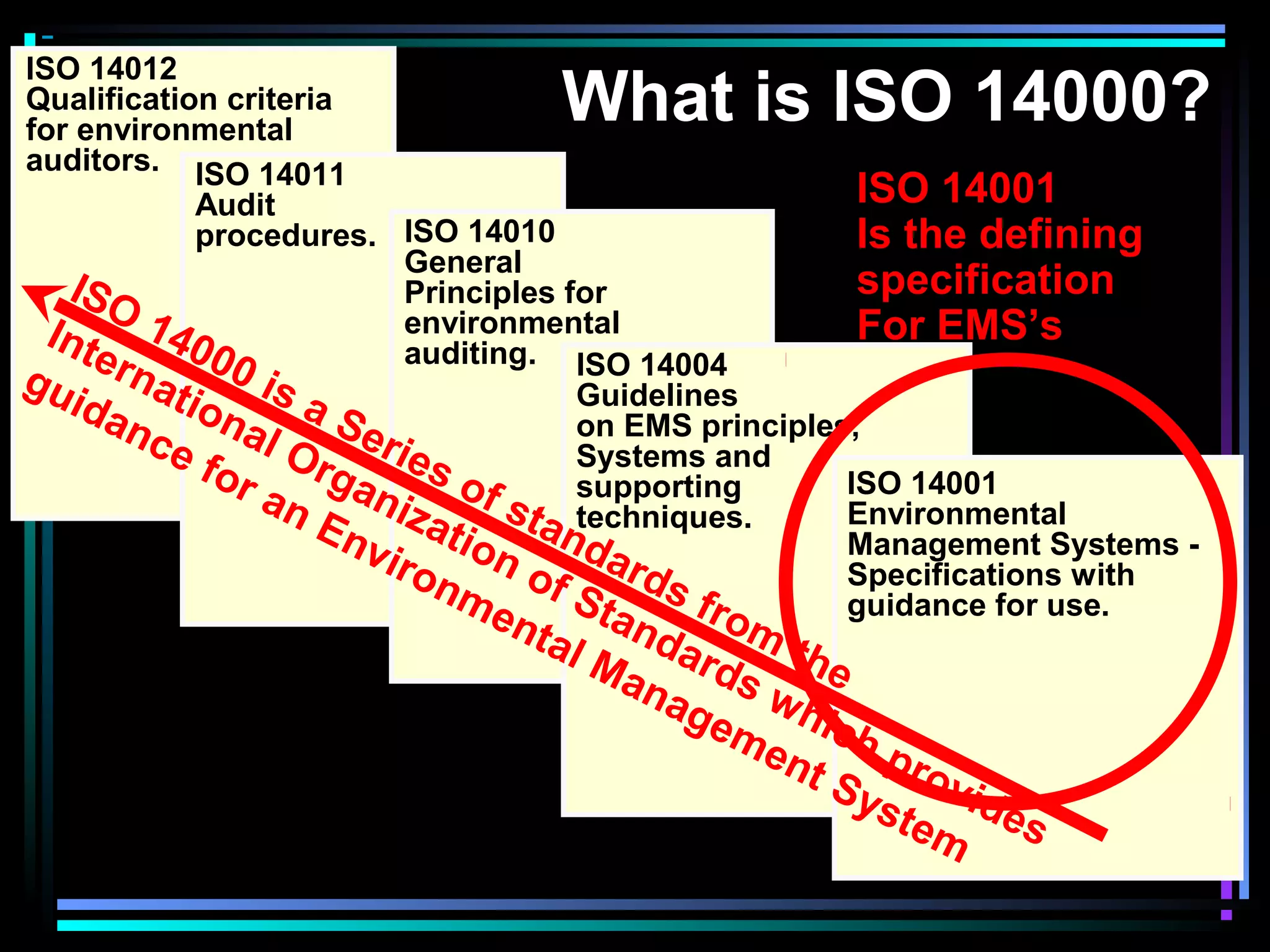
ISO 14012
Qualification criteria
for environmental
auditors. ISO 14011
Audit
procedures. ISO 14010
General
Principles for
environmental
auditing. ISO 14004
Guidelines
on EMS principles,
Systems and
supporting
techniques.
ISO 14001
Environmental
Management Systems -
Specifications with
guidance for use.
What is ISO 14000?
ISO 14001
Is the defining
specification
For EMS’s
ISO 14000 is a Series of standards from
the
International Organization of Standards which provides
guidance for an Environmental Management System
History
• Evolved in the early nineties
• 1972:UN organized a Conference
• United Nations Environment Program (UNEP)
was launched
• Establishment of the World Commission on
Environment and Development & adoption of
the Montreal Protocol and Basel Convention
• In 1992, Earth Summit was held
• Same year, BSI Group published the
environmental management systems
standard, BS 7750
• ISO 14000 series in 1996, by the
International Organization for Standardization
• 2,23, 149 organizations in 159 countries and
economies
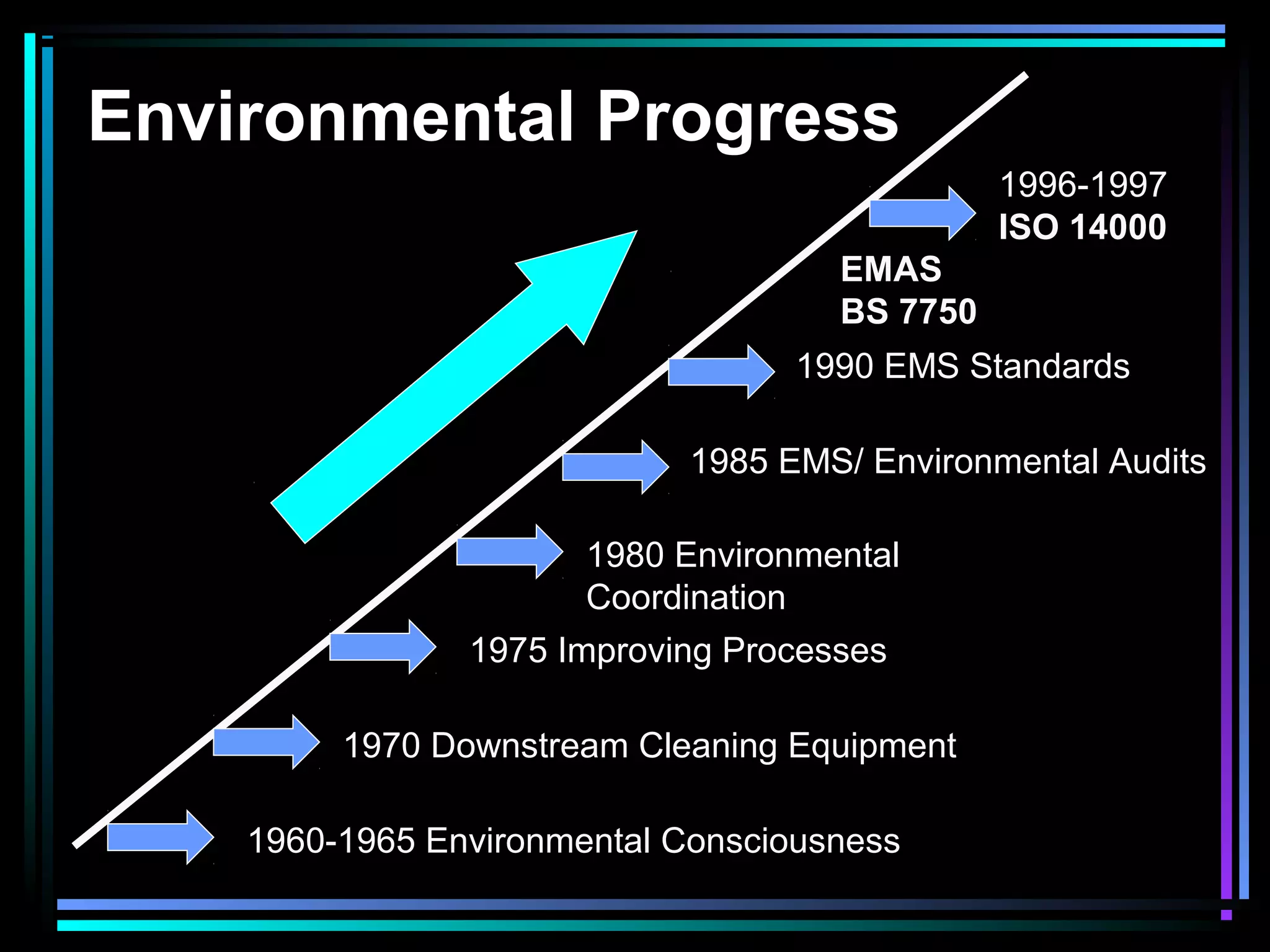
Environmental Progress
1960-1965 Environmental Consciousness
1970 Downstream Cleaning Equipment
1975 Improving Processes
1980 Environmental
Coordination
1985 EMS/ Environmental Audits
1990 EMS Standards
EMAS
BS 7750
1996-1997
ISO 14000
What is EMS?
An environmental management system (EMS)
is a management structure that allows an
organization to assess and control the
environmental impact of its activities,
products or services.
• International Voluntary Standards for providing
common framework for managing
environmental issues
• Guiding Principles: • Better Environment Mgmt.
• Flexible and applicable
to all nations
• Scientific
• Practical & useful
ISO 14000
• ISO 14000 is Product and Process oriented
• Determines environmental impacts of
products and services;
establish, maintain and evaluate EMS
• ISO 14000 is Process NOT a Performance
standard
• ISO 14000 entails five aspects:
• ISO 14000 / EMAS / BS 7750 are all
standards of implementation of EMS
• Environmental Management System
• Environmental Auditing and related investigations
• Environmental Labels and Declarations
• Environmental Performance Evaluation
• Life Cycle Analysis & Terms and Definitions.
WHY ISO 14000?
• Reduces environmental liability
• Enhances public image and reputation
• Assures customers
• Satisfies investor criteria
• Meets your clients’ registration
requirements
• Reduces your consumption of materials and
energy
• Facilitates permits & authorizations
• Reduces the cost
• Improve industry-government relations
Six key elements: ISO 14000
• Aspects/Impacts
• Legal Requirements
• Objectives/Targets
Plan
• Mngmnt. Structure
• Training/Awareness
• Communication
• Documentation
• Emergncy Response
Do
• Monitor & Measure
• Corrective Action
• EMS Audit
Check
Continual
Improvement
• Mngmnt. Review
• Evaluate
• Continualy Improve
Act
Environmental Aspects
An environmental “Aspect” is any
element of an organization's activities,
products, or services that can interact
with the environment causing impact to
the environment, whether adverse or
beneficial.
Bulk Storage of
liquids or Gases
Releases
Resource UseHazardous
M
aterial
Energy Use
Legal Requirements
Legal drivers for compliance efforts.
Established by Federal, State, or local
laws and tracked by the Environmental
Division to ensure we are in
compliance.
 An environmental ”Objective” is an
overall environmental goal, arising from
the environmental policy, that an
organization sets itself to achieve, and
which is quantified where practicable.
 An environmental “Target” is a detailed
performance requirement, quantified
where practicable, applicable to the
organization or parts thereof, that arises
from the environmental objectives and that
needs to be set and met in order to
achieve those objectives.
We want
To reduce
Hazardous
Material
20%
Reduction
By 2013
Environmental Objectives/Targets
Management Structure
Roles, responsibility and authorities are defined,
documented, and communicated via directives
NUWCDIVKPT5090 and KPT5090-17
Training/Awareness
Establish procedures to make employees aware of
the importance of environmental conformance with
the requirements of the EMS, and their roles in
achieving it
DO
Communication
The organization shall establish and maintain
procedures for internal communication between the
various levels and functions of the organization and
communication from external interested parties.
Documentation
The organization shall establish and maintain
information in paper or electronic form to describe
the core elements of the EMS.
Monitor & Measure
Maintain documented procedures to monitor and
measure the key characteristics of its operations
and activities that can have a significant impact
on the environment
Corrective Action
Establish procedures for defining responsibility
and authority for handling and investigating
nonconformance
CHECK
EMS Audit
Periodic EMS audits in order to determine
whether or not the EMS conforms ISO 14000
and has been properly implemented and
maintained
Management Review
The organization's top management shall review
the EMS to ensure its continuing suitability,
adequacy, and effectiveness
Evaluate
Evaluate the EMS to ensure suitability of operation
Continually Improve
Consider continual improvement as part of its
operation
ACT
Honeywell Inc
• Honeywell has been aggressive in their efforts to improve
environmental performance. These efforts include the
following areas:
• Reducing environmental releases
• Managing Wastes
• Eliminating Ozone-Depleting Chemicals
• Saving energy
• Green Lights Program
• Energy Star Buildings Program
Case Study:
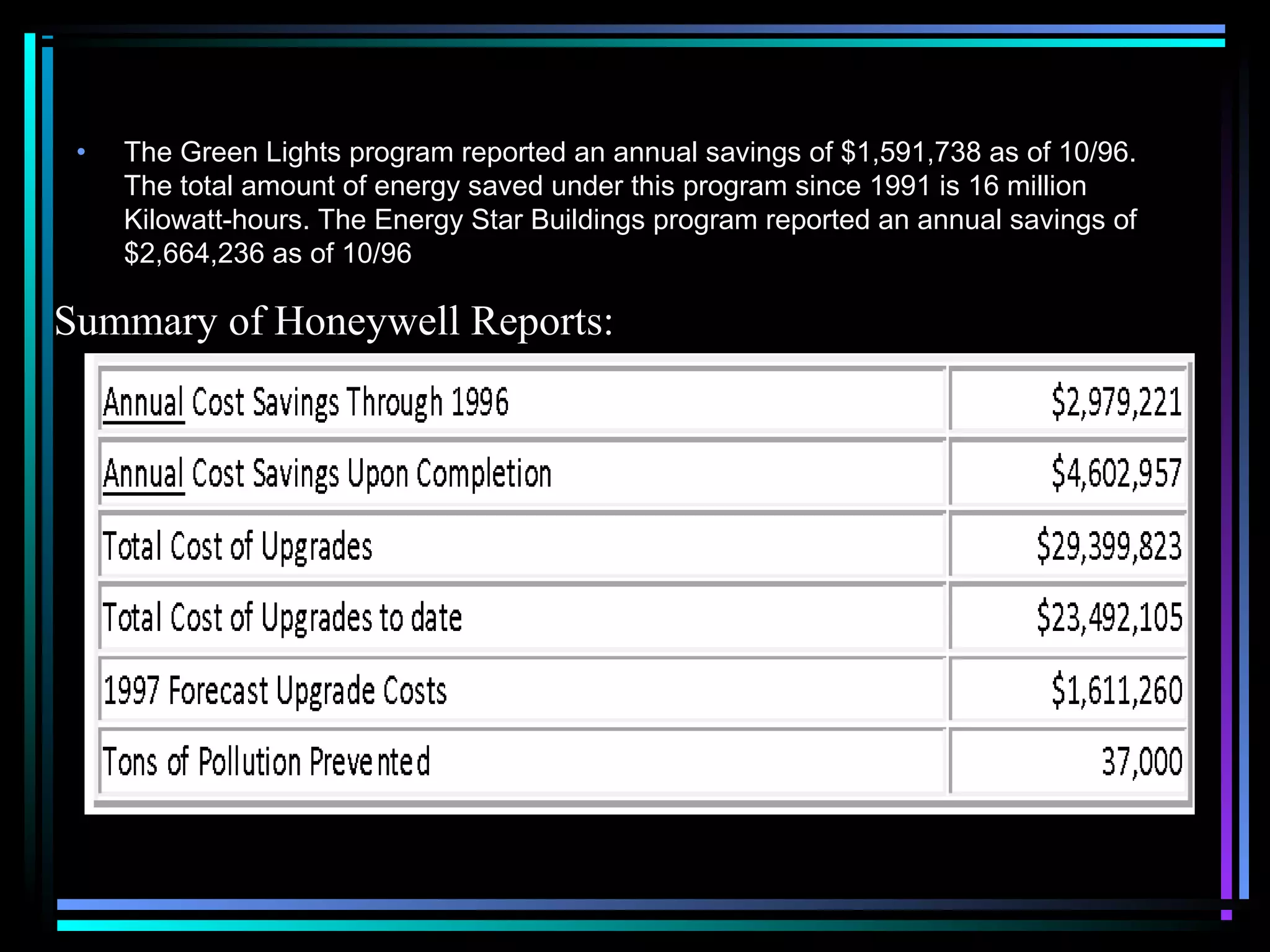
• The Green Lights program reported an annual savings of $1,591,738 as of 10/96.
The total amount of energy saved under this program since 1991 is 16 million
Kilowatt-hours. The Energy Star Buildings program reported an annual savings of
$2,664,236 as of 10/96
Summary of Honeywell Reports:
Conclusion
From a strategic viewpoint, many organizations are
focusing on issues such as: quick response (to
customer needs), customer relationships, core
competence, and continuous improvement, in addition
to conventional indicators including: cost control and
technology. Implementing an ISO-14001 EMS system
could positively influence customers’ perceptions
about companies.
REFERENCES:
•Production Operations Analysis – Fifth Edition By Steven Nahmias
•Environmental Management Systems – An Implementation Guide For
Small And Medium Sized Organisations – Written by Philip J. Stapleton,
Principal Glover-Stapleton Associates, Inc. Anita M. Cooney, Project
Manager NSF International William M. Hix Jr., Intern NSF International.
http://www.ehso.com/manuals/iso14000implguide.pdf
•International Organization for Standardization- http://www.thesite.eu/iso
%201400.pdf
•http://www.bsigroup.com/LocalFiles/en-GB/iso-14001/resources/ISO-
14001-benefits-and-features-UK-EN.pdf
•Production And Operations Analysis – Third Edition By Steven Nahmias
•Environmental Regulation By Any Other Name – Jullian Morris ( January
1997)
https://cei.org/sites/default/files/ISO%2014000.pdf
•http://novellaqalive2.mhhe.com/sites/dl/free/0070601690/271581/ISO1400
0.pdf
•http://www.iso.org/iso/theiso14000family_2009.pdf
Iso 14000 slide

Iso 14000 slide

  • 1.
    ISO 14000 Jithin Mundadan Roll.No:25 MBA-IB (2nd Semester)
  • 2.
    Definition ISO 14000 isa family of standards related to environmental management that exists to help organizations • Minimize operations: negatively affect the environment • Comply with applicable laws, regulations, and other environmentally oriented requirements • Continually improve in the above.
  • 3.
    • ISO 14000is similar to ISO 9000 quality management • The requirements of ISO 14000 are an integral part of the European Union‘s Eco-Management and Audit Scheme (EMAS)
  • 4.
    ISO 14012 Qualification criteria forenvironmental auditors. ISO 14011 Audit procedures. ISO 14010 General Principles for environmental auditing. ISO 14004 Guidelines on EMS principles, Systems and supporting techniques. ISO 14001 Environmental Management Systems - Specifications with guidance for use. What is ISO 14000? ISO 14001 Is the defining specification For EMS’s ISO 14000 is a Series of standards from the International Organization of Standards which provides guidance for an Environmental Management System
  • 5.
    History • Evolved inthe early nineties • 1972:UN organized a Conference • United Nations Environment Program (UNEP) was launched • Establishment of the World Commission on Environment and Development & adoption of the Montreal Protocol and Basel Convention
  • 6.
    • In 1992,Earth Summit was held • Same year, BSI Group published the environmental management systems standard, BS 7750 • ISO 14000 series in 1996, by the International Organization for Standardization • 2,23, 149 organizations in 159 countries and economies
  • 7.
    Environmental Progress 1960-1965 EnvironmentalConsciousness 1970 Downstream Cleaning Equipment 1975 Improving Processes 1980 Environmental Coordination 1985 EMS/ Environmental Audits 1990 EMS Standards EMAS BS 7750 1996-1997 ISO 14000
  • 8.
    What is EMS? Anenvironmental management system (EMS) is a management structure that allows an organization to assess and control the environmental impact of its activities, products or services.
  • 9.
    • International VoluntaryStandards for providing common framework for managing environmental issues • Guiding Principles: • Better Environment Mgmt. • Flexible and applicable to all nations • Scientific • Practical & useful ISO 14000
  • 10.
    • ISO 14000is Product and Process oriented • Determines environmental impacts of products and services; establish, maintain and evaluate EMS • ISO 14000 is Process NOT a Performance standard
  • 11.
    • ISO 14000entails five aspects: • ISO 14000 / EMAS / BS 7750 are all standards of implementation of EMS • Environmental Management System • Environmental Auditing and related investigations • Environmental Labels and Declarations • Environmental Performance Evaluation • Life Cycle Analysis & Terms and Definitions.
  • 12.
    WHY ISO 14000? •Reduces environmental liability • Enhances public image and reputation • Assures customers • Satisfies investor criteria • Meets your clients’ registration requirements
  • 13.
    • Reduces yourconsumption of materials and energy • Facilitates permits & authorizations • Reduces the cost • Improve industry-government relations
  • 14.
  • 15.
    • Aspects/Impacts • LegalRequirements • Objectives/Targets Plan • Mngmnt. Structure • Training/Awareness • Communication • Documentation • Emergncy Response Do • Monitor & Measure • Corrective Action • EMS Audit Check Continual Improvement • Mngmnt. Review • Evaluate • Continualy Improve Act
  • 16.
    Environmental Aspects An environmental“Aspect” is any element of an organization's activities, products, or services that can interact with the environment causing impact to the environment, whether adverse or beneficial. Bulk Storage of liquids or Gases Releases Resource UseHazardous M aterial Energy Use
  • 17.
    Legal Requirements Legal driversfor compliance efforts. Established by Federal, State, or local laws and tracked by the Environmental Division to ensure we are in compliance.
  • 18.
     An environmental”Objective” is an overall environmental goal, arising from the environmental policy, that an organization sets itself to achieve, and which is quantified where practicable.  An environmental “Target” is a detailed performance requirement, quantified where practicable, applicable to the organization or parts thereof, that arises from the environmental objectives and that needs to be set and met in order to achieve those objectives. We want To reduce Hazardous Material 20% Reduction By 2013 Environmental Objectives/Targets
  • 19.
    Management Structure Roles, responsibilityand authorities are defined, documented, and communicated via directives NUWCDIVKPT5090 and KPT5090-17 Training/Awareness Establish procedures to make employees aware of the importance of environmental conformance with the requirements of the EMS, and their roles in achieving it DO
  • 20.
    Communication The organization shallestablish and maintain procedures for internal communication between the various levels and functions of the organization and communication from external interested parties. Documentation The organization shall establish and maintain information in paper or electronic form to describe the core elements of the EMS.
  • 21.
    Monitor & Measure Maintaindocumented procedures to monitor and measure the key characteristics of its operations and activities that can have a significant impact on the environment Corrective Action Establish procedures for defining responsibility and authority for handling and investigating nonconformance CHECK
  • 22.
    EMS Audit Periodic EMSaudits in order to determine whether or not the EMS conforms ISO 14000 and has been properly implemented and maintained
  • 23.
    Management Review The organization'stop management shall review the EMS to ensure its continuing suitability, adequacy, and effectiveness Evaluate Evaluate the EMS to ensure suitability of operation Continually Improve Consider continual improvement as part of its operation ACT
  • 24.
    Honeywell Inc • Honeywellhas been aggressive in their efforts to improve environmental performance. These efforts include the following areas: • Reducing environmental releases • Managing Wastes • Eliminating Ozone-Depleting Chemicals • Saving energy • Green Lights Program • Energy Star Buildings Program Case Study:
  • 25.
    • The GreenLights program reported an annual savings of $1,591,738 as of 10/96. The total amount of energy saved under this program since 1991 is 16 million Kilowatt-hours. The Energy Star Buildings program reported an annual savings of $2,664,236 as of 10/96 Summary of Honeywell Reports:
  • 26.
    Conclusion From a strategicviewpoint, many organizations are focusing on issues such as: quick response (to customer needs), customer relationships, core competence, and continuous improvement, in addition to conventional indicators including: cost control and technology. Implementing an ISO-14001 EMS system could positively influence customers’ perceptions about companies.
  • 27.
    REFERENCES: •Production Operations Analysis– Fifth Edition By Steven Nahmias •Environmental Management Systems – An Implementation Guide For Small And Medium Sized Organisations – Written by Philip J. Stapleton, Principal Glover-Stapleton Associates, Inc. Anita M. Cooney, Project Manager NSF International William M. Hix Jr., Intern NSF International. http://www.ehso.com/manuals/iso14000implguide.pdf •International Organization for Standardization- http://www.thesite.eu/iso %201400.pdf •http://www.bsigroup.com/LocalFiles/en-GB/iso-14001/resources/ISO- 14001-benefits-and-features-UK-EN.pdf •Production And Operations Analysis – Third Edition By Steven Nahmias •Environmental Regulation By Any Other Name – Jullian Morris ( January 1997) https://cei.org/sites/default/files/ISO%2014000.pdf •http://novellaqalive2.mhhe.com/sites/dl/free/0070601690/271581/ISO1400 0.pdf •http://www.iso.org/iso/theiso14000family_2009.pdf