ISO 14001
 ISO develops International Standards but does not
operate any schemes for assessing conformity with
them.
 ISO is not an auditor, assessor, registrar, or certifier of
management systems, products, services, materials or
personnel, nor does it endorse or control any such
activities performed by other parties.
A Brief About ISO
 ISO 14001 is known as a generic management
system standard, meaning that it is relevant to any
organization seeking to improve and manage
resources more effectively.
 ISO 14001 is one of the ISO's most well known
standards.
 All standards are periodically reviewed by ISO to
ensure they still meet market requirements. The
current version of ISO 14001 – ISO 14001:2004 is
under review as of April 2012
Introduction
Overview of ISO 9000, ISO
14000 and 14001
 ISO 9000, the quality standard is considered to be a
precedent for ISO 14001. ISO 9000 is well established
quality standard and has a fairly good acceptability.
 The Asian countries which did not adopt ISO 9000 found
themselves at a disadvantage for European market.
 ISO 14000 is a family of standards related
to environmental management that exists to help
organizations (a) minimize how their operations .
negatively affect the environment (i.e. cause adverse
changes to air, water, or land); (b) comply with applicable
laws, regulations, and other environmentally oriented
requirements, and (c) continually improve in the above.
 ISO 14000 is similar to ISO 9000 quality management in
that both pertain to the process of how a product is
produced, rather than to the product itself. As with ISO
9000, certification is performed by third-party
organizations rather than being awarded by ISO directly.
The ISO 19011 audit standard applies when auditing for
both 9000 and 14000 compliance at once.
 First version finalized and issued in 1996, revised every
five years (2004 current version).
 Market sector created and driven; governments
participate but it is not legislative or regulatory.
 Each participating nation has a committee that develops
consensus and contributes (one vote each, for US it is
ANSI).
 14001 is one of the standards in the 14000 series.
 ISO 14001 helps organizations to implement
environmental management.
 Provides the company with a guideline on how
to manage environmental aspects.
 Requires management commitments and
involvement from all employees.
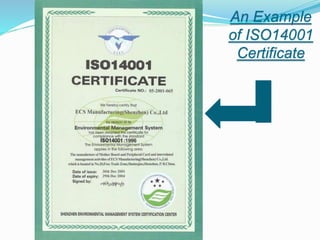
An Example
of ISO14001
Certificate
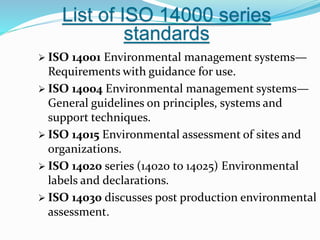
List of ISO 14000 series
standards
 ISO 14001 Environmental management systems—
Requirements with guidance for use.
 ISO 14004 Environmental management systems—
General guidelines on principles, systems and
support techniques.
 ISO 14015 Environmental assessment of sites and
organizations.
 ISO 14020 series (14020 to 14025) Environmental
labels and declarations.
 ISO 14030 discusses post production environmental
assessment.
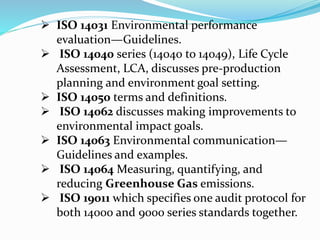
 ISO 14031 Environmental performance
evaluation—Guidelines.
 ISO 14040 series (14040 to 14049), Life Cycle
Assessment, LCA, discusses pre-production
planning and environment goal setting.
 ISO 14050 terms and definitions.
 ISO 14062 discusses making improvements to
environmental impact goals.
 ISO 14063 Environmental communication—
Guidelines and examples.
 ISO 14064 Measuring, quantifying, and
reducing Greenhouse Gas emissions.
 ISO 19011 which specifies one audit protocol for
both 14000 and 9000 series standards together.
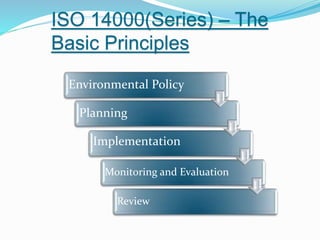
ISO 14000(Series) – The
Basic Principles
Environmental Policy
Planning
Implementation
Monitoring and Evaluation
Review
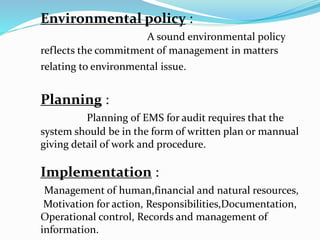
Environmental policy :
A sound environmental policy
reflects the commitment of management in matters
relating to environmental issue.
Planning :
Planning of EMS for audit requires that the
system should be in the form of written plan or mannual
giving detail of work and procedure.
Implementation :
Management of human,financial and natural resources,
Motivation for action, Responsibilities,Documentation,
Operational control, Records and management of
information.
Cont.….
Monitoring and evaluation :
EMS demands a mechanism for
measuring performance and evaluation for which a process
has to be evolved that involves testing and verification.
Review :
At Review stage, the organization has to think in
terms of continual improvements of environmental
performance.
Issue to be discussed in the process of review are:
 Suitability of environmental policy;
 Recommendations of audit report;
 New regulations;
 Interest of stakeholders;
 Public awareness and pressures;
Benefits of ISO 14001
 Common language for dealing with customers
and suppliers worldwide in B2B.
 Increase efficiency and effectiveness.
 Model for continual improvement.
 Integate with global economy.
 Uniform base for industry sectors.
 Quality suppliers for global supply chains.
Transfer of good practice to developing countries
Tools for new economic players
Regional integration
Facilitate rise of services
Sustainable Business
Technical support for regulations
Benefits (cont.)
References
 www.iso 14000.com
 www.iso.org
 Book- Environmental Management,
Uberoi
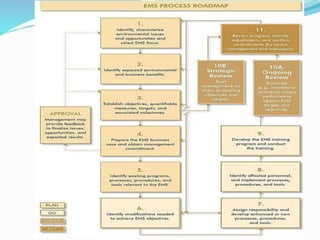
Ems standards

Ems standards

  • 1.
  • 2.
     ISO developsInternational Standards but does not operate any schemes for assessing conformity with them.  ISO is not an auditor, assessor, registrar, or certifier of management systems, products, services, materials or personnel, nor does it endorse or control any such activities performed by other parties. A Brief About ISO
  • 3.
     ISO 14001is known as a generic management system standard, meaning that it is relevant to any organization seeking to improve and manage resources more effectively.  ISO 14001 is one of the ISO's most well known standards.  All standards are periodically reviewed by ISO to ensure they still meet market requirements. The current version of ISO 14001 – ISO 14001:2004 is under review as of April 2012 Introduction
  • 4.
    Overview of ISO9000, ISO 14000 and 14001  ISO 9000, the quality standard is considered to be a precedent for ISO 14001. ISO 9000 is well established quality standard and has a fairly good acceptability.  The Asian countries which did not adopt ISO 9000 found themselves at a disadvantage for European market.  ISO 14000 is a family of standards related to environmental management that exists to help organizations (a) minimize how their operations . negatively affect the environment (i.e. cause adverse changes to air, water, or land); (b) comply with applicable laws, regulations, and other environmentally oriented requirements, and (c) continually improve in the above.
  • 5.
     ISO 14000is similar to ISO 9000 quality management in that both pertain to the process of how a product is produced, rather than to the product itself. As with ISO 9000, certification is performed by third-party organizations rather than being awarded by ISO directly. The ISO 19011 audit standard applies when auditing for both 9000 and 14000 compliance at once.  First version finalized and issued in 1996, revised every five years (2004 current version).  Market sector created and driven; governments participate but it is not legislative or regulatory.  Each participating nation has a committee that develops consensus and contributes (one vote each, for US it is ANSI).
  • 6.
     14001 isone of the standards in the 14000 series.  ISO 14001 helps organizations to implement environmental management.  Provides the company with a guideline on how to manage environmental aspects.  Requires management commitments and involvement from all employees.
  • 7.
  • 8.
    List of ISO14000 series standards  ISO 14001 Environmental management systems— Requirements with guidance for use.  ISO 14004 Environmental management systems— General guidelines on principles, systems and support techniques.  ISO 14015 Environmental assessment of sites and organizations.  ISO 14020 series (14020 to 14025) Environmental labels and declarations.  ISO 14030 discusses post production environmental assessment.
  • 9.
     ISO 14031Environmental performance evaluation—Guidelines.  ISO 14040 series (14040 to 14049), Life Cycle Assessment, LCA, discusses pre-production planning and environment goal setting.  ISO 14050 terms and definitions.  ISO 14062 discusses making improvements to environmental impact goals.  ISO 14063 Environmental communication— Guidelines and examples.  ISO 14064 Measuring, quantifying, and reducing Greenhouse Gas emissions.  ISO 19011 which specifies one audit protocol for both 14000 and 9000 series standards together.
  • 10.
    ISO 14000(Series) –The Basic Principles Environmental Policy Planning Implementation Monitoring and Evaluation Review
  • 11.
    Environmental policy : Asound environmental policy reflects the commitment of management in matters relating to environmental issue. Planning : Planning of EMS for audit requires that the system should be in the form of written plan or mannual giving detail of work and procedure. Implementation : Management of human,financial and natural resources, Motivation for action, Responsibilities,Documentation, Operational control, Records and management of information.
  • 12.
    Cont.…. Monitoring and evaluation: EMS demands a mechanism for measuring performance and evaluation for which a process has to be evolved that involves testing and verification. Review : At Review stage, the organization has to think in terms of continual improvements of environmental performance. Issue to be discussed in the process of review are:  Suitability of environmental policy;  Recommendations of audit report;  New regulations;  Interest of stakeholders;  Public awareness and pressures;
  • 14.
    Benefits of ISO14001  Common language for dealing with customers and suppliers worldwide in B2B.  Increase efficiency and effectiveness.  Model for continual improvement.  Integate with global economy.  Uniform base for industry sectors.  Quality suppliers for global supply chains.
  • 15.
    Transfer of goodpractice to developing countries Tools for new economic players Regional integration Facilitate rise of services Sustainable Business Technical support for regulations Benefits (cont.)
  • 16.
    References  www.iso 14000.com www.iso.org  Book- Environmental Management, Uberoi