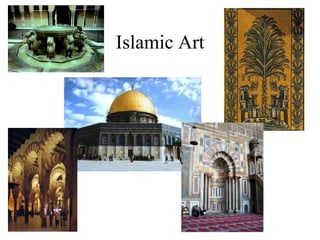
The document provides historical background on Islamic art, including the origins of Islam and the life of the Prophet Muhammad. It then summarizes key aspects of Islamic architecture such as its emphasis on horizontality, use of arches and columns, avoidance of images, and focus on geometric patterns and calligraphy. Important examples of Islamic architecture are described, including the Dome of the Rock, the Alhambra, and the Taj Mahal.
From the beginnings to the classical culture of Islam. architecture, art, medicine, war and society. everything you wanted to know.
Research, Assembly and Design by Alex Brown.
Blog: www.alexbrown.net
A Report by Jose Radin L. Garduque
in MAT Soc. Sci. class of Prof. Jonathan Adjijil in Filamer Christian University, Roxas City (First Semester, A.Y. 2013-2014)
From the beginnings to the classical culture of Islam. architecture, art, medicine, war and society. everything you wanted to know.
Research, Assembly and Design by Alex Brown.
Blog: www.alexbrown.net
A Report by Jose Radin L. Garduque
in MAT Soc. Sci. class of Prof. Jonathan Adjijil in Filamer Christian University, Roxas City (First Semester, A.Y. 2013-2014)
Islamic Architecture from early Medieval to Ottoman: It encompasses a wide range of both secular and religious styles from the foundation of Islam to the present day. What today is known as Islamic architecture was influenced by Roman, Byzantine and all other lands which the Muslims conquered in the 7th and 8th centuries.
Islamic Architecture from early Medieval to Ottoman: It encompasses a wide range of both secular and religious styles from the foundation of Islam to the present day. What today is known as Islamic architecture was influenced by Roman, Byzantine and all other lands which the Muslims conquered in the 7th and 8th centuries.
An introductory presentation about Islamic Art History, focusing on the Islamic architecture aesthetics throughout different eras and geographical locations.
This presentation has been presented as a part of Art History 1 course at Universiti Malaysia Sabah in Malaysia.
this PowerPoint presentation contains all you should know about Islamic architecture. this features the history, architectural character, examples of Islamic structures, and the contemporary Islamic architects. Best for architecture students studying History of Architecture 3.
The Chakra System in our body - A Portal to Interdimensional Consciousness.pptxBharat Technology
each chakra is studied in greater detail, several steps have been included to
strengthen your personal intention to open each chakra more fully. These are designed
to draw forth the highest benefit for your spiritual growth.
Lesson 9 - Resisting Temptation Along the Way.pptxCelso Napoleon
Lesson 9 - Resisting Temptation Along the Way
SBs – Sunday Bible School
Adult Bible Lessons 2nd quarter 2024 CPAD
MAGAZINE: THE CAREER THAT IS PROPOSED TO US: The Path of Salvation, Holiness and Perseverance to Reach Heaven
Commentator: Pastor Osiel Gomes
Presentation: Missionary Celso Napoleon
Renewed in Grace
In Jude 17-23 Jude shifts from piling up examples of false teachers from the Old Testament to a series of practical exhortations that flow from apostolic instruction. He preserves for us what may well have been part of the apostolic catechism for the first generation of Christ-followers. In these instructions Jude exhorts the believer to deal with 3 different groups of people: scoffers who are "devoid of the Spirit", believers who have come under the influence of scoffers and believers who are so entrenched in false teaching that they need rescue and pose some real spiritual risk for the rescuer. In all of this Jude emphasizes Jesus' call to rescue straying sheep, leaving the 99 safely behind and pursuing the 1.
What Should be the Christian View of Anime?Joe Muraguri
We will learn what Anime is and see what a Christian should consider before watching anime movies? We will also learn a little bit of Shintoism religion and hentai (the craze of internet pornography today).
Homily: The Solemnity of the Most Holy Trinity Sunday 2024.docxJames Knipper
Countless volumes have been written trying to explain the mystery of three persons in one true God, leaving us to resort to metaphors such as the three-leaf clover to try to comprehend the Divinity. Many of us grew up with the quintessential pyramidal Trinity structure of God at the top and Son and Spirit in opposite corners. But what if we looked at this ‘mystery’ from a different perspective? What if we shifted our language of God as a being towards the concept of God as love? What if we focused more on the relationship within the Trinity versus the persons of the Trinity? What if stopped looking at God as a noun…and instead considered God as a verb? Check it out…
The Book of Joshua is the sixth book in the Hebrew Bible and the Old Testament, and is the first book of the Deuteronomistic history, the story of Israel from the conquest of Canaan to the Babylonian exile.
The PBHP DYC ~ Reflections on The Dhamma (English).pptxOH TEIK BIN
A PowerPoint Presentation based on the Dhamma Reflections for the PBHP DYC for the years 1993 – 2012. To motivate and inspire DYC members to keep on practicing the Dhamma and to do the meritorious deed of Dhammaduta work.
The texts are in English.
For the Video with audio narration, comments and texts in English, please check out the Link:
https://www.youtube.com/watch?v=zF2g_43NEa0
The Good News, newsletter for June 2024 is hereNoHo FUMC
Our monthly newsletter is available to read online. We hope you will join us each Sunday in person for our worship service. Make sure to subscribe and follow us on YouTube and social media.
3. Historical Background: The Prophet Mohammed was born in Arabia in 570 CE, at the height of the Byzantine Empire. A trader, married to a wealthy widow, he experiences a spiritual awakening in his early middle age, receiving the word of God (Quran) from the angel Gabriel. He begins preaching in Mecca, criticizing the wealthiest residents who benefit most from the pilgrimages made by pagan Arabs to visit the idols housed in the Kaaba, built by Abraham. He’s forced to flee from Mecca (flight known as the Hegira) and goes to Medina, where his preaching gathers followers. Becoming both a spiritual and temporal military leader, he gathers his forces and returns to conquer Mecca in the first Holy War, in the name of Allah. He preaches submission to God, equality of all before God, strict monotheism, obedience to God's requirements: prayers facing Mecca 5x/day, fasting during Ramadan, giving alms to the poor, pilgrimage to Mecca (if possible) once during lifetime, following dietary restrictions. Islam becomes the fastest-growing religion in world history.
4. 5 Pillars of Islam Declaration of Faith Prayer (salat) Zacat or Tithe The Fast of Ramadan (9th month of the Islamic calendar) Pilgrimage
5. Dedication of Faith There is no god but God (Allah) and Muhammed is his Prophet To become a Muslim one need only make this simple declaration of faith Islam has absolute Monotheism Mohammed transmits the direct word of God Unlike Christ, Muhammed, while the perfect man is not divine – the preeminent role model
6. Prayer (Salat) 5 times a day (daybreak, noon, mid-afternoon, evening, sunset) Alone or together, indoors or out Preferable to pray with others, demonstrating brotherhood Face Mecca when praying, toward the Kaaba (house of God believed to have been built by Abraham and Ismail) Once a week on Friday, gather for the Sabbath at a mosque or Islamic center
7. Zakat or Tithe Means “purification” Individual and communal responsibility to care for the poor Not veiwed as Charity; it is an obligation Functions as a form of social security
8. The fast of Ramadan Once a year in the 9th month of the Islamic calendar Represents the first revelation of the Quran to Muhammed IF health permits – abstain from food, drink and sexual activity from dawn to sunset A discipline to stimulate religious reflection Ends with a special feast (resembles Christmas with gifts, food, etc.)
9. Haji or the Pilgrimage At least once in a lifetime (if able) to Mecca Every year more than 2,000,000 make the journey to form a community of faith Pilgrims wear simple clothing to symbolize purity The Eid al-Adha occurs toward the end: The Feast of the Sacrifice
14. serves as a focal and unifying point among the Muslim peopleAccording to the Qur'an, the Ka'aba was built by the prophet Abraham and his son Ishmael as a house of monotheistic worship
15.
16. Islamic Architecture Built to accommodate as many worshippers as possible in prostrate position: Communal Prayer No elaborate ritual with a center of visual attention (like an altar) Emphasizes horizontality as opposed to verticality (Christian Churches). Roofed part held up by a combination of arches/columns called a hypostyle hall. Worshipers face Mecca. Wall opposite entrance faces Mecca (quibla). Quibla usually marked by a niche (often domed) called a mihrab. Ornamentation prohibits use of graven images (no 3-D forms of humans or animals) Decorations utilize patterns of: 1. Geometric figures 2. Intertwining plant forms 3. Calligraphy of Arabic quotations from Quran. Exterior has at least one minaret, up which the muezzin climbs to call for prayer.
29. Islamic Architecture The Alhambra, Granada Originally a military fortification Later reconstructed as a palace Slender columns set inside walls and abut window frames Finely chiseled marble gives the effect of transparency Marble cut in honeycomb pattern on ceiling Stone inset in ceilings hangs like stalactites, and double sets of windows provide light Small bubbling fountains provide relief Canals pass water among the buildings Calligraphy Arabesque Tessellation Major emphasis on mathematics and symmetry
35. Lions are crudely carved, indicating infrequency with subject in art.
36.
37. Built by 'Abd al-Rahman I, who escaped from Syria to the Iberian Peninsula after his family was massacred by a rival political dynasty circa 750 by he Abassid revolt. Only surviving member of the Ummayyad dynasty. – 800 family members massacred at peace banquet Consecrated as a Christian Cathedral in 1236 by Ferdinand III, king of Castille
38. Islamic Art Great Mosque, Córdoba, begun in 786 An infinite sea of columns on the interior (columns harvested from existing Roman and Visigothic buildings. Short columns (c. 9 feet) necessitated 2-tiered arches to raise ceiling and increase light. Columns interlace with each other Columns have capitals, but no bases Arches are rounded, with alternating stripes (red brick and white marble) Columns represent endless number of worshippers All face the mihrab Rich, varied visual effects & highly decorative
41. Islamic Architecture The Taj Mahal, Agra 1632-48 Burial place of Mumtaz Mahal, who died giving birth to her 14th child Enclosed by a large red sandstone wall to provide a focused view Vast symbolic image of Islamic paradise Symmetrical Harmonious Minarets act to balance the composition Typical of Islamic architecture: one large central arch, framed by two smaller arches one above the other Square plan with chamfered corners Small kiosks around dome Dome has an onion shape (ancestry in the Byzantine empire) Intricate floral and geometric inlays Calligraphy across façade and on interior
60. The earliest of Islamic buildings in Cairo which had a great impact on Medieval architecture in Europe
61. Aisled portico on the fourth wall contains several mihrabs (unusual)
62. Sharply pointed arches suported by massive bricks piers into whose corners are set little columns (columnettes) – used extensively in Christian churches in the Middle Ages
63.
64. The Great Mosque at Isfahan 15th - 18th centuries Contains no less than 476 vaults, almost all domes First of a new type with 4 iwans
77. Islamic Painting Human or animal figures of any kind theoretically banned Generally in effect against large-scale representational art for public display Ornate decorations on practical itmes (incense burners, cloth embroidery) Heavy use in book illustration Merging of outside/inside No sense of true 3-D space
78. Development of Paper A third important reason for the Golden Age was the establishment of a paper mill (factory) in Baghdad. Paper was first invented in China and then the Muslims learned how it was made. (Actually Chinese papermakers were taken prisoner and forced to teach their captors how to make paper) Soon paper replaced parchment (the skin of animals) and papyrus (a plant made into a kind of "paper" in ancient Egypt). The development of paper made it possible for a great many people to get books and learn from them. This was an important advance which affected education and scholarship.
80. Suleyman the Magnificent as a young man" Semailname, Nakkas Osman 1579 Gentile Bellini "The Sultan Mehmet II" (1480) National Gallery, London
81. Socrates and his StudentsMukhtar al-Hikam wa-Mahasin al-Kalim ('Choice Maxims and Finest Sayings')by Al-Mubashshir.Syria, beginning of 13th century