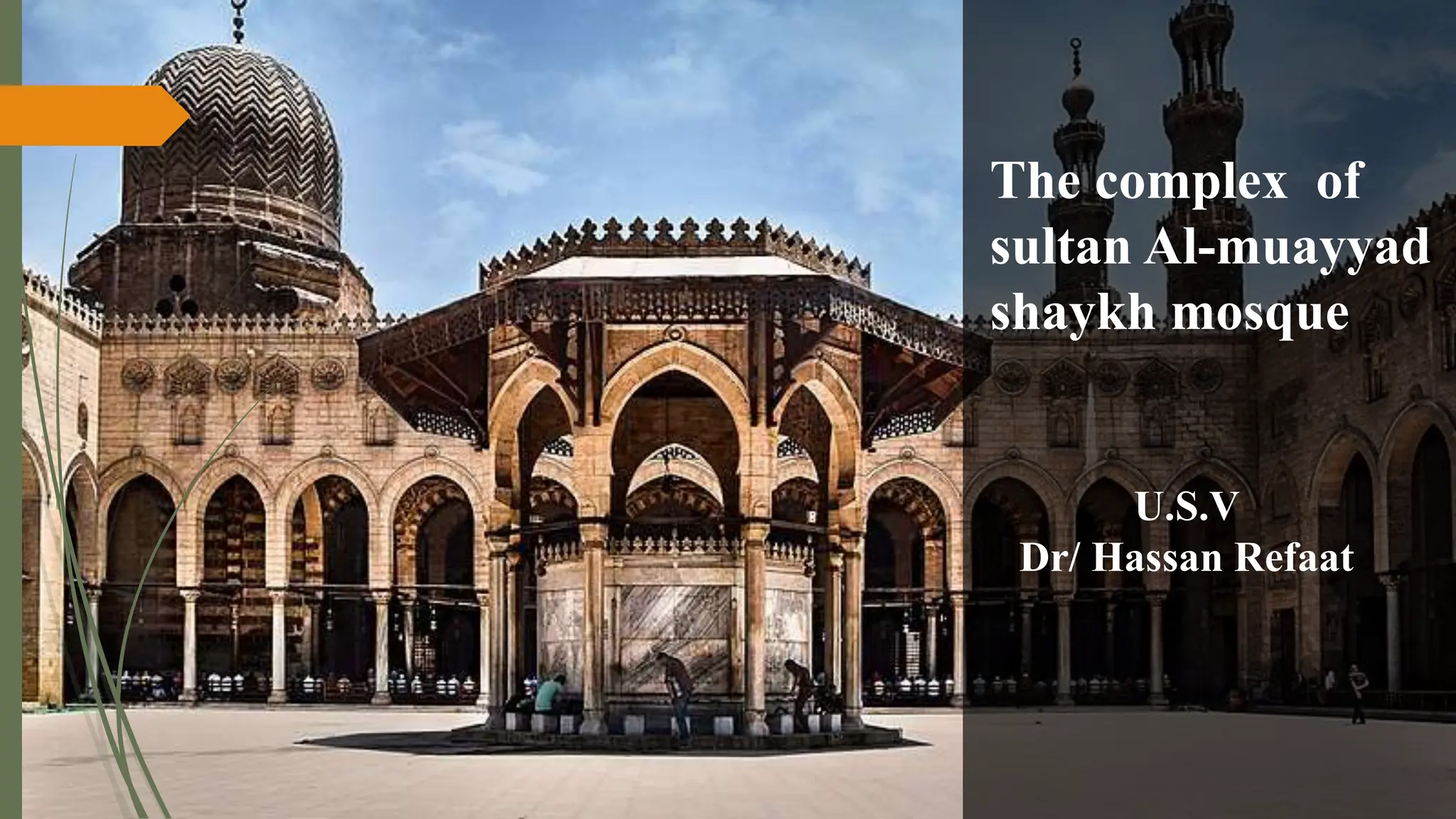
The complex of
sultan Al-muayyad
shaykh mosque
U.S.V
Dr/ Hassan Refaat
References:
-The book of the complex of sultan Al-muayyad
shaykh at Bab zuwayla) written by dr/ fahmy abd
elaleem ), of the history of Egypt through the age
1994
Introduction
The location
The founder and establishment
The layout
The description
The restoration of the mosque
the mosque and school of
sultan a Al-muayyad shaykh
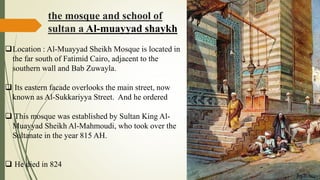
Location : Al-Muayyad Sheikh Mosque is located in
the far south of Fatimid Cairo, adjacent to the
southern wall and Bab Zuwayla.
 Its eastern facade overlooks the main street, now
known as Al-Sukkariyya Street. And he ordered
 This mosque was established by Sultan King Al-
Muayyad Sheikh Al-Mahmoudi, who took over the
Sultanate in the year 815 AH.
 He died in 824
The founder : Sultan Al-Muayyad Sheikh Al-Mahmoudi, born in the year
770 AH. He was brought to Egypt by the merchant Mahmoud Al-Bazdari
with a group of slaves and attributed to him.
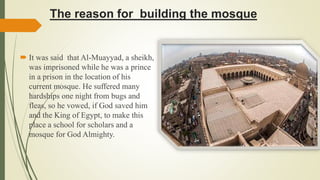
The reason for building the mosque
 It was said that Al-Muayyad, a sheikh,
was imprisoned while he was a prince
in a prison in the location of his
current mosque. He suffered many
hardships one night from bugs and
fleas, so he vowed, if God saved him
and the King of Egypt, to make this
place a school for scholars and a
mosque for God Almighty.
The importance of the mosque
 This facility was used as a school and a mosque simultaneously; The legal argument of
Sultan Al-Muayyad Sheikh confirms that this building was intended to teach Islamic
jurisprudence according to the four schools of thought, in addition to lessons in interpreting
the noble Prophet’s hadith and reciting the Holy Qur’an.
 Thus, it follows the system of university mosques in planning, and this form of school
planning eliminates old theories that confirm The school must be planned according to
plan, as the layout of this facility combines the functions of the mosque and the mosque at
the same time.
 Its use as a mosque is confirmed by the presence of the two minarets above the entrance to
Bab Zuwayla, as well as the prayer bench, mihrab, and pulpit inside the mosque.
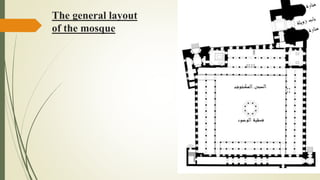
The general layout
of the mosque
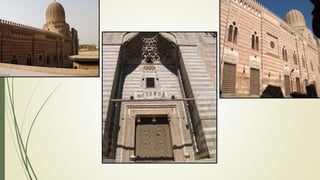
The entrance and the façade:
it contains of decorations and muqarnas
And writings were a feature of architecture in that era.
The entrance to the mosque is towering, surrounded by two mastabas, each of which
has frames of kufic writing above the entrance is a stalactite of muqarnas
The pendants are surrounded by a frame of naskhi writing, which is a verse from the
Holy Qur’an
And the entrance to the mosque is Bent Entrance or (Al-Bashoura)
Where the entrance leads to the courtyard and the iwans in an indirect manner and
zigzag paths
Some architectural elements in the mosque
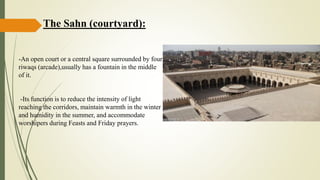
The Sahn (courtyard):
-An open court or a central square surrounded by four
riwaqs (arcade),usually has a fountain in the middle
of it.
-Its function is to reduce the intensity of light
reaching the corridors, maintain warmth in the winter
and humidity in the summer, and accommodate
worshipers during Feasts and Friday prayers.
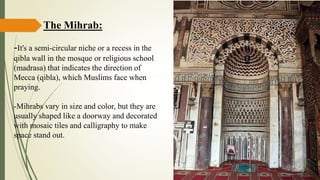
The Mihrab:
-It's a semi-circular niche or a recess in the
qibla wall in the mosque or religious school
(madrasa) that indicates the direction of
Mecca (qibla), which Muslims face when
praying.
-Mihrabs vary in size and color, but they are
usually shaped like a doorway and decorated
with mosaic tiles and calligraphy to make
space stand out.
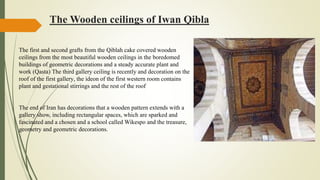
The Wooden ceilings of Iwan Qibla
The first and second grafts from the Qiblah cake covered wooden
ceilings from the most beautiful wooden ceilings in the boredomed
buildings of geometric decorations and a steady accurate plant and
work (Qasta) The third gallery ceiling is recently and decoration on the
roof of the first gallery, the ideon of the first western room contains
plant and gestational stirrings and the rest of the roof
The end of Iran has decorations that a wooden pattern extends with a
gallery show, including rectangular spaces, which are sparked and
fascinated and a chosen and a school called Wikespo and the treasure,
geometry and geometric decorations.
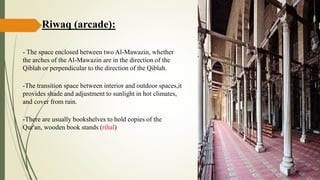
Riwaq (arcade):
- The space enclosed between two Al-Mawazin, whether
the arches of the Al-Mawazin are in the direction of the
Qiblah or perpendicular to the direction of the Qiblah.
-The transition space between interior and outdoor spaces,it
provides shade and adjustment to sunlight in hot climates,
and cover from rain.
-There are usually bookshelves to hold copies of the
Qur'an, wooden book stands (rihal)
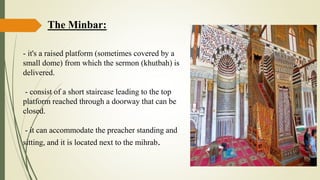
The Minbar:
- it's a raised platform (sometimes covered by a
small dome) from which the sermon (khutbah) is
delivered.
- consist of a short staircase leading to the top
platform reached through a doorway that can be
closed.
- it can accommodate the preacher standing and
sitting, and it is located next to the mihrab.
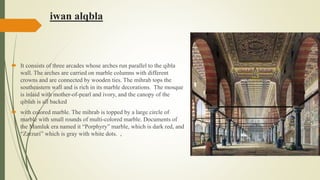
iwan alqbla
 It consists of three arcades whose arches run parallel to the qibla
wall. The arches are carried on marble columns with different
crowns and are connected by wooden ties. The mihrab tops the
southeastern wall and is rich in its marble decorations. The mosque
is inlaid with mother-of-pearl and ivory, and the canopy of the
qiblah is all backed
 with colored marble. The mihrab is topped by a large circle of
marble with small rounds of multi-colored marble. Documents of
the Mamluk era named it “Porphyry” marble, which is dark red, and
“Zarzuri” which is gray with white dots. ,
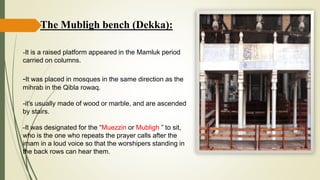
The Mubligh bench (Dekka):
-It is a raised platform appeared in the Mamluk period
carried on columns.
-It was placed in mosques in the same direction as the
mihrab in the Qibla rowaq.
-it's usually made of wood or marble, and are ascended
by stairs.
-It was designated for the “Muezzin or Mubligh ” to sit,
who is the one who repeats the prayer calls after the
imam in a loud voice so that the worshipers standing in
the back rows can hear them.
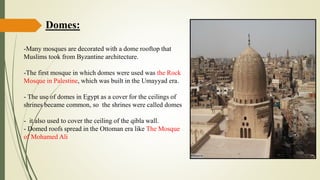
Domes:
-Many mosques are decorated with a dome rooftop that
Muslims took from Byzantine architecture.
-The first mosque in which domes were used was the Rock
Mosque in Palestine, which was built in the Umayyad era.
- The use of domes in Egypt as a cover for the ceilings of
shrines became common, so the shrines were called domes
- it also used to cover the ceiling of the qibla wall.
- Domed roofs spread in the Ottoman era like The Mosque
of Mohamed Ali
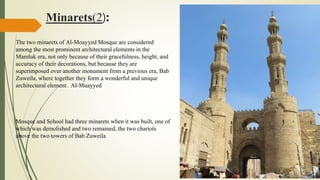
Minarets(2):
The two minarets of Al-Moayyed Mosque are considered
among the most prominent architectural elements in the
Mamluk era, not only because of their gracefulness, height, and
accuracy of their decorations, but because they are
superimposed over another monument from a previous era, Bab
Zuweila, where together they form a wonderful and unique
architectural element. Al-Muayyed
Mosque and School had three minarets when it was built, one of
which was demolished and two remained, the two chariots
above the two towers of Bab Zuweila
Mosque restoration workers
1-in the nineteenth century AD the mosque was
in bad conditiom
2- During the reign of khediv Ismail , the three
sides of the mosque were renewed
3-During the reign of khedive tawfiq , He
restored the pulpit the door
4- in the year 2000 , the ministry of culture
began to restore the mosque , and in 2006 the
mosque was opened by prime minister Ahmed
nazif
خمدرسة ومسجد السلطان المؤيد شيخ بجوار بابب وزيل

خمدرسة ومسجد السلطان المؤيد شيخ بجوار بابب وزيل

  • 1.
    The complex of sultanAl-muayyad shaykh mosque U.S.V Dr/ Hassan Refaat
  • 2.
    References: -The book ofthe complex of sultan Al-muayyad shaykh at Bab zuwayla) written by dr/ fahmy abd elaleem ), of the history of Egypt through the age 1994
  • 3.
    Introduction The location The founderand establishment The layout The description The restoration of the mosque
  • 4.
    the mosque andschool of sultan a Al-muayyad shaykh Location : Al-Muayyad Sheikh Mosque is located in the far south of Fatimid Cairo, adjacent to the southern wall and Bab Zuwayla.  Its eastern facade overlooks the main street, now known as Al-Sukkariyya Street. And he ordered  This mosque was established by Sultan King Al- Muayyad Sheikh Al-Mahmoudi, who took over the Sultanate in the year 815 AH.  He died in 824
  • 5.
    The founder :Sultan Al-Muayyad Sheikh Al-Mahmoudi, born in the year 770 AH. He was brought to Egypt by the merchant Mahmoud Al-Bazdari with a group of slaves and attributed to him.
  • 6.
    The reason forbuilding the mosque  It was said that Al-Muayyad, a sheikh, was imprisoned while he was a prince in a prison in the location of his current mosque. He suffered many hardships one night from bugs and fleas, so he vowed, if God saved him and the King of Egypt, to make this place a school for scholars and a mosque for God Almighty.
  • 7.
    The importance ofthe mosque  This facility was used as a school and a mosque simultaneously; The legal argument of Sultan Al-Muayyad Sheikh confirms that this building was intended to teach Islamic jurisprudence according to the four schools of thought, in addition to lessons in interpreting the noble Prophet’s hadith and reciting the Holy Qur’an.  Thus, it follows the system of university mosques in planning, and this form of school planning eliminates old theories that confirm The school must be planned according to plan, as the layout of this facility combines the functions of the mosque and the mosque at the same time.  Its use as a mosque is confirmed by the presence of the two minarets above the entrance to Bab Zuwayla, as well as the prayer bench, mihrab, and pulpit inside the mosque.
  • 8.
  • 9.
    The entrance andthe façade: it contains of decorations and muqarnas And writings were a feature of architecture in that era. The entrance to the mosque is towering, surrounded by two mastabas, each of which has frames of kufic writing above the entrance is a stalactite of muqarnas The pendants are surrounded by a frame of naskhi writing, which is a verse from the Holy Qur’an And the entrance to the mosque is Bent Entrance or (Al-Bashoura) Where the entrance leads to the courtyard and the iwans in an indirect manner and zigzag paths
  • 11.
  • 12.
    The Sahn (courtyard): -Anopen court or a central square surrounded by four riwaqs (arcade),usually has a fountain in the middle of it. -Its function is to reduce the intensity of light reaching the corridors, maintain warmth in the winter and humidity in the summer, and accommodate worshipers during Feasts and Friday prayers.
  • 13.
    The Mihrab: -It's asemi-circular niche or a recess in the qibla wall in the mosque or religious school (madrasa) that indicates the direction of Mecca (qibla), which Muslims face when praying. -Mihrabs vary in size and color, but they are usually shaped like a doorway and decorated with mosaic tiles and calligraphy to make space stand out.
  • 14.
    The Wooden ceilingsof Iwan Qibla The first and second grafts from the Qiblah cake covered wooden ceilings from the most beautiful wooden ceilings in the boredomed buildings of geometric decorations and a steady accurate plant and work (Qasta) The third gallery ceiling is recently and decoration on the roof of the first gallery, the ideon of the first western room contains plant and gestational stirrings and the rest of the roof The end of Iran has decorations that a wooden pattern extends with a gallery show, including rectangular spaces, which are sparked and fascinated and a chosen and a school called Wikespo and the treasure, geometry and geometric decorations.
  • 15.
    Riwaq (arcade): - Thespace enclosed between two Al-Mawazin, whether the arches of the Al-Mawazin are in the direction of the Qiblah or perpendicular to the direction of the Qiblah. -The transition space between interior and outdoor spaces,it provides shade and adjustment to sunlight in hot climates, and cover from rain. -There are usually bookshelves to hold copies of the Qur'an, wooden book stands (rihal)
  • 16.
    The Minbar: - it'sa raised platform (sometimes covered by a small dome) from which the sermon (khutbah) is delivered. - consist of a short staircase leading to the top platform reached through a doorway that can be closed. - it can accommodate the preacher standing and sitting, and it is located next to the mihrab.
  • 17.
    iwan alqbla  Itconsists of three arcades whose arches run parallel to the qibla wall. The arches are carried on marble columns with different crowns and are connected by wooden ties. The mihrab tops the southeastern wall and is rich in its marble decorations. The mosque is inlaid with mother-of-pearl and ivory, and the canopy of the qiblah is all backed  with colored marble. The mihrab is topped by a large circle of marble with small rounds of multi-colored marble. Documents of the Mamluk era named it “Porphyry” marble, which is dark red, and “Zarzuri” which is gray with white dots. ,
  • 18.
    The Mubligh bench(Dekka): -It is a raised platform appeared in the Mamluk period carried on columns. -It was placed in mosques in the same direction as the mihrab in the Qibla rowaq. -it's usually made of wood or marble, and are ascended by stairs. -It was designated for the “Muezzin or Mubligh ” to sit, who is the one who repeats the prayer calls after the imam in a loud voice so that the worshipers standing in the back rows can hear them.
  • 19.
    Domes: -Many mosques aredecorated with a dome rooftop that Muslims took from Byzantine architecture. -The first mosque in which domes were used was the Rock Mosque in Palestine, which was built in the Umayyad era. - The use of domes in Egypt as a cover for the ceilings of shrines became common, so the shrines were called domes - it also used to cover the ceiling of the qibla wall. - Domed roofs spread in the Ottoman era like The Mosque of Mohamed Ali
  • 20.
    Minarets(2): The two minaretsof Al-Moayyed Mosque are considered among the most prominent architectural elements in the Mamluk era, not only because of their gracefulness, height, and accuracy of their decorations, but because they are superimposed over another monument from a previous era, Bab Zuweila, where together they form a wonderful and unique architectural element. Al-Muayyed Mosque and School had three minarets when it was built, one of which was demolished and two remained, the two chariots above the two towers of Bab Zuweila
  • 21.
    Mosque restoration workers 1-inthe nineteenth century AD the mosque was in bad conditiom 2- During the reign of khediv Ismail , the three sides of the mosque were renewed 3-During the reign of khedive tawfiq , He restored the pulpit the door 4- in the year 2000 , the ministry of culture began to restore the mosque , and in 2006 the mosque was opened by prime minister Ahmed nazif