Is the English Language
Changing?
U3A Linguistics Group
Is English Changing?
• English, like all other languages is constantly
changing to match the needs of its users.
• The change is so slow that from year to year
we hardly notice it, except to grumble every
so often about the ‘poor English’ being used
by the younger generation!
Wasn’t English more elegant in
the old days?
People tend to think that older forms of
languages are more elegant, logical, or
‘correct’ than current forms, but it's just not
true.
The fact that language is always changing
doesn't mean it's getting worse; it's just
becoming different.
Why does language change?
• New technologies new products, new
experiences, new professions
• Emigration
• Colonisation
• Invasion
• Immigration
• Mistakes
• Fashion
New technologies
Consider texting: originally it was called text
messaging, because it allowed one person to
send another text rather than voice
messages by phone.
As that became more common, people began
using the shorter form text to refer to both
the message and the process, as in I just got
a text or I'll text Sylvia right now.
Also true of facsimile to fax.
Obtaining new words...
• Borrow from other languages
• Shortening longer words e.g. gym, bus, taxi
• Combining words, e.g. Breakfast, brunch
• Borrow from proper names e.g Levis,
fahrenheit
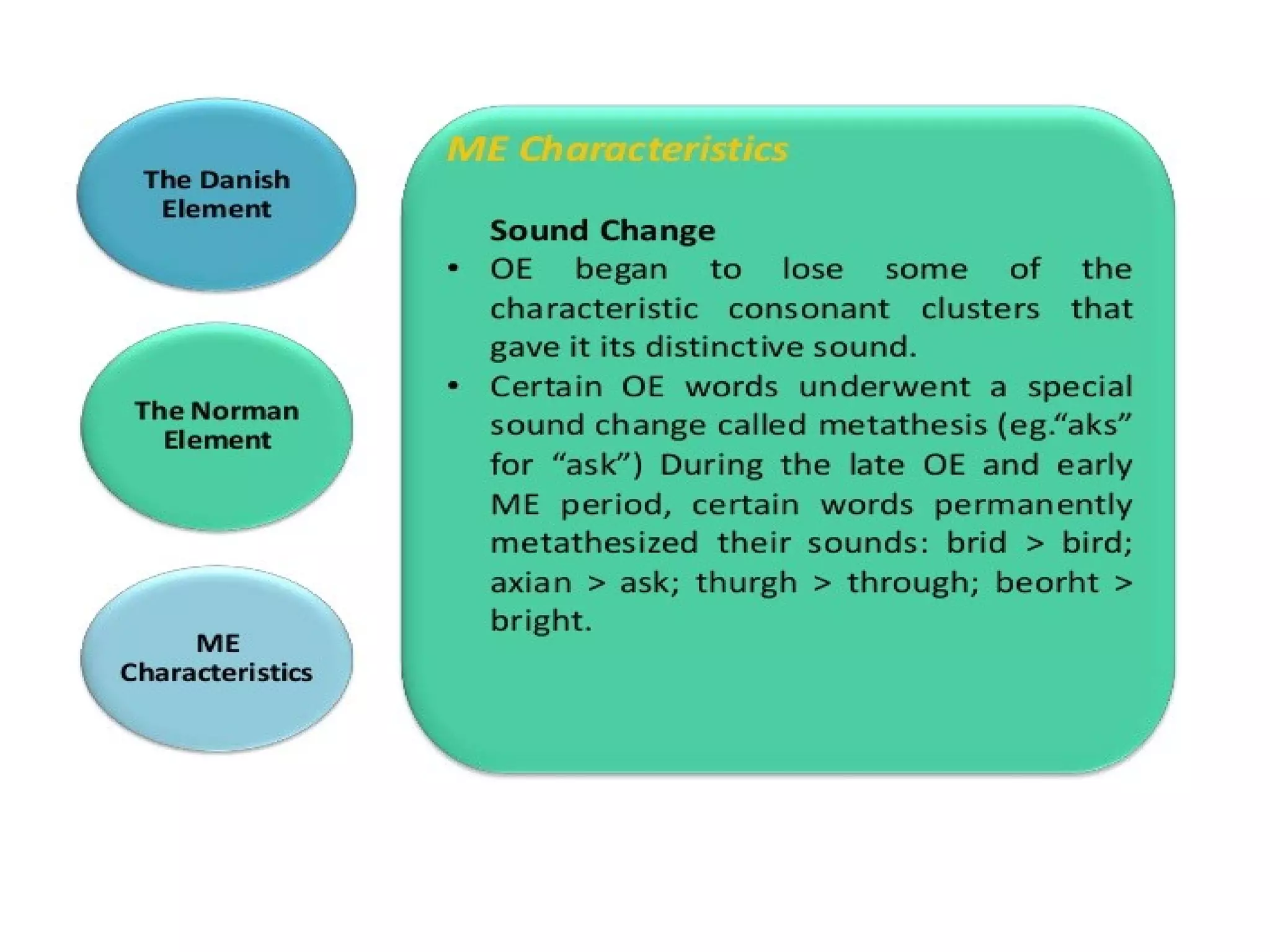
• Move letters from e.g a norange, a brid
• Incorrect back-formation, e.g. Pease to pea
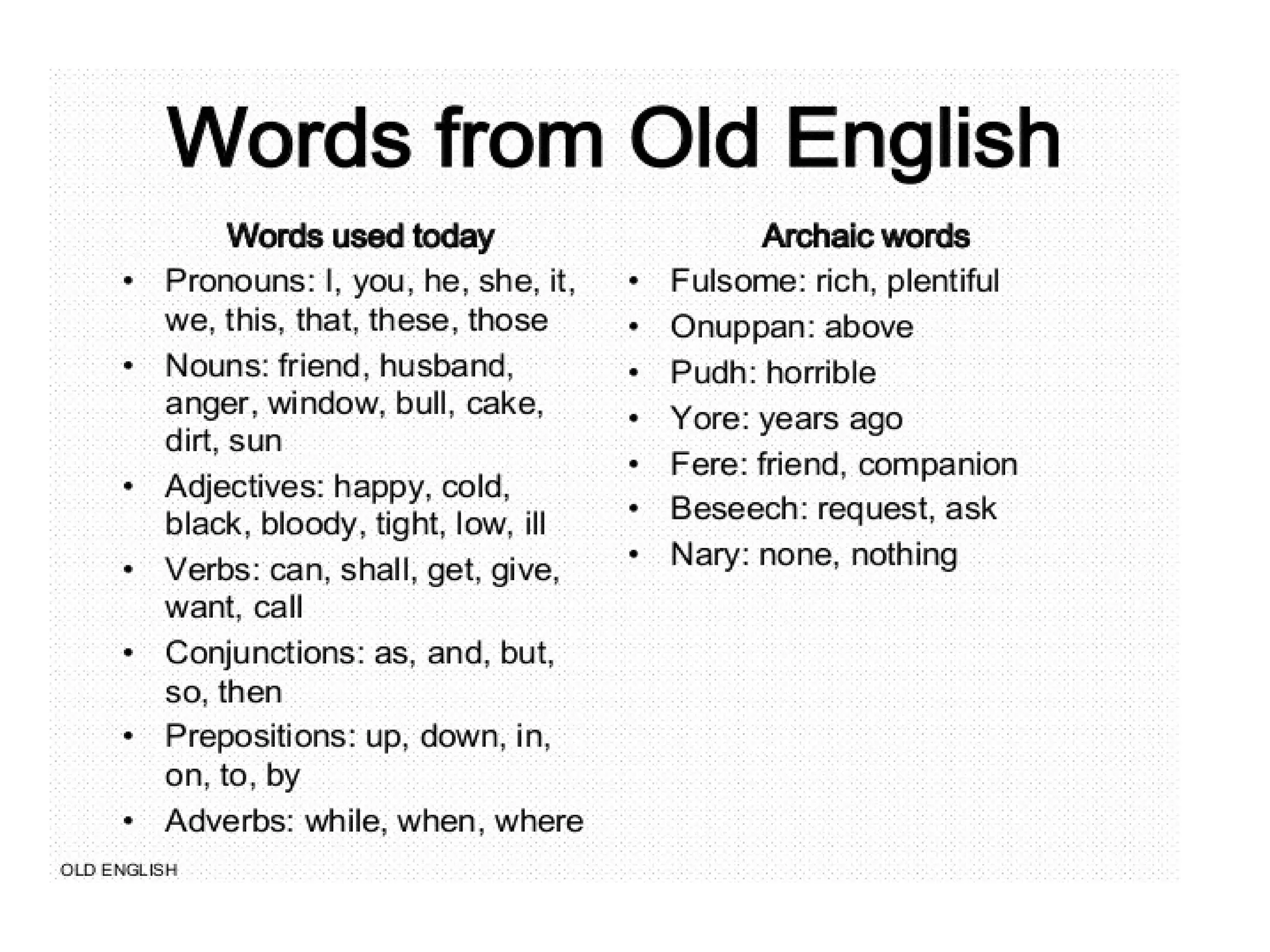
Old English / Anglo Saxon
• In the 5th century AD, settlers from west
Germany crossed over to Britain.
• These tribes were called Saxons, Jutes and
Angles, and set up kingdoms called ‘East
Anglia’, ‘West Saxon’, ‘East Saxon’ etc.
• They spoke a dialect of the Germanic
language and this slowly evolved into the
English we speak today.
English is changed Germanic
Changed?
Old English was a very complex language, at least in
comparison with modern English. Nouns had three
genders (male, female and neuter) and could be
inflected for up to five cases. There were seven
classes of “strong” verbs and three of “weak” verbs,
and their endings changed for number, tense, mood
and person. Adjectives could have up to eleven
forms. Even definite articles had three genders and
five case forms as a singular and four as a plural.
Word order was much freer than today, the sense
being carried by the inflections
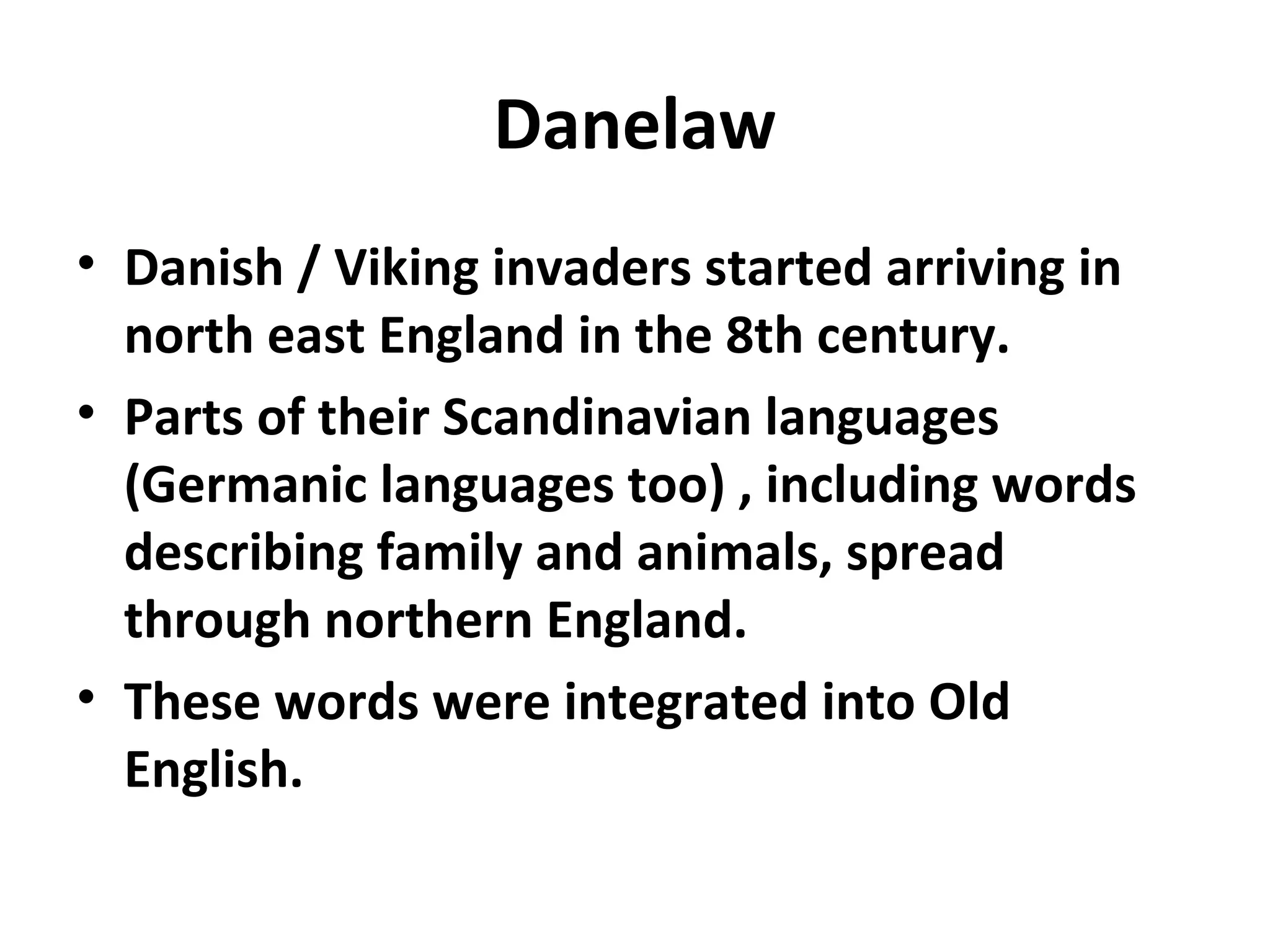
Danelaw
• Danish / Viking invaders started arriving in
north east England in the 8th century.
• Parts of their Scandinavian languages
(Germanic languages too) , including words
describing family and animals, spread
through northern England.
• These words were integrated into Old
English.
Loss of word endings.....
In grammar, inflexion is the modification of a 
word to express different grammatical 
categories such as tense, case, voice, aspect, 
person, number, gender, and mood. The 
inflection of verbs is also called conjugation, 
and one can refer to the inflection of nouns, 
adjectives and pronouns as declension.
Loss of verb inflexions
Who is biting who?
Old English (or Anglo-Saxon) was, compared to Modern 
English, a heavily inflected language. That is, the function of 
a word in a sentence was indicated by the endings: Se hund 
biteÞ Þone ealdan mann (the dog bites the old man) means 
exactly the same as Þone ealdan mann biteÞ se 
hunda (The "Þ" stands for "th.") In Modern English the 
position of the words determines their meaning; "The old 
man bites the dog" differs considerably from "The dog bites 
the old man." In Old English the -ne on Þone and -an on 
ealdan indicate that "mann" is the object of the action, no 
matter in what order they appear, and the forms of Se and 
hund indicate that the "hund" does the biting.
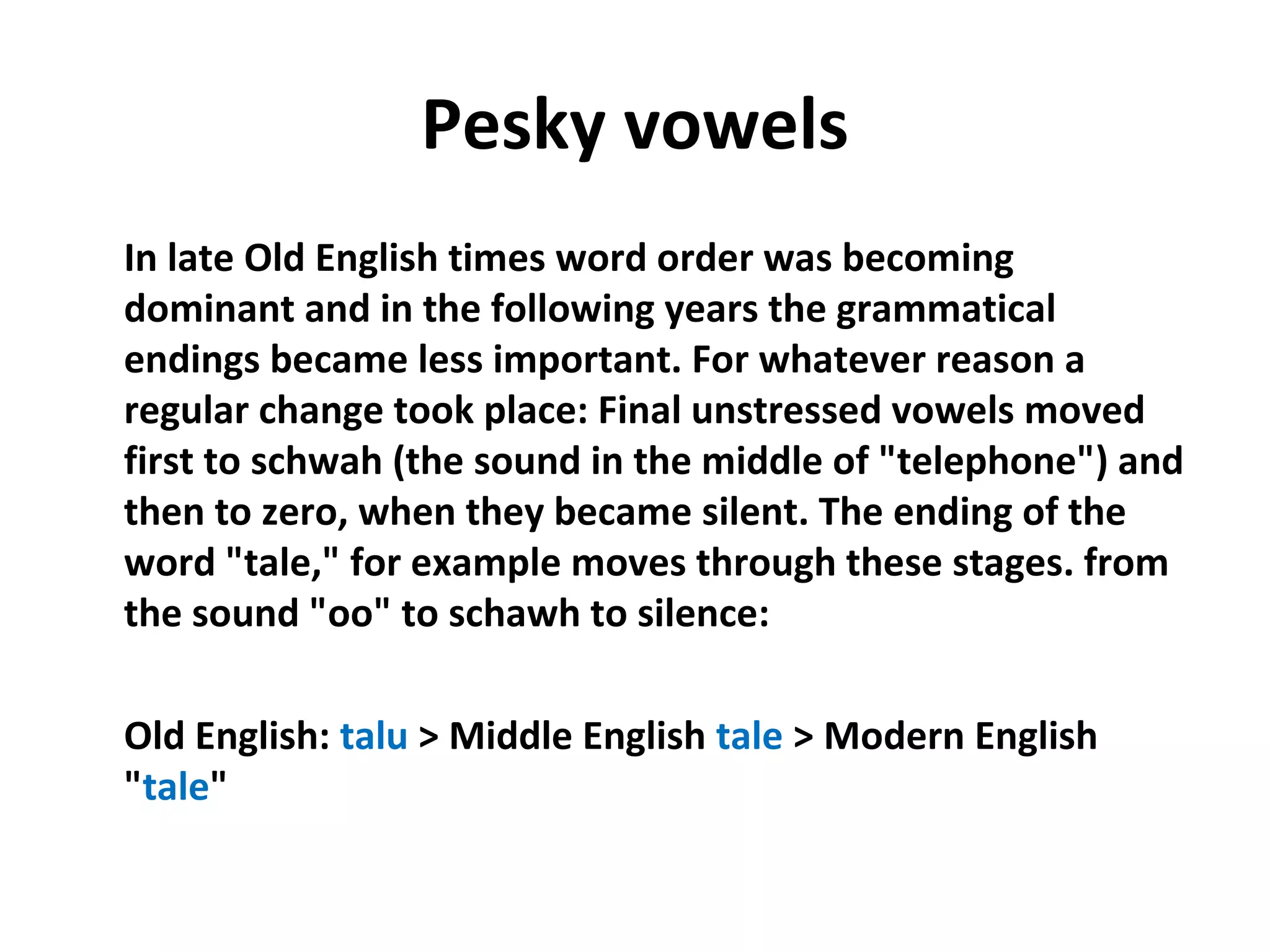
Pesky vowels
In late Old English times word order was becoming 
dominant and in the following years the grammatical 
endings became less important. For whatever reason a 
regular change took place: Final unstressed vowels moved 
first to schwah (the sound in the middle of "telephone") and 
then to zero, when they became silent. The ending of the 
word "tale," for example moves through these stages. from 
the sound "oo" to schawh to silence:
Old English: talu > Middle English tale > Modern English 
"tale"
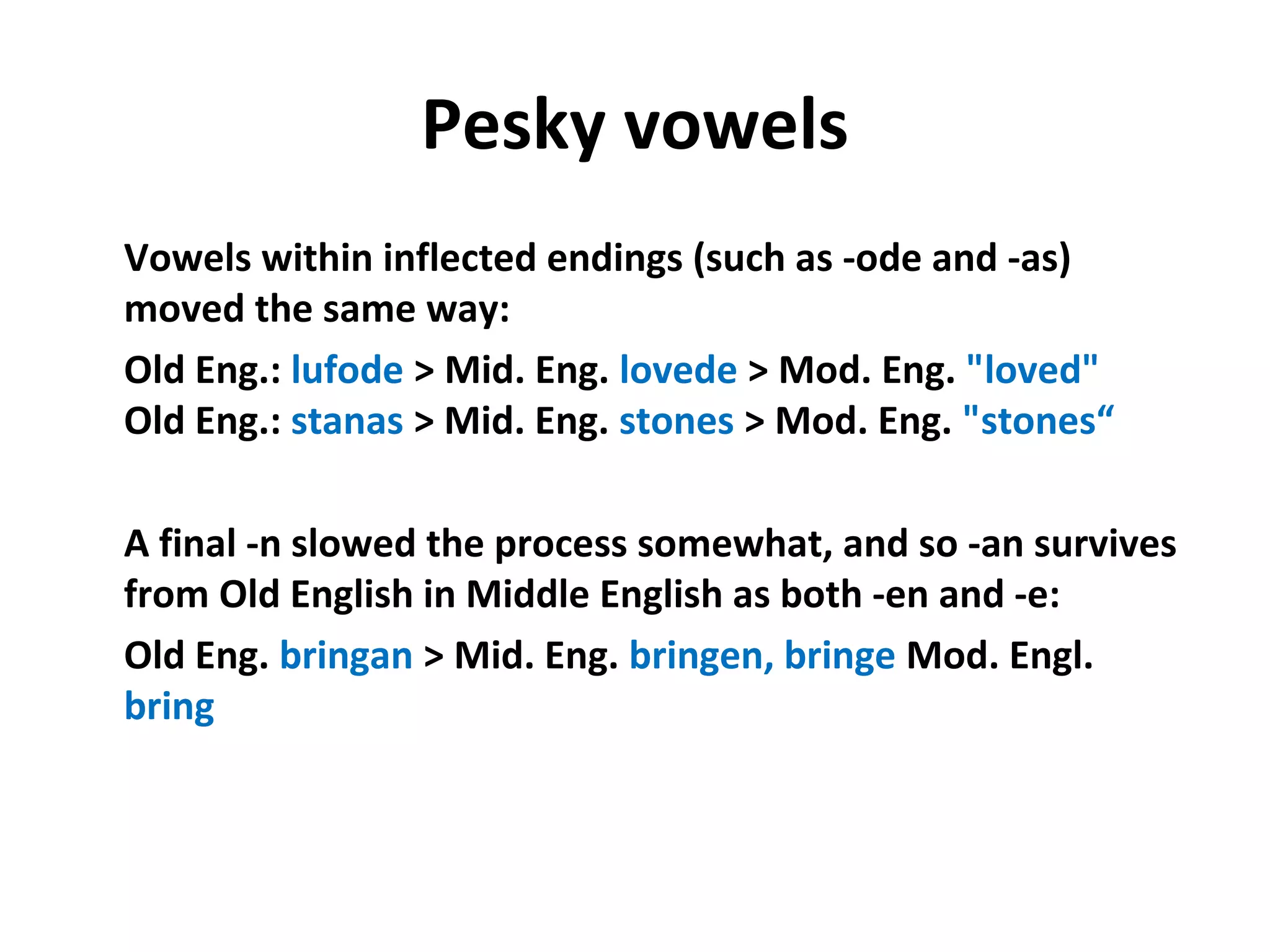
Pesky vowels
Vowels within inflected endings (such as -ode and -as) 
moved the same way:
Old Eng.: lufode > Mid. Eng. lovede > Mod. Eng. "loved" 
Old Eng.: stanas > Mid. Eng. stones > Mod. Eng. "stones“
A final -n slowed the process somewhat, and so -an survives 
from Old English in Middle English as both -en and -e:
Old Eng. bringan > Mid. Eng. bringen, bringe Mod. Engl. 
bring
Beowulf Prologue
7th
century onwards
Then the Normans Landed!
• Anglo Saxons defeated.
• Current French became the language of the 
court, religion, administration and the 
nobility.
• Latin was the language of the Church 
sacraments and learned works.
• Old English became the language of the 
underclasses.  
• For a few centuries!
Resurgence of English
• Over time English became more widely used 
by the educated upper classes and by 1425 
English was used universally again in speech 
and writing.
• However, it had changed completely since 
the Old English period and became known as 
Middle English.
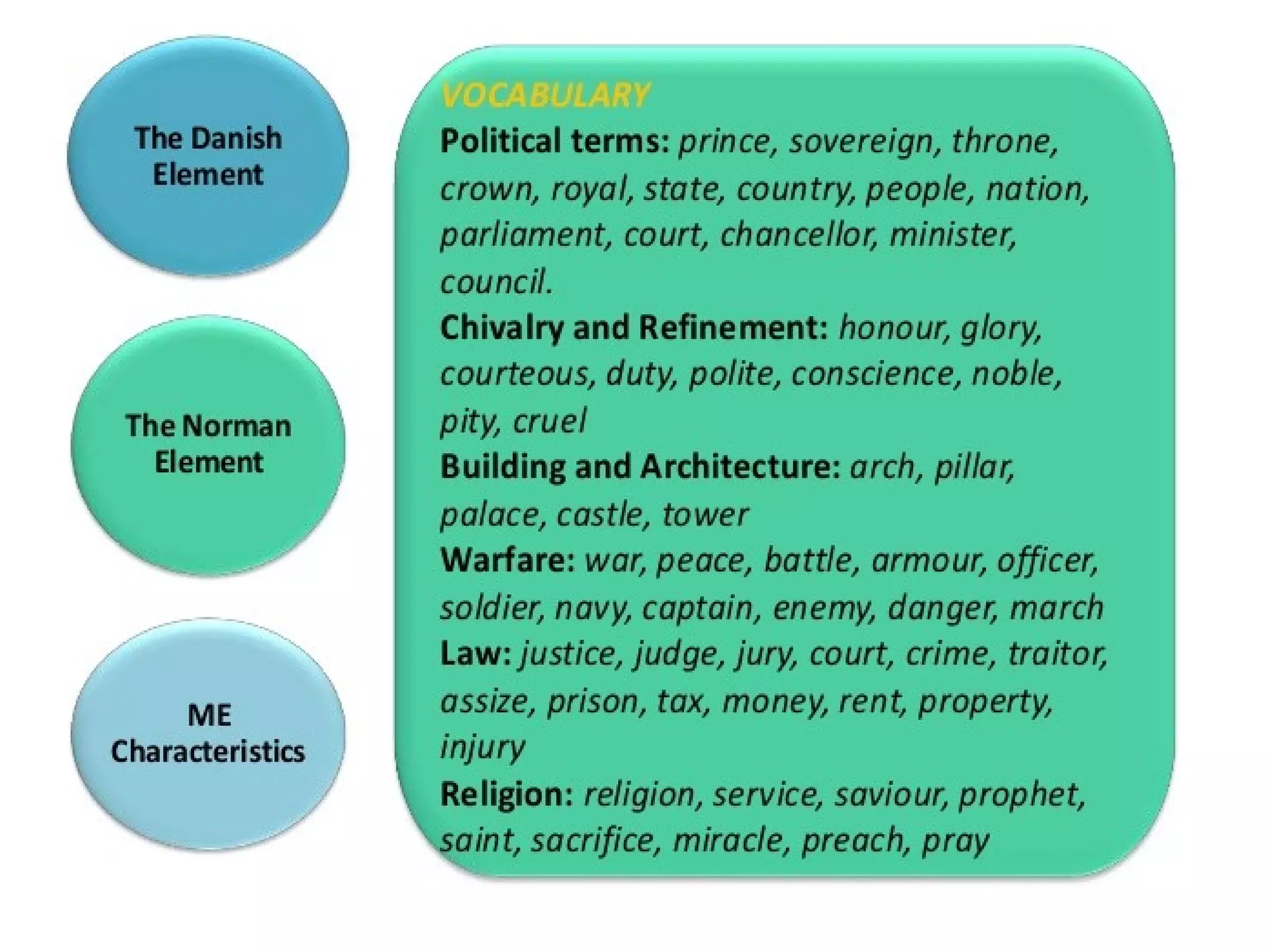
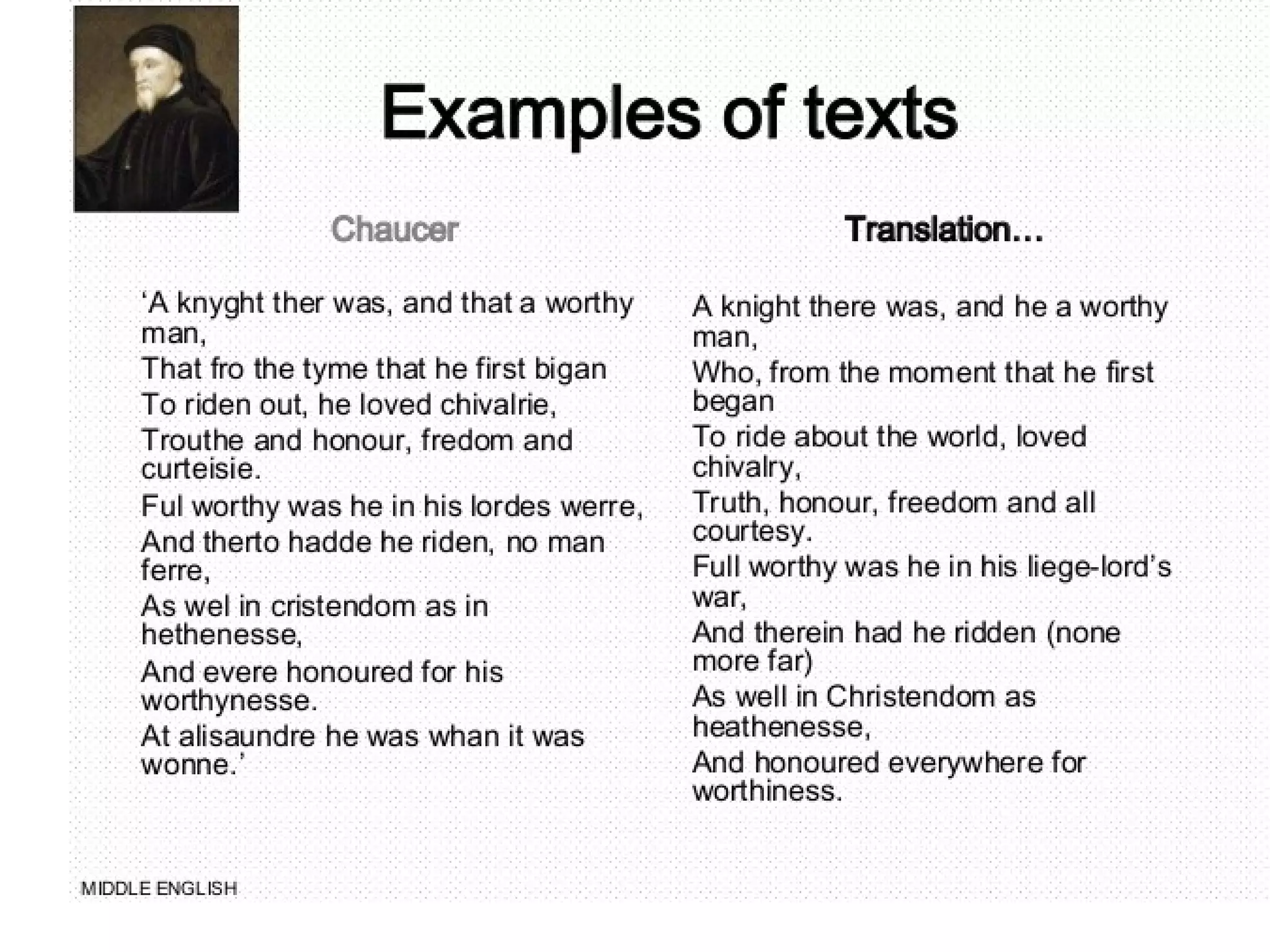
Features of Middle English
heavily influenced by
Middle
English
especially legal,
religious and
administrative terms
such as justice, jury,
govern and sovereign.
French lexis
became much
simpler, reflecting
the way the two
languages had to
co-exist
inflections
disappeared (all
plurals ended -en,
-es or -s.
grammar
Go to the ‘Ages of English’
interactive timeline at
listen to Old and Middle
English texts.
© www.teachit.co.uk 2010 12961 Page 7 of 15
Features of Middle English
pronunciation was
changing with
vowels becoming
shorter, e.g. leef
became life and teem
became time.
known as the Great
Vowel Shift
an estimated 85% of
Old English words
fell out of use after
the Viking and
Norman invasions
no standardised
system of spelling
pronunciation
thousands of Latin
words, found in
French, replaced Old
English terms
Latin words
Middle
English
© www.teachit.co.uk 2010 12961 Page 8 of 15
Ayenbite of Inwit 1340AD
• Nou ich wille þet ye ywite hou hit is ywent
þet þis boc is ywrite mid Engliss of Kent.
Þis boc is ymad vor lewede men
Vor vader and vor moder and vor oþer ken
ham vor to ber e vram alle manyere zenȝ
þet ine hare inwytte ne bleve no voul wen.
'Huo ase god' in his name yzed,
Þet þis boc made god him yeve þet bread,
Of angles of hevene, and þerto his red,
And ondervonge his zaule huanne þet he is dyad. 
Amen. Kentish dialect
Mandeville’s Travels 1370AD
In þat lond ben trees þat beren wolle, as þogh it were of scheep; 
whereof men maken clothes, and all þing þat may ben made of wolle. 
In þat contree ben many ipotaynes, þat dwellen som tyme in the water, 
and somtyme on the lond: and þei ben half man and half hors, as I haue 
seyd before; and þei eten men, whan þei may take hem. And þere ben 
ryueres and watres þat ben fulle byttere, þree sithes more þan is the 
water of the see. In þat contré ben many griffounes, more plentee þan in 
ony other contree. Sum men seyn þat þei han the body vpward as an 
egle, and benethe as a lyoun: and treuly þei seyn soth þat þei ben of þat 
schapp. But o griffoun hath the body more gret, and is more 
strong, þanne eight lyouns, of suche lyouns as ben o this half; and more 
gret and strongere þan an hundred egles, suche as we han amonges vs. 
For o griffoun þere wil bere fleynge to his nest a gret hors, 3if he may 
fynde him at the poynt, or two oxen 3oked togidere, as þei gon at the 
plowgh.
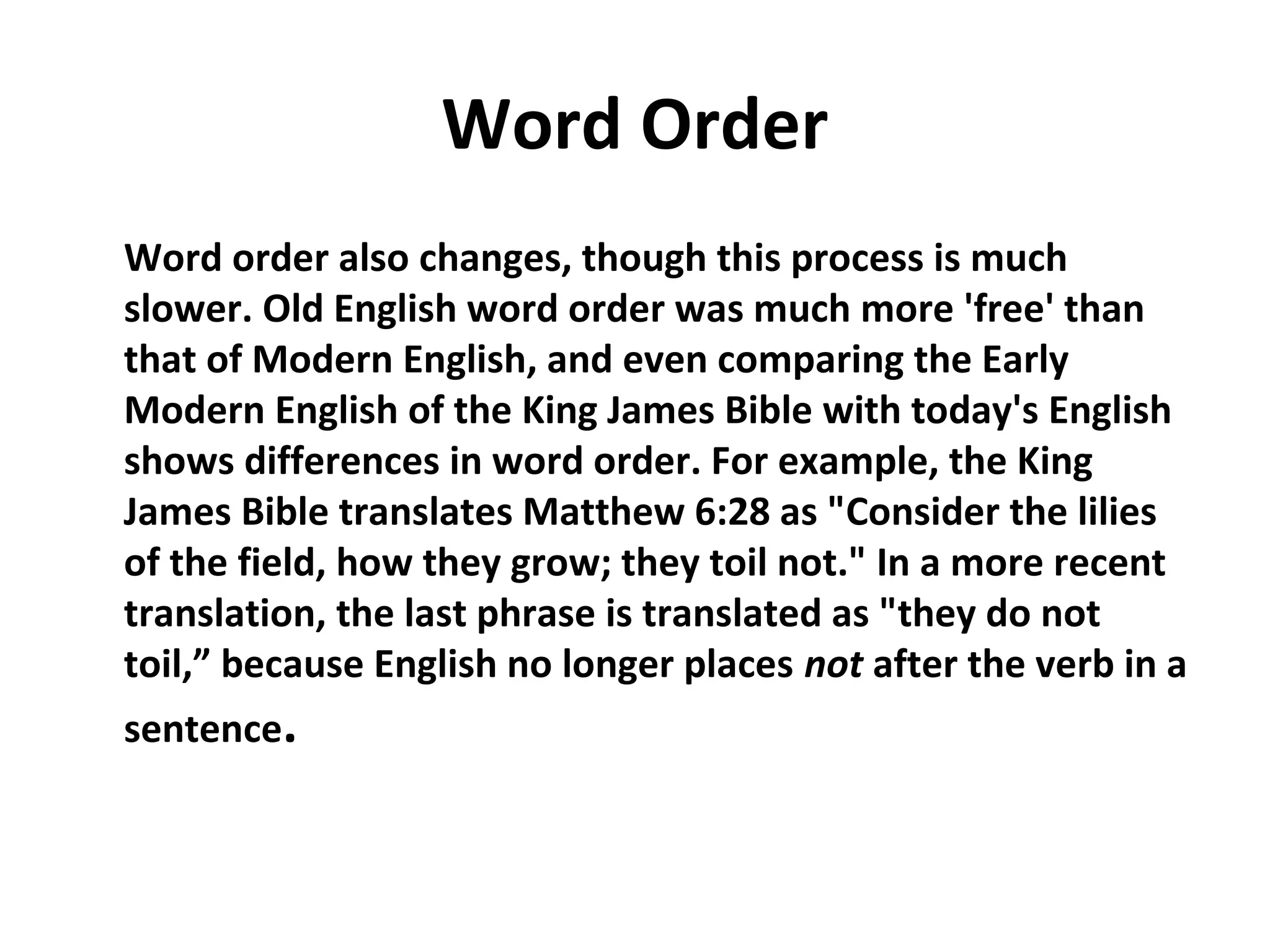
Word Order
Word order also changes, though this process is much
slower. Old English word order was much more 'free' than
that of Modern English, and even comparing the Early
Modern English of the King James Bible with today's English
shows differences in word order. For example, the King
James Bible translates Matthew 6:28 as "Consider the lilies
of the field, how they grow; they toil not." In a more recent
translation, the last phrase is translated as "they do not
toil,” because English no longer places not after the verb in a
sentence.
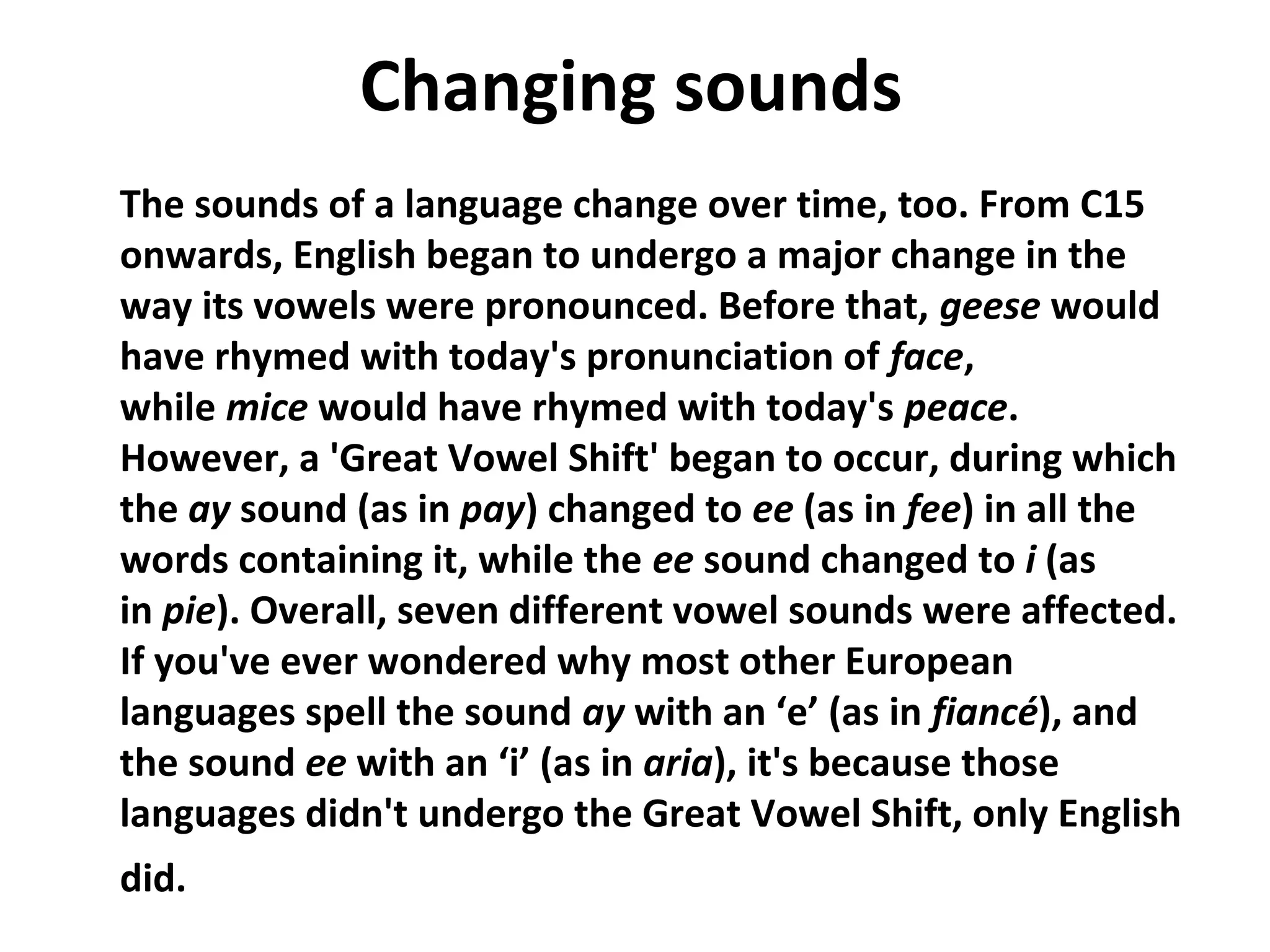
Changing sounds
The sounds of a language change over time, too. From C15
onwards, English began to undergo a major change in the
way its vowels were pronounced. Before that, geese would
have rhymed with today's pronunciation of face,
while mice would have rhymed with today's peace.
However, a 'Great Vowel Shift' began to occur, during which
the ay sound (as in pay) changed to ee (as in fee) in all the
words containing it, while the ee sound changed to i (as
in pie). Overall, seven different vowel sounds were affected.
If you've ever wondered why most other European
languages spell the sound ay with an ‘e’ (as in fiancé), and
the sound ee with an ‘i’ (as in aria), it's because those
languages didn't undergo the Great Vowel Shift, only English
did.                                        
The Great Vowel Shift (15C to 17C)
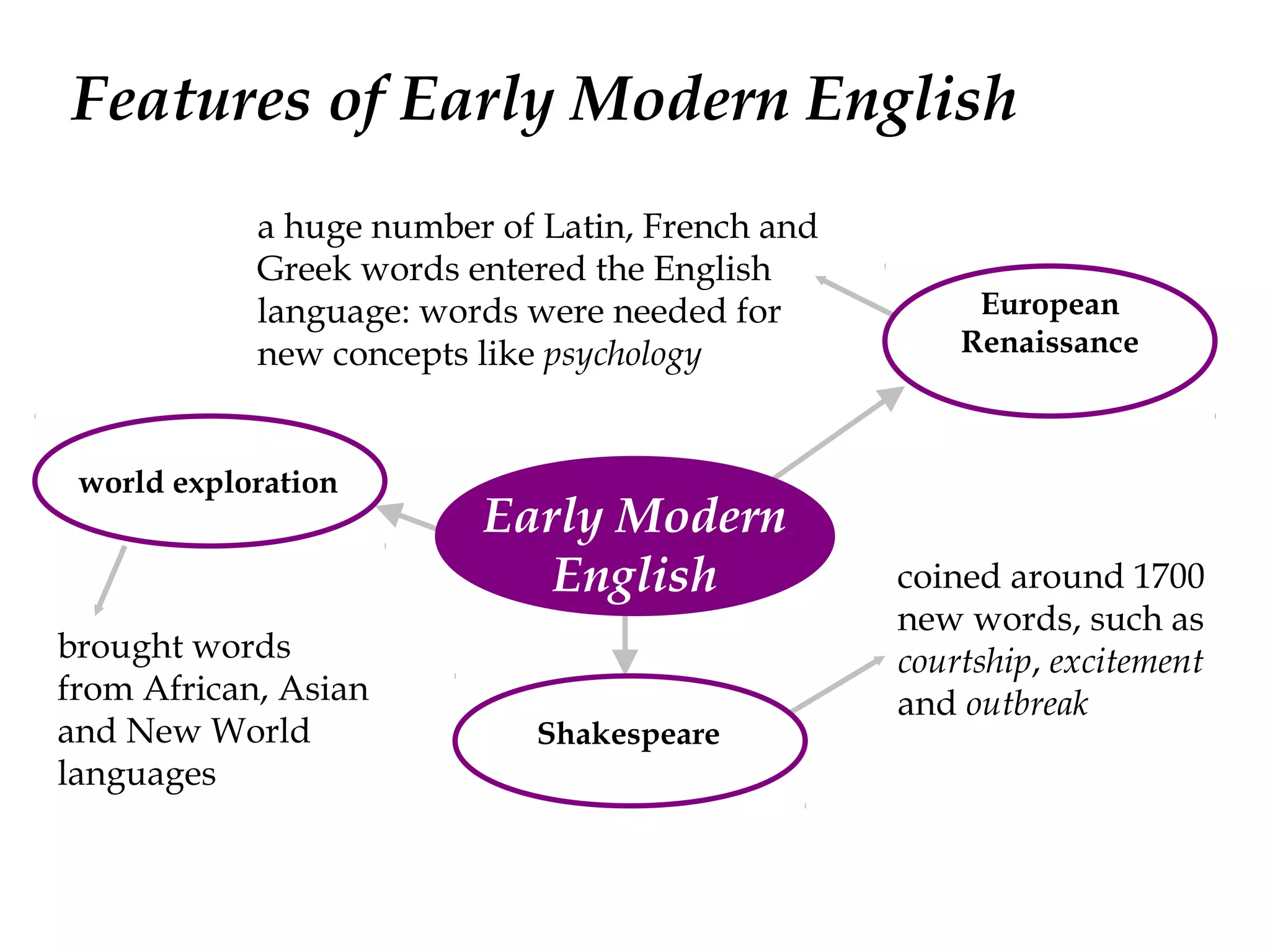
Features of Early Modern English
brought words
from African, Asian
and New World
languages
world exploration
a huge number of Latin, French and
Greek words entered the English
language: words were needed for
new concepts like psychology
European
Renaissance
coined around 1700
new words, such as
courtship, excitement
and outbreak
Shakespeare
Early Modern
English
© www.teachit.co.uk 2010 12961 Page 10 of 15
Influences of Latin
• More than half of our modern English
vocabulary is Latinate (of Latin origin), e.g.
colossal, dignified, emotion, history,
ambiguous, immense opponent, ultimatum,
vacuum, nation, exaggerate.
• Most of our prefixes and suffixes come from
Latin, e.g. anti-, post-, pre-, -al, -ate, -ic.
Is english changing?

Is english changing?