Googling for Genealogy
February 2015
Hillingdon U3A
Family History
Introductory
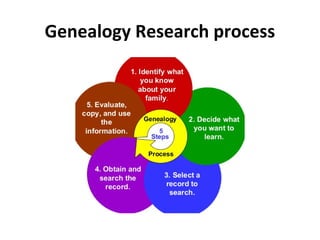
Genealogy Research process
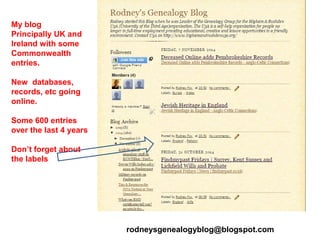
My blog
Principally UK and
Ireland with some
Commonwealth
entries.
New databases,
records, etc going
online.
Some 600 entries
over the last 4 years
Don’t forget about
the labels
rodneysgenealogyblog@blogspot.com
Finding information......
• The principal genealogy research websites
(Ancestry, Findmypast, The Genealogist, etc.)
have their own search capabilities to access
their own databases.
• But what about everything else on the
internet?
• You need a Search Engine!
What is a Search Engine?
A program that searches for and identifies items in
a database that correspond to keywords specified
by the user, used especially for finding particular
information on the World Wide Web.
When a person looks for something online, it
requires the search engines to scour billions of
documents and do two things – first, return only
those results that are relevant or useful to the
searcher’s query, and second, rank those results in
order of perceived usefulness.
All Search Engines do not work in
the same way...
• They will not produce the same results for a
given search request.
• Some are general search engines, some focus
on specific subjects.
• The syntax that each uses to carry out
searches is different.
• Some are meta Search Engines.
• Why not give another search engine a try?
What is Google?
• Google is the largest
but only one of many
search engines......the
list includes.........
• Yahoo
• Bing (ex MSN Search)
• Dogpile
• Ask (Jeeves)
• DuckDuckGo
• Excite
• Yippy
• Alta Vista
• Etc.
What Google consists of.......
• A spider program crawls and indexes the
billions of documents, pages, files, news,
videos and media on the public web and
builds a huge database from the web pages
• The Google Search Box gives ways to search
this database by entering search terms and
symbols that act as search limiters.
What Google consists of.......
• Provision of answers to user search queries,
most frequently through lists of relevant
pages, through retrieval and rankings.
• Google’s page rank system decides how the
results should be organized for display:
– traffic, popularity of pages
– linking to a page
– popularity - a link to a page is a vote for it
– word proximity and placement
Using Google
• Using Google will almost certainly assist you
in your genealogy research.
• Google can provide accurate and relevant
search results in seconds.
• The key to making Google significantly more
productive in your research is knowing how
to frame your search queries in order to get
the best answers.
Using Google
• Avoid one word searches
• Think about what you are looking for.
• Bring together what information you already
have.
• Select what key words in that information
you want to include in the search criteria.
All Search terms count......
• A basic search will only return web pages
that include all of your search terms
canal family history
will return all pages that include these three
search term words
Search Order Matters.... 
• Google will return results that contain all of
your search terms, but will give higher
priority to the earlier terms in your query
• Thus, a search for fox durham cemetery will
return pages in a different ranked order
than durham cemetery fox
• Put your most important term first, and
group your search terms in a way that makes
sense
Might as well use lower case....
• Google is case insensitive. Search terms will
return the same results, regardless of the
combination of upper and lower case letters
used in the search query
• Google also ignores most common
punctuation such as commas and full stops.
Thus a search for Rodney Fox Driffield,
England will return the same results as
rodney fox driffield england
Don’t need many small words......
• Google ignores most small words, which it
calls stop words, such as the following:
I, an, for, from, how, of, in, is, it, the, and
where among others
• If you need these words, place them in
“”quotation marks.
Get exactly what you want...
Google works hard to ensure accurate search
results, including automatically considering
searches for words that are common
synonyms to be identical, or suggesting
alternate, more common spellings.
A similar approach, called stemming, returns
not only results with your keyword, but also
with terms based on the keyword stem - such
as distribute, distributor, distribution
The Basic Search
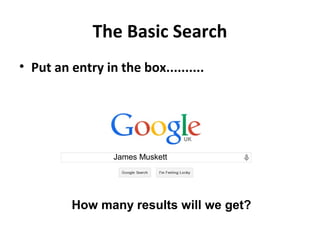
• Put an entry in the box..........
James Muskett
How many results will we get?
The Basic Search
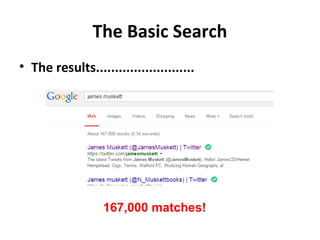
• The results..........................
167,000 matches!
Why so Many?
• Google will bring back pages that have all of
the words you entered in your search query,
but these words will most likely not be in the
order you intended or anywhere near each
other..............
• For example, a search for james muskett will
bring up web pages with e.g. james
cordon and netta muskett
Modifying the Search into a
phrase....
• Use quotation marks around any two word
or greater phrase to find results where the
words appear together exactly as you have
entered them
• So searching for ”james muskett” will only
bring up pages with the name james muskett
included as a phrase
Modifying the Basic Search
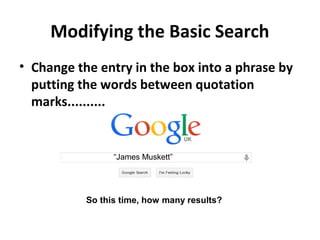
• Change the entry in the box into a phrase by
putting the words between quotation
marks..........
“James Muskett”
So this time, how many results?
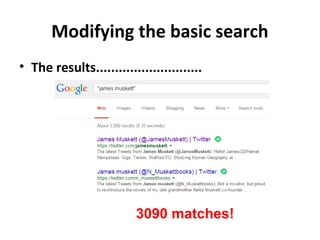
Modifying the basic search
• The results............................
3090 matches!
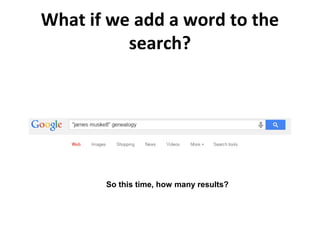
What if we add a word to the
search?
So this time, how many results?
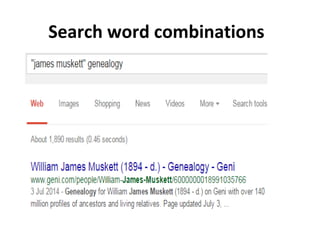
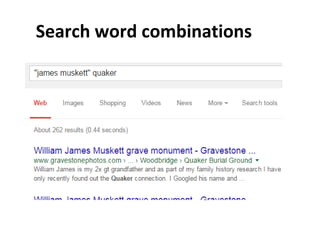
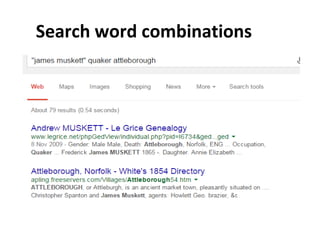
Search word combinations
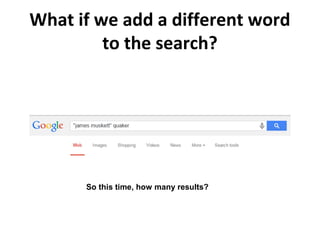
What if we add a different word
to the search?
So this time, how many results?
Search word combinations
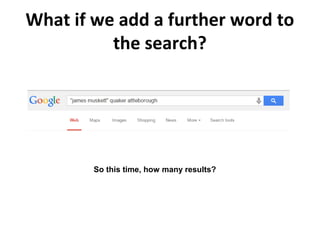
What if we add a further word to
the search?
So this time, how many results?
Search word combinations
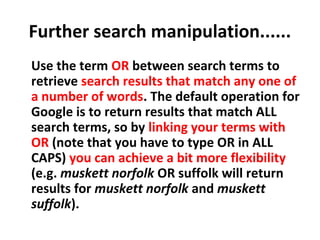
Further search manipulation......
Use the term OR between search terms to
retrieve search results that match any one of
a number of words. The default operation for
Google is to return results that match ALL
search terms, so by linking your terms with
OR (note that you have to type OR in ALL
CAPS) you can achieve a bit more flexibility
(e.g. muskett norfolk OR suffolk will return
results for muskett norfolk and muskett
suffolk).
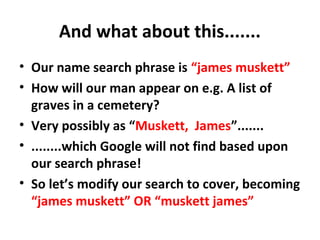
And what about this.......
• Our name search phrase is “james muskett”
• How will our man appear on e.g. A list of
graves in a cemetery?
• Very possibly as “Muskett, James”.......
• ........which Google will not find based upon
our search phrase!
• So let’s modify our search to cover, becoming
“james muskett” OR “muskett james”
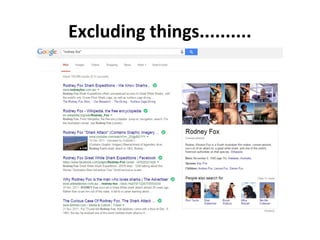
Excluding things..........
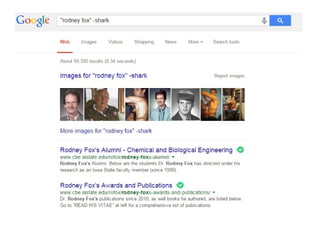
Further search manipulation......
• To exclude a specific commonly used word
from a search result you can use a minus
sign. This will omit the word following the
minus sign from search results.
• This is especially useful when searching for a
surname with frequent mention on the web,
such as an Australian Rodney Fox who was
almost bitten in two by a shark, and lived!
Wildcards......
Including an *, or wildcard, in a search query
tells Google to treat the star as a placeholder for
any unknown term(s) and then find the best
matches.
Use the wildcard (*) operator to end a question
or phrase such as james muskett was born in *
Use as a proximity search to find terms located
within two words of each other such as james *
muskett (good for middle names and initials).
Note for Google that the * operator works only
on whole words, not parts of words.
Site Search
• You can use Google to search within a
specific site
• site:URL "keyphrase“
• Rootsweb is a well known free genealogy
community website which includes the very
popular mailing lists.
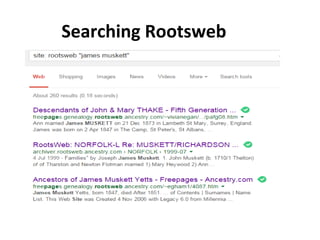
• So what about James Muskett references
specifically in Rootsweb...................?
Searching Rootsweb
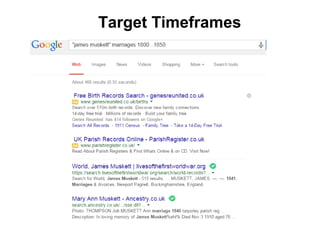
Numerical ranges...
• Set target timeframes, by defining a date
range for your searches to exclude e.g. recent
events.
• Put the date from / to separated by 3 dots.
• This will search for any range of numbers,
not just dates
• What about our friend James Muskett in the
first half of the nineteenth century?
Target Timeframes
Use Google's Advanced Search Form..
  If you want a more process driven approach 
for your research you can try using 
Google's Advanced Search Form which covers 
most of the search options previously 
mentioned, such as using search phrases, as 
well as removing words you don't want 
included in your search results.
http://www.google.co.uk/advanced_search
Googling for genealogy

Googling for genealogy

  • 1.
    Googling for Genealogy February2015 Hillingdon U3A Family History Introductory
  • 2.
  • 4.
    My blog Principally UKand Ireland with some Commonwealth entries. New databases, records, etc going online. Some 600 entries over the last 4 years Don’t forget about the labels rodneysgenealogyblog@blogspot.com
  • 5.
    Finding information...... • Theprincipal genealogy research websites (Ancestry, Findmypast, The Genealogist, etc.) have their own search capabilities to access their own databases. • But what about everything else on the internet? • You need a Search Engine!
  • 6.
    What is aSearch Engine? A program that searches for and identifies items in a database that correspond to keywords specified by the user, used especially for finding particular information on the World Wide Web. When a person looks for something online, it requires the search engines to scour billions of documents and do two things – first, return only those results that are relevant or useful to the searcher’s query, and second, rank those results in order of perceived usefulness.
  • 7.
    All Search Enginesdo not work in the same way... • They will not produce the same results for a given search request. • Some are general search engines, some focus on specific subjects. • The syntax that each uses to carry out searches is different. • Some are meta Search Engines. • Why not give another search engine a try?
  • 8.
    What is Google? •Google is the largest but only one of many search engines......the list includes......... • Yahoo • Bing (ex MSN Search) • Dogpile • Ask (Jeeves) • DuckDuckGo • Excite • Yippy • Alta Vista • Etc.
  • 9.
    What Google consistsof....... • A spider program crawls and indexes the billions of documents, pages, files, news, videos and media on the public web and builds a huge database from the web pages • The Google Search Box gives ways to search this database by entering search terms and symbols that act as search limiters.
  • 11.
    What Google consistsof....... • Provision of answers to user search queries, most frequently through lists of relevant pages, through retrieval and rankings. • Google’s page rank system decides how the results should be organized for display: – traffic, popularity of pages – linking to a page – popularity - a link to a page is a vote for it – word proximity and placement
  • 12.
    Using Google • UsingGoogle will almost certainly assist you in your genealogy research. • Google can provide accurate and relevant search results in seconds. • The key to making Google significantly more productive in your research is knowing how to frame your search queries in order to get the best answers.
  • 13.
    Using Google • Avoidone word searches • Think about what you are looking for. • Bring together what information you already have. • Select what key words in that information you want to include in the search criteria.
  • 14.
    All Search termscount...... • A basic search will only return web pages that include all of your search terms canal family history will return all pages that include these three search term words
  • 15.
    Search Order Matters....  •Google will return results that contain all of your search terms, but will give higher priority to the earlier terms in your query • Thus, a search for fox durham cemetery will return pages in a different ranked order than durham cemetery fox • Put your most important term first, and group your search terms in a way that makes sense
  • 16.
    Might as welluse lower case.... • Google is case insensitive. Search terms will return the same results, regardless of the combination of upper and lower case letters used in the search query • Google also ignores most common punctuation such as commas and full stops. Thus a search for Rodney Fox Driffield, England will return the same results as rodney fox driffield england
  • 17.
    Don’t need manysmall words...... • Google ignores most small words, which it calls stop words, such as the following: I, an, for, from, how, of, in, is, it, the, and where among others • If you need these words, place them in “”quotation marks.
  • 18.
    Get exactly whatyou want... Google works hard to ensure accurate search results, including automatically considering searches for words that are common synonyms to be identical, or suggesting alternate, more common spellings. A similar approach, called stemming, returns not only results with your keyword, but also with terms based on the keyword stem - such as distribute, distributor, distribution
  • 19.
    The Basic Search •Put an entry in the box.......... James Muskett How many results will we get?
  • 20.
    The Basic Search •The results.......................... 167,000 matches!
  • 21.
    Why so Many? •Google will bring back pages that have all of the words you entered in your search query, but these words will most likely not be in the order you intended or anywhere near each other.............. • For example, a search for james muskett will bring up web pages with e.g. james cordon and netta muskett
  • 22.
    Modifying the Searchinto a phrase.... • Use quotation marks around any two word or greater phrase to find results where the words appear together exactly as you have entered them • So searching for ”james muskett” will only bring up pages with the name james muskett included as a phrase
  • 23.
    Modifying the BasicSearch • Change the entry in the box into a phrase by putting the words between quotation marks.......... “James Muskett” So this time, how many results?
  • 24.
    Modifying the basicsearch • The results............................ 3090 matches!
  • 25.
    What if weadd a word to the search? So this time, how many results?
  • 26.
  • 27.
    What if weadd a different word to the search? So this time, how many results?
  • 28.
  • 29.
    What if weadd a further word to the search? So this time, how many results?
  • 30.
  • 31.
    Further search manipulation...... Usethe term OR between search terms to retrieve search results that match any one of a number of words. The default operation for Google is to return results that match ALL search terms, so by linking your terms with OR (note that you have to type OR in ALL CAPS) you can achieve a bit more flexibility (e.g. muskett norfolk OR suffolk will return results for muskett norfolk and muskett suffolk).
  • 32.
    And what aboutthis....... • Our name search phrase is “james muskett” • How will our man appear on e.g. A list of graves in a cemetery? • Very possibly as “Muskett, James”....... • ........which Google will not find based upon our search phrase! • So let’s modify our search to cover, becoming “james muskett” OR “muskett james”
  • 33.
  • 34.
    Further search manipulation...... •To exclude a specific commonly used word from a search result you can use a minus sign. This will omit the word following the minus sign from search results. • This is especially useful when searching for a surname with frequent mention on the web, such as an Australian Rodney Fox who was almost bitten in two by a shark, and lived!
  • 36.
    Wildcards...... Including an *,or wildcard, in a search query tells Google to treat the star as a placeholder for any unknown term(s) and then find the best matches. Use the wildcard (*) operator to end a question or phrase such as james muskett was born in * Use as a proximity search to find terms located within two words of each other such as james * muskett (good for middle names and initials). Note for Google that the * operator works only on whole words, not parts of words.
  • 37.
    Site Search • Youcan use Google to search within a specific site • site:URL "keyphrase“ • Rootsweb is a well known free genealogy community website which includes the very popular mailing lists. • So what about James Muskett references specifically in Rootsweb...................?
  • 38.
  • 39.
    Numerical ranges... • Settarget timeframes, by defining a date range for your searches to exclude e.g. recent events. • Put the date from / to separated by 3 dots. • This will search for any range of numbers, not just dates • What about our friend James Muskett in the first half of the nineteenth century?
  • 40.
  • 41.
    Use Google's AdvancedSearch Form..   If you want a more process driven approach  for your research you can try using  Google's Advanced Search Form which covers  most of the search options previously  mentioned, such as using search phrases, as  well as removing words you don't want  included in your search results. http://www.google.co.uk/advanced_search