Genealogy
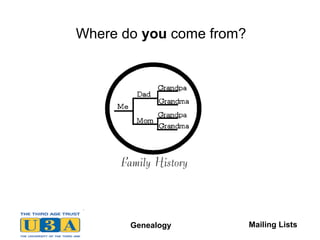
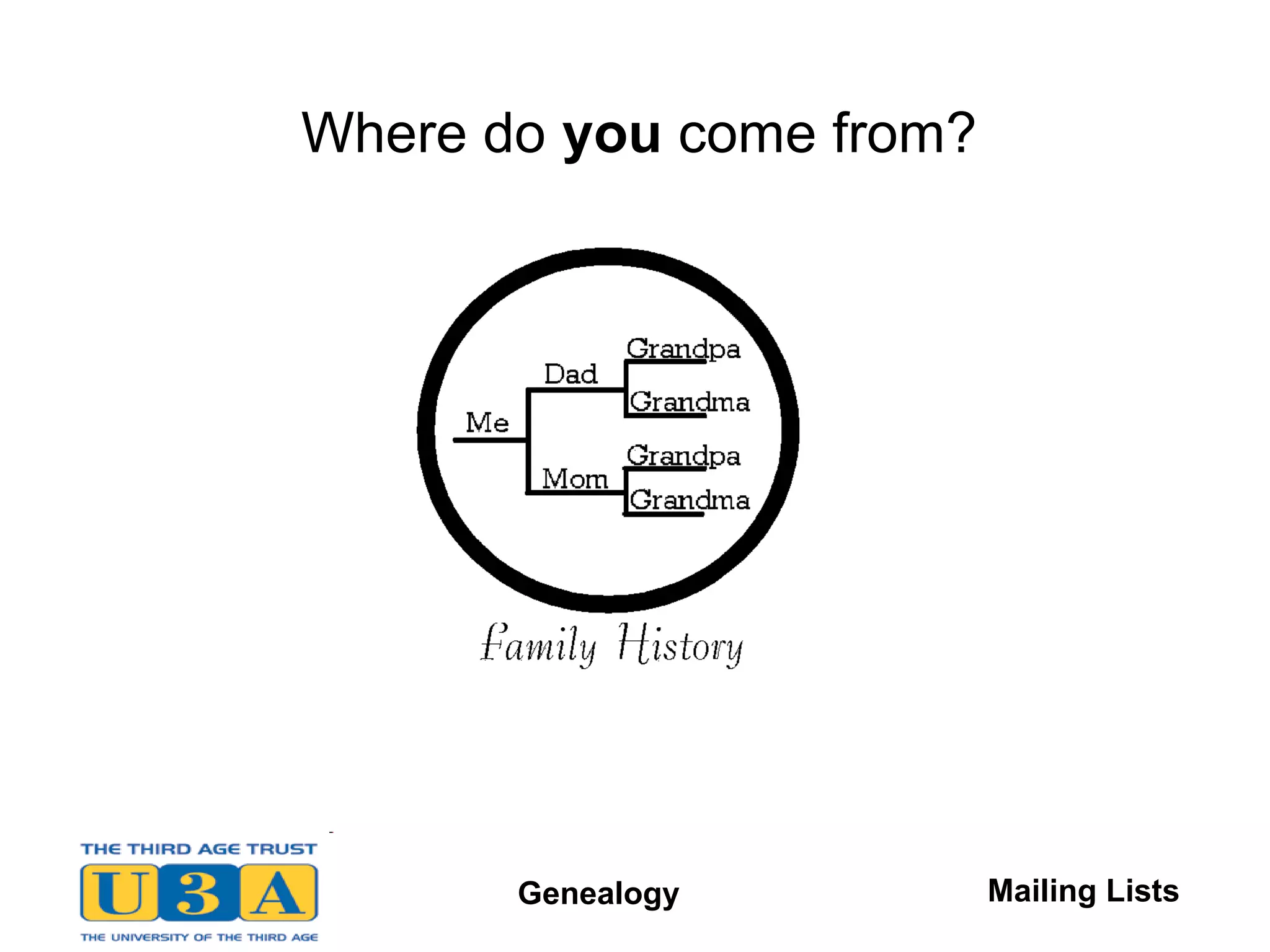
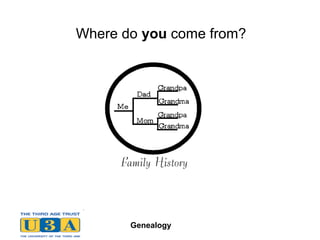
Where do you come from?
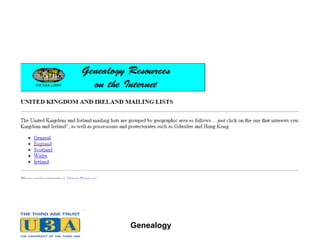
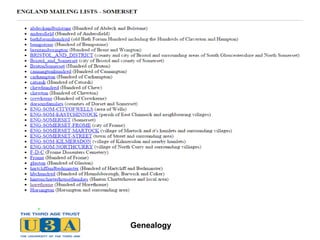
Mailing Lists
Genealogy
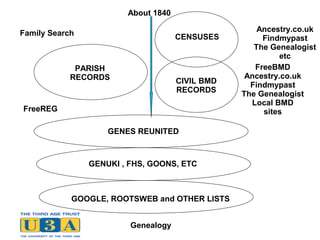
CENSUSES
CIVIL BMD
RECORDS
About 1840
PARISH
RECORDS
GENES REUNITED
GENUKI , FHS, GOONS, ETC
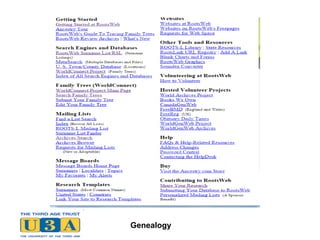
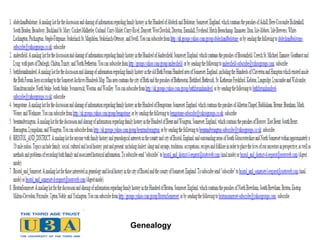
GOOGLE, ROOTSWEB and OTHER LISTS
Ancestry.co.uk
Findmypast
The Genealogist
etc
FreeBMD
Ancestry.co.uk
Findmypast
The Genealogist
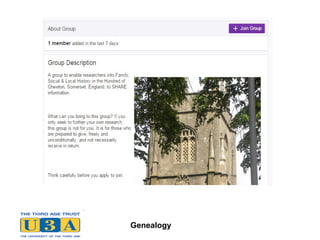
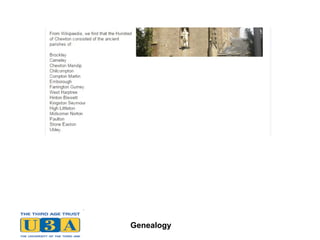
Local BMD
sites
Family Search
FreeREG
Genealogy
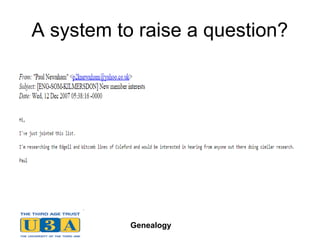
A system to raise a question?
Genealogy
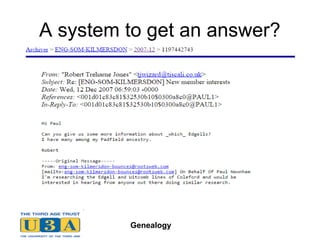
A system to get an answer?
Genealogy
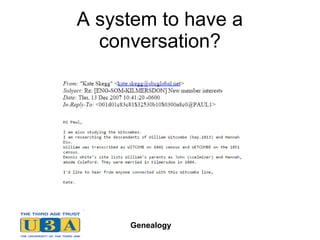
A system to have a
conversation?
Genealogy
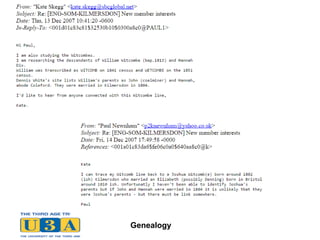
Genealogy
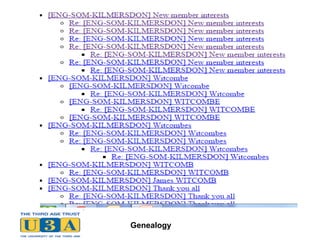
Genealogy
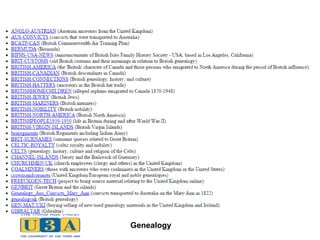
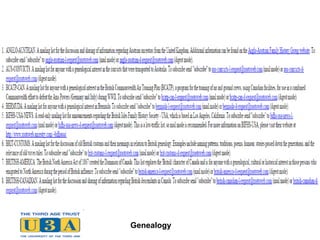
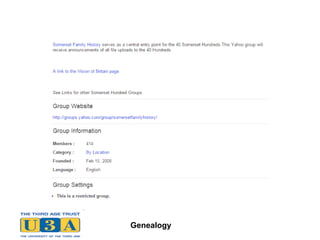
Mailing Lists
• You express an interest in a surname,
geography, profession, etc by
registering for a specific Mailing List
• You can enter a query for other
members of the List to respond or
comment
• You receive (email) entries of new
entries on the List from other members
Genealogy
Mailing Lists
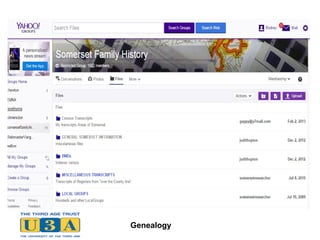
• You can browse the archive contents of
your subscribed Mailing Lists.
• Using your email box, the most
common Mailing List organisations are
Rootsweb and Yahoo Groups
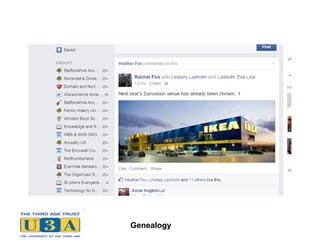
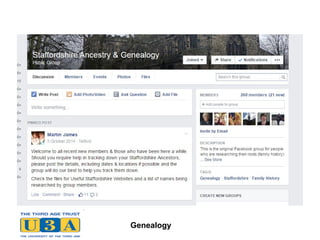
• Facebook has a similar facility but puts
entries to your Facebook page not your
email.
Genealogy
Genealogy
Genealogy
Genealogy
Using Mailing Lists to further
your research
It's like having your own virtual research
community. An easy way to network with
other genealogists to share distant
ancestors, get answers to questions,
request lookups and swap research
stories. Genealogy mailing lists are free,
fun and are often one of the best online
possibilities for filling in some of the blanks
in your family tree.
Genealogy
Do they work?
• But instead of being posted to the Internet,
mailing list messages come directly to
your email box
• Because they arrive daily in subscriber
mailboxes, mailing lists better promote
"real-time discussion," with faster
responses than you'll generally receive
with a message board post.
Genealogy
Do they work?
Also, because individuals have to
subscribe to post or receive messages,
mailing lists generally encourage "serious"
researchers and more in-depth
discussions and exchange of data. Thus,
a genealogy mailing list can often be an
excellent way to locate fellow researchers
or data that correspond with your subjects
or areas of interest.
Genealogy
How Mailing Lists Work
Once you find a relevant genealogy
mailing list, you can usually join by
sending an email that automatically adds
you to a list of subscribers. Most
genealogy mailing lists also offer two
subscription modes:
Genealogy
List or Mail Mode
You'll receive each message posted to the
mailing list individually, as they are sent.
These can sometimes be hard to
distinguish from your regular email.
Genealogy
Digest Mode
You'll receive periodic emails with several
mailing list messages bundled together.
Each digest email will usually include a
table of contents at the top with links to
each of the individual email messages
listed further down in the email. Digest
mode is a great way to reduce clutter in
your inbox, but it can sometimes be harder
to follow the thread of a conversation.
Genealogy
Joining a List
The instructions for joining a particular list should
be posted on the Web page which introduces
the mailing list, but usually it is just a matter of
sending an email to the administration address
with the word subscribe in the subject line.
These emails are usually processed by a
computer, so there is no need to include
anything else. You will then receive a welcome
letter, usually within a few hours. Be sure to
save this email as it will contain important
information concerning list rules and -- this is
very important -- how to unsubscribe.
Genealogy
Can Lists help?
Literally tens of thousands of genealogy
mailing lists are available, covering just
about every conceivable topic. If you're
new to genealogy mailing lists, they
function much like genealogy forums and
message boards, with posts, queries, and
responses by researchers.
Genealogy
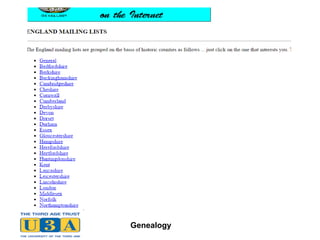
Location, Location
If you've traced your ancestors to a
specific locality, then there is most likely a
mailing list to help you in your quest for
location-specific clues. Consider
subscribing to a genealogy mailing list that
covers the county (e.g. Somerset for me),
town or parish of the family line which is
giving you the most trouble.
Genealogy
Location, Location
Once you've joined, you'll find your fellow
list-members a great resource when
you're stuck for ideas for where to look
next. Location-specific lists are also a
good place to find researchers who have
access to books or records that would
help you in your search.
Genealogy
Genealogy
Need a Helping hand?
Whether you are new to genealogy, or feel
like you've been researching your family
tree for most of your life, there are mailing
lists geared toward helping people find
answers to questions and exchange tips
and ideas. There are plenty of mailing lists
geared toward helping genealogists
improve their research skills.
Genealogy
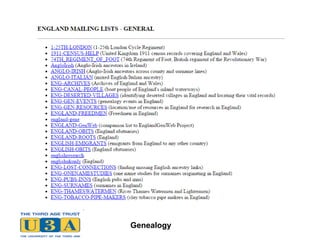
What's Your Interest?
Genealogists have set up mailing lists on
just about every topic imaginable. There
are mailing lists for specific record types
[census, military, immigration]; for specific
places [Ellis Island, Somerset Coalfields,
Black Country, ] and for a wide variety of
special interests [witch hunting, railway
workers, mariners].
Genealogy
Tip!
If the mailing list you're interested in has
archives online, this can give you an idea
of how busy the list will be. Some receive
only a few messages per month, while
others average over 100 new messages
each day.
Genealogy
Are there a lot of
mailing Lists?
Thousands of genealogy mailing lists are
available. From the over 28,000 mailing
lists hosted by RootsWeb, to individual
mailing lists sponsored by genealogical
societies, genealogy software publishers,
etc.,
Genealogy
Getting to know your List
Genealogy mailing lists are similar to a
community or neighbourhood in that they
reflect the personalities of their
subscribers. Some lists are friendly with a
number of off-topic "chatty" posts, while
others are strictly run with no off-topic
discussion allowed. When you first join a
mailing list, it is best to "lurk" for a few
days.
Genealogy
Getting to know your List
Read the messages from others and get
the feel for the list's community and rules
before posting your first message. After a
week or so, however, it's time to introduce
yourself. Let the list members know who
you are and what research problem you
are tackling that is related to the topic of
the mailing list.
Genealogy
Rules for Success
• Format your questions in an efficient
and effective manner.
Keep the message as brief as possible,
while still providing all pertinent
information (being too vague will
discourage responses as well as waste
the time of list members who suggest
things that you've already tried).
Genealogy
Rules for Success
• Be specific in your subject line.
People just don't have time to open and
respond to emails titled "need help." Be
sure to include the primary topic of your
query in the subject line of your email -
whether it be a surname, place, or time
period.
Genealogy
Rules for Success
• Be courteous.
The mantra "you only get one chance to
make a first impression" holds true on the
Internet as well as in person. Be polite in
all postings, use good grammar and
punctuation and don't type messages in all
capital letters (this is the equivalent of
shouting at the reader).
Genealogy
Query Tips
• Include surnames in CAPITAL LETTERS
in the Subject line and the first time you
use it in the query.
• Be specific. People do not often respond
to queries such as "Send me all
information about the POWELL family"
• Check online sources for answers to
general research questions before posting
to a list. Genealogists love to help those
who help themselves.
Genealogy
Query Tips
• Try to stay away from too using too many
abbreviations unless your space is limited.
Many researchers may not recognize the
abbreviations you are using.
• Try to use an email address you will be
sticking with. There are thousands of
queries on the Internet with no way to
reach the posters because the email
address is invalid.
Genealogy
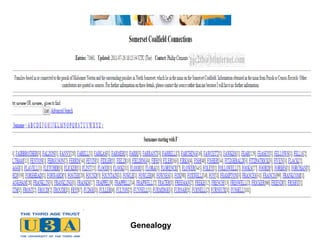
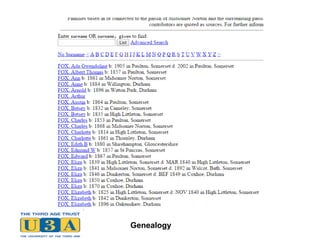
Network your Names
Unless you are researching a very
unusual surname, there is probably a
mailing list with your name on it. Surname
lists are a great way to connect with other
genealogists who are researching the
same name to share family connections,
ask questions and swap tips and
resources. I subscribe to mailing lists
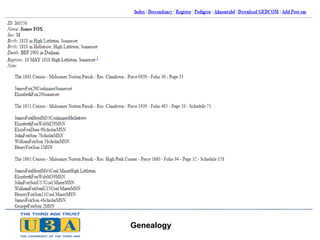
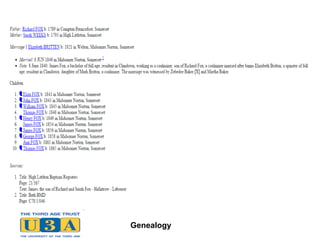
which deal with FOX, NICHOLSON
surnames, as well as several others
Genealogy
Genealogy
Genealogy
Genealogy
Genealogy
Genealogy
Genealogy
Genealogy
Genealogy
Genealogy
Genealogy
Genealogy
Genealogy
Genealogy
Genealogy
Genealogy
Where do you come from?

U3amailinglists

  • 1.
    Genealogy Where do youcome from? Mailing Lists
  • 2.
    Genealogy CENSUSES CIVIL BMD RECORDS About 1840 PARISH RECORDS GENESREUNITED GENUKI , FHS, GOONS, ETC GOOGLE, ROOTSWEB and OTHER LISTS Ancestry.co.uk Findmypast The Genealogist etc FreeBMD Ancestry.co.uk Findmypast The Genealogist Local BMD sites Family Search FreeREG
  • 3.
    Genealogy A system toraise a question?
  • 4.
    Genealogy A system toget an answer?
  • 5.
    Genealogy A system tohave a conversation?
  • 6.
  • 7.
  • 8.
    Genealogy Mailing Lists • Youexpress an interest in a surname, geography, profession, etc by registering for a specific Mailing List • You can enter a query for other members of the List to respond or comment • You receive (email) entries of new entries on the List from other members
  • 9.
    Genealogy Mailing Lists • Youcan browse the archive contents of your subscribed Mailing Lists. • Using your email box, the most common Mailing List organisations are Rootsweb and Yahoo Groups • Facebook has a similar facility but puts entries to your Facebook page not your email.
  • 10.
  • 11.
  • 12.
  • 13.
    Genealogy Using Mailing Liststo further your research It's like having your own virtual research community. An easy way to network with other genealogists to share distant ancestors, get answers to questions, request lookups and swap research stories. Genealogy mailing lists are free, fun and are often one of the best online possibilities for filling in some of the blanks in your family tree.
  • 14.
    Genealogy Do they work? •But instead of being posted to the Internet, mailing list messages come directly to your email box • Because they arrive daily in subscriber mailboxes, mailing lists better promote "real-time discussion," with faster responses than you'll generally receive with a message board post.
  • 15.
    Genealogy Do they work? Also,because individuals have to subscribe to post or receive messages, mailing lists generally encourage "serious" researchers and more in-depth discussions and exchange of data. Thus, a genealogy mailing list can often be an excellent way to locate fellow researchers or data that correspond with your subjects or areas of interest.
  • 16.
    Genealogy How Mailing ListsWork Once you find a relevant genealogy mailing list, you can usually join by sending an email that automatically adds you to a list of subscribers. Most genealogy mailing lists also offer two subscription modes:
  • 17.
    Genealogy List or MailMode You'll receive each message posted to the mailing list individually, as they are sent. These can sometimes be hard to distinguish from your regular email.
  • 18.
    Genealogy Digest Mode You'll receiveperiodic emails with several mailing list messages bundled together. Each digest email will usually include a table of contents at the top with links to each of the individual email messages listed further down in the email. Digest mode is a great way to reduce clutter in your inbox, but it can sometimes be harder to follow the thread of a conversation.
  • 19.
    Genealogy Joining a List Theinstructions for joining a particular list should be posted on the Web page which introduces the mailing list, but usually it is just a matter of sending an email to the administration address with the word subscribe in the subject line. These emails are usually processed by a computer, so there is no need to include anything else. You will then receive a welcome letter, usually within a few hours. Be sure to save this email as it will contain important information concerning list rules and -- this is very important -- how to unsubscribe.
  • 20.
    Genealogy Can Lists help? Literallytens of thousands of genealogy mailing lists are available, covering just about every conceivable topic. If you're new to genealogy mailing lists, they function much like genealogy forums and message boards, with posts, queries, and responses by researchers.
  • 21.
    Genealogy Location, Location If you'vetraced your ancestors to a specific locality, then there is most likely a mailing list to help you in your quest for location-specific clues. Consider subscribing to a genealogy mailing list that covers the county (e.g. Somerset for me), town or parish of the family line which is giving you the most trouble.
  • 22.
    Genealogy Location, Location Once you'vejoined, you'll find your fellow list-members a great resource when you're stuck for ideas for where to look next. Location-specific lists are also a good place to find researchers who have access to books or records that would help you in your search.
  • 23.
  • 24.
    Genealogy Need a Helpinghand? Whether you are new to genealogy, or feel like you've been researching your family tree for most of your life, there are mailing lists geared toward helping people find answers to questions and exchange tips and ideas. There are plenty of mailing lists geared toward helping genealogists improve their research skills.
  • 25.
    Genealogy What's Your Interest? Genealogistshave set up mailing lists on just about every topic imaginable. There are mailing lists for specific record types [census, military, immigration]; for specific places [Ellis Island, Somerset Coalfields, Black Country, ] and for a wide variety of special interests [witch hunting, railway workers, mariners].
  • 26.
    Genealogy Tip! If the mailinglist you're interested in has archives online, this can give you an idea of how busy the list will be. Some receive only a few messages per month, while others average over 100 new messages each day.
  • 27.
    Genealogy Are there alot of mailing Lists? Thousands of genealogy mailing lists are available. From the over 28,000 mailing lists hosted by RootsWeb, to individual mailing lists sponsored by genealogical societies, genealogy software publishers, etc.,
  • 28.
    Genealogy Getting to knowyour List Genealogy mailing lists are similar to a community or neighbourhood in that they reflect the personalities of their subscribers. Some lists are friendly with a number of off-topic "chatty" posts, while others are strictly run with no off-topic discussion allowed. When you first join a mailing list, it is best to "lurk" for a few days.
  • 29.
    Genealogy Getting to knowyour List Read the messages from others and get the feel for the list's community and rules before posting your first message. After a week or so, however, it's time to introduce yourself. Let the list members know who you are and what research problem you are tackling that is related to the topic of the mailing list.
  • 30.
    Genealogy Rules for Success •Format your questions in an efficient and effective manner. Keep the message as brief as possible, while still providing all pertinent information (being too vague will discourage responses as well as waste the time of list members who suggest things that you've already tried).
  • 31.
    Genealogy Rules for Success •Be specific in your subject line. People just don't have time to open and respond to emails titled "need help." Be sure to include the primary topic of your query in the subject line of your email - whether it be a surname, place, or time period.
  • 32.
    Genealogy Rules for Success •Be courteous. The mantra "you only get one chance to make a first impression" holds true on the Internet as well as in person. Be polite in all postings, use good grammar and punctuation and don't type messages in all capital letters (this is the equivalent of shouting at the reader).
  • 33.
    Genealogy Query Tips • Includesurnames in CAPITAL LETTERS in the Subject line and the first time you use it in the query. • Be specific. People do not often respond to queries such as "Send me all information about the POWELL family" • Check online sources for answers to general research questions before posting to a list. Genealogists love to help those who help themselves.
  • 34.
    Genealogy Query Tips • Tryto stay away from too using too many abbreviations unless your space is limited. Many researchers may not recognize the abbreviations you are using. • Try to use an email address you will be sticking with. There are thousands of queries on the Internet with no way to reach the posters because the email address is invalid.
  • 35.
    Genealogy Network your Names Unlessyou are researching a very unusual surname, there is probably a mailing list with your name on it. Surname lists are a great way to connect with other genealogists who are researching the same name to share family connections, ask questions and swap tips and resources. I subscribe to mailing lists which deal with FOX, NICHOLSON surnames, as well as several others
  • 36.
  • 37.
  • 38.
  • 39.
  • 40.
  • 41.
  • 42.
  • 43.
  • 44.
  • 45.
  • 46.
  • 47.
  • 48.
  • 49.
  • 50.
  • 51.