Language Families
Introduction
A language family is a grouping of linguistically linked languages,
stemming from a common ancestral mother language called
Protolanguage.
Most languages in the world belong to a specific family. Languages that
have no demonstrable relation with others, and cannot be classified
within a specific family, are generally known as language isolates.
Living languages
20th
According to the edition of Ethnologue (published
February 2017), there are currently 7,099 living languages or
we can say languages in existence in the world today.
A "living language" is simply one that is currently used as the
primary form of communication of a group of people. There
are also many dead languages, or languages which have no
native speakers living, and extinct languages, which have no
native speakers and no descendant languages.
Genetic links
• If we compare, for instance, French, Spanish, Portuguese, Italian,
Romanian, we discover a surprising set of resemblances, which give to
these languages a “family likeness”. This “family likeness” does not
appear when comparing French to German. But if one compares German
to English, Dutch, Swedish or Danish, one finds another “family likeness”
between these languages.
• Linguists manage to set up genetic classifications by comparing
languages and trying to define constant rules about their similarities (and
differences). This method is called comparative linguistics.
•
• The basic idea is that those languages look alike because all of them are
different evolutions, “descendants” from the same former language (also
called “protolanguage”), which does not exist anymore.
• A proto-language or ancestral language (a single language that is
believed to exist, but is unattested), gave rise to several daughter
languages, which in turn became parent languages of further daughter
languages.
• A language family tree is a visual representation of the languages
and their relations which belong to a common family.
• To make these connections easier to understand at a glance, linguists
most often organize them in a visual aid known as an evolutionary tree,
or simply a language family tree.
Misleading resemblances
However, one has to pay attention. Resemblances between two or several languages
may come from their genetic relationship (resembling shapes come from a common
former shape) but they also may have others origins:
loans: the fact that the French word tomate looks like the Aztec word tomatl does
not prove that these two languages are connected, but rather that they have been in
contact. The name given to a new plant brought to Europe was the name people from its
homeland had given it. Therefore, French “borrowed” a word from another language
and adapted it to its vocabulary.
random: languages have limited sound systems to express thousands of complex
notions. If we choose randomly two languages spoken far away one from another, we
always find 3 or 4 words that look alike, in their shape and meaning.
Therefore, one can speak about a genetic relationship only if one finds a converging
set of resemblances, even partial, instead of a striking but isolated resemblance.
Discovery of Language Families
• Although we don't have any evidence of the original parent
language (the culture that spoke it did not possess writing),
we call the original language Proto-Language.
• An Englishman, Sir William Jones (1786) was the first to
notice that some languages were related to each other by
comparing words in Sanskrit (a very ancient I-E language)
with words in Greek, Latin, and English.
SANSKRIT (Ancient language of India)
• Sanskrit has many similarities with European languages:
Sanskrit Latin Greek English
pitr pater pater father
matar mater matr mother
bhratr frater phrater brother
• All these languages and many other ones, all belong to
one “family” of related languages called the INDO-
EUROPEAN PROTO-INDO-EUROPEAN family.
How Many Language Families Are There?
• It is difficult to definitively determine how many language families exist today, or have existed
since the dawn of language.
• This is due mostly to the fact that the history of human language predates recorded
history, so the existence of proto-languages can only be inferred, and not concretely
proven. Additionally, deciding which language families exist (and which languages belong
to which families) is still a matter of heated debate among historical linguists.
• Though there is no definitive number of language families, *Ethnologue lists a total of
145 language families, not including unclassified languages, constructed languages, mixed
languages, sign languages, isolates, pidgins, and creoles.
*Ethnologue: Languages of the World is an annual reference publication in print and
online that provides statistics and other information on the world’s living languages.
Major Language Families
https://owlcation.com/humanities/Major-Language-Families
1- Indo-European language family
With 443 languages, the Indo-European language family is
one of the largest language families in the world. It has ten
branches of living language, Germanic is one of the main
branches, and other three are primarily spoken in Asia:
1.Armenian
2.Iranian
3.Indo-Aryan (also called Indic)
Armenian
The Armenian language constitutes a separate branch of the Indo-
European language family. There are approximately 6 million first-
language speakers, a little over half of whom live in Armenia. The
rest live in 29 other countries around the world, with the largest groups
in Azerbaijan, Cyprus, Iran, Iraq, Israel, Jordan, Lebanon, Syria, and
Turkey. There are many different dialects, but they are all inherently
intelligible. There are two slightly different written varieties, East
Armenian, based on the dialect of Yerevan, the capital of Armenia, and
West Armenian, based on the dialect of Istanbul.
Iranian
The 84 Iranian languages are spoken in a vast continuous area from Pakistan and the
Xinjiang province of China in the east and into Turkey in the west, with Iran in the
middle. The six most important members of the group are:
Balochi (3 separate languages, mainly spoken in Pakistan, but also in neighboring countries:
Eastern Balochi, 1.8 million speakers; Western Balochi, 3.4 million speakers; Southern Balochi,
1.8 million speakers),
Kurdish (2 separate languages: Kurdi, with more than 6 million speakers in Iran and Iraq; Kurmanji, with
more than 4 million speakers in Turkey, 1 million speakers in Syria, and smaller groups in Armenia,
Azerbaijan, Iraq, and Iran),
Osetin (or Ossete, Ossetic; approximately 600,000 speakers, out of which 164,000 in Georgia, and the
rest in neighboring countries),
Pashtu (3 separate languages: Northern Pashto, 10 million speakers, mainly in Pakistan; Southern
Pashto, 10 million speakers, mainly in Afghanistan; Central Pashto, in Pakistan, the number of speakers
is not known),
Persian (or Farsi; two main varieties: Western Persian, 22 million speakers in Iran and more than 2
million speakers around the world; Eastern Persian or Dari, approaching 6 million speakers in
Afghanistan and 1 million in Pakistan), and
Tajiki (3.5 million speakers in Tajikistan and 1 million in neighboring countries).
Indo-Aryan
Indo-Aryan
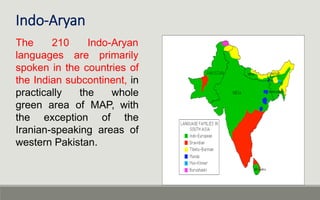
The 210
languages are primarily
spoken in the countries of
the Indian subcontinent, in
practically the whole
green area of MAP, with
the exception of the
Iranian-speaking areas of
western Pakistan.
Some major Indo-Aryan languages are:
• Assamese (more than 15 million speakers, primarily in the Indian states of Assam,
Meghalaya, and Arunachal Pradesh, but also in Bangladesh and Bhutan),
• Bengali (207 million first language speakers, primarily in Bangladesh and in the
Indian state of West Bengal),
• Gujarati (45.5 millions in the Indian states of Gujarat, Maharashtra, Rajasthan,
Karnataka, Madhya Pradesh, and more than half a million speakers around the
world),
• Hindi (more than 180 million first language speakers throughout northern India: Delhi,
Uttar Pradesh, Rajasthan, Punjab, Madhya Pradesh, northern Bihar, and Himachal
Pradesh. The total number of first language speakers around the world is 366 millions
and more than 120 million second language speakers.
• Marathi (68 million first language speakers in the Indian state of Maharashtra and
adjacent states and 3 million second language speakers),
• Oriya (more than 32 million speakers in the Indian states of Orissa, Bihar, West
Bengal, Assam, and Andhra Pradesh. Also spoken in Bangladesh),
• Punjabi (or Panjabi; 27 million speakers of Eastern Punjabi in northwestern India,
primarily in Punjab, but also in Rajasthan, Haryana, Delhi, and Jammu and
Kashmir; probably around 45 million speakers of Western Punjabi in the Punjab
area of Pakistan),
• Urdu (very close to Hindi, but with a formal vocabulary borrowed from Arabic and
Persian, while Hindi is de-Persianized and de-Arabicized, and borrows form a
vocabulary from Sanskrit; more than 11 million first language speakers in Pakistan,
48 million in India (Jammu and Kashmir and Muslims throughout the country), and
a few million around the world; close to 45 million second language speakers).
• In addition, we should mention Sinhalese (more than 13 million speakers in Sri
Lanka).
Germanic
• The Germanic languages are a branch of the Indo-European language
family spoken natively by a population of about 515 million people mainly
in Europe, North America, Oceania, and Southern Africa.
• The Ethnologue lists 48 different living Germanic languages, 41 of which belong to the
Western branch and six to the Northern branch;
• The West Germanic languages include the three most widely spoken Germanic
languages:
 English with around 360-400 million native speakers;
 German with over 100 million native speakers;and
 Dutch with 23 million native speakers.
• The main North Germanic languages are Danish, Faroese, Icelandic, Norwegian,
and Swedish, which have a combined total of about 20 million speakers.
• The East Germanic branch included Gothic, Burgundian, and Vandalic, all of which
are now extinct. The last to die off was Crimean Gothic, spoken until the late 18th century
in some isolated areas of Crimea.

Language Family.pptx

  • 1.
  • 2.
    Introduction A language familyis a grouping of linguistically linked languages, stemming from a common ancestral mother language called Protolanguage. Most languages in the world belong to a specific family. Languages that have no demonstrable relation with others, and cannot be classified within a specific family, are generally known as language isolates.
  • 3.
    Living languages 20th According tothe edition of Ethnologue (published February 2017), there are currently 7,099 living languages or we can say languages in existence in the world today. A "living language" is simply one that is currently used as the primary form of communication of a group of people. There are also many dead languages, or languages which have no native speakers living, and extinct languages, which have no native speakers and no descendant languages.
  • 4.
    Genetic links • Ifwe compare, for instance, French, Spanish, Portuguese, Italian, Romanian, we discover a surprising set of resemblances, which give to these languages a “family likeness”. This “family likeness” does not appear when comparing French to German. But if one compares German to English, Dutch, Swedish or Danish, one finds another “family likeness” between these languages. • Linguists manage to set up genetic classifications by comparing languages and trying to define constant rules about their similarities (and differences). This method is called comparative linguistics. •
  • 5.
    • The basicidea is that those languages look alike because all of them are different evolutions, “descendants” from the same former language (also called “protolanguage”), which does not exist anymore. • A proto-language or ancestral language (a single language that is believed to exist, but is unattested), gave rise to several daughter languages, which in turn became parent languages of further daughter languages. • A language family tree is a visual representation of the languages and their relations which belong to a common family. • To make these connections easier to understand at a glance, linguists most often organize them in a visual aid known as an evolutionary tree, or simply a language family tree.
  • 6.
    Misleading resemblances However, onehas to pay attention. Resemblances between two or several languages may come from their genetic relationship (resembling shapes come from a common former shape) but they also may have others origins: loans: the fact that the French word tomate looks like the Aztec word tomatl does not prove that these two languages are connected, but rather that they have been in contact. The name given to a new plant brought to Europe was the name people from its homeland had given it. Therefore, French “borrowed” a word from another language and adapted it to its vocabulary. random: languages have limited sound systems to express thousands of complex notions. If we choose randomly two languages spoken far away one from another, we always find 3 or 4 words that look alike, in their shape and meaning. Therefore, one can speak about a genetic relationship only if one finds a converging set of resemblances, even partial, instead of a striking but isolated resemblance.
  • 7.
    Discovery of LanguageFamilies • Although we don't have any evidence of the original parent language (the culture that spoke it did not possess writing), we call the original language Proto-Language. • An Englishman, Sir William Jones (1786) was the first to notice that some languages were related to each other by comparing words in Sanskrit (a very ancient I-E language) with words in Greek, Latin, and English.
  • 8.
    SANSKRIT (Ancient languageof India) • Sanskrit has many similarities with European languages: Sanskrit Latin Greek English pitr pater pater father matar mater matr mother bhratr frater phrater brother • All these languages and many other ones, all belong to one “family” of related languages called the INDO- EUROPEAN PROTO-INDO-EUROPEAN family.
  • 9.
    How Many LanguageFamilies Are There? • It is difficult to definitively determine how many language families exist today, or have existed since the dawn of language. • This is due mostly to the fact that the history of human language predates recorded history, so the existence of proto-languages can only be inferred, and not concretely proven. Additionally, deciding which language families exist (and which languages belong to which families) is still a matter of heated debate among historical linguists. • Though there is no definitive number of language families, *Ethnologue lists a total of 145 language families, not including unclassified languages, constructed languages, mixed languages, sign languages, isolates, pidgins, and creoles. *Ethnologue: Languages of the World is an annual reference publication in print and online that provides statistics and other information on the world’s living languages.
  • 10.
  • 11.
    1- Indo-European languagefamily With 443 languages, the Indo-European language family is one of the largest language families in the world. It has ten branches of living language, Germanic is one of the main branches, and other three are primarily spoken in Asia: 1.Armenian 2.Iranian 3.Indo-Aryan (also called Indic)
  • 12.
    Armenian The Armenian languageconstitutes a separate branch of the Indo- European language family. There are approximately 6 million first- language speakers, a little over half of whom live in Armenia. The rest live in 29 other countries around the world, with the largest groups in Azerbaijan, Cyprus, Iran, Iraq, Israel, Jordan, Lebanon, Syria, and Turkey. There are many different dialects, but they are all inherently intelligible. There are two slightly different written varieties, East Armenian, based on the dialect of Yerevan, the capital of Armenia, and West Armenian, based on the dialect of Istanbul.
  • 13.
    Iranian The 84 Iranianlanguages are spoken in a vast continuous area from Pakistan and the Xinjiang province of China in the east and into Turkey in the west, with Iran in the middle. The six most important members of the group are: Balochi (3 separate languages, mainly spoken in Pakistan, but also in neighboring countries: Eastern Balochi, 1.8 million speakers; Western Balochi, 3.4 million speakers; Southern Balochi, 1.8 million speakers), Kurdish (2 separate languages: Kurdi, with more than 6 million speakers in Iran and Iraq; Kurmanji, with more than 4 million speakers in Turkey, 1 million speakers in Syria, and smaller groups in Armenia, Azerbaijan, Iraq, and Iran), Osetin (or Ossete, Ossetic; approximately 600,000 speakers, out of which 164,000 in Georgia, and the rest in neighboring countries), Pashtu (3 separate languages: Northern Pashto, 10 million speakers, mainly in Pakistan; Southern Pashto, 10 million speakers, mainly in Afghanistan; Central Pashto, in Pakistan, the number of speakers is not known), Persian (or Farsi; two main varieties: Western Persian, 22 million speakers in Iran and more than 2 million speakers around the world; Eastern Persian or Dari, approaching 6 million speakers in Afghanistan and 1 million in Pakistan), and Tajiki (3.5 million speakers in Tajikistan and 1 million in neighboring countries).
  • 14.
    Indo-Aryan Indo-Aryan The 210 languages areprimarily spoken in the countries of the Indian subcontinent, in practically the whole green area of MAP, with the exception of the Iranian-speaking areas of western Pakistan.
  • 15.
    Some major Indo-Aryanlanguages are: • Assamese (more than 15 million speakers, primarily in the Indian states of Assam, Meghalaya, and Arunachal Pradesh, but also in Bangladesh and Bhutan), • Bengali (207 million first language speakers, primarily in Bangladesh and in the Indian state of West Bengal), • Gujarati (45.5 millions in the Indian states of Gujarat, Maharashtra, Rajasthan, Karnataka, Madhya Pradesh, and more than half a million speakers around the world), • Hindi (more than 180 million first language speakers throughout northern India: Delhi, Uttar Pradesh, Rajasthan, Punjab, Madhya Pradesh, northern Bihar, and Himachal Pradesh. The total number of first language speakers around the world is 366 millions and more than 120 million second language speakers. • Marathi (68 million first language speakers in the Indian state of Maharashtra and adjacent states and 3 million second language speakers), • Oriya (more than 32 million speakers in the Indian states of Orissa, Bihar, West Bengal, Assam, and Andhra Pradesh. Also spoken in Bangladesh),
  • 16.
    • Punjabi (orPanjabi; 27 million speakers of Eastern Punjabi in northwestern India, primarily in Punjab, but also in Rajasthan, Haryana, Delhi, and Jammu and Kashmir; probably around 45 million speakers of Western Punjabi in the Punjab area of Pakistan), • Urdu (very close to Hindi, but with a formal vocabulary borrowed from Arabic and Persian, while Hindi is de-Persianized and de-Arabicized, and borrows form a vocabulary from Sanskrit; more than 11 million first language speakers in Pakistan, 48 million in India (Jammu and Kashmir and Muslims throughout the country), and a few million around the world; close to 45 million second language speakers). • In addition, we should mention Sinhalese (more than 13 million speakers in Sri Lanka).
  • 17.
    Germanic • The Germaniclanguages are a branch of the Indo-European language family spoken natively by a population of about 515 million people mainly in Europe, North America, Oceania, and Southern Africa. • The Ethnologue lists 48 different living Germanic languages, 41 of which belong to the Western branch and six to the Northern branch; • The West Germanic languages include the three most widely spoken Germanic languages:  English with around 360-400 million native speakers;  German with over 100 million native speakers;and  Dutch with 23 million native speakers. • The main North Germanic languages are Danish, Faroese, Icelandic, Norwegian, and Swedish, which have a combined total of about 20 million speakers. • The East Germanic branch included Gothic, Burgundian, and Vandalic, all of which are now extinct. The last to die off was Crimean Gothic, spoken until the late 18th century in some isolated areas of Crimea.