LEARNING THEORY:
 CONSTRUCTIVISM
     MADISON C.
     JULYRIES P.
CONSTRUCTIVISM

• It puts the learner at the center of the education.
• Students learn by “doing”.
• Teachers use scaffolding, which is, questions, clues,
  or suggestions that help a student link prior
  knowledge to new knowledge.
• Students participate in learning process.


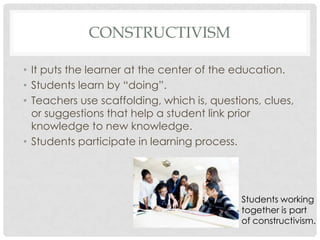
                                            Students working
                                            together is part
                                            of constructivism.
JEAN PIAGET
• Developed the cognitive learning theory.
• Believed children are active learners and think
  differently from adults.
• Defined four cognitive stages:
  • Sensorimotor (birth to 2 years) – learning through senses and
    motor actions.
  • Preoperational (2 to 6/7 years) – begin to use symbols and
    images.
  • Concrete operational ( 6/7 to 11/12 years) – begin to think
    logically.
  • Formal operational (11/12 years through adulthood) –
    transition from concrete thinking to more abstract.
LEV VYGOTSKY

• Developed social cognition
• Believed that learning was influenced significantly
  by social development.
• Proposed the zone of proximal development, which
  is the difference between the problem-solving
  ability that a child has learned and the potential
  that the child can achieve from collaboration with
  a more advanced peer or expert.
• Theorized collaborative learning, a child will
  understand better with an adult or more advanced
  child than by himself.
OTHER KEY PEOPLE

•   John Dewey
•   Jerome Bruner
•   Giambattista Vico
•   Richard Rorty


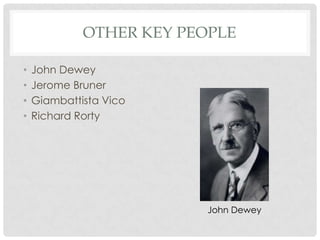
                          John Dewey
WHAT THE TEACHER DOES

• Teachers use scaffolding
• Teachers use schemata, an organized way of
  providing a cognitive framework for understanding
  and remembering information.
• Teachers use anchored instruction, a model for
  technology-based learning.
• Teachers should provide lessons that students can
  practice “doing” or where they can work with
  others.
WHAT THE STUDENT DOES

• Student must “do”
• Students actively participate in the learning process
  by using critical-thinking skills to analyze a problem
• Students will create or construct (can use
  technology)
• Students can use technology easily under this
  theory
WILL WE USE THIS IN OUR TEACHING

Both of us are planning to be math teachers and this theory is
perfect for math. Students have to work out problems so they are
“doing” and understanding better. With the graphing
calculators, students can practice how to use them while doing
classwork or homework. They can also work with other students
which can fit into collaborative learning. While doing their math
problems they are using the Socratic method, discovered by
Bruner. So it is a clear answer that we both can use this theory
while we teach.
WORKS CITED

• Gunter, Glenda A., Randolph E. Gunter, and Gary B. Shelly.
  Teachers Discovering Computers Integrating Technology in a
  Connected World. Boston: Course Technology, Cengage
  Learning. 2012. Book.
• Sadker, David Miller, and Karen R. Zittleman. Teachers,
  Schools, & Society Brief Introduction to Education. The
  McGraw-Hill Companies. 2012. Book.
• "Constructivism." Learning Theories. N.p., n.d. Web. 17 Nov.
  2012. <http://www.learning-
  theories.com/constructivism.html>.
• "John Dewey." John Dewey. N.p., 19 July 1999. Web. 17 Nov.
  2012. <http://dewey.pragmatism.org/>.
• "TI-84 Plus Silver Edition." By Texas Instruments. N.p., 25 Mar.
  1986. Web. 17 Nov. 2012.
  <http://education.ti.com/educationportal/sites/US/productDe
  tail/us_ti84pse.html>.

Learning theory

  • 1.
    LEARNING THEORY: CONSTRUCTIVISM MADISON C. JULYRIES P.
  • 2.
    CONSTRUCTIVISM • It putsthe learner at the center of the education. • Students learn by “doing”. • Teachers use scaffolding, which is, questions, clues, or suggestions that help a student link prior knowledge to new knowledge. • Students participate in learning process. Students working together is part of constructivism.
  • 3.
    JEAN PIAGET • Developedthe cognitive learning theory. • Believed children are active learners and think differently from adults. • Defined four cognitive stages: • Sensorimotor (birth to 2 years) – learning through senses and motor actions. • Preoperational (2 to 6/7 years) – begin to use symbols and images. • Concrete operational ( 6/7 to 11/12 years) – begin to think logically. • Formal operational (11/12 years through adulthood) – transition from concrete thinking to more abstract.
  • 4.
    LEV VYGOTSKY • Developedsocial cognition • Believed that learning was influenced significantly by social development. • Proposed the zone of proximal development, which is the difference between the problem-solving ability that a child has learned and the potential that the child can achieve from collaboration with a more advanced peer or expert. • Theorized collaborative learning, a child will understand better with an adult or more advanced child than by himself.
  • 5.
    OTHER KEY PEOPLE • John Dewey • Jerome Bruner • Giambattista Vico • Richard Rorty John Dewey
  • 6.
    WHAT THE TEACHERDOES • Teachers use scaffolding • Teachers use schemata, an organized way of providing a cognitive framework for understanding and remembering information. • Teachers use anchored instruction, a model for technology-based learning. • Teachers should provide lessons that students can practice “doing” or where they can work with others.
  • 7.
    WHAT THE STUDENTDOES • Student must “do” • Students actively participate in the learning process by using critical-thinking skills to analyze a problem • Students will create or construct (can use technology) • Students can use technology easily under this theory
  • 8.
    WILL WE USETHIS IN OUR TEACHING Both of us are planning to be math teachers and this theory is perfect for math. Students have to work out problems so they are “doing” and understanding better. With the graphing calculators, students can practice how to use them while doing classwork or homework. They can also work with other students which can fit into collaborative learning. While doing their math problems they are using the Socratic method, discovered by Bruner. So it is a clear answer that we both can use this theory while we teach.
  • 9.
    WORKS CITED • Gunter,Glenda A., Randolph E. Gunter, and Gary B. Shelly. Teachers Discovering Computers Integrating Technology in a Connected World. Boston: Course Technology, Cengage Learning. 2012. Book. • Sadker, David Miller, and Karen R. Zittleman. Teachers, Schools, & Society Brief Introduction to Education. The McGraw-Hill Companies. 2012. Book. • "Constructivism." Learning Theories. N.p., n.d. Web. 17 Nov. 2012. <http://www.learning- theories.com/constructivism.html>. • "John Dewey." John Dewey. N.p., 19 July 1999. Web. 17 Nov. 2012. <http://dewey.pragmatism.org/>. • "TI-84 Plus Silver Edition." By Texas Instruments. N.p., 25 Mar. 1986. Web. 17 Nov. 2012. <http://education.ti.com/educationportal/sites/US/productDe tail/us_ti84pse.html>.