Alexis Cora-Aylen Fernández Practice II
PRACTICE II, DIDACTICS OF ELT. Adjunto a/c Prof. Estela N.
Braun (2016).AssistantTeacher: Prof.VanesaCabral.
1) Which are the five dimensions of CLIL? Do they act in isolation?
The five dimensions of CLIL are scaffolding, anchoring into previous learning, chunking and
repackaging knowledge, fostering creative and critical thinking and challenging students to
step just outside their comfort zone which do not act in isolation, instead they work
collaboratively in order to expand learning opportunities for students and also enable teachers
and learners to take greater control over the learning process and to improve learning results.
Explain each of them in detail:
A.Scaffolding: In education, this technique is used to access, improve and add to the
current knowledge. In this context it is similar to a temporary supporting structure that
students learn to use and to rely on in order to achieve learning outcomes. This technique
can be described as a partner-assisted which is socially rather than strictly individualistic.
Scaffolding helps pupils to access to previously acquired knowledge, to analyse it, to
process new information, to construct new links and to take their understanding several
steps further. Indeed, it helps students to better understand the learning process, to build
momentum, to save time and to enjoy short term wins. It lowers frustration and build
success.
All in all, scaffolding is a sheltered learning technique that help students feel emotionally
secure, motivates them and provides the building blocks needed to do the complex
structures. It is not a permanent as it is slowly removed so that another is quickly build
up to support the next topic at hand.
B. Anchoring into previous learning: Is the way in which a bridge between the known
contents and the acquisition of new knowledge is build, i.e. “to make progress in
understanding means linking to prior learning”. In other words, “relational links are the
Alexis Cora-Aylen Fernández Practice II
glue thatfixeslearninginmemory”,andthe firstrelationallinkthatneedstobe madeistoone’s
prior learning. Consequently, our existing knowledge is the base to access to the new
information.
This “anchoring” does not only apply for content learning process but also to the learning
of the foreign language. For instance, it is not only the prior knowledge about the
language that is involved but also the experiences and attitudes towards the relationship
with the language. In order to take advantage of this dimension, we need to create a
context for the content under study so that students have the necessity to anchor this
content with the previous knowledge. One of the most effective ways of anchoring into
previous learning is through brainstorming. I.e. through exercising in free association.
Participants say whatever comes to their minds in relation to the given topic. So that then
we are able to analyze what they understand before starting with that topic.
C. Chunking and repackaging knowledge: it refers to the idea that if we are able to
break a content into smaller pieces it would be easier to incorporate it and to reconstruct
it again later. It is commonly believed that we can hold no more than seven pieces of
information in our short-term working memory. Consequently if we are presented with
large amounts of information our minds unconsciously reject it.
In order to move information into our long-term memory, we need to anchor it to prior
knowledge by defining relational links and contrasting new knowledge with what we
already have. When written or oral information is presented in clear chunks, which do
not contain more than seven pieces of well-organized information, the short-term
memory can usually process it. Therefore, a sense of confidence and emotional security
can be developed, making the learning process more effective.
There are numerous tools for chunking, such as tables, charts, diagrams, mind maps, webs
and pictures; it also involves using analogies, or groups of words and numbers, among
others.
D. Fostering creative and critical thinking: involves the
creation/generation/development of ideas, processes, objects, relational links, and quality
relationships. In education, this can be described as mental processes that learners use “to
plan, describe and evaluate their thinking and learning”. It is self-directed thinking and
fundamental to learning. By thinking critically, we improve learning. Yet creative
Alexis Cora-Aylen Fernández Practice II
thinking, is an essential element in effective planning and has the potential to improve it.
Creativity can be used to better explain our ideas and even to evaluate our plans and
results from different perspectives. Creative thinking and critical thinking are
inextricably intertwined.
Our emotional state of mind can contribute to or hide our learning. Positive emotions
“enhance the ability to think flexibly and with more complexity”. On the contrary, ‘when
a concept struggles with an emotion, the emotion almost always wins’. Consequently,
“learners in positive, joyful environments are likely to experience better learning,
memory, and feelings of self-esteem”.
Critical thinking is also tied to social processes. The understandings we reach and the
solutions to problems we propose need to match on some level with the understanding of
others. As educators, we can use different frameworks to support students in becoming
independent learners, some of them include: associating (connecting items together),
classifying (putting items into categories), combining (putting items into a single whole),
committing (understanding and accepting responsibility), comparing (identifying
similarities and differences), defining (determining key qualities and/or characteristics),
describing (reporting the features of an item or information), extending (taking ideas a
step further), imagining (forming a mental image),linking (finding relationships),
predicting (anticipating what is likely to happen), roleplaying (thinking like someone else
and acting as that person would).
E. Challenging students to step just outside their comfort zone: some of the
dimensions mentioned above are tools for extending learning, for helping students to step
out of their comfort zone. Those strategies are about helping students to operate in what
Lev Vygotsky has called the zone of proximal development. These allow them to move
from their current understanding of content and attitudes to a new level of understanding,
and then to take another step forward into the zone of proximal development.
2) How do you think the following CLIL key terms interact in a CLIL lesson?
Target language, exposure, ICT, Intercultural knowledge and understanding,
language awareness, learning styles and learning strategies?
Alexis Cora-Aylen Fernández Practice II
A CLIL lesson is aimed to foster intercultural knowledge and understanding in our
students, as well as creating an environment where they learn a target language through
a constant exposure to it. Making students able to find meaning on what they are learning
and also to find relationships between the subjects, e.g. if they are learning the water
circle they will not only be learning English but also reinforcing the contents learned in
the natural sciences class. A CLIL lesson also involves different learning styles and
strategies to approach this new language and to make sure that every student is able to
acquire the contents being taught.
3) How do visual organizers help to scaffold students´learning? Provide graphic
examples.
Visual organizers help to scaffold students´ learning since they allow them to classify,
categorize or summarize the information provided. Through doing these activities we can
favor the understanding and learning of the new information.
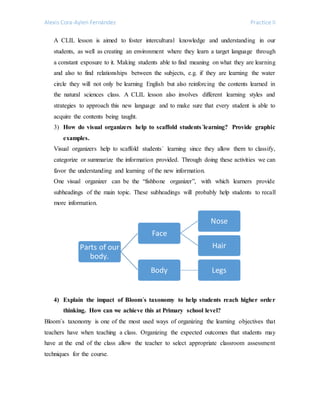
One visual organizer can be the “fishbone organizer”, with which learners provide
subheadings of the main topic. These subheadings will probably help students to recall
more information.
4) Explain the impact of Bloom´s taxonomy to help students reach higher order
thinking. How can we achieve this at Primary school level?
Bloom´s taxonomy is one of the most used ways of organizing the learning objectives that
teachers have when teaching a class. Organizing the expected outcomes that students may
have at the end of the class allow the teacher to select appropriate classroom assessment
techniques for the course.
Parts of our
body.
Face
Nose
Hair
Body Legs
Alexis Cora-Aylen Fernández Practice II
By using Bloom´s taxonomy teachers can identify the intellectual level in which students are
capable of realize their work without any difficulty. Bloom´s taxonomy also helps teachers
ask questions and create instructions aimed at critical thinking, so students can reach the top
of the three levels, which are analysis, synthesis and evaluation.
At primary level we can achieve the higher order thinking through making students questions,
of a higher level, about the topic we are dealing with which will develop independent thinking
and will also motivate them to think critically.
5) In pairs, design a lesson plan following CLIL.
As we are working in 4th grade we decided to use one of the concepts we have to develop
and to relate it with another subject, which is maths. In this context, the curriculum for maths
states in its fourth article that students in fourth grade are expected to:
 Recognize and group figures and bodies using different criteria.
 Build figures using the known properties and instruments necessary, assessing the
adequacy of the figure obtained.
 Composing and decomposing shapes using triangles and quadrangles, analyzing the
characteristics of the new figures.
From this point onwards we decided that, from the content of “geometric shapes” students
will be able to “anchor” the prior knowledge with the new activity in the following lesson
plan.
School: Instituto Maria Auxiliadora
Course/ Grade: 4th grade.
Related Discipline: Mathematics.
Lesson Plan n° 7.
-Opening the Lesson:Warm-UpActivity (5‘)
Macroskills:Listening andSpeaking
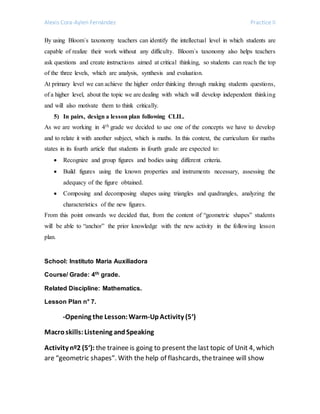
Activity nº2 (5‘): the trainee is going to present the last topic of Unit 4, which
are “geometric shapes”. With the help of flashcards, thetrainee will show
Alexis Cora-Aylen Fernández Practice II
these shapes (triangle, rectangle, circle and square). After this, the trainee
will ask students for examples inside the classroom.
e.g. “The blackboard is a rectangle. Can you see any other rectangle here?
Any triangle?”
Body of the lesson(28’)
Activity n°3:(6’)
Macroskills:Reading Comprehension-Writing
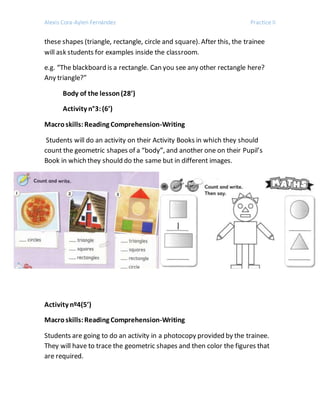
Students will do an activity on their Activity Books in which they should
count the geometric shapes of a “body”, and another one on their Pupil’s
Book in which they should do the same but in different images.
Activity nº4(5’)
Macroskills:Reading Comprehension-Writing
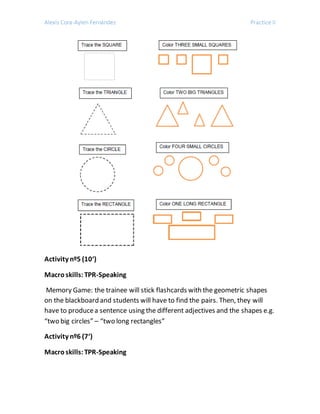
Students are going to do an activity in a photocopy provided by the trainee.
They will have to trace the geometric shapes and then color the figures that
are required.
Alexis Cora-Aylen Fernández Practice II
Activity nº5 (10‘)
Macroskills:TPR-Speaking
Memory Game: the trainee will stick flashcards with the geometric shapes
on the blackboard and students will have to find the pairs. Then, they will
have to producea sentence using the different adjectives and the shapes e.g.
“two big circles” – “two long rectangles”
Activity nº6 (7‘)
Macroskills:TPR-Speaking
Alexis Cora-Aylen Fernández Practice II
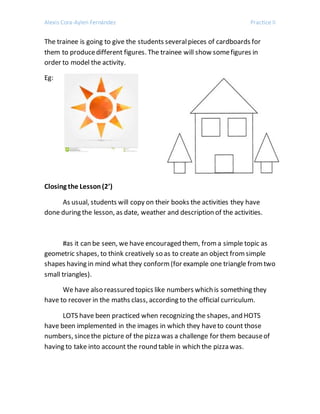
The trainee is going to give the students severalpieces of cardboards for
them to producedifferent figures. The trainee will show somefigures in
order to model the activity.
Eg:
Closing the Lesson(2’)
As usual, students will copy on their books the activities they have
done during the lesson, as date, weather and description of the activities.
#as it can be seen, we have encouraged them, froma simple topic as
geometric shapes, to think creatively so as to create an object fromsimple
shapes having in mind what they conform(for example one triangle fromtwo
small triangles).
We have also reassured topics like numbers which is something they
have to recover in the maths class, according to the official curriculum.
LOTS have been practiced when recognizing the shapes, and HOTS
have been implemented in the images in which they haveto count those
numbers, sincethe picture of the pizza was a challenge for them becauseof
having to take into account the round table in which the pizza was.

Practical 14 clil

  • 1.
    Alexis Cora-Aylen FernándezPractice II PRACTICE II, DIDACTICS OF ELT. Adjunto a/c Prof. Estela N. Braun (2016).AssistantTeacher: Prof.VanesaCabral. 1) Which are the five dimensions of CLIL? Do they act in isolation? The five dimensions of CLIL are scaffolding, anchoring into previous learning, chunking and repackaging knowledge, fostering creative and critical thinking and challenging students to step just outside their comfort zone which do not act in isolation, instead they work collaboratively in order to expand learning opportunities for students and also enable teachers and learners to take greater control over the learning process and to improve learning results. Explain each of them in detail: A.Scaffolding: In education, this technique is used to access, improve and add to the current knowledge. In this context it is similar to a temporary supporting structure that students learn to use and to rely on in order to achieve learning outcomes. This technique can be described as a partner-assisted which is socially rather than strictly individualistic. Scaffolding helps pupils to access to previously acquired knowledge, to analyse it, to process new information, to construct new links and to take their understanding several steps further. Indeed, it helps students to better understand the learning process, to build momentum, to save time and to enjoy short term wins. It lowers frustration and build success. All in all, scaffolding is a sheltered learning technique that help students feel emotionally secure, motivates them and provides the building blocks needed to do the complex structures. It is not a permanent as it is slowly removed so that another is quickly build up to support the next topic at hand. B. Anchoring into previous learning: Is the way in which a bridge between the known contents and the acquisition of new knowledge is build, i.e. “to make progress in understanding means linking to prior learning”. In other words, “relational links are the
  • 2.
    Alexis Cora-Aylen FernándezPractice II glue thatfixeslearninginmemory”,andthe firstrelationallinkthatneedstobe madeistoone’s prior learning. Consequently, our existing knowledge is the base to access to the new information. This “anchoring” does not only apply for content learning process but also to the learning of the foreign language. For instance, it is not only the prior knowledge about the language that is involved but also the experiences and attitudes towards the relationship with the language. In order to take advantage of this dimension, we need to create a context for the content under study so that students have the necessity to anchor this content with the previous knowledge. One of the most effective ways of anchoring into previous learning is through brainstorming. I.e. through exercising in free association. Participants say whatever comes to their minds in relation to the given topic. So that then we are able to analyze what they understand before starting with that topic. C. Chunking and repackaging knowledge: it refers to the idea that if we are able to break a content into smaller pieces it would be easier to incorporate it and to reconstruct it again later. It is commonly believed that we can hold no more than seven pieces of information in our short-term working memory. Consequently if we are presented with large amounts of information our minds unconsciously reject it. In order to move information into our long-term memory, we need to anchor it to prior knowledge by defining relational links and contrasting new knowledge with what we already have. When written or oral information is presented in clear chunks, which do not contain more than seven pieces of well-organized information, the short-term memory can usually process it. Therefore, a sense of confidence and emotional security can be developed, making the learning process more effective. There are numerous tools for chunking, such as tables, charts, diagrams, mind maps, webs and pictures; it also involves using analogies, or groups of words and numbers, among others. D. Fostering creative and critical thinking: involves the creation/generation/development of ideas, processes, objects, relational links, and quality relationships. In education, this can be described as mental processes that learners use “to plan, describe and evaluate their thinking and learning”. It is self-directed thinking and fundamental to learning. By thinking critically, we improve learning. Yet creative
  • 3.
    Alexis Cora-Aylen FernándezPractice II thinking, is an essential element in effective planning and has the potential to improve it. Creativity can be used to better explain our ideas and even to evaluate our plans and results from different perspectives. Creative thinking and critical thinking are inextricably intertwined. Our emotional state of mind can contribute to or hide our learning. Positive emotions “enhance the ability to think flexibly and with more complexity”. On the contrary, ‘when a concept struggles with an emotion, the emotion almost always wins’. Consequently, “learners in positive, joyful environments are likely to experience better learning, memory, and feelings of self-esteem”. Critical thinking is also tied to social processes. The understandings we reach and the solutions to problems we propose need to match on some level with the understanding of others. As educators, we can use different frameworks to support students in becoming independent learners, some of them include: associating (connecting items together), classifying (putting items into categories), combining (putting items into a single whole), committing (understanding and accepting responsibility), comparing (identifying similarities and differences), defining (determining key qualities and/or characteristics), describing (reporting the features of an item or information), extending (taking ideas a step further), imagining (forming a mental image),linking (finding relationships), predicting (anticipating what is likely to happen), roleplaying (thinking like someone else and acting as that person would). E. Challenging students to step just outside their comfort zone: some of the dimensions mentioned above are tools for extending learning, for helping students to step out of their comfort zone. Those strategies are about helping students to operate in what Lev Vygotsky has called the zone of proximal development. These allow them to move from their current understanding of content and attitudes to a new level of understanding, and then to take another step forward into the zone of proximal development. 2) How do you think the following CLIL key terms interact in a CLIL lesson? Target language, exposure, ICT, Intercultural knowledge and understanding, language awareness, learning styles and learning strategies?
  • 4.
    Alexis Cora-Aylen FernándezPractice II A CLIL lesson is aimed to foster intercultural knowledge and understanding in our students, as well as creating an environment where they learn a target language through a constant exposure to it. Making students able to find meaning on what they are learning and also to find relationships between the subjects, e.g. if they are learning the water circle they will not only be learning English but also reinforcing the contents learned in the natural sciences class. A CLIL lesson also involves different learning styles and strategies to approach this new language and to make sure that every student is able to acquire the contents being taught. 3) How do visual organizers help to scaffold students´learning? Provide graphic examples. Visual organizers help to scaffold students´ learning since they allow them to classify, categorize or summarize the information provided. Through doing these activities we can favor the understanding and learning of the new information. One visual organizer can be the “fishbone organizer”, with which learners provide subheadings of the main topic. These subheadings will probably help students to recall more information. 4) Explain the impact of Bloom´s taxonomy to help students reach higher order thinking. How can we achieve this at Primary school level? Bloom´s taxonomy is one of the most used ways of organizing the learning objectives that teachers have when teaching a class. Organizing the expected outcomes that students may have at the end of the class allow the teacher to select appropriate classroom assessment techniques for the course. Parts of our body. Face Nose Hair Body Legs
  • 5.
    Alexis Cora-Aylen FernándezPractice II By using Bloom´s taxonomy teachers can identify the intellectual level in which students are capable of realize their work without any difficulty. Bloom´s taxonomy also helps teachers ask questions and create instructions aimed at critical thinking, so students can reach the top of the three levels, which are analysis, synthesis and evaluation. At primary level we can achieve the higher order thinking through making students questions, of a higher level, about the topic we are dealing with which will develop independent thinking and will also motivate them to think critically. 5) In pairs, design a lesson plan following CLIL. As we are working in 4th grade we decided to use one of the concepts we have to develop and to relate it with another subject, which is maths. In this context, the curriculum for maths states in its fourth article that students in fourth grade are expected to:  Recognize and group figures and bodies using different criteria.  Build figures using the known properties and instruments necessary, assessing the adequacy of the figure obtained.  Composing and decomposing shapes using triangles and quadrangles, analyzing the characteristics of the new figures. From this point onwards we decided that, from the content of “geometric shapes” students will be able to “anchor” the prior knowledge with the new activity in the following lesson plan. School: Instituto Maria Auxiliadora Course/ Grade: 4th grade. Related Discipline: Mathematics. Lesson Plan n° 7. -Opening the Lesson:Warm-UpActivity (5‘) Macroskills:Listening andSpeaking Activity nº2 (5‘): the trainee is going to present the last topic of Unit 4, which are “geometric shapes”. With the help of flashcards, thetrainee will show
  • 6.
    Alexis Cora-Aylen FernándezPractice II these shapes (triangle, rectangle, circle and square). After this, the trainee will ask students for examples inside the classroom. e.g. “The blackboard is a rectangle. Can you see any other rectangle here? Any triangle?” Body of the lesson(28’) Activity n°3:(6’) Macroskills:Reading Comprehension-Writing Students will do an activity on their Activity Books in which they should count the geometric shapes of a “body”, and another one on their Pupil’s Book in which they should do the same but in different images. Activity nº4(5’) Macroskills:Reading Comprehension-Writing Students are going to do an activity in a photocopy provided by the trainee. They will have to trace the geometric shapes and then color the figures that are required.
  • 7.
    Alexis Cora-Aylen FernándezPractice II Activity nº5 (10‘) Macroskills:TPR-Speaking Memory Game: the trainee will stick flashcards with the geometric shapes on the blackboard and students will have to find the pairs. Then, they will have to producea sentence using the different adjectives and the shapes e.g. “two big circles” – “two long rectangles” Activity nº6 (7‘) Macroskills:TPR-Speaking
  • 8.
    Alexis Cora-Aylen FernándezPractice II The trainee is going to give the students severalpieces of cardboards for them to producedifferent figures. The trainee will show somefigures in order to model the activity. Eg: Closing the Lesson(2’) As usual, students will copy on their books the activities they have done during the lesson, as date, weather and description of the activities. #as it can be seen, we have encouraged them, froma simple topic as geometric shapes, to think creatively so as to create an object fromsimple shapes having in mind what they conform(for example one triangle fromtwo small triangles). We have also reassured topics like numbers which is something they have to recover in the maths class, according to the official curriculum. LOTS have been practiced when recognizing the shapes, and HOTS have been implemented in the images in which they haveto count those numbers, sincethe picture of the pizza was a challenge for them becauseof having to take into account the round table in which the pizza was.