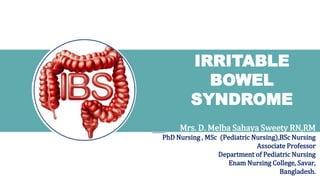
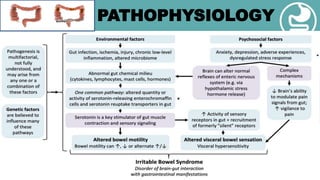
IRRITABLE
BOWEL
SYNDROME
Mrs. D. Melba Sahaya Sweety RN,RM
PhD Nursing , MSc (Pediatric Nursing),BSc Nursing
Associate Professor
Department of Pediatric Nursing
Enam Nursing College, Savar,
Bangladesh.
INTRODUCTION
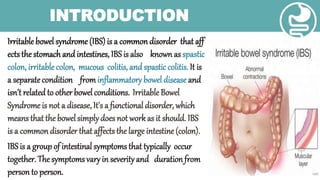
Irritable bowel syndrome(IBS) is a commondisorder that aff
ectsthe stomach and intestines, IBSis also known as spastic
colon, irritablecolon, mucous colitis, and spastic colitis. It is
a separate condition frominflammatorybowel disease and
isn’t related to other bowel conditions. Irritable Bowel
Syndrome is not a disease,It's a functional disorder, which
means that the bowelsimplydoes not work as it should. IBS
is a common disorder that affects the large intestine (colon).
IBSis a group of intestinal symptoms that typically occur
together. The symptomsvary in severityand duration from
person to person.
DEFINITION
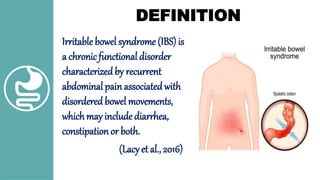
Irritable bowel syndrome (IBS) is
a chronicfunctional disorder
characterizedby recurrent
abdominal painassociated with
disordered bowel movements,
whichmay include diarrhea,
constipationor both.
(Lacyet al., 2016)
INCIDENCE
 Prevalence 3 - 22% world-wide Reason for 20 - 50%
of gastroenterology visits.
 IBS is less among Asian population with 6.5 – 11% p
revalence rate.
 26%prevalence among children with recurrent
abdominal pain.
 40% onset before age 35.
 50% onset age 35 – 50.
 Female > Male (3:1)
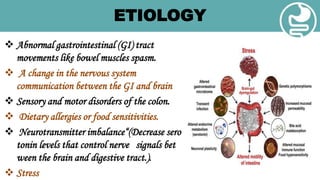
ETIOLOGY
 Abnormal gastrointestinal (GI) tract
movements like bowel muscles spasm.
 A change in the nervous system
communication between the GI and brain
 Sensory and motor disorders of the colon.
 Dietary allergies or food sensitivities.
 Neurotransmitter imbalance“(Decrease sero
tonin levels that control nerve signals bet
ween the brain and digestive tract.).
 Stress
•Gender - About twice as many women as men hav
e the condition. It’s not clear why, but some researc
hers think the changing hormones in the menstrual c
ycle may have something to do with it.
•Age - IBS can affect people of all ages, but it's mor
e likely for people in their teens through their 40s.
•Family history - The condition seems to run in f
amilies. Some studies have shown that the genes ma
y play a role.
•Medications - Studies have shown a link betwee
RISK FACTORS
•Mental health— anxiety, depression, personality
disorder, and history of abuse are all associated risk
factors
•Food sensitivities - Foods like dairy, wheat, a s
ugar in fruits called fructose, or the sug
ar substitute sorbitol. Fatty foods, carbonated drink
s, and alcohol can also upset digestion and they ma
y trigger symptoms.
•Other digestive problems, like stomach fl
u, traveler’s diarrhea, or food
RISK FACTORS
TYPES OF IBS
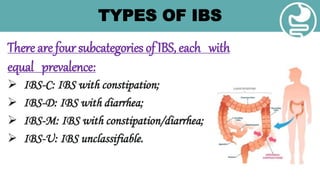
There are four subcategories of IBS, each with
equal prevalence:
 IBS-C: IBS with constipation;
 IBS-D: IBS with diarrhea;
 IBS-M: IBS with constipation/diarrhea;
 IBS-U: IBS unclassifiable.
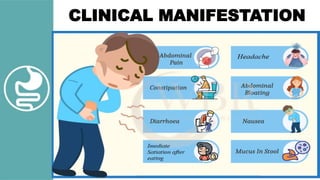
PATHOPHYSIOLOGY
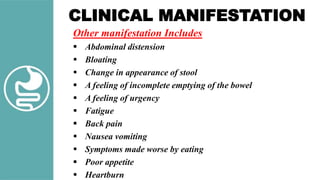
CLINICAL MANIFESTATION
Other manifestation Includes
 Abdominal distension
 Bloating
 Change in appearance of stool
 A feeling of incomplete emptying of the bowel
 A feeling of urgency
 Fatigue
 Back pain
 Nausea vomiting
 Symptoms made worse by eating
 Poor appetite
 Heartburn
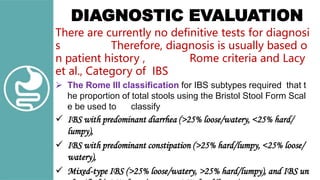
DIAGNOSTIC EVALUATION
There are currently no definitive tests for diagnosi
s Therefore, diagnosis is usually based o
n patient history , Rome criteria and Lacy
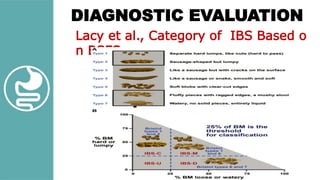
et al., Category of IBS
 The Rome III classification for IBS subtypes required that t
he proportion of total stools using the Bristol Stool Form Scal
e be used to classify
 IBS with predominant diarrhea (>25% loose/watery, <25% hard/
lumpy),
 IBS with predominant constipation (>25% hard/lumpy, <25% loose/
watery),
 Mixed-type IBS (>25% loose/watery, >25% hard/lumpy), and IBS un
DIAGNOSTIC EVALUATION
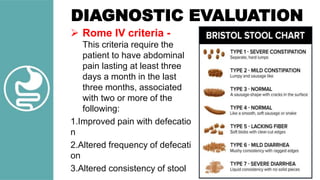
 Rome IV criteria -
This criteria require the
patient to have abdominal
pain lasting at least three
days a month in the last
three months, associated
with two or more of the
following:
1.Improved pain with defecatio
n
2.Altered frequency of defecati
on
3.Altered consistency of stool
Lacy et al., Category of IBS Based o
n BSFS
DIAGNOSTIC EVALUATION
Additional Diagnosis
•Flexible sigmoidoscopy or colonoscopy to look for signs of blo
ckage or inflammation in your intestines
•Upper endoscopy if you have heartburn or indigestion
•X-rays and CT scan Tests to look for problems with your bowe
l muscles
•Blood tests to look for anemia (too few red blood cells), thyroi
d problems, and signs of infection
•Stool tests for blood or infections
• Lactose intolerance Test, to detect gluten allergy, or celiac di
ease
DIAGNOSTIC EVALUATION
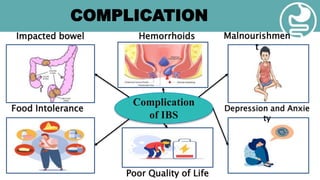
COMPLICATION
Complication
of IBS
Impacted bowel Hemorrhoids Malnourishmen
t
Food Intolerance Depression and Anxie
ty
Poor Quality of Life
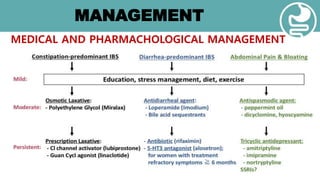
MANAGEMENT
MEDICAL AND PHARMACHOLOGICAL MANAGEMENT
MANAGEMENT
MEDICAL MANAGEMENT
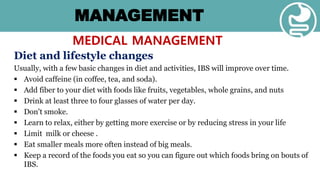
Diet and lifestyle changes
Usually, with a few basic changes in diet and activities, IBS will improve over time.
 Avoid caffeine (in coffee, tea, and soda).
 Add fiber to your diet with foods like fruits, vegetables, whole grains, and nuts
 Drink at least three to four glasses of water per day.
 Don't smoke.
 Learn to relax, either by getting more exercise or by reducing stress in your life
 Limit milk or cheese .
 Eat smaller meals more often instead of big meals.
 Keep a record of the foods you eat so you can figure out which foods bring on bouts of
IBS.
MANAGEMENT
NURSING MANAGEMENT
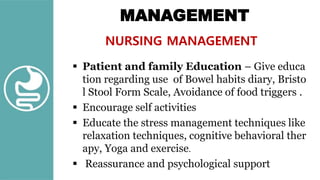
 Patient and family Education – Give educa
tion regarding use of Bowel habits diary, Bristo
l Stool Form Scale, Avoidance of food triggers .
 Encourage self activities
 Educate the stress management techniques like
relaxation techniques, cognitive behavioral ther
apy, Yoga and exercise.
 Reassurance and psychological support
IRRITABLE BOWEL SYNDROME.pptx

IRRITABLE BOWEL SYNDROME.pptx

  • 1.
    IRRITABLE BOWEL SYNDROME Mrs. D. MelbaSahaya Sweety RN,RM PhD Nursing , MSc (Pediatric Nursing),BSc Nursing Associate Professor Department of Pediatric Nursing Enam Nursing College, Savar, Bangladesh.
  • 2.
    INTRODUCTION Irritable bowel syndrome(IBS)is a commondisorder that aff ectsthe stomach and intestines, IBSis also known as spastic colon, irritablecolon, mucous colitis, and spastic colitis. It is a separate condition frominflammatorybowel disease and isn’t related to other bowel conditions. Irritable Bowel Syndrome is not a disease,It's a functional disorder, which means that the bowelsimplydoes not work as it should. IBS is a common disorder that affects the large intestine (colon). IBSis a group of intestinal symptoms that typically occur together. The symptomsvary in severityand duration from person to person.
  • 3.
    DEFINITION Irritable bowel syndrome(IBS) is a chronicfunctional disorder characterizedby recurrent abdominal painassociated with disordered bowel movements, whichmay include diarrhea, constipationor both. (Lacyet al., 2016)
  • 4.
    INCIDENCE  Prevalence 3- 22% world-wide Reason for 20 - 50% of gastroenterology visits.  IBS is less among Asian population with 6.5 – 11% p revalence rate.  26%prevalence among children with recurrent abdominal pain.  40% onset before age 35.  50% onset age 35 – 50.  Female > Male (3:1)
  • 5.
    ETIOLOGY  Abnormal gastrointestinal(GI) tract movements like bowel muscles spasm.  A change in the nervous system communication between the GI and brain  Sensory and motor disorders of the colon.  Dietary allergies or food sensitivities.  Neurotransmitter imbalance“(Decrease sero tonin levels that control nerve signals bet ween the brain and digestive tract.).  Stress
  • 6.
    •Gender - Abouttwice as many women as men hav e the condition. It’s not clear why, but some researc hers think the changing hormones in the menstrual c ycle may have something to do with it. •Age - IBS can affect people of all ages, but it's mor e likely for people in their teens through their 40s. •Family history - The condition seems to run in f amilies. Some studies have shown that the genes ma y play a role. •Medications - Studies have shown a link betwee RISK FACTORS
  • 7.
    •Mental health— anxiety,depression, personality disorder, and history of abuse are all associated risk factors •Food sensitivities - Foods like dairy, wheat, a s ugar in fruits called fructose, or the sug ar substitute sorbitol. Fatty foods, carbonated drink s, and alcohol can also upset digestion and they ma y trigger symptoms. •Other digestive problems, like stomach fl u, traveler’s diarrhea, or food RISK FACTORS
  • 8.
    TYPES OF IBS Thereare four subcategories of IBS, each with equal prevalence:  IBS-C: IBS with constipation;  IBS-D: IBS with diarrhea;  IBS-M: IBS with constipation/diarrhea;  IBS-U: IBS unclassifiable.
  • 9.
  • 10.
  • 11.
    CLINICAL MANIFESTATION Other manifestationIncludes  Abdominal distension  Bloating  Change in appearance of stool  A feeling of incomplete emptying of the bowel  A feeling of urgency  Fatigue  Back pain  Nausea vomiting  Symptoms made worse by eating  Poor appetite  Heartburn
  • 12.
    DIAGNOSTIC EVALUATION There arecurrently no definitive tests for diagnosi s Therefore, diagnosis is usually based o n patient history , Rome criteria and Lacy et al., Category of IBS  The Rome III classification for IBS subtypes required that t he proportion of total stools using the Bristol Stool Form Scal e be used to classify  IBS with predominant diarrhea (>25% loose/watery, <25% hard/ lumpy),  IBS with predominant constipation (>25% hard/lumpy, <25% loose/ watery),  Mixed-type IBS (>25% loose/watery, >25% hard/lumpy), and IBS un
  • 13.
    DIAGNOSTIC EVALUATION  RomeIV criteria - This criteria require the patient to have abdominal pain lasting at least three days a month in the last three months, associated with two or more of the following: 1.Improved pain with defecatio n 2.Altered frequency of defecati on 3.Altered consistency of stool
  • 14.
    Lacy et al.,Category of IBS Based o n BSFS DIAGNOSTIC EVALUATION
  • 15.
    Additional Diagnosis •Flexible sigmoidoscopyor colonoscopy to look for signs of blo ckage or inflammation in your intestines •Upper endoscopy if you have heartburn or indigestion •X-rays and CT scan Tests to look for problems with your bowe l muscles •Blood tests to look for anemia (too few red blood cells), thyroi d problems, and signs of infection •Stool tests for blood or infections • Lactose intolerance Test, to detect gluten allergy, or celiac di ease DIAGNOSTIC EVALUATION
  • 16.
    COMPLICATION Complication of IBS Impacted bowelHemorrhoids Malnourishmen t Food Intolerance Depression and Anxie ty Poor Quality of Life
  • 17.
  • 18.
    MANAGEMENT MEDICAL MANAGEMENT Diet andlifestyle changes Usually, with a few basic changes in diet and activities, IBS will improve over time.  Avoid caffeine (in coffee, tea, and soda).  Add fiber to your diet with foods like fruits, vegetables, whole grains, and nuts  Drink at least three to four glasses of water per day.  Don't smoke.  Learn to relax, either by getting more exercise or by reducing stress in your life  Limit milk or cheese .  Eat smaller meals more often instead of big meals.  Keep a record of the foods you eat so you can figure out which foods bring on bouts of IBS.
  • 19.
    MANAGEMENT NURSING MANAGEMENT  Patientand family Education – Give educa tion regarding use of Bowel habits diary, Bristo l Stool Form Scale, Avoidance of food triggers .  Encourage self activities  Educate the stress management techniques like relaxation techniques, cognitive behavioral ther apy, Yoga and exercise.  Reassurance and psychological support