Unit : II
BASIC HUMAN
NEEDS
Mrs. D. Melba Sahaya Sweety, RN, RM
Ph.D Nursing , M.Sc Pediatric Nursing, B.Sc Nursing,
Associate Professor,
Enam medical College and Hospital,
Savar, Dhaka, Bangladesh
INTRODUCTION
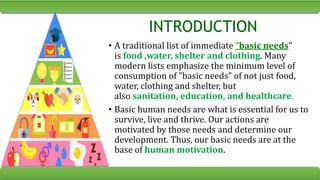
• A traditional list of immediate "basic needs"
is food ,water, shelter and clothing. Many
modern lists emphasize the minimum level of
consumption of "basic needs" of not just food,
water, clothing and shelter, but
also sanitation, education, and healthcare.
• Basic human needs are what is essential for us to
survive, live and thrive. Our actions are
motivated by those needs and determine our
development. Thus, our basic needs are at the
base of human motivation.
CHARACTERISTICS OF BASIC
HUMAN NEEDS
Basic needs are approximately same for all, Meeting those
needs is influenced by a person own culture .
 The importance of each need is different for each person
 People meet their needs relative to their own priorities.
 All the basic needs are interconnected and interactive.
Failure to meet needs leads to alteration in wellbeing or
illness
ABRAHAM MASLOW’S
HIERARCHY THEORY
INTRODUCTION
Abraham Harold Maslow (April 1, 1908 – June 8, 1970) was an
American psychologist who was best known for creating Maslow's
hierarchy of needs, He first introduced the concept of a hierarchy of
needs in his 1943 paper, titled "A Theory of Human Motivation," and
again in his subsequent book, "Motivation and Personality." This
hierarchy suggests that people are motivated to fulfill basic needs
before moving on to other, more advanced needs.
As a humanist, Maslow believed that people have an
inborn desire to be self-actualized, that is, to be all they
can be. To achieve this ultimate goal, however, a number
of more basic needs must be met. This includes the need
for food, safety, love, and self-esteem.
MASLOW’S ASSUMPTION
 Human nature is basically good, not evil
 Normal human development involves the
actualization of this inherent goodness
 Psychopathology results from the
frustration of a human being’s essential
nature
TYPES OF NEEDS
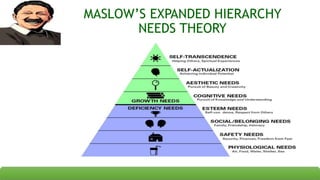
According to Maslow there are two type of needs they are., Deficiency needs
and growth needs
The first four levels of the hierarchy model are often referred to as deficiency
needs (D-needs), and the top level is known as growth or being needs (B-
needs).
 Deficiency needs arise due to deprivation and are said to motivate people
when they are unmet.
Growth needs do not stem from a lack of something, but rather from a desire
to grow as a person. Once these growth needs have been reasonably satisfied,
one may be able to reach the highest level called self-actualization.
Maslow's Hierarchy of
Needs Theory
• Abraham Maslow's hierarchy of
needs is one of the best-
known theories of motivation.
Maslow's theory states that our
actions are motivated by certain
physiological and psychological
needs that progress from basic to
complex.
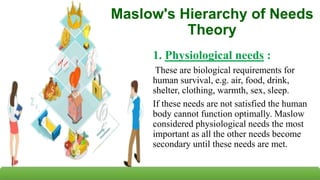
1. Physiological needs :
These are biological requirements for
human survival, e.g. air, food, drink,
shelter, clothing, warmth, sex, sleep.
If these needs are not satisfied the human
body cannot function optimally. Maslow
considered physiological needs the most
important as all the other needs become
secondary until these needs are met.
Maslow's Hierarchy of Needs
Theory
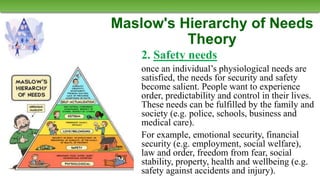
2. Safety needs
once an individual’s physiological needs are
satisfied, the needs for security and safety
become salient. People want to experience
order, predictability and control in their lives.
These needs can be fulfilled by the family and
society (e.g. police, schools, business and
medical care).
For example, emotional security, financial
security (e.g. employment, social welfare),
law and order, freedom from fear, social
stability, property, health and wellbeing (e.g.
safety against accidents and injury).
Maslow's Hierarchy of Needs
Theory
3. Love and belongingness needs
After physiological and safety needs have been
fulfilled, the third level of human needs is social and
involves feelings of belongingness. Belongingness,
refers to a human emotional need for interpersonal
relationships, affiliating, connectedness, and being part
of a group.
Examples of belongingness needs include friendship,
intimacy, trust, and acceptance, receiving and giving
affection, and love.
Maslow's Hierarchy of Needs
Theory
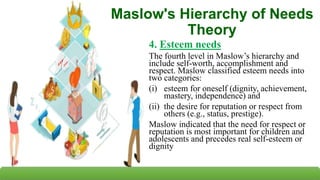
4. Esteem needs
The fourth level in Maslow’s hierarchy and
include self-worth, accomplishment and
respect. Maslow classified esteem needs into
two categories:
(i) esteem for oneself (dignity, achievement,
mastery, independence) and
(ii) the desire for reputation or respect from
others (e.g., status, prestige).
Maslow indicated that the need for respect or
reputation is most important for children and
adolescents and precedes real self-esteem or
dignity
Maslow's Hierarchy of Needs
Theory
5. Self-actualization needs
• It is the highest level in Maslow's hierarchy, and refer to the
realization of a person's potential, self-fulfillment, seeking
personal growth and peak experiences.
• Maslow emphasizes need for self actualization is a healthy
individual’s prime motivation
• Self-actualization means actualizing one’s potential becoming all
one is capable of becoming
• Nobody can do everything, but we can nearly all do more than we
think we can
• Individuals may perceive or focus on this need very specifically.
For example, one individual may have a strong desire to become
an ideal parent. In another, the desire may be expressed
economically, academically or athletically. For others, it may be
expressed creatively, in paintings, pictures, or inventions.
Maslow's Hierarchy of Needs
Theory
Maslow’s Definition of a Self-actualized
Person
• Has no mental illness
• Satisfied in basic needs
• Fully exploited talents
• Motivated by values
 Truth
 Goodness
 Beauty
 Wholeness
 Dichotomy-
transcendence
 Aliveness
 Uniqueness
 Perfection
 Completion
 Necessity
 Justice
 Order
 Simplicity
 Richness
 Effortlessness
 Playfulness
 Self-sufficiency
The 17 Meta needs.....
Some Characteristics of
Self-actualizing persons
• Superior perception of reality
• Increased acceptance of self, of
others, and of nature
• Increased spontaneity
• Increased detachment and desire for
privacy
• Greater freshness of appreciation
and richness of emotional reaction
• Increased autonomy and resistance
to conformity
• Higher frequency of peak
experiences
• Increased identification with the
human species
• Improved interpersonal experiences
• More democratic character
structure
• High levels of creativity
MASLOW’S EXPANDED HIERARCHY
NEEDS THEORY
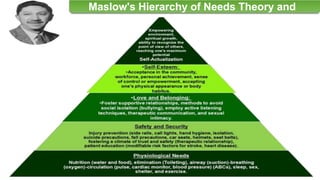
Maslow's Hierarchy of Needs Theory and
Nursing
VIRGINIA
HENDRESON’S
NURSING
NEEDS THEORY
Virginia Avenel Henderson (November 30, 1897 – March
19, 1996) was a nurse, theorist, and author known for her
Need Theory and nursing definition
Henderson is also known as “The First Lady of Nursing,”
“The Nightingale of Modern Nursing,” “Modern-Day
Mother of Nursing,” and “The 20th Century Florence
Nightingale.”
Virginia Henderson developed the Nursing Need Theory to
define the unique focus of nursing practice. The theory
focuses on the importance of increasing the patient’s
independence to hasten their progress in the hospital.
Henderson’s theory emphasizes the basic human needs and
how nurses can meet those needs.
INTRODUCTION
 Virginia Henderson was born on November 30, 1897 in
Kansas City, Missouri, and was the fifth of eight children in
her family.
 In 1921, Henderson graduated from the Army School of
Nursing at Walter Reed Hospital in Washington, D.C. In 1932,
she earned her Bachelor's Degree and
 In 1934 earned her Master's Degree in Nursing Education,
from Teachers College at Columbia University.
 In 1939, she was the author of three editions of “Principles
and Practices of Nursing,” a widely used text. Her “Basic
Principles of Nursing,” published in 1966 and revised in 1972,
has been published in 27 languages by the International
Council of Nurses.
 Henderson died on March 19, 1996.
BIOGRAPHY
ASSUMPTIONS OF THE NEED
THEORY
Virginia Henderson’s Need Theory assumptions are:
(1) Nurses care for patients until they can care for themselves once again.
Although not precisely explained,
(2) Patients desire to return to health.
(3) Nurses are willing to serve, and “nurses will devote themselves to the
patient day and night.”
(4) Henderson also believes that the “mind and body are inseparable and are
interrelated.”
Human being or Individual : Henderson considers the biological, psychological,
sociological and spiritual components. The patient as an individual who requires
assistance to achieve health and independence or peaceful death. The mind and the
body are inseparable. The patient and his family are viewed as a unit.
Health:
• Although not explicitly defined in Henderson’s theory, health was taken to mean balance in
all realms of human life. It is equated with the independence or ability to perform activities
without aid in the 14 components or basic human needs.
• On the other hand, nurses are key persons in promoting health, preventing illness, and
curing. According to Henderson, good health is a challenge because it is affected by
numerous factors such as age, cultural background, emotional balance, and others.
METAPARADIGM OF THE NEED
THEORY
Environment: Although the Need Theory did not explicitly define the environment,
Henderson stated that maintaining a supportive environment conducive to health is one of
her 14 activities for client assistance.
Henderson’s theory supports the private and public health sector’s tasks or agencies to keep
people healthy. She believes that society wants and expects the nurse’s act for individuals
who cannot function independently.
Nursing: In1966, Henderson ultimate statements in the definition of nursing
were published of her ideas it reads as follows:
“The unique function of the nurse is to assist the individual (sick or well)
in the performance of those activities contributing to health or its recovery
(or peaceful death) that he would perform unaided if he had the necessary
strength, will or knowledge. And to do this, in such a way as to help him
gain independence as rapidly as possible.”
METAPARADIGM OF THE NEED
THEORY
FUNDAMENTAL NEEDS OF
HUMAN ACCORDING TO
VIRGINIA HENDERSON
STENGTH AND WEAKNESS OF
HENDERSON’S THEORY
Strengths
Virginia Henderson’s concept of nursing is widely accepted in nursing practice
today. Her theory and 14 components are relatively simple, logical, and
applied to individuals of all ages.
Weaknesses
There is an absence of a conceptual diagram that interconnects Henderson’s
theory’s 14 concepts and sub concepts. On assisting the individual in the dying
process, there is little explanation of what the nurse does to provide “peaceful
death.”
HENDERSON’S 14 NEEDS AS APPLIED TO
MASLOW’S HEIRARCHY OF NEEDS
Basic Human needs.pptx

Basic Human needs.pptx

  • 1.
    Unit : II BASICHUMAN NEEDS Mrs. D. Melba Sahaya Sweety, RN, RM Ph.D Nursing , M.Sc Pediatric Nursing, B.Sc Nursing, Associate Professor, Enam medical College and Hospital, Savar, Dhaka, Bangladesh
  • 2.
    INTRODUCTION • A traditionallist of immediate "basic needs" is food ,water, shelter and clothing. Many modern lists emphasize the minimum level of consumption of "basic needs" of not just food, water, clothing and shelter, but also sanitation, education, and healthcare. • Basic human needs are what is essential for us to survive, live and thrive. Our actions are motivated by those needs and determine our development. Thus, our basic needs are at the base of human motivation.
  • 3.
    CHARACTERISTICS OF BASIC HUMANNEEDS Basic needs are approximately same for all, Meeting those needs is influenced by a person own culture .  The importance of each need is different for each person  People meet their needs relative to their own priorities.  All the basic needs are interconnected and interactive. Failure to meet needs leads to alteration in wellbeing or illness
  • 4.
  • 5.
    INTRODUCTION Abraham Harold Maslow(April 1, 1908 – June 8, 1970) was an American psychologist who was best known for creating Maslow's hierarchy of needs, He first introduced the concept of a hierarchy of needs in his 1943 paper, titled "A Theory of Human Motivation," and again in his subsequent book, "Motivation and Personality." This hierarchy suggests that people are motivated to fulfill basic needs before moving on to other, more advanced needs. As a humanist, Maslow believed that people have an inborn desire to be self-actualized, that is, to be all they can be. To achieve this ultimate goal, however, a number of more basic needs must be met. This includes the need for food, safety, love, and self-esteem.
  • 6.
    MASLOW’S ASSUMPTION  Humannature is basically good, not evil  Normal human development involves the actualization of this inherent goodness  Psychopathology results from the frustration of a human being’s essential nature
  • 7.
    TYPES OF NEEDS Accordingto Maslow there are two type of needs they are., Deficiency needs and growth needs The first four levels of the hierarchy model are often referred to as deficiency needs (D-needs), and the top level is known as growth or being needs (B- needs).  Deficiency needs arise due to deprivation and are said to motivate people when they are unmet. Growth needs do not stem from a lack of something, but rather from a desire to grow as a person. Once these growth needs have been reasonably satisfied, one may be able to reach the highest level called self-actualization.
  • 8.
    Maslow's Hierarchy of NeedsTheory • Abraham Maslow's hierarchy of needs is one of the best- known theories of motivation. Maslow's theory states that our actions are motivated by certain physiological and psychological needs that progress from basic to complex.
  • 9.
    1. Physiological needs: These are biological requirements for human survival, e.g. air, food, drink, shelter, clothing, warmth, sex, sleep. If these needs are not satisfied the human body cannot function optimally. Maslow considered physiological needs the most important as all the other needs become secondary until these needs are met. Maslow's Hierarchy of Needs Theory
  • 10.
    2. Safety needs oncean individual’s physiological needs are satisfied, the needs for security and safety become salient. People want to experience order, predictability and control in their lives. These needs can be fulfilled by the family and society (e.g. police, schools, business and medical care). For example, emotional security, financial security (e.g. employment, social welfare), law and order, freedom from fear, social stability, property, health and wellbeing (e.g. safety against accidents and injury). Maslow's Hierarchy of Needs Theory
  • 11.
    3. Love andbelongingness needs After physiological and safety needs have been fulfilled, the third level of human needs is social and involves feelings of belongingness. Belongingness, refers to a human emotional need for interpersonal relationships, affiliating, connectedness, and being part of a group. Examples of belongingness needs include friendship, intimacy, trust, and acceptance, receiving and giving affection, and love. Maslow's Hierarchy of Needs Theory
  • 12.
    4. Esteem needs Thefourth level in Maslow’s hierarchy and include self-worth, accomplishment and respect. Maslow classified esteem needs into two categories: (i) esteem for oneself (dignity, achievement, mastery, independence) and (ii) the desire for reputation or respect from others (e.g., status, prestige). Maslow indicated that the need for respect or reputation is most important for children and adolescents and precedes real self-esteem or dignity Maslow's Hierarchy of Needs Theory
  • 13.
    5. Self-actualization needs •It is the highest level in Maslow's hierarchy, and refer to the realization of a person's potential, self-fulfillment, seeking personal growth and peak experiences. • Maslow emphasizes need for self actualization is a healthy individual’s prime motivation • Self-actualization means actualizing one’s potential becoming all one is capable of becoming • Nobody can do everything, but we can nearly all do more than we think we can • Individuals may perceive or focus on this need very specifically. For example, one individual may have a strong desire to become an ideal parent. In another, the desire may be expressed economically, academically or athletically. For others, it may be expressed creatively, in paintings, pictures, or inventions. Maslow's Hierarchy of Needs Theory
  • 14.
    Maslow’s Definition ofa Self-actualized Person • Has no mental illness • Satisfied in basic needs • Fully exploited talents • Motivated by values  Truth  Goodness  Beauty  Wholeness  Dichotomy- transcendence  Aliveness  Uniqueness  Perfection  Completion  Necessity  Justice  Order  Simplicity  Richness  Effortlessness  Playfulness  Self-sufficiency The 17 Meta needs.....
  • 15.
    Some Characteristics of Self-actualizingpersons • Superior perception of reality • Increased acceptance of self, of others, and of nature • Increased spontaneity • Increased detachment and desire for privacy • Greater freshness of appreciation and richness of emotional reaction • Increased autonomy and resistance to conformity • Higher frequency of peak experiences • Increased identification with the human species • Improved interpersonal experiences • More democratic character structure • High levels of creativity
  • 16.
  • 17.
    Maslow's Hierarchy ofNeeds Theory and Nursing
  • 18.
  • 19.
    Virginia Avenel Henderson(November 30, 1897 – March 19, 1996) was a nurse, theorist, and author known for her Need Theory and nursing definition Henderson is also known as “The First Lady of Nursing,” “The Nightingale of Modern Nursing,” “Modern-Day Mother of Nursing,” and “The 20th Century Florence Nightingale.” Virginia Henderson developed the Nursing Need Theory to define the unique focus of nursing practice. The theory focuses on the importance of increasing the patient’s independence to hasten their progress in the hospital. Henderson’s theory emphasizes the basic human needs and how nurses can meet those needs. INTRODUCTION
  • 20.
     Virginia Hendersonwas born on November 30, 1897 in Kansas City, Missouri, and was the fifth of eight children in her family.  In 1921, Henderson graduated from the Army School of Nursing at Walter Reed Hospital in Washington, D.C. In 1932, she earned her Bachelor's Degree and  In 1934 earned her Master's Degree in Nursing Education, from Teachers College at Columbia University.  In 1939, she was the author of three editions of “Principles and Practices of Nursing,” a widely used text. Her “Basic Principles of Nursing,” published in 1966 and revised in 1972, has been published in 27 languages by the International Council of Nurses.  Henderson died on March 19, 1996. BIOGRAPHY
  • 21.
    ASSUMPTIONS OF THENEED THEORY Virginia Henderson’s Need Theory assumptions are: (1) Nurses care for patients until they can care for themselves once again. Although not precisely explained, (2) Patients desire to return to health. (3) Nurses are willing to serve, and “nurses will devote themselves to the patient day and night.” (4) Henderson also believes that the “mind and body are inseparable and are interrelated.”
  • 22.
    Human being orIndividual : Henderson considers the biological, psychological, sociological and spiritual components. The patient as an individual who requires assistance to achieve health and independence or peaceful death. The mind and the body are inseparable. The patient and his family are viewed as a unit. Health: • Although not explicitly defined in Henderson’s theory, health was taken to mean balance in all realms of human life. It is equated with the independence or ability to perform activities without aid in the 14 components or basic human needs. • On the other hand, nurses are key persons in promoting health, preventing illness, and curing. According to Henderson, good health is a challenge because it is affected by numerous factors such as age, cultural background, emotional balance, and others. METAPARADIGM OF THE NEED THEORY
  • 23.
    Environment: Although theNeed Theory did not explicitly define the environment, Henderson stated that maintaining a supportive environment conducive to health is one of her 14 activities for client assistance. Henderson’s theory supports the private and public health sector’s tasks or agencies to keep people healthy. She believes that society wants and expects the nurse’s act for individuals who cannot function independently. Nursing: In1966, Henderson ultimate statements in the definition of nursing were published of her ideas it reads as follows: “The unique function of the nurse is to assist the individual (sick or well) in the performance of those activities contributing to health or its recovery (or peaceful death) that he would perform unaided if he had the necessary strength, will or knowledge. And to do this, in such a way as to help him gain independence as rapidly as possible.” METAPARADIGM OF THE NEED THEORY
  • 24.
    FUNDAMENTAL NEEDS OF HUMANACCORDING TO VIRGINIA HENDERSON
  • 25.
    STENGTH AND WEAKNESSOF HENDERSON’S THEORY Strengths Virginia Henderson’s concept of nursing is widely accepted in nursing practice today. Her theory and 14 components are relatively simple, logical, and applied to individuals of all ages. Weaknesses There is an absence of a conceptual diagram that interconnects Henderson’s theory’s 14 concepts and sub concepts. On assisting the individual in the dying process, there is little explanation of what the nurse does to provide “peaceful death.”
  • 26.
    HENDERSON’S 14 NEEDSAS APPLIED TO MASLOW’S HEIRARCHY OF NEEDS