Presentation
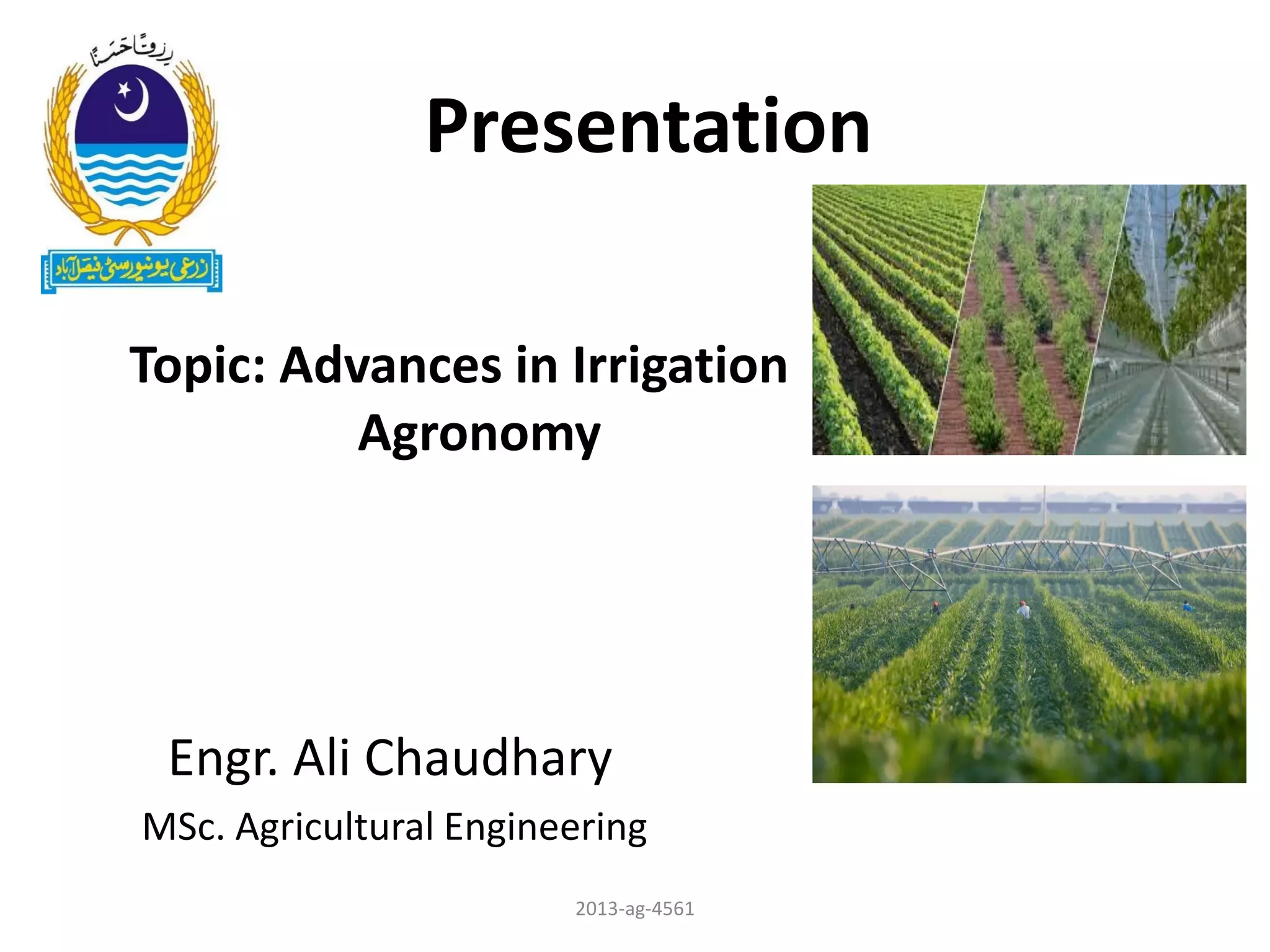
Topic: Advances in Irrigation
Agronomy
Engr. Ali Chaudhary
MSc. Agricultural Engineering
2013-ag-4561
Introduction
Irrigation has been used for thousands of years to maximize the
performance, efficiency and profitability of crops and it is a
science that is constantly evolving. This potential for improved
crop yields has never been more important as population levels
and demand for food continue to grow.
Linking crop physiology, agronomy and irrigation practices, this is
a valuable resource for planners, irrigation engineers,
agronomists and producers concerned with the international
need to improve water productivity in agriculture in the face of
increased pressure on water resources.
Contents
• Introduction
• Why we need of it?
• Irrigation Systems
• Important Factors
• Ways for Solution
• References
Why we need of it?
During the previous two decades, due to a false
perception among policy-makers that no new
investments in food and agriculture were needed.
Particularly, since the dramatic increases in the price of
food in 2008 agriculture is back on the global agenda and
will remain there for years to come. Population growth
and economic development are the driving forces behind
demands for increased food production and for a more
diversified diet. World production of fruits and vegetables
has proportionally increased from 18 to 23% of the total
agricultural output over the last nine years. The diversity
of fruits now being offered to consumers in world
markets has expanded enormously.
Modern advances in agriculture have been
founded on agricultural research, and fruit
production is no exception. However, much of
the research has been carried out on temperate
species such as the apple, and much less effort
has been devoted to study the performance of
fruit crops grown in subtropical and tropical
environments. Water management is essential
for stability of production in such environments.
Irrigation Systems
There are basic three types of Irrigation systems.
These are followings
• Flood Irrigation
• Sprinkler Irrigation
• Trickle (Drip) Irrigation.
Flood Irrigation
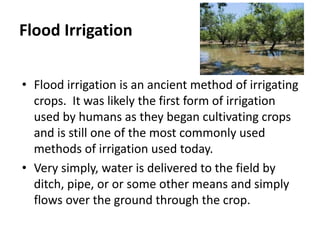
• Flood irrigation is an ancient method of irrigating
crops. It was likely the first form of irrigation
used by humans as they began cultivating crops
and is still one of the most commonly used
methods of irrigation used today.
• Very simply, water is delivered to the field by
ditch, pipe, or or some other means and simply
flows over the ground through the crop.
Techniques
There are several techniques that can be used to improve
its efficiency:
• Leveling fields – because water is transported using
gravity it won’t reach high spots in the field
• Surge flooding – rather than releasing water all at once
it is released in intervals allowing each release to
infiltrate the soil before releasing additional water.
• Recycling runoff – water that runs off the end and
sides of the irrigated are is captured in low-lying areas
and pumped to the top of the field where it can be
reused.
Sprinkler Irrigation
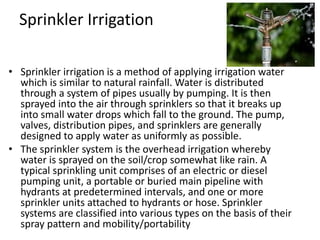
• Sprinkler irrigation is a method of applying irrigation water
which is similar to natural rainfall. Water is distributed
through a system of pipes usually by pumping. It is then
sprayed into the air through sprinklers so that it breaks up
into small water drops which fall to the ground. The pump,
valves, distribution pipes, and sprinklers are generally
designed to apply water as uniformly as possible.
• The sprinkler system is the overhead irrigation whereby
water is sprayed on the soil/crop somewhat like rain. A
typical sprinkling unit comprises of an electric or diesel
pumping unit, a portable or buried main pipeline with
hydrants at predetermined intervals, and one or more
sprinkler units attached to hydrants or hose. Sprinkler
systems are classified into various types on the basis of their
spray pattern and mobility/portability
Drip /Trickle Irrigation
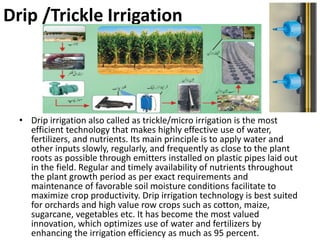
• Drip irrigation also called as trickle/micro irrigation is the most
efficient technology that makes highly effective use of water,
fertilizers, and nutrients. Its main principle is to apply water and
other inputs slowly, regularly, and frequently as close to the plant
roots as possible through emitters installed on plastic pipes laid out
in the field. Regular and timely availability of nutrients throughout
the plant growth period as per exact requirements and
maintenance of favorable soil moisture conditions facilitate to
maximize crop productivity. Drip irrigation technology is best suited
for orchards and high value row crops such as cotton, maize,
sugarcane, vegetables etc. It has become the most valued
innovation, which optimizes use of water and fertilizers by
enhancing the irrigation efficiency as much as 95 percent.
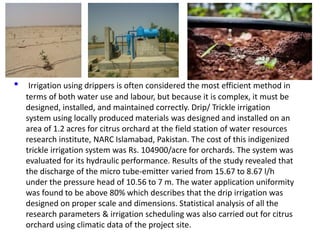
• Irrigation using drippers is often considered the most efficient method in
terms of both water use and labour, but because it is complex, it must be
designed, installed, and maintained correctly. Drip/ Trickle irrigation
system using locally produced materials was designed and installed on an
area of 1.2 acres for citrus orchard at the field station of water resources
research institute, NARC Islamabad, Pakistan. The cost of this indigenized
trickle irrigation system was Rs. 104900/acre for orchards. The system was
evaluated for its hydraulic performance. Results of the study revealed that
the discharge of the micro tube-emitter varied from 15.67 to 8.67 l/h
under the pressure head of 10.56 to 7 m. The water application uniformity
was found to be above 80% which describes that the drip irrigation was
designed on proper scale and dimensions. Statistical analysis of all the
research parameters & irrigation scheduling was also carried out for citrus
orchard using climatic data of the project site.
Important factors:
• The water economy information,
• Design irrigation scheduling,
• the crop, and the climatic conditions.
• Sprinkling is greatly influenced by the wind speed, wind
direction and durability.
• Surface irrigation is greatly dependent on the dynamics of
the water table, related to the deep percolation under the
first half of the furrow length.
• Micro-irrigation - it is very important to choose the
irrigation wings very precisely in order to be appropriate
for the soil type and the irrigation scheduling.
Ways for Solutions:
Farm-level adaptation
• Using water more efficiently by reducing water
losses, improving irrigation practices, and
recycling or storing water
• Improving soil management by increasing water
retention to conserve soil moisture, and
• Landscape management, such as maintaining
landscape features providing shelter to livestoc
Ways for Solutions:
Sectoral-level adaptation
• Enhancing investment in improved efficiency of
irrigation infrastructure and water use
technologies, as well as management of water
resources,
• Developing irrigation plans based on thorough
assessments of their impacts, future water
availability and water needs of different users,
taking account of the balance between demand
and supply
• Developing risk and crisis management
instruments to cope with the economic
consequences of climate-driven events.
References:
• Advances in Irrigation Agronomy:
(By M. K. V. Carr)
• http://ga.water.usgs.gov/edu/irmethods.html. USGS. Water Science
for Schools. Irrigation Techniques. Flood (Furrow) Irrigation.
Accessed August 12, 2008
• The Ride family's 'Nomad' brand tractor lawn sprinkler, National
Museum of Australia
• Jensen, M. E, 1981: Design and operation of farm irrigation
systems. American Society of Agri. Engineers (ASAE.), Monograph
Number 3, Michigan
• WRRI, 2001: Handbook of pressurized irrigation systems and
innovative adaptations. Water Resources Research Institute (WRRI),
NARC, Islamabad.
• https://www.researchgate.net/publication/287242993_Advances_i
n_irrigation_agronomy_Plantation_crops .
Advances in irrigation agronomy

Advances in irrigation agronomy

  • 1.
    Presentation Topic: Advances inIrrigation Agronomy Engr. Ali Chaudhary MSc. Agricultural Engineering 2013-ag-4561
  • 2.
    Introduction Irrigation has beenused for thousands of years to maximize the performance, efficiency and profitability of crops and it is a science that is constantly evolving. This potential for improved crop yields has never been more important as population levels and demand for food continue to grow. Linking crop physiology, agronomy and irrigation practices, this is a valuable resource for planners, irrigation engineers, agronomists and producers concerned with the international need to improve water productivity in agriculture in the face of increased pressure on water resources.
  • 3.
    Contents • Introduction • Whywe need of it? • Irrigation Systems • Important Factors • Ways for Solution • References
  • 4.
    Why we needof it? During the previous two decades, due to a false perception among policy-makers that no new investments in food and agriculture were needed. Particularly, since the dramatic increases in the price of food in 2008 agriculture is back on the global agenda and will remain there for years to come. Population growth and economic development are the driving forces behind demands for increased food production and for a more diversified diet. World production of fruits and vegetables has proportionally increased from 18 to 23% of the total agricultural output over the last nine years. The diversity of fruits now being offered to consumers in world markets has expanded enormously.
  • 5.
    Modern advances inagriculture have been founded on agricultural research, and fruit production is no exception. However, much of the research has been carried out on temperate species such as the apple, and much less effort has been devoted to study the performance of fruit crops grown in subtropical and tropical environments. Water management is essential for stability of production in such environments.
  • 6.
    Irrigation Systems There arebasic three types of Irrigation systems. These are followings • Flood Irrigation • Sprinkler Irrigation • Trickle (Drip) Irrigation.
  • 7.
    Flood Irrigation • Floodirrigation is an ancient method of irrigating crops. It was likely the first form of irrigation used by humans as they began cultivating crops and is still one of the most commonly used methods of irrigation used today. • Very simply, water is delivered to the field by ditch, pipe, or or some other means and simply flows over the ground through the crop.
  • 8.
    Techniques There are severaltechniques that can be used to improve its efficiency: • Leveling fields – because water is transported using gravity it won’t reach high spots in the field • Surge flooding – rather than releasing water all at once it is released in intervals allowing each release to infiltrate the soil before releasing additional water. • Recycling runoff – water that runs off the end and sides of the irrigated are is captured in low-lying areas and pumped to the top of the field where it can be reused.
  • 9.
    Sprinkler Irrigation • Sprinklerirrigation is a method of applying irrigation water which is similar to natural rainfall. Water is distributed through a system of pipes usually by pumping. It is then sprayed into the air through sprinklers so that it breaks up into small water drops which fall to the ground. The pump, valves, distribution pipes, and sprinklers are generally designed to apply water as uniformly as possible. • The sprinkler system is the overhead irrigation whereby water is sprayed on the soil/crop somewhat like rain. A typical sprinkling unit comprises of an electric or diesel pumping unit, a portable or buried main pipeline with hydrants at predetermined intervals, and one or more sprinkler units attached to hydrants or hose. Sprinkler systems are classified into various types on the basis of their spray pattern and mobility/portability
  • 10.
    Drip /Trickle Irrigation •Drip irrigation also called as trickle/micro irrigation is the most efficient technology that makes highly effective use of water, fertilizers, and nutrients. Its main principle is to apply water and other inputs slowly, regularly, and frequently as close to the plant roots as possible through emitters installed on plastic pipes laid out in the field. Regular and timely availability of nutrients throughout the plant growth period as per exact requirements and maintenance of favorable soil moisture conditions facilitate to maximize crop productivity. Drip irrigation technology is best suited for orchards and high value row crops such as cotton, maize, sugarcane, vegetables etc. It has become the most valued innovation, which optimizes use of water and fertilizers by enhancing the irrigation efficiency as much as 95 percent.
  • 11.
    • Irrigation usingdrippers is often considered the most efficient method in terms of both water use and labour, but because it is complex, it must be designed, installed, and maintained correctly. Drip/ Trickle irrigation system using locally produced materials was designed and installed on an area of 1.2 acres for citrus orchard at the field station of water resources research institute, NARC Islamabad, Pakistan. The cost of this indigenized trickle irrigation system was Rs. 104900/acre for orchards. The system was evaluated for its hydraulic performance. Results of the study revealed that the discharge of the micro tube-emitter varied from 15.67 to 8.67 l/h under the pressure head of 10.56 to 7 m. The water application uniformity was found to be above 80% which describes that the drip irrigation was designed on proper scale and dimensions. Statistical analysis of all the research parameters & irrigation scheduling was also carried out for citrus orchard using climatic data of the project site.
  • 12.
    Important factors: • Thewater economy information, • Design irrigation scheduling, • the crop, and the climatic conditions. • Sprinkling is greatly influenced by the wind speed, wind direction and durability. • Surface irrigation is greatly dependent on the dynamics of the water table, related to the deep percolation under the first half of the furrow length. • Micro-irrigation - it is very important to choose the irrigation wings very precisely in order to be appropriate for the soil type and the irrigation scheduling.
  • 13.
    Ways for Solutions: Farm-leveladaptation • Using water more efficiently by reducing water losses, improving irrigation practices, and recycling or storing water • Improving soil management by increasing water retention to conserve soil moisture, and • Landscape management, such as maintaining landscape features providing shelter to livestoc
  • 14.
    Ways for Solutions: Sectoral-leveladaptation • Enhancing investment in improved efficiency of irrigation infrastructure and water use technologies, as well as management of water resources, • Developing irrigation plans based on thorough assessments of their impacts, future water availability and water needs of different users, taking account of the balance between demand and supply • Developing risk and crisis management instruments to cope with the economic consequences of climate-driven events.
  • 15.
    References: • Advances inIrrigation Agronomy: (By M. K. V. Carr) • http://ga.water.usgs.gov/edu/irmethods.html. USGS. Water Science for Schools. Irrigation Techniques. Flood (Furrow) Irrigation. Accessed August 12, 2008 • The Ride family's 'Nomad' brand tractor lawn sprinkler, National Museum of Australia • Jensen, M. E, 1981: Design and operation of farm irrigation systems. American Society of Agri. Engineers (ASAE.), Monograph Number 3, Michigan • WRRI, 2001: Handbook of pressurized irrigation systems and innovative adaptations. Water Resources Research Institute (WRRI), NARC, Islamabad. • https://www.researchgate.net/publication/287242993_Advances_i n_irrigation_agronomy_Plantation_crops .