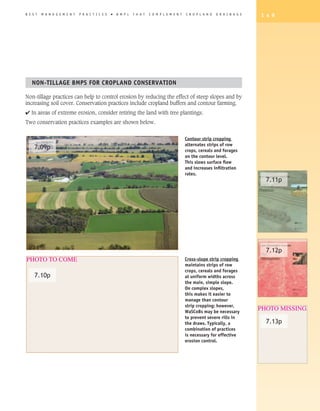
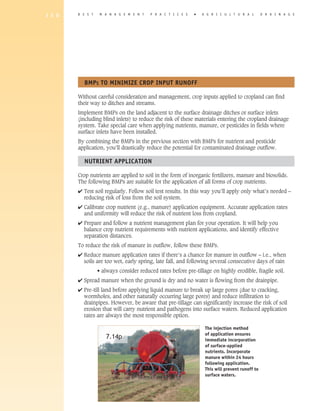
B E S T   M A N A G E M E N T   P R A C T I C E S   �   B M P s   F O R   C R O P L A N D   E R O S I O N   C O N T R O L    9 7


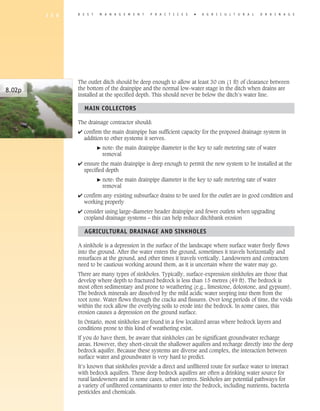
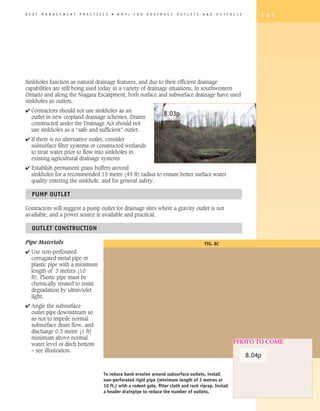
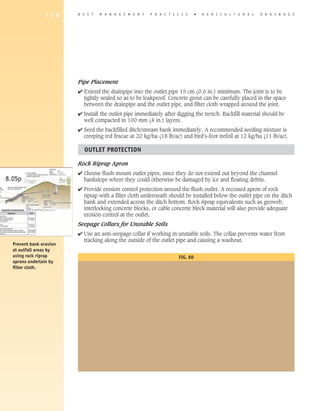
BMPS FOR CROPLAND EROSION
CONTROL

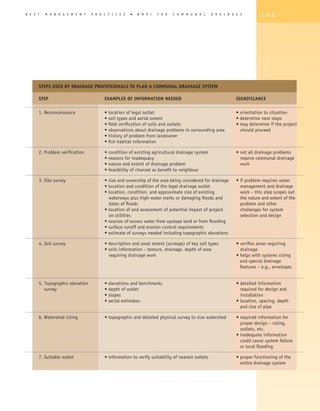
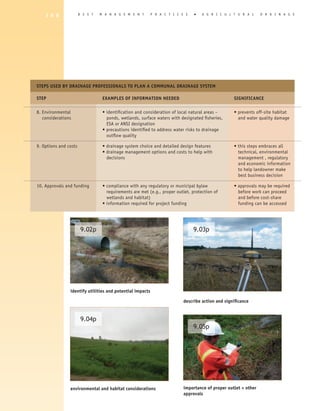
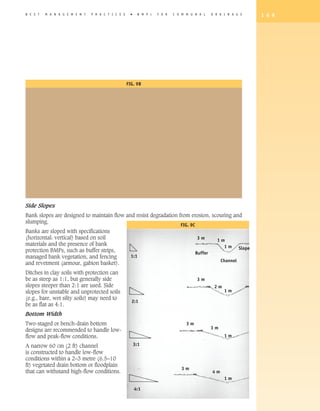
Properly designed and located erosion control structures can safely convey excess
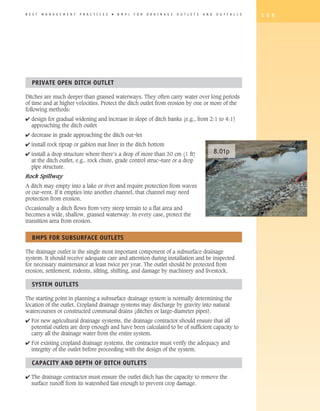
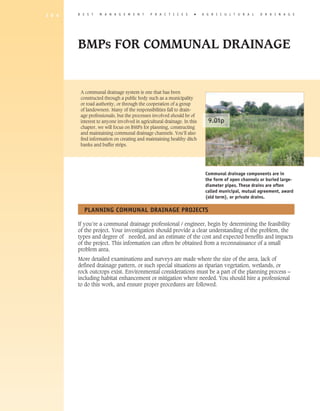
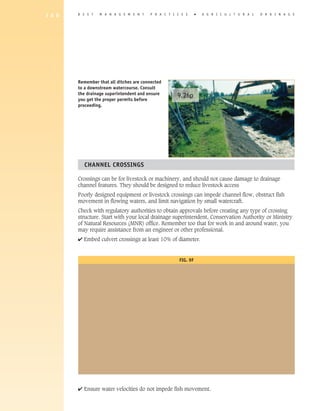
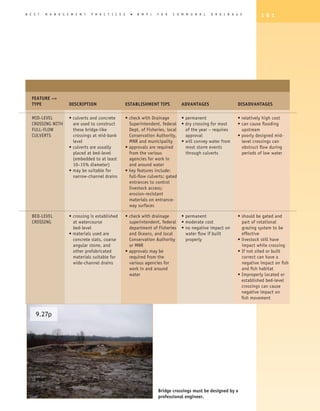
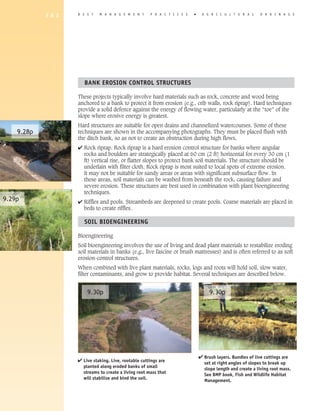
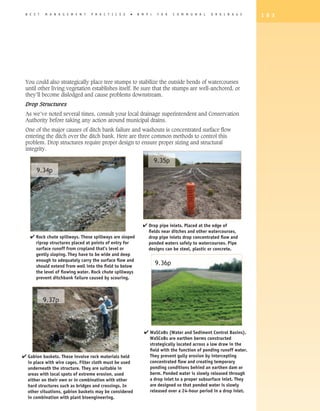
water to an appropriate outlet. This chapter explains how to verify soil erosion                     5.01p
issues, presents different types of erosion control structures and their respective
features and maintenance needs, and shows how to plan for their implementation.


Some surface drainage structures are intended to remove ponded water
from depressional areas on cropland. However, not all surface water
is ponded. In fact, ponded water can become runoff if permitted to
overflow into low runs (draws) in unevenly sloped fields.
On sloping cropland, runoff can lead to the erosion of soil particles.
Cropland erosion in uniform layers is known as sheet erosion. Erosion
caused by concentrated flow forms rills. When the rills develop into
channels large enough to prevent crossing by farm machinery, these
channels are known as gullies.
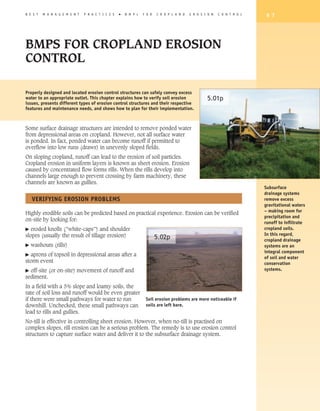
                                                                                                                            Subsurface
                                                                                                                            drainage systems
    VERIFyING EROSION PROBLEMS                                                                                              remove excess
                                                                                                                            gravitational waters
                                                                                                                            – making room for
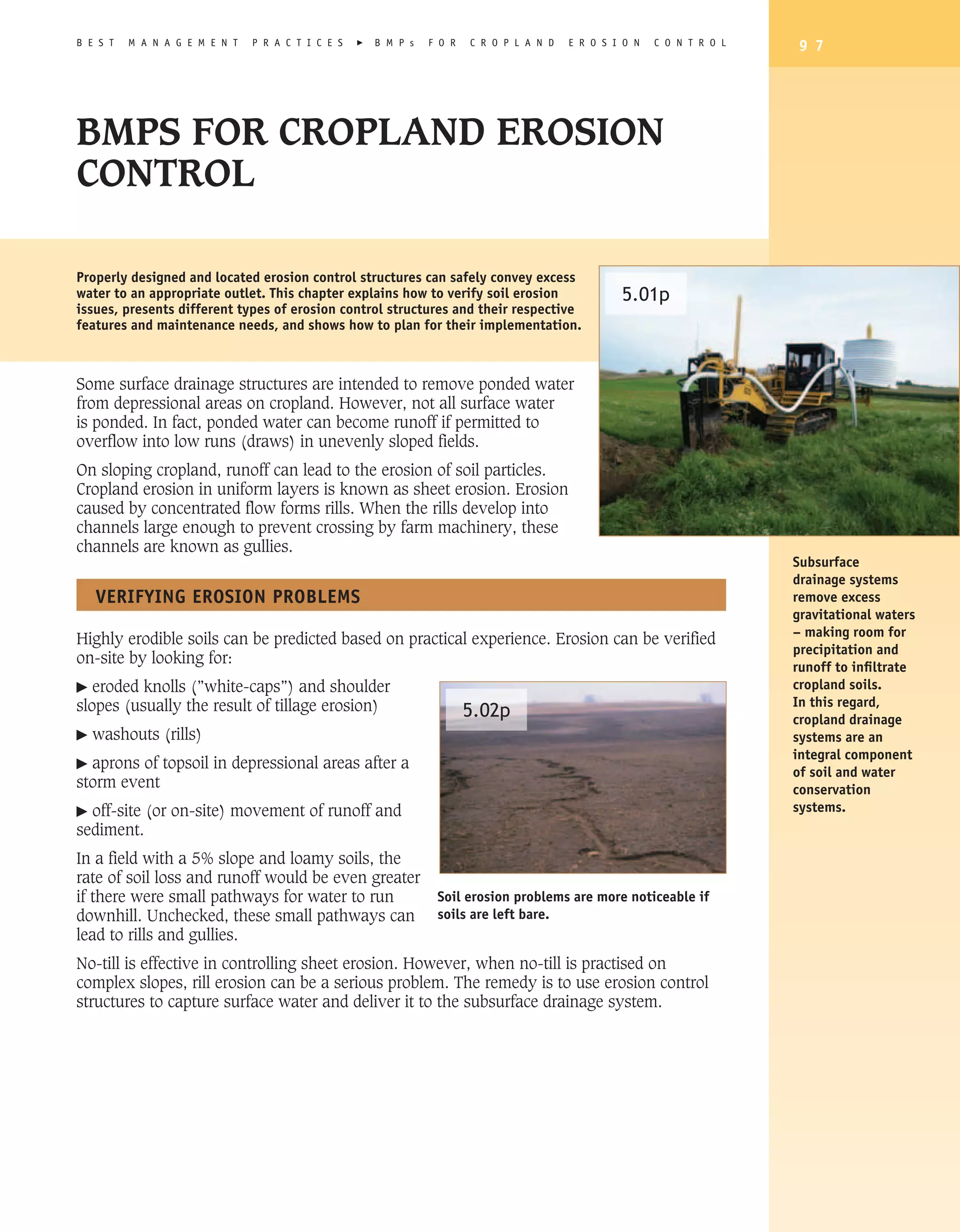
Highly erodible soils can be predicted based on practical experience. Erosion can be verified
                                                                                                                            precipitation and
on-site by looking for:
                                                                                                                            runoff to infiltrate
�  eroded knolls (”white-caps”) and shoulder                                                                                cropland soils.
slopes (usually the result of tillage erosion)                                                                              In this regard,
                                                                          5.02p                                             cropland drainage
�   washouts (rills)                                                                                                        systems are an
                                                                                                                            integral component
� aprons of topsoil in depressional areas after a
                                                                                                                            of soil and water
storm event                                                                                                                 conservation
� off-site (or on-site) movement of runoff and                                                                              systems.
sediment.
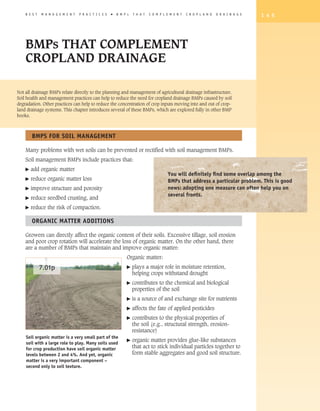
In a field with a 5% slope and loamy soils, the
rate of soil loss and runoff would be even greater
if there were small pathways for water to run                      Soil erosion problems are more noticeable if
downhill. Unchecked, these small pathways can                      soils are left bare.
lead to rills and gullies.
No-till is effective in controlling sheet erosion. However, when no-till is practised on
complex slopes, rill erosion can be a serious problem. The remedy is to use erosion control
structures to capture surface water and deliver it to the subsurface drainage system.
9 8      B E S T   M A N A G E M E N T     P R A C T I C E S     �   A G R I C U L T U R A L     D R A I N A G E


                           EROSION CONTROL STRUCTURES

                         Erosion control structures are designed to both control erosion and safely convey surface
5.03p                    water to an adequate outlet. Common examples include grassed waterways, terraces, and
                         water and sediment control basins (WaSCoBs). Some of these systems are designed so that
                         the rate of water removal has been reduced.
                         Calibrated standpipe inlets (e.g., Hickenbottom inlets) in WaSCoBs limit sediment loading
                         from runoff events by allowing the water to pond for a short period of time and soil particles
                         to settle out before entering the inlet.
                         Erosion control structures move surface runoff to subsurface drainage systems and, by
                         strategic placement, limit the erosive forces of runoff events. This type of erosion control
                         structure includes diversion terraces and narrow-based terraces.


                                                                A systems approach is the most effective way to
                                                                address cropland runoff and erosion problems. A soil and
                                                                water conservation system designed to reduce the risks
                                                                of soil loss has the following components:

                                                                • cropland erosion control structures
                                                                • surface water management
                                                                • subsurface drainage
                                                                • soil management BMPs, and
                                                                • conservation tillage and cropping practices.
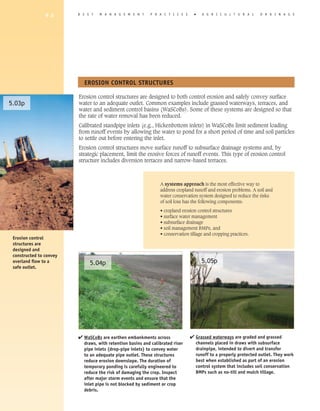
 Erosion control
 structures are
 designed and
 constructed to convey
 overland flow to a           5.04p                                                  5.05p
 safe outlet.


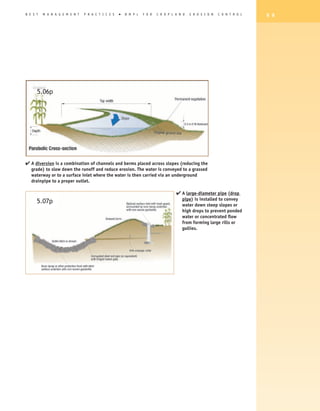
                         4 WaSCoBs are earthen embankments across              4 Grassed waterways are graded and grassed
                           draws, with retention basins and calibrated riser      channels placed in draws with subsurface
                           pipe inlets (drop-pipe inlets) to convey water         drainpipe, intended to divert and transfer
                           to an adequate pipe outlet. These structures           runoff to a properly protected outlet. They work
                           reduce erosion downslope. The duration of              best when established as part of an erosion
                           temporary ponding is carefully engineered to           control system that includes soil conservation
                           reduce the risk of damaging the crop. Inspect          BMPs such as no-till and mulch tillage.
                           after major storm events and ensure that the
                           inlet pipe is not blocked by sediment or crop
                           debris.
B E S T   M A N A G E M E N T   P R A C T I C E S   �   B M P s   F O R   C R O P L A N D   E R O S I O N   C O N T R O L   9 9


      5.06p


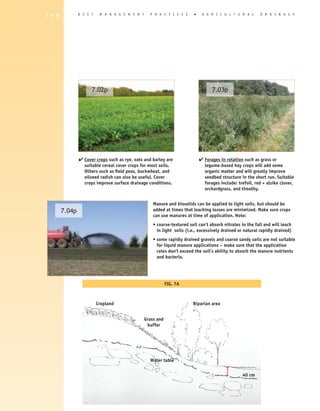
4 A diversion is a combination of channels and berms placed across slopes (reducing the
   grade) to slow down the runoff and reduce erosion. The water is conveyed to a grassed
   waterway or to a surface inlet where the water is then carried via an underground
   drainpipe to a proper outlet.

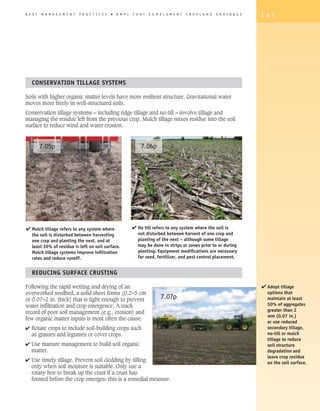
                                                                                    4 A large-diameter pipe (drop
                                                                                       pipe) is installed to convey
      5.07p
                                                                                       water down steep slopes or
                                                                                       high drops to prevent ponded
                                                                                       water or concentrated flow
                                                                                       from forming large rills or
                                                                                       gullies.
1 0 0   B E S T   M A N A G E M E N T      P R A C T I C E S     �   A G R I C U L T U R A L     D R A I N A G E


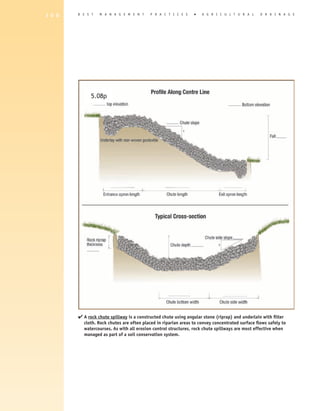
              5.08p


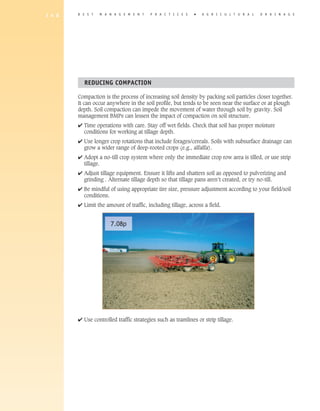
        4 A rock chute spillway is a constructed chute using angular stone (riprap) and underlain with filter
          cloth. Rock chutes are often placed in riparian areas to convey concentrated surface flows safely to
          watercourses. As with all erosion control structures, rock chute spillways are most effective when
          managed as part of a soil conservation system.
B E S T   M A N A G E M E N T   P R A C T I C E S   �   B M P s   F O R   C R O P L A N D   E R O S I O N   C O N T R O L        1 0 1


   EROSION CONTROL STRUCTURES

   BMP + DESCRIPTION 	          FUNCTION & DESIGN FEATURES	                                      MAINTENANCE & REPAIR

   TERRACE 	               • intercepts surface runoff and breaks up a single 	                  • monitor in spring and after storm events for
   	                         slope-length into shorter lengths	                                    breaches in, or erosion of, berms
   Earthen berm or ridge 	 • constructed at a suitable lateral grade to an outlet	               • ensure proper functioning of emergency
   across slope 	          • see WASCoB for design considerations 	                                spillway
   		                                                                                            • keep drop-pipe inlets clear of debris

   WaSCoB	                      • berm and basin with inlet built across slope to 	              • monitor inlet area for function and condition
   	                              divert runoff to subsurface drainpipe	                         • clean debris from inlet to allow for proper
   (Water and sediment	         • settles out some sediment	                                       functioning
   control basin) 	             • design accounts for watershed size and shape, rate 	           • ensure the integrity of the berm
   	                              of runoff, volume of storage, erodibility of soil 	            • keep track of soil sediment buildup and
   Small water-detention	         material, and impacts of cropping and tillage 	                  remove when necessary
   basins and berm	               practices on runoff
   	                            • works on watersheds up to 20 ha (50 ac)
   	                            • basin design is usually sized to hold 15 years of
   	                              eroded soil

   DIVERSION	           • constructed across slope to divert water and runoff 	                  • monitor in spring and after storm events for
   	                      to a position where it can be safely conveyed	                           breaches in, or erosion of, berms
   A channel with a	    • see WASCoB for design considerations	                                  • monitor inlet area for function and
   supporting ridge on		                                                                           condition
   the lower side		                                                                              • clean debris from inlet to allow for proper
   		                                                                                              functioning

   GRASSED WATERWAY	            • safe transport of runoff from field or erosion control 	       • seed with recommended grass mixture and
   	                              structure such as diversions, terrace and 	                      fertilize to ensure proper cover
   Natural or constructed,	       strip-cropping to a proper outlet	                             • mow vegetation at least twice per year to
   grassed waterway – 	         • works best if part of soil conservation system	                  promote establishment and cover
   usually in draw or 	         • has parabolic or trapezoidal cross-sectional shape to	         • reduce traffic on grassed waterway
   between convergent 	           resemble natural channels	                                     • don’t create dead furrow along water way
   slopes	                      • requires a subsurface pipe underneath to handle	                 – could cause rill beside waterway
   	                              low-flow conditions and maintain good hydrologic 	             • respect separation distances to keep
   	                              conditions	                                                      cropland herbicides away from cover
   	                            • best suited to grades <5%	                                     • can be grazed or hayed if conditions are dry

   DROP-PIPE INLET	             • intercept and carry a concentrated flow of water 	             • monitor pipes and inlet area for function
   	                              safely from a higher to a lower elevation	                       and condition
   Enclosed vertical pipe	      • structures of steel, plastic or concrete vertical pipe 	       • clean debris from inlet to allow for proper
   structure connected to	        are usually located near watercourses	                           functioning
   subsurface drainpipe	        • can be used if drop is greater than 1.5 m (5 ft)	              • replace broken pipe, grates, and constrictors
   	                            • design based on peak flow, fall and distance, berm
                                  
                                  size and spillway requirements

   ROCK CHUTE SPILLWAY	         • safely conveys fast-flowing channelized water down 	 • monitor for erosion under spillway, shifting
   	                              a steep gradient	                                         rocks and debris
   	                            • works well where water from a grassed waterway 	        • remove debris
   	                              enters a drainage channel or stream or in old fence 	 • replace and adjust rocks and filter cloth as
   	                              lines where the rate of water flow prevents vegetation 	 needed to prevent scouring
   	                              from maintaining cover
   	                            • uses entrance and exit aprons to reduce erosion and
   	                              to control flow
   	                            • large rocks (22 kg (50 lb) are recommended
   	                            • anchored filter cloth underneath rock is recommended
1 0 2       B E S T    M A N A G E M E N T   P R A C T I C E S   �   A G R I C U L T U R A L    D R A I N A G E


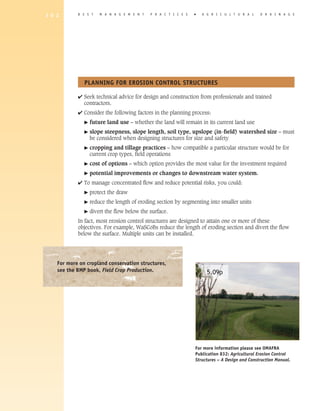
               PLANNING FOR EROSION CONTROL STRUCTURES

            4 Seek technical advice for design and construction from professionals and trained
              contractors.
            4 Consider the following factors in the planning process:
               �   future land use – whether the land will remain in its current land use
               �   slope steepness, slope length, soil type, upslope (in-field) watershed size – must
                   be considered when designing structures for size and safety
               �   cropping and tillage practices – how compatible a particular structure would be for
                   current crop types, field operations
               �   cost of options – which option provides the most value for the investment required
               �   potential improvements or changes to downstream water system.
            4 To manage concentrated flow and reduce potential risks, you could:
               �   protect the draw
               �   reduce the length of eroding section by segmenting into smaller units
               �   divert the flow below the surface.
            In fact, most erosion control structures are designed to attain one or more of these
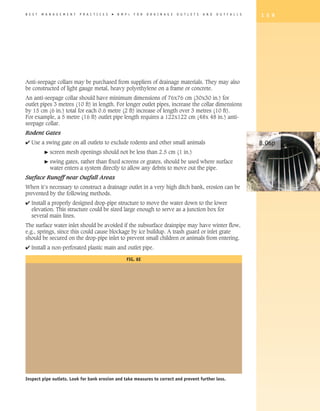
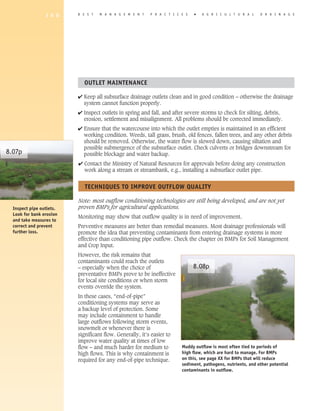
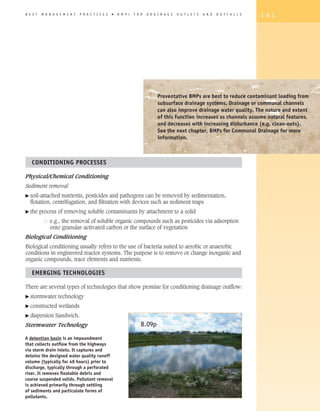
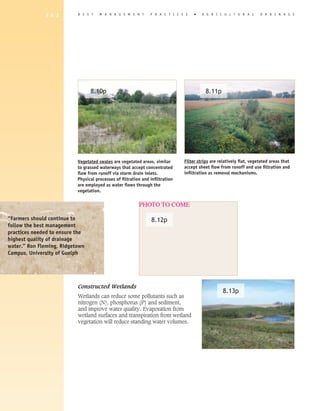
            objectives. For example, WaSCoBs reduce the length of eroding section and divert the flow
            below the surface. Multiple units can be installed.


    For more on cropland conservation structures,
    see the BMP book, Field Crop Production.                           5.09p


                                                                 For more information please see OMAFRA
                                                                 Publication 832: Agricultural Erosion Control
                                                                 Structures – A Design and Construction Manual.
B E S T   M A N A G E M E N T   P R A C T I C E S   �   B M P s   F O R   S U B S U R F A C E   D R A I N A G E   1 0 3


BMPs FOR SUBSURFACE
DRAINAGE

This extensive chapter begins with approaches to identify subsurface drainage issues. Accurate on-site
diagnostics are the first step in planning a subsurface drainage system. Once site conditions are
understood, system design is the next stage, and we will take it step by step. We’ll explain BMPs for
installation – using checklists for both landowners and licensed drainage contractors. As we move to
maintenance and management BMPs, we focus on troubleshooting. The chapter concludes with a look at
emerging technologies.


The main challenges for subsurface drainage are:
• managing crop inputs and other contaminants
• removing excess water but also conserving water
• managing wet areas, and
• protecting adjacent wetlands.


   Diagnosing Subsurface Drainage Issues
   Conditions That Require Subsurface Drainage

In many cases, cropland drainage systems are established or improved due to the limitations
of local soil and site conditions. Also, we have a humid climate in Ontario, which means
that on average there is a net surplus of water on most croplands. The growing season
(optimum temperatures) is limited and soil needs to be in a good hydrological condition for
the full growing season.
Soils may need subsurface drainage for one or more of the following reasons.
Uneven soil moisture conditions. Soil moisture conditions are not sufficiently uniform for
efficient field operations on fields with highly variable soil types and slope positions.
Inadequate natural drainage for the crop’s sensitivity. Some crops are very sensitive
to water (“wet feet”), and are easily damaged if roots are in saturated soil. Some soils have
average natural drainage, but are unsuitable for the crop’s needs.
Soils with naturally high water tables. Usually found in level-to-depressional
topography or where impermeable subsoils limit water infiltration, these soils will benefit
from systematic subsurface drainage systems. Such soils are referred to as poor and
imperfectly drained soil types on soil maps and reports.
1 0 4     B E S T   M A N A G E M E N T   P R A C T I C E S      �   A gricultural       D R A I N A G E


                                                                       Fig. 6A


                          Soils may need subsurface drainage for one or more of the following reasons.
                          Uneven soil moisture conditions. Soil moisture conditions are not sufficiently uniform for
                          efficient field operations on fields with highly variable soil types and slope positions.
                          Inadequate natural drainage for the crop’s sensitivity. Some crops are very sensitive to
                          water (“wet feet”), and are easily damaged if roots are in saturated soil. Some soils have
                          average natural drainage, but are unsuitable for the crop’s needs.
                          Soils with naturally high water tables. Usually found in level-to-depressional topography or
                          where impermeable subsoils limit water infiltration, these soils will benefit from systematic
                          subsurface drainage systems. Such soils are referred to as poor and imperfectly drained soil
                          types on soil maps and reports.

                                           Fig. 6b
Croplands soils with a
drainage class of poor
require subsurface
drainage. Poorly
drained soils have a
high water table for
most of the year. To
verify poor drainage,
check for a zone of
mottles and gley
colours in the top 50
cm (20 in.) of the soil
profile.
B E S T   M A N A G E M E N T   P R A C T I C E S    �   B M P s   F O R   S U B S U R F A C E   D R A I N A G E   1 0 5


Water won’t flow to outlet because land is too flat or natural surface barriers limit movement
of water. Such sites are often in depressional areas.
Artificial barriers. Constructed barriers that obstruct or limit the flow of water include roads,
fence rows, dams, dikes, bridges, and culverts of insufficient capacity and depth.
Topographic site position. For want of sufficient land slope, or due to natural surface
barriers, water cannot flow to an oulet. Such sites are often in depressional areas.
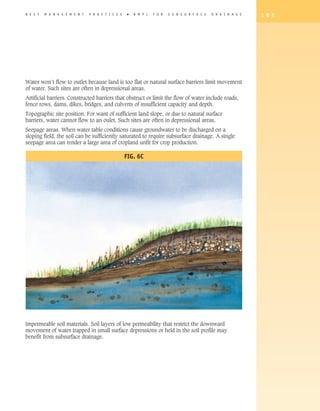
Seepage areas. When water table conditions cause groundwater to be discharged on a
sloping field, the soil can be sufficiently saturated to require subsurface drainage. A single
seepage area can render a large area of cropland unfit for crop production.

                                                    Fig. 6c


Impermeable soil materials. Soil layers of low permeability that restrict the downward
movement of water trapped in small surface depressions or held in the soil profile may
benefit from subsurface drainage.
1 0 6    B E S T   M A N A G E M E N T   P R A C T I C E S   �   A G R I C U L T U R A L    D R A I N A G E


                                                                            FIG. 6D


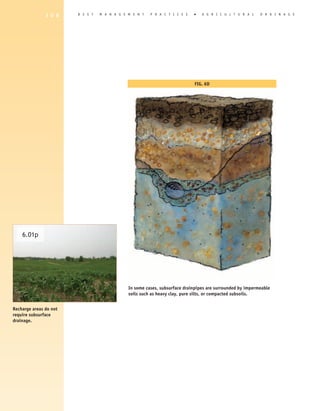
    6.01p


                                              In some cases, subsurface drainpipes are surrounded by impermeable
                                              soils such as heavy clay, pure silts, or compacted subsoils.


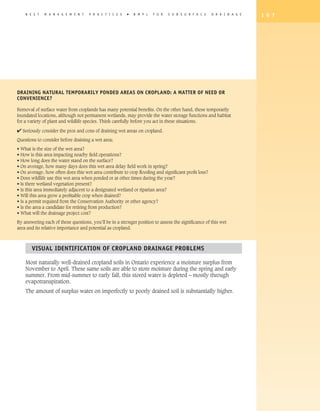
Recharge areas do not
require subsurface
drainage.
B E S T   M A N A G E M E N T    P R A C T I C E S   �   B M P s   F O R   S U B S U R F A C E    D R A I N A G E   1 0 7


Draining Natural Temporarily Ponded Areas on Cropland: A Matter of Need or
Convenience?

Removal of surface water from croplands has many potential benefits. On the other hand, these temporarily
inundated locations, although not permanent wetlands, may provide the water storage functions and habitat
for a variety of plant and wildlife species. Think carefully before you act in these situations.

4 Seriously consider the pros and cons of draining wet areas on cropland.
Questions to consider before draining a wet area:

• What is the size of the wet area?
• How is this area impacting nearby field operations?
• How long does the water stand on the surface?
• On average, how many days does this wet area delay field work in spring?
• On average, how often does this wet area contribute to crop flooding and significant profit loss?
• Does wildlife use this wet area when ponded or at other times during the year?
• Is there wetland vegetation present?
• Is this area immediately adjacent to a designated wetland or riparian area?
• Will this area grow a profitable crop when drained?
• Is a permit required from the Conservation Authority or other agency?
• Is the area a candidate for retiring from production?
• What will the drainage project cost?

By answering each of these questions, you’ll be in a stronger position to assess the significance of this wet
area and its relative importance and potential as cropland.


       Visual Identification of Cropland Drainage Problems

    Most naturally well-drained cropland soils in Ontario experience a moisture surplus from
    November to April. These same soils are able to store moisture during the spring and early
    summer. From mid-summer to early fall, this stored water is depleted – mostly through
    evapotranspiration.
    The amount of surplus water on imperfectly to poorly drained soil is substantially higher.
1 0 8   B E S T   M A N A G E M E N T     P R A C T I C E S      �   A G R I C U L T U R A L     D R A I N A G E


                                                       FIG. 6E


                                FIG. 6F
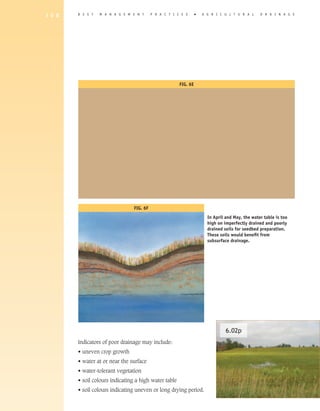
                                                                       In April and May, the water table is too
                                                                       high on imperfectly drained and poorly
                                                                       drained soils for seedbed preparation.
                                                                       These soils would benefit from
                                                                       subsurface drainage.


                                                                                6.02p
        Indicators of poor drainage may include:
        • uneven crop growth
        • water at or near the surface
        • water-tolerant vegetation
        • soil colours indicating a high water table
        • soil colours indicating uneven or long drying period.
B E S T   M A N A G E M E N T   P R A C T I C E S   �   B M P s   F O R   S U B S U R F A C E   D R A I N A G E   1 0 9


It’s prudent to conduct a site investigation of drainage problems before drainpipes are
installed or in drained fields requiring troubleshooting. Simply put: cropland drainage
improvement is limited by site conditions.
There are two major soil-water-related problems in most fields: surface water soils and
groundwater soils.
Surface water problems occur where precipitation and snowmelt water on
the surface won’t infiltrate and percolate through the soil quickly enough for
agricultural use – resulting in soils remaining saturated too long. This can be due                       6.03p
to high water tables, or soils that are impermeable, such as soils with a high clay
content.
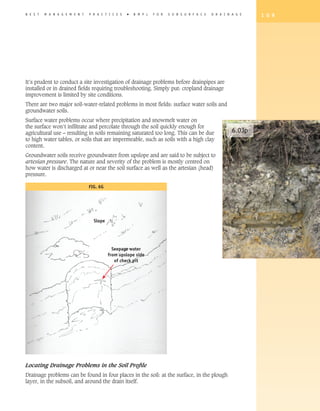
Groundwater soils receive groundwater from upslope and are said to be subject to
artesian pressure. The nature and severity of the problem is mostly centred on
how water is discharged at or near the soil surface as well as the artesian (head)
pressure.

                                FIG. 6G


                                  Slope


                                            Seepage water
                                          from upslope side
                                             of check pit


Locating Drainage Problems in the Soil Profile
Drainage problems can be found in four places in the soil: at the surface, in the plough
layer, in the subsoil, and around the drain itself.
1 1 0   B E S T   M A N A G E M E N T      P R A C T I C E S       �   A gricultural            D R A I N A G E


                                           Fig. 6H


                                                         Fig. 6I


        Surface Problems
        Most surface problems are associated with soil crusting – a sheet of soil that prevents infiltration.
        Following the rapid wetting and drying of an overworked seedbed, a solid sheet forms (0.2–5 cm or 0.8–2
        in. thick) that is tight enough to prevent crop emergence. A track record of poor soil management and
        few organic matter inputs is most often the cause. A similar impeding layer at the surface can result
        from “puddling” caused by a heavy rainfall of large rain droplets. Here the surface is compacted by the
        droplets, creating a barrier.

        4  dopt farming practices that maintain good soil structure and organic matter/crop residue to prevent
          A
          crusting.
B E S T   M A N A G E M E N T   P R A C T I C E S   �   B M P s   F O R   S U B S U R F A C E   D R A I N A G E   1 1 1


                                                    Fig. 6J


Plough-Layer Problems
Most plough-layer drainage problems are actually compaction problems. Compaction is the process of
increasing soil density by packing soil or smearing particles closer together. It can occur anywhere in the
soil profile, but tends to be seen near the surface or at plough depth.

4  onsider a range of BMPs, including tillage at proper soil moisture conditions, use of deep-rooted
  C
   crops, and mulch tillage, to reduce the impact of compaction on soil structure.
1 1 2   B E S T    M A N A G E M E N T     P R A C T I C E S     �   A gricultural                D R A I N A G E


                            Fig. 6K


        Subsoil Problems
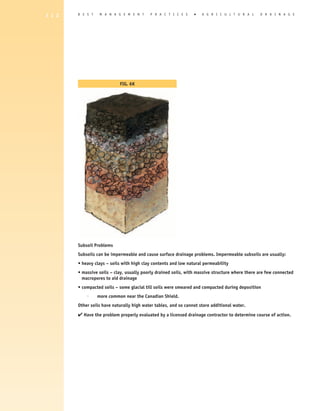
        Subsoils can be impermeable and cause surface drainage problems. Impermeable subsoils are usually:
        • heavy clays – soils with high clay contents and low natural permeability
        •  assive soils – clay, usually poorly drained soils, with massive structure where there are few connected
          m
          macropores to aid drainage
        • compacted soils – some glacial till soils were smeared and compacted during deposition
             	    more common near the Canadian Shield.
        Other soils have naturally high water tables, and so cannot store additional water.
        4 Have the problem properly evaluated by a licensed drainage contractor to determine course of action.
B E S T   M A N A G E M E N T   P R A C T I C E S   �   B M P s   F O R   S U B S U R F A C E   D R A I N A G E   1 1 3


                            FIG. 6L


Around the Drainpipe
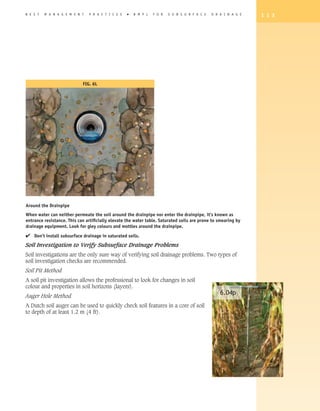
When water can neither permeate the soil around the drainpipe nor enter the drainpipe, it’s known as
entrance resistance. This can artificially elevate the water table. Saturated soils are prone to smearing by
drainage equipment. Look for gley colours and mottles around the drainpipe.

4 Don’t install subsurface drainage in saturated soils.
Soil Investigation to Verify Subsurface Drainage Problems
Soil investigations are the only sure way of verifying soil drainage problems. Two types of
soil investigation checks are recommended.
Soil Pit Method
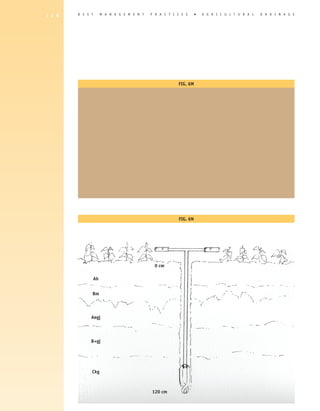
A soil pit investigation allows the professional to look for changes in soil
colour and properties in soil horizons (layers).
Auger Hole Method
                                                                                                    6.04p
A Dutch soil auger can be used to quickly check soil features in a core of soil
to depth of at least 1.2 m (4 ft).
1 1 4   B E S T        M A N A G E M E N T   P R A C T I C E S     �   A gricultural   D R A I N A G E


                                                         Fig. 6M


                                                         Fig. 6N


                                              0 cm

                  Ah


              Bm


              Aegj


              B+gj


              Ckg


                                             120 cm
B E S T   M A N A G E M E N T   P R A C T I C E S   �   B M P s   F O R   S U B S U R F A C E   D R A I N A G E        1 1 5


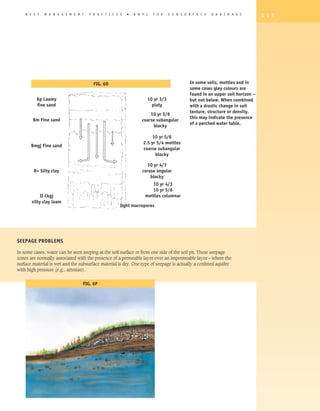
                                       Fig. 6O                                          In some soils, mottles and in
                                                                                        some cases gley colours are
                                                                                        found in an upper soil horizon –
          Ap Loamy                                                10 yr 3/3             but not below. When combined
          fine sand                                                 platy               with a drastic change in soil
                                                                                        texture, structure or density,
                                                                    10 yr 5/6
                                                                                        this may indicate the presence
        Bm Fine sand                                            coarse subangular
                                                                                        of a perched water table.
                                                                     blocky

                                                                    10 yr 5/6
                                                                2.5 yr 5/4 mottles
       Bmgj Fine sand
                                                                coarse subangular
                                                                      blocky

                                                                  10 yr 4/3
        B+ Silty clay                                           corase angular
                                                                    blocky
                                                                    10 yr 4/3
                                                                    10 yr 5/6
            II Ckgj                                              mottles columnar
       silty clay loam
                                                    light macropores


Seepage Problems

In some cases, water can be seen seeping at the soil surface or from one side of the soil pit. These seepage
zones are normally associated with the presence of a permeable layer over an impermeable layer – where the
surface material is wet and the subsurface material is dry. One type of seepage is actually a confined aquifer
with high pressure (e.g., artesian).


                                 Fig. 6p
1 1 6   B E S T    M A N A G E M E N T     P R A C T I C E S       �   A G R I C U L T U R A L    D R A I N A G E


                                                                        FIG. 6q


                       In most cases, some form of subsurface interceptor drainage design is used to correct the problem if it
                       is well-defined. In other cases, more than one drainpipe is required or a gravel-filled trench is needed
                       to cut off groundwater flow. The water is intercepted long before it reaches the ground surface and the
                       drainpipe is installed across (not parallel to) the flowpath.

                          STEPS FOR PLANNING A SUBSURFACE DRAINAGE SySTEM

                       Begin by determining the feasibility of the project. Your investigation should provide a clear
                       understanding of the problem, the kinds and amounts of practices necessary, an estimate of
                       the cost and value of expected benefits, and the impacts of the project. This information can
                       often be obtained from a reconnaissance of a small problem area.
                                 4 Hire a professional, licensed drainage contractor to conduct more detailed
                                   examinations and surveys that determine the size of the area, the drainage
    6.07p                          pattern, and special features where riparian vegetation, wetlands, or rock
                                   outcrops exist.


Environmental
considerations must
be a part of the
cropland drainage
planning process –
including habitat
enhancement or
mitigation where
needed.
B E S T     M A N A G E M E N T   P R A C T I C E S   �   B M P s   F O R   S U B S U R F A C E   D R A I N A G E        1 1 7


    INFORMATION REqUIRED TO hELP PLAN A SUBSURFACE DRAINAGE PROJECT

    STEP                                      INFORMATION NEEDED

    1. RECONNAISSANCE                         • nature and extent of drainage problem
                                              • location and condition of existing drainage system if one already exists
                                              • feasibility of outlet on neighbour’s property – if necessary
                                              • whether activities or conditions on neighbouring property contribute to
                                                drainage problem
                                              • identify any utilities or pipelines

    2. Problem analysis                       • watershed area
                                              • suitability of outlet
                                              • suitability of grades for mains
                                              • drainage system design

    3. Detailed survey and                    • survey information to size watershed and to size field to drain
       check for legal outlet                 • estimate of surface runoff and water volumes/rates of subsurface flow through drains

    4. Design options and costs               • consideration and cost of any regulatory or municipal bylaw requirements
                                                (e.g., proper outlet, protection of wetlands, habitat, utilities and pipelines)
                                              • this step embraces all technical, environmental management , regulatory and
                                                economic information to help you make best business decision

    5. Approvals and funding                  • compliance with any regulatory or municipal bylaw requirements


    BMPS FOR SUBSURFACE DRAINAGE DESIGN

The intent of subsurface drainage is to remove only the necessary quantity of water that
will ensure adequate cropland access and improved crop performance. Beyond that, it’s
important to conserve water to support crop growth during dry periods.
Design is critical. Improper design can lead to poor performance, failure, or repeated repair.
Most drainage projects are designed by licensed contractors.                                                        6.08p
Design factors include:
�   drainpipe location
�   spacing
�   depth
�   alignment
                                                                                                                           All subsurface
�   materials                                                                                                              drainage design
                                                                                                                           should be conducted
�   outlets                                                                                                                by trained and
�   correct drainage coefficient for soil type and crops grown.                                                            licensed drainage
                                                                                                                           contractors.
1 1 8         B E S T    M A N A G E M E N T    P R A C T I C E S   �   A gricultural          D R A I N A G E


                     The following considerations are also part of the system design process:
                     �   legal outlet (see planning section)
                     �   drainage coefficient (drainage rate – see page XX)
                     �   drainage depth and spacing
                     �   cropland slope/topography
                     �   impermeable layers
                     �   drainage pipe material and sizing
                     �   arrangement and systems
                     �   drainage outlets
                     �   surface inlets
                     �   envelopes, e.g., filter
                     �   environmental considerations
                     	            e
                                   .g., quantity of water drained and proximity to natural areas such as wetlands
                                  and riparian areas
                     	            e.g., alternative water uses, such as irrigation storage
                     �   system implementation costs.
                     Design procedures must account for site factors (soil type, depth to water table, hydraulic
                     conductivity) and the variability of soils and drainage requirements across the area to be
                     drained.


For more detailed information on drainage design principles and
practices, see OMAFRA Publication 29, the Drainage Guide for
Ontario. For more information on subsurface drainage and the
Agricultural Tile Drain Installation Act, check the Drainage page on
the OMAFRA website.
http://www.omafra.gov.on.ca/english/landuse/drainage.htm
B E S T   M A N A G E M E N T    P R A C T I C E S   �   B M P s   F O R   S U B S U R F A C E    D R A I N A G E   1 1 9


Interdependent Ecosystems at Work

Farmers can produce high crop yield in a sustain-                                                            Fig. 6R
able way without reducing water quality. To do so,
it must be understood that the soil, and the plant
and animal life it supports, operate as an ecosys-
tem. This soil ecosystem requires that the input
elements (air, sunlight, water and soil particulars)
and plant life and animal life communities be man-
aged as an integrated system. Each one of the input
elements and living communities of that ecosystem
must be kept in balance so as to optimize the pro-
duction of any one of the components.

Cropland agriculture focuses on optimization of the
plant life community of that ecosystem. A common
input element among plant life, both above and
below the soil surface, is water originating in the
form of soil moisture.

Soil Ecosystem

Within the soil ecosystem, the percent moisture
present determines if there’s enough air to allow
eco-life (living organisms) to thrive. Eco-life breaks                                                                  To be effective,
down organic matter, aids nutrient release from organic matter, and assists plants in nutrient retrieval. Large,        drainage systems
healthy plants increase organic matter content in the soil. Increased organic matter contributes to moisture            need to work in
retention and increased eco-life, which increases nutrient availability and the production of glues that hold soil      concert with other
components together. If there’s too much or too little moisture in the soil, interactions are limited – thus plant      farm production
growth and soil stability are reduced.                                                                                  systems – such as
                                                                                                                        nutrient management,
Plant Life Community – Crop Production                                                                                  soil management, and
                                                                                                                        pest management.
Moisture – too much or too little – affects each component of the soil ecosystem and the plant community or
crop production system, and each affected component can affect several others.

	             Example 1:	Soil moisture (wet) -- results in crop disease -- results in need to re-select crop
                          variety or crops used in a crop rotation or in sometimes increased use of pesticides.

	             Example 2:	Soil moisture (wet) -- increases tillage to dry soil -- reduces crop residue to
                          further dry soil -- soil structure is damaged -- allows more flexible weed control
                          program or to reduce crop root disease.[Alison to check w/Don to clarify]

If the decision is made to remove excess water with subsurface drainage, then both the soil ecosystem and the
crop production plant community changes.

Soil eco-life increases soil porosity, and if crop production management will allow the use of a practice like
no-tillage, compaction will be reduced. This in turn allows the retention of crop residue and leaves crop roots
undisturbed in the soil – which in turn allows the organic matter content of the soil to increase and the soil
structure to become more stable.

By reducing soil moisture through the installation of a drainage system, crop management practices can be
deployed to increase water infiltration and percolation – reducing the erosion of soil sediment into outlet drains,
streams, and rivers.
1 2 0    B E S T   M A N A G E M E N T      P R A C T I C E S     �   A G R I C U L T U R A L       D R A I N A G E


                           DRAINAGE COEFFICIENT

                        The drainage coefficient or drainage rate is a design standard that reflects the amount of
                        water that can be drained from a watershed in a 24-hour period. It is the physical capacity
                        of the drainage system, and more specifically the main collector drainpipe. The coefficient is
                        expressed in units of mm/24 hr (in. /24 hr), i.e., surface equivalent. It does not reflect the
                        soil’s ability to transmit the water.
                        Part of the decision process is to ensure the soil and drainage system are balanced with
                        the appropriate drainage coefficient needed for the crops to be grown. In some cases,
                        expectations may have to be adjusted as some soils will not allow gravitational water to
                        move at the desired rate needed to protect the proposed crop.
                        The most common drainage coefficient used in Ontario is 12 mm/day (0.5 in. /day) for cash
                        crops on average soils. In other words, a drainage system designed to a 12 mm drainage
                        coefficient would be capable of removing 12 mm of excess water from the entire subsurface-
                        drained area over a 24-hour period.
                        If there is a heavier rain and more than 12 mm/24 hr needs to be removed, it would take
                        longer to remove the excess water. Higher drainage coefficient rates are sometimes used for
                        crops that are more susceptible to damage from excess moisture.
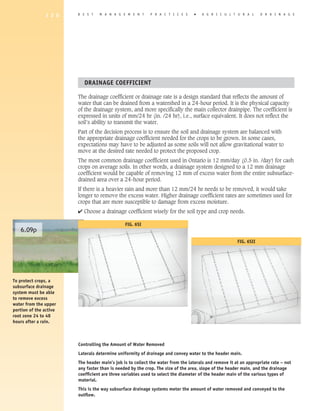
                        4 Choose a drainage coefficient wisely for the soil type and crop needs.

                                               FIG. 6SI
   6.09p
                                                                                                       FIG. 6SII


To protect crops, a
subsurface drainage
system must be able
to remove excess
water from the upper
portion of the active
root zone 24 to 48
hours after a rain.


                        Controlling the Amount of Water Removed
                        Laterals determine uniformity of drainage and convey water to the header main.
                        The header main’s job is to collect the water from the laterals and remove it at an appropriate rate – not
                        any faster than is needed by the crop. The size of the area, slope of the header main, and the drainage
                        coefficient are three variables used to select the diameter of the header main of the various types of
                        material.
                        This is the way subsurface drainage systems meter the amount of water removed and conveyed to the
                        outflow.
B E S T   M A N A G E M E N T   P R A C T I C E S   �   B M P s   F O R   S U B S U R F A C E   D R A I N A G E   1 2 1


Watershed characteristics such as intended land use, soil type, and proportion of watershed
to be drained under forest cover [Alison to confirm wording] should be considered in the
selection of an appropriate drainage coefficient.
The drainage coefficient method of drainpipe design is the most common design method
used in agricultural applications
                                                                                                                  6.10p
Check the Drainage Guide for more information on drainage rate and other design ratings
based on mapped soil series.

   DRAINAGE DEPTh AND SPACING

Drainpipes used for 100 mm (4 in.) laterals should be deep enough to prevent damage from
tillage operations and the weight of the equipment – a minimum of 600 mm or 24 inches of
cover.
Check the Drainage Guide for recommended depth and spacing criteria related to the
individual soil series as mapped and published in regional and county soil survey reports.
Laterals' depth and spacing are linked, and should be selected jointly. Laterals must
be shallow enough to provide timely drainage, deep enough to remove excess water from
the root zone, and spaced appropriately to get uniform drainage at the soil surface. The goal
is to remove only the water that will impede proper crop growth.
Main and sub-main drains must be deep enough to provide an easy connection point and
a good outlet for lateral drains. Also, the maximum depth at which drains can be laid to
withstand trench loading varies with the width of the trench and the crushing strength of
the drainpipe to be used. Typical depths of header mains are in the range of 900–1200 mm
(36–48 in.) deep, but can be deeper as dictated by topography. A header main is there for
the primary purpose of transporting water to the outlet

   IMPERMEABLE LAyERS

The influence of an impermeable layer on the behaviour of a groundwater table depends
on its depth below the level of drainpipe and on the drainpipe spacing. The flow pattern
and rate of the water moving toward the drain can be altered drastically by an impermeable
layer (such as dense, compacted, or heavier subsoil).
Most drainpipe spacing in Ontario is close enough together not to be affected by the
impermeable layer as long as the drainpipe is installed above it. Where the drainpipe needs
to be installed in the impermeable layer in order to get adequate depth and cover, the
impermeable layer can have a major affect. Regardless of the soil above the impermeable
layer, the rate of water movement to the drainpipe is greatly controlled by the impermeable
layer.
There are various options available to overcome this problem – each with a cost associated
with it. It is best to consult with a licensed drainage contractor or experienced drainage
designer for options. Each situation is unique. In some cases, a decision may need to be
made whether subdrainage will be effective at all.
1 2 2   B E S T   M A N A G E M E N T      P R A C T I C E S       �   A gricultural             D R A I N A G E


                                                         Fig. 6T


        When impermeable layers are encountered, the pipes need to be placed closer together to achieve the
        effect they would have in a deep permeable soil. However, if the depth of the impermeable layer below
        pipe level exceeds a fourth of the drain spacing, the flow system can be treated as if such a layer were
        absent.

           Drainpipe and Sizing

        The maximum amount of water a drainage pipe can carry (its flow capacity) depends on
        the drainpipe's inside diameter, the installation grade, and the inside drainpipe surface
        roughness.
        In the farm drainage industry, a more common way of reflecting drainage pipe capacity
        is the number of acres that can be drained through a particular diameter of drainage pipe.
        [Alison to get clarification on length/spacing vis-a-vis no. of acres]
B E S T   M A N A G E M E N T   P R A C T I C E S   �   B M P s   F O R     S U B S U R F A C E   D R A I N A G E           1 2 3


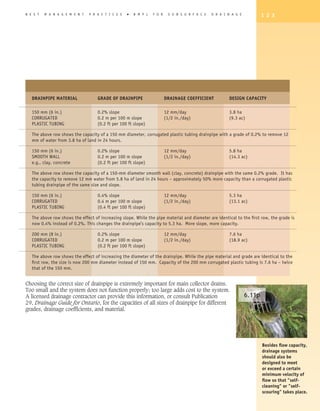
   DRAINPIPE MATERIAL               GRADE OF DRAINPIPE                    DRAINAGE COEFFICIENT            DESIGN CAPACITy

   150 mm (6 in.)                   0.2% slope                            12 mm/day                       3.8 ha
   CORRUGATED                       0.2 m per 100 m slope                 (1/2 in./day)                   (9.3 ac)
   PLASTIC TUBING                   (0.2 ft per 100 ft slope)

   The above row shows the capacity of a 150 mm diameter, corrugated plastic tubing drainpipe with a grade of 0.2% to remove 12
   mm of water from 3.8 ha of land in 24 hours.

   150 mm (6 in.)                   0.2% slope                            12 mm/day                       5.8 ha
   SMOOTH WALL                      0.2 m per 100 m slope                 (1/2 in./day)                   (14.3 ac)
   e.g., clay, concrete             (0.2 ft per 100 ft slope)

   The above row shows the capacity of a 150-mm diameter smooth wall (clay, concrete) drainpipe with the same 0.2% grade. It has
   the capacity to remove 12 mm water from 5.8 ha of land in 24 hours – approximately 50% more capacity than a corrugated plastic
   tubing drainpipe of the same size and slope.

   150 mm (6 in.)                   0.4% slope                            12 mm/day                       5.3 ha
   CORRUGATED                       0.4 m per 100 m slope                 (1/2 in./day)                   (13.1 ac)
   PLASTIC TUBING                   (0.4 ft per 100 ft slope)

   The above row shows the effect of increasing slope. While the pipe material and diameter are identical to the first row, the grade is
   now 0.4% instead of 0.2%. This changes the drainpipe’s capacity to 5.3 ha. More slope, more capacity.

   200 mm (8 in.)                   0.2% slope                            12 mm/day                       7.6 ha
   CORRUGATED                       0.2 m per 100 m slope                 (1/2 in./day)                   (18.9 ac)
   PLASTIC TUBING                   (0.2 ft per 100 ft slope)

   The above row shows the effect of increasing the diameter of the drainpipe. While the pipe material and grade are identical to the
   first row, the size is now 200 mm diameter instead of 150 mm. Capacity of the 200 mm corrugated plastic tubing is 7.6 ha – twice
   that of the 150 mm.


Choosing the correct size of drainpipe is extremely important for main collector drains.
Too small and the system does not function properly; too large adds cost to the system.
A licensed drainage contractor can provide this information, or consult Publication                                 6.11p
29, Drainage Guide for Ontario, for the capacities of all sizes of drainpipe for different
grades, drainage coefficients, and material.


                                                                                                                            Besides flow capacity,
                                                                                                                            drainage systems
                                                                                                                            should also be
                                                                                                                            designed to meet
                                                                                                                            or exceed a certain
                                                                                                                            minimum velocity of
                                                                                                                            flow so that self-
                                                                                                                            cleaning or self-
                                                                                                                            scouring takes place.
1 2 4   B E S T   M A N A G E M E N T     P R A C T I C E S       �   A gricultural            D R A I N A G E


                                                        Fig. 6u


        A drainpipe’s flow capacity is the maximum amount of water it can carry. Flow capacity depends on the
        drainpipe's inside diameter, the installation grade, and the drainpipe’s surface roughness.

          Layouts and Systems

        When selecting a layout pattern for a particular field or topography, aim for the following.
        4 Orient lateral drains nearly parallel to the field's contours, crossing the slope – not straight
          
          up and down. This way, water flowing downslope can be intercepted by laterals and the
          system will function more effectively and produce more uniform results.
        4 Orient lateral drains askew to tillage and planting pattern. This ensures that tracking of
          
          heavy equipment will be across the drainpipe and not lengthwise, thus reducing potential
          for damage. Also, tillage or row planting can alter the flow path of surface water. An
          askew pattern of drainage will ensure water flowing will be better intercepted by laterals
          and more uniform drainage.
        4 Minimize the number of short lateral drains to reduce costs. Each lateral requires
          
          excavation to start installation and a connection to header main.
        4 Balance the number and size of header mains for capacity and to reduce costs.
        4 Minimize the number of outlets to reduce costs and maintenance.
        Usually, not all of these objectives can be attained at the same time. A well-designed system
        will balance function with cost. Communication between the landowner and a licensed
        drainage contractor is must.
        Remember, a drainage system lasts a lifetime, and a little extra cost in the beginning is often
        an excellent investment in the long run.
B E S T   M A N A G E M E N T     P R A C T I C E S   �   B M P s   F O R   S U B S U R F A C E   D R A I N A G E   1 2 5


                                                      Fig. 6v


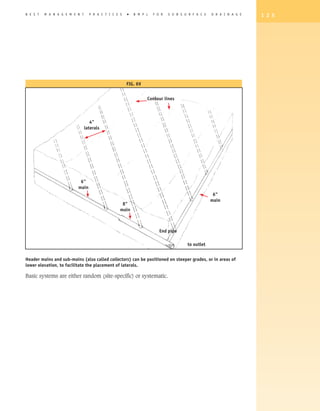
                                                                Contour lines


                                   4
                                laterals


                           6
                          main
                                                                                                   6
                                                                                                  main
                                                   8
                                                  main


                                                                       End pipe

                                                                                     to outlet


Header mains and sub-mains (also called collectors) can be positioned on steeper grades, or in areas of
lower elevation, to facilitate the placement of laterals.

Basic systems are either random (site-specific) or systematic.
1 2 6   B E S T   M A N A G E M E N T       P R A C T I C E S       �   A gricultural              D R A I N A G E


                                                          Fig. 6W


        Random System (site-specific)
        The header main is generally placed near the lowest natural depression, and smaller drainpipes branch
        off to drain the wet areas. Because such drains often become outlets for a more complete system
        established in the higher areas of the field, the depth, location, and capacity of the random lines should
        be considered as part of a complete drainage system.
        Systematic Systems
        Systematic patterns drain larger areas. There are two types: parallel and herringbone.
        The parallel field drainage pattern consists of laterals that are perpendicular to the main drain or sub-
        main. In most cases, the laterals run parallel to a field boundary. Variations of this system are often used
        with other patterns
        The herringbone field drainage pattern consists of laterals that enter the main drain at an angle,
        generally from both sides. This system can be used in place of the parallel pattern. It can also be used
        where the main is located on the major slope and the lateral grade is obtained by angling the laterals
        across slope. This pattern may be used with other patterns in laying out a composite system in small or
        irregular areas.

        4  lign laterals across the slope, which ensures that the general movement of both surface water and
          A
          groundwater is across the lateral drainpipe line.
        This improves the potential to capture the water for drainage, and makes drainage more uniform.
        Herringbone systems can more easily achieve these objectives than the parallel system. However, in
        general herringbone systems cost more to install than parallel systems, as usually there are more mains
        to install and more tap connections to be made to the main.
        The option of choosing the type of system layout is only available in new systems, or with complete
        system replacements.
B E S T   M A N A G E M E N T   P R A C T I C E S   �   B M P s   F O R   S U B S U R F A C E   D R A I N A G E   1 2 7


                                                    FIG. 6X


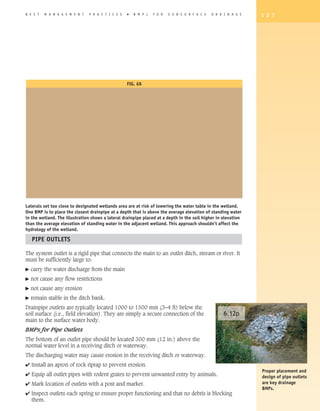
Laterals set too close to designated wetlands area are at risk of lowering the water table in the wetland.
One BMP is to place the closest drainpipe at a depth that is above the average elevation of standing water
in the wetland. The illustration shows a lateral drainpipe placed at a depth in the soil higher in elevation
than the average elevation of standing water in the adjacent wetland. This approach shouldn’t affect the
hydrology of the wetland.

    PIPE OUTLETS

The system outlet is a rigid pipe that connects the main to an outlet ditch, stream or river. It
must be sufficiently large to:
�   carry the water discharge from the main
�   not cause any flow restrictions
�   not cause any erosion
�   remain stable in the ditch bank.
Drainpipe outlets are typically located 1000 to 1500 mm (3–4 ft) below the
soil surface (i.e., field elevation). They are simply a secure connection of the                      6.12p
main to the surface water body.
BMPs for Pipe Outlets
The bottom of an outlet pipe should be located 300 mm (12 in.) above the
normal water level in a receiving ditch or waterway.
The discharging water may cause erosion in the receiving ditch or waterway.
4 Install an apron of rock riprap to prevent erosion.
                                                                                                                  Proper placement and
4 Equip all outlet pipes with rodent grates to prevent unwanted entry by animals.                                 design of pipe outlets
4 Mark location of outlets with a post and marker.                                                                are key drainage
                                                                                                                  BMPs.
4 Inspect outlets each spring to ensure proper functioning and that no debris is blocking
  them.
1 2 8    B E S T   M A N A G E M E N T     P R A C T I C E S    �   A G R I C U L T U R A L          D R A I N A G E


                                CONSTRUCTION ChALLENGES

                              Sedimentation – Drainpipe Plugging
                              Fine and very fine sands and silts are not sticky, which means it’s easier for them to move
                              through the orifices and into subsurface drainpipe.
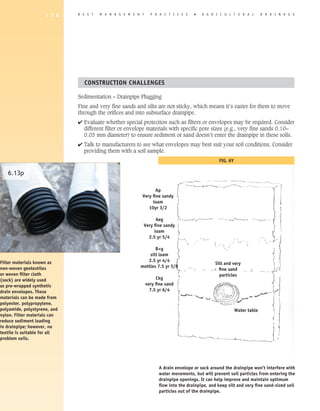
                              4 Evaluate whether special protection such as filters or envelopes may be required. Consider
                                different filter or envelope materials with specific pore sizes (e.g., very fine sands 0.10–
                                0.05 mm diameter) to ensure sediment or sand doesn’t enter the drainpipe in these soils.
                              4 Talk to manufacturers to see what envelopes may best suit your soil conditions. Consider
                                providing them with a soil sample.
                                                                                                  FIG. 6y

   6.13p

                                                                 Ap
                                                          Very fine sandy
                                                               loam
                                                             10yr 3/2

                                                                Aeg
                                                          Very fine sandy
                                                               loam
                                                            2.5 yr 5/4

                                                                B+g
                                                             silt loam
Filter materials known as                                   2.5 yr 4/4
                                                                                                Silt and very
non-woven geotextiles                                    mottles 7.5 yr 5/8
                                                                                                  fine sand
or woven filter cloth                                                                             particles
(sock) are widely used                                             Ckg
as pre-wrapped synthetic                                      very fine sand
drain envelopes. These                                          7.5 yr 6/4
materials can be made from
polyester, polypropylene,
polyamide, polystyrene, and                                                                                 Water table
nylon. Filter materials can
reduce sediment loading
in drainpipe; however, no
textile is suitable for all
problem soils.


                                                                    A drain envelope or sock around the drainpipe won’t interfere with
                                                                    water movements, but will prevent soil particles from entering the
                                                                    drainpipe openings. It can help improve and maintain optimum
                                                                    flow into the drainpipe, and keep silt and very fine sand-sized soil
                                                                    particles out of the drainpipe.
B E S T   M A N A G E M E N T   P R A C T I C E S   �   B M P s   F O R   S U B S U R F A C E   D R A I N A G E   1 2 9


Ochre, an iron oxide, affects about 2% of drainage systems in Ontario. It occurs in two soil
conditions: acidic sands and poorly drained sands.
Ochre accumulates through chemical or microbiological processes, or both. It’s a natural
condition usually found where new land – sandy in nature with high organic matter – is
cleared and drained. Recognized by brilliant red deposits at drain outfalls, iron ochre can
seal drain openings very quickly.
At present there are no long-term solutions. If you encounter ochre:
�   plan to replace or abandon the original system when it fails
�   flush drainpipe with high-pressure water to provide temporary relief.
Connecting Old Drainage System to New System
If existing lateral pipes are relatively new, clean and not full of sediment, they are probably
working. They can be hooked into new drainpipe.
However, if they are full of sediment, then relieve [Alison to clarify] with crushed stone. Do
not directly connect the two systems, as the old system may add excessive sediment to the
new installation.

    Seepage Control

Broad, flat areas that are wet due to seepage from adjoining highlands, springs, seepage
lines at two different layers of soil etc. can benefit from interception drains.
Interception drains are installed at right angles to the flow of groundwater to intercept
subsurface flows.
1 3 0   B E S T     M A N A G E M E N T       P R A C T I C E S          �   A gricultural                D R A I N A G E


                                                               Fig. 6Z


        Subsurface drainpipe for interception of seepage must be located properly to drain wet areas caused by
        upslope water. In steeply graded depressions or draws, a layout may include a main or sub-main drain
        in the draw or to one side of the draw, with the interceptor lines across the slope on grades slightly off-
        contour.


         Summary of Siting Recommendations for Manure Storage Facilities

         If you store manure, a number of legal separation distances relating to surface and groundwater may apply to
         your facility. These could include specific setbacks from wells, site investigations, observation stations for sub-
         surface drains within 15 metres (49 ft) of a manure storage, and structural design.

         Here is a summary of setbacks for new or expanding permanent manure storage facilities:
         �   a minimum of 24 metres (76 ft) from a drilled well that is at least 15 metres (49 ft) deep
         �   and has a 6 metre (20 ft) casing from the soil surface
         �   at least 151 metres (501 ft) from a municipal well
         �   at least 46 metres (151 ft) from any other well
         �   a
              t least 24 metres (76 ft) from a drainpipe – whether existing or to be constructed, and with a flow-path that
             is at least 50 metres (164 ft) from the nearest surface water.


                                   Manure = fecal material + undigested feed + urine + bedding +
                                   uncontaminated water + wastewater + other wastes.
                                   It bears repeating: when managing manure, account for all
                                   materials – especially liquids.
B E S T   M A N A G E M E N T   P R A C T I C E S    �   B M P s   F O R   S U B S U R F A C E   D R A I N A G E   1 3 1


                                                    FIG. 6AA


   BMPS FOR INSTALLING SUBSURFACE DRAINAGE
   BEFORE CONSTRUCTION

All agricultural subsurface drainage systems must be installed in accordance with the
Agricultural Tile Drainage Installation Act. The act requires that each drainage contractor
hold a valid licence to install subsurface drainage systems on agricultural land, that each
tile drainage machine be licensed, and that each operator of a drainage machine be licensed.
Landowners installing subsurface drains on their own farm with their own equipment are
exempt.
Review the Construction section of OMAFRA Publication 29, Drainage Guide for Ontario.
It defines the minimum standard for workmanship, materials, and methods of construction
acceptable for the installation of subsurface drains.
See back cover for contact information. A list of drainage contractors is available from your
nearest OMAFRA regional information office and the Land Improvement Contractors’ of
Ontario (LICO) website – www.drainage.org

   BMP ChECKLIST FOR LANDOWNERS
                                                                                                                    6.14p
Landowner Checklist – Before Construction
4 Seek professional advice to verify that subsurface drainage will be a good investment.
4 Have the soil examined if there’s some doubt of its drainage properties (see section on
  diagnostics)
4 ensure soil is suitable for a subsurface drainage system.
4 Discharge water at a location where collected water can be legally discharged without
  adversely affecting downstream landowners, e.g., natural watercourses, agreement
  drains, municipal drains:
1 3 2   B E S T   M A N A G E M E N T      P R A C T I C E S   �   A gricultural             D R A I N A G E


        4  etermine whether a satisfactory outlet is available for the proposed work on the your
          d
          property
        4 f not, negotiate agreements, in writing, with neighbours and other parties to obtain
          i
          authority to enter their property [add: in order to access outlet?]
        4 f this does not work out, consider a petition for a municipal drain under the Drainage Act
          i
          – see section 7.
        4  heck with your local CA regarding regulatory requirements, e.g., Clean Water
          C
          Act, Conservation Authorities Act -- source water protection, section 28, localized
          requirements or restrictions
        4  isit the municipal office to ensure municipal drain requirements will be met. [add more
          V
          detail?]
        4 Ensure financing is in place to complete the project.
        4 Locate existing drainage plans of the farm.
        4 Obtain a plan for the entire farm, even though only a part is to be drained.
        4  lan with consideration for drainage of upslope watersheds or neighbouring farms’
          P
          drainage flow.
        4 Ensure the contractor is aware of the location and existence of gas and oil lines,
          
          telephone lines, hydro lines, water lines, and septic beds. In other words, over and above
          knowledge of your own utilities – “Call before you dig.”
        4 Arrange mutual agreements and easements (hydro and other utilities) in advance. [add
          
          more detail?]
        4 Ensure that the contractor is aware of the location of manure storages and transfer
          
          systems so that requirements for distance separation under the Nutrient Management Act
          can be accounted for when designing the drainage system.
        4 Discuss the removal and/or repair of fencing and access of livestock to the work area, or
          
          any other on-farm practices that the contractor should know about.
        4 Point out the location of existing subsurface drains to the contractor.
        4  o avoid the risk of soil compaction, install drains in the summer or fall whenever
          T
          possible
        	         �   c
                       rop damage can be as little as 10% when drains are constructed with care
                      through crops
        	         �   m
                       ake use of strategic crop rotation planning, e.g., field to be drained is planted in
                      wheat or hay
        	         �   c
                       onstruction should be in reasonably dry soil so its structure is not destroyed and
                      drainability impaired – if the field is dry enough to work, it’s dry enough to install
                      drains.
B E S T   M A N A G E M E N T   P R A C T I C E S   �   B M P s   F O R   S U B S U R F A C E   D R A I N A G E   1 3 3


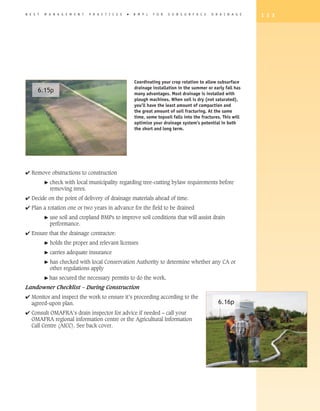
                                                        Coordinating your crop rotation to allow subsurface
                                                        drainage installation in the summer or early fall has
      6.15p                                             many advantages. Most drainage is installed with
                                                        plough machines. When soil is dry (not saturated),
                                                        you’ll have the least amount of compaction and
                                                        the great amount of soil fracturing. At the same
                                                        time, some topsoil falls into the fractures. This will
                                                        optimize your drainage system’s potential in both
                                                        the short and long term.


4 Remove obstructions to construction
          �   check with local municipality regarding tree-cutting bylaw requirements before
              removing trees.
4 Decide on the point of delivery of drainage materials ahead of time.
4 Plan a rotation one or two years in advance for the field to be drained
          �   use soil and cropland BMPs to improve soil conditions that will assist drain
              performance.
4 Ensure that the drainage contractor:
          �   holds the proper and relevant licenses
          �   carries adequate insurance
          �   has checked with local Conservation Authority to determine whether any CA or
              other regulations apply
          � has   secured the necessary permits to do the work.
Landowner Checklist – During Construction
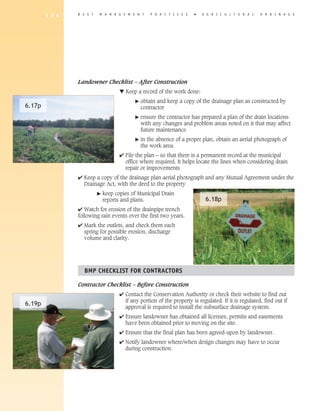
4 Monitor and inspect the work to ensure it’s proceeding according to the
  agreed-upon plan.                                                                                6.16p
4 Consult OMAFRA’s drain inspector for advice if needed – call your
  OMAFRA regional information centre or the Agricultural Information
  Call Centre (AICC). See back cover.
1 3 4   B E S T   M A N A G E M E N T       P R A C T I C E S   �   A G R I C U L T U R A L   D R A I N A G E


                Landowner Checklist – After Construction
                                     ▼ Keep a record of the work done:
                                            �   obtain and keep a copy of the drainage plan as constructed by
6.17p                                           contractor
                                            �   ensure the contractor has prepared a plan of the drain locations
                                                with any changes and problem areas noted on it that may affect
                                                future maintenance
                                            �   in the absence of a proper plan, obtain an aerial photograph of
                                                the work area.
                                     4 File the plan – so that there is a permanent record at the municipal
                                       office where required. It helps locate the lines when considering drain
                                       repair or improvements
                4 Keep a copy of the drainage plan aerial photograph and any Mutual Agreement under the
                  Drainage Act, with the deed to the property
                          �   keep copies of Municipal Drain
                              reports and plans.                             6.18p
                4 Watch for erosion of the drainpipe trench
                following rain events over the first two years.
                4 Mark the outlets, and check them each
                  spring for possible erosion, discharge
                  volume and clarity.


                  BMP ChECKLIST FOR CONTRACTORS

                Contractor Checklist – Before Construction
                                     4 Contact the Conservation Authority or check their website to find out
                                       if any portion of the property is regulated. If it is regulated, find out if
6.19p                                  approval is required to install the subsurface drainage system.
                                     4 Ensure landowner has obtained all licenses, permits and easements
                                       have been obtained prior to moving on the site.
                                     4 Ensure that the final plan has been agreed-upon by landowner.
                                     4 Notify landowner where/when design changes may have to occur
                                       during construction.
B E S T    M A N A G E M E N T   P R A C T I C E S   �   B M P s   F O R   S U B S U R F A C E   D R A I N A G E     1 3 5


4 Inspect the site with the owner to ensure adequate outlets are available, utilities have
  been located, and possible problems identified (e.g., the soil is not drainable)
            �   inspect the soil profile to below drain depth
            �   advise the owner regarding necessary notices to third parties.
4 Agree with the owner on the financial costs and how and to whom the costs are to be
  paid.
4 Determine whether there is an adequate outlet.
4 Review Occupational Health and Safety Act requirements for health and safety on the job
  site, and remind workers of them.


          Conservation Authority regulations may apply to some
          cropland, e.g., where wetlands or floodplains occur. Consult the
          local CA prior to undertaking any subsurface drainage work.


Contractor Checklist – During Construction
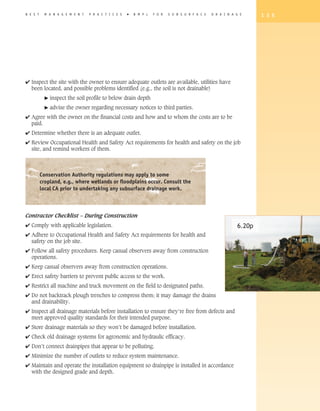
4 Comply with applicable legislation.                                                                        6.20p
4 Adhere to Occupational Health and Safety Act requirements for health and
  safety on the job site.
4 Follow all safety procedures. Keep casual observers away from construction
  operations.
4 Keep casual observers away from construction operations.
4 Erect safety barriers to prevent public access to the work.
4 Restrict all machine and truck movement on the field to designated paths.
4 Do not backtrack plough trenches to compress them; it may damage the drains
  and drainability.
4 Inspect all drainage materials before installation to ensure they’re free from defects and
  meet approved quality standards for their intended purpose.
4 Store drainage materials so they won’t be damaged before installation.
4 Check old drainage systems for agronomic and hydraulic efficacy.
4 Don’t connect drainpipes that appear to be polluting.
4 Minimize the number of outlets to reduce system maintenance.
4 Maintain and operate the installation equipment so drainpipe is installed in accordance
  with the designed grade and depth.
1 3 6         B E S T    M A N A G E M E N T         P R A C T I C E S   �   A G R I C U L T U R A L   D R A I N A G E


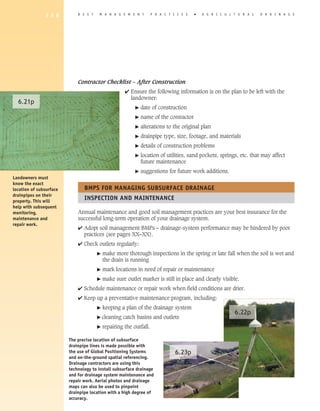
                             Contractor Checklist – After Construction
                                                     4 Ensure the following information is on the plan to be left with the
                                                       landowner:
  6.21p
                                                          �   date of construction
                                                          �   name of the contractor
                                                          �   alterations to the original plan
                                                          �   drainpipe type, size, footage, and materials
                                                          �   details of construction problems
                                                          �   location of utilities, sand pockets, springs, etc. that may affect
                                                              future maintenance
                                                          �   suggestions for future work additions.
Landowners must
know the exact
location of subsurface          BMPS FOR MANAGING SUBSURFACE DRAINAGE
drainpipes on their
property. This will
                                INSPECTION AND MAINTENANCE
help with subsequent
monitoring,                  Annual maintenance and good soil management practices are your best insurance for the
maintenance and              successful long-term operation of your drainage system.
repair work.
                             4 Adopt soil management BMPs – drainage-system performance may be hindered by poor
                               practices (see pages XX–XX).
                             4 Check outlets regularly:
                                       �   make more thorough inspections in the spring or late fall when the soil is wet and
                                           the drain is running
                                       �   mark locations in need of repair or maintenance
                                       �   make sure outlet marker is still in place and clearly visible.
                             4 Schedule maintenance or repair work when field conditions are drier.
                             4 Keep up a preventative maintenance program, including:
                                       �   keeping a plan of the drainage system
                                                                                                          6.22p
                                       � cleaning   catch basins and outlets
                                       �   repairing the outfall.

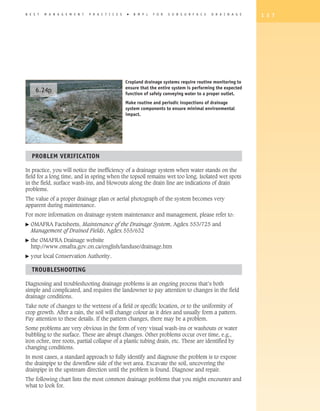
                         The precise location of subsurface
                         drainpipe lines is made possible with
                         the use of Global Positioning Systems                 6.23p
                         and on-the-ground spatial referencing.
                         Drainage contractors are using this
                         technology to install subsurface drainage
                         and for drainage system maintenance and
                         repair work. Aerial photos and drainage
                         maps can also be used to pinpoint
                         drainpipe location with a high degree of
                         accuracy.
B E S T   M A N A G E M E N T   P R A C T I C E S   �   B M P s   F O R   S U B S U R F A C E   D R A I N A G E   1 3 7


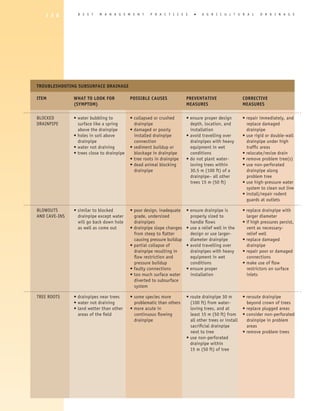
                                                    Cropland drainage systems require routine monitoring to
                                                    ensure that the entire system is performing the expected
      6.24p                                         function of safely conveying water to a proper outlet.
                                                    Make routine and periodic inspections of drainage
                                                    system components to ensure minimal environmental
                                                    impact.


    PROBLEM VERIFICATION

In practice, you will notice the inefficiency of a drainage system when water stands on the
field for a long time, and in spring when the topsoil remains wet too long. Isolated wet spots
in the field, surface wash-ins, and blowouts along the drain line are indications of drain
problems.
The value of a proper drainage plan or aerial photograph of the system becomes very
apparent during maintenance.
For more information on drainage system maintenance and management, please refer to:
�   OMAFRA Factsheets, Maintenance of the Drainage System, Agdex 553/725 and
    Management of Drained Fields, Agdex 555/632
�   the OMAFRA Drainage website
    http://www.omafra.gov.on.ca/english/landuse/drainage.htm
�   your local Conservation Authority.

    TROUBLEShOOTING

Diagnosing and troubleshooting drainage problems is an ongoing process that’s both
simple and complicated, and requires the landowner to pay attention to changes in the field
drainage conditions.
Take note of changes to the wetness of a field or specific location, or to the uniformity of
crop growth. After a rain, the soil will change colour as it dries and usually form a pattern.
Pay attention to these details. If the pattern changes, there may be a problem.
Some problems are very obvious in the form of very visual wash-ins or washouts or water
bubbling to the surface. These are abrupt changes. Other problems occur over time, e.g.,
iron ochre, tree roots, partial collapse of a plastic tubing drain, etc. These are identified by
changing conditions.
In most cases, a standard approach to fully identify and diagnose the problem is to expose
the drainpipe to the downflow side of the wet area. Excavate the soil, uncovering the
drainpipe in the upstream direction until the problem is found. Diagnose and repair.
The following chart lists the most common drainage problems that you might encounter and
what to look for.
1 3 8          B E S T   M A N A G E M E N T     P R A C T I C E S       �   A gricultural                  D R A I N A G E


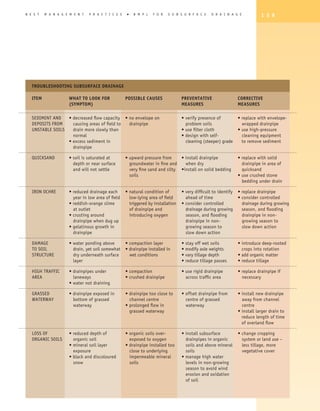
TROUBLESHOOTING SUBSURFACE DRAINAGE

ITEM 	           WHAT TO LOOK FOR	 POSSIBLE CAUSES	                      PREVENTATIVE 	 CORRECTIVE
	                (SYMPTOM)		                                             MEASURES	 MEASURES

BLOCKED 	   • water bubbling to	        • collapsed or crushed	    • ensure proper design	             • repair immediately, and
DRAINPIPE 	   surface like a spring	      drainpipe	                 depth, location, and	               replace damaged
	             above the drainpipe	      • damaged or poorly	         installation	                       drainpipe
	           • holes in soil above	        installed drainpipe	     • avoid travelling over	            • use rigid or double-wall
	             drainpipe	                  connection	                drainpipes with heavy	              drainpipe under high
	           • water not draining	       • sediment buildup or	       equipment in wet	                   traffic areas
	           • trees close to drainpipe	   blockage in drainpipe	     conditions	                       • relocate/resize drain
		                                      • tree roots in drainpipe	 • do not plant water-	              • remove problem tree(s)
		                                      • dead animal blocking	      loving trees within	              • use non-perforated
		                                        drainpipe	                 30.5 m (100 ft) of a 	              drainpipe along
			                                                                  drainpipe– all other	               problem tree
			                                                                  trees 15 m (50 ft)	               • use high-pressure water
				                                                                                                     system to clean out line
				                                                                                                   • install/repair rodent
				                                                                                                     guards at outlets

BLOWOUTS 	    • similar to blocked	        • poor design, inadequate	    • ensure drainpipe is	        • replace drainpipe with
AND CAVE-INS	   drainpipe except water	      grade, undersized	            properly sized to	            larger diameter
	               will go back down hole	      drainpipes	                   handle flows	               • if high pressures persist,
	               as well as come out	       • drainpipe slope changes	    • use a relief well in the	     vent as necessary-
		                                           from steep to flatter	        design or use larger-	        relief well
		                                           causing pressure buildup	     diameter drainpipe	         • replace damaged
		                                         • partial collapse of	        • avoid travelling over	        drainpipe
		                                           drainpipe resulting in	       drainpipes with heavy	      • repair poor or damaged
		                                           flow restriction and	         equipment in wet	             connections
		                                           pressure buildup	             conditions	                 • make use of flow
		                                         • faulty connections	         • ensure proper	                restrictors on surface
		                                         • too much surface water	       installation	                 inlets
		                                           diverted to subsurface
		                                           system

TREE ROOTS	 • drainpipes near trees	  • some species more	       • route drainpipe 30 m	               • reroute drainpipe
	           • water not draining	       problematic than others	   (100 ft) from water-	                 beyond crown of trees
	           • land wetter than other	 • more acute in	             loving trees, and at	               • replace plugged areas
	             areas of the field	       continuous flowing	        least 15 m (50 ft) from	            • consider non-perforated
		                                      drainpipe	                 all other trees or install	           drainpipe in problem
			                                                                sacrificial drainpipe	                areas
			                                                                next to tree	                       • remove problem trees
			                                                              •  se non-perforated
                                                                   u
                                                                   drainpipe within
                                                                   15 m (50 ft) of tree
B E S T   M A N A G E M E N T   P R A C T I C E S   �   B M P s   F O R    S U B S U R F A C E   D R A I N A G E          1 3 9


   TROUBLESHOOTING SUBSURFACE DRAINAGE

   ITEM 	            WHAT TO LOOK FOR	 POSSIBLE CAUSES	                          PREVENTATIVE 	 CORRECTIVE
   	                 (SYMPTOM)		                                                 MEASURES	 MEASURES

   SEDIMENT AND 	 • decreased flow capacity	 • no envelope on	                   • verify presence of	       • replace with envelope-
   DEPOSITS FROM 	   causing areas of field to	 drainpipe	                         problem soils	              wrapped drainpipe
   UNSTABLE SOILS 	 drain more slowly than		                                     • use filter cloth	         • use high-pressure
   	                 normal		                                                    • design with self-	          cleaning equipment
   	               • excess sediment in		                                          cleaning (steeper) grade	   to remove sediment
   	                 drainpipe

   QUICKSAND	 • soil is saturated at	  • upward pressure from	     • install drainpipe	                       • replace with solid
   	            depth or near surface	   groundwater in fine and	 when dry	                                     drainpipe in area of
   	            and will not settle	     very fine sand and silty	 •install on solid bedding	                   quicksand
   		                                    soils		                                                              • use crushed stone
   				                                                                                                         bedding under drain

   IRON OCHRE	       • reduced drainage each	 • natural condition of	        • very difficult to identify	 • replace drainpipe
   	                   year in low area of field	 low-lying area of field	     ahead of time	              • consider controlled
   	                 • reddish-orange slime	      triggered by installation	 • consider controlled	          drainage during growing
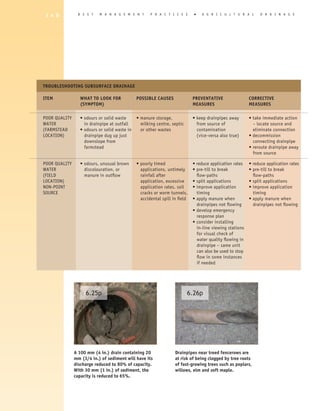
   	                   at outlet	                 of drainpipe and	            drainage during growing	      season, and flooding
   	                 • crusting around	           introducing oxygen	          season, and flooding	         drainpipe in non-
   	                   drainpipe when dug up		                                 drainpipe in non-	            growing season to
   	                 • gelatinous growth in		                                  growing season to	            slow down action
   	                   drainpipe		                                             slow down action

   DAMAGE	           • water ponding above	      • compaction layer	             • stay off wet soils	        • introduce deep-rooted
   TO SOIL	            drain, yet soil somewhat	 • drainpipe installed in	       • modify axle weights	         crops into rotation
   STRUCTURE	          dry underneath surface	     wet conditions	               • vary tillage depth	        • add organic matter
   	                   layer		                                                   • reduce tillage passes	     • reduce tillage

   HIGH TRAFFIC 	    • drainpipes under 	           • compaction	                • use rigid drainpipe	       • replace drainpipe if
   AREA	               laneways	                    • crushed drainpipe	           across traffic area	         necessary
   	                 • water not draining

   GRASSED	  • drainpipe exposed in	                • drainpipe too close to	 • offset drainpipe from	        • install new drainpipe
   WATERWAY	   bottom of grassed 	                    channel centre	           centre of grassed	              away from channel
   	           waterway	                            • prolonged flow in	        waterway	                       centre
   		                                                 grassed waterway		                                      • nstall larger drain to
                                                                                                                i
                                                                                                                reduce length of time
                                                                                                                of overland flow

   LOSS OF 	      • reduced depth of	       • organic soils over-	               • install subsurface	      • change cropping
   ORGANIC SOILS	   organic soil	             exposed to oxygen	                   drainpipes in organic	     system or land use –
   	              • mineral soil layer 	    • drainpipe installed too	             soils and above mineral	   less tillage, more
   	                exposure	                 close to underlying	                 soils	                     vegetative cover
   	              • black and discoloured 	   impermeable mineral	               • manage high water
   	                snow	                     soils	                               levels in non-growing
   			                                                                             season to avoid wind
   			                                                                             erosion and oxidation
   			                                                                             of soil
1 4 0           B E S T    M A N A G E M E N T        P R A C T I C E S      �   A G R I C U L T U R A L       D R A I N A G E


TROUBLEShOOTING SUBSURFACE DRAINAGE

ITEM              WhAT TO LOOK FOR             POSSIBLE CAUSES               PREVENTATIVE                 CORRECTIVE
                  (SyMPTOM)                                                  MEASURES                     MEASURES

POOR QUALITY      • odours or solid waste      • manure storage,             • keep drainpipes away       • take immediate action
WATER               in drainpipe at outfall      milking centre, septic        from source of               – locate source and
(FARMSTEAD        • odours or solid waste in     or other wastes               contamination                eliminate connection
LOCATION)           drainpipe dug up just                                      (vice-versa also true)     • decommission
                    downslope from                                                                          connecting drainpipe
                    farmstead                                                                             • reroute drainpipe away
                                                                                                            from source

POOR QUALITY      • odours, unusual brown      • poorly timed                • reduce application rates   • reduce application rates
WATER               discolouration, or           applications, untimely      • pre-till to break          • pre-till to break
(FIELD              manure in outflow            rainfall after                flow-paths                   flow-paths
LOCATION)                                        application, excessive      • split applications         • split applications
NON-POINT                                        application rates, soil     • improve application        • improve application
SOURCE                                           cracks or worm tunnels,       timing                       timing
                                                 accidental spill in field   • apply manure when          • apply manure when
                                                                               drainpipes not flowing       drainpipes not flowing
                                                                             • develop emergency
                                                                               response plan
                                                                             • consider installing
                                                                               in-line viewing stations
                                                                               for visual check of
                                                                               water quality flowing in
                                                                               drainpipe – same unit
                                                                               can also be used to stop
                                                                               flow in some instances
                                                                               if needed


                    6.25p                                                 6.26p


               A 100 mm (4 in.) drain containing 20                Drainpipes near treed fencerows are
               mm (3/4 in.) of sediment will have its              at risk of being clogged by tree roots
               discharge reduced to 80% of capacity.               of fast-growing trees such as poplars,
               With 30 mm (1 in.) of sediment, the                 willows, elm and soft maple.
               capacity is reduced to 65%.
B E S T    M A N A G E M E N T   P R A C T I C E S   �   B M P s   F O R   S U B S U R F A C E   D R A I N A G E      1 4 1


          6.27p                                                     6.28p


As with pipe outlets and surface inlets, regular             If existing lateral drainpipes are relatively new,
inspections are an excellent early-warning system to         clean and not full of sediment, they are probably
help you troubleshoot.                                       working. They can be hooked into new drainpipe –
                                                             once you verify they are working properly. however,
                                                             if existing drainpipes are full of sediment, then
                                                             relieve with crushed stone. Do not directly connect
                                                             the two systems, as the old system may add excessive
                                                             sediment.

          6.29p                                              When drains are being installed, ensure you’re not
                                                             hooking up to existing drains that may be a source of
                                                             pollutant / wastewater. No direct or illegal hookups.
                                                             [Alison to clarify] Also respect separation distances.


                                                                    6.30p


     6.31p
1 4 2      B E S T   M A N A G E M E N T   P R A C T I C E S   �   A G R I C U L T U R A L   D R A I N A G E


        PHOTO TO COME
           6.32p


                                                               6.33p


        PHOTO TO COME

          6.34p

                                                         PHOTO TO COME

                                                               6.35p


        PHOTO TO COME

          6.36p
B E S T   M A N A G E M E N T    P R A C T I C E S   �   B M P s   F O R   S U B S U R F A C E   D R A I N A G E         1 4 3


       CLEANING CLOGGED DRAINPIPE

    High-pressure techniques are needed to remove root systems. This service is available by
    contract. The water jet displaces material in the drain by using just enough water to move
    the jet in the drainpipe. Sediment and debris are contained on-site during these operations.
    Changes in the soil structure outside the drainpipe due to the flushing operation may create
    additional sedimentation problems.


EMERGING TEChNOLOGIES

In specific conditions, a subsurface drainage system can be used to maintain soil moisture at lev-
els that meet crop requirements throughout the growing season.
                                                                                                             6.37p
Controlled drainage uses water-table-level control devices and drainpipes to hold back some
of the water that would normally drain to an outlet. By doing so, more water is made avail-
able for plant growth by capillary action and for a longer period of time. Under normal drainage
conditions, the water table over time is lowered to the bottom of the drainpipe. With the control
devices, the lowering of the water table is managed to a strategic depth conducive to root devel-
opment and crop growth. Without additional rain, the water table will continue to lower because
of evapotranspiration and normal deep percolation.

Controlled drainage may also be used to hold back soil water in non-cropping seasons (winter). It
has been successfully used in muck soils to reduce soil loss in the non-growing season.

Sub-irrigation adds another dimension to the system. The water table is maintained at the
optimum location for plants to use by adding water to the drainage system with pumps. Hence, a
water supply is required to make this system function. The water supply can be a separate source      Controlled drainage has not been extensively
such as a river, stream or well, or it could be water that was captured from the drainage system      tested in Ontario. The consensus to date is
and stored for irrigation use.                                                                        mixed. Site requirements are too limiting.
                                                                                                      There are few sites with the precise soil
For both practices, soil water contaminants may be withheld or allowed to be processed to other       and slope requirement necessary to make
less environmentally harmful forms. (For example, nitrate is converted to nitrogen gas through        controlled drainage effective. Further, it is
denitrification.)                                                                                     difficult to maintain the uniformity of soil
                                                                                                      water table depths necessary to maintain
Research continues to evaluate the effectiveness and conditions under which these technologies
                                                                                                      desired soil moisture levels.
may be used. Site conditions must be appropriate – such as flat terrain, proper lateral spacing,
and an impermeable layer at or below but near the drainpipe depth – to make effective use of this
emerging technology.
1 4 4   B E S T   M A N A G E M E N T     P R A C T I C E S     �   A gricultural                 D R A I N A G E


                                                 Fig. 6BB


                                      Water table


                                          Impermeable
                                             layer                                  Conventional


                                                              Water table


                                          Impermeable
                                             layer                                   Controlled


                                   Water table


                                          Impermeable
                                                                                   Sub Irrigation
                                             layer


        Normal systematic drainage design in Ontario – with shallow drainpipe depths – approximates the same
        intended effect of controlled drainage. Sub-irrigation is similar to controlled drainage except that the
        water table is maintained at the optimum location for plants to use by adding water to the drainage
        system with pumps Controlled drainage / sub-irrigation does show promise where soil and site conditions
        are suitable and the water supply is adequate.t
B E S T   M A N A G E M E N T   P R A C T I C E S   �   B M P s   T H A T   C O M P L E M E N T   C R O P L A N D   D R A I N A G E   1 4 5


    BMPs THAT COMPLEMENT
    CROPLAND DRAINAGE

Not all drainage BMPs relate directly to the planning and management of agricultural drainage infrastructure.
Soil health and management practices can help to reduce the need for cropland drainage BMPs caused by soil
degradation. Other practices can help to reduce the concentration of crop inputs moving into and out of crop-
land drainage systems. This chapter introduces several of these BMPs, which are explored fully in other BMP
books.


        BMPS FOR SOIL MANAGEMENT

    Many problems with wet soils can be prevented or rectified with soil management BMPs.
    Soil management BMPs include practices that:
    �   add organic matter
                                                                                          you will definitely find some overlap among the
    �   reduce organic matter loss                                                        BMPs that address a particular problem. This is good
    �   improve structure and porosity                                                    news: adopting one measure can often help you on
                                                                                          several fronts.
    �   reduce seedbed crusting, and
    �   reduce the risk of compaction.

        ORGANIC MATTER ADDITIONS

    Growers can directly affect the organic content of their soils. Excessive tillage, soil erosion
    and poor crop rotation will accelerate the loss of organic matter. On the other hand, there
    are a number of BMPs that maintain and improve organic matter:
                                                                 Organic matter:

              7.01p                                              �    plays a major role in moisture retention,
                                                                      helping crops withstand drought
                                                                 �    contributes to the chemical and biological
                                                                      properties of the soil
                                                                 �    is a source of and exchange site for nutrients
                                                                 �    affects the fate of applied pesticides
                                                                 �    contributes to the physical properties of
                                                                      the soil (e.g., structural strength, erosion-
                                                                      resistance)
    Soil organic matter is a very small part of the
                                                                 �    organic matter provides glue-like substances
    soil with a large role to play. Many soils used
    for crop production have soil organic matter                      that act to stick individual particles together to
    levels between 2 and 4%. And yet, organic                         form stable aggregates and good soil structure.
    matter is a very important component –
    second only to soil texture.
1 4 6           B E S T    M A N A G E M E N T     P R A C T I C E S      �    A G R I C U L T U R A L      D R A I N A G E


                      7.02p                                                         7.03p


                4 Cover crops such as rye, oats and barley are                4 Forages in rotation such as grass or
                   suitable cereal cover crops for most soils.                  legume-based hay crops will add some
                   Others such as field peas, buckwheat, and                    organic matter and will greatly improve
                   oilseed radish can also be useful. Cover                     seedbed structure in the short run. Suitable
                   crops improve surface drainage conditions.                   forages include: trefoil, red + alsike clover,
                                                                                orchardgrass, and timothy.


                                                     Manure and biosolids can be applied to light soils, but should be
        7.04p                                        added at times that leaching losses are minimized. Make sure crops
                                                     can use manures at time of application. Note:
                                                     • coarse-textured soil can’t absorb nitrates in the fall and will leach
                                                       in light soils (i.e., excessively drained or natural rapidly drained)
                                                     • some rapidly drained gravels and coarse sandy soils are not suitable
                                                       for liquid manure applications – make sure that the application
                                                       rates don’t exceed the soil’s ability to absorb the manure nutrients
                                                       and bacteria.


                                                             FIG. 7A


                          Cropland                                       Riparian area


                                                 Grass and
                                                  buffer


                                                   Water table


                                                                                                   40 cm
B E S T   M A N A G E M E N T   P R A C T I C E S   �   B M P s   T H A T   C O M P L E M E N T   C R O P L A N D   D R A I N A G E   1 4 7


   CONSERVATION TILLAGE SySTEMS

Soils with higher organic matter levels have more resilient structure. Gravitational water
moves more freely in well-structured soils.
Conservation tillage systems – including ridge tillage and no-till – involve tillage and
managing the residue left from the previous crop. Mulch tillage mixes residue into the soil
surface to reduce wind and water erosion.


          7.05p                                                       7.06p


4 Mulch tillage refers to any system where                        4 No till refers to any system where the soil is
   the soil is disturbed between harvesting                         not disturbed between harvest of one crop and
   one crop and planting the next, and at                           planting of the next – although some tillage
   least 30% of residue is left on soil surface.                    may be done in strips or zones prior to or during
   Mulch tillage systems improve infiltration                       planting. Equipment modifications are necessary
   rates and reduce runoff.                                         for seed, fertilizer, and pest control placement.


   REDUCING SURFACE CRUSTING

Following the rapid wetting and drying of an                                                                                          4 Adopt tillage
overworked seedbed, a solid sheet forms (0.2–5 cm                                                                                       options that
or 0.07–2 in. thick) that is tight enough to prevent                              7.07p                                                 maintain at least
water infiltration and crop emergence. A track                                                                                          50% of aggregates
record of poor soil management (e.g., erosion) and                                                                                      greater than 2
                                                                                                                                        mm (0.07 in.)
few organic matter inputs is most often the cause.
                                                                                                                                        or use reduced
4 Rotate crops to include soil-building crops such                                                                                      secondary tillage,
  as grasses and legumes or cover crops.                                                                                                no-till or mulch
                                                                                                                                        tillage to reduce
4 Use manure management to build soil organic                                                                                           soil structure
  matter.                                                                                                                               degradation and
                                                                                                                                        leave crop residue
4 Use timely tillage. Prevent soil clodding by tilling                                                                                  on the soil surface.
  only when soil moisture is suitable. Only use a
  rotary hoe to break up the crust if a crust has
  formed before the crop emerges: this is a remedial measure.
1 4 8   B E S T   M A N A G E M E N T    P R A C T I C E S   �   A G R I C U L T U R A L   D R A I N A G E


          REDUCING COMPACTION

        Compaction is the process of increasing soil density by packing soil particles closer together.
        It can occur anywhere in the soil profile, but tends to be seen near the surface or at plough
        depth. Soil compaction can impede the movement of water through soil by gravity. Soil
        management BMPs can lessen the impact of compaction on soil structure.
        4 Time operations with care. Stay off wet fields. Check that soil has proper moisture
          conditions for working at tillage depth.
        4 Use longer crop rotations that include forages/cereals. Soils with subsurface drainage can
          grow a wider range of deep-rooted crops (e.g., alfalfa).
        4 Adopt a no-till crop system where only the immediate crop row area is tilled, or use strip
          tillage.
        4 Adjust tillage equipment. Ensure it lifts and shatters soil as opposed to pulverizing and
          grinding . Alternate tillage depth so that tillage pans aren’t created, or try no-till.
        4 Be mindful of using appropriate tire size, pressure adjustment according to your field/soil
          conditions.
        4 Limit the amount of traffic, including tillage, across a field.


                      7.08p


        4 Use controlled traffic strategies such as tramlines or strip tillage.
B E S T   M A N A G E M E N T   P R A C T I C E S   �   B M P s   T H A T   C O M P L E M E N T   C R O P L A N D   D R A I N A G E   1 4 9


   NON-TILLAGE BMPS FOR CROPLAND CONSERVATION

Non-tillage practices can help to control erosion by reducing the effect of steep slopes and by
increasing soil cover. Conservation practices include cropland buffers and contour farming.
4 In areas of extreme erosion, consider retiring the land with tree plantings.
Two conservation practices examples are shown below.


                                                                                                  Contour strip cropping
                                                                                                  alternates strips of row
     7.09p                                                                                        crops, cereals and forages
                                                                                                  on the contour level.
                                                                                                  This slows surface flow
                                                                                                  and increases infiltration
                                                                                                  rates.
                                                                                                                                        7.11p


                                                                                                                                        7.12p
PHOTO TO COME                                                                                     Cross-slope strip cropping
                                                                                                  maintains strips of row
                                                                                                  crops, cereals and forages
     7.10p                                                                                        at uniform widths across
                                                                                                  the main, simple slope.
                                                                                                  On complex slopes,
                                                                                                  this makes it easier to
                                                                                                  manage than contour
                                                                                                  strip cropping; however,
                                                                                                  WaSCoBs may be necessary
                                                                                                                                      PHOTO MISSING
                                                                                                  to prevent severe rills in
                                                                                                  the draws. Typically, a               7.13p
                                                                                                  combination of practices
                                                                                                  is necessary for effective
                                                                                                  erosion control.
1 5 0   B E S T    M A N A G E M E N T   P R A C T I C E S   �   A G R I C U L T U R A L        D R A I N A G E


          BMPS TO MINIMIzE CROP INPUT RUNOFF

        Without careful consideration and management, crop inputs applied to cropland can find
        their way to ditches and streams.
        Implement BMPs on the land adjacent to the surface drainage ditches or surface inlets
        (including blind inlets) to reduce the risk of these materials entering the cropland drainage
        system. Take special care when applying nutrients, manure, or pesticides in fields where
        surface inlets have been installed.
        By combining the BMPs in the previous section with BMPs for nutrient and pesticide
        application, you’ll drastically reduce the potential for contaminated drainage outflow.

          NUTRIENT APPLICATION

        Crop nutrients are applied to soil in the form of inorganic fertilizers, manure and biosolids.
        The following BMPs are suitable for the application of all forms of crop nutrients.
        4 Test soil regularly. Follow soil test results. In this way you’ll apply only what’s needed –
          reducing risk of loss from the soil system.
        4 Calibrate crop nutrient (e.g., manure) application equipment. Accurate application rates
          and uniformity will reduce the risk of nutrient loss from cropland.
        4 Prepare and follow a nutrient management plan for your operation. It will help you
          balance crop nutrient requirements with nutrient applications, and identify effective
          separation distances.
        To reduce the risk of manure in outflow, follow these BMPs.
        4 Reduce manure application rates if there’s a chance for manure in outflow – i.e., when
          soils are too wet, early spring, late fall, and following several consecutive days of rain
                  • always consider reduced rates before pre-tillage on highly erodible, fragile soil.
        4 Spread manure when the ground is dry and no water is flowing from the drainpipe.
        4 Pre-till land before applying liquid manure to break up large pores (due to cracking,
          wormholes, and other naturally occurring large pores) and reduce infiltration to
          drainpipes. However, be aware that pre-tillage can significantly increase the risk of soil
          erosion that will carry nutrient and pathogens into surface waters. Reduced application
          rates are always the most responsible option.

                                                                  The injection method
                                                                  of application ensures
                      7.14p                                       immediate incorporation
                                                                  of surface-applied
                                                                  nutrients. Incorporate
                                                                  manure within 24 hours
                                                                  following application.
                                                                  This will prevent runoff to
                                                                  surface waters.
B E S T   M A N A G E M E N T   P R A C T I C E S   �   B M P s   T H A T   C O M P L E M E N T   C R O P L A N D   D R A I N A G E   1 5 1


    4 Don’t spread if any of the following conditions is present:
               �   rainfall occurs shortly before application
               �   heavy rains are forecast within 12–24 hours of spreading on cropland with
                   subsurface drainage
               �   ground is frozen and/or snow-covered.
                                                                                                                        7.15p
    4 Incorporate manure when and where there is risk for soil erosion.
    4 Develop a monitoring and contingency plan for manure application.
      React immediately to spills and leaks. This will reduce the risk of
      manure entering the agricultural drainage system.


                                                                      Prepare spills
                                                                      contingency plans
         7.16p                                                        and communicate
                                                                      them to staff and
                                                                      family members.
                                                                                                                                          Monitor pipe outlets
                                                                                                                                          after applying liquid
                                                                                                                                          manure.


                                                                                                                                            7.17p


BMPS FOR LIqUID MANURE AND BIOSOLIDS ON CROPLAND WITh SUBSURFACE DRAINAGE:

4 use control valves for transfer of liquid manure from storage to field, where feasible, to
  shut off the system if a manure leak is detected

4 use inspection chambers on subsurface drains at farm lot lines so that you can see and                            7.19p
   take samples of subsurface drain water [Alison to check re: John’s comment]

4 ensure milking centre washwater treatment systems or household septic systems are not                                                     7.18p
   connected to field subsurface drainage systems – this practice is illegal!

4 create a contingency plans for spills – specify what to do if a problem arises, who to
   contact, etc.

4 set up a visual inspection schedule of subsurface drains e.g. spring, fall, after major
                                                                                                               For more information on
   storm events, during spreading of liquid manure etc .
                                                                                                               nutrient management,
               �   keep written record of observations – if contaminants are suspected,                        please see the Best
                   implement your contingency plan                                                             Management Practices
                                                                                                               books, 5.61p Managing
4 ensure outlet areas are not subject to scouring with erosion – protect with filter cloth and                 Crop Nutrients, 5.62p
  rock rip-rap where necessary
                                                                                                               Manure Management
                                                                                                               and 5.63p Nutrient
                                                                                                               Management Planning.
1 5 2       B E S T   M A N A G E M E N T       P R A C T I C E S   �     A G R I C U L T U R A L   D R A I N A G E


                             PESTICIDE APPLICATION

                          Herbicides and other pesticides are very expensive, and must be applied judiciously in crop
                          production systems to help you reach goals for crop production efficiency.
                          4 Choose those herbicides/pesticides that are more effective and have the least
                            environmental impact.
   7.20p                  4 Employ integrated pest management strategies. Identify, monitor, and determine critical
                            pest and economic thresholds – before selecting pest control methods.
                          4 Read and follow the label instructions before making application. Do not exceed
                            recommended rate and frequency of pesticide use.
                          4 Select nozzles to attain the droplet size spectrum that will bring about proper coverage,
                            deposition and to reduce drift.
                          4 Calibrate your application equipment before using it.
                          4 Don’t spray pesticides if weather is inappropriate, e.g., rain or high wind. Washed-off
   7.21p                    insecticides and fungicides can cause off-site damage and reapplication is expensive.
                          4 Ensure you comply with recommended separation distances. If not otherwise stated,
                            leave 15-metre (49 ft) buffer strips between your treatment and riparian areas.

                                PHOTO TO COME                                         When applying
                                                                                      pesticides, follow
                                                                                      label directions for
                                    7.22p                                             separation distances
                                                                                      from environmentally
For more information
                                                                                      sensitive areas.
on pest management,
see the BMP books,
Integrated Pest
Management and
Pesticide Storage,
Handling and
Application.


                                                                                  7.24p
                          7.23p


                       Select nozzle size and application conditions that    Grower Pesticide Safety Course training and
                       will minimize spray drift.                            certification are required to purchase and apply
                                                                             pesticides on cropland in Ontario. See www.opep.ca
B E S T   M A N A G E M E N T   P R A C T I C E S   �   B M P   s   F O R   D R A I N A G E   O U T L E T S   A N D   O U T F A L L S   1 5 3


    BMPs FOR DRAINAGE OUTLETS
    AND OUTFALLS

Outlets and outfalls are very important features of a drainage system that need careful design, construction,
protection, and maintenance. This chapter explores various types of surface and subsurface drainage outlets,
and what each needs to function well. We’ll also look at new technologies for improving outfall quality.


       Surface Drainage Outlets

    An outlet is a transition point in any system that removes water, and results from a change
    in shape and/or size, change in grade, or a change from a closed to an open system. This
    transition or change brings the potential for erosion. With careful planning and design,
    surface water can be moved from the field to the receiving waterway with minimal impact.

       Surface Waterway Outlets

    One of the major causes of ditch bank failures and washouts is concentrated surface flows
    entering the ditch over the ditch bank. Even small flows – those directed to the ditch by a
    plough furrow – can cause damage that requires costly repairs. The designer or inspector
    should locate these areas and provide special means of entering these flows into the ditch.
    Two common methods of safely entering these flows are using drop inlets (pipe, catch
    basins etc.), and small chute spillway drop structures.
    Drop Inlets
    Drop inlets or special surface water inlets are used to introduce surface flows into an open
    ditch. Many companies pre¬fabricate different types of catch basins and drop pipes that do
    a good job when properly selected and installed. The trash guard, riser pipe size, outlet pipe
    size, and outlet protection are all points to consider when in¬stalling a drop inlet.


                                                                    Fig. 8A
1 5 4   B E S T    M A N A G E M E N T   P R A C T I C E S      �   A gricultural       D R A I N A G E


        Small Chute Spillway
        The small chute spillway drop structure is designed to have a slope equivalent to the bank
        slope of the receiving ditch. This means field operations can be performed parallel to the
        ditch bank without undue obstruction. These smaller structures are suitable for watersheds
        of 4 ha (10 ac) or less.

                                                      Fig. 8B


            Grassed Waterway Outlets

        Grassed waterways usually exit into ditches and streams, and it’s important to design and
        construct non-erosive outlets at these locations. Construct a chute spillway, drop pipe inlet,
        or grade control structure to carry water from the grassed waterway level to the outlet
        elevation.
        If a waterway exits into a low-lying swampy area, the waterway cross-section must be
        flared out – wider and shallower – as it enters this area.
        A grassed waterway must be designed and constructed so that the water exits the channel
        at a proper outlet. If water isn’t carried to a proper outlet, further erosion and cropland
        drainage problems will occur on adjacent lands. If a neighbour’s land is involved at the
        outlet, consider the following alternatives:
        �   d
             iscuss the project with the neighbour and encourage the extension of the waterway
            across their property, or
        �   r
             eceive written permission from the neighbour for the outlet location and have the
            agreement registered.
        Both the contractor and farmer are responsible for the waterway outlet installation. If
        a future problem develops, both parties may be liable for damages caused to the lower
        landowner.
B E S T   M A N A G E M E N T   P R A C T I C E S   �   B M P   s   F O R   D R A I N A G E   O U T L E T S   A N D   O U T F A L L S   1 5 5


   PRIVATE OPEN DITCh OUTLET

Ditches are much deeper than grassed waterways. They often carry water over long periods
of time and at higher velocities. Protect the ditch outlet from erosion by one or more of the
following methods:
4 design for gradual widening and increase in slope of ditch banks (e.g., from 2:1 to 4:1)
  approaching the ditch outlet
4 decrease in grade approaching the ditch out¬let
4 install rock riprap or gabion mat liner in the ditch bottom
4 install a drop structure where there’s a drop of more than 30 cm (1 ft)                                             8.01p
  at the ditch outlet, e.g., rock chute, grade control struc¬ture or a drop
  pipe structure.
Rock Spillway
A ditch may empty into a lake or river and require protection from waves
or cur¬rent. If it empties into another channel, that channel may need
protection from erosion.
Occasionally a ditch flows from very steep terrain to a flat area and
becomes a wide, shallow, grassed waterway. In every case, protect the
transition area from erosion.


   BMPS FOR SUBSURFACE OUTLETS

The drainage outlet is the single most important component of a subsurface drainage
system. It should receive adequate care and attention during installation and be inspected
for necessary maintenance at least twice per year. The outlet should be protected from
erosion, settlement, rodents, silting, shifting, and damage by machinery and livestock.

   SySTEM OUTLETS

The starting point in planning a subsurface drainage system is normally determining the
location of the outlet. Cropland drainage systems may discharge by gravity into natural
watercourses or constructed communal drains (ditches or large-diameter pipes).
4 For new agricultural drainage systems, the drainage contractor should ensure that all
  potential outlets are deep enough and have been calculated to be of sufficient capacity to
  carry all the drainage water from the entire system.
4 For existing cropland drainage systems, the contractor must verify the adequacy and
  integrity of the outlet before proceeding with the design of the system.

   CAPACITy AND DEPTh OF DITCh OUTLETS

4 The drainage contractor must ensure the outlet ditch has the capacity to remove the
  surface runoff from its watershed fast enough to prevent crop damage.
1 5 6   B E S T   M A N A G E M E N T     P R A C T I C E S   �   A G R I C U L T U R A L   D R A I N A G E


                The outlet ditch should be deep enough to allow at least 30 cm (1 ft) of clearance between
8.02p           the bottom of the drainpipe and the normal low-water stage in the ditch when drains are
                installed at the specified depth. This should never be below the ditch’s water line.

                  MAIN COLLECTORS

                The drainage contractor should:
                4 confirm the main drainpipe has sufficient capacity for the proposed drainage system in
                  addition to other systems it serves.
                          �   note: the main drainpipe diameter is the key to safe metering rate of water
                              removal
                4 ensure the main drainpipe is deep enough to permit the new system to be installed at the
                  specified depth
                          �   note: the main drainpipe diameter is the key to safe metering rate of water
                              removal
                4 confirm any existing subsurface drains to be used for the outlet are in good condition and
                  working properly
                4 consider using large-diameter header drainpipe and fewer outlets when upgrading
                  cropland drainage systems – this can help reduce ditchbank erosion

                  AGRICULTURAL DRAINAGE AND SINKhOLES

                A sinkhole is a depression in the surface of the landscape where surface water freely flows
                into the ground. After the water enters the ground, sometimes it travels horizontally and
                resurfaces at the ground, and other times it travels vertically. Landowners and contractors
                need to be cautious working around them, as it is uncertain where the water may go.
                There are many types of sinkholes. Typically, surface-expression sinkholes are those that
                develop where depth to fractured bedrock is less than 15 metres (49 ft). The bedrock is
                most often sedimentary and prone to weathering (e.g., limestone, dolostone, and gypsum).
                The bedrock minerals are dissolved by the mild acidic water seeping into them from the
                root zone. Water flows through the cracks and fissures. Over long periods of time, the voids
                within the rock allow the overlying soils to erode into the bedrock. In some cases, this
                erosion causes a depression on the ground surface.
                In Ontario, most sinkholes are found in a few localized areas where bedrock layers and
                conditions prone to this kind of weathering exist.
                If you do have them, be aware that sinkholes can be significant groundwater recharge
                areas. However, they short-circuit the shallower aquifers and recharge directly into the deep
                bedrock aquifer. Because these systems are diverse and complex, the interaction between
                surface water and groundwater is very hard to predict.
                It’s known that sinkholes provide a direct and unfiltered route for surface water to interact
                with bedrock aquifers. These deep bedrock aquifers are often a drinking water source for
                rural landowners and in some cases, urban centres. Sinkholes are potential pathways for
                a variety of unfiltered contaminants to enter into the bedrock, including nutrients, bacteria
                pesticides and chemicals.
B E S T   M A N A G E M E N T   P R A C T I C E S   �   B M P   s   F O R   D R A I N A G E   O U T L E T S   A N D   O U T F A L L S       1 5 7


Sinkholes function as natural drainage features, and due to their efficient drainage
capabilities are still being used today in a variety of drainage situations. In southwestern
Ontario and along the Niagara Escarpment, both surface and subsurface drainage have used
sinkholes as outlets.
4 Contractors should not use sinkholes as an
  outlet in new cropland drainage schemes. Drains
                                                                                     8.03p
  constructed under the Drainage Act should not
  use sinkholes as a “safe and sufficient” outlet.
4 If there is no alternative outlet, consider
  subsurface filter systems or constructed wetlands
  to treat water prior to flow into sinkholes in
  existing agricultural drainage systems
4 Establish permanent grass buffers around
  sinkholes for a recommended 15 metre (49 ft) radius to ensure better surface water
  quality entering the sinkhole, and for general safety.

   PUMP OUTLET

Contractors will suggest a pump outlet for drainage sites where a gravity outlet is not
available, and a power source is available and practical.

   OUTLET CONSTRUCTION

Pipe Materials                                                                                                FIG. 8C
4 Use non-perforated
  corrugated metal pipe or
  plastic pipe with a minimum
  length of 3 metres (10
  ft). Plastic pipe must be
  chemically treated to resist
  degradation by ultraviolet
  light.
4 Angle the subsurface
  outlet pipe downstream so
  as not to impede normal
  subsurface drain flow, and
  discharge 0.3 metre (1 ft)
  minimum above normal
  water level or ditch bottom                                                                                                   PHOTO TO COME
  – see illustration.
                                                                                                                                        8.04p

                                              To reduce bank erosion around subsurface outlets, install
                                              non-perforated rigid pipe (minimum length of 3 metres or
                                              10 ft.) with a rodent gate, filter cloth and rock riprap. Install
                                              a header drainpipe to reduce the number of outlets.
1 5 8   B E S T   M A N A G E M E N T   P R A C T I C E S      �   A G R I C U L T U R A L   D R A I N A G E


                         Pipe Placement
                         4 Extend the drainpipe into the outlet pipe 15 cm (0.6 in.) minimum. The joint is to be
                           tightly sealed so as to be leakproof. Concrete grout can be carefully placed in the space
                           between the drainpipe and the outlet pipe, and filter cloth wrapped around the joint.
                         4 Install the outlet pipe immediately after digging the trench. Backfill material should be
                           well compacted in 100 mm (4 in.) layers.
                         4 Seed the backfilled ditch/stream bank immediately. A recommended seeding mixture is
                           creeping red fescue at 20 kg/ha (18 lb/ac) and bird's-foot trefoil at 12 kg/ha (11 lb/ac).

                           OUTLET PROTECTION

                         Rock Riprap Apron
                         4 Choose flush-mount outlet pipes, since they do not extend out beyond the channel
8.05p                      bankslope where they could otherwise be damaged by ice and floating debris.
                         4 Provide erosion control protection around the flush outlet. A recessed apron of rock
                           riprap with a filter cloth underneath should be installed below the outlet pipe on the ditch
                           bank and extended across the ditch bottom. Rock riprap equivalents such as geoweb,
                           interlocking concrete blocks, or cable concrete block material will also provide adequate
                           erosion control at the outlet.
                         Seepage Collars for Unstable Soils
                         4 Use an anti-seepage collar if working in unstable soils. The collar prevents water from
                           tracking along the outside of the outlet pipe and causing a washout.
  Prevent bank erosion
  at outfall areas by
  using rock riprap                                                   FIG. 8D
  aprons underlain by
  filter cloth.
B E S T   M A N A G E M E N T   P R A C T I C E S   �   B M P   s   F O R   D R A I N A G E   O U T L E T S   A N D   O U T F A L L S   1 5 9


Anti-seepage collars may be purchased from suppliers of drainage materials. They may also
be constructed of light gauge metal, heavy polyethylene on a frame or concrete.
An anti-seepage collar should have minimum dimensions of 76x76 cm (30x30 in.) for
outlet pipes 3 metres (10 ft) in length. For longer outlet pipes, increase the collar dimensions
by 15 cm (6 in.) total for each 0.6 metre (2 ft) increase of length over 3 metres (10 ft).
For example, a 5 metre (16 ft) outlet pipe length requires a 122x122 cm (48x 48 in.) anti-
seepage collar.
Rodent Gates
4 Use a swing gate on all outlets to exclude rodents and other small animals                                                            8.06p
           �   screen mesh openings should not be less than 2.5 cm (1 in.)
           �   swing gates, rather than fixed screens or grates, should be used where surface
               water enters a system directly to allow any debris to move out the pipe.
Surface Runoff near Outfall Areas
When it’s necessary to construct a drainage outlet in a very high ditch bank, erosion can be
prevented by the following methods.
4 Install a properly designed drop-pipe structure to move the water down to the lower
  elevation. This structure could be sized large enough to serve as a junction box for
  several main lines.
The surface water inlet should be avoided if the subsurface drainpipe may have winter flow,
e.g., springs, since this could cause blockage by ice buildup. A trash guard or inlet grate
should be secured on the drop-pipe inlet to prevent small children or animals from entering.
4 Install a non-perforated plastic main and outlet pipe.

                                                            FIG. 8E


Inspect pipe outlets. Look for bank erosion and take measures to correct and prevent further loss.
1 6 0    B E S T   M A N A G E M E N T    P R A C T I C E S   �   A G R I C U L T U R A L    D R A I N A G E


                            OUTLET MAINTENANCE

                          4 Keep all subsurface drainage outlets clean and in good condition – otherwise the drainage
                            system cannot function properly.
                          4 Inspect outlets in spring and fall, and after severe storms to check for silting, debris,
                            erosion, settlement and misalignment. All problems should be corrected immediately.
                          4 Ensure that the watercourse into which the outlet empties is maintained in an efficient
                            working condition. Weeds, tall grass, brush, old fences, fallen trees, and any other debris
                            should be removed. Otherwise, the water flow is slowed down, causing siltation and
                            possible submergence of the subsurface outlet. Check culverts or bridges downstream for
8.07p                       possible blockage and water backup.
                          4 Contact the Ministry of Natural Resources for approvals before doing any construction
                            work along a stream or streambank, e.g., installing a subsurface outlet pipe.


                             TEChNIqUES TO IMPROVE OUTFLOW qUALITy

                          Note: most outflow conditioning technologies are still being developed, and are not yet
  Inspect pipe outlets.   proven BMPs for agricultural applications.
  Look for bank erosion
                          Monitoring may show that outflow quality is in need of improvement.
  and take measures to
  correct and prevent     Preventive measures are better than remedial measures. Most drainage professionals will
  further loss.           promote the idea that preventing contaminants from entering drainage systems is more
                          effective than conditioning pipe outflow. Check the chapter on BMPs for Soil Management
                          and Crop Input.
                          However, the risk remains that
                          contaminants could reach the outlets
                          – especially when the choice of                      8.08p
                          preventative BMPs prove to be ineffective
                          for local site conditions or when storm
                          events override the system.
                          In these cases, “end-of-pipe”
                          conditioning systems may serve as
                          a backup level of protection. Some
                          may include containment to handle
                          large outflows following storm events,
                          snowmelt or whenever there is
                          significant flow. Generally, it’s easier to
                          improve water quality at times of low
                          flow – and much harder for medium to           Muddy outflow is most often tied to periods of
                          high flows. This is why containment is         high flow, which are hard to manage. For BMPs
                          required for any end-of-pipe technique.        on this, see page XX for BMPs that will reduce
                                                                         sediment, pathogens, nutrients, and other potential
                                                                         contaminants in outflow.
B E S T   M A N A G E M E N T   P R A C T I C E S   �   B M P   s   F O R   D R A I N A G E   O U T L E T S   A N D   O U T F A L L S   1 6 1


                                                                                  Preventative BMPs are best to reduce contaminant loading from
                                                                                  subsurface drainage systems. Drainage or communal channels
                                                                                  can also improve drainage water quality. The nature and extent
                                                                                  of this function increases as channels assume natural features,
                                                                                  and decreases with increasing disturbance (e.g. clean-outs).
                                                                                  See the next chapter, BMPs for Communal Drainage for more
                                                                                  information.


   CONDITIONING PROCESSES

Physical/Chemical Conditioning
Sediment removal
� soil-attached nutrients, pesticides and pathogens can be removed by sedimentation,
  flotation, centrifugation, and filtration with devices such as sediment traps
� the     process of removing soluble contaminants by attachment to a solid
              e.g., the removal of soluble organic compounds such as pesticides via adsorption
              onto granular-activated carbon or the surface of vegetation
Biological Conditioning
Biological conditioning usually refers to the use of bacteria suited to aerobic or anaerobic
conditions in engineered reactor systems. The purpose is to remove or change inorganic and
organic compounds, trace elements and nutrients.

   EMERGING TEChNOLOGIES

There are several types of technologies that show promise for conditioning drainage outflow:
� stormwater       technology
� constructed      wetlands
� dispersion     Sandwich.
Stormwater Technology                                                   8.09p

A detention basin is an impoundment
that collects outflow from the highways
via storm drain inlets. It captures and
detains the designed water quality runoff
volume (typically for 48 hours) prior to
discharge, typically through a perforated
riser. It removes floatable debris and
coarse suspended solids. Pollutant removal
is achieved primarily through settling
of sediments and particulate forms of
pollutants.
1 6 2        B E S T    M A N A G E M E N T       P R A C T I C E S   �   A G R I C U L T U R A L       D R A I N A G E


                                 8.10p                                                    8.11p


                           Vegetated swales are vegetated areas, similar       Filter strips are relatively flat, vegetated areas that
                           to grassed waterways that accept concentrated       accept sheet flow from runoff and use filtration and
                           flow from runoff via storm drain inlets.            infiltration as removal mechanisms.
                           Physical processes of filtration and infiltration
                           are employed as water flows through the
                           vegetation.


                                                          PHOTO TO COME

“Farmers should continue to                                     8.12p
follow the best management
practices needed to ensure the
highest quality of drainage
water.” Ron Fleming, Ridgetown
Campus, University of Guelph


                           Constructed Wetlands
                                                                                                   8.13p
                           Wetlands can reduce some pollutants such as
                           nitrogen (N), phosphorus (P) and sediment,
                           and improve water quality. Evaporation from
                           wetland surfaces and transpiration from wetland
                           vegetation will reduce standing water volumes.
B E S T   M A N A G E M E N T   P R A C T I C E S   �   B M P   s   F O R   D R A I N A G E   O U T L E T S   A N D   O U T F A L L S   1 6 3


                                                                Fig. 8F


Natural wetlands are recognized for their ecological role in filtration, habitat and groundwater
restoration. Constructed wetlands have similar benefits to the environment, and are being explored as a
mechanism to treat wastewater from livestock farms and agricultural drainage.

Flow-through wetlands are one option for the management of agricultural drainage
water. They are constructed wetlands or natural depressional areas that make possible the
movement of surface waters through specially selected vegetation.

                                                                                                                  Fig. 8G
Flow-through wetlands can improve
drainage water quality, providing:
•  hysical filtration and
  p
  sedimentation of soil particles and
  attached contaminants
•  egetation to remove excess N, P,
  v
  K and organic wastes
•  reeding, nesting, feeding and
  b
  cover habitats for invertebrates,
  insects amphibians, reptiles, birds
  and mammals.


          A dispersion sandwich is a denitrification reactor that uses alternate
          layers of fine and coarse wood particles aimed at maintenance-free
          nitrate removal (up to 25%) in agricultural subsurface drainage.
          They are most usefully applied in the treatment of baseflows rather
          than peak flows.va
1 6 4   B E S T   M A N A G E M E N T        P R A C T I C E S      �    A G R I C U L T U R A L    D R A I N A G E


        BMPs FOR COMMUNAL DRAINAGE


         A communal drainage system is one that has been
         constructed through a public body such as a municipality
         or road authority, or through the cooperation of a group
         of landowners. Many of the responsibilities fall to drain-
         age professionals, but the processes involved should be of
         interest to anyone involved in agricultural drainage. In this     9.01p
         chapter, we will focus on BMPs for planning, constructing
         and maintaining communal drainage channels. You’ll also
         find information on creating and maintaining healthy ditch
         banks and buffer strips.


                                                                          Communal drainage components are in
                                                                          the form of open channels or buried large-
                                                                          diameter pipes. These drains are often
                                                                          called municipal, mutual agreement, award
                                                                          (old term), or private drains.

          PLANNING COMMUNAL DRAINAGE PROJECTS

        If you’re a communal drainage professional / engineer, begin by determining the feasibility
        of the project. Your investigation should provide a clear understanding of the problem, the
        types and degree of needed, and an estimate of the cost and expected benefits and impacts
        of the project. This information can often be obtained from a reconnaissance of a small
        problem area.
        More detailed examinations and surveys are made where the size of the area, lack of
        defined drainage pattern, or such special situations as riparian vegetation, wetlands, or
        rock outcrops exist. Environmental considerations must be a part of the planning process –
        including habitat enhancement or mitigation where needed. You should hire a professional
        to do this work, and ensure proper procedures are followed.
B E S T   M A N A G E M E N T     P R A C T I C E S   �   B M P   s   for   C O M M U N A L      D R A I N A G E         1 6 5


      STEPS USED BY DRAINAGE PROFESSIONALS TO PLAN A COMMUNAL DRAINAGE SYSTEM

      STEP	                             EXAMPLES OF INFORMATION NEEDED	                                      SIGNIFICANCE

      1. Reconnaissance	                • location of legal outlet 	                                         • orientation to situation
      	                                 • soil types and aerial extent 	                                     • determine next steps
      	                                 • field verification of soils and outlets 	                          • may determine if the project
      	                                 • observations about drainage problems in surrounding area	            should proceed
      	                                 • history of problem from landowner
      	                                 • fish habitat information

      2. Problem verification	          • condition of existing agricultural drainage system 	               • not all drainage problems
      	                                 • reasons for inadequacy	                                              require communal drainage
      	                                 • nature and extent of drainage problem	                               work
      	                                 • feasibility of channel as benefit to neighbour

      3. Site survey	                   • size and ownership of the area being considered for drainage	      • if problem requires water
      	                                 • location and condition of the legal drainage outlet	                 management and drainage
      	                                 • location, condition, and approximate size of existing	               work – this step scopes out
      	                                   waterways plus high-water marks or damaging floods and	              the nature and extent of the
      	                                   dates of floods	                                                     problem and other
      	                                 • location of and assessment of potential impact of project	           challenges for system
      	                                   on utilities	                                                        selection and design
      	                                 • sources of excess water from upslope land or from flooding
      	                                 • surface runoff and erosion control requirements
      	                                 • estimate of surveys needed including topographic elevations

      4. Soil survey	                   • description and areal extent (acreage) of key soil types	          • verifies areas requiring
      	                                 • soils information – texture, drainage, depth of area 	               drainage
      	                                   requiring drainage work	                                           •  elps with systems sizing
                                                                                                               h
                                                                                                               and special drainage
                                                                                                               features – e.g., envelopes


      5. Topographic elevation	         • elevations and benchmarks	                                         • detailed information
         survey	                        • depth of outlet	                                                     required for design and
      	                                 • slopes	                                                              installation
      	                                 • aerial estimates	                                                  • ocation, spacing, depth
                                                                                                               l
                                                                                                               and size of pipe

      6. Watershed sizing	 • topographic and detailed physical survey to size watershed	                     • required information for
      		                                                                                                       proper design – sizing,
      		                                                                                                       outlets, etc.
      		                                                                                                     • inadequate information
      		                                                                                                       could cause system failure
      		                                                                                                       or local flooding

      7. Suitable outlet	 • information to verify suitability of nearest outlets	                            • proper functioning of the
      		                                                                                                       entire drainage system
1 6 6              B E S T   M A N A G E M E N T       P R A C T I C E S    �   A G R I C U L T U R A L     D R A I N A G E


STEPS USED By DRAINAGE PROFESSIONALS TO PLAN A COMMUNAL DRAINAGE SySTEM

STEP                              EXAMPLES OF INFORMATION NEEDED                                  SIGNIFICANCE

8. Environmental                  • identification and consideration of local natural areas –     • prevents off-site habitat
   considerations                   ponds, wetlands, surface waters with designated fisheries,      and water quality damage
                                    ESA or ANSI designation
                                  • precautions identified to address water risks to drainage
                                    outflow quality

9. Options and costs              • drainage system choice and detailed design features           • this steps embraces all
                                  • drainage management options and costs to help with              technical, environmental
                                    decisions                                                       management , regulatory
                                                                                                    and economic information
                                                                                                    to help landowner make
                                                                                                    best business decision

10. Approvals and funding         • compliance with any regulatory or municipal bylaw             • approvals may be required
                                    requirements are met (e.g., proper outlet, protection of        before work can proceed
                                    wetlands and habitat)                                           and before cost-share
                                  • information required for project funding                        funding can be accessed


                        9.02p                                                  9.03p


                identify utilities and potential impacts

                                                                          describe action and significance


                        9.04p
                                                                               9.05p


                environmental and habitat considerations                  importance of proper outlet + other
                                                                          approvals
B E S T   M A N A G E M E N T   P R A C T I C E S   �   B M P   s    F O R   C O M M U N A L   D R A I N A G E           1 6 7


Most municipal drains constructed under the Drainage Act are either open drains (ditches)
or closed drains (large-diameter drainpipe). They can also include structures such as dikes
or berms, pumping stations, buffer strips, grassed waterways, stormwater
detention ponds, culverts and bridges. Some creeks and small rivers have        PHOTO TO COME
been incorporated as municipal drains.
                                                                                                  9.06p
To minimize the potential negative impacts on natural watercourses,
sometimes a natural watercourse is incorporated as a municipal drain
strictly for the purpose of removing beaver dams and other obstructions. No
channelization work is involved.
A municipal drain can also include a water control structure. Some water
control structures are being fitted into existing municipal drains for the
purpose of retaining water and even restoring or enhancing wetlands. [For
more info, see wetland drain restoration project, page XX.]
                                                                                                                         Some large rivers
    DESIGNING A NEW OR IMPROVED CONSTRUCTED DRAIN PROJECT                                                                such as the South
                                                                                                                         Branch of the Nation,
If this is a big enough project, there are many factors for drainage professionals to consider.                          and portions of the
                                                                                                                         Raisin and Saugeen
Design Considerations                                                                                                    are channels under
                                                                                                                         the Drainage Act.
The design should consider the following:                           9.07p
�   order: peak flow, flooding, scouring, low-
    level flow, etc.
�   peak-flow rates in outlet watercourse that
    won’t be increased from pre-construction                                                                     9.08p
    conditions after the project is completed
�   ability to handle volume and flow-rate
    capacity of a 1 in 2-year design storm
    frequency
�   prevention of increased flooding downstream
�   flood control measures downstream where                                     9.09p
    warranted.
�   minimal ditch-bank scouring and slumping
�   effective sediment transport
�   low-level flow that allows outlets to discharge
�   prevention of soil saturation and flooding.                                                                          Closed communal
                                                                                                                         drains are often
                                                                                                                         constructed with
                                                                                                                         oversized pipe to
                                                                                                                         accommodate future
                                                                                                                         additions to the
                                                                                                                         acreage outlet.
1 6 8   B E S T     M A N A G E M E N T   P R A C T I C E S      �   A gricultural         D R A I N A G E


        Hydraulic Design: Hydraulic Grade Line
        The hydraulic grade line is the actual water surface profile in the designed channel at the
        design flow. The first step is to determine the highest allowable hydraulic grade line.
        Control points are established to drain cropland, allow for surface runoff from surface
        drainage features, as well as elevations of bridges, culverts and roads. The maximum
        hydraulic grade line is drawn through or below as many control points as possible to
        minimize flooding

                                                       Fig. 9A


        Bottom Grade and Depth of Ditch
        The ditch bottom should be deep enough to allow outlets to discharge above the low-flow
        elevation: 0.3–0.5 metre (1–1.6 ft) above the ditch bottom. Also:
        �   m
             inimum depth for ditches with outlets is 1.5 m (5 ft) [Fig. 9B (was 5.R illustration
            x-section of ditch]
        �  ufficient
          s          depth is provided for some sediment build-up – this will prevent early
            sedimentation as an obstacle to flow
        	            t
                     arget to have sufficient depth so that the outlet pipe is at or above normal flow of
                     water – preferably 0.3 m (1 ft) above
        �  rades
          g        and depths of pipe from the lowest drainable depression in the watershed to
            the outlet for the drainage channel must be aligned to determine minimum ditch depth
            throughout the project.
B E S T   M A N A G E M E N T   P R A C T I C E S     �    B M P   s   for   C O M M U N A L       D R A I N A G E        1 6 9


                                                    Fig. 9B


Side Slopes
Bank slopes are designed to maintain flow and resist degradation from erosion, scouring and
slumping.
                                                                                Fig. 9C
Banks are sloped with specifications
(horizontal: vertical) based on soil                                                      3m         1m
materials and the presence of bank                                                                     1m         Slope
protection BMPs, such as buffer strips,                                                   Buffer
managed bank vegetation, and fencing                  1:1
                                                                                                        Channel
and revetment (armour, gabion basket).
Ditches in clay soils with protection can
be as steep as 1:1, but generally side                                                    3m
slopes steeper than 2:1 are used. Side                                                              2m
slopes for unstable and unprotected soils                                                                1m
(e.g., bare, wet silty soils) may need to
                                                      2:1
be as flat as 4:1.
Bottom Width
Two-staged or bench-drain bottom                                                   3m
                                                                                                   3m
designs are recommended to handle low-
flow and peak-flow conditions.                                                                           1m

A narrow 60 cm (2 ft) channel                             3:1
is constructed to handle low-flow
conditions within a 2–3 metre (6.5–10
ft) vegetated drain bottom or floodplain
                                                                                3m
that can withstand high-flow conditions.                                                           4m
                                                                                                         1m

                                                          4:1
1 7 0   B E S T   M A N A G E M E N T   P R A C T I C E S      �   A gricultural   D R A I N A G E


                                                     Fig. 9D


                                                     Fig. 9E
B E S T   M A N A G E M E N T   P R A C T I C E S   �   B M P   s   F O R   C O M M U N A L   D R A I N A G E      1 7 1


   CONSTRUCTING COMMUNAL DRAINAGE ChANNELS

During ditch construction, the potential risk to the environment is greater. Sediment from
excavation, bare banks, and adjacent lands can become deposited in the channel, impairing
water quality and habitat. Drainage professionals and contractors must ensure that sediment
control is addressed in the timing, planning and construction of the drainage channel.
4 Schedule drain construction or improvement work during the summer following the
  harvest of cereals in rotation to reduce sedimentation and habitat disturbance. per Don
  Lobb, cross-ref w/Timing of Maintenance Activities]
After considering downstream impacts, select one or more of the following BMPs that suit
your circumstances.
Buffer strips keep agricultural activities and water separated. They reduce the need
for clean-out maintenance of drains They can also reduce runoff, filter contaminants,
act as windbreaks, be harvested as forage, provide shade (which in turn cools water
temperatures), and provide habitat for a variety of species.
Long-Term Protection
4 Establish buffer strips (for more
information, see pages XX–XX). Consult                      Be cautious. With buffer strips, build it and they will come. The
with your local Conservation Authority                      issue of wildlife predation may have to be addressed.
or Ministry of Natural Resources office
to identify the most appropriate timing
window for construction, to protect fish and
wildlife.
Short-Term During Construction                                                                             9.10p
4 Use mulching and silt (turbidity) fences:
          � mulching  can provide temporary protection of ditch banks from erosion
            during or immediately following construction
          �a   wide range of natural and synthetic mulching materials is available
          � seed–mulch     mixes used in road construction are also effective
          � turbidity   fence and rock check dams.
1 7 2    B E S T     M A N A G E M E N T     P R A C T I C E S      �   A G R I C U L T U R A L   D R A I N A G E


                         4 Establish vegetative cover:
                                    � bare soils on banks and near channels can                 9.11p
                                      lead to erosion and sedimentation
                                    � vegetative   cover will keep soils in place
                                    � specialseed mixtures and nurse-crop
                                      combinations have been developed for
                                      construction and erosion control
                                    � timingis critical to encourage seed
                                      germination
                                                ensure there is adequate moisture and sufficient temperatures for
                                                germination of growth – seed banks within 24 hours of excavation, when
                                                soil surface is still rough (to capture seed) and has some moisture
                                                avoid seeding too early, too late, and too dry
                                                combine with mulch to secure the site and to increase germination rates.


                           MAINTAINING DRAINAGE ChANNELS
9.12p
                         Open drains need maintenance when their ability to move water is impaired. This usually
                         results from filling in with sediment and debris due to one or more of the following:
                         � erosion    of topsoil from adjacent fields
                         � cropping    too close to drainage channel
                         � poor    drain design – inability of channel to transport sediments out of system
  Livestock should
  be excluded from       � excessive    growth of vegetation along banks
  drainage ditches.
                         � excessive slumping and erosion along banks caused by too-steep banks, lack of bank
  Exclusion can be
  accomplished by          vegetation, or livestock/machinery access
  permanent fencing or   � failure   of outlet structures
  temporary fencing as
  part of an intensive   � failure   of upstream drainage systems.
  grazing management
  system. See the BMP    Excavation during maintenance can destroy fish, their eggs, and amphibians. Habitats for
  book Streamside        many species, including aquatic insects that fish feed on, can be wiped out. Traditional
  Grazing.               maintenance can also reduce habitat diversity by eliminating pools, riffles, and overhanging
                         banks. Water depth may be lowered, and sediment loads could be temporarily increased,
                         which harms habitat quality.
                         Bottom cleanouts will reduce sediment in the bed of the channel without disturbing the
                         banks and bank vegetation. BMPs for drain maintenance will reduce impact. A full channel
                         excavation is usually only done to increase side slope for longer-term benefit. As with drain
                         construction, these too should be seeded immediately to reduce impacts.
B E S T   M A N A G E M E N T   P R A C T I C E S   �   B M P   s   F O R     C O M M U N A L   D R A I N A G E   1 7 3


                                                                            Sediment, excessive vegetation,
                                                                            and woody debris at the bottom
     9.13p                                                                  of the channel may obstruct flow
                                                                            excessively. Remove it during the
                                                                            early part of the growing season
                                                                            (June) where possible to minimize
                                                                            disturbance. Bottom cleanouts will
                                                                            only remove the obstructions in the
                                                                            channel bed. Bank stability is not
                                                                            affected. Removed sediment should
                                                                            be spread well back from the top of
                                                                            the ditch bank.


Vegetation and crop residue
can block the flow of draining
water during times of high flow.            9.14p
Removing large obstructions can
stabilize the banks. This involves
the judicious removal of woody
vegetation by trimming, pruning
and thinning, or mowing only
heavily grassed areas. Removal from
only one side of the ditch bank may
be all that’s necessary.


Other [open?] drainage channels tend to naturalize over time. The naturalization process
results in:
� changes   in the channel’s shape, which increases habitat diversity
� increased   plant diversity on the banks
� increased   shade and cover provided by bank vegetation
� increased   numbers of aquatic plants.
Many species of fish and wildlife that require
clean water and substrates benefit from good
drain maintenance. And remember that                                  When planting trees, take care that the tree species you select
conservation cropping, establishing buffers
                                                                      will not interfere with future maintenance activities, won’t
between cropped fields and drainage channels,
                                                                      drop undue debris, and that trees comply with engineer’s
and planting shade trees along drainage
channels will go a long way to reducing future                        report if it’s a municipal drain.
drain maintenance requirements and improving
habitats for a range of species.
1 7 4   B E S T    M A N A G E M E N T        P R A C T I C E S       �   A G R I C U L T U R A L         D R A I N A G E


        Check with your local drainage superintendent and Conservation Authority before taking
        any action around drains as described in the following charts.

        PHOTO TO COME
          9.15p


        When cropland drainage systems in a watershed are not
        contributing flow, the wider and deeper (“improved”) natural
        watercourses perform poorly at cycling natural baseflow. At these
        times, flow may stop or become stagnant, and this will cause
        water quality to deteriorate to the point no one can use the water.
        Furthermore, during low-flow periods, the oversized natural
        channel will become choked with sediment. The lack of a flushing
        flow will allow vegetation to take over – again impeding flow.
        When the cropland drainage system next delivers flow, flooding
        and other property damage is very likely to occur if the channel
        has not already been cleared.


         Municipal drains are the responsibility of the local municipality. If the drain is in disrepair, contact the munici-
         pal drainage superintendent to confirm whether the outlet is indeed a municipal drain, and discuss the prob-
         lem. If it is a municipal drain in disrepair, it is the municipality’s duty to repair it. You must give formal notice
         in writing to the clerk that the drain is in disrepair.

         The cost of the maintenance will be spread over the drainage area according to the last applicable drain bylaw,
         and will usually be collected by the municipality. If the drain is old and the land use in the area has changed, it
         may be better to petition for a new assessment.

         If the outlet is an old award drain or an agreement drain, maintenance must be secured through an agreement
         or a court order. See OMAFRA Factsheet, Drainage Legislation, Agdex 752.
B E S T   M A N A G E M E N T       P R A C T I C E S   �   B M P   s   for   C O M M U N A L   D R A I N A G E         1 7 5


   BMP 	HOW IT WORKS	                                                    BENEFITS 	                     MAKING IT WORK


   4 Selectively remove excess 	 • excess bank vegetation	           • decreased maintenance costs	     • retain trees wherever
       bank vegetation – remove 	       (where high density causes	 • stable banks	                       possible
       some vegetation so that 	        wind throw and breakage) 	 • vegetation provides habitat	       • remove cuttings to prevent
       channel remains functional 	     can reduce drain’s ability	    for various wildlife and	          downstream damming
   	                                    to move water and can 	        insects and fish	                • minimize removal of
   	                                    hinder maintenance	          • fish species that require	         vegetation by confining
   	                                  • vegetation helps keep water 	 clear water and clean	              operations to one side only,
   	                                    cool, stabilizes banks and 	   substrates	                        if possible
   	                                    provides habitat for many 		                                    • don’t use herbicides to
   	                                    species		                                                         control or eliminate bank
   	                                  • bank vegetation helps to 		                                       vegetation – they destroy
   	                                    remove nitrates from 		                                           habitat, may harm some
   	                                    groundwater and filters 		                                        wildlife, and present water
   	                                    sediments from surface 		                                         quality risks
   	                                    water –selective removal 		                                     • avoid exposing bare soil
   	                                    may be required to allow
   	                                    machinery access or to
   	                                    improve flows

   • Revegetate bare banks – 	    • vegetation helps to	            • reduced erosion leads to	         • use bioengineering
     establishment of vegetation 	 stabilize banks	                   decreased maintenance	              techniques to establish
     along banks of ditched and 	 • shrubs don’t restrict access	     costs and stable banks	             woody vegetation on
     channels	                      by heavy equipment (like	       • vegetation provides habitat	        unstable banks
   	                                trees can), and they provide	     for various wildlife and	         • use erosion control mats
   	                                excellent habitat for wildlife	   insects and fish	                   and erosion control seed
   	                              • native grasses are more 	       • fish species that require	          mixtures to establish grass
   	                                difficult to establish than 	     clear water and clean	              cover
   	                                tame grasses, but last longer 	 substrates	                         • seed in fall for adequate
   	                                and provide better habitat		                                          moisture conditions and
   			                                                                                                    lower risks of scouring

   4 Install sediment (sand) 	        • trapping sediments will	     • sediment traps will decrease 	   • require regular maintenance
       traps – creation of 	            reduce the amount	             long-term maintenance costs	       to ensure effectiveness
       excavated depressions in 	       transported downstream	      • aquatic species that require	    • can be included as part of
       the channel bottom that 	      • can reduce future	             clear water and clean	             an engineer’s report on
       trap sediments	                  maintenance requirements	      substrates	                        municipal drain projects
   	                                    and costs	                   •feeding and rearing pools	        • ensure they don’t destroy
   	                                  • maintenance efforts can be	    for fish, and helps maintain	      critical fish habitats
   	                                    concentrated around	           habitat in other portions of	    • use in sandy soils and use
   	                                    sediment traps reducing the	   the watercourse	                   to trap sediment stirred up
   	                                    need to maintain entire 		                                        during cleanouts
   	                                    drains
1 7 6           B E S T     M A N A G E M E N T      P R A C T I C E S     �   A gricultural                  D R A I N A G E


BMP 	HOW IT WORKS	                                                 BENEFITS 	                        MAKING IT WORK


4 Time maintenance 	          • early season maintenance	       • properly timed maintenance	        • do maintenance early in the
  activities – schedule 	       will help disturbed bank	         can decrease costs	                  growing season to allow
  drainage work to maximize 	   vegetation re-establish	        • all fish and wildlife species, 	     more time for regrowth of
  effectiveness while 	       • alternatively, maintaining	       if maintenance is well-timed	        vegetation
  minimizing impact on 	        drains when water flow is		                                          [per Don Lobb, cross-ref w/
  drain habitat	                low will disturb less		                                              Timing of Maintenance
	                               vegetation, banks and 		                                             Activities]
	                               habitat		                                                            • do it in as short a period
	                             • there are critical periods in 		                                       as possible
	                               the year for spawning, 		                                            • maintain drains when flows
	                               nesting and hibernation – 		                                           are low
	                               avoiding these times will 		                                         • avoid critical times for fish,
	                               help with species survival		                                           amphibians, birds and
			                                                                                                    reptiles

4 Remove debris and excess 	 • excess debris/ vegetation	  • improved drain function	                • remove debris and
vegetation from bottom of 	  on drain bottom can	          • less sediment buildup and	                vegetation if heavy siltation
drainage channel – 	         obstruct flow, trap sediment	   reduced need for drain	                   exists and flushing are
manual or mechanical 	       and create barriers to fish	    maintenance	                              required
removal of vegetation and 		                               • fish species requiring clean	           • create a two-stage channel:
debris from channel bed		                                    substrates and barrier-free 	             excavate or cut a narrow
		                                                           mobility	                                 c
                                                                                                        hannel through bottom
                                                                                                       vegetation (especially
                                                                                                       cattails); water flow may be
                                                                                                       sufficient to keep open

4 Perform bottom cleanout 	      • most obstacles to flow and	     • increased efficiency of	        • practise good sediment
    vs full drain cleanout – 	     drain function are in the	        cleanout work	                    control techniques during
    excavate or cut a narrow 	     bottom of the channel	          • less excavated material to	       cleanout
    channel through 	            • restricting cleanouts to the	     manage	                         • incorporate natural-channel
    vegetation and sediment 	      drain bottom will allow: 	      • reduced fossil fuel	              features into drains during
    at bottom of drain	            water to flow, undisturbed	       consumption	                      bottom cleanouts to benefit
	                                  bank vegetation to 	            • many fish and wildlife	           fish and reduce erosion/
	                                  assimilate nutrients and 	        species, because bottom	          sedimentation and bank
	                                  sediment, and aquatic 	           cleanouts provide superior	       failures
	                                  habitats to function with 	       protection of habitats than
	                                  minimal disturbance	              full drain cleanouts
B E S T    M A N A G E M E N T     P R A C T I C E S   �   B M P   s   F O R     C O M M U N A L    D R A I N A G E         1 7 7


      BMP                                hOW IT WORKS                          BENEFITS                         MAKING IT WORK


      4 Relocate soil properly –         • excavated sediment,                 • reduced frequency of           • deposit on dry land, and
          distribute cleanout spoils       vegetation and debris can             cleanouts                        spread and stabilize with
          to minimize impact on            wash back into channel,             • less interference with field     vegetation as soon as
          adjacent cropland and            cause flooding on adjacent            operations on adjacent           practical
          drainage channel function        fields and interfere with             cropland                       • start spreading at least 3 m
                                           riparian traffic                    • less interference with field     (10 ft) from the bank
                                         • there are 3 operating                 operations on adjacent         • ideally place at least 3 m
                                           principles to consider:               cropland                         (10 f) back from the bank,
                                           • weight distribution               • aquatic species that require     and spread and stabilize
                                              and bank stability                 clear water and clean            with vegetation as soon as
                                           • cost and inconvenience              substrates                       possible
                                              of wide distribution                                              • spread as thinly as possible
                                           • obstacles to runoff (i.e.,                                           to avoid affecting seedbed
                                              bermed spoils) will require                                         characteristics
                                              surface outlet (e.g. rock
                                              chute spillway)


                                                                       PHOTO TO COME
     9.17p                                                               9.18p


                                                                       Sediment may be flushed from gravel bottom
                                                                       by narrowing the channel to speed up the
                                                                       current.
Spread material according to drainage report. 2 inches
thick over 100 ft – cause less problems. Spread as thinly              PHOTO TO COME
as possible to minimize surface flow back to the channel if
it’s a non-engineered drain                                              9.19p
1 7 8   B E S T   M A N A G E M E N T      P R A C T I C E S   �   A G R I C U L T U R A L     D R A I N A G E


          BEAVER DAM REMOVAL

        Beaver dams need to be removed or breached periodically to avoid the flooding of private
        and public land. Removal is normally handled by professionals and is accomplished using
        hand tools or equipment such as backhoes. However, the removal of beaver dams can have
        a negative impact on fish and fish habitat and on downstream flows. Consider impacts on
        hibernating animals.
        4 Before undertaking this work, notify your local Conservation Authority or Fisheries and
          Ocean Canada office. For more information, see the “Beaver Dam Removal” operational
          statement produced by Fisheries and Oceans Canada.
        4 Beaver bafflers and similar techniques that maintain the dam but lower ponds and
          maintain flow are not recommended for municipal drains.
        4 Hire a licensed trapper to remove beaver. Consider live trapping and release.
        For more information, see the recent guidelines on drain maintenance developed by the
        Ministry of Natural Resources, OMAFRA, and the Drainage Superintendents Association of
        Ontario. (MNR Guide to Understand and Coping with Beaver Activities” FG-006.) [insert
        reference]

                                                                   The key BMPs for beaver removal
                                                                   include contacting the proper
                           9.20p                                   authorities and, where appropriate,
                                                                   hiring a professional to handle the task.
                                                                   This approach will reduce the risk of
                                                                   causing damage downstream.


          BMPS FOR DITCh BANKS AND BUFFER STRIPS

        Some ditch banks are subject to slumping, scouring, and other forms of bank erosion.
        Observe the integrity of ditch banks seasonally, and take timely action when need so as to
        reduce downstream sedimentation and early drain cleanout maintenance.
        Before you start
        4 Verify the problem. Determine the type of bank                    9.21p
          erosion, e.g., stream or subsurface flow. Decide
          what’s caused the erosion.


                                   Inspect the integrity of on-farm and
                                   communal ditch banks each spring and
                                   after severe rainfall events.
B E S T   M A N A G E M E N T    P R A C T I C E S   �   B M P   s   F O R   C O M M U N A L   D R A I N A G E      1 7 9


4 Get technical assistance from your Drainage Superintendent, Conservation Authority or
  the Ministry of Natural Resources. They can help you assess the situation and discuss
                                                                                                                   9.22p
  BMP options. Some groups may offer financial assistance.
4 Talk to your neighbours. You may share a problem, and perhaps a project. At the very
  least, share your views.
4 Look into local habitat or environmental group initiatives. Volunteers can make a
  difference.
4 Get the necessary permits and approvals. Don’t let a missed step ruin your good
  intentions.
4 Use local natural materials and native or non-invasive plants wherever possible. Select
  the most suitable species for the job.
4 Once you’ve started, install sediment control features, e.g., coffer dams, erosion control                     PHOTO TO COME
  blankets, bales.                                                                                                 9.23p
4 When the project is completed:
          � restrict   access to plantings during establishment
          � water   plants during droughts
          � control    weeds until your plants are established
          � monitor     the site and make adjustments.
                                                                                                                    Coffer dams in the
   REShAPING BANKS                                                                                                  South Nation River
                                                                                                                    reduce sediment
4 Shape ditch banks to prevent erosion and                                                                          disturbance.
  provide bank stability.                                                    9.25p
In general, 2:1 slopes are recommended for most
soil types. Consider 1.5 horizontal to 1.0 vertical                                                                9.24p
as the absolute steepest slope, with 2.0 to 1.0
preferred normal slope.
An important advantage of the flatter slope,
other than stability, is that it’s easier to get
vegetation established on the banks.
Note: the risk of erosion, sedimentation and
negative habitat impacts can be reduced by staging (planning at different times) drainage
channel works. This will leave pockets of habitat undisturbed.                                                      Use silt fences or
                                                                                                                    other fish-friendly
4 Establish vegetative cover (after reshaping) as soon as possible on the bare ditch bank.                          measures for working
                                                                                                                    on banks while doing
A proven method of seed establishment is called “daily seeding,” which simply means that
                                                                                                                    work in streams.
a section of ditch constructed on a specific day is seeded the same day. This can be easily
achieved with a hand-operated cyclone seeder. The main reason for the success of this                               Disturb only when
method is that a newly cut bank will normally provide enough moisture and roughness /                               necessary: soil and
loose soil to allow the seed to establish.                                                                          plants in place are
                                                                                                                    already stable. Don’t
In sensitive areas, where faster or more guaranteed seed establishment is required, you may                         use invasive species
consider doing special application of materials, e.g., straw mulch, hydro-seeding, erosion                          or wood treated with
control mats.                                                                                                       preservatives.
1 8 0   B E S T   M A N A G E M E N T    P R A C T I C E S      �   A G R I C U L T U R A L   D R A I N A G E


        Remember that all ditches are connected
        to a downstream watercourse. Consult
        the drainage superintendent and ensure       9.26p
        you get the proper permits before
        proceeding.


          ChANNEL CROSSINGS

        Crossings can be for livestock or machinery, and should not cause damage to drainage
        channel features. They should be designed to reduce livestock access
        Poorly designed equipment or livestock crossings can impede channel flow, obstruct fish
        movement in flowing waters, and limit navigation by small watercraft.
        Check with regulatory authorities to obtain approvals before creating any type of crossing
        structure. Start with your local drainage superintendent, Conservation Authority or Ministry
        of Natural Resources (MNR) office. Remember too that for work in and around water, you
        may require assistance from an engineer or other professional.
        4 Embed culvert crossings at least 10% of diameter.


                                                      FIG. 9F


        4 Ensure water velocities do not impede fish movement.
B E S T   M A N A G E M E N T   P R A C T I C E S     �   B M P   s   F O R   C O M M U N A L   D R A I N A G E        1 8 1


   FEATURE –
   TyPE              DESCRIPTION                    ESTABLIShMENT TIPS           ADVANTAGES                 DISADVANTAGES

   MID-LEVEL         • culverts and concrete        • check with Drainage       • permanent                 • relatively high cost
   CROSSING WITH       are used to construct          Superintendent, federal • dry crossing for most       • can cause flooding
   FULL-FLOW           these bridge-like              Dept. of Fisheries, local   of the year – requires      upstream
   CULVERTS            crossings at mid-bank          Conservation Authority,     approval                  • poorly designed mid-
                       level                          MNR and municipality      • will convey water from      level crossings can
                     • culverts are usually         • approvals are required      most storm events           obstruct flow during
                       placed at bed-level            from the various            through culverts            periods of low water
                       (embedded to at least          agencies for work in
                       10–15% diameter)               and around water
                     • may be suitable for          • key features include:
                       narrow-channel drains          full-flow culverts; gated
                                                      entrances to control
                                                      livestock access;
                                                      erosion-resistant
                                                      materials on entrance-
                                                      way surfaces

   BED-LEVEL         • crossing is established      • check with drainage        • permanent                • should be gated and
   CROSSING            at watercourse                 superintendent, federal    • moderate cost              part of rotational
                       bed-level                      department of Fisheries    • no negative impact on      grazing system to be
                     • materials used are             and Oceans, and local        water flow if built        effective
                       concrete slats, coarse         Conservation Authority       properly                 • livestock still have
                       angular stone, and             or MNR                                                  impact while crossing
                       other prefabricated          • approvals may be                                      • If not sited or built
                       materials suitable for         required from the                                       correct can have a
                       wide-channel drains            various agencies for                                    negative impact on fish
                                                      work in and around                                      and fish habitat
                                                      water                                                 • Improperly located or
                                                                                                              established bed-level
                                                                                                              crossings can cause
                                                                                                              negative impact on
                                                                                                              fish movement


     9.27p


                                                                      Bridge crossings must be designed by a
                                                                      professional engineer.
1 8 2   B E S T   M A N A G E M E N T      P R A C T I C E S   �    A G R I C U L T U R A L      D R A I N A G E


                       BANK EROSION CONTROL STRUCTURES

                    These projects typically involve hard materials such as rock, concrete and wood being
                    anchored to a bank to protect it from erosion (e.g., crib walls, rock riprap). Hard techniques
                    provide a solid defence against the energy of flowing water, particularly at the “toe” of the
                    slope where erosive energy is greatest.
                    Hard structures are suitable for open drains and channelized watercourses. Some of these
    9.28p           techniques are shown in the accompanying photographs. They must be placed flush with
                    the ditch bank, so as not to create an obstruction during high flows.
                    4 Rock riprap. Rock riprap is a hard erosion control structure for banks where angular
                      rocks and boulders are strategically placed at 60 cm (2 ft) horizontal for every 30 cm (1
                      ft) vertical rise, or flatter slopes to protect bank soil materials. The structure should be
                      underlain with filter cloth. Rock riprap is most suited to local spots of extreme erosion.
                      It may not be suitable for sandy areas or areas with significant subsurface flow. In
                      these areas, soil materials can be washed from beneath the rock, causing failure and
                      severe erosion. These structures are best used in combination with plant bioengineering
                      techniques.
9.29p               4 Riffles and pools. Streambeds are deepened to create pools. Coarse materials are placed in
                      beds to create riffles.

                       SOIL BIOENGINEERING

                    Bioengineering
                    Soil bioengineering involves the use of living and dead plant materials to restabilize eroding
                    soil materials in banks (e.g., live fascine or brush mattresses) and is often referred to as soft
                    erosion-control structures.
                    When combined with live plant materials, rocks, logs and roots will hold soil, slow water,
                    filter contaminants, and grow to provide habitat. Several techniques are described below.


                        9.30p                                                       9.30p


                                                                               4 Brush layers. Bundles of live cuttings are
                    4 Live staking. Live, rootable cuttings are                  set at right angles of slopes to break up
                      planted along eroded banks of small                        slope length and create a living root mass.
                      streams to create a living root mass that                  See BMP book, Fish and Wildlife habitat
                      will stabilize and bind the soil.                          Management.
B E S T   M A N A G E M E N T   P R A C T I C E S    �   B M P   s    F O R   C O M M U N A L   D R A I N A G E     1 8 3


 You could also strategically place tree stumps to stabilize the outside bends of watercourses
 until other living vegetation establishes itself. Be sure that the stumps are well-anchored, or
 they’ll become dislodged and cause problems downstream.
 Drop Structures
 As we’ve noted several times, consult your local drainage superintendent and Conservation
 Authority before taking any action around municipal drains.
 One of the major causes of ditch bank failure and washouts is concentrated surface flow
 entering the ditch over the ditch bank. Here are three common methods to control this
 problem. Drop structures require proper design to ensure proper sizing and structural
 integrity.

                                                                      9.35p
      9.34p


                                                            4 Drop pipe inlets. Placed at the edge of
                                                                  fields near ditches and other watercourses,
   4 Rock chute spillways. These spillways are sloped             drop pipe inlets drop concentrated flow and
      riprap structures placed at points of entry for             ponded waters safely to watercourses. Pipe
      surface runoff from cropland that’s level or                designs can be steel, plastic or concrete.
      gently sloping. They have to be wide and deep
      enough to adequately carry the surface flow and
      should extend from well into the field to below
                                                                      9.36p
      the level of flowing water. Rock chute spillways
      prevent ditchbank failure caused by scouring.


           9.37p


                                                             4 WaSCoBs (Water and Sediment Control Basins).
                                                                  WaSCoBs are earthen berms constructed
                                                                  strategically located across a low draw in the
                                                                  field with the function of ponding runoff water.
4 Gabion baskets. These involve rock materials held               They prevent gully erosion by intercepting
  in place with wire cages. Filter cloth must be used             concentrated flow and creating temporary
  underneath the structure. They are suitable in                  ponding conditions behind an earthen dam or
  areas with local spots of extreme erosion, used                 berm. Ponded water is slowly released through
  either on their own or in combination with other                a drop inlet to a proper subsurface inlet. They
  hard structures such as bridges and crossings. In               are designed so that ponded water is slowly
  other situations, gabion baskets may be considered              released over a 24-hour period in a drop inlet.
  in combination with plant bioengineering.
1 8 4   B E S T    M A N A G E M E N T   P R A C T I C E S   �    A G R I C U L T U R A L      D R A I N A G E


          BUFFER STRIPS

        Buffer strips come in all shapes and sizes, and for good reason. Wider buffers are
        advantageous for wildlife habitats, whereas narrow buffers are perfectly adequate for simple
        setbacks from cropland. Local site conditions also affect buffer strip design. Wider buffers are
        more effective for runoff and erosion control on steeply sloping lands.,
        Generally speaking:
        4 grassed buffers should be at least 3 metres (10 ft), wide but 5 metres is more effective
        [see BMP Buffer Strips]
        4 consider designs that serve multiple uses: e.g., erosion control, filters for runoff, wildlife
          habitat, biodiversity, field access and forestry
        4 municipal drains can be treed – but preferably
          on south and west side – assuming                          9.38p
          accommodation has been made for
          maintenance
                  � check Drainage Report for tree
                   planting details
                  � thedrainage superintendent must
                   be consulted and approval obtained
                   before altering or replanting
        4 drop structures and berms may be
          appropriate where field runoff regularly flows
          in a draw before it reaches the ditch.                 Routinely inspect buffers strips along drains
                                                                 and other outlets. Look for areas where
        4 Plan and implement the most suitable design            concentrated overland flow has bypassed your
          to meet the desired functions for the riparian         buffers (e.g., for “short-circuiting” overland
          condition and your preferences. This is key to         flow).
          a successful riparian buffer.
        Buffer strips can be planted to grass, wildflowers, shrubs and trees.
        4 Select plants according to the desired buffer function and also the plants’ suitability to
          local site conditions, including climate, soil, soil drainage, soil pH and risk of flooding.
          Avoid invasive, non-native species, wherever possible.
        Plants can be established in many arrangements and mixtures to suit design needs. Suitable
        species for buffer strip plantings are grouped and listed below.
B E S T   M A N A G E M E N T       P R A C T I C E S       �   B M P   s   for   C O M M U N A L   D R A I N A G E   1 8 5


Grasses
4 Look for grasses that have as many of the following features as possible:
	         � dense    branching

                                                        Fig. 9g


                     Switch Grass                                                  Orchard Grass


�  pright
  u        stems that remain erect in winter to trap sediment in runoff and offer superior
          waterfowl nesting
	         � strong,     deep rooting systems and/or that are drought-tolerant
	         � match     local soil and site conditions
	         � usefulness     for harvesting forage.
Trees and Shrubs for Buffer Strips
4 Base your selection of trees and shrubs for buffer strip plantings on the following criteria:
	         � climate     – think globally and plant locally by using plants suited to the region
	         � soil   drainage – promote survival and growth by matching trees to site conditions
	         � flood   tolerance – ensure any trees in floodplains are flood-tolerant
	         �  hade
            s       tolerance – ensure slower growing trees and shrubs, or ones that are likely
             to be in the shade for most of their existence, are shade-tolerant
	         �  rowth
            g       rate – plant fast-growing native or non-invasive trees if you need to create
             shade as soon as possible
	         �  ildlife
            w       value – determine which trees are best suited to providing cover, shelter
             and food
1 8 6   B E S T    M A N A G E M E N T        P R A C T I C E S       �   A gricultural   D R A I N A G E


        	         � use    diverse number of species – avoid monocultures
        	         � economic     value – be aware of the most valuable trees to grow
        	         � f
                    i planting shrubs on the side of the channel that will be used for maintenance,
                    ensure they’re hardy enough to withstand possible machine damage.
        Check with the local drainage superintendent and Conservation Authority to ensure the
        suitability of the project and species selected.
        How to Establish a Buffer Strip Project
        The most effective buffer strip projects are planned. Here are some planning considerations:
        Step #1	Assess existing conditions in your riparian area(s) – e.g., in-stream
                 conditions, water quality, and vegetation quality. Draw map showing soil types,
                                                            Fig. 9H


                                                                          Woodlot


                                      Cropland


                         Slope    Buffer

                                                                  Wetland Area
                         Stream and      Drainage ditch
                                                          Wet area in
                         floodplain
                                                            spring


                     slopes, existing vegetation, adjacent croplands, and other riparian and natural
                     areas. Complete a Grazing Management Plan if appropriate.
        Step #2 	Predict the benefits of a well-maintained, planted buffer strip. Put your list of
                  desired benefits together with other related management goals and objectives.
                  Consult your Conservation Authority to discuss risk assessment and identify
                  opportunities. Select multiple functions for the buffer strips. Talk to neighbours.
        Step #3	Assess upslope conditions on the farm. Ask yourself whether additional soil and
                 water conservation BMPs would enhance the effectiveness of your buffer strip(s).
        Step #4 	Examine and select options. Which BMPs will do the job? Do the advantages
                  outweigh the disadvantages? Which options require approvals, permits
                  and technical assistance? Which agencies offer financial assistance? If the
                  watercourse is a municipal drain, prior approval of the drainage superintendent is
                  required.
        Step #5	Design and implement. Seek technical advice from a Conservation Authority and
                 other agencies and from experienced landowners. Obtain permits and approvals
B E S T   M A N A G E M E N T   P R A C T I C E S     �   B M P   s   F O R   C O M M U N A L   D R A I N A G E      1 8 7


            where necessary. Create an action plan: outline your resources, your
            time, and a schedule of activities. Remember that the project can be                             9.39p
            phased in over several years. [scan of Buffer Strip book. see BMP Buffer
            Strips for designs]
Step #6     Maintain, monitor and evaluate. Maintain planted vegetation by
            irrigating until plants are have become established.
            Confirm survival rates of planted grasses, shrubs and trees. Look for
            washouts and rills cutting across buffer strip, as well as sedimentation
            building up the buffer strip which may eventually create a berm.
            Determine if the project is fulfilling its intended functions. Assess whether
            additional BMPs would improve its effectiveness.
                                                                                                                     Consult with your
                                                    FIG. #35
                                                                                                                     local Conservation
                                                                                                                     Authority to discuss
                                                                                                                     risk assessment
                                                                                                                     and identify
                                                                                                                     opportunities.


On the left is the “before” sketch. On the right is the planned projects sketch for an on-farm stream bank
area.
Cropland erosion is evident from the sloping field on the left of the stream and bank degradation from
intensive livestock access is noted on the right side of the stream. Soil and water conservation measures
– including a cropland buffer strip – are planned for the sloping field. Intensive grazing management,
fencing and alternate water sources are planned for the streamside grazing area.

                                       Narrow buffer strip
     9.41p                             designs are most suitable
                                       along communal drainage                                  9.43p
                                       channels.


                                                           Wide, shallow and
                                                           channelized streams
                                                           will become narrower
                                                           after buffer strips are
                                                           established.
1 8 8             B E S T   M A N A G E M E N T     P R A C T I C E S     �   A gricultural               D R A I N A G E


                      APPENDIX I
                      LEGAL ASPECTS OF
                      AGRICULTURAL DRAINAGE
                      Many relevant pieces of legislation – federal, provincial and municipal – are in place to
                      help ensure everyone working in or around water is giving due consideration to all users,
                      including private landowners and the general public, as well as aquatic life.
                      The following tables – the first for federal laws and the second for provincial laws – list the
                      most relevant legislation that can directly affect the design, construction and maintenance of
                      cropland drainage and erosion control structural works, the government agency responsible
                      for it, and its general purpose. Each table is followed by a brief text description of laws
                      summarized in the tables.

Federal Legislation

LAW / GUIDELINE	         GOVERNMENT AGENCY	           GOAL	                                RELEVANCE TO LANDOWNER

Fisheries Act 	 Fisheries and Oceans and 	 • to protect fish and fisheries	                • general prohibitions against
	               Environment Canada	           habitat	                                       discharging pollutants to a
			                                                                                          watercourse that would harm fish
	               CAs have partnership 		                                                      or habitat
	               agreements with DFO to 		                                                  • general prohibitions against
	               review projects for impacts		                                                stream alterations that would
			                                                                                          harm fish habitat

Navigable Waters 	 Transport Canada	 • to protect the public’s interest	                   • some manmade watercourses can
Protection Act, 		                     in navigable waterways	                               be considered navigable
R.S.O. 1970			                                                                             • approval may be required if a
			                                                                                          property owner is proposing to
			                                                                                          restrict the channel

Railway Safety Act, 	 Transport Canada	               • to promote and provide for the	   • controls how a drainage works will
R.S.O. 1970		                                           safety of the public and	           be constructed on the lands of a
		                                                      personnel, and the protection of	   railroad under the jurisdiction of
		                                                      property and the environment, in	   the Canadian Transport Agency
		                                                      the operation of railways

Species at Risk Act	 Environment Canada	              • to protect many aquatic species	   • any works in or near aquatic
		                                                      from becoming extinct by 	           habitat areas require approvals
		                                                      providing for the recovery of 	      and permits
		                                                      species at risk due to human
		                                                      activity and ensuring through
		                                                      sound management that species
		                                                      of special concern don’t become
B E S T   M A N A G E M E N T   P R A C T I C E S   �   L E G A L   A S P E C T S   O F   A G R I C U L T U R A L   D R A I N A G E   1 8 9


The information provided in this table and within this document is not to be used by persons with drainage or
water problems as a substitute for competent legal advice. The application of the law usually depends upon the
circumstances of each case and laws may be changed by court decisions or legislation.

Where there are legal obligations, there are potential court actions. These court actions are not restricted to
property owners, and may involve contractors and anyone else providing services of any kind to the parties
directly or indirectly involved.

Various penalties including fines, jail terms, profit-stripping, restitution, restoration orders, forfeiture or license
suspension may be imposed against individuals or corporations convicted under the acts noted in this appen-
dix.


    Fisheries Act
    The Fisheries Act, R.S.C., 1970, is federal legislation dealing with three fundamental
    subject matters – the proper management and control of the fisheries, the conservation and
    protection of fish and the protection of fish habitat, and the prevention of pollution.
    The federal Fisheries Act, R.S.C., 1970, provides for the protection of fish habitat, which
    is defined as “spawning grounds and nursery, rearing, food supply and migration areas on
    which fish depend directly and indirectly to carry out their life processes”.
    Under the Fisheries Act, R.S.C., 1970, no one may carry out any work or undertaking that
    results in the harmful alteration, disruption or destruction (HADD) of fish habitat, unless
    authorized by the Minister of Fisheries and Oceans Canada. The Act also states that no one
    is permitted to deposit a deleterious (harmful) substance into water containing fish.
    When planning a project near water, consider the following:
    � will    the project affect fish habitat?
    � could    it affect ground water discharge or recharge areas?
    � could    there be downstream or upstream effects?
    � will    sand, gravel or stone be added or removed from the water body?
    � is   a culvert, dam or bridge to be installed or replaced?
    � is   a dam or reservoir being created?
    Fisheries and Oceans Canada may become aware of a project through a direct request or
    through a referral from a provincial agency or other organization. Fisheries and Oceans
    Canada will review the information to determine if there is fish habitat affected by the
    project.
    When considering a project, start by contacting one of the following agencies in the area:
    �  ontact
      c           the local Conservation Authority (CA) office if property is in a watershed that has
       a CA
    � f
      i  there is no CA in the area – contact the local Ontario Ministry of Natural Resources
       (MNR) office
    � f
      i  the property fronts onto the Rideau Canal, Trent-Severn Waterway or other federal lands
       – contact the local Parks Canada Agency (PCA) office.
1 9 0          B E S T   M A N A G E M E N T     P R A C T I C E S     �   A gricultural                 D R A I N A G E


                   To find out more information about the Fisheries Act, R.S.C. 1970, visit
                   www.dfo-mpo.gc.ca/oceans-habitat
                   Species at Risk Act (SARA)
                   A growing number of wildlife species in Canada face a very real – and in many cases,
                   immediate – threat of extinction. Some of these species are important to industries such as
                   Canada’s fisheries. Some of them are the last of their kind in the world. All of them have an
                   essential role to play in the environments where they live. The Species at Risk Act (SARA),
                   2002, was created to protect many aquatic species from becoming extinct – including fish,
                   reptiles, marine mammals and mollusks – in two ways:
                   � providing    for the recovery of species at risk due to human activity
                   �  nsuring
                     e       through sound management that species of special concern don’t become
                     endangered or threatened.
                   SARA became law in June 2003, and enforceable in June 2004. It’s important to know
                   about SARA, when installing a culvert, starting a new dredging operation. It’s the
                   responsibility of individuals to ensure any projects undertaken comply with SARA. The
                   process for doing so remains as it always has been. Any works – from marinas to bridges –
                   must be reviewed by local, provincial or federal authorities and authorized through formal
                   approvals and permits. Apart from making sure the work is in compliance with the Act,
                   active steps can be taken to protect the habitat of species at risk.
                   To find out more about species at risk, contact appropriate municipal, provincial and federal
                   government representatives, or view the SARA online at www.dfo-mpo.gc.ca


Provincial Legislation

LAW / GUIDELINE	      GOVERNMENT AGENCY	           GOAL	                                 RELEVANCE TO LANDOWNER

Agricultural Tile 	     OMAFRA	                    • to provide for the licensing of	    • the Act does not apply to
Drainage Installation 		                             contractors engaged in the	           contractors working under the
Act		                                                business of installation of 	         Drainage Act nor to individuals
		                                                   agricultural drainage systems	        installing drains on their own
		                                                 • each contractor, each of their /	     property with their own equipment
		                                                   her drainage machines, and each
		                                                   of their operators must be
		                                                   licensed
		                                                 • regulates the quality of work by
		                                                   licensed drainage contractors

Common Law	 Provincial Courts	 • generally, to protect the rights 	                      Potential civil liability if:
		                               of the people	                                          • blocking or interfering with the
			                                                                                        flow in a natural watercourse,
			                                                                                        causing damage to others
			                                                                                      •  ollecting and discharging surface
                                                                                           c
                                                                                           water onto a lower property owner
                                                                                           causing damage
B E S T   M A N A G E M E N T   P R A C T I C E S   �   L E G A L   A S P E C T S   O F   A G R I C U L T U R A L   D R A I N A G E        1 9 1


   Provincial Legislation

   LAW / GUIDELINE	             GOVERNMENT AGENCY	                    GOAL	                                         RELEVANCE TO LANDOWNER

   Conservation 	     Administered by MNR; 	      • to manage and conserve natural	                                 Conservation Authorities regulate
   Authorities Act, 	 responsibilities delivered	   resources within watershed	                                     and require permission for:
   R.S.O. 1990	       by the local CA	              jurisdiction	                                                   • proposed development and
   		                                             • to ensure that the control of	                                    activities in or adjacent any
   		                                               flooding, erosion, dynamic	                                       surface waters (e.g., river or lake),
   		                                               beaches, pollution or the	                                        stream valleys, shorelines,
   		                                               conservation of land are not 	                                    hazardous lands and wetlands
   		                                               affected 	                                                      • proposed modification (e.g.,
   		                                             • to ensure that development and	                                   straightening, diverting) or
   		                                               land management activities do	                                    interfering in any way with the
   		                                               not have a negative hydrologic 	                                  existing channel of a watercourse
   		                                               impact of wetlands	                                               or a wetland
   			                                                                                                              •  roposed development adjacent
                                                                                                                      p
                                                                                                                      to wetlands – this could include
                                                                                                                      lands 30 m or 120 m from the
                                                                                                                      wetland boundary, depending on
                                                                                                                      the individual policy adopted by
                                                                                                                      the CA

   Drainage Act, 	 Local municipality, 	 • to provide landowners with a	                                            • can be used to obtain an outlet
   R.S.O. 1990	    OMAFRA	                 procedure to resolve drainage	                                             for subsurface drainage systems
   		                                      outlet problems through the	                                             • costs are shared among property
   		                                      establishment of communal	                                                 owners who contribute water or
   		                                      systems called municipal drains	                                           benefit from the drain
   		                                    • also provides for the subsequent	                                        • municipality is responsible for
   		                                      improvement, repair and	                                                   future maintenance
   		                                      maintenance of municipal drains 	                                        • grants are available towards share
   		                                      by the municipality	                                                       of cost assessed on agricultural
   			                                                                                                                land

   Endangered Species 	 MNR	 • to protect species at risk and	                                                      • some activities on ditches or the
   Act, 2007		                 their habitats, and to promote 	                                                       surrounding land may impact
   		                          the recovery of species that are 	                                                     protected species and habitat and
   		                          at risk	                                                                               may require approval or
   			                                                                                                                involvement of MNR
   			                                                                                                              •  rainage activities should not
                                                                                                                      d
                                                                                                                      contravene section 9 (species
                                                                                                                      protection) or section 10 (habitat
                                                                                                                      protection) of the ESA 2007

   Environmental 	   MOE	 • to protect Ontario’s land, water, 	                                                     • public sector undertakings that
   Assessment Act, 		       and air resources from pollution	                                                         may include water and flood
   R.S.O. 1990			                                                                                                     protection works

   Environmental 	   MOE	 • to protect Ontario’s land, water, 	                                                     • contaminants are not allowed to
   Protection Act, 		       and air resources from pollution	                                                         be discharged into the
   R.S.O. 1990			                                                                                                     environment in excess of
   			                                                                                                                regulatory limits
1 9 2           B E S T   M A N A G E M E N T     P R A C T I C E S       �   A gricultural               D R A I N A G E


Provincial Legislation

LAW / GUIDELINE	      GOVERNMENT AGENCY	           GOAL	                                  RELEVANCE TO LANDOWNER

Fish and Wildlife 	 MNR	                           • governs the hunting and	             • removal of nuisance beaver and
Conservation Act		                                   trapping of wildlife and fish in 	     beaver dams must comply with
		                                                   the province of Ontario and, 	         the legislation
		                                                   ultimately, facilitates the
		                                                   conservation and protection of
		                                                   wildlife and the environment
		                                                   they inhabit

Lakes and Rivers 	 MNR	                            • to ensure flow and water level	      • any work forwarding, holding
Improvement Act		                                    characteristics of lakes and rivers 	 back, or diverting water must
		                                                   are not altered to the point of 	      receive prior approval from MNR
		                                                   disadvantaging other water users
		                                                   including fish and wildlife

Municipal Act, 	 MMAH, local municipality	         • to provide for the organization	    • landowners are responsible for
S.O. 2001		                                          and operation of Ontario’s 	          knowing about local by-laws and
		                                                   municipalities; control the types 	   the implications (their
		                                                   of by-laws that municipalities 	      responsibilities) for drainage
		                                                   can adopt; regulate health, 	         activities
		                                                   safety and other matters

Nutrient Management 	 OMAFRA, MOE	                 • to provide for the management	    • compliant livestock producers are
Act, R.S.O. 2002		                                   of materials containing 	           required to develop and follow
		                                                   nutrients in ways that will 	       Nutrient Management Plans and
		                                                   enhance protection of the 	         manage manure according to
		                                                   natural environment and provide 	   regulatory requirements
		                                                   a sustainable future for
		                                                   agricultural operations and rural
		                                                   development

Ontario Water 	  MOE	 • to protect the quality and	                                       • general prohibitions against
Resources Act, 		       quantity of Ontario’s surface	                                      discharging pollutants to surface
R.S.O. 1990		           water and groundwater resources	                                    water or ground water
			                                                                                       •  ermits are required for the
                                                                                            p
                                                                                            taking of large amounts of surface
                                                                                            water or groundwater, i.e., for
                                                                                            irrigation

Pesticides Act, 	 MOE	                             • protects surface water and	          • landowners who wish to purchase
R.S.O. 1990		                                        ground water resources from 	          and apply pesticides must take
		                                                   damage due to improper use of 	        Grower Pesticide Safety Course
		                                                   pesticides	                          •  egulations are set for pesticide
                                                                                            r
                                                                                            storage, mixing, loading and
                                                                                            application
B E S T   M A N A G E M E N T   P R A C T I C E S   �   L E G A L   A S P E C T S   O F   A G R I C U L T U R A L   D R A I N A G E       1 9 3


   Provincial Legislation

   LAW / GUIDELINE	              GOVERNMENT AGENCY	                   GOAL	                                         RELEVANCE TO LANDOWNER

   Planning Act, 	 Local Municipality, MMAH	                          • provides a legislative framework 	          • minimum setbacks may be
   R.S.O. 1990		                                                        f
                                                                         or land use planning; establish 	           established between watercourses
                                                                        Provincial Policy Statements 		               and structures
                                                                        setting provincial policy for
                                                                        management of flood plains, the
                                                                        planning of natural resources
                                                                        and growth management;
                                                                        authorize municipalities to
                                                                        establish Official Plans, zoning
                                                                        by-laws, site plan control,
                                                                        interim control by-laws;
                                                                        temporary use by-laws,
                                                                        subdivision control

   Public Lands Act, 	 MNR 	                                          • sets out the rules governing the 	          • the beds of most lakes, rivers and
   R.S.O. 1990		                                                        administration of Crown Land 	                streams are legally provincial
   		                                                                   (not under Federal control, e.g., 	           Crown Land in Ontario
   		                                                                   national parks, Indian reserves,
   		                                                                   canals etc.)

   Public Transportation 	 Ministry of Transportation	                • generally, sets out procedures	     • landowners will require permission
   and Highway 		                                                       and controls for the construction, 	 for proposed drainage work that
   Improvement Act, 		                                                  maintenance, drainage, 	              implicates the drainage or normal
   R.S.O. 1990		                                                        construction / development 	          function of highway corridors
   		                                                                   adjacent to highways etc. in
   		                                                                   Ontario

   Wetlands Policy 	 MMA/ MNR	 • to protect wetlands	                                                               • wetlands are protected under the
   Statement			                                                                                                       authority of section 3 of the
   			                                                                                                                Planning Act


MNR – Ontario Ministry of Natural Resources; MOE – Ontario Ministry of the Environment; OMAFRA – Ontario Ministry of
Agriculture, Food and Rural Affairs; CA – Conservation Authority
Drainage Legislation
Profitable returns from farmland depend on effective drainage. A farmer may be convinced
of the need for improved drainage but complications such as getting access to a proper outlet
or securing adequate funding may arise when undertaking such work often delays action.
The provincial government has created laws to assist farmers in carrying out drainage
projects.
The Drainage Act, R.S.O. 1990
Within this act, the three types of procedures established for construction of drains involving
more than one landowner are the mutual agreement, requisition and petition procedures.
Contractors doing work to control soil erosion are encour¬aged to make use of the mutual
agreement when the structure can be defined as a drainage work under the Drainage Act,
R.S.O. 1990, and it requires the cooperation of two or more landowners.
1 9 4         B E S T   M A N A G E M E N T   P R A C T I C E S   �   A gricultural           D R A I N A G E


                         Mutual agreements are recognized to have a limited application and should be reserved for
                         smaller projects. The limits result from the fact that, although the agreement might state
                         how the project is to be constructed and maintained, the only method of forcing compliance
                         with the agreement is through the courts. Alternately other methods of drain construction
                         under the act are con¬trolled by the municipal government, the costs are collected as taxes,
                         and landowners are compelled to cooperate.
                         Any grants outside of the Drainage Act, R.S.O. 1990 are targeted for erosion control works
                         rather than drainage works. A private drainage work may be eligible for grants on the
                         portion of the work deemed to be for erosion control rather than for the full grant on the
                         total cost of the works.
                         Mutual agreement forms are available from
                         Municipal World,
                         Box 399,
                         St. Thomas, Ontario
                         N5P 3V3.
                         The Tile Drainage Act, R.S.O. 1990 –
                         Provides loans to agricultural property owners to assist them in financing tile drainage
                         projects.
                         The Agricultural Tile Drainage Installation Act, R.S.O. 1990 –
                         Regulates the installation of tile drainage, e.g. contractor, business, machine licensing and
                         quality of work.
                         Common Law
                         Common Law forms the basis of the legal system. It always applies, unless it is specifically
                         altered by a statute passed by the provincial or federal governments. Common Law disputes
                         are arguments between landowners, and if they can’t be mutually resolved, final solutions
                         can be determined through the courts. More information is found in the OMAFRA Factsheet,
                         Top 10 Common Law Drainage Problems Between Rural Neighbours, Order No. 98-015.


Statute Laws
Statute laws are established by the legislature or parliament
in order to protect and meet the needs of the people. The
Drainage Act, R.S.O. 1990, Tile Drainage Act, R.S.O. 1990,
Water Resources Act, R.S.O. 1990, and Highway Traffic Act,
R.S. O. 1990, are examples of statutes
B E S T   M A N A G E M E N T   P R A C T I C E S   �   L E G A L   A S P E C T S   O F   A G R I C U L T U R A L   D R A I N A G E   1 9 5


Common Law – The Right to Drain Land

In Ontario, we have two types of laws. “Statute law” is government legislation that is passed to provide
direction on a specific subject matter. Examples of this include the Ontario Water Resources Act, the Drainage
Act, the Municipal Act and many others. “Common law” is a system of law that is completely based on
previous court decisions and the precedence set by these decisions. This is the type of law by which civil
lawsuits are launched.

Common law always applies until it is specifically altered by statute law. To find out how common law applies,
you need to research previous court decisions. To resolve a common law problem or dispute, the complainant
has to take the offending party to court. Neither provincial ministries nor municipal governments have a role
in common law disputes unless they are part of the dispute.

On the specific subject of drainage, the courts have established two principles: (1) water in a natural
watercourse and (2) surface water. The dividing line between these two principles is the definition of a natural
watercourse, which has been defined by the courts as “a stream of water flowing along a defined channel, with
defined bed and banks, for a sufficient time to give it substantial existence…”

(1) Water in a Natural Watercourse

Water in a natural watercourse has the right to flow downstream. If a property owner blocks or dams a natural
watercourse, then he or she can be held liable for the damages caused by upstream flooding or downstream
deprivation of water. If an owner interferes with the channel of a natural watercourse and this causes damages
to another owner, the party causing the problem can be held liable.

The damaged landowner would launch a civil action to recover the damage cost from the interfering
landowner. The court decides if there is fault, damage, and makes a decision accordingly. However, a beaver
dam is considered to be a natural obstruction and an owner has no obligation to remove it for the benefit of
another owner. In fact, an owner can be held liable for damage from removing a beaver dam if the removal
floods someone downstream or deprives an upstream owner of privileges. A constructed ditch is not
considered to be a natural watercourse.

(2) Surface Water

Under the common law, surface water has no right of drainage. The courts have said that, even if water is
naturally flowing downhill to the next property, the lower property doesn't have to accept that water. They
can protect their property by building berms or dykes to stop the water coming onto their property.
The courts have also said that if a higher-elevation landowner collects or concentrates surface water (e.g., by
ditches, tiles, eavestroughs/downspouts, basement drainage, etc), and then deposits this collected water on a
lower landowner, they can be held liable for the damages.

However, if a property owner has been collecting and concentrating water onto the property of a lower
elevation property owner for over 20 years with the full knowledge of the lower owner, the higher landowner
could try to claim an easement for drain through prescriptive rights.
www.mnr.gov.on.ca/MNR/water/links.html


    Contact the local Conservation Authority for more information or Conservation Ontario at
    www.conservation-ontario.on.ca
1 9 6   B E S T   M A N A G E M E N T   P R A C T I C E S   �   A gricultural            D R A I N A G E


        Conservation Authorities Act and Section 28 Regulations
        The Conservation Authorities Act was created in 1946 in response to erosion and drought
        concerns, recognizing that these and other natural resource initiatives are best managed
        on a watershed basis. This Act, administered by the MNR, provides for two or more
        municipalities within a common watershed to enter into partnership with the Province
        to establish a conservation authority (CA) for local resource management work. Today
        there are 36 CAs in Ontario. Under the Act, the objects of an authority are to establish and
        undertake, in the area over which it has jurisdiction, a program designed to further the
        conservation, restoration, development and management of natural resources other than
        gas, oil, coal and minerals.
        In 2006, the Minister of Natural Resources approved the “Development, Interference and
        Alteration” Regulations for all CAs (Ontario Regulations 42/06 and 146/06 to 182/06)
        consistent with Ontario Regulation 97/04 made under Section 28 of the Conservation
        Authorities Act. Through these regulations, CAs are empowered to regulate development
        and activities in or adjacent to river or stream valleys, Great Lakes and large inland
        lakes shorelines, watercourses, hazardous lands and wetlands. This “second generation”
        of regulations replace the previous “Fill, Construction and Alteration to Waterways
        Regulations” administered by all CAs, in some cases since the mid-1950s. They ensure
        conformity of wording across all CAs and compliment municipal implementation of
        provincial policies under the Planning Act such as hazardous lands and wetlands.
        Development taking place on these lands may require permission from the CA to confirm
        that the control of flooding, erosion, dynamic beaches, pollution or the conservation of land
        are not affected. They also regulate the straightening, changing, diverting or interfering in
        any way with the existing channel of a river, creek, stream, watercourse or for changing or
        interfering in any way with a wetland.
        Development taking place in designated “other areas” may also require permission from
        the CA. Designated areas include the area adjacent to a wetland in which development
        may result in a hydrologic impact to the wetland, and may include 30m or 120m from
        the wetland boundary depending on the individual Conservation Authorities policy.
        Development is prohibited in designated ‘other areas’ unless in the opinion of the
        Conservation Authority the hydrologic functions of the adjacent wetland will not be affected
        by the proposed development.
        It is recommended that prior to any drainage activity being undertaken, the landowner
        contact the local CA office of the proposed project site for specific application requirements
        for permissions. For more information on CAs, including maps identifying where CAs are
        located see Conservation Ontario’s website at: http://www.conservationontario.ca.
        Class Authorization System for Southern Ontario
        Fisheries and Oceans Canada and Conservation Authorities, with input from MNR have
        developed a Class Authorization System to help streamline the process of reviewing fisheries
        concerns for municipal drain maintenance.
        Since there are many municipal drains being maintained across Ontario, this could be a
        very time consuming process and cause delays for landowners needing improved drainage,
        as well as for drainage superintendents trying to coordinate their work schedules. The
        Class Authorization System cuts through much of that red tape. It allows municipalities,
        through their drainage superintendents, to complete work such as bottom clean outs, on less
        sensitive drains. Drainage superintendents can save time on planning since they will know
B E S T   M A N A G E M E N T   P R A C T I C E S   �   L E G A L   A S P E C T S   O F   A G R I C U L T U R A L   D R A I N A G E   1 9 7


in advance what kind of work and timing is required for certain maintenance projects. The
Class Authorization System also helps municipalities and drainage superintendents identify
projects that might need a more in-depth examination.
For habitat management purposes, the Class Authorization System classifies municipal
drains according to their flow characteristics, water temperatures, fish species present and
time since the last full clean out.
Drainage superintendents, conservation authorities and other agencies are classifying all
municipal drains in Ontario with the goal of putting this information onto maps to help
municipalities and their drainage superintendents identify the correct steps in maintaining
a particular drain. As characteristics of the drains change, the new information is used to
update the classification.
Contact the local drainage superintendent or conservation authority for more details.
Fisheries and Oceans Canada has a set of factsheets for more information, available on-line
at www.dfo-mpo.gc.ca/oceans-habitat
The Environmental Assessment Act
The purpose of the Environmental Assessment Act, R.S.O. 1990, as stated in the Act,
is the bet¬terment of the people of the whole or any part of Ontario by providing for
the protection, conservation and wise management in Ontario of the environment. It is
administered by the Ministry of the Environment.
An environmental assessment, if required to be submitted for a project, would include:
the purpose of the undertaking, rationale for the undertaking consider¬ing alternatives,
description of environmental effects, and an evaluation of the advantages and
disadvantages. The cost of the environmental assessment is paid by the proponents
(requested for private projects).
Contact the Ontario Ministry of the Environment at www.ene.gov.on.ca for further
information.
Environmental Protection Act
The main source of environmental regulation in Ontario is the Environmental Protection
Act, R.S.O. 1990. It provides for the control of air, water and land pollution and its basic
structure is to prohibit the emission or discharge of a broad range of contaminants that
cause or are likely to cause an “adverse effect” to the natural environment. Prohibited
adverse effects include harm or material discomfort to persons; the impairment of the safety
of persons; injury or damage to property or to plant or animal life; loss of enjoyment of
normal use of property; and interference with the normal conduct of business.
The Lakes and Rivers Improvement Act
The Lakes and Rivers Improvement Act, R.S.O. 1990, gives the Ministry of Natural
Resources the mandate to manage water-related activities, particularly in the areas outside
the jurisdiction of conservation authorities. The purpose of the Act is to manage the use
of the waters of the lakes and rivers of Ontario, to regulate improvements in them, and to
provide for:
� preserving      public rights in or over water
� protecting     the interests of riparian owners
� management         of fish, wildlife and other natural resources dependent on such waters
1 9 8   B E S T    M A N A G E M E N T      P R A C T I C E S   �   A gricultural           D R A I N A G E


        � preserving    natural amenities
        �  rotecting
          p       persons and property by ensuring the suitability of the location and nature of
          improvements while having regard to the above.
        The Lakes and Rivers Improvement Act, R.S.O. 1990, applies to both private and public
        lands covered by water and therefore may be applied to any drain that uses a natural stream
        as a part or whole of its length and is applicable to any drains that outlet into a natural
        stream or lake. A work permit is required for any activities that increases the flow, holds
        back or diverts water.
        Further information on this Act, the MNR Factsheet Working Around Water? – What you
        should know about the Lakes and Rivers Improvement Act, R.S.O. 1990, can be seen
        online at www.mnr.gov.on.ca/MNR/csb/news/crown4.html
        Further information can be obtained by contacting the local MNR office or visit
        The Municipal Act
        The Municipal Act, R.S.O. 2001, provides the authority to the local council to pass various
        by-laws that may affect the actions of the landowners with respect to drainage. Some of the
        key areas of interest related to drainage include:
        �  uthorization
          a            for council to pass by-laws to enter into agreements concerning joint works
          and undertakings
        � power   to pass by-law providing for joint management of water and sewage systems
        � power   to pass by-law for constructing or stopping up drains and watercourses
        � passing   of by-laws for prohibiting the obstruction of drains or watercourses
        � by-law    for filling up, draining of any grounds, and repairing private drains
        � by-laws    on drainage or sewage regulations
        � drain   connections
        � by-laws    on regulating construction of trenches
        � by-laws    for extension of sewers into adjoining municipality
        � by-laws    on regulating discharges into drains or sewers
        � by-laws    for prohibiting obstruction of ditches or culverts on highways.
        Nutrient Management Act
        Enacted in June 2002, the Nutrient Management Act, 2002 as amended, is intended to
        control nutrients on phased-in farms so they don’t enter surface water or infiltrate ground
        water. It’s also designed to control pollution from biosolids (i.e. sludge from sewage
        treatment plants) when they are spread on land. The Act is administered by both the
        Ministry of the Environment and the Ministry of Agriculture, Food and Rural Affairs.
        A general regulation (O.Reg. 267/03, as amended) has been passed under the Nutrient
        Management Act, 2002 to set out requirements regarding the application (and phasing-in)
        of the Act; the development and approval of nutrient management strategies and plans; and
        standards respecting land application, facility siting and construction, and sampling and
        analysis.
B E S T   M A N A G E M E N T   P R A C T I C E S   �   L E G A L   A S P E C T S   O F   A G R I C U L T U R A L   D R A I N A G E   1 9 9


Ontario Water Resources Act
The purpose of the Ontario Water Resources Act, R.S.O. 1990, is to preserve the
supply and purity of the natural waters. The Act is administered by the Ministry of the
Environment. There could be situations where the following sections of the Act would apply
to a project.
Every municipality or person that discharges or deposits material of any kind into any water
body or watercourse that impairs the quality of that water is guilty of an offence. When a
municipality or person pollutes a water body through discharging material into it that is not
in the normal course of events, the municipality or person must notify the minister.
Public Transportation and Highway Improvement Act
Construction on or adjacent to a provincial highway may require a permit from the
Ministry of Transportation (MTO). MTO issues permits under the Public Transportation
and Highway Improvement Act, R.S.O. 1990, and administration of the permits is the
responsibility of the Corridor Management Office. The Corridor Management Office reviews
applications from developers, municipalities, utility companies and the general public for
adherence to policies and impacts on the highway system, resolving conflicts, issuing
permits and enforcement of violation of policies.
For the purpose of this guideline, typical highway improvements may include – but aren’t
limited to – drainage works, landscaping, culverts for walkways, storm sewers, stream
diversions, watermains, sanitary sewers, underground cable or hydro lines, gas lines,
telephone cables, television cable and field surveys.
Visit www.mto.gov.on.ca/english/engineering/management/corridor/encroach.htm
for more information.
MTO has developed a number of documents and tools to address drainage and hydrology
considerations in highway design and corridor management. These tools are intended to
assist consultants, design engineers, drainage professionals and MTO staff to identify MTO
drainage policy, MTO design procedures and MTO requirements.
Visit www.mto.gov.on.ca/english/engineering/drainage/ for more information.
Permit Requirements
Permits may be required under many of the statutes. The following lists the agencies
responsible for issuing permits under the various statutes.
Ministry of the Environment
Permits may be required for the use of some herbicides on drains. Obtain permits from the
MOE, regional office or the pesticides control section, 135 St. Clair Avenue West, Toronto,
Ontario M4V 1P5, telephone 416-325-4000 or 1-800-565-4923.
If the work includes a diversion channel or dam, a permit to take water may be required
from the Ministry of the Environment. A permit to take water is required when 50,000 litres
of water is taken into storage or diverted in a 24-hour period.
A permit or certificate of approval is required from MOE whenever a contaminant is
discharged from wastewater outfall. Where the discharge is into a body of water, an
approval is required under the Ontario Water Resources Act, R.S.O. 1990, which regulates
both the taking of water for human or industrial use, and the discharge of wastes and storm
water directly into a river or lake. Before a permit or certificate of approval will be issued,
2 0 0   B E S T    M A N A G E M E N T   P R A C T I C E S   �   A gricultural           D R A I N A G E


        government agencies generally require detailed plans describing the nature of the discharge
        source and the manner in which the level or concentration of contaminants in the discharge
        will be minimized.
        The Clean Water Act, S.O. 2006, will ensure communities are able to identify potential
        risks to their supply of drinking water and take action to reduce or eliminate these risks.
        Municipalities, conservation authorities, landowners, farmers, industry, community groups
        and the public all work together to meet common goals. The effect of this legislation on soil
        erosion and drainage is still not determined.
        Contact the Ontario Ministry of the Environment at www.ene.gov.on.ca for further
        information.
        Conservation Authority
        Through each CA’s individual “Development, Interference and Alteration” Regulation
        Ontario Regulations 42/06 and 146/06 to 182/06) consistent with Ontario Regulation
        97/04 made under Section 28 of the Conservation Authorities Act, CAs are empowered to
        regulate development and activities in or adjacent to river or stream valleys, Great Lakes
        and large inland lakes shorelines, watercourses, hazardous lands and wetlands.
        Development taking place on these lands may require permission from the CA to confirm
        that the control of flooding, erosion, dynamic beaches, pollution or the conservation of land
        are not affected. They also regulate the straightening, changing, diverting or interfering
        in any way with the existing channel of a river, creek, stream, and watercourse or for
        changing or interfering in any way with a wetland.
        It is recommended that prior to any drainage activity being undertaken, the landowner
        contact the local CA office of the proposed project site for specific application requirements
        for permissions. For more information on CAs, including maps identifying where CAs are
        located see Conservation Ontario’s website at: http://www.conservationontario.ca.
        Ministry of Natural Resources
        The Ministry of Natural Resources works with many partners to develop and implement
        sustainable water management programs through legislation. A permit from the Ministry of
        Natural Resources may be required under the following acts:
        � Lakes    and Rivers Improvement Act, R.S.O. 1990
        � Public   Lands Act, R.S.O. 1990
        � Fisheries   Act, R.S.C. 1970
        � for   work on:
        	           bridges (new or repair)
        	           crown land
                    private land where the drainage area is greater than 5 km2
                    culverts
                    stream, rivers, creeks or lakes
        	           open municipal drains
        	           p
                     rivate land where the length of work to be done is less than 20 m and drainage
                    area is greater than 5 km2, or the length is greater than 20 m
B E S T    M A N A G E M E N T   P R A C T I C E S   �   L E G A L   A S P E C T S   O F   A G R I C U L T U R A L   D R A I N A G E   2 0 1


	              municipal land where the length is greater than 20 m
Other
� for     work on:
	              dams, channelizations, diversions, in-stream ponds and by-pass ponds on all
               lands
               cables or pipelines into lakes or river beds (where excavation required), for
               commercial or industrial activity on all lands
Approvals are not required for agricultural drains constructed under the Drainage Act and
trenching to install heat loops, water intakes and service cables for private residences.
Public Lands Act
A work permit is a document issued by the Ministry of Natural Resources under authority of
Section 14 of the Public Lands Act, R.S.O. 1990, to authorize specific activities and works
on public lands and shore lands. A work permit is required to:
�  ill
  f    shore lands such as creating a beach and constructing shoreline protection works (e.g.
    break wall, groyne, seawall)
� dredge      shore lands such as:
	              creating a boat slip, boating channel or swimming area
	              installing a water line, heat loop or cable for commercial use (i.e. marina, resort or
               large scale development)
	              removal of rocks/boulders from shore lands or the bottom of a lake or stream
�  onstruct
  c           a dock or boathouse where the total surface area of the supporting structure
    (e.g. pipes, cribs) placed on the bed of the water body exceeds 15 m2 (161.5 ft2)
�  onstruct
  c          a water crossing (e.g. bridge, culvert and causeway) on public land, except
    where constructed under the authority of the Crown Forest Sustainability Act, 1994
� remove       aquatic vegetation
Some types of activities do not require a work permit including:
� cantilever      docks where the footings are located off the shore lands
� floating     docks and floating boathouses
�  ocks
  d        or boathouses where the total surface area of the supporting structure (e.g. pipes,
    cribs) placed on the bed of the water body is less than 15 m2 (161.5 ft2)
� removal       of an old dock or boathouse
� ice     fishing huts
� installation      of a water line, submarine cable or heat loop for private use
� work      carried out on federal lands
For detailed information on the Ministry’s requirements for work permits, refer to Policy PL
3.03.04 – Public Lands Act, R.S.O. 1990, Section 14, Work Permits.
Fisheries Act
2 0 2   B E S T     M A N A G E M E N T   P R A C T I C E S   �   A gricultural             D R A I N A G E


        In areas where conservation authorities don’t exist, contact the local MNR office for
        authorization requirements. Visit www.mnr.gov.on.ca/MNR/water/links.html for more
        information.
        Ministry of Transportation
        All development and highway improvements are controlled by MTO permits under
        authority of the Public Transportation and Highway Improvement Act, R.S.O. 1990,
        (PTHIA). Where appropriate, a legal agreement, executed by the Minister or a delegated
        authority, may be required in addition to the permit. Anyone planning to construct on or
        adjacent to a provincial highway may require a permit from the Ministry of Transportation
        (MTO). MTO issues permits under the Public Transportation and Highway Improvement
        Act, R.S.O. 1990, and administration of the permits is the responsibility of the Corridor
        Management Office. The Corridor Management Office reviews applications from developers,
        municipalities, utility companies and the general public for adherence to policies and impacts
        on the highway system, resolving conflicts, issuing permits and enforcement of violation
        of policies. For the purpose of this guideline, typical highway improvements may include –
        but are not limited to – drainage works, landscaping, culverts for walkways, storm sewers,
        stream diversions, water mains, sanitary sewers, underground cable or hydro lines, gas
        lines, telephone cables, television cable and field surveys.
        For drainage improvements works that encroach on MTO regulated lands, a permit will
        likely be required. Visit www.mto.gov.on.ca for more information.
        Utilities
        If a telephone line, gas or oil pipeline, or other utility is to be crossed, it’s essential they be
        contacted early in the procedure so decisions can be made relative to design of the drain
        on relocation of the facilities. If relocation is necessary, the time involved could be as much
        as a year where new easements have to be obtained. Approval from the company may be
        required prior to commencing.
        “Always call before you dig.” Regardless of location and what regulations may apply,
        always call One-Call or individual companies to ensure work will not interfere with buried
        facilities.
B   E   S   T   M   A   N   A   G   E   M   E   N   T   P   R   A   C   T   I   C   E   S   �   G   L   O   S   S   A   R   Y   2 0 3


APPENDIX 2
Glossary
2 0 4   B E S T   M A N A G E M E N T   P R A C T I C E S   �   A gricultural   D R A I N A G E
B E S T   M A N A G E M E N T   P R A C T I C E S   �   C R O P L A N D   D R A I N A G E   2 0 5
2 0 6   B E S T   M A N A G E M E N T   P R A C T I C E S   �   A gricultural   D R A I N A G E

Agricultural Drainage

  • 1.
    B E ST M A N A G E M E N T P R A C T I C E S � B M P s F O R C R O P L A N D E R O S I O N C O N T R O L 9 7 BMPS FOR CROPLAND EROSION CONTROL Properly designed and located erosion control structures can safely convey excess water to an appropriate outlet. This chapter explains how to verify soil erosion 5.01p issues, presents different types of erosion control structures and their respective features and maintenance needs, and shows how to plan for their implementation. Some surface drainage structures are intended to remove ponded water from depressional areas on cropland. However, not all surface water is ponded. In fact, ponded water can become runoff if permitted to overflow into low runs (draws) in unevenly sloped fields. On sloping cropland, runoff can lead to the erosion of soil particles. Cropland erosion in uniform layers is known as sheet erosion. Erosion caused by concentrated flow forms rills. When the rills develop into channels large enough to prevent crossing by farm machinery, these channels are known as gullies. Subsurface drainage systems VERIFyING EROSION PROBLEMS remove excess gravitational waters – making room for Highly erodible soils can be predicted based on practical experience. Erosion can be verified precipitation and on-site by looking for: runoff to infiltrate � eroded knolls (”white-caps”) and shoulder cropland soils. slopes (usually the result of tillage erosion) In this regard, 5.02p cropland drainage � washouts (rills) systems are an integral component � aprons of topsoil in depressional areas after a of soil and water storm event conservation � off-site (or on-site) movement of runoff and systems. sediment. In a field with a 5% slope and loamy soils, the rate of soil loss and runoff would be even greater if there were small pathways for water to run Soil erosion problems are more noticeable if downhill. Unchecked, these small pathways can soils are left bare. lead to rills and gullies. No-till is effective in controlling sheet erosion. However, when no-till is practised on complex slopes, rill erosion can be a serious problem. The remedy is to use erosion control structures to capture surface water and deliver it to the subsurface drainage system.
  • 2.
    9 8 B E S T M A N A G E M E N T P R A C T I C E S � A G R I C U L T U R A L D R A I N A G E EROSION CONTROL STRUCTURES Erosion control structures are designed to both control erosion and safely convey surface 5.03p water to an adequate outlet. Common examples include grassed waterways, terraces, and water and sediment control basins (WaSCoBs). Some of these systems are designed so that the rate of water removal has been reduced. Calibrated standpipe inlets (e.g., Hickenbottom inlets) in WaSCoBs limit sediment loading from runoff events by allowing the water to pond for a short period of time and soil particles to settle out before entering the inlet. Erosion control structures move surface runoff to subsurface drainage systems and, by strategic placement, limit the erosive forces of runoff events. This type of erosion control structure includes diversion terraces and narrow-based terraces. A systems approach is the most effective way to address cropland runoff and erosion problems. A soil and water conservation system designed to reduce the risks of soil loss has the following components: • cropland erosion control structures • surface water management • subsurface drainage • soil management BMPs, and • conservation tillage and cropping practices. Erosion control structures are designed and constructed to convey overland flow to a 5.04p 5.05p safe outlet. 4 WaSCoBs are earthen embankments across 4 Grassed waterways are graded and grassed draws, with retention basins and calibrated riser channels placed in draws with subsurface pipe inlets (drop-pipe inlets) to convey water drainpipe, intended to divert and transfer to an adequate pipe outlet. These structures runoff to a properly protected outlet. They work reduce erosion downslope. The duration of best when established as part of an erosion temporary ponding is carefully engineered to control system that includes soil conservation reduce the risk of damaging the crop. Inspect BMPs such as no-till and mulch tillage. after major storm events and ensure that the inlet pipe is not blocked by sediment or crop debris.
  • 3.
    B E ST M A N A G E M E N T P R A C T I C E S � B M P s F O R C R O P L A N D E R O S I O N C O N T R O L 9 9 5.06p 4 A diversion is a combination of channels and berms placed across slopes (reducing the grade) to slow down the runoff and reduce erosion. The water is conveyed to a grassed waterway or to a surface inlet where the water is then carried via an underground drainpipe to a proper outlet. 4 A large-diameter pipe (drop pipe) is installed to convey 5.07p water down steep slopes or high drops to prevent ponded water or concentrated flow from forming large rills or gullies.
  • 4.
    1 0 0 B E S T M A N A G E M E N T P R A C T I C E S � A G R I C U L T U R A L D R A I N A G E 5.08p 4 A rock chute spillway is a constructed chute using angular stone (riprap) and underlain with filter cloth. Rock chutes are often placed in riparian areas to convey concentrated surface flows safely to watercourses. As with all erosion control structures, rock chute spillways are most effective when managed as part of a soil conservation system.
  • 5.
    B E ST M A N A G E M E N T P R A C T I C E S � B M P s F O R C R O P L A N D E R O S I O N C O N T R O L 1 0 1 EROSION CONTROL STRUCTURES BMP + DESCRIPTION FUNCTION & DESIGN FEATURES MAINTENANCE & REPAIR TERRACE • intercepts surface runoff and breaks up a single • monitor in spring and after storm events for slope-length into shorter lengths breaches in, or erosion of, berms Earthen berm or ridge • constructed at a suitable lateral grade to an outlet • ensure proper functioning of emergency across slope • see WASCoB for design considerations spillway • keep drop-pipe inlets clear of debris WaSCoB • berm and basin with inlet built across slope to • monitor inlet area for function and condition divert runoff to subsurface drainpipe • clean debris from inlet to allow for proper (Water and sediment • settles out some sediment functioning control basin) • design accounts for watershed size and shape, rate • ensure the integrity of the berm of runoff, volume of storage, erodibility of soil • keep track of soil sediment buildup and Small water-detention material, and impacts of cropping and tillage remove when necessary basins and berm practices on runoff • works on watersheds up to 20 ha (50 ac) • basin design is usually sized to hold 15 years of eroded soil DIVERSION • constructed across slope to divert water and runoff • monitor in spring and after storm events for to a position where it can be safely conveyed breaches in, or erosion of, berms A channel with a • see WASCoB for design considerations • monitor inlet area for function and supporting ridge on condition the lower side • clean debris from inlet to allow for proper functioning GRASSED WATERWAY • safe transport of runoff from field or erosion control • seed with recommended grass mixture and structure such as diversions, terrace and fertilize to ensure proper cover Natural or constructed, strip-cropping to a proper outlet • mow vegetation at least twice per year to grassed waterway – • works best if part of soil conservation system promote establishment and cover usually in draw or • has parabolic or trapezoidal cross-sectional shape to • reduce traffic on grassed waterway between convergent resemble natural channels • don’t create dead furrow along water way slopes • requires a subsurface pipe underneath to handle – could cause rill beside waterway low-flow conditions and maintain good hydrologic • respect separation distances to keep conditions cropland herbicides away from cover • best suited to grades <5% • can be grazed or hayed if conditions are dry DROP-PIPE INLET • intercept and carry a concentrated flow of water • monitor pipes and inlet area for function safely from a higher to a lower elevation and condition Enclosed vertical pipe • structures of steel, plastic or concrete vertical pipe • clean debris from inlet to allow for proper structure connected to are usually located near watercourses functioning subsurface drainpipe • can be used if drop is greater than 1.5 m (5 ft) • replace broken pipe, grates, and constrictors • design based on peak flow, fall and distance, berm size and spillway requirements ROCK CHUTE SPILLWAY • safely conveys fast-flowing channelized water down • monitor for erosion under spillway, shifting a steep gradient rocks and debris • works well where water from a grassed waterway • remove debris enters a drainage channel or stream or in old fence • replace and adjust rocks and filter cloth as lines where the rate of water flow prevents vegetation needed to prevent scouring from maintaining cover • uses entrance and exit aprons to reduce erosion and to control flow • large rocks (22 kg (50 lb) are recommended • anchored filter cloth underneath rock is recommended
  • 6.
    1 0 2 B E S T M A N A G E M E N T P R A C T I C E S � A G R I C U L T U R A L D R A I N A G E PLANNING FOR EROSION CONTROL STRUCTURES 4 Seek technical advice for design and construction from professionals and trained contractors. 4 Consider the following factors in the planning process: � future land use – whether the land will remain in its current land use � slope steepness, slope length, soil type, upslope (in-field) watershed size – must be considered when designing structures for size and safety � cropping and tillage practices – how compatible a particular structure would be for current crop types, field operations � cost of options – which option provides the most value for the investment required � potential improvements or changes to downstream water system. 4 To manage concentrated flow and reduce potential risks, you could: � protect the draw � reduce the length of eroding section by segmenting into smaller units � divert the flow below the surface. In fact, most erosion control structures are designed to attain one or more of these objectives. For example, WaSCoBs reduce the length of eroding section and divert the flow below the surface. Multiple units can be installed. For more on cropland conservation structures, see the BMP book, Field Crop Production. 5.09p For more information please see OMAFRA Publication 832: Agricultural Erosion Control Structures – A Design and Construction Manual.
  • 7.
    B E ST M A N A G E M E N T P R A C T I C E S � B M P s F O R S U B S U R F A C E D R A I N A G E 1 0 3 BMPs FOR SUBSURFACE DRAINAGE This extensive chapter begins with approaches to identify subsurface drainage issues. Accurate on-site diagnostics are the first step in planning a subsurface drainage system. Once site conditions are understood, system design is the next stage, and we will take it step by step. We’ll explain BMPs for installation – using checklists for both landowners and licensed drainage contractors. As we move to maintenance and management BMPs, we focus on troubleshooting. The chapter concludes with a look at emerging technologies. The main challenges for subsurface drainage are: • managing crop inputs and other contaminants • removing excess water but also conserving water • managing wet areas, and • protecting adjacent wetlands. Diagnosing Subsurface Drainage Issues Conditions That Require Subsurface Drainage In many cases, cropland drainage systems are established or improved due to the limitations of local soil and site conditions. Also, we have a humid climate in Ontario, which means that on average there is a net surplus of water on most croplands. The growing season (optimum temperatures) is limited and soil needs to be in a good hydrological condition for the full growing season. Soils may need subsurface drainage for one or more of the following reasons. Uneven soil moisture conditions. Soil moisture conditions are not sufficiently uniform for efficient field operations on fields with highly variable soil types and slope positions. Inadequate natural drainage for the crop’s sensitivity. Some crops are very sensitive to water (“wet feet”), and are easily damaged if roots are in saturated soil. Some soils have average natural drainage, but are unsuitable for the crop’s needs. Soils with naturally high water tables. Usually found in level-to-depressional topography or where impermeable subsoils limit water infiltration, these soils will benefit from systematic subsurface drainage systems. Such soils are referred to as poor and imperfectly drained soil types on soil maps and reports.
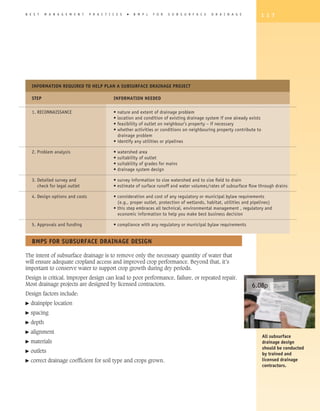
  • 8.
    1 0 4 B E S T M A N A G E M E N T P R A C T I C E S � A gricultural D R A I N A G E Fig. 6A Soils may need subsurface drainage for one or more of the following reasons. Uneven soil moisture conditions. Soil moisture conditions are not sufficiently uniform for efficient field operations on fields with highly variable soil types and slope positions. Inadequate natural drainage for the crop’s sensitivity. Some crops are very sensitive to water (“wet feet”), and are easily damaged if roots are in saturated soil. Some soils have average natural drainage, but are unsuitable for the crop’s needs. Soils with naturally high water tables. Usually found in level-to-depressional topography or where impermeable subsoils limit water infiltration, these soils will benefit from systematic subsurface drainage systems. Such soils are referred to as poor and imperfectly drained soil types on soil maps and reports. Fig. 6b Croplands soils with a drainage class of poor require subsurface drainage. Poorly drained soils have a high water table for most of the year. To verify poor drainage, check for a zone of mottles and gley colours in the top 50 cm (20 in.) of the soil profile.
  • 9.
    B E ST M A N A G E M E N T P R A C T I C E S � B M P s F O R S U B S U R F A C E D R A I N A G E 1 0 5 Water won’t flow to outlet because land is too flat or natural surface barriers limit movement of water. Such sites are often in depressional areas. Artificial barriers. Constructed barriers that obstruct or limit the flow of water include roads, fence rows, dams, dikes, bridges, and culverts of insufficient capacity and depth. Topographic site position. For want of sufficient land slope, or due to natural surface barriers, water cannot flow to an oulet. Such sites are often in depressional areas. Seepage areas. When water table conditions cause groundwater to be discharged on a sloping field, the soil can be sufficiently saturated to require subsurface drainage. A single seepage area can render a large area of cropland unfit for crop production. Fig. 6c Impermeable soil materials. Soil layers of low permeability that restrict the downward movement of water trapped in small surface depressions or held in the soil profile may benefit from subsurface drainage.
  • 10.
    1 0 6 B E S T M A N A G E M E N T P R A C T I C E S � A G R I C U L T U R A L D R A I N A G E FIG. 6D 6.01p In some cases, subsurface drainpipes are surrounded by impermeable soils such as heavy clay, pure silts, or compacted subsoils. Recharge areas do not require subsurface drainage.
  • 11.
    B E ST M A N A G E M E N T P R A C T I C E S � B M P s F O R S U B S U R F A C E D R A I N A G E 1 0 7 Draining Natural Temporarily Ponded Areas on Cropland: A Matter of Need or Convenience? Removal of surface water from croplands has many potential benefits. On the other hand, these temporarily inundated locations, although not permanent wetlands, may provide the water storage functions and habitat for a variety of plant and wildlife species. Think carefully before you act in these situations. 4 Seriously consider the pros and cons of draining wet areas on cropland. Questions to consider before draining a wet area: • What is the size of the wet area? • How is this area impacting nearby field operations? • How long does the water stand on the surface? • On average, how many days does this wet area delay field work in spring? • On average, how often does this wet area contribute to crop flooding and significant profit loss? • Does wildlife use this wet area when ponded or at other times during the year? • Is there wetland vegetation present? • Is this area immediately adjacent to a designated wetland or riparian area? • Will this area grow a profitable crop when drained? • Is a permit required from the Conservation Authority or other agency? • Is the area a candidate for retiring from production? • What will the drainage project cost? By answering each of these questions, you’ll be in a stronger position to assess the significance of this wet area and its relative importance and potential as cropland. Visual Identification of Cropland Drainage Problems Most naturally well-drained cropland soils in Ontario experience a moisture surplus from November to April. These same soils are able to store moisture during the spring and early summer. From mid-summer to early fall, this stored water is depleted – mostly through evapotranspiration. The amount of surplus water on imperfectly to poorly drained soil is substantially higher.
  • 12.
    1 0 8 B E S T M A N A G E M E N T P R A C T I C E S � A G R I C U L T U R A L D R A I N A G E FIG. 6E FIG. 6F In April and May, the water table is too high on imperfectly drained and poorly drained soils for seedbed preparation. These soils would benefit from subsurface drainage. 6.02p Indicators of poor drainage may include: • uneven crop growth • water at or near the surface • water-tolerant vegetation • soil colours indicating a high water table • soil colours indicating uneven or long drying period.
  • 13.
    B E ST M A N A G E M E N T P R A C T I C E S � B M P s F O R S U B S U R F A C E D R A I N A G E 1 0 9 It’s prudent to conduct a site investigation of drainage problems before drainpipes are installed or in drained fields requiring troubleshooting. Simply put: cropland drainage improvement is limited by site conditions. There are two major soil-water-related problems in most fields: surface water soils and groundwater soils. Surface water problems occur where precipitation and snowmelt water on the surface won’t infiltrate and percolate through the soil quickly enough for agricultural use – resulting in soils remaining saturated too long. This can be due 6.03p to high water tables, or soils that are impermeable, such as soils with a high clay content. Groundwater soils receive groundwater from upslope and are said to be subject to artesian pressure. The nature and severity of the problem is mostly centred on how water is discharged at or near the soil surface as well as the artesian (head) pressure. FIG. 6G Slope Seepage water from upslope side of check pit Locating Drainage Problems in the Soil Profile Drainage problems can be found in four places in the soil: at the surface, in the plough layer, in the subsoil, and around the drain itself.
  • 14.
    1 1 0 B E S T M A N A G E M E N T P R A C T I C E S � A gricultural D R A I N A G E Fig. 6H Fig. 6I Surface Problems Most surface problems are associated with soil crusting – a sheet of soil that prevents infiltration. Following the rapid wetting and drying of an overworked seedbed, a solid sheet forms (0.2–5 cm or 0.8–2 in. thick) that is tight enough to prevent crop emergence. A track record of poor soil management and few organic matter inputs is most often the cause. A similar impeding layer at the surface can result from “puddling” caused by a heavy rainfall of large rain droplets. Here the surface is compacted by the droplets, creating a barrier. 4 dopt farming practices that maintain good soil structure and organic matter/crop residue to prevent A crusting.
  • 15.
    B E ST M A N A G E M E N T P R A C T I C E S � B M P s F O R S U B S U R F A C E D R A I N A G E 1 1 1 Fig. 6J Plough-Layer Problems Most plough-layer drainage problems are actually compaction problems. Compaction is the process of increasing soil density by packing soil or smearing particles closer together. It can occur anywhere in the soil profile, but tends to be seen near the surface or at plough depth. 4 onsider a range of BMPs, including tillage at proper soil moisture conditions, use of deep-rooted C crops, and mulch tillage, to reduce the impact of compaction on soil structure.
  • 16.
    1 1 2 B E S T M A N A G E M E N T P R A C T I C E S � A gricultural D R A I N A G E Fig. 6K Subsoil Problems Subsoils can be impermeable and cause surface drainage problems. Impermeable subsoils are usually: • heavy clays – soils with high clay contents and low natural permeability • assive soils – clay, usually poorly drained soils, with massive structure where there are few connected m macropores to aid drainage • compacted soils – some glacial till soils were smeared and compacted during deposition more common near the Canadian Shield. Other soils have naturally high water tables, and so cannot store additional water. 4 Have the problem properly evaluated by a licensed drainage contractor to determine course of action.
  • 17.
    B E ST M A N A G E M E N T P R A C T I C E S � B M P s F O R S U B S U R F A C E D R A I N A G E 1 1 3 FIG. 6L Around the Drainpipe When water can neither permeate the soil around the drainpipe nor enter the drainpipe, it’s known as entrance resistance. This can artificially elevate the water table. Saturated soils are prone to smearing by drainage equipment. Look for gley colours and mottles around the drainpipe. 4 Don’t install subsurface drainage in saturated soils. Soil Investigation to Verify Subsurface Drainage Problems Soil investigations are the only sure way of verifying soil drainage problems. Two types of soil investigation checks are recommended. Soil Pit Method A soil pit investigation allows the professional to look for changes in soil colour and properties in soil horizons (layers). Auger Hole Method 6.04p A Dutch soil auger can be used to quickly check soil features in a core of soil to depth of at least 1.2 m (4 ft).
  • 18.
    1 1 4 B E S T M A N A G E M E N T P R A C T I C E S � A gricultural D R A I N A G E Fig. 6M Fig. 6N 0 cm Ah Bm Aegj B+gj Ckg 120 cm
  • 19.
    B E ST M A N A G E M E N T P R A C T I C E S � B M P s F O R S U B S U R F A C E D R A I N A G E 1 1 5 Fig. 6O In some soils, mottles and in some cases gley colours are found in an upper soil horizon – Ap Loamy 10 yr 3/3 but not below. When combined fine sand platy with a drastic change in soil texture, structure or density, 10 yr 5/6 this may indicate the presence Bm Fine sand coarse subangular of a perched water table. blocky 10 yr 5/6 2.5 yr 5/4 mottles Bmgj Fine sand coarse subangular blocky 10 yr 4/3 B+ Silty clay corase angular blocky 10 yr 4/3 10 yr 5/6 II Ckgj mottles columnar silty clay loam light macropores Seepage Problems In some cases, water can be seen seeping at the soil surface or from one side of the soil pit. These seepage zones are normally associated with the presence of a permeable layer over an impermeable layer – where the surface material is wet and the subsurface material is dry. One type of seepage is actually a confined aquifer with high pressure (e.g., artesian). Fig. 6p
  • 20.
    1 1 6 B E S T M A N A G E M E N T P R A C T I C E S � A G R I C U L T U R A L D R A I N A G E FIG. 6q In most cases, some form of subsurface interceptor drainage design is used to correct the problem if it is well-defined. In other cases, more than one drainpipe is required or a gravel-filled trench is needed to cut off groundwater flow. The water is intercepted long before it reaches the ground surface and the drainpipe is installed across (not parallel to) the flowpath. STEPS FOR PLANNING A SUBSURFACE DRAINAGE SySTEM Begin by determining the feasibility of the project. Your investigation should provide a clear understanding of the problem, the kinds and amounts of practices necessary, an estimate of the cost and value of expected benefits, and the impacts of the project. This information can often be obtained from a reconnaissance of a small problem area. 4 Hire a professional, licensed drainage contractor to conduct more detailed examinations and surveys that determine the size of the area, the drainage 6.07p pattern, and special features where riparian vegetation, wetlands, or rock outcrops exist. Environmental considerations must be a part of the cropland drainage planning process – including habitat enhancement or mitigation where needed.
  • 21.
    B E ST M A N A G E M E N T P R A C T I C E S � B M P s F O R S U B S U R F A C E D R A I N A G E 1 1 7 INFORMATION REqUIRED TO hELP PLAN A SUBSURFACE DRAINAGE PROJECT STEP INFORMATION NEEDED 1. RECONNAISSANCE • nature and extent of drainage problem • location and condition of existing drainage system if one already exists • feasibility of outlet on neighbour’s property – if necessary • whether activities or conditions on neighbouring property contribute to drainage problem • identify any utilities or pipelines 2. Problem analysis • watershed area • suitability of outlet • suitability of grades for mains • drainage system design 3. Detailed survey and • survey information to size watershed and to size field to drain check for legal outlet • estimate of surface runoff and water volumes/rates of subsurface flow through drains 4. Design options and costs • consideration and cost of any regulatory or municipal bylaw requirements (e.g., proper outlet, protection of wetlands, habitat, utilities and pipelines) • this step embraces all technical, environmental management , regulatory and economic information to help you make best business decision 5. Approvals and funding • compliance with any regulatory or municipal bylaw requirements BMPS FOR SUBSURFACE DRAINAGE DESIGN The intent of subsurface drainage is to remove only the necessary quantity of water that will ensure adequate cropland access and improved crop performance. Beyond that, it’s important to conserve water to support crop growth during dry periods. Design is critical. Improper design can lead to poor performance, failure, or repeated repair. Most drainage projects are designed by licensed contractors. 6.08p Design factors include: � drainpipe location � spacing � depth � alignment All subsurface � materials drainage design should be conducted � outlets by trained and � correct drainage coefficient for soil type and crops grown. licensed drainage contractors.
  • 22.
    1 1 8 B E S T M A N A G E M E N T P R A C T I C E S � A gricultural D R A I N A G E The following considerations are also part of the system design process: � legal outlet (see planning section) � drainage coefficient (drainage rate – see page XX) � drainage depth and spacing � cropland slope/topography � impermeable layers � drainage pipe material and sizing � arrangement and systems � drainage outlets � surface inlets � envelopes, e.g., filter � environmental considerations e .g., quantity of water drained and proximity to natural areas such as wetlands and riparian areas e.g., alternative water uses, such as irrigation storage � system implementation costs. Design procedures must account for site factors (soil type, depth to water table, hydraulic conductivity) and the variability of soils and drainage requirements across the area to be drained. For more detailed information on drainage design principles and practices, see OMAFRA Publication 29, the Drainage Guide for Ontario. For more information on subsurface drainage and the Agricultural Tile Drain Installation Act, check the Drainage page on the OMAFRA website. http://www.omafra.gov.on.ca/english/landuse/drainage.htm
  • 23.
    B E ST M A N A G E M E N T P R A C T I C E S � B M P s F O R S U B S U R F A C E D R A I N A G E 1 1 9 Interdependent Ecosystems at Work Farmers can produce high crop yield in a sustain- Fig. 6R able way without reducing water quality. To do so, it must be understood that the soil, and the plant and animal life it supports, operate as an ecosys- tem. This soil ecosystem requires that the input elements (air, sunlight, water and soil particulars) and plant life and animal life communities be man- aged as an integrated system. Each one of the input elements and living communities of that ecosystem must be kept in balance so as to optimize the pro- duction of any one of the components. Cropland agriculture focuses on optimization of the plant life community of that ecosystem. A common input element among plant life, both above and below the soil surface, is water originating in the form of soil moisture. Soil Ecosystem Within the soil ecosystem, the percent moisture present determines if there’s enough air to allow eco-life (living organisms) to thrive. Eco-life breaks To be effective, down organic matter, aids nutrient release from organic matter, and assists plants in nutrient retrieval. Large, drainage systems healthy plants increase organic matter content in the soil. Increased organic matter contributes to moisture need to work in retention and increased eco-life, which increases nutrient availability and the production of glues that hold soil concert with other components together. If there’s too much or too little moisture in the soil, interactions are limited – thus plant farm production growth and soil stability are reduced. systems – such as nutrient management, Plant Life Community – Crop Production soil management, and pest management. Moisture – too much or too little – affects each component of the soil ecosystem and the plant community or crop production system, and each affected component can affect several others. Example 1: Soil moisture (wet) -- results in crop disease -- results in need to re-select crop variety or crops used in a crop rotation or in sometimes increased use of pesticides. Example 2: Soil moisture (wet) -- increases tillage to dry soil -- reduces crop residue to further dry soil -- soil structure is damaged -- allows more flexible weed control program or to reduce crop root disease.[Alison to check w/Don to clarify] If the decision is made to remove excess water with subsurface drainage, then both the soil ecosystem and the crop production plant community changes. Soil eco-life increases soil porosity, and if crop production management will allow the use of a practice like no-tillage, compaction will be reduced. This in turn allows the retention of crop residue and leaves crop roots undisturbed in the soil – which in turn allows the organic matter content of the soil to increase and the soil structure to become more stable. By reducing soil moisture through the installation of a drainage system, crop management practices can be deployed to increase water infiltration and percolation – reducing the erosion of soil sediment into outlet drains, streams, and rivers.
  • 24.
    1 2 0 B E S T M A N A G E M E N T P R A C T I C E S � A G R I C U L T U R A L D R A I N A G E DRAINAGE COEFFICIENT The drainage coefficient or drainage rate is a design standard that reflects the amount of water that can be drained from a watershed in a 24-hour period. It is the physical capacity of the drainage system, and more specifically the main collector drainpipe. The coefficient is expressed in units of mm/24 hr (in. /24 hr), i.e., surface equivalent. It does not reflect the soil’s ability to transmit the water. Part of the decision process is to ensure the soil and drainage system are balanced with the appropriate drainage coefficient needed for the crops to be grown. In some cases, expectations may have to be adjusted as some soils will not allow gravitational water to move at the desired rate needed to protect the proposed crop. The most common drainage coefficient used in Ontario is 12 mm/day (0.5 in. /day) for cash crops on average soils. In other words, a drainage system designed to a 12 mm drainage coefficient would be capable of removing 12 mm of excess water from the entire subsurface- drained area over a 24-hour period. If there is a heavier rain and more than 12 mm/24 hr needs to be removed, it would take longer to remove the excess water. Higher drainage coefficient rates are sometimes used for crops that are more susceptible to damage from excess moisture. 4 Choose a drainage coefficient wisely for the soil type and crop needs. FIG. 6SI 6.09p FIG. 6SII To protect crops, a subsurface drainage system must be able to remove excess water from the upper portion of the active root zone 24 to 48 hours after a rain. Controlling the Amount of Water Removed Laterals determine uniformity of drainage and convey water to the header main. The header main’s job is to collect the water from the laterals and remove it at an appropriate rate – not any faster than is needed by the crop. The size of the area, slope of the header main, and the drainage coefficient are three variables used to select the diameter of the header main of the various types of material. This is the way subsurface drainage systems meter the amount of water removed and conveyed to the outflow.
  • 25.
    B E ST M A N A G E M E N T P R A C T I C E S � B M P s F O R S U B S U R F A C E D R A I N A G E 1 2 1 Watershed characteristics such as intended land use, soil type, and proportion of watershed to be drained under forest cover [Alison to confirm wording] should be considered in the selection of an appropriate drainage coefficient. The drainage coefficient method of drainpipe design is the most common design method used in agricultural applications 6.10p Check the Drainage Guide for more information on drainage rate and other design ratings based on mapped soil series. DRAINAGE DEPTh AND SPACING Drainpipes used for 100 mm (4 in.) laterals should be deep enough to prevent damage from tillage operations and the weight of the equipment – a minimum of 600 mm or 24 inches of cover. Check the Drainage Guide for recommended depth and spacing criteria related to the individual soil series as mapped and published in regional and county soil survey reports. Laterals' depth and spacing are linked, and should be selected jointly. Laterals must be shallow enough to provide timely drainage, deep enough to remove excess water from the root zone, and spaced appropriately to get uniform drainage at the soil surface. The goal is to remove only the water that will impede proper crop growth. Main and sub-main drains must be deep enough to provide an easy connection point and a good outlet for lateral drains. Also, the maximum depth at which drains can be laid to withstand trench loading varies with the width of the trench and the crushing strength of the drainpipe to be used. Typical depths of header mains are in the range of 900–1200 mm (36–48 in.) deep, but can be deeper as dictated by topography. A header main is there for the primary purpose of transporting water to the outlet IMPERMEABLE LAyERS The influence of an impermeable layer on the behaviour of a groundwater table depends on its depth below the level of drainpipe and on the drainpipe spacing. The flow pattern and rate of the water moving toward the drain can be altered drastically by an impermeable layer (such as dense, compacted, or heavier subsoil). Most drainpipe spacing in Ontario is close enough together not to be affected by the impermeable layer as long as the drainpipe is installed above it. Where the drainpipe needs to be installed in the impermeable layer in order to get adequate depth and cover, the impermeable layer can have a major affect. Regardless of the soil above the impermeable layer, the rate of water movement to the drainpipe is greatly controlled by the impermeable layer. There are various options available to overcome this problem – each with a cost associated with it. It is best to consult with a licensed drainage contractor or experienced drainage designer for options. Each situation is unique. In some cases, a decision may need to be made whether subdrainage will be effective at all.
  • 26.
    1 2 2 B E S T M A N A G E M E N T P R A C T I C E S � A gricultural D R A I N A G E Fig. 6T When impermeable layers are encountered, the pipes need to be placed closer together to achieve the effect they would have in a deep permeable soil. However, if the depth of the impermeable layer below pipe level exceeds a fourth of the drain spacing, the flow system can be treated as if such a layer were absent. Drainpipe and Sizing The maximum amount of water a drainage pipe can carry (its flow capacity) depends on the drainpipe's inside diameter, the installation grade, and the inside drainpipe surface roughness. In the farm drainage industry, a more common way of reflecting drainage pipe capacity is the number of acres that can be drained through a particular diameter of drainage pipe. [Alison to get clarification on length/spacing vis-a-vis no. of acres]
  • 27.
    B E ST M A N A G E M E N T P R A C T I C E S � B M P s F O R S U B S U R F A C E D R A I N A G E 1 2 3 DRAINPIPE MATERIAL GRADE OF DRAINPIPE DRAINAGE COEFFICIENT DESIGN CAPACITy 150 mm (6 in.) 0.2% slope 12 mm/day 3.8 ha CORRUGATED 0.2 m per 100 m slope (1/2 in./day) (9.3 ac) PLASTIC TUBING (0.2 ft per 100 ft slope) The above row shows the capacity of a 150 mm diameter, corrugated plastic tubing drainpipe with a grade of 0.2% to remove 12 mm of water from 3.8 ha of land in 24 hours. 150 mm (6 in.) 0.2% slope 12 mm/day 5.8 ha SMOOTH WALL 0.2 m per 100 m slope (1/2 in./day) (14.3 ac) e.g., clay, concrete (0.2 ft per 100 ft slope) The above row shows the capacity of a 150-mm diameter smooth wall (clay, concrete) drainpipe with the same 0.2% grade. It has the capacity to remove 12 mm water from 5.8 ha of land in 24 hours – approximately 50% more capacity than a corrugated plastic tubing drainpipe of the same size and slope. 150 mm (6 in.) 0.4% slope 12 mm/day 5.3 ha CORRUGATED 0.4 m per 100 m slope (1/2 in./day) (13.1 ac) PLASTIC TUBING (0.4 ft per 100 ft slope) The above row shows the effect of increasing slope. While the pipe material and diameter are identical to the first row, the grade is now 0.4% instead of 0.2%. This changes the drainpipe’s capacity to 5.3 ha. More slope, more capacity. 200 mm (8 in.) 0.2% slope 12 mm/day 7.6 ha CORRUGATED 0.2 m per 100 m slope (1/2 in./day) (18.9 ac) PLASTIC TUBING (0.2 ft per 100 ft slope) The above row shows the effect of increasing the diameter of the drainpipe. While the pipe material and grade are identical to the first row, the size is now 200 mm diameter instead of 150 mm. Capacity of the 200 mm corrugated plastic tubing is 7.6 ha – twice that of the 150 mm. Choosing the correct size of drainpipe is extremely important for main collector drains. Too small and the system does not function properly; too large adds cost to the system. A licensed drainage contractor can provide this information, or consult Publication 6.11p 29, Drainage Guide for Ontario, for the capacities of all sizes of drainpipe for different grades, drainage coefficients, and material. Besides flow capacity, drainage systems should also be designed to meet or exceed a certain minimum velocity of flow so that self- cleaning or self- scouring takes place.
  • 28.
    1 2 4 B E S T M A N A G E M E N T P R A C T I C E S � A gricultural D R A I N A G E Fig. 6u A drainpipe’s flow capacity is the maximum amount of water it can carry. Flow capacity depends on the drainpipe's inside diameter, the installation grade, and the drainpipe’s surface roughness. Layouts and Systems When selecting a layout pattern for a particular field or topography, aim for the following. 4 Orient lateral drains nearly parallel to the field's contours, crossing the slope – not straight up and down. This way, water flowing downslope can be intercepted by laterals and the system will function more effectively and produce more uniform results. 4 Orient lateral drains askew to tillage and planting pattern. This ensures that tracking of heavy equipment will be across the drainpipe and not lengthwise, thus reducing potential for damage. Also, tillage or row planting can alter the flow path of surface water. An askew pattern of drainage will ensure water flowing will be better intercepted by laterals and more uniform drainage. 4 Minimize the number of short lateral drains to reduce costs. Each lateral requires excavation to start installation and a connection to header main. 4 Balance the number and size of header mains for capacity and to reduce costs. 4 Minimize the number of outlets to reduce costs and maintenance. Usually, not all of these objectives can be attained at the same time. A well-designed system will balance function with cost. Communication between the landowner and a licensed drainage contractor is must. Remember, a drainage system lasts a lifetime, and a little extra cost in the beginning is often an excellent investment in the long run.
  • 29.
    B E ST M A N A G E M E N T P R A C T I C E S � B M P s F O R S U B S U R F A C E D R A I N A G E 1 2 5 Fig. 6v Contour lines 4 laterals 6 main 6 main 8 main End pipe to outlet Header mains and sub-mains (also called collectors) can be positioned on steeper grades, or in areas of lower elevation, to facilitate the placement of laterals. Basic systems are either random (site-specific) or systematic.
  • 30.
    1 2 6 B E S T M A N A G E M E N T P R A C T I C E S � A gricultural D R A I N A G E Fig. 6W Random System (site-specific) The header main is generally placed near the lowest natural depression, and smaller drainpipes branch off to drain the wet areas. Because such drains often become outlets for a more complete system established in the higher areas of the field, the depth, location, and capacity of the random lines should be considered as part of a complete drainage system. Systematic Systems Systematic patterns drain larger areas. There are two types: parallel and herringbone. The parallel field drainage pattern consists of laterals that are perpendicular to the main drain or sub- main. In most cases, the laterals run parallel to a field boundary. Variations of this system are often used with other patterns The herringbone field drainage pattern consists of laterals that enter the main drain at an angle, generally from both sides. This system can be used in place of the parallel pattern. It can also be used where the main is located on the major slope and the lateral grade is obtained by angling the laterals across slope. This pattern may be used with other patterns in laying out a composite system in small or irregular areas. 4 lign laterals across the slope, which ensures that the general movement of both surface water and A groundwater is across the lateral drainpipe line. This improves the potential to capture the water for drainage, and makes drainage more uniform. Herringbone systems can more easily achieve these objectives than the parallel system. However, in general herringbone systems cost more to install than parallel systems, as usually there are more mains to install and more tap connections to be made to the main. The option of choosing the type of system layout is only available in new systems, or with complete system replacements.
  • 31.
    B E ST M A N A G E M E N T P R A C T I C E S � B M P s F O R S U B S U R F A C E D R A I N A G E 1 2 7 FIG. 6X Laterals set too close to designated wetlands area are at risk of lowering the water table in the wetland. One BMP is to place the closest drainpipe at a depth that is above the average elevation of standing water in the wetland. The illustration shows a lateral drainpipe placed at a depth in the soil higher in elevation than the average elevation of standing water in the adjacent wetland. This approach shouldn’t affect the hydrology of the wetland. PIPE OUTLETS The system outlet is a rigid pipe that connects the main to an outlet ditch, stream or river. It must be sufficiently large to: � carry the water discharge from the main � not cause any flow restrictions � not cause any erosion � remain stable in the ditch bank. Drainpipe outlets are typically located 1000 to 1500 mm (3–4 ft) below the soil surface (i.e., field elevation). They are simply a secure connection of the 6.12p main to the surface water body. BMPs for Pipe Outlets The bottom of an outlet pipe should be located 300 mm (12 in.) above the normal water level in a receiving ditch or waterway. The discharging water may cause erosion in the receiving ditch or waterway. 4 Install an apron of rock riprap to prevent erosion. Proper placement and 4 Equip all outlet pipes with rodent grates to prevent unwanted entry by animals. design of pipe outlets 4 Mark location of outlets with a post and marker. are key drainage BMPs. 4 Inspect outlets each spring to ensure proper functioning and that no debris is blocking them.
  • 32.
    1 2 8 B E S T M A N A G E M E N T P R A C T I C E S � A G R I C U L T U R A L D R A I N A G E CONSTRUCTION ChALLENGES Sedimentation – Drainpipe Plugging Fine and very fine sands and silts are not sticky, which means it’s easier for them to move through the orifices and into subsurface drainpipe. 4 Evaluate whether special protection such as filters or envelopes may be required. Consider different filter or envelope materials with specific pore sizes (e.g., very fine sands 0.10– 0.05 mm diameter) to ensure sediment or sand doesn’t enter the drainpipe in these soils. 4 Talk to manufacturers to see what envelopes may best suit your soil conditions. Consider providing them with a soil sample. FIG. 6y 6.13p Ap Very fine sandy loam 10yr 3/2 Aeg Very fine sandy loam 2.5 yr 5/4 B+g silt loam Filter materials known as 2.5 yr 4/4 Silt and very non-woven geotextiles mottles 7.5 yr 5/8 fine sand or woven filter cloth particles (sock) are widely used Ckg as pre-wrapped synthetic very fine sand drain envelopes. These 7.5 yr 6/4 materials can be made from polyester, polypropylene, polyamide, polystyrene, and Water table nylon. Filter materials can reduce sediment loading in drainpipe; however, no textile is suitable for all problem soils. A drain envelope or sock around the drainpipe won’t interfere with water movements, but will prevent soil particles from entering the drainpipe openings. It can help improve and maintain optimum flow into the drainpipe, and keep silt and very fine sand-sized soil particles out of the drainpipe.
  • 33.
    B E ST M A N A G E M E N T P R A C T I C E S � B M P s F O R S U B S U R F A C E D R A I N A G E 1 2 9 Ochre, an iron oxide, affects about 2% of drainage systems in Ontario. It occurs in two soil conditions: acidic sands and poorly drained sands. Ochre accumulates through chemical or microbiological processes, or both. It’s a natural condition usually found where new land – sandy in nature with high organic matter – is cleared and drained. Recognized by brilliant red deposits at drain outfalls, iron ochre can seal drain openings very quickly. At present there are no long-term solutions. If you encounter ochre: � plan to replace or abandon the original system when it fails � flush drainpipe with high-pressure water to provide temporary relief. Connecting Old Drainage System to New System If existing lateral pipes are relatively new, clean and not full of sediment, they are probably working. They can be hooked into new drainpipe. However, if they are full of sediment, then relieve [Alison to clarify] with crushed stone. Do not directly connect the two systems, as the old system may add excessive sediment to the new installation. Seepage Control Broad, flat areas that are wet due to seepage from adjoining highlands, springs, seepage lines at two different layers of soil etc. can benefit from interception drains. Interception drains are installed at right angles to the flow of groundwater to intercept subsurface flows.
  • 34.
    1 3 0 B E S T M A N A G E M E N T P R A C T I C E S � A gricultural D R A I N A G E Fig. 6Z Subsurface drainpipe for interception of seepage must be located properly to drain wet areas caused by upslope water. In steeply graded depressions or draws, a layout may include a main or sub-main drain in the draw or to one side of the draw, with the interceptor lines across the slope on grades slightly off- contour. Summary of Siting Recommendations for Manure Storage Facilities If you store manure, a number of legal separation distances relating to surface and groundwater may apply to your facility. These could include specific setbacks from wells, site investigations, observation stations for sub- surface drains within 15 metres (49 ft) of a manure storage, and structural design. Here is a summary of setbacks for new or expanding permanent manure storage facilities: � a minimum of 24 metres (76 ft) from a drilled well that is at least 15 metres (49 ft) deep � and has a 6 metre (20 ft) casing from the soil surface � at least 151 metres (501 ft) from a municipal well � at least 46 metres (151 ft) from any other well � a t least 24 metres (76 ft) from a drainpipe – whether existing or to be constructed, and with a flow-path that is at least 50 metres (164 ft) from the nearest surface water. Manure = fecal material + undigested feed + urine + bedding + uncontaminated water + wastewater + other wastes. It bears repeating: when managing manure, account for all materials – especially liquids.
  • 35.
    B E ST M A N A G E M E N T P R A C T I C E S � B M P s F O R S U B S U R F A C E D R A I N A G E 1 3 1 FIG. 6AA BMPS FOR INSTALLING SUBSURFACE DRAINAGE BEFORE CONSTRUCTION All agricultural subsurface drainage systems must be installed in accordance with the Agricultural Tile Drainage Installation Act. The act requires that each drainage contractor hold a valid licence to install subsurface drainage systems on agricultural land, that each tile drainage machine be licensed, and that each operator of a drainage machine be licensed. Landowners installing subsurface drains on their own farm with their own equipment are exempt. Review the Construction section of OMAFRA Publication 29, Drainage Guide for Ontario. It defines the minimum standard for workmanship, materials, and methods of construction acceptable for the installation of subsurface drains. See back cover for contact information. A list of drainage contractors is available from your nearest OMAFRA regional information office and the Land Improvement Contractors’ of Ontario (LICO) website – www.drainage.org BMP ChECKLIST FOR LANDOWNERS 6.14p Landowner Checklist – Before Construction 4 Seek professional advice to verify that subsurface drainage will be a good investment. 4 Have the soil examined if there’s some doubt of its drainage properties (see section on diagnostics) 4 ensure soil is suitable for a subsurface drainage system. 4 Discharge water at a location where collected water can be legally discharged without adversely affecting downstream landowners, e.g., natural watercourses, agreement drains, municipal drains:
  • 36.
    1 3 2 B E S T M A N A G E M E N T P R A C T I C E S � A gricultural D R A I N A G E 4 etermine whether a satisfactory outlet is available for the proposed work on the your d property 4 f not, negotiate agreements, in writing, with neighbours and other parties to obtain i authority to enter their property [add: in order to access outlet?] 4 f this does not work out, consider a petition for a municipal drain under the Drainage Act i – see section 7. 4 heck with your local CA regarding regulatory requirements, e.g., Clean Water C Act, Conservation Authorities Act -- source water protection, section 28, localized requirements or restrictions 4 isit the municipal office to ensure municipal drain requirements will be met. [add more V detail?] 4 Ensure financing is in place to complete the project. 4 Locate existing drainage plans of the farm. 4 Obtain a plan for the entire farm, even though only a part is to be drained. 4 lan with consideration for drainage of upslope watersheds or neighbouring farms’ P drainage flow. 4 Ensure the contractor is aware of the location and existence of gas and oil lines, telephone lines, hydro lines, water lines, and septic beds. In other words, over and above knowledge of your own utilities – “Call before you dig.” 4 Arrange mutual agreements and easements (hydro and other utilities) in advance. [add more detail?] 4 Ensure that the contractor is aware of the location of manure storages and transfer systems so that requirements for distance separation under the Nutrient Management Act can be accounted for when designing the drainage system. 4 Discuss the removal and/or repair of fencing and access of livestock to the work area, or any other on-farm practices that the contractor should know about. 4 Point out the location of existing subsurface drains to the contractor. 4 o avoid the risk of soil compaction, install drains in the summer or fall whenever T possible � c rop damage can be as little as 10% when drains are constructed with care through crops � m ake use of strategic crop rotation planning, e.g., field to be drained is planted in wheat or hay � c onstruction should be in reasonably dry soil so its structure is not destroyed and drainability impaired – if the field is dry enough to work, it’s dry enough to install drains.
  • 37.
    B E ST M A N A G E M E N T P R A C T I C E S � B M P s F O R S U B S U R F A C E D R A I N A G E 1 3 3 Coordinating your crop rotation to allow subsurface drainage installation in the summer or early fall has 6.15p many advantages. Most drainage is installed with plough machines. When soil is dry (not saturated), you’ll have the least amount of compaction and the great amount of soil fracturing. At the same time, some topsoil falls into the fractures. This will optimize your drainage system’s potential in both the short and long term. 4 Remove obstructions to construction � check with local municipality regarding tree-cutting bylaw requirements before removing trees. 4 Decide on the point of delivery of drainage materials ahead of time. 4 Plan a rotation one or two years in advance for the field to be drained � use soil and cropland BMPs to improve soil conditions that will assist drain performance. 4 Ensure that the drainage contractor: � holds the proper and relevant licenses � carries adequate insurance � has checked with local Conservation Authority to determine whether any CA or other regulations apply � has secured the necessary permits to do the work. Landowner Checklist – During Construction 4 Monitor and inspect the work to ensure it’s proceeding according to the agreed-upon plan. 6.16p 4 Consult OMAFRA’s drain inspector for advice if needed – call your OMAFRA regional information centre or the Agricultural Information Call Centre (AICC). See back cover.
  • 38.
    1 3 4 B E S T M A N A G E M E N T P R A C T I C E S � A G R I C U L T U R A L D R A I N A G E Landowner Checklist – After Construction ▼ Keep a record of the work done: � obtain and keep a copy of the drainage plan as constructed by 6.17p contractor � ensure the contractor has prepared a plan of the drain locations with any changes and problem areas noted on it that may affect future maintenance � in the absence of a proper plan, obtain an aerial photograph of the work area. 4 File the plan – so that there is a permanent record at the municipal office where required. It helps locate the lines when considering drain repair or improvements 4 Keep a copy of the drainage plan aerial photograph and any Mutual Agreement under the Drainage Act, with the deed to the property � keep copies of Municipal Drain reports and plans. 6.18p 4 Watch for erosion of the drainpipe trench following rain events over the first two years. 4 Mark the outlets, and check them each spring for possible erosion, discharge volume and clarity. BMP ChECKLIST FOR CONTRACTORS Contractor Checklist – Before Construction 4 Contact the Conservation Authority or check their website to find out if any portion of the property is regulated. If it is regulated, find out if 6.19p approval is required to install the subsurface drainage system. 4 Ensure landowner has obtained all licenses, permits and easements have been obtained prior to moving on the site. 4 Ensure that the final plan has been agreed-upon by landowner. 4 Notify landowner where/when design changes may have to occur during construction.
  • 39.
    B E ST M A N A G E M E N T P R A C T I C E S � B M P s F O R S U B S U R F A C E D R A I N A G E 1 3 5 4 Inspect the site with the owner to ensure adequate outlets are available, utilities have been located, and possible problems identified (e.g., the soil is not drainable) � inspect the soil profile to below drain depth � advise the owner regarding necessary notices to third parties. 4 Agree with the owner on the financial costs and how and to whom the costs are to be paid. 4 Determine whether there is an adequate outlet. 4 Review Occupational Health and Safety Act requirements for health and safety on the job site, and remind workers of them. Conservation Authority regulations may apply to some cropland, e.g., where wetlands or floodplains occur. Consult the local CA prior to undertaking any subsurface drainage work. Contractor Checklist – During Construction 4 Comply with applicable legislation. 6.20p 4 Adhere to Occupational Health and Safety Act requirements for health and safety on the job site. 4 Follow all safety procedures. Keep casual observers away from construction operations. 4 Keep casual observers away from construction operations. 4 Erect safety barriers to prevent public access to the work. 4 Restrict all machine and truck movement on the field to designated paths. 4 Do not backtrack plough trenches to compress them; it may damage the drains and drainability. 4 Inspect all drainage materials before installation to ensure they’re free from defects and meet approved quality standards for their intended purpose. 4 Store drainage materials so they won’t be damaged before installation. 4 Check old drainage systems for agronomic and hydraulic efficacy. 4 Don’t connect drainpipes that appear to be polluting. 4 Minimize the number of outlets to reduce system maintenance. 4 Maintain and operate the installation equipment so drainpipe is installed in accordance with the designed grade and depth.
  • 40.
    1 3 6 B E S T M A N A G E M E N T P R A C T I C E S � A G R I C U L T U R A L D R A I N A G E Contractor Checklist – After Construction 4 Ensure the following information is on the plan to be left with the landowner: 6.21p � date of construction � name of the contractor � alterations to the original plan � drainpipe type, size, footage, and materials � details of construction problems � location of utilities, sand pockets, springs, etc. that may affect future maintenance � suggestions for future work additions. Landowners must know the exact location of subsurface BMPS FOR MANAGING SUBSURFACE DRAINAGE drainpipes on their property. This will INSPECTION AND MAINTENANCE help with subsequent monitoring, Annual maintenance and good soil management practices are your best insurance for the maintenance and successful long-term operation of your drainage system. repair work. 4 Adopt soil management BMPs – drainage-system performance may be hindered by poor practices (see pages XX–XX). 4 Check outlets regularly: � make more thorough inspections in the spring or late fall when the soil is wet and the drain is running � mark locations in need of repair or maintenance � make sure outlet marker is still in place and clearly visible. 4 Schedule maintenance or repair work when field conditions are drier. 4 Keep up a preventative maintenance program, including: � keeping a plan of the drainage system 6.22p � cleaning catch basins and outlets � repairing the outfall. The precise location of subsurface drainpipe lines is made possible with the use of Global Positioning Systems 6.23p and on-the-ground spatial referencing. Drainage contractors are using this technology to install subsurface drainage and for drainage system maintenance and repair work. Aerial photos and drainage maps can also be used to pinpoint drainpipe location with a high degree of accuracy.
  • 41.
    B E ST M A N A G E M E N T P R A C T I C E S � B M P s F O R S U B S U R F A C E D R A I N A G E 1 3 7 Cropland drainage systems require routine monitoring to ensure that the entire system is performing the expected 6.24p function of safely conveying water to a proper outlet. Make routine and periodic inspections of drainage system components to ensure minimal environmental impact. PROBLEM VERIFICATION In practice, you will notice the inefficiency of a drainage system when water stands on the field for a long time, and in spring when the topsoil remains wet too long. Isolated wet spots in the field, surface wash-ins, and blowouts along the drain line are indications of drain problems. The value of a proper drainage plan or aerial photograph of the system becomes very apparent during maintenance. For more information on drainage system maintenance and management, please refer to: � OMAFRA Factsheets, Maintenance of the Drainage System, Agdex 553/725 and Management of Drained Fields, Agdex 555/632 � the OMAFRA Drainage website http://www.omafra.gov.on.ca/english/landuse/drainage.htm � your local Conservation Authority. TROUBLEShOOTING Diagnosing and troubleshooting drainage problems is an ongoing process that’s both simple and complicated, and requires the landowner to pay attention to changes in the field drainage conditions. Take note of changes to the wetness of a field or specific location, or to the uniformity of crop growth. After a rain, the soil will change colour as it dries and usually form a pattern. Pay attention to these details. If the pattern changes, there may be a problem. Some problems are very obvious in the form of very visual wash-ins or washouts or water bubbling to the surface. These are abrupt changes. Other problems occur over time, e.g., iron ochre, tree roots, partial collapse of a plastic tubing drain, etc. These are identified by changing conditions. In most cases, a standard approach to fully identify and diagnose the problem is to expose the drainpipe to the downflow side of the wet area. Excavate the soil, uncovering the drainpipe in the upstream direction until the problem is found. Diagnose and repair. The following chart lists the most common drainage problems that you might encounter and what to look for.
  • 42.
    1 3 8 B E S T M A N A G E M E N T P R A C T I C E S � A gricultural D R A I N A G E TROUBLESHOOTING SUBSURFACE DRAINAGE ITEM WHAT TO LOOK FOR POSSIBLE CAUSES PREVENTATIVE CORRECTIVE (SYMPTOM) MEASURES MEASURES BLOCKED • water bubbling to • collapsed or crushed • ensure proper design • repair immediately, and DRAINPIPE surface like a spring drainpipe depth, location, and replace damaged above the drainpipe • damaged or poorly installation drainpipe • holes in soil above installed drainpipe • avoid travelling over • use rigid or double-wall drainpipe connection drainpipes with heavy drainpipe under high • water not draining • sediment buildup or equipment in wet traffic areas • trees close to drainpipe blockage in drainpipe conditions • relocate/resize drain • tree roots in drainpipe • do not plant water- • remove problem tree(s) • dead animal blocking loving trees within • use non-perforated drainpipe 30.5 m (100 ft) of a drainpipe along drainpipe– all other problem tree trees 15 m (50 ft) • use high-pressure water system to clean out line • install/repair rodent guards at outlets BLOWOUTS • similar to blocked • poor design, inadequate • ensure drainpipe is • replace drainpipe with AND CAVE-INS drainpipe except water grade, undersized properly sized to larger diameter will go back down hole drainpipes handle flows • if high pressures persist, as well as come out • drainpipe slope changes • use a relief well in the vent as necessary- from steep to flatter design or use larger- relief well causing pressure buildup diameter drainpipe • replace damaged • partial collapse of • avoid travelling over drainpipe drainpipe resulting in drainpipes with heavy • repair poor or damaged flow restriction and equipment in wet connections pressure buildup conditions • make use of flow • faulty connections • ensure proper restrictors on surface • too much surface water installation inlets diverted to subsurface system TREE ROOTS • drainpipes near trees • some species more • route drainpipe 30 m • reroute drainpipe • water not draining problematic than others (100 ft) from water- beyond crown of trees • land wetter than other • more acute in loving trees, and at • replace plugged areas areas of the field continuous flowing least 15 m (50 ft) from • consider non-perforated drainpipe all other trees or install drainpipe in problem sacrificial drainpipe areas next to tree • remove problem trees • se non-perforated u drainpipe within 15 m (50 ft) of tree
  • 43.
    B E ST M A N A G E M E N T P R A C T I C E S � B M P s F O R S U B S U R F A C E D R A I N A G E 1 3 9 TROUBLESHOOTING SUBSURFACE DRAINAGE ITEM WHAT TO LOOK FOR POSSIBLE CAUSES PREVENTATIVE CORRECTIVE (SYMPTOM) MEASURES MEASURES SEDIMENT AND • decreased flow capacity • no envelope on • verify presence of • replace with envelope- DEPOSITS FROM causing areas of field to drainpipe problem soils wrapped drainpipe UNSTABLE SOILS drain more slowly than • use filter cloth • use high-pressure normal • design with self- cleaning equipment • excess sediment in cleaning (steeper) grade to remove sediment drainpipe QUICKSAND • soil is saturated at • upward pressure from • install drainpipe • replace with solid depth or near surface groundwater in fine and when dry drainpipe in area of and will not settle very fine sand and silty •install on solid bedding quicksand soils • use crushed stone bedding under drain IRON OCHRE • reduced drainage each • natural condition of • very difficult to identify • replace drainpipe year in low area of field low-lying area of field ahead of time • consider controlled • reddish-orange slime triggered by installation • consider controlled drainage during growing at outlet of drainpipe and drainage during growing season, and flooding • crusting around introducing oxygen season, and flooding drainpipe in non- drainpipe when dug up drainpipe in non- growing season to • gelatinous growth in growing season to slow down action drainpipe slow down action DAMAGE • water ponding above • compaction layer • stay off wet soils • introduce deep-rooted TO SOIL drain, yet soil somewhat • drainpipe installed in • modify axle weights crops into rotation STRUCTURE dry underneath surface wet conditions • vary tillage depth • add organic matter layer • reduce tillage passes • reduce tillage HIGH TRAFFIC • drainpipes under • compaction • use rigid drainpipe • replace drainpipe if AREA laneways • crushed drainpipe across traffic area necessary • water not draining GRASSED • drainpipe exposed in • drainpipe too close to • offset drainpipe from • install new drainpipe WATERWAY bottom of grassed channel centre centre of grassed away from channel waterway • prolonged flow in waterway centre grassed waterway • nstall larger drain to i reduce length of time of overland flow LOSS OF • reduced depth of • organic soils over- • install subsurface • change cropping ORGANIC SOILS organic soil exposed to oxygen drainpipes in organic system or land use – • mineral soil layer • drainpipe installed too soils and above mineral less tillage, more exposure close to underlying soils vegetative cover • black and discoloured impermeable mineral • manage high water snow soils levels in non-growing season to avoid wind erosion and oxidation of soil
  • 44.
    1 4 0 B E S T M A N A G E M E N T P R A C T I C E S � A G R I C U L T U R A L D R A I N A G E TROUBLEShOOTING SUBSURFACE DRAINAGE ITEM WhAT TO LOOK FOR POSSIBLE CAUSES PREVENTATIVE CORRECTIVE (SyMPTOM) MEASURES MEASURES POOR QUALITY • odours or solid waste • manure storage, • keep drainpipes away • take immediate action WATER in drainpipe at outfall milking centre, septic from source of – locate source and (FARMSTEAD • odours or solid waste in or other wastes contamination eliminate connection LOCATION) drainpipe dug up just (vice-versa also true) • decommission downslope from connecting drainpipe farmstead • reroute drainpipe away from source POOR QUALITY • odours, unusual brown • poorly timed • reduce application rates • reduce application rates WATER discolouration, or applications, untimely • pre-till to break • pre-till to break (FIELD manure in outflow rainfall after flow-paths flow-paths LOCATION) application, excessive • split applications • split applications NON-POINT application rates, soil • improve application • improve application SOURCE cracks or worm tunnels, timing timing accidental spill in field • apply manure when • apply manure when drainpipes not flowing drainpipes not flowing • develop emergency response plan • consider installing in-line viewing stations for visual check of water quality flowing in drainpipe – same unit can also be used to stop flow in some instances if needed 6.25p 6.26p A 100 mm (4 in.) drain containing 20 Drainpipes near treed fencerows are mm (3/4 in.) of sediment will have its at risk of being clogged by tree roots discharge reduced to 80% of capacity. of fast-growing trees such as poplars, With 30 mm (1 in.) of sediment, the willows, elm and soft maple. capacity is reduced to 65%.
  • 45.
    B E ST M A N A G E M E N T P R A C T I C E S � B M P s F O R S U B S U R F A C E D R A I N A G E 1 4 1 6.27p 6.28p As with pipe outlets and surface inlets, regular If existing lateral drainpipes are relatively new, inspections are an excellent early-warning system to clean and not full of sediment, they are probably help you troubleshoot. working. They can be hooked into new drainpipe – once you verify they are working properly. however, if existing drainpipes are full of sediment, then relieve with crushed stone. Do not directly connect the two systems, as the old system may add excessive sediment. 6.29p When drains are being installed, ensure you’re not hooking up to existing drains that may be a source of pollutant / wastewater. No direct or illegal hookups. [Alison to clarify] Also respect separation distances. 6.30p 6.31p
  • 46.
    1 4 2 B E S T M A N A G E M E N T P R A C T I C E S � A G R I C U L T U R A L D R A I N A G E PHOTO TO COME 6.32p 6.33p PHOTO TO COME 6.34p PHOTO TO COME 6.35p PHOTO TO COME 6.36p
  • 47.
    B E ST M A N A G E M E N T P R A C T I C E S � B M P s F O R S U B S U R F A C E D R A I N A G E 1 4 3 CLEANING CLOGGED DRAINPIPE High-pressure techniques are needed to remove root systems. This service is available by contract. The water jet displaces material in the drain by using just enough water to move the jet in the drainpipe. Sediment and debris are contained on-site during these operations. Changes in the soil structure outside the drainpipe due to the flushing operation may create additional sedimentation problems. EMERGING TEChNOLOGIES In specific conditions, a subsurface drainage system can be used to maintain soil moisture at lev- els that meet crop requirements throughout the growing season. 6.37p Controlled drainage uses water-table-level control devices and drainpipes to hold back some of the water that would normally drain to an outlet. By doing so, more water is made avail- able for plant growth by capillary action and for a longer period of time. Under normal drainage conditions, the water table over time is lowered to the bottom of the drainpipe. With the control devices, the lowering of the water table is managed to a strategic depth conducive to root devel- opment and crop growth. Without additional rain, the water table will continue to lower because of evapotranspiration and normal deep percolation. Controlled drainage may also be used to hold back soil water in non-cropping seasons (winter). It has been successfully used in muck soils to reduce soil loss in the non-growing season. Sub-irrigation adds another dimension to the system. The water table is maintained at the optimum location for plants to use by adding water to the drainage system with pumps. Hence, a water supply is required to make this system function. The water supply can be a separate source Controlled drainage has not been extensively such as a river, stream or well, or it could be water that was captured from the drainage system tested in Ontario. The consensus to date is and stored for irrigation use. mixed. Site requirements are too limiting. There are few sites with the precise soil For both practices, soil water contaminants may be withheld or allowed to be processed to other and slope requirement necessary to make less environmentally harmful forms. (For example, nitrate is converted to nitrogen gas through controlled drainage effective. Further, it is denitrification.) difficult to maintain the uniformity of soil water table depths necessary to maintain Research continues to evaluate the effectiveness and conditions under which these technologies desired soil moisture levels. may be used. Site conditions must be appropriate – such as flat terrain, proper lateral spacing, and an impermeable layer at or below but near the drainpipe depth – to make effective use of this emerging technology.
  • 48.
    1 4 4 B E S T M A N A G E M E N T P R A C T I C E S � A gricultural D R A I N A G E Fig. 6BB Water table Impermeable layer Conventional Water table Impermeable layer Controlled Water table Impermeable Sub Irrigation layer Normal systematic drainage design in Ontario – with shallow drainpipe depths – approximates the same intended effect of controlled drainage. Sub-irrigation is similar to controlled drainage except that the water table is maintained at the optimum location for plants to use by adding water to the drainage system with pumps Controlled drainage / sub-irrigation does show promise where soil and site conditions are suitable and the water supply is adequate.t
  • 49.
    B E ST M A N A G E M E N T P R A C T I C E S � B M P s T H A T C O M P L E M E N T C R O P L A N D D R A I N A G E 1 4 5 BMPs THAT COMPLEMENT CROPLAND DRAINAGE Not all drainage BMPs relate directly to the planning and management of agricultural drainage infrastructure. Soil health and management practices can help to reduce the need for cropland drainage BMPs caused by soil degradation. Other practices can help to reduce the concentration of crop inputs moving into and out of crop- land drainage systems. This chapter introduces several of these BMPs, which are explored fully in other BMP books. BMPS FOR SOIL MANAGEMENT Many problems with wet soils can be prevented or rectified with soil management BMPs. Soil management BMPs include practices that: � add organic matter you will definitely find some overlap among the � reduce organic matter loss BMPs that address a particular problem. This is good � improve structure and porosity news: adopting one measure can often help you on several fronts. � reduce seedbed crusting, and � reduce the risk of compaction. ORGANIC MATTER ADDITIONS Growers can directly affect the organic content of their soils. Excessive tillage, soil erosion and poor crop rotation will accelerate the loss of organic matter. On the other hand, there are a number of BMPs that maintain and improve organic matter: Organic matter: 7.01p � plays a major role in moisture retention, helping crops withstand drought � contributes to the chemical and biological properties of the soil � is a source of and exchange site for nutrients � affects the fate of applied pesticides � contributes to the physical properties of the soil (e.g., structural strength, erosion- resistance) Soil organic matter is a very small part of the � organic matter provides glue-like substances soil with a large role to play. Many soils used for crop production have soil organic matter that act to stick individual particles together to levels between 2 and 4%. And yet, organic form stable aggregates and good soil structure. matter is a very important component – second only to soil texture.
  • 50.
    1 4 6 B E S T M A N A G E M E N T P R A C T I C E S � A G R I C U L T U R A L D R A I N A G E 7.02p 7.03p 4 Cover crops such as rye, oats and barley are 4 Forages in rotation such as grass or suitable cereal cover crops for most soils. legume-based hay crops will add some Others such as field peas, buckwheat, and organic matter and will greatly improve oilseed radish can also be useful. Cover seedbed structure in the short run. Suitable crops improve surface drainage conditions. forages include: trefoil, red + alsike clover, orchardgrass, and timothy. Manure and biosolids can be applied to light soils, but should be 7.04p added at times that leaching losses are minimized. Make sure crops can use manures at time of application. Note: • coarse-textured soil can’t absorb nitrates in the fall and will leach in light soils (i.e., excessively drained or natural rapidly drained) • some rapidly drained gravels and coarse sandy soils are not suitable for liquid manure applications – make sure that the application rates don’t exceed the soil’s ability to absorb the manure nutrients and bacteria. FIG. 7A Cropland Riparian area Grass and buffer Water table 40 cm
  • 51.
    B E ST M A N A G E M E N T P R A C T I C E S � B M P s T H A T C O M P L E M E N T C R O P L A N D D R A I N A G E 1 4 7 CONSERVATION TILLAGE SySTEMS Soils with higher organic matter levels have more resilient structure. Gravitational water moves more freely in well-structured soils. Conservation tillage systems – including ridge tillage and no-till – involve tillage and managing the residue left from the previous crop. Mulch tillage mixes residue into the soil surface to reduce wind and water erosion. 7.05p 7.06p 4 Mulch tillage refers to any system where 4 No till refers to any system where the soil is the soil is disturbed between harvesting not disturbed between harvest of one crop and one crop and planting the next, and at planting of the next – although some tillage least 30% of residue is left on soil surface. may be done in strips or zones prior to or during Mulch tillage systems improve infiltration planting. Equipment modifications are necessary rates and reduce runoff. for seed, fertilizer, and pest control placement. REDUCING SURFACE CRUSTING Following the rapid wetting and drying of an 4 Adopt tillage overworked seedbed, a solid sheet forms (0.2–5 cm options that or 0.07–2 in. thick) that is tight enough to prevent 7.07p maintain at least water infiltration and crop emergence. A track 50% of aggregates record of poor soil management (e.g., erosion) and greater than 2 mm (0.07 in.) few organic matter inputs is most often the cause. or use reduced 4 Rotate crops to include soil-building crops such secondary tillage, as grasses and legumes or cover crops. no-till or mulch tillage to reduce 4 Use manure management to build soil organic soil structure matter. degradation and leave crop residue 4 Use timely tillage. Prevent soil clodding by tilling on the soil surface. only when soil moisture is suitable. Only use a rotary hoe to break up the crust if a crust has formed before the crop emerges: this is a remedial measure.
  • 52.
    1 4 8 B E S T M A N A G E M E N T P R A C T I C E S � A G R I C U L T U R A L D R A I N A G E REDUCING COMPACTION Compaction is the process of increasing soil density by packing soil particles closer together. It can occur anywhere in the soil profile, but tends to be seen near the surface or at plough depth. Soil compaction can impede the movement of water through soil by gravity. Soil management BMPs can lessen the impact of compaction on soil structure. 4 Time operations with care. Stay off wet fields. Check that soil has proper moisture conditions for working at tillage depth. 4 Use longer crop rotations that include forages/cereals. Soils with subsurface drainage can grow a wider range of deep-rooted crops (e.g., alfalfa). 4 Adopt a no-till crop system where only the immediate crop row area is tilled, or use strip tillage. 4 Adjust tillage equipment. Ensure it lifts and shatters soil as opposed to pulverizing and grinding . Alternate tillage depth so that tillage pans aren’t created, or try no-till. 4 Be mindful of using appropriate tire size, pressure adjustment according to your field/soil conditions. 4 Limit the amount of traffic, including tillage, across a field. 7.08p 4 Use controlled traffic strategies such as tramlines or strip tillage.
  • 53.
    B E ST M A N A G E M E N T P R A C T I C E S � B M P s T H A T C O M P L E M E N T C R O P L A N D D R A I N A G E 1 4 9 NON-TILLAGE BMPS FOR CROPLAND CONSERVATION Non-tillage practices can help to control erosion by reducing the effect of steep slopes and by increasing soil cover. Conservation practices include cropland buffers and contour farming. 4 In areas of extreme erosion, consider retiring the land with tree plantings. Two conservation practices examples are shown below. Contour strip cropping alternates strips of row 7.09p crops, cereals and forages on the contour level. This slows surface flow and increases infiltration rates. 7.11p 7.12p PHOTO TO COME Cross-slope strip cropping maintains strips of row crops, cereals and forages 7.10p at uniform widths across the main, simple slope. On complex slopes, this makes it easier to manage than contour strip cropping; however, WaSCoBs may be necessary PHOTO MISSING to prevent severe rills in the draws. Typically, a 7.13p combination of practices is necessary for effective erosion control.
  • 54.
    1 5 0 B E S T M A N A G E M E N T P R A C T I C E S � A G R I C U L T U R A L D R A I N A G E BMPS TO MINIMIzE CROP INPUT RUNOFF Without careful consideration and management, crop inputs applied to cropland can find their way to ditches and streams. Implement BMPs on the land adjacent to the surface drainage ditches or surface inlets (including blind inlets) to reduce the risk of these materials entering the cropland drainage system. Take special care when applying nutrients, manure, or pesticides in fields where surface inlets have been installed. By combining the BMPs in the previous section with BMPs for nutrient and pesticide application, you’ll drastically reduce the potential for contaminated drainage outflow. NUTRIENT APPLICATION Crop nutrients are applied to soil in the form of inorganic fertilizers, manure and biosolids. The following BMPs are suitable for the application of all forms of crop nutrients. 4 Test soil regularly. Follow soil test results. In this way you’ll apply only what’s needed – reducing risk of loss from the soil system. 4 Calibrate crop nutrient (e.g., manure) application equipment. Accurate application rates and uniformity will reduce the risk of nutrient loss from cropland. 4 Prepare and follow a nutrient management plan for your operation. It will help you balance crop nutrient requirements with nutrient applications, and identify effective separation distances. To reduce the risk of manure in outflow, follow these BMPs. 4 Reduce manure application rates if there’s a chance for manure in outflow – i.e., when soils are too wet, early spring, late fall, and following several consecutive days of rain • always consider reduced rates before pre-tillage on highly erodible, fragile soil. 4 Spread manure when the ground is dry and no water is flowing from the drainpipe. 4 Pre-till land before applying liquid manure to break up large pores (due to cracking, wormholes, and other naturally occurring large pores) and reduce infiltration to drainpipes. However, be aware that pre-tillage can significantly increase the risk of soil erosion that will carry nutrient and pathogens into surface waters. Reduced application rates are always the most responsible option. The injection method of application ensures 7.14p immediate incorporation of surface-applied nutrients. Incorporate manure within 24 hours following application. This will prevent runoff to surface waters.
  • 55.
    B E ST M A N A G E M E N T P R A C T I C E S � B M P s T H A T C O M P L E M E N T C R O P L A N D D R A I N A G E 1 5 1 4 Don’t spread if any of the following conditions is present: � rainfall occurs shortly before application � heavy rains are forecast within 12–24 hours of spreading on cropland with subsurface drainage � ground is frozen and/or snow-covered. 7.15p 4 Incorporate manure when and where there is risk for soil erosion. 4 Develop a monitoring and contingency plan for manure application. React immediately to spills and leaks. This will reduce the risk of manure entering the agricultural drainage system. Prepare spills contingency plans 7.16p and communicate them to staff and family members. Monitor pipe outlets after applying liquid manure. 7.17p BMPS FOR LIqUID MANURE AND BIOSOLIDS ON CROPLAND WITh SUBSURFACE DRAINAGE: 4 use control valves for transfer of liquid manure from storage to field, where feasible, to shut off the system if a manure leak is detected 4 use inspection chambers on subsurface drains at farm lot lines so that you can see and 7.19p take samples of subsurface drain water [Alison to check re: John’s comment] 4 ensure milking centre washwater treatment systems or household septic systems are not 7.18p connected to field subsurface drainage systems – this practice is illegal! 4 create a contingency plans for spills – specify what to do if a problem arises, who to contact, etc. 4 set up a visual inspection schedule of subsurface drains e.g. spring, fall, after major For more information on storm events, during spreading of liquid manure etc . nutrient management, � keep written record of observations – if contaminants are suspected, please see the Best implement your contingency plan Management Practices books, 5.61p Managing 4 ensure outlet areas are not subject to scouring with erosion – protect with filter cloth and Crop Nutrients, 5.62p rock rip-rap where necessary Manure Management and 5.63p Nutrient Management Planning.
  • 56.
    1 5 2 B E S T M A N A G E M E N T P R A C T I C E S � A G R I C U L T U R A L D R A I N A G E PESTICIDE APPLICATION Herbicides and other pesticides are very expensive, and must be applied judiciously in crop production systems to help you reach goals for crop production efficiency. 4 Choose those herbicides/pesticides that are more effective and have the least environmental impact. 7.20p 4 Employ integrated pest management strategies. Identify, monitor, and determine critical pest and economic thresholds – before selecting pest control methods. 4 Read and follow the label instructions before making application. Do not exceed recommended rate and frequency of pesticide use. 4 Select nozzles to attain the droplet size spectrum that will bring about proper coverage, deposition and to reduce drift. 4 Calibrate your application equipment before using it. 4 Don’t spray pesticides if weather is inappropriate, e.g., rain or high wind. Washed-off 7.21p insecticides and fungicides can cause off-site damage and reapplication is expensive. 4 Ensure you comply with recommended separation distances. If not otherwise stated, leave 15-metre (49 ft) buffer strips between your treatment and riparian areas. PHOTO TO COME When applying pesticides, follow label directions for 7.22p separation distances from environmentally For more information sensitive areas. on pest management, see the BMP books, Integrated Pest Management and Pesticide Storage, Handling and Application. 7.24p 7.23p Select nozzle size and application conditions that Grower Pesticide Safety Course training and will minimize spray drift. certification are required to purchase and apply pesticides on cropland in Ontario. See www.opep.ca
  • 57.
    B E ST M A N A G E M E N T P R A C T I C E S � B M P s F O R D R A I N A G E O U T L E T S A N D O U T F A L L S 1 5 3 BMPs FOR DRAINAGE OUTLETS AND OUTFALLS Outlets and outfalls are very important features of a drainage system that need careful design, construction, protection, and maintenance. This chapter explores various types of surface and subsurface drainage outlets, and what each needs to function well. We’ll also look at new technologies for improving outfall quality. Surface Drainage Outlets An outlet is a transition point in any system that removes water, and results from a change in shape and/or size, change in grade, or a change from a closed to an open system. This transition or change brings the potential for erosion. With careful planning and design, surface water can be moved from the field to the receiving waterway with minimal impact. Surface Waterway Outlets One of the major causes of ditch bank failures and washouts is concentrated surface flows entering the ditch over the ditch bank. Even small flows – those directed to the ditch by a plough furrow – can cause damage that requires costly repairs. The designer or inspector should locate these areas and provide special means of entering these flows into the ditch. Two common methods of safely entering these flows are using drop inlets (pipe, catch basins etc.), and small chute spillway drop structures. Drop Inlets Drop inlets or special surface water inlets are used to introduce surface flows into an open ditch. Many companies pre¬fabricate different types of catch basins and drop pipes that do a good job when properly selected and installed. The trash guard, riser pipe size, outlet pipe size, and outlet protection are all points to consider when in¬stalling a drop inlet. Fig. 8A
  • 58.
    1 5 4 B E S T M A N A G E M E N T P R A C T I C E S � A gricultural D R A I N A G E Small Chute Spillway The small chute spillway drop structure is designed to have a slope equivalent to the bank slope of the receiving ditch. This means field operations can be performed parallel to the ditch bank without undue obstruction. These smaller structures are suitable for watersheds of 4 ha (10 ac) or less. Fig. 8B Grassed Waterway Outlets Grassed waterways usually exit into ditches and streams, and it’s important to design and construct non-erosive outlets at these locations. Construct a chute spillway, drop pipe inlet, or grade control structure to carry water from the grassed waterway level to the outlet elevation. If a waterway exits into a low-lying swampy area, the waterway cross-section must be flared out – wider and shallower – as it enters this area. A grassed waterway must be designed and constructed so that the water exits the channel at a proper outlet. If water isn’t carried to a proper outlet, further erosion and cropland drainage problems will occur on adjacent lands. If a neighbour’s land is involved at the outlet, consider the following alternatives: � d iscuss the project with the neighbour and encourage the extension of the waterway across their property, or � r eceive written permission from the neighbour for the outlet location and have the agreement registered. Both the contractor and farmer are responsible for the waterway outlet installation. If a future problem develops, both parties may be liable for damages caused to the lower landowner.
  • 59.
    B E ST M A N A G E M E N T P R A C T I C E S � B M P s F O R D R A I N A G E O U T L E T S A N D O U T F A L L S 1 5 5 PRIVATE OPEN DITCh OUTLET Ditches are much deeper than grassed waterways. They often carry water over long periods of time and at higher velocities. Protect the ditch outlet from erosion by one or more of the following methods: 4 design for gradual widening and increase in slope of ditch banks (e.g., from 2:1 to 4:1) approaching the ditch outlet 4 decrease in grade approaching the ditch out¬let 4 install rock riprap or gabion mat liner in the ditch bottom 4 install a drop structure where there’s a drop of more than 30 cm (1 ft) 8.01p at the ditch outlet, e.g., rock chute, grade control struc¬ture or a drop pipe structure. Rock Spillway A ditch may empty into a lake or river and require protection from waves or cur¬rent. If it empties into another channel, that channel may need protection from erosion. Occasionally a ditch flows from very steep terrain to a flat area and becomes a wide, shallow, grassed waterway. In every case, protect the transition area from erosion. BMPS FOR SUBSURFACE OUTLETS The drainage outlet is the single most important component of a subsurface drainage system. It should receive adequate care and attention during installation and be inspected for necessary maintenance at least twice per year. The outlet should be protected from erosion, settlement, rodents, silting, shifting, and damage by machinery and livestock. SySTEM OUTLETS The starting point in planning a subsurface drainage system is normally determining the location of the outlet. Cropland drainage systems may discharge by gravity into natural watercourses or constructed communal drains (ditches or large-diameter pipes). 4 For new agricultural drainage systems, the drainage contractor should ensure that all potential outlets are deep enough and have been calculated to be of sufficient capacity to carry all the drainage water from the entire system. 4 For existing cropland drainage systems, the contractor must verify the adequacy and integrity of the outlet before proceeding with the design of the system. CAPACITy AND DEPTh OF DITCh OUTLETS 4 The drainage contractor must ensure the outlet ditch has the capacity to remove the surface runoff from its watershed fast enough to prevent crop damage.
  • 60.
    1 5 6 B E S T M A N A G E M E N T P R A C T I C E S � A G R I C U L T U R A L D R A I N A G E The outlet ditch should be deep enough to allow at least 30 cm (1 ft) of clearance between 8.02p the bottom of the drainpipe and the normal low-water stage in the ditch when drains are installed at the specified depth. This should never be below the ditch’s water line. MAIN COLLECTORS The drainage contractor should: 4 confirm the main drainpipe has sufficient capacity for the proposed drainage system in addition to other systems it serves. � note: the main drainpipe diameter is the key to safe metering rate of water removal 4 ensure the main drainpipe is deep enough to permit the new system to be installed at the specified depth � note: the main drainpipe diameter is the key to safe metering rate of water removal 4 confirm any existing subsurface drains to be used for the outlet are in good condition and working properly 4 consider using large-diameter header drainpipe and fewer outlets when upgrading cropland drainage systems – this can help reduce ditchbank erosion AGRICULTURAL DRAINAGE AND SINKhOLES A sinkhole is a depression in the surface of the landscape where surface water freely flows into the ground. After the water enters the ground, sometimes it travels horizontally and resurfaces at the ground, and other times it travels vertically. Landowners and contractors need to be cautious working around them, as it is uncertain where the water may go. There are many types of sinkholes. Typically, surface-expression sinkholes are those that develop where depth to fractured bedrock is less than 15 metres (49 ft). The bedrock is most often sedimentary and prone to weathering (e.g., limestone, dolostone, and gypsum). The bedrock minerals are dissolved by the mild acidic water seeping into them from the root zone. Water flows through the cracks and fissures. Over long periods of time, the voids within the rock allow the overlying soils to erode into the bedrock. In some cases, this erosion causes a depression on the ground surface. In Ontario, most sinkholes are found in a few localized areas where bedrock layers and conditions prone to this kind of weathering exist. If you do have them, be aware that sinkholes can be significant groundwater recharge areas. However, they short-circuit the shallower aquifers and recharge directly into the deep bedrock aquifer. Because these systems are diverse and complex, the interaction between surface water and groundwater is very hard to predict. It’s known that sinkholes provide a direct and unfiltered route for surface water to interact with bedrock aquifers. These deep bedrock aquifers are often a drinking water source for rural landowners and in some cases, urban centres. Sinkholes are potential pathways for a variety of unfiltered contaminants to enter into the bedrock, including nutrients, bacteria pesticides and chemicals.
  • 61.
    B E ST M A N A G E M E N T P R A C T I C E S � B M P s F O R D R A I N A G E O U T L E T S A N D O U T F A L L S 1 5 7 Sinkholes function as natural drainage features, and due to their efficient drainage capabilities are still being used today in a variety of drainage situations. In southwestern Ontario and along the Niagara Escarpment, both surface and subsurface drainage have used sinkholes as outlets. 4 Contractors should not use sinkholes as an outlet in new cropland drainage schemes. Drains 8.03p constructed under the Drainage Act should not use sinkholes as a “safe and sufficient” outlet. 4 If there is no alternative outlet, consider subsurface filter systems or constructed wetlands to treat water prior to flow into sinkholes in existing agricultural drainage systems 4 Establish permanent grass buffers around sinkholes for a recommended 15 metre (49 ft) radius to ensure better surface water quality entering the sinkhole, and for general safety. PUMP OUTLET Contractors will suggest a pump outlet for drainage sites where a gravity outlet is not available, and a power source is available and practical. OUTLET CONSTRUCTION Pipe Materials FIG. 8C 4 Use non-perforated corrugated metal pipe or plastic pipe with a minimum length of 3 metres (10 ft). Plastic pipe must be chemically treated to resist degradation by ultraviolet light. 4 Angle the subsurface outlet pipe downstream so as not to impede normal subsurface drain flow, and discharge 0.3 metre (1 ft) minimum above normal water level or ditch bottom PHOTO TO COME – see illustration. 8.04p To reduce bank erosion around subsurface outlets, install non-perforated rigid pipe (minimum length of 3 metres or 10 ft.) with a rodent gate, filter cloth and rock riprap. Install a header drainpipe to reduce the number of outlets.
  • 62.
    1 5 8 B E S T M A N A G E M E N T P R A C T I C E S � A G R I C U L T U R A L D R A I N A G E Pipe Placement 4 Extend the drainpipe into the outlet pipe 15 cm (0.6 in.) minimum. The joint is to be tightly sealed so as to be leakproof. Concrete grout can be carefully placed in the space between the drainpipe and the outlet pipe, and filter cloth wrapped around the joint. 4 Install the outlet pipe immediately after digging the trench. Backfill material should be well compacted in 100 mm (4 in.) layers. 4 Seed the backfilled ditch/stream bank immediately. A recommended seeding mixture is creeping red fescue at 20 kg/ha (18 lb/ac) and bird's-foot trefoil at 12 kg/ha (11 lb/ac). OUTLET PROTECTION Rock Riprap Apron 4 Choose flush-mount outlet pipes, since they do not extend out beyond the channel 8.05p bankslope where they could otherwise be damaged by ice and floating debris. 4 Provide erosion control protection around the flush outlet. A recessed apron of rock riprap with a filter cloth underneath should be installed below the outlet pipe on the ditch bank and extended across the ditch bottom. Rock riprap equivalents such as geoweb, interlocking concrete blocks, or cable concrete block material will also provide adequate erosion control at the outlet. Seepage Collars for Unstable Soils 4 Use an anti-seepage collar if working in unstable soils. The collar prevents water from tracking along the outside of the outlet pipe and causing a washout. Prevent bank erosion at outfall areas by using rock riprap FIG. 8D aprons underlain by filter cloth.
  • 63.
    B E ST M A N A G E M E N T P R A C T I C E S � B M P s F O R D R A I N A G E O U T L E T S A N D O U T F A L L S 1 5 9 Anti-seepage collars may be purchased from suppliers of drainage materials. They may also be constructed of light gauge metal, heavy polyethylene on a frame or concrete. An anti-seepage collar should have minimum dimensions of 76x76 cm (30x30 in.) for outlet pipes 3 metres (10 ft) in length. For longer outlet pipes, increase the collar dimensions by 15 cm (6 in.) total for each 0.6 metre (2 ft) increase of length over 3 metres (10 ft). For example, a 5 metre (16 ft) outlet pipe length requires a 122x122 cm (48x 48 in.) anti- seepage collar. Rodent Gates 4 Use a swing gate on all outlets to exclude rodents and other small animals 8.06p � screen mesh openings should not be less than 2.5 cm (1 in.) � swing gates, rather than fixed screens or grates, should be used where surface water enters a system directly to allow any debris to move out the pipe. Surface Runoff near Outfall Areas When it’s necessary to construct a drainage outlet in a very high ditch bank, erosion can be prevented by the following methods. 4 Install a properly designed drop-pipe structure to move the water down to the lower elevation. This structure could be sized large enough to serve as a junction box for several main lines. The surface water inlet should be avoided if the subsurface drainpipe may have winter flow, e.g., springs, since this could cause blockage by ice buildup. A trash guard or inlet grate should be secured on the drop-pipe inlet to prevent small children or animals from entering. 4 Install a non-perforated plastic main and outlet pipe. FIG. 8E Inspect pipe outlets. Look for bank erosion and take measures to correct and prevent further loss.
  • 64.
    1 6 0 B E S T M A N A G E M E N T P R A C T I C E S � A G R I C U L T U R A L D R A I N A G E OUTLET MAINTENANCE 4 Keep all subsurface drainage outlets clean and in good condition – otherwise the drainage system cannot function properly. 4 Inspect outlets in spring and fall, and after severe storms to check for silting, debris, erosion, settlement and misalignment. All problems should be corrected immediately. 4 Ensure that the watercourse into which the outlet empties is maintained in an efficient working condition. Weeds, tall grass, brush, old fences, fallen trees, and any other debris should be removed. Otherwise, the water flow is slowed down, causing siltation and possible submergence of the subsurface outlet. Check culverts or bridges downstream for 8.07p possible blockage and water backup. 4 Contact the Ministry of Natural Resources for approvals before doing any construction work along a stream or streambank, e.g., installing a subsurface outlet pipe. TEChNIqUES TO IMPROVE OUTFLOW qUALITy Note: most outflow conditioning technologies are still being developed, and are not yet Inspect pipe outlets. proven BMPs for agricultural applications. Look for bank erosion Monitoring may show that outflow quality is in need of improvement. and take measures to correct and prevent Preventive measures are better than remedial measures. Most drainage professionals will further loss. promote the idea that preventing contaminants from entering drainage systems is more effective than conditioning pipe outflow. Check the chapter on BMPs for Soil Management and Crop Input. However, the risk remains that contaminants could reach the outlets – especially when the choice of 8.08p preventative BMPs prove to be ineffective for local site conditions or when storm events override the system. In these cases, “end-of-pipe” conditioning systems may serve as a backup level of protection. Some may include containment to handle large outflows following storm events, snowmelt or whenever there is significant flow. Generally, it’s easier to improve water quality at times of low flow – and much harder for medium to Muddy outflow is most often tied to periods of high flows. This is why containment is high flow, which are hard to manage. For BMPs required for any end-of-pipe technique. on this, see page XX for BMPs that will reduce sediment, pathogens, nutrients, and other potential contaminants in outflow.
  • 65.
    B E ST M A N A G E M E N T P R A C T I C E S � B M P s F O R D R A I N A G E O U T L E T S A N D O U T F A L L S 1 6 1 Preventative BMPs are best to reduce contaminant loading from subsurface drainage systems. Drainage or communal channels can also improve drainage water quality. The nature and extent of this function increases as channels assume natural features, and decreases with increasing disturbance (e.g. clean-outs). See the next chapter, BMPs for Communal Drainage for more information. CONDITIONING PROCESSES Physical/Chemical Conditioning Sediment removal � soil-attached nutrients, pesticides and pathogens can be removed by sedimentation, flotation, centrifugation, and filtration with devices such as sediment traps � the process of removing soluble contaminants by attachment to a solid e.g., the removal of soluble organic compounds such as pesticides via adsorption onto granular-activated carbon or the surface of vegetation Biological Conditioning Biological conditioning usually refers to the use of bacteria suited to aerobic or anaerobic conditions in engineered reactor systems. The purpose is to remove or change inorganic and organic compounds, trace elements and nutrients. EMERGING TEChNOLOGIES There are several types of technologies that show promise for conditioning drainage outflow: � stormwater technology � constructed wetlands � dispersion Sandwich. Stormwater Technology 8.09p A detention basin is an impoundment that collects outflow from the highways via storm drain inlets. It captures and detains the designed water quality runoff volume (typically for 48 hours) prior to discharge, typically through a perforated riser. It removes floatable debris and coarse suspended solids. Pollutant removal is achieved primarily through settling of sediments and particulate forms of pollutants.
  • 66.
    1 6 2 B E S T M A N A G E M E N T P R A C T I C E S � A G R I C U L T U R A L D R A I N A G E 8.10p 8.11p Vegetated swales are vegetated areas, similar Filter strips are relatively flat, vegetated areas that to grassed waterways that accept concentrated accept sheet flow from runoff and use filtration and flow from runoff via storm drain inlets. infiltration as removal mechanisms. Physical processes of filtration and infiltration are employed as water flows through the vegetation. PHOTO TO COME “Farmers should continue to 8.12p follow the best management practices needed to ensure the highest quality of drainage water.” Ron Fleming, Ridgetown Campus, University of Guelph Constructed Wetlands 8.13p Wetlands can reduce some pollutants such as nitrogen (N), phosphorus (P) and sediment, and improve water quality. Evaporation from wetland surfaces and transpiration from wetland vegetation will reduce standing water volumes.
  • 67.
    B E ST M A N A G E M E N T P R A C T I C E S � B M P s F O R D R A I N A G E O U T L E T S A N D O U T F A L L S 1 6 3 Fig. 8F Natural wetlands are recognized for their ecological role in filtration, habitat and groundwater restoration. Constructed wetlands have similar benefits to the environment, and are being explored as a mechanism to treat wastewater from livestock farms and agricultural drainage. Flow-through wetlands are one option for the management of agricultural drainage water. They are constructed wetlands or natural depressional areas that make possible the movement of surface waters through specially selected vegetation. Fig. 8G Flow-through wetlands can improve drainage water quality, providing: • hysical filtration and p sedimentation of soil particles and attached contaminants • egetation to remove excess N, P, v K and organic wastes • reeding, nesting, feeding and b cover habitats for invertebrates, insects amphibians, reptiles, birds and mammals. A dispersion sandwich is a denitrification reactor that uses alternate layers of fine and coarse wood particles aimed at maintenance-free nitrate removal (up to 25%) in agricultural subsurface drainage. They are most usefully applied in the treatment of baseflows rather than peak flows.va
  • 68.
    1 6 4 B E S T M A N A G E M E N T P R A C T I C E S � A G R I C U L T U R A L D R A I N A G E BMPs FOR COMMUNAL DRAINAGE A communal drainage system is one that has been constructed through a public body such as a municipality or road authority, or through the cooperation of a group of landowners. Many of the responsibilities fall to drain- age professionals, but the processes involved should be of interest to anyone involved in agricultural drainage. In this 9.01p chapter, we will focus on BMPs for planning, constructing and maintaining communal drainage channels. You’ll also find information on creating and maintaining healthy ditch banks and buffer strips. Communal drainage components are in the form of open channels or buried large- diameter pipes. These drains are often called municipal, mutual agreement, award (old term), or private drains. PLANNING COMMUNAL DRAINAGE PROJECTS If you’re a communal drainage professional / engineer, begin by determining the feasibility of the project. Your investigation should provide a clear understanding of the problem, the types and degree of needed, and an estimate of the cost and expected benefits and impacts of the project. This information can often be obtained from a reconnaissance of a small problem area. More detailed examinations and surveys are made where the size of the area, lack of defined drainage pattern, or such special situations as riparian vegetation, wetlands, or rock outcrops exist. Environmental considerations must be a part of the planning process – including habitat enhancement or mitigation where needed. You should hire a professional to do this work, and ensure proper procedures are followed.
  • 69.
    B E ST M A N A G E M E N T P R A C T I C E S � B M P s for C O M M U N A L D R A I N A G E 1 6 5 STEPS USED BY DRAINAGE PROFESSIONALS TO PLAN A COMMUNAL DRAINAGE SYSTEM STEP EXAMPLES OF INFORMATION NEEDED SIGNIFICANCE 1. Reconnaissance • location of legal outlet • orientation to situation • soil types and aerial extent • determine next steps • field verification of soils and outlets • may determine if the project • observations about drainage problems in surrounding area should proceed • history of problem from landowner • fish habitat information 2. Problem verification • condition of existing agricultural drainage system • not all drainage problems • reasons for inadequacy require communal drainage • nature and extent of drainage problem work • feasibility of channel as benefit to neighbour 3. Site survey • size and ownership of the area being considered for drainage • if problem requires water • location and condition of the legal drainage outlet management and drainage • location, condition, and approximate size of existing work – this step scopes out waterways plus high-water marks or damaging floods and the nature and extent of the dates of floods problem and other • location of and assessment of potential impact of project challenges for system on utilities selection and design • sources of excess water from upslope land or from flooding • surface runoff and erosion control requirements • estimate of surveys needed including topographic elevations 4. Soil survey • description and areal extent (acreage) of key soil types • verifies areas requiring • soils information – texture, drainage, depth of area drainage requiring drainage work • elps with systems sizing h and special drainage features – e.g., envelopes 5. Topographic elevation • elevations and benchmarks • detailed information survey • depth of outlet required for design and • slopes installation • aerial estimates • ocation, spacing, depth l and size of pipe 6. Watershed sizing • topographic and detailed physical survey to size watershed • required information for proper design – sizing, outlets, etc. • inadequate information could cause system failure or local flooding 7. Suitable outlet • information to verify suitability of nearest outlets • proper functioning of the entire drainage system
  • 70.
    1 6 6 B E S T M A N A G E M E N T P R A C T I C E S � A G R I C U L T U R A L D R A I N A G E STEPS USED By DRAINAGE PROFESSIONALS TO PLAN A COMMUNAL DRAINAGE SySTEM STEP EXAMPLES OF INFORMATION NEEDED SIGNIFICANCE 8. Environmental • identification and consideration of local natural areas – • prevents off-site habitat considerations ponds, wetlands, surface waters with designated fisheries, and water quality damage ESA or ANSI designation • precautions identified to address water risks to drainage outflow quality 9. Options and costs • drainage system choice and detailed design features • this steps embraces all • drainage management options and costs to help with technical, environmental decisions management , regulatory and economic information to help landowner make best business decision 10. Approvals and funding • compliance with any regulatory or municipal bylaw • approvals may be required requirements are met (e.g., proper outlet, protection of before work can proceed wetlands and habitat) and before cost-share • information required for project funding funding can be accessed 9.02p 9.03p identify utilities and potential impacts describe action and significance 9.04p 9.05p environmental and habitat considerations importance of proper outlet + other approvals
  • 71.
    B E ST M A N A G E M E N T P R A C T I C E S � B M P s F O R C O M M U N A L D R A I N A G E 1 6 7 Most municipal drains constructed under the Drainage Act are either open drains (ditches) or closed drains (large-diameter drainpipe). They can also include structures such as dikes or berms, pumping stations, buffer strips, grassed waterways, stormwater detention ponds, culverts and bridges. Some creeks and small rivers have PHOTO TO COME been incorporated as municipal drains. 9.06p To minimize the potential negative impacts on natural watercourses, sometimes a natural watercourse is incorporated as a municipal drain strictly for the purpose of removing beaver dams and other obstructions. No channelization work is involved. A municipal drain can also include a water control structure. Some water control structures are being fitted into existing municipal drains for the purpose of retaining water and even restoring or enhancing wetlands. [For more info, see wetland drain restoration project, page XX.] Some large rivers DESIGNING A NEW OR IMPROVED CONSTRUCTED DRAIN PROJECT such as the South Branch of the Nation, If this is a big enough project, there are many factors for drainage professionals to consider. and portions of the Raisin and Saugeen Design Considerations are channels under the Drainage Act. The design should consider the following: 9.07p � order: peak flow, flooding, scouring, low- level flow, etc. � peak-flow rates in outlet watercourse that won’t be increased from pre-construction 9.08p conditions after the project is completed � ability to handle volume and flow-rate capacity of a 1 in 2-year design storm frequency � prevention of increased flooding downstream � flood control measures downstream where 9.09p warranted. � minimal ditch-bank scouring and slumping � effective sediment transport � low-level flow that allows outlets to discharge � prevention of soil saturation and flooding. Closed communal drains are often constructed with oversized pipe to accommodate future additions to the acreage outlet.
  • 72.
    1 6 8 B E S T M A N A G E M E N T P R A C T I C E S � A gricultural D R A I N A G E Hydraulic Design: Hydraulic Grade Line The hydraulic grade line is the actual water surface profile in the designed channel at the design flow. The first step is to determine the highest allowable hydraulic grade line. Control points are established to drain cropland, allow for surface runoff from surface drainage features, as well as elevations of bridges, culverts and roads. The maximum hydraulic grade line is drawn through or below as many control points as possible to minimize flooding Fig. 9A Bottom Grade and Depth of Ditch The ditch bottom should be deep enough to allow outlets to discharge above the low-flow elevation: 0.3–0.5 metre (1–1.6 ft) above the ditch bottom. Also: � m inimum depth for ditches with outlets is 1.5 m (5 ft) [Fig. 9B (was 5.R illustration x-section of ditch] � ufficient s depth is provided for some sediment build-up – this will prevent early sedimentation as an obstacle to flow t arget to have sufficient depth so that the outlet pipe is at or above normal flow of water – preferably 0.3 m (1 ft) above � rades g and depths of pipe from the lowest drainable depression in the watershed to the outlet for the drainage channel must be aligned to determine minimum ditch depth throughout the project.
  • 73.
    B E ST M A N A G E M E N T P R A C T I C E S � B M P s for C O M M U N A L D R A I N A G E 1 6 9 Fig. 9B Side Slopes Bank slopes are designed to maintain flow and resist degradation from erosion, scouring and slumping. Fig. 9C Banks are sloped with specifications (horizontal: vertical) based on soil 3m 1m materials and the presence of bank 1m Slope protection BMPs, such as buffer strips, Buffer managed bank vegetation, and fencing 1:1 Channel and revetment (armour, gabion basket). Ditches in clay soils with protection can be as steep as 1:1, but generally side 3m slopes steeper than 2:1 are used. Side 2m slopes for unstable and unprotected soils 1m (e.g., bare, wet silty soils) may need to 2:1 be as flat as 4:1. Bottom Width Two-staged or bench-drain bottom 3m 3m designs are recommended to handle low- flow and peak-flow conditions. 1m A narrow 60 cm (2 ft) channel 3:1 is constructed to handle low-flow conditions within a 2–3 metre (6.5–10 ft) vegetated drain bottom or floodplain 3m that can withstand high-flow conditions. 4m 1m 4:1
  • 74.
    1 7 0 B E S T M A N A G E M E N T P R A C T I C E S � A gricultural D R A I N A G E Fig. 9D Fig. 9E
  • 75.
    B E ST M A N A G E M E N T P R A C T I C E S � B M P s F O R C O M M U N A L D R A I N A G E 1 7 1 CONSTRUCTING COMMUNAL DRAINAGE ChANNELS During ditch construction, the potential risk to the environment is greater. Sediment from excavation, bare banks, and adjacent lands can become deposited in the channel, impairing water quality and habitat. Drainage professionals and contractors must ensure that sediment control is addressed in the timing, planning and construction of the drainage channel. 4 Schedule drain construction or improvement work during the summer following the harvest of cereals in rotation to reduce sedimentation and habitat disturbance. per Don Lobb, cross-ref w/Timing of Maintenance Activities] After considering downstream impacts, select one or more of the following BMPs that suit your circumstances. Buffer strips keep agricultural activities and water separated. They reduce the need for clean-out maintenance of drains They can also reduce runoff, filter contaminants, act as windbreaks, be harvested as forage, provide shade (which in turn cools water temperatures), and provide habitat for a variety of species. Long-Term Protection 4 Establish buffer strips (for more information, see pages XX–XX). Consult Be cautious. With buffer strips, build it and they will come. The with your local Conservation Authority issue of wildlife predation may have to be addressed. or Ministry of Natural Resources office to identify the most appropriate timing window for construction, to protect fish and wildlife. Short-Term During Construction 9.10p 4 Use mulching and silt (turbidity) fences: � mulching can provide temporary protection of ditch banks from erosion during or immediately following construction �a wide range of natural and synthetic mulching materials is available � seed–mulch mixes used in road construction are also effective � turbidity fence and rock check dams.
  • 76.
    1 7 2 B E S T M A N A G E M E N T P R A C T I C E S � A G R I C U L T U R A L D R A I N A G E 4 Establish vegetative cover: � bare soils on banks and near channels can 9.11p lead to erosion and sedimentation � vegetative cover will keep soils in place � specialseed mixtures and nurse-crop combinations have been developed for construction and erosion control � timingis critical to encourage seed germination ensure there is adequate moisture and sufficient temperatures for germination of growth – seed banks within 24 hours of excavation, when soil surface is still rough (to capture seed) and has some moisture avoid seeding too early, too late, and too dry combine with mulch to secure the site and to increase germination rates. MAINTAINING DRAINAGE ChANNELS 9.12p Open drains need maintenance when their ability to move water is impaired. This usually results from filling in with sediment and debris due to one or more of the following: � erosion of topsoil from adjacent fields � cropping too close to drainage channel � poor drain design – inability of channel to transport sediments out of system Livestock should be excluded from � excessive growth of vegetation along banks drainage ditches. � excessive slumping and erosion along banks caused by too-steep banks, lack of bank Exclusion can be accomplished by vegetation, or livestock/machinery access permanent fencing or � failure of outlet structures temporary fencing as part of an intensive � failure of upstream drainage systems. grazing management system. See the BMP Excavation during maintenance can destroy fish, their eggs, and amphibians. Habitats for book Streamside many species, including aquatic insects that fish feed on, can be wiped out. Traditional Grazing. maintenance can also reduce habitat diversity by eliminating pools, riffles, and overhanging banks. Water depth may be lowered, and sediment loads could be temporarily increased, which harms habitat quality. Bottom cleanouts will reduce sediment in the bed of the channel without disturbing the banks and bank vegetation. BMPs for drain maintenance will reduce impact. A full channel excavation is usually only done to increase side slope for longer-term benefit. As with drain construction, these too should be seeded immediately to reduce impacts.
  • 77.
    B E ST M A N A G E M E N T P R A C T I C E S � B M P s F O R C O M M U N A L D R A I N A G E 1 7 3 Sediment, excessive vegetation, and woody debris at the bottom 9.13p of the channel may obstruct flow excessively. Remove it during the early part of the growing season (June) where possible to minimize disturbance. Bottom cleanouts will only remove the obstructions in the channel bed. Bank stability is not affected. Removed sediment should be spread well back from the top of the ditch bank. Vegetation and crop residue can block the flow of draining water during times of high flow. 9.14p Removing large obstructions can stabilize the banks. This involves the judicious removal of woody vegetation by trimming, pruning and thinning, or mowing only heavily grassed areas. Removal from only one side of the ditch bank may be all that’s necessary. Other [open?] drainage channels tend to naturalize over time. The naturalization process results in: � changes in the channel’s shape, which increases habitat diversity � increased plant diversity on the banks � increased shade and cover provided by bank vegetation � increased numbers of aquatic plants. Many species of fish and wildlife that require clean water and substrates benefit from good drain maintenance. And remember that When planting trees, take care that the tree species you select conservation cropping, establishing buffers will not interfere with future maintenance activities, won’t between cropped fields and drainage channels, drop undue debris, and that trees comply with engineer’s and planting shade trees along drainage channels will go a long way to reducing future report if it’s a municipal drain. drain maintenance requirements and improving habitats for a range of species.
  • 78.
    1 7 4 B E S T M A N A G E M E N T P R A C T I C E S � A G R I C U L T U R A L D R A I N A G E Check with your local drainage superintendent and Conservation Authority before taking any action around drains as described in the following charts. PHOTO TO COME 9.15p When cropland drainage systems in a watershed are not contributing flow, the wider and deeper (“improved”) natural watercourses perform poorly at cycling natural baseflow. At these times, flow may stop or become stagnant, and this will cause water quality to deteriorate to the point no one can use the water. Furthermore, during low-flow periods, the oversized natural channel will become choked with sediment. The lack of a flushing flow will allow vegetation to take over – again impeding flow. When the cropland drainage system next delivers flow, flooding and other property damage is very likely to occur if the channel has not already been cleared. Municipal drains are the responsibility of the local municipality. If the drain is in disrepair, contact the munici- pal drainage superintendent to confirm whether the outlet is indeed a municipal drain, and discuss the prob- lem. If it is a municipal drain in disrepair, it is the municipality’s duty to repair it. You must give formal notice in writing to the clerk that the drain is in disrepair. The cost of the maintenance will be spread over the drainage area according to the last applicable drain bylaw, and will usually be collected by the municipality. If the drain is old and the land use in the area has changed, it may be better to petition for a new assessment. If the outlet is an old award drain or an agreement drain, maintenance must be secured through an agreement or a court order. See OMAFRA Factsheet, Drainage Legislation, Agdex 752.
  • 79.
    B E ST M A N A G E M E N T P R A C T I C E S � B M P s for C O M M U N A L D R A I N A G E 1 7 5 BMP HOW IT WORKS BENEFITS MAKING IT WORK 4 Selectively remove excess • excess bank vegetation • decreased maintenance costs • retain trees wherever bank vegetation – remove (where high density causes • stable banks possible some vegetation so that wind throw and breakage) • vegetation provides habitat • remove cuttings to prevent channel remains functional can reduce drain’s ability for various wildlife and downstream damming to move water and can insects and fish • minimize removal of hinder maintenance • fish species that require vegetation by confining • vegetation helps keep water clear water and clean operations to one side only, cool, stabilizes banks and substrates if possible provides habitat for many • don’t use herbicides to species control or eliminate bank • bank vegetation helps to vegetation – they destroy remove nitrates from habitat, may harm some groundwater and filters wildlife, and present water sediments from surface quality risks water –selective removal • avoid exposing bare soil may be required to allow machinery access or to improve flows • Revegetate bare banks – • vegetation helps to • reduced erosion leads to • use bioengineering establishment of vegetation stabilize banks decreased maintenance techniques to establish along banks of ditched and • shrubs don’t restrict access costs and stable banks woody vegetation on channels by heavy equipment (like • vegetation provides habitat unstable banks trees can), and they provide for various wildlife and • use erosion control mats excellent habitat for wildlife insects and fish and erosion control seed • native grasses are more • fish species that require mixtures to establish grass difficult to establish than clear water and clean cover tame grasses, but last longer substrates • seed in fall for adequate and provide better habitat moisture conditions and lower risks of scouring 4 Install sediment (sand) • trapping sediments will • sediment traps will decrease • require regular maintenance traps – creation of reduce the amount long-term maintenance costs to ensure effectiveness excavated depressions in transported downstream • aquatic species that require • can be included as part of the channel bottom that • can reduce future clear water and clean an engineer’s report on trap sediments maintenance requirements substrates municipal drain projects and costs •feeding and rearing pools • ensure they don’t destroy • maintenance efforts can be for fish, and helps maintain critical fish habitats concentrated around habitat in other portions of • use in sandy soils and use sediment traps reducing the the watercourse to trap sediment stirred up need to maintain entire during cleanouts drains
  • 80.
    1 7 6 B E S T M A N A G E M E N T P R A C T I C E S � A gricultural D R A I N A G E BMP HOW IT WORKS BENEFITS MAKING IT WORK 4 Time maintenance • early season maintenance • properly timed maintenance • do maintenance early in the activities – schedule will help disturbed bank can decrease costs growing season to allow drainage work to maximize vegetation re-establish • all fish and wildlife species, more time for regrowth of effectiveness while • alternatively, maintaining if maintenance is well-timed vegetation minimizing impact on drains when water flow is [per Don Lobb, cross-ref w/ drain habitat low will disturb less Timing of Maintenance vegetation, banks and Activities] habitat • do it in as short a period • there are critical periods in as possible the year for spawning, • maintain drains when flows nesting and hibernation – are low avoiding these times will • avoid critical times for fish, help with species survival amphibians, birds and reptiles 4 Remove debris and excess • excess debris/ vegetation • improved drain function • remove debris and vegetation from bottom of on drain bottom can • less sediment buildup and vegetation if heavy siltation drainage channel – obstruct flow, trap sediment reduced need for drain exists and flushing are manual or mechanical and create barriers to fish maintenance required removal of vegetation and • fish species requiring clean • create a two-stage channel: debris from channel bed substrates and barrier-free excavate or cut a narrow mobility c hannel through bottom vegetation (especially cattails); water flow may be sufficient to keep open 4 Perform bottom cleanout • most obstacles to flow and • increased efficiency of • practise good sediment vs full drain cleanout – drain function are in the cleanout work control techniques during excavate or cut a narrow bottom of the channel • less excavated material to cleanout channel through • restricting cleanouts to the manage • incorporate natural-channel vegetation and sediment drain bottom will allow: • reduced fossil fuel features into drains during at bottom of drain water to flow, undisturbed consumption bottom cleanouts to benefit bank vegetation to • many fish and wildlife fish and reduce erosion/ assimilate nutrients and species, because bottom sedimentation and bank sediment, and aquatic cleanouts provide superior failures habitats to function with protection of habitats than minimal disturbance full drain cleanouts
  • 81.
    B E ST M A N A G E M E N T P R A C T I C E S � B M P s F O R C O M M U N A L D R A I N A G E 1 7 7 BMP hOW IT WORKS BENEFITS MAKING IT WORK 4 Relocate soil properly – • excavated sediment, • reduced frequency of • deposit on dry land, and distribute cleanout spoils vegetation and debris can cleanouts spread and stabilize with to minimize impact on wash back into channel, • less interference with field vegetation as soon as adjacent cropland and cause flooding on adjacent operations on adjacent practical drainage channel function fields and interfere with cropland • start spreading at least 3 m riparian traffic • less interference with field (10 ft) from the bank • there are 3 operating operations on adjacent • ideally place at least 3 m principles to consider: cropland (10 f) back from the bank, • weight distribution • aquatic species that require and spread and stabilize and bank stability clear water and clean with vegetation as soon as • cost and inconvenience substrates possible of wide distribution • spread as thinly as possible • obstacles to runoff (i.e., to avoid affecting seedbed bermed spoils) will require characteristics surface outlet (e.g. rock chute spillway) PHOTO TO COME 9.17p 9.18p Sediment may be flushed from gravel bottom by narrowing the channel to speed up the current. Spread material according to drainage report. 2 inches thick over 100 ft – cause less problems. Spread as thinly PHOTO TO COME as possible to minimize surface flow back to the channel if it’s a non-engineered drain 9.19p
  • 82.
    1 7 8 B E S T M A N A G E M E N T P R A C T I C E S � A G R I C U L T U R A L D R A I N A G E BEAVER DAM REMOVAL Beaver dams need to be removed or breached periodically to avoid the flooding of private and public land. Removal is normally handled by professionals and is accomplished using hand tools or equipment such as backhoes. However, the removal of beaver dams can have a negative impact on fish and fish habitat and on downstream flows. Consider impacts on hibernating animals. 4 Before undertaking this work, notify your local Conservation Authority or Fisheries and Ocean Canada office. For more information, see the “Beaver Dam Removal” operational statement produced by Fisheries and Oceans Canada. 4 Beaver bafflers and similar techniques that maintain the dam but lower ponds and maintain flow are not recommended for municipal drains. 4 Hire a licensed trapper to remove beaver. Consider live trapping and release. For more information, see the recent guidelines on drain maintenance developed by the Ministry of Natural Resources, OMAFRA, and the Drainage Superintendents Association of Ontario. (MNR Guide to Understand and Coping with Beaver Activities” FG-006.) [insert reference] The key BMPs for beaver removal include contacting the proper 9.20p authorities and, where appropriate, hiring a professional to handle the task. This approach will reduce the risk of causing damage downstream. BMPS FOR DITCh BANKS AND BUFFER STRIPS Some ditch banks are subject to slumping, scouring, and other forms of bank erosion. Observe the integrity of ditch banks seasonally, and take timely action when need so as to reduce downstream sedimentation and early drain cleanout maintenance. Before you start 4 Verify the problem. Determine the type of bank 9.21p erosion, e.g., stream or subsurface flow. Decide what’s caused the erosion. Inspect the integrity of on-farm and communal ditch banks each spring and after severe rainfall events.
  • 83.
    B E ST M A N A G E M E N T P R A C T I C E S � B M P s F O R C O M M U N A L D R A I N A G E 1 7 9 4 Get technical assistance from your Drainage Superintendent, Conservation Authority or the Ministry of Natural Resources. They can help you assess the situation and discuss 9.22p BMP options. Some groups may offer financial assistance. 4 Talk to your neighbours. You may share a problem, and perhaps a project. At the very least, share your views. 4 Look into local habitat or environmental group initiatives. Volunteers can make a difference. 4 Get the necessary permits and approvals. Don’t let a missed step ruin your good intentions. 4 Use local natural materials and native or non-invasive plants wherever possible. Select the most suitable species for the job. 4 Once you’ve started, install sediment control features, e.g., coffer dams, erosion control PHOTO TO COME blankets, bales. 9.23p 4 When the project is completed: � restrict access to plantings during establishment � water plants during droughts � control weeds until your plants are established � monitor the site and make adjustments. Coffer dams in the REShAPING BANKS South Nation River reduce sediment 4 Shape ditch banks to prevent erosion and disturbance. provide bank stability. 9.25p In general, 2:1 slopes are recommended for most soil types. Consider 1.5 horizontal to 1.0 vertical 9.24p as the absolute steepest slope, with 2.0 to 1.0 preferred normal slope. An important advantage of the flatter slope, other than stability, is that it’s easier to get vegetation established on the banks. Note: the risk of erosion, sedimentation and negative habitat impacts can be reduced by staging (planning at different times) drainage channel works. This will leave pockets of habitat undisturbed. Use silt fences or other fish-friendly 4 Establish vegetative cover (after reshaping) as soon as possible on the bare ditch bank. measures for working on banks while doing A proven method of seed establishment is called “daily seeding,” which simply means that work in streams. a section of ditch constructed on a specific day is seeded the same day. This can be easily achieved with a hand-operated cyclone seeder. The main reason for the success of this Disturb only when method is that a newly cut bank will normally provide enough moisture and roughness / necessary: soil and loose soil to allow the seed to establish. plants in place are already stable. Don’t In sensitive areas, where faster or more guaranteed seed establishment is required, you may use invasive species consider doing special application of materials, e.g., straw mulch, hydro-seeding, erosion or wood treated with control mats. preservatives.
  • 84.
    1 8 0 B E S T M A N A G E M E N T P R A C T I C E S � A G R I C U L T U R A L D R A I N A G E Remember that all ditches are connected to a downstream watercourse. Consult the drainage superintendent and ensure 9.26p you get the proper permits before proceeding. ChANNEL CROSSINGS Crossings can be for livestock or machinery, and should not cause damage to drainage channel features. They should be designed to reduce livestock access Poorly designed equipment or livestock crossings can impede channel flow, obstruct fish movement in flowing waters, and limit navigation by small watercraft. Check with regulatory authorities to obtain approvals before creating any type of crossing structure. Start with your local drainage superintendent, Conservation Authority or Ministry of Natural Resources (MNR) office. Remember too that for work in and around water, you may require assistance from an engineer or other professional. 4 Embed culvert crossings at least 10% of diameter. FIG. 9F 4 Ensure water velocities do not impede fish movement.
  • 85.
    B E ST M A N A G E M E N T P R A C T I C E S � B M P s F O R C O M M U N A L D R A I N A G E 1 8 1 FEATURE – TyPE DESCRIPTION ESTABLIShMENT TIPS ADVANTAGES DISADVANTAGES MID-LEVEL • culverts and concrete • check with Drainage • permanent • relatively high cost CROSSING WITH are used to construct Superintendent, federal • dry crossing for most • can cause flooding FULL-FLOW these bridge-like Dept. of Fisheries, local of the year – requires upstream CULVERTS crossings at mid-bank Conservation Authority, approval • poorly designed mid- level MNR and municipality • will convey water from level crossings can • culverts are usually • approvals are required most storm events obstruct flow during placed at bed-level from the various through culverts periods of low water (embedded to at least agencies for work in 10–15% diameter) and around water • may be suitable for • key features include: narrow-channel drains full-flow culverts; gated entrances to control livestock access; erosion-resistant materials on entrance- way surfaces BED-LEVEL • crossing is established • check with drainage • permanent • should be gated and CROSSING at watercourse superintendent, federal • moderate cost part of rotational bed-level department of Fisheries • no negative impact on grazing system to be • materials used are and Oceans, and local water flow if built effective concrete slats, coarse Conservation Authority properly • livestock still have angular stone, and or MNR impact while crossing other prefabricated • approvals may be • If not sited or built materials suitable for required from the correct can have a wide-channel drains various agencies for negative impact on fish work in and around and fish habitat water • Improperly located or established bed-level crossings can cause negative impact on fish movement 9.27p Bridge crossings must be designed by a professional engineer.
  • 86.
    1 8 2 B E S T M A N A G E M E N T P R A C T I C E S � A G R I C U L T U R A L D R A I N A G E BANK EROSION CONTROL STRUCTURES These projects typically involve hard materials such as rock, concrete and wood being anchored to a bank to protect it from erosion (e.g., crib walls, rock riprap). Hard techniques provide a solid defence against the energy of flowing water, particularly at the “toe” of the slope where erosive energy is greatest. Hard structures are suitable for open drains and channelized watercourses. Some of these 9.28p techniques are shown in the accompanying photographs. They must be placed flush with the ditch bank, so as not to create an obstruction during high flows. 4 Rock riprap. Rock riprap is a hard erosion control structure for banks where angular rocks and boulders are strategically placed at 60 cm (2 ft) horizontal for every 30 cm (1 ft) vertical rise, or flatter slopes to protect bank soil materials. The structure should be underlain with filter cloth. Rock riprap is most suited to local spots of extreme erosion. It may not be suitable for sandy areas or areas with significant subsurface flow. In these areas, soil materials can be washed from beneath the rock, causing failure and severe erosion. These structures are best used in combination with plant bioengineering techniques. 9.29p 4 Riffles and pools. Streambeds are deepened to create pools. Coarse materials are placed in beds to create riffles. SOIL BIOENGINEERING Bioengineering Soil bioengineering involves the use of living and dead plant materials to restabilize eroding soil materials in banks (e.g., live fascine or brush mattresses) and is often referred to as soft erosion-control structures. When combined with live plant materials, rocks, logs and roots will hold soil, slow water, filter contaminants, and grow to provide habitat. Several techniques are described below. 9.30p 9.30p 4 Brush layers. Bundles of live cuttings are 4 Live staking. Live, rootable cuttings are set at right angles of slopes to break up planted along eroded banks of small slope length and create a living root mass. streams to create a living root mass that See BMP book, Fish and Wildlife habitat will stabilize and bind the soil. Management.
  • 87.
    B E ST M A N A G E M E N T P R A C T I C E S � B M P s F O R C O M M U N A L D R A I N A G E 1 8 3 You could also strategically place tree stumps to stabilize the outside bends of watercourses until other living vegetation establishes itself. Be sure that the stumps are well-anchored, or they’ll become dislodged and cause problems downstream. Drop Structures As we’ve noted several times, consult your local drainage superintendent and Conservation Authority before taking any action around municipal drains. One of the major causes of ditch bank failure and washouts is concentrated surface flow entering the ditch over the ditch bank. Here are three common methods to control this problem. Drop structures require proper design to ensure proper sizing and structural integrity. 9.35p 9.34p 4 Drop pipe inlets. Placed at the edge of fields near ditches and other watercourses, 4 Rock chute spillways. These spillways are sloped drop pipe inlets drop concentrated flow and riprap structures placed at points of entry for ponded waters safely to watercourses. Pipe surface runoff from cropland that’s level or designs can be steel, plastic or concrete. gently sloping. They have to be wide and deep enough to adequately carry the surface flow and should extend from well into the field to below 9.36p the level of flowing water. Rock chute spillways prevent ditchbank failure caused by scouring. 9.37p 4 WaSCoBs (Water and Sediment Control Basins). WaSCoBs are earthen berms constructed strategically located across a low draw in the field with the function of ponding runoff water. 4 Gabion baskets. These involve rock materials held They prevent gully erosion by intercepting in place with wire cages. Filter cloth must be used concentrated flow and creating temporary underneath the structure. They are suitable in ponding conditions behind an earthen dam or areas with local spots of extreme erosion, used berm. Ponded water is slowly released through either on their own or in combination with other a drop inlet to a proper subsurface inlet. They hard structures such as bridges and crossings. In are designed so that ponded water is slowly other situations, gabion baskets may be considered released over a 24-hour period in a drop inlet. in combination with plant bioengineering.
  • 88.
    1 8 4 B E S T M A N A G E M E N T P R A C T I C E S � A G R I C U L T U R A L D R A I N A G E BUFFER STRIPS Buffer strips come in all shapes and sizes, and for good reason. Wider buffers are advantageous for wildlife habitats, whereas narrow buffers are perfectly adequate for simple setbacks from cropland. Local site conditions also affect buffer strip design. Wider buffers are more effective for runoff and erosion control on steeply sloping lands., Generally speaking: 4 grassed buffers should be at least 3 metres (10 ft), wide but 5 metres is more effective [see BMP Buffer Strips] 4 consider designs that serve multiple uses: e.g., erosion control, filters for runoff, wildlife habitat, biodiversity, field access and forestry 4 municipal drains can be treed – but preferably on south and west side – assuming 9.38p accommodation has been made for maintenance � check Drainage Report for tree planting details � thedrainage superintendent must be consulted and approval obtained before altering or replanting 4 drop structures and berms may be appropriate where field runoff regularly flows in a draw before it reaches the ditch. Routinely inspect buffers strips along drains and other outlets. Look for areas where 4 Plan and implement the most suitable design concentrated overland flow has bypassed your to meet the desired functions for the riparian buffers (e.g., for “short-circuiting” overland condition and your preferences. This is key to flow). a successful riparian buffer. Buffer strips can be planted to grass, wildflowers, shrubs and trees. 4 Select plants according to the desired buffer function and also the plants’ suitability to local site conditions, including climate, soil, soil drainage, soil pH and risk of flooding. Avoid invasive, non-native species, wherever possible. Plants can be established in many arrangements and mixtures to suit design needs. Suitable species for buffer strip plantings are grouped and listed below.
  • 89.
    B E ST M A N A G E M E N T P R A C T I C E S � B M P s for C O M M U N A L D R A I N A G E 1 8 5 Grasses 4 Look for grasses that have as many of the following features as possible: � dense branching Fig. 9g Switch Grass Orchard Grass � pright u stems that remain erect in winter to trap sediment in runoff and offer superior waterfowl nesting � strong, deep rooting systems and/or that are drought-tolerant � match local soil and site conditions � usefulness for harvesting forage. Trees and Shrubs for Buffer Strips 4 Base your selection of trees and shrubs for buffer strip plantings on the following criteria: � climate – think globally and plant locally by using plants suited to the region � soil drainage – promote survival and growth by matching trees to site conditions � flood tolerance – ensure any trees in floodplains are flood-tolerant � hade s tolerance – ensure slower growing trees and shrubs, or ones that are likely to be in the shade for most of their existence, are shade-tolerant � rowth g rate – plant fast-growing native or non-invasive trees if you need to create shade as soon as possible � ildlife w value – determine which trees are best suited to providing cover, shelter and food
  • 90.
    1 8 6 B E S T M A N A G E M E N T P R A C T I C E S � A gricultural D R A I N A G E � use diverse number of species – avoid monocultures � economic value – be aware of the most valuable trees to grow � f i planting shrubs on the side of the channel that will be used for maintenance, ensure they’re hardy enough to withstand possible machine damage. Check with the local drainage superintendent and Conservation Authority to ensure the suitability of the project and species selected. How to Establish a Buffer Strip Project The most effective buffer strip projects are planned. Here are some planning considerations: Step #1 Assess existing conditions in your riparian area(s) – e.g., in-stream conditions, water quality, and vegetation quality. Draw map showing soil types, Fig. 9H Woodlot Cropland Slope Buffer Wetland Area Stream and Drainage ditch Wet area in floodplain spring slopes, existing vegetation, adjacent croplands, and other riparian and natural areas. Complete a Grazing Management Plan if appropriate. Step #2 Predict the benefits of a well-maintained, planted buffer strip. Put your list of desired benefits together with other related management goals and objectives. Consult your Conservation Authority to discuss risk assessment and identify opportunities. Select multiple functions for the buffer strips. Talk to neighbours. Step #3 Assess upslope conditions on the farm. Ask yourself whether additional soil and water conservation BMPs would enhance the effectiveness of your buffer strip(s). Step #4 Examine and select options. Which BMPs will do the job? Do the advantages outweigh the disadvantages? Which options require approvals, permits and technical assistance? Which agencies offer financial assistance? If the watercourse is a municipal drain, prior approval of the drainage superintendent is required. Step #5 Design and implement. Seek technical advice from a Conservation Authority and other agencies and from experienced landowners. Obtain permits and approvals
  • 91.
    B E ST M A N A G E M E N T P R A C T I C E S � B M P s F O R C O M M U N A L D R A I N A G E 1 8 7 where necessary. Create an action plan: outline your resources, your time, and a schedule of activities. Remember that the project can be 9.39p phased in over several years. [scan of Buffer Strip book. see BMP Buffer Strips for designs] Step #6 Maintain, monitor and evaluate. Maintain planted vegetation by irrigating until plants are have become established. Confirm survival rates of planted grasses, shrubs and trees. Look for washouts and rills cutting across buffer strip, as well as sedimentation building up the buffer strip which may eventually create a berm. Determine if the project is fulfilling its intended functions. Assess whether additional BMPs would improve its effectiveness. Consult with your FIG. #35 local Conservation Authority to discuss risk assessment and identify opportunities. On the left is the “before” sketch. On the right is the planned projects sketch for an on-farm stream bank area. Cropland erosion is evident from the sloping field on the left of the stream and bank degradation from intensive livestock access is noted on the right side of the stream. Soil and water conservation measures – including a cropland buffer strip – are planned for the sloping field. Intensive grazing management, fencing and alternate water sources are planned for the streamside grazing area. Narrow buffer strip 9.41p designs are most suitable along communal drainage 9.43p channels. Wide, shallow and channelized streams will become narrower after buffer strips are established.
  • 92.
    1 8 8 B E S T M A N A G E M E N T P R A C T I C E S � A gricultural D R A I N A G E APPENDIX I LEGAL ASPECTS OF AGRICULTURAL DRAINAGE Many relevant pieces of legislation – federal, provincial and municipal – are in place to help ensure everyone working in or around water is giving due consideration to all users, including private landowners and the general public, as well as aquatic life. The following tables – the first for federal laws and the second for provincial laws – list the most relevant legislation that can directly affect the design, construction and maintenance of cropland drainage and erosion control structural works, the government agency responsible for it, and its general purpose. Each table is followed by a brief text description of laws summarized in the tables. Federal Legislation LAW / GUIDELINE GOVERNMENT AGENCY GOAL RELEVANCE TO LANDOWNER Fisheries Act Fisheries and Oceans and • to protect fish and fisheries • general prohibitions against Environment Canada habitat discharging pollutants to a watercourse that would harm fish CAs have partnership or habitat agreements with DFO to • general prohibitions against review projects for impacts stream alterations that would harm fish habitat Navigable Waters Transport Canada • to protect the public’s interest • some manmade watercourses can Protection Act, in navigable waterways be considered navigable R.S.O. 1970 • approval may be required if a property owner is proposing to restrict the channel Railway Safety Act, Transport Canada • to promote and provide for the • controls how a drainage works will R.S.O. 1970 safety of the public and be constructed on the lands of a personnel, and the protection of railroad under the jurisdiction of property and the environment, in the Canadian Transport Agency the operation of railways Species at Risk Act Environment Canada • to protect many aquatic species • any works in or near aquatic from becoming extinct by habitat areas require approvals providing for the recovery of and permits species at risk due to human activity and ensuring through sound management that species of special concern don’t become
  • 93.
    B E ST M A N A G E M E N T P R A C T I C E S � L E G A L A S P E C T S O F A G R I C U L T U R A L D R A I N A G E 1 8 9 The information provided in this table and within this document is not to be used by persons with drainage or water problems as a substitute for competent legal advice. The application of the law usually depends upon the circumstances of each case and laws may be changed by court decisions or legislation. Where there are legal obligations, there are potential court actions. These court actions are not restricted to property owners, and may involve contractors and anyone else providing services of any kind to the parties directly or indirectly involved. Various penalties including fines, jail terms, profit-stripping, restitution, restoration orders, forfeiture or license suspension may be imposed against individuals or corporations convicted under the acts noted in this appen- dix. Fisheries Act The Fisheries Act, R.S.C., 1970, is federal legislation dealing with three fundamental subject matters – the proper management and control of the fisheries, the conservation and protection of fish and the protection of fish habitat, and the prevention of pollution. The federal Fisheries Act, R.S.C., 1970, provides for the protection of fish habitat, which is defined as “spawning grounds and nursery, rearing, food supply and migration areas on which fish depend directly and indirectly to carry out their life processes”. Under the Fisheries Act, R.S.C., 1970, no one may carry out any work or undertaking that results in the harmful alteration, disruption or destruction (HADD) of fish habitat, unless authorized by the Minister of Fisheries and Oceans Canada. The Act also states that no one is permitted to deposit a deleterious (harmful) substance into water containing fish. When planning a project near water, consider the following: � will the project affect fish habitat? � could it affect ground water discharge or recharge areas? � could there be downstream or upstream effects? � will sand, gravel or stone be added or removed from the water body? � is a culvert, dam or bridge to be installed or replaced? � is a dam or reservoir being created? Fisheries and Oceans Canada may become aware of a project through a direct request or through a referral from a provincial agency or other organization. Fisheries and Oceans Canada will review the information to determine if there is fish habitat affected by the project. When considering a project, start by contacting one of the following agencies in the area: � ontact c the local Conservation Authority (CA) office if property is in a watershed that has a CA � f i there is no CA in the area – contact the local Ontario Ministry of Natural Resources (MNR) office � f i the property fronts onto the Rideau Canal, Trent-Severn Waterway or other federal lands – contact the local Parks Canada Agency (PCA) office.
  • 94.
    1 9 0 B E S T M A N A G E M E N T P R A C T I C E S � A gricultural D R A I N A G E To find out more information about the Fisheries Act, R.S.C. 1970, visit www.dfo-mpo.gc.ca/oceans-habitat Species at Risk Act (SARA) A growing number of wildlife species in Canada face a very real – and in many cases, immediate – threat of extinction. Some of these species are important to industries such as Canada’s fisheries. Some of them are the last of their kind in the world. All of them have an essential role to play in the environments where they live. The Species at Risk Act (SARA), 2002, was created to protect many aquatic species from becoming extinct – including fish, reptiles, marine mammals and mollusks – in two ways: � providing for the recovery of species at risk due to human activity � nsuring e through sound management that species of special concern don’t become endangered or threatened. SARA became law in June 2003, and enforceable in June 2004. It’s important to know about SARA, when installing a culvert, starting a new dredging operation. It’s the responsibility of individuals to ensure any projects undertaken comply with SARA. The process for doing so remains as it always has been. Any works – from marinas to bridges – must be reviewed by local, provincial or federal authorities and authorized through formal approvals and permits. Apart from making sure the work is in compliance with the Act, active steps can be taken to protect the habitat of species at risk. To find out more about species at risk, contact appropriate municipal, provincial and federal government representatives, or view the SARA online at www.dfo-mpo.gc.ca Provincial Legislation LAW / GUIDELINE GOVERNMENT AGENCY GOAL RELEVANCE TO LANDOWNER Agricultural Tile OMAFRA • to provide for the licensing of • the Act does not apply to Drainage Installation contractors engaged in the contractors working under the Act business of installation of Drainage Act nor to individuals agricultural drainage systems installing drains on their own • each contractor, each of their / property with their own equipment her drainage machines, and each of their operators must be licensed • regulates the quality of work by licensed drainage contractors Common Law Provincial Courts • generally, to protect the rights Potential civil liability if: of the people • blocking or interfering with the flow in a natural watercourse, causing damage to others • ollecting and discharging surface c water onto a lower property owner causing damage
  • 95.
    B E ST M A N A G E M E N T P R A C T I C E S � L E G A L A S P E C T S O F A G R I C U L T U R A L D R A I N A G E 1 9 1 Provincial Legislation LAW / GUIDELINE GOVERNMENT AGENCY GOAL RELEVANCE TO LANDOWNER Conservation Administered by MNR; • to manage and conserve natural Conservation Authorities regulate Authorities Act, responsibilities delivered resources within watershed and require permission for: R.S.O. 1990 by the local CA jurisdiction • proposed development and • to ensure that the control of activities in or adjacent any flooding, erosion, dynamic surface waters (e.g., river or lake), beaches, pollution or the stream valleys, shorelines, conservation of land are not hazardous lands and wetlands affected • proposed modification (e.g., • to ensure that development and straightening, diverting) or land management activities do interfering in any way with the not have a negative hydrologic existing channel of a watercourse impact of wetlands or a wetland • roposed development adjacent p to wetlands – this could include lands 30 m or 120 m from the wetland boundary, depending on the individual policy adopted by the CA Drainage Act, Local municipality, • to provide landowners with a • can be used to obtain an outlet R.S.O. 1990 OMAFRA procedure to resolve drainage for subsurface drainage systems outlet problems through the • costs are shared among property establishment of communal owners who contribute water or systems called municipal drains benefit from the drain • also provides for the subsequent • municipality is responsible for improvement, repair and future maintenance maintenance of municipal drains • grants are available towards share by the municipality of cost assessed on agricultural land Endangered Species MNR • to protect species at risk and • some activities on ditches or the Act, 2007 their habitats, and to promote surrounding land may impact the recovery of species that are protected species and habitat and at risk may require approval or involvement of MNR • rainage activities should not d contravene section 9 (species protection) or section 10 (habitat protection) of the ESA 2007 Environmental MOE • to protect Ontario’s land, water, • public sector undertakings that Assessment Act, and air resources from pollution may include water and flood R.S.O. 1990 protection works Environmental MOE • to protect Ontario’s land, water, • contaminants are not allowed to Protection Act, and air resources from pollution be discharged into the R.S.O. 1990 environment in excess of regulatory limits
  • 96.
    1 9 2 B E S T M A N A G E M E N T P R A C T I C E S � A gricultural D R A I N A G E Provincial Legislation LAW / GUIDELINE GOVERNMENT AGENCY GOAL RELEVANCE TO LANDOWNER Fish and Wildlife MNR • governs the hunting and • removal of nuisance beaver and Conservation Act trapping of wildlife and fish in beaver dams must comply with the province of Ontario and, the legislation ultimately, facilitates the conservation and protection of wildlife and the environment they inhabit Lakes and Rivers MNR • to ensure flow and water level • any work forwarding, holding Improvement Act characteristics of lakes and rivers back, or diverting water must are not altered to the point of receive prior approval from MNR disadvantaging other water users including fish and wildlife Municipal Act, MMAH, local municipality • to provide for the organization • landowners are responsible for S.O. 2001 and operation of Ontario’s knowing about local by-laws and municipalities; control the types the implications (their of by-laws that municipalities responsibilities) for drainage can adopt; regulate health, activities safety and other matters Nutrient Management OMAFRA, MOE • to provide for the management • compliant livestock producers are Act, R.S.O. 2002 of materials containing required to develop and follow nutrients in ways that will Nutrient Management Plans and enhance protection of the manage manure according to natural environment and provide regulatory requirements a sustainable future for agricultural operations and rural development Ontario Water MOE • to protect the quality and • general prohibitions against Resources Act, quantity of Ontario’s surface discharging pollutants to surface R.S.O. 1990 water and groundwater resources water or ground water • ermits are required for the p taking of large amounts of surface water or groundwater, i.e., for irrigation Pesticides Act, MOE • protects surface water and • landowners who wish to purchase R.S.O. 1990 ground water resources from and apply pesticides must take damage due to improper use of Grower Pesticide Safety Course pesticides • egulations are set for pesticide r storage, mixing, loading and application
  • 97.
    B E ST M A N A G E M E N T P R A C T I C E S � L E G A L A S P E C T S O F A G R I C U L T U R A L D R A I N A G E 1 9 3 Provincial Legislation LAW / GUIDELINE GOVERNMENT AGENCY GOAL RELEVANCE TO LANDOWNER Planning Act, Local Municipality, MMAH • provides a legislative framework • minimum setbacks may be R.S.O. 1990 f or land use planning; establish established between watercourses Provincial Policy Statements and structures setting provincial policy for management of flood plains, the planning of natural resources and growth management; authorize municipalities to establish Official Plans, zoning by-laws, site plan control, interim control by-laws; temporary use by-laws, subdivision control Public Lands Act, MNR • sets out the rules governing the • the beds of most lakes, rivers and R.S.O. 1990 administration of Crown Land streams are legally provincial (not under Federal control, e.g., Crown Land in Ontario national parks, Indian reserves, canals etc.) Public Transportation Ministry of Transportation • generally, sets out procedures • landowners will require permission and Highway and controls for the construction, for proposed drainage work that Improvement Act, maintenance, drainage, implicates the drainage or normal R.S.O. 1990 construction / development function of highway corridors adjacent to highways etc. in Ontario Wetlands Policy MMA/ MNR • to protect wetlands • wetlands are protected under the Statement authority of section 3 of the Planning Act MNR – Ontario Ministry of Natural Resources; MOE – Ontario Ministry of the Environment; OMAFRA – Ontario Ministry of Agriculture, Food and Rural Affairs; CA – Conservation Authority Drainage Legislation Profitable returns from farmland depend on effective drainage. A farmer may be convinced of the need for improved drainage but complications such as getting access to a proper outlet or securing adequate funding may arise when undertaking such work often delays action. The provincial government has created laws to assist farmers in carrying out drainage projects. The Drainage Act, R.S.O. 1990 Within this act, the three types of procedures established for construction of drains involving more than one landowner are the mutual agreement, requisition and petition procedures. Contractors doing work to control soil erosion are encour¬aged to make use of the mutual agreement when the structure can be defined as a drainage work under the Drainage Act, R.S.O. 1990, and it requires the cooperation of two or more landowners.
  • 98.
    1 9 4 B E S T M A N A G E M E N T P R A C T I C E S � A gricultural D R A I N A G E Mutual agreements are recognized to have a limited application and should be reserved for smaller projects. The limits result from the fact that, although the agreement might state how the project is to be constructed and maintained, the only method of forcing compliance with the agreement is through the courts. Alternately other methods of drain construction under the act are con¬trolled by the municipal government, the costs are collected as taxes, and landowners are compelled to cooperate. Any grants outside of the Drainage Act, R.S.O. 1990 are targeted for erosion control works rather than drainage works. A private drainage work may be eligible for grants on the portion of the work deemed to be for erosion control rather than for the full grant on the total cost of the works. Mutual agreement forms are available from Municipal World, Box 399, St. Thomas, Ontario N5P 3V3. The Tile Drainage Act, R.S.O. 1990 – Provides loans to agricultural property owners to assist them in financing tile drainage projects. The Agricultural Tile Drainage Installation Act, R.S.O. 1990 – Regulates the installation of tile drainage, e.g. contractor, business, machine licensing and quality of work. Common Law Common Law forms the basis of the legal system. It always applies, unless it is specifically altered by a statute passed by the provincial or federal governments. Common Law disputes are arguments between landowners, and if they can’t be mutually resolved, final solutions can be determined through the courts. More information is found in the OMAFRA Factsheet, Top 10 Common Law Drainage Problems Between Rural Neighbours, Order No. 98-015. Statute Laws Statute laws are established by the legislature or parliament in order to protect and meet the needs of the people. The Drainage Act, R.S.O. 1990, Tile Drainage Act, R.S.O. 1990, Water Resources Act, R.S.O. 1990, and Highway Traffic Act, R.S. O. 1990, are examples of statutes
  • 99.
    B E ST M A N A G E M E N T P R A C T I C E S � L E G A L A S P E C T S O F A G R I C U L T U R A L D R A I N A G E 1 9 5 Common Law – The Right to Drain Land In Ontario, we have two types of laws. “Statute law” is government legislation that is passed to provide direction on a specific subject matter. Examples of this include the Ontario Water Resources Act, the Drainage Act, the Municipal Act and many others. “Common law” is a system of law that is completely based on previous court decisions and the precedence set by these decisions. This is the type of law by which civil lawsuits are launched. Common law always applies until it is specifically altered by statute law. To find out how common law applies, you need to research previous court decisions. To resolve a common law problem or dispute, the complainant has to take the offending party to court. Neither provincial ministries nor municipal governments have a role in common law disputes unless they are part of the dispute. On the specific subject of drainage, the courts have established two principles: (1) water in a natural watercourse and (2) surface water. The dividing line between these two principles is the definition of a natural watercourse, which has been defined by the courts as “a stream of water flowing along a defined channel, with defined bed and banks, for a sufficient time to give it substantial existence…” (1) Water in a Natural Watercourse Water in a natural watercourse has the right to flow downstream. If a property owner blocks or dams a natural watercourse, then he or she can be held liable for the damages caused by upstream flooding or downstream deprivation of water. If an owner interferes with the channel of a natural watercourse and this causes damages to another owner, the party causing the problem can be held liable. The damaged landowner would launch a civil action to recover the damage cost from the interfering landowner. The court decides if there is fault, damage, and makes a decision accordingly. However, a beaver dam is considered to be a natural obstruction and an owner has no obligation to remove it for the benefit of another owner. In fact, an owner can be held liable for damage from removing a beaver dam if the removal floods someone downstream or deprives an upstream owner of privileges. A constructed ditch is not considered to be a natural watercourse. (2) Surface Water Under the common law, surface water has no right of drainage. The courts have said that, even if water is naturally flowing downhill to the next property, the lower property doesn't have to accept that water. They can protect their property by building berms or dykes to stop the water coming onto their property. The courts have also said that if a higher-elevation landowner collects or concentrates surface water (e.g., by ditches, tiles, eavestroughs/downspouts, basement drainage, etc), and then deposits this collected water on a lower landowner, they can be held liable for the damages. However, if a property owner has been collecting and concentrating water onto the property of a lower elevation property owner for over 20 years with the full knowledge of the lower owner, the higher landowner could try to claim an easement for drain through prescriptive rights. www.mnr.gov.on.ca/MNR/water/links.html Contact the local Conservation Authority for more information or Conservation Ontario at www.conservation-ontario.on.ca
  • 100.
    1 9 6 B E S T M A N A G E M E N T P R A C T I C E S � A gricultural D R A I N A G E Conservation Authorities Act and Section 28 Regulations The Conservation Authorities Act was created in 1946 in response to erosion and drought concerns, recognizing that these and other natural resource initiatives are best managed on a watershed basis. This Act, administered by the MNR, provides for two or more municipalities within a common watershed to enter into partnership with the Province to establish a conservation authority (CA) for local resource management work. Today there are 36 CAs in Ontario. Under the Act, the objects of an authority are to establish and undertake, in the area over which it has jurisdiction, a program designed to further the conservation, restoration, development and management of natural resources other than gas, oil, coal and minerals. In 2006, the Minister of Natural Resources approved the “Development, Interference and Alteration” Regulations for all CAs (Ontario Regulations 42/06 and 146/06 to 182/06) consistent with Ontario Regulation 97/04 made under Section 28 of the Conservation Authorities Act. Through these regulations, CAs are empowered to regulate development and activities in or adjacent to river or stream valleys, Great Lakes and large inland lakes shorelines, watercourses, hazardous lands and wetlands. This “second generation” of regulations replace the previous “Fill, Construction and Alteration to Waterways Regulations” administered by all CAs, in some cases since the mid-1950s. They ensure conformity of wording across all CAs and compliment municipal implementation of provincial policies under the Planning Act such as hazardous lands and wetlands. Development taking place on these lands may require permission from the CA to confirm that the control of flooding, erosion, dynamic beaches, pollution or the conservation of land are not affected. They also regulate the straightening, changing, diverting or interfering in any way with the existing channel of a river, creek, stream, watercourse or for changing or interfering in any way with a wetland. Development taking place in designated “other areas” may also require permission from the CA. Designated areas include the area adjacent to a wetland in which development may result in a hydrologic impact to the wetland, and may include 30m or 120m from the wetland boundary depending on the individual Conservation Authorities policy. Development is prohibited in designated ‘other areas’ unless in the opinion of the Conservation Authority the hydrologic functions of the adjacent wetland will not be affected by the proposed development. It is recommended that prior to any drainage activity being undertaken, the landowner contact the local CA office of the proposed project site for specific application requirements for permissions. For more information on CAs, including maps identifying where CAs are located see Conservation Ontario’s website at: http://www.conservationontario.ca. Class Authorization System for Southern Ontario Fisheries and Oceans Canada and Conservation Authorities, with input from MNR have developed a Class Authorization System to help streamline the process of reviewing fisheries concerns for municipal drain maintenance. Since there are many municipal drains being maintained across Ontario, this could be a very time consuming process and cause delays for landowners needing improved drainage, as well as for drainage superintendents trying to coordinate their work schedules. The Class Authorization System cuts through much of that red tape. It allows municipalities, through their drainage superintendents, to complete work such as bottom clean outs, on less sensitive drains. Drainage superintendents can save time on planning since they will know
  • 101.
    B E ST M A N A G E M E N T P R A C T I C E S � L E G A L A S P E C T S O F A G R I C U L T U R A L D R A I N A G E 1 9 7 in advance what kind of work and timing is required for certain maintenance projects. The Class Authorization System also helps municipalities and drainage superintendents identify projects that might need a more in-depth examination. For habitat management purposes, the Class Authorization System classifies municipal drains according to their flow characteristics, water temperatures, fish species present and time since the last full clean out. Drainage superintendents, conservation authorities and other agencies are classifying all municipal drains in Ontario with the goal of putting this information onto maps to help municipalities and their drainage superintendents identify the correct steps in maintaining a particular drain. As characteristics of the drains change, the new information is used to update the classification. Contact the local drainage superintendent or conservation authority for more details. Fisheries and Oceans Canada has a set of factsheets for more information, available on-line at www.dfo-mpo.gc.ca/oceans-habitat The Environmental Assessment Act The purpose of the Environmental Assessment Act, R.S.O. 1990, as stated in the Act, is the bet¬terment of the people of the whole or any part of Ontario by providing for the protection, conservation and wise management in Ontario of the environment. It is administered by the Ministry of the Environment. An environmental assessment, if required to be submitted for a project, would include: the purpose of the undertaking, rationale for the undertaking consider¬ing alternatives, description of environmental effects, and an evaluation of the advantages and disadvantages. The cost of the environmental assessment is paid by the proponents (requested for private projects). Contact the Ontario Ministry of the Environment at www.ene.gov.on.ca for further information. Environmental Protection Act The main source of environmental regulation in Ontario is the Environmental Protection Act, R.S.O. 1990. It provides for the control of air, water and land pollution and its basic structure is to prohibit the emission or discharge of a broad range of contaminants that cause or are likely to cause an “adverse effect” to the natural environment. Prohibited adverse effects include harm or material discomfort to persons; the impairment of the safety of persons; injury or damage to property or to plant or animal life; loss of enjoyment of normal use of property; and interference with the normal conduct of business. The Lakes and Rivers Improvement Act The Lakes and Rivers Improvement Act, R.S.O. 1990, gives the Ministry of Natural Resources the mandate to manage water-related activities, particularly in the areas outside the jurisdiction of conservation authorities. The purpose of the Act is to manage the use of the waters of the lakes and rivers of Ontario, to regulate improvements in them, and to provide for: � preserving public rights in or over water � protecting the interests of riparian owners � management of fish, wildlife and other natural resources dependent on such waters
  • 102.
    1 9 8 B E S T M A N A G E M E N T P R A C T I C E S � A gricultural D R A I N A G E � preserving natural amenities � rotecting p persons and property by ensuring the suitability of the location and nature of improvements while having regard to the above. The Lakes and Rivers Improvement Act, R.S.O. 1990, applies to both private and public lands covered by water and therefore may be applied to any drain that uses a natural stream as a part or whole of its length and is applicable to any drains that outlet into a natural stream or lake. A work permit is required for any activities that increases the flow, holds back or diverts water. Further information on this Act, the MNR Factsheet Working Around Water? – What you should know about the Lakes and Rivers Improvement Act, R.S.O. 1990, can be seen online at www.mnr.gov.on.ca/MNR/csb/news/crown4.html Further information can be obtained by contacting the local MNR office or visit The Municipal Act The Municipal Act, R.S.O. 2001, provides the authority to the local council to pass various by-laws that may affect the actions of the landowners with respect to drainage. Some of the key areas of interest related to drainage include: � uthorization a for council to pass by-laws to enter into agreements concerning joint works and undertakings � power to pass by-law providing for joint management of water and sewage systems � power to pass by-law for constructing or stopping up drains and watercourses � passing of by-laws for prohibiting the obstruction of drains or watercourses � by-law for filling up, draining of any grounds, and repairing private drains � by-laws on drainage or sewage regulations � drain connections � by-laws on regulating construction of trenches � by-laws for extension of sewers into adjoining municipality � by-laws on regulating discharges into drains or sewers � by-laws for prohibiting obstruction of ditches or culverts on highways. Nutrient Management Act Enacted in June 2002, the Nutrient Management Act, 2002 as amended, is intended to control nutrients on phased-in farms so they don’t enter surface water or infiltrate ground water. It’s also designed to control pollution from biosolids (i.e. sludge from sewage treatment plants) when they are spread on land. The Act is administered by both the Ministry of the Environment and the Ministry of Agriculture, Food and Rural Affairs. A general regulation (O.Reg. 267/03, as amended) has been passed under the Nutrient Management Act, 2002 to set out requirements regarding the application (and phasing-in) of the Act; the development and approval of nutrient management strategies and plans; and standards respecting land application, facility siting and construction, and sampling and analysis.
  • 103.
    B E ST M A N A G E M E N T P R A C T I C E S � L E G A L A S P E C T S O F A G R I C U L T U R A L D R A I N A G E 1 9 9 Ontario Water Resources Act The purpose of the Ontario Water Resources Act, R.S.O. 1990, is to preserve the supply and purity of the natural waters. The Act is administered by the Ministry of the Environment. There could be situations where the following sections of the Act would apply to a project. Every municipality or person that discharges or deposits material of any kind into any water body or watercourse that impairs the quality of that water is guilty of an offence. When a municipality or person pollutes a water body through discharging material into it that is not in the normal course of events, the municipality or person must notify the minister. Public Transportation and Highway Improvement Act Construction on or adjacent to a provincial highway may require a permit from the Ministry of Transportation (MTO). MTO issues permits under the Public Transportation and Highway Improvement Act, R.S.O. 1990, and administration of the permits is the responsibility of the Corridor Management Office. The Corridor Management Office reviews applications from developers, municipalities, utility companies and the general public for adherence to policies and impacts on the highway system, resolving conflicts, issuing permits and enforcement of violation of policies. For the purpose of this guideline, typical highway improvements may include – but aren’t limited to – drainage works, landscaping, culverts for walkways, storm sewers, stream diversions, watermains, sanitary sewers, underground cable or hydro lines, gas lines, telephone cables, television cable and field surveys. Visit www.mto.gov.on.ca/english/engineering/management/corridor/encroach.htm for more information. MTO has developed a number of documents and tools to address drainage and hydrology considerations in highway design and corridor management. These tools are intended to assist consultants, design engineers, drainage professionals and MTO staff to identify MTO drainage policy, MTO design procedures and MTO requirements. Visit www.mto.gov.on.ca/english/engineering/drainage/ for more information. Permit Requirements Permits may be required under many of the statutes. The following lists the agencies responsible for issuing permits under the various statutes. Ministry of the Environment Permits may be required for the use of some herbicides on drains. Obtain permits from the MOE, regional office or the pesticides control section, 135 St. Clair Avenue West, Toronto, Ontario M4V 1P5, telephone 416-325-4000 or 1-800-565-4923. If the work includes a diversion channel or dam, a permit to take water may be required from the Ministry of the Environment. A permit to take water is required when 50,000 litres of water is taken into storage or diverted in a 24-hour period. A permit or certificate of approval is required from MOE whenever a contaminant is discharged from wastewater outfall. Where the discharge is into a body of water, an approval is required under the Ontario Water Resources Act, R.S.O. 1990, which regulates both the taking of water for human or industrial use, and the discharge of wastes and storm water directly into a river or lake. Before a permit or certificate of approval will be issued,
  • 104.
    2 0 0 B E S T M A N A G E M E N T P R A C T I C E S � A gricultural D R A I N A G E government agencies generally require detailed plans describing the nature of the discharge source and the manner in which the level or concentration of contaminants in the discharge will be minimized. The Clean Water Act, S.O. 2006, will ensure communities are able to identify potential risks to their supply of drinking water and take action to reduce or eliminate these risks. Municipalities, conservation authorities, landowners, farmers, industry, community groups and the public all work together to meet common goals. The effect of this legislation on soil erosion and drainage is still not determined. Contact the Ontario Ministry of the Environment at www.ene.gov.on.ca for further information. Conservation Authority Through each CA’s individual “Development, Interference and Alteration” Regulation Ontario Regulations 42/06 and 146/06 to 182/06) consistent with Ontario Regulation 97/04 made under Section 28 of the Conservation Authorities Act, CAs are empowered to regulate development and activities in or adjacent to river or stream valleys, Great Lakes and large inland lakes shorelines, watercourses, hazardous lands and wetlands. Development taking place on these lands may require permission from the CA to confirm that the control of flooding, erosion, dynamic beaches, pollution or the conservation of land are not affected. They also regulate the straightening, changing, diverting or interfering in any way with the existing channel of a river, creek, stream, and watercourse or for changing or interfering in any way with a wetland. It is recommended that prior to any drainage activity being undertaken, the landowner contact the local CA office of the proposed project site for specific application requirements for permissions. For more information on CAs, including maps identifying where CAs are located see Conservation Ontario’s website at: http://www.conservationontario.ca. Ministry of Natural Resources The Ministry of Natural Resources works with many partners to develop and implement sustainable water management programs through legislation. A permit from the Ministry of Natural Resources may be required under the following acts: � Lakes and Rivers Improvement Act, R.S.O. 1990 � Public Lands Act, R.S.O. 1990 � Fisheries Act, R.S.C. 1970 � for work on: bridges (new or repair) crown land private land where the drainage area is greater than 5 km2 culverts stream, rivers, creeks or lakes open municipal drains p rivate land where the length of work to be done is less than 20 m and drainage area is greater than 5 km2, or the length is greater than 20 m
  • 105.
    B E ST M A N A G E M E N T P R A C T I C E S � L E G A L A S P E C T S O F A G R I C U L T U R A L D R A I N A G E 2 0 1 municipal land where the length is greater than 20 m Other � for work on: dams, channelizations, diversions, in-stream ponds and by-pass ponds on all lands cables or pipelines into lakes or river beds (where excavation required), for commercial or industrial activity on all lands Approvals are not required for agricultural drains constructed under the Drainage Act and trenching to install heat loops, water intakes and service cables for private residences. Public Lands Act A work permit is a document issued by the Ministry of Natural Resources under authority of Section 14 of the Public Lands Act, R.S.O. 1990, to authorize specific activities and works on public lands and shore lands. A work permit is required to: � ill f shore lands such as creating a beach and constructing shoreline protection works (e.g. break wall, groyne, seawall) � dredge shore lands such as: creating a boat slip, boating channel or swimming area installing a water line, heat loop or cable for commercial use (i.e. marina, resort or large scale development) removal of rocks/boulders from shore lands or the bottom of a lake or stream � onstruct c a dock or boathouse where the total surface area of the supporting structure (e.g. pipes, cribs) placed on the bed of the water body exceeds 15 m2 (161.5 ft2) � onstruct c a water crossing (e.g. bridge, culvert and causeway) on public land, except where constructed under the authority of the Crown Forest Sustainability Act, 1994 � remove aquatic vegetation Some types of activities do not require a work permit including: � cantilever docks where the footings are located off the shore lands � floating docks and floating boathouses � ocks d or boathouses where the total surface area of the supporting structure (e.g. pipes, cribs) placed on the bed of the water body is less than 15 m2 (161.5 ft2) � removal of an old dock or boathouse � ice fishing huts � installation of a water line, submarine cable or heat loop for private use � work carried out on federal lands For detailed information on the Ministry’s requirements for work permits, refer to Policy PL 3.03.04 – Public Lands Act, R.S.O. 1990, Section 14, Work Permits. Fisheries Act
  • 106.
    2 0 2 B E S T M A N A G E M E N T P R A C T I C E S � A gricultural D R A I N A G E In areas where conservation authorities don’t exist, contact the local MNR office for authorization requirements. Visit www.mnr.gov.on.ca/MNR/water/links.html for more information. Ministry of Transportation All development and highway improvements are controlled by MTO permits under authority of the Public Transportation and Highway Improvement Act, R.S.O. 1990, (PTHIA). Where appropriate, a legal agreement, executed by the Minister or a delegated authority, may be required in addition to the permit. Anyone planning to construct on or adjacent to a provincial highway may require a permit from the Ministry of Transportation (MTO). MTO issues permits under the Public Transportation and Highway Improvement Act, R.S.O. 1990, and administration of the permits is the responsibility of the Corridor Management Office. The Corridor Management Office reviews applications from developers, municipalities, utility companies and the general public for adherence to policies and impacts on the highway system, resolving conflicts, issuing permits and enforcement of violation of policies. For the purpose of this guideline, typical highway improvements may include – but are not limited to – drainage works, landscaping, culverts for walkways, storm sewers, stream diversions, water mains, sanitary sewers, underground cable or hydro lines, gas lines, telephone cables, television cable and field surveys. For drainage improvements works that encroach on MTO regulated lands, a permit will likely be required. Visit www.mto.gov.on.ca for more information. Utilities If a telephone line, gas or oil pipeline, or other utility is to be crossed, it’s essential they be contacted early in the procedure so decisions can be made relative to design of the drain on relocation of the facilities. If relocation is necessary, the time involved could be as much as a year where new easements have to be obtained. Approval from the company may be required prior to commencing. “Always call before you dig.” Regardless of location and what regulations may apply, always call One-Call or individual companies to ensure work will not interfere with buried facilities.
  • 107.
    B E S T M A N A G E M E N T P R A C T I C E S � G L O S S A R Y 2 0 3 APPENDIX 2 Glossary
  • 108.
    2 0 4 B E S T M A N A G E M E N T P R A C T I C E S � A gricultural D R A I N A G E
  • 109.
    B E ST M A N A G E M E N T P R A C T I C E S � C R O P L A N D D R A I N A G E 2 0 5
  • 110.
    2 0 6 B E S T M A N A G E M E N T P R A C T I C E S � A gricultural D R A I N A G E