Disinfection of root canal
GUIDED BY DR HEMANT VAGARALLI
PRESENTED BY DR ASHA K
CONTENTS
• Introduction
• Definition
• Objectives
• Ideal requirements of irrigants
• Classification of irrigants
• Sodium hypochlorite (NaOCl)
oMOA
oProperties
oAdverse effects
oToxicity
oManagement
oAdvantages
oDisadvantages
• Hydrogen peroxide
• Urea peroxide
• Ethylenediaminetetraacetic Acid (EDTA)
oMOA
• Chlorhexidine Digluconate (CHX 2%)
oMOA
oLimitations
• Other Irrigants
oHEBP
oIodine Potassium Iodide (IKI)
• Antibiotic-Containing Irrigants
oMTAD
oTetraclean
oQMiX
• Intracanal medicaments – calcium hydroxide
• Chlorhexidine
• Formaldehyde
• Halogens
• TAP
PART -2
• Irrigation guidelines
• Irrigant activation/agitation:
1. MANUAL
• Syringe irrigation with needles
• Brushes
• Manual dynamic agitation
2. MACHINE ASSISTED
• Rotary brushes
• Continuous irrigation during instrumentation
• Sonic irrigation
• Ultrasonic irrigation
oContinuous ultrasonic irrigation (CUI)
oPassive ultrasonic irrigation (PUI)
• Pressure alternation devices
oEndovac
oRinsendo
• Laser-activated irrigation: Photon-induced
photoacoustic streaming (PIPS)
• Wide-spectrum sound energy
• Conclusion
• References
INTRODUCTION
• Disinfectant is defined as an agent that destroys or
inhibits the activity of microorganisms that cause
disease.
• Irrigation is defined as to wash out a body cavity or
wound with water or a medicated fluid
Cohen 10th edition
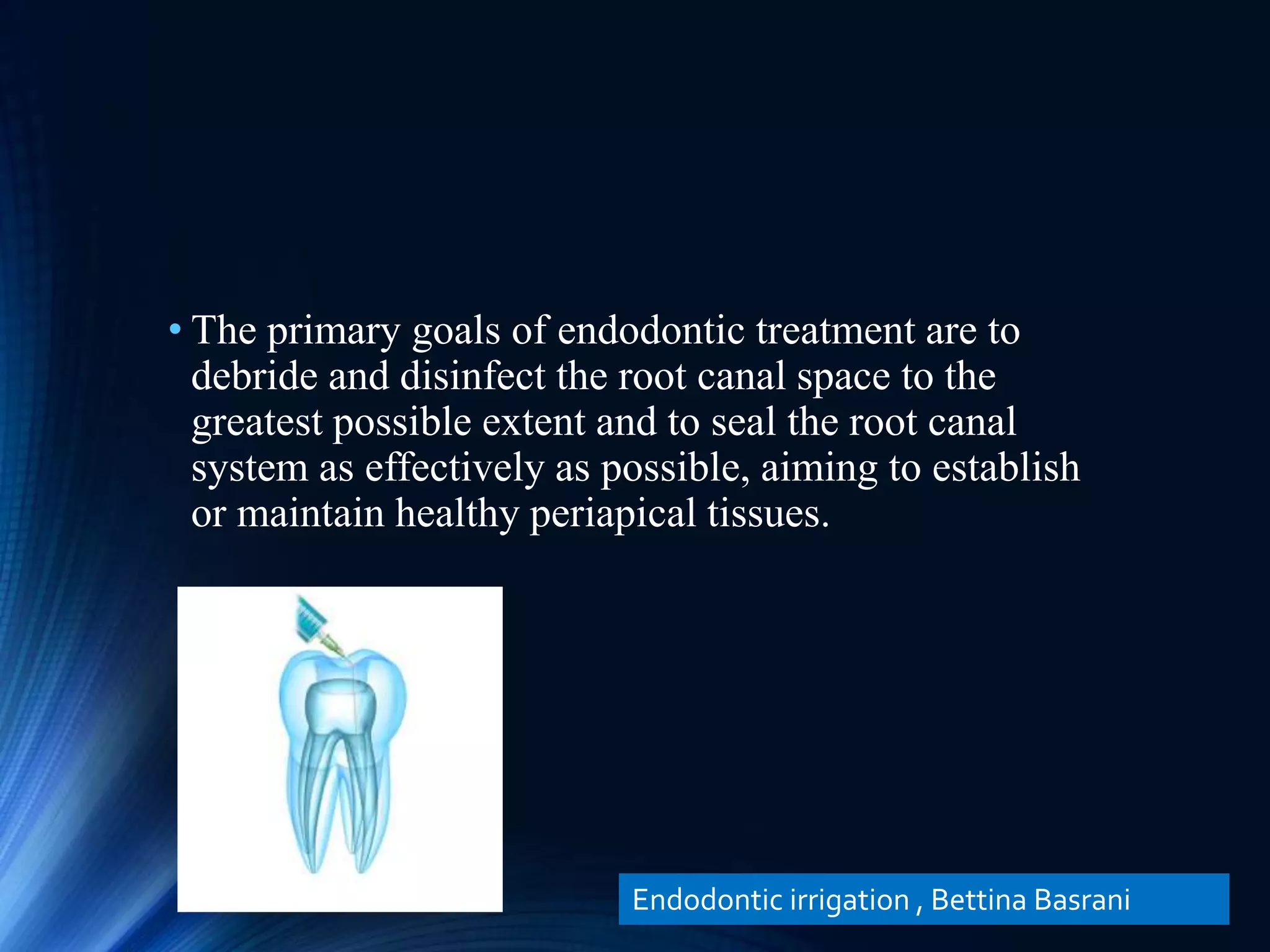
• The primary goals of endodontic treatment are to
debride and disinfect the root canal space to the
greatest possible extent and to seal the root canal
system as effectively as possible, aiming to establish
or maintain healthy periapical tissues.
Endodontic irrigation , Bettina Basrani
• Cleaning and shaping of the root canal system though is
able to reduce the number of bacteria, complete
disinfection of the canal is difficult because of internal
complexity of the root canal system.
• Most endodontic failures is likely caused by the inability to
eliminate bacteria from the root canal system.
• Investigators have shown many factors which
attribute to internal complexity of the canals:
• multiple foramina,
• additional canals,
• fins, deltas, inter-canal connections,
• ‘C-shaped’ canals and
• accessory canals
• Studies have demonstrated that
mechanical instrumentation cannot
sufficiently disinfect root canals
regardless of the instrumentation
technique or system used.
• Despite technological advances in the
ability to shape root canals, at least 35%
of root canal surfaces still remain
uninstrumented.
• Thus a root canal irrigant is imperative
to aid in the disinfection of the canals
completely.
In vitro efficacy of a non-instrumentation technique to remove intracanal multispecies
biofilm, Ronald et . al , JOE 2021
• The choice of an irrigating solution for use in
infected root canals requires previous knowledge of
the microorganism responsible for the infectious
process as well as the properties of different
irrigating solutions.
Objectives of irrigation
• Mechanical and chemical functions:
• Flushing
• Lubrication
• Dissolution
• Smear layer removal
• Biological functions:
• Antimicrobial
Ideal requirements
• Antimicrobial activity
• Mechanically flushes out the debris from the root canal
• Nontoxic and nonirritating to the periapical tissues
• Dissolves necrotic and vital pulp tissues
• Serves as a lubricant
• Removes the smear layer
• Low surface tension
Grossman 13th edition
Irrigating solutions for endodontic use must meet
precise requirements:
a) they must be able to digest proteins and dissolve necrotic tissue
b) they must have a low surface tension to reach the apical delta and
all the areas that cannot be reached by the instruments
c) they must have germicidal and antibacterial properties
d) they must be non-toxic and non-irritating to the periapical tissues
e) they must keep the dentinal debris in suspension
f) they must lubricate the canal instruments
g) they must prevent discoloration of the tooth; indeed, they should
bleach the tooth
h) they must be relatively harmless to the patient and dentist
i) they must be readily available and inexpensive.
- Castellucci vol 2
Classification
Most commonly used irrigants
 Sodium hypochlorite (NaOCl)
 Ethylenediaminetetraacetic acid (EDTA)
 Chlorhexidine digluconate (CHX)
Other recently introduced irrigants
 1 – hydroxyethylidene – 1 , 1-bisphosphonate ( HEBP)
 Iodine potassium iodide (IKI)
Antibiotic containing irrigants
 MTAD
 Tetraclean
 QMix Grossman 14th edition
Irrigants
Chemical
agents
Tissue
dissolving
agents
Ex: NaOCl,
ClO2
Antibacteria
l agents
Bactericidal
Ex: CHX
Bacteriostatic
Ex: MTAD
Chelating
agents
Mild pH
Ex: HEBP
Strong pH
Ex: EDTA
Natural
agents
Antibacterial
agents
Ex: Green
tea, Triphala
Root canal irrigants: Journal of Conservative Dentistry (2010)
Normal saline
• Normal saline causes gross debridement and
lubrication of root canals.
• Very mild in action - used as an adjunct to
chemical irrigant.
• Normal saline as 0.9%W/V is commonly used
as irrigant in endodontics.
• It basically acts by flushing action.
• It can also be used as final rinse for root canals
to remove any chemical irrigant left after root
canal preparation.
Sodium hypochlorite
• Sodium hypochlorite (NaOCl), a
reducing agent, is a clear, straw-
colored solution.
• Most widely used irrigating solution
History:
• First produced in 1789 in France
• Was used as a hospital antiseptic that
was sold under the trade names Eusol
and Dakin’s solution
In 1919 , Coolidge introduced NaOCl to endodontics as
an intracanal irrigant solution
Mechanism of action
According to Estrela et al., the mechanism of action
of sodium hypochlorite occurs due to the following
properties and interactions:
• Saponification reaction
• Amino acid neutralization
• Hypochlorous acid formation
• Chloramination reaction
• High alkaline pH >11
- Cohen 12th edition
Tissue dissolution ability
• NaOCl posses strong tissue dissolution property
• The solvent action of NaOCl has been attributed to
its high alkalinity
• It depends on its concentration, temperature & time
of application.
• Grossman and Meiman reported that 5% sodium
hypochlorite dissolves pulp tissue in 20 min to 2 h
Various concentrations
• There has been much controversy over the
appropriate concentration of hypochlorite solutions
to be used in endodontics
• As Dakin's original 0.5% sodium hypochlorite
solution was designed to treat open (burnt) wounds
• It was surmised that in the confined area of a root
canal system, higher concentrations should be used ,
as they would be more efficient than Dakin's solution
• NaOCl has been used in various concentrations ranging
from 0.5- 5.25%
• ADA (American Dental Association) accepted
concentration for clinical use of NaOCl as an irrigant is
5.25% (Cunningham et al. 1980).
• Most commonly used concentration - 2.5%
• The antibacterial effectiveness and tissue dissolving
capacity of NaOCl is a function of its concentration but
so is its toxicity
• The lower and higher concentrations are equally efficient
in reducing the number of bacteria in infected root canal
• But the tissue dissolving effect is directly related to the
concentration
Baumgartner and Cuenin commented that-
The effectiveness of low concentrations of NaOCl may be
improved by using larger volumes of irrigant and
replenishing fresh solutions into the canal more frequently
• 1% and 5% NaOCl was used
Effect of temperature:
• There are various devices to preheat NaOCl syringes
however, it was demonstrated that as soon as the
irrigant touches the root canal system, the
temperature reaches the body temperature.
• Increasing the temperature of low-concentration
NaOCl solutions improves their immediate tissue-
dissolution capacity
• Therefore, some authors recommend in-situ heating of
NaOCl. This can be done by activating ultrasonic or sonic
tips to the NaOCl inside the root canal for a couple of
minutes
• Macedo and colleagues stated that the efficacy of NaOCl on
dentin is improved by refreshment, ultrasonic activation, and
exposure time
• In this investigation, a 10° C temperature rise during
ultrasonic activation was insufficient to increase the reaction
rate
• However, no clinical studies are available to support the use
of heated NaOCl.
• A 100- fold increase in killing efficacy of E.feacalis
was observed between the corresponding NaOCl
solutions at 20°C and 45°C in a study conducted by
George et al(2005)
Bleaching action of NaOCl:
• Satisfies the need to use an irrigating solution that
prevents discoloration of the tooth and may help to
bleach them
• Commercially sold bleaching agent (Household
purposes) – 5.25% NaOCl
• Schilder described bleaching activity as passive and
esthetic
• Coolidge attributed the bleaching ability to the
oxidizing activity of NaOCl
Adverse Effects of NaOCl:
1. Effect on physical properties of dentin
2. Influence of NaOCl on Endodontic Instruments
3. NaOCl toxicity
4. Damage to eyes
5. Damage to clothing
6. NaOCl accidents – Apical Extrusion
7. Allergic reactions to NaOCl
Effect on physical properties of
dentin
• NaOCl is an efficient organic solvent that causes dentin
degeneration because of the dissolution of collagen by the
breakdown of the bonds between carbon atoms and
disorganization of the proteic primary structure.
Effect of NaOCl treatment on bonding to root canal dentin
using a new evaluation method. Dent Mater J. 2001
• The reduction of the bond strength seen between adhesive
systems and dentin walls may be because of the removal of
collagen fibrils from the dentin surface by NaOCl,
impeding the formation of a consistent hybrid layer
Bond strengths to endodontically-treated teeth. Am J Dent.
1999
Effect on resin bonding:
• The reduction of the bond strength seen between
adhesive systems and dentin walls may be because of the
removal of collagen fibrils from the dentin surface by
NaOCl, impeding the formation of a consistent hybrid
layer.
• It requires a use of a reversal agent (ascorbic acid or
sodium ascorbate) because of its ability to affect the
polymerization of the resin sealer
A Contemporary Overview of Endodontic Irrigants – A
Review – Journal of Dental Applications 2014
Influence of NaOCl on
Endodontic files:
• Corrosion adversely affects the metallic surfaces by
causing pitting and porosity
• It is supposed that these microstructural defects can
lead to areas of stress collection and crack formation,
weakening the structure of the instrument (Oshida et
al. 1992).
• Decreases the cutting efficiency of endodontic files
(Stokes et al. 1999)
• Busslinger and Barbakow evaluated corrosion of
NiTi endodontic files caused by NaOCl solutions of
different concentrations from 0.5% to 5.5%
• These authors concluded that the quantities of ions
released by the corrosion process into the NaOCl
solutions were insignificant
• Fabiola et al. suggests that exposure to 5.25%
NaOCl solution affects neither resistance to flexural
fatigue nor torsional resistance of NiTi K3
endodontic files.
1. Interaction with CHX
• The reaction between NaOCl and CHX produces a
carcinogenic product - parachloroanaline (PCA)
• The presence of PCA was confirmed by the Beilstein
test for the presence of chlorine and the HCl
solubility test for the presence of aniline
• This reaction coats the canal surface and
significantly occludes the dentinal tubules and
affects the seal of the root canal
2. Interaction with EDTA
• Grawehr concluded that EDTA retained its calcium
complexing ability when mixed with NaOCl, but
however it instantaneously reduces the amount of
chlorine of NaOCl & ultimately NaOCl loses its
tissue-dissolving capacity
• Short-term irrigation with hypochlorite after EDTA
at the end of chemomechanical preparation causes
strong erosion of the canal-wall surface dentin
3. Interaction with H2O2
• Many clinicians mix NaOCl with hydrogen peroxide
for root canal irrigation
• Despite more vigorous bubbling, the effectiveness of
the mixture has not been shown to be better than that
of NaOCl alone
Advantages
• The ability of NaOCl to dissolve organic soft tissue of
the pulp
• It is well recognized to be effective against a broad
range of pathogens: gram-positive and gram-negative
bacteria, fungi, spores, and viruses including the human
immunodeficiency virus
• Gross debridement and flushing out of debris
• Removes smear layer when used with EDTA
Disadvantages
• Acute inflammation followed by necrosis results
when NaOCl comes into contact with vital tissue -
when extrude out of the apical foramen
• Hypersensitivity - irritation to eyes
• May crystallize on the root canal walls
Effect on physical properties:
• Degraded by light, air, and contaminants- hence to
use fresh solution always
NaOCl Toxicity:
• A 1% concentration of NaOCl provides sufficient
tissue dissolution and antimicrobial effect, but the
concentration used has been as high as 5.25%
because of enhanced anti-microbial activity
(Yesilsoy et al. 1995).
• As the concentration used rises so does its toxicity.
• Numerous reports have described clinical
complications because of the improper use of NaOCl
• Sodium hypochlorite is a cytotoxic agent (Gatot et al.
1991, Gernhardt et al. 2004).
• When it comes into contact with vital tissue, it causes
• haemolysis,
• ulceration,
• inhibits neutrophil migration
• and damages endothelial and fibroblast cells (Gatot et
al.1991)
• It has a pH of approximately 11–12 and causes injury
primarily by oxidation of proteins (Kaufman & Keila
1989, Gatot et al. 1991, Serper et al. 2004)
Damage to the eye
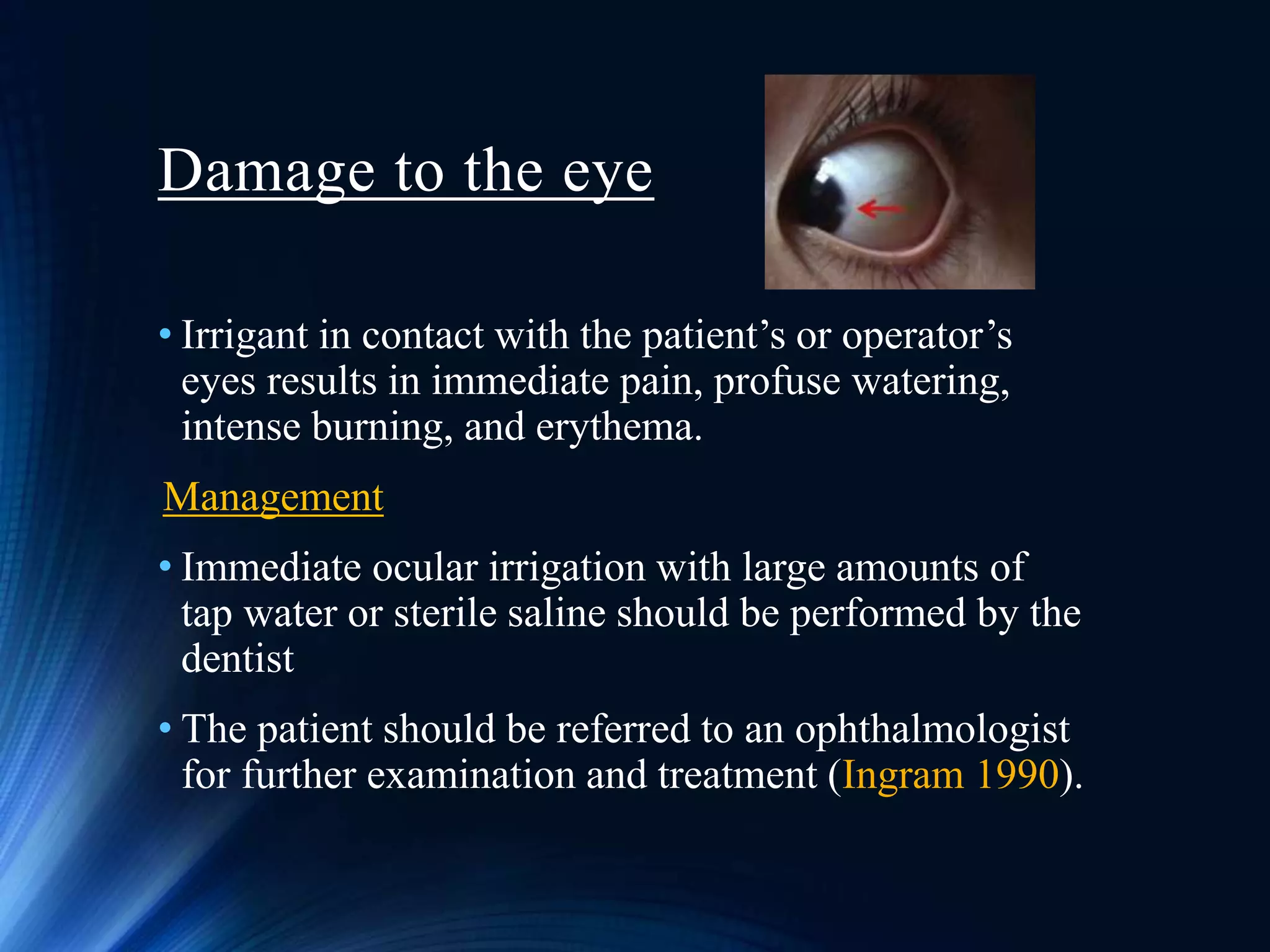
• Irrigant in contact with the patient’s or operator’s
eyes results in immediate pain, profuse watering,
intense burning, and erythema.
Management
• Immediate ocular irrigation with large amounts of
tap water or sterile saline should be performed by the
dentist
• The patient should be referred to an ophthalmologist
for further examination and treatment (Ingram 1990).
Damage to clothing:
• Probably the most common incidents during root
canal irrigation concern damage of the patients’
clothing.
Prevention
• By proper protection of the patients clothing.
• When using hand irrigation, one should assure that
the irrigation needle and syringe are securely
attached.
NaOCl Accidents:
Occurrence:
• when the apical constriction has been destroyed
during root canal preparation or by resorption.
• may occur in teeth with wide apical foramina
• extreme pressure during irrigation
• binding of the irrigation needle tip in the root canal
The excellent tissue-dissolving capability of sodium
hypochlorite will lead to tissue necrosis.
Symptomatology
Pain
• Immediate severe pain ( 2-6 minutes)
Oedema
• Immediate oedema of neighbouring soft tissues
• Possible extension of oedema over the injured half
• side of the face, upper lip, infraorbital region
Modern Endodontic Principles Part 4: Irrigation ,James Darcey
Chlorhexidine digluconate
• Cationic bisbiguanide
• pH of 5.5 – 7
• Structure consists of two symmetric four-
chlorophenyl rings and two bisguanide groups held
together by a central hexamethylene chain
Various concentrations
• Available as - 0.12%, 0.2%, 2%
• Commercially available oral rinse
typically contains 0.12% CHX
gluconate
• 0.12% CHX has been found to be
ineffective for endodontic use
whereas concentrations above it
have been successfully used
• Available in both gel and liquid
formulations
Mechanism of action
Antibacterial activity
• It has a wide antimicrobial spectrum and is effective
against both Gram-positive and Gram -ve bacteria as
well as yeasts, while bacterial spores are resistant to
CHX
• Possesses greater efficacy towards Gram +ve
bacteria
• Low concentrations - bacteriostatic
• High concentrations - bactericidal
• CHX penetrates the cell wall and causes
precipitation or coagulation of cytoplasm probably
caused by cross linking
substantivity
• Clinically CHX’s substantivity seems to be an
advantage over NaOCl, sustaining the antimicrobial
activity over a period of 48 hours or 72 hrs after
treatment
• Their cationic properties also allow them to bind
electrostatically to surfaces
• They are gradually released from the surface, as the
concentration of chlorhexidine in the environment
decreases
• The reversible reaction of uptake and release of
CHX results in a substantive antibacterial activity
Interactions of CHX
1. CHX and dentin bonding (Anticollagenolytic
Activity):
• CHX is known to have a broad-spectrum MMP
inhibitory effect & so significantly improved the
integrity of the hybrid layer in a 6-month clinical
trial
• Adsorption of CHX by dentin improves the resin
infiltration in dentinal tubules and thereby increasing
bond strength
2 . CHX and coronal microleakage:
• Canals medicated with CHX alone or in combination with
CHX retard the entrance of microorganisms through the
coronal portion of the tooth into the root canal system,
due to its wide antimicrobial activity and substantivity
• Such a finding is interesting, especially if the coronal
restoration becomes defective or if it is lost
3 . Allergic reactions of CHX:
• CHX may have a number of rare side effects, such as
desquamative gingivitis, discoloration of the teeth and
tongue, or dysgeusia
Biocompatibility
Various studies have shown that CHX has extremely
low level of tissue toxicity as compared to NaOCl ( as
low as 0.5%)
Limitations
• Inability to dissolve organic matter
• No action on smear layer
EDTA – Ethylene diamine tetra
acetic acid
Is a polycarboxylic aminoacid, colourless ,water
soluble solid
History:
• 1957- Nygaard Ostby recommended the use of 15%
EDTA solution (pH 7.3)
formula for 15% EDTA was:
• disodium salt of EDTA - 17.0 g
• distilled water - 100.00 ml
• 5N sodium hydroxide - 9.25 ml
• 1963 - A detergent was added to increase the cleaning and
bactericidal potential of EDTA
• The new composition being known as EDTAC which has
0.84g of quaternary ammonium compound - Cetavlon
• EDTAC reduced surface tension of the irrigant
facilitating wetting of the entire root canal wall thereby
increasing the ability of chelators to penetrate dentine
• It also had a greater anti-microbial effect than EDTA
• 1969- Strewart et al. introduced RC-Prep (Premier
Dental) paste type chelating agent
Recently paste type chelators have regained
popularity as almost all manufacturers of Ni-Ti
instruments recommend the use of EDTA as a
lubricant during rotary root canal preparation to
reduce the risk of instrument separation
Mechanism of action
• EDTA functions by forming a calcium–chelate
solution with the calcium ion of dentin
• The dentin thereby becomes more friable and easier
to instrument
• This solution removes the inorganic component of
the endodontic smear layer
• The smear layer is a combination of dentin, pulpal,
and bacterial debris
• On direct exposure for extended time, EDTA extracts
bacterial surface proteins by combining with metal ions from
the cell membrane which can eventually lead to bacterial
death.
• Chelators such as EDTA form a stable complex with
calcium. When all available ions have been bound,
equilibrium is formed and no further dissolution takes place.
• EDTA is self-limiting
Some clinicians advocate the removal of the
smear layer by irrigating the canal with sodium
hypochlorite followed by EDTA
The demineralizing action :
•Removes inorganic component of smear layer
•Reduces the time necessary for debridement
•Aides in enlarging narrow/ obstructed canals
•Helps bypass fragmented instruments
Changes in dentin permeability
After removal of smear layer with the aid of EDTA,
dentin permeability increased and reduction in micro
leakage between the definitive root canal filling and
canal wall was achieved
Clinical recommendations
• Root canal preparation can be carried out with the aid of
chelator paste.
• A chelator in paste form serves as a lubricant for files and
reduces the risk of instrument fracture in the canal.
• A final intensive rinse with 17% EDTA reduces the extent of
the smear layer remaining which in turn results in a cleaner
canal wall and better adaptation of the root fillings to the canal
walls
• EDTA containing agents should be used between 1-5 minutes
Various Preparations:
 Liquid chelators:
Calcinase
• Contains 17% Sodium edetate, sodium
hydroxide as a stabilizer and purified
water.
REDTA (Roth International)
• has 17% EDTA solution with addition of
0.84g Cetrimide to reduce the surface
tension.
EDTA-t
• Contains 17% EDTA+ Sodium lauryl
ether sulfate (Tergentol) as a detergent.
Largal ultra (septodent)
• contains 15% EDTA,
• 0.75% cetrimide
• pH value 7.4
 Paste chelators:
These paste chelators are the one most commonly
recommended with rotary instrumentation
Calcinase slide:
• it contains 15% sodium EDTA
• 58 to 60% water.
• has alkaline pH value of 8.9
• it is water soluble hence easily rinsed from root canal
system
• The gel is firm at room temperature and develops a
creamy consistency when agitated
RC-PREP
• It contains 15% EDTA,
• 10% Urea peroxide and
• Glycol in aqueous ointment base .
• Oxygen is set free by reaction of
NaOCl with RC-Prep resulting in
effervescence, so that pulpal remnants
and blood coagulates can be easily
removed from the root canal wall
(Stewart et al)
• Glycol acts as a lubricant
Glyde file
• Is composed of 15% EDTA
• 10% Urea peroxide in aqueous solution
• It has got properties similar to RC-Prep
FileCare EDTA
• Also composed of 15% EDTA
• 10% urea peroxide
File EZE
• Contains 19% EDTA
Hydroxyethylidene bisphosphonate
(HEBP)
• Also known as etidronic acid or etidronate
• Weak chelator and a potential alternative to
EDTA
• It has no short term reactivity with NaOCl
• Can be used in combination with NaOCl
without affecting its proteolytic or
antimicrobial properties
• Studies have shown that HEBP prevents
bone resorption and is used systemically in
patients suffering from osteoporosis or
Paget’s disease
Ruddle solution
• Hypaque is a high contrast radiopaque & injectable
dye.
• It is water soluble with pH of 6.7- 7.7
• This composition simultaneously provides the
solvent action of full-strength NaOCl, visualization,
& improved penetration
• Used to visualize the microanatomy, verify the
shape, monitor the remaining root wall thickness
Hydrogen peroxide
• H2O2 is a widely used biocide for
disinfection and sterilization
• It is a clear, colorless liquid that is used in
a variety of concentrations in dentistry,
ranging from 1% to 30%
• It degrades into water and oxygen
• H2O2 is active against viruses, bacteria,
yeasts, and even bacterial spores
Mechanism of action:
• It is highly unstable and easily decomposed by heat
and light
• It rapidly dissociates into water and nascent oxygen
• On coming in contact with tissue enzymes catalase
and peroxidase , the liberated [O] produces
bactericidal effect but this effect is transient and
diminishes in presence of organic debris
• It causes oxidation of bacterial sulfhydryl group of
enzymes and thus interferes with bacterial
metabolism
• The rapid release of nascent oxygen on contact with
organic tissue results in bubbling action which is
thought to aid in mechanical debridement by dislodging
particles of necrotic tissue and dentinal debris and
floating them to the surface
• Moller recommended 30% H2O2 as the first step in
tooth surface disinfection
• It has been particularly popular in cleaning the pulp
chamber from blood and tissue remnants, it has also
been used in canal irrigation
• For years 3% H2O2 has been recommended as a
canal irrigant because of its effervescent action in
presence of blood products
Effervescent action:
• This action was specially indicated in mandibular
teeth where the bubbling of the peroxide was thought
to lift debris from the canal system.
• However, H2O2 does not possess tissue dissolution
properties and is not effective as a lubricant
• Hence, alternate use of H202 + NaOCl irrigating
solutions was recommended by Grossman.
Injection of hydrogen peroxide beyond
apex
• Bhat (1974) reported a case in which hydrogen
peroxide of unknown concentration was injected into
the soft tissues due to lateral perforation of right
maxillary central incisor
• Patient experienced no pain under L.A but
complained about a rapidly developing swelling on
the upper lip and some difficulty in breathing
• The canal was left open, the patient was prescribed
antibiotics and instructed to apply cold packs
• The emphysema, caused by oxygen liberated from
the hydrogen peroxide, subsided in 1 week and root
canal treatment was completed IEJ 2000
Disadvantage
• It does not possess tissue dissolving property
• Not a lubricant
• Limited antimicrobial action
• Complication
• Peroxide must be eliminated from the canal before
the crown is sealed otherwise oxygen may be
evolved afterwards as a result of contact with blood
or tissue fluids
Urea peroxide
• Urea peroxide (Endo-PTC or Gly-Oxide) is another
widely used solution to aid instrumentation
Mechanism of action
• Produces hydroxyl radicals that oxidises sulphydryl
groups, double bonds in proteins, lipid and outer
membranes - cause cell death
• It retains its antibacterial activity in the presence of
blood whereas aqueous 3% hydrogen peroxide does
not
Iodine potassium iodide (IKI)
• IKI is a broad-spectrum antimicrobial
irrigant used in a concentration of 2–
5% in endodontics
• A potential disadvantage of iodine-
containing irrigants is a possible
allergic reaction in some patients.
Citric acid
• Available in 10-50% concentration
• Demineralizing solution that is used during the
endodontic therapy to remove the smear layer from the
prepared root canal
• Citric acid interferes with the mechanism of action of
NaOCl
• Citric acid 10% is more biocompatible and effective in
removing smear layer than 17% of EDTA
Maleic acid
• Acid conditioner in adhesive dentistry at
5-7% conc.
• Final irrigation with 7% of maleic acid is
more efficient than 17% of EDTA in the
removal of smear layer from the apical
third of the root canal.
• 7% of maleic acid produces greater
surface roughness on root canal walls as
compared to 17% of EDTA
• This surface roughness provides an
important role in micromechanical
bonding of resin sealers
MTAD
• Combined chelating and antibacterial properties
• Clinically effective
• Biocompatible
• Citric acid may serve to remove the smear layer,
allowing doxycycline to enter the dentinal tubules and
exert an antibacterial effect
• Removes smear layer while being less erosive
• Potential sustained antibacterial activity
Final rinse
• The recently revised protocol for clinical use of MTAD
advises an initial irrigation for 20 min with 1.3% NaOCl,
followed by a 5-min final rinse with MTAD
Tetraclean
• Tetraclean like MTAD, is mixture of an Citric Acid,
doxycycline, and a detergent
• However, the concentration of the antibiotic
(doxycycline-50 mg/ml), and the type of detergent
(polypropylene glycol) differ from those of MTAD
• Tetraclean is a mixture of doxycycline hyclate (at a
lower concentration than in MTAD), an acid, and a
detergent
• They do not dissolve organic tissue and are intended
for use at the end of chemomechanical preparation
after sodium hypochlorite
Antimicrobial action
• It shows a high action against both, strictly anaerobic
and facultative anaerobic bacteria
• It is also more effective than MTAD against E.
faecalis in planktonic culture and in mixed species in
vitro biofilm
Smear layer
• It is able to eliminate microorganisms and smear
layer in dentinal tubules of infected root canals with
a final 5-min rinse.
Surface tension
• It has low surface tension which enables a better
adaptation of the mixtures to the dentinal walls
QMix
• It is a combination of 17% edta and 2%
chloorhexidine
• Q mix is an irrigation solution used as a final rinse
Triclosan and gantrez
• Triclosan is a broad spectrum antimicrobial agent
• Active against G+ and G- bacteria, some fungi and
viruses
• Nudera et al. evaluated minimum bactericidal
concentrations (MBC) of triclosan and triclosan with
Gantrez against P intermedia, F nucleatum, A naeslundii,
P gingivalis, and E faecalis
• The MBC of triclosan ranged from 12–94 μg/ml
• The MBC of triclosan with Gantrez ranged from <0.3–
10.4 μg/ml
• The addition of Gantrez enhanced the bactericidal activity
of triclosan
Electrochemically activated water
• Russian scientists have developed a process whereby
so-called electro-chemically activated water (ECA)
is produced with a new and unique anode–cathode
system (Leonov 1997)
• ECA is produced from tap water and saline solution
by a special unit that houses a unique flow-through
electrolytic module (FEM)
To obtain the best end solutions with the ECA, NaCI water
solutions with no more than 5.0 g/L concentration or fresh
water of less than 1.0 g/L mineralization is needed
• The FEM contains the
Anode
• made from titanium and coated
with ruthenium-oxide, iridium
and Platinum
Cathode
• made from titanium coated with
pyro carbon and glass carbon
• the anode being a solid cylinder
fits coaxially inside the cathode
which is a hollow cylinder
Membrane
• Made up of ceramic in between
them
• The physical and chemical nature of ECA is not yet fully
understood
• The solution supposedly exists in a metastable or dis
equilibrious state for 48 h after production and contains
many free radicals and a variety of molecules
• After 48h the solution returns to the stable state, becoming
inactive again
• In the metastable state the solutions have a very high
oxidation reduction potential
An in vitro study of comparative evaluation
of efficacy of electrochemically activated
water as a root canal irrigant in smear layer
removal
• Results: NaOCl, maleic acid, and ECA had similar
smear layer removal efficacy. MTAD was less
efficient than the other irrigants tested. Saline did not
remove the smear layer.
• Conclusion: Electrochemically activated water has
promising smear layer removal efficacy and is
comparable with conventional root canal irrigants.
•. 2020 Sep-Oct;23(5):447-450. doi: 10.4103/JCD.JCD_488_20. Epub 2021 Feb 10
Evaluation of the Antibacterial Efficacy
of QMix and AgNP Solutions in Root
Canals of Primary Molars: An In-Vitro
Study
Dania et al 2022
• Results - Sodium hypochlorite, AgNPs, and QMix 2in1
effectively reduced the bacterial count of Enterococcus
within root canals of primary molars. There were statistical
differences between all groups. QMix 2in1 solution showed
the greatest antibacterial efficacy, then NaOCl solution and
AgNPs solution.
Irrigation devices
…………….to be continued
Formocresol
• Formocresol, which is categorized into
the aldehydes, has been used
extensively in endodontic therapy
• Buckley referred to it as an effective
intracanal medicament in 1904
• Formaldehyde is volatile and releases
antimicrobial vapors when applied to a
cotton pellet for the disinfection of pulp
chamber
Calcium hydroxide
• Calcium hydroxide is the most commonly used
intracanal medicament
• It is highly alkaline with a pH of approximately
12.5 which prevents the growth and survival of
bacteria , most of which cannot survive pH11 or
above
Mechanism of action
LIMITATIONS
• The handling and proper placement of calcium
hydroxide present a challenge to clinician.
• Also ,the removal of calcium hydroxide is frequently
incomplete ,resulting in a residue covering 20% to 45%
of the canal wall surfaces ,even after copious irrigation
with saline ,NaOCl / EDTA
• Most notably ,it may interfere with the seal of the root
filling and compromise the quality of treatment
• Recently the ability of calcium hydroxide to
completely eradicate bacteria from the root canal has
been questioned.
• Various invitro studies have shown that dentin can
inactivate the antibacterial activity of calcium
hydroxide
Phenols
• It is one of the oldest antimicrobial
agents used in medicine ,introduced by
Lord Lister in 1867
• It was used for many years for its
disinfectant and caustic action
• However it has strong inflammatory
potential.so, at present ,it is rarely used
as an intracanal medicament
• Liquefied phenol consist of 9 parts of
phenol and 1 part of water
Parachlorophenol
• It has been very popular component of
dressing , as phenol is no longer used in
endodontics because of its high toxicity to
efficacy ratio
COMPOSITION – this is substitution
product of phenol in which chlorine
replaces one of the hydrogen atoms.
Concentration – 1% aqueous solution is
preferred
Uses – used as an dressing of choice for
infected tooth
Camphorated parachlorophenol
• The camphor present in camphorated
parachlorophenol reduces irritating
effect of pure parachlorophenol and
acting as a diluent and vehicle.
• Grossman brought to light the
antimicrobial effect of camphorated
parachlorophenol compared to some
other root canal medicaments
Camphorated
monoparachlorophenol (CMCP)
2 parts of parachlorophenol +3 parts gum
camphor
Camphorated monochlorophenol(CMCP)
Triple antibiotic paste (TAP)
• The efficacy of triple antibiotic paste for
elimination of bacteria was first discussed
by Hoshino et al.(1996)
• The combination consists of metronidazole,
ciprofloxacin and minocycline
• Triple antibiotic powder, either mixed with
normal saline or 2% chlorhexidine,
produced the largest zone of inhibition
against E. faecalis
• DRAWBACK – antibacterial resistance
Polyantibiotic
paste (PBSC)
PBSN
Novel and Advanced Disinfection
Therapies
Nanoparticles
Nanoparticles measure between 1 and 100 nm
Silver nanoparticles are the most widely
investigated metallic nanoparticle in the field of root
canal disinfection
A study found that a silver nanoparticle-based
irrigant had antibiofilm activity comparable to 2%
chlorhexidine and 5% sodium hypochlorite
Drawback – dentin discoration , cytotoxic
Chitosan nanoparticle
• Derived from chitin, a natural component found in
shrimp and crab shells
• Chitosan nanoparticles exhibit excellent
biocompatibility as well as promising antibiofilm
and antimicrobial properties
• Chitosan nanoparticles were found to potently kill
planktonic and biofilm E. faecalis cells
• Chitosan nanoparticles have also been functionalized
with photosensitizers such as Rose Bengal and
methylene blue to enhance antibiofilm efficacy via
photodynamic activation
Calcium hydroxide
nanoparticles
• Developed to improve its diffusivity and
antibacterial activity
• Studies have reported that nanocalcium hydroxide
was able to penetrate deeper into dentinal tubules
and was more effective against E. faecalis compared
to conventional calcium hydroxide
• Mesoporous calcium silicate nanoparticles combined
with silver nanoparticles were able to inhibit the
growth of both planktonic and biofilm forms of E.
faecalis
Antimicrobial Peptides
• Antimicrobial peptides have recently gained
attention for their potential therapeutic applications
in disinfection.
• These peptides disrupt and destabilize the bacterial
membrane integrity and cellular functions,
eventually leading to cell death.
• This enables their broad-spectrum antimicrobial
activity including drug-resistant strains
(Present status and future directions of intracanal medicaments, Ronald et al
IEJ 2022)
Disinfectant devices and
techniques
Syringe irrigation with needles
• Regardless of the delivery system,
• the solution must be introduced slowly
• the needle never wedged in the canal
• As a rule, the clinician should irrigate copiously,
recapitulate and continue
Gauge of the needle
• Gauges ranging from standard 22 to finer 30 have been
used in endodontic irrigation.
• It should be bent approximately 30º in the center of
the needle to allow easier delivery of the solution
and to prevent deep penetration of the needle or
probe
Using a forefinger to
depress the plunger gives
greater control of irrigant
delivery
Stropko irrigator
• It consists of an adapter that connects to the air /
water syringe and accepts standard luerlock needle
tips for irrigant removal and application.
• As well as air drying
Manual brushes
• These are adjunctive aids in canal
debridement or agitation of
irrigants.
• The bristles help in cleaning the
uninstrumented recesses of the
radicular pulp space.
• Examples include the Endobrush
and NaviTip FX
Rotary brushes
• Advancement in small wire technology, bristle
materials and bristle attaching techniques have
enabled the creation of an endodontic microbrush of
clinical field testing
• They consist of microbrushes attached to rotary
handpieces, ex: CanalBrush, Ruddle Brush
• The brush includes a shaft or shank and a tapered
brush section .
Manual dynamic agitation
• An irrigant must be in direct contact
with the canal walls for effective action.
• Its often difficult for the irrigant to reach
the apical portion of the canal because
of the so-called vapor lock effect
• The gently moving well-fitting gutta-
percha master cone up and down in
short 2 to 3 mm strokes within an
instrumented canal
• Can produce an effective hydrodynamic
effect and significantly improve the
displacement and exchange of any given
reagent
Apical vapor lock
• Definition: Air entrapment at the apical
part of root canal during syringe irrigation
and totally block irrigant penetration in
that area, a phenomenon also termed apical
vapor lock (Bettina basrani et al)
• NaOCl reacts with organic material in the
root canal and quickly forms micro air
bubbles at the apical third that coalesce
into an apical vapor lock with subsequent
instrumentation
Problems of apical vapor lock:
• Prevents the flow of irrigant into the apical region
• Prevents adequate debridement of the canal system
How to overcome the vapor lock?
• Manual-dynamic irrigation: Hand-activated (moving
up & down) well-fitting gutta-percha master cone
that is introduced to working length after
instrumentation
• Apical negative pressure irrigation, such as EndoVac
Continuous irrigation during
instrumentation
Quantec E System:
• It uses a pump console, 2 irrigation
reservoirs and tubing
• It provides continuous irrigation
during rotary instrumentation
• Increased volume of irrigant
• Cleaner canal walls in the coronal
third (setlock et al ,walters et al)
Disadvantage: No significant cleaning
efficiency in middle and apical third
Sonic irrigation
• Sonic instruments was introduced by Tronstad et al
in 1985.
• It works in lower frequency (1–6 kHz) and produces
smaller shear stresses than ultrasonic irrigation
• Ex: Vibringe system , Endo Activator System
Endo activator system
• Handpiece: Cordless, portable, battery operated
• Polymer tips: Disposable (single use), smooth non-
cutting, radiolucent, strong & flexible
• Agitate irrigant solutions, provides 10,000 cpm /min
• It removes the smear layer, debride the uninstrumented
portion of the root canal system, and dislodge the biofilm
within long, narrow, and highly curved canal of molar
teeth.
Ultrasonic irrigation
• Richman (1967) introduced ultrasonics in
endodontics
• Ultrasonic irrigation modality operates at frequencies
of 25–30 kHz setting up transverse vibrations with a
characteristic pattern of nodes and antinode
Types:
1. Continuous ultrasonic irrigation (CUI)
2. Passive ultrasonic irrigation (PUI)
Continuous ultrasonic irrigation
(CUI)
• 25-gauge irrigation needle is used instead of an endosonic file.
• Irrigant is carried out from intravenous tubing connected via a
Luer-lok to an irrigation delivering syringe.
• Irrigant is delivered in apical one third by continuous flow.
Passive ultrasonic irrigation (PUI)
• Weller et al. in 1980
• Energy is transmitted from a file or smooth
oscillating wire to the irrigant by means of ultrasonic
waves that induce two physical phenomena:
Acoustic streaming
Cavitation
Acoustic streaming
• Acoustic streaming is the rapid movement of
fluid in a circular or vortex-like motion around
a vibrating object
• The acoustic streaming that occurs in the root
canal during ultrasonic irrigation has been
described as acoustic micro streaming
• The shear flow caused by acoustic
microstreaming produces shear stresses along
the root canal wall, which can remove debris
and bacteria from the wall
Cavitation
• Acoustic cavitation can be defined as the
creation of new bubbles or the expansion,
contraction and/or distortion of pre-
existing bubbles (so-called nuclei) in a
liquid, the process being coupled to
acoustic energy (Leighton 1994)
• These bubbles expand and then rapidly
collapse producing a focus of energy
Application of irrigant during PUI
• Two flushing methods can be used during PUI,
namely a continuous flush of irrigant from the
ultrasonic handpiece or an intermittent flush method
using syringe delivery(Cameron 1988)
• Both flushing methods were equally effective in
removing dentine debris from the root canal in an ex
vivo model when the irrigation time was set at 3 min
(van der Sluis et al. 2006)
1. REMOVAL OF SMEAR LAYER:
• PUI is more effective than syringe needle irrigation in
removing pulpal tissue remnants and dentin debris
• Smear layers were effectively removed from the apical,
middle, and cervical thirds of the canal walls by Cetavlon
(EDTAC) and NaOCl by using a size 15 file energized by
ultrasonic agitation
2. REMOVAL OF BACTERIA:
• High-power ultrasound causes de-agglomeration of
bacterial biofilms via the action of acoustic streaming
• Cavitation may produce temporary weakening of the cell
membrane
Safety Irrigator
• Is an irrigation /evacuation system that apically
delivers the irrigant under positive pressure through
a thin needle containing a lateral opening and
evacuates the solution through a large needle at root
canal orifices
• The safety irrigator features a large coronal
evacuation tube ,enabling the user to safely irrigate
and evacuate simultaneously
• It was designed to limit risk of NaOCl accidents
• This technique produces better cleaning efficacy
than syringe irrigation but significantly worse than
MDA with a tapered cone
Pressure alteration devices
EndoVac System:
• Apical negative pressure irrigation system
• It uses suction technique to wash out the debris and
encourage the flow of irrigation in apical two third of
the canal
• Composed of three basic components:
1. Master Delivery Tip (MDT)
2. Macrocannula
3. Microcannula
MDT - The manufacturer’s instructions
must be followed for correct use of the
Master Delivery Tip and to avoid creation
of positive pressure in the pulp canal
• The flow of irrigant from the MDT should
always be directed into an axial wall or the
wall of pulp chamber and never directly
into an orifice
Macro-cannula is plastic with an
open end that measures size 55
with a 0.02 taper.
• Following complete
instrumentation, the
macrocannula is used in each
canal for 30 s in a short up-and-
down pecking motion as close
as possible to working length
Micro-cannula - is stainless steel and has 12 small,
laterally positioned, offset holes in 4 rows of 3, with a
closed end measuring ISO size 30.
• The micro-cannula can be used at working length in a
canal enlarged to ISO size 35 or larger
Rins Endo:
• Rins Endo was introduced by Durr
Dental Co
• Based on pressure suction
technology with aproximately 100
cycles per minute
• Its components are a handpiece, a
cannula with a 7 mm exit aperture,
and a syringe carrying irrigant.
Disadvantage:
• Higher risk of apical extrusion of
irrigant (McGill et al.)
Ozone
• Occurs as ozonated water, ozonated olive oil and
oxygen/ozone gas
• Antiseptic, powerful oxidant, and antibacterial agent
• Unstable - cannot be bottled, must be generated fresh
when needed
• Half-life - 40 minutes
• It is unstable and dissociates readily
back into oxygen (O2), thus liberating
so-called singlet oxygen (O1), which is
a strong oxidizing agent which further
impose the deleterious effect on
microorganisms
• Nagayoshi et al. found that ozonated
water (0.5–4 mg/L) was highly
effective in killing both gram positive
and negative micro-organisms
• Ozone is applied from the access opening, making
the technical realization a simple process
• There are five differently sized silicone cups
available to enable perfect tooth sealing
Inserting the
ozone cannula into
the prepared root
canal
Treatment with
ozone with a
complete seal
Limitations
Irritating to respiratory system
 At very low conc. (0.2–0.5 ppm) - headache,
irritation or dryness of the nose, throat and
eyes (McDonnell et al. 1983)
 At higher conc. (1–10 ppm over a few hours) -
lung congestion, oedema, hemorrhage,
changes to the blood and loss of vital lung
capacity
Irritating to the eyes - redness, pain and blurred
vision
Multisonic ultracleaning system
• GentleWave consists of a central unit from
which high-pressure pumps send high-speed
degassed irrigants to a special handpiece with
the tip of the handpiece placed into the pulp
chamber of the tooth.
• . It operates using a handpiece but no
component of this is placed within the canal
system .
• The instrument is placed over the pulp chamber,
sealing the tooth from the oral cavity and is activated
from a computer console.
• From this a spray of irrigant is delivered at 45 ml/
min at 40 °C.
Lasers
• Lasers have been studied for their ability to clean
and effectively disinfect the root canals.
• Provides greater accessibility of formerly
unreachable parts of the tubular network due to their
better penetration into dentinal tissues
• Scientific research was first conducted with the Nd:
YAG and the diode lasers which gained widespread
acceptance in the fields of laser assisted endodontics
• In various laser systems used in dentistry, the emitted
energy can be delivered into the root canal system by
Thin optical fiber
• Nd:YAG
• Er,Cr:YSGG
• Argon
• Diode
• Hollow tube
• CO2
• Er:YAG
Photon induced photoacoustic
streaming (PIPS)
• PIPS employs a erbium laser to pulse
extremely low energy levels of laser
light to create photoacoustic
shockwaves throughout the entire root
canal system without enlarging the
root canals
• The PIPS tip is placed in the pulp
chamber only and not in the canals
• The PIPS tapered tip creates a pressure
wave that streams irrigants throughout
the root canal system
Limitations
• Impossible to obtain uniform coverage of the canal
surface using a laser making complete removal of
smear layer and debris difficult
• Investigators strongly recommended improving the
endodontic tip to enable irradiation of all areas of the
root canal walls
• Another limitation is the safety of such a procedure
because thermal damage to the periapical tissues
potentially is possible
Photo activated disinfection (PAD)
• Also known as photodynamic
therapy(PDT)
• Is based on the concept that a nontoxic,
photosensitizing agent known as
photosensitizer(PS) can be preferentially
localized in certain tissues and
• Subsequently activated by light of the
appropriate wavelength to generate
• Singlet oxygen and free radicals that are
cytotoxic to cells of the target tissues
How Does PAD Work?
• Same bacteria sample after photo activated disinfection
process showing disruption of membrane
Same bacteria
sample after photo
activated
disinfection process
showing disruption
of membrane
Bacteria
before photo
activated
disinfection
Advantages
• PAD can be applied effectively for killing gram-positive,
gram negative, aerobic and anaerobic bacteria - in fact, all
commonly encountered bacteria associated with dental
disease
• PAD can kill bacteria in complex biofilms, which are
typically resistant to the action of antimicrobial agents
• Photo activated disinfection overcomes the problems of
antibiotic resistance
• PAD does not pose any thermal risks due to the low
power of the PAD laser
Disadvantages
• At the concentration provided, PAD solution
produces no side effect other than
• A transient color change in the dentine on the surface
of the canal wall
• This is removed by the washing process with sterile
saline performed after disinfection of the canal
Efficacy of sonically,
ultrasonically and laser-activated
irrigation in removing a biofilm-
mimicking hydrogel from an isthmus
model
• Aim: To evaluate the efficacy of sonically,
ultrasonically and laser-activated irrigation (LAI) in
removing a biofilm-mimicking hydrogel from the
isthmus in a root canal mode
• Conclusions: Laser-activated irrigation and Eddy
resulted in the greatest hydrogel removal and
performed better than EA and UAI. The effect of
LAI was also not dependent on deep intracanal tip
placement.
•. 2019 Apr;52(4):515-523. doi: 10.1111/iej.13024. Epub 2018 Oct 29.
Comparison of Vibringe,
EndoActivator, and needle
irrigation on sealer penetration
in extracted human teeth
• AIM - To compare the effect of different irrigation
systems on sealer penetration into dentinal tubules of
extracted single-rooted teeth.
• Conclusions: The use of sonic activation with either
the EndoActivator or Vibringe did not significantly
improve the sealer penetration when compared with
conventional irrigation.
•. 2013 May;39(5):708-11. doi: 10.1016/j.joen.2013.01.006. Epub 2013 Mar 7.
SUMMARY
Irrigation guidelines
• Solution should be introduced slowly and passively
into the canal
• Needle should never be wedged into the canal and
should allow an adequate backflow
• Blunted needle of 26 gauge or 27 gauge are
preferred
• In case of small canals, deposit the solution in pulp
chamber. Then file carries the solution into the canal.
Capillary action of narrow canal will stain the
solution
• To remove the excess fluid, either the aspirating syringe
or 2 × 2 inches folded gauge pad is placed near the
chamber
• In case of large canals, tip of needle should be introduced
until resistance is felt, then withdraw the needle 2–3 mm
away from that point and irrigate the canal passively
• In order to clean effectively in both anterior and posterior
teeth canals, a blunt bend of 30° in the center of needle
can be given to reach the optimum length to the canal
• Volume of irrigant is more important than concentration
or type of irrigant
CONCLUSION
• Instrumentation of the root canal system must
always be supported by an irrigation system capable
of removing pulp tissue remnants and dentin debris
• Liberal amounts of irrigation are essential for the
effective function of the files
• A variety of chemical agents in fluid form and
sometimes in viscous preparation has been used to
aid canal preparation and irrigation
• Selection and use of the correct irrigant for the
different clinical situations will help to achieve
predictable endodontic success
• Future research on irrigants needs to focus on
finding a single irrigant that has tissue dissolving
capacity, smear layer removal property, and
antibacterial efficacy.
References
• Pathways of the pulp – Cohen 11th edition
• Grossman’s Endodontic Practice – 14th edition
• Ingle’s Endodontics – 7th edition
• Endodontics – Vol II – Arnold Castellucci
• Agrawal Vineet S, Rajesh M, Sonali K, Mukesh P. A
contemporary overview of endodontic irrigants–A
review. J Dent App. 2014 Oct;1(6):105-5
• Napte B, Srinidhi SR. Endodontic irrigants. Journal of
Dental and Allied Sciences. 2015 Jan 1;4(1):25
• Zehnder M. Root canal irrigants. Journal of endodontics.
2006 May 1;32(5):389-98
• Estrela C, Estrela CR, Barbin EL, Spanó JC, Marchesan
MA, Pécora JD. Mechanism of action of sodium
hypochlorite. Brazilian dental journal. 2002;13(2):113-7
• Hülsmann M, Hahn W. Complications during root canal
irrigation–literature review and case reports. International
endodontic journal. 2000 May;33(3):186-93
• Gulabivala K, Patel B, Evans G, Ng YL. Effects of
mechanical and chemical procedures on root canal
surfaces. Endodontic Topics. 2005 Mar;10(1):103-22
Disinfection of root canal.pptx

Disinfection of root canal.pptx

  • 1.
    Disinfection of rootcanal GUIDED BY DR HEMANT VAGARALLI PRESENTED BY DR ASHA K
  • 2.
    CONTENTS • Introduction • Definition •Objectives • Ideal requirements of irrigants • Classification of irrigants • Sodium hypochlorite (NaOCl) oMOA oProperties oAdverse effects
  • 3.
    oToxicity oManagement oAdvantages oDisadvantages • Hydrogen peroxide •Urea peroxide • Ethylenediaminetetraacetic Acid (EDTA) oMOA • Chlorhexidine Digluconate (CHX 2%) oMOA oLimitations
  • 4.
    • Other Irrigants oHEBP oIodinePotassium Iodide (IKI) • Antibiotic-Containing Irrigants oMTAD oTetraclean oQMiX • Intracanal medicaments – calcium hydroxide • Chlorhexidine • Formaldehyde • Halogens • TAP
  • 5.
    PART -2 • Irrigationguidelines • Irrigant activation/agitation: 1. MANUAL • Syringe irrigation with needles • Brushes • Manual dynamic agitation 2. MACHINE ASSISTED • Rotary brushes • Continuous irrigation during instrumentation • Sonic irrigation
  • 6.
    • Ultrasonic irrigation oContinuousultrasonic irrigation (CUI) oPassive ultrasonic irrigation (PUI) • Pressure alternation devices oEndovac oRinsendo • Laser-activated irrigation: Photon-induced photoacoustic streaming (PIPS) • Wide-spectrum sound energy • Conclusion • References
  • 7.
    INTRODUCTION • Disinfectant isdefined as an agent that destroys or inhibits the activity of microorganisms that cause disease. • Irrigation is defined as to wash out a body cavity or wound with water or a medicated fluid Cohen 10th edition
  • 8.
    • The primarygoals of endodontic treatment are to debride and disinfect the root canal space to the greatest possible extent and to seal the root canal system as effectively as possible, aiming to establish or maintain healthy periapical tissues. Endodontic irrigation , Bettina Basrani
  • 9.
    • Cleaning andshaping of the root canal system though is able to reduce the number of bacteria, complete disinfection of the canal is difficult because of internal complexity of the root canal system. • Most endodontic failures is likely caused by the inability to eliminate bacteria from the root canal system.
  • 10.
    • Investigators haveshown many factors which attribute to internal complexity of the canals: • multiple foramina, • additional canals, • fins, deltas, inter-canal connections, • ‘C-shaped’ canals and • accessory canals
  • 11.
    • Studies havedemonstrated that mechanical instrumentation cannot sufficiently disinfect root canals regardless of the instrumentation technique or system used. • Despite technological advances in the ability to shape root canals, at least 35% of root canal surfaces still remain uninstrumented. • Thus a root canal irrigant is imperative to aid in the disinfection of the canals completely. In vitro efficacy of a non-instrumentation technique to remove intracanal multispecies biofilm, Ronald et . al , JOE 2021
  • 12.
    • The choiceof an irrigating solution for use in infected root canals requires previous knowledge of the microorganism responsible for the infectious process as well as the properties of different irrigating solutions.
  • 13.
    Objectives of irrigation •Mechanical and chemical functions: • Flushing • Lubrication • Dissolution • Smear layer removal • Biological functions: • Antimicrobial
  • 14.
    Ideal requirements • Antimicrobialactivity • Mechanically flushes out the debris from the root canal • Nontoxic and nonirritating to the periapical tissues • Dissolves necrotic and vital pulp tissues • Serves as a lubricant • Removes the smear layer • Low surface tension Grossman 13th edition
  • 15.
    Irrigating solutions forendodontic use must meet precise requirements: a) they must be able to digest proteins and dissolve necrotic tissue b) they must have a low surface tension to reach the apical delta and all the areas that cannot be reached by the instruments c) they must have germicidal and antibacterial properties d) they must be non-toxic and non-irritating to the periapical tissues e) they must keep the dentinal debris in suspension f) they must lubricate the canal instruments g) they must prevent discoloration of the tooth; indeed, they should bleach the tooth h) they must be relatively harmless to the patient and dentist i) they must be readily available and inexpensive. - Castellucci vol 2
  • 17.
    Classification Most commonly usedirrigants  Sodium hypochlorite (NaOCl)  Ethylenediaminetetraacetic acid (EDTA)  Chlorhexidine digluconate (CHX) Other recently introduced irrigants  1 – hydroxyethylidene – 1 , 1-bisphosphonate ( HEBP)  Iodine potassium iodide (IKI) Antibiotic containing irrigants  MTAD  Tetraclean  QMix Grossman 14th edition
  • 18.
    Irrigants Chemical agents Tissue dissolving agents Ex: NaOCl, ClO2 Antibacteria l agents Bactericidal Ex:CHX Bacteriostatic Ex: MTAD Chelating agents Mild pH Ex: HEBP Strong pH Ex: EDTA Natural agents Antibacterial agents Ex: Green tea, Triphala Root canal irrigants: Journal of Conservative Dentistry (2010)
  • 19.
    Normal saline • Normalsaline causes gross debridement and lubrication of root canals. • Very mild in action - used as an adjunct to chemical irrigant. • Normal saline as 0.9%W/V is commonly used as irrigant in endodontics. • It basically acts by flushing action. • It can also be used as final rinse for root canals to remove any chemical irrigant left after root canal preparation.
  • 21.
    Sodium hypochlorite • Sodiumhypochlorite (NaOCl), a reducing agent, is a clear, straw- colored solution. • Most widely used irrigating solution History: • First produced in 1789 in France • Was used as a hospital antiseptic that was sold under the trade names Eusol and Dakin’s solution
  • 22.
    In 1919 ,Coolidge introduced NaOCl to endodontics as an intracanal irrigant solution
  • 23.
    Mechanism of action Accordingto Estrela et al., the mechanism of action of sodium hypochlorite occurs due to the following properties and interactions: • Saponification reaction • Amino acid neutralization • Hypochlorous acid formation • Chloramination reaction • High alkaline pH >11
  • 24.
    - Cohen 12thedition
  • 25.
    Tissue dissolution ability •NaOCl posses strong tissue dissolution property • The solvent action of NaOCl has been attributed to its high alkalinity • It depends on its concentration, temperature & time of application. • Grossman and Meiman reported that 5% sodium hypochlorite dissolves pulp tissue in 20 min to 2 h
  • 27.
    Various concentrations • Therehas been much controversy over the appropriate concentration of hypochlorite solutions to be used in endodontics • As Dakin's original 0.5% sodium hypochlorite solution was designed to treat open (burnt) wounds • It was surmised that in the confined area of a root canal system, higher concentrations should be used , as they would be more efficient than Dakin's solution
  • 28.
    • NaOCl hasbeen used in various concentrations ranging from 0.5- 5.25% • ADA (American Dental Association) accepted concentration for clinical use of NaOCl as an irrigant is 5.25% (Cunningham et al. 1980). • Most commonly used concentration - 2.5% • The antibacterial effectiveness and tissue dissolving capacity of NaOCl is a function of its concentration but so is its toxicity
  • 29.
    • The lowerand higher concentrations are equally efficient in reducing the number of bacteria in infected root canal • But the tissue dissolving effect is directly related to the concentration Baumgartner and Cuenin commented that- The effectiveness of low concentrations of NaOCl may be improved by using larger volumes of irrigant and replenishing fresh solutions into the canal more frequently
  • 30.
    • 1% and5% NaOCl was used
  • 31.
    Effect of temperature: •There are various devices to preheat NaOCl syringes however, it was demonstrated that as soon as the irrigant touches the root canal system, the temperature reaches the body temperature. • Increasing the temperature of low-concentration NaOCl solutions improves their immediate tissue- dissolution capacity
  • 32.
    • Therefore, someauthors recommend in-situ heating of NaOCl. This can be done by activating ultrasonic or sonic tips to the NaOCl inside the root canal for a couple of minutes • Macedo and colleagues stated that the efficacy of NaOCl on dentin is improved by refreshment, ultrasonic activation, and exposure time • In this investigation, a 10° C temperature rise during ultrasonic activation was insufficient to increase the reaction rate • However, no clinical studies are available to support the use of heated NaOCl.
  • 33.
    • A 100-fold increase in killing efficacy of E.feacalis was observed between the corresponding NaOCl solutions at 20°C and 45°C in a study conducted by George et al(2005)
  • 34.
    Bleaching action ofNaOCl: • Satisfies the need to use an irrigating solution that prevents discoloration of the tooth and may help to bleach them • Commercially sold bleaching agent (Household purposes) – 5.25% NaOCl • Schilder described bleaching activity as passive and esthetic • Coolidge attributed the bleaching ability to the oxidizing activity of NaOCl
  • 35.
    Adverse Effects ofNaOCl: 1. Effect on physical properties of dentin 2. Influence of NaOCl on Endodontic Instruments 3. NaOCl toxicity 4. Damage to eyes 5. Damage to clothing 6. NaOCl accidents – Apical Extrusion 7. Allergic reactions to NaOCl
  • 36.
    Effect on physicalproperties of dentin • NaOCl is an efficient organic solvent that causes dentin degeneration because of the dissolution of collagen by the breakdown of the bonds between carbon atoms and disorganization of the proteic primary structure. Effect of NaOCl treatment on bonding to root canal dentin using a new evaluation method. Dent Mater J. 2001 • The reduction of the bond strength seen between adhesive systems and dentin walls may be because of the removal of collagen fibrils from the dentin surface by NaOCl, impeding the formation of a consistent hybrid layer Bond strengths to endodontically-treated teeth. Am J Dent. 1999
  • 37.
    Effect on resinbonding: • The reduction of the bond strength seen between adhesive systems and dentin walls may be because of the removal of collagen fibrils from the dentin surface by NaOCl, impeding the formation of a consistent hybrid layer. • It requires a use of a reversal agent (ascorbic acid or sodium ascorbate) because of its ability to affect the polymerization of the resin sealer A Contemporary Overview of Endodontic Irrigants – A Review – Journal of Dental Applications 2014
  • 38.
    Influence of NaOClon Endodontic files: • Corrosion adversely affects the metallic surfaces by causing pitting and porosity • It is supposed that these microstructural defects can lead to areas of stress collection and crack formation, weakening the structure of the instrument (Oshida et al. 1992). • Decreases the cutting efficiency of endodontic files (Stokes et al. 1999)
  • 40.
    • Busslinger andBarbakow evaluated corrosion of NiTi endodontic files caused by NaOCl solutions of different concentrations from 0.5% to 5.5% • These authors concluded that the quantities of ions released by the corrosion process into the NaOCl solutions were insignificant • Fabiola et al. suggests that exposure to 5.25% NaOCl solution affects neither resistance to flexural fatigue nor torsional resistance of NiTi K3 endodontic files.
  • 41.
    1. Interaction withCHX • The reaction between NaOCl and CHX produces a carcinogenic product - parachloroanaline (PCA) • The presence of PCA was confirmed by the Beilstein test for the presence of chlorine and the HCl solubility test for the presence of aniline • This reaction coats the canal surface and significantly occludes the dentinal tubules and affects the seal of the root canal
  • 42.
    2. Interaction withEDTA • Grawehr concluded that EDTA retained its calcium complexing ability when mixed with NaOCl, but however it instantaneously reduces the amount of chlorine of NaOCl & ultimately NaOCl loses its tissue-dissolving capacity • Short-term irrigation with hypochlorite after EDTA at the end of chemomechanical preparation causes strong erosion of the canal-wall surface dentin
  • 43.
    3. Interaction withH2O2 • Many clinicians mix NaOCl with hydrogen peroxide for root canal irrigation • Despite more vigorous bubbling, the effectiveness of the mixture has not been shown to be better than that of NaOCl alone
  • 44.
    Advantages • The abilityof NaOCl to dissolve organic soft tissue of the pulp • It is well recognized to be effective against a broad range of pathogens: gram-positive and gram-negative bacteria, fungi, spores, and viruses including the human immunodeficiency virus • Gross debridement and flushing out of debris • Removes smear layer when used with EDTA
  • 45.
    Disadvantages • Acute inflammationfollowed by necrosis results when NaOCl comes into contact with vital tissue - when extrude out of the apical foramen • Hypersensitivity - irritation to eyes • May crystallize on the root canal walls Effect on physical properties: • Degraded by light, air, and contaminants- hence to use fresh solution always
  • 46.
    NaOCl Toxicity: • A1% concentration of NaOCl provides sufficient tissue dissolution and antimicrobial effect, but the concentration used has been as high as 5.25% because of enhanced anti-microbial activity (Yesilsoy et al. 1995). • As the concentration used rises so does its toxicity. • Numerous reports have described clinical complications because of the improper use of NaOCl
  • 47.
    • Sodium hypochloriteis a cytotoxic agent (Gatot et al. 1991, Gernhardt et al. 2004). • When it comes into contact with vital tissue, it causes • haemolysis, • ulceration, • inhibits neutrophil migration • and damages endothelial and fibroblast cells (Gatot et al.1991) • It has a pH of approximately 11–12 and causes injury primarily by oxidation of proteins (Kaufman & Keila 1989, Gatot et al. 1991, Serper et al. 2004)
  • 48.
    Damage to theeye • Irrigant in contact with the patient’s or operator’s eyes results in immediate pain, profuse watering, intense burning, and erythema. Management • Immediate ocular irrigation with large amounts of tap water or sterile saline should be performed by the dentist • The patient should be referred to an ophthalmologist for further examination and treatment (Ingram 1990).
  • 49.
    Damage to clothing: •Probably the most common incidents during root canal irrigation concern damage of the patients’ clothing. Prevention • By proper protection of the patients clothing. • When using hand irrigation, one should assure that the irrigation needle and syringe are securely attached.
  • 50.
    NaOCl Accidents: Occurrence: • whenthe apical constriction has been destroyed during root canal preparation or by resorption. • may occur in teeth with wide apical foramina • extreme pressure during irrigation • binding of the irrigation needle tip in the root canal The excellent tissue-dissolving capability of sodium hypochlorite will lead to tissue necrosis.
  • 51.
    Symptomatology Pain • Immediate severepain ( 2-6 minutes) Oedema • Immediate oedema of neighbouring soft tissues • Possible extension of oedema over the injured half • side of the face, upper lip, infraorbital region
  • 54.
    Modern Endodontic PrinciplesPart 4: Irrigation ,James Darcey
  • 55.
    Chlorhexidine digluconate • Cationicbisbiguanide • pH of 5.5 – 7 • Structure consists of two symmetric four- chlorophenyl rings and two bisguanide groups held together by a central hexamethylene chain
  • 56.
    Various concentrations • Availableas - 0.12%, 0.2%, 2% • Commercially available oral rinse typically contains 0.12% CHX gluconate • 0.12% CHX has been found to be ineffective for endodontic use whereas concentrations above it have been successfully used • Available in both gel and liquid formulations
  • 57.
  • 58.
    Antibacterial activity • Ithas a wide antimicrobial spectrum and is effective against both Gram-positive and Gram -ve bacteria as well as yeasts, while bacterial spores are resistant to CHX • Possesses greater efficacy towards Gram +ve bacteria • Low concentrations - bacteriostatic • High concentrations - bactericidal • CHX penetrates the cell wall and causes precipitation or coagulation of cytoplasm probably caused by cross linking
  • 59.
    substantivity • Clinically CHX’ssubstantivity seems to be an advantage over NaOCl, sustaining the antimicrobial activity over a period of 48 hours or 72 hrs after treatment • Their cationic properties also allow them to bind electrostatically to surfaces • They are gradually released from the surface, as the concentration of chlorhexidine in the environment decreases • The reversible reaction of uptake and release of CHX results in a substantive antibacterial activity
  • 60.
    Interactions of CHX 1.CHX and dentin bonding (Anticollagenolytic Activity): • CHX is known to have a broad-spectrum MMP inhibitory effect & so significantly improved the integrity of the hybrid layer in a 6-month clinical trial • Adsorption of CHX by dentin improves the resin infiltration in dentinal tubules and thereby increasing bond strength
  • 61.
    2 . CHXand coronal microleakage: • Canals medicated with CHX alone or in combination with CHX retard the entrance of microorganisms through the coronal portion of the tooth into the root canal system, due to its wide antimicrobial activity and substantivity • Such a finding is interesting, especially if the coronal restoration becomes defective or if it is lost 3 . Allergic reactions of CHX: • CHX may have a number of rare side effects, such as desquamative gingivitis, discoloration of the teeth and tongue, or dysgeusia
  • 62.
    Biocompatibility Various studies haveshown that CHX has extremely low level of tissue toxicity as compared to NaOCl ( as low as 0.5%) Limitations • Inability to dissolve organic matter • No action on smear layer
  • 63.
    EDTA – Ethylenediamine tetra acetic acid Is a polycarboxylic aminoacid, colourless ,water soluble solid History: • 1957- Nygaard Ostby recommended the use of 15% EDTA solution (pH 7.3) formula for 15% EDTA was: • disodium salt of EDTA - 17.0 g • distilled water - 100.00 ml • 5N sodium hydroxide - 9.25 ml
  • 64.
    • 1963 -A detergent was added to increase the cleaning and bactericidal potential of EDTA • The new composition being known as EDTAC which has 0.84g of quaternary ammonium compound - Cetavlon • EDTAC reduced surface tension of the irrigant facilitating wetting of the entire root canal wall thereby increasing the ability of chelators to penetrate dentine • It also had a greater anti-microbial effect than EDTA
  • 65.
    • 1969- Strewartet al. introduced RC-Prep (Premier Dental) paste type chelating agent Recently paste type chelators have regained popularity as almost all manufacturers of Ni-Ti instruments recommend the use of EDTA as a lubricant during rotary root canal preparation to reduce the risk of instrument separation
  • 66.
    Mechanism of action •EDTA functions by forming a calcium–chelate solution with the calcium ion of dentin • The dentin thereby becomes more friable and easier to instrument • This solution removes the inorganic component of the endodontic smear layer • The smear layer is a combination of dentin, pulpal, and bacterial debris
  • 67.
    • On directexposure for extended time, EDTA extracts bacterial surface proteins by combining with metal ions from the cell membrane which can eventually lead to bacterial death. • Chelators such as EDTA form a stable complex with calcium. When all available ions have been bound, equilibrium is formed and no further dissolution takes place. • EDTA is self-limiting
  • 68.
    Some clinicians advocatethe removal of the smear layer by irrigating the canal with sodium hypochlorite followed by EDTA
  • 69.
    The demineralizing action: •Removes inorganic component of smear layer •Reduces the time necessary for debridement •Aides in enlarging narrow/ obstructed canals •Helps bypass fragmented instruments Changes in dentin permeability After removal of smear layer with the aid of EDTA, dentin permeability increased and reduction in micro leakage between the definitive root canal filling and canal wall was achieved
  • 70.
    Clinical recommendations • Rootcanal preparation can be carried out with the aid of chelator paste. • A chelator in paste form serves as a lubricant for files and reduces the risk of instrument fracture in the canal. • A final intensive rinse with 17% EDTA reduces the extent of the smear layer remaining which in turn results in a cleaner canal wall and better adaptation of the root fillings to the canal walls • EDTA containing agents should be used between 1-5 minutes
  • 71.
    Various Preparations:  Liquidchelators: Calcinase • Contains 17% Sodium edetate, sodium hydroxide as a stabilizer and purified water. REDTA (Roth International) • has 17% EDTA solution with addition of 0.84g Cetrimide to reduce the surface tension.
  • 72.
    EDTA-t • Contains 17%EDTA+ Sodium lauryl ether sulfate (Tergentol) as a detergent. Largal ultra (septodent) • contains 15% EDTA, • 0.75% cetrimide • pH value 7.4
  • 73.
     Paste chelators: Thesepaste chelators are the one most commonly recommended with rotary instrumentation Calcinase slide: • it contains 15% sodium EDTA • 58 to 60% water. • has alkaline pH value of 8.9 • it is water soluble hence easily rinsed from root canal system • The gel is firm at room temperature and develops a creamy consistency when agitated
  • 74.
    RC-PREP • It contains15% EDTA, • 10% Urea peroxide and • Glycol in aqueous ointment base . • Oxygen is set free by reaction of NaOCl with RC-Prep resulting in effervescence, so that pulpal remnants and blood coagulates can be easily removed from the root canal wall (Stewart et al) • Glycol acts as a lubricant
  • 75.
    Glyde file • Iscomposed of 15% EDTA • 10% Urea peroxide in aqueous solution • It has got properties similar to RC-Prep FileCare EDTA • Also composed of 15% EDTA • 10% urea peroxide File EZE • Contains 19% EDTA
  • 76.
    Hydroxyethylidene bisphosphonate (HEBP) • Alsoknown as etidronic acid or etidronate • Weak chelator and a potential alternative to EDTA • It has no short term reactivity with NaOCl • Can be used in combination with NaOCl without affecting its proteolytic or antimicrobial properties • Studies have shown that HEBP prevents bone resorption and is used systemically in patients suffering from osteoporosis or Paget’s disease
  • 77.
    Ruddle solution • Hypaqueis a high contrast radiopaque & injectable dye. • It is water soluble with pH of 6.7- 7.7 • This composition simultaneously provides the solvent action of full-strength NaOCl, visualization, & improved penetration • Used to visualize the microanatomy, verify the shape, monitor the remaining root wall thickness
  • 78.
    Hydrogen peroxide • H2O2is a widely used biocide for disinfection and sterilization • It is a clear, colorless liquid that is used in a variety of concentrations in dentistry, ranging from 1% to 30% • It degrades into water and oxygen • H2O2 is active against viruses, bacteria, yeasts, and even bacterial spores
  • 79.
    Mechanism of action: •It is highly unstable and easily decomposed by heat and light • It rapidly dissociates into water and nascent oxygen • On coming in contact with tissue enzymes catalase and peroxidase , the liberated [O] produces bactericidal effect but this effect is transient and diminishes in presence of organic debris • It causes oxidation of bacterial sulfhydryl group of enzymes and thus interferes with bacterial metabolism
  • 80.
    • The rapidrelease of nascent oxygen on contact with organic tissue results in bubbling action which is thought to aid in mechanical debridement by dislodging particles of necrotic tissue and dentinal debris and floating them to the surface • Moller recommended 30% H2O2 as the first step in tooth surface disinfection • It has been particularly popular in cleaning the pulp chamber from blood and tissue remnants, it has also been used in canal irrigation
  • 81.
    • For years3% H2O2 has been recommended as a canal irrigant because of its effervescent action in presence of blood products Effervescent action: • This action was specially indicated in mandibular teeth where the bubbling of the peroxide was thought to lift debris from the canal system. • However, H2O2 does not possess tissue dissolution properties and is not effective as a lubricant • Hence, alternate use of H202 + NaOCl irrigating solutions was recommended by Grossman.
  • 82.
    Injection of hydrogenperoxide beyond apex • Bhat (1974) reported a case in which hydrogen peroxide of unknown concentration was injected into the soft tissues due to lateral perforation of right maxillary central incisor • Patient experienced no pain under L.A but complained about a rapidly developing swelling on the upper lip and some difficulty in breathing • The canal was left open, the patient was prescribed antibiotics and instructed to apply cold packs • The emphysema, caused by oxygen liberated from the hydrogen peroxide, subsided in 1 week and root canal treatment was completed IEJ 2000
  • 83.
    Disadvantage • It doesnot possess tissue dissolving property • Not a lubricant • Limited antimicrobial action • Complication • Peroxide must be eliminated from the canal before the crown is sealed otherwise oxygen may be evolved afterwards as a result of contact with blood or tissue fluids
  • 84.
    Urea peroxide • Ureaperoxide (Endo-PTC or Gly-Oxide) is another widely used solution to aid instrumentation Mechanism of action • Produces hydroxyl radicals that oxidises sulphydryl groups, double bonds in proteins, lipid and outer membranes - cause cell death • It retains its antibacterial activity in the presence of blood whereas aqueous 3% hydrogen peroxide does not
  • 85.
    Iodine potassium iodide(IKI) • IKI is a broad-spectrum antimicrobial irrigant used in a concentration of 2– 5% in endodontics • A potential disadvantage of iodine- containing irrigants is a possible allergic reaction in some patients.
  • 86.
    Citric acid • Availablein 10-50% concentration • Demineralizing solution that is used during the endodontic therapy to remove the smear layer from the prepared root canal • Citric acid interferes with the mechanism of action of NaOCl • Citric acid 10% is more biocompatible and effective in removing smear layer than 17% of EDTA
  • 87.
    Maleic acid • Acidconditioner in adhesive dentistry at 5-7% conc. • Final irrigation with 7% of maleic acid is more efficient than 17% of EDTA in the removal of smear layer from the apical third of the root canal. • 7% of maleic acid produces greater surface roughness on root canal walls as compared to 17% of EDTA • This surface roughness provides an important role in micromechanical bonding of resin sealers
  • 88.
  • 89.
    • Combined chelatingand antibacterial properties • Clinically effective • Biocompatible • Citric acid may serve to remove the smear layer, allowing doxycycline to enter the dentinal tubules and exert an antibacterial effect • Removes smear layer while being less erosive • Potential sustained antibacterial activity Final rinse • The recently revised protocol for clinical use of MTAD advises an initial irrigation for 20 min with 1.3% NaOCl, followed by a 5-min final rinse with MTAD
  • 90.
    Tetraclean • Tetraclean likeMTAD, is mixture of an Citric Acid, doxycycline, and a detergent • However, the concentration of the antibiotic (doxycycline-50 mg/ml), and the type of detergent (polypropylene glycol) differ from those of MTAD • Tetraclean is a mixture of doxycycline hyclate (at a lower concentration than in MTAD), an acid, and a detergent • They do not dissolve organic tissue and are intended for use at the end of chemomechanical preparation after sodium hypochlorite
  • 91.
    Antimicrobial action • Itshows a high action against both, strictly anaerobic and facultative anaerobic bacteria • It is also more effective than MTAD against E. faecalis in planktonic culture and in mixed species in vitro biofilm Smear layer • It is able to eliminate microorganisms and smear layer in dentinal tubules of infected root canals with a final 5-min rinse. Surface tension • It has low surface tension which enables a better adaptation of the mixtures to the dentinal walls
  • 92.
    QMix • It isa combination of 17% edta and 2% chloorhexidine • Q mix is an irrigation solution used as a final rinse
  • 93.
    Triclosan and gantrez •Triclosan is a broad spectrum antimicrobial agent • Active against G+ and G- bacteria, some fungi and viruses • Nudera et al. evaluated minimum bactericidal concentrations (MBC) of triclosan and triclosan with Gantrez against P intermedia, F nucleatum, A naeslundii, P gingivalis, and E faecalis • The MBC of triclosan ranged from 12–94 μg/ml • The MBC of triclosan with Gantrez ranged from <0.3– 10.4 μg/ml • The addition of Gantrez enhanced the bactericidal activity of triclosan
  • 94.
    Electrochemically activated water •Russian scientists have developed a process whereby so-called electro-chemically activated water (ECA) is produced with a new and unique anode–cathode system (Leonov 1997) • ECA is produced from tap water and saline solution by a special unit that houses a unique flow-through electrolytic module (FEM)
  • 95.
    To obtain thebest end solutions with the ECA, NaCI water solutions with no more than 5.0 g/L concentration or fresh water of less than 1.0 g/L mineralization is needed
  • 96.
    • The FEMcontains the Anode • made from titanium and coated with ruthenium-oxide, iridium and Platinum Cathode • made from titanium coated with pyro carbon and glass carbon • the anode being a solid cylinder fits coaxially inside the cathode which is a hollow cylinder Membrane • Made up of ceramic in between them
  • 97.
    • The physicaland chemical nature of ECA is not yet fully understood • The solution supposedly exists in a metastable or dis equilibrious state for 48 h after production and contains many free radicals and a variety of molecules • After 48h the solution returns to the stable state, becoming inactive again • In the metastable state the solutions have a very high oxidation reduction potential
  • 98.
    An in vitrostudy of comparative evaluation of efficacy of electrochemically activated water as a root canal irrigant in smear layer removal • Results: NaOCl, maleic acid, and ECA had similar smear layer removal efficacy. MTAD was less efficient than the other irrigants tested. Saline did not remove the smear layer. • Conclusion: Electrochemically activated water has promising smear layer removal efficacy and is comparable with conventional root canal irrigants. •. 2020 Sep-Oct;23(5):447-450. doi: 10.4103/JCD.JCD_488_20. Epub 2021 Feb 10
  • 99.
    Evaluation of theAntibacterial Efficacy of QMix and AgNP Solutions in Root Canals of Primary Molars: An In-Vitro Study Dania et al 2022 • Results - Sodium hypochlorite, AgNPs, and QMix 2in1 effectively reduced the bacterial count of Enterococcus within root canals of primary molars. There were statistical differences between all groups. QMix 2in1 solution showed the greatest antibacterial efficacy, then NaOCl solution and AgNPs solution.
  • 103.
  • 104.
    Formocresol • Formocresol, whichis categorized into the aldehydes, has been used extensively in endodontic therapy • Buckley referred to it as an effective intracanal medicament in 1904 • Formaldehyde is volatile and releases antimicrobial vapors when applied to a cotton pellet for the disinfection of pulp chamber
  • 105.
    Calcium hydroxide • Calciumhydroxide is the most commonly used intracanal medicament • It is highly alkaline with a pH of approximately 12.5 which prevents the growth and survival of bacteria , most of which cannot survive pH11 or above
  • 106.
  • 109.
    LIMITATIONS • The handlingand proper placement of calcium hydroxide present a challenge to clinician. • Also ,the removal of calcium hydroxide is frequently incomplete ,resulting in a residue covering 20% to 45% of the canal wall surfaces ,even after copious irrigation with saline ,NaOCl / EDTA • Most notably ,it may interfere with the seal of the root filling and compromise the quality of treatment
  • 110.
    • Recently theability of calcium hydroxide to completely eradicate bacteria from the root canal has been questioned. • Various invitro studies have shown that dentin can inactivate the antibacterial activity of calcium hydroxide
  • 112.
    Phenols • It isone of the oldest antimicrobial agents used in medicine ,introduced by Lord Lister in 1867 • It was used for many years for its disinfectant and caustic action • However it has strong inflammatory potential.so, at present ,it is rarely used as an intracanal medicament • Liquefied phenol consist of 9 parts of phenol and 1 part of water
  • 113.
    Parachlorophenol • It hasbeen very popular component of dressing , as phenol is no longer used in endodontics because of its high toxicity to efficacy ratio COMPOSITION – this is substitution product of phenol in which chlorine replaces one of the hydrogen atoms. Concentration – 1% aqueous solution is preferred Uses – used as an dressing of choice for infected tooth
  • 114.
    Camphorated parachlorophenol • Thecamphor present in camphorated parachlorophenol reduces irritating effect of pure parachlorophenol and acting as a diluent and vehicle. • Grossman brought to light the antimicrobial effect of camphorated parachlorophenol compared to some other root canal medicaments
  • 115.
    Camphorated monoparachlorophenol (CMCP) 2 partsof parachlorophenol +3 parts gum camphor Camphorated monochlorophenol(CMCP)
  • 116.
    Triple antibiotic paste(TAP) • The efficacy of triple antibiotic paste for elimination of bacteria was first discussed by Hoshino et al.(1996) • The combination consists of metronidazole, ciprofloxacin and minocycline • Triple antibiotic powder, either mixed with normal saline or 2% chlorhexidine, produced the largest zone of inhibition against E. faecalis • DRAWBACK – antibacterial resistance
  • 117.
  • 118.
    Novel and AdvancedDisinfection Therapies Nanoparticles Nanoparticles measure between 1 and 100 nm Silver nanoparticles are the most widely investigated metallic nanoparticle in the field of root canal disinfection A study found that a silver nanoparticle-based irrigant had antibiofilm activity comparable to 2% chlorhexidine and 5% sodium hypochlorite Drawback – dentin discoration , cytotoxic
  • 119.
    Chitosan nanoparticle • Derivedfrom chitin, a natural component found in shrimp and crab shells • Chitosan nanoparticles exhibit excellent biocompatibility as well as promising antibiofilm and antimicrobial properties • Chitosan nanoparticles were found to potently kill planktonic and biofilm E. faecalis cells • Chitosan nanoparticles have also been functionalized with photosensitizers such as Rose Bengal and methylene blue to enhance antibiofilm efficacy via photodynamic activation
  • 120.
    Calcium hydroxide nanoparticles • Developedto improve its diffusivity and antibacterial activity • Studies have reported that nanocalcium hydroxide was able to penetrate deeper into dentinal tubules and was more effective against E. faecalis compared to conventional calcium hydroxide • Mesoporous calcium silicate nanoparticles combined with silver nanoparticles were able to inhibit the growth of both planktonic and biofilm forms of E. faecalis
  • 121.
    Antimicrobial Peptides • Antimicrobialpeptides have recently gained attention for their potential therapeutic applications in disinfection. • These peptides disrupt and destabilize the bacterial membrane integrity and cellular functions, eventually leading to cell death. • This enables their broad-spectrum antimicrobial activity including drug-resistant strains (Present status and future directions of intracanal medicaments, Ronald et al IEJ 2022)
  • 122.
  • 124.
    Syringe irrigation withneedles • Regardless of the delivery system, • the solution must be introduced slowly • the needle never wedged in the canal • As a rule, the clinician should irrigate copiously, recapitulate and continue Gauge of the needle • Gauges ranging from standard 22 to finer 30 have been used in endodontic irrigation.
  • 126.
    • It shouldbe bent approximately 30º in the center of the needle to allow easier delivery of the solution and to prevent deep penetration of the needle or probe
  • 127.
    Using a forefingerto depress the plunger gives greater control of irrigant delivery
  • 128.
    Stropko irrigator • Itconsists of an adapter that connects to the air / water syringe and accepts standard luerlock needle tips for irrigant removal and application. • As well as air drying
  • 129.
    Manual brushes • Theseare adjunctive aids in canal debridement or agitation of irrigants. • The bristles help in cleaning the uninstrumented recesses of the radicular pulp space. • Examples include the Endobrush and NaviTip FX
  • 130.
    Rotary brushes • Advancementin small wire technology, bristle materials and bristle attaching techniques have enabled the creation of an endodontic microbrush of clinical field testing • They consist of microbrushes attached to rotary handpieces, ex: CanalBrush, Ruddle Brush • The brush includes a shaft or shank and a tapered brush section .
  • 132.
    Manual dynamic agitation •An irrigant must be in direct contact with the canal walls for effective action. • Its often difficult for the irrigant to reach the apical portion of the canal because of the so-called vapor lock effect • The gently moving well-fitting gutta- percha master cone up and down in short 2 to 3 mm strokes within an instrumented canal • Can produce an effective hydrodynamic effect and significantly improve the displacement and exchange of any given reagent
  • 133.
    Apical vapor lock •Definition: Air entrapment at the apical part of root canal during syringe irrigation and totally block irrigant penetration in that area, a phenomenon also termed apical vapor lock (Bettina basrani et al) • NaOCl reacts with organic material in the root canal and quickly forms micro air bubbles at the apical third that coalesce into an apical vapor lock with subsequent instrumentation
  • 134.
    Problems of apicalvapor lock: • Prevents the flow of irrigant into the apical region • Prevents adequate debridement of the canal system How to overcome the vapor lock? • Manual-dynamic irrigation: Hand-activated (moving up & down) well-fitting gutta-percha master cone that is introduced to working length after instrumentation • Apical negative pressure irrigation, such as EndoVac
  • 135.
    Continuous irrigation during instrumentation QuantecE System: • It uses a pump console, 2 irrigation reservoirs and tubing • It provides continuous irrigation during rotary instrumentation • Increased volume of irrigant • Cleaner canal walls in the coronal third (setlock et al ,walters et al) Disadvantage: No significant cleaning efficiency in middle and apical third
  • 136.
    Sonic irrigation • Sonicinstruments was introduced by Tronstad et al in 1985. • It works in lower frequency (1–6 kHz) and produces smaller shear stresses than ultrasonic irrigation • Ex: Vibringe system , Endo Activator System
  • 137.
    Endo activator system •Handpiece: Cordless, portable, battery operated • Polymer tips: Disposable (single use), smooth non- cutting, radiolucent, strong & flexible • Agitate irrigant solutions, provides 10,000 cpm /min • It removes the smear layer, debride the uninstrumented portion of the root canal system, and dislodge the biofilm within long, narrow, and highly curved canal of molar teeth.
  • 138.
    Ultrasonic irrigation • Richman(1967) introduced ultrasonics in endodontics • Ultrasonic irrigation modality operates at frequencies of 25–30 kHz setting up transverse vibrations with a characteristic pattern of nodes and antinode Types: 1. Continuous ultrasonic irrigation (CUI) 2. Passive ultrasonic irrigation (PUI)
  • 139.
    Continuous ultrasonic irrigation (CUI) •25-gauge irrigation needle is used instead of an endosonic file. • Irrigant is carried out from intravenous tubing connected via a Luer-lok to an irrigation delivering syringe. • Irrigant is delivered in apical one third by continuous flow.
  • 140.
    Passive ultrasonic irrigation(PUI) • Weller et al. in 1980 • Energy is transmitted from a file or smooth oscillating wire to the irrigant by means of ultrasonic waves that induce two physical phenomena: Acoustic streaming Cavitation
  • 141.
    Acoustic streaming • Acousticstreaming is the rapid movement of fluid in a circular or vortex-like motion around a vibrating object • The acoustic streaming that occurs in the root canal during ultrasonic irrigation has been described as acoustic micro streaming • The shear flow caused by acoustic microstreaming produces shear stresses along the root canal wall, which can remove debris and bacteria from the wall
  • 142.
    Cavitation • Acoustic cavitationcan be defined as the creation of new bubbles or the expansion, contraction and/or distortion of pre- existing bubbles (so-called nuclei) in a liquid, the process being coupled to acoustic energy (Leighton 1994) • These bubbles expand and then rapidly collapse producing a focus of energy
  • 143.
    Application of irrigantduring PUI • Two flushing methods can be used during PUI, namely a continuous flush of irrigant from the ultrasonic handpiece or an intermittent flush method using syringe delivery(Cameron 1988) • Both flushing methods were equally effective in removing dentine debris from the root canal in an ex vivo model when the irrigation time was set at 3 min (van der Sluis et al. 2006)
  • 144.
    1. REMOVAL OFSMEAR LAYER: • PUI is more effective than syringe needle irrigation in removing pulpal tissue remnants and dentin debris • Smear layers were effectively removed from the apical, middle, and cervical thirds of the canal walls by Cetavlon (EDTAC) and NaOCl by using a size 15 file energized by ultrasonic agitation 2. REMOVAL OF BACTERIA: • High-power ultrasound causes de-agglomeration of bacterial biofilms via the action of acoustic streaming • Cavitation may produce temporary weakening of the cell membrane
  • 145.
    Safety Irrigator • Isan irrigation /evacuation system that apically delivers the irrigant under positive pressure through a thin needle containing a lateral opening and evacuates the solution through a large needle at root canal orifices
  • 146.
    • The safetyirrigator features a large coronal evacuation tube ,enabling the user to safely irrigate and evacuate simultaneously • It was designed to limit risk of NaOCl accidents • This technique produces better cleaning efficacy than syringe irrigation but significantly worse than MDA with a tapered cone
  • 147.
    Pressure alteration devices EndoVacSystem: • Apical negative pressure irrigation system • It uses suction technique to wash out the debris and encourage the flow of irrigation in apical two third of the canal • Composed of three basic components: 1. Master Delivery Tip (MDT) 2. Macrocannula 3. Microcannula
  • 149.
    MDT - Themanufacturer’s instructions must be followed for correct use of the Master Delivery Tip and to avoid creation of positive pressure in the pulp canal • The flow of irrigant from the MDT should always be directed into an axial wall or the wall of pulp chamber and never directly into an orifice
  • 150.
    Macro-cannula is plasticwith an open end that measures size 55 with a 0.02 taper. • Following complete instrumentation, the macrocannula is used in each canal for 30 s in a short up-and- down pecking motion as close as possible to working length
  • 151.
    Micro-cannula - isstainless steel and has 12 small, laterally positioned, offset holes in 4 rows of 3, with a closed end measuring ISO size 30. • The micro-cannula can be used at working length in a canal enlarged to ISO size 35 or larger
  • 152.
    Rins Endo: • RinsEndo was introduced by Durr Dental Co • Based on pressure suction technology with aproximately 100 cycles per minute • Its components are a handpiece, a cannula with a 7 mm exit aperture, and a syringe carrying irrigant. Disadvantage: • Higher risk of apical extrusion of irrigant (McGill et al.)
  • 153.
    Ozone • Occurs asozonated water, ozonated olive oil and oxygen/ozone gas • Antiseptic, powerful oxidant, and antibacterial agent • Unstable - cannot be bottled, must be generated fresh when needed • Half-life - 40 minutes
  • 154.
    • It isunstable and dissociates readily back into oxygen (O2), thus liberating so-called singlet oxygen (O1), which is a strong oxidizing agent which further impose the deleterious effect on microorganisms • Nagayoshi et al. found that ozonated water (0.5–4 mg/L) was highly effective in killing both gram positive and negative micro-organisms
  • 155.
    • Ozone isapplied from the access opening, making the technical realization a simple process • There are five differently sized silicone cups available to enable perfect tooth sealing Inserting the ozone cannula into the prepared root canal Treatment with ozone with a complete seal
  • 156.
    Limitations Irritating to respiratorysystem  At very low conc. (0.2–0.5 ppm) - headache, irritation or dryness of the nose, throat and eyes (McDonnell et al. 1983)  At higher conc. (1–10 ppm over a few hours) - lung congestion, oedema, hemorrhage, changes to the blood and loss of vital lung capacity Irritating to the eyes - redness, pain and blurred vision
  • 157.
    Multisonic ultracleaning system •GentleWave consists of a central unit from which high-pressure pumps send high-speed degassed irrigants to a special handpiece with the tip of the handpiece placed into the pulp chamber of the tooth. • . It operates using a handpiece but no component of this is placed within the canal system .
  • 158.
    • The instrumentis placed over the pulp chamber, sealing the tooth from the oral cavity and is activated from a computer console. • From this a spray of irrigant is delivered at 45 ml/ min at 40 °C.
  • 159.
    Lasers • Lasers havebeen studied for their ability to clean and effectively disinfect the root canals. • Provides greater accessibility of formerly unreachable parts of the tubular network due to their better penetration into dentinal tissues • Scientific research was first conducted with the Nd: YAG and the diode lasers which gained widespread acceptance in the fields of laser assisted endodontics
  • 160.
    • In variouslaser systems used in dentistry, the emitted energy can be delivered into the root canal system by Thin optical fiber • Nd:YAG • Er,Cr:YSGG • Argon • Diode • Hollow tube • CO2 • Er:YAG
  • 161.
    Photon induced photoacoustic streaming(PIPS) • PIPS employs a erbium laser to pulse extremely low energy levels of laser light to create photoacoustic shockwaves throughout the entire root canal system without enlarging the root canals • The PIPS tip is placed in the pulp chamber only and not in the canals • The PIPS tapered tip creates a pressure wave that streams irrigants throughout the root canal system
  • 162.
    Limitations • Impossible toobtain uniform coverage of the canal surface using a laser making complete removal of smear layer and debris difficult • Investigators strongly recommended improving the endodontic tip to enable irradiation of all areas of the root canal walls • Another limitation is the safety of such a procedure because thermal damage to the periapical tissues potentially is possible
  • 163.
    Photo activated disinfection(PAD) • Also known as photodynamic therapy(PDT) • Is based on the concept that a nontoxic, photosensitizing agent known as photosensitizer(PS) can be preferentially localized in certain tissues and • Subsequently activated by light of the appropriate wavelength to generate • Singlet oxygen and free radicals that are cytotoxic to cells of the target tissues
  • 166.
    How Does PADWork? • Same bacteria sample after photo activated disinfection process showing disruption of membrane Same bacteria sample after photo activated disinfection process showing disruption of membrane Bacteria before photo activated disinfection
  • 168.
    Advantages • PAD canbe applied effectively for killing gram-positive, gram negative, aerobic and anaerobic bacteria - in fact, all commonly encountered bacteria associated with dental disease • PAD can kill bacteria in complex biofilms, which are typically resistant to the action of antimicrobial agents • Photo activated disinfection overcomes the problems of antibiotic resistance • PAD does not pose any thermal risks due to the low power of the PAD laser
  • 169.
    Disadvantages • At theconcentration provided, PAD solution produces no side effect other than • A transient color change in the dentine on the surface of the canal wall • This is removed by the washing process with sterile saline performed after disinfection of the canal
  • 170.
    Efficacy of sonically, ultrasonicallyand laser-activated irrigation in removing a biofilm- mimicking hydrogel from an isthmus model • Aim: To evaluate the efficacy of sonically, ultrasonically and laser-activated irrigation (LAI) in removing a biofilm-mimicking hydrogel from the isthmus in a root canal mode • Conclusions: Laser-activated irrigation and Eddy resulted in the greatest hydrogel removal and performed better than EA and UAI. The effect of LAI was also not dependent on deep intracanal tip placement. •. 2019 Apr;52(4):515-523. doi: 10.1111/iej.13024. Epub 2018 Oct 29.
  • 171.
    Comparison of Vibringe, EndoActivator,and needle irrigation on sealer penetration in extracted human teeth • AIM - To compare the effect of different irrigation systems on sealer penetration into dentinal tubules of extracted single-rooted teeth. • Conclusions: The use of sonic activation with either the EndoActivator or Vibringe did not significantly improve the sealer penetration when compared with conventional irrigation. •. 2013 May;39(5):708-11. doi: 10.1016/j.joen.2013.01.006. Epub 2013 Mar 7.
  • 172.
  • 180.
    Irrigation guidelines • Solutionshould be introduced slowly and passively into the canal • Needle should never be wedged into the canal and should allow an adequate backflow • Blunted needle of 26 gauge or 27 gauge are preferred • In case of small canals, deposit the solution in pulp chamber. Then file carries the solution into the canal. Capillary action of narrow canal will stain the solution
  • 181.
    • To removethe excess fluid, either the aspirating syringe or 2 × 2 inches folded gauge pad is placed near the chamber • In case of large canals, tip of needle should be introduced until resistance is felt, then withdraw the needle 2–3 mm away from that point and irrigate the canal passively • In order to clean effectively in both anterior and posterior teeth canals, a blunt bend of 30° in the center of needle can be given to reach the optimum length to the canal • Volume of irrigant is more important than concentration or type of irrigant
  • 182.
    CONCLUSION • Instrumentation ofthe root canal system must always be supported by an irrigation system capable of removing pulp tissue remnants and dentin debris • Liberal amounts of irrigation are essential for the effective function of the files • A variety of chemical agents in fluid form and sometimes in viscous preparation has been used to aid canal preparation and irrigation • Selection and use of the correct irrigant for the different clinical situations will help to achieve predictable endodontic success
  • 183.
    • Future researchon irrigants needs to focus on finding a single irrigant that has tissue dissolving capacity, smear layer removal property, and antibacterial efficacy.
  • 184.
    References • Pathways ofthe pulp – Cohen 11th edition • Grossman’s Endodontic Practice – 14th edition • Ingle’s Endodontics – 7th edition • Endodontics – Vol II – Arnold Castellucci • Agrawal Vineet S, Rajesh M, Sonali K, Mukesh P. A contemporary overview of endodontic irrigants–A review. J Dent App. 2014 Oct;1(6):105-5
  • 185.
    • Napte B,Srinidhi SR. Endodontic irrigants. Journal of Dental and Allied Sciences. 2015 Jan 1;4(1):25 • Zehnder M. Root canal irrigants. Journal of endodontics. 2006 May 1;32(5):389-98 • Estrela C, Estrela CR, Barbin EL, Spanó JC, Marchesan MA, Pécora JD. Mechanism of action of sodium hypochlorite. Brazilian dental journal. 2002;13(2):113-7 • Hülsmann M, Hahn W. Complications during root canal irrigation–literature review and case reports. International endodontic journal. 2000 May;33(3):186-93 • Gulabivala K, Patel B, Evans G, Ng YL. Effects of mechanical and chemical procedures on root canal surfaces. Endodontic Topics. 2005 Mar;10(1):103-22

Editor's Notes

  • #10 The cleaning and shaping of the root canal constitutes one of the most important phases of endodontic therapy.
  • #15 Inactivate endotoxins …………and it should be……… Non toxic when they come in contact with vital tissue and not cause an anaphylactic reaction
  • #17 HIGHER CONCENTRATION HAS BETTER DISSLOVING PROPERTIES …BUT IT LEADS TO CYTOTOXICITY CONTACT – IRRIGANTS TO BE EFFECTIVE IT SHOULD CONTACT THE SUBSTRATE QUANTITY – LARGER THE QUANTITY BETTER REMOVAL OF DEBRIS FROM CANAL 27 OR 28 gauge needle is preferred for better delivery and debridement action Surface tension – lower surface tension better penetration seen in narrow areas Temp increases – efficacy increases Canal diameter – wider the canal ,better debridement action Age of irrigant – freshly prepared solutions are more efficient ,than older ones
  • #18 HEBP OR ETRIDONIC ACID
  • #21 Image showing after instrumentation ….where saline was used for irrigation …..walls appear smooth but organic debris still intact…..magnified image ….it is even more appreciable
  • #22 It is the irrigant of choice in endodontics and it satisfies most of the preferred characteristics stated earlier Ph 0f 11 available between 0.5 to 5%
  • #24 Destruction of bacteria takes place in two phases: 1. Penetration into the bacterial cell wall 2. Chemical combination with the protoplasm of the bacterial cell and disruption of DNA synthesis
  • #32 Increasing the temperature of low concentration- improves the ir immediate tissue dissolving capacity …….also removes the organic debris efficiently
  • #42 The combination of NaOCl and CHX produces a change of color and a precipitate The reaction is dependent of the concentration of NaOCl. The higher the concentration of NaOCl, the larger the precipitate is if 2 % CHX is used PCA has been shown to be toxic in humans with short-term exposure, resulting in cyanosis, which is a manifestation of methemoglobin formation. higher the concentration of NaOCl, the higher the amount of precipitate
  • #46 Furthermore a 5.25% solution significantly decreases the elastic modulus and flexural strength of dentin
  • #56 CHX digluconate salt is easily soluble in water and is very stable
  • #64 Chelating agent is defined as chemical which combines with metal to form chelate helps in removal the mineralized portion of smear layer ,most commonly used is EDTA
  • #68 HENCE IT SHOULD BE REFRESHING WITH EDTA EVERY 15MINUTES
  • #69 Cervical third, middle third , apical third
  • #78 IT IS OF 17 %EDTA ……
  • #79 MAINLY 3 % IS USED
  • #85 GLYOXIDE – 10 % of urea peroxide in anhydrous glycerol base Increses the stability and shelf life Disad – it dissociates more slowly when compared to h2o2
  • #93 Q mix 2 in 1 is a colorless and odorless solution Consists of 17%edta and 2% chlorhexidine Functions – kills 99.9% bacteria, penetrates biofilm Advantages – less demineralization of dentin compared to edta
  • #97 Electrolysis of water is known as a redox reaction. At the anode electrons are removed from the water and it is oxidized, as in 2H2O = O2 + 4H+ + 4e- we get oxygen gas and hydrogen ions At the cathode electrons are added to the water as it is reduced, 2H2O + 4e- = 2H2 + 4OH we get hydrogen gas and hydroxide ions
  • #99 They have compared with eca , mtad , naocl ,saline ,citric acid
  • #100 The study aimed to evaluate QMix 2in1 and silver nanoparticles (AgNPs) solution in eliminating Enterococcus faecalis (E. faecalis) bacteria within root canals of primary molars.
  • #103 Protocol for irrigation in regenerative endodontics 2 appointments
  • #105 DISADVANTAGES - Studies have shown that formocresol exhibits cytotoxicity, teratogenicity and tumorigenicity and induce immune reactions
  • #106 Hermann introduced it to dentistry in 1920. It has been clinically used to obtain microbial control, dissolve organic remnants, heal periapical inflammation, inhibit inflammatory root resorption, stimulate hard tissue formation and serve as a temporary obturating material between appointments
  • #107 Calcium hydroxide has antibacterial properties and has the ability to induce repair and stimulate hard tissue formation. The release of hydroxyl ions in an aqueous environment is related to the antimicrobial property.
  • #108 Calcium hydroxide is slow acting antiseptic
  • #109 Aqueous – rapid relese Viscous and oily -release is slower Inert - doesnot add additional property to caoh Bioactive – additional property like increases antimicrobial activity with caoh
  • #117 intracanal use of minocycline can cause tooth discoloration, creating potential cosmetic complications. To overcome this disadvantage, double antibiotic paste eliminating minocycline has been advocated
  • #118 BY GROSSMAN IN 1951 – PBSC Both are available in a paste form that may be injected into root canals or impregnated on paper points
  • #119 In the last decade, nanoparticle-based disinfection therapies have generated significant enthusiasm within the endodontic research community efficacy of silver nanoparticles depends on contact and time dependent Drawback - dentine discolouration and produce cytotoxic and inflammatory reactions from the host tissues Other antimicrobial metallic nanoparticles that have been investigated as root canal irrigants include zinc oxide, magnesium oxide, titanium dioxide, and iron oxide
  • #122 One of the first antimicrobial peptides to be discovered and subsequently gain attention for its potential biomedical applications is .. Nisin used as an irrigant was found to reduce E. faecalis growth and helps in disruption of biofilm structure Other anti microbial peptide is Peptide GH12 exhibited multimode mechanisms against E. faecalis
  • #126 The first three is open ended …flat , bevelled , notched The next three is closed ended ….side vented , double vented ,multiple vented Ideal properties of irrigating needle – it shld be blunt , allow back flow ,be flexible , be longer in length ,be easily available and cost effective
  • #128 In passive syringe irrigation , it is restricted to 1 to 1.5 mm apical to the needle tip. For relatively large canals the tip of the syringe is placed until resistance from the canal wall is felt, the tip is withdrawn a few millimeters, the solution is expressed very slowly until the chamber is full. In treatment of posterior teeth and or small canals the solution is deposited in the chamber In imature teeth ,open apex ,when there is no apical constriction - special care must be taken to prevent irrigation extrusion and potential accidents
  • #131 It is a machine assisted agitation technique
  • #132 These brushes are used as adjuncts in the agitation of irrigation in the root canal.
  • #133 Factors affecting manual dynamic irrigation are …….greater intracanal pressure changes during pushing movements….leading to effective delivery of irrigant to untouched canal ………..the push pull motion of the gutta percha point acts by physically displacing ,folding,and cutting of fluid and allows fresh unreacted irrigant to spent reacted irrigant.
  • #136 a self contained fluid delivery unit which is attached to the Quantec-E Endo System
  • #137 Vibringe system is the first endodontic sonic irrigation system that permits the delivery and activation of the irrigation solution in the root canal. ………. Activated by acoustic streaming………. It has better irrigation than the syringe irrigation in removing the debris from the apical two third of the rootcanal
  • #138 Does not deliver new irrigant to the canal but if facilitates the penetration and renewal of the irrigant in the canal
  • #139 PASSIVE ultrasonic works without simultaneous instrumentation
  • #140 Simultaneous continuous irrigant delivery and ultrasonic activation LIMITATION : It should not contact walls Might cause ledge
  • #141  It is a non cutting technology which reduces , creating abnormal shapes in root canal system
  • #145 Research shows continuous ultrasonic irrigation has better elimination of debris and better penetration of irrigant into dentinal tubules……….unlike passive ultrasonic ….where intermittent replenishment of irrigant required.
  • #148 These were introduced Negative pressure - Negative pressure refers to a situation in which an enclosed volume has lower pressure than its surroundings.
  • #149 First image shows complete setup of endovac system second image –macrocanula attached to its handle ….used for initial flushing of the coronal portion of the canal Third image – mirocanula attached to its handle ….used for irrigation at the apical portion of the canal fourth image – evacuation tip attached to a syringe ……..irrigant is delivered by metallic needle and excess is suctioned off through plastic tubing
  • #150 No. 35 instrument with a 4% taper or with a non-tapered system like LightSpeed, a size #45 at full working length
  • #151 The macrocannula is made of blue translucent plastic and it is attached to an autoclavable aluminium handpiece
  • #152 First micro cycle -Place the micro cannula till working length ….deliver naocl for 10 sec……. …deliver naocl 10 sec ….stop irrigant flow for brief movement to purge out the gas bubbles….. deliver naocl for 10 sec…stop irrigant flow for a brief movement to purge out the gas bubbles….leave it charged for 60 sec Second cycle – edta is delivered Third cycle - same as like first cycle naocl is delivered….dry the canal
  • #155 In two different and coexisting modes one involving direct reactions of molecular ozone the other a free radical-mediated reaction (Staehelin & Hoigne 1985) As a result, hydroxyl (OH) radicals are generated, which are amongst the most reactive oxidizing species
  • #158 Sonnendo develops so called multisonic cleaning technology called gentle wave uses multiple sonic waves to facilitate irrigation. It will be marketed as ‘Gentle Wave’
  • #160 Moa – based on generation of secondary cavitation effect with expansion and the successive implosion of fluids
  • #161 Among those er:yag laser has wavelength of 2940 nm has highest absorption in water and high affinity to hydroxyapatite , which make it suitable for use in root canal treatment
  • #164 During the early 1990’s Prof. M. Wilson and Prof. G. Pearson first proved PAD killed S.mutans in significant numbers tolonium chloride which was established as the most effective photosensitiser…….. A low power 635 nm laser light source which optimally activates the solution
  • #165 MOA - The principle on which it operates is that PS molecules attach to the membrane of the bacteria. Irradiation with light at a specific wavelength matched to the peak absorption of the PS leads to the production of singlet oxygen, which causes the bacterial cell wall to rupture, killing the bacteria
  • #168 EFFICACY PAD has been shown to kill all types of bacteria commonly found in caries and root canals including- Streptococcus mutans, S. sobrinus, S. intermedius Actinomyces Lactobacillus Veilonella Prevotella intermedia
  • #171 TO COMPARE between endoactivator ,ultrasonically activated irrigation and laser
  • #180 Irrigation in nonvital teeth will be initiated with either sodium hypochlorite or chlorhexidine for 10 mins for the elimination of various bacteria present in the canal and dental tubuli…..use distilled water / saline to neutralize the effect of these irrigants the rest of the sequence is similar to vital teeth