Newer aspects of Iron supplementation Newer aspects of Iron supplementation
Today’s discussion What we know! What we may not know! What we need to know!
What we know!
Anemia in pregnancy Defined as Hb < than 10 gm/dl.  Classify any patient at start of pregnancy with Hb < than 11 gm/dl to 11.5 gm/dl as anaemic. One common reason for anaemia in pregnancy As pregnancy progresses, dilution of blood  ->  woman anaemic. Dilution of blood in pregnancy is a natural process  Starts at approximately the 8 th  week of pregnancy  Progresses until the 32 nd  to 34 th  week of pregnancy.  Reduced iron status and iron stores also play an important role.
Anemia in pregnancy  - consequences   IN THE MOTHER Cardiovascular stress Impaired resistance to infection Preterm labour Pre-eclampsia Maternal death IN THE FOETUS Peri-natal mortality Deficient mental & psychomotor development Improper cell growth & neural tube defects Maybe, megaloblastic anemia.
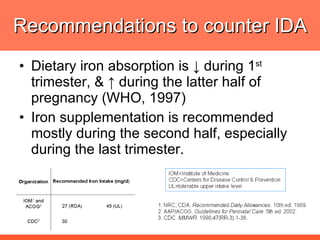
Recommendations to counter IDA Dietary iron absorption is  ↓  during 1 st  trimester, &  ↑  during the latter half of pregnancy (WHO, 1997) Iron supplementation is recommended mostly during the second half, especially during the last trimester.
ACOG Recommendations General nutritional recommendations during pregnancy: ACOG Pregnancy particularly increases nutrient requirements for folic acid and iron If diet is insufficient, provide supplementation to raise intake to RDAs for pregnant women The big question? Which Iron salt?
What me may not know!  How do the iron salts compare, with each claiming to be better!
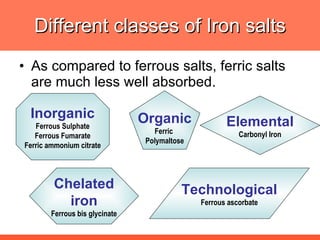
Different classes of Iron salts As compared to ferrous salts, ferric salts are much less well absorbed. Inorganic Ferrous Sulphate Ferrous Fumarate Ferric ammonium citrate Technological Ferrous ascorbate Elemental Carbonyl Iron Organic Ferric  Polymaltose Chelated iron Ferrous bis glycinate
Iron formulation adoption curve Unrealistic Over-enthusiasm Initial optimism Backlash antipathy Realistic adoption New concept
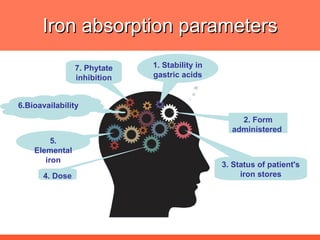
Iron absorption parameters 6.Bioavailability 5. Elemental iron 7. Phytate inhibition 2. Form administered   4. Dose 3. Status of patient's iron stores 1. Stability in gastric acids
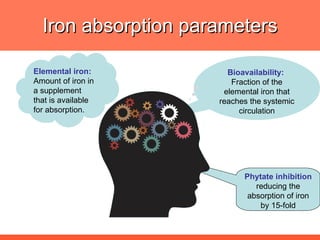
Iron absorption parameters Elemental iron:   Amount of iron in a supplement that is available for absorption. Bioavailability:   Fraction of the elemental iron that reaches the systemic circulation Phytate inhibition  reducing the absorption of iron by 15-fold
Iron absorption parameters Absorption of iron is influenced by many factors  Form administered  Ferric products tend to have lower absorption. All iron has to be reduced to ferrous form to enter the mucosal cells. Hence bivalent iron salts preferred over ferric salts. slow-release and delayed-release preparations - Maximal absorption takes place in the duodenum and proximal jejunum; therefore, iron may not be as well absorbed from slow-release and delayed-release preparations which may bypass the site of optimal absorption Dose  In patient's diet / supplement. Dosage calculation should always be in terms of the elemental iron content and the bioavailability Status of patient's iron stores Absorption will be increased in iron deficient individuals the degree of erythropoiesis, and  Ferrous iron passes through gastrointestinal mucosal cells directly into the blood and is immediately bound to transferrin which transports iron to the bone marrow where it is incorporated into hemoglobin..
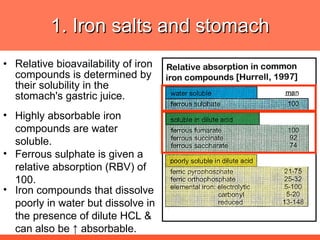
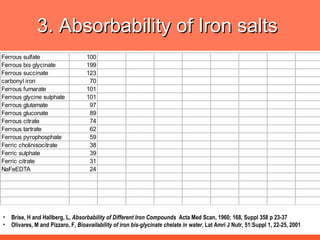
1. Iron salts and stomach Relative bioavailability of iron compounds is determined by their solubility in the stomach's gastric juice.  Highly absorbable iron compounds are water soluble.  Ferrous sulphate is given a relative absorption (RBV) of 100. Iron compounds that dissolve poorly in water but dissolve in the presence of dilute HCL & can also be  ↑  absorbable.
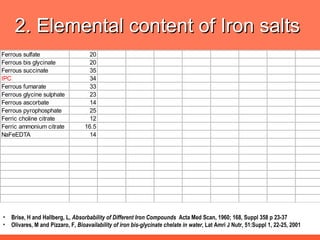
2. Elemental content of Iron salts Elemental iron content maybe high or low in iron salts affecting the amount of iron availability.  The amount of iron salts used to deliver the same amount of elemental iron varies.  ↑  the amount of iron used,  ↑  the gastric irritation and other side effects and vice versa.  Absorbability of iron maybe high or low in iron salts affecting the amount of iron bioavailability.
2. Elemental content of Iron salts  Brise, H and Hallberg, L,  Absorbability of Different Iron Compounds   Acta Med Scan, 1960; 168, Suppl 358 p 23-37  Olivares, M and Pizzaro, F,  Bioavailability of iron bis-glycinate chelate in water , Lat Amri J Nutr, 51:Suppl 1, 22-25, 2001
3. Absorbability of Iron salts  Brise, H and Hallberg, L,  Absorbability of Different Iron Compounds   Acta Med Scan, 1960; 168, Suppl 358 p 23-37  Olivares, M and Pizzaro, F,  Bioavailability of iron bis-glycinate chelate in water , Lat Amri J Nutr, 51:Suppl 1, 22-25, 2001
4. Varying influences & iron absorption Consumption of certain foods, such as coffee or tea, will generally reduce iron absorption eg. Phenols in the tea rendering the iron insoluble. Phosphates, phytates, and bran will inhibit iron absorption, similarly.  Conversely, organic acids such as ascorbic acid, amino acids, or meat protein will generally enhance absorption of iron.  ARCHIVOS LATINOAMERICANOS DE NUTRlClON,  Suplemento Vol. 51 N&quot; 1. 2001,  The absorption and metabolism of iron amino acid chelate by H. DeWayne Ashmead
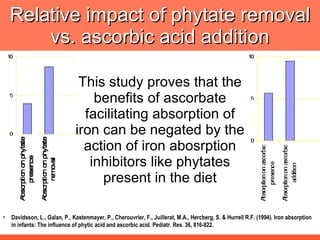
4. Varying influences & iron absorption Phytates inhibit iron absorption. Even the iron, with the best bioavailability, is not immune to this problem. Because of this varying influence of phytates, iron uptake may be vary tenfold. To prevent iron  IN  and iron  OUT  problem, phytate inhibition must be avoided. Or else, iron bioavailability is not assurable. Ascorbic acid does facilitate iron absorption but gets reduced functionality in the presence of phytates.
Relative impact of phytate removal vs. ascorbic acid addition This study proves that the benefits of ascorbate facilitating absorption of iron can be negated by the action of iron abosrption inhibitors like phytates present in the diet Davidsson, L., Galan, P., Kastenmayer, P., Cherouvrier, F., Juillerat, M.A., Hercberg, S. & Hurrell R.F. (1994). Iron absorption in infants: The influence of phytic acid and ascorbic acid. Pediatr. Res. 36, 816-822.
What we need to know!
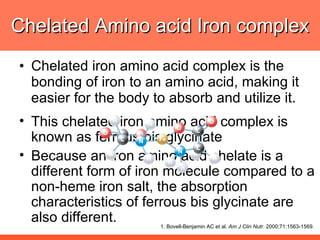
Chelated Amino acid Iron complex Chelated iron amino acid complex is the bonding of iron to an amino acid, making it easier for the body to absorb and utilize it. 1. Bovell-Benjamin AC et al.  Am J Clin Nutr . 2000;71:1563-1569. This chelated iron amino acid complex is known as ferrous bis glycinate  Because an iron amino acid chelate is a different form of iron molecule compared to a non-heme iron salt, the absorption characteristics of ferrous bis glycinate are also different.
Chelated Iron: reactivity Chelation gives protection to the iron by limiting its reactivity with dietary components or gastric acid.
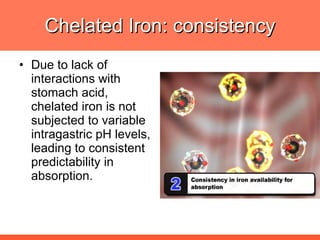
Chelated Iron: consistency Due to lack of interactions with stomach acid, chelated iron is not subjected to variable intragastric pH levels, leading to consistent predictability in absorption.
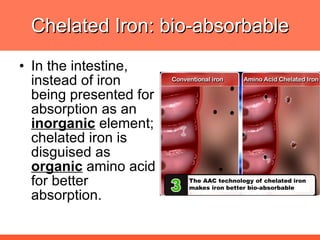
Chelated Iron: bio-absorbable In the intestine, instead of iron being presented for absorption as an  inorganic  element; chelated iron is disguised as  organic  amino acid for better absorption.
Chelated Iron: advantages Thus, chelated iron provides 2 basic advantages.  No reaction with food ingredients, providing more of the iron potentially for absorption. Preferentially absorption into the intestinal cells in greater quantities.
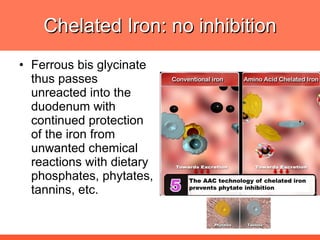
Chelated Iron: no inhibition Ferrous bis glycinate thus passes unreacted into the duodenum with continued protection of the iron from unwanted chemical reactions with dietary phosphates, phytates, tannins, etc.
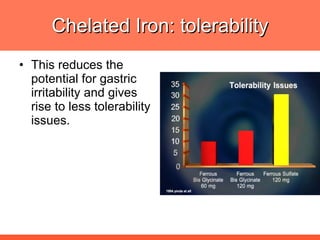
Chelated Iron: tolerability This reduces the potential for gastric irritability and gives rise to less tolerability issues.
Chelated Iron: stability constant In effectively viable iron amino acid chelates, attention is paid to the stability constant that  is high enough to: Prevent the chelate dissociating in the gut.  Permit the chelate to cross unchanged across the intestinal cell membrane into the cytoplasm,  Enable the cytoplasmic ligands to hydrolyze the chelate for subsequent iron utility. ARCHIVOS LATINOAMERICANOS DE NUTRlClON,  Suplemento Vol. 51 N&quot; 1. 2001,  The absorption and metabolism of iron amino acid chelate by H. DeWayne Ashmead
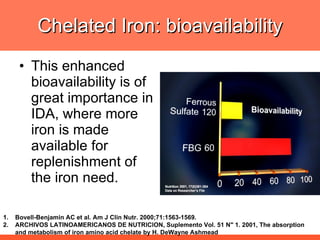
Chelated Iron: absorption ratio Bovell-Benjamin has shown absorption from chelated iron to be 4 times higher than from ferrous sulfate 1 Other studies have iron amino acid chelate absorption to be consistently about 5.3 times more than FeSO4. Bovell-Benjamin AC et al. Am J Clin Nutr. 2000;71:1563-1569. ARCHIVOS LATINOAMERICANOS DE NUTRlClON,  Suplemento Vol. 51 N&quot; 1. 2001,  The absorption and metabolism of iron amino acid chelate by H. DeWayne Ashmead
Chelated Iron: bioavailability This enhanced bioavailability is of great importance in IDA, where more iron is made available for replenishment of the iron need. Bovell-Benjamin AC et al. Am J Clin Nutr. 2000;71:1563-1569. ARCHIVOS LATINOAMERICANOS DE NUTRlClON,  Suplemento Vol. 51 N&quot; 1. 2001,  The absorption and metabolism of iron amino acid chelate by H. DeWayne Ashmead
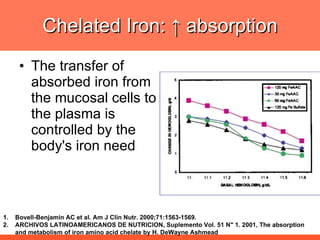
Chelated Iron:  ↑  absorption The transfer of absorbed iron from the mucosal cells to the plasma is controlled by the body's iron need Bovell-Benjamin AC et al. Am J Clin Nutr. 2000;71:1563-1569. ARCHIVOS LATINOAMERICANOS DE NUTRlClON,  Suplemento Vol. 51 N&quot; 1. 2001,  The absorption and metabolism of iron amino acid chelate by H. DeWayne Ashmead
Chelated Iron: -ve feedback Once absorbed, regulatory mechanism in the mucosal cells metabolically regulates how much is transferred to the plasma, thus preventing iron overload and toxicity.  This way, iron over-loading and subsequent toxicity is not present with ferrous bis glycinate despite the better bioavailability.
Chelated Iron: regulation The mucosal cells aggressively conserve iron that is not immediately required by the body, by retaining in the mucosal cell.  This could potentially result in toxicity within the mucosal tissue if the iron remained there indefinitely.  Mucosal cells migrate up the intestinal villus and after 3-4 days, these cells (and their iron, if it has not been transferred to the plasma) will be sloughed off and excreted in the feces ARCHIVOS LATINOAMERICANOS DE NUTRlClON,  Suplemento Vol. 51 N&quot; 1. 2001,  The absorption and metabolism of iron amino acid chelate by H. DeWayne Ashmead
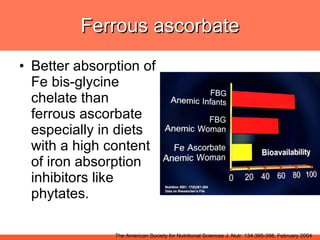
Chelated Iron: comparison Also a chelate but contains the less preferred ferric form. It breaks down within the gastrointestinal tract to release elemental iron, which is then absorbed like any other iron salt. Sodium Ferric Edetate Better absorption of Fe bis-glycinate than ferrous ascorbate especially in diets with a high content of iron absorption inhibitors like phytates. Ferrous Ascorbate Bioavailability 58% to 70% in relation to ferrous sulfate. Higher incidence of gastric irritation and tolerability issues. Carbonyl iron
Ferrous ascorbate Better absorption of Fe bis-glycine chelate than ferrous ascorbate especially in diets with a high content of iron absorption inhibitors like phytates. The American Society for Nutritional Sciences J. Nutr. 134:395-398, February 2004
Summary Iron amino acid chelate OR Ferrous Bis Glycinate Non buffered in stomach Non precipitated in intestine Not antagonized by phytates Superior dependable bioavailability Unique chelate design potentially allows for smaller doses with fewer complaints due to better biovailability.

Iron Salt Comparison New

  • 1.
    Newer aspects ofIron supplementation Newer aspects of Iron supplementation
  • 2.
    Today’s discussion Whatwe know! What we may not know! What we need to know!
  • 3.
  • 4.
    Anemia in pregnancyDefined as Hb < than 10 gm/dl. Classify any patient at start of pregnancy with Hb < than 11 gm/dl to 11.5 gm/dl as anaemic. One common reason for anaemia in pregnancy As pregnancy progresses, dilution of blood -> woman anaemic. Dilution of blood in pregnancy is a natural process Starts at approximately the 8 th week of pregnancy Progresses until the 32 nd to 34 th week of pregnancy. Reduced iron status and iron stores also play an important role.
  • 5.
    Anemia in pregnancy - consequences IN THE MOTHER Cardiovascular stress Impaired resistance to infection Preterm labour Pre-eclampsia Maternal death IN THE FOETUS Peri-natal mortality Deficient mental & psychomotor development Improper cell growth & neural tube defects Maybe, megaloblastic anemia.
  • 6.
    Recommendations to counterIDA Dietary iron absorption is ↓ during 1 st trimester, & ↑ during the latter half of pregnancy (WHO, 1997) Iron supplementation is recommended mostly during the second half, especially during the last trimester.
  • 7.
    ACOG Recommendations Generalnutritional recommendations during pregnancy: ACOG Pregnancy particularly increases nutrient requirements for folic acid and iron If diet is insufficient, provide supplementation to raise intake to RDAs for pregnant women The big question? Which Iron salt?
  • 8.
    What me maynot know! How do the iron salts compare, with each claiming to be better!
  • 9.
    Different classes ofIron salts As compared to ferrous salts, ferric salts are much less well absorbed. Inorganic Ferrous Sulphate Ferrous Fumarate Ferric ammonium citrate Technological Ferrous ascorbate Elemental Carbonyl Iron Organic Ferric Polymaltose Chelated iron Ferrous bis glycinate
  • 10.
    Iron formulation adoptioncurve Unrealistic Over-enthusiasm Initial optimism Backlash antipathy Realistic adoption New concept
  • 11.
    Iron absorption parameters6.Bioavailability 5. Elemental iron 7. Phytate inhibition 2. Form administered 4. Dose 3. Status of patient's iron stores 1. Stability in gastric acids
  • 12.
    Iron absorption parametersElemental iron: Amount of iron in a supplement that is available for absorption. Bioavailability: Fraction of the elemental iron that reaches the systemic circulation Phytate inhibition reducing the absorption of iron by 15-fold
  • 13.
    Iron absorption parametersAbsorption of iron is influenced by many factors Form administered Ferric products tend to have lower absorption. All iron has to be reduced to ferrous form to enter the mucosal cells. Hence bivalent iron salts preferred over ferric salts. slow-release and delayed-release preparations - Maximal absorption takes place in the duodenum and proximal jejunum; therefore, iron may not be as well absorbed from slow-release and delayed-release preparations which may bypass the site of optimal absorption Dose In patient's diet / supplement. Dosage calculation should always be in terms of the elemental iron content and the bioavailability Status of patient's iron stores Absorption will be increased in iron deficient individuals the degree of erythropoiesis, and Ferrous iron passes through gastrointestinal mucosal cells directly into the blood and is immediately bound to transferrin which transports iron to the bone marrow where it is incorporated into hemoglobin..
  • 14.
    1. Iron saltsand stomach Relative bioavailability of iron compounds is determined by their solubility in the stomach's gastric juice. Highly absorbable iron compounds are water soluble. Ferrous sulphate is given a relative absorption (RBV) of 100. Iron compounds that dissolve poorly in water but dissolve in the presence of dilute HCL & can also be ↑ absorbable.
  • 15.
    2. Elemental contentof Iron salts Elemental iron content maybe high or low in iron salts affecting the amount of iron availability. The amount of iron salts used to deliver the same amount of elemental iron varies. ↑ the amount of iron used, ↑ the gastric irritation and other side effects and vice versa. Absorbability of iron maybe high or low in iron salts affecting the amount of iron bioavailability.
  • 16.
    2. Elemental contentof Iron salts Brise, H and Hallberg, L, Absorbability of Different Iron Compounds Acta Med Scan, 1960; 168, Suppl 358 p 23-37 Olivares, M and Pizzaro, F, Bioavailability of iron bis-glycinate chelate in water , Lat Amri J Nutr, 51:Suppl 1, 22-25, 2001
  • 17.
    3. Absorbability ofIron salts Brise, H and Hallberg, L, Absorbability of Different Iron Compounds Acta Med Scan, 1960; 168, Suppl 358 p 23-37 Olivares, M and Pizzaro, F, Bioavailability of iron bis-glycinate chelate in water , Lat Amri J Nutr, 51:Suppl 1, 22-25, 2001
  • 18.
    4. Varying influences& iron absorption Consumption of certain foods, such as coffee or tea, will generally reduce iron absorption eg. Phenols in the tea rendering the iron insoluble. Phosphates, phytates, and bran will inhibit iron absorption, similarly. Conversely, organic acids such as ascorbic acid, amino acids, or meat protein will generally enhance absorption of iron. ARCHIVOS LATINOAMERICANOS DE NUTRlClON, Suplemento Vol. 51 N&quot; 1. 2001, The absorption and metabolism of iron amino acid chelate by H. DeWayne Ashmead
  • 19.
    4. Varying influences& iron absorption Phytates inhibit iron absorption. Even the iron, with the best bioavailability, is not immune to this problem. Because of this varying influence of phytates, iron uptake may be vary tenfold. To prevent iron IN and iron OUT problem, phytate inhibition must be avoided. Or else, iron bioavailability is not assurable. Ascorbic acid does facilitate iron absorption but gets reduced functionality in the presence of phytates.
  • 20.
    Relative impact ofphytate removal vs. ascorbic acid addition This study proves that the benefits of ascorbate facilitating absorption of iron can be negated by the action of iron abosrption inhibitors like phytates present in the diet Davidsson, L., Galan, P., Kastenmayer, P., Cherouvrier, F., Juillerat, M.A., Hercberg, S. & Hurrell R.F. (1994). Iron absorption in infants: The influence of phytic acid and ascorbic acid. Pediatr. Res. 36, 816-822.
  • 21.
    What we needto know!
  • 22.
    Chelated Amino acidIron complex Chelated iron amino acid complex is the bonding of iron to an amino acid, making it easier for the body to absorb and utilize it. 1. Bovell-Benjamin AC et al. Am J Clin Nutr . 2000;71:1563-1569. This chelated iron amino acid complex is known as ferrous bis glycinate Because an iron amino acid chelate is a different form of iron molecule compared to a non-heme iron salt, the absorption characteristics of ferrous bis glycinate are also different.
  • 23.
    Chelated Iron: reactivityChelation gives protection to the iron by limiting its reactivity with dietary components or gastric acid.
  • 24.
    Chelated Iron: consistencyDue to lack of interactions with stomach acid, chelated iron is not subjected to variable intragastric pH levels, leading to consistent predictability in absorption.
  • 25.
    Chelated Iron: bio-absorbableIn the intestine, instead of iron being presented for absorption as an inorganic element; chelated iron is disguised as organic amino acid for better absorption.
  • 26.
    Chelated Iron: advantagesThus, chelated iron provides 2 basic advantages. No reaction with food ingredients, providing more of the iron potentially for absorption. Preferentially absorption into the intestinal cells in greater quantities.
  • 27.
    Chelated Iron: noinhibition Ferrous bis glycinate thus passes unreacted into the duodenum with continued protection of the iron from unwanted chemical reactions with dietary phosphates, phytates, tannins, etc.
  • 28.
    Chelated Iron: tolerabilityThis reduces the potential for gastric irritability and gives rise to less tolerability issues.
  • 29.
    Chelated Iron: stabilityconstant In effectively viable iron amino acid chelates, attention is paid to the stability constant that is high enough to: Prevent the chelate dissociating in the gut. Permit the chelate to cross unchanged across the intestinal cell membrane into the cytoplasm, Enable the cytoplasmic ligands to hydrolyze the chelate for subsequent iron utility. ARCHIVOS LATINOAMERICANOS DE NUTRlClON, Suplemento Vol. 51 N&quot; 1. 2001, The absorption and metabolism of iron amino acid chelate by H. DeWayne Ashmead
  • 30.
    Chelated Iron: absorptionratio Bovell-Benjamin has shown absorption from chelated iron to be 4 times higher than from ferrous sulfate 1 Other studies have iron amino acid chelate absorption to be consistently about 5.3 times more than FeSO4. Bovell-Benjamin AC et al. Am J Clin Nutr. 2000;71:1563-1569. ARCHIVOS LATINOAMERICANOS DE NUTRlClON, Suplemento Vol. 51 N&quot; 1. 2001, The absorption and metabolism of iron amino acid chelate by H. DeWayne Ashmead
  • 31.
    Chelated Iron: bioavailabilityThis enhanced bioavailability is of great importance in IDA, where more iron is made available for replenishment of the iron need. Bovell-Benjamin AC et al. Am J Clin Nutr. 2000;71:1563-1569. ARCHIVOS LATINOAMERICANOS DE NUTRlClON, Suplemento Vol. 51 N&quot; 1. 2001, The absorption and metabolism of iron amino acid chelate by H. DeWayne Ashmead
  • 32.
    Chelated Iron: ↑ absorption The transfer of absorbed iron from the mucosal cells to the plasma is controlled by the body's iron need Bovell-Benjamin AC et al. Am J Clin Nutr. 2000;71:1563-1569. ARCHIVOS LATINOAMERICANOS DE NUTRlClON, Suplemento Vol. 51 N&quot; 1. 2001, The absorption and metabolism of iron amino acid chelate by H. DeWayne Ashmead
  • 33.
    Chelated Iron: -vefeedback Once absorbed, regulatory mechanism in the mucosal cells metabolically regulates how much is transferred to the plasma, thus preventing iron overload and toxicity. This way, iron over-loading and subsequent toxicity is not present with ferrous bis glycinate despite the better bioavailability.
  • 34.
    Chelated Iron: regulationThe mucosal cells aggressively conserve iron that is not immediately required by the body, by retaining in the mucosal cell. This could potentially result in toxicity within the mucosal tissue if the iron remained there indefinitely. Mucosal cells migrate up the intestinal villus and after 3-4 days, these cells (and their iron, if it has not been transferred to the plasma) will be sloughed off and excreted in the feces ARCHIVOS LATINOAMERICANOS DE NUTRlClON, Suplemento Vol. 51 N&quot; 1. 2001, The absorption and metabolism of iron amino acid chelate by H. DeWayne Ashmead
  • 35.
    Chelated Iron: comparisonAlso a chelate but contains the less preferred ferric form. It breaks down within the gastrointestinal tract to release elemental iron, which is then absorbed like any other iron salt. Sodium Ferric Edetate Better absorption of Fe bis-glycinate than ferrous ascorbate especially in diets with a high content of iron absorption inhibitors like phytates. Ferrous Ascorbate Bioavailability 58% to 70% in relation to ferrous sulfate. Higher incidence of gastric irritation and tolerability issues. Carbonyl iron
  • 36.
    Ferrous ascorbate Betterabsorption of Fe bis-glycine chelate than ferrous ascorbate especially in diets with a high content of iron absorption inhibitors like phytates. The American Society for Nutritional Sciences J. Nutr. 134:395-398, February 2004
  • 37.
    Summary Iron aminoacid chelate OR Ferrous Bis Glycinate Non buffered in stomach Non precipitated in intestine Not antagonized by phytates Superior dependable bioavailability Unique chelate design potentially allows for smaller doses with fewer complaints due to better biovailability.

Editor's Notes

  • #12 Speaker Notes For purposes of this presentation, we will use the definitions on this and the following 3 slides Many of these definitions have been established by organizations involved in developing nutritional guidelines for groups and populations Some of them were agreed upon by the Council for purposes of the roundtable discussion—these are marked with a double asterisk We will use these definitions to maintain a common language as we discuss prenatal nutrition I won’t comment on all of them, but will focus on those that may not be as familiar as others An adequate intake, or AI, value is established for a nutrient when there is insufficient scientific data available to establish an RDA An AI level generally meets or exceeds the amount of a nutrient needed to maintain an adequate nutritional state in the majority of members of a specific age and gender group Dietary reference intakes , or DRIs , are a comprehensive set of nutrient reference values for healthy populations that can be used to plan and assess appropriate diets DRIs reflect the current state of scientific knowledge regarding nutrient requirements and include RDAs, AIs , and tolerable upper intake levels
  • #13 Speaker Notes For purposes of this presentation, we will use the definitions on this and the following 3 slides Many of these definitions have been established by organizations involved in developing nutritional guidelines for groups and populations Some of them were agreed upon by the Council for purposes of the roundtable discussion—these are marked with a double asterisk We will use these definitions to maintain a common language as we discuss prenatal nutrition I won’t comment on all of them, but will focus on those that may not be as familiar as others An adequate intake, or AI, value is established for a nutrient when there is insufficient scientific data available to establish an RDA An AI level generally meets or exceeds the amount of a nutrient needed to maintain an adequate nutritional state in the majority of members of a specific age and gender group Dietary reference intakes , or DRIs , are a comprehensive set of nutrient reference values for healthy populations that can be used to plan and assess appropriate diets DRIs reflect the current state of scientific knowledge regarding nutrient requirements and include RDAs, AIs , and tolerable upper intake levels