ANEMIA
BY: Dr Erum Amir
Objectives
 Learn about iron deficiency anemia(IDA)
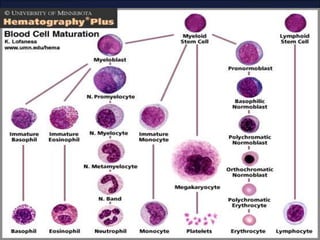
 Learn about Erythropoiesis
 Learn about Iron Cycle
 Learn about lab diagnosis of IDA
What is Anemia?
 Anemia is defined by reduction in Hg Concentration,
Hematocrit (Hct) Concentration or RBC count
 Or defined as 2 standard deviations below the mean
 WHO criteria is Hg < 13 in men and Hg < 12 in
women
 Revised WHO criteria for patient’s with malignancy Hg
< 14 in men and Hg < 12 in women
 Pregnant females lower limits were 10.5 g/dl
RED BLOOD CELL MORPHOLOGY
DEFINITIONS PERIPHERAL SMEAR
 Abnormal erythrocyte
morphology is found in
pathological states that may
be :
 - abnormalities in size
(anisocytosis).
 - In shape (poikilocytosis).
 -In hemoglobin content or the
presence of inclusion bodies
in erythrocyte.
 l
RED BLOOD CELL MORPHOLOGY
 Hypochromic: A descriptive term applied to a red
blood cell with a decreased concentration of
hemoglobin.
 Normochromic:
 A descriptive term applied to a red blood cell with a
normal concentration of hemoglobin.
 Normocytic
 A descriptive term applied to normal size of RBC
 MacrocyticA descriptive term applied to a larger than
normal red blood cell.
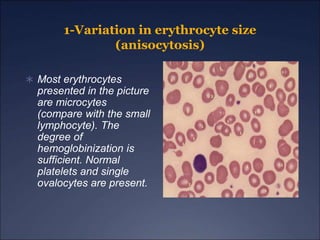
1-Variation in erythrocyte size
(anisocytosis)
 Most erythrocytes
presented in the picture
are microcytes
(compare with the small
lymphocyte). The
degree of
hemoglobinization is
sufficient. Normal
platelets and single
ovalocytes are present.
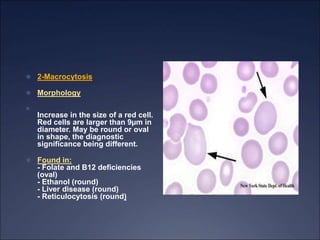
 2-Macrocytosis
 Morphology

Increase in the size of a red cell.
Red cells are larger than 9µm in
diameter. May be round or oval
in shape, the diagnostic
significance being different.
 Found in:
- Folate and B12 deficiencies
(oval)
- Ethanol (round)
- Liver disease (round)
- Reticulocytosis (round)
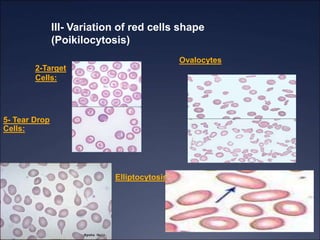
III- Variation of red cells shape
(Poikilocytosis)
2-Target
Cells:
Ovalocytes
Elliptocytosis
5- Tear Drop
Cells:
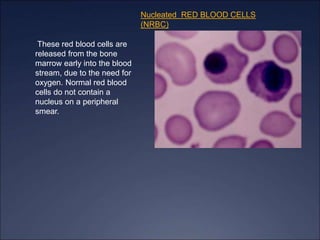
Nucleated RED BLOOD CELLS
(NRBC)
These red blood cells are
released from the bone
marrow early into the blood
stream, due to the need for
oxygen. Normal red blood
cells do not contain a
nucleus on a peripheral
smear.
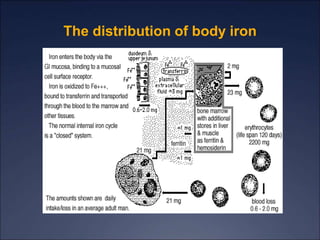
The distribution of body iron
15
Iron absorption, Transport and storage
 Iron absorbed from duodenum and jejunum in the GIT
 Moves via circulation to the bone marrow
 Incorporated with protoporpyirin in mitochondria of the erythroid
precursor to make Heme
IRON TRANSPORT
 There are three proteins important for
transporting
 1.Transferrin
 2.Transferrin receptors
 3.Ferritin
Transport
Transferrin: transports iron from the plasma to the
erythroblasts in the marrow for erythropoiesis
The transferrin will bind to transferrin receptor on the
erythrocyte membrane
Storage
 Hgb contains about two third of the body iron
 At the end of their life, RBCs are broken down in the
macrophage of reticuloendothelial system and then
iron is released from Hgb enters plasma and
provided to transferrin.
 Some stored in reticuloendothelial cell as ferritin
soluble protein – iron complex) and hemosiderin
(37%) (degraded form of ferritin insoluble)
 iron is also found in muscles as myoglobin and in
other cells as iron containing enzymes
Daily Iron cycle (Fig)
Iron Deficiency Anemia (IDA)
 Sequence of iron depletion
 When iron loss or use exceeds absorption, there is a
sequence of iron depletion in the body:
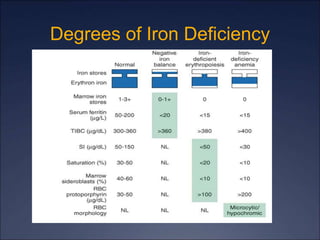
 Storage iron decreases/ low serum ferritin; serum iron
& TIBC are normal, no anemia, normal red cells.
 Serum iron decreases/TIBC increases (increased
transferrin); no anemia, normal red cells.
 Anemia with microcytic/hypochromic red cells = IDA.
Pathophysiological classification
 Decreased RBC production
 Lack of nutrients (B12, folate, iron)
 Bone Marrow Disorder
 Bone Marrow Suppression
 Increased RBC destruction
 Inherited and Acquired Hemolytic Anemias
 Blood Loss
Morphological Approach
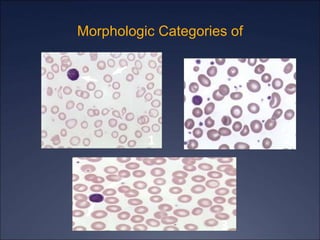
 Microcytic (MCV < 80)
 Reduced iron availability
 Reduced heme synthesis
 Reduced globin production
 Normocytic ( 80 < MCV < 100)
 Macrocytic (MCV > 100)
 Liver disease, B12, folate
Morphologic Categories of
1 2
3
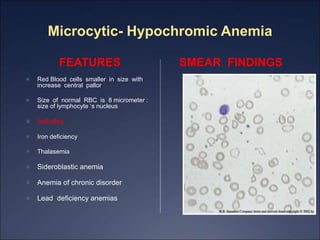
Microcytic- Hypochromic Anemia
FEATURES
 Red Blood cells smaller in size with
increase central pallor
 Size of normal RBC is 8 micrometer :
size of lymphocyte ‘s nucleus
 Includes
 Iron deficiency
 Thalasemia
 Sideroblastic anemia
 Anemia of chronic disorder
 Lead deficiency anemias
SMEAR FINDINGS
Symptoms
 Exertional dyspnea and Dyspnea at Exertion
 Headaches
 Fatigue
 Bounding pulses and Roaring in the Ears
 Palpitations
 PICA
Physical Manifestation : “Spoon
Nails” in Iron Deficiency
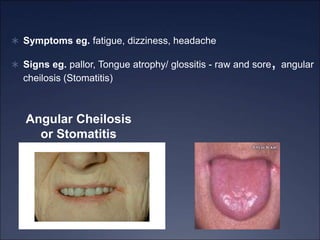
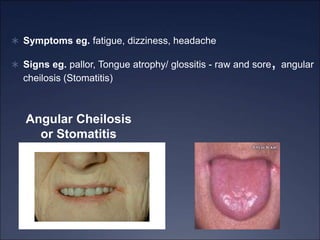
 Symptoms eg. fatigue, dizziness, headache
 Signs eg. pallor, Tongue atrophy/ glossitis - raw and sore, angular
cheilosis (Stomatitis)
Angular Cheilosis
or Stomatitis
Diagnosis of anemia
 Lab investigations
 A complete blood count, CBC
 RBC count
 Hematocrit (Hct) or packed cell volume
 Hemoglobin determination
 RBC indices calculation
 Reticulocyte count
 Blood smear examination to evaluate:
 PLeukocytes or Platelets abnormalities
 poikilocytosis
Lab investigation
 A bone marrow smear and biopsy to observe:
 Maturation of RBC and WBC series
 Ratio of myeloid to erythroid series
 Abundance of iron stores (ringed sideroblasts)
 Presence or absence of granulomas or tumor cells
 Red to yellow ratio
 Presence of megakaryocytes
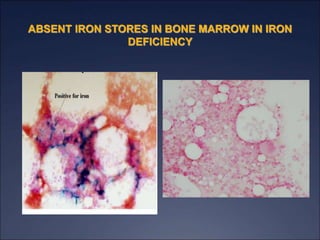
ABSENT IRON STORES IN BONE MARROW IN IRON
DEFICIENCY
 Symptoms eg. fatigue, dizziness, headache
 Signs eg. pallor, Tongue atrophy/ glossitis - raw and sore, angular
cheilosis (Stomatitis)
Angular Cheilosis
or Stomatitis
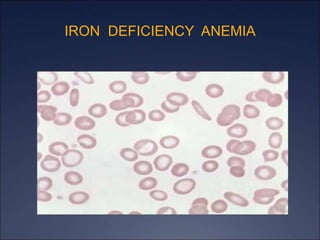
IRON DEFICIENCY ANEMIA
Iron Deficiency Anemia
 RBC morphology
 Hypochromia
 Anisocytosis : Variation in size of RBC
 Microcytosis : Decrease in size of RBC
 Poikilocytosis : Variation in shapes of RBC
 Pencil cells (cigar cells)
 Target cells
 no RBC inclusions
 Iron parameters
 Low serum iron,
 Low serum Ferritin
 High TIBC,
Lab Investigation cont’d
 Serum iron level
 measures the amount of iron bound to transferrin
 Does not include the free form of iron
 Total Iron Binding Capacity (TIBC)
 Is an indirect measure of the amount of transferrin protein in the serum
 Inversely proportional to the serum iron level
 If serum iron is decreased, total iron binding capacity
of transferrin increased (transferrin has more empty
space to carry iron)
Lab Investigation cont’d
 Serum ferritin
 indirectly reflects storage iron in tissues
 found in trace amount in plasma
 It is in equilibrium with the body stores
 Variation in the quantity of iron in the storing compartment is reflected
by plasma ferritin concentration
 e.g. Plasma ferritin is decreases in IDA
 Plasma ferritin increases in ACD
 Limitation: During infection or inflammation Serum Ferritin
increases like other acute phase proteins, and then it is not an
accurate indicator in such situations.
Bone marrow iron (Tissue iron)
 Tissue biopsy of bone marrow
 Prussian blue stain
 Type of iron is hemosiderin
Iron Deficiency Anemia
Labs
 Information can be gleaned from good history taking and a
physical exam (pallor, jaundice, etc)
 CBC With Diff
 Leukopenia with anemia may suggest aplastic anemia
 Increased Neutrophils may suggest infection
 Increased Monocytes may suggest Myelodysplasia
 Thrombocytopenia may suggest hypersplenism, marrow
involvement with malignancy, autoimmune destruction,
folate deficiency
 Reticulocyte Count
 Peripheral Smear
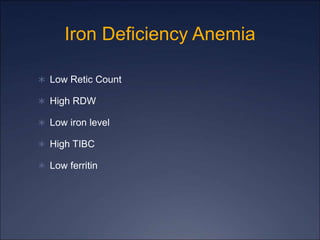
Iron Deficiency Anemia
 Low Retic Count
 High RDW
 Low iron level
 High TIBC
 Low ferritin
Degrees of Iron Deficiency
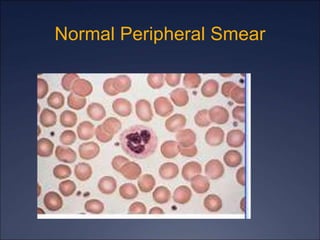
Normal Peripheral Smear
Iron Deficiency Anemia: Peripheral
Smear
Microcytosis &, Hypochromic RBCs
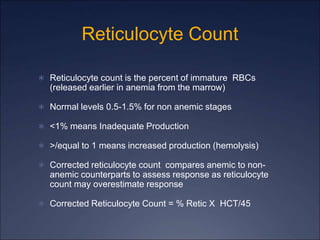
Reticulocyte Count
 Reticulocyte count is the percent of immature RBCs
(released earlier in anemia from the marrow)
 Normal levels 0.5-1.5% for non anemic stages
 <1% means Inadequate Production
 >/equal to 1 means increased production (hemolysis)
 Corrected reticulocyte count compares anemic to non-
anemic counterparts to assess response as reticulocyte
count may overestimate response
 Corrected Reticulocyte Count = % Retic X HCT/45
Reticulocytes
Reticulocyte Correction Factor
 RPI = % reticulocytes X HCT/45 X 1/Correction Factor
 Normal RPI =1
 RPI < 2 Hypoproliferative
 RPI greater than/equal 2 Hyperproliferative Disorder
Hematocrit Correction Factor
40-45 1
35-39 1.5
25-34 2
15-24 2.5
So now that it’s iron deficiency….
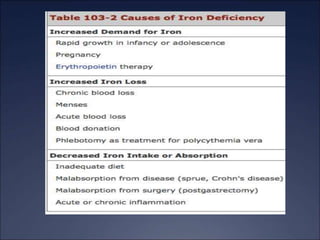
 What Causes Iron Deficiency?
 Blood Loss (occult or overt): PUD, Diverticulosis, Colon
Cancer
 Decreased Iron Absorption: achlorhydria, atrophic
gastritis, celiac disease
 Foods and Medications: phytate, calcium, soy protein,
polyphenols decrease iron absorption
 Uncommon causes: intravascular hemolysis, pulmonary
hemosiderosis, EPO, gastric bypass
 Decreased Intake (rare)
Who needs a GI work-up?
 All men, all women without menorrhagia, women
greater than 50 with menorrhagia
 If UGI symptoms, EGD
 If asymptomatic, colonoscopy
 Women less than 50 plus menorrhagia: consider GI
workup based upon symptoms
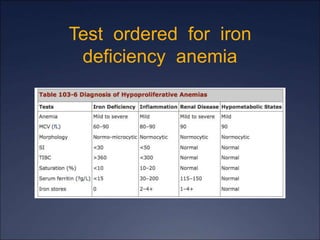
Test ordered for iron
deficiency anemia
Gold Standard for Diagnosis
 Bone Marrow Biopsy
 Prussian Blue staining shows lack of iron in erythroid
precursors and macrophages
 However, it is invasive and costly
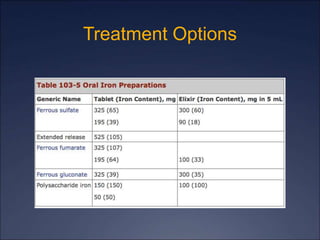
Treatment Options
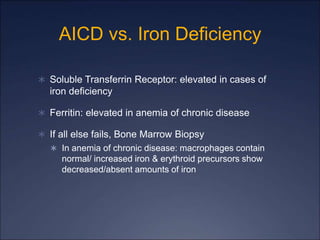
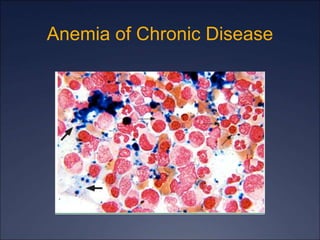
AICD vs. Iron Deficiency
 Soluble Transferrin Receptor: elevated in cases of
iron deficiency
 Ferritin: elevated in anemia of chronic disease
 If all else fails, Bone Marrow Biopsy
 In anemia of chronic disease: macrophages contain
normal/ increased iron & erythroid precursors show
decreased/absent amounts of iron
Anemia of Chronic Disease
Treatment
 Treat the underlying cause
 And Treat the Underlying Cause!
 Consider co-existent iron deficiency as well
 If underlying disease state requires it, consider EPO
injection
Summary
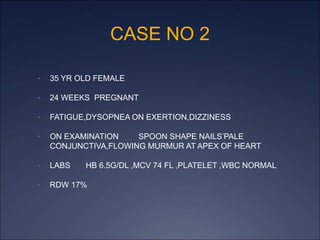
CASE NO 2
• 35 YR OLD FEMALE
• 24 WEEKS PREGNANT
• FATIGUE,DYSOPNEA ON EXERTION,DIZZINESS
• ON EXAMINATION SPOON SHAPE NAILS’PALE
CONJUNCTIVA,FLOWING MURMUR AT APEX OF HEART
• LABS HB 6.5G/DL ,MCV 74 FL ,PLATELET ,WBC NORMAL
• RDW 17%
CASE NO 1
• 18 YEAR OLD FEMALE
• FATIGUE, FAILS TO CONCENTRATE,URGE TO EAT ICE
• HISTORY OF HEAVY MENSTRUAKL BLEEDING EVERY MONTH
• PHYSICAL EXAMINATION SHOWS PALE CONJUNCTIVA,SMOOTH TONGUE ,BRITTLE NAILS
• LABS SHOWS CBC :Hg 7g/dl ,MCV 70FL ,MCHC 28 G/DL ,MCH 20G/DL,hct 19.8fl
• Retic count 1.5% N 0-5-2 %
• RDW 18 % N 16%
• TIBC 600 N 250-400 MG/DI
• Serum Ferritin 23 ng/ml N 32-100
• Peripheral smear show microcytic hypochromasia,pencil cells,target cells
QUERRY
 What could be the most
likely diagnosis?
 What is differential
diagnosis ?
 Iron deficiency anemia
 Aplastic anemia
 Megaloblastic anemia
 Thalessemia
 Anemia of chronic disorder
References
 Harrison’s Principles of Internal Medicine
 Adamson JW. Chapter 103. Iron Deficiency and Other Hypoproliferative
Anemias. In: Longo DL, Fauci AS, Kasper DL, Hauser SL, Jameson JL,
Loscalzo J, eds. Harrison's Principles of Internal Medicine. 18th ed. New York:
McGraw-Hill; 2012.
http://www.accessmedicine.com/content.aspx?aID=9117223. Accessed
December 7, 2011
 Wians, F.H. and Urban JE. “Discriminating between Anemia of Chronic
disease Using Traditional Indices of Iron Status v. Transferring Receptor
Concentration”. 2001. American Journal of Clinical Pathology. Volume 115.
 UptoDate
 Schrier, SL. Approach to the adult patient with anemia. In: UpToDate, Landaw,
SA(ED). UptoDate, Waltham, MA. 2012.
 Schrier, SL. Causes and diagnosis of anemia due to iron deficiency. In:
UpToDate. Landaw, SA.(ED). Uptodate, Waltham, MA. 2012.

Anemia

  • 1.
  • 2.
    Objectives  Learn aboutiron deficiency anemia(IDA)  Learn about Erythropoiesis  Learn about Iron Cycle  Learn about lab diagnosis of IDA
  • 3.
    What is Anemia? Anemia is defined by reduction in Hg Concentration, Hematocrit (Hct) Concentration or RBC count  Or defined as 2 standard deviations below the mean  WHO criteria is Hg < 13 in men and Hg < 12 in women  Revised WHO criteria for patient’s with malignancy Hg < 14 in men and Hg < 12 in women  Pregnant females lower limits were 10.5 g/dl
  • 7.
    RED BLOOD CELLMORPHOLOGY DEFINITIONS PERIPHERAL SMEAR  Abnormal erythrocyte morphology is found in pathological states that may be :  - abnormalities in size (anisocytosis).  - In shape (poikilocytosis).  -In hemoglobin content or the presence of inclusion bodies in erythrocyte.  l
  • 8.
    RED BLOOD CELLMORPHOLOGY  Hypochromic: A descriptive term applied to a red blood cell with a decreased concentration of hemoglobin.  Normochromic:  A descriptive term applied to a red blood cell with a normal concentration of hemoglobin.  Normocytic  A descriptive term applied to normal size of RBC  MacrocyticA descriptive term applied to a larger than normal red blood cell.
  • 9.
    1-Variation in erythrocytesize (anisocytosis)  Most erythrocytes presented in the picture are microcytes (compare with the small lymphocyte). The degree of hemoglobinization is sufficient. Normal platelets and single ovalocytes are present.
  • 10.
     2-Macrocytosis  Morphology  Increasein the size of a red cell. Red cells are larger than 9µm in diameter. May be round or oval in shape, the diagnostic significance being different.  Found in: - Folate and B12 deficiencies (oval) - Ethanol (round) - Liver disease (round) - Reticulocytosis (round)
  • 11.
    III- Variation ofred cells shape (Poikilocytosis) 2-Target Cells: Ovalocytes Elliptocytosis 5- Tear Drop Cells:
  • 12.
    Nucleated RED BLOODCELLS (NRBC) These red blood cells are released from the bone marrow early into the blood stream, due to the need for oxygen. Normal red blood cells do not contain a nucleus on a peripheral smear.
  • 13.
  • 15.
    15 Iron absorption, Transportand storage  Iron absorbed from duodenum and jejunum in the GIT  Moves via circulation to the bone marrow  Incorporated with protoporpyirin in mitochondria of the erythroid precursor to make Heme
  • 16.
    IRON TRANSPORT  Thereare three proteins important for transporting  1.Transferrin  2.Transferrin receptors  3.Ferritin Transport Transferrin: transports iron from the plasma to the erythroblasts in the marrow for erythropoiesis The transferrin will bind to transferrin receptor on the erythrocyte membrane
  • 17.
    Storage  Hgb containsabout two third of the body iron  At the end of their life, RBCs are broken down in the macrophage of reticuloendothelial system and then iron is released from Hgb enters plasma and provided to transferrin.  Some stored in reticuloendothelial cell as ferritin soluble protein – iron complex) and hemosiderin (37%) (degraded form of ferritin insoluble)  iron is also found in muscles as myoglobin and in other cells as iron containing enzymes
  • 18.
  • 19.
    Iron Deficiency Anemia(IDA)  Sequence of iron depletion  When iron loss or use exceeds absorption, there is a sequence of iron depletion in the body:  Storage iron decreases/ low serum ferritin; serum iron & TIBC are normal, no anemia, normal red cells.  Serum iron decreases/TIBC increases (increased transferrin); no anemia, normal red cells.  Anemia with microcytic/hypochromic red cells = IDA.
  • 20.
    Pathophysiological classification  DecreasedRBC production  Lack of nutrients (B12, folate, iron)  Bone Marrow Disorder  Bone Marrow Suppression  Increased RBC destruction  Inherited and Acquired Hemolytic Anemias  Blood Loss
  • 21.
    Morphological Approach  Microcytic(MCV < 80)  Reduced iron availability  Reduced heme synthesis  Reduced globin production  Normocytic ( 80 < MCV < 100)  Macrocytic (MCV > 100)  Liver disease, B12, folate
  • 22.
  • 23.
    Microcytic- Hypochromic Anemia FEATURES Red Blood cells smaller in size with increase central pallor  Size of normal RBC is 8 micrometer : size of lymphocyte ‘s nucleus  Includes  Iron deficiency  Thalasemia  Sideroblastic anemia  Anemia of chronic disorder  Lead deficiency anemias SMEAR FINDINGS
  • 24.
    Symptoms  Exertional dyspneaand Dyspnea at Exertion  Headaches  Fatigue  Bounding pulses and Roaring in the Ears  Palpitations  PICA
  • 25.
    Physical Manifestation :“Spoon Nails” in Iron Deficiency
  • 26.
     Symptoms eg.fatigue, dizziness, headache  Signs eg. pallor, Tongue atrophy/ glossitis - raw and sore, angular cheilosis (Stomatitis) Angular Cheilosis or Stomatitis
  • 27.
    Diagnosis of anemia Lab investigations  A complete blood count, CBC  RBC count  Hematocrit (Hct) or packed cell volume  Hemoglobin determination  RBC indices calculation  Reticulocyte count  Blood smear examination to evaluate:  Blood smear examination to evaluate:  PLeukocytes or Platelets abnormalities  poikilocytosis
  • 28.
    Lab investigation  Abone marrow smear and biopsy to observe:  Maturation of RBC and WBC series  Ratio of myeloid to erythroid series  Abundance of iron stores (ringed sideroblasts)  Presence or absence of granulomas or tumor cells  Red to yellow ratio  Presence of megakaryocytes
  • 29.
    ABSENT IRON STORESIN BONE MARROW IN IRON DEFICIENCY
  • 30.
     Symptoms eg.fatigue, dizziness, headache  Signs eg. pallor, Tongue atrophy/ glossitis - raw and sore, angular cheilosis (Stomatitis) Angular Cheilosis or Stomatitis
  • 31.
  • 32.
    Iron Deficiency Anemia RBC morphology  Hypochromia  Anisocytosis : Variation in size of RBC  Microcytosis : Decrease in size of RBC  Poikilocytosis : Variation in shapes of RBC  Pencil cells (cigar cells)  Target cells  no RBC inclusions  Iron parameters  Low serum iron,  Low serum Ferritin  High TIBC,
  • 33.
    Lab Investigation cont’d Serum iron level  measures the amount of iron bound to transferrin  Does not include the free form of iron  Total Iron Binding Capacity (TIBC)  Is an indirect measure of the amount of transferrin protein in the serum  Inversely proportional to the serum iron level  If serum iron is decreased, total iron binding capacity of transferrin increased (transferrin has more empty space to carry iron)
  • 34.
    Lab Investigation cont’d Serum ferritin  indirectly reflects storage iron in tissues  found in trace amount in plasma  It is in equilibrium with the body stores  Variation in the quantity of iron in the storing compartment is reflected by plasma ferritin concentration  e.g. Plasma ferritin is decreases in IDA  Plasma ferritin increases in ACD  Limitation: During infection or inflammation Serum Ferritin increases like other acute phase proteins, and then it is not an accurate indicator in such situations.
  • 35.
    Bone marrow iron(Tissue iron)  Tissue biopsy of bone marrow  Prussian blue stain  Type of iron is hemosiderin
  • 36.
  • 37.
    Labs  Information canbe gleaned from good history taking and a physical exam (pallor, jaundice, etc)  CBC With Diff  Leukopenia with anemia may suggest aplastic anemia  Increased Neutrophils may suggest infection  Increased Monocytes may suggest Myelodysplasia  Thrombocytopenia may suggest hypersplenism, marrow involvement with malignancy, autoimmune destruction, folate deficiency  Reticulocyte Count  Peripheral Smear
  • 38.
    Iron Deficiency Anemia Low Retic Count  High RDW  Low iron level  High TIBC  Low ferritin
  • 39.
    Degrees of IronDeficiency
  • 40.
  • 41.
    Iron Deficiency Anemia:Peripheral Smear Microcytosis &, Hypochromic RBCs
  • 42.
    Reticulocyte Count  Reticulocytecount is the percent of immature RBCs (released earlier in anemia from the marrow)  Normal levels 0.5-1.5% for non anemic stages  <1% means Inadequate Production  >/equal to 1 means increased production (hemolysis)  Corrected reticulocyte count compares anemic to non- anemic counterparts to assess response as reticulocyte count may overestimate response  Corrected Reticulocyte Count = % Retic X HCT/45
  • 43.
  • 44.
    Reticulocyte Correction Factor RPI = % reticulocytes X HCT/45 X 1/Correction Factor  Normal RPI =1  RPI < 2 Hypoproliferative  RPI greater than/equal 2 Hyperproliferative Disorder Hematocrit Correction Factor 40-45 1 35-39 1.5 25-34 2 15-24 2.5
  • 45.
    So now thatit’s iron deficiency….  What Causes Iron Deficiency?  Blood Loss (occult or overt): PUD, Diverticulosis, Colon Cancer  Decreased Iron Absorption: achlorhydria, atrophic gastritis, celiac disease  Foods and Medications: phytate, calcium, soy protein, polyphenols decrease iron absorption  Uncommon causes: intravascular hemolysis, pulmonary hemosiderosis, EPO, gastric bypass  Decreased Intake (rare)
  • 47.
    Who needs aGI work-up?  All men, all women without menorrhagia, women greater than 50 with menorrhagia  If UGI symptoms, EGD  If asymptomatic, colonoscopy  Women less than 50 plus menorrhagia: consider GI workup based upon symptoms
  • 49.
    Test ordered foriron deficiency anemia
  • 50.
    Gold Standard forDiagnosis  Bone Marrow Biopsy  Prussian Blue staining shows lack of iron in erythroid precursors and macrophages  However, it is invasive and costly
  • 51.
  • 52.
    AICD vs. IronDeficiency  Soluble Transferrin Receptor: elevated in cases of iron deficiency  Ferritin: elevated in anemia of chronic disease  If all else fails, Bone Marrow Biopsy  In anemia of chronic disease: macrophages contain normal/ increased iron & erythroid precursors show decreased/absent amounts of iron
  • 53.
  • 54.
    Treatment  Treat theunderlying cause  Treat the underlying cause  And Treat the Underlying Cause!  Consider co-existent iron deficiency as well  If underlying disease state requires it, consider EPO injection
  • 55.
  • 56.
    CASE NO 2 •35 YR OLD FEMALE • 24 WEEKS PREGNANT • FATIGUE,DYSOPNEA ON EXERTION,DIZZINESS • ON EXAMINATION SPOON SHAPE NAILS’PALE CONJUNCTIVA,FLOWING MURMUR AT APEX OF HEART • LABS HB 6.5G/DL ,MCV 74 FL ,PLATELET ,WBC NORMAL • RDW 17%
  • 57.
    CASE NO 1 •18 YEAR OLD FEMALE • FATIGUE, FAILS TO CONCENTRATE,URGE TO EAT ICE • HISTORY OF HEAVY MENSTRUAKL BLEEDING EVERY MONTH • PHYSICAL EXAMINATION SHOWS PALE CONJUNCTIVA,SMOOTH TONGUE ,BRITTLE NAILS • LABS SHOWS CBC :Hg 7g/dl ,MCV 70FL ,MCHC 28 G/DL ,MCH 20G/DL,hct 19.8fl • Retic count 1.5% N 0-5-2 % • RDW 18 % N 16% • TIBC 600 N 250-400 MG/DI • Serum Ferritin 23 ng/ml N 32-100 • Peripheral smear show microcytic hypochromasia,pencil cells,target cells
  • 59.
    QUERRY  What couldbe the most likely diagnosis?  What is differential diagnosis ?  Iron deficiency anemia  Aplastic anemia  Megaloblastic anemia  Thalessemia  Anemia of chronic disorder
  • 60.
    References  Harrison’s Principlesof Internal Medicine  Adamson JW. Chapter 103. Iron Deficiency and Other Hypoproliferative Anemias. In: Longo DL, Fauci AS, Kasper DL, Hauser SL, Jameson JL, Loscalzo J, eds. Harrison's Principles of Internal Medicine. 18th ed. New York: McGraw-Hill; 2012. http://www.accessmedicine.com/content.aspx?aID=9117223. Accessed December 7, 2011  Wians, F.H. and Urban JE. “Discriminating between Anemia of Chronic disease Using Traditional Indices of Iron Status v. Transferring Receptor Concentration”. 2001. American Journal of Clinical Pathology. Volume 115.  UptoDate  Schrier, SL. Approach to the adult patient with anemia. In: UpToDate, Landaw, SA(ED). UptoDate, Waltham, MA. 2012.  Schrier, SL. Causes and diagnosis of anemia due to iron deficiency. In: UpToDate. Landaw, SA.(ED). Uptodate, Waltham, MA. 2012.

Editor's Notes

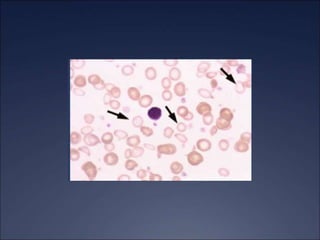
  • #42 The arrows show that the RBCs are smaller and paler
  • #52 When give 200-300 mg of elemental iron, only 50-60 mg/day is absorbed Iron Tolerance Test: two iron tablets given on an empty stomach and the serum iron level measured over the next two hours. Normal absorption will result in increase of serum iron level by 100 ug/dL Pts may not take due to side effects (GI Side Effects) Parenteral Formulations When patient cannot tolerate PO due to side effects When patient needs iron on an ongoing basis Side Effect: 0.7% of iron dextran causes anaphylaxis so usually a small tester dose is given to monitor response