Lecture 04
Iron-Carbon Diagram
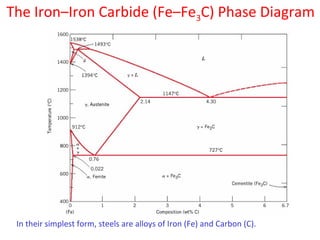
The Iron–Iron Carbide (Fe–Fe3C) Phase Diagram
In their simplest form, steels are alloys of Iron (Fe) and Carbon (C).
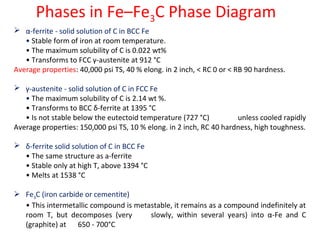
Phases in Fe–Fe3C Phase Diagram
 α-ferrite - solid solution of C in BCC Fe
• Stable form of iron at room temperature.
• The maximum solubility of C is 0.022 wt%
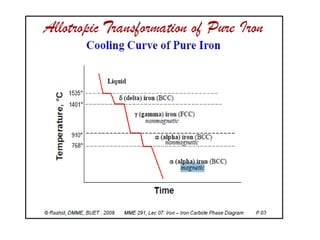
• Transforms to FCC γ-austenite at 912 °C
Average properties: 40,000 psi TS, 40 % elong. in 2 inch, < RC 0 or < RB 90 hardness.
 γ-austenite - solid solution of C in FCC Fe
• The maximum solubility of C is 2.14 wt %.
• Transforms to BCC δ-ferrite at 1395 °C
• Is not stable below the eutectoid temperature (727 °C) unless cooled rapidly
Average properties: 150,000 psi TS, 10 % elong. in 2 inch, RC 40 hardness, high toughness.
 δ-ferrite solid solution of C in BCC Fe
• The same structure as a-ferrite
• Stable only at high T, above 1394 °C
• Melts at 1538 °C
 Fe3C (iron carbide or cementite)
• This intermetallic compound is metastable, it remains as a compound indefinitely at
room T, but decomposes (very slowly, within several years) into α-Fe and C
(graphite) at 650 - 700°C
A few comments on Fe–Fe3C system
 C is an interstitial impurity in Fe. It forms a solid solution
with α, γ, δ phases of iron
 Maximum solubility in BCC α-ferrite is limited (max. 0.022
wt% at 727°C) - BCC has relatively small interstitial
positions
 Maximum solubility in FCC austenite is 2.14 wt% at 1147°C
- FCC has larger interstitial positions
 Mechanical properties: Cementite is very hard and brittle
can strengthen steels. Mechanical properties also depend
on the microstructure, that is, how ferrite and cementite
are mixed.
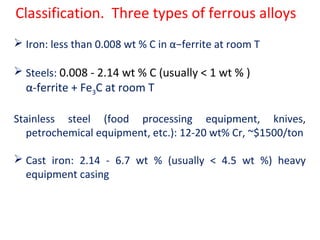
Classification. Three types of ferrous alloys
 Iron: less than 0.008 wt % C in α−ferrite at room T
 Steels: 0.008 - 2.14 wt % C (usually < 1 wt % )
α-ferrite + Fe3C at room T
Stainless steel (food processing equipment, knives,
petrochemical equipment, etc.): 12-20 wt% Cr, ~$1500/ton
 Cast iron: 2.14 - 6.7 wt % (usually < 4.5 wt %) heavy
equipment casing
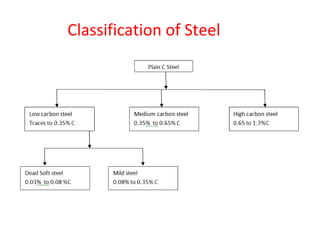
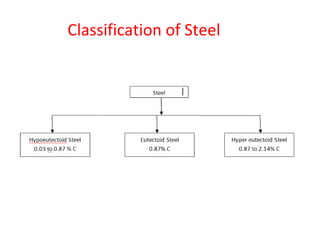
Classification of Steel
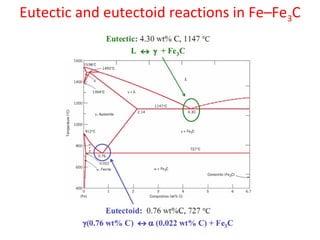
Eutectic and eutectoid reactions in Fe–Fe3C
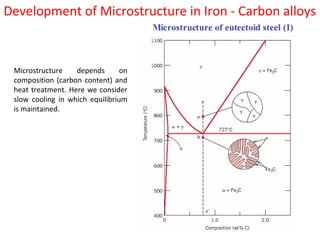
Development of Microstructure in Iron - Carbon alloys
Microstructure depends on
composition (carbon content) and
heat treatment. Here we consider
slow cooling in which equilibrium
is maintained.
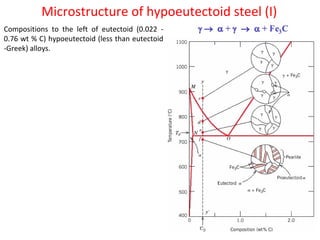
Compositions to the left of eutectoid (0.022 -
0.76 wt % C) hypoeutectoid (less than eutectoid
-Greek) alloys.
Microstructure of hypoeutectoid steel (I)
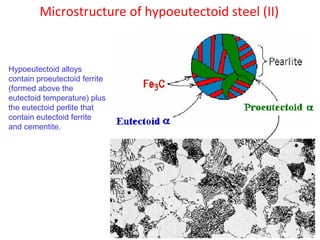
Microstructure of hypoeutectoid steel (II)
Hypoeutectoid alloys
contain proeutectoid ferrite
(formed above the
eutectoid temperature) plus
the eutectoid perlite that
contain eutectoid ferrite
and cementite.
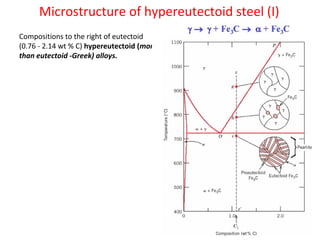
Microstructure of hypereutectoid steel (I)
Compositions to the right of eutectoid
(0.76 - 2.14 wt % C) hypereutectoid (more
than eutectoid -Greek) alloys.
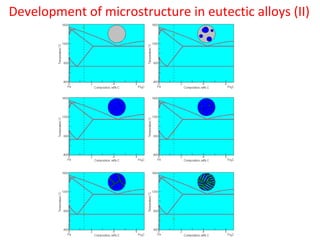
Development of microstructure in eutectic alloys (II)
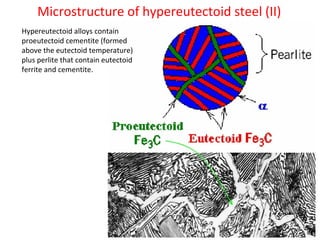
Microstructure of hypereutectoid steel (II)
Hypereutectoid alloys contain
proeutectoid cementite (formed
above the eutectoid temperature)
plus perlite that contain eutectoid
ferrite and cementite.
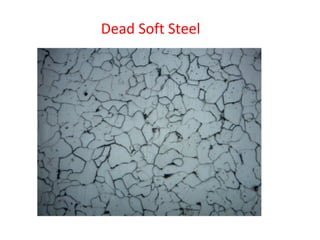
Dead Soft Steel
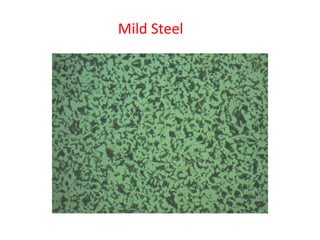
Mild Steel
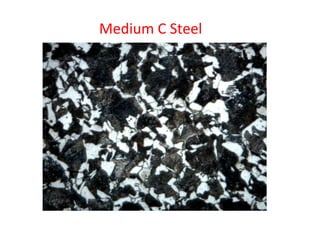
Medium C Steel
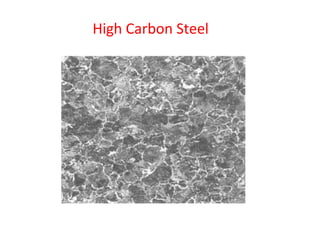
High Carbon Steel

Iron carbon diagram

  • 1.
  • 3.
    The Iron–Iron Carbide(Fe–Fe3C) Phase Diagram In their simplest form, steels are alloys of Iron (Fe) and Carbon (C).
  • 4.
    Phases in Fe–Fe3CPhase Diagram  α-ferrite - solid solution of C in BCC Fe • Stable form of iron at room temperature. • The maximum solubility of C is 0.022 wt% • Transforms to FCC γ-austenite at 912 °C Average properties: 40,000 psi TS, 40 % elong. in 2 inch, < RC 0 or < RB 90 hardness.  γ-austenite - solid solution of C in FCC Fe • The maximum solubility of C is 2.14 wt %. • Transforms to BCC δ-ferrite at 1395 °C • Is not stable below the eutectoid temperature (727 °C) unless cooled rapidly Average properties: 150,000 psi TS, 10 % elong. in 2 inch, RC 40 hardness, high toughness.  δ-ferrite solid solution of C in BCC Fe • The same structure as a-ferrite • Stable only at high T, above 1394 °C • Melts at 1538 °C  Fe3C (iron carbide or cementite) • This intermetallic compound is metastable, it remains as a compound indefinitely at room T, but decomposes (very slowly, within several years) into α-Fe and C (graphite) at 650 - 700°C
  • 5.
    A few commentson Fe–Fe3C system  C is an interstitial impurity in Fe. It forms a solid solution with α, γ, δ phases of iron  Maximum solubility in BCC α-ferrite is limited (max. 0.022 wt% at 727°C) - BCC has relatively small interstitial positions  Maximum solubility in FCC austenite is 2.14 wt% at 1147°C - FCC has larger interstitial positions  Mechanical properties: Cementite is very hard and brittle can strengthen steels. Mechanical properties also depend on the microstructure, that is, how ferrite and cementite are mixed.
  • 6.
    Classification. Three typesof ferrous alloys  Iron: less than 0.008 wt % C in α−ferrite at room T  Steels: 0.008 - 2.14 wt % C (usually < 1 wt % ) α-ferrite + Fe3C at room T Stainless steel (food processing equipment, knives, petrochemical equipment, etc.): 12-20 wt% Cr, ~$1500/ton  Cast iron: 2.14 - 6.7 wt % (usually < 4.5 wt %) heavy equipment casing
  • 7.
  • 8.
  • 9.
    Eutectic and eutectoidreactions in Fe–Fe3C
  • 10.
    Development of Microstructurein Iron - Carbon alloys Microstructure depends on composition (carbon content) and heat treatment. Here we consider slow cooling in which equilibrium is maintained.
  • 11.
    Compositions to theleft of eutectoid (0.022 - 0.76 wt % C) hypoeutectoid (less than eutectoid -Greek) alloys. Microstructure of hypoeutectoid steel (I)
  • 12.
    Microstructure of hypoeutectoidsteel (II) Hypoeutectoid alloys contain proeutectoid ferrite (formed above the eutectoid temperature) plus the eutectoid perlite that contain eutectoid ferrite and cementite.
  • 13.
    Microstructure of hypereutectoidsteel (I) Compositions to the right of eutectoid (0.76 - 2.14 wt % C) hypereutectoid (more than eutectoid -Greek) alloys.
  • 14.
    Development of microstructurein eutectic alloys (II)
  • 15.
    Microstructure of hypereutectoidsteel (II) Hypereutectoid alloys contain proeutectoid cementite (formed above the eutectoid temperature) plus perlite that contain eutectoid ferrite and cementite.
  • 16.
  • 17.
  • 18.
  • 19.