International Research Journal of Engineering and Technology (IRJET) e-ISSN: 2395-0056
Volume: 06 Issue: 04 | Apr 2019 www.irjet.net p-ISSN: 2395-0072
© 2019, IRJET | Impact Factor value: 7.211 | ISO 9001:2008 Certified Journal | Page 1
Study and Analysis of Changes in Water Quality of Gomti River at
Different Locations
Ashutosh1, Kamal Nabh Tripathi2, Dr. Arif Siddiquie3
1M. Tech Student, Department of Civil Engineering, Babu Banarsi Das University, Lucknow
2Assistant Professor, Department of Civil Engineering, Babu Banarsi Das University, Lucknow
3Associate Professor, Department of Civil Engineering, Babu Banarsi Das University, Lucknow
------------------------------------------------------------------------***-------------------------------------------------------------------------
ABSTRACT:- According to the U.S. GeologicalSurvey,there
are over 332,519,000 cubic miles of water on the planet
Earth among which 97% of all the water on Earth is hold
by the oceans and contains heavy composition of salt in it
and most of the remaining 3% is frozen in the glaciers
and icebergs. The atmosphere, rivers, lakes and
underground stores hold less than 1% of all the fresh
water and this small amount has to provide the fresh
water needed to support the Earth's population. River
plays a very important role in the life of human beings as
well as the other living organismslikeanimalsandplants
on the earth. River used to be one of the most important
source of clean water during earlier days but nowadays
due to the heavy contamination the quality of water of
river is decreasing day by day.
In this project work we are going to do analysis of
physical and chemicalparametersof waterof GomtiRiver
in different season at three different locations. The
collected samples are analyzed for 8 Physiochemical
parameters such as temperature,pH,BOD,DO,COD,Total
Hardness, TDS and Alkalinity.
Keywords: Gomti River,waterquality of River,pH,Physio-
chemical parameters.
1. INTRODUCTION
As the population increasing daybydaythedemandof water
for food production, domestic activities as well as industrial
activities also increasing day by day. As we already know
that the water is the most essential need for life and over
97% of the water on earth is holds by the oceans is salty and
3% is in frozen state and remaining amount which is
approximately near about 1%is considered suitable for
living beings on earth. Water is no doubt essential forlifebut
the large quantity of water in the world is pollutedduetothe
excessive contamination and inputs of untreated industrial
effluents, household dirty water and sewage water along
with farming wastes and decaying materials of human,
animals and plants. The quality of water is vital concern for
mankind since it is directly linked with human welfare and
due to the limited quantity of available waterforuse,proper
management and prevention is very necessary to fulfill the
long term requirement and needs of the vast population for
daily house hold use and requirements like agriculture etc.
The Gomti river is an important river of Uttar Pradesh and it
is one of the much known tributary of Ganga river. Gomti
river is also known as Adi- Ganga. It contributes about 15%
total water flow of Ganga river and Like many otherriversin
India Gomti river is also facing many kind of pollution
problems due to large level of commercialization and
colonization.
1.1 Origin
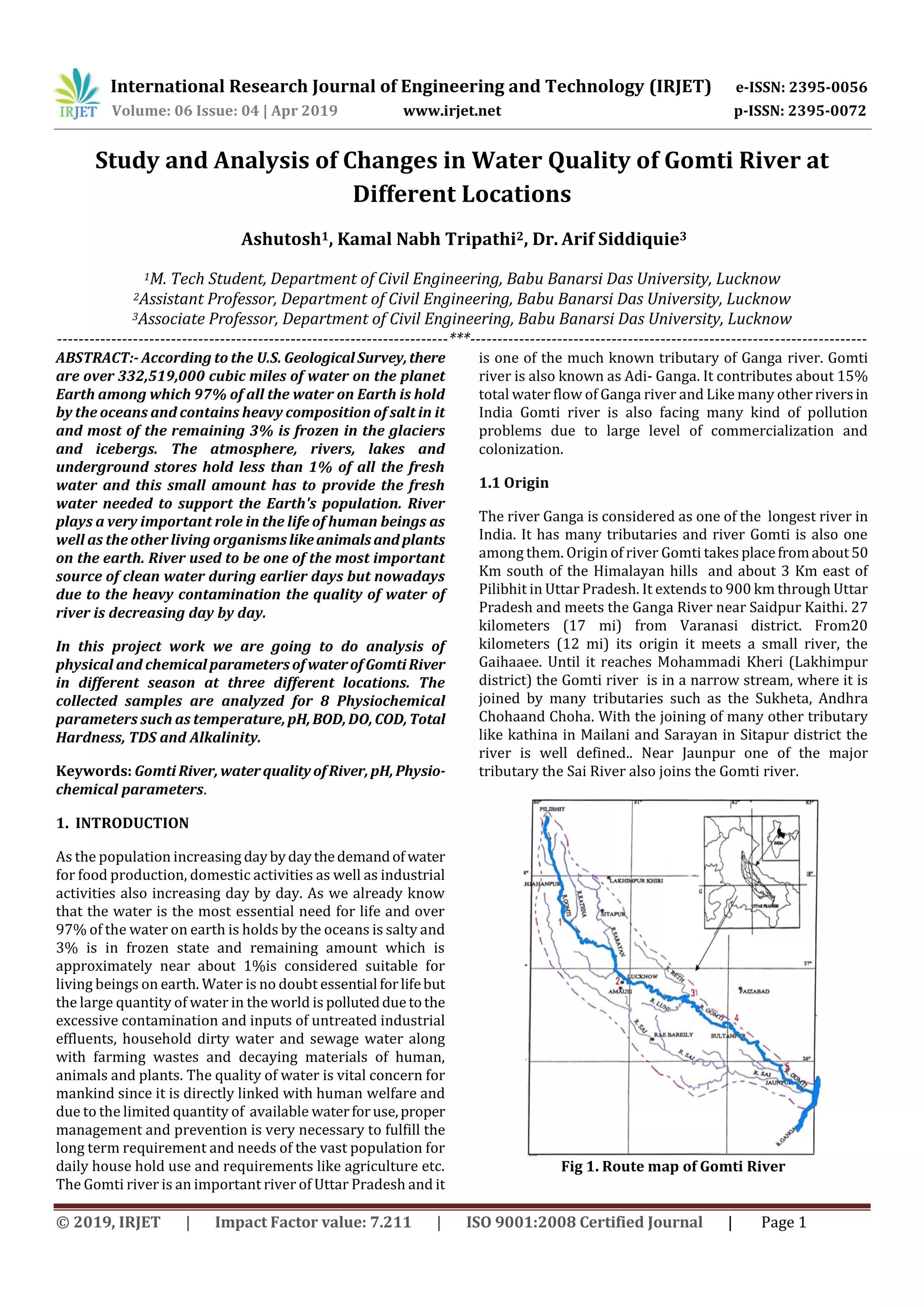
The river Ganga is considered as one of the longest river in
India. It has many tributaries and river Gomti is also one
among them. Origin of river Gomti takes placefromabout50
Km south of the Himalayan hills and about 3 Km east of
Pilibhit in Uttar Pradesh. It extends to 900 km through Uttar
Pradesh and meets the Ganga River near Saidpur Kaithi. 27
kilometers (17 mi) from Varanasi district. From20
kilometers (12 mi) its origin it meets a small river, the
Gaihaaee. Until it reaches Mohammadi Kheri (Lakhimpur
district) the Gomti river is in a narrow stream, where it is
joined by many tributaries such as the Sukheta, Andhra
Chohaand Choha. With the joining of many other tributary
like kathina in Mailani and Sarayan in Sitapur district the
river is well defined.. Near Jaunpur one of the major
tributary the Sai River also joins the Gomti river.
Fig 1. Route map of Gomti River
International Research Journal of Engineering and Technology (IRJET) e-ISSN: 2395-0056
Volume: 06 Issue: 04 | Apr 2019 www.irjet.net p-ISSN: 2395-0072
© 2019, IRJET | Impact Factor value: 7.211 | ISO 9001:2008 Certified Journal | Page 4861
The river Gomti enters Lucknow after travelling
approximately around 240 km. For about 12 km going
through the city it supply its water to most of the places of
the city. Situated on the northern western shore of Gomti
river and surrounded by Barabanki from eastern side and
Unnao from western side, Rae Bareli by the southern side
and Sitapur - Hardoi by northern side is the Lucknow city
which has elevation of 404 ft. (123 m) above sea level. The
city covers an area of 2,528 square kilometers. Inaddition to
Lakhimpurkheri, Sultanpur and Jaunpur, Lucknow is also
among 15 of the most prominent town of the river
catchment basin.
2. APPROACHES
Water quality is a multifarious subject, which involves
physical, chemical, hydrological and biological
characteristics of water and their complex and delicate
relations. It is very essential and important to test the water
before it is used for drinking, domestic, agricultural or
industrial purpose. Water must be tested with different
physic-chemical parameters. Selection of parameters for
testing of water is exclusively depends upon for what
purpose we going to use that water and what level we need
its quality and purity. Some physical test should be
performed for testing of its physical properties like
temperature while chemical tests should be performed for
its BOD, COD, dissolved oxygen, hardness and other
characteristics.
3.1 Collection of samples
Water samples were collected from three different selected
sites (Sitapur, Lucknow, Sultanpur) of Gomti River during
the month of May and November. Samples were collected in
the year 2018 during the entire study period of oneyeartwo
times the sample were collected from the sites. To carry out
the study and analysis of physiochemical change in water of
Gomti River samples were taken out during the time of pre
monsoon (May) and post monsoon (November) season. The
process of sampling involves some process which are as
follows –
 Plan for sampling
 Labeling of sample
 Storing of sample
 Sample testing
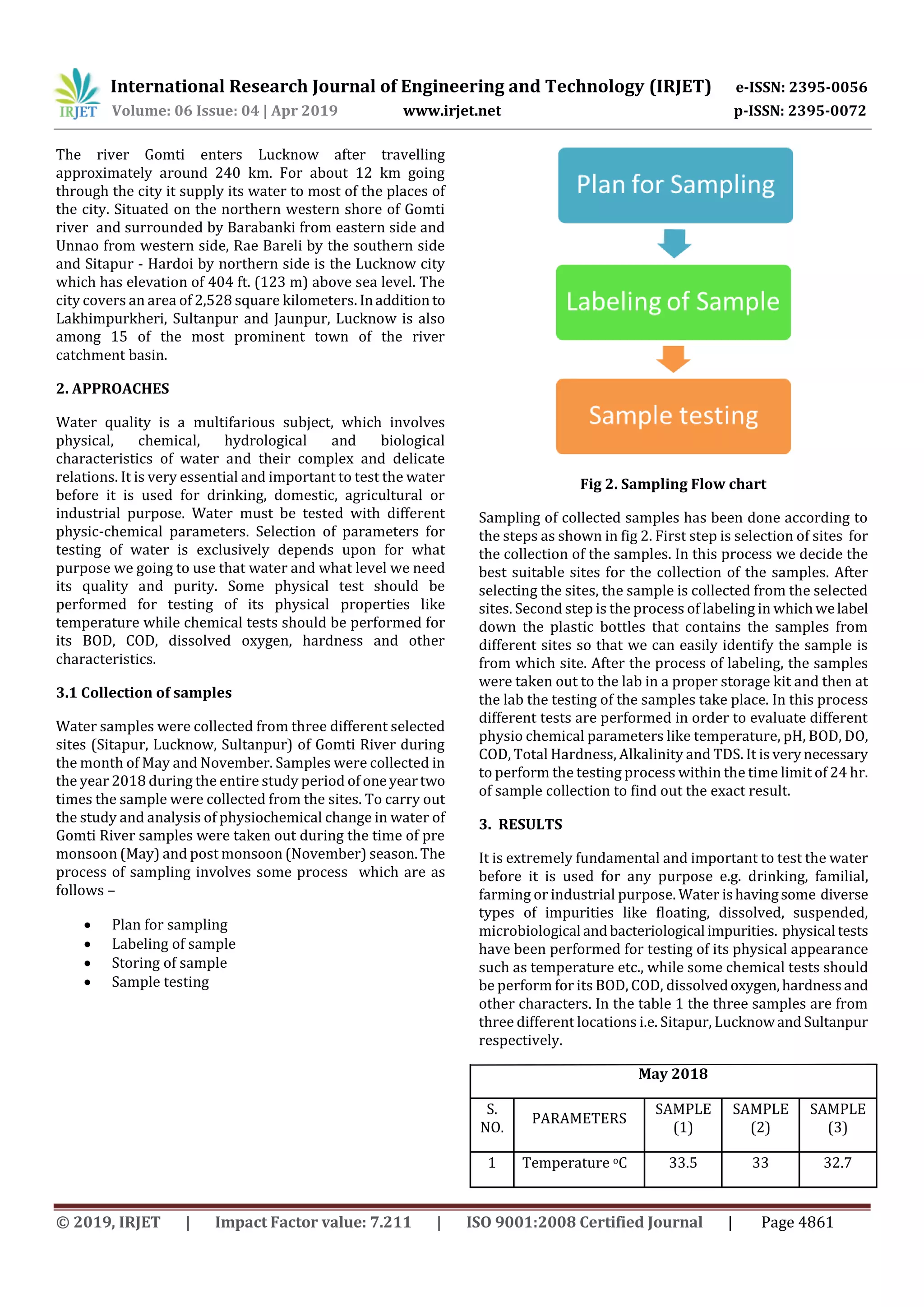
Fig 2. Sampling Flow chart
Sampling of collected samples has been done according to
the steps as shown in fig 2. First step is selection of sites for
the collection of the samples. In this process we decide the
best suitable sites for the collection of the samples. After
selecting the sites, the sample is collected from the selected
sites. Second step is the process of labeling in whichwelabel
down the plastic bottles that contains the samples from
different sites so that we can easily identify the sample is
from which site. After the process of labeling, the samples
were taken out to the lab in a proper storage kit and then at
the lab the testing of the samples take place. In this process
different tests are performed in order to evaluate different
physio chemical parameters like temperature, pH, BOD, DO,
COD, Total Hardness, Alkalinity and TDS. It is verynecessary
to perform the testing process within the time limit of 24 hr.
of sample collection to find out the exact result.
3. RESULTS
It is extremely fundamental and important to test the water
before it is used for any purpose e.g. drinking, familial,
farming or industrial purpose. Water ishavingsome diverse
types of impurities like floating, dissolved, suspended,
microbiological andbacteriological impurities. physical tests
have been performed for testing of its physical appearance
such as temperature etc., while some chemical tests should
be perform for its BOD, COD, dissolvedoxygen,hardnessand
other characters. In the table 1 the three samples are from
three different locations i.e. Sitapur, Lucknowand Sultanpur
respectively.
May 2018
S.
NO.
PARAMETERS
SAMPLE
(1)
SAMPLE
(2)
SAMPLE
(3)
1 Temperature oC 33.5 33 32.7
International Research Journal of Engineering and Technology (IRJET) e-ISSN: 2395-0056
Volume: 06 Issue: 04 | Apr 2019 www.irjet.net p-ISSN: 2395-0072
© 2019, IRJET | Impact Factor value: 7.211 | ISO 9001:2008 Certified Journal | Page 4862
2 pH 7.40 7.85 7.65
3 DO(mg/l) 10.4 7.8 10.1
4 BOD (mg/l) 3.6 4.3 4.6
5 COD (mg/l) 16.0 20.5 15.2
6
Total Hardness
(mg/l (CaCO3) 200 223 216
7
Alkalinity (mg/l
CaCO3) 230 198 210
8 T.D.S. (mg/l) 453 665.3 465
Table 1. Water quality parameters of collected samples
4. CONCLUSION
The different parameters of quality of water is analyzed at
three different location in summer season. As shown in the
result, the highest temperature was found at Sitapur
location. The highest pH value was found at Lucknow. The
highest value of DO (Dissolved Oxygen) wasfoundatSitapur
location. The highest value of BOD (Biological Oxygen
Demand) was found at Sultanpurlocation. BODindicates the
amounts of organic materials in water. The highest value of
COD (Chemical Oxygen Demand)was shown at Lucknow.
Higher value of COD indicates the higher amount of
pollution. Highest value of hardness was analyzed at
Lucknow. Hardness is due to soapy and other wastes from
industries and society. Alkalinity is basically a measure of
the water’s ability to neutralize acidity. Highest value of
alkanity was found at Sitapur location. Highest amount of
Total Dissolved Solids(TDS) was analyzed at Lucknow
location.
REFERENCES
[1] Srivastava S.C., Verma P. and Tripathi M. Comparative
Analysis of the microbial load in cat fish (Mystus aor )And
Carp fish (Labio bata) from Gomti River, Lucknow India,
Flora and Fauna (20) pp.77-82,2014
[2] UPPCB:http://www.indiawaterportal.org/news/report-
Uttar-Pradesh pollution-control board-uppcb-reveals-
deteriorating-condition Gomti-river. 2013.
[3] Kumar A. and Shukla M. Physico-chemical characteristic
of Sai River at Raibarely in relation to its population. Journal
of Eco-physiological Occupation Health. pp.33-38. 2002.
[4]WHO.www.who.int/water_sanitation_health/publications
/facts. 2004.
[5] US EPA, http/www.epa.gob
[6] Singh, K. P., Mohan, D. and Mallick, A. ‘Studies on
distribution and fractionation of heavy metalsinGomtiriver
sediments—a tributary of the Ganges, India’. Journal of
Hydrology, v. 312, pp. 14-27. 2005.
[7] Singh V. K., Singh K. P. and Mohan D. ‘Status of heavy
metals in water and bed sediments of river Gomti– A
Tributary of the Ganga River, India’. Environmental
Monitoring and Assessment, v. 105, pp. 43–67 .2005.
BIOGRAPHIES
Mr. Ashutosh is pursing M.Tech in
Enviromental Engineering from Babu
Banarsi Das University ,Lucknow. He also
holds a B.tech degree in Civil Engineering.
Mr. Kamal Nabh Tripathi is currently
working as an Assistant Professor in
Department of Civil Engineering at Babu
Banarasi Das University(BBDU),Lucknow.
He holds a M.Tech degree in
Environmental Engineering from Integral
University, Lucknow. He has teaching experience for almost
4 years. His teachings areas are subjects related to
Environmental engineeringlikeWaste Watertechnology etc.
He has also published many research papers in many
international as well as national journals.
Dr. Arif Siddiquie is currently working as
an Associate Professor in Department of
Civil Engineering at BBDNITM, Lucknow.
He has been awarded PhD in
Environmental Impact Assessment (EIA)
in the year 2009 from Baba Saheb
Bhimrao Ambedkar (A Central)UniversityLucknowandalso
holding a M.Tech. degreeinEnvironmental engineeringfrom
Department of Civil Engineering Integral University,
Lucknow. Besides teaching and researchassignmentshe has
also worked as a consultant to the Indian Minister of State
Maneka Gandhi in the Ministry of culture and Ministry of
Statistics & Programme Implementation Govt. of India,
Shastri Bhawan, New Delhi, India where he developed a
state-of-the art on foreign funding sources for non-profit
sectors in India. He has also published various research
papers in various reputed national and International
journals.

IRJET- Study and Analysis of Changes in Water Quality of Gomti River at different Locations

  • 1.
    International Research Journalof Engineering and Technology (IRJET) e-ISSN: 2395-0056 Volume: 06 Issue: 04 | Apr 2019 www.irjet.net p-ISSN: 2395-0072 © 2019, IRJET | Impact Factor value: 7.211 | ISO 9001:2008 Certified Journal | Page 1 Study and Analysis of Changes in Water Quality of Gomti River at Different Locations Ashutosh1, Kamal Nabh Tripathi2, Dr. Arif Siddiquie3 1M. Tech Student, Department of Civil Engineering, Babu Banarsi Das University, Lucknow 2Assistant Professor, Department of Civil Engineering, Babu Banarsi Das University, Lucknow 3Associate Professor, Department of Civil Engineering, Babu Banarsi Das University, Lucknow ------------------------------------------------------------------------***------------------------------------------------------------------------- ABSTRACT:- According to the U.S. GeologicalSurvey,there are over 332,519,000 cubic miles of water on the planet Earth among which 97% of all the water on Earth is hold by the oceans and contains heavy composition of salt in it and most of the remaining 3% is frozen in the glaciers and icebergs. The atmosphere, rivers, lakes and underground stores hold less than 1% of all the fresh water and this small amount has to provide the fresh water needed to support the Earth's population. River plays a very important role in the life of human beings as well as the other living organismslikeanimalsandplants on the earth. River used to be one of the most important source of clean water during earlier days but nowadays due to the heavy contamination the quality of water of river is decreasing day by day. In this project work we are going to do analysis of physical and chemicalparametersof waterof GomtiRiver in different season at three different locations. The collected samples are analyzed for 8 Physiochemical parameters such as temperature,pH,BOD,DO,COD,Total Hardness, TDS and Alkalinity. Keywords: Gomti River,waterquality of River,pH,Physio- chemical parameters. 1. INTRODUCTION As the population increasing daybydaythedemandof water for food production, domestic activities as well as industrial activities also increasing day by day. As we already know that the water is the most essential need for life and over 97% of the water on earth is holds by the oceans is salty and 3% is in frozen state and remaining amount which is approximately near about 1%is considered suitable for living beings on earth. Water is no doubt essential forlifebut the large quantity of water in the world is pollutedduetothe excessive contamination and inputs of untreated industrial effluents, household dirty water and sewage water along with farming wastes and decaying materials of human, animals and plants. The quality of water is vital concern for mankind since it is directly linked with human welfare and due to the limited quantity of available waterforuse,proper management and prevention is very necessary to fulfill the long term requirement and needs of the vast population for daily house hold use and requirements like agriculture etc. The Gomti river is an important river of Uttar Pradesh and it is one of the much known tributary of Ganga river. Gomti river is also known as Adi- Ganga. It contributes about 15% total water flow of Ganga river and Like many otherriversin India Gomti river is also facing many kind of pollution problems due to large level of commercialization and colonization. 1.1 Origin The river Ganga is considered as one of the longest river in India. It has many tributaries and river Gomti is also one among them. Origin of river Gomti takes placefromabout50 Km south of the Himalayan hills and about 3 Km east of Pilibhit in Uttar Pradesh. It extends to 900 km through Uttar Pradesh and meets the Ganga River near Saidpur Kaithi. 27 kilometers (17 mi) from Varanasi district. From20 kilometers (12 mi) its origin it meets a small river, the Gaihaaee. Until it reaches Mohammadi Kheri (Lakhimpur district) the Gomti river is in a narrow stream, where it is joined by many tributaries such as the Sukheta, Andhra Chohaand Choha. With the joining of many other tributary like kathina in Mailani and Sarayan in Sitapur district the river is well defined.. Near Jaunpur one of the major tributary the Sai River also joins the Gomti river. Fig 1. Route map of Gomti River
  • 2.
    International Research Journalof Engineering and Technology (IRJET) e-ISSN: 2395-0056 Volume: 06 Issue: 04 | Apr 2019 www.irjet.net p-ISSN: 2395-0072 © 2019, IRJET | Impact Factor value: 7.211 | ISO 9001:2008 Certified Journal | Page 4861 The river Gomti enters Lucknow after travelling approximately around 240 km. For about 12 km going through the city it supply its water to most of the places of the city. Situated on the northern western shore of Gomti river and surrounded by Barabanki from eastern side and Unnao from western side, Rae Bareli by the southern side and Sitapur - Hardoi by northern side is the Lucknow city which has elevation of 404 ft. (123 m) above sea level. The city covers an area of 2,528 square kilometers. Inaddition to Lakhimpurkheri, Sultanpur and Jaunpur, Lucknow is also among 15 of the most prominent town of the river catchment basin. 2. APPROACHES Water quality is a multifarious subject, which involves physical, chemical, hydrological and biological characteristics of water and their complex and delicate relations. It is very essential and important to test the water before it is used for drinking, domestic, agricultural or industrial purpose. Water must be tested with different physic-chemical parameters. Selection of parameters for testing of water is exclusively depends upon for what purpose we going to use that water and what level we need its quality and purity. Some physical test should be performed for testing of its physical properties like temperature while chemical tests should be performed for its BOD, COD, dissolved oxygen, hardness and other characteristics. 3.1 Collection of samples Water samples were collected from three different selected sites (Sitapur, Lucknow, Sultanpur) of Gomti River during the month of May and November. Samples were collected in the year 2018 during the entire study period of oneyeartwo times the sample were collected from the sites. To carry out the study and analysis of physiochemical change in water of Gomti River samples were taken out during the time of pre monsoon (May) and post monsoon (November) season. The process of sampling involves some process which are as follows –  Plan for sampling  Labeling of sample  Storing of sample  Sample testing Fig 2. Sampling Flow chart Sampling of collected samples has been done according to the steps as shown in fig 2. First step is selection of sites for the collection of the samples. In this process we decide the best suitable sites for the collection of the samples. After selecting the sites, the sample is collected from the selected sites. Second step is the process of labeling in whichwelabel down the plastic bottles that contains the samples from different sites so that we can easily identify the sample is from which site. After the process of labeling, the samples were taken out to the lab in a proper storage kit and then at the lab the testing of the samples take place. In this process different tests are performed in order to evaluate different physio chemical parameters like temperature, pH, BOD, DO, COD, Total Hardness, Alkalinity and TDS. It is verynecessary to perform the testing process within the time limit of 24 hr. of sample collection to find out the exact result. 3. RESULTS It is extremely fundamental and important to test the water before it is used for any purpose e.g. drinking, familial, farming or industrial purpose. Water ishavingsome diverse types of impurities like floating, dissolved, suspended, microbiological andbacteriological impurities. physical tests have been performed for testing of its physical appearance such as temperature etc., while some chemical tests should be perform for its BOD, COD, dissolvedoxygen,hardnessand other characters. In the table 1 the three samples are from three different locations i.e. Sitapur, Lucknowand Sultanpur respectively. May 2018 S. NO. PARAMETERS SAMPLE (1) SAMPLE (2) SAMPLE (3) 1 Temperature oC 33.5 33 32.7
  • 3.
    International Research Journalof Engineering and Technology (IRJET) e-ISSN: 2395-0056 Volume: 06 Issue: 04 | Apr 2019 www.irjet.net p-ISSN: 2395-0072 © 2019, IRJET | Impact Factor value: 7.211 | ISO 9001:2008 Certified Journal | Page 4862 2 pH 7.40 7.85 7.65 3 DO(mg/l) 10.4 7.8 10.1 4 BOD (mg/l) 3.6 4.3 4.6 5 COD (mg/l) 16.0 20.5 15.2 6 Total Hardness (mg/l (CaCO3) 200 223 216 7 Alkalinity (mg/l CaCO3) 230 198 210 8 T.D.S. (mg/l) 453 665.3 465 Table 1. Water quality parameters of collected samples 4. CONCLUSION The different parameters of quality of water is analyzed at three different location in summer season. As shown in the result, the highest temperature was found at Sitapur location. The highest pH value was found at Lucknow. The highest value of DO (Dissolved Oxygen) wasfoundatSitapur location. The highest value of BOD (Biological Oxygen Demand) was found at Sultanpurlocation. BODindicates the amounts of organic materials in water. The highest value of COD (Chemical Oxygen Demand)was shown at Lucknow. Higher value of COD indicates the higher amount of pollution. Highest value of hardness was analyzed at Lucknow. Hardness is due to soapy and other wastes from industries and society. Alkalinity is basically a measure of the water’s ability to neutralize acidity. Highest value of alkanity was found at Sitapur location. Highest amount of Total Dissolved Solids(TDS) was analyzed at Lucknow location. REFERENCES [1] Srivastava S.C., Verma P. and Tripathi M. Comparative Analysis of the microbial load in cat fish (Mystus aor )And Carp fish (Labio bata) from Gomti River, Lucknow India, Flora and Fauna (20) pp.77-82,2014 [2] UPPCB:http://www.indiawaterportal.org/news/report- Uttar-Pradesh pollution-control board-uppcb-reveals- deteriorating-condition Gomti-river. 2013. [3] Kumar A. and Shukla M. Physico-chemical characteristic of Sai River at Raibarely in relation to its population. Journal of Eco-physiological Occupation Health. pp.33-38. 2002. [4]WHO.www.who.int/water_sanitation_health/publications /facts. 2004. [5] US EPA, http/www.epa.gob [6] Singh, K. P., Mohan, D. and Mallick, A. ‘Studies on distribution and fractionation of heavy metalsinGomtiriver sediments—a tributary of the Ganges, India’. Journal of Hydrology, v. 312, pp. 14-27. 2005. [7] Singh V. K., Singh K. P. and Mohan D. ‘Status of heavy metals in water and bed sediments of river Gomti– A Tributary of the Ganga River, India’. Environmental Monitoring and Assessment, v. 105, pp. 43–67 .2005. BIOGRAPHIES Mr. Ashutosh is pursing M.Tech in Enviromental Engineering from Babu Banarsi Das University ,Lucknow. He also holds a B.tech degree in Civil Engineering. Mr. Kamal Nabh Tripathi is currently working as an Assistant Professor in Department of Civil Engineering at Babu Banarasi Das University(BBDU),Lucknow. He holds a M.Tech degree in Environmental Engineering from Integral University, Lucknow. He has teaching experience for almost 4 years. His teachings areas are subjects related to Environmental engineeringlikeWaste Watertechnology etc. He has also published many research papers in many international as well as national journals. Dr. Arif Siddiquie is currently working as an Associate Professor in Department of Civil Engineering at BBDNITM, Lucknow. He has been awarded PhD in Environmental Impact Assessment (EIA) in the year 2009 from Baba Saheb Bhimrao Ambedkar (A Central)UniversityLucknowandalso holding a M.Tech. degreeinEnvironmental engineeringfrom Department of Civil Engineering Integral University, Lucknow. Besides teaching and researchassignmentshe has also worked as a consultant to the Indian Minister of State Maneka Gandhi in the Ministry of culture and Ministry of Statistics & Programme Implementation Govt. of India, Shastri Bhawan, New Delhi, India where he developed a state-of-the art on foreign funding sources for non-profit sectors in India. He has also published various research papers in various reputed national and International journals.