Download to read offline
![International Research Journal of Engineering and Technology (IRJET) e-ISSN: 2395-0056
Volume: 05 Issue: 03 | Mar-2018 www.irjet.net p-ISSN: 2395-0072
© 2018, IRJET | Impact Factor value: 6.171 | ISO 9001:2008 Certified Journal | Page 2647
Speech Based Answer Sheet Evaluation System
Sairaj Chittal1, Rohini Sonawane2, Asmita Patil3, Pankaj Mohite4, V.B Gaikwad5
[1] [2] [3] [4]Student,Dept. of Computer Engineering, Terna Engineering College , Nerul , Navi Mumbai,
Maharashtra,India
[5]Associate Professor, Dept. of Computer Engineering, Terna Engineering College , Nerul , Navi Mumbai,
Maharashtra,India
---------------------------------------------------------------------***---------------------------------------------------------------------
Abstract - Speech is the most effective form for
interaction among humans. Human computer interface is the
middle link which acts like an interpreter between the human
user and the computer system. In this paper we present a
direction in which the speech recognition technology can be
used for evaluation of answer sheets. Real time answer sheet
evaluation requires the examiner to manually evaluate the
answer sheets and give marks accordingly. Our proposed
system is an effort to minimize the drawbacks of the existing
manual method of answer sheet evaluation, improve the
performance, possibly prevent malpractices and to provide
ease of usability over the existing system arrangement. Some
concepts that are aimed to be used in this system are Hidden
Markov’s Model (HMM), Vector Quantization (VQ) as part of
Google Speech API used for speech recognition and
corresponding evaluation.
KEY WORDS: Speech recognition, answer sheet
evaluation, HMM, VQ, ease of usability, malpractices
1. INTRODUCTION
Answer sheet evaluation is a major aspect of present day
education system. Speech recognition is used to
communicate with a particular machine using speech input.
The speech recognition process is accomplished by
converting the speech signal to a sequence of textual
representation by way of various algorithms implemented.
Modern day speech recognition systems are instantly
capable of swearing out and understandingspokenlanguage
input for an ordination of up to thousands of words in real
time operational environment.
Our aim is to develop a model system which can evaluate
the scanned answer sheets through speech input provided
by examiner. The marks and other evaluated data will be
stored in appropriate tablesin the database.Theobjective of
this project is to make improvements over the existing
system of paper evaluation by adding speech recognition
functionality for evaluation. Our softwaresystemisaimedto
correctly interpret and recognize the user speech input and
accurately perform the evaluation process.
2. LITERATURE OVERVIEW
By the year 2001, the speech recognition by computer
machines had a maximum accuracy of up to 70%. However,
this technology’s progress seemed to be slowed down
towards the remainder of the decade. Although recent
research activities have contributed to substantial
improvements in this area. Now variousparallelprocessing
methods which use combinations of Hidden Markov
Model’s(HMM’s) and acoustic-phonetic approaches for the
detection and correction of linguistic errors and for
increasing the robustness of system for correct speech
recognition even in a fairly noisy environment, have been
discovered. The collection of these techniques together can
be called as a Speech Recognition System.
SUMA SHANKARANAND describes the Enhanced Speech
Recognition System as it consisted of two main modules
namely, 1) Speaker Recognition and 2) Speech Recognition.
She explains that the Speaker Identification feature
extraction process ,extracts data from the speech signal that
is unique for each speaker. She further states that the Mel
Frequency Cepstral Coefficient (MFCC) technique is
practiced to create like a fingerprint i.e. a unique
identification of the sound files. VQ Algorithm is used for
feature extraction in both modules.[1]
PRACHI KHILARI describes the Automatic Speech
Recognition (ASR) system. The ASR systems operate in two
phases viz. 1) Training Phase and 2) Recognizing Phase. In
the training phase, the system determines the patterns for
presenting the different language sounds like words,
phonemes and short phrases that are a function of the
linguistic vocabulary. These patterns are stored in form of
templates. In the recognizing phase, if an unknownpatternis
identified by considering the set of references, it isstoredfor
future referencing and processing. A proper database hasto
be created from the various domain words and syllables.[7]
3. EXISTING SYSTEM
The traditional system is a manual evaluation system where
an examiner/evaluator grades a bunch of papers at hand
manually. The chances of malpractices in this traditional
system are more as examiner has direct access to answer
sheet hardcopies. However, recent improvements have
contributed to the use of a software arrangement forproper
evaluation where an examiner sits in front of the computer
system and grades the answer sheets which are in the
configuration of scanned copies. In this existing system the
evaluator has to manually enter the marks for evaluation of
answer sheets in the software system. Even this system](https://image.slidesharecdn.com/irjet-v5i3608-190130102921/85/IRJET-Speech-Based-Answer-Sheet-Evaluation-System-1-320.jpg)
![International Research Journal of Engineering and Technology (IRJET) e-ISSN: 2395-0056
Volume: 05 Issue: 03 | Mar-2018 www.irjet.net p-ISSN: 2395-0072
© 2018, IRJET | Impact Factor value: 6.171 | ISO 9001:2008 Certified Journal | Page 2647
Speech Based Answer Sheet Evaluation System
Sairaj Chittal1, Rohini Sonawane2, Asmita Patil3, Pankaj Mohite4, V.B Gaikwad5
[1] [2] [3] [4]Student,Dept. of Computer Engineering, Terna Engineering College , Nerul , Navi Mumbai,
Maharashtra,India
[5]Associate Professor, Dept. of Computer Engineering, Terna Engineering College , Nerul , Navi Mumbai,
Maharashtra,India
---------------------------------------------------------------------***---------------------------------------------------------------------
Abstract - Speech is the most effective form for
interaction among humans. Human computer interface is the
middle link which acts like an interpreter between the human
user and the computer system. In this paper we present a
direction in which the speech recognition technology can be
used for evaluation of answer sheets. Real time answer sheet
evaluation requires the examiner to manually evaluate the
answer sheets and give marks accordingly. Our proposed
system is an effort to minimize the drawbacks of the existing
manual method of answer sheet evaluation, improve the
performance, possibly prevent malpractices and to provide
ease of usability over the existing system arrangement. Some
concepts that are aimed to be used in this system are Hidden
Markov’s Model (HMM), Vector Quantization (VQ) as part of
Google Speech API used for speech recognition and
corresponding evaluation.
KEY WORDS: Speech recognition, answer sheet
evaluation, HMM, VQ, ease of usability, malpractices
1. INTRODUCTION
Answer sheet evaluation is a major aspect of present day
education system. Speech recognition is used to
communicate with a particular machine using speech input.
The speech recognition process is accomplished by
converting the speech signal to a sequence of textual
representation by way of various algorithms implemented.
Modern day speech recognition systems are instantly
capable of swearing out and understandingspokenlanguage
input for an ordination of up to thousands of words in real
time operational environment.
Our aim is to develop a model system which can evaluate
the scanned answer sheets through speech input provided
by examiner. The marks and other evaluated data will be
stored in appropriate tablesin the database.Theobjective of
this project is to make improvements over the existing
system of paper evaluation by adding speech recognition
functionality for evaluation. Our softwaresystemisaimedto
correctly interpret and recognize the user speech input and
accurately perform the evaluation process.
2. LITERATURE OVERVIEW
By the year 2001, the speech recognition by computer
machines had a maximum accuracy of up to 70%. However,
this technology’s progress seemed to be slowed down
towards the remainder of the decade. Although recent
research activities have contributed to substantial
improvements in this area. Now variousparallelprocessing
methods which use combinations of Hidden Markov
Model’s(HMM’s) and acoustic-phonetic approaches for the
detection and correction of linguistic errors and for
increasing the robustness of system for correct speech
recognition even in a fairly noisy environment, have been
discovered. The collection of these techniques together can
be called as a Speech Recognition System.
SUMA SHANKARANAND describes the Enhanced Speech
Recognition System as it consisted of two main modules
namely, 1) Speaker Recognition and 2) Speech Recognition.
She explains that the Speaker Identification feature
extraction process ,extracts data from the speech signal that
is unique for each speaker. She further states that the Mel
Frequency Cepstral Coefficient (MFCC) technique is
practiced to create like a fingerprint i.e. a unique
identification of the sound files. VQ Algorithm is used for
feature extraction in both modules.[1]
PRACHI KHILARI describes the Automatic Speech
Recognition (ASR) system. The ASR systems operate in two
phases viz. 1) Training Phase and 2) Recognizing Phase. In
the training phase, the system determines the patterns for
presenting the different language sounds like words,
phonemes and short phrases that are a function of the
linguistic vocabulary. These patterns are stored in form of
templates. In the recognizing phase, if an unknownpatternis
identified by considering the set of references, it isstoredfor
future referencing and processing. A proper database hasto
be created from the various domain words and syllables.[7]
3. EXISTING SYSTEM
The traditional system is a manual evaluation system where
an examiner/evaluator grades a bunch of papers at hand
manually. The chances of malpractices in this traditional
system are more as examiner has direct access to answer
sheet hardcopies. However, recent improvements have
contributed to the use of a software arrangement forproper
evaluation where an examiner sits in front of the computer
system and grades the answer sheets which are in the
configuration of scanned copies. In this existing system the
evaluator has to manually enter the marks for evaluation of
answer sheets in the software system. Even this system](https://image.slidesharecdn.com/irjet-v5i3608-190130102921/75/IRJET-Speech-Based-Answer-Sheet-Evaluation-System-1-2048.jpg)
![International Research Journal of Engineering and Technology (IRJET) e-ISSN: 2395-0056
Volume: 05 Issue: 03 | Mar-2018 www.irjet.net p-ISSN: 2395-0072
© 2018, IRJET | Impact Factor value: 6.171 | ISO 9001:2008 Certified Journal | Page 2648
requires more human efforts likemoremouseclicksandalso
requires greater amount of constant precision of the
examiner.
4. PROPOSED SYSTEM
To overcome the drawbacks of existing system we are
proposing to construct a speech based answer sheet
evaluation system that will use speech input of examiner for
evaluation. The primary purpose here is toutilisethespeech
recognition technique to provide a better performance by
the software system as well as have maximum level of
transparency and ease of evaluation for the examiner, as
compared to the existing system. The proposed system
consists of two main actors, 1) Admin and 2) Examiner.
Admin can add/remove the examiners and assign the
subjects to the examiners. Admin has to upload the scanned
answer sheets for the various subjects. Examiner can only
evaluate the answer sheets of the subjects that he/she is
assigned to. The software system is aimed to be able to
correctly interpret and recognize the examiner’s speech
input via a microphone and accurately perform the
evaluation and store the results in the corresponding tables
in the database.
5. SCOPE
This software system can possibly be used for evaluating
answer sheets of any domain. This scheme is in line with
technical changes which are moving towardsautomation i.e.
minimizing manual human efforts. Attempt to use
maximum features provided by a computer system.
Efficient utilizationof speech recognition technology for the
evaluation process. Possibility of improvement over
traditional software system majorly in terms of ease of
usability.
6. REQUIREMENTS
Hardware Specifications :
Processor : AMD A4-6210 APU with AMD Radeon R3
Graphics.
Installed memory (RAM) : 4 GB.
System Type : 64-bit Operating System , x64 based
processor
Microphone
Software Specifications :
Windows 10
Netbeans 7.2 version+
Eclipse Juno
SQLYog Community Edition (MYSQL GUI)
7. SPEECH RECOGNITION SYSTEM
Speech recognition is the ability of a machine or program to
identify words and idiomatic expressions present in spoken
words or phrases and convert them to a machine-
understandable format. Primary speech recognition
software’s have a fixed vocabulary of words and phrases,
and it may simply identify these if they are uttered with
more clarity. In our system we are using Google Speech API
for speech recognition. Our system uses finite i.e. limitedset
of words,phrasesand numeric speech inputs for evaluation
purposes.
HMM method is used for speech recognition basically
because it has an inherent statistical (mathematically
precise) framework, the ease and availability of various
training algorithms for correct estimation of parameters of
the models from the finite training sets of speech data, the
flexibility of the resulting recognition system where one can
easily change the type, size and architecture of themodelsto
suit the particular words, sounds etc., and the ease of
implementation of the overall recognition system.[8].
The Automatic Speech Recognition of Google API is done
using Deep Learning Neural Networking. It has a Global
Vocabulary i.e. it can support as many as 80 languages. The
speech to text conversion isdone by applyingsetofpowerful
neural network models and in an easy to use API. The
command and control is done through speech input,
enabling application’s microphone. Figure-1 depicts the
basic working of Google speech API.
Figure-1: Google Speech API Working
8. SPEECHEVALUATIONWORKFLOWOFPROPOSED
SYSTEM.
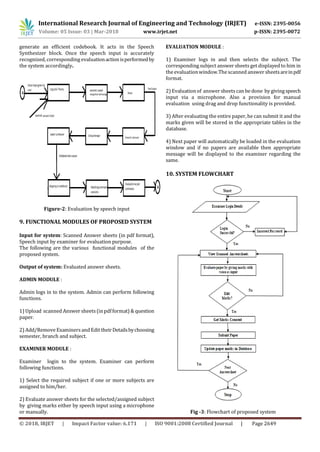
The speech evaluation workflow diagram (Figure-2) is the
description of how the important concepts of HMM and VQ
work as a part of Automatic Speech Recognition for Google
Speech API. HMM acts in the ASR technology block using
acoustic models. Powerful neural network models are used
for speech to text conversion.The main aim of VQ is to](https://image.slidesharecdn.com/irjet-v5i3608-190130102921/85/IRJET-Speech-Based-Answer-Sheet-Evaluation-System-2-320.jpg)
![International Research Journal of Engineering and Technology (IRJET) e-ISSN: 2395-0056
Volume: 05 Issue: 03 | Mar-2018 www.irjet.net p-ISSN: 2395-0072
© 2018, IRJET | Impact Factor value: 6.171 | ISO 9001:2008 Certified Journal | Page 2650
11. CONCLUSIONS
To summarize in a nutshell, we haveusedspeechrecognition
technology by taking speech as input via a microphone for
answer sheet evaluation in our proposed software system.
This can be applied as an additional functionality over the
traditional evaluation system and can possibly reduce the
malpractices and possibly offer more accuracy. Keeping in
mind about the move towards automation, our system is in
conformity with it and can prove to be beneficial as minimal
manual human efforts are required. Tested accuracy of
correct speech recognition of our proposed system hasbeen
found decent enough i.e. about 80-85%.
ACKNOWLEDGEMENT
This project is guided by Prof. V.B.Gaikwad, Assistant
Professor at Terna Engineering College Nerul.
REFERENCES
[1] Suma Shankaranand, Manasa S, Mani Sharma, Nithya
A.S, Roopa K.S, K.V Ramakrishnan “An enhanced speech
recognition system”,IJRDET,Vol-2,Issue-3,March-2014
[2] Nuzhat Atiqua Nafis ,Md.Safaet Hussain, “Speech to text
conversion in real time”, IJISR Journal,Vol-17,No-2,Aug
2015
[3] Suma Swamy, K.V Ramakrishnan “An efficient speech
recognition system”, CSEIJ, August 2013
[4] Dan Jurafsky CS 224S / LINGUIST 181 Speech
Recognition and Synthesis. World Wide Web,
http://www.stanford.edu/class/cs224s/
[5] Lawrence R. Rabiner. “A Tutorial on Hidden Markov
Model and Selected Applicaiton in Speech
Recognition”.IEEE, 1989.
[6] Willie Walker, Paul Lamere, and Philip Kwok. Sphinx-4:
“”A Flexible Open Source Framework for Speech
Recognition. SUN Microsystem, 2004.
[7] Prachi Khilari, Bhope V.P,”A review on speech to text
conversion methods”, IJARCET, Volume 4 Issue 7, July
2015.
[8] LR Rabiner “Hidden Markov Models for Speech
Recognition — Strengths and Limitations”
https://link.springer.com/chapter/10.1007/978-3-
642-76626-8_1](https://image.slidesharecdn.com/irjet-v5i3608-190130102921/85/IRJET-Speech-Based-Answer-Sheet-Evaluation-System-4-320.jpg)

The document describes a proposed speech-based answer sheet evaluation system. It aims to improve on existing manual evaluation methods by utilizing speech recognition technology. The key points are: 1. The proposed system would allow examiners to provide speech input to evaluate scanned answer sheets, rather than manually entering marks. This could minimize errors and malpractices compared to existing systems. 2. Speech recognition would be implemented using Google Speech API and techniques like Hidden Markov Models and Vector Quantization. The system is intended to accurately interpret examiner speech and perform the corresponding evaluation actions. 3. By automating more of the evaluation process and providing a speech interface, the system aims to make the process easier for examiners compared to existing


