International Research Journal of Engineering and Technology (IRJET) e-ISSN: 2395-0056
Volume: 06 Issue: 06 | June 2019 www.irjet.net p-ISSN: 2395-0072
© 2019, IRJET | Impact Factor value: 7.211 | ISO 9001:2008 Certified Journal | Page 3376
Providing Privacy in Healthcare Cloud for Medical Data using Fog
Computing and Cryptography
Miss. Pachore Poonam A1, Prof. S.D. Jondhale2
1Miss. Pachore Poonam A, Dept. of Computer Engineering, PREC, Loni, Maharashtra, India.
2Prof. S. D. Jondhale, Dept. of Computer Engineering, PREC, Loni, Maharashtra, India
---------------------------------------------------------------------***----------------------------------------------------------------------
Abstract - Today internet is getting faster and cheaper to
use with the introduction of 4G network. Thus due to this
external storage sources such as cloud is used by many on
daily basis. There emerged various cloud providers both in
private and public cloud computing scenarios. Thus with the
fast and massive growth of data that is being stored on the
cloud gave development opportunitiestomakethecloudmore
secure and reliable. The major sector among all that was
heath related services which started using cloud to satisfy
their daily needs.
So in this paper we are going to concentrate on
securing health services using cloud and ways to make it safe
and secure to use. However, in currentstoragescenario, health
care data is totally stored in cloud servers. Thus, users who
upload their data on cloud lose their right of control of the
data on cloud and face privacy leakage risk. The other privacy
protection schemes and technologies are usually based on
encryption technology, but these kinds of methods cannot
effectively resist attack that are originated from the inside of
cloud server by a cloud provider whoseservicesarehandled by
a third party source. So we thought of implementing a novel
approach which will spilt data and store on cloud and local
servers simultaneously. This technique will be explained as
Split and Combine (SaC). To upload data, the data will be split
in to two where the first will be saved on the cloud and the
other will be saved on the local server. To request data, wewill
again combine the data from the cloud and the local server.
We are intending to use Google Drive as the Cloud. In this
project, the main focus has been given to secure healthcare
private data in the cloud using a local server computing
facility and AES algorithm.
Key Words: Cloud, Healthcare, Security, Local Server,
Spreadsheet, AES, SaC.
1. INTRODUCTION
Today computer technology isbecomeanintegral partof our
day to day life. Cloud computing is the hot topic today that is
being used by many. Thus cloud computing is used in large
amount of applications from social networks to health care
and many more. Thus as the use of cloud increased it gave
rise to misuse of user data by an attacker. Thus security
challenges arose from it as most of the application data is
handled by third party cloud handlers. Withtheintroduction
of 3G and 4G networks the internetgotfasterthusincreasing
the amount of data that is being sent on the cloud. Thus to
track this amount of data from attackers got a very
challenging task. Thus the privacy of data on the cloud
providers was unpredictable. There were many cyber-
attacks
2. REVIEW OF LITERATURE
This topic of previous studies describes the fundamentals of
various techniques and technologies used to protect data
that is stored on the cloud. It helps in understanding and
evaluating various ideas put forward by various technical
papers published by various publishers.
Ashish Singh et al.[1] authors explains the idea of
about the basic features of the cloud computing, security
issues, threats and their solutions that can be achieved by
using various techniques used to overcome them. It also
explains some key topics related to cloud such as cloud
architecture framework, service and deployment model,
cloud technologies, cloud security concepts, threats, and
attacks that come with cloud computing.Italsoconcentrates
a lot of open research issues related to the cloud security
that can be improved upon. The Main Limitation of this
paper is that it concentrates on saving data as whole on the
cloud only.
Tian Wang et al.[2] authors explains the idea of
taking full advantage of cloud storage and protect the
privacy of data from leakage together. In this paper they
explain a technique named, Hash-Solomon codealgorithmis
designed to divide data into different parts to store data at
various steps. Then, a small part of data is saved in local
machine and fog server in order to protect the privacy of a
whole data. It has high accuracy to store data.TheLimitation
of the paper is that it concentrates on only splitting data and
not the security of the split data which is achieved by the
concept in our paper.
S. Seema et al. [3] authors explain the idea of using
multi keyword search approachforfindingdata onthecloud.
The approach presented in this paper is known as secure
multi-keyword ranked search over encrypted cloud data.
This approach in the paper supports some of the functions
like uploading and deletion of les which can be done by
multiusers. Here RSA algorithm is used. The proposed
technique in this paper makes use of a structure known as
tree-based indexing to develop search competence and also
provides adaptable uploading and deletion of les. The
International Research Journal of Engineering and Technology (IRJET) e-ISSN: 2395-0056
Volume: 06 Issue: 06 | June 2019 www.irjet.net p-ISSN: 2395-0072
© 2019, IRJET | Impact Factor value: 7.211 | ISO 9001:2008 Certified Journal | Page 3377
Limitation of the paper is that it concentrates on RSA
algorithm and not on SaC technique which is more efficient
then it.
Sherman S.M. Chow, et al.[4] authors explain the
idea of public auditing of the data that is stored on the cloud.
It introduces a third party auditor (TPA) to check the
integrity of outsourced data and be worry free and be
tension free. Thus the work proposed in thispaperincreases
a securecloudstoragesystemsupporting privacy-preserving
public auditing for easy cloud use. It also extends TPA to
perform audits for multiple users simultaneously and
efficiently without any extra cost and efforts. This proposed
schemes are provably secure and highly efficient for various
cloud providers. The Limitation of the paper is that it
concentrates on public auditing and not on SaC technique
which is more efficient then it.
R. Kowsik et al. [5] authors explain the idea for
securing data in the cloud using offensive decoy technology
for data security. In this paper abnormal data activity is
found using a thread . The unauthorized access is detected
using challenge questions set during registration. When
unauthorized access is detected disinformation attack is
launched by returning large amounts of decoy in formation
to the attacker to misguide him. It protects the misuse of
data by the attacker. The Limitation of the paper is that it
concentrates on offensive decoy technology and not on SaC
technique which is more efficient then it.
3. PROPOSED METHODOLOGY
In the proposed system we consider of dropping the
traditional approach of storing the data as a wholeusing SaC
technique. Furthermore, data security is the mostimportant
part in cloud storage security and it includes three aspects:
data privacy, data integrity and data availability at a given
time a user intends to use them. Thus to add extra security
for the SaC we are going to use encryption and decryption
techniques with it. We are proposingtouseGoogleDriveand
Google Spreadsheet for demonstration of out technique.
3.1 Architecture
Fig -1: Proposed System Architecture
Fig 1 shows the proposed system architecture which will be
explained in brief as follows:
1) Healthcare User: This entity may be anyonefrom
the health sector such as doctor, patient, Staff etc. This will
be a mobile application with various users.
2) Send Data: Here data is sent for uploading which
is received on the local server for further processing. The
data will be received using internet and cloud.
3) Split Data: Here data is split on local server for
uploading. The Split data calculation will depend on the
formula applied to number of fields in the table that is to be
uploaded.
4) Encryption: Here the split data isencryptedusing
AES Algorithm. The AES algorithm increases the security of
the data.
5) Upload: Here the 80 percent split data is
uploaded to cloud and the remaining is kept on the local
server. The local server database may be oracle etc. and the
cloud server database will be Google Spreadsheet.
6) Request Data: Here data is requested by user for
downloading which is receivedonthelocal serverforfurther
processing. The Request is first received by the local server.
7) Download data: Here data is downloaded from
the cloud and local server.
8) Combine Data: Here the split data is combined
together with help of formula to split and combine
technique.
9) Decryption: Here the combineddata isdecrypted
and shown to the user. The user can view the data on the
mobile
3.2 Algorithm
AES is a short form of Rijndael block cipher . It was
developed by two Belgian cryptographers, Vincent Rijmen
and Joan Daemen, who submitted a proposal to NIST during
the AES selection process. Rijndael is a familyofcipherswith
different key and block sizes each with a block size of 128
bits, but three different key lengths: 128, 192 and 256 bits.
AES was first adopted by the U.S. government for
security and is now used worldwide. It is the advanced
version of the Data Encryption Standard (DES), which was
published in 1977. The AES algorithm is a symmetric-key
algorithm, meaning the same key is used forbothencrypting
and decrypting the data using AES. AES is included in the
ISO/IEC 18033-3 standard for security features.
AES is the rst (and only) publicly accessible cipher
approved by the National Security Agency(NSA) for top
International Research Journal of Engineering and Technology (IRJET) e-ISSN: 2395-0056
Volume: 06 Issue: 06 | June 2019 www.irjet.net p-ISSN: 2395-0072
© 2019, IRJET | Impact Factor value: 7.211 | ISO 9001:2008 Certified Journal | Page 3378
secret information when used in an NSA approved
cryptographic module (see Security of AES, below).
4. RESULT ANALYSIS AND DISCUSSION
4.1 Results for communication with cloud
1) Upload and View Data: In the screenshot a
communication with the cloud is made and the data can be
uploaded and downloaded using the application.
Fig-2 : Result to Upload and View Data
Fig-3: Result to Show Data on Cloud
2) Data on the Cloud: In the screenshotthedata that
is to be uploaded and downloaded is stored on the Google
Drive Spreadsheet.
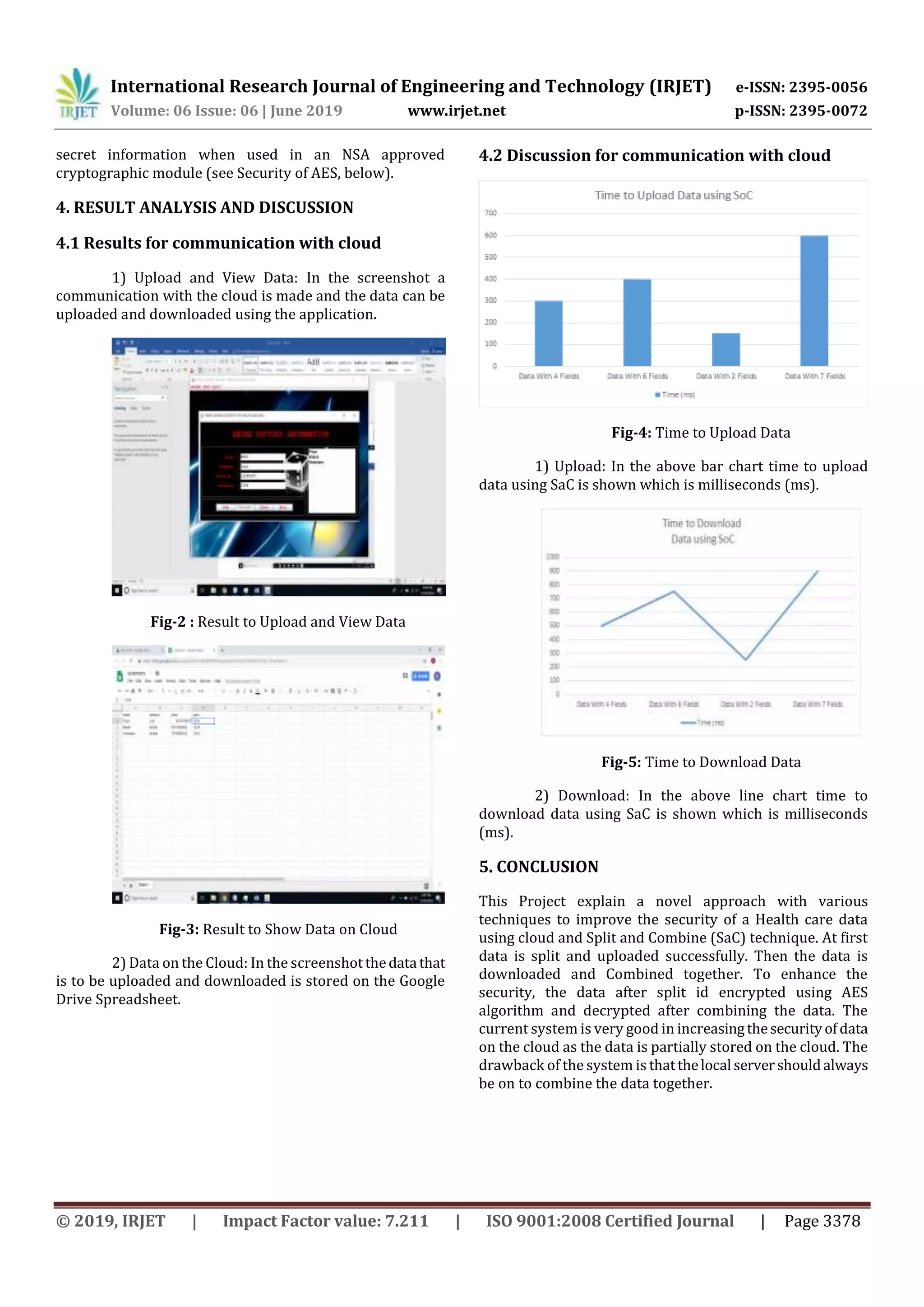
4.2 Discussion for communication with cloud
Fig-4: Time to Upload Data
1) Upload: In the above bar chart time to upload
data using SaC is shown which is milliseconds (ms).
Fig-5: Time to Download Data
2) Download: In the above line chart time to
download data using SaC is shown which is milliseconds
(ms).
5. CONCLUSION
This Project explain a novel approach with various
techniques to improve the security of a Health care data
using cloud and Split and Combine (SaC) technique. At first
data is split and uploaded successfully. Then the data is
downloaded and Combined together. To enhance the
security, the data after split id encrypted using AES
algorithm and decrypted after combining the data. The
current system is very good in increasingthesecurityofdata
on the cloud as the data is partially stored on the cloud. The
drawback of the system is thatthelocal servershouldalways
be on to combine the data together.
International Research Journal of Engineering and Technology (IRJET) e-ISSN: 2395-0056
Volume: 06 Issue: 06 | June 2019 www.irjet.net p-ISSN: 2395-0072
© 2019, IRJET | Impact Factor value: 7.211 | ISO 9001:2008 Certified Journal | Page 3379
REFERENCES
[1] Cloud security issues and challenges:Asurvey byAshish
Singh and Kakali Chatterjee in Journal of Network and
Computer Application Volume 79, 1 February 2017,
Pages 88-115
[2] A Three-Layer PrivacyPreservingCloudStorageScheme
Based on Computational Intelligence in Fog Computing
on Cloud Computing by Tian Wang , Jiyuan Zhou, Xinlei
Chen , Guojun Wang , Anfeng Liu and Yang Liu in IEEE
Transactions on Emerging Topics in Computational
Intelligence ( Volume: 2 , Issue: 1 , Feb. 2018 )
[3] Centralized multi-user and dynamic multi-keywords
search scheme over encrypted cloud data by S. Seema ;
Y. Harshitha ; P. Apoorva in 2017 International
Conference on Communication and Signal Processing
(ICCSP)
[4] Privacy-Preserving Public Auditing for Secure Cloud
Storage by Cong Wang ; Sherman S.M.Chow;QianWang
; Kui Ren ; Wenjing Lou in IEEE Transactions on
Computers ( Volume: 62 , Issue: 2 , Feb. 2013 )
[5] “Mitigating Insider Data Theft Attacks in the Cloud on
Cloud Computing by R. Kowsik ; L. Vignesh in 2016
Second International ConferenceonScienceTechnology
Engineering and Management (ICONSTEM)
[6] J. Shen, D. Liu, J. Shen, Q. Liu, and X. Sun, “A secure cloud-
assisted urban data sharing framework for ubiquitous-
cities,” Pervasive Mobile Computing., vol. 41, pp. 219–
230, 2017.
[7] Z. Fu, F. Huang, K. Ren, J.Weng, and C.Wang, “Privacy-
preserving smart semantic search based on conceptual
graphs over encryptedoutsourceddata,”IEEETrans.Inf.
Forensics Security, vol. 12, no. 8, pp. 1874–1884, Aug.
2017.
[8] J. Hou, C. Piao, and T. Fan, “Privacy preservation cloud
storage architecture research,” J. Hebei Acad. Sci., vol.
30, no. 2, pp. 45–48, 2013. 12
[9] Q. Hou, Y. Wu, W. Zheng, and G. Yang, “A method on
protection of user data privacy in cloud storage
platform,” J. Comput. Res. Develop., vol. 48, no. 7, pp.
1146–1154, 2011.
[10] P. Barham et al., “Xen and the art of virtualization,” ACM
SIGOPS Oper. Syst. Rev., vol. 37, no. 5, pp. 164–177,
2003.

IRJET- Providing Privacy in Healthcare Cloud for Medical Data using Fog Computing and Cryptography

  • 1.
    International Research Journalof Engineering and Technology (IRJET) e-ISSN: 2395-0056 Volume: 06 Issue: 06 | June 2019 www.irjet.net p-ISSN: 2395-0072 © 2019, IRJET | Impact Factor value: 7.211 | ISO 9001:2008 Certified Journal | Page 3376 Providing Privacy in Healthcare Cloud for Medical Data using Fog Computing and Cryptography Miss. Pachore Poonam A1, Prof. S.D. Jondhale2 1Miss. Pachore Poonam A, Dept. of Computer Engineering, PREC, Loni, Maharashtra, India. 2Prof. S. D. Jondhale, Dept. of Computer Engineering, PREC, Loni, Maharashtra, India ---------------------------------------------------------------------***---------------------------------------------------------------------- Abstract - Today internet is getting faster and cheaper to use with the introduction of 4G network. Thus due to this external storage sources such as cloud is used by many on daily basis. There emerged various cloud providers both in private and public cloud computing scenarios. Thus with the fast and massive growth of data that is being stored on the cloud gave development opportunitiestomakethecloudmore secure and reliable. The major sector among all that was heath related services which started using cloud to satisfy their daily needs. So in this paper we are going to concentrate on securing health services using cloud and ways to make it safe and secure to use. However, in currentstoragescenario, health care data is totally stored in cloud servers. Thus, users who upload their data on cloud lose their right of control of the data on cloud and face privacy leakage risk. The other privacy protection schemes and technologies are usually based on encryption technology, but these kinds of methods cannot effectively resist attack that are originated from the inside of cloud server by a cloud provider whoseservicesarehandled by a third party source. So we thought of implementing a novel approach which will spilt data and store on cloud and local servers simultaneously. This technique will be explained as Split and Combine (SaC). To upload data, the data will be split in to two where the first will be saved on the cloud and the other will be saved on the local server. To request data, wewill again combine the data from the cloud and the local server. We are intending to use Google Drive as the Cloud. In this project, the main focus has been given to secure healthcare private data in the cloud using a local server computing facility and AES algorithm. Key Words: Cloud, Healthcare, Security, Local Server, Spreadsheet, AES, SaC. 1. INTRODUCTION Today computer technology isbecomeanintegral partof our day to day life. Cloud computing is the hot topic today that is being used by many. Thus cloud computing is used in large amount of applications from social networks to health care and many more. Thus as the use of cloud increased it gave rise to misuse of user data by an attacker. Thus security challenges arose from it as most of the application data is handled by third party cloud handlers. Withtheintroduction of 3G and 4G networks the internetgotfasterthusincreasing the amount of data that is being sent on the cloud. Thus to track this amount of data from attackers got a very challenging task. Thus the privacy of data on the cloud providers was unpredictable. There were many cyber- attacks 2. REVIEW OF LITERATURE This topic of previous studies describes the fundamentals of various techniques and technologies used to protect data that is stored on the cloud. It helps in understanding and evaluating various ideas put forward by various technical papers published by various publishers. Ashish Singh et al.[1] authors explains the idea of about the basic features of the cloud computing, security issues, threats and their solutions that can be achieved by using various techniques used to overcome them. It also explains some key topics related to cloud such as cloud architecture framework, service and deployment model, cloud technologies, cloud security concepts, threats, and attacks that come with cloud computing.Italsoconcentrates a lot of open research issues related to the cloud security that can be improved upon. The Main Limitation of this paper is that it concentrates on saving data as whole on the cloud only. Tian Wang et al.[2] authors explains the idea of taking full advantage of cloud storage and protect the privacy of data from leakage together. In this paper they explain a technique named, Hash-Solomon codealgorithmis designed to divide data into different parts to store data at various steps. Then, a small part of data is saved in local machine and fog server in order to protect the privacy of a whole data. It has high accuracy to store data.TheLimitation of the paper is that it concentrates on only splitting data and not the security of the split data which is achieved by the concept in our paper. S. Seema et al. [3] authors explain the idea of using multi keyword search approachforfindingdata onthecloud. The approach presented in this paper is known as secure multi-keyword ranked search over encrypted cloud data. This approach in the paper supports some of the functions like uploading and deletion of les which can be done by multiusers. Here RSA algorithm is used. The proposed technique in this paper makes use of a structure known as tree-based indexing to develop search competence and also provides adaptable uploading and deletion of les. The
  • 2.
    International Research Journalof Engineering and Technology (IRJET) e-ISSN: 2395-0056 Volume: 06 Issue: 06 | June 2019 www.irjet.net p-ISSN: 2395-0072 © 2019, IRJET | Impact Factor value: 7.211 | ISO 9001:2008 Certified Journal | Page 3377 Limitation of the paper is that it concentrates on RSA algorithm and not on SaC technique which is more efficient then it. Sherman S.M. Chow, et al.[4] authors explain the idea of public auditing of the data that is stored on the cloud. It introduces a third party auditor (TPA) to check the integrity of outsourced data and be worry free and be tension free. Thus the work proposed in thispaperincreases a securecloudstoragesystemsupporting privacy-preserving public auditing for easy cloud use. It also extends TPA to perform audits for multiple users simultaneously and efficiently without any extra cost and efforts. This proposed schemes are provably secure and highly efficient for various cloud providers. The Limitation of the paper is that it concentrates on public auditing and not on SaC technique which is more efficient then it. R. Kowsik et al. [5] authors explain the idea for securing data in the cloud using offensive decoy technology for data security. In this paper abnormal data activity is found using a thread . The unauthorized access is detected using challenge questions set during registration. When unauthorized access is detected disinformation attack is launched by returning large amounts of decoy in formation to the attacker to misguide him. It protects the misuse of data by the attacker. The Limitation of the paper is that it concentrates on offensive decoy technology and not on SaC technique which is more efficient then it. 3. PROPOSED METHODOLOGY In the proposed system we consider of dropping the traditional approach of storing the data as a wholeusing SaC technique. Furthermore, data security is the mostimportant part in cloud storage security and it includes three aspects: data privacy, data integrity and data availability at a given time a user intends to use them. Thus to add extra security for the SaC we are going to use encryption and decryption techniques with it. We are proposingtouseGoogleDriveand Google Spreadsheet for demonstration of out technique. 3.1 Architecture Fig -1: Proposed System Architecture Fig 1 shows the proposed system architecture which will be explained in brief as follows: 1) Healthcare User: This entity may be anyonefrom the health sector such as doctor, patient, Staff etc. This will be a mobile application with various users. 2) Send Data: Here data is sent for uploading which is received on the local server for further processing. The data will be received using internet and cloud. 3) Split Data: Here data is split on local server for uploading. The Split data calculation will depend on the formula applied to number of fields in the table that is to be uploaded. 4) Encryption: Here the split data isencryptedusing AES Algorithm. The AES algorithm increases the security of the data. 5) Upload: Here the 80 percent split data is uploaded to cloud and the remaining is kept on the local server. The local server database may be oracle etc. and the cloud server database will be Google Spreadsheet. 6) Request Data: Here data is requested by user for downloading which is receivedonthelocal serverforfurther processing. The Request is first received by the local server. 7) Download data: Here data is downloaded from the cloud and local server. 8) Combine Data: Here the split data is combined together with help of formula to split and combine technique. 9) Decryption: Here the combineddata isdecrypted and shown to the user. The user can view the data on the mobile 3.2 Algorithm AES is a short form of Rijndael block cipher . It was developed by two Belgian cryptographers, Vincent Rijmen and Joan Daemen, who submitted a proposal to NIST during the AES selection process. Rijndael is a familyofcipherswith different key and block sizes each with a block size of 128 bits, but three different key lengths: 128, 192 and 256 bits. AES was first adopted by the U.S. government for security and is now used worldwide. It is the advanced version of the Data Encryption Standard (DES), which was published in 1977. The AES algorithm is a symmetric-key algorithm, meaning the same key is used forbothencrypting and decrypting the data using AES. AES is included in the ISO/IEC 18033-3 standard for security features. AES is the rst (and only) publicly accessible cipher approved by the National Security Agency(NSA) for top
  • 3.
    International Research Journalof Engineering and Technology (IRJET) e-ISSN: 2395-0056 Volume: 06 Issue: 06 | June 2019 www.irjet.net p-ISSN: 2395-0072 © 2019, IRJET | Impact Factor value: 7.211 | ISO 9001:2008 Certified Journal | Page 3378 secret information when used in an NSA approved cryptographic module (see Security of AES, below). 4. RESULT ANALYSIS AND DISCUSSION 4.1 Results for communication with cloud 1) Upload and View Data: In the screenshot a communication with the cloud is made and the data can be uploaded and downloaded using the application. Fig-2 : Result to Upload and View Data Fig-3: Result to Show Data on Cloud 2) Data on the Cloud: In the screenshotthedata that is to be uploaded and downloaded is stored on the Google Drive Spreadsheet. 4.2 Discussion for communication with cloud Fig-4: Time to Upload Data 1) Upload: In the above bar chart time to upload data using SaC is shown which is milliseconds (ms). Fig-5: Time to Download Data 2) Download: In the above line chart time to download data using SaC is shown which is milliseconds (ms). 5. CONCLUSION This Project explain a novel approach with various techniques to improve the security of a Health care data using cloud and Split and Combine (SaC) technique. At first data is split and uploaded successfully. Then the data is downloaded and Combined together. To enhance the security, the data after split id encrypted using AES algorithm and decrypted after combining the data. The current system is very good in increasingthesecurityofdata on the cloud as the data is partially stored on the cloud. The drawback of the system is thatthelocal servershouldalways be on to combine the data together.
  • 4.
    International Research Journalof Engineering and Technology (IRJET) e-ISSN: 2395-0056 Volume: 06 Issue: 06 | June 2019 www.irjet.net p-ISSN: 2395-0072 © 2019, IRJET | Impact Factor value: 7.211 | ISO 9001:2008 Certified Journal | Page 3379 REFERENCES [1] Cloud security issues and challenges:Asurvey byAshish Singh and Kakali Chatterjee in Journal of Network and Computer Application Volume 79, 1 February 2017, Pages 88-115 [2] A Three-Layer PrivacyPreservingCloudStorageScheme Based on Computational Intelligence in Fog Computing on Cloud Computing by Tian Wang , Jiyuan Zhou, Xinlei Chen , Guojun Wang , Anfeng Liu and Yang Liu in IEEE Transactions on Emerging Topics in Computational Intelligence ( Volume: 2 , Issue: 1 , Feb. 2018 ) [3] Centralized multi-user and dynamic multi-keywords search scheme over encrypted cloud data by S. Seema ; Y. Harshitha ; P. Apoorva in 2017 International Conference on Communication and Signal Processing (ICCSP) [4] Privacy-Preserving Public Auditing for Secure Cloud Storage by Cong Wang ; Sherman S.M.Chow;QianWang ; Kui Ren ; Wenjing Lou in IEEE Transactions on Computers ( Volume: 62 , Issue: 2 , Feb. 2013 ) [5] “Mitigating Insider Data Theft Attacks in the Cloud on Cloud Computing by R. Kowsik ; L. Vignesh in 2016 Second International ConferenceonScienceTechnology Engineering and Management (ICONSTEM) [6] J. Shen, D. Liu, J. Shen, Q. Liu, and X. Sun, “A secure cloud- assisted urban data sharing framework for ubiquitous- cities,” Pervasive Mobile Computing., vol. 41, pp. 219– 230, 2017. [7] Z. Fu, F. Huang, K. Ren, J.Weng, and C.Wang, “Privacy- preserving smart semantic search based on conceptual graphs over encryptedoutsourceddata,”IEEETrans.Inf. Forensics Security, vol. 12, no. 8, pp. 1874–1884, Aug. 2017. [8] J. Hou, C. Piao, and T. Fan, “Privacy preservation cloud storage architecture research,” J. Hebei Acad. Sci., vol. 30, no. 2, pp. 45–48, 2013. 12 [9] Q. Hou, Y. Wu, W. Zheng, and G. Yang, “A method on protection of user data privacy in cloud storage platform,” J. Comput. Res. Develop., vol. 48, no. 7, pp. 1146–1154, 2011. [10] P. Barham et al., “Xen and the art of virtualization,” ACM SIGOPS Oper. Syst. Rev., vol. 37, no. 5, pp. 164–177, 2003.