International Research Journal of Engineering and Technology (IRJET) e-ISSN: 2395-0056
Volume: 06 Issue: 06 | June 2019 www.irjet.net p-ISSN: 2395-0072
© 2019, IRJET | Impact Factor value: 7.211 | ISO 9001:2008 Certified Journal | Page 3122
A Key-Policy Attribute based Temporary Keyword Search Scheme for
Secure Cloud Storage
Dr. Aziz Makandar1, Mrs. Rashmi.Somshekhar2 and Miss. Soukhya Homey3
1Professor, Dept. of Computer Science, KSAWU, Vijayapura
2Research Scholar, Dept. of Computer Science, KSAWU, Vijayapura
3Student, Dept. of Computer Science, KSAWU, Vijayapura
---------------------------------------------------------------------***---------------------------------------------------------------------
Abstract - Temporary keyword search on confidential data
in a cloud environment is the main focus of this project. The
cloud providers are not fully trusted. So, it is necessary to
outsource data in the encrypted form. In the attribute - based
keyword search schemes, the authorized users can generate
some search tokens and send them to the cloud for search
operation. These search tokens can be used to extract all the
cipher texts which are produced at any time and contain the
corresponding keyword. Since this may lead to some
information leakage, it is more secure to propose a scheme in
which the search tokens can only extract the cipher texts
generated in a specified time interval. To this end, in this
project, we introduce a new cryptographic primitive called a
key-policy attribute-based temporary keyword search (KP-
ABTKS) which provide this property. To evaluate this security
of our scheme, we formally prove that our proposed scheme
achieves the keyword secrecy property and is secure against
selectively chosen keyword attack.
Key Words: Attribute based encryption, Token, Temporary
keyword search, cloud security.
1. INTRODUCTION
Cloud computing plays an important role in our
daily life, because it provides efficient, reliable and scalable
resources for data storage and computational activities at a
very low price. However, the direct access of the cloudtothe
sensitive information of its users threatens their privacy. A
trivial solution to address this problem is encrypting data
before outsourcing it to thecloud.However,searchingon the
encrypted data is very difficult.
In Key-Policy Attribute Based Temporary Keyword
Search (KP-ABTKS) schemes, the data owner generates a
searchable cipher text related to a keyword and the time of
encrypting according to an arbitrary time interval and
generates a search token for intended keyword to find the
cipher text. Then, he/she sends the generated token to the
cloud to run the search operation.Byreceivingthetoken,the
cloud looks for the documents contain the intended
keyword. The search result on a cipher text is positive, if (i)
the data user’s attributes satisfies the access control policy,
(ii) the time interval of the search token encompasses the
time of encrypting, and (iii) the search token and the cipher
text are related to the same keyword. To show that the
proposed notion can be realized, we also propose a concrete
instantiation for this new cryptographic primitive based on
bilinear map.
We introduce the novel notion of KP-ABTKS, and
propose a concrete construction for this new cryptographic
primitive which can be applied in the cloud storage services.
The proposed concrete scheme is designedbasedon bilinear
pairing. In the proposed KP-ABTKS, each user is identified
with an access control policy. The data owner selects an
attribute set, and runs the encryption algorithm with regard
to it. If a data user’s attributes set satisfies the access tree of
the data owner, then he/she can generate a valid search
token. The cloud applies the generated search token to find
the corresponding cipher texts which have been encrypted
in a time interval specified by the data user.
We formally define two security definitions for
KPABTKS in the standard model. One of them defines its
security against selectively chosen keyword attack
(KPABTKS-SCKA), and the other one defines the keyword
secrecy of KP-ABTKS. We formally prove that our proposed
scheme satisfies these security definitions under the
hardness of the Decisional Diffe-Hellman(DDH)assumption.
We evaluate the performance of the proposed
construction of KP-ABTKS in terms of both computational
complexity and the execution time. The performance
evaluation shows the practical aspects of our proposal.
Algorithms:
The project consists of five algorithms, Setup, Key
Generation, Encryption, Token Generation, and Search.
These algorithms are described as follows:
 (msk,pp) ← Setup(1λ):This algorithm is run by the
TTP. It takes the security parameter λ as input and
generates the master secret key msk and the public
parameter pp.
 sk ← KeyGen(msk,Tr): This algorithm generates a
secret key sk for the user with the access tree, Tr.
The TTP determines the access tree Trandrunsthis
algorithm.
 cph ← Enc(ω,ti,Atts,pp): This algorithm generates
a searchable ciphertext related to the keyword ω
International Research Journal of Engineering and Technology (IRJET) e-ISSN: 2395-0056
Volume: 06 Issue: 06 | June 2019 www.irjet.net p-ISSN: 2395-0072
© 2019, IRJET | Impact Factor value: 7.211 | ISO 9001:2008 Certified Journal | Page 3123
and time of encrypting ti according to an attribute
set, Atts which is determined by the data owner.
 st ← TokenGen(sk,ω,[ts,te]): The data user runsthis
algorithm to generate the search token st for
searching the ciphertexts which are encrypted in
the time interval [ts,te], and contain the keyword ω,
according to its secret key sk.
 {0,1} := Search(cph,st): For each stored ciphertext
cph and the received search token st which is
associated with specific keyword ω and attribute
set Atts, this algorithm returns 1.
2. Architecture
Fig -1 Architecture
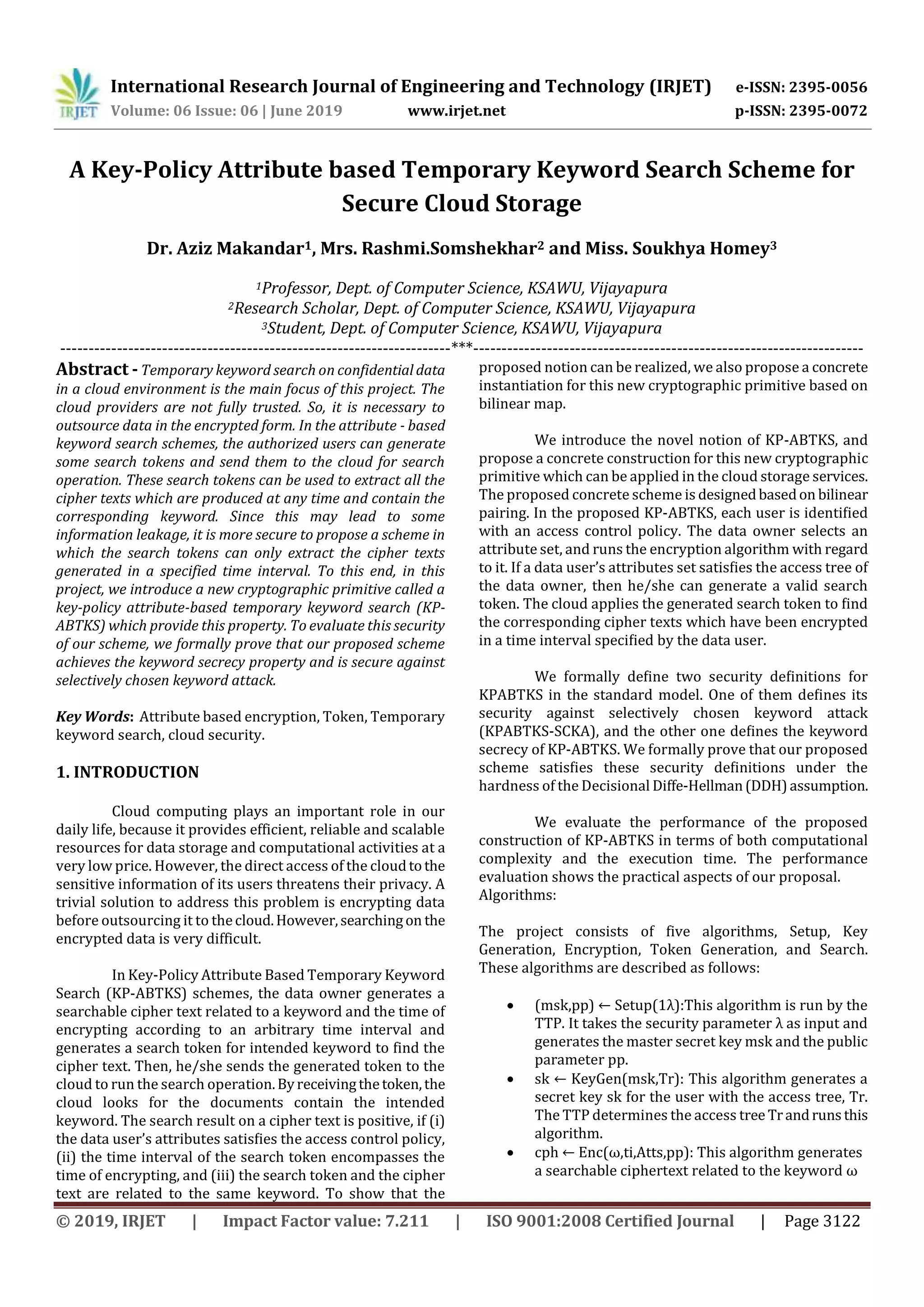
Data Owner registerforfileuploadafterregistration
successfully the data owner will login with the help of user
name and password. To upload the file, Data owner will
require master key. After the registration of the data owner
successfully master key goes to TTP. Data Owner’s request
for the response of TTP. The TTP will login with the help of
username and password. After the login Data Owner’s
request will be displayed. TTP will analyse pending request
lists after TTP will response to the Data Owner. At that time
master key will upload the file into the cloud successfully.
Data User firstly register. After the completion of
registration successfully,Data Userwill loginwiththehelpof
username and password. After the registration successfully
the master key request goes to the TTP. The TTP will login
with the help of user name and password. After the login,
Data User’s request details will be displayed. TTP will
analyse the pending request lists after TTP will response to
the Data User. At that time master key will go to the Data
User’s mail. Data User with the help of master key Data User
will search the files. After the activation for the required file,
Data User needs a token. Token behaves like one time
password. Once the token is used it will used for the another
time. It acts like one time password.
After that Data User will put that particular token,
the list of Data Owner files will be displayed. The files will be
in the form of encrypted. The fileswhichareintheencrypted
form cannot readable that is in the non-readable form. To
convert the files from non-readabletoreadableso,weneeda
keyword. A keyword is used for conversion of non-readable
to readable form and it can be used for download the file. It
is also used for the specific interval of time for the download
of file. If the Data User needs decrypted and download the
file. The Data User send a request to the cloud.
The cloud firstly login with the help of username
and password. After that cloud will knowaboutthekeyword
request details. Based on the particular keyword request,
Cloud will response that keyword. The Data User will get the
keyword and put that particular keyword to decrypt the file
and download that file successfully.
If the download process will not completedwiththe
given interval of time. It will send the alert messageas“Time
Over”. At that time Data User cannotdownloadagainrequest
will do for the security purpose.
2.1 Tools Used
Java:
Developed by Sun Microsystems, Java is one of the
most used programming languages. It is High-Level
language. It is Object-oriented language andisvery robust in
nature. Java is flexible and provides cross-platform support.
It was created by James Gosling.
jQuery:
jQuery is a library of JavaScript. It helps in reducing
scripting on client system side. We can operate on multiple
platforms using JQuery. It is very small and hence very agile.
JavaScript:
It is a lightweight interpreted or just-in-time compiled
programming language with first-class functions. While it is
most well-known as the scripting language for web pages,
many non-browser environmentsalsouseit,suchasNode.js,
etc. JavaScript is a prototype-based, multi-paradigm,
dynamic language, supporting object-oriented, imperative
and declarative styles.
HTML:
HypertextMarkupLanguage (HTML)isthestandard
markup language for creating web pages and web
applications. With Cascading Style Sheets (CSS) and
JavaScript.
Eclipse:
It is an integrated development environment (IDE)
used in computer programming, and is the mostwidelyused
Java IDE. It contains a base workspace and an extensible
plug-in system for customizing the environment. Eclipse is
written mostly Java and its primary use is for developing
Java applications in other programming languages.
MySQL:
It is open-source relational database management system
(RDBMS). Its name is a combination of “My”, the name of co-
International Research Journal of Engineering and Technology (IRJET) e-ISSN: 2395-0056
Volume: 06 Issue: 06 | June 2019 www.irjet.net p-ISSN: 2395-0072
© 2019, IRJET | Impact Factor value: 7.211 | ISO 9001:2008 Certified Journal | Page 3124
founder Michael Widenius’s daughter and “SQL”, the
abbreviation for Structured Query Language.
3. Results:
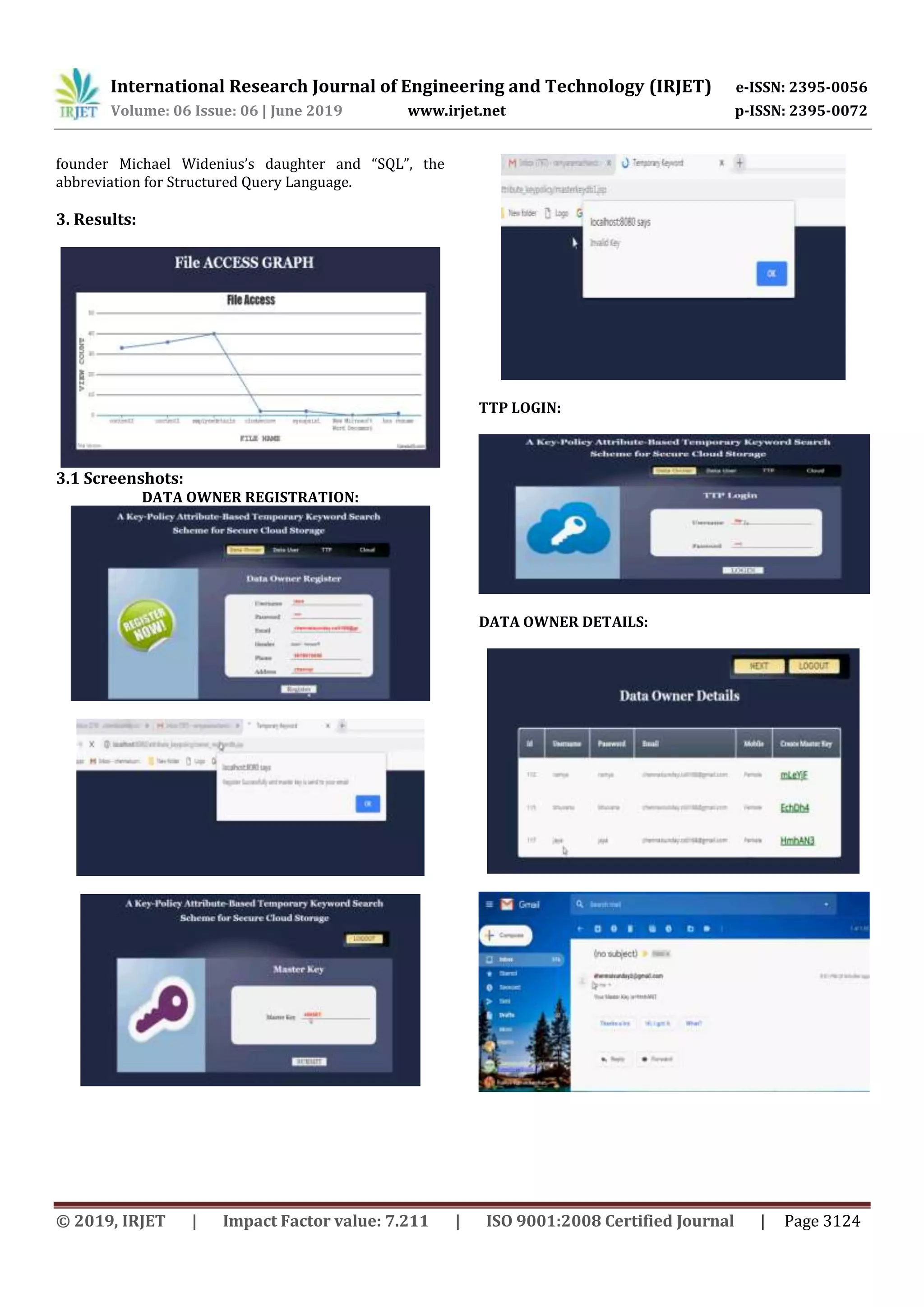
3.1 Screenshots:
DATA OWNER REGISTRATION:
TTP LOGIN:
DATA OWNER DETAILS:
International Research Journal of Engineering and Technology (IRJET) e-ISSN: 2395-0056
Volume: 06 Issue: 06 | June 2019 www.irjet.net p-ISSN: 2395-0072
© 2019, IRJET | Impact Factor value: 7.211 | ISO 9001:2008 Certified Journal | Page 3125
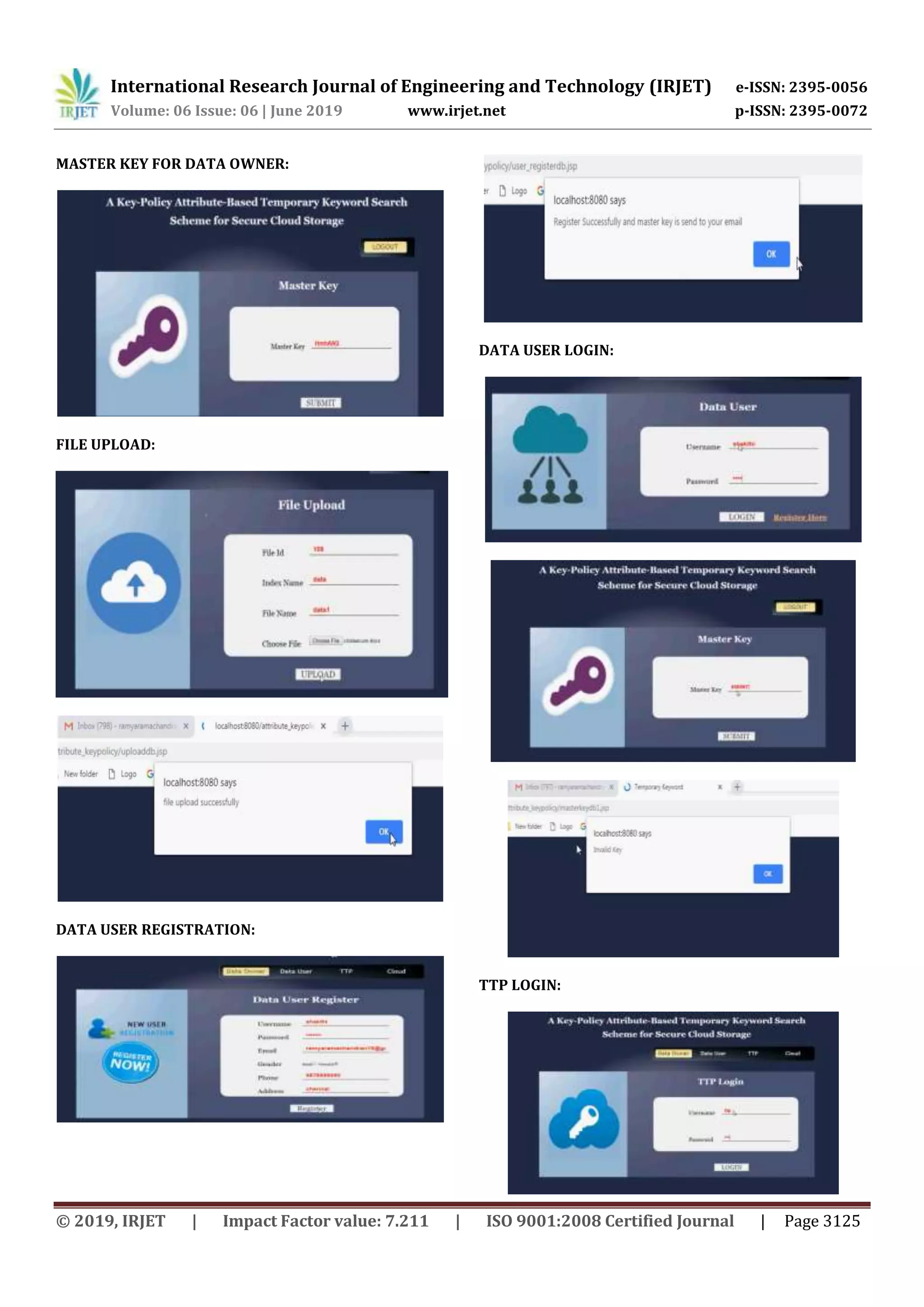
MASTER KEY FOR DATA OWNER:
FILE UPLOAD:
DATA USER REGISTRATION:
DATA USER LOGIN:
TTP LOGIN:
International Research Journal of Engineering and Technology (IRJET) e-ISSN: 2395-0056
Volume: 06 Issue: 06 | June 2019 www.irjet.net p-ISSN: 2395-0072
© 2019, IRJET | Impact Factor value: 7.211 | ISO 9001:2008 Certified Journal | Page 3126
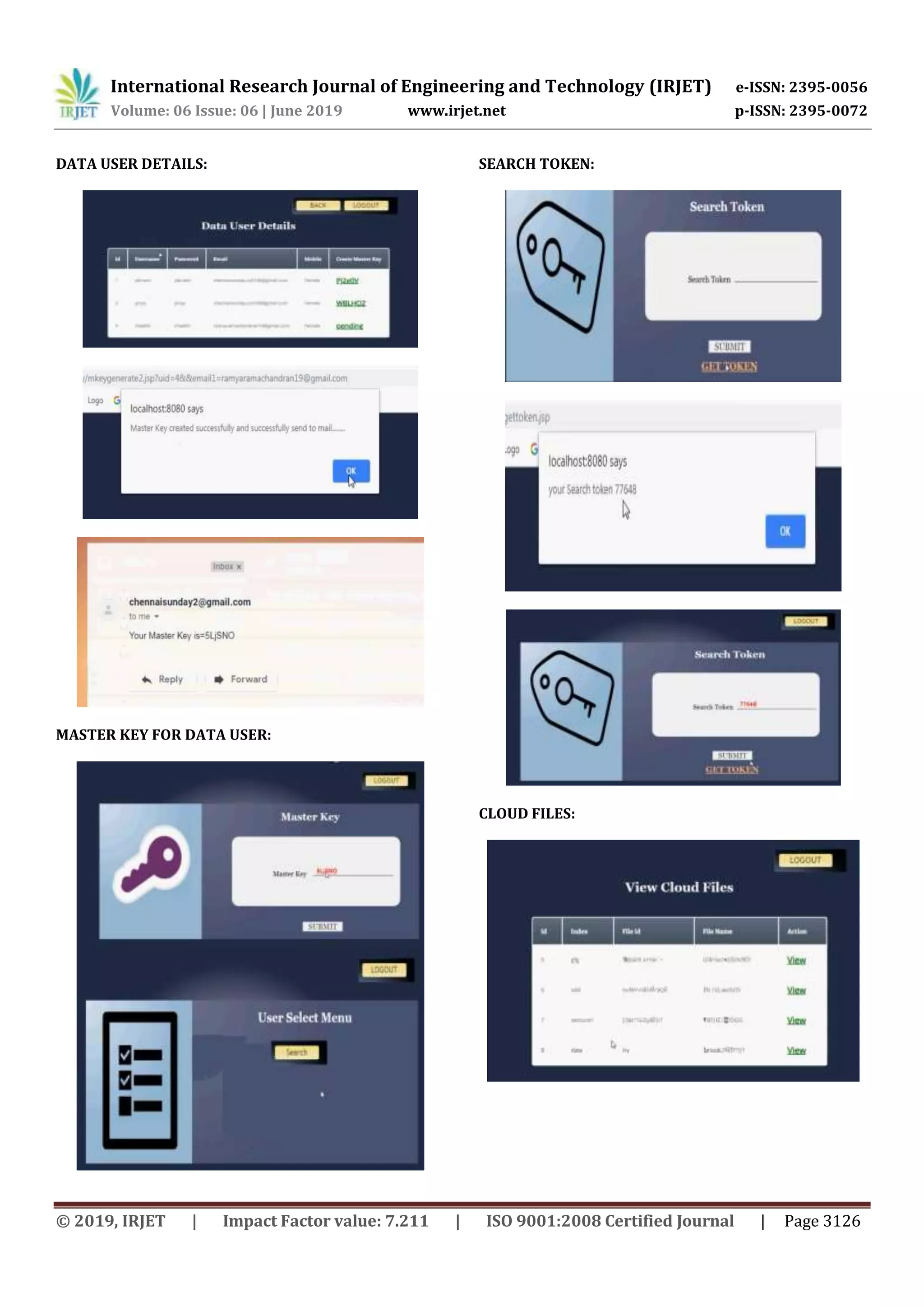
DATA USER DETAILS:
MASTER KEY FOR DATA USER:
SEARCH TOKEN:
CLOUD FILES:
International Research Journal of Engineering and Technology (IRJET) e-ISSN: 2395-0056
Volume: 06 Issue: 06 | June 2019 www.irjet.net p-ISSN: 2395-0072
© 2019, IRJET | Impact Factor value: 7.211 | ISO 9001:2008 Certified Journal | Page 3127
ORIGINAL FILE:
4. CONCLUSION
Securing cloud storage is an important problem in cloud
computing. We addressed this issue and introduced the
notion of key-policy attribute-based temporary keyword
search (KPABTKS). According to this notion, each data user
can generate a search token which is valid only for a limited
time interval. We proposed the first concrete construction
for this new cryptographic primitive based on bilinear map.
We formally showed that our scheme is provably secure in
the random oracle model. The complexity of encryption
algorithm of our proposal is linear with respect to the
number of the involved attributes.Inaddition,thenumberof
required pairing in the search algorithms is independent of
the number of the intended time unit’s specified in the
search token and it is linear with respect to the number of
attributes. Performance evaluation of our scheme in term of
both computational cost and execution time shows the
practical aspects of the proposed scheme.
References:
[1] D. Boneh, G. Di Crescenzo, R. Ostrovsky, and G. Persiano,
“Public key encryption with keyword search”.
[2] Q. Zheng, S. Xu, and G. Ateniese, “Vabks: Verifiable
attribute-based keyword search over outsourced encrypted
data”.
[3] M. Abdalla, M. Bellare, D. Catalano, E. Kiltz, T. Kohno, T.
Lange, J. Malone-Lee, G. Neven, P. Paillier, and H. Shi,
“Searchable encryption revisited: Consistency properties,
relation to anonymous ibe, and extensions”.

IRJET- A Key-Policy Attribute based Temporary Keyword Search Scheme for Secure Cloud Storage

  • 1.
    International Research Journalof Engineering and Technology (IRJET) e-ISSN: 2395-0056 Volume: 06 Issue: 06 | June 2019 www.irjet.net p-ISSN: 2395-0072 © 2019, IRJET | Impact Factor value: 7.211 | ISO 9001:2008 Certified Journal | Page 3122 A Key-Policy Attribute based Temporary Keyword Search Scheme for Secure Cloud Storage Dr. Aziz Makandar1, Mrs. Rashmi.Somshekhar2 and Miss. Soukhya Homey3 1Professor, Dept. of Computer Science, KSAWU, Vijayapura 2Research Scholar, Dept. of Computer Science, KSAWU, Vijayapura 3Student, Dept. of Computer Science, KSAWU, Vijayapura ---------------------------------------------------------------------***--------------------------------------------------------------------- Abstract - Temporary keyword search on confidential data in a cloud environment is the main focus of this project. The cloud providers are not fully trusted. So, it is necessary to outsource data in the encrypted form. In the attribute - based keyword search schemes, the authorized users can generate some search tokens and send them to the cloud for search operation. These search tokens can be used to extract all the cipher texts which are produced at any time and contain the corresponding keyword. Since this may lead to some information leakage, it is more secure to propose a scheme in which the search tokens can only extract the cipher texts generated in a specified time interval. To this end, in this project, we introduce a new cryptographic primitive called a key-policy attribute-based temporary keyword search (KP- ABTKS) which provide this property. To evaluate this security of our scheme, we formally prove that our proposed scheme achieves the keyword secrecy property and is secure against selectively chosen keyword attack. Key Words: Attribute based encryption, Token, Temporary keyword search, cloud security. 1. INTRODUCTION Cloud computing plays an important role in our daily life, because it provides efficient, reliable and scalable resources for data storage and computational activities at a very low price. However, the direct access of the cloudtothe sensitive information of its users threatens their privacy. A trivial solution to address this problem is encrypting data before outsourcing it to thecloud.However,searchingon the encrypted data is very difficult. In Key-Policy Attribute Based Temporary Keyword Search (KP-ABTKS) schemes, the data owner generates a searchable cipher text related to a keyword and the time of encrypting according to an arbitrary time interval and generates a search token for intended keyword to find the cipher text. Then, he/she sends the generated token to the cloud to run the search operation.Byreceivingthetoken,the cloud looks for the documents contain the intended keyword. The search result on a cipher text is positive, if (i) the data user’s attributes satisfies the access control policy, (ii) the time interval of the search token encompasses the time of encrypting, and (iii) the search token and the cipher text are related to the same keyword. To show that the proposed notion can be realized, we also propose a concrete instantiation for this new cryptographic primitive based on bilinear map. We introduce the novel notion of KP-ABTKS, and propose a concrete construction for this new cryptographic primitive which can be applied in the cloud storage services. The proposed concrete scheme is designedbasedon bilinear pairing. In the proposed KP-ABTKS, each user is identified with an access control policy. The data owner selects an attribute set, and runs the encryption algorithm with regard to it. If a data user’s attributes set satisfies the access tree of the data owner, then he/she can generate a valid search token. The cloud applies the generated search token to find the corresponding cipher texts which have been encrypted in a time interval specified by the data user. We formally define two security definitions for KPABTKS in the standard model. One of them defines its security against selectively chosen keyword attack (KPABTKS-SCKA), and the other one defines the keyword secrecy of KP-ABTKS. We formally prove that our proposed scheme satisfies these security definitions under the hardness of the Decisional Diffe-Hellman(DDH)assumption. We evaluate the performance of the proposed construction of KP-ABTKS in terms of both computational complexity and the execution time. The performance evaluation shows the practical aspects of our proposal. Algorithms: The project consists of five algorithms, Setup, Key Generation, Encryption, Token Generation, and Search. These algorithms are described as follows:  (msk,pp) ← Setup(1λ):This algorithm is run by the TTP. It takes the security parameter λ as input and generates the master secret key msk and the public parameter pp.  sk ← KeyGen(msk,Tr): This algorithm generates a secret key sk for the user with the access tree, Tr. The TTP determines the access tree Trandrunsthis algorithm.  cph ← Enc(ω,ti,Atts,pp): This algorithm generates a searchable ciphertext related to the keyword ω
  • 2.
    International Research Journalof Engineering and Technology (IRJET) e-ISSN: 2395-0056 Volume: 06 Issue: 06 | June 2019 www.irjet.net p-ISSN: 2395-0072 © 2019, IRJET | Impact Factor value: 7.211 | ISO 9001:2008 Certified Journal | Page 3123 and time of encrypting ti according to an attribute set, Atts which is determined by the data owner.  st ← TokenGen(sk,ω,[ts,te]): The data user runsthis algorithm to generate the search token st for searching the ciphertexts which are encrypted in the time interval [ts,te], and contain the keyword ω, according to its secret key sk.  {0,1} := Search(cph,st): For each stored ciphertext cph and the received search token st which is associated with specific keyword ω and attribute set Atts, this algorithm returns 1. 2. Architecture Fig -1 Architecture Data Owner registerforfileuploadafterregistration successfully the data owner will login with the help of user name and password. To upload the file, Data owner will require master key. After the registration of the data owner successfully master key goes to TTP. Data Owner’s request for the response of TTP. The TTP will login with the help of username and password. After the login Data Owner’s request will be displayed. TTP will analyse pending request lists after TTP will response to the Data Owner. At that time master key will upload the file into the cloud successfully. Data User firstly register. After the completion of registration successfully,Data Userwill loginwiththehelpof username and password. After the registration successfully the master key request goes to the TTP. The TTP will login with the help of user name and password. After the login, Data User’s request details will be displayed. TTP will analyse the pending request lists after TTP will response to the Data User. At that time master key will go to the Data User’s mail. Data User with the help of master key Data User will search the files. After the activation for the required file, Data User needs a token. Token behaves like one time password. Once the token is used it will used for the another time. It acts like one time password. After that Data User will put that particular token, the list of Data Owner files will be displayed. The files will be in the form of encrypted. The fileswhichareintheencrypted form cannot readable that is in the non-readable form. To convert the files from non-readabletoreadableso,weneeda keyword. A keyword is used for conversion of non-readable to readable form and it can be used for download the file. It is also used for the specific interval of time for the download of file. If the Data User needs decrypted and download the file. The Data User send a request to the cloud. The cloud firstly login with the help of username and password. After that cloud will knowaboutthekeyword request details. Based on the particular keyword request, Cloud will response that keyword. The Data User will get the keyword and put that particular keyword to decrypt the file and download that file successfully. If the download process will not completedwiththe given interval of time. It will send the alert messageas“Time Over”. At that time Data User cannotdownloadagainrequest will do for the security purpose. 2.1 Tools Used Java: Developed by Sun Microsystems, Java is one of the most used programming languages. It is High-Level language. It is Object-oriented language andisvery robust in nature. Java is flexible and provides cross-platform support. It was created by James Gosling. jQuery: jQuery is a library of JavaScript. It helps in reducing scripting on client system side. We can operate on multiple platforms using JQuery. It is very small and hence very agile. JavaScript: It is a lightweight interpreted or just-in-time compiled programming language with first-class functions. While it is most well-known as the scripting language for web pages, many non-browser environmentsalsouseit,suchasNode.js, etc. JavaScript is a prototype-based, multi-paradigm, dynamic language, supporting object-oriented, imperative and declarative styles. HTML: HypertextMarkupLanguage (HTML)isthestandard markup language for creating web pages and web applications. With Cascading Style Sheets (CSS) and JavaScript. Eclipse: It is an integrated development environment (IDE) used in computer programming, and is the mostwidelyused Java IDE. It contains a base workspace and an extensible plug-in system for customizing the environment. Eclipse is written mostly Java and its primary use is for developing Java applications in other programming languages. MySQL: It is open-source relational database management system (RDBMS). Its name is a combination of “My”, the name of co-
  • 3.
    International Research Journalof Engineering and Technology (IRJET) e-ISSN: 2395-0056 Volume: 06 Issue: 06 | June 2019 www.irjet.net p-ISSN: 2395-0072 © 2019, IRJET | Impact Factor value: 7.211 | ISO 9001:2008 Certified Journal | Page 3124 founder Michael Widenius’s daughter and “SQL”, the abbreviation for Structured Query Language. 3. Results: 3.1 Screenshots: DATA OWNER REGISTRATION: TTP LOGIN: DATA OWNER DETAILS:
  • 4.
    International Research Journalof Engineering and Technology (IRJET) e-ISSN: 2395-0056 Volume: 06 Issue: 06 | June 2019 www.irjet.net p-ISSN: 2395-0072 © 2019, IRJET | Impact Factor value: 7.211 | ISO 9001:2008 Certified Journal | Page 3125 MASTER KEY FOR DATA OWNER: FILE UPLOAD: DATA USER REGISTRATION: DATA USER LOGIN: TTP LOGIN:
  • 5.
    International Research Journalof Engineering and Technology (IRJET) e-ISSN: 2395-0056 Volume: 06 Issue: 06 | June 2019 www.irjet.net p-ISSN: 2395-0072 © 2019, IRJET | Impact Factor value: 7.211 | ISO 9001:2008 Certified Journal | Page 3126 DATA USER DETAILS: MASTER KEY FOR DATA USER: SEARCH TOKEN: CLOUD FILES:
  • 6.
    International Research Journalof Engineering and Technology (IRJET) e-ISSN: 2395-0056 Volume: 06 Issue: 06 | June 2019 www.irjet.net p-ISSN: 2395-0072 © 2019, IRJET | Impact Factor value: 7.211 | ISO 9001:2008 Certified Journal | Page 3127 ORIGINAL FILE: 4. CONCLUSION Securing cloud storage is an important problem in cloud computing. We addressed this issue and introduced the notion of key-policy attribute-based temporary keyword search (KPABTKS). According to this notion, each data user can generate a search token which is valid only for a limited time interval. We proposed the first concrete construction for this new cryptographic primitive based on bilinear map. We formally showed that our scheme is provably secure in the random oracle model. The complexity of encryption algorithm of our proposal is linear with respect to the number of the involved attributes.Inaddition,thenumberof required pairing in the search algorithms is independent of the number of the intended time unit’s specified in the search token and it is linear with respect to the number of attributes. Performance evaluation of our scheme in term of both computational cost and execution time shows the practical aspects of the proposed scheme. References: [1] D. Boneh, G. Di Crescenzo, R. Ostrovsky, and G. Persiano, “Public key encryption with keyword search”. [2] Q. Zheng, S. Xu, and G. Ateniese, “Vabks: Verifiable attribute-based keyword search over outsourced encrypted data”. [3] M. Abdalla, M. Bellare, D. Catalano, E. Kiltz, T. Kohno, T. Lange, J. Malone-Lee, G. Neven, P. Paillier, and H. Shi, “Searchable encryption revisited: Consistency properties, relation to anonymous ibe, and extensions”.