International Research Journal of Engineering and Technology (IRJET) e-ISSN: 2395-0056
Volume: 05 Issue: 12 | Dec 2018 www.irjet.net p-ISSN: 2395-0072
© 2018, IRJET | Impact Factor value: 7.211 | ISO 9001:2008 Certified Journal | Page 1103
Inheritance in Java
Mrs. Kanchanmala D Talekar1, Mr. Mithun Jadhav2
1Lecturer, Dept. of computer Engineering, GVAP Shelu, Maharashtra, India.
2HOD, Dept. of computer Engineering, GVAP Shelu, Maharashtra, India
---------------------------------------------------------------------***----------------------------------------------------------------------
1. INTRODUCTION
It is always nice if we could reuse something that already
exists rather than creating the same all over againandagain.
Java supports this concept. Java classes can be reused in
several ways. This is basically done by creating new classes,
reusing the properties of existing ones. The mechanism of
deriving a new class from an old one is called Inheritance.
The old class is known as base class or super class or parent
class. The new class is called the derived class or subclass or
child class. Inheritance in java is a mechanism in which one
object acquires all the properties and behaviors of parent
object. The idea behind inheritance is that you can create
new classes that are built upon existing classes. When you
inherit from an existing class, you can reuse methods and
fields of parent class and you can add new methods and
fields also. Inheritance represents the IS-A relationship,also
known as parent-child relationship.
Advantages of Inheritance:
1. For Method Overriding: so runtime
polymorphism can be achieved.
2. For Code Reusability.
Syntax of java Inheritance:
class Superclass_Name{
//methods and fields
}
class Subclass_Name extends Superclass_Name
{ //methods and fields
}
The extends keyword indicates that you are making new
class that derives from an existing class.
Types of Inheritance:
There are following types of Inheritance:
1. Single Inheritance
2. Multilevel Inheritance
3. Hierarchical Inheritance
4. Hybrid Inheritance
Super Keyword:
 Super keyword can be used to refer immediate
parent class instance variable.
 Super keyword can be used to invoke immediate
parent class method.
 Super() can be used to invoke immediate parent
class Constructor.
1.1 Single Inheritance:
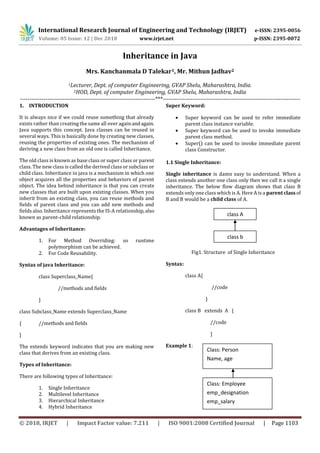
Single inheritance is damn easy to understand. When a
class extends another one class only then we call it a single
inheritance. The below flow diagram shows that class B
extends only one class which is A. Here A is a parent classof
B and B would be a child class of A.
Fig1. Structure of Single Inheritance
Syntax:
class A{
//code
}
class B extends A {
//code
}
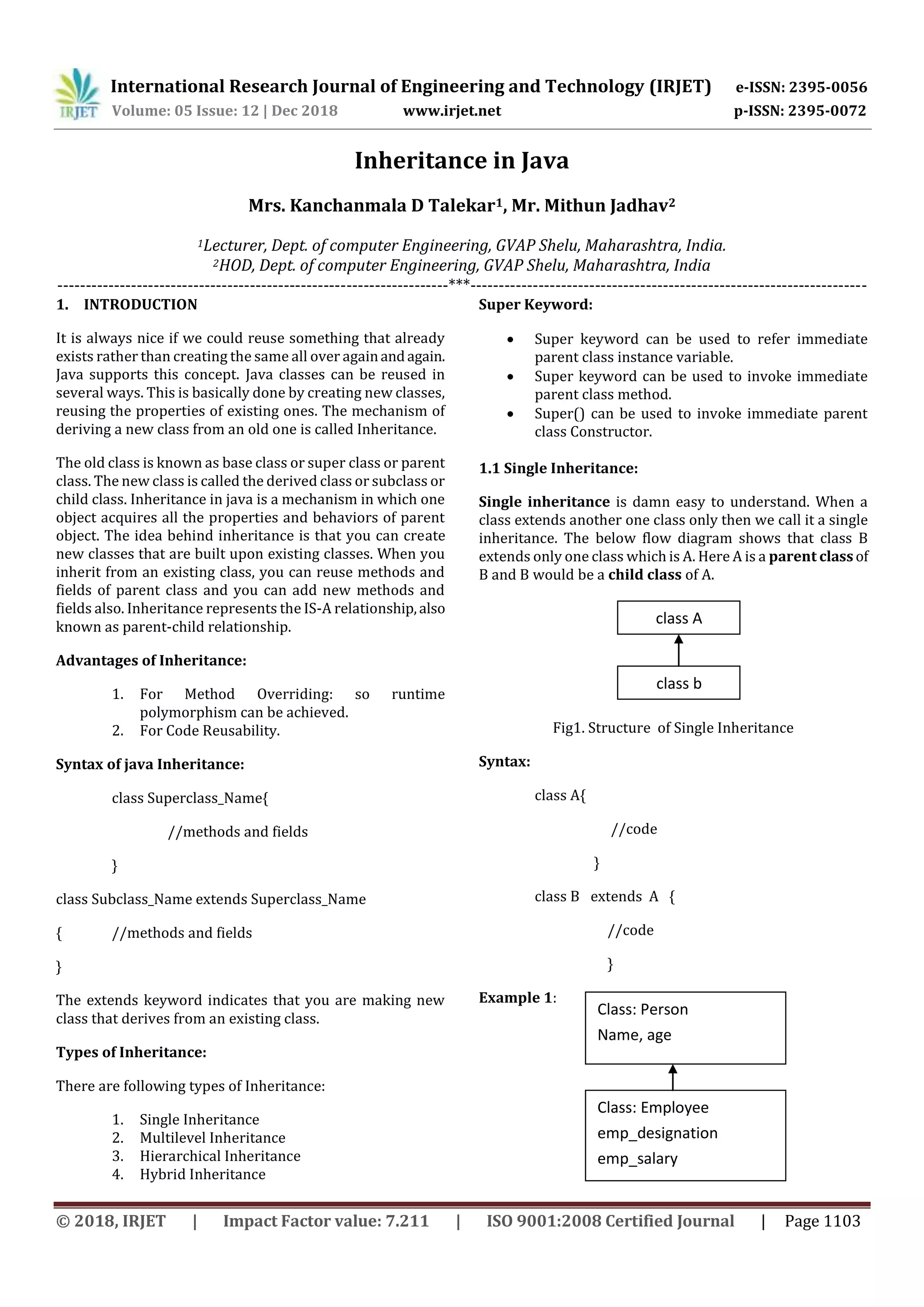
Example 1:
class A
class b
Class: Person
Name, age
Class: Employee
emp_designation
emp_salary
International Research Journal of Engineering and Technology (IRJET) e-ISSN: 2395-0056
Volume: 05 Issue: 12 | Dec 2018 www.irjet.net p-ISSN: 2395-0072
© 2018, IRJET | Impact Factor value: 7.211 | ISO 9001:2008 Certified Journal | Page 1104
Fig 2. Example of Single Inheritance
class Person{
String name;
int age;
Person(String n,int a){
name=n;
age=a;
}
void display(){
System.out.println("n Name ="+name);
System.out.println("n Age="+age);
}
}
class Employee extends Person{
String emp_designation;
float emp_salary;
Employee(String n,int a,String d,float s) {
super(n,a);
emp_designation=d;
emp_salary=s;
}
void display(){
super.display();
System.out.println("n Employee
designation="+emp_designation);
System.out.println("n Employee salary="+emp_salary);
}
}
public class SingleInheritance{
public static void main(String args[]){
Employee e=new
Employee("Anushree",26,"Developer",35000);
e.display();
}
}
Output:
Fig 3: Output of Single Inheritance
1.2 Multilevel Inheritance
Multilevel inheritance refers to a mechanism in OO
technology where one can inherit from a derived class,
thereby making this derived class the base class for the new
class. As you can see in below flow diagram C is subclass or
child class of B and B is a child class of A. For more details
and example refer – Multilevel inheritance in Java.
Fig 4: Structure of Multilevel Inheritance
Syntax:
class A {
//code
}
class B extends A {
//code
}
class C extends A {
//code
}
class Animal
class Dog
class BabyDog
International Research Journal of Engineering and Technology (IRJET) e-ISSN: 2395-0056
Volume: 05 Issue: 12 | Dec 2018 www.irjet.net p-ISSN: 2395-0072
© 2018, IRJET | Impact Factor value: 7.211 | ISO 9001:2008 Certified Journal | Page 1105
Example:
Fig 5: Example of Multilevel Inheritance
Example:
class Animal{
void eat(){
System.out.println("n Eating.....");
}
}
class Dog extends Animal{
void bark(){
System.out.println("n Barking.....");
}
}
class BabyDog extends Dog{
void weep(){
System.out.println("n weeping.....");
}
}
class MultipleInheritance{
public static void main(String args[]){
BabyDog b1=new BabyDog();
b1.weep();
b1.bark();
b1.eat();
}
}
Output:
Fig 6: Output of Multilevel Inheritance
1.3 Hierarchical Inheritance
When more than one classes inheritsa sameclassthenthisis
called hierarchical inheritance
Fig 7: Structure of Hierarchical Inheritance
Syntax:
class A{
//code
}
class B extends A{
//code
}
class c extends A{
//code
}
Example:
Fig 8: Example of Hierarchical Inheritance
class Car{
public Car() {
System.out.println("Class Car");
}
public void vehicleType() {
class Car
class Car class Car
class A
class B class C
class Animal
class Dog
class BabyDog
International Research Journal of Engineering and Technology (IRJET) e-ISSN: 2395-0056
Volume: 05 Issue: 12 | Dec 2018 www.irjet.net p-ISSN: 2395-0072
© 2018, IRJET | Impact Factor value: 7.211 | ISO 9001:2008 Certified Journal | Page 1106
System.out.println("Vehicle Type: Car");
}
}
class Maruti extends Car{
public Maruti() {
System.out.println("Class Maruti");
}
public void brand() {
System.out.println("Brand: Maruti");
}
public void speed() {
System.out.println("Max: 90Kmph");
}
}
class Maruti800 extends Maruti{
public Maruti800() {
System.out.println("Maruti Model: 800");
}
public void speed() {
System.out.println("Max: 80Kmph");
}
}
public class Hirarchical_Inheritance{
public static void main(String args[])
{
Maruti800 obj=new Maruti800();
obj.vehicleType();
obj.brand();
obj.speed();
}
}
Fig 9: output of Hierarchical Inheritance
1.4 Multiple Inheritance
“Multiple Inheritance” refers to the concept of one class
extending (Or inherits) more than one base class. The
inheritance we learnt earlier had the concept of one base
class or parent. The problem with “multiple inheritance” is
that the derived class will have to manage the dependency
on two base classes.
Fig 10: Structure of Multiple Inheritance
Note 1: Multiple Inheritances is very rarely used in software
projects. Using multiple inheritance often leads to problems
in the hierarchy. This results in unwanted complexity when
further extending the class.
Note 2: Most of the new OO languages like Small Talk, Java,
and C # do not support Multiple inheritance. Multiple
Inheritances is supported in C++.
1.5 Hybrid Inheritance
In simple terms you can say that Hybrid inheritance is a
combination of Single and Multiple inheritance. A typical
flow diagram would look like below. A hybrid inheritance
can be achieved in the java in a same way as
multiple inheritance can be!! Using interfaces.yesyouheard
it right. By using interfaces you can have multiple as well as
hybrid inheritance in Java.
Fig 10: Structure of Multiple Inheritance
REFERENCES
1. https://beginnersbook.com
2. https://www.javatpoint.com
class A class B
class C
class A
class B class C
class D

IRJET- Inheritance in Java

  • 1.
    International Research Journalof Engineering and Technology (IRJET) e-ISSN: 2395-0056 Volume: 05 Issue: 12 | Dec 2018 www.irjet.net p-ISSN: 2395-0072 © 2018, IRJET | Impact Factor value: 7.211 | ISO 9001:2008 Certified Journal | Page 1103 Inheritance in Java Mrs. Kanchanmala D Talekar1, Mr. Mithun Jadhav2 1Lecturer, Dept. of computer Engineering, GVAP Shelu, Maharashtra, India. 2HOD, Dept. of computer Engineering, GVAP Shelu, Maharashtra, India ---------------------------------------------------------------------***---------------------------------------------------------------------- 1. INTRODUCTION It is always nice if we could reuse something that already exists rather than creating the same all over againandagain. Java supports this concept. Java classes can be reused in several ways. This is basically done by creating new classes, reusing the properties of existing ones. The mechanism of deriving a new class from an old one is called Inheritance. The old class is known as base class or super class or parent class. The new class is called the derived class or subclass or child class. Inheritance in java is a mechanism in which one object acquires all the properties and behaviors of parent object. The idea behind inheritance is that you can create new classes that are built upon existing classes. When you inherit from an existing class, you can reuse methods and fields of parent class and you can add new methods and fields also. Inheritance represents the IS-A relationship,also known as parent-child relationship. Advantages of Inheritance: 1. For Method Overriding: so runtime polymorphism can be achieved. 2. For Code Reusability. Syntax of java Inheritance: class Superclass_Name{ //methods and fields } class Subclass_Name extends Superclass_Name { //methods and fields } The extends keyword indicates that you are making new class that derives from an existing class. Types of Inheritance: There are following types of Inheritance: 1. Single Inheritance 2. Multilevel Inheritance 3. Hierarchical Inheritance 4. Hybrid Inheritance Super Keyword:  Super keyword can be used to refer immediate parent class instance variable.  Super keyword can be used to invoke immediate parent class method.  Super() can be used to invoke immediate parent class Constructor. 1.1 Single Inheritance: Single inheritance is damn easy to understand. When a class extends another one class only then we call it a single inheritance. The below flow diagram shows that class B extends only one class which is A. Here A is a parent classof B and B would be a child class of A. Fig1. Structure of Single Inheritance Syntax: class A{ //code } class B extends A { //code } Example 1: class A class b Class: Person Name, age Class: Employee emp_designation emp_salary
  • 2.
    International Research Journalof Engineering and Technology (IRJET) e-ISSN: 2395-0056 Volume: 05 Issue: 12 | Dec 2018 www.irjet.net p-ISSN: 2395-0072 © 2018, IRJET | Impact Factor value: 7.211 | ISO 9001:2008 Certified Journal | Page 1104 Fig 2. Example of Single Inheritance class Person{ String name; int age; Person(String n,int a){ name=n; age=a; } void display(){ System.out.println("n Name ="+name); System.out.println("n Age="+age); } } class Employee extends Person{ String emp_designation; float emp_salary; Employee(String n,int a,String d,float s) { super(n,a); emp_designation=d; emp_salary=s; } void display(){ super.display(); System.out.println("n Employee designation="+emp_designation); System.out.println("n Employee salary="+emp_salary); } } public class SingleInheritance{ public static void main(String args[]){ Employee e=new Employee("Anushree",26,"Developer",35000); e.display(); } } Output: Fig 3: Output of Single Inheritance 1.2 Multilevel Inheritance Multilevel inheritance refers to a mechanism in OO technology where one can inherit from a derived class, thereby making this derived class the base class for the new class. As you can see in below flow diagram C is subclass or child class of B and B is a child class of A. For more details and example refer – Multilevel inheritance in Java. Fig 4: Structure of Multilevel Inheritance Syntax: class A { //code } class B extends A { //code } class C extends A { //code } class Animal class Dog class BabyDog
  • 3.
    International Research Journalof Engineering and Technology (IRJET) e-ISSN: 2395-0056 Volume: 05 Issue: 12 | Dec 2018 www.irjet.net p-ISSN: 2395-0072 © 2018, IRJET | Impact Factor value: 7.211 | ISO 9001:2008 Certified Journal | Page 1105 Example: Fig 5: Example of Multilevel Inheritance Example: class Animal{ void eat(){ System.out.println("n Eating....."); } } class Dog extends Animal{ void bark(){ System.out.println("n Barking....."); } } class BabyDog extends Dog{ void weep(){ System.out.println("n weeping....."); } } class MultipleInheritance{ public static void main(String args[]){ BabyDog b1=new BabyDog(); b1.weep(); b1.bark(); b1.eat(); } } Output: Fig 6: Output of Multilevel Inheritance 1.3 Hierarchical Inheritance When more than one classes inheritsa sameclassthenthisis called hierarchical inheritance Fig 7: Structure of Hierarchical Inheritance Syntax: class A{ //code } class B extends A{ //code } class c extends A{ //code } Example: Fig 8: Example of Hierarchical Inheritance class Car{ public Car() { System.out.println("Class Car"); } public void vehicleType() { class Car class Car class Car class A class B class C class Animal class Dog class BabyDog
  • 4.
    International Research Journalof Engineering and Technology (IRJET) e-ISSN: 2395-0056 Volume: 05 Issue: 12 | Dec 2018 www.irjet.net p-ISSN: 2395-0072 © 2018, IRJET | Impact Factor value: 7.211 | ISO 9001:2008 Certified Journal | Page 1106 System.out.println("Vehicle Type: Car"); } } class Maruti extends Car{ public Maruti() { System.out.println("Class Maruti"); } public void brand() { System.out.println("Brand: Maruti"); } public void speed() { System.out.println("Max: 90Kmph"); } } class Maruti800 extends Maruti{ public Maruti800() { System.out.println("Maruti Model: 800"); } public void speed() { System.out.println("Max: 80Kmph"); } } public class Hirarchical_Inheritance{ public static void main(String args[]) { Maruti800 obj=new Maruti800(); obj.vehicleType(); obj.brand(); obj.speed(); } } Fig 9: output of Hierarchical Inheritance 1.4 Multiple Inheritance “Multiple Inheritance” refers to the concept of one class extending (Or inherits) more than one base class. The inheritance we learnt earlier had the concept of one base class or parent. The problem with “multiple inheritance” is that the derived class will have to manage the dependency on two base classes. Fig 10: Structure of Multiple Inheritance Note 1: Multiple Inheritances is very rarely used in software projects. Using multiple inheritance often leads to problems in the hierarchy. This results in unwanted complexity when further extending the class. Note 2: Most of the new OO languages like Small Talk, Java, and C # do not support Multiple inheritance. Multiple Inheritances is supported in C++. 1.5 Hybrid Inheritance In simple terms you can say that Hybrid inheritance is a combination of Single and Multiple inheritance. A typical flow diagram would look like below. A hybrid inheritance can be achieved in the java in a same way as multiple inheritance can be!! Using interfaces.yesyouheard it right. By using interfaces you can have multiple as well as hybrid inheritance in Java. Fig 10: Structure of Multiple Inheritance REFERENCES 1. https://beginnersbook.com 2. https://www.javatpoint.com class A class B class C class A class B class C class D