International Research Journal of Engineering and Technology (IRJET) e-ISSN: 2395-0056
Volume: 06 Issue: 06 | June 2019 www.irjet.net p-ISSN: 2395-0072
© 2019, IRJET | Impact Factor value: 7.211 | ISO 9001:2008 Certified Journal | Page 577
DYNAMIC RESOURCE ALLOCATION OF HETEROGENEOUS WORKLOAD
IN CLOUD
M.Mala M.E1, K.Sankar M.TECH (P.hD) 2, T.Viswanathkani M.E3
1PG Student, Dept. of Computer Science and Engineering, Vivekanandha college of Engineering for Women,
Tamilnadu, India
2Assistant Professor, Dept. of Computer Science and Engineering, Vivekanandha college of Engineering for Women,
Tamilnadu, India
3Assistant Professor, Dept. of Computer Science and Engineering, Vivekanandha College of Engineering for
Women, Tamilnadu, India
---------------------------------------------------------------------***----------------------------------------------------------------------
Abstract - Cloud computing is on demand service because
it offers dynamic, versatile and economical resource
allocation for reliable and warranted services in pay-as-
you-use manner to the customers. In Cloud computing
multiple cloud users will request range of cloud services at
the same time, therefore there should be a provision that
each one resources square measure created offered to
requesting user in economical manner to satisfy their want
while not compromising on the performance of the
resources. Current IaaS clouds provision resources in terms
of virtual machines (VMs) with unvaried resource
configurations where different types of resources in VMs
have similar share of the potential in a physical machine
(PM). However, most user jobs demand totally different
amounts for various resources. As an example, high
performance-computing jobs need more central processor
cores whereas massive processing applications need
additional memory. Dynamic capability provisioning has
become a promising answer for reducing energy
consumption in knowledge centers in recent years. A
heterogeneity-aware framework that dynamically adjusts
the amount of machines to strike a balance between energy
savings and planning delay.
Key Words: Cloud computing, heterogeneous
workloads, resource allocation, Task scheduling
1. INTRODUCTION
Clouds resources aren't only shared by multiple users
however also are dynamically re-allocated on demand.
The most enabling technology is virtualization.
Virtualization software package permits a physical
electronic computer to be electronically separated into
one or additional "virtual" devices, every of which might
be simply used and managed to reason tasks.
Virtualization provides the nimbleness needed to hurry
up IT operations, and reduces value by increasing
infrastructure utilization. Scheduling is a vital of any OS.
CPU planning deals with downside of deciding that of the
processes within the prepared queue is to be allotted CPU
time. Once employment is submitted to a resource
manager, the work waits in an exceedingly queue till its
regular and dead. The time spent within the queue, or
wait time, depends on many factors as well as job
priority, load on the system, and convenience of
requested resources. Turnaround represents the period
between once the work is submitted and once the work is
completed. It includes the wait time furthermore because
the jobs actual execution time. Response time represents
how briskly a user receives a response from the system
once the work is submitted.
Resource utilization throughout the period of
time of the work represents the particular helpful work
that has been performed. System output is outlined
because the variety of jobs completed per unit time. Mean
response time is a vital performance metric for users,
WHO expect token interval. In a typical production
atmosphere, many alternative jobs square measure
submitted to cloud. So, the job scheduler software
package should have interfaces to outline workflows
and/or job dependencies, execute the submitted jobs
mechanically. The cloud broker has pre-configured and
keeps within the cloud all the necessary VM pictures to
run users’ jobs. All the incoming jobs square measure en-
queued into a queue. A system-level scheduler, running
on a zealous system, manages all the roles and a pool of
machines, and decides whether to provision new VM
from clouds and/or to apportion jobs to VMs. The
hardware is dead periodically. At each moment, the
hardware performs five tasks:
(1) Predicting future incoming workloads;
(2) Provisioning necessary VMs ahead, from clouds;
(3) Allocating jobs to VM;
(4) Emotional idle VMs if its asking unit of time
(BTU) is about to increase;
(5) If the time of un-allocated jobs is high, starting
the mandatory variety of VMs.
International Research Journal of Engineering and Technology (IRJET) e-ISSN: 2395-0056
Volume: 06 Issue: 06 | June 2019 www.irjet.net p-ISSN: 2395-0072
© 2019, IRJET | Impact Factor value: 7.211 | ISO 9001:2008 Certified Journal | Page 578
2. RELATED WORK
IaaS cloud allocates resources to competitor
requests supported pre-defined resourceallocationpolicies.
Presently, mostofthecloudsuppliersacceptstraightforward
resource allocation policies like immediate and best effort.
Amazon EC2 could be a public cloud that provides
computing resources to general public on pay-per-use
model. Eucalyptus and Open Nebula square measure cloud
toolkits which may be wont to setup a cloud on local
infrastructure. Haizea is Associate in nursing open supply
resource lease manager that may be used as a computer
hardware for Open Nebula and Haizea provides the sole
Virtual Infrastructure (VI) management answer providing
advance reservation of capability and configurable VM
placement policy. Generally it's unacceptable for cloud
providers to satisfy all the requests that come back to them
on immediate basis because of lack of resources.
Batch schedulers implement thebackfillingformula
however with completely different variants.a widelyknown
variant is Conservative backfilling wherever employment
enters the waiting queue with Associate in Nursing
associated begin time once a job is submitted to the
computer hardware. Some jobswithinthe queuewill then be
reordered with Associate in Nursing earlier begin time if
they are doing not delay the already allottedjobs.Avariation
of this backfilling is aggressive backfilling where the
computer hardware attributes a begin time for the primary
job within the queue and every one the opposite jobs within
the queue can be organized at any time if they are doing not
delay the beginning time of the primary job.
Haizea comes with backfilling in concert of its
default planning actions. Virtualization permits making
further virtual processors on physical ones to scale back the
matter of planning each sequent and parallel jobs. The
researchers use virtualization of cloud nodes to manage the
time spent by all running tasks on everyprocessorandshare
them with alternative tasks.
Sharing between users is but not continuously realistic on
cloud because the applications square measure typically
tuned to urge the simplest performance with the idea that
they run alone on one processor.
3. EXISTING SYSTEM
Cloud users rent VMs from IaaS public cloudstorun
their applications in a pay-as you-go manner. Cloud
providers charge users according to the resource amounts
and running time of VMs. Cloud users submit their VM
requests to the cloud data center according to their
heterogeneous resource demands and choose the VM types
that are most appropriate in terms of satisfying the user
demands while minimizing the resource wastage. All VM
requests are maintained by a schedulingqueue.According to
the arrival rates and service rates of requests, SAMR
conducts resource prediction based on a Markov Chain
model periodically in every time slot with a duration of t to
satisfy the user experience interms ofVMallocationdelay.In
VM scheduling phase during each time slot with the length t,
cloud providers allocate resources and host each VM into
PMs using SAMR allocation algorithm. In cloud service, one
of the most significant impacts on user experience is the
service delay caused by schedulers. There source (or VM)
allocation delay as the main metric for service-level-
agreements (SLA) between users and cloud providers.
However, maintaining too many active PMs may
cope well even under peak load but wastes energy
unnecessary. Maintaining too few PMs may causesignificant
degradation in user experience due to lacks of active PMs
and the need to wait for powering up more PMs. It is
challenging to find the adequate number of active PMs. We
use the Markov Chain model to determine the adequate
number of active PMs for operation. The model assumes
heterogeneous workloads and balanced utilization of all
types of resources within a PM. The SAMR scheduling aims
to minimize the skewness in datacenterinordertoavoid the
resource starvation.
3.1 DRAWBACKS
1) The Viterbi algorithm is expensive, both in terms of
memory and compute time.
2) For a sequence of length n, the dynamic
programming for locating the most effective path
through a model with s states and e edges takes
memory proportional to atomic number 50 and
time proportional to en. FortheREPsearches,doing
a search with a hidden Markov model is about 10
times slower than usinga simpleMarkovmodel--for
larger HMMs the penalty would grow.
3) Other algorithms for hidden
Markov models, like the forward backward
formula, square measure even costlier
4. PROPOSED SYSTEM
Resource preparation means that selecting
provision and runtime management of software system
therefore, the last word goal of the cloud user is minimize
the prices by leasing the resourcesandalsothemaximize the
angle of the cloud service supplier profit by allocating
resources with efficiency. So as to achieve the goal,thecloud
user should raise cloud service supplier a provision for the
resources either static or dynamic, Virtual Machine (VM) to
extend the resource utilization. Moreover, the previous
strategies don't offer economical resource allocation for
heterogeneous jobs in current cloud systems and don't
provide completely different SLO degrees for various job
varieties to attain higher resource utilization and lower SLO
violation rate. Therefore, we tend to propose a made-to-
order Cooperative Resource Provisioning (CCRP) theme for
the heterogeneous jobs in clouds. CCRP uses the hybrid
International Research Journal of Engineering and Technology (IRJET) e-ISSN: 2395-0056
Volume: 06 Issue: 06 | June 2019 www.irjet.net p-ISSN: 2395-0072
© 2019, IRJET | Impact Factor value: 7.211 | ISO 9001:2008 Certified Journal | Page 579
resource allocation and provides SLO handiness
customization for various job varieties. To check the
performance of CCRP, we tend to compared CCRP with
existing strategies beneath numerous situations. Our
cooperative transmission protocol consists of 2 phases.
Within the routing part, the initial path between the supply
and also the sink nodes is discoveredasassociateunderlying
“one-node-thick” path.Then, thetrail undergoesa thickening
method within the “recruiting-and-transmitting” part.
ADVANTAGES
1) Saves the node energy through cooperation.
2) Increases the dependability of packet delivery.
3) Data transmission betweensourcestodestinationis
economical and quick.
4) To maximize the attitude of the cloud service
supplier profit by allocating resources
expeditiously.
5) By providing the resources, theQoS parameterslike
availableness, throughput, Safety, interval,
dependability, performance, etc shouldbeachieved
while not violating SLA.
5. RESULT ANALYSIS
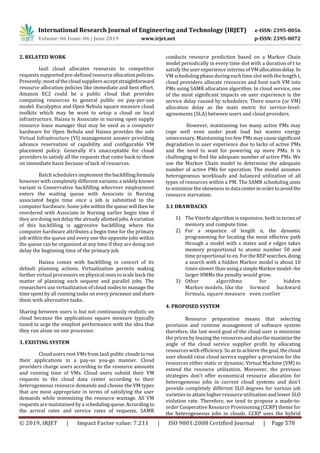
5.1 THE COOPERATIVE RESOURCE PROVISIONING
MODEL
As additional computing moves to information
centers, a RP has to provision resources for increasing
heterogeneous workloads. completely different from the
server sprawl caused by analytic applications or package
non uniformity (server consolidation), increasing
heterogeneous workloads in terms of each varieties and
intensities raise new challenges withinthesystemcapability
coming up with, since they need considerably completely
different resource consumption characteristics. Resource
demands in terms of usage mode, timing, intensity, size and
length are significantly completely different. Net server
workloads are usually composed of a series of requests with
short durations like seconds; the ratios of peak loads to
normal loads are high requests are often maintained at the
same time and interleaved through resource multiplexing
Fig: Resource allocation
5.2 PREDICTING EXECUTION TIME OF JOBS
To a lot of accurately predict the execution time of
jobs, we tend to extract 2 forms of options: job-related
options and system-related features. Tend to use the
historical information to estimate the run time of jobs. To
extract the numerical values of the options from the
historical informationforpredictingthejobs’ executiontime.
Within the historical information, we tend to contemplate a
part of them as coaching information, and use a part the
information as testing data. To enhance the accuracy, we
tend to use the cross-validation to perform classification. To
classify jobs into 2 types: short jobs and long jobs. Tend to
contemplate jobs with execution time no quite ten minutes
as short jobs and that we contemplate jobs with execution
time quite ten minutes as long jobs. To realize high resource
utilization, CCRP packsthecomplementaryjobshappinessto
an equivalent sort along and allocates the resource to the
packed job.
5.3 UPLOAD & SEND FILES TO USERS
Every node on the path from the availability nodeto
the destination node becomes a clusterhead,withthetask of
recruiting alternative nodes in its neighborhood and
coordinating their transmissions.
Consequently, the classical route from a supply node to a
sink node is replaced with a multihop cooperative path, and
also the classical point-to-point communication is replaced
with many-to-many cooperativecommunication.Duringthis
module, server will transfer the files within the information.
5.4 BEST PATH ESTIMATION
Every node on thepathfrom theavailabilitynodeto
the destination node becomes a clusterhead,withthetask of
recruiting completely different nodes in its neighborhood
and coordinative their transmissions. The path will then be
represented as “having a breadth,” whereverthe“width”ofa
path at a selected hop is decided by the quantity of nodes on
every finish of a hop. Every move this path represents
communication from several geographically shut nodes,
referred to as a causing cluster, to a different cluster of
International Research Journal of Engineering and Technology (IRJET) e-ISSN: 2395-0056
Volume: 06 Issue: 06 | June 2019 www.irjet.net p-ISSN: 2395-0072
© 2019, IRJET | Impact Factor value: 7.211 | ISO 9001:2008 Certified Journal | Page 580
nodes, termed a receiving cluster. The nodes ineverycluster
join forces in transmission of packets that propagate on the
trail from one Cluster to successive
Table: Best path
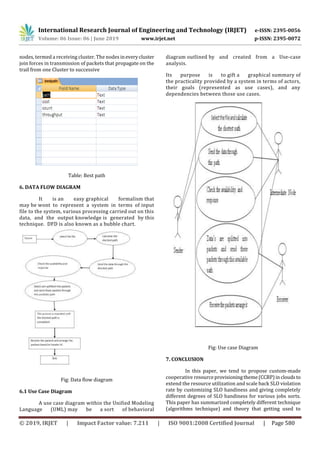
6. DATA FLOW DIAGRAM
It is an easy graphical formalism that
may be wont to represent a system in terms of input
file to the system, various processing carried out on this
data, and the output knowledge is generated by this
technique. DFD is also known as a bubble chart.
Fig: Data flow diagram
6.1 Use Case Diagram
A use case diagram within the Unified Modeling
Language (UML) may be a sort of behavioral
diagram outlined by and created from a Use-case
analysis.
Its purpose is to gift a graphical summary of
the practicality provided by a system in terms of actors,
their goals (represented as use cases), and any
dependencies between those use cases.
Fig: Use case Diagram
7. CONCLUSION
In this paper, we tend to propose custom-made
cooperative resourceprovisioningtheme(CCRP)incloudsto
extend the resource utilization and scale back SLO violation
rate by customizing SLO handiness and giving completely
different degrees of SLO handiness for various jobs sorts.
This paper has summarized completely different technique
(algorithms technique) and theory that getting used to
International Research Journal of Engineering and Technology (IRJET) e-ISSN: 2395-0056
Volume: 06 Issue: 06 | June 2019 www.irjet.net p-ISSN: 2395-0072
© 2019, IRJET | Impact Factor value: 7.211 | ISO 9001:2008 Certified Journal | Page 581
formulate framework and model, derived to supply a
stronger resource allocation and watching method in terms
of a stronger performance, competitive and potency to
satisfy the specified SLA, improved the resource
performance and down the ability consumption.
8. FUTURE ENHANCEMENT
Machine and work non-uniformity awareness for
resource provisioning well-tried to be a promising
approach for reducing the ability consumption
and programming delay. In the current scenario, the
systems on which tasks aren’t assigned are kept idle and
consume the idle time power consumption. The cost of
power consumption can be further reduced if the idle
machines are turned off
REFERENCES
[1] L. Wang, J. Zhan, W. Shi, and Y. Liang, “In cloud, will
scientific communities get pleasure from the economies of
scale?” IEEE Trans. Parallel Distrib. Syst., vol. 23, no. 2, pp.
296–303, Feb.2012.
[2] R. V. den Bossche, K. Vanmechelen, and J. Broeckhove,
“Costoptimal scheduling in hybrid IaaS clouds for deadline
constrained workloads,” in IEEE 3rd Int. Conf. Cloud
Comput., 2010, pp. 228–235.
[3] M. Malawski, G. Juve, E. Deelman, and J. Nabrzyski, “Cost-
and deadline-constrained provisioning for scientific work
flow ensembles in IaaS clouds,” in Proc.Int. Conf. High
Perform. Comput,Netw,2012,pp.22.
[4] Amazon Pricing [Online] Available:
https://aws.amazon.com/ ec2/pricing/, 2015.
[5] E. Michon, J. Gossa, S. Genaud, et al., “Free elasticity and
free cpu power for scientific workloads on IaaS clouds,” in
Proc. IEEE 18th Int. Conf. Parallel-Distrib.Syst,2012,pp.85–
92.

IRJET- Dynamic Resource Allocation of Heterogeneous Workload in Cloud

  • 1.
    International Research Journalof Engineering and Technology (IRJET) e-ISSN: 2395-0056 Volume: 06 Issue: 06 | June 2019 www.irjet.net p-ISSN: 2395-0072 © 2019, IRJET | Impact Factor value: 7.211 | ISO 9001:2008 Certified Journal | Page 577 DYNAMIC RESOURCE ALLOCATION OF HETEROGENEOUS WORKLOAD IN CLOUD M.Mala M.E1, K.Sankar M.TECH (P.hD) 2, T.Viswanathkani M.E3 1PG Student, Dept. of Computer Science and Engineering, Vivekanandha college of Engineering for Women, Tamilnadu, India 2Assistant Professor, Dept. of Computer Science and Engineering, Vivekanandha college of Engineering for Women, Tamilnadu, India 3Assistant Professor, Dept. of Computer Science and Engineering, Vivekanandha College of Engineering for Women, Tamilnadu, India ---------------------------------------------------------------------***---------------------------------------------------------------------- Abstract - Cloud computing is on demand service because it offers dynamic, versatile and economical resource allocation for reliable and warranted services in pay-as- you-use manner to the customers. In Cloud computing multiple cloud users will request range of cloud services at the same time, therefore there should be a provision that each one resources square measure created offered to requesting user in economical manner to satisfy their want while not compromising on the performance of the resources. Current IaaS clouds provision resources in terms of virtual machines (VMs) with unvaried resource configurations where different types of resources in VMs have similar share of the potential in a physical machine (PM). However, most user jobs demand totally different amounts for various resources. As an example, high performance-computing jobs need more central processor cores whereas massive processing applications need additional memory. Dynamic capability provisioning has become a promising answer for reducing energy consumption in knowledge centers in recent years. A heterogeneity-aware framework that dynamically adjusts the amount of machines to strike a balance between energy savings and planning delay. Key Words: Cloud computing, heterogeneous workloads, resource allocation, Task scheduling 1. INTRODUCTION Clouds resources aren't only shared by multiple users however also are dynamically re-allocated on demand. The most enabling technology is virtualization. Virtualization software package permits a physical electronic computer to be electronically separated into one or additional "virtual" devices, every of which might be simply used and managed to reason tasks. Virtualization provides the nimbleness needed to hurry up IT operations, and reduces value by increasing infrastructure utilization. Scheduling is a vital of any OS. CPU planning deals with downside of deciding that of the processes within the prepared queue is to be allotted CPU time. Once employment is submitted to a resource manager, the work waits in an exceedingly queue till its regular and dead. The time spent within the queue, or wait time, depends on many factors as well as job priority, load on the system, and convenience of requested resources. Turnaround represents the period between once the work is submitted and once the work is completed. It includes the wait time furthermore because the jobs actual execution time. Response time represents how briskly a user receives a response from the system once the work is submitted. Resource utilization throughout the period of time of the work represents the particular helpful work that has been performed. System output is outlined because the variety of jobs completed per unit time. Mean response time is a vital performance metric for users, WHO expect token interval. In a typical production atmosphere, many alternative jobs square measure submitted to cloud. So, the job scheduler software package should have interfaces to outline workflows and/or job dependencies, execute the submitted jobs mechanically. The cloud broker has pre-configured and keeps within the cloud all the necessary VM pictures to run users’ jobs. All the incoming jobs square measure en- queued into a queue. A system-level scheduler, running on a zealous system, manages all the roles and a pool of machines, and decides whether to provision new VM from clouds and/or to apportion jobs to VMs. The hardware is dead periodically. At each moment, the hardware performs five tasks: (1) Predicting future incoming workloads; (2) Provisioning necessary VMs ahead, from clouds; (3) Allocating jobs to VM; (4) Emotional idle VMs if its asking unit of time (BTU) is about to increase; (5) If the time of un-allocated jobs is high, starting the mandatory variety of VMs.
  • 2.
    International Research Journalof Engineering and Technology (IRJET) e-ISSN: 2395-0056 Volume: 06 Issue: 06 | June 2019 www.irjet.net p-ISSN: 2395-0072 © 2019, IRJET | Impact Factor value: 7.211 | ISO 9001:2008 Certified Journal | Page 578 2. RELATED WORK IaaS cloud allocates resources to competitor requests supported pre-defined resourceallocationpolicies. Presently, mostofthecloudsuppliersacceptstraightforward resource allocation policies like immediate and best effort. Amazon EC2 could be a public cloud that provides computing resources to general public on pay-per-use model. Eucalyptus and Open Nebula square measure cloud toolkits which may be wont to setup a cloud on local infrastructure. Haizea is Associate in nursing open supply resource lease manager that may be used as a computer hardware for Open Nebula and Haizea provides the sole Virtual Infrastructure (VI) management answer providing advance reservation of capability and configurable VM placement policy. Generally it's unacceptable for cloud providers to satisfy all the requests that come back to them on immediate basis because of lack of resources. Batch schedulers implement thebackfillingformula however with completely different variants.a widelyknown variant is Conservative backfilling wherever employment enters the waiting queue with Associate in Nursing associated begin time once a job is submitted to the computer hardware. Some jobswithinthe queuewill then be reordered with Associate in Nursing earlier begin time if they are doing not delay the already allottedjobs.Avariation of this backfilling is aggressive backfilling where the computer hardware attributes a begin time for the primary job within the queue and every one the opposite jobs within the queue can be organized at any time if they are doing not delay the beginning time of the primary job. Haizea comes with backfilling in concert of its default planning actions. Virtualization permits making further virtual processors on physical ones to scale back the matter of planning each sequent and parallel jobs. The researchers use virtualization of cloud nodes to manage the time spent by all running tasks on everyprocessorandshare them with alternative tasks. Sharing between users is but not continuously realistic on cloud because the applications square measure typically tuned to urge the simplest performance with the idea that they run alone on one processor. 3. EXISTING SYSTEM Cloud users rent VMs from IaaS public cloudstorun their applications in a pay-as you-go manner. Cloud providers charge users according to the resource amounts and running time of VMs. Cloud users submit their VM requests to the cloud data center according to their heterogeneous resource demands and choose the VM types that are most appropriate in terms of satisfying the user demands while minimizing the resource wastage. All VM requests are maintained by a schedulingqueue.According to the arrival rates and service rates of requests, SAMR conducts resource prediction based on a Markov Chain model periodically in every time slot with a duration of t to satisfy the user experience interms ofVMallocationdelay.In VM scheduling phase during each time slot with the length t, cloud providers allocate resources and host each VM into PMs using SAMR allocation algorithm. In cloud service, one of the most significant impacts on user experience is the service delay caused by schedulers. There source (or VM) allocation delay as the main metric for service-level- agreements (SLA) between users and cloud providers. However, maintaining too many active PMs may cope well even under peak load but wastes energy unnecessary. Maintaining too few PMs may causesignificant degradation in user experience due to lacks of active PMs and the need to wait for powering up more PMs. It is challenging to find the adequate number of active PMs. We use the Markov Chain model to determine the adequate number of active PMs for operation. The model assumes heterogeneous workloads and balanced utilization of all types of resources within a PM. The SAMR scheduling aims to minimize the skewness in datacenterinordertoavoid the resource starvation. 3.1 DRAWBACKS 1) The Viterbi algorithm is expensive, both in terms of memory and compute time. 2) For a sequence of length n, the dynamic programming for locating the most effective path through a model with s states and e edges takes memory proportional to atomic number 50 and time proportional to en. FortheREPsearches,doing a search with a hidden Markov model is about 10 times slower than usinga simpleMarkovmodel--for larger HMMs the penalty would grow. 3) Other algorithms for hidden Markov models, like the forward backward formula, square measure even costlier 4. PROPOSED SYSTEM Resource preparation means that selecting provision and runtime management of software system therefore, the last word goal of the cloud user is minimize the prices by leasing the resourcesandalsothemaximize the angle of the cloud service supplier profit by allocating resources with efficiency. So as to achieve the goal,thecloud user should raise cloud service supplier a provision for the resources either static or dynamic, Virtual Machine (VM) to extend the resource utilization. Moreover, the previous strategies don't offer economical resource allocation for heterogeneous jobs in current cloud systems and don't provide completely different SLO degrees for various job varieties to attain higher resource utilization and lower SLO violation rate. Therefore, we tend to propose a made-to- order Cooperative Resource Provisioning (CCRP) theme for the heterogeneous jobs in clouds. CCRP uses the hybrid
  • 3.
    International Research Journalof Engineering and Technology (IRJET) e-ISSN: 2395-0056 Volume: 06 Issue: 06 | June 2019 www.irjet.net p-ISSN: 2395-0072 © 2019, IRJET | Impact Factor value: 7.211 | ISO 9001:2008 Certified Journal | Page 579 resource allocation and provides SLO handiness customization for various job varieties. To check the performance of CCRP, we tend to compared CCRP with existing strategies beneath numerous situations. Our cooperative transmission protocol consists of 2 phases. Within the routing part, the initial path between the supply and also the sink nodes is discoveredasassociateunderlying “one-node-thick” path.Then, thetrail undergoesa thickening method within the “recruiting-and-transmitting” part. ADVANTAGES 1) Saves the node energy through cooperation. 2) Increases the dependability of packet delivery. 3) Data transmission betweensourcestodestinationis economical and quick. 4) To maximize the attitude of the cloud service supplier profit by allocating resources expeditiously. 5) By providing the resources, theQoS parameterslike availableness, throughput, Safety, interval, dependability, performance, etc shouldbeachieved while not violating SLA. 5. RESULT ANALYSIS 5.1 THE COOPERATIVE RESOURCE PROVISIONING MODEL As additional computing moves to information centers, a RP has to provision resources for increasing heterogeneous workloads. completely different from the server sprawl caused by analytic applications or package non uniformity (server consolidation), increasing heterogeneous workloads in terms of each varieties and intensities raise new challenges withinthesystemcapability coming up with, since they need considerably completely different resource consumption characteristics. Resource demands in terms of usage mode, timing, intensity, size and length are significantly completely different. Net server workloads are usually composed of a series of requests with short durations like seconds; the ratios of peak loads to normal loads are high requests are often maintained at the same time and interleaved through resource multiplexing Fig: Resource allocation 5.2 PREDICTING EXECUTION TIME OF JOBS To a lot of accurately predict the execution time of jobs, we tend to extract 2 forms of options: job-related options and system-related features. Tend to use the historical information to estimate the run time of jobs. To extract the numerical values of the options from the historical informationforpredictingthejobs’ executiontime. Within the historical information, we tend to contemplate a part of them as coaching information, and use a part the information as testing data. To enhance the accuracy, we tend to use the cross-validation to perform classification. To classify jobs into 2 types: short jobs and long jobs. Tend to contemplate jobs with execution time no quite ten minutes as short jobs and that we contemplate jobs with execution time quite ten minutes as long jobs. To realize high resource utilization, CCRP packsthecomplementaryjobshappinessto an equivalent sort along and allocates the resource to the packed job. 5.3 UPLOAD & SEND FILES TO USERS Every node on the path from the availability nodeto the destination node becomes a clusterhead,withthetask of recruiting alternative nodes in its neighborhood and coordinating their transmissions. Consequently, the classical route from a supply node to a sink node is replaced with a multihop cooperative path, and also the classical point-to-point communication is replaced with many-to-many cooperativecommunication.Duringthis module, server will transfer the files within the information. 5.4 BEST PATH ESTIMATION Every node on thepathfrom theavailabilitynodeto the destination node becomes a clusterhead,withthetask of recruiting completely different nodes in its neighborhood and coordinative their transmissions. The path will then be represented as “having a breadth,” whereverthe“width”ofa path at a selected hop is decided by the quantity of nodes on every finish of a hop. Every move this path represents communication from several geographically shut nodes, referred to as a causing cluster, to a different cluster of
  • 4.
    International Research Journalof Engineering and Technology (IRJET) e-ISSN: 2395-0056 Volume: 06 Issue: 06 | June 2019 www.irjet.net p-ISSN: 2395-0072 © 2019, IRJET | Impact Factor value: 7.211 | ISO 9001:2008 Certified Journal | Page 580 nodes, termed a receiving cluster. The nodes ineverycluster join forces in transmission of packets that propagate on the trail from one Cluster to successive Table: Best path 6. DATA FLOW DIAGRAM It is an easy graphical formalism that may be wont to represent a system in terms of input file to the system, various processing carried out on this data, and the output knowledge is generated by this technique. DFD is also known as a bubble chart. Fig: Data flow diagram 6.1 Use Case Diagram A use case diagram within the Unified Modeling Language (UML) may be a sort of behavioral diagram outlined by and created from a Use-case analysis. Its purpose is to gift a graphical summary of the practicality provided by a system in terms of actors, their goals (represented as use cases), and any dependencies between those use cases. Fig: Use case Diagram 7. CONCLUSION In this paper, we tend to propose custom-made cooperative resourceprovisioningtheme(CCRP)incloudsto extend the resource utilization and scale back SLO violation rate by customizing SLO handiness and giving completely different degrees of SLO handiness for various jobs sorts. This paper has summarized completely different technique (algorithms technique) and theory that getting used to
  • 5.
    International Research Journalof Engineering and Technology (IRJET) e-ISSN: 2395-0056 Volume: 06 Issue: 06 | June 2019 www.irjet.net p-ISSN: 2395-0072 © 2019, IRJET | Impact Factor value: 7.211 | ISO 9001:2008 Certified Journal | Page 581 formulate framework and model, derived to supply a stronger resource allocation and watching method in terms of a stronger performance, competitive and potency to satisfy the specified SLA, improved the resource performance and down the ability consumption. 8. FUTURE ENHANCEMENT Machine and work non-uniformity awareness for resource provisioning well-tried to be a promising approach for reducing the ability consumption and programming delay. In the current scenario, the systems on which tasks aren’t assigned are kept idle and consume the idle time power consumption. The cost of power consumption can be further reduced if the idle machines are turned off REFERENCES [1] L. Wang, J. Zhan, W. Shi, and Y. Liang, “In cloud, will scientific communities get pleasure from the economies of scale?” IEEE Trans. Parallel Distrib. Syst., vol. 23, no. 2, pp. 296–303, Feb.2012. [2] R. V. den Bossche, K. Vanmechelen, and J. Broeckhove, “Costoptimal scheduling in hybrid IaaS clouds for deadline constrained workloads,” in IEEE 3rd Int. Conf. Cloud Comput., 2010, pp. 228–235. [3] M. Malawski, G. Juve, E. Deelman, and J. Nabrzyski, “Cost- and deadline-constrained provisioning for scientific work flow ensembles in IaaS clouds,” in Proc.Int. Conf. High Perform. Comput,Netw,2012,pp.22. [4] Amazon Pricing [Online] Available: https://aws.amazon.com/ ec2/pricing/, 2015. [5] E. Michon, J. Gossa, S. Genaud, et al., “Free elasticity and free cpu power for scientific workloads on IaaS clouds,” in Proc. IEEE 18th Int. Conf. Parallel-Distrib.Syst,2012,pp.85– 92.