International Research Journal of Engineering and Technology (IRJET) e-ISSN: 2395-0056
Volume: 06 Issue: 12 | Dec 2019 www.irjet.net p-ISSN: 2395-0072
© 2019, IRJET | Impact Factor value: 7.34 | ISO 9001:2008 Certified Journal | Page 47
“DESIGN AND IMPLEMENTATION OF PERFORMANCE EVALUATION OF
ROUTING PROTOCOL UNDER DIFFERENT MOBILITY MODEL IN MANET”
R.C. Dhandekar1, S.M.Dandage2, Dr. P.M. Jawandhiya3
1,2,3Dept. Computer Science & Engineering, PLITSM Buldana, SGBAU, MH. India
--------------------------------------------------------------------------***----------------------------------------------------------------------------
Abstract:- MANET is self a self-configuring network consisting of mobiles nodes (laptop, cellular phone.etc)which having routing
ability where each node worked as host as well as router to forward data packets each other in the configured network And each
one have self organization properties. The self Configuration which enables to form new network area quickly .Routing protocol in
MANETs to support send and receive data between the host or mobile nodes. in this paper we are doing study of reactive
protocol/On-demand(eg.AODV.DSR,TORA) and proactive protocol/Table-driven(OLSR,DSDV,WRP) and last one mean’s hybrid, it’s
not a type, this is only combination of earlier protocol types. these kind of protocols based on various mobility models such as
chain model, Disaster model, small world in motion and probabilistic random walk model with respect to various parameters like
packet delivery ratio, average end-to-end delay, jitter, throughput etc. in this dissertation our finding show that, design &
implementation performance evaluation of routing protocol under different mobility model in MANET using NS-2 simulator and
Bonn-motion-2.1.3 Ver. tools.
Keywords: MANETs, Mobility model, routing protocols,
I Introduction
MANETS is collection of wireless node instantly forming a temporary network without the aid of any established
infrastructure or centralized administration .MANET support several routing protocols this paper consider reactive, proactive
& hybrid for performance comparisons with varying mobility model such as chain model(it’s sequence of Random Waypoint-
RWP, Manhattan, RPM-reference point group mobility model),Disaster Area Model, Small World In Motion, Probabilistic
Random Walk Model w.r.t. various parameters such as packet delivery, average end to end delay, normalized routing load and
throughput. some Advantages of Mobile Ad hoc Networks listed here, like i) low cost of deployment ii) fast deployment iii)
dynamic configuration, it is also important for its application such as i) Battlefield ii) Rescue Operation iii) Event Coverage iv)
classroom. In this review paper we basically focused on to study the performance of proactive, reactive and hybrid routing
protocols over’s different types of mobility models such as CHAIN Mobility Model, Disaster Area Model, Small World In Motion
Mobility Model, Probabilistic Random Walk Mobility Model w.r.t. various parameters such as Packet Delivery Ratio (PDR),
Average an end to end delay (Delay), jitter and throughput etc.
II Literature Review & Related Work
The below tabular format follow the performance of my thesis over the different Routing Protocols
Table 1: Referred by Various Research Papers
Sr
No
References Parameter Previous Work analysis Implementation of project
1
Akshai A et al.
Sabinaet al.
Nodes
In mobility scenario, they
used up to 200 nodes and
performance of DSR is worst
with increases the nodes
We have used up to 300 nodes so
might be used Ex-DSR with neural
networks to improve the
throughput and packet dropped
parameters
2
Suman Kumariet
al Kuljit Kauret al
Work
AODV and DSR used on On
demand route discovery
phenomenon’s uses source
routing and route cache.
Working on route discovery and
route maintenance regarding the
combination of both in Modified-
DSR protocol.
International Research Journal of Engineering and Technology (IRJET) e-ISSN: 2395-0056
Volume: 06 Issue: 12 | Dec 2019 www.irjet.net p-ISSN: 2395-0072
© 2019, IRJET | Impact Factor value: 7.34 | ISO 9001:2008 Certified Journal | Page 48
3 Zubair I et cl.
Performance
criteria
As per simulation work,
AODV protocol better
performance in highest
number of nodes (up to 200)
As per simulation work DSR
perform low as high number of
nodes so it will improve the
performance of DSR (similar to
AODV) with increasing number of
nodes (up to 300 )using Routing
Algorithm for Ex-DSR
4
Preeti G et al. Packet
delivery
Ratio
As per graph the DSR PDF
performance decline
drastically (up to 100 nodes)
when the increased no of
node
we would improve PDF
performance of DSR when
increasing no of nodes ( after 100)
using the decision algorithmShashank
dwivediet al.
5
Parma Nand et al,
,VenetisKanakaris
etal.
Traffic and
Mobility
AODV is DSR preferable for
Moderate mobility and low
traffic
We have use the M-DSR
technology can improve the high
mobility and high traffic
6
Gulati et al.
Nodes
A deeper simulation of
DSDV, AODV, DSR with
performance of all protocol
up to 200 mobile nodes and
AODV has good one then
DSR.
AODV shown the awesome
experience in a network with low
mobility scenarios while the
AODV and DSR showing better
output as per their characteristics
in all mobility scenario.
7 SamayveerS et. Al
Performance
criteria
The simulation analysis
carried out AODV and DSR.
In this paper that the
The throughput and the end-
to end delay are used for
only 50 to 100 nodes.
We have to use Modified-DSR
protocol Algorithm to improve the
few performance parameters with
highlyutilized of nodes.
8 Dr Mudassar et al
Protocols
used
Performance comparison of
all three protocols and
among that basically
normally used protocol
which has characteristics of
protocol mainly focus on
routing for
better performance and have
little defense capability
against the
Variationof nodes.
M-DSR preferable for Moderate
mobility and low traffic as per
AODV protocol.
9
Hasein Issa Sigiuk
et al
Dipankar S et al.
Performance
criteria
In papertested the
comparison of both scenario
and DSR protocol perform
better due to multiple path
registered kept the route
cache and provide stability
on the network of variation
of nodes DSDV has low
packet delivery ratio and
DSR having low latency and
energy consumption
We have used Ex-DSR routing
Algorithm to reach the AODV
performance parameters and
need to make combination mobile
sink and static protocols which is
best in both scenario.
International Research Journal of Engineering and Technology (IRJET) e-ISSN: 2395-0056
Volume: 06 Issue: 12 | Dec 2019 www.irjet.net p-ISSN: 2395-0072
© 2019, IRJET | Impact Factor value: 7.34 | ISO 9001:2008 Certified Journal | Page 49
10 Rajeev Paulus et al
Application
Metrics
The authors showing that
DSR giving the less dropping
ratio than other protocols
but other parameter are
decreases and also compare
few parameters.
We have used Ex-DSR routing
Algorithm to reach good
performance of all performance
parameter.
11 Nitin Tyagi et al congestion
Worked on upto 100 nodes
in CBR traffic in MANET
We should be propose EX-DSR
protocol and implement mobility
as well as non-mobility nodes
constant nodes upto 300 and we
would get some positive results in
performance parameters.
III. ROUTING PROTOCOLS AND MOBILITY MODELS
3.1 Mobile Ad-hoc network routing protocol
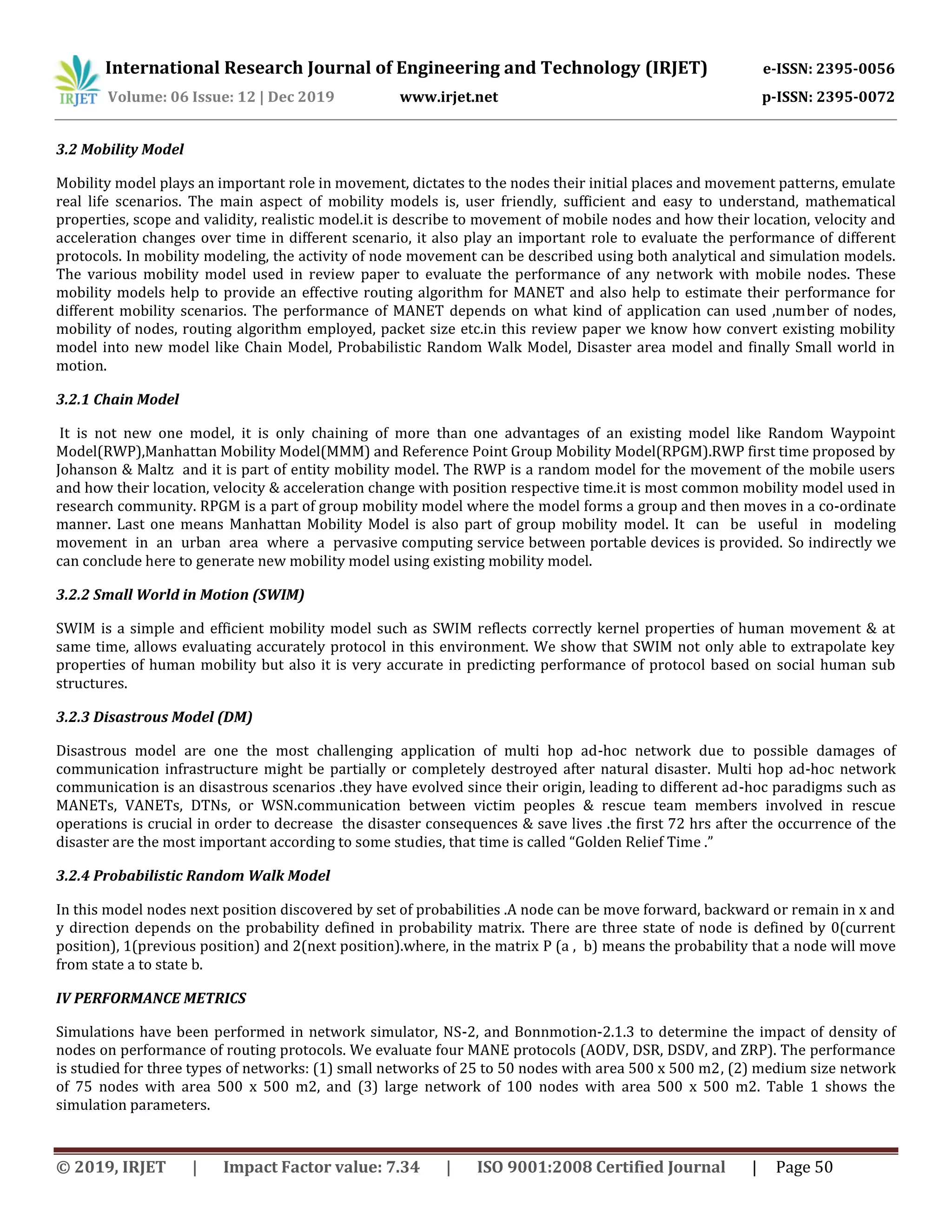
MANET routing protocol basically classified into two type such as Reactive and proactive routing protocol but accordingly
some researchers when combined these two routing protocol and generate third one routing protocol i.e. Hybrid routing
protocol.
Fig 3.1 : Types of MANET routing protocols
3.1.1 Reactive Routing Protocol:
Reactive routing protocol also called as demand routing protocol, in this mechanism source node initiate route discovery
broadcasting route request into the given network. A serious issue for MANET occurs when the links are failure due to high
node mobility. In reactive routing protocol each node has its own routing table which contains the information about the
route/path from current location to destination location.
3.1.2 Proactive Routing Protocol
Also known as table driven protocols, this algorithm is used for finding shortest path between the multiples path. It is based on
Bellman-ford algorithm, routing table entries updates by two ways 1) full dump method and incremental method.
3.1.3Hybrid Routing Protocol
This kind of protocol combine the advantages of proactive routing protocol and reactive routing protocol (e.g. GRP,ZRP, ZHLS,
etc.)
International Research Journal of Engineering and Technology (IRJET) e-ISSN: 2395-0056
Volume: 06 Issue: 12 | Dec 2019 www.irjet.net p-ISSN: 2395-0072
© 2019, IRJET | Impact Factor value: 7.34 | ISO 9001:2008 Certified Journal | Page 50
3.2 Mobility Model
Mobility model plays an important role in movement, dictates to the nodes their initial places and movement patterns, emulate
real life scenarios. The main aspect of mobility models is, user friendly, sufficient and easy to understand, mathematical
properties, scope and validity, realistic model.it is describe to movement of mobile nodes and how their location, velocity and
acceleration changes over time in different scenario, it also play an important role to evaluate the performance of different
protocols. In mobility modeling, the activity of node movement can be described using both analytical and simulation models.
The various mobility model used in review paper to evaluate the performance of any network with mobile nodes. These
mobility models help to provide an effective routing algorithm for MANET and also help to estimate their performance for
different mobility scenarios. The performance of MANET depends on what kind of application can used ,number of nodes,
mobility of nodes, routing algorithm employed, packet size etc.in this review paper we know how convert existing mobility
model into new model like Chain Model, Probabilistic Random Walk Model, Disaster area model and finally Small world in
motion.
3.2.1 Chain Model
It is not new one model, it is only chaining of more than one advantages of an existing model like Random Waypoint
Model(RWP),Manhattan Mobility Model(MMM) and Reference Point Group Mobility Model(RPGM).RWP first time proposed by
Johanson & Maltz and it is part of entity mobility model. The RWP is a random model for the movement of the mobile users
and how their location, velocity & acceleration change with position respective time.it is most common mobility model used in
research community. RPGM is a part of group mobility model where the model forms a group and then moves in a co-ordinate
manner. Last one means Manhattan Mobility Model is also part of group mobility model. It can be useful in modeling
movement in an urban area where a pervasive computing service between portable devices is provided. So indirectly we
can conclude here to generate new mobility model using existing mobility model.
3.2.2 Small World in Motion (SWIM)
SWIM is a simple and efficient mobility model such as SWIM reflects correctly kernel properties of human movement & at
same time, allows evaluating accurately protocol in this environment. We show that SWIM not only able to extrapolate key
properties of human mobility but also it is very accurate in predicting performance of protocol based on social human sub
structures.
3.2.3 Disastrous Model (DM)
Disastrous model are one the most challenging application of multi hop ad-hoc network due to possible damages of
communication infrastructure might be partially or completely destroyed after natural disaster. Multi hop ad-hoc network
communication is an disastrous scenarios .they have evolved since their origin, leading to different ad-hoc paradigms such as
MANETs, VANETs, DTNs, or WSN.communication between victim peoples & rescue team members involved in rescue
operations is crucial in order to decrease the disaster consequences & save lives .the first 72 hrs after the occurrence of the
disaster are the most important according to some studies, that time is called “Golden Relief Time .”
3.2.4 Probabilistic Random Walk Model
In this model nodes next position discovered by set of probabilities .A node can be move forward, backward or remain in x and
y direction depends on the probability defined in probability matrix. There are three state of node is defined by 0(current
position), 1(previous position) and 2(next position).where, in the matrix P (a , b) means the probability that a node will move
from state a to state b.
IV PERFORMANCE METRICS
Simulations have been performed in network simulator, NS-2, and Bonnmotion-2.1.3 to determine the impact of density of
nodes on performance of routing protocols. We evaluate four MANE protocols (AODV, DSR, DSDV, and ZRP). The performance
is studied for three types of networks: (1) small networks of 25 to 50 nodes with area 500 x 500 m2, (2) medium size network
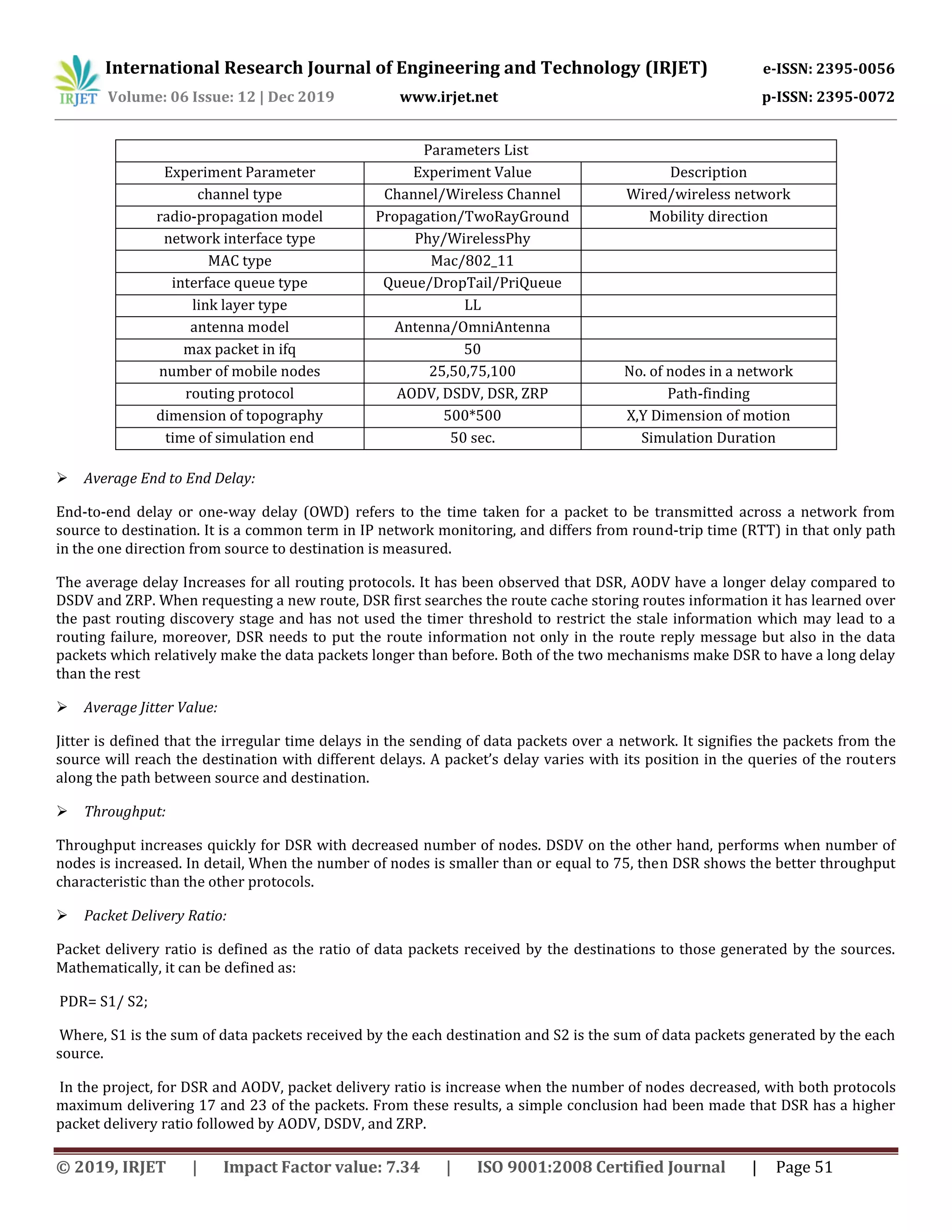
of 75 nodes with area 500 x 500 m2, and (3) large network of 100 nodes with area 500 x 500 m2. Table 1 shows the
simulation parameters.
International Research Journal of Engineering and Technology (IRJET) e-ISSN: 2395-0056
Volume: 06 Issue: 12 | Dec 2019 www.irjet.net p-ISSN: 2395-0072
© 2019, IRJET | Impact Factor value: 7.34 | ISO 9001:2008 Certified Journal | Page 51
Parameters List
Experiment Parameter Experiment Value Description
channel type Channel/Wireless Channel Wired/wireless network
radio-propagation model Propagation/TwoRayGround Mobility direction
network interface type Phy/WirelessPhy
MAC type Mac/802_11
interface queue type Queue/DropTail/PriQueue
link layer type LL
antenna model Antenna/OmniAntenna
max packet in ifq 50
number of mobile nodes 25,50,75,100 No. of nodes in a network
routing protocol AODV, DSDV, DSR, ZRP Path-finding
dimension of topography 500*500 X,Y Dimension of motion
time of simulation end 50 sec. Simulation Duration
 Average End to End Delay:
End-to-end delay or one-way delay (OWD) refers to the time taken for a packet to be transmitted across a network from
source to destination. It is a common term in IP network monitoring, and differs from round-trip time (RTT) in that only path
in the one direction from source to destination is measured.
The average delay Increases for all routing protocols. It has been observed that DSR, AODV have a longer delay compared to
DSDV and ZRP. When requesting a new route, DSR first searches the route cache storing routes information it has learned over
the past routing discovery stage and has not used the timer threshold to restrict the stale information which may lead to a
routing failure, moreover, DSR needs to put the route information not only in the route reply message but also in the data
packets which relatively make the data packets longer than before. Both of the two mechanisms make DSR to have a long delay
than the rest
 Average Jitter Value:
Jitter is defined that the irregular time delays in the sending of data packets over a network. It signifies the packets from the
source will reach the destination with different delays. A packet’s delay varies with its position in the queries of the routers
along the path between source and destination.
 Throughput:
Throughput increases quickly for DSR with decreased number of nodes. DSDV on the other hand, performs when number of
nodes is increased. In detail, When the number of nodes is smaller than or equal to 75, then DSR shows the better throughput
characteristic than the other protocols.
 Packet Delivery Ratio:
Packet delivery ratio is defined as the ratio of data packets received by the destinations to those generated by the sources.
Mathematically, it can be defined as:
PDR= S1/ S2;
Where, S1 is the sum of data packets received by the each destination and S2 is the sum of data packets generated by the each
source.
In the project, for DSR and AODV, packet delivery ratio is increase when the number of nodes decreased, with both protocols
maximum delivering 17 and 23 of the packets. From these results, a simple conclusion had been made that DSR has a higher
packet delivery ratio followed by AODV, DSDV, and ZRP.
International Research Journal of Engineering and Technology (IRJET) e-ISSN: 2395-0056
Volume: 06 Issue: 12 | Dec 2019 www.irjet.net p-ISSN: 2395-0072
© 2019, IRJET | Impact Factor value: 7.34 | ISO 9001:2008 Certified Journal | Page 52
V. CONCLUSIONS
MANET is one of the busiest and required public area networks. in this paper we reviewed on some can be implemented
mobility model like chain model, disaster area model, small world in motion model, probabilistic random walk model out of
these some mobility model generate using existing mobility model. Newly generated mobility model overcome their
drawbacks. Every protocol being simulated using same characteristics that had been discussed to ensure the simulation
produced accurate results. From the observation the objective of this project which is to evaluate the mobility performance for
three-to-four MANET protocols: AODV, DSR, DSDV and ZRP are fulfilled .the analysis has been done through simulation using
highly reliable ns-2 and bonnmotion-2.1.3 simulator. These performances metrics considered are the packet delivery ration
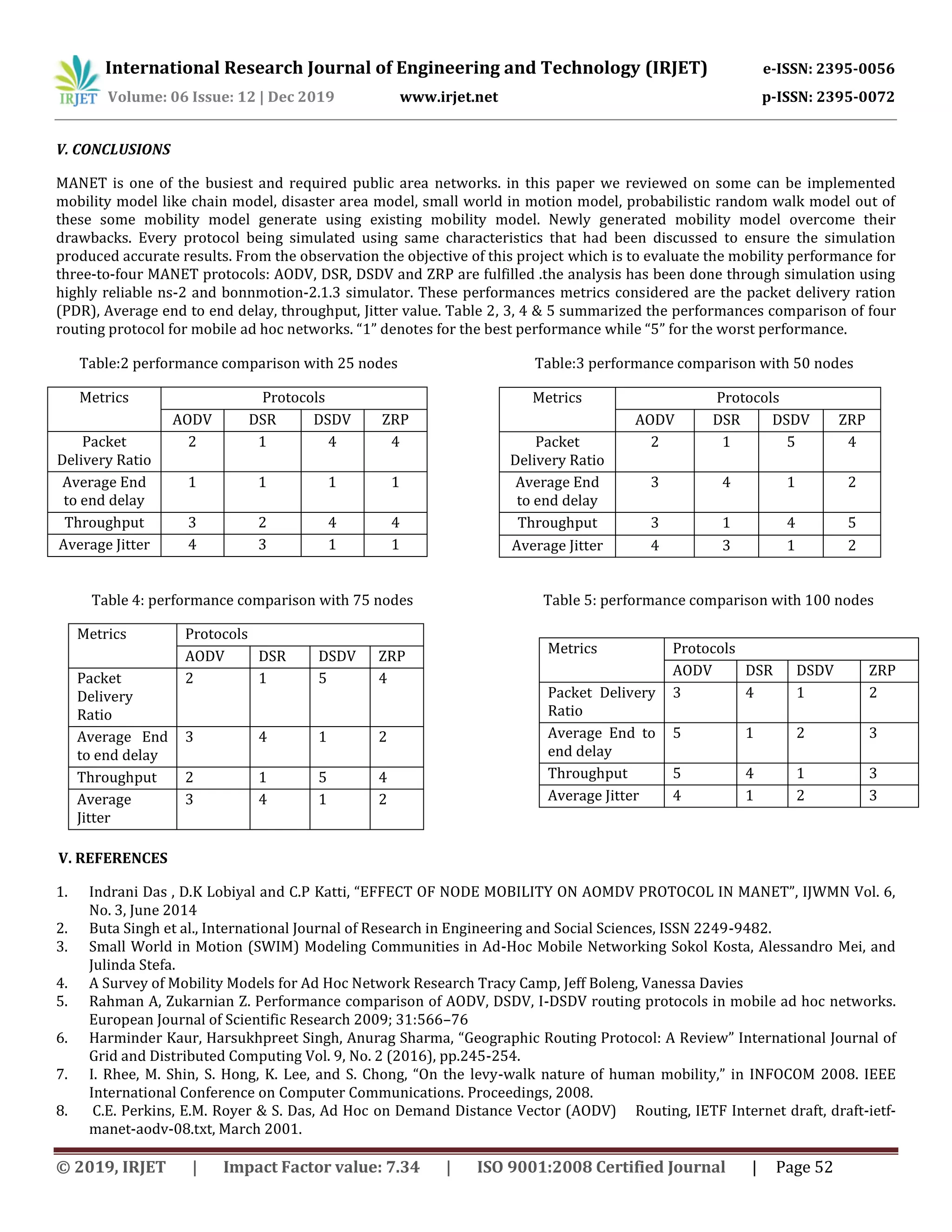
(PDR), Average end to end delay, throughput, Jitter value. Table 2, 3, 4 & 5 summarized the performances comparison of four
routing protocol for mobile ad hoc networks. “1” denotes for the best performance while “5” for the worst performance.
V. REFERENCES
1. Indrani Das , D.K Lobiyal and C.P Katti, “EFFECT OF NODE MOBILITY ON AOMDV PROTOCOL IN MANET”, IJWMN Vol. 6,
No. 3, June 2014
2. Buta Singh et al., International Journal of Research in Engineering and Social Sciences, ISSN 2249-9482.
3. Small World in Motion (SWIM) Modeling Communities in Ad-Hoc Mobile Networking Sokol Kosta, Alessandro Mei, and
Julinda Stefa.
4. A Survey of Mobility Models for Ad Hoc Network Research Tracy Camp, Jeff Boleng, Vanessa Davies
5. Rahman A, Zukarnian Z. Performance comparison of AODV, DSDV, I-DSDV routing protocols in mobile ad hoc networks.
European Journal of Scientific Research 2009; 31:566–76
6. Harminder Kaur, Harsukhpreet Singh, Anurag Sharma, “Geographic Routing Protocol: A Review” International Journal of
Grid and Distributed Computing Vol. 9, No. 2 (2016), pp.245-254.
7. I. Rhee, M. Shin, S. Hong, K. Lee, and S. Chong, “On the levy-walk nature of human mobility,” in INFOCOM 2008. IEEE
International Conference on Computer Communications. Proceedings, 2008.
8. C.E. Perkins, E.M. Royer & S. Das, Ad Hoc on Demand Distance Vector (AODV) Routing, IETF Internet draft, draft-ietf-
manet-aodv-08.txt, March 2001.
Metrics Protocols
AODV DSR DSDV ZRP
Packet
Delivery Ratio
2 1 4 4
Average End
to end delay
1 1 1 1
Throughput 3 2 4 4
Average Jitter 4 3 1 1
Metrics Protocols
AODV DSR DSDV ZRP
Packet
Delivery Ratio
2 1 5 4
Average End
to end delay
3 4 1 2
Throughput 3 1 4 5
Average Jitter 4 3 1 2
Metrics Protocols
AODV DSR DSDV ZRP
Packet
Delivery
Ratio
2 1 5 4
Average End
to end delay
3 4 1 2
Throughput 2 1 5 4
Average
Jitter
3 4 1 2
Metrics Protocols
AODV DSR DSDV ZRP
Packet Delivery
Ratio
3 4 1 2
Average End to
end delay
5 1 2 3
Throughput 5 4 1 3
Average Jitter 4 1 2 3
Table:2 performance comparison with 25 nodes Table:3 performance comparison with 50 nodes
Table 4: performance comparison with 75 nodes Table 5: performance comparison with 100 nodes
International Research Journal of Engineering and Technology (IRJET) e-ISSN: 2395-0056
Volume: 06 Issue: 12 | Dec 2019 www.irjet.net p-ISSN: 2395-0072
© 2019, IRJET | Impact Factor value: 7.34 | ISO 9001:2008 Certified Journal | Page 53
9. Nesargi and R. Prakash. ―Distributed Wireless Channel Allocation in Networks with Mobile Base Stations.‖ IEEE
Conference on Computer Communications (INFOCOM ’99), 1999.
10. J. Broch, D. Maltz, D. Johnson, Y. Hu, and J. Jetcheva. ―Multi-Hop Wireless Ad Hoc Network Routing Protocols.‖ ACM/IEEE
International Conference on Mobile Computing and Networking (MOBICOM’98), pages 85-97, 1998.
11. D. Johnson and D. Maltz. Dynamic source routing in ad hoc wireless networks. In T. Imelinsky and H. Korth editors, Mobile
Computing, pages 153–181. Kluwer Academic Publishers, 1996.
12. E. Royer, P. Melliar-Smith, and L. Moser. ―An Analysis of the Optimum Node Density for Ad hoc Mobile Networks.‖
Submitted, 2000.
13. S. Lee, M. Gerla, and C. Chiang. ―On-Demand Multicast Routing Protocol.‖ IEEE Wireless Communications and
Networking Conference (WCNC’99), 1999.
14. Diouba Sacko, Prof.Huang Benxiong, Prof. Wang Furong and I.Khider, Huazhong, ―A Survey of group merge and split
mobility models‖, Ubiquitous Computing and Communication Journal, 2008.
15. C. Bettstetter, H. Hartenstein, and X. PerezCosta, “Stochastic properties of the random Waypoint mobility model”,
ACM/Kluwer Wireless Networks, 2003.
16. N. Aschenbruck, E. Gerhards-Padilla, M. Gerharz, M. Frank, and P. Martini, “Modeling Mobility in Disaster Area
Scenarios,” Proc. 10th ACM-IEEE Int. Symposium on Modeling, Analysis and Simulation of Wireless and Mobile Systems
(MSWIM), pp.4–12, 2007.
17. “Analysis on Influence of Mobility Models on the Performance of Routing Protocols in Wireless Mobile Ad-hoc
Networks” International Journal of Innovative Research in Computer and Communication Engineering ISSN: 2320-9798
Vol. 5, Issue 6, June 2017.
18. Sokol Kosta,Alessandro Mei,and Julinda Stefa,Sapienza University of rome ,Italy, “Small World In Motion
(SWIM):Modeling Communities in Ad-Hoc mobile Netwprking ”

IRJET- Design and Implementation of Performance Evaluation of Routing Protocol Under Different Mobility Model in Manet

  • 1.
    International Research Journalof Engineering and Technology (IRJET) e-ISSN: 2395-0056 Volume: 06 Issue: 12 | Dec 2019 www.irjet.net p-ISSN: 2395-0072 © 2019, IRJET | Impact Factor value: 7.34 | ISO 9001:2008 Certified Journal | Page 47 “DESIGN AND IMPLEMENTATION OF PERFORMANCE EVALUATION OF ROUTING PROTOCOL UNDER DIFFERENT MOBILITY MODEL IN MANET” R.C. Dhandekar1, S.M.Dandage2, Dr. P.M. Jawandhiya3 1,2,3Dept. Computer Science & Engineering, PLITSM Buldana, SGBAU, MH. India --------------------------------------------------------------------------***---------------------------------------------------------------------------- Abstract:- MANET is self a self-configuring network consisting of mobiles nodes (laptop, cellular phone.etc)which having routing ability where each node worked as host as well as router to forward data packets each other in the configured network And each one have self organization properties. The self Configuration which enables to form new network area quickly .Routing protocol in MANETs to support send and receive data between the host or mobile nodes. in this paper we are doing study of reactive protocol/On-demand(eg.AODV.DSR,TORA) and proactive protocol/Table-driven(OLSR,DSDV,WRP) and last one mean’s hybrid, it’s not a type, this is only combination of earlier protocol types. these kind of protocols based on various mobility models such as chain model, Disaster model, small world in motion and probabilistic random walk model with respect to various parameters like packet delivery ratio, average end-to-end delay, jitter, throughput etc. in this dissertation our finding show that, design & implementation performance evaluation of routing protocol under different mobility model in MANET using NS-2 simulator and Bonn-motion-2.1.3 Ver. tools. Keywords: MANETs, Mobility model, routing protocols, I Introduction MANETS is collection of wireless node instantly forming a temporary network without the aid of any established infrastructure or centralized administration .MANET support several routing protocols this paper consider reactive, proactive & hybrid for performance comparisons with varying mobility model such as chain model(it’s sequence of Random Waypoint- RWP, Manhattan, RPM-reference point group mobility model),Disaster Area Model, Small World In Motion, Probabilistic Random Walk Model w.r.t. various parameters such as packet delivery, average end to end delay, normalized routing load and throughput. some Advantages of Mobile Ad hoc Networks listed here, like i) low cost of deployment ii) fast deployment iii) dynamic configuration, it is also important for its application such as i) Battlefield ii) Rescue Operation iii) Event Coverage iv) classroom. In this review paper we basically focused on to study the performance of proactive, reactive and hybrid routing protocols over’s different types of mobility models such as CHAIN Mobility Model, Disaster Area Model, Small World In Motion Mobility Model, Probabilistic Random Walk Mobility Model w.r.t. various parameters such as Packet Delivery Ratio (PDR), Average an end to end delay (Delay), jitter and throughput etc. II Literature Review & Related Work The below tabular format follow the performance of my thesis over the different Routing Protocols Table 1: Referred by Various Research Papers Sr No References Parameter Previous Work analysis Implementation of project 1 Akshai A et al. Sabinaet al. Nodes In mobility scenario, they used up to 200 nodes and performance of DSR is worst with increases the nodes We have used up to 300 nodes so might be used Ex-DSR with neural networks to improve the throughput and packet dropped parameters 2 Suman Kumariet al Kuljit Kauret al Work AODV and DSR used on On demand route discovery phenomenon’s uses source routing and route cache. Working on route discovery and route maintenance regarding the combination of both in Modified- DSR protocol.
  • 2.
    International Research Journalof Engineering and Technology (IRJET) e-ISSN: 2395-0056 Volume: 06 Issue: 12 | Dec 2019 www.irjet.net p-ISSN: 2395-0072 © 2019, IRJET | Impact Factor value: 7.34 | ISO 9001:2008 Certified Journal | Page 48 3 Zubair I et cl. Performance criteria As per simulation work, AODV protocol better performance in highest number of nodes (up to 200) As per simulation work DSR perform low as high number of nodes so it will improve the performance of DSR (similar to AODV) with increasing number of nodes (up to 300 )using Routing Algorithm for Ex-DSR 4 Preeti G et al. Packet delivery Ratio As per graph the DSR PDF performance decline drastically (up to 100 nodes) when the increased no of node we would improve PDF performance of DSR when increasing no of nodes ( after 100) using the decision algorithmShashank dwivediet al. 5 Parma Nand et al, ,VenetisKanakaris etal. Traffic and Mobility AODV is DSR preferable for Moderate mobility and low traffic We have use the M-DSR technology can improve the high mobility and high traffic 6 Gulati et al. Nodes A deeper simulation of DSDV, AODV, DSR with performance of all protocol up to 200 mobile nodes and AODV has good one then DSR. AODV shown the awesome experience in a network with low mobility scenarios while the AODV and DSR showing better output as per their characteristics in all mobility scenario. 7 SamayveerS et. Al Performance criteria The simulation analysis carried out AODV and DSR. In this paper that the The throughput and the end- to end delay are used for only 50 to 100 nodes. We have to use Modified-DSR protocol Algorithm to improve the few performance parameters with highlyutilized of nodes. 8 Dr Mudassar et al Protocols used Performance comparison of all three protocols and among that basically normally used protocol which has characteristics of protocol mainly focus on routing for better performance and have little defense capability against the Variationof nodes. M-DSR preferable for Moderate mobility and low traffic as per AODV protocol. 9 Hasein Issa Sigiuk et al Dipankar S et al. Performance criteria In papertested the comparison of both scenario and DSR protocol perform better due to multiple path registered kept the route cache and provide stability on the network of variation of nodes DSDV has low packet delivery ratio and DSR having low latency and energy consumption We have used Ex-DSR routing Algorithm to reach the AODV performance parameters and need to make combination mobile sink and static protocols which is best in both scenario.
  • 3.
    International Research Journalof Engineering and Technology (IRJET) e-ISSN: 2395-0056 Volume: 06 Issue: 12 | Dec 2019 www.irjet.net p-ISSN: 2395-0072 © 2019, IRJET | Impact Factor value: 7.34 | ISO 9001:2008 Certified Journal | Page 49 10 Rajeev Paulus et al Application Metrics The authors showing that DSR giving the less dropping ratio than other protocols but other parameter are decreases and also compare few parameters. We have used Ex-DSR routing Algorithm to reach good performance of all performance parameter. 11 Nitin Tyagi et al congestion Worked on upto 100 nodes in CBR traffic in MANET We should be propose EX-DSR protocol and implement mobility as well as non-mobility nodes constant nodes upto 300 and we would get some positive results in performance parameters. III. ROUTING PROTOCOLS AND MOBILITY MODELS 3.1 Mobile Ad-hoc network routing protocol MANET routing protocol basically classified into two type such as Reactive and proactive routing protocol but accordingly some researchers when combined these two routing protocol and generate third one routing protocol i.e. Hybrid routing protocol. Fig 3.1 : Types of MANET routing protocols 3.1.1 Reactive Routing Protocol: Reactive routing protocol also called as demand routing protocol, in this mechanism source node initiate route discovery broadcasting route request into the given network. A serious issue for MANET occurs when the links are failure due to high node mobility. In reactive routing protocol each node has its own routing table which contains the information about the route/path from current location to destination location. 3.1.2 Proactive Routing Protocol Also known as table driven protocols, this algorithm is used for finding shortest path between the multiples path. It is based on Bellman-ford algorithm, routing table entries updates by two ways 1) full dump method and incremental method. 3.1.3Hybrid Routing Protocol This kind of protocol combine the advantages of proactive routing protocol and reactive routing protocol (e.g. GRP,ZRP, ZHLS, etc.)
  • 4.
    International Research Journalof Engineering and Technology (IRJET) e-ISSN: 2395-0056 Volume: 06 Issue: 12 | Dec 2019 www.irjet.net p-ISSN: 2395-0072 © 2019, IRJET | Impact Factor value: 7.34 | ISO 9001:2008 Certified Journal | Page 50 3.2 Mobility Model Mobility model plays an important role in movement, dictates to the nodes their initial places and movement patterns, emulate real life scenarios. The main aspect of mobility models is, user friendly, sufficient and easy to understand, mathematical properties, scope and validity, realistic model.it is describe to movement of mobile nodes and how their location, velocity and acceleration changes over time in different scenario, it also play an important role to evaluate the performance of different protocols. In mobility modeling, the activity of node movement can be described using both analytical and simulation models. The various mobility model used in review paper to evaluate the performance of any network with mobile nodes. These mobility models help to provide an effective routing algorithm for MANET and also help to estimate their performance for different mobility scenarios. The performance of MANET depends on what kind of application can used ,number of nodes, mobility of nodes, routing algorithm employed, packet size etc.in this review paper we know how convert existing mobility model into new model like Chain Model, Probabilistic Random Walk Model, Disaster area model and finally Small world in motion. 3.2.1 Chain Model It is not new one model, it is only chaining of more than one advantages of an existing model like Random Waypoint Model(RWP),Manhattan Mobility Model(MMM) and Reference Point Group Mobility Model(RPGM).RWP first time proposed by Johanson & Maltz and it is part of entity mobility model. The RWP is a random model for the movement of the mobile users and how their location, velocity & acceleration change with position respective time.it is most common mobility model used in research community. RPGM is a part of group mobility model where the model forms a group and then moves in a co-ordinate manner. Last one means Manhattan Mobility Model is also part of group mobility model. It can be useful in modeling movement in an urban area where a pervasive computing service between portable devices is provided. So indirectly we can conclude here to generate new mobility model using existing mobility model. 3.2.2 Small World in Motion (SWIM) SWIM is a simple and efficient mobility model such as SWIM reflects correctly kernel properties of human movement & at same time, allows evaluating accurately protocol in this environment. We show that SWIM not only able to extrapolate key properties of human mobility but also it is very accurate in predicting performance of protocol based on social human sub structures. 3.2.3 Disastrous Model (DM) Disastrous model are one the most challenging application of multi hop ad-hoc network due to possible damages of communication infrastructure might be partially or completely destroyed after natural disaster. Multi hop ad-hoc network communication is an disastrous scenarios .they have evolved since their origin, leading to different ad-hoc paradigms such as MANETs, VANETs, DTNs, or WSN.communication between victim peoples & rescue team members involved in rescue operations is crucial in order to decrease the disaster consequences & save lives .the first 72 hrs after the occurrence of the disaster are the most important according to some studies, that time is called “Golden Relief Time .” 3.2.4 Probabilistic Random Walk Model In this model nodes next position discovered by set of probabilities .A node can be move forward, backward or remain in x and y direction depends on the probability defined in probability matrix. There are three state of node is defined by 0(current position), 1(previous position) and 2(next position).where, in the matrix P (a , b) means the probability that a node will move from state a to state b. IV PERFORMANCE METRICS Simulations have been performed in network simulator, NS-2, and Bonnmotion-2.1.3 to determine the impact of density of nodes on performance of routing protocols. We evaluate four MANE protocols (AODV, DSR, DSDV, and ZRP). The performance is studied for three types of networks: (1) small networks of 25 to 50 nodes with area 500 x 500 m2, (2) medium size network of 75 nodes with area 500 x 500 m2, and (3) large network of 100 nodes with area 500 x 500 m2. Table 1 shows the simulation parameters.
  • 5.
    International Research Journalof Engineering and Technology (IRJET) e-ISSN: 2395-0056 Volume: 06 Issue: 12 | Dec 2019 www.irjet.net p-ISSN: 2395-0072 © 2019, IRJET | Impact Factor value: 7.34 | ISO 9001:2008 Certified Journal | Page 51 Parameters List Experiment Parameter Experiment Value Description channel type Channel/Wireless Channel Wired/wireless network radio-propagation model Propagation/TwoRayGround Mobility direction network interface type Phy/WirelessPhy MAC type Mac/802_11 interface queue type Queue/DropTail/PriQueue link layer type LL antenna model Antenna/OmniAntenna max packet in ifq 50 number of mobile nodes 25,50,75,100 No. of nodes in a network routing protocol AODV, DSDV, DSR, ZRP Path-finding dimension of topography 500*500 X,Y Dimension of motion time of simulation end 50 sec. Simulation Duration  Average End to End Delay: End-to-end delay or one-way delay (OWD) refers to the time taken for a packet to be transmitted across a network from source to destination. It is a common term in IP network monitoring, and differs from round-trip time (RTT) in that only path in the one direction from source to destination is measured. The average delay Increases for all routing protocols. It has been observed that DSR, AODV have a longer delay compared to DSDV and ZRP. When requesting a new route, DSR first searches the route cache storing routes information it has learned over the past routing discovery stage and has not used the timer threshold to restrict the stale information which may lead to a routing failure, moreover, DSR needs to put the route information not only in the route reply message but also in the data packets which relatively make the data packets longer than before. Both of the two mechanisms make DSR to have a long delay than the rest  Average Jitter Value: Jitter is defined that the irregular time delays in the sending of data packets over a network. It signifies the packets from the source will reach the destination with different delays. A packet’s delay varies with its position in the queries of the routers along the path between source and destination.  Throughput: Throughput increases quickly for DSR with decreased number of nodes. DSDV on the other hand, performs when number of nodes is increased. In detail, When the number of nodes is smaller than or equal to 75, then DSR shows the better throughput characteristic than the other protocols.  Packet Delivery Ratio: Packet delivery ratio is defined as the ratio of data packets received by the destinations to those generated by the sources. Mathematically, it can be defined as: PDR= S1/ S2; Where, S1 is the sum of data packets received by the each destination and S2 is the sum of data packets generated by the each source. In the project, for DSR and AODV, packet delivery ratio is increase when the number of nodes decreased, with both protocols maximum delivering 17 and 23 of the packets. From these results, a simple conclusion had been made that DSR has a higher packet delivery ratio followed by AODV, DSDV, and ZRP.
  • 6.
    International Research Journalof Engineering and Technology (IRJET) e-ISSN: 2395-0056 Volume: 06 Issue: 12 | Dec 2019 www.irjet.net p-ISSN: 2395-0072 © 2019, IRJET | Impact Factor value: 7.34 | ISO 9001:2008 Certified Journal | Page 52 V. CONCLUSIONS MANET is one of the busiest and required public area networks. in this paper we reviewed on some can be implemented mobility model like chain model, disaster area model, small world in motion model, probabilistic random walk model out of these some mobility model generate using existing mobility model. Newly generated mobility model overcome their drawbacks. Every protocol being simulated using same characteristics that had been discussed to ensure the simulation produced accurate results. From the observation the objective of this project which is to evaluate the mobility performance for three-to-four MANET protocols: AODV, DSR, DSDV and ZRP are fulfilled .the analysis has been done through simulation using highly reliable ns-2 and bonnmotion-2.1.3 simulator. These performances metrics considered are the packet delivery ration (PDR), Average end to end delay, throughput, Jitter value. Table 2, 3, 4 & 5 summarized the performances comparison of four routing protocol for mobile ad hoc networks. “1” denotes for the best performance while “5” for the worst performance. V. REFERENCES 1. Indrani Das , D.K Lobiyal and C.P Katti, “EFFECT OF NODE MOBILITY ON AOMDV PROTOCOL IN MANET”, IJWMN Vol. 6, No. 3, June 2014 2. Buta Singh et al., International Journal of Research in Engineering and Social Sciences, ISSN 2249-9482. 3. Small World in Motion (SWIM) Modeling Communities in Ad-Hoc Mobile Networking Sokol Kosta, Alessandro Mei, and Julinda Stefa. 4. A Survey of Mobility Models for Ad Hoc Network Research Tracy Camp, Jeff Boleng, Vanessa Davies 5. Rahman A, Zukarnian Z. Performance comparison of AODV, DSDV, I-DSDV routing protocols in mobile ad hoc networks. European Journal of Scientific Research 2009; 31:566–76 6. Harminder Kaur, Harsukhpreet Singh, Anurag Sharma, “Geographic Routing Protocol: A Review” International Journal of Grid and Distributed Computing Vol. 9, No. 2 (2016), pp.245-254. 7. I. Rhee, M. Shin, S. Hong, K. Lee, and S. Chong, “On the levy-walk nature of human mobility,” in INFOCOM 2008. IEEE International Conference on Computer Communications. Proceedings, 2008. 8. C.E. Perkins, E.M. Royer & S. Das, Ad Hoc on Demand Distance Vector (AODV) Routing, IETF Internet draft, draft-ietf- manet-aodv-08.txt, March 2001. Metrics Protocols AODV DSR DSDV ZRP Packet Delivery Ratio 2 1 4 4 Average End to end delay 1 1 1 1 Throughput 3 2 4 4 Average Jitter 4 3 1 1 Metrics Protocols AODV DSR DSDV ZRP Packet Delivery Ratio 2 1 5 4 Average End to end delay 3 4 1 2 Throughput 3 1 4 5 Average Jitter 4 3 1 2 Metrics Protocols AODV DSR DSDV ZRP Packet Delivery Ratio 2 1 5 4 Average End to end delay 3 4 1 2 Throughput 2 1 5 4 Average Jitter 3 4 1 2 Metrics Protocols AODV DSR DSDV ZRP Packet Delivery Ratio 3 4 1 2 Average End to end delay 5 1 2 3 Throughput 5 4 1 3 Average Jitter 4 1 2 3 Table:2 performance comparison with 25 nodes Table:3 performance comparison with 50 nodes Table 4: performance comparison with 75 nodes Table 5: performance comparison with 100 nodes
  • 7.
    International Research Journalof Engineering and Technology (IRJET) e-ISSN: 2395-0056 Volume: 06 Issue: 12 | Dec 2019 www.irjet.net p-ISSN: 2395-0072 © 2019, IRJET | Impact Factor value: 7.34 | ISO 9001:2008 Certified Journal | Page 53 9. Nesargi and R. Prakash. ―Distributed Wireless Channel Allocation in Networks with Mobile Base Stations.‖ IEEE Conference on Computer Communications (INFOCOM ’99), 1999. 10. J. Broch, D. Maltz, D. Johnson, Y. Hu, and J. Jetcheva. ―Multi-Hop Wireless Ad Hoc Network Routing Protocols.‖ ACM/IEEE International Conference on Mobile Computing and Networking (MOBICOM’98), pages 85-97, 1998. 11. D. Johnson and D. Maltz. Dynamic source routing in ad hoc wireless networks. In T. Imelinsky and H. Korth editors, Mobile Computing, pages 153–181. Kluwer Academic Publishers, 1996. 12. E. Royer, P. Melliar-Smith, and L. Moser. ―An Analysis of the Optimum Node Density for Ad hoc Mobile Networks.‖ Submitted, 2000. 13. S. Lee, M. Gerla, and C. Chiang. ―On-Demand Multicast Routing Protocol.‖ IEEE Wireless Communications and Networking Conference (WCNC’99), 1999. 14. Diouba Sacko, Prof.Huang Benxiong, Prof. Wang Furong and I.Khider, Huazhong, ―A Survey of group merge and split mobility models‖, Ubiquitous Computing and Communication Journal, 2008. 15. C. Bettstetter, H. Hartenstein, and X. PerezCosta, “Stochastic properties of the random Waypoint mobility model”, ACM/Kluwer Wireless Networks, 2003. 16. N. Aschenbruck, E. Gerhards-Padilla, M. Gerharz, M. Frank, and P. Martini, “Modeling Mobility in Disaster Area Scenarios,” Proc. 10th ACM-IEEE Int. Symposium on Modeling, Analysis and Simulation of Wireless and Mobile Systems (MSWIM), pp.4–12, 2007. 17. “Analysis on Influence of Mobility Models on the Performance of Routing Protocols in Wireless Mobile Ad-hoc Networks” International Journal of Innovative Research in Computer and Communication Engineering ISSN: 2320-9798 Vol. 5, Issue 6, June 2017. 18. Sokol Kosta,Alessandro Mei,and Julinda Stefa,Sapienza University of rome ,Italy, “Small World In Motion (SWIM):Modeling Communities in Ad-Hoc mobile Netwprking ”