Absorption and Mass
   Spectroscopy
 Presenter: Cynthia Echefu
Absorption Spectroscopy
  Infrared (IR)- Used to determine functional
   groups (molecular vibration, which includes
        bending, stretching and rotation)

Ultraviolet- Used to identify conjugated double
                       bonds

Visible – sequence of light color the eye can see
AAMC: Must know about IR

• intramolecular vibrations and
  rotations
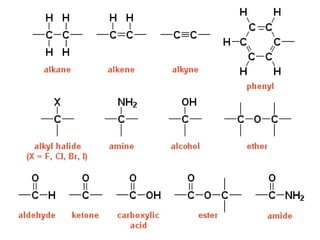
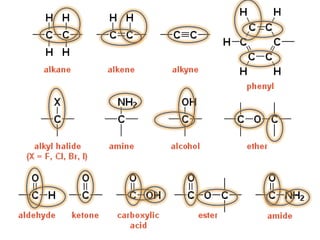
• recognizing common
  characteristic group
  absorptions, fingerprint region
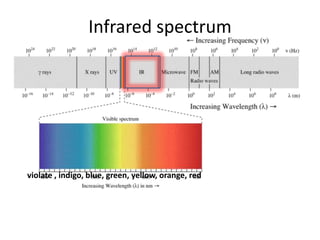
Infrared spectrum


violate , indigo, blue, green, yellow, orange, red
Vibrations: bonds can stretch, compress and
       bend like a spring. It is this vibration that is
       measured in IR-spec.

     Rotations: molecules can rotate. Rotations
       produce waves mainly in the microwave
       region. However, part of the rotation spectra
       does overlap with the vibration spectra.

http://www2.chemistry.msu.edu/faculty/reusch/VirtTxtJml/Spectrpy/InfraRed/infrared.htm
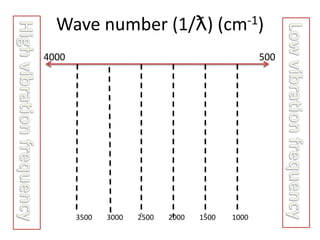
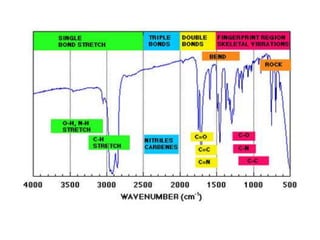
Wave number (1/ƛ)                       (cm-1)

4000                                              500


       3500   3000   2500   2000   1500    1000
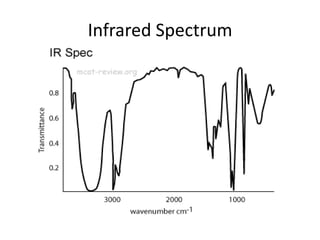
Infrared Spectrum
Common functional group
           characteristics
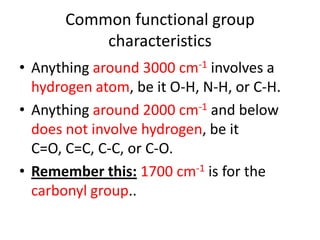
• Anything around 3000 cm-1 involves a
  hydrogen atom, be it O-H, N-H, or C-H.
• Anything around 2000 cm-1 and below
  does not involve hydrogen, be it
  C=O, C=C, C-C, or C-O.
• Remember this: 1700 cm-1 is for the
  carbonyl group..
Continues…
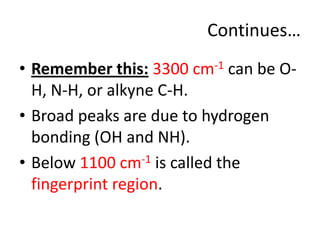
• Remember this: 3300 cm-1 can be O-
  H, N-H, or alkyne C-H.
• Broad peaks are due to hydrogen
  bonding (OH and NH).
• Below 1100 cm-1 is called the
  fingerprint region.
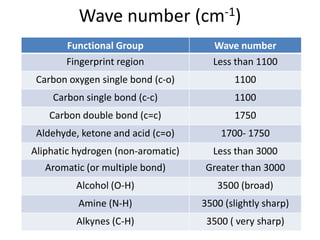
Wave number               (cm-1)

       Functional Group               Wave number
       Fingerprint region             Less than 1100
 Carbon oxygen single bond (c-o)           1100
    Carbon single bond (c-c)               1100
    Carbon double bond (c=c)               1750
 Aldehyde, ketone and acid (c=o)        1700- 1750
Aliphatic hydrogen (non-aromatic)     Less than 3000
   Aromatic (or multiple bond)       Greater than 3000
          Alcohol (O-H)                3500 (broad)
          Amine (N-H)               3500 (slightly sharp)
          Alkynes (C-H)              3500 ( very sharp)
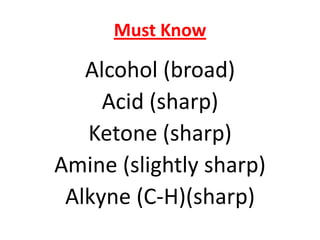
Must Know

   Alcohol (broad)
     Acid (sharp)
   Ketone (sharp)
Amine (slightly sharp)
 Alkyne (C-H)(sharp)
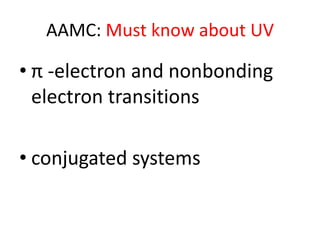
AAMC: Must know about UV

• π -electron and nonbonding
  electron transitions

• conjugated systems
Ultraviolet Spectroscopy

 Electrons absorption UV energy,
  which causes the electrons to
transition from a low energy level
(ground state) to a higher energy
        level (excited state).
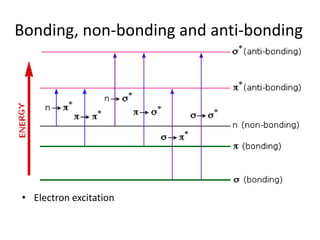
Bonding, non-bonding and anti-bonding


• Electron excitation
Ultraviolet Spectroscopy
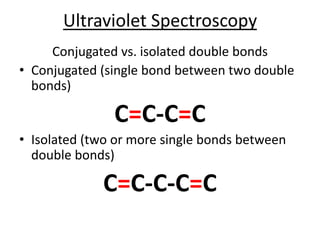
     Conjugated vs. isolated double bonds
• Conjugated (single bond between two double
  bonds)

               C=C-C=C
• Isolated (two or more single bonds between
  double bonds)

             C=C-C-C=C
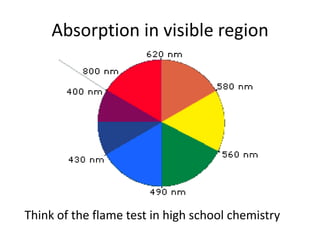
AAMC: Must know about visible

• absorption in visible region
  yielding complementary color

• effect of structural changes on
  absorption
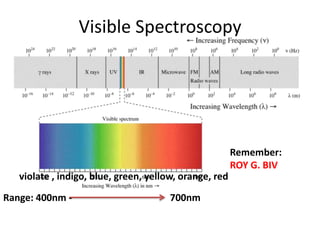
Visible Spectroscopy


                                                        Remember:
                                                        ROY G. BIV
   violate , indigo, blue, green, yellow, orange, red

Range: 400nm -                         700nm
Absorption in visible region


Think of the flame test in high school chemistry
AAMC: Must know about mass spec.

•Mass-to-charge ratio
 (m/z)
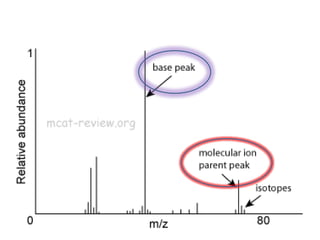
•Molecular ion peak
Mass spectroscopy

 Used to identify chemical
formula and molecular mass,
by bombarding with electrons
  and fragmenting sample.
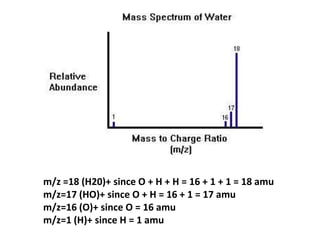
m/z =18 (H20)+ since O + H + H = 16 + 1 + 1 = 18 amu
m/z=17 (HO)+ since O + H = 16 + 1 = 17 amu
m/z=16 (O)+ since O = 16 amu
m/z=1 (H)+ since H = 1 amu
Any questions?
      Comments?
     Suggestions?
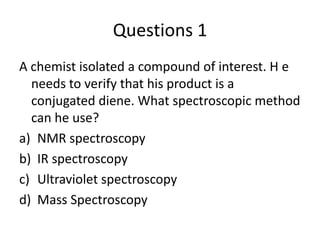
Questions 1
A chemist isolated a compound of interest. H e
  needs to verify that his product is a
  conjugated diene. What spectroscopic method
  can he use?
a) NMR spectroscopy
b) IR spectroscopy
c) Ultraviolet spectroscopy
d) Mass Spectroscopy
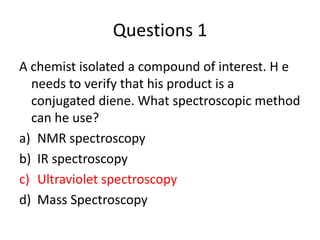
Questions 1
A chemist isolated a compound of interest. H e
  needs to verify that his product is a
  conjugated diene. What spectroscopic method
  can he use?
a) NMR spectroscopy
b) IR spectroscopy
c) Ultraviolet spectroscopy
d) Mass Spectroscopy
Question 2
A stretch at 3400 cm-1 in an IR spectrum
  indicates the presence of what functional
  group?
a) Alkyne
b) Ketone
c) Alkene
d) Alcohol
Question 2
A stretch at 3400 cm-1 in an IR spectrum
  indicates the presence of what functional
  group?
a) Alkynes
b) Ketone
c) Alkenes
d) Alcohol
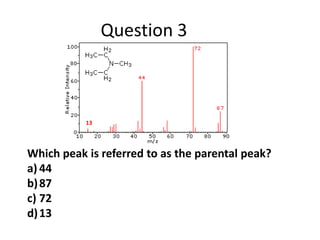
Question 3


           13


Which peak is referred to as the parental peak?
a) 44
b) 87
c) 72
d) 13
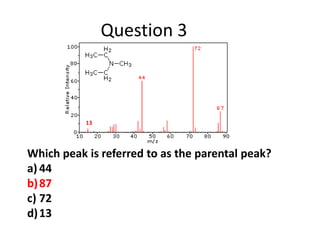
Question 3


           13


Which peak is referred to as the parental peak?
a) 44
b) 87
c) 72
d) 13
References
• Dr. Flowers MCAT
• Google Images: IR spectroscopy, visible
  spectroscopy,
• http://mcat-review.org/molecular-structure-
  spectra.php
• http://www.users.muohio.edu/gungbw/functi
  onalgroups.html
• http://chemicalinstrumentation.weebly.com/ir
  -spectrometry.html
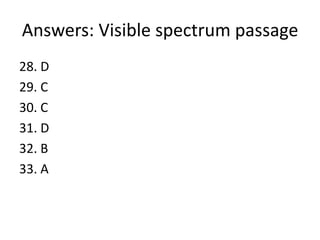
Answers: Visible spectrum passage
28. D
29. C
30. C
31. D
32. B
33. A

Absorption spectroscopy

  • 1.
    Absorption and Mass Spectroscopy Presenter: Cynthia Echefu
  • 2.
    Absorption Spectroscopy Infrared (IR)- Used to determine functional groups (molecular vibration, which includes bending, stretching and rotation) Ultraviolet- Used to identify conjugated double bonds Visible – sequence of light color the eye can see
  • 3.
    AAMC: Must knowabout IR • intramolecular vibrations and rotations • recognizing common characteristic group absorptions, fingerprint region
  • 4.
    Infrared spectrum violate ,indigo, blue, green, yellow, orange, red
  • 5.
    Vibrations: bonds canstretch, compress and bend like a spring. It is this vibration that is measured in IR-spec. Rotations: molecules can rotate. Rotations produce waves mainly in the microwave region. However, part of the rotation spectra does overlap with the vibration spectra. http://www2.chemistry.msu.edu/faculty/reusch/VirtTxtJml/Spectrpy/InfraRed/infrared.htm
  • 6.
    Wave number (1/ƛ) (cm-1) 4000 500 3500 3000 2500 2000 1500 1000
  • 7.
  • 8.
    Common functional group characteristics • Anything around 3000 cm-1 involves a hydrogen atom, be it O-H, N-H, or C-H. • Anything around 2000 cm-1 and below does not involve hydrogen, be it C=O, C=C, C-C, or C-O. • Remember this: 1700 cm-1 is for the carbonyl group..
  • 9.
    Continues… • Remember this:3300 cm-1 can be O- H, N-H, or alkyne C-H. • Broad peaks are due to hydrogen bonding (OH and NH). • Below 1100 cm-1 is called the fingerprint region.
  • 12.
    Wave number (cm-1) Functional Group Wave number Fingerprint region Less than 1100 Carbon oxygen single bond (c-o) 1100 Carbon single bond (c-c) 1100 Carbon double bond (c=c) 1750 Aldehyde, ketone and acid (c=o) 1700- 1750 Aliphatic hydrogen (non-aromatic) Less than 3000 Aromatic (or multiple bond) Greater than 3000 Alcohol (O-H) 3500 (broad) Amine (N-H) 3500 (slightly sharp) Alkynes (C-H) 3500 ( very sharp)
  • 14.
    Must Know Alcohol (broad) Acid (sharp) Ketone (sharp) Amine (slightly sharp) Alkyne (C-H)(sharp)
  • 15.
    AAMC: Must knowabout UV • π -electron and nonbonding electron transitions • conjugated systems
  • 16.
    Ultraviolet Spectroscopy Electronsabsorption UV energy, which causes the electrons to transition from a low energy level (ground state) to a higher energy level (excited state).
  • 17.
    Bonding, non-bonding andanti-bonding • Electron excitation
  • 18.
    Ultraviolet Spectroscopy Conjugated vs. isolated double bonds • Conjugated (single bond between two double bonds) C=C-C=C • Isolated (two or more single bonds between double bonds) C=C-C-C=C
  • 19.
    AAMC: Must knowabout visible • absorption in visible region yielding complementary color • effect of structural changes on absorption
  • 20.
    Visible Spectroscopy Remember: ROY G. BIV violate , indigo, blue, green, yellow, orange, red Range: 400nm - 700nm
  • 21.
    Absorption in visibleregion Think of the flame test in high school chemistry
  • 22.
    AAMC: Must knowabout mass spec. •Mass-to-charge ratio (m/z) •Molecular ion peak
  • 23.
    Mass spectroscopy Usedto identify chemical formula and molecular mass, by bombarding with electrons and fragmenting sample.
  • 25.
    m/z =18 (H20)+since O + H + H = 16 + 1 + 1 = 18 amu m/z=17 (HO)+ since O + H = 16 + 1 = 17 amu m/z=16 (O)+ since O = 16 amu m/z=1 (H)+ since H = 1 amu
  • 26.
    Any questions? Comments? Suggestions?
  • 27.
    Questions 1 A chemistisolated a compound of interest. H e needs to verify that his product is a conjugated diene. What spectroscopic method can he use? a) NMR spectroscopy b) IR spectroscopy c) Ultraviolet spectroscopy d) Mass Spectroscopy
  • 28.
    Questions 1 A chemistisolated a compound of interest. H e needs to verify that his product is a conjugated diene. What spectroscopic method can he use? a) NMR spectroscopy b) IR spectroscopy c) Ultraviolet spectroscopy d) Mass Spectroscopy
  • 29.
    Question 2 A stretchat 3400 cm-1 in an IR spectrum indicates the presence of what functional group? a) Alkyne b) Ketone c) Alkene d) Alcohol
  • 30.
    Question 2 A stretchat 3400 cm-1 in an IR spectrum indicates the presence of what functional group? a) Alkynes b) Ketone c) Alkenes d) Alcohol
  • 31.
    Question 3 13 Which peak is referred to as the parental peak? a) 44 b) 87 c) 72 d) 13
  • 32.
    Question 3 13 Which peak is referred to as the parental peak? a) 44 b) 87 c) 72 d) 13
  • 33.
    References • Dr. FlowersMCAT • Google Images: IR spectroscopy, visible spectroscopy, • http://mcat-review.org/molecular-structure- spectra.php • http://www.users.muohio.edu/gungbw/functi onalgroups.html • http://chemicalinstrumentation.weebly.com/ir -spectrometry.html
  • 34.
    Answers: Visible spectrumpassage 28. D 29. C 30. C 31. D 32. B 33. A